EP0451925B1 - Anchorsystem - Google Patents
Anchorsystem Download PDFInfo
- Publication number
- EP0451925B1 EP0451925B1 EP19910200872 EP91200872A EP0451925B1 EP 0451925 B1 EP0451925 B1 EP 0451925B1 EP 19910200872 EP19910200872 EP 19910200872 EP 91200872 A EP91200872 A EP 91200872A EP 0451925 B1 EP0451925 B1 EP 0451925B1
- Authority
- EP
- European Patent Office
- Prior art keywords
- anchor
- recesses
- leg
- sheeting panel
- panel
- Prior art date
- Legal status (The legal status is an assumption and is not a legal conclusion. Google has not performed a legal analysis and makes no representation as to the accuracy of the status listed.)
- Expired - Lifetime
Links
Images
Classifications
-
- E—FIXED CONSTRUCTIONS
- E02—HYDRAULIC ENGINEERING; FOUNDATIONS; SOIL SHIFTING
- E02D—FOUNDATIONS; EXCAVATIONS; EMBANKMENTS; UNDERGROUND OR UNDERWATER STRUCTURES
- E02D19/00—Keeping dry foundation sites or other areas in the ground
- E02D19/06—Restraining of underground water
- E02D19/12—Restraining of underground water by damming or interrupting the passage of underground water
- E02D19/18—Restraining of underground water by damming or interrupting the passage of underground water by making use of sealing aprons, e.g. diaphragms made from bituminous or clay material
Definitions
- the invention relates to a system comprising a U-shaped anchor for a sheeting panel and a steel insertion member for said anchor.
- the object of the invention is to produce a connection between anchor and sheeting panel considerably more quickly without there being any risk of wedging occurring between insertion member and anchor as a result of which a sheeting panel would be pulled up with the insertion member during the raising of said member after the insertion of said sheeting panel and the locks between the panels could consequently spring apart.
- the system is to this end characterized in that the top piece of one of the legs of the U-shaped anchor is bent in the direction of the other leg to form an accommodation chamber for a thickened part at the bottom edge of the sheeting panel, that a space exists between the free edge of the inward bent leg part and the other leg allowing the bottom edge of the steel insertion member to move through this space, and that a number of substantially vertical recesses are provided in the anchor section said recesses extending from the free edge of said other leg.
- the virtually vertical-running recesses in the vertical leg of the U of the anchor section which can lie against the insertion member during the insertion of the sheeting panel, reduce the local rigidity of the anchor section.
- the correct wedging between anchor section and insertion member can be achieved by providing the correct number of such recesses over the length of the anchor section and/or adapting the length and/or the breadth of said recesses, depending on the shape of the anchor section and/or bottom part of the insertion member, as a result of which the insertion member can be removed from the anchor without too much force after the sheeting panel has been pressed into the lowest position and, in addition, the sheeting panel with its locks is not placed under unnecessary stress.
- the recesses can continue into a part of the bottom of the U.
- the breadth of the recesses preferably lies between 0.5 and 300 mm.
- projecting centring wings can be fixed on the anchor in both sides.
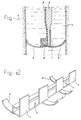
- Figure 1 shows a cross-section through the bottom part of an anchor according to the invention with insertion sheet and sheeting panel.
- Figure 2 shows a perspective view of the anchor.
- the steel anchor 1 shown in the figures is in the shape of a U of which one of the flanges is bent inwards at its top part for the purpose of forming a channel into which the thickened bottom edge 2 of a sheeting panel 3 is pushed.
- This sheeting panel is made of plastic, for example HDPE, and is connected in a manner which is known per se by edge locking sections to a sheeting panel already placed in the trenches.
- a steel insertion sheet for pressing the sheeting panel with anchor into a ground trench 4 filled with bentonite mixture is indicated by 5 and projects with its bottom edge into the anchor.
- centring wings 6 are fixed to the anchor 1, projecting on either side. These wings end in an upward-sloping part, so that during the downward movement of the anchor they cannot become jammed in the trench wall when they come into contact with said wall.
- the wings are welded to the bottom of the anchor section, but they can also be connected to the anchor section at other places.
- Vertical-running recesses 7 are provided in order to be able to adjust the local wedging between anchor section 1 and the insertion sheet 5. These recesses are preferably of a minimum breadth of 0.5 mm and a maximum breadth of 300 mm. They can continue into the bottom of the U.
Landscapes
- Engineering & Computer Science (AREA)
- Life Sciences & Earth Sciences (AREA)
- Environmental & Geological Engineering (AREA)
- Hydrology & Water Resources (AREA)
- General Life Sciences & Earth Sciences (AREA)
- Mining & Mineral Resources (AREA)
- Paleontology (AREA)
- Civil Engineering (AREA)
- General Engineering & Computer Science (AREA)
- Structural Engineering (AREA)
- Piles And Underground Anchors (AREA)
Description
- The invention relates to a system comprising a U-shaped anchor for a sheeting panel and a steel insertion member for said anchor.
- Such a system is known from EP-A-0074686.
- For the isolation of poluted ground and ground water and in the case of well drainage it is known to make use of vertical screens formed in the ground, made of a bentonite-containing mixture in which a liquid-tight panel wall of thick HDPE sheeting is provided in order to increase the water impermeability. The flexible panels of these walls are, for example, 2 to 3 metres wide and are interconnected by means of locking sections. The insertion of the panels by means of the steel insertion sheet takes place in such a way that the locks are placed under little or no load. At the bottom side the bentonite sheeting screen must be connected to a watertight layer, for example a natural clay or an injected synthetic layer. In order to anchor a panel after it has been pushed into the ground trench, it is disclosed in said EP-A-0074686 that an anchor is fixed to the bottom edge of a panel. The fixing of the anchor to a sheeting panel is time consuming.
- The object of the invention is to produce a connection between anchor and sheeting panel considerably more quickly without there being any risk of wedging occurring between insertion member and anchor as a result of which a sheeting panel would be pulled up with the insertion member during the raising of said member after the insertion of said sheeting panel and the locks between the panels could consequently spring apart.
- According to the invention the system is to this end characterized in that the top piece of one of the legs of the U-shaped anchor is bent in the direction of the other leg to form an accommodation chamber for a thickened part at the bottom edge of the sheeting panel, that a space exists between the free edge of the inward bent leg part and the other leg allowing the bottom edge of the steel insertion member to move through this space, and that a number of substantially vertical recesses are provided in the anchor section said recesses extending from the free edge of said other leg.
- The virtually vertical-running recesses in the vertical leg of the U of the anchor section, which can lie against the insertion member during the insertion of the sheeting panel, reduce the local rigidity of the anchor section. The correct wedging between anchor section and insertion member can be achieved by providing the correct number of such recesses over the length of the anchor section and/or adapting the length and/or the breadth of said recesses, depending on the shape of the anchor section and/or bottom part of the insertion member, as a result of which the insertion member can be removed from the anchor without too much force after the sheeting panel has been pressed into the lowest position and, in addition, the sheeting panel with its locks is not placed under unnecessary stress.
- In order to be able to reduce the rigidity of the anchor even more in its lengthwise direction the recesses can continue into a part of the bottom of the U.
- The breadth of the recesses preferably lies between 0.5 and 300 mm.
- In order to centre a sheeting panel when it is being pressed into the ground and thereby take the load off the locking connections between panels, projecting centring wings can be fixed on the anchor in both sides.
- The invention will now be explained in greater detail with reference to the figures.
- Figure 1 shows a cross-section through the bottom part of an anchor according to the invention with insertion sheet and sheeting panel.
- Figure 2 shows a perspective view of the anchor.
- The steel anchor 1 shown in the figures is in the shape of a U of which one of the flanges is bent inwards at its top part for the purpose of forming a channel into which the thickened
bottom edge 2 of asheeting panel 3 is pushed. This sheeting panel is made of plastic, for example HDPE, and is connected in a manner which is known per se by edge locking sections to a sheeting panel already placed in the trenches. - A steel insertion sheet for pressing the sheeting panel with anchor into a
ground trench 4 filled with bentonite mixture is indicated by 5 and projects with its bottom edge into the anchor. - In order to centre the sheeting panel when it is being pressed into the ground trench, centring
wings 6 are fixed to the anchor 1, projecting on either side. These wings end in an upward-sloping part, so that during the downward movement of the anchor they cannot become jammed in the trench wall when they come into contact with said wall. - The wings are welded to the bottom of the anchor section, but they can also be connected to the anchor section at other places.
- The
wings 6 at both sides of the anchor section can also be fixed as a continuous unit to the bottom side of the anchor section. - Vertical-running
recesses 7 are provided in order to be able to adjust the local wedging between anchor section 1 and theinsertion sheet 5. These recesses are preferably of a minimum breadth of 0.5 mm and a maximum breadth of 300 mm. They can continue into the bottom of the U.
Claims (4)
- System comprising a U-shaped anchor (1) for a sheeting panel (3) and a steel insertion member (5) for said anchor, characterized in that the top piece of one of the legs of the U-shaped anchor is bent in the direction of the other leg to form an accommodation chamber for a thickened part (2) at the bottom edge of the sheeting panel, that a space exists between the free edge of the inward bent leg part and the other leg allowing the bottom edge of the steel insertion member (5) to move through this space, and that a number of substantially vertical recesses (7) are provided in the anchor section said recesses extending from the free edge of said other leg.
- System according to claim 1, characterized in that said recesses continue into a part of the bottom of the U-shaped anchor.
- System according to claim 1 or 2, characterized in that the breadth of the recesses measures between 0.5 and 300 mm.
- System according to any of the preceding claims, characterized in that centring wings (6) are fixed to the anchor (1), projecting on either side.
Applications Claiming Priority (2)
| Application Number | Priority Date | Filing Date | Title |
|---|---|---|---|
| NL9000875A NL9000875A (en) | 1990-04-12 | 1990-04-12 | ANCHOR. |
| NL9000875 | 1990-04-12 |
Publications (2)
| Publication Number | Publication Date |
|---|---|
| EP0451925A1 EP0451925A1 (en) | 1991-10-16 |
| EP0451925B1 true EP0451925B1 (en) | 1993-07-14 |
Family
ID=19856923
Family Applications (1)
| Application Number | Title | Priority Date | Filing Date |
|---|---|---|---|
| EP19910200872 Expired - Lifetime EP0451925B1 (en) | 1990-04-12 | 1991-04-12 | Anchorsystem |
Country Status (3)
| Country | Link |
|---|---|
| EP (1) | EP0451925B1 (en) |
| DE (1) | DE69100167T2 (en) |
| NL (1) | NL9000875A (en) |
Family Cites Families (3)
| Publication number | Priority date | Publication date | Assignee | Title |
|---|---|---|---|---|
| US3479933A (en) * | 1968-01-11 | 1969-11-25 | Brown Co D S | Elongated,hollow,elastomer sealing strip with elongated,laterally deformable spring |
| NL191153C (en) * | 1981-09-15 | 1995-02-16 | Stevin Volker Beton Water | A method of manufacturing a groundwater flow limiting screen in the soil as well as sheet and lance for use in this method. |
| DE3540270A1 (en) * | 1985-11-13 | 1987-05-14 | Wayss & Freytag Ag | Method of producing a diaphragm wall and apparatus for carrying out the method |
-
1990
- 1990-04-12 NL NL9000875A patent/NL9000875A/en not_active Application Discontinuation
-
1991
- 1991-04-12 DE DE1991600167 patent/DE69100167T2/en not_active Expired - Fee Related
- 1991-04-12 EP EP19910200872 patent/EP0451925B1/en not_active Expired - Lifetime
Also Published As
| Publication number | Publication date |
|---|---|
| DE69100167D1 (en) | 1993-08-19 |
| DE69100167T2 (en) | 1993-10-28 |
| NL9000875A (en) | 1991-11-01 |
| EP0451925A1 (en) | 1991-10-16 |
Similar Documents
| Publication | Publication Date | Title |
|---|---|---|
| CA2495749C (en) | Reinforcing system for stackable retaining wall units | |
| US4699544A (en) | Protective frame device for drainage channel | |
| US5340234A (en) | Trench drain system and installation method | |
| EP0067551A1 (en) | Reinforced earth structures and facing units therefor | |
| US5035095A (en) | Basement wall structure to prevent water leakage | |
| US5399047A (en) | Trench forming assemblies having enhanced anchoring means | |
| EP1302598A2 (en) | Reinforcing system for stackable retaining wall units | |
| US5794393A (en) | Concrete foundation wall form apparatus and method | |
| EP3362607B1 (en) | Earth retention levee system | |
| IE50212B1 (en) | Construction plate for a ditch construction device | |
| US3986310A (en) | Modular swimming pool structure and method for its erection | |
| US3064273A (en) | Swimming pool | |
| JPS6314124B2 (en) | ||
| EP0451925B1 (en) | Anchorsystem | |
| US975665A (en) | Shoring. | |
| EP0041516A1 (en) | LIQUID BASIN DESIGN. | |
| US10508396B2 (en) | Water barrier element | |
| JP2548634B2 (en) | Underwater structure using underwater ground driving member | |
| US20080170913A1 (en) | Seawall connector for attachment of geogrid material | |
| EP0026782B1 (en) | Soil and water-retaining wall, composed of prefabricated plate elements | |
| EP0050166B1 (en) | Ground retaining wall | |
| KR102351788B1 (en) | Apparatus for connecting support | |
| JPS6033160Y2 (en) | Civil engineering and construction blocks | |
| JPH07127051A (en) | Structure of rebar cage for continuous underground wall construction and its construction method | |
| JPH0656001B2 (en) | Wall structure with earth pressure reduction structure |
Legal Events
| Date | Code | Title | Description |
|---|---|---|---|
| PUAI | Public reference made under article 153(3) epc to a published international application that has entered the european phase |
Free format text: ORIGINAL CODE: 0009012 |
|
| AK | Designated contracting states |
Kind code of ref document: A1 Designated state(s): BE DE GB LU NL |
|
| 17P | Request for examination filed |
Effective date: 19911112 |
|
| 17Q | First examination report despatched |
Effective date: 19920427 |
|
| GRAA | (expected) grant |
Free format text: ORIGINAL CODE: 0009210 |
|
| AK | Designated contracting states |
Kind code of ref document: B1 Designated state(s): BE DE GB LU NL |
|
| REF | Corresponds to: |
Ref document number: 69100167 Country of ref document: DE Date of ref document: 19930819 |
|
| PLBE | No opposition filed within time limit |
Free format text: ORIGINAL CODE: 0009261 |
|
| STAA | Information on the status of an ep patent application or granted ep patent |
Free format text: STATUS: NO OPPOSITION FILED WITHIN TIME LIMIT |
|
| EPTA | Lu: last paid annual fee | ||
| 26N | No opposition filed | ||
| REG | Reference to a national code |
Ref country code: GB Ref legal event code: IF02 |
|
| PGFP | Annual fee paid to national office [announced via postgrant information from national office to epo] |
Ref country code: GB Payment date: 20050407 Year of fee payment: 15 |
|
| PGFP | Annual fee paid to national office [announced via postgrant information from national office to epo] |
Ref country code: BE Payment date: 20050421 Year of fee payment: 15 |
|
| PGFP | Annual fee paid to national office [announced via postgrant information from national office to epo] |
Ref country code: LU Payment date: 20050425 Year of fee payment: 15 |
|
| PGFP | Annual fee paid to national office [announced via postgrant information from national office to epo] |
Ref country code: DE Payment date: 20050427 Year of fee payment: 15 |
|
| PGFP | Annual fee paid to national office [announced via postgrant information from national office to epo] |
Ref country code: NL Payment date: 20050429 Year of fee payment: 15 |
|
| PG25 | Lapsed in a contracting state [announced via postgrant information from national office to epo] |
Ref country code: GB Free format text: LAPSE BECAUSE OF NON-PAYMENT OF DUE FEES Effective date: 20060412 |
|
| PG25 | Lapsed in a contracting state [announced via postgrant information from national office to epo] |
Ref country code: LU Free format text: LAPSE BECAUSE OF NON-PAYMENT OF DUE FEES Effective date: 20060430 Ref country code: BE Free format text: LAPSE BECAUSE OF NON-PAYMENT OF DUE FEES Effective date: 20060430 |
|
| PG25 | Lapsed in a contracting state [announced via postgrant information from national office to epo] |
Ref country code: NL Free format text: LAPSE BECAUSE OF NON-PAYMENT OF DUE FEES Effective date: 20061101 Ref country code: DE Free format text: LAPSE BECAUSE OF NON-PAYMENT OF DUE FEES Effective date: 20061101 |
|
| GBPC | Gb: european patent ceased through non-payment of renewal fee |
Effective date: 20060412 |
|
| NLV4 | Nl: lapsed or anulled due to non-payment of the annual fee |
Effective date: 20061101 |
|
| BERE | Be: lapsed |
Owner name: HOLLANDSCHE *BETON GROEP N.V. Effective date: 20060430 |