EP0451049B1 - Verfahren und Speicher- und Abrufsystem von chemischen Formeln in einer Datenbank - Google Patents
Verfahren und Speicher- und Abrufsystem von chemischen Formeln in einer Datenbank Download PDFInfo
- Publication number
- EP0451049B1 EP0451049B1 EP91400897A EP91400897A EP0451049B1 EP 0451049 B1 EP0451049 B1 EP 0451049B1 EP 91400897 A EP91400897 A EP 91400897A EP 91400897 A EP91400897 A EP 91400897A EP 0451049 B1 EP0451049 B1 EP 0451049B1
- Authority
- EP
- European Patent Office
- Prior art keywords
- list
- formula
- formulae
- fragment
- markush
- Prior art date
- Legal status (The legal status is an assumption and is not a legal conclusion. Google has not performed a legal analysis and makes no representation as to the accuracy of the status listed.)
- Expired - Lifetime
Links
Images






Classifications
-
- G—PHYSICS
- G16—INFORMATION AND COMMUNICATION TECHNOLOGY [ICT] SPECIALLY ADAPTED FOR SPECIFIC APPLICATION FIELDS
- G16C—COMPUTATIONAL CHEMISTRY; CHEMOINFORMATICS; COMPUTATIONAL MATERIALS SCIENCE
- G16C20/00—Chemoinformatics, i.e. ICT specially adapted for the handling of physicochemical or structural data of chemical particles, elements, compounds or mixtures
- G16C20/90—Programming languages; Computing architectures; Database systems; Data warehousing
Definitions
- the present invention relates to a method and a storage and retrieval system in a database data from Markush formulas, and information associated with said formulas.
- a Markush formula is a structural representation of a component or family of chemical components with common structural characteristics. Such a formula is represented by a diagram comprising a part common to the family of components, or basic group, and one or more parts of different characteristics, or "substituent" groups, usually represented by symbols such as R, R 1 , etc ...
- the invention finds an application particularly important although not exclusive in the fields of pharmaceutical research and industrial chemistry. It allows storage, research and identification of information on Markush formulas mentioned in the literature and especially in patent claims.
- the invention can thus be used in the study properties of a molecule, or a family of molecules, for example intended for a drug or for an industrial chemical.
- US Patent 4,642,762 describes a method of storage and search of Markush formulas including a preselection step of this type. For do this we start by rewriting the formulas of Markush in the form of a multiple representation specific and then in the form of a representation corresponding generic multiple representing all individual generic representations of said Markush formulas.
- the present invention aims to provide a method and a formula storage and search system chemicals responding better than those previously known to the requirements of practice especially in this that they allow to search in a file of Markush formulas previously constituted, a formula determined with a high degree of reliability and great speed.
- the invention makes it possible to directly obtain the images of chemical formulas close to, or corresponding to, the desired chemical formula of automatic or semi-automatic and under a modified and improved form. Easy comparison by the user, of the image of the formula sought, with that of the formulas obtained by research, goes, moreover, be possible.
- the invention which poses and solves the problem complex technique which consists in finding, among a extremely large amount of chemical formulas appearing in literature in multiple forms and different representations, elements and information about a specific formula, allows perform this research interactively with the operator. It allows, as we will see, to operate the computer system set up work with the invention, with optimal yield, especially when using its calculator, which allows, at equal power, a greater number of concurrent users. Optimization of the research, thanks to the invention, thus saves a significant connection time between the user and the computer system, and therefore reduces the costs.
- the invention also provides a computer system or device for implementing the method for storing and searching for Markush formulas defined above, comprising a central unit, working and storage memories, input means for Markush formulas in graphic and / or alpha-numeric form and means for restoring information, characterized in that it comprises means for generating a basic file of chemical formulas, from said Markush formulas, in the form of connectivity tables, each formula comprising a reference number and a "preselection" number describing typical characters of said formula defined according to a definition table previously stored in a system memory, means for generating, for each stored or sought formula, the list of all the nodes, or focal atoms, comprising at least two immediate neighboring atoms, means of calculation, for each node of this list by formula, of all the possible parts, called fragments, of said formula, resulting from this node, a fragment being defined as a part of structure of formula constituted by a hearth, its atoms immediate neighbors (environment 1) and if there exist the immediate neighboring atom
- Figure 1 is a simple example of a formula for Markush.
- a Markush formula is a structural representation of a chemical component or family of components. It is generally presented in the form of a graph or diagram comprising a common part, or basic group, (represented by R 0 in FIG. 1), and one or more parts of different characteristics, or group " substituting ", represented in FIG. 1 by the symbols R 1 and R 2 and which can signify any of the atoms or groups of atoms mentioned by way of example in FIG. 1.
- Figure 2 shows a formula for Markush as used in representations data entry or output graphs of the present invention.
- the formula in the example shown in Figure 2, consists of a basic graph, or basic group, G 0 . This graph is often called the "father" graph.
- G 1 It is connected in two of these nodes to two graphs or "son" groups G 1 and G 2 .
- the values of G 1 are represented in the figure as being able to be a hydrogen, bromine, chlorine or iodine atom; the values taken by G 2 can be, bromine, chlorine, iodine or two subgraphs or groups G 3 , G 4 , which can in turn take several different values as shown in Figure 2.
- each node usually represents a atom, whose identity can then be saved, we saw that a node could also represent a generic term, such as alkyl, carboxyl, etc.
- connections between nodes of a formula of Markush, who represent the bonds must also be defined, to allow a sufficiently complete representation of the molecules to store or search.
- Information about these connections like orientation or layout relative in space of the different nodes compared to others (stereochemistry) are mentioned in Figure 4 which also gives a type of graphic representation of these connections, such that advantageously used in this invention.
- an advantageous embodiment for storing formulas according to the invention provides for store the different nodes of the graphs representing the Markush formula by assigning to each node a label or "attribute" to report these information.
- free site is important. It is used to specify the amount or degree of substitution desired for an atom or a position. If no free site is specified, the system automatically completes by "balancing" the valence with hydrogen atoms. The number of free sites specified indicates the maximum number of acceptable bond (s) for a given atom, in addition to that (s) explicitly represented (s) in the graph.
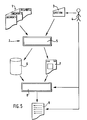
- Figure 5 is a block diagram of the system storage and retrieval of Markush formula according to the embodiment of the invention more particularly described here.
- This embodiment is advantageously implemented works through a computer that understands, so known in itself, a central unit (CPU) connected to ancillary devices comprising units of external storage and input interface means - outputs, such as display screens and printers, said peripherals being connected to the central unit in a manner known per se by the means usual telecommunications.
- CPU central unit
- ancillary devices comprising units of external storage and input interface means - outputs, such as display screens and printers, said peripherals being connected to the central unit in a manner known per se by the means usual telecommunications.
- the central unit is for example constituted by one or more IBM computers (INTERNATIONAL BUSINESS MACHINE) of high capacity, for example type IBM 3090.
- IBM computers INTERNATIONAL BUSINESS MACHINE
- Peripherals, or terminals, input-output interfaces can themselves be microcomputers of the IBM PC type, or others Hewlett Packard 2647A type terminals, for allow data entry in graphical form and / or alpha-numeric.
- FIG. 5 a series 1 of documents, (Document 1, Document 2 ..) comprising each a Markush formula.
- Markush formulas of these documents are entered into system 2 by through an application program, known in itself, allowing graphic representation and / or alpha-numeric formulas, for example a program PLOT 10 type from TEKTRONIX., or a other type available on the market.
- This program stores the data formed by the formulas of the documents entered in the system, in a database file 6, in the form of connectivity tables including each a reference number of the formula and a preset number, as will be described by the following.
- the program generates a list after 9 processing, list from which we visually extract, and / or in print, references and / or representation of the Markush formula (s), if any of file 6 of the database, and which correspond to the Markush formula sought 7.
- Table VII representing the table of numbers used in the rest of the program a was also created (reference 11 in the figure 6a).
- a connectivity table is made up of several tables.
- An exemplary embodiment of a connectivity table used in the method and the system according to the invention is given below, (table VIII).
- the table notably advantageously includes 5 first tables (DEG, ADR, TABGR, TABLI and TABST) precisely defining each node of the graph of the Markush formula it represents, and 4 second tables (LIRAT, IFR, IAT and NVAL) defining the relations between the different groups as will be seen more precisely in the rest of the text.
- each formula is assigned of Markush an identification number (NOFMi) and a preset number (Npsi) describing synthetically predetermined type characters of the formula, with reference to the table created previously said standard characters (table VII).
- the preselection number is advantageously calculated automatically. This calculation is shown schematically by the functional block 13 on the Figure 6a.
- the preselection number is calculated to be in the form of a chain of n bits for example of 200 bits, each bit of which corresponds to a fixed selection criteria.
- the value 1 corresponds to the presence of this criterion, the value 0 not necessarily corresponding to the absence of this criterion.
- the calculation is carried out from the connectivity tables introduced, by means of an algorithm (GENBIT) of which an example of representation in pseudo-code, understandable for the skilled person, is provided below (table IX ).
- the basic file 14 of chemical formulas obtained after this first treatment is presented as a series of files per formula, referenced NOFM 1 , NOFM 2 , ... NOFM n , each comprising a corresponding connectivity table TC 1 , TC 2 . ... TC n and a preset number Nps 1 , Nps 2 ... Nps n .
- a fragment file 18 is formed (block 17) comprising, for each calculated fragment, formulas from the base file 14, the list of reference numbers of the formulas comprising this fragment (FRAG 1 , FRAG 2 (2003)) .
- Figure 7a shows a structure 20a. It has three fragments to two environments 21a, 22a and 23a, whose foci are marked with an asterisk.
- Figure 7b shows another structure 20b. She comprises two fragments with two environments 21b and 22b, with a presentation different from that of the Figure 7a, the foci being always identified by asterisks.
- a fragment with two environments can also be defined as a built substructure concentrically around a hearth, the hearth being the vertex of said substructure and comprising at minimum two determined neighboring atoms, each neighbor being connected to the household by a determined connection (these two conditions defining the environment 1 of the hearth), said substructure extending to all vertices or neighboring atoms neighboring atoms of environment 1, i.e. having a distance of "2" in relation to the focus of the fragment.
- This second row of atoms forms the environment 2.
- FRAG 1 is the "subfragment" file. he contains the description of the "sub fragments" at a environment (1) of the database. At every penny fragment 1 is associated with a list of positions 2 possible. This list is described in FRAG 2.
- FRAG 2 is the list file 2. It contains the description of the position lists 2 associated with each sub fragment 1. At each set of positions 2 corresponds to a list of structure numbers described in FRAG N.
- FRAG N is the file number lists of structures or formulas. It contains description lists of structure numbers associated with a Fragment with two environments.
- Table XIbis gives, by way of example, details of the procedures in pseudocode, implemented in advantageous embodiments of the invention. They allow, in particular, thanks to the use of connectivity tables with drawers and their LIRAT or NVAL tables, significant time savings in data processing. Instead of recalculating all the necessary elements, each time, the existence of such tables makes it possible to seek there directly, as in a "drawer", the information sought for the continuation of the operations of calculation.
- the program After sorting all the fragments generated for all the foci of all the formulas in the table, the program, described in table XIII, detects the redundancy between the "fragments" and eliminates identical fragments from the same focus.
- the program (table XIV) detects the inter-fragment redundancy and calculates the occurrence of each fragment within each formula entered (updated).
- Figure 6b is a simplified flowchart of the Markush formula research program according to the embodiment of the invention more particularly described here.
- fragment of the formula of Markush sought, advantageously chosen fragment as being the fragment common to the formula sought and a minimum number of formulas from the fragments 18 with which we compare it (block 34), we extract (block 35) of said file 18 a first list the formula reference number.
- the operation can be renewed (decision block 37) for the next fragment, and and so on.
- the preset number is, as we have seen, in the form of a chain of n bits, each bit of which corresponds to a fixed selection criterion.
- the value 1 corresponds for example to the presence of the character, the value 0 not corresponding, at least at the level of the search for the Markush formula sought, to the absence of character.
- step 38 of reading the list "from fragments of optimized length” are essentially: reading the preset number of the formula sought (39), comparison of the numbers of preselection (40) of the formula sought with those the list from fragments of optimized length and, once the comparison is complete (decision block 41), continuation of the program.
- the response file is read and decompacting (operating block 42) the tables conectivities of the formulas selected.
- a node-to-node comparison of the formulas in the final list is also carried out with the Markush formula sought (block 43). This comparison is for example carried out using an algorithm such as that appearing in Table XV below.
- the operation is renewed, for example by manual operator control, until optional satisfactory results or no results (block decision 44).
- circuits can be provided automatic "load shedding", allowing only exceptionally a node-to-node comparison, more long.
- Figure 8 shows the formula marked with a CN number: 87010122-01; It shows the existence of a first group G1.
- Figure 9 shows the detail of the possible values for this group G1, the initial general formula remains visible in a window at the top left of the screen.
- Figure 9 shows the existence of a second group G 2 .
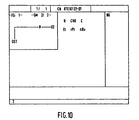
- FIG. 10 gives the different values that the group G 2 can take, the group G 1 being this time visible at the top left of the screen.
- This "drawers" or window display mode notably facilitates research by the operator.
- FIGS. 11a and 11b now give an example of a connectivity table as described in Table VIII, above.
- the upper line 50a basically includes an assigned internal number by software (NOFM), an external number assigned by the user (UID1) and an internal number assigned by the software from information provided by user or operator (UID2).
- NOFM assigned internal number by software
- UID1 an external number assigned by the user
- UID2 an internal number assigned by the software from information provided by user or operator
- Line 51a gives the largest number in the group defined (NBGM) and the number of defined groups (NBGR).
- Table 52a shows the group information.
- Table 52a shows the group information.
- Table 52a shows the group information.
- Table 52a shows the group information.
- Table 52a shows the group information.
- IDEB (I + 1) -1 being the number of the last atom of the fragment I.
- Table 54a gives the relative information at the beginning of value.
- NBGG group number
- the length of IAT in words of length 2 (LGIAT)
- the table address by IAT group IFR
- the group values IAT.
- Figure 11b illustrates the rest of the tables appearing in the table embodiment connectivity of the invention more particularly described here.
- the top row of the table shown on Figure 11b contains an indication 50b of the number of atoms (NAT) of the formula, and the value 51b of the table length (LG).
- the first column 52b gives the number (NOAT) assigned (arbitrarily) to each node of the formula.
- the second column 53b gives an address table (ADR) to TABGR, TABLI and TABST (see table VII above).
- the third column 54b is the table giving, for each of the N nodes (here 32) of the graph of the formula, the number of neighbors of this node.
- column 55b is the nature of the atom, as defined by table I provided in the appendix, "-1", "-2" indicating in particular "child” groups.
- Figure 12 shows the table of attributes of each of the nodes of the formula CN #: 87010122-01 taken as an example, as it stands advantageously used in an embodiment of the invention.
- the system includes a computer 80 of the type defined above, which itself basically three elements, a CPU 81, memory circuits (RAM, ROM) 82 and a circuit -Output interface module 83.
- the computer 80 is connected, via the circuit 83, either to peripherals consisting of keyboards 84, "mice” 85 and display screens 86 and / or printers, either on one or more microcomputers 87.
- Two types of entry and search in the database data can therefore be considered, itself live, oneself via a microcomputer.
- the computer 80 further comprises means 89 for generation of files and calculation, belonging or no to the central unit 81, and comprising one or several microprocessors of known type, for example 80386 of the INTEL Company, programmed to generate said files.
- These means 89 are programmed as described previously to generate a base file (14) of chemical formulas from Markush formulas introduced into the system via the peripherals 84, 85 or 87, and to store said base file in memory 88, in the form of a connectivity table with a reference number and a number of "preselection" defined according to table VII, previously stored in memory 82 or 88.
- the means 89 are also programmed to generate for each stored formula, the list of all the nodes, and to calculate for each node of this list, all the fragments of said formula, from this node.
- the means 89 are finally also programmed to generate a fragment file (18) comprising for each fragment the list of formulas including said fragment.
- This list is stored in the means of memory 82 or 88 of known type.
- the central unit 81 also programmed in consequence, also includes the different means of extraction and comparison such as previously defined and used to perform the searches by fragment, by selection number, node to node, by cross-checking attributes etc ... to get on screen 86 or microcomputer 87, the results of research carried out on a formula of Markush data entered into the system via peripherals 84, 85 and / or 87.
- the means 89 for generating the base file 14, include one or more electronic circuits programmed to constitute a preset number in the form of a chain of n bits, each bit of which corresponds to a typical character of the definition table (table VII ).
- the operator connects via peripherals 84, 85 and 86, or 87, to the central computer 80 connected to the memory 88 containing the database 14.
- the system then automatically calculates the fragments of the desired formula, then performs the first research on fragments by making appear on the screen the number of candidates found having a fragment common with the formula sought, number which may also be zero.
- the operator controls the comparison of preset numbers, and further research to obtain in fine and possibly, a list of candidate formulas, or the candidate sought after whether or not you chose to perform a node search per node.
Landscapes
- Engineering & Computer Science (AREA)
- Computing Systems (AREA)
- Theoretical Computer Science (AREA)
- Databases & Information Systems (AREA)
- Software Systems (AREA)
- Chemical & Material Sciences (AREA)
- Crystallography & Structural Chemistry (AREA)
- Life Sciences & Earth Sciences (AREA)
- Bioinformatics & Cheminformatics (AREA)
- Bioinformatics & Computational Biology (AREA)
- Information Retrieval, Db Structures And Fs Structures Therefor (AREA)
- Nitrogen And Oxygen Or Sulfur-Condensed Heterocyclic Ring Systems (AREA)
Claims (14)
- Verfahren zur Speicherung und Suche von Markush-Formeln (1),
dadurch gekennzeichnet, daßund die Operation solange wiederholt wird, wie sie für notwendig erachtet wird, indem jede neue Nummernliste möglicher Formeln, die einem neuen Fragment entsprechen, mit der Liste verglichen wird, die aus den gemeinsamen Nummern aller vorhergehenden Listen gebildet ist, um eine "von Fragmenten" einer optimierten Länge "abgeleitete" Liste zu bilden,(a) eine Basisdatei (14) chemischer Formeln ausgehend von den Markush-Formeln gebildet wi.rd, in welcher Basisdatei jede Markush-Formel in Form von Konnektivitätstabellen (TC1, TC2, ... TCn) gespeichert ist, die eine Bezugsnummer (NOFM1, NOFM2, ..., NOFMn) der gespeicherten Formel und eine "Vorauswahl"-Nummer (Nps1, Nps2, ..., Npsn) enthalten, die vorbestimmte Typzeichen der Formel synthetisch beschreibt, die gemäß einer zuvor aus den Typzeichen (Tabelle VII) gebildeten Definitionstabelle definiert sind,b) für jede Formel der Basisdatei (14) und für die gesuchte Formel (3), die identisch mit den Formeln der Datei gespeichert ist, die Liste aller Knoten oder Herd-Atome mit mindestens zwei unmittelbaren Nachbarn bestimmt wird und, wobei ein "Fragment" als ein Teil der Struktur der Formel definiert ist, die durch einen Herd, seine unmittelbar benachbarten Atome (Umgebung 1) und, falls vorhanden, das unmittelbar benachbarte Atom oder die unmittelbar benachbarten Atome des Herds (Umgebung 2) jedes der dem Herd unmittelbar benachbarten Atome gebildet ist, für jeden Knoten dieser Liste alle möglichen Teile oder Fragmente der von diesem Knoten abgeleiteten Formel berechnet werden,c) eine Fragmentedatei (18) gebildet wird, die für jedes berechnete Fragment der Formeln der Basisdatei die Liste der Bezugsnummern der dieses Fragment enthaltenden Formeln enthält,d) für ein erstes Fragment der gesuchten Markush-Formel eine erste Liste von Bezugsnummern der möglichen Formeln, die das Fragment der gesuchten Markush-Formel enthalten, aus der Fragmentedatei (18) extrahiert wird,e) anschließend notwendigenfalls und für ein zweites Fragment der gesuchten Formel eine zweite Liste von Bezugsnummern der möglichen Formeln, die das zweite Fragment enthalten, aus der Fragmentedatei (18) extrahiert wird; diese zweite Liste mit der ersten, für das erste Fragment erhaltenen Liste verglichen wird, um eine dritte, "von den Fragmenten abgeleitete" Liste zu bilden, die aus den gemeinsamen Nummern der ersten beiden Listen gebildet ist,f) die "Vorauswahl"-Nummer der gesuchten Markush-Formel mit den "Vorauswahl"-Nummern der Formeln der "von Fragmenten" optimierter Länge "abgeleiteten" Liste verglichen wird und daraus eine abschließende Liste extrahiert wird, die aus den Bezugsnummern der Formeln gebildet ist, die eine "Vorauswahl"-Nummer aufweisen, die mit derjenigen der gesuchten Markush-Formel identisch ist. - Verfahren zur Speicherung und Suche von Markush-Formeln (1) nach Anspruch 1, dadurch gekennzeichnet, daß ausgehend von einer Datenbank (6), die die Basisdatei (14) chemischer Formeln, die ausgehend von Markush-Formeln (1) gebildet ist, und die Fragmentedatei (18) enthält, die die Listen der Bezugsnummern der mit jedem Fragment der Formeln der Basisdatei (14) assoziierten Formeln enthält, die gesuchte Markush-Formel (3) in ähnlicher Form gespeichert wird wie die Formeln der Datenbank (6), d. h. in Form einer Konnektivitätstabelle (TCi) mit einer Vorauswahl-Nummer (Npsi) der gesuchten Formel.
- Verfahren nach Anspruch 1 zur Speicherung und Suche von Markush-Formeln (1) durch eine Bedienungsperson,
dadurch gekennzeichnet,daß jede Markush-Formel der Basisdatei (14) in einem Datenverarbeitungssystem durch die Bedienungsperson gespeichert wird,daß die Liste aller Knoten oder Herdatome mit mindestens zwei unmittelbaren Nachbarn für jede Formel der Basisdatei (14) und für die gesuchte Formel (3) automatisch bestimmt wird, die identisch mit den Formeln der durch die Bedienungsperson gespeicherten Datei gespeichert ist,daß alle möglichen Teile oder Fragmente der Formel, die von diesem Knoten abgeleitet sind, automatisch für jeden Knoten dieser Liste berechnet werden,daß die Fragmentedatei (18) automatisch gebildet wird, daß die zweite Liste von Bezugsnummern der möglichen, das zweite Fragment enthaltenden Formeln infolge eines Befehls der Bedienungsperson extrahiert wird und mit der ersten, für das erste Fragment erhaltenen Liste verglichen wird,daß die Operation durch manuellen Befehl der Bedienungsperson wiederholt wird, indem jede neue Nummernliste möglicher, einem neuen Fragment entsprechender Formeln mit der Liste verglichen wird, die aus den Nummern gebildet ist, die allen vorhergehenden Listen gemeinsamen sind, um eine "von Fragmenten" optimierter Länge "abgeleitete" Liste automatisch zu bilden,und daß infolge eines manuellen Befehls der Bedienungsperson die "Vorauswahl"-Nummer der gesuchten Markush-Formel mit den "Vorauswahl"-Nummern der Formeln der Liste automatisch verglichen wird, die "von Fragmenten" optimierter Länge "abgeleitet" ist, wobei die abschließende Liste daraus automatisch extrahiert wird. - Verfahren zur Speicherung und Suche von Markush-Formeln (1) durch einen Benutzer in einem Datenverarbeitungssystem nach Anspruch 2 und 3,
dadurch gekennzeichnet, daß jede Markush-Formel in dem Datenverarbeitungssystem in Form von Konnektivitätstabellen (TCi) gespeichert wird,daß der Benutzer in dem Datenverarbeitungssystem die gesuchte Markush-Formel (3) ähnlich wie die Formeln der Datenbank (6) speichert,daß das Datenverarbeitungssystem für die gesuchte Formel (3) die Liste der Knoten automatisch bestimmt und alle Fragmente berechnet,daß das Datenverarbeitungssystem automatisch aus der Fragmentedatei (18) die erste Bezugsnummern-Liste extrahiert,daß das Datenverarbeitungssystem automatisch aus der Fragmentedatei (18) die zweite Bezugsnummern-Liste extrahiert, die das Datenverarbeitungssystem mit der ersten, für das erste Fragment erhaltenen Liste vergleicht, um die dritte Liste zu bilden,daß das Datenverarbeitungssystem die durch manuellen Befehl des Benutzers eingeleitete Operation solange wiederholt, wie es der Benutzer für notwendig erachtet, indem jede neue Liste mit der Liste automatisch verglichen wird, die aus den Nummern gebildet ist, die allen vorhergehenden Listen gemeinsam sind,daß infolge eines manuellen Befehls der Bedienungsperson das Datenverarbeitungssystem automatisch die "Vorauswahl"-Nummer mit den "Vorauswahl"-Nummern der Formeln der Liste vergleicht, die "von Fragmenten abgeleitet ist", und daraus die abschließende Liste extrahiert. - Verfahren nach Anspruch 2 und 3 zur Speicherung und Suche von Markush-Formeln (1) durch einen Benutzer in einem Datenverarbeitungssystem,
dadurch gekennzeichnet, daß ausgehend von der Datenbank (6) des Datenverarbeitungssystems der Benutzer mindestens teilweise die gesuchte Markush-Formel (3) in graphischer Form eingibt, die in dem Datenverarbeitungssystem bestimmt ist,daß das Datenverarbeitungssystem die graphische Darstellung liest und sie transformiert, um sie zu speichern, daß die Operation der Bildung der dritten Liste durch das Datenverarbeitungssystem wiederholt wird, das jede neue Liste mit der Liste automatisch vergleicht, die aus den Nummern gebildet ist, die allen vorhergehenden Listen gemeinsamen sind, bis der Vergleich nicht mehr gestattet, die Anzahl von Formeln der "von Fragmenten abgeleiteten" Liste signifikativ zu reduzieren, um eine Liste zu bilden, die von Fragmenten optimierter Länge abgeleitet ist,daß das Datenverarbeitungssystem automatisch oder der Benutzer manuell daraufhin den Schritt steuert, wo das Datenverarbeitungssystem die "Vorauswahl"-Nummer mit den "Vorauswahl"-Nummern der Formeln der Liste vergleicht, die "von Fragmenten abgeleitet" ist, und daraus die abschließende Liste extrahiert,und daß das Datenverarbeitungssystem eins zu eins auf Anforderung des Benutzers und notwendigenfalls die in der abschließenden Liste enthaltenen Formeln extrahiert, indem sie transformiert werden, um sie in Form eines adaptierten graphischen Bilds darzustellen, das geeignet ist, einen optimierten Vergleich mit bestimmten graphischen Form der gesuchten Formel zu gestatten. - Verfahren nach einem der vorhergehenden Ansprüche, dadurch gekennzeichnet, daß ferner ein Knoten-zu-Knoten-Vergleich der Formeln der abschließenden Liste mit der gesuchten Markush-Formel (3) ausgeführt wird und daß die Bezugspunkte bzw. Referenzen der Markush-Formel oder der Markush-Formeln extrahiert werden, die gegebenenfalls durch diesen Vergleich erhalten wurden.
- Verfahren nach einem der vorhergehenden Ansprüche, dadurch gekennzeichnet, daß bestimmten Atomen oder Atomgruppen der Markush-Formeln der abgefragten Basisdatei (14), und notwendigenfalls der gesuchten Markush-Formel (3) eine Einheit von Attributen zugewiesen wird und in der Markush-Formeln-Basisdatei nur die Formeln gesucht werden, die eine Struktur aufweisen, die mit dem Attribut oder Attributen versehen ist, das bzw. die der gesuchten Formel spezifisch zugewiesen ist bzw. sind.
- Verfahren nach einem der vorhergehenden Ansprüche, dadurch gekennzeichnet, daß die durch Graphen gebildeten Markush-Formeln gespeichert werden, indem, wenn für die Knoten der Graphen erforderlich, falsche Atome verwendet werden, die Gattungsbegriffe und/oder Einheiten invarianter Atome darstellen, um die Darstellungen der Formeln zu vereinfachen.
- Verfahren nach einem der vorhergehenden Ansprüche, dadurch gekennzeichnet, daß die Markush-Formeln in der Basisdatei (14) gespeichert werden und die Basisdatei abgefragt wird, um eine spezifische Markush-Formel, im wesentlichen in graphischer Form mithilfe einer Schnittstelle vom "Maus"-Typ zu suchen.
- Verfahren nach einem der vorhergehenden Ansprüche, dadurch gekennzeichnet, daß die "Vorauswahl"-Nummer (Npsi), die vorbestimmte Typzeichen einer Markush-Formel synthetisch beschreibt, in Form einer Kette von n Bits gebildet wird, von denen jedes Bit einem bestimmten Typzeichen der Definitionstabelle entspricht, die zuvor aus n Typzeichen gebildet wurde (Tabelle VII).
- Verfahren nach einem der vorhergehenden Ansprüche, dadurch gekennzeichnet, daß die Konnektivitätstabellen, die die Markush-Formeln darstellen, aus "Schubladen"-Konnektivitätstabellen gebildet werden, aufweisend:Vier Tabellen, die die Beziehungen zwischen den verschiedenen Atomgruppen oder "Neben"-Graphen (graphes "fils") der Struktur wiedergeben, welche Tabellen aus einer ersten Tabelle (LIRAT) gebildet sind, die die Atome kennzeichnet, mit denen die Gruppen in Verbindung stehen, - eine zweite Tabelle (NVAL), die die Werte-Ziffern (nombres de valeurs) für jede der Gruppen angibt,eine dritte Tabelle (IAT), die die Anfänge der Werte der Gruppen angibt undeine vierte Tabelle (IFR), die die Adressen pro Gruppe an die Tabelle der Werteanfänge (IAT) liefert.
- Datenverarbeitungssystem für den Einsatz des Verfahrens zur Speicherung und Suche von Markush-Formeln nach einem der vorhergehenden Ansprüche, aufweisend eine Zentraleinheit (81), Arbeits- und Pufferspeicher (82, 88), Speicher (84, 85, 87) für die Eingabe von Markush-Formeln in graphischer und/oder alphanumerischer Form und Mittel zur Datenwiedergabe (86, 87),
dadurch gekennzeichnet, daß es umfaßt:Mittel (81, 89), um eine Basisdatei (14) chemischer Formeln ausgehend von den Markush-Formeln in Form von Konnektivitätstabellen (TC1) zu erzeugen, wobei jede Formel eine Bezugsnummer (NOFM) und eine "Vorauswahl"-Nummer (Npsi) enthält, die Typzeichen der Formel beschreibt, die gemäß einer Definitionstabelle (Tabelle VII) definiert sind, die zuvor in einem Speicher (88) des Systems gespeichert wurde,Mittel (81, 89), um für jede gespeicherte oder gesuchte Formel die Liste alle Knoten oder Herd-Atome mit mindestens zwei unmittelbaren Nachbarn zu erzeugen,Mittel (89) zur Berechnung aller möglichen Teile der Formel, Fragmente genannt, die von diesem Knoten abgeleitet sind, für jeden Knoten dieser Liste, wobei ein Fragment als ein Teil der Struktur der Formel definiert ist, die durch einen Herd, seine unmittelbar benachbarten Atome (Umgebung 1) und, falls vorhanden, das unmittelbar benachbarte Atom oder die unmittelbar benachbarten Atome (Umgebung 2) jedes der unmittelbar benachbarten Atome des Herds gebildet ist,Mittel (81, 89), um eine Fragmentedatei zu erzeugen, die für jedes berechnete Fragment der Formeln der Basisdatei die Liste der Bezugsnummern der dieses Fragment enthaltenden Formeln enthält,Mittel (81) zur Extrahierung von Bezugsnummern-Listen möglicher Formeln, die mindestens ein Fragment der gesuchten Markush-Formel enthalten, ausgehend von der Fragmentedatei, wobei die Mittel vorgesehen sind, um eine Liste zu erzeugen, "die von Fragmenten" einer optimierten Länge "abgeleitet ist", gebildet durch die Markush-Nummern, die eine durch den Benutzer bestimmte, optimierte Anzahl von mit der gesuchten Markush-Formel gemeinsamen Fragmenten aufweisen,und Mittel (81) zum Vergleich der "Vorauswahl"-Nummer der gesuchten Markush-Formel mit den "Vorauswahl"-Nummern der Formeln der Liste, "die von Fragmenten" einer optimierten Länge und ausgehend von diesem Vergleich "abgeleitet ist", zur Bildung einer abschließenden Liste, die aus den Bezugsnummern der Formeln gebildet ist, die eine "Vorauswahl"-Nummer aufweisen, die mit derjenigen der gesuchten Markush-Formel identisch ist. - System nach Anspruch 12,
dadurch gekennzeichnet, daß es ferner Mittel zum Knotenzu-Knoten-Vergleich der Formeln der abschließenden Liste mit der gesuchten Markush-Formel und zur Extrahierung der Bezugspunkte bzw. Referenzen der Markush-Formel oder der Markush-Formeln aufweist, die gegebenenfalls durch diesen Vergleich erhalten wird bzw. werden. - System nach einem der Ansprüche 12 und 13,
dadurch gekennzeichnet, daß die Mittel zur Erzeugung einer Datei chemischer Formeln ausgehend von den Markush-Formeln in Form von Konnektivitätstabellen Mittel zur Bildung einer Vorauswahl-Nummer in Form einer Kette von n Bits aufweisen, von denen jedes Bit einem Typzeichen entspricht, das von der Definitionstabelle bestimmt ist, die zuvor aus den n Typzeichen (Tabelle VII) gebildet wurde.
Applications Claiming Priority (2)
| Application Number | Priority Date | Filing Date | Title |
|---|---|---|---|
| FR9004134A FR2660458B1 (fr) | 1990-03-30 | 1990-03-30 | Procede et systeme de stockage et de recherche de formules chimiques dans une base de donnees. |
| FR9004134 | 1990-03-30 |
Publications (2)
| Publication Number | Publication Date |
|---|---|
| EP0451049A1 EP0451049A1 (de) | 1991-10-09 |
| EP0451049B1 true EP0451049B1 (de) | 1998-10-21 |
Family
ID=9395314
Family Applications (1)
| Application Number | Title | Priority Date | Filing Date |
|---|---|---|---|
| EP91400897A Expired - Lifetime EP0451049B1 (de) | 1990-03-30 | 1991-04-02 | Verfahren und Speicher- und Abrufsystem von chemischen Formeln in einer Datenbank |
Country Status (5)
| Country | Link |
|---|---|
| EP (1) | EP0451049B1 (de) |
| JP (1) | JPH04227573A (de) |
| AT (1) | ATE172560T1 (de) |
| DE (1) | DE69130373T2 (de) |
| FR (1) | FR2660458B1 (de) |
Families Citing this family (1)
| Publication number | Priority date | Publication date | Assignee | Title |
|---|---|---|---|---|
| JP3991628B2 (ja) * | 2001-07-19 | 2007-10-17 | セイコーエプソン株式会社 | 管理情報データベース構造定義ファイル結合方法、ネットワークデバイス管理システムおよび管理情報データベース構造定義ファイルを結合するための処理プログラムならびに管理デバイス |
Family Cites Families (2)
| Publication number | Priority date | Publication date | Assignee | Title |
|---|---|---|---|---|
| US4642762A (en) * | 1984-05-25 | 1987-02-10 | American Chemical Society | Storage and retrieval of generic chemical structure representations |
| JPS61223941A (ja) * | 1985-03-29 | 1986-10-04 | Kagaku Joho Kyokai | 化学構造の検索方法 |
-
1990
- 1990-03-30 FR FR9004134A patent/FR2660458B1/fr not_active Expired - Lifetime
-
1991
- 1991-03-29 JP JP3133818A patent/JPH04227573A/ja active Pending
- 1991-04-02 DE DE69130373T patent/DE69130373T2/de not_active Expired - Fee Related
- 1991-04-02 EP EP91400897A patent/EP0451049B1/de not_active Expired - Lifetime
- 1991-04-02 AT AT91400897T patent/ATE172560T1/de not_active IP Right Cessation
Also Published As
| Publication number | Publication date |
|---|---|
| JPH04227573A (ja) | 1992-08-17 |
| ATE172560T1 (de) | 1998-11-15 |
| FR2660458A1 (fr) | 1991-10-04 |
| DE69130373D1 (de) | 1998-11-26 |
| EP0451049A1 (de) | 1991-10-09 |
| FR2660458B1 (fr) | 1992-07-17 |
| DE69130373T2 (de) | 1999-05-20 |
Similar Documents
| Publication | Publication Date | Title |
|---|---|---|
| CN112579155B (zh) | 代码相似性检测方法、装置以及存储介质 | |
| US9996566B2 (en) | Visual design system for generating a visual data structure associated with a semantic composition based on a hierarchy of components | |
| CN110532019B (zh) | 一种软件代码片段历史追溯的方法 | |
| EP2523126A2 (de) | Informationsverarbeitungsvorrichtung, Informationsverarbeitungsverfahren, Programm und Informationsverarbeitungssystem | |
| CN101021850B (zh) | 单词检索设备和单词检索方法 | |
| US20070016612A1 (en) | Molecular keyword indexing for chemical structure database storage, searching, and retrieval | |
| JP2004178604A (ja) | 情報検索装置及びその方法 | |
| EP1515239A1 (de) | Verfahren und System zur Verarbeitung von Daten aus mehrdimensionalen Datenbanken mit einem Tabellenkalkulationprogramm | |
| CN1126042C (zh) | 输出树结构间差分的方法及其装置 | |
| WO2015112049A1 (ru) | Способ извлечения полезного контента из установочных файлов мобильных приложений | |
| CN113743432A (zh) | 一种图像实体信息获取方法、设备、电子设备和存储介质 | |
| KR20040054901A (ko) | 동영상 검색 시스템 및 방법 | |
| EP0451049B1 (de) | Verfahren und Speicher- und Abrufsystem von chemischen Formeln in einer Datenbank | |
| US7672958B2 (en) | Method and system to identify records that relate to a pre-defined context in a data set | |
| JP4136594B2 (ja) | データ処理方法およびデータ処理プログラム | |
| CN119474540B (zh) | 一种知识引导的基于大语言模型的可信api推荐方法 | |
| CN1746891A (zh) | 信息处理 | |
| CN114398432A (zh) | 数据展示方法、装置、计算机设备和存储介质 | |
| CN108984513A (zh) | 一种词串识别方法和服务器 | |
| WO2009004231A2 (fr) | Procede de tri d'informations | |
| JP2001134594A (ja) | 類似特徴量の検索方法,その検索装置およびその検索プログラム記録媒体 | |
| JP2005063043A (ja) | 画像表示装置、画像表示方法および画像表示プログラム | |
| JP5582065B2 (ja) | 閲覧情報生成装置および閲覧情報生成方法 | |
| JP6361472B2 (ja) | 対応情報生成プログラム、対応情報生成装置及び対応情報生成方法 | |
| TW201441849A (zh) | 自動決定圖像樣本群以進行分析之方法、系統及電腦程式產品 |
Legal Events
| Date | Code | Title | Description |
|---|---|---|---|
| PUAI | Public reference made under article 153(3) epc to a published international application that has entered the european phase |
Free format text: ORIGINAL CODE: 0009012 |
|
| AK | Designated contracting states |
Kind code of ref document: A1 Designated state(s): AT BE CH DE DK ES FR GB GR IT LI LU NL SE |
|
| 17P | Request for examination filed |
Effective date: 19911022 |
|
| 17Q | First examination report despatched |
Effective date: 19970131 |
|
| GRAG | Despatch of communication of intention to grant |
Free format text: ORIGINAL CODE: EPIDOS AGRA |
|
| GRAG | Despatch of communication of intention to grant |
Free format text: ORIGINAL CODE: EPIDOS AGRA |
|
| GRAH | Despatch of communication of intention to grant a patent |
Free format text: ORIGINAL CODE: EPIDOS IGRA |
|
| GRAH | Despatch of communication of intention to grant a patent |
Free format text: ORIGINAL CODE: EPIDOS IGRA |
|
| GRAA | (expected) grant |
Free format text: ORIGINAL CODE: 0009210 |
|
| AK | Designated contracting states |
Kind code of ref document: B1 Designated state(s): AT BE CH DE DK ES FR GB GR IT LI LU NL SE |
|
| PG25 | Lapsed in a contracting state [announced via postgrant information from national office to epo] |
Ref country code: IT Free format text: LAPSE BECAUSE OF FAILURE TO SUBMIT A TRANSLATION OF THE DESCRIPTION OR TO PAY THE FEE WITHIN THE PRE;WARNING: LAPSES OF ITALIAN PATENTS WITH EFFECTIVE DATE BEFORE 2007 MAY HAVE OCCURRED AT ANY TIME BEFORE 2007. THE CORRECT EFFECTIVE DATE MAY BE DIFFERENT FROM THE ONE RECORDED.SCRIBED TIME-LIMIT Effective date: 19981021 Ref country code: ES Free format text: THE PATENT HAS BEEN ANNULLED BY A DECISION OF A NATIONAL AUTHORITY Effective date: 19981021 Ref country code: AT Free format text: LAPSE BECAUSE OF FAILURE TO SUBMIT A TRANSLATION OF THE DESCRIPTION OR TO PAY THE FEE WITHIN THE PRESCRIBED TIME-LIMIT Effective date: 19981021 Ref country code: GR Free format text: LAPSE BECAUSE OF NON-PAYMENT OF DUE FEES Effective date: 19981021 |
|
| REF | Corresponds to: |
Ref document number: 172560 Country of ref document: AT Date of ref document: 19981115 Kind code of ref document: T |
|
| REG | Reference to a national code |
Ref country code: CH Ref legal event code: EP |
|
| REF | Corresponds to: |
Ref document number: 69130373 Country of ref document: DE Date of ref document: 19981126 |
|
| PG25 | Lapsed in a contracting state [announced via postgrant information from national office to epo] |
Ref country code: SE Free format text: LAPSE BECAUSE OF FAILURE TO SUBMIT A TRANSLATION OF THE DESCRIPTION OR TO PAY THE FEE WITHIN THE PRESCRIBED TIME-LIMIT Effective date: 19990121 Ref country code: DK Free format text: LAPSE BECAUSE OF FAILURE TO SUBMIT A TRANSLATION OF THE DESCRIPTION OR TO PAY THE FEE WITHIN THE PRESCRIBED TIME-LIMIT Effective date: 19990121 |
|
| GBT | Gb: translation of ep patent filed (gb section 77(6)(a)/1977) |
Effective date: 19990105 |
|
| REG | Reference to a national code |
Ref country code: CH Ref legal event code: NV Representative=s name: PATENTANWAELTE SCHAAD, BALASS, MENZL & PARTNER AG |
|
| PG25 | Lapsed in a contracting state [announced via postgrant information from national office to epo] |
Ref country code: LU Free format text: LAPSE BECAUSE OF NON-PAYMENT OF DUE FEES Effective date: 19990402 |
|
| PLBE | No opposition filed within time limit |
Free format text: ORIGINAL CODE: 0009261 |
|
| STAA | Information on the status of an ep patent application or granted ep patent |
Free format text: STATUS: NO OPPOSITION FILED WITHIN TIME LIMIT |
|
| 26N | No opposition filed | ||
| PG25 | Lapsed in a contracting state [announced via postgrant information from national office to epo] |
Ref country code: FR Free format text: LAPSE BECAUSE OF NON-PAYMENT OF DUE FEES Effective date: 19991231 |
|
| REG | Reference to a national code |
Ref country code: FR Ref legal event code: ST |
|
| REG | Reference to a national code |
Ref country code: GB Ref legal event code: IF02 |
|
| PGFP | Annual fee paid to national office [announced via postgrant information from national office to epo] |
Ref country code: DE Payment date: 20080411 Year of fee payment: 18 Ref country code: CH Payment date: 20080415 Year of fee payment: 18 |
|
| PGFP | Annual fee paid to national office [announced via postgrant information from national office to epo] |
Ref country code: BE Payment date: 20080513 Year of fee payment: 18 |
|
| PGFP | Annual fee paid to national office [announced via postgrant information from national office to epo] |
Ref country code: NL Payment date: 20080319 Year of fee payment: 18 |
|
| PGFP | Annual fee paid to national office [announced via postgrant information from national office to epo] |
Ref country code: GB Payment date: 20080408 Year of fee payment: 18 |
|
| BERE | Be: lapsed |
Owner name: *QUESTEL Effective date: 20090430 |
|
| REG | Reference to a national code |
Ref country code: CH Ref legal event code: PL |
|
| GBPC | Gb: european patent ceased through non-payment of renewal fee |
Effective date: 20090402 |
|
| NLV4 | Nl: lapsed or anulled due to non-payment of the annual fee |
Effective date: 20091101 |
|
| PG25 | Lapsed in a contracting state [announced via postgrant information from national office to epo] |
Ref country code: LI Free format text: LAPSE BECAUSE OF NON-PAYMENT OF DUE FEES Effective date: 20090430 Ref country code: DE Free format text: LAPSE BECAUSE OF NON-PAYMENT OF DUE FEES Effective date: 20091103 Ref country code: CH Free format text: LAPSE BECAUSE OF NON-PAYMENT OF DUE FEES Effective date: 20090430 |
|
| PG25 | Lapsed in a contracting state [announced via postgrant information from national office to epo] |
Ref country code: NL Free format text: LAPSE BECAUSE OF NON-PAYMENT OF DUE FEES Effective date: 20091101 |
|
| PG25 | Lapsed in a contracting state [announced via postgrant information from national office to epo] |
Ref country code: GB Free format text: LAPSE BECAUSE OF NON-PAYMENT OF DUE FEES Effective date: 20090402 |
|
| PG25 | Lapsed in a contracting state [announced via postgrant information from national office to epo] |
Ref country code: BE Free format text: LAPSE BECAUSE OF NON-PAYMENT OF DUE FEES Effective date: 20090430 |