EP0446946A2 - Endlosband und damit ausgerüstetes Heizgerät - Google Patents
Endlosband und damit ausgerüstetes Heizgerät Download PDFInfo
- Publication number
- EP0446946A2 EP0446946A2 EP91104047A EP91104047A EP0446946A2 EP 0446946 A2 EP0446946 A2 EP 0446946A2 EP 91104047 A EP91104047 A EP 91104047A EP 91104047 A EP91104047 A EP 91104047A EP 0446946 A2 EP0446946 A2 EP 0446946A2
- Authority
- EP
- European Patent Office
- Prior art keywords
- film
- rib
- hardness
- jis
- degrees
- Prior art date
- Legal status (The legal status is an assumption and is not a legal conclusion. Google has not performed a legal analysis and makes no representation as to the accuracy of the status listed.)
- Granted
Links
- 238000010438 heat treatment Methods 0.000 title claims description 5
- 239000012790 adhesive layer Substances 0.000 claims abstract description 6
- 239000000463 material Substances 0.000 claims description 54
- 239000000853 adhesive Substances 0.000 claims description 26
- 230000001070 adhesive effect Effects 0.000 claims description 26
- 229920001971 elastomer Polymers 0.000 claims description 22
- 239000000806 elastomer Substances 0.000 claims description 14
- 229920001169 thermoplastic Polymers 0.000 claims description 12
- 239000004416 thermosoftening plastic Substances 0.000 claims description 12
- 239000005060 rubber Substances 0.000 claims description 8
- 239000004642 Polyimide Substances 0.000 claims description 5
- 229920001721 polyimide Polymers 0.000 claims description 5
- 229920002943 EPDM rubber Polymers 0.000 claims description 4
- 229920006311 Urethane elastomer Polymers 0.000 claims 2
- 239000007767 bonding agent Substances 0.000 description 12
- 229920002635 polyurethane Polymers 0.000 description 10
- 239000004814 polyurethane Substances 0.000 description 10
- 229920006332 epoxy adhesive Polymers 0.000 description 8
- 229920005989 resin Polymers 0.000 description 8
- 239000011347 resin Substances 0.000 description 8
- -1 polyethylene terephthalate Polymers 0.000 description 6
- 229920001343 polytetrafluoroethylene Polymers 0.000 description 5
- 239000004810 polytetrafluoroethylene Substances 0.000 description 5
- 238000002474 experimental method Methods 0.000 description 4
- 239000004695 Polyether sulfone Substances 0.000 description 3
- 238000001514 detection method Methods 0.000 description 3
- 229920006393 polyether sulfone Polymers 0.000 description 3
- PPBRXRYQALVLMV-UHFFFAOYSA-N Styrene Chemical compound C=CC1=CC=CC=C1 PPBRXRYQALVLMV-UHFFFAOYSA-N 0.000 description 2
- 239000010410 layer Substances 0.000 description 2
- 229920001084 poly(chloroprene) Polymers 0.000 description 2
- OKTJSMMVPCPJKN-UHFFFAOYSA-N Carbon Chemical compound [C] OKTJSMMVPCPJKN-UHFFFAOYSA-N 0.000 description 1
- 239000004709 Chlorinated polyethylene Substances 0.000 description 1
- 229920001651 Cyanoacrylate Polymers 0.000 description 1
- 239000004593 Epoxy Substances 0.000 description 1
- JOYRKODLDBILNP-UHFFFAOYSA-N Ethyl urethane Chemical compound CCOC(N)=O JOYRKODLDBILNP-UHFFFAOYSA-N 0.000 description 1
- YCKRFDGAMUMZLT-UHFFFAOYSA-N Fluorine atom Chemical compound [F] YCKRFDGAMUMZLT-UHFFFAOYSA-N 0.000 description 1
- 239000004640 Melamine resin Substances 0.000 description 1
- 229920000877 Melamine resin Polymers 0.000 description 1
- 229920000459 Nitrile rubber Polymers 0.000 description 1
- 239000004696 Poly ether ether ketone Substances 0.000 description 1
- 239000004952 Polyamide Substances 0.000 description 1
- 239000004697 Polyetherimide Substances 0.000 description 1
- 239000004734 Polyphenylene sulfide Substances 0.000 description 1
- 150000001336 alkenes Chemical class 0.000 description 1
- XAGFODPZIPBFFR-UHFFFAOYSA-N aluminium Chemical compound [Al] XAGFODPZIPBFFR-UHFFFAOYSA-N 0.000 description 1
- 229910052782 aluminium Inorganic materials 0.000 description 1
- 125000003118 aryl group Chemical group 0.000 description 1
- 229920005549 butyl rubber Polymers 0.000 description 1
- 229910052799 carbon Inorganic materials 0.000 description 1
- 239000011248 coating agent Substances 0.000 description 1
- 238000000576 coating method Methods 0.000 description 1
- 230000001276 controlling effect Effects 0.000 description 1
- 238000007599 discharging Methods 0.000 description 1
- HQQADJVZYDDRJT-UHFFFAOYSA-N ethene;prop-1-ene Chemical group C=C.CC=C HQQADJVZYDDRJT-UHFFFAOYSA-N 0.000 description 1
- 239000005038 ethylene vinyl acetate Substances 0.000 description 1
- 229910052731 fluorine Inorganic materials 0.000 description 1
- 239000011737 fluorine Substances 0.000 description 1
- 229920003049 isoprene rubber Polymers 0.000 description 1
- 239000004973 liquid crystal related substance Substances 0.000 description 1
- 238000012986 modification Methods 0.000 description 1
- 230000004048 modification Effects 0.000 description 1
- JRZJOMJEPLMPRA-UHFFFAOYSA-N olefin Natural products CCCCCCCC=C JRZJOMJEPLMPRA-UHFFFAOYSA-N 0.000 description 1
- 239000005011 phenolic resin Substances 0.000 description 1
- 229920001200 poly(ethylene-vinyl acetate) Polymers 0.000 description 1
- 229920002492 poly(sulfone) Polymers 0.000 description 1
- 229920002647 polyamide Polymers 0.000 description 1
- 229920000728 polyester Polymers 0.000 description 1
- 239000004645 polyester resin Substances 0.000 description 1
- 229920001225 polyester resin Polymers 0.000 description 1
- 229920002530 polyetherether ketone Polymers 0.000 description 1
- 229920001601 polyetherimide Polymers 0.000 description 1
- 229920000139 polyethylene terephthalate Polymers 0.000 description 1
- 239000005020 polyethylene terephthalate Substances 0.000 description 1
- 229920000069 polyphenylene sulfide Polymers 0.000 description 1
- 230000001105 regulatory effect Effects 0.000 description 1
- 238000000926 separation method Methods 0.000 description 1
- 229920002379 silicone rubber Polymers 0.000 description 1
- 239000004945 silicone rubber Substances 0.000 description 1
- 229920003048 styrene butadiene rubber Polymers 0.000 description 1
- 229920001897 terpolymer Polymers 0.000 description 1
- 229920002725 thermoplastic elastomer Polymers 0.000 description 1
- 229940117958 vinyl acetate Drugs 0.000 description 1
- 125000000391 vinyl group Chemical group [H]C([*])=C([H])[H] 0.000 description 1
- 229920002554 vinyl polymer Polymers 0.000 description 1
- 238000010792 warming Methods 0.000 description 1
Images

Classifications
-
- G—PHYSICS
- G03—PHOTOGRAPHY; CINEMATOGRAPHY; ANALOGOUS TECHNIQUES USING WAVES OTHER THAN OPTICAL WAVES; ELECTROGRAPHY; HOLOGRAPHY
- G03G—ELECTROGRAPHY; ELECTROPHOTOGRAPHY; MAGNETOGRAPHY
- G03G15/00—Apparatus for electrographic processes using a charge pattern
- G03G15/20—Apparatus for electrographic processes using a charge pattern for fixing, e.g. by using heat
- G03G15/2003—Apparatus for electrographic processes using a charge pattern for fixing, e.g. by using heat using heat
- G03G15/2014—Apparatus for electrographic processes using a charge pattern for fixing, e.g. by using heat using heat using contact heat
- G03G15/2064—Apparatus for electrographic processes using a charge pattern for fixing, e.g. by using heat using heat using contact heat combined with pressure
-
- G—PHYSICS
- G03—PHOTOGRAPHY; CINEMATOGRAPHY; ANALOGOUS TECHNIQUES USING WAVES OTHER THAN OPTICAL WAVES; ELECTROGRAPHY; HOLOGRAPHY
- G03G—ELECTROGRAPHY; ELECTROPHOTOGRAPHY; MAGNETOGRAPHY
- G03G2215/00—Apparatus for electrophotographic processes
- G03G2215/20—Details of the fixing device or porcess
- G03G2215/2003—Structural features of the fixing device
- G03G2215/2016—Heating belt
-
- G—PHYSICS
- G03—PHOTOGRAPHY; CINEMATOGRAPHY; ANALOGOUS TECHNIQUES USING WAVES OTHER THAN OPTICAL WAVES; ELECTROGRAPHY; HOLOGRAPHY
- G03G—ELECTROGRAPHY; ELECTROPHOTOGRAPHY; MAGNETOGRAPHY
- G03G2215/00—Apparatus for electrophotographic processes
- G03G2215/20—Details of the fixing device or porcess
- G03G2215/2003—Structural features of the fixing device
- G03G2215/2016—Heating belt
- G03G2215/2035—Heating belt the fixing nip having a stationary belt support member opposing a pressure member
- G03G2215/2038—Heating belt the fixing nip having a stationary belt support member opposing a pressure member the belt further entrained around one or more rotating belt support members
Definitions
- the present invention relates to an endless film and a heating apparatus using the same, usable with an image forming apparatus such as a copying machine or photoprinter to fix an unfixed image or to improve the surface property of the image.
- the recording material is passed through a nip formed between a heating roller and a pressing roller, that is, a heat-roller type is widely used.
- the heat-roller type fixing system involves a problem that the time required for warming the apparatus up to a predetermined temperature is long.
- the film tends to shift laterally, that is, shift in the direction perpendicular to the film travel.
- a rib or ribs are provided at a lateral end or ends to confine the lateral shifting tendency.
- the use of the rib still involves problems.
- the curvature becomes locally small. If the rib is bonded on the film, the rib is peeled off the film where the curvature of small, or the rib does not deform in compliance with the curvature with the result of stress applied to the film beyond the tensile strength of the film with the result of tearing it.
- an endless film to which a rib having a JIS (Japanese Industrial Standard) A hardness of not more than 100 degrees with a bonding agent having a JIS A hardness of more than 100 degrees after curing.
- JIS Japanese Industrial Standard
- a heating apparatus comprising a film provided with a rib having a JIS A hardness of not more than 100 degrees bonded with a bonding agent having a JIS A hardness of not more than 100 degrees.
- Figure 1 is a sectional view of an image fixing apparatus according to an embodiment of the present invention.
- Figure 2 is a top plan view of the image fixing apparatus of Figure 1.
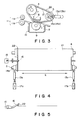
- Figure 3 is a sectional view of an image fixing apparatus according to another embodiment of the present invention.
- Figure 4 is a perspective view of the apparatus of Figure 3, as seen from upper right side.
- Figure 5 is a perspective view of the apparatus of Figure 3, as seen from left side.
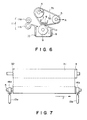
- Figure 6 is a sectional view of an image fixing apparatus according to a further embodiment of the present invention.
- Figure 7 is a perspective view of the apparatus of Figure 6, as seen from upper right side.
- the fixing apparatus comprises a low thermal capacity linear heater 1 which is stationary in use.
- the heater includes aluminum base plate having a high thermal conductivity and an electric resistance material applied thereon. It generates heat upon power supply thereto.
- the resistance material is connected with an electric energy supply source at longitudinal opposite ends.
- the heater 1 is fixed by a low thermal conductivity insulating member (holder) 6 and a supporting member 7 having sufficient rigidity.
- the power supply is in the form of a pulse wave of DC 100 v with the period of 20 msec, for example.
- the temperature is detected by a temperature sensor, and the controlled pulse energy is supplied in accordance with the amount of energy emission. Generally, the pulsewidth ranges between 0.5 - 5 msec.
- the film comprises a heat-resistive resin having a thickness of approximately 20 microns, in the form of a thin endless film.
- the base member is preferably made of polyethylene terephthalate, polyphenylene sulfide, liquid crystal aromatic polyester resin, polyether ether ketone, polysulfone, polyether sulfone, polyether imide, polyimide or the like. From the standpoint of preventing the toner offset, it is preferable the heat resistive resin base is coated with a thin parting layer of fluorinated resin such as polytetrafluoroethylene having increased electric conductivity by dispersing carbon or the like therein.
- the coating is outside the base material.
- the part or parts of the resin base at which a rib or ribs which will be described hereinafter are bonded are not coated with the parting layer, from the standpoint of increasing the bonding strength between the rib and the endless film.
- the total thickness of the film is generally preferable if it is smaller than 50 microns.
- the ribs 3a and 3b are made of rubber or thermo-plastic elastomer material and are bonded to the film 2 with a bonding agent or adhesive material.
- the usable materials of the rib include styrene butadiene rubber, nitrile rubber, chloroprene rubber, ethylenepropylene terpolymer, butyl rubber, isoprene rubber, silicone rubber or another rubber material, and include styrene thermo-plastic elastomer, olefin thermoplastic elastomer, polychloride vinyl thermo-plastic elastomer, urethane thermo-plastic elastomer, polyester thermo-plastic elastomer, polyamide thermo-plastic elastomer, fluorine thermo-plastic elastomer, chlorinated polyethylene thermo-plastic elastomer, or another thermo-plastic elastomer.
- the usable bonding materials include a rubber bonding agent such as neoprene or chloroprene bonding agent, melamine resin bonding agent, phenol resin bonding agent, epoxy bonding agent, vinylacetate bonding agent, ethylenevinylacetate bonding agent, cyanoacrylate bonding agent and polyurethane bonding agent.
- a rubber bonding agent such as neoprene or chloroprene bonding agent, melamine resin bonding agent, phenol resin bonding agent, epoxy bonding agent, vinylacetate bonding agent, ethylenevinylacetate bonding agent, cyanoacrylate bonding agent and polyurethane bonding agent.
- the fixing film 2 is stretched around a driving roller 4 and a follower roller 5 which cooperate with the heater 1 to constitute a film travel path.
- the fixing film 2 is stretched by urging the follower roller 5 in the direction of an arrow A, and is moved in the direction B by the driving roller 4.
- the pressing roller 9 is supported by unshown bearing to rotate following the film 2 travel. It urges the film 2 to the heater 1 with a total pressure of 4 - 7 kg, so that it is rotated in press-contact to the heater 1.
- FIG. 2 is a top plan view of the apparatus of Figure 1.
- Confining members 12A and 12B are provided along an outer periphery of the driving roller 4 at the insides of the ribs 3a and 3b to confine the ribs 3a and 3b. Even if the film 2 tends to laterally shift in a direction indicated by an arrow C, for example, the rib 3a abuts the confining member 12a, so that the lateral shift stops. On the contrary, if the film tends to shift in a direction D, the rib 3b is confined by the confining member 12b, so that the lateral shift in this detection stops.
- an unshown recording sheet is passed along an inlet guide 8 and is introduced into the nip formed between the film 2 and the pressing roller 9.
- the toner image on the recording material is heated and fused by the heat and the pressure provided by the heater 1 and the pressing roller 9, by which the toner image is fixed on the recording material.
- the recording material now having the fixed image is discharged to the outside of the apparatus by sheet discharging rollers 11 along a separation guide 10.
- Rib Polyurethane material having JIS A hardness of 80 degrees.
- Adhesive Epoxy adhesive having JIS A hardness of 86 degrees after being cured.
- the film was incorporated in the fixing apparatus of Figure 1, and the recording materials were continuously processed to fix the images thereon. As a result, it was confirmed that the lateral shift of the film was effectively prevented without peeling of the ribs and without tearing of the film.
- Rib Polyurethane material having JIS A hardness of 90 degrees.
- the film was incorporated in the fixing apparatus of Figure 1, and the recording materials were continuously processed to fix the images thereon. As a result, it was confirmed that the lateral shift of the film was effectively prevented without peeling of the ribs and without tearing of the film, similarly to Example 1.
- Rib Polyurethane material having JIS A hardness of 100 degrees.
- the film was incorporated in the fixing apparatus of Figure 1, and the recording materials were continuously processed to fix the images thereon. As a result, it was confirmed that the lateral shift of the film was effectively prevented without peeling of the ribs and without tearing of the film, similarly to Example 1.
- Rib EPDM material having JIS A hardness of 100 degrees.
- the film was incorporated in the fixing apparatus of Figure 1, and the recording materials were continuously processed to fix the images thereon. As a result, it was confirmed that the lateral shift of the film was effectively prevented without peeling of the ribs and without tearing of the film, similarly to Example 1.
- Rib Polyurethane material having JIS A hardness of 100 degrees.
- the film was incorporated in the fixing apparatus of Figure 1, and the recording materials were continuously processed to fix the images thereon. As a result, it was confirmed that the lateral shift of the film was effective prevented without peeling of the ribs and without tearing of the film.
- Rib Polyurethane material having JIS A hardness of 110 degrees.
- Adhesive Epoxy adhesive having JIS A hardness of 86 degrees after being cured, as in Example 1.
- the film was incorporated in the fixing apparatus of Figure 1, and the recording materials were continuously processed to fix the images thereon.
- the rib or ribs were peeled off the film in several hours, with the result of the lateral shift was not controllable.
- Rib EPDM material having JIS A hardness of 110 degrees.
- the film was incorporated in the fixing apparatus of Figure 1, and the recording materials were continuously processed to fix the images thereon.
- the rib or ribs were peeled off the film in several hours, with the result that the lateral shift of the film was not controllable.
- Rib Polyurethane material having JIS A hardness of 110 degrees.
- the film was incorporated in the fixing apparatus of Figure 1, and the recording materials were continuously processed to fix the images thereon.
- the film was torn.
- the peeling of the rib and the tearing of the film can be prevented by using, as the material of the rib, rubber or thermo-plastic elastomer material having JIS A hardness of 100 degrees or less.
- the inventor has found that the hardness of the adhesive is significantly influential to the durability of the film. Experiments have been conducted with a variety of hardness of the adhesive.
- Rib Polyurethane material having JIS A hardness of 90 degrees.
- Adhesive Epoxy adhesive having JIS A hardness of 78 degrees after being cured.
- the film was incorporated in the fixing apparatus of Figure 1, and the recording materials were continuously processed to fix the images thereon. As a result, it was confirmed that the lateral shift of the film was effectively prevented without peeling of the ribs and without tearing of the film.
- Adhesive Epoxy adhesive having JIS A hardness of 92 degrees after being cured.
- the film was incorporated in the fixing apparatus of Figure 1, and the recording materials were continuously processed to fix the images thereon. As a result, it was confirmed that the lateral shift of the film as effectively prevented without peeling of the ribs and without tearing of the film.
- Adhesive Epoxy adhesive having JIS A hardness of 98 degrees after being cured.
- the film was incorporated in the fixing apparatus of Figure 1, and the recording materials were continuously processed to fix the images thereon. As a result, it was confirmed that the lateral shift of the film was effectively prevented without peeling of the ribs and without tearing of the film.
- Adhesive Polyurethane adhesive having JIS A hardness of 95 degrees after being cured.
- the film was incorporated in the fixing apparatus of Figure 1, and the recording materials were continuously processed to fix the images thereon. As a result, it was confirmed that the lateral shift of the film was effectively prevented without peeling of the ribs and without tearing of the film.
- Adhesive Epoxy adhesive having JIS A hardness of 98 degrees after being cured.
- the film was incorporated in the fixing apparatus of Figure 1, and the recording materials were continuously processed to fix the image thereon. As a result, it was confirmed that the lateral shift of the film was effectively prevented without peeling of the ribs and without tearing of the film.
- Adhesive Epoxy adhesive having JIS A hardness of 105 degrees after being cured.
- the film was incorporated in the fixing apparatus of Figure 1, and the recording materials were continuously processed to fix the images thereon.
- the rib or ribs were peeled off the film in several hours, with the result that the lateral shift of the film was not controllable.
- Adhesive Polyurethane adhesive having JIS A hardness of 110 degrees after being cured.
- the film as incorporated in the fixing apparatus of Figure 1, and the recording materials were continuously processed to fix the images thereon.
- the rib or ribs were peeled off the film in several hours, with the result that the lateral shift of the film was not controllable.
- Adhesive Epoxy adhesive having JIS A hardness of 105 degrees after being cured.
- the film was incorporated in the fixing apparatus of Figure 1, and the recording materials were continuously processed to fix the images thereon.
- the film was torn.
- the rib is made of a material having JIS A hardness of 100 degrees or less and if the adhesive used has a JIS A hardness of 100 degrees or less after being cured.
- Figure 3 is a sectional view of an image fixing apparatus of this embodiment wherein the lateral shift of the film is detected using the rib at the end of the film, in order to suppress the lateral shift of the film.
- Figure 4 is a perspective view of the apparatus of Figure 3, as seen from upper right side.
- Figure 5 is a right side view of the apparatus of Figure 3.
- a lever 16 functioning as an actuator for the sensor 15 is contacted to a part of the rib 22 on the film 21. If the film 21 is shifted laterally in the direction of an arrow E, the lever 16 rotates to actuate or deactuate the sensor.
- solenoids 17A and 17B are energized or deenergized, thus controlling the urging force applied by the urging means 13a and 13b. In this manner, the lateral shift direction can be changed to assure the control.
- the fixing film having the rib made of the material having JIS A hardness of 100 degrees or less, as in the embodiment of Figure 1, which is bonded thereto with an adhesive having a JIS A hardness of 100 degrees or less after being cured was effective, because the detection of the lateral shift of the film was assured without peeling of the rib and the tearing of the film.
- Figure 6 is a sectional view of an image fixing apparatus of another type wherein the rib is confined to prevent the lateral shifting of the film.
- the rib 32 is formed on an inside surface of the fixing film 31 and at one lateral end.
- Figure 7 is a perspective view of the apparatus of Figure 6, as seen from the film 31 is stretched by urging the tension roller 5 in the direction A by urging means 13a and 13b, and is conveyed in a direction B by a driving roller 4.
- the film 31 always receives a lateral shifting force in a direction indicated by an arrow F during its travel, by adjusting the inclination or inclinations of the rollers 4 and/or 5 or the like or by adjusting the urging force by the urging means 13a and 13b.
- the rib 32 is abutted to the end surfaces of the driving roller 4, the tension roller 5 and the insulative member 6, so that the film is not shifted in the direction F.
- the film having the rib of the material having a JIS A hardness of 100 degrees or less which is bonded thereto with an adhesive having a JIS A hardness of 100 degrees or less after being cured is effectively used, since the lateral shifting of the film can be prevented without peeling of the rib and the tearing of the film.
- the rib is prevented from being peeled off the film, and the film is prevented from being torn, and therefore, the lateral shift of the film can be stably controlled and regulated in a long period of time.
- An endless film includes an endless film member; a rib having a JIS A hardness of not more than 100 degrees; and an adhesive layer between the film and the rib, the adhesive layer having a JIS A hardness after being cured.
Landscapes
- Physics & Mathematics (AREA)
- General Physics & Mathematics (AREA)
- Fixing For Electrophotography (AREA)
Applications Claiming Priority (2)
| Application Number | Priority Date | Filing Date | Title |
|---|---|---|---|
| JP66106/90 | 1990-03-16 | ||
| JP2066106A JP2862317B2 (ja) | 1990-03-16 | 1990-03-16 | エンドレス樹脂フィルム及び加熱装置 |
Publications (3)
| Publication Number | Publication Date |
|---|---|
| EP0446946A2 true EP0446946A2 (de) | 1991-09-18 |
| EP0446946A3 EP0446946A3 (en) | 1992-07-08 |
| EP0446946B1 EP0446946B1 (de) | 1995-06-28 |
Family
ID=13306309
Family Applications (1)
| Application Number | Title | Priority Date | Filing Date |
|---|---|---|---|
| EP91104047A Expired - Lifetime EP0446946B1 (de) | 1990-03-16 | 1991-03-15 | Endlosband und damit ausgerüstetes Heizgerät |
Country Status (4)
| Country | Link |
|---|---|
| US (1) | US5119143A (de) |
| EP (1) | EP0446946B1 (de) |
| JP (1) | JP2862317B2 (de) |
| DE (1) | DE69110709T2 (de) |
Cited By (2)
| Publication number | Priority date | Publication date | Assignee | Title |
|---|---|---|---|---|
| EP0519454A3 (en) * | 1991-06-20 | 1993-09-29 | Canon Kabushiki Kaisha | Lateral shift preventing mechanism for endless belt |
| EP1762911A1 (de) * | 2005-09-13 | 2007-03-14 | Canon Kabushiki Kaisha | Bilderheizvorrichtung mit induktionsgeheiztem Band |
Families Citing this family (16)
| Publication number | Priority date | Publication date | Assignee | Title |
|---|---|---|---|---|
| US5196895A (en) * | 1991-02-15 | 1993-03-23 | Canon Kabushiki Kaisha | Heating apparatus using endless film |
| JPH04284481A (ja) * | 1991-03-14 | 1992-10-09 | Hitachi Koki Co Ltd | 熱定着装置 |
| JP3200080B2 (ja) * | 1991-03-19 | 2001-08-20 | キヤノン株式会社 | エンドレスベルトへのリブの接着方法 |
| JP2986126B2 (ja) * | 1991-07-19 | 1999-12-06 | キヤノン株式会社 | 像加熱装置 |
| US5257078A (en) * | 1991-07-19 | 1993-10-26 | Canon Kabushiki Kaisha | Image heating apparatus regulating shift of endless fixing film |
| JP2989953B2 (ja) * | 1992-02-10 | 1999-12-13 | 富士ゼロックス株式会社 | 定着装置及び定着用エンドレスベルト |
| JPH05346746A (ja) * | 1992-06-16 | 1993-12-27 | Nec Niigata Ltd | 画像形成装置の定着装置 |
| JP3299103B2 (ja) * | 1996-01-11 | 2002-07-08 | キヤノン株式会社 | 円筒形状物及び円筒形状物の製造方法及び画像形成装置用のフィルム |
| JPH09258583A (ja) * | 1996-03-22 | 1997-10-03 | Canon Inc | 管状フィルム、及び、管状フィルムの製造方法、並びに、管状フィルムを用いた画像形成装置 |
| US5960243A (en) * | 1996-07-03 | 1999-09-28 | Fuji Xerox Co., Ltd. | Fixation apparatus and image forming apparatus |
| JP2002284384A (ja) * | 2001-03-28 | 2002-10-03 | Canon Inc | 搬送ベルト、該搬送ベルトの製造方法、および前記搬送ベルトを備えた画像形成装置 |
| JP2003295649A (ja) * | 2002-03-29 | 2003-10-15 | Toshiba Tec Corp | 定着装置 |
| JP4609104B2 (ja) * | 2005-02-15 | 2011-01-12 | 富士ゼロックス株式会社 | 定着装置および画像形成装置 |
| JP5936331B2 (ja) | 2011-11-10 | 2016-06-22 | キヤノン株式会社 | 像加熱装置 |
| JP5949424B2 (ja) * | 2012-10-15 | 2016-07-06 | 富士ゼロックス株式会社 | 定着装置および画像形成装置 |
| JP2015052681A (ja) * | 2013-09-06 | 2015-03-19 | 株式会社リコー | 定着装置及び画像形成装置 |
Family Cites Families (6)
| Publication number | Priority date | Publication date | Assignee | Title |
|---|---|---|---|---|
| DE683461C (de) * | 1937-03-20 | 1939-11-07 | Leitz Ernst Gmbh | Filmstreifen mit durch Einnaehen von Faeden o. dgl. gewonnener Randverdickung und Vorichtung zu seiner Herstellung |
| US3811828A (en) * | 1970-10-29 | 1974-05-21 | Ricoh Kk | Process and device for heating and fixing an image upon a recording medium |
| DE3854801T2 (de) * | 1987-06-16 | 1996-06-13 | Canon Kk | Bildfixiergerät |
| IT1213910B (it) * | 1987-10-09 | 1990-01-05 | F I R I E Di Giorgio Sansone S | Nastro trasportatore e o accompagnatore a bordi nervati per la guida su cilindri di rinvio e trascinamento |
| US5017969A (en) * | 1988-05-30 | 1991-05-21 | Canon Kabushiki Kaisha | Device having movable belt |
| DE68921531T2 (de) * | 1988-10-03 | 1995-07-27 | Canon Kk | Bilderzeugungsgerät. |
-
1990
- 1990-03-16 JP JP2066106A patent/JP2862317B2/ja not_active Expired - Lifetime
-
1991
- 1991-03-14 US US07/669,469 patent/US5119143A/en not_active Expired - Lifetime
- 1991-03-15 DE DE69110709T patent/DE69110709T2/de not_active Expired - Fee Related
- 1991-03-15 EP EP91104047A patent/EP0446946B1/de not_active Expired - Lifetime
Cited By (6)
| Publication number | Priority date | Publication date | Assignee | Title |
|---|---|---|---|---|
| EP0519454A3 (en) * | 1991-06-20 | 1993-09-29 | Canon Kabushiki Kaisha | Lateral shift preventing mechanism for endless belt |
| US5343279A (en) * | 1991-06-20 | 1994-08-30 | Canon Kabushiki Kaisha | Lateral shift preventing mechanism for endless belt |
| EP1762911A1 (de) * | 2005-09-13 | 2007-03-14 | Canon Kabushiki Kaisha | Bilderheizvorrichtung mit induktionsgeheiztem Band |
| US7424261B2 (en) | 2005-09-13 | 2008-09-09 | Canon Kabushiki Kaisha | Image heating apparatus |
| CN100511025C (zh) * | 2005-09-13 | 2009-07-08 | 佳能株式会社 | 图像加热设备 |
| US7684745B2 (en) | 2005-09-13 | 2010-03-23 | Canon Kabushiki Kaisha | Image heating apparatus |
Also Published As
| Publication number | Publication date |
|---|---|
| JPH03266870A (ja) | 1991-11-27 |
| EP0446946B1 (de) | 1995-06-28 |
| DE69110709T2 (de) | 1995-12-21 |
| US5119143A (en) | 1992-06-02 |
| DE69110709D1 (de) | 1995-08-03 |
| JP2862317B2 (ja) | 1999-03-03 |
| EP0446946A3 (en) | 1992-07-08 |
Similar Documents
| Publication | Publication Date | Title |
|---|---|---|
| EP0446946B1 (de) | Endlosband und damit ausgerüstetes Heizgerät | |
| EP1496406B1 (de) | Bilderwärmungsgerät | |
| US5262834A (en) | Image fixing apparatus | |
| US8478180B2 (en) | Image heating apparatus | |
| US7493074B2 (en) | Fixing device, sheet member, and image forming apparatus | |
| JP4478342B2 (ja) | 定着装置 | |
| US9517888B2 (en) | Endless belt and image heating apparatus including the endless belt | |
| US5828035A (en) | Web-type heating apparatus with movably supported heater | |
| US10545442B1 (en) | Image heating apparatus | |
| US7890041B2 (en) | Fixing device and image forming apparatus | |
| US6952538B2 (en) | Image forming apparatus with heater having bias applying portion setting bias based on sheet width | |
| JP4516593B2 (ja) | 定着装置及び画像形成装置 | |
| JP4681966B2 (ja) | 画像定着装置 | |
| JP2005077872A (ja) | 定着装置および画像形成装置 | |
| JP2016180825A (ja) | 加熱部材、定着装置及び画像形成装置 | |
| JP4123113B2 (ja) | 定着装置 | |
| JPH06118817A (ja) | 加熱装置 | |
| JP2005077847A (ja) | 定着装置および画像形成装置 | |
| US5266134A (en) | Rib mounting method for endless belt | |
| JP2006154540A (ja) | 定着装置及び画像形成装置 | |
| JPH0481791B2 (de) | ||
| JPH11345680A (ja) | 加熱ヒータ、温度検知部材、加熱装置、及び画像形成装置 | |
| JPH0527631A (ja) | 加熱装置 | |
| JP2003114586A (ja) | 加熱定着装置 | |
| JPH096156A (ja) | 像加熱装置 |
Legal Events
| Date | Code | Title | Description |
|---|---|---|---|
| PUAI | Public reference made under article 153(3) epc to a published international application that has entered the european phase |
Free format text: ORIGINAL CODE: 0009012 |
|
| 17P | Request for examination filed |
Effective date: 19910415 |
|
| AK | Designated contracting states |
Kind code of ref document: A2 Designated state(s): DE FR GB IT NL |
|
| PUAL | Search report despatched |
Free format text: ORIGINAL CODE: 0009013 |
|
| AK | Designated contracting states |
Kind code of ref document: A3 Designated state(s): DE FR GB IT NL |
|
| 17Q | First examination report despatched |
Effective date: 19930909 |
|
| GRAA | (expected) grant |
Free format text: ORIGINAL CODE: 0009210 |
|
| ITF | It: translation for a ep patent filed | ||
| AK | Designated contracting states |
Kind code of ref document: B1 Designated state(s): DE FR GB IT NL |
|
| REF | Corresponds to: |
Ref document number: 69110709 Country of ref document: DE Date of ref document: 19950803 |
|
| ET | Fr: translation filed | ||
| PLBE | No opposition filed within time limit |
Free format text: ORIGINAL CODE: 0009261 |
|
| STAA | Information on the status of an ep patent application or granted ep patent |
Free format text: STATUS: NO OPPOSITION FILED WITHIN TIME LIMIT |
|
| 26N | No opposition filed | ||
| REG | Reference to a national code |
Ref country code: GB Ref legal event code: IF02 |
|
| PGFP | Annual fee paid to national office [announced via postgrant information from national office to epo] |
Ref country code: NL Payment date: 20090318 Year of fee payment: 19 |
|
| PGFP | Annual fee paid to national office [announced via postgrant information from national office to epo] |
Ref country code: GB Payment date: 20090331 Year of fee payment: 19 |
|
| PGFP | Annual fee paid to national office [announced via postgrant information from national office to epo] |
Ref country code: DE Payment date: 20090331 Year of fee payment: 19 Ref country code: IT Payment date: 20090312 Year of fee payment: 19 |
|
| PGFP | Annual fee paid to national office [announced via postgrant information from national office to epo] |
Ref country code: FR Payment date: 20090325 Year of fee payment: 19 |
|
| REG | Reference to a national code |
Ref country code: NL Ref legal event code: V1 Effective date: 20101001 |
|
| GBPC | Gb: european patent ceased through non-payment of renewal fee |
Effective date: 20100315 |
|
| REG | Reference to a national code |
Ref country code: FR Ref legal event code: ST Effective date: 20101130 |
|
| PG25 | Lapsed in a contracting state [announced via postgrant information from national office to epo] |
Ref country code: FR Free format text: LAPSE BECAUSE OF NON-PAYMENT OF DUE FEES Effective date: 20100331 Ref country code: NL Free format text: LAPSE BECAUSE OF NON-PAYMENT OF DUE FEES Effective date: 20101001 |
|
| PG25 | Lapsed in a contracting state [announced via postgrant information from national office to epo] |
Ref country code: DE Free format text: LAPSE BECAUSE OF NON-PAYMENT OF DUE FEES Effective date: 20101001 |
|
| PG25 | Lapsed in a contracting state [announced via postgrant information from national office to epo] |
Ref country code: IT Free format text: LAPSE BECAUSE OF NON-PAYMENT OF DUE FEES Effective date: 20100315 Ref country code: GB Free format text: LAPSE BECAUSE OF NON-PAYMENT OF DUE FEES Effective date: 20100315 |