EP0443423B1 - Verfahren und Anordnung zur Ausführung von Sicherheitswegbefehlen - Google Patents
Verfahren und Anordnung zur Ausführung von Sicherheitswegbefehlen Download PDFInfo
- Publication number
- EP0443423B1 EP0443423B1 EP91101985A EP91101985A EP0443423B1 EP 0443423 B1 EP0443423 B1 EP 0443423B1 EP 91101985 A EP91101985 A EP 91101985A EP 91101985 A EP91101985 A EP 91101985A EP 0443423 B1 EP0443423 B1 EP 0443423B1
- Authority
- EP
- European Patent Office
- Prior art keywords
- trusted
- command
- user
- subject
- tcb
- Prior art date
- Legal status (The legal status is an assumption and is not a legal conclusion. Google has not performed a legal analysis and makes no representation as to the accuracy of the status listed.)
- Expired - Lifetime
Links
Images


Classifications
-
- G—PHYSICS
- G06—COMPUTING OR CALCULATING; COUNTING
- G06F—ELECTRIC DIGITAL DATA PROCESSING
- G06F21/00—Security arrangements for protecting computers, components thereof, programs or data against unauthorised activity
- G06F21/50—Monitoring users, programs or devices to maintain the integrity of platforms, e.g. of processors, firmware or operating systems
- G06F21/52—Monitoring users, programs or devices to maintain the integrity of platforms, e.g. of processors, firmware or operating systems during program execution, e.g. stack integrity ; Preventing unwanted data erasure; Buffer overflow
- G06F21/53—Monitoring users, programs or devices to maintain the integrity of platforms, e.g. of processors, firmware or operating systems during program execution, e.g. stack integrity ; Preventing unwanted data erasure; Buffer overflow by executing in a restricted environment, e.g. sandbox or secure virtual machine
-
- G—PHYSICS
- G06—COMPUTING OR CALCULATING; COUNTING
- G06F—ELECTRIC DIGITAL DATA PROCESSING
- G06F2211/00—Indexing scheme relating to details of data-processing equipment not covered by groups G06F3/00 - G06F13/00
- G06F2211/009—Trust
Definitions
- This invention relates to techniques for improving security in a computer system. More specifically, this invention concerns a method, an apparatus and a computer program product for implementing trusted commands through both trusted and untrusted code.
- US Patent 4,918,653 proposes a trusted-path mechanism for an operating system to inhibit Trojan-horse programs.
- SAK Secure Attention key
- TBC trusted computing base
- 4,797,853 proposes a direct memory access controller that controls access to memory and allows for the passing of data during a single clock cycle.
- the controller acts as a bus master it causes the generation of one of three access signals which determine the access range of the controller. Attempts to address memory space without access permission result in the generation of an error signal.
- U.S. Patent No. 4,754,326 proposes a method for preventing unauthorized access to a computing system through the use of a check to determine user authorization coupled with the selection of parameters by the user. A "lock" feature is employed whereby each user of the system selects a one-to-six character password which "locks" the system.
- U.S. Patent No. 4,751,669 proposes a videotext decoded apparatus which is used, inter alia, to provide easy log-on and log-off procedures for videotext users. Certain commands (i.e., log-out) require confirmation by the user before they will execute.
- U.S. Patent No. 4,677,546 and U.S. Patent No. 4,669,043 propose a memory access controller (MAC). The MAC controls access to the memory hierarchy.
- US 4,677,546 proposes a method whereby protected code data may be accessed by redefining regions of an address space with reference gates.
- FILER Version 2.20
- User Documentation describes a FILER program that has been available on the publicly accessible CompuServe information service prior to the priority date of this application.
- the FILER program repeats back potentially dangerous user commands and requests confirmation from the user prior to execution. For example, a user may instruct the FILER program to erase a group of files using "wild card” designators (e.g., "DEL*.*"). Prior to executing the command, the program displays a list of the specific files matching the wild card designator that will be erased and asks for confirmation that the files should be deleted.
- wild card designators e.g., "DEL*.*”
- the /S command-line option of the program permits the user to confirm selectively the deletion of individual files matching the wild card designator.
- UNIX operating system no specific reference document.
- a number of simple shell commands translate directly into system calls. This feature is well documented.
- the "rm” command corresponds to the "unlink” system call and results in removal of a file.
- the "rmdir” command corresponds to the "rmdir” system call and results in removal of a directly.
- the "chmod” command corresponds to the "chmod” system call and results in a change to the protection mode of a file.
- the prior art includes an untrusted program parsing a command and then executing the command by calling a trusted service that executes in a trusted computing environment, namely kernal mode.
- KSOS DOD Kernalized Secure Operating System
- Section 3.1 discusses the security kernel concept; section 3.1.1 includes a background discussion of trusted processes.
- Section 3.1.5 beginning at page 9, discusses a proposed secure terminal interface, including the concept of blocking the normal path when the terminal user presses a reserved attention character such as the BREAK key.
- Figure 2 of the paper illustrates the proposal.
- EP-A-326699 discloses a data processing network including a data processor at a server node which can run an untrusted process, and also including provision for establishment of a trusted path between a data processor at a client node and a trusted process in the processor at the remote server node.
- a “secure” computer system generally includes some type of “reference validation” system. These reference validation systems (known as reference monitors) are responsible for enforcing the security rules (security policy) for a given computer system.
- Reference monitors mediate all access to "objects" by "subjects".
- Objects are passive entities that contain or receive information. Access to an object implies access to the information that it contains.
- Subjects are active entities, generally in the form of a person, process or device that cause information to flow among objects or change the system state. A subject may ordinarily reference its own, subject-internal information without the involvement of the reference monitor. Reference monitors controlling such access to objects by subjects are known in the art, and may utilize a security kernel approach.
- TDB trusted computing base
- TCBs attempt to meet the control objectives set out in the Orange Book. Compliance with these objectives inspires user confidence, and increases the overall desirability of a computer system. These objectives deal with:
- the security policy objective entails enforcement by the TCB of the desired security rules. These security rules are designed to limit the access to and dissemination of information in a precisely defined manner.
- Security policies may include provisions for the enforcement of both mandatory and discretionary access control rules.
- Mandatory access control rules control access based directly on comparisons of the user's security level and the sensitivity level of the information being sought.
- Discretionary access rules control and limit access to identified individuals who have been determined to have a need-to-know.
- These access control rules call for associating with each user identification code a statement indicating the user's access rights.
- This statement often includes information representing the user's security level (for mandatory control purposes), and membership in groups (for discretionary control purposes).
- the accountability objective calls for providing each user with an individual user identification code (often called a "user name”) and for the TCB to be able to recognize the code and ensure that it is being used by its proper user. This may be done by checking the user's password. This ensuring the user's identity is known as "authentication.”
- the assurance objective is especially important in the present context. That objective is concerned with taking steps to ensure that the security policy is correctly implemented and that the TCB accurately mediates and enforces the intent of that policy. Steps may be taken to insure that each portion of the TCB is assured. To accomplish this objective, two types of assurance are needed.
- the first type of assurance is life-cycle assurance. This type of assurance refers to steps taken to ensure that the computer system is designed, developed, and maintained using formalized and rigorous control standards.
- the second type of assurance is operational assurance.
- Operational assurance deals with the features and system architecture used to ensure that the security policy is uncircumventably enforced during system operation. All of the software (sometimes referred to informally in the art as "code") in the TCB is generally analyzed to determine the assurance level of the system.
- a TCB is usually operated in conjunction with a substantial amount of software, such as text editors and other applications, operating within the security policy of the TCB.
- this untrusted software asks the TCB for access to objects when the user or the untrusted software requires them.
- the majority of the user's requests to the TCB, and the majority of the information that a user obtains from the TCB, are handled through the agency of untrusted software.
- This untrusted software is by nature in danger of compromise and vulnerable to bugs.
- malicious or malfunctioning untrusted software could compromise the enforcement of the security policy.
- TCBs cannot distinguish between requests faithfully made by the untrusted software on command from a user and either (1) requests made by the untrusted software at its own initiative (2) or requests that misrepresent the user's actual command. For example, if commands issued by an authorized user to change certain users' security levels were made through the agency of untrusted software, it would be possible for malicious or malfunctioning untrusted software to inappropriately raise the security level of a user. Such inappropriate raising of a security level could result in the disclosure of sensitive information.
- TCBs generally cannot ensure that displays made by untrusted software are faithful. This poses problems in that if displays of audit records were made through the use of untrusted software it would be possible for malicious untrusted software to misrepresent these audit records to hide suspicious activities.
- a trusted path is a mechanism by which the user can communicate directly with the TCB.
- a trusted path may only be activated by the user or the TCB and cannot be imitated by untrusted code.
- Such a trusted path is a positive TCB-to-user connection that bypasses all untrusted software.
- the Orange Book requires a trusted path for all systems that are given a security rank of B2 or above.
- a "trusted command” (also known as a trusted-path command) is a command which requires a trusted path between the user and the TCB for execution.
- the specific security policy of a computer system will determine which commands are defined as trusted commands. For example, commands relating to changes of the security levels of users would be trusted commands.
- the parser performs the basic interpretation of user commands by translating a human-readable representation of a user command (e.g., a command typed by a user at a keyboard) into a machine-readable representation known as the binary representation, or the parsed command.
- a user command may consist of a group of words, typed by the user, specifying some action to be taken.
- the user command may also specify one or more variations or options of that action.
- parsers allow these option words to be typed in any order without changing the meaning of the user command. Also, most parsers allow the user to type the words in either full or abbreviated form. In some instances, several possible abbreviations exist. Further, in most parsers, the user may vary the spacing between the words without changing the meaning of the command. Some parsers also check user commands for proper syntax, and report errors to the user prior to execution of the command. Other parsers prompt the user for missing information, avoiding the need to completely retype an incomplete command.
- Prior-art trusted software systems have included the parser for trusted commands, and thus the associated code, within the TCB. In these systems every trusted command was parsed and executed exclusively by trusted code. The inclusion of the parsing code in the TCB was regarded as necessary for proper system operation.
- the present invention provides a number of advantages over the prior art. By reducing the complexity of the TCB, the amount of trusted code that must be verified or assured is reduced. In addition, the general usability of the system is increased, because the improved method of processing trusted commands allows for the implementation of added computing functions at little or no additional cost in TCB assurance.
- the present invention includes an improved method for the execution of trusted commands according to claim 1.
- the required steps for processing a trusted command are split between trusted and untrusted code.
- the amount of trusted code in the TCB may be significantly reduced.
- the present invention further provides a computer program product according to claim 12 and a computer apparatus according to claim 13.
- the parsing of a command can be comparatively difficult, and often requires large amounts of complex code.
- it is relatively simple to translate the parsed representation of a command into a standard human-readable representation for display to the user. This is in part because a single, standard human-readable display representation may be associated with each parsed representation.
- the present invention takes advantage of this fact by parsing the trusted commands in untrusted code prior to execution in the TCB.
- the present invention includes a computer system which includes a TCB operating as a reference monitor. Included in the TCB is the security-relevant code necessary for the actual execution of a trusted command.
- TCB Associated with the TCB are one or more untrusted subjects (e.g. processes). Each such subject has particular access rights, which may include a security level. These untrusted subjects communicate only with the involvement of the TCB. The TCB allows communication only as permitted by the system's security policy. Each untrusted subject is substantially independent.
- untrusted software is generally run.
- This untrusted software may include an untrusted operating system (UOS), and generally includes applications such as text editors.
- UOS untrusted operating system
- the untrusted code includes the non-security relevant functions necessary for the execution of a trusted command.
- Attached to the computer system are several user terminals. These user terminals allow the user to exchange information with the computer system. All terminal activity is seen first by the TCB. A secure-attention key is dedicated for use on each terminal attached to the computer system. The TCB is designed to recognize and trap this key signal. Activation of this key by the user establishes a trusted path between the user terminal and the TCB. Alternate methods for establishing a trusted path may be utilized.
- the TCB is generally provided with a limited number of "direct” user commands (direct commands). Because of this, the majority of the user's activities will take place in the untrusted operating system.
- the untrusted code in the UOS checks the syntax of the command and may prompt for missing parameters; then the untrusted parser converts the command into a parsed representation that will be referred to here for convenience as the "binary representation.” In some instances, command procedures and application-issued trusted commands will also be parsed and translated into a binary representation.
- This binary representation is then passed from the UOS to the TCB.
- the TCB initially associates the binary representation with a physical terminal, and copies the binary representation into a memory buffer assigned to that terminal.
- the untrusted code in the UOS may prompt the user to activate the secure-attention key. If this key is activated, a trusted path will be established between the user terminal and the TCB. Alternate methods may be employed to initiate this trusted path. A randomly generated process ID, which may be generated at login, may be utilized to prevent untrusted code from simulating a trusted path.
- Subsequent activity by the TCB depends on the type of command that is represented by the binary representation. If the command is one that will not modify any information, i.e., a request to view information, the TCB verifies that the user has the necessary access rights, and attempts to execute the binary representation. A human-readable standard representation of the binary command received by the TCB is displayed along with the information.
- the TCB displays for confirmation a standard human-readable form of the command, along with an indication of what the result of command execution will be. The user is then requested to confirm (by typing a response via the trusted path) that the displayed command was received correctly and should be executed.
- This confirmation allows the user to ensure that untrusted code has not performed an unauthorized modification of the user's original command. Also, confirmation allows for the detection by the user of any errors that may have occurred during the parsing process. In situations where the binary representation represents a command procedure or an application-issued trusted command, the confirmation ensures that the command proposed by the untrusted software is acceptable to the user.
- the TCB checks to ensure that the user has the necessary access rights to execute the command and, if so, attempts to execute the command.
- a distinct advantage of the present invention arises from the fact that the execution of a trusted command is split between trusted code and untrusted code. The actual parsing of the command occurs in untrusted code.
- the trusted code included in the TCB checks the parsed command for correctness and displays it to the user in human readable form. This checking and display of a parsed command requires substantially less code than is required to parse a command.
- the command parser since the command parser is included in the untrusted code, the amount of trusted code in the TCB is minimized. This lowers the difficulty of trusted system assurance, and increases the amount of confidence that may be placed in a system.
- the user interface is separate from the underlying functions performed by the TCB. This allows for implementation of alternate UOS-to-user interfaces without major modification of the TCB. Further, the amount of time and effort to develop such a command interface is reduced.
- a still further advantage is that more useability features may be provided without substantially increasing the complexity of the TCB. Examples of such useability features are command-line editing and recall.
- a specific embodiment of the present invention is described with respect to a computer which supports various user processes and may operate in a multiuser environment.
- a VAX model computer available from Digital Equipment Corporation (DEC)
- DEC Digital Equipment Corporation
- the present invention may be readily applied to various types of computer systems including PC networks, stand-alone multiuser computer systems, or single user computer systems, to name a few examples.
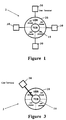
- FIG. 1 illustrates a preferred computing environment which is generally designated by the reference numeral 2.
- a trusted computing base (TCB) 10 resides at the center of the computer system.
- the TCB 10 acts as a reference monitor in that access to information is mediated by the TCB 10.
- the TCB 10 may be a secure kernel residing under the general operating system of a computer system.
- the TCB 10 comprises trusted code residing underneath a VMS or Ultrix system (the UOS).
- the TCB 10 enforces a security policy which identifies permissible modes of access between users or computer processes (subjects) and files, memory segments or other objects. Access to stored information is mediated by the TCB 10, so that the TCB 10 may determine whether a particular user or untrusted subject can access particular information. In order for the TCB 10 to fulfill its protective function, it must take into account the three requirements discussed above: (1) completeness, (2) isolation, and (3) verifiability.
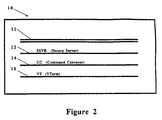
- the TCB 10 may comprise several distinct layers. Each layer of the TCB 10 comprises trusted code. This trusted status is indicated by the security boundary 11. In one embodiment, layers of particular interest are the layers to be referred to as: secure server (SSVR) 12, Command Conveyor (CC) 14, and Virtual Terminals (VT) 16.
- SSLVR secure server
- CC Command Conveyor
- VT Virtual Terminals
- the TCB 10 includes the trusted code necessary to ensure compliance with the Orange Book requirements. In alternate embodiments, the trusted code may ensure compliance with different systems of security requirements.
- the TCB 10 also includes the code which actually executes the requested trusted command, as discussed below.
- Each untrusted subject is generally supported by an untrusted process. This process may spend time in one of two “modes.”
- the first mode in which the process usually runs, is known as “user mode.”
- This mode is a restricted hardware state such as the VAX user mode that is known in the art.
- This process may also spend time executing trusted code in an all-powerful hardware state.
- This state is represented by the VAX "kernel mode”, which is known in the art.
- This state may be triggered by a request by the untrusted subject of the security kernel. Such a request may be made in a conventional manner and is commonly called a "kernel call.”
- This mode may also be triggered by asynchronous events (e.g. the completion of an Input/Output request previously made by the untrusted subject).
- the TCB 10 also has one process associated with each terminal that communicates with the user over the trusted path. This process is known in the art as an "execution thread.” In this embodiment, each execution thread shares its address space with other TCB execution threads. An advantage of such sharing is economy of machine resources. Full-blown processes, each with its own address space, would require far more machine resources than if such address space sharing is employed.
- CC 14 which provides the interprocess communication for passing parsed commands between the processes that support the untrusted subjects, and the processes within the TCB 10 that support the trusted path.
- the untrusted code may submit to the TCB 10 the parsed representation of the trusted command by making a kernel call.
- the kernel call causes the process supporting the untrusted subject to switch to the all-powerful hardware state and to begin to execute trusted code designed to handle kernel calls.
- This trusted code recognizes the nature of the kernel call and calls the CC 14.
- the CC 14 then obtains and copies the binary representation of the trusted command into protected memory and puts it in a global data structure that supports the process associated with the terminal in question.
- the VT 16 layer includes the trusted code which monitors all terminal activity and checks for activation of the secure-attention key.
- the VT 16 layer also includes code which tracks which physical terminal is associated with a particular user or untrusted subject.
- the UOS 20 generally comprises untrusted code and may include a traditional operating system such as Ultrix or VMS. Alternate constructions are envisioned where the UOS 20 includes any untrusted code. It will be appreciated that the system may include untrusted code that is separate from TCB 10 and UOS 20.
- UOS 20 Most user activity will occur in the UOS 20.
- a specific UOS 20 may run in each untrusted subject.
- terminals 30 Associated with the computer system are one or more user terminals 30. These terminals 30 may be conventional in construction, in that they allow the user to exchange information with the computer system. Either “intelligent” or “dumb” terminals may be used. Examples of such dumb terminals are the well-known VT series 200 and 300 terminals. These terminals are available from Digital Equipment Corporation or its authorized dealers.
- a particularly useful terminal includes control programming that is designed with security features in mind, such as is described in EP-0 436 365, entitled “Method for Securing Terminal and Terminal Apparatus for Use with the Method,” by Wei-Ming Hu, Clifford E. Kahn, Andrew H. Mason, and Peter A. Sichel.
- a keyboard is attached to each user terminal.
- Each keyboard includes a key employed as a secure-attention key. This key is utilized to establish a trusted path between a user terminal and the TCB 10.
- the secure-attention key is an "out-of-band key" for the UOS 20. It is desirable that the signal sent by the terminal upon activation of the secure-attention key is generally not utilized by the applications running in the UOS 20. An out-of-band key is convenient since it does not restrict the traditional number of user keys and the signal is sent immediately, even if other I/O is pending.
- the secure-attention key may be the BREAK key on the terminal keyboard.
- the BREAK key signal may be transmitted, even from a locked keyboard.
- the signal generated by activation of the BREAK key comes in ahead of other characters in the keyboard buffer.
- a further advantage of utilizing the BREAK key is that software running in the UOS 20 cannot get certain terminals to send that character.
- the TCB 10 generally operates as a reference monitor.
- the TCB 10 Upon initial login or at other times when the user is not connected to a process in the UOS 20 (e.g., an application program), the TCB 10 responds to a comparatively limited series of "direct commands," which may include a CONNECT command to connect to an untrusted subject.
- direct commands may include a CONNECT command to connect to an untrusted subject.
- the TCB 10 checks for the secure-attention signal; if a signal other than the secure-attention signal is received, the TCB 10 passes the signal to the connected untrusted subject.
- the trusted code in the VT layer 16 monitors all terminal activity.
- the SSVR is signaled in a conventional manner (such as by advancing an event count or activating a flag).
- Code in the SSVR 12 recognizes this signaling and establishes a trusted path between the user terminal and itself. In this manner, the secure-attention key signal is trapped by the TCB 10.
- the TCB 10 make displays when a trusted path is established and exited by the user.
- the TCB 10 sends a reset command sequence to the physical user terminal 30 to assure that it is in a known state. This is done in part to ensure that the information displayed to the user by the TCB 10 is in the intended form, (e.g., correct font).
- a particularly useful sequence of commands to implement the reset command sequence is described in the aforementioned copending U.S. patent application by Hu et at.
- the secure server 12 When the secure-attention key is activated, other than in connection with the issuance of a trusted command, the secure server 12 displays a particular banner and prompt (for example: "SSVR>" together with the user's process identifier, discussed below), to indicate that the user is conversing interactively with trusted code. If the secure-attention key was activated in connection with the issuance of a trusted command, the secure server 12 displays to the user some indication of what is to be done, as discussed below.
- a banner and prompt for example: "SSVR>" together with the user's process identifier, discussed below
- the TCB 10 When command execution is complete, or when the user establishes or reactivates a session with the UOS 20, the TCB 10 issues a message to inform the user that he/she is breaking the trusted path.
- the memory in the physical terminal may be cleared by the TCB. This is done to protect trusted information from both untrusted code and unclassified persons who may later use the terminal. A particularly advantageous method of clearing the terminal memory is described in the aforementioned co-pending patent application.
- the number of direct user commands available from the TCB 10 is preferably limited to reduce the complexity of the TCB 10. Generally, a command is direct if:
- the user will converse with the TCB 10 through the SSVR 12.
- the user conversing with the SSVR 12 may be restricted to commands which allow him/her to establish (connect) or end (disconnect) a computing session in the general UOS 20. Further commands may be added, such as allowing the user to view the existing UOS 20 sessions or change his or her password, but it is generally desirable to limit the number of available commands in the TCB 10. It is further desirable to ensure simplicity in the syntax of these direct commands.
- the user may first login to the computing environment through the SSVR 12. To initiate a login, the user activates the secure-attention key (or performs some other action to gain the attention of the SSVR 12). As discussed above, this establishes a trusted path between the user terminal and the TCB 10. Alternate embodiments are envisioned wherein other methods are employed to establish a trusted path.
- the SSVR 12 prompts the user for his/her specific user name and password.
- the various layers in the TCB 10 perform well-known security checks to ensure that the user has the necessary access rights to login at the terminal. If the user possesses the required access rights, a computing session is established in the SSVR 12.
- the user's security information is stored by the TCB 10.
- the TCB 10 also stores in memory a unique identifier of the user process. This information is maintained in memory by the TCB 10 until the user logs out of the TCB 10.
- the user will generally choose to establish a computing session with an untrusted subject.
- an untrusted subject may include application programs residing in the UOS 20.
- the user's physical terminal 30 is associated with a virtual terminal of the UOS.
- the user converses with the untrusted subject through a computing session within the UOS 20.
- the VT layer 16 of the TCB 10 stores in memory which physical terminal 30 is associated with which virtual terminal in an untrusted subject. In this manner, trusted commands received from an untrusted subject may be attributed to the actual user at the physical terminal 30.
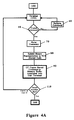
- Activities indicated by heavily bordered blocks are performed by the TCB 10, or trusted code. Activities represented by lightly bordered blocks are performed by untrusted code.
- the user terminal is represented as having established a computing session 100 within the general UOS 20.
- the user may attempt to execute various commands.
- Utilities within the UOS 20 determine whether the issued commands are trusted commands 50. If the command is not identified by the UOS 20 as a trusted command, the UOS 20 attempts to perform the command at process 60. In these cases the operation and existence of the TCB 10 may have little effect on the command's behavior as seen by the user.
- a process identifier is associated with each user process at the time of login.
- This process ID is a pseudo-randomly generated alpha-numeric tag which is associated with the user throughout his/her computing session.
- the process ID is useful if the untrusted code can temporarily disable or delay the effect of activation of the secure-attention key. For example, untrusted code can send a reset command to some terminals. While these terminals are resetting, activation of the secure-attention key has no effect. Such a technique may allow untrusted code to trick the user into thinking a trusted path had been established when it had not been. The process ID inhibits such trickery by allowing the user to distinguish between actual and emulated trusted paths.
- the untrusted code may be able to program the terminal so that the secure-attention key generates a signal that is recognizable to the untrusted code, but not to the TCB.
- generation of the process ID at the time of login would be unsatisfactory.
- the process ID may be generated prior to user login.
- the process ID may be generated when the user is registered with the TCB 10 and stored in protected memory.
- the user may be given a way of changing his/her process ID, just as the user can generally change his/her password.
- the user logs in the SSVR 12 pseudo-randomly generates a process ID and assigns this ID to the specific user at the physical terminal.
- Methods of generating pseudorandom identifiers are generally known in the art.
- the random number initial seed is based on a hardware (as opposed to a software) event. The algorithm for generating successive random numbers should be computationally difficult to invert.
- This process ID is maintained in the TCB and is never provided to untrusted code. Thus, untrusted code in the general UOS 20 is prevented from discovering the specific process ID assigned to the user.
- the user is responsible for noting and retaining his/her assigned process ID.
- the process ID may be generated as a pronounceable group of characters. Methods for generating such pronounceable passwords are described in "A Random Word Generator", MITRE Technical Report (MTR-3006), May, 1975, by Morrie Gasser.
- the process ID is displayed to the user when a trusted path is established between the user terminal and the SSVR 12. Displaying the ID serves a useful security function as it inhibits untrusted code from "spoofing" the user. Absent the process ID it may be possible for an untrusted subject to emulate the SSVR 12. An untrusted subject, emulating the SSVR 12, may be able to trick the user into divulging security-relevant information or otherwise compromising system security.
- the process ID known only to the user and the SSVR 12, inhibits this type of "spoofing." Before the user responds to an apparent SSVR 12 request, he/she will first verify that the proper process ID is displayed. Since the process ID is known by only the user and the SSVR 12, it is extremely difficult for an untrusted subject, unaware of the process ID, to fool the user into believing that he/she is conversing with the SSVR 12.
- FIG.6 illustrates a flow diagram of this process.
- a randomly generated process ID is assigned to the user. This activity is represented by process 310.
- this process ID comprises alphabetic characters and is pronounceable. The pronounceable nature promotes user retention of the ID.
- the process ID is then stored in trusted memory by the SSVR 12 and displayed to the user by the SSVR 12 at process 320.
- the TCB determines if the user is operating through a trusted path. This activity occurs at process 330. If the TCB determines that a trusted path is not established, the process ID will not be displayed to the user. This is noted at process 350.
- the process ID is maintained in trusted code and memory, and is inaccessible to untrusted subjects.
- the SSVR 12 displays the user's process ID at process 340. By observing the displayed ID, the user is assured that an actual trusted path has been established.
- the command conveyor (CC) 14 is a layer in the TCB 10 which comprises part of the trusted code.
- the CC 14 is utilized to ensure proper communication of trusted commands between the SSVR 12 and the process supporting the untrusted subject.
- an untrusted subject may include a UOS 20.
- a command buffer Associated with each physical terminal 30 is a command buffer.
- a status code may be associated with each terminal.
- one of five command states is also associated with each physical terminal.
- the command buffer is used to store the binary representation of the trusted command.
- the status code may be employed to provide the resulting execution status to the untrusted subject.
- the command states generally comprise five possibilities:
- FIG. 7 is state transition of the command states. A detailed explanation of these states and the statuses may be obtained from the following discussion.
- commands include user instructions received through the use of command line interfaces, menu interfaces, direct manipulation interfaces or the like.
- the first category includes "direct commands" issued while the user is operating in the SSVR 12 layer of the TCB 10, i.e., is interactively conversing with the TCB 10. As discussed above, it is desirable to limit the number of direct commands available to the user. The execution and processing of these direct commands is carried out using traditional methods known in the art.
- the second category includes "trusted commands.” These commands are issued by a user operating in a non-trusted computing environment, such as in the general UOS 20. In one embodiment these trusted commands are issued by a user operating in an untrusted virtual machine. FIGS. 4A and 4B illustrate the activity necessary to execute such a command.
- the parser residing in the general UOS 20 parses the trusted command string and converts it into a binary representation at process 70.
- the untrusted code in the UOS 20 checks syntax and semantics, and prompts for missing parameters. Parsing strategies are well known in the art and will not be discussed herein.
- a process supporting the UOS 20 issues a call to the TCB, submitting to the TCB the parsed representation of the command and the identification of the terminal from which such command was issued, at process 80.
- identification of the virtual terminal from which the command was issued is submitted to the TCB.
- Such a call is processed by the CC 14 in the TCB 10.
- the CC 14 determines which trusted subject submitted the command and copies the parsed representation into protected memory at process 90. In one embodiment this determination is made by asking VTerm to identify the physical terminal associated with the UOS's virtual terminal.
- the command state of the submitting physical terminal is no command, which indicates that there is no trusted command submitted by that physical terminal or in progress.
- This state is represented by state 400 in FIG. 7.
- the CC 14 saves the binary representation in the command buffer, and sets the physical terminal's state to command submitted, represented by transition state 410. Otherwise, the submission fails.
- the untrusted subject running in untrusted code When the untrusted subject running in untrusted code receives indication from the TCB 10 that the command has been successfully submitted, it requests the user to activate the secure-attention key. In one embodiment, the untrusted code in the UOS 20 will request that the user activate the BREAK key.
- code in the general UOS 20 may cancel the trusted command. This can be accomplished by the untrusted code issuing a kernel call (i.e., a request by the untrusted subject of the security kernel) informing the CC 14 that the command is to be aborted. If the CC 14 finds that the command has not been sent to the SSVR 12, the command is canceled. Similarly, if the user process in the UOS 20 is killed, the process rundown code may cancel the trusted command request. However, if the CC 14 finds that the command has already been sent it proceeds, because the user is already executing the command.
- a kernel call i.e., a request by the untrusted subject of the security kernel
- cancellation of the trusted command request results in the command state being changed from command submitted to no command. This process is indicated in FIG. 7.
- the TCB 10 must arbitrate; either of these requests may be processed first. If the secure-attention signal is processed first, the TCB 10 may defer the command submission, and a connection with the SSVR 12 is established. If the submission is processed first, then the user sees the confirmation screen as is described below.
- a trusted path is established between the user's physical terminal 30 and the SSVR 12 in the TCB 10. This configuration is illustrated by the dark line in FIG.3.
- the VT layer 16 detects the secure-attention (BREAK) key, it notifies the SSVR 12 which then establishes a trusted path in the trusted path-supporting process associated with the user's physical terminal 30.
- BREAK secure-attention
- the TCB 10 maintains exclusive control over the physical terminal 30.
- untrusted code in the UOS 20 waits to be notified that the command has been completed.
- the user essentially bypasses the untrusted code, and converses only with trusted code.
- the trusted command may still be executed. The user will not be informed of any of these disruptions until the trusted command has been completed or abandoned.
- the security requirements of the system require interaction between the user and the SSVR 12. This is necessary to execute commands which require the establishment of a trusted path.
- the Orange Book criteria, and/or the system's security goals, will determine which commands require this interaction as is generally discussed in Section 4.9 below.
- the establishment of a trusted path in these instances is useful for several reasons. First, it allows the secure server to identify the specific user issuing the command. Second, the trusted path allows the user to review and approve (or reject) the requested action in a trusted fashion. This reduces the possibility of malicious untrusted software altering a command request, and allows for the detection of parsing errors.
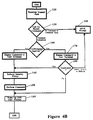
- FIG.4B illustrates the activity occurring after control has passed to the TCB 10.
- the TCB 10 first establishes a trusted path at process 120.
- the TCB checks to see if a trusted command has been submitted by the user. Untrusted code may then wait for the command to finish.
- the SSVR 12 will call the CC 14 to return the binary representation at process 130.
- the CC 14 will first determine the command state of the physical user terminal 30.
- the command state is command submitted 410 (FIG. 7)
- the CC 14 will return to the SSVR 12 the binary representation, and change the command state to command in progress 420. If the state is no command 400 or command done 430, the call will fail, and the SSVR 12 will display the SSVR prompt (SSVR>) to the user.
- An initial command state of command in progress 420 or ignore finish 440 implies a bug in the SSVR 12 and may result in the CC 14 crashing the TCB 10.
- the CC 14 will return to the SSVR 12 the binary representation of the requested command.
- the SSVR 12 will determine if the command requires confirmation at process 140 (FIG. 4B). Confirmation should generally be required for commands which request modification of information. Commands that do not alter the information, such as the viewing of information, should not generally require confirmation. For purposes of confirmation, redirecting the display into a file should be considered as viewing information.
- secure-attention trusted commands are a mechanism for use by system managers, security managers, operators, and holders of special privileges.
- a command which is not a direct command is a secure-attention command if:
- the TCB 10 enforces the system's security policy and determines if the user has the necessary access rights to execute the command at process 145. If this is the case the TCB 10 attempts to execute the binary representation at process 150. Since certain commands, e.g. commands that merely display information, do not change the state of the system, user confirmation is not required. There is no security problem in not confirming these commands since the system allows users to view only information to which they have access.
- commands which normally display information may, by writing to the listing file, alter the state of the system. In these cases, confirmation of these commands is generally not required because the flow of information is constrained by the TCB's security policy.
- the SSVR 12 When a command requesting the display of information is executed by the TCB 10, the SSVR 12 responds by displaying a complete representation of the requested command as well as the requested information, i.e. the standard human-readable representation of the command. In one embodiment, the SSVR 12 displays the function code, command modifiers, and command parameters all in unambiguous notation. If employed, the process ID may also be displayed.
- the SSVR 12 displays a standard human-readable representation of what is about to be done to the user terminal at process 170.
- the code representing each command should produce a different display, unless the commands have the same effect.
- the re-display of the action that a binary representation will perform is less complex than the parsing of the original command. This is in part because by definition there is only one standard human-readable representation for each parsed command.
- the overall complexity of the TCB 10 is decreased.
- the display of "what is about to be done” may of course vary from one command to another.
- the display may contain what the new record will contain, or what the attributes of the object will be if the command is confirmed.
- the display may show what the updated data will look like, or what the attributes of the object will be if the command is confirmed. For commands which remove an existing object, or delete an existing file, the display may show the record or object.
- the data packet representing the submitted command may contain fields for the object's attributes, such as its name, its size and its protection. For each of these fields, the packet may also have a flag indicating whether the field is meaningful. These flags indicating meaningful fields may be know as "field selectors.”
- the TCB may supply default values for unselected fields.
- unselected fields may retain their previous values.
- the selected fields may be highlighted when displayed for confirmation.
- Such highlighting may be accomplished by methods known in the art (e.g., by using escape sequences that begin and end reverse video). This highlighting draws the user's attention to the fields that have non-default or changed values and helps to protect the user from tricks by untrusted code.
- every packet field is displayed on the screen, except for fields ignored by the particular command.
- the display generated by the SSVR 12 may express in a human language (e.g., English), what action is to be done. In this manner, the possibility of an erroneous confirmation is reduced since the user is requested to confirm the results, (an understandably stated action), not a potentially cryptic command.
- a human language e.g., English
- the SSVR 12 may also display a list of user protection attributes (such as the privileges the user has enabled) so that the user knows what role he or she is exercising. The user is required to confirm explicitly (Yes or No) the action requested.
- the TCB 12 displays for confirmation the results which would occur if the command is executed.
- any information in the binary representation that is displayed is first validated. This information is checked once to ensure that certain requirements are met, e.g., to ensure that the counts of array elements are within array bounds (since out-of-bounds conditions could provide an opportunity for entry into the TCB by illicit software).
- any that could cause the formatting code to malfunction may be validated.
- candidates for validation could include anything used to index into something else.
- Specific examples include the PASCAL language's implementation of varying strings (a count followed by an array of characters; the count is checked to be less than or equal to the character array size), and numbers that represent keywords (their value is checked before it is used to index into an array of keyword text strings). Further methods of validation are well known in the art and will not be discussed herein.
- the replies that the user may make to the confirmation prompt are "yes”, “no”, Ctrl-C, Ctrl-Y, or the BREAK key. No default responses exist in this embodiment.
- the secure server may display a message restating the response. If the response was "yes” or "no", the secure server 12 displays an indication of the computing session in the UOS 20 when it is being be resumed after command completion.
- the command will be aborted.
- the CC then changes the command status code to negative. This may be done to inform the submitting process that the command has been aborted. In these cases a direct session with the SSVR 12 will be established at process 300. In these instances, the user must explicitly issue a resume command to return to the session in the UOS 20.
- the TCB 10 If the user confirms the results or command, by replying with "yes", or if the command does not require confirmation, the TCB 10 enforces the system's security policy at process 145. At this process the TCB 10 determines if the user has the necessary access privileges to perform the requested activity. If the user has the required access rights, the SSVR 12, along with other code in the TCB 10 attempts to execute the command in a conventional manner.
- the SSVR 12 may inform the CC 14 of the execution status. In some high-security situations, concern for information flow from trusted to untrusted code will prevent informing the CC 14.
- the CC 14 may change the command status to indicate the SSVR 12 response.
- the CC 14 changes the command state from command in progress 420 (FIG. 7) to command done 430. In these cases, the CC 14 notifies the submitting untrusted subject by traditional methods (or by advancing an eventcount for that process). The SSVR 12 then reestablishes the terminal connection with the computing session in the UOS 20 from which the command was executed.
- the secure server informs the session in the UOS 20 that the command was not executed (negative status code). If command states are also employed, the SSVR 12 changes the command state to command done, and re-establishes the user's session in the general UOS 20 at process 160.
- the SSVR 12 displays a message indicating that a change has been made and requests reconfirmation. In this case, the SSVR 12 waits for a response as if it were the first time the information was displayed.
- the TCB may utilize identifiers known as "modification counts" (mod-counts).
- Each element of key databases may contain a modification count. This mod-count is advanced after each modification and thus identifies how many modifications have been made to the database. Thus, when a user attempts to modify a database element, the SSVR 12 first obtains that database element's mod-count. After the user has confirmed the request, the TCB 10 checks the mod-count in the request against the current mod-count.
- a different mod-count indicates that a change has been made to the database element, and the user is asked to reconfirm the request since the result previously confirmed by the user is not what the result would actually be.
- the user's session in the general UOS 20 is reestablished. In one embodiment, this may be accompanied by the CC 14 informing the untrusted subject of the status of the submitted command.
- the untrusted code in the general UOS 20 then wake-up the untrusted process running in the UOS 20 at process 160.
- the SSVR 12 prompts the user to activate a carriage return. This step is necessary to inform the user that he/she is being placed into an untrusted environment.
- the SSVR 12 audits (i.e., creates an audit trail by writing to an audit or log file) at the command level.
- the SSVR 12 audits both the command line and the final status of the command.
- trusted commands secure-attention commands
- the SSVR 12 audits both the confirmation display and the final status of the command.
- the SSVR 12 defines a portion of memory to store the strings of information sent by the SSVR 12 to the user's terminal. In one embodiment, this portion of memory is known as the "sink.” Only the strings that comprise the SSVR's confirmation screens are placed in the sink.
- Strings may be appended to the sink only when the sink is opened.
- the sink is opened when the SSVR 12 begins to service a trusted command.
- the sink may be closed after the user has responded to the confirmation prompt, or before the display of certain requested information.
- the information stored in the sink does not include the user input to any prompts.
- the information stored in the sink is maintained for auditing purposes and may be utilized according to traditional auditing practices.
- Such non-submitting user confirmation may be accomplished by having the code in the untrusted subject lie about which user is submitting the command.
- the code in the UOS 20 may ensure that certain commands are always sent to the TCB 10 as if they had been submitted by a selected user.
- This select user would be to confirm these certain commands for the other users. After a non-select user submits one of the certain commands, the selected user will be notified that there is a submitted command waiting. The select user may then observe the confirmation display. If the select user determines that the command submitted was a legitimate command, he/she may confirm the command. Otherwise, the original user's attempt to execute the command fails.
- the method for executing trusted commands described above may be implemented through the use of appropriate software.
- the actual design and coding is a matter of routine for those skilled in the art having the benefit of this disclosure. Such a design will of course vary with the hardware platform and other factors associated with the specific desired implementation.
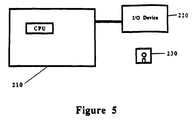
- FIG. 5 illustrates one such method for implementing the present invention.
- a programmable machine comprises a central processing unit (CPU) 210, and an input/output (I/O) device 220.
- the I/O unit 220 is capable of reading and transmitting stored programming instructions from known storage media 230.
- the CPU 210 is capable of processing these instructions and executing the programming steps represented on media 230.
- Such systems are well known in the art and will not further be described.
- the necessary programming steps are stored on storage media 230 by traditional methods.
- the storage media 230 is then read by the I/O unit 220 and the programming instructions are transmitted to the CPU 210.
- the CPU 210 reads and interprets the instructions, and may thereafter carry out the method of the invention.
Landscapes
- Engineering & Computer Science (AREA)
- Computer Security & Cryptography (AREA)
- Software Systems (AREA)
- Theoretical Computer Science (AREA)
- Computer Hardware Design (AREA)
- Physics & Mathematics (AREA)
- General Engineering & Computer Science (AREA)
- General Physics & Mathematics (AREA)
- Storage Device Security (AREA)
Claims (21)
- Maschinen-ausgeführtes Verfahren zum Ausführen, in einer gesicherten Umgebung (TCB 10) auf einem Computersystem, eines von einem Subjekt gegebenen Befehls, wobei das Computersystem auch eine nicht gesicherte Computerumgebung (UOS 20) enthält, und das Verfahren gekennzeichnet ist durch:(a) Syntaxanalysieren eines von dem Subjekt in der nicht gesicherten Computerumgebung gegebenen gesicherten Befehls (70), um einen syntaxanalysierten Befehl zu erzeugen;(b) Weitergeben des syntaxanalysierten Befehls (80) an die gesicherte Computerumgebung;(c) Übertragen einer Repräsentation des syntaxanalysierten Befehls (170) über einen gesicherten Weg an das Subjekt;(d) Empfangen eines Signals von dem Subjekt über einen gesicherten Weg, welches eine Bestätigung oder keine Bestätigung des syntaxanalysierten Befehls (180) anzeigt;(e) wenn das empfangene Signal keine Bestätigung anzeigt, dann Verhindern der Ausführung des syntaxanalysierten Befehls; und(f) wenn das empfangene Signal eine Bestätigung anzeigt, dann Ausführen des syntaxanalysierten Befehls in der gesicherten Umgebung.
- Verfahren nach Anspruch 1, welches ferner vor dem Schritt (a) aufweist:(g) Empfangen von Subjektidentifikationsdaten in der gesicherten Computerumgebung von dem Subjekt über einen gesicherten Weg und Prüfen der Sicherheit der Subjektidentifikationsdaten, um eine Sitzung (100) auf dem Computersystem als Antwort auf eine erfolgreiche Sicherheitsprüfung zu einzurichten; und(h) Empfangen des gesicherten Befehls von dem Subjekt in der nicht gesicherten Computerumgebung über einen nicht gesicherten Weg.
- Verfahren nach Anspruch 1 oder 2 einschließlich der Durchführung einer Sicherheitsprüfung an dem syntaxanalysierten Befehl in der gesicherten Computerumgebung vor dem Ausführen des gesicherten Befehls in der gesicherten Computerumgebung einschließt.
- Verfahren nach einem der vorstehenden Ansprüche, in welchem das Subjekt ein Benutzer ist, und in welchem die Übertragung der Repräsentation des syntaxanalysierten Befehls das Anzeigen der Repräsentation für den Benutzer mit umfasst.
- Verfahren nach Anspruch 4, ferner umfassend:nach dem Einloggen durch einen Benutzer, Zuweisen eines Prozessidentifikators an den Benutzer in der gesicherten Computerumgebung (310) ;Speichern des zugewiesenen Prozessidentifikators im gesicherten Speicher (320);Aufbauen eines gesicherten Wegs zwischen dem Benutzer und der gesicherten Computerumgebung;über den gesicherten Weg Anzeigen des Prozessidentifikators dem Benutzer (330); undnach dem anschließenden Eintritt des Benutzers in die gesicherte Umgebung, Anzeigen des Prozeßidentifikators dem Benutzer über den gesicherten Weg (340).
- Verfahren nach Anspruch 5, wobei der Prozessidentifikator eine zufällig oder pseudozufällig erzeugte Gruppe alphanumerischer Zeichen ist.
- Verfahren nach Anspruch 6, wobei der Prozessidentifikator aussprechbar ist.
- Verfahren nach einem der Ansprüche 1 bis 7, wobei der Schritt (d) von Anspruch 1 bewirkt wird durch:Empfangen eines Signals von dem Subjekt, welches anzeigt, ob die angezeigte Repräsentation genau den gesicherten Befehl repräsentiert oder nicht.
- Verfahren nach einem der Ansprüche 1 bis 8, wobei die gesicherte Computerumgebung einen Sicherheitskern aufweist.
- Verfahren nach einem der Ansprüche 1 bis 9, wobei die nicht gesicherte Umgebung (UOS 20) ein allgemeines Betriebssystem aufweist.
- Verfahren nach einem der Ansprüche 1 bis 10, und zusätzlich mit den nach dem Schritt (b) und vor dem Schritt (c) von Anspruch 1 ausgeführten Schritten:in der gesicherten Umgebung, Übertragen einer Repräsentation des syntaxanalysierten Befehls an ein zweites Subjekt;Empfangen eines Signals von dem zweiten Subjekt, welches eine Bestätigung oder keine Bestätigung des syntaxanalysierten Befehls anzeigt; undwenn das empfangene Signal aus dem zweiten Objekt keine Bestätigung des syntaxanalysierten Befehls anzeigt, dann Verhindern der Ausführung des syntaxanalysierten Befehls.
- Computerprogrammprodukt mit einem Computer-lesbaren-Medium mit einer darauf befindlichen Computerprogrammcodeeinrichtung, welche dafür angepasst ist, wenn das Programm auf einen Computer geladen wird, den Computer die Prozedur von einem der Ansprüche 1 bis 11 ausführen zu lassen.
- Computeranordnung mit einer nicht gesicherten Computerumgebung (UOS 20) und einer gesicherten Computerumgebung (TCB 10), gekennzeichnet durch:eine Einrichtung zur Syntaxanalyse (70) in der nicht gesicherten Computerumgebung, eines von dem Subjekt gegebenen gesicherten Befehls, um einen syntaxanalysierten Befehl zu erzeugen;eine Einrichtung zum Weitergeben (80) des syntaxanalysierten Befehls an die gesicherte Computerumgebung;eine Einrichtung zum Übertragen (SSRV12) einer Repräsentation des syntaxanalysierten Befehls über einen gesicherten Weg an das Subjekt zur Bestätigung (170); undeine Einrichtung (180) zum Empfangen eines Signals von dem Subjekt über einen gesicherten Weg, welcher eine Bestätigung oder keine Bestätigung des syntaxanalysierten Befehls (18) anzeigt; undeine Einrichtung, die so betreibbar ist, dass sie die Aüsführung des syntaxanalysierten Befehls verhindert, wenn das empfangene Signal keine Bestätigung anzeigt, und den syntaxanalysierten Befehl in der gesicherten Computerumgebung (TCB 10) ausführt, wenn das empfangene Signal eine Bestätigung anzeigt.
- Computeranordnung nach Anspruch 13, welche ferner aufweist:eine Einrichtung, um in der gesicherten Computerumgebung (TCB 10) von dem Subjekt über einen gesicherten Weg Subjektidentifikationsdaten zu empfangen, um eine Sicherheitsprüfung an den Subjektidentifikationsdaten auszuführen, und um eine Computersitzung (100) als Antwort auf eine erfolgreiche Sicherheitsprüfung einzurichten; undeine Einrichtung, um den gesicherten Befehl von dem Subjekt in der nicht gesicherten Computerumgebung (UOS20) über einen nicht gesicherten Weg zu empfangen.
- Computeranordnung nach Anspruch 12 oder 13, ferner mit einer Einrichtung zum Durchführen einer Sicherheitsprüfung an dem syntaxanalysierten Befehl in der gesicherten Computerumgebung vor der Ausführung des gesicherten Befehls in der gesicherten Computerumgebung.
- Computeranordnung nach einem der Ansprüche 13 bis 15, wobei das Subjekt ein Benutzer ist, und in welcher die Einrichtung für die Übertragung der Repräsentation des syntaxanalysierten Befehls eine Einrichtung für das Anzeigen der Repräsentation für den Benutzer mit umfasst.
- Computeranordnung nach Anspruch 16, ferner mit:einer Einrichtung, um nach dem Einloggen durch einen Benutzer einen Prozessidentifikator dem Benutzer in der gesicherten Computerumgebung (310) zuzuweisen;einer Einrichtung zum Speichern des zugewiesenen Prozessidentifikators in einem gesicherten Speicher (320) ;einer Einrichtung zum Aufbauen eines gesicherten Wegs zwischen dem Benutzer und der gesicherten Computerumgebung;einer Einrichtung zum Anzeigen des Prozessidentifikators für den Benutzer (330) über den gesicherten Weg; undeiner Einrichtung, um dem Benutzer den Prozess-identifikator über den gesicherten Weg (340) nach dem anschließenden Eintritt des Benutzers in die gesicherte Umgebung anzuzeigen.
- Computeranordnung nach einem der Ansprüche 13 bis 16, ferner mit:einer Einrichtung zum Empfangen eines Signals von dem Subjekt, welches anzeigt, ob die übertragene Repräsentation genau den gesicherten Befehl repräsentiert oder nicht.
- Computeranordnung nach einem der Ansprüche 13 bis 18, wobei die gesicherte Computerumgebung einen Sicherheitskern aufweist.
- Computeranordnung nach einem der Ansprüche 13 bis 19, wobei die nicht gesicherte Umgebung (UOS 20) ein allgemeines Betriebssystem aufweist.
- Computeranordnung nach einem der Ansprüche 13 bis 20, ferner mit:einer Einrichtung, um in der gesicherten Umgebung eine Repräsentation des syntaxanalysierten Befehls an ein zweites Subjekt zu übertragen;einer Einrichtung zum Empfangen eines Signals von dem zweiten Subjekt, welches eine Bestätigung oder keine Bestätigung des syntaxanalysierten Befehls anzeigt; undeiner Einrichtung, um eine Ausführung des syntaxanalysierten Befehls zu verhindern, wenn das empfangene Signal von dem zweiten Subjekt keine Bestätigung des syntaxanalysierten Befehls anzeigt.
Applications Claiming Priority (2)
| Application Number | Priority Date | Filing Date | Title |
|---|---|---|---|
| US479666 | 1990-02-13 | ||
| US07/479,666 US6507909B1 (en) | 1990-02-13 | 1990-02-13 | Method for executing trusted-path commands |
Publications (3)
| Publication Number | Publication Date |
|---|---|
| EP0443423A2 EP0443423A2 (de) | 1991-08-28 |
| EP0443423A3 EP0443423A3 (en) | 1993-04-21 |
| EP0443423B1 true EP0443423B1 (de) | 2001-11-14 |
Family
ID=23904915
Family Applications (1)
| Application Number | Title | Priority Date | Filing Date |
|---|---|---|---|
| EP91101985A Expired - Lifetime EP0443423B1 (de) | 1990-02-13 | 1991-02-13 | Verfahren und Anordnung zur Ausführung von Sicherheitswegbefehlen |
Country Status (6)
| Country | Link |
|---|---|
| US (4) | US6507909B1 (de) |
| EP (1) | EP0443423B1 (de) |
| AU (1) | AU7103191A (de) |
| CA (1) | CA2036257A1 (de) |
| DE (1) | DE69132809T2 (de) |
| GB (1) | GB9103055D0 (de) |
Families Citing this family (50)
| Publication number | Priority date | Publication date | Assignee | Title |
|---|---|---|---|---|
| CA2082146C (en) * | 1991-10-29 | 2005-11-15 | Brendan Beahan | Communications security and trusted path method and means |
| US5596718A (en) * | 1992-07-10 | 1997-01-21 | Secure Computing Corporation | Secure computer network using trusted path subsystem which encrypts/decrypts and communicates with user through local workstation user I/O devices without utilizing workstation processor |
| SE9603962D0 (sv) * | 1996-10-30 | 1996-10-30 | Christian Wettergren | Device and method for communication |
| EP1056010A1 (de) | 1999-05-28 | 2000-11-29 | Hewlett-Packard Company | Datenintegritätsüberwachung in einer vertrauten Rechnereinheit |
| EP1055990A1 (de) | 1999-05-28 | 2000-11-29 | Hewlett-Packard Company | Registrierung von Ereignissen in einer Computerplattform |
| US7353209B1 (en) * | 2000-01-14 | 2008-04-01 | Microsoft Corporation | Releasing decrypted digital content to an authenticated path |
| US6938164B1 (en) * | 2000-11-22 | 2005-08-30 | Microsoft Corporation | Method and system for allowing code to be securely initialized in a computer |
| US20020066039A1 (en) * | 2000-11-30 | 2002-05-30 | Dent Paul W. | Anti-spoofing password protection |
| GB2372594B (en) * | 2001-02-23 | 2004-10-06 | Hewlett Packard Co | Trusted computing environment |
| GB2372592B (en) * | 2001-02-23 | 2005-03-30 | Hewlett Packard Co | Information system |
| GB2372595A (en) * | 2001-02-23 | 2002-08-28 | Hewlett Packard Co | Method of and apparatus for ascertaining the status of a data processing environment. |
| US6871279B2 (en) * | 2001-03-20 | 2005-03-22 | Networks Associates Technology, Inc. | Method and apparatus for securely and dynamically managing user roles in a distributed system |
| GB2378272A (en) * | 2001-07-31 | 2003-02-05 | Hewlett Packard Co | Method and apparatus for locking an application within a trusted environment |
| US7783572B2 (en) * | 2001-11-27 | 2010-08-24 | Heartland Payment Systems, Inc. | Apparatus and method for downloading configuration data to card terminals and for viewing activity at card terminals |
| WO2004066156A1 (ja) * | 2003-01-20 | 2004-08-05 | Fujitsu Limited | 複製防止装置、複製防止方法およびその方法をコンピュータに実行させるプログラム |
| US7370212B2 (en) | 2003-02-25 | 2008-05-06 | Microsoft Corporation | Issuing a publisher use license off-line in a digital rights management (DRM) system |
| US6970954B1 (en) * | 2003-03-27 | 2005-11-29 | Logicube, Inc. | System and method for intercepting and evaluating commands to determine if commands are harmful or benign and to emulate harmful commands |
| US7620959B2 (en) * | 2003-05-12 | 2009-11-17 | Microsoft Corporation | Reflection-based processing of input parameters for commands |
| DE20317062U1 (de) * | 2003-11-06 | 2004-01-15 | Siemens Ag | Medizinische Einrichtung zur Diagnostik und/oder Therapie mit einer Bedienkonsole zur Steuerung von Anwendungen |
| AU2003298193A1 (en) * | 2003-12-17 | 2005-07-05 | Telecom Italia S.P.A. | Method and apparatus for monitoring operation of processing systems, related network and computer program product therefor |
| US7783891B2 (en) * | 2004-02-25 | 2010-08-24 | Microsoft Corporation | System and method facilitating secure credential management |
| US20060242406A1 (en) * | 2005-04-22 | 2006-10-26 | Microsoft Corporation | Protected computing environment |
| US8719591B1 (en) | 2004-05-14 | 2014-05-06 | Radix Holdings, Llc | Secure data entry |
| US8347078B2 (en) | 2004-10-18 | 2013-01-01 | Microsoft Corporation | Device certificate individualization |
| US8176564B2 (en) | 2004-11-15 | 2012-05-08 | Microsoft Corporation | Special PC mode entered upon detection of undesired state |
| US8464348B2 (en) * | 2004-11-15 | 2013-06-11 | Microsoft Corporation | Isolated computing environment anchored into CPU and motherboard |
| US8336085B2 (en) * | 2004-11-15 | 2012-12-18 | Microsoft Corporation | Tuning product policy using observed evidence of customer behavior |
| US7360253B2 (en) * | 2004-12-23 | 2008-04-15 | Microsoft Corporation | System and method to lock TPM always ‘on’ using a monitor |
| EP1866825A1 (de) | 2005-03-22 | 2007-12-19 | Hewlett-Packard Development Company, L.P. | Verfahren, einrichtungen und datenstrukturen für vertrauenswürdige daten |
| US8438645B2 (en) | 2005-04-27 | 2013-05-07 | Microsoft Corporation | Secure clock with grace periods |
| US8725646B2 (en) * | 2005-04-15 | 2014-05-13 | Microsoft Corporation | Output protection levels |
| US9363481B2 (en) * | 2005-04-22 | 2016-06-07 | Microsoft Technology Licensing, Llc | Protected media pipeline |
| US9436804B2 (en) | 2005-04-22 | 2016-09-06 | Microsoft Technology Licensing, Llc | Establishing a unique session key using a hardware functionality scan |
| US20060265758A1 (en) | 2005-05-20 | 2006-11-23 | Microsoft Corporation | Extensible media rights |
| US8353046B2 (en) * | 2005-06-08 | 2013-01-08 | Microsoft Corporation | System and method for delivery of a modular operating system |
| US7752436B2 (en) * | 2005-08-09 | 2010-07-06 | Intel Corporation | Exclusive access for secure audio program |
| US9087218B1 (en) | 2005-08-11 | 2015-07-21 | Aaron T. Emigh | Trusted path |
| US7996682B2 (en) * | 2005-10-17 | 2011-08-09 | Microsoft Corporation | Secure prompting |
| US20080024450A1 (en) * | 2006-07-28 | 2008-01-31 | International Business Machines Corporation | A system for command-line keyboard buffer viewing and editing |
| US7530106B1 (en) | 2008-07-02 | 2009-05-05 | Kaspersky Lab, Zao | System and method for security rating of computer processes |
| US20100020971A1 (en) * | 2008-07-24 | 2010-01-28 | Richard Hanks | Device and Method for a Secure Transaction |
| US8321916B2 (en) * | 2008-12-19 | 2012-11-27 | Intel Corporation | Method, apparatus and system for remote management of mobile devices |
| US8850573B1 (en) * | 2010-04-14 | 2014-09-30 | Google Inc. | Computing device with untrusted user execution mode |
| US8621649B1 (en) | 2011-03-31 | 2013-12-31 | Emc Corporation | Providing a security-sensitive environment |
| US9396327B2 (en) * | 2011-05-16 | 2016-07-19 | D2L Corporation | Systems and methods for security verification in electronic learning systems and other systems |
| US9195838B2 (en) * | 2012-07-02 | 2015-11-24 | At&T Intellectual Property I, L.P. | Method and apparatus for providing provably secure user input/output |
| US9246884B1 (en) * | 2013-03-14 | 2016-01-26 | Rockwell Collins, Inc. | Position-based cryptographic key management system and related method |
| US10698900B2 (en) | 2017-09-25 | 2020-06-30 | Splunk Inc. | Generating a distributed execution model with untrusted commands |
| US10698897B2 (en) | 2017-09-25 | 2020-06-30 | Splunk Inc. | Executing a distributed execution model with untrusted commands |
| US10929097B2 (en) * | 2018-06-26 | 2021-02-23 | ROVl GUIDES, INC. | Systems and methods for switching operational modes based on audio triggers |
Family Cites Families (41)
| Publication number | Priority date | Publication date | Assignee | Title |
|---|---|---|---|---|
| US4005386A (en) | 1974-05-21 | 1977-01-25 | Canon Kabushiki Kaisha | Clearing system |
| US3956615A (en) * | 1974-06-25 | 1976-05-11 | Ibm Corporation | Transaction execution system with secure data storage and communications |
| GB1561482A (en) | 1976-11-18 | 1980-02-20 | Ibm | Protection of data processing system against unauthorised programmes |
| US4227253A (en) | 1977-12-05 | 1980-10-07 | International Business Machines Corporation | Cryptographic communication security for multiple domain networks |
| US4405829A (en) * | 1977-12-14 | 1983-09-20 | Massachusetts Institute Of Technology | Cryptographic communications system and method |
| US4310720A (en) | 1978-03-31 | 1982-01-12 | Pitney Bowes Inc. | Computer accessing system |
| US4218738A (en) | 1978-05-05 | 1980-08-19 | International Business Machines Corporation | Method for authenticating the identity of a user of an information system |
| US4253145A (en) | 1978-12-26 | 1981-02-24 | Honeywell Information Systems Inc. | Hardware virtualizer for supporting recursive virtual computer systems on a host computer system |
| US4315101A (en) * | 1979-02-05 | 1982-02-09 | Atalla Technovations | Method and apparatus for securing data transmissions |
| US4488217A (en) | 1979-03-12 | 1984-12-11 | Digital Equipment Corporation | Data processing system with lock-unlock instruction facility |
| US4328542A (en) | 1979-11-07 | 1982-05-04 | The Boeing Company | Secure implementation of transition machine computer |
| US4442484A (en) | 1980-10-14 | 1984-04-10 | Intel Corporation | Microprocessor memory management and protection mechanism |
| JPS57137957A (en) | 1981-02-20 | 1982-08-25 | Hitachi Ltd | Terminal connection system |
| US4593353A (en) | 1981-10-26 | 1986-06-03 | Telecommunications Associates, Inc. | Software protection method and apparatus |
| US4430728A (en) | 1981-12-29 | 1984-02-07 | Marathon Oil Company | Computer terminal security system |
| US4829469A (en) | 1982-07-12 | 1989-05-09 | Pitney Bowes Inc. | Security system for use with electronic postage meter to prevent lock erasure of data |
| US4531023A (en) | 1982-08-13 | 1985-07-23 | Hlf Corporation | Computer security system for a time shared computer accessed over telephone lines |
| US4754326A (en) | 1983-10-25 | 1988-06-28 | Keycom Electronic Publishing | Method and apparatus for assisting user of information retrieval systems |
| US4652990A (en) | 1983-10-27 | 1987-03-24 | Remote Systems, Inc. | Protected software access control apparatus and method |
| US4584639A (en) | 1983-12-23 | 1986-04-22 | Key Logic, Inc. | Computer security system |
| US4621321A (en) | 1984-02-16 | 1986-11-04 | Honeywell Inc. | Secure data processing system architecture |
| US4669043A (en) | 1984-02-17 | 1987-05-26 | Signetics Corporation | Memory access controller |
| US4751669A (en) | 1984-03-30 | 1988-06-14 | Wang Laboratories, Inc. | Videotex frame processing |
| US4677546A (en) | 1984-08-17 | 1987-06-30 | Signetics | Guarded regions for controlling memory access |
| US4799153A (en) | 1984-12-14 | 1989-01-17 | Telenet Communications Corporation | Method and apparatus for enhancing security of communications in a packet-switched data communications system |
| US4754395A (en) | 1985-05-06 | 1988-06-28 | Computer X, Inc. | Network interface module with minimized data paths |
| US4677670A (en) | 1985-07-01 | 1987-06-30 | Henderson Jr Paul B | Paired-secure message identification controller for computers and the like |
| US4797853A (en) | 1985-11-15 | 1989-01-10 | Unisys Corporation | Direct memory access controller for improved system security, memory to memory transfers, and interrupt processing |
| US4799061A (en) | 1985-11-18 | 1989-01-17 | International Business Machines Corporation | Secure component authentication system |
| US4742447A (en) | 1986-01-16 | 1988-05-03 | International Business Machines Corporation | Method to control I/O accesses in a multi-tasking virtual memory virtual machine type data processing system |
| US4794515A (en) | 1986-01-17 | 1988-12-27 | International Business Machines Corporation | Protection of data in a multiprogramming data processing system |
| US4771461A (en) | 1986-06-27 | 1988-09-13 | International Business Machines Corporation | Initialization of cryptographic variables in an EFT/POS network with a large number of terminals |
| US4748668A (en) | 1986-07-09 | 1988-05-31 | Yeda Research And Development Company Limited | Method, apparatus and article for identification and signature |
| US4858117A (en) | 1987-08-07 | 1989-08-15 | Bull Hn Information Systems Inc. | Apparatus and method for preventing computer access by unauthorized personnel |
| US4918653A (en) | 1988-01-28 | 1990-04-17 | International Business Machines Corporation | Trusted path mechanism for an operating system |
| US4945468A (en) | 1988-02-01 | 1990-07-31 | International Business Machines Corporation | Trusted path mechanism for virtual terminal environments |
| US4885789A (en) * | 1988-02-01 | 1989-12-05 | International Business Machines Corporation | Remote trusted path mechanism for telnet |
| DE3803230C1 (de) | 1988-02-04 | 1989-03-16 | Benz & Hilgers Gmbh, 4000 Duesseldorf, De | |
| US4926476A (en) | 1989-02-03 | 1990-05-15 | Motorola, Inc. | Method and apparatus for secure execution of untrusted software |
| US4962533A (en) | 1989-02-17 | 1990-10-09 | Texas Instrument Incorporated | Data protection for computer systems |
| US5073933A (en) * | 1989-12-01 | 1991-12-17 | Sun Microsystems, Inc. | X window security system |
-
1990
- 1990-02-13 US US07/479,666 patent/US6507909B1/en not_active Expired - Fee Related
-
1991
- 1991-02-13 EP EP91101985A patent/EP0443423B1/de not_active Expired - Lifetime
- 1991-02-13 GB GB919103055A patent/GB9103055D0/en active Pending
- 1991-02-13 AU AU71031/91A patent/AU7103191A/en not_active Abandoned
- 1991-02-13 CA CA002036257A patent/CA2036257A1/en not_active Abandoned
- 1991-02-13 DE DE69132809T patent/DE69132809T2/de not_active Expired - Lifetime
-
2000
- 2000-02-29 US US09/515,384 patent/US7036022B1/en not_active Expired - Fee Related
- 2000-02-29 US US09/514,978 patent/US6871283B1/en not_active Expired - Fee Related
-
2004
- 2004-11-30 US US10/998,654 patent/US20050097354A1/en not_active Abandoned
Non-Patent Citations (1)
| Title |
|---|
| Applicant submitted 2 pages containing 9 citations from the prosecution of the corresponding US application. Examiner regards these as useful background to the field of the present application. The 2 pages are inserted into page 1 of the description. * |
Also Published As
| Publication number | Publication date |
|---|---|
| US20050097354A1 (en) | 2005-05-05 |
| EP0443423A3 (en) | 1993-04-21 |
| DE69132809D1 (de) | 2001-12-20 |
| AU7103191A (en) | 1991-08-15 |
| US6871283B1 (en) | 2005-03-22 |
| DE69132809T2 (de) | 2002-05-29 |
| EP0443423A2 (de) | 1991-08-28 |
| US6507909B1 (en) | 2003-01-14 |
| CA2036257A1 (en) | 1991-08-14 |
| GB9103055D0 (en) | 1991-03-27 |
| US7036022B1 (en) | 2006-04-25 |
Similar Documents
| Publication | Publication Date | Title |
|---|---|---|
| US6507909B1 (en) | Method for executing trusted-path commands | |
| US7437766B2 (en) | Method and apparatus providing deception and/or altered operation in an information system operating system | |
| US5347578A (en) | Computer system security | |
| US7296274B2 (en) | Method and apparatus providing deception and/or altered execution of logic in an information system | |
| Gasser | Building a secure computer system | |
| US7251834B2 (en) | Filtering a permission set using permission requests associated with a code assembly | |
| EP0326700B1 (de) | Sicherheitswegmechanismus für virtuelle Terminalumgebungen | |
| EP1309906B1 (de) | Sicherheitsverfahren das auf der prüfung basiert ist | |
| Lindqvist et al. | A map of security risks associated with using COTS | |
| US7490072B1 (en) | Providing access controls | |
| US20050044381A1 (en) | System & method of table building for a process-based security system using intrusion detection | |
| US7665143B2 (en) | Creating secure process objects | |
| JP2002517852A (ja) | 信頼できないコンテントを安全に実行するための方法およびシステム | |
| Gligor et al. | On the design and the implementation of secure Xenix workstations | |
| RU2134931C1 (ru) | Способ обеспечения доступа к объектам в операционной системе мсвс | |
| US8621345B2 (en) | Intercepting text strings to prevent exposing secure information | |
| Landwehr et al. | A taxonomy of computer program security flaws, with examples | |
| US7350067B2 (en) | Bios security management | |
| US8788845B1 (en) | Data access security | |
| JP2002304231A (ja) | コンピュータシステム | |
| Rabin et al. | An integrated toolkit for operating system security | |
| Ramasubramanian et al. | An active rule based approach to database security in e-commerce systems using temporal constraints | |
| Haugh et al. | Document History | |
| Hilchie | A trusted path design and implementation for security enhanced linux | |
| Cristiá | Security Model of GIDISS Trusted Linux 0.1 Z Version 0.8. 0 |
Legal Events
| Date | Code | Title | Description |
|---|---|---|---|
| PUAI | Public reference made under article 153(3) epc to a published international application that has entered the european phase |
Free format text: ORIGINAL CODE: 0009012 |
|
| AK | Designated contracting states |
Kind code of ref document: A2 Designated state(s): AT BE CH DE DK ES FR GB GR IT LI LU NL SE |
|
| RBV | Designated contracting states (corrected) |
Designated state(s): DE GB NL |
|
| PUAL | Search report despatched |
Free format text: ORIGINAL CODE: 0009013 |
|
| AK | Designated contracting states |
Kind code of ref document: A3 Designated state(s): AT BE CH DE DK ES FR GB GR IT LI LU NL SE |
|
| 17P | Request for examination filed |
Effective date: 19930630 |
|
| 17Q | First examination report despatched |
Effective date: 19961227 |
|
| RAP1 | Party data changed (applicant data changed or rights of an application transferred) |
Owner name: COMPAQ COMPUTER CORPORATION |
|
| RTI1 | Title (correction) |
Free format text: METHOD FOR EXECUTING TRUSTED-PATH COMMANDS |
|
| RTI1 | Title (correction) |
Free format text: METHOD AND APPARATUS FOR EXECUTING TRUSTED-PATH COMMANDS |
|
| GRAG | Despatch of communication of intention to grant |
Free format text: ORIGINAL CODE: EPIDOS AGRA |
|
| GRAG | Despatch of communication of intention to grant |
Free format text: ORIGINAL CODE: EPIDOS AGRA |
|
| GRAG | Despatch of communication of intention to grant |
Free format text: ORIGINAL CODE: EPIDOS AGRA |
|
| GRAH | Despatch of communication of intention to grant a patent |
Free format text: ORIGINAL CODE: EPIDOS IGRA |
|
| GRAH | Despatch of communication of intention to grant a patent |
Free format text: ORIGINAL CODE: EPIDOS IGRA |
|
| GRAA | (expected) grant |
Free format text: ORIGINAL CODE: 0009210 |
|
| AK | Designated contracting states |
Kind code of ref document: B1 Designated state(s): DE GB NL |
|
| REF | Corresponds to: |
Ref document number: 69132809 Country of ref document: DE Date of ref document: 20011220 |
|
| REG | Reference to a national code |
Ref country code: GB Ref legal event code: IF02 |
|
| PG25 | Lapsed in a contracting state [announced via postgrant information from national office to epo] |
Ref country code: NL Free format text: LAPSE BECAUSE OF NON-PAYMENT OF DUE FEES Effective date: 20020901 |
|
| PLBE | No opposition filed within time limit |
Free format text: ORIGINAL CODE: 0009261 |
|
| STAA | Information on the status of an ep patent application or granted ep patent |
Free format text: STATUS: NO OPPOSITION FILED WITHIN TIME LIMIT |
|
| GBPC | Gb: european patent ceased through non-payment of renewal fee |
Effective date: 20020214 |
|
| NLV4 | Nl: lapsed or anulled due to non-payment of the annual fee |
Effective date: 20020901 |
|
| 26N | No opposition filed | ||
| REG | Reference to a national code |
Ref country code: GB Ref legal event code: 728V |
|
| NLXE | Nl: other communications concerning ep-patents (part 3 heading xe) |
Free format text: A REQUEST FOR RESTORATION TO THE PRIOR STATE (ARTICLE 23 OF THE PATENTS ACT 1995) HAS BEEN FILED ON 20021115. |
|
| REG | Reference to a national code |
Ref country code: GB Ref legal event code: 728Y |
|
| NLXE | Nl: other communications concerning ep-patents (part 3 heading xe) |
Free format text: A REQUEST FOR RESTORATION TO THE PRIOR STATE AS PROVIDED FOR IN ARTICLE 23 OF THE PATENTS ACT 1995 (SEE PUBLICATION IN HEADING XE OF THE PATENT BULLETIN OF 20030203/03) HAS BEEN GRANTED; THE RESTORATION OF THE PATENT HAS BEEN ENTERED IN THE PATENT REGISTER. |
|
| REG | Reference to a national code |
Ref country code: GB Ref legal event code: 732E |
|
| PGFP | Annual fee paid to national office [announced via postgrant information from national office to epo] |
Ref country code: DE Payment date: 20100226 Year of fee payment: 20 Ref country code: GB Payment date: 20100224 Year of fee payment: 20 |
|
| PGFP | Annual fee paid to national office [announced via postgrant information from national office to epo] |
Ref country code: NL Payment date: 20100223 Year of fee payment: 20 |
|
| REG | Reference to a national code |
Ref country code: DE Ref legal event code: R071 Ref document number: 69132809 Country of ref document: DE |
|
| REG | Reference to a national code |
Ref country code: NL Ref legal event code: V4 Effective date: 20110213 |
|
| REG | Reference to a national code |
Ref country code: GB Ref legal event code: PE20 Expiry date: 20110212 |
|
| PG25 | Lapsed in a contracting state [announced via postgrant information from national office to epo] |
Ref country code: GB Free format text: LAPSE BECAUSE OF EXPIRATION OF PROTECTION Effective date: 20110212 |
|
| PG25 | Lapsed in a contracting state [announced via postgrant information from national office to epo] |
Ref country code: DE Free format text: LAPSE BECAUSE OF EXPIRATION OF PROTECTION Effective date: 20110213 |
|
| PGRI | Patent reinstated in contracting state [announced from national office to epo] |
Ref country code: NL Effective date: 20030920 |