EP0443370B1 - Dentalwerkstoffe - Google Patents
Dentalwerkstoffe Download PDFInfo
- Publication number
- EP0443370B1 EP0443370B1 EP91101639A EP91101639A EP0443370B1 EP 0443370 B1 EP0443370 B1 EP 0443370B1 EP 91101639 A EP91101639 A EP 91101639A EP 91101639 A EP91101639 A EP 91101639A EP 0443370 B1 EP0443370 B1 EP 0443370B1
- Authority
- EP
- European Patent Office
- Prior art keywords
- meth
- denote
- bis
- acrylic acid
- hexafluoro
- Prior art date
- Legal status (The legal status is an assumption and is not a legal conclusion. Google has not performed a legal analysis and makes no representation as to the accuracy of the status listed.)
- Expired - Lifetime
Links
- 239000005548 dental material Substances 0.000 title description 9
- CERQOIWHTDAKMF-UHFFFAOYSA-N Methacrylic acid Chemical compound CC(=C)C(O)=O CERQOIWHTDAKMF-UHFFFAOYSA-N 0.000 claims abstract description 29
- JQSQNRHYULVGBE-UHFFFAOYSA-N (3,3,4,4,5,5-hexafluoro-2-phenoxycyclopenten-1-yl)oxybenzene Chemical class C=1C=CC=CC=1OC=1C(F)(F)C(F)(F)C(F)(F)C=1OC1=CC=CC=C1 JQSQNRHYULVGBE-UHFFFAOYSA-N 0.000 claims abstract description 11
- 238000002360 preparation method Methods 0.000 claims abstract description 6
- 229910052739 hydrogen Inorganic materials 0.000 claims description 27
- 125000002496 methyl group Chemical group [H]C([H])([H])* 0.000 claims description 21
- -1 chlorocarbonyl Chemical group 0.000 claims description 20
- UFHFLCQGNIYNRP-UHFFFAOYSA-N Hydrogen Chemical compound [H][H] UFHFLCQGNIYNRP-UHFFFAOYSA-N 0.000 claims description 17
- 238000011049 filling Methods 0.000 claims description 15
- 239000001257 hydrogen Substances 0.000 claims description 14
- 239000000463 material Substances 0.000 claims description 14
- 238000000034 method Methods 0.000 claims description 13
- 238000006116 polymerization reaction Methods 0.000 claims description 11
- 239000004215 Carbon black (E152) Substances 0.000 claims description 9
- 125000004432 carbon atom Chemical group C* 0.000 claims description 9
- 229930195733 hydrocarbon Natural products 0.000 claims description 9
- 229910052760 oxygen Inorganic materials 0.000 claims description 7
- 239000001301 oxygen Substances 0.000 claims description 7
- 239000003054 catalyst Substances 0.000 claims description 6
- 239000003112 inhibitor Substances 0.000 claims description 6
- 150000002430 hydrocarbons Chemical class 0.000 claims description 4
- 239000011248 coating agent Substances 0.000 claims description 3
- 150000002431 hydrogen Chemical class 0.000 claims description 3
- 239000012442 inert solvent Substances 0.000 claims description 3
- 125000001261 isocyanato group Chemical group *N=C=O 0.000 claims description 3
- 239000000178 monomer Substances 0.000 abstract description 24
- NIXOWILDQLNWCW-UHFFFAOYSA-N 2-Propenoic acid Natural products OC(=O)C=C NIXOWILDQLNWCW-UHFFFAOYSA-N 0.000 abstract description 6
- SMZOUWXMTYCWNB-UHFFFAOYSA-N 2-(2-methoxy-5-methylphenyl)ethanamine Chemical compound COC1=CC=C(C)C=C1CCN SMZOUWXMTYCWNB-UHFFFAOYSA-N 0.000 abstract description 3
- 239000000203 mixture Substances 0.000 description 23
- NIXOWILDQLNWCW-UHFFFAOYSA-M Acrylate Chemical compound [O-]C(=O)C=C NIXOWILDQLNWCW-UHFFFAOYSA-M 0.000 description 20
- HEDRZPFGACZZDS-MICDWDOJSA-N Trichloro(2H)methane Chemical compound [2H]C(Cl)(Cl)Cl HEDRZPFGACZZDS-MICDWDOJSA-N 0.000 description 20
- YMWUJEATGCHHMB-UHFFFAOYSA-N Dichloromethane Chemical compound ClCCl YMWUJEATGCHHMB-UHFFFAOYSA-N 0.000 description 18
- 238000006243 chemical reaction Methods 0.000 description 13
- HEDRZPFGACZZDS-UHFFFAOYSA-N Chloroform Chemical compound ClC(Cl)Cl HEDRZPFGACZZDS-UHFFFAOYSA-N 0.000 description 12
- 150000001875 compounds Chemical class 0.000 description 12
- 238000005160 1H NMR spectroscopy Methods 0.000 description 10
- UKMBKKFLJMFCSA-UHFFFAOYSA-N [3-hydroxy-2-(2-methylprop-2-enoyloxy)propyl] 2-methylprop-2-enoate Chemical compound CC(=C)C(=O)OCC(CO)OC(=O)C(C)=C UKMBKKFLJMFCSA-UHFFFAOYSA-N 0.000 description 10
- ZMANZCXQSJIPKH-UHFFFAOYSA-N Triethylamine Chemical compound CCN(CC)CC ZMANZCXQSJIPKH-UHFFFAOYSA-N 0.000 description 9
- 125000000391 vinyl group Chemical group [H]C([*])=C([H])[H] 0.000 description 8
- 229920002554 vinyl polymer Polymers 0.000 description 8
- VYPSYNLAJGMNEJ-UHFFFAOYSA-N Silicium dioxide Chemical compound O=[Si]=O VYPSYNLAJGMNEJ-UHFFFAOYSA-N 0.000 description 7
- WEVYAHXRMPXWCK-UHFFFAOYSA-N Acetonitrile Chemical compound CC#N WEVYAHXRMPXWCK-UHFFFAOYSA-N 0.000 description 6
- 238000004519 manufacturing process Methods 0.000 description 6
- 239000003921 oil Substances 0.000 description 6
- 229920003023 plastic Polymers 0.000 description 6
- 229920000642 polymer Polymers 0.000 description 6
- 150000003254 radicals Chemical class 0.000 description 6
- 239000000243 solution Substances 0.000 description 6
- YCKRFDGAMUMZLT-UHFFFAOYSA-N Fluorine atom Chemical compound [F] YCKRFDGAMUMZLT-UHFFFAOYSA-N 0.000 description 5
- 239000000945 filler Substances 0.000 description 5
- 229910052731 fluorine Inorganic materials 0.000 description 5
- 239000011737 fluorine Substances 0.000 description 5
- 239000004033 plastic Substances 0.000 description 5
- 239000000047 product Substances 0.000 description 5
- 239000002904 solvent Substances 0.000 description 5
- 239000000126 substance Substances 0.000 description 5
- 125000002023 trifluoromethyl group Chemical group FC(F)(F)* 0.000 description 5
- XLYOFNOQVPJJNP-UHFFFAOYSA-N water Substances O XLYOFNOQVPJJNP-UHFFFAOYSA-N 0.000 description 5
- HWSSEYVMGDIFMH-UHFFFAOYSA-N 2-[2-[2-(2-methylprop-2-enoyloxy)ethoxy]ethoxy]ethyl 2-methylprop-2-enoate Chemical compound CC(=C)C(=O)OCCOCCOCCOC(=O)C(C)=C HWSSEYVMGDIFMH-UHFFFAOYSA-N 0.000 description 4
- NLZUEZXRPGMBCV-UHFFFAOYSA-N Butylhydroxytoluene Chemical compound CC1=CC(C(C)(C)C)=C(O)C(C(C)(C)C)=C1 NLZUEZXRPGMBCV-UHFFFAOYSA-N 0.000 description 4
- WOBHKFSMXKNTIM-UHFFFAOYSA-N Hydroxyethyl methacrylate Chemical compound CC(=C)C(=O)OCCO WOBHKFSMXKNTIM-UHFFFAOYSA-N 0.000 description 4
- WYURNTSHIVDZCO-UHFFFAOYSA-N Tetrahydrofuran Chemical compound C1CCOC1 WYURNTSHIVDZCO-UHFFFAOYSA-N 0.000 description 4
- 150000001252 acrylic acid derivatives Chemical class 0.000 description 4
- 239000012948 isocyanate Substances 0.000 description 4
- 150000002513 isocyanates Chemical class 0.000 description 4
- 150000002978 peroxides Chemical class 0.000 description 4
- 125000001424 substituent group Chemical group 0.000 description 4
- NGNBDVOYPDDBFK-UHFFFAOYSA-N 2-[2,4-di(pentan-2-yl)phenoxy]acetyl chloride Chemical group CCCC(C)C1=CC=C(OCC(Cl)=O)C(C(C)CCC)=C1 NGNBDVOYPDDBFK-UHFFFAOYSA-N 0.000 description 3
- VHSHLMUCYSAUQU-UHFFFAOYSA-N 2-hydroxypropyl methacrylate Chemical compound CC(O)COC(=O)C(C)=C VHSHLMUCYSAUQU-UHFFFAOYSA-N 0.000 description 3
- 0 CC(C*(C)(C1)CCC(C)(C)C#C2)C1CC2(C)OC Chemical compound CC(C*(C)(C1)CCC(C)(C)C#C2)C1CC2(C)OC 0.000 description 3
- ZAMOUSCENKQFHK-UHFFFAOYSA-N Chlorine atom Chemical compound [Cl] ZAMOUSCENKQFHK-UHFFFAOYSA-N 0.000 description 3
- PEDCQBHIVMGVHV-UHFFFAOYSA-N Glycerine Chemical compound OCC(O)CO PEDCQBHIVMGVHV-UHFFFAOYSA-N 0.000 description 3
- KWYUFKZDYYNOTN-UHFFFAOYSA-M Potassium hydroxide Chemical compound [OH-].[K+] KWYUFKZDYYNOTN-UHFFFAOYSA-M 0.000 description 3
- HEMHJVSKTPXQMS-UHFFFAOYSA-M Sodium hydroxide Chemical compound [OH-].[Na+] HEMHJVSKTPXQMS-UHFFFAOYSA-M 0.000 description 3
- YXFVVABEGXRONW-UHFFFAOYSA-N Toluene Chemical compound CC1=CC=CC=C1 YXFVVABEGXRONW-UHFFFAOYSA-N 0.000 description 3
- 239000007795 chemical reaction product Substances 0.000 description 3
- 229910052801 chlorine Inorganic materials 0.000 description 3
- 239000000460 chlorine Substances 0.000 description 3
- MTHSVFCYNBDYFN-UHFFFAOYSA-N diethylene glycol Chemical compound OCCOCCO MTHSVFCYNBDYFN-UHFFFAOYSA-N 0.000 description 3
- 125000005442 diisocyanate group Chemical group 0.000 description 3
- 125000005843 halogen group Chemical group 0.000 description 3
- 239000004611 light stabiliser Substances 0.000 description 3
- NWVVVBRKAWDGAB-UHFFFAOYSA-N p-methoxyphenol Chemical compound COC1=CC=C(O)C=C1 NWVVVBRKAWDGAB-UHFFFAOYSA-N 0.000 description 3
- 229920005862 polyol Polymers 0.000 description 3
- 150000003077 polyols Chemical class 0.000 description 3
- 239000000376 reactant Substances 0.000 description 3
- 238000003756 stirring Methods 0.000 description 3
- 239000002966 varnish Substances 0.000 description 3
- VNQXSTWCDUXYEZ-UHFFFAOYSA-N 1,7,7-trimethylbicyclo[2.2.1]heptane-2,3-dione Chemical compound C1CC2(C)C(=O)C(=O)C1C2(C)C VNQXSTWCDUXYEZ-UHFFFAOYSA-N 0.000 description 2
- MUKSKOBIYRTOOK-UHFFFAOYSA-N 1-[3,3,4,4,5,5-hexafluoro-2-(4-isocyanatophenoxy)cyclopenten-1-yl]oxy-4-isocyanatobenzene Chemical compound C=1C=C(N=C=O)C=CC=1OC=1C(F)(F)C(F)(F)C(F)(F)C=1OC1=CC=C(N=C=O)C=C1 MUKSKOBIYRTOOK-UHFFFAOYSA-N 0.000 description 2
- PAMIQIKDUOTOBW-UHFFFAOYSA-N 1-methylpiperidine Chemical compound CN1CCCCC1 PAMIQIKDUOTOBW-UHFFFAOYSA-N 0.000 description 2
- XFCMNSHQOZQILR-UHFFFAOYSA-N 2-[2-(2-methylprop-2-enoyloxy)ethoxy]ethyl 2-methylprop-2-enoate Chemical compound CC(=C)C(=O)OCCOCCOC(=O)C(C)=C XFCMNSHQOZQILR-UHFFFAOYSA-N 0.000 description 2
- XDLMVUHYZWKMMD-UHFFFAOYSA-N 3-trimethoxysilylpropyl 2-methylprop-2-enoate Chemical compound CO[Si](OC)(OC)CCCOC(=O)C(C)=C XDLMVUHYZWKMMD-UHFFFAOYSA-N 0.000 description 2
- OGSHGNAAZOBBNC-UHFFFAOYSA-N 4-[2-(4-carbonochloridoylphenoxy)-3,3,4,4,5,5-hexafluorocyclopenten-1-yl]oxybenzoyl chloride Chemical class C=1C=C(C(Cl)=O)C=CC=1OC=1C(F)(F)C(F)(F)C(F)(F)C=1OC1=CC=C(C(Cl)=O)C=C1 OGSHGNAAZOBBNC-UHFFFAOYSA-N 0.000 description 2
- OMPJBNCRMGITSC-UHFFFAOYSA-N Benzoylperoxide Chemical compound C=1C=CC=CC=1C(=O)OOC(=O)C1=CC=CC=C1 OMPJBNCRMGITSC-UHFFFAOYSA-N 0.000 description 2
- WKBOTKDWSSQWDR-UHFFFAOYSA-N Bromine atom Chemical compound [Br] WKBOTKDWSSQWDR-UHFFFAOYSA-N 0.000 description 2
- 125000006519 CCH3 Chemical group 0.000 description 2
- OKTJSMMVPCPJKN-UHFFFAOYSA-N Carbon Chemical compound [C] OKTJSMMVPCPJKN-UHFFFAOYSA-N 0.000 description 2
- DGAQECJNVWCQMB-PUAWFVPOSA-M Ilexoside XXIX Chemical compound C[C@@H]1CC[C@@]2(CC[C@@]3(C(=CC[C@H]4[C@]3(CC[C@@H]5[C@@]4(CC[C@@H](C5(C)C)OS(=O)(=O)[O-])C)C)[C@@H]2[C@]1(C)O)C)C(=O)O[C@H]6[C@@H]([C@H]([C@@H]([C@H](O6)CO)O)O)O.[Na+] DGAQECJNVWCQMB-PUAWFVPOSA-M 0.000 description 2
- YIVJZNGAASQVEM-UHFFFAOYSA-N Lauroyl peroxide Chemical compound CCCCCCCCCCCC(=O)OOC(=O)CCCCCCCCCCC YIVJZNGAASQVEM-UHFFFAOYSA-N 0.000 description 2
- AMFGWXWBFGVCKG-UHFFFAOYSA-N Panavia opaque Chemical compound C1=CC(OCC(O)COC(=O)C(=C)C)=CC=C1C(C)(C)C1=CC=C(OCC(O)COC(=O)C(C)=C)C=C1 AMFGWXWBFGVCKG-UHFFFAOYSA-N 0.000 description 2
- JUJWROOIHBZHMG-UHFFFAOYSA-N Pyridine Chemical compound C1=CC=NC=C1 JUJWROOIHBZHMG-UHFFFAOYSA-N 0.000 description 2
- ZJCCRDAZUWHFQH-UHFFFAOYSA-N Trimethylolpropane Chemical compound CCC(CO)(CO)CO ZJCCRDAZUWHFQH-UHFFFAOYSA-N 0.000 description 2
- 238000010521 absorption reaction Methods 0.000 description 2
- 239000002253 acid Substances 0.000 description 2
- 239000000853 adhesive Substances 0.000 description 2
- 230000001070 adhesive effect Effects 0.000 description 2
- 125000000217 alkyl group Chemical group 0.000 description 2
- 150000001412 amines Chemical class 0.000 description 2
- 235000019400 benzoyl peroxide Nutrition 0.000 description 2
- GDTBXPJZTBHREO-UHFFFAOYSA-N bromine Substances BrBr GDTBXPJZTBHREO-UHFFFAOYSA-N 0.000 description 2
- 229910052794 bromium Inorganic materials 0.000 description 2
- 235000010354 butylated hydroxytoluene Nutrition 0.000 description 2
- 150000001805 chlorine compounds Chemical class 0.000 description 2
- 239000008199 coating composition Substances 0.000 description 2
- 230000007717 exclusion Effects 0.000 description 2
- 239000002241 glass-ceramic Substances 0.000 description 2
- 238000004128 high performance liquid chromatography Methods 0.000 description 2
- 239000003999 initiator Substances 0.000 description 2
- 239000011256 inorganic filler Substances 0.000 description 2
- 229910003475 inorganic filler Inorganic materials 0.000 description 2
- 239000011159 matrix material Substances 0.000 description 2
- TWNQGVIAIRXVLR-UHFFFAOYSA-N oxo(oxoalumanyloxy)alumane Chemical compound O=[Al]O[Al]=O TWNQGVIAIRXVLR-UHFFFAOYSA-N 0.000 description 2
- 239000002245 particle Substances 0.000 description 2
- 229920001223 polyethylene glycol Polymers 0.000 description 2
- 239000003505 polymerization initiator Substances 0.000 description 2
- BWHMMNNQKKPAPP-UHFFFAOYSA-L potassium carbonate Substances [K+].[K+].[O-]C([O-])=O BWHMMNNQKKPAPP-UHFFFAOYSA-L 0.000 description 2
- 150000003513 tertiary aromatic amines Chemical class 0.000 description 2
- YLQBMQCUIZJEEH-UHFFFAOYSA-N tetrahydrofuran Natural products C=1C=COC=1 YLQBMQCUIZJEEH-UHFFFAOYSA-N 0.000 description 2
- GGSQMKDPESKTMD-UHFFFAOYSA-N (1,1,1,3,3,3-hexafluoro-2-phenylpropan-2-yl) prop-2-enoate Chemical compound C=CC(=O)OC(C(F)(F)F)(C(F)(F)F)C1=CC=CC=C1 GGSQMKDPESKTMD-UHFFFAOYSA-N 0.000 description 1
- OVEWNBYMFPGNRR-UHFFFAOYSA-N (1,1,2,2-tetrafluoro-2-phenylethyl)benzene Chemical compound C=1C=CC=CC=1C(F)(F)C(F)(F)C1=CC=CC=C1 OVEWNBYMFPGNRR-UHFFFAOYSA-N 0.000 description 1
- SWFHGTMLYIBPPA-UHFFFAOYSA-N (4-methoxyphenyl)-phenylmethanone Chemical compound C1=CC(OC)=CC=C1C(=O)C1=CC=CC=C1 SWFHGTMLYIBPPA-UHFFFAOYSA-N 0.000 description 1
- BYEAHWXPCBROCE-UHFFFAOYSA-N 1,1,1,3,3,3-hexafluoropropan-2-ol Chemical group FC(F)(F)C(O)C(F)(F)F BYEAHWXPCBROCE-UHFFFAOYSA-N 0.000 description 1
- AJDIZQLSFPQPEY-UHFFFAOYSA-N 1,1,2-Trichlorotrifluoroethane Chemical compound FC(F)(Cl)C(F)(Cl)Cl AJDIZQLSFPQPEY-UHFFFAOYSA-N 0.000 description 1
- RYHBNJHYFVUHQT-UHFFFAOYSA-N 1,4-Dioxane Chemical compound C1COCCO1 RYHBNJHYFVUHQT-UHFFFAOYSA-N 0.000 description 1
- SGUVLZREKBPKCE-UHFFFAOYSA-N 1,5-diazabicyclo[4.3.0]-non-5-ene Chemical compound C1CCN=C2CCCN21 SGUVLZREKBPKCE-UHFFFAOYSA-N 0.000 description 1
- VZXPHDGHQXLXJC-UHFFFAOYSA-N 1,6-diisocyanato-5,6-dimethylheptane Chemical compound O=C=NC(C)(C)C(C)CCCCN=C=O VZXPHDGHQXLXJC-UHFFFAOYSA-N 0.000 description 1
- OGBWMWKMTUSNKE-UHFFFAOYSA-N 1-(2-methylprop-2-enoyloxy)hexyl 2-methylprop-2-enoate Chemical compound CCCCCC(OC(=O)C(C)=C)OC(=O)C(C)=C OGBWMWKMTUSNKE-UHFFFAOYSA-N 0.000 description 1
- XDIIOLIFZDMGHX-UHFFFAOYSA-N 1-(n,3,5-trimethylanilino)propan-2-yl n-methylcarbamate Chemical compound CNC(=O)OC(C)CN(C)C1=CC(C)=CC(C)=C1 XDIIOLIFZDMGHX-UHFFFAOYSA-N 0.000 description 1
- HYQASEVIBPSPMK-UHFFFAOYSA-N 12-(2-methylprop-2-enoyloxy)dodecyl 2-methylprop-2-enoate Chemical compound CC(=C)C(=O)OCCCCCCCCCCCCOC(=O)C(C)=C HYQASEVIBPSPMK-UHFFFAOYSA-N 0.000 description 1
- KWVGIHKZDCUPEU-UHFFFAOYSA-N 2,2-dimethoxy-2-phenylacetophenone Chemical compound C=1C=CC=CC=1C(OC)(OC)C(=O)C1=CC=CC=C1 KWVGIHKZDCUPEU-UHFFFAOYSA-N 0.000 description 1
- GQHTUMJGOHRCHB-UHFFFAOYSA-N 2,3,4,6,7,8,9,10-octahydropyrimido[1,2-a]azepine Chemical compound C1CCCCN2CCCN=C21 GQHTUMJGOHRCHB-UHFFFAOYSA-N 0.000 description 1
- JKNCOURZONDCGV-UHFFFAOYSA-N 2-(dimethylamino)ethyl 2-methylprop-2-enoate Chemical compound CN(C)CCOC(=O)C(C)=C JKNCOURZONDCGV-UHFFFAOYSA-N 0.000 description 1
- LCZVSXRMYJUNFX-UHFFFAOYSA-N 2-[2-(2-hydroxypropoxy)propoxy]propan-1-ol Chemical compound CC(O)COC(C)COC(C)CO LCZVSXRMYJUNFX-UHFFFAOYSA-N 0.000 description 1
- LTHJXDSHSVNJKG-UHFFFAOYSA-N 2-[2-[2-[2-(2-methylprop-2-enoyloxy)ethoxy]ethoxy]ethoxy]ethyl 2-methylprop-2-enoate Chemical compound CC(=C)C(=O)OCCOCCOCCOCCOC(=O)C(C)=C LTHJXDSHSVNJKG-UHFFFAOYSA-N 0.000 description 1
- TXBCBTDQIULDIA-UHFFFAOYSA-N 2-[[3-hydroxy-2,2-bis(hydroxymethyl)propoxy]methyl]-2-(hydroxymethyl)propane-1,3-diol Chemical compound OCC(CO)(CO)COCC(CO)(CO)CO TXBCBTDQIULDIA-UHFFFAOYSA-N 0.000 description 1
- JWQRYFYKHVZIDQ-UHFFFAOYSA-N 2-[n-(2-hydroxyethyl)-3,5-dimethylanilino]ethanol Chemical compound CC1=CC(C)=CC(N(CCO)CCO)=C1 JWQRYFYKHVZIDQ-UHFFFAOYSA-N 0.000 description 1
- JUVSRZCUMWZBFK-UHFFFAOYSA-N 2-[n-(2-hydroxyethyl)-4-methylanilino]ethanol Chemical compound CC1=CC=C(N(CCO)CCO)C=C1 JUVSRZCUMWZBFK-UHFFFAOYSA-N 0.000 description 1
- 125000000954 2-hydroxyethyl group Chemical group [H]C([*])([H])C([H])([H])O[H] 0.000 description 1
- GWZMWHWAWHPNHN-UHFFFAOYSA-N 2-hydroxypropyl prop-2-enoate Chemical compound CC(O)COC(=O)C=C GWZMWHWAWHPNHN-UHFFFAOYSA-N 0.000 description 1
- FHQKLIHFKVAEEP-UHFFFAOYSA-N 3,3,4,4,5,5-hexafluorocyclopentene Chemical group FC1(F)C=CC(F)(F)C1(F)F FHQKLIHFKVAEEP-UHFFFAOYSA-N 0.000 description 1
- QOXOZONBQWIKDA-UHFFFAOYSA-N 3-hydroxypropyl Chemical group [CH2]CCO QOXOZONBQWIKDA-UHFFFAOYSA-N 0.000 description 1
- BGNGWHSBYQYVRX-UHFFFAOYSA-N 4-(dimethylamino)benzaldehyde Chemical compound CN(C)C1=CC=C(C=O)C=C1 BGNGWHSBYQYVRX-UHFFFAOYSA-N 0.000 description 1
- ZAJCJTYYSXOWAY-UHFFFAOYSA-N 5-hydroxy-6-[4-[2-[4-(2-hydroxy-5-methyl-4-oxohex-5-enoxy)phenyl]propan-2-yl]phenoxy]-2-methylhex-1-en-3-one Chemical compound C1=CC(OCC(O)CC(=O)C(=C)C)=CC=C1C(C)(C)C1=CC=C(OCC(O)CC(=O)C(C)=C)C=C1 ZAJCJTYYSXOWAY-UHFFFAOYSA-N 0.000 description 1
- SAPGBCWOQLHKKZ-UHFFFAOYSA-N 6-(2-methylprop-2-enoyloxy)hexyl 2-methylprop-2-enoate Chemical compound CC(=C)C(=O)OCCCCCCOC(=O)C(C)=C SAPGBCWOQLHKKZ-UHFFFAOYSA-N 0.000 description 1
- YYVYAPXYZVYDHN-UHFFFAOYSA-N 9,10-phenanthroquinone Chemical compound C1=CC=C2C(=O)C(=O)C3=CC=CC=C3C2=C1 YYVYAPXYZVYDHN-UHFFFAOYSA-N 0.000 description 1
- 241000894006 Bacteria Species 0.000 description 1
- BRLQWZUYTZBJKN-UHFFFAOYSA-N Epichlorohydrin Chemical compound ClCC1CO1 BRLQWZUYTZBJKN-UHFFFAOYSA-N 0.000 description 1
- LYCAIKOWRPUZTN-UHFFFAOYSA-N Ethylene glycol Chemical class OCCO LYCAIKOWRPUZTN-UHFFFAOYSA-N 0.000 description 1
- 239000005057 Hexamethylene diisocyanate Substances 0.000 description 1
- 206010061217 Infestation Diseases 0.000 description 1
- 239000005058 Isophorone diisocyanate Substances 0.000 description 1
- OKKJLVBELUTLKV-UHFFFAOYSA-N Methanol Chemical class OC OKKJLVBELUTLKV-UHFFFAOYSA-N 0.000 description 1
- VVQNEPGJFQJSBK-UHFFFAOYSA-N Methyl methacrylate Chemical compound COC(=O)C(C)=C VVQNEPGJFQJSBK-UHFFFAOYSA-N 0.000 description 1
- QVHMSMOUDQXMRS-UHFFFAOYSA-N PPG n4 Chemical compound CC(O)COC(C)COC(C)COC(C)CO QVHMSMOUDQXMRS-UHFFFAOYSA-N 0.000 description 1
- 239000002202 Polyethylene glycol Substances 0.000 description 1
- DNIAPMSPPWPWGF-UHFFFAOYSA-N Propylene glycol Chemical class CC(O)CO DNIAPMSPPWPWGF-UHFFFAOYSA-N 0.000 description 1
- 244000028419 Styrax benzoin Species 0.000 description 1
- 235000000126 Styrax benzoin Nutrition 0.000 description 1
- 235000008411 Sumatra benzointree Nutrition 0.000 description 1
- ATJFFYVFTNAWJD-UHFFFAOYSA-N Tin Chemical compound [Sn] ATJFFYVFTNAWJD-UHFFFAOYSA-N 0.000 description 1
- GSEJCLTVZPLZKY-UHFFFAOYSA-N Triethanolamine Chemical compound OCCN(CCO)CCO GSEJCLTVZPLZKY-UHFFFAOYSA-N 0.000 description 1
- UKLDJPRMSDWDSL-UHFFFAOYSA-L [dibutyl(dodecanoyloxy)stannyl] dodecanoate Chemical compound CCCCCCCCCCCC(=O)O[Sn](CCCC)(CCCC)OC(=O)CCCCCCCCCCC UKLDJPRMSDWDSL-UHFFFAOYSA-L 0.000 description 1
- 238000005299 abrasion Methods 0.000 description 1
- 125000003647 acryloyl group Chemical group O=C([*])C([H])=C([H])[H] 0.000 description 1
- 230000004913 activation Effects 0.000 description 1
- 239000002318 adhesion promoter Substances 0.000 description 1
- 239000003463 adsorbent Substances 0.000 description 1
- 150000001298 alcohols Chemical class 0.000 description 1
- 125000003277 amino group Chemical group 0.000 description 1
- 125000004429 atom Chemical group 0.000 description 1
- 239000011324 bead Substances 0.000 description 1
- UHOVQNZJYSORNB-UHFFFAOYSA-N benzene Substances C1=CC=CC=C1 UHOVQNZJYSORNB-UHFFFAOYSA-N 0.000 description 1
- WURBFLDFSFBTLW-UHFFFAOYSA-N benzil Chemical compound C=1C=CC=CC=1C(=O)C(=O)C1=CC=CC=C1 WURBFLDFSFBTLW-UHFFFAOYSA-N 0.000 description 1
- 229960002130 benzoin Drugs 0.000 description 1
- RWCCWEUUXYIKHB-UHFFFAOYSA-N benzophenone Chemical compound C=1C=CC=CC=1C(=O)C1=CC=CC=C1 RWCCWEUUXYIKHB-UHFFFAOYSA-N 0.000 description 1
- 239000012965 benzophenone Substances 0.000 description 1
- GCTPMLUUWLLESL-UHFFFAOYSA-N benzyl prop-2-enoate Chemical class C=CC(=O)OCC1=CC=CC=C1 GCTPMLUUWLLESL-UHFFFAOYSA-N 0.000 description 1
- 230000015572 biosynthetic process Effects 0.000 description 1
- 238000004061 bleaching Methods 0.000 description 1
- 238000009835 boiling Methods 0.000 description 1
- 229930006711 bornane-2,3-dione Natural products 0.000 description 1
- CDQSJQSWAWPGKG-UHFFFAOYSA-N butane-1,1-diol Chemical compound CCCC(O)O CDQSJQSWAWPGKG-UHFFFAOYSA-N 0.000 description 1
- 125000000484 butyl group Chemical group [H]C([*])([H])C([H])([H])C([H])([H])C([H])([H])[H] 0.000 description 1
- 230000000711 cancerogenic effect Effects 0.000 description 1
- 231100000315 carcinogenic Toxicity 0.000 description 1
- 230000015556 catabolic process Effects 0.000 description 1
- 239000003638 chemical reducing agent Substances 0.000 description 1
- 238000004140 cleaning Methods 0.000 description 1
- 238000000576 coating method Methods 0.000 description 1
- 239000000470 constituent Substances 0.000 description 1
- 229910052906 cristobalite Inorganic materials 0.000 description 1
- 238000004132 cross linking Methods 0.000 description 1
- BLCKNMAZFRMCJJ-UHFFFAOYSA-N cyclohexyl cyclohexyloxycarbonyloxy carbonate Chemical compound C1CCCCC1OC(=O)OOC(=O)OC1CCCCC1 BLCKNMAZFRMCJJ-UHFFFAOYSA-N 0.000 description 1
- DIOQZVSQGTUSAI-NJFSPNSNSA-N decane Chemical compound CCCCCCCCC[14CH3] DIOQZVSQGTUSAI-NJFSPNSNSA-N 0.000 description 1
- INSRQEMEVAMETL-UHFFFAOYSA-N decane-1,1-diol Chemical compound CCCCCCCCCC(O)O INSRQEMEVAMETL-UHFFFAOYSA-N 0.000 description 1
- 238000000354 decomposition reaction Methods 0.000 description 1
- 238000006731 degradation reaction Methods 0.000 description 1
- 208000002925 dental caries Diseases 0.000 description 1
- ISAOCJYIOMOJEB-UHFFFAOYSA-N desyl alcohol Natural products C=1C=CC=CC=1C(O)C(=O)C1=CC=CC=C1 ISAOCJYIOMOJEB-UHFFFAOYSA-N 0.000 description 1
- JQZRVMZHTADUSY-UHFFFAOYSA-L di(octanoyloxy)tin Chemical compound [Sn+2].CCCCCCCC([O-])=O.CCCCCCCC([O-])=O JQZRVMZHTADUSY-UHFFFAOYSA-L 0.000 description 1
- 239000012975 dibutyltin dilaurate Substances 0.000 description 1
- 230000001079 digestive effect Effects 0.000 description 1
- 239000003085 diluting agent Substances 0.000 description 1
- SZXQTJUDPRGNJN-UHFFFAOYSA-N dipropylene glycol Chemical compound OCCCOCCCO SZXQTJUDPRGNJN-UHFFFAOYSA-N 0.000 description 1
- GTZOYNFRVVHLDZ-UHFFFAOYSA-N dodecane-1,1-diol Chemical compound CCCCCCCCCCCC(O)O GTZOYNFRVVHLDZ-UHFFFAOYSA-N 0.000 description 1
- 238000004049 embossing Methods 0.000 description 1
- 230000032050 esterification Effects 0.000 description 1
- 238000005886 esterification reaction Methods 0.000 description 1
- 150000002148 esters Chemical class 0.000 description 1
- 125000001301 ethoxy group Chemical group [H]C([H])([H])C([H])([H])O* 0.000 description 1
- MHCLJIVVJQQNKQ-UHFFFAOYSA-N ethyl carbamate;2-methylprop-2-enoic acid Chemical class CCOC(N)=O.CC(=C)C(O)=O MHCLJIVVJQQNKQ-UHFFFAOYSA-N 0.000 description 1
- 125000001495 ethyl group Chemical group [H]C([H])([H])C([H])([H])* 0.000 description 1
- 230000002349 favourable effect Effects 0.000 description 1
- 239000000706 filtrate Substances 0.000 description 1
- 238000001914 filtration Methods 0.000 description 1
- YLQWCDOCJODRMT-UHFFFAOYSA-N fluoren-9-one Chemical compound C1=CC=C2C(=O)C3=CC=CC=C3C2=C1 YLQWCDOCJODRMT-UHFFFAOYSA-N 0.000 description 1
- 229910021485 fumed silica Inorganic materials 0.000 description 1
- 235000019382 gum benzoic Nutrition 0.000 description 1
- 125000001188 haloalkyl group Chemical group 0.000 description 1
- MHIBEGOZTWERHF-UHFFFAOYSA-N heptane-1,1-diol Chemical compound CCCCCCC(O)O MHIBEGOZTWERHF-UHFFFAOYSA-N 0.000 description 1
- RRAMGCGOFNQTLD-UHFFFAOYSA-N hexamethylene diisocyanate Chemical compound O=C=NCCCCCCN=C=O RRAMGCGOFNQTLD-UHFFFAOYSA-N 0.000 description 1
- ACCCMOQWYVYDOT-UHFFFAOYSA-N hexane-1,1-diol Chemical compound CCCCCC(O)O ACCCMOQWYVYDOT-UHFFFAOYSA-N 0.000 description 1
- 230000007062 hydrolysis Effects 0.000 description 1
- 238000006460 hydrolysis reaction Methods 0.000 description 1
- 238000002329 infrared spectrum Methods 0.000 description 1
- 238000002347 injection Methods 0.000 description 1
- 239000007924 injection Substances 0.000 description 1
- PNDPGZBMCMUPRI-UHFFFAOYSA-N iodine Chemical compound II PNDPGZBMCMUPRI-UHFFFAOYSA-N 0.000 description 1
- 125000000959 isobutyl group Chemical group [H]C([H])([H])C([H])(C([H])([H])[H])C([H])([H])* 0.000 description 1
- NIMLQBUJDJZYEJ-UHFFFAOYSA-N isophorone diisocyanate Chemical compound CC1(C)CC(N=C=O)CC(C)(CN=C=O)C1 NIMLQBUJDJZYEJ-UHFFFAOYSA-N 0.000 description 1
- 125000001449 isopropyl group Chemical group [H]C([H])([H])C([H])(*)C([H])([H])[H] 0.000 description 1
- 238000004898 kneading Methods 0.000 description 1
- 239000004922 lacquer Substances 0.000 description 1
- 229910052746 lanthanum Inorganic materials 0.000 description 1
- FZLIPJUXYLNCLC-UHFFFAOYSA-N lanthanum atom Chemical compound [La] FZLIPJUXYLNCLC-UHFFFAOYSA-N 0.000 description 1
- 150000002734 metacrylic acid derivatives Chemical class 0.000 description 1
- 125000005397 methacrylic acid ester group Chemical group 0.000 description 1
- RBQRWNWVPQDTJJ-UHFFFAOYSA-N methacryloyloxyethyl isocyanate Chemical compound CC(=C)C(=O)OCCN=C=O RBQRWNWVPQDTJJ-UHFFFAOYSA-N 0.000 description 1
- WCYWZMWISLQXQU-UHFFFAOYSA-N methyl Chemical compound [CH3] WCYWZMWISLQXQU-UHFFFAOYSA-N 0.000 description 1
- GYVGXEWAOAAJEU-UHFFFAOYSA-N n,n,4-trimethylaniline Chemical compound CN(C)C1=CC=C(C)C=C1 GYVGXEWAOAAJEU-UHFFFAOYSA-N 0.000 description 1
- DIOQZVSQGTUSAI-UHFFFAOYSA-N n-butylhexane Natural products CCCCCCCCCC DIOQZVSQGTUSAI-UHFFFAOYSA-N 0.000 description 1
- FVXBCDWMKCEPCL-UHFFFAOYSA-N nonane-1,1-diol Chemical compound CCCCCCCCC(O)O FVXBCDWMKCEPCL-UHFFFAOYSA-N 0.000 description 1
- OEIJHBUUFURJLI-UHFFFAOYSA-N octane-1,8-diol Chemical compound OCCCCCCCCO OEIJHBUUFURJLI-UHFFFAOYSA-N 0.000 description 1
- 239000003605 opacifier Substances 0.000 description 1
- 239000012074 organic phase Substances 0.000 description 1
- 150000003961 organosilicon compounds Chemical class 0.000 description 1
- WXZMFSXDPGVJKK-UHFFFAOYSA-N pentaerythritol Chemical compound OCC(CO)(CO)CO WXZMFSXDPGVJKK-UHFFFAOYSA-N 0.000 description 1
- UWJJYHHHVWZFEP-UHFFFAOYSA-N pentane-1,1-diol Chemical compound CCCCC(O)O UWJJYHHHVWZFEP-UHFFFAOYSA-N 0.000 description 1
- 125000001997 phenyl group Chemical group [H]C1=C([H])C([H])=C(*)C([H])=C1[H] 0.000 description 1
- 239000000049 pigment Substances 0.000 description 1
- 229920003229 poly(methyl methacrylate) Polymers 0.000 description 1
- 229920000193 polymethacrylate Polymers 0.000 description 1
- 239000004926 polymethyl methacrylate Substances 0.000 description 1
- 229920001451 polypropylene glycol Polymers 0.000 description 1
- 239000011736 potassium bicarbonate Substances 0.000 description 1
- 229910000028 potassium bicarbonate Inorganic materials 0.000 description 1
- 235000015497 potassium bicarbonate Nutrition 0.000 description 1
- 229910000027 potassium carbonate Inorganic materials 0.000 description 1
- 235000011181 potassium carbonates Nutrition 0.000 description 1
- TYJJADVDDVDEDZ-UHFFFAOYSA-M potassium hydrogencarbonate Chemical compound [K+].OC([O-])=O TYJJADVDDVDEDZ-UHFFFAOYSA-M 0.000 description 1
- 229940086066 potassium hydrogencarbonate Drugs 0.000 description 1
- 235000011118 potassium hydroxide Nutrition 0.000 description 1
- 239000002244 precipitate Substances 0.000 description 1
- 125000002572 propoxy group Chemical group [*]OC([H])([H])C(C([H])([H])[H])([H])[H] 0.000 description 1
- 125000001436 propyl group Chemical group [H]C([*])([H])C([H])([H])C([H])([H])[H] 0.000 description 1
- 235000013772 propylene glycol Nutrition 0.000 description 1
- UMJSCPRVCHMLSP-UHFFFAOYSA-N pyridine Natural products COC1=CC=CN=C1 UMJSCPRVCHMLSP-UHFFFAOYSA-N 0.000 description 1
- 239000011044 quartzite Substances 0.000 description 1
- 239000011541 reaction mixture Substances 0.000 description 1
- 238000007717 redox polymerization reaction Methods 0.000 description 1
- 230000000630 rising effect Effects 0.000 description 1
- 239000011034 rock crystal Substances 0.000 description 1
- 239000006120 scratch resistant coating Substances 0.000 description 1
- 239000000565 sealant Substances 0.000 description 1
- 239000003566 sealing material Substances 0.000 description 1
- 238000007493 shaping process Methods 0.000 description 1
- 238000002444 silanisation Methods 0.000 description 1
- 229910002027 silica gel Inorganic materials 0.000 description 1
- 239000000741 silica gel Substances 0.000 description 1
- 239000000377 silicon dioxide Substances 0.000 description 1
- 235000015424 sodium Nutrition 0.000 description 1
- 229910000030 sodium bicarbonate Inorganic materials 0.000 description 1
- UIIMBOGNXHQVGW-UHFFFAOYSA-M sodium bicarbonate Substances [Na+].OC([O-])=O UIIMBOGNXHQVGW-UHFFFAOYSA-M 0.000 description 1
- 235000017557 sodium bicarbonate Nutrition 0.000 description 1
- CDBYLPFSWZWCQE-UHFFFAOYSA-L sodium carbonate Substances [Na+].[Na+].[O-]C([O-])=O CDBYLPFSWZWCQE-UHFFFAOYSA-L 0.000 description 1
- 229910000029 sodium carbonate Inorganic materials 0.000 description 1
- 235000011121 sodium hydroxide Nutrition 0.000 description 1
- 239000007787 solid Substances 0.000 description 1
- 239000003381 stabilizer Substances 0.000 description 1
- 239000000758 substrate Substances 0.000 description 1
- 230000002195 synergetic effect Effects 0.000 description 1
- 150000003512 tertiary amines Chemical class 0.000 description 1
- UWHCKJMYHZGTIT-UHFFFAOYSA-N tetraethylene glycol Chemical compound OCCOCCOCCOCCO UWHCKJMYHZGTIT-UHFFFAOYSA-N 0.000 description 1
- 238000012719 thermal polymerization Methods 0.000 description 1
- YRHRIQCWCFGUEQ-UHFFFAOYSA-N thioxanthen-9-one Chemical compound C1=CC=C2C(=O)C3=CC=CC=C3SC2=C1 YRHRIQCWCFGUEQ-UHFFFAOYSA-N 0.000 description 1
- 150000003609 titanium compounds Chemical class 0.000 description 1
- 230000002110 toxicologic effect Effects 0.000 description 1
- 231100000027 toxicology Toxicity 0.000 description 1
- ZIBGPFATKBEMQZ-UHFFFAOYSA-N triethylene glycol Chemical compound OCCOCCOCCO ZIBGPFATKBEMQZ-UHFFFAOYSA-N 0.000 description 1
- JOYRKODLDBILNP-UHFFFAOYSA-N urethane group Chemical group NC(=O)OCC JOYRKODLDBILNP-UHFFFAOYSA-N 0.000 description 1
- 229910052845 zircon Inorganic materials 0.000 description 1
- GFQYVLUOOAAOGM-UHFFFAOYSA-N zirconium(iv) silicate Chemical compound [Zr+4].[O-][Si]([O-])([O-])[O-] GFQYVLUOOAAOGM-UHFFFAOYSA-N 0.000 description 1
Classifications
-
- C—CHEMISTRY; METALLURGY
- C07—ORGANIC CHEMISTRY
- C07C—ACYCLIC OR CARBOCYCLIC COMPOUNDS
- C07C69/00—Esters of carboxylic acids; Esters of carbonic or haloformic acids
- C07C69/76—Esters of carboxylic acids having a carboxyl group bound to a carbon atom of a six-membered aromatic ring
- C07C69/84—Esters of carboxylic acids having a carboxyl group bound to a carbon atom of a six-membered aromatic ring of monocyclic hydroxy carboxylic acids, the hydroxy groups and the carboxyl groups of which are bound to carbon atoms of a six-membered aromatic ring
- C07C69/90—Esters of carboxylic acids having a carboxyl group bound to a carbon atom of a six-membered aromatic ring of monocyclic hydroxy carboxylic acids, the hydroxy groups and the carboxyl groups of which are bound to carbon atoms of a six-membered aromatic ring with esterified hydroxyl and carboxyl groups
-
- A—HUMAN NECESSITIES
- A61—MEDICAL OR VETERINARY SCIENCE; HYGIENE
- A61K—PREPARATIONS FOR MEDICAL, DENTAL OR TOILETRY PURPOSES
- A61K6/00—Preparations for dentistry
- A61K6/20—Protective coatings for natural or artificial teeth, e.g. sealings, dye coatings or varnish
-
- A—HUMAN NECESSITIES
- A61—MEDICAL OR VETERINARY SCIENCE; HYGIENE
- A61K—PREPARATIONS FOR MEDICAL, DENTAL OR TOILETRY PURPOSES
- A61K6/00—Preparations for dentistry
- A61K6/30—Compositions for temporarily or permanently fixing teeth or palates, e.g. primers for dental adhesives
-
- A—HUMAN NECESSITIES
- A61—MEDICAL OR VETERINARY SCIENCE; HYGIENE
- A61K—PREPARATIONS FOR MEDICAL, DENTAL OR TOILETRY PURPOSES
- A61K6/00—Preparations for dentistry
- A61K6/80—Preparations for artificial teeth, for filling teeth or for capping teeth
- A61K6/884—Preparations for artificial teeth, for filling teeth or for capping teeth comprising natural or synthetic resins
- A61K6/887—Compounds obtained by reactions only involving carbon-to-carbon unsaturated bonds
-
- C—CHEMISTRY; METALLURGY
- C07—ORGANIC CHEMISTRY
- C07C—ACYCLIC OR CARBOCYCLIC COMPOUNDS
- C07C271/00—Derivatives of carbamic acids, i.e. compounds containing any of the groups, the nitrogen atom not being part of nitro or nitroso groups
- C07C271/06—Esters of carbamic acids
- C07C271/08—Esters of carbamic acids having oxygen atoms of carbamate groups bound to acyclic carbon atoms
- C07C271/26—Esters of carbamic acids having oxygen atoms of carbamate groups bound to acyclic carbon atoms with the nitrogen atom of at least one of the carbamate groups bound to a carbon atom of a six-membered aromatic ring
- C07C271/28—Esters of carbamic acids having oxygen atoms of carbamate groups bound to acyclic carbon atoms with the nitrogen atom of at least one of the carbamate groups bound to a carbon atom of a six-membered aromatic ring to a carbon atom of a non-condensed six-membered aromatic ring
-
- C—CHEMISTRY; METALLURGY
- C08—ORGANIC MACROMOLECULAR COMPOUNDS; THEIR PREPARATION OR CHEMICAL WORKING-UP; COMPOSITIONS BASED THEREON
- C08F—MACROMOLECULAR COMPOUNDS OBTAINED BY REACTIONS ONLY INVOLVING CARBON-TO-CARBON UNSATURATED BONDS
- C08F20/00—Homopolymers and copolymers of compounds having one or more unsaturated aliphatic radicals, each having only one carbon-to-carbon double bond, and only one being terminated by only one carboxyl radical or a salt, anhydride, ester, amide, imide or nitrile thereof
- C08F20/02—Monocarboxylic acids having less than ten carbon atoms, Derivatives thereof
- C08F20/10—Esters
- C08F20/26—Esters containing oxygen in addition to the carboxy oxygen
- C08F20/30—Esters containing oxygen in addition to the carboxy oxygen containing aromatic rings in the alcohol moiety
-
- C—CHEMISTRY; METALLURGY
- C08—ORGANIC MACROMOLECULAR COMPOUNDS; THEIR PREPARATION OR CHEMICAL WORKING-UP; COMPOSITIONS BASED THEREON
- C08F—MACROMOLECULAR COMPOUNDS OBTAINED BY REACTIONS ONLY INVOLVING CARBON-TO-CARBON UNSATURATED BONDS
- C08F20/00—Homopolymers and copolymers of compounds having one or more unsaturated aliphatic radicals, each having only one carbon-to-carbon double bond, and only one being terminated by only one carboxyl radical or a salt, anhydride, ester, amide, imide or nitrile thereof
- C08F20/02—Monocarboxylic acids having less than ten carbon atoms, Derivatives thereof
- C08F20/10—Esters
- C08F20/34—Esters containing nitrogen, e.g. N,N-dimethylaminoethyl (meth)acrylate
- C08F20/36—Esters containing nitrogen, e.g. N,N-dimethylaminoethyl (meth)acrylate containing oxygen in addition to the carboxy oxygen, e.g. 2-N-morpholinoethyl (meth)acrylate or 2-isocyanatoethyl (meth)acrylate
-
- C—CHEMISTRY; METALLURGY
- C07—ORGANIC CHEMISTRY
- C07C—ACYCLIC OR CARBOCYCLIC COMPOUNDS
- C07C2601/00—Systems containing only non-condensed rings
- C07C2601/06—Systems containing only non-condensed rings with a five-membered ring
- C07C2601/10—Systems containing only non-condensed rings with a five-membered ring the ring being unsaturated
-
- Y—GENERAL TAGGING OF NEW TECHNOLOGICAL DEVELOPMENTS; GENERAL TAGGING OF CROSS-SECTIONAL TECHNOLOGIES SPANNING OVER SEVERAL SECTIONS OF THE IPC; TECHNICAL SUBJECTS COVERED BY FORMER USPC CROSS-REFERENCE ART COLLECTIONS [XRACs] AND DIGESTS
- Y10—TECHNICAL SUBJECTS COVERED BY FORMER USPC
- Y10S—TECHNICAL SUBJECTS COVERED BY FORMER USPC CROSS-REFERENCE ART COLLECTIONS [XRACs] AND DIGESTS
- Y10S522/00—Synthetic resins or natural rubbers -- part of the class 520 series
- Y10S522/908—Dental utility
Definitions
- the invention relates to new acrylic acid and methacrylic acid esters of substituted 1,2-bis (phenoxy) -3,3,4,4,5,5-hexafluoro-1-cyclopentenes, their preparation and their use as monomers for use in the dental field.
- the organic matrix consists of 2,2-bis- [4 '(3''-methacryloyl-2''- hydroxypropoxy) phenyl] propane (Bis-GMA).
- Bis-GMA 2,2-bis- [4 '(3''-methacryloyl-2''- hydroxypropoxy) phenyl] propane
- the plastics produced therefrom by polymerization are relatively highly hydrophilic and experience a degradation in the patient's mouth through combined chemical and physical stress. Due to their hydrophilicity, these plastics absorb water and the chemicals and bacteria in it in the moist oral environment, which arise in the mouth during the digestive process, for example. This leads over a longer period for a decrease in the hardness and wear resistance of these materials and also promotes plaque infestation and thus the formation of secondary caries.
- Fluorine-containing phenylcarbinol acrylates such as 1,1,1,3,3,3-hexafluoro-2-phenyl-2-acryloyloxypropane are from Org. Coat. Plastic. Chem. 42 (1980) 204.
- Similar (meth) acrylic esters such as 1,3-bis (2- (meth) acryloyloxy-1,1,1,3,3,3-hexafluoropropyl-2) -5-perfluoroalkyl-benzene, and their use in the dental field are described in US 4,356,296.
- the carbinols are acidified by the trifluoromethyl groups and the carbinol esters produced therefrom are distinguished by a reduced resistance to hydrolysis. This limits their usability as dental monomers.
- PFMA polyfluorinated methacrylates
- PFUMA urethane methacrylates
- C1- to C4-alkyl can be a straight-chain or branched hydrocarbon radical having 1 to 4 carbon atoms.
- the following alkyl radicals may be mentioned, for example: methyl, ethyl, propyl, isopropyl, butyl and isobutyl.
- the methyl radical is preferred.
- Hydrogen is particularly preferred for the radicals R 1 and R 2.
- C1- to C4-haloalkyl radicals can be radicals with one or more, identical or different halogen atoms. Halogen atoms are fluorine, chlorine, bromine and / or iodine, fluorine, chlorine and / or bromine, in particular fluorine, are preferred and / or chlorine.
- the halogen atom or atoms can be arranged internally or terminally.
- a particularly preferred group of C1 to C4 haloalkyl radicals are the perfluoroalkyl radicals; the trifluoromethyl group is very particularly preferred.
- the (n + 1) - or (m + 1) -valent hydrocarbon radicals can be straight or branched chain and contain 2 to 15, preferably 2 to 10 and particularly preferably 2 to 5, carbon atoms.
- These hydrocarbon radicals for R3 and R4 can optionally also contain 1 to 3 oxygen bridges, preferably 1 or 2 oxygen bridges.
- n and m independently of one another represent integers from 1 to 5, preferably 1 and 2.
- radicals R5 and R6 represent hydrogen or methyl. In the context of the present invention, this is expressed in the designation (meth) acrylic acid ester, which means esters of acrylic or methacrylic acid. Methyl is preferred for the radicals R5 and R6.
- the new (meth) acrylic acid esters according to the invention are colorless, low-volatility, low-viscosity oils and, after polymerization, give transparent plastics.
- it is also preferred to use mixtures of various (meth) acrylic acid esters according to the invention they can be used particularly well in sealants, adhesives and preferably use dental materials, such as tooth filling compounds and coating agents.
- the materials obtained in this way are characterized by a surprisingly high resistance to physical and chemical stress.
- the mechanical properties are improved compared to the usual materials used for this purpose.
- Particularly noteworthy are the favorable surface properties and low water absorption of the polymers obtained with the new (meth) acrylic acid esters.
- Suitable compounds of the formula (III) are: OH-functional (meth) acrylic acid derivatives of the formulas (IV) and (V) are commercially available or can be prepared in a known manner by partial esterification of the corresponding polyols HO-R3 (OH) n or HO-R4 (OH) m getting produced.
- Preferred OH-functional (meth) acrylic acid derivatives of the formulas (IV) and (V) are hexanediol mono (meth) acrylate, pentanediol mono (meth) acrylate, butanediol mono (meth) acrylate, tetraethylene glycol mono (meth) acrylate, tetrapropylene glycol mono (meth) acrylate and called trimethylolpropane di (meth) acrylate.
- Particularly preferred OH-functional (meth) acrylic acid derivatives are 3-hydroxypropyl (meth) acrylate, 2-hydroxyethyl (meth) acrylate, tri- and diethylene glycol mono (meth) acrylate, tri- and dipropylene glycol mono (meth) acrylate and glycerol di (meth) acrylate.
- the reaction of the diisocyanates and acid chlorides according to formula (III) to the (meth) acrylic acid esters (I) according to the invention is preferably carried out with the exclusion of water in an inert solvent.
- suitable solvents are: chloroform, tetrahydrofuran, dioxane, methylene chloride, toluene, acetonitrile and Frigene.
- Preferred solvents are chloroform, tetrahydrofuran, Frigen 113, acetonitrile and methylene chloride.
- the process according to the invention can also be carried out in a low-viscosity comonomer as solvent which itself contains (meth) acrylate groups and therefore does not have to be removed after the reaction, since it can be copolymerized with the compounds according to the invention.
- the monomer mixture obtained is thus directly suitable for the production of dental materials.
- Suitable reactive diluents are di (meth) acrylates of dihydric alcohols such as alkane diols or ethylene glycols and propylene glycols with two to twelve carbon atoms. Hexanediol dimethacrylate and triethylene glycol dimethacrylate are particularly suitable.
- the reaction is generally carried out in the temperature range from -40 to + 100 ° C., preferably from -35 to + 70 ° C.
- tin-containing catalysts such as dibutyltin dilaurate or tin (II) octoate may be used.
- Other suitable catalysts are compounds with tert. Amino groups and titanium compounds.
- the catalyst is used in an amount of 0.01 to 2.5% by weight, preferably 0.1 to 1.5% by weight, based on the total amount of the reactants.
- the reaction of the acid chlorides according to formula (III) can optionally be carried out in the presence of bases.
- bases are sodium hydroxide, potassium hydroxide, sodium or potassium carbonate, sodium or potassium hydrogen carbonate and tertiary amines such as triethylamine, pyridine, N-methylpiperidine, 1,5-diazabicyclo [4.3.0] non-5-ene or 1,8-diazabicyclo [ 5.4.0] undec-7-en.
- the process according to the invention is generally advantageously carried out in the presence of 0.01 to 0.2% by weight of a polymerization inhibitor, based on the total amount of the reactants, under normal pressure. However, it is also possible to carry out the method according to the invention at a negative or positive pressure.
- a suitable inhibitor is, for example, 2,6-di-tert-butyl-p-cresol. Air which is introduced into the reaction mixture is also suitable.
- the method according to the invention can be carried out, for example, as follows:
- the reactants are dissolved in the solvent and, if necessary, the catalyst and / or the base are added with stirring.
- the course of the implementation over time can be tracked, for example, by measuring the IR spectra.
- the reaction products are isolated after filtration of solids contained by removing the solvent. Prior cleaning with the aid of adsorbents, for example activated carbon, bleaching earth, silica gel or aluminum oxide, is possible.
- the (meth) acrylic acid esters of the formula (I) according to the invention can be mixed with monomers known per se, for example in order to adapt the viscosity to the intended use. Viscosities in the range from 60 to 20,000 mPa.s are preferred. This can be achieved by optionally adding a comonomer of lower viscosity to the monomers according to the invention.
- the compounds according to the invention are used in a mixture with comonomers in a proportion of approximately 10 to 90% by weight, a proportion of 20 to 80% by weight being particularly preferred.
- Examples include the following comonomers: triethylene glycol dimethacrylate, tetraethylene glycol dimethacrylate, 1,12-dodecanediol dimethacrylate, 1,6-hexanediol dimethacrylate, tri- and diethylene glycol dimethacrylate, bis-GMA, 2,2-bis [p- (2'-methacryloyloxyanoxy) phenyl].
- Comonomers with urethane groups for example the known reaction products of 1 mol of a diisocyanate, for example hexamethylene diisocyanate, trimethylhexamethylene diisocyanate, are also advantageous or isophorone diisocyanate, with 2 moles of a hydroxyalkyl (meth) acrylic acid ester, for example glycerol dimethacrylate, 2-hydroxypropyl acrylate, etc.
- a diisocyanate for example hexamethylene diisocyanate, trimethylhexamethylene diisocyanate
- isophorone diisocyanate with 2 moles of a hydroxyalkyl (meth) acrylic acid ester, for example glycerol dimethacrylate, 2-hydroxypropyl acrylate, etc.
- comonomers are: trimethylolpropane tri (meth) acrylate, bis (meth) acryloyloxyethoxymethyltricyclo [5.2.1.0 2.6 ] decane (according to DE-A 2 931 925 and 2 931 926), 1.3- Di [(meth) acryloyloxypropyl] -1,1,3,3-tetramethyl-disiloxane, 1,3-bis [3- (meth) -acryloyloxyethylcarbamoyloxypropyl] -1,1,3,3-tetramethyl-disiloxane.
- comonomers are preferred which have a boiling point above 100 ° C. at 13 mbar.
- the (meth) acrylic acid esters (I) according to the invention can be used, if appropriate in a mixture with the monomers mentioned, for the production of polymeric materials.
- the polymerization results in polymers which have a high crosslinking density and, compared to conventional polymers, a lower polarity of the surface tension.
- the (meth) acrylic acid derivatives (I) according to the invention can be used in particular as monomers for dental materials.
- Dental materials include, for example, filling materials for teeth, coating compositions for teeth and components for the production of dentures. Depending on the area of application, dental materials may contain further auxiliary substances.
- the (meth) acrylic acid esters (I) according to the invention can be crosslinked with polymers known per se, optionally in a mixture with the monomers mentioned cure (GM Brauer, H. Argentar, Am, Chem. Soc., Symp. Ser. 212 , pp. 359 to 371 [1983]).
- peroxides are: Dibenzoyl peroxide, dilauroyl peroxide, di-4-chlorobenzene peroxide and dicyclohexyl peroxydicarbonate.
- tertiary aromatic amines are N, N-dimethyl-p-toluidine, bis- (2-hydroxyethyl) -p-toluidine, bis (2-hydroxyethyl) -3,5-dimethylaniline and that in German Pat. No. 2,759,239 N-methyl-N- (2-methylcarbamoyloxypropyl) -3,5-dimethylaniline described.
- concentrations of the peroxide or of the amine are advantageously chosen such that they are 0.1 to 5% by weight, preferably 0.5 to 3% by weight, based on the monomer mixture.
- the peroxide or amine-containing monomer mixtures are stored separately until use.
- the monomers according to the invention can also be brought to polymerization by irradiation with UV light or visible light (for example in the wavelength range from 230 to 650 nm).
- Suitable initiators for the photo-initiated polymerization are, for example, benzil, benzil dimethyl ketal, benzoin monoalkyl ether, benzophenone, p-methoxybenzophenone, fluorenone, thioxanthone, phenanthrenequinone and 2,3-bornandione (camperquinone), optionally in the presence of synergistic acting photoactivators, such as N, N-dimethylaminoethyl methacrylate, triethanolamine, 4-N, N-dimethylaminobenzenesulfonic acid bisallylamide.
- synergistic acting photoactivators such as N, N-dimethylaminoethyl methacrylate, triethanolamine, 4-N, N-dimethylaminobenzene
- light stabilizers and polymerization inhibitors known per se for this purpose can be added to the (meth) acrylic acid esters according to the invention.
- the light stabilizer and the polymerization inhibitor are generally used in an amount of 0.01 to 0.50 parts by weight, based on 100 parts by weight of the monomer mixture.
- the monomer mixtures can be used as coating agents for teeth (tooth varnishes) without the addition of fillers. After the polymerization, a scratch-resistant coating is obtained on the substrate.
- fillers When used as dental filling materials, fillers are generally added to the monomer mixtures obtained. In order to be able to achieve a high degree of filling, monomer mixtures which have a viscosity in the range from 60 to 20,000 mPa.s are particularly advantageous.
- the monomer mixtures containing the compounds of the formula (I) according to the invention can preferably be admixed with inorganic fillers.
- inorganic fillers for example, rock crystal, quartzite, cristobalite, quartz glass, highly disperse silica, aluminum oxide and glass ceramics, for example glass ceramics containing lanthanum and zircon (DE-A 2 347 591), may be mentioned.
- the inorganic fillers are preferably pretreated with an adhesion promoter.
- Adhesion can be achieved, for example, by treatment with organosilicon compounds [EP Plueddemann, Progress in Organic coatings, 11 , 297 to 308 (1983)].
- 3-Methacryloyloxypropyltrimethoxysilane is preferably used.
- the fillers for the dental filling materials according to the invention generally have an average particle diameter of 0.01 to 100 »m, preferably 0.05 to 50» m, particularly preferably 0.05 to 5 »m. It can also be advantageous to use several fillers next to one another which have a different particle diameter and a different degree of silanization.
- the filler content in the tooth filling materials is generally 5 to 85% by weight, preferably 50 to 80% by weight.
- the components are processed using commercially available kneading machines.
- the proportion of the (meth) acrylic acid derivatives according to the invention in the filling materials is generally 5 to 90% by weight, preferably 10 to 60% by weight, based on the filling material.
- the tooth filling materials are hardened into a shaped body in the cavity of the tooth using the methods mentioned above.
- the (meth) acrylic acid derivatives according to the invention can also be used as components in the manufacture of dentures.
- the monomers according to the invention are combined with the commonly used constituents known per se.
- the monomers are preferably used in a mixture with alkyl methacrylates, such as methyl methacrylate.
- alkyl methacrylates such as methyl methacrylate.
- Known bead polymer lists can also be added.
- Known inorganic and organic color pigments and opacifiers can be added to adjust the tooth shade. Stabilizers and light stabilizers can also be used.
- the plastic teeth are produced by radical polymerisation of the dental materials with shaping. Processing is possible both by injection process and embossing process and is generally carried out using the customary production methods for teeth based on poly (methyl methacrylate), for example by thermal polymerization using polymerization initiators known per se, for example based on peroxides and azo compounds such as dibenzoyl peroxide , Dilauroyl peroxide, cyclohexyl percarbonate, azoisobutyronitrile. Mixtures of polymerization initiators with different half-lives with regard to their decomposition are also very suitable.
- a tooth filling compound 29 parts by weight of the activated unpolymerized monomer mixture and 71 parts by weight of a mixture of pyrogenic silica and ground quartz glass silanized with 3-methacryloyloxypropyltrimethoxysilane are processed into a paste in a commercially available kneader at room temperature.
Landscapes
- Health & Medical Sciences (AREA)
- Chemical & Material Sciences (AREA)
- Organic Chemistry (AREA)
- Oral & Maxillofacial Surgery (AREA)
- Veterinary Medicine (AREA)
- Animal Behavior & Ethology (AREA)
- General Health & Medical Sciences (AREA)
- Public Health (AREA)
- Life Sciences & Earth Sciences (AREA)
- Epidemiology (AREA)
- Chemical Kinetics & Catalysis (AREA)
- Medicinal Chemistry (AREA)
- Polymers & Plastics (AREA)
- Plastic & Reconstructive Surgery (AREA)
- Dental Preparations (AREA)
- Organic Low-Molecular-Weight Compounds And Preparation Thereof (AREA)
- Addition Polymer Or Copolymer, Post-Treatments, Or Chemical Modifications (AREA)
Description
- Die Erfindung betrifft neue Acrylsäure- und Methacrylsäureester substituierter 1,2-Bis(phenoxy)-3,3,4,4,5,5-hexafluor-1-cyclopentene, ihre Herstellung und ihre Verwendung als Monomere für die Anwendung im Dentalbereich.
- In konventionellen Zahnfüllmassen, Zahnlacken und speziellen Klebstoffen für dentale Anwendungen besteht die organische Matrix u.a. aus 2,2-Bis-[4'(3''-methacryloyl-2''-hydroxypropoxy)phenyl]-propan (Bis-GMA). Die daraus durch Polymerisation hergestellten Kunststoffe sind relativ stark hydrophil und erfahren im Mund des Patienten eine Degradation durch kombinierte chemische und physikalische Beanspruchung. Aufgrund ihre Hydrophilie nehmen diese Kunststoffe im feuchten Mundmilieu Wasser und in ihm befindliche Chemikalien und Bakterien auf, die z.B. beim Verdauungsprozeß im Mund entstehen. Dies führt über einen längeren Zeitraum zu einer Abnahme der Härte und Verschleißfestigkeit dieser Materialien und fördert zudem den Plaquebefall und damit die Bildung von Sekundärkaries.
- Zur Hydrophobierung von Dentalmaterialien ist bereits der Einsatz fluorhaltiger Verbindungen bekannt. Fluorhaltige Phenylcarbinolacrylate wie 1,1,1,3,3,3-Hexafluor-2-phenyl-2-acryloyloxy-propan sind aus Org. Coat. Plast. Chem. 42 (1980) 204 bekannt. Ähnlich aufgebaute (Meth)acrylsäureester, wie 1,3-Bis-(2-(meth)acryloyloxy-1,1,1,3,3,3-hexafluoropropyl-2)-5-perfluoralkyl-benzol und ihre Verwendung auf dem Dentalgebiet werden in der US 4 356 296 beschrieben. Durch die Trifluormethylgruppen werden die Carbinole acidifiziert und die daraus hergestellten Carbinolester zeichnen sich durch eine verminderte Hydrolysenbeständigkeit aus. Dadurch ist ihre Verwendbarkeit als Dentalmonomere eingeschränkt.
- Weiterhin ist die Verwendung von 1,1,5-Trihydro-octafluoro-pentyl-methacrylat in Zahnfüllmassen in J. Dent. Res. 58 (1979) 1181 beschrieben (US 4 292 029). Monomere dieses Typs liefern Dentalmaterialien mit niedrigem mechanischen Eigenschaftsniveau und sind in ihrem Verarbeitungsverhalten und aus toxikologischen Erwägungen aufgrund ihres hohen Dampfdruckes kritisch zu beurteilen. Trifluormethylgruppen enthaltende (Meth)acrylate nach EP 295 639 entstehen durch sukzessive Umsetzung von Hexafluor-2-propanol-Einheiten mit dem carzinogenen Epichlorhydrin, Base und Methacrylsäure, wobei das entstehende Produkt stark hydrophile Hydroxypropylgruppen enthält. In Polym. Mater. Sci. Eng. 59 (1988) 388 werden polyfluorierte Methacrylate ("PFMA", US 4 616 073) und Urethanmethacrylate ("PFUMA") beschrieben, die sich in einer polymeranalogen Reaktion aus einem polyfluorierten Polyol bilden. Die Vollständigkeit der Umsetzung der OH-Funktionen des Polyols muß dabei ebenso kritisch beurteilt werden, wie die Verfügbarkeit eingesetzter Chemikalien wie dem 2-Isocyanatoethylmethacrylat.
- (Meth)acrylsäureester mit einem zentralen 1,2-Diphenyl-1,1,2,2-tetrafluorethan-Baustein sind zudem aus der DE-OS 35 16 256 und DE-OS 35 16 257 bekannt.
- Es wurden nun neue (Meth)acrylsäureester substituierter 1,2-Bis-(phenoxy)-3,3,4,4,5,5-hexafluor-1-cyclopentene der Formel (I)

gefunden, in der jeweils unabhängig voneinander - R¹, R²
- C₁- bis C₄-Alkyl, C₁- bis C₄-Halogenalkyl oder Wasserstoff bedeuten,
- R³, R⁴
- (n + 1)- bzw. (m + 1)-wertige, geradkettige oder verzweigte Kohlenwasserstoffreste mit 2 bis 15 Kohlenstoffatomen, die gegebenenfalls 1 bis 3 Sauerstoffbrücken enthalten können, bedeuten,
- R⁵, R⁶
- Wasserstoff oder Methyl bedeuten und

- X
- für steht und
- n und m
- ganze Zahlen von 1 bis 5 bedeuten.
- Im Rahmen der vorliegenden Erfindung können die Substituenten im allgemeinen folgende Bedeutung haben;
- C₁- bis C₄-Alkyl kann einen geradkettigen oder verzweigten Kohlenwasserstoffrest mit 1 bis 4 Kohlenstoffatomen bedeuten. Beispielsweise seien die folgenden Alkylreste genannt: Methyl, Ethyl, Propyl, Isopropyl, Butyl und Isobutyl. Bevorzugt ist der Methylrest. Als besonders bevorzugt für die Reste R¹ und R² gilt Wasserstoff. Bei C₁- bis C₄-Halogenalkylresten kann es sich um Reste mit einem oder mehreren, gleichen oder verschiedenen Halogenatomen handeln. Als Halogenatome kommen Fluor, Chlor, Brom und/oder Iod in Frage, bevorzugt sind Fluor, Chlor und/oder Brom, insbesondere Fluor und/oder Chlor. Das bzw. die Halogenatome können innenständig oder endständig angeordnet sein. Eine besonders bevorzugte Gruppe von C₁- bis C₄-Halogenalkylresten sind die Perfluoralkylreste; ganz besonders bevorzugt ist die Trifluormethylgruppe. Im Rahmen der Substituenten R³ und R⁴ können die (n + 1)- bzw. (m + 1)-wertigen Kohlenwasserstoffreste gerad- oder verzweigtkettig sein und 2 bis 15, bevorzugt 2 bis 10 und besonders bevorzugt 2 bis 5, Kohlenstoffatome enthalten. Diese Kohlenwasserstoffreste für R³ und R⁴ können gegebenenfalls auch 1 bis 3 Sauerstoffbrücken, bevorzugt 1 oder 2 Sauerstoffbrücken, enthalten.
- Die Wertigkeiten der Substituenten werden durch n und m bestimmt. n und m stehen unabhängig voneinander für ganze Zahlen von 1 bis 5, bevorzugt 1 und 2.
- Beispielsweise seien die folgenden Reste für die Substituenten R³ und R⁴ genannt:


-CH₂CH₂- . - Die Reste R⁵ und R⁶ stehen für Wasserstoff oder Methyl. Dies findet im Rahmen vorliegender Erfindung Ausdruck in der Bezeichnung (Meth)acrylsäureester, womit Ester der Acryl- oder Methacrylsäure gemeint sind, Bevorzugt für die Reste R⁵ und R⁶ wird Methyl.
- Die neuen erfindungsgemäßen (Meth)acrylsäureester sind farblose, schwerflüchtige, niederviskose Öle und ergeben nach Polymerisation transparente Kunststoffe, Im Rahmen der vorliegenden Erfindung ist es ebenfalls bevorzugt, Mischungen verschiedener erfindungsgemäßer (Meth)acrylsäureester einzusetzen, Sie lassen sich besonders gut in Abdichtungsmitteln, Klebstoffen und vorzugsweise Dentalmaterialien, wie Zahnfüllmassen und Beschichtungsmitteln, verwenden. Die so erhaltenen Materialien zeichnen sich durch eine überraschend große Widerstandfähigkeit gegenüber physikalischer und chemischer Beanspruchung aus. In besonderem Maße sind die mechanischen Eigenschaften gegenüber üblichen, zu diesem Zweck eingesetzten Materialien, verbessert, Besonders hervorzuheben sind die günstigen Oberflächeneigenschaften und geringe Wasseraufnahme der mit den neuen (Meth)acrylsäureestern erhaltenen Polymerisate.
- Bevorzugte (Meth)acrylsäureester substituierter 1,2-Bis-(phenoxy)-3,3,4,4,5,5-hexafluor-1-cyclopentene sind Verbindungen der Formel (I)

in der jeweils unabhängig voneinander - R¹, R²
- Wasserstoff oder Trifluormethyl bedeuten,
- R³, R⁴
- (n + 1)- bzw. (m + 1)-wertige, geradkettige oder verzweigte Kohlenwasserstoffreste mit 2 bis 15 Kohlenstoffatomen bedeuten,
- R⁵, R⁶
- Wasserstoff oder Methyl bedeuten und
- X
- für

- n und m
- 1 oder 2 bedeuten.
- Beispielsweise seien die folgenden erfindungsgemäßen (Meth)acrylsäureester genannt, wobei für den 3,3,4,4,5,5-Hexafluor-1-cyclopenten-Ring das Symbol
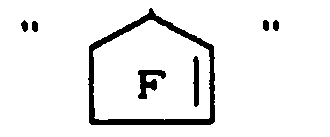
gewählt wird.


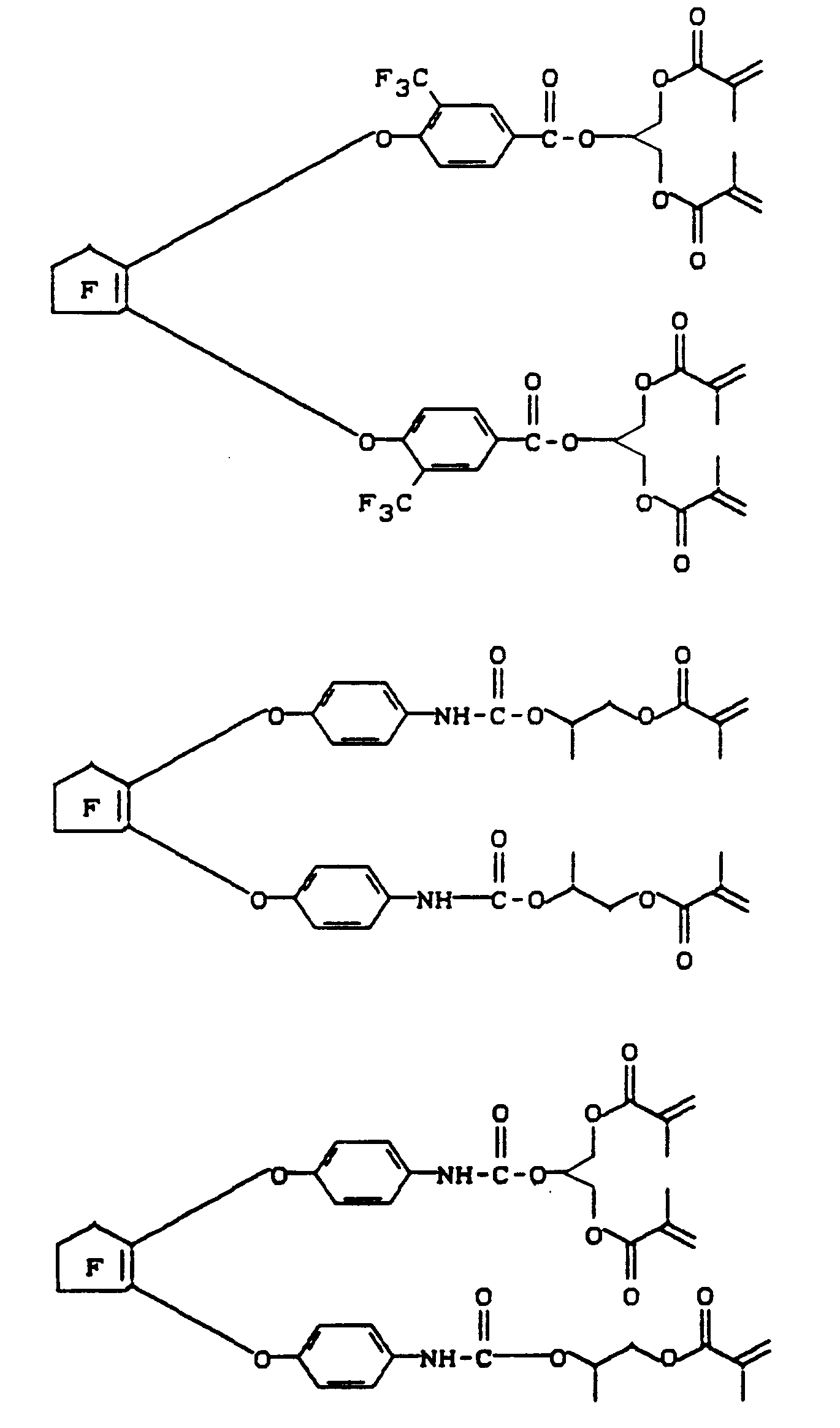


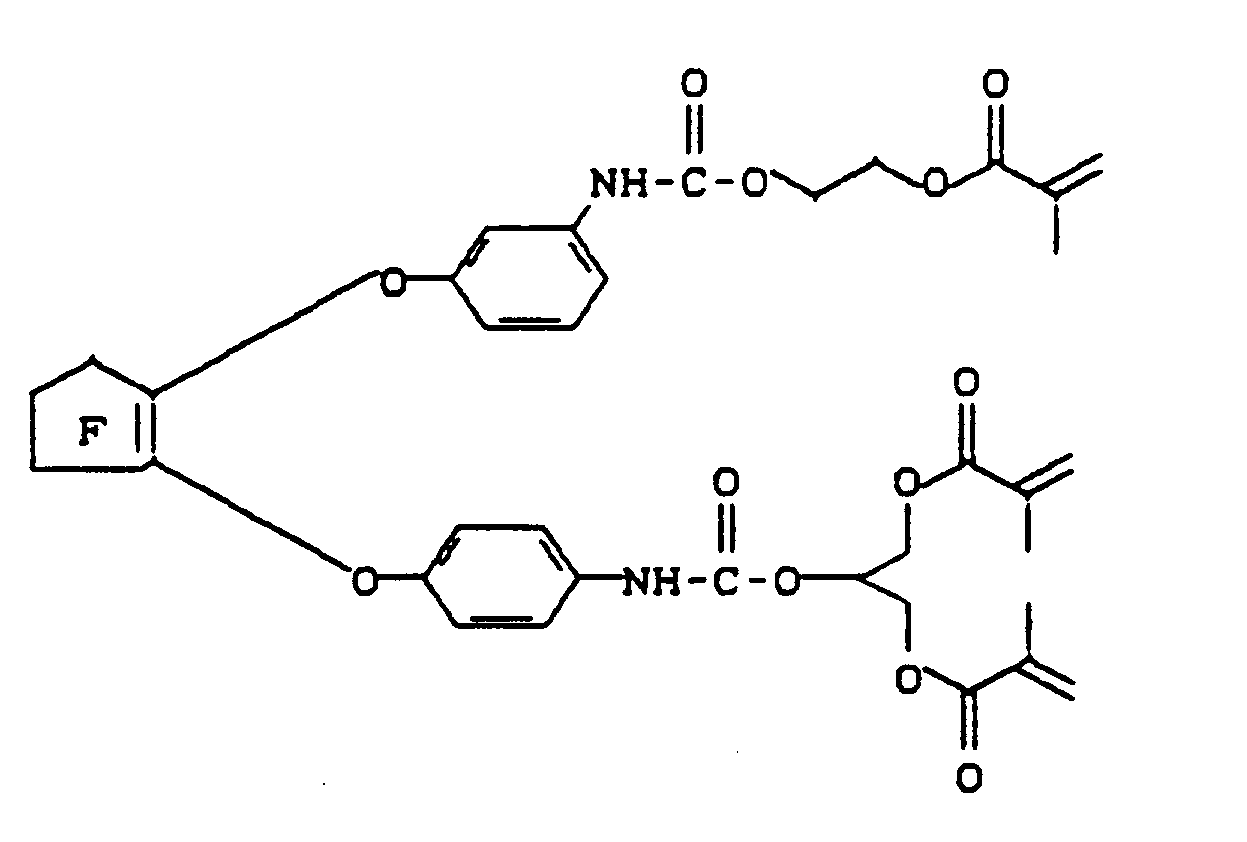
Es wurde weiterhin ein Verfahren zur Herstellung von (Meth)acrylsäureestern der Formel (I) gefunden, das dadurch gekennzeichnet ist, daß man substituierte 1,2-Bis-(phenoxy)-3,3,4,4,5,5-hexafluor-1-cyclopentene der Formel
worin - R¹, R²
- unabhängig voneinander C₁- bis C₄-Alkyl, C₁- bis C₄-Hologenalkyl oder Wasserstoff bedeuten und
- Y
- für Isocyanato (-NCO) oder Chlorocarbonyl (-COCl) steht,
- R³, R⁴
- (n + 1)- bzw. (m + 1)-wertige, geradkettige oder verzweigte Kohlenwasserstoffreste mit 2 bis 15 Kohlenstoffatomen, die gegebenenfalls 1 bis 3 Sauerstoffbrücken enthalten können, bedeuten,
- R⁵, R⁶
- Wasserstoff oder Methyl bedeuten und
- n und m
- ganze Zahlen von 1 bis 5 bedeuten
- Die Herstellung der für das erfindungsgemäße Verfahren benötigten substituierten 1,2-Bis(phenoxy)-3,3,4,4,5,5-hexafluor-1-cyclopentene der Formel (III) ist aus der DE-OS 3 817 626 bekannt. Als geeignete Verbindungen der Formel (III) seien genannt:
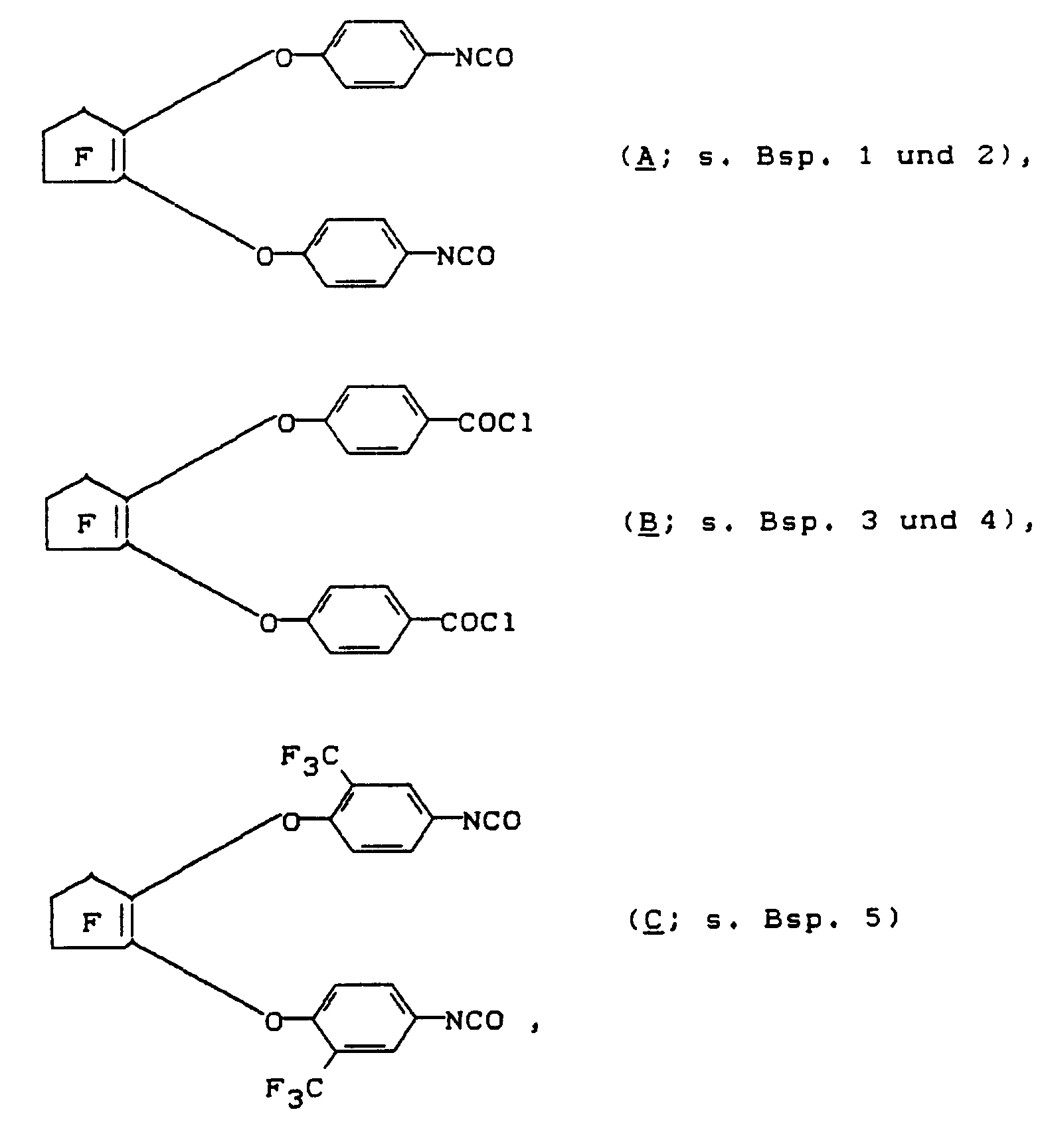

OH-funktionelle (Meth)acrylsäure-Derivate der Formeln (IV) und (V) sind handelsüblich oder können in bekannter Weise durch partielle Veresterung der entsprechenden Polyole
HO-R³(OH)n
oder
HO-R⁴(OH)m
hergestellt werden. - Als geeignete OH-funktionelle (Meth)acrylsäure-Derivate seien genannt:
- Dodekandiolmono(meth)acrylat, Decandiolmono(meth)acrylat, Nonandiolmono(meth)acrylat, Octandiolmono(meth)acrylat, Heptandiolmono(meth)acrylat, Polyethylenglykolmono(meth)acrylate mit mehr als vier Ethoxyeinheiten, Polypropylenglykolmono(meth)acrylate mit mehr als vier Propoxyeinheiten, Pentaerythrittri(meth)acrylat und Dipentaerythritpenta(meth)acrylat.
- Als bevorzugte OH-funktionelle (Meth)acrylsaure-Derivate der Formeln (IV) und (V) seien Hexandiolmono(meth)acrylat, Pentandiolmono(meth)acrylat, Butandiolmono(meth)acrylat, Tetraethylenglykolmono(meth)acrylat, Tetrapropylenglykolmono(meth)acrylat und Trimethylolpropandi(meth)acrylat genannt.
- Besonders bevorzugte OH-funktionelle (Meth)acrylsäure-Derivate sind 3-Hydroxypropyl(meth)acrylat, 2-Hydroxyethyl(meth)acrylat, Tri- und Diethylenglykolmono(meth)acrylat, Tri- und Dipropylenglykolmono(meth)acrylat und Glycerindi(meth)acrylat.
- Existieren Isomere der genannten OH-funktionellen (Meth)acrylsäure-Derivate der Formeln (IV) und (V) bezüglich der Stellung der (Meth)acryloyl-Gruppierung bzw. bezüglich des zentralen Kohlenwasserstoffskeletts (-verzweigt bzw. unverzweigt-), so ist die Verwendung von Isomerengemischen bevorzugt.
- Die Umsetzung der Diisocyanate und Säurechloride gemäß Formel (III) zu den erfindungsgemäßen (Meth)acrylsäureestern (I) erfolgt vorzugsweise unter Wasserausschluß in einem inerten Lösungsmittel. Beispiele für geeignete Lösungsmittel sind: Chloroform, Tetrahydrofuran, Dioxan, Methylenchlorid, Toluol, Acetonitril und Frigene. Bevorzugte Lösungsmittel sind Chloroform, Tetrahydrofuran, Frigen 113, Acetonitril und Methylenchlorid.
- Insbesondere kann das erfindungsgemäße Verfahren auch in einem niedrig viskosen Comonomer als Lösungsmittel erfolgen, das selbst (Meth)acrylatgruppen enthält und deshalb nach der Reaktion nicht entfernt werden muß, da es mit den erfindungsgemäßen Verbindungen copolymerisierbar ist. Das erhaltene Monomergemisch ist so direkt zur Herstellung von Dentalmaterialien geeignet. Geeignete Reaktivverdünner sind Di(meth)acrylate von zweiwertigen Alkoholen wie Alkandiolen oder Ethylenglykolen und Propylenglykolen mit zwei bis zwölf Kohlenstoffatomen. Besonders geeignet sind Hexandioldimethacrylat und Triethylenglykoldimethacrylat.
- Die Umsetzung wird im allgemeinen im Temperaturbereich von -40 bis +100°C, vorzugsweise -35 bis +70°C, durchgeführt.
- Zur Beschleunigung der Umsetzung der Diisocyanate gemäß Formel (III) werden gegebenenfalls zinnhaltige Katalysatoren wie Dibutylzinndilaurat oder Zinn(II)octoat verwendet. Andere geeignete Katalysatoren sind Verbindungen mit tert. Aminogruppen und Titanverbindungen. Im allgemeinen wird der Katalysator in einer Menge von 0,01 bis 2,5 Gew.-%, bevorzugt von 0,1 bis 1,5 Gew.-%, bezogen auf die Gesamtmenge der Reaktanden, eingesetzt.
- Die Umsetzung der Säurechloride gemäß Formel (III) kann gegebenenfalls in Gegenwart von Basen erfolgen. Geeignete Basen sind Natriumhydroxid, Kaliumhydroxid, Natrium- oder Kaliumcarbonat, Natrium- oder Kaliumhydrogencarbonat sowie tertiäre Amine wie Triethylamin, Pyridin, N-Methylpiperidin, 1,5-Diazabicyclo[4.3.0]non-5-en oder 1,8-Diazabicyclo[5.4.0]undec-7-en.
- Das erfindungsgemäße Verfahren wird im allgemeinen vorteilhaft in Gegenwart von 0,01 bis 0,2 Gew.-% eines Polymerisations-Inhibitors, bezogen auf die Gesamtmenge der Reaktanden, unter Normaldruck durchgeführt. Es ist aber auch möglich, das erfindungsgemäße Verfahren bei einem Unter- oder Überdruck durchzuführen.
- Ein geeigneter Inhibitor ist zum Beispiel 2,6-Di-tert.-butyl-p-kresol. Geeignet ist auch Luft, die in das Reaktionsgemisch eingeleitet wird. Das erfindungsgemäße Verfahren kann beispielsweise wie folgt durchgeführt werden:
- Die Reaktanden werden in dem Lösungsmittel gelöst und unter Rühren gegebenenfalls mit dem Katalysator und/oder der Base versetzt. Der zeitliche Verlauf der Umsetzung kann beispielsweise durch Messung der IR-Spektren verfolgt werden. Nach vollständiger Umsetzung der Isocyanat- bzw. Säurechloridgruppen werden die Reaktionsprodukte nach Filtration enthaltener Feststoffe durch Entfernen des Lösungsmittels isoliert. Eine vorherige Reinigung mit Hilfe von Adsorbentien, beispielsweise Aktivkohle, Bleicherde, Kieselgel oder Aluminiumoxid ist möglich.
- Für die Anwendung als Monomere für polymere Zahnfüllmassen oder Beschichtungsmittel (Zahnlacke) im Dentalbereich können die erfindungsgemäßen (Meth)acrylsäureester der Formel (I) mit an sich bekannten Monomeren gemischt werden, um beispielsweise die Viskosität dem Verwendungszweck anzupassen. Viskositäten im Bereich von 60 bis 20.000 mPa.s sind dabei bevorzugt. Dies ist dadurch erreichbar, daß man den erfindungsgemäßen Monomeren gegebenenfalls ein Comonomer niedrigerer Viskosität zumischt. Die erfindungsgemäßen Verbindungen werden in der Mischung mit Comonomeren mit einem Anteil von ca. 10 bis 90 Gew.-% eingesetzt, wobei ein Anteil von 20 bis 80 Gew.-% besonders bevorzugt ist.
- Es ist auch möglich, Monomermischungen einzusetzen, die mehrere Comonomere enthalten.
- Beispielsweise seien die folgenden Comonomere genannt: Triethylenglykoldimethacrylat, Tetraethylenglykoldimethacrylat, 1,12-Dodecandioldimethacrylat, 1,6-Hexandioldimethacrylat, Tri- und Diethylenglykoldimethacrylat, Bis-GMA, 2,2-Bis[p-(2'-methacryloyloxyethoxy)phenyl]propan. Von Vorteil sind auch Comonomere mit Urethangruppen, z.B. die bekannten Umsetzungsprodukte von 1 Mol eines Diisocyanats, z.B. Hexamethylendiisocyanat, Trimethylhexamethylendiisocyanat oder Isophorondiisocyanat, mit 2 Molen eines Hydroxyalkyl(meth)acrylsäureesters, z.B. Glycerindimethacrylat, 2-Hydroxypropylacrylat usw.
- Weitere Beispiele für Comonomere sind: Trimethylolpropan-tri(meth)-acrylat, Bis-(Meth)acryloyloxyethoxymethyl-Tricyclo[5.2,1.02,6]decan (gemäß DE-A 2 931 925 und 2 931 926), 1,3-Di[(meth)acryloyloxypropyl]-1,1,3,3-tetramethyl-disiloxan, 1,3-Bis[3-(meth)-acryloyloxyethylcarbamoyloxy-propyl]-1,1,3,3-tetramethyl-disiloxan. Insbesondere werden Comonomere bevorzugt, die bei 13 mbar einen Siedepunkt über 100°C besitzen.
- Die erfindungsgemäßen (Meth)acrylsäureester (I) lassen sich, gegebenenfalls in Mischung mit den genannten Monomeren, zur Herstellung von polymeren Werkstoffen verwenden. Die Polymerisation ergibt Polymerisate, die eine hohe Vernetzungsdichte und gegenüber herkömmlichen Polymerisaten eine Erniedrigung der polaren Anteile der Oberflächenspannung aufweisen, Die erfindungsgemäßen (Meth)acrylsäurederivate (I) können insbesondere als Monomere für Dentalmaterialien verwendet werden. Als Dentalmaterialien seien beispielsweise Füllungsmaterialien für Zähne, Beschichtungsmittel für Zähne und Komponenten für die Herstellung von Zahnersatz genannt. Je nach Anwendungsgebiet können Dentalmaterialien weitere Hilfsstoffe enthalten.
- Die erfindungsgemäßen (Meth)acrylsäureester (I) lassen sich, gegebenenfalls in Mischung mit den genannten Monomeren, mit an sich bekannten Methoden zu vernetzten Polymerisaten aushärten (G.M. Brauer, H. Argentar, Am, Chem. Soc., Symp. Ser. 212, S. 359 bis 371 [1983]). Für die sogenannte Redoxpolymerisation ist ein System aus einer peroxidischen Verbindung und einem Reduktionsmittel, beispielsweise auf Basis tertiärer aromatischer Amine, geeignet.
- Beispiele für Peroxide sind:
Dibenzoylperoxid, Dilauroylperoxid, Di-4-Chlorbenzolperoxid und Dicyclohexylperoxydicarbonat. - Als tertiäre aromatische Amine seien beispielsweise N,N-Dimethyl-p-toluidin, Bis-(2-hydroxyethyl)-p-toluidin, Bis(2-hydroxyethyl)-3,5-dimethylanilin und das in der DE-PS 2 759 239 beschriebene N-Methyl-N-(2-methylcarbamoyloxypropyl)-3,5-dimethylanilin genannt.
- Die Konzentrationen des Peroxids bzw. des Amins werden vorteilhaft so gewählt, daß sie 0,1 bis 5 Gew.-%, bevorzugt 0,5 bis 3 Gew,-%, bezogen auf die Monomermischung, betragen. Die peroxid- bzw. aminhaltigen Monomermischungen werden bis zur Anwendung getrennt gelagert.
- Die erfindungsgemäßen Monomeren können auch durch Bestrahlung mit UV-Licht oder sichtbarem Licht (beispielsweise im Wellenlängenbereich von 230 bis 650 nm) zur Polymerisation gebracht werden. Als Initiatoren für die fotoinitiierte Polymerisation eignen sich beispielsweise Benzil, Benzildimethylketal, Benzoinmonoalkylether, Benzophenon, p-Methoxybenzophenon, Fluorenon, Thioxanthon, Phenanthrenchinon und 2,3-Bornandion (Camperchinon), gegebenenfalls in Gegenwart von synergistisch wirkenden Fotoaktivatoren, wie N,N-Dimethylaminoethylmethacrylat, Triethanolamin, 4-N,N-Dimethylaminobenzolsulfonsäurebisallylamid. Die Durchführung des Photopolymerisationsverfahrens ist beispielsweise in der DE-PS 3 135 115 beschrieben.
- Neben den oben beschriebenen Initiatoren können den erfindungsgemäßen (Meth)acrylsäureestern an sich für diesen Einsatzzweck bekannte Lichtschutzmittel und Polymerisations-Inhibitoren zugesetzt werden. Das Lichtschutzmittel und der Polymerisations-Inhibitor werden jeweils im allgemeinen in einer Menge von 0,01 bis 0,50 Gew.-Teilen, bezogen auf 100 Gew.-Teile der Monomermischung, eingesetzt. Die Monomermischungen können ohne Zusatz von Füllstoffen als Beschichtungsmitel für Zahne (Zahnlacke) eingesetzt werden. Nach der Polymerisation erhält man einen kratzfesten Überzug auf dem Substrat.
- Bei der Verwendung als Zahnfüllmassen setzt man den erhaltenen Monomermischungen im allgemeinen Füllstoffe zu. Um einen hohen Füllgrad erreichen zu können, sind Monomermischungen, die eine Viskosität im Bereich von 60 bis 20.000 mPa.s besitzen, besonders vorteilhaft. Den die erfindungsgemäßen Verbindungen der Formel (I) enthaltenden Monomermischungen können vorzugsweise anorganische Füllstoffe zugemischt werden. Beispielsweise seien Bergkristall, Quarzit, Kristobalit, Quarzglas, hochdisperse Kieselsäure, Aluminiumoxid und Glaskeramiken, beispielsweise Lanthan und Zirkon enthaltende Glaskeramiken (DE-A 2 347 591), genannt.
- Die anorganischen Füllstoffe werden zur Verbesserung des Verbundes zur Polymermatrix des Polymethacrylats vorzugsweise mit einem Haftvermittler vorbehandelt. Die Haftvermittlung kann beispielsweise durch eine Behandlung mit Organosiliciumverbindungen erreicht werden [E.P. Plueddemann, Progress in Organic coatings, 11, 297 bis 308 (1983)]. Bevorzugt wird 3-Methacryloyloxypropyltrimethoxysilan eingesetzt.
- Die Füllstoffe für die erfindungsgemäßen Zahnfüllmassen weisen im allgemeinen einen mittleren Teilchendurchmesser von 0,01 bis 100 »m, vorzugsweise von 0,05 bis 50 »m, besonders bevorzugt 0,05 bis 5 »m, auf. Es kann auch vorteilhaft sein, mehrere Füllstoffe nebeneinander einzusetzen, die einen voneinander verschiedenen Teilchendurchmesser und verschiedenen Silanisierungsgrad besitzen.
- Der Füllstoffanteil in den Zahnfüllmassen beträgt im allgemeinen 5 bis 85 Gew.-%, vorzugsweise 50 bis 80 Gew.-%.
- Für die Herstellung der Zahnfüllmassen werden die Komponenten unter Verwendung handelsüblicher Knetmaschinen verarbeitet.
- Der Anteil der erfindungsgemäßen (Meth)acrylsäure-Derivate in den Füllmassen beträgt im allgemeinen 5 bis 90 Gew.-%, vorzugsweise 10 bis 60 Gew.-%, bezogen auf die Füllmasse. Die Aushärtung der Zahnfüllmassen zu einem Formkörper erfolgt in der Kavität des Zahnes mit den oben genannten Methoden.
- Die erfindungsgemäßen (Meth)acrylsäure-Derivate können auch als Komponenten bei der Herstellung von Zahnersatz eingesetzt werden.
- Dabei werden die erfindungsgemäßen Monomeren mit den üblicherweise verwendeten, an sich bekannten Bestandteilen kombiniert. Vorzugsweise werden die Monomeren im Gemisch mit Alkylmethacrylaten, wie Methylmethacrylat, eingesetzt. Es können auch zusätzlich an sich bekannte Perlpolymeriste zugesetzt werden. Zur Einstellung der Zahnfarbe können bekannte anorganische und organische Farbpigmente und Trübungsmittel zugesetzt werden. Auch die Anwendung von Stabilisatoren und Lichtschutzmitteln ist möglich.
- Die Kunststoffzähne werden durch radikalische Polymerisation der Dentalmassen unter Formgebung hergestellt. Die Verarbeitung ist sowohl nach Injektionsverfahren als auch Prägeverfahren möglich und erfolgt im allgemeinen nach den üblichen Herstellungsmethoden für Zähne auf Basis von Poly(methylmethacrylat), z.B. durch thermische Polymerisation unter Verwendung von an sich bekannten Polymerisationsinitiatoren, beispielsweise auf Basis von Peroxiden und Azoverbindungen, wie Dibenzoylperoxid, Dilauroylperoxid, Cyclohexylpercarbonat, Azoisobuttersäuredinitril. Gut geeignet sind auch Mischungen von Polymerisationsinitiatoren mit unterschiedlichen Halbwertzeiten bezüglich ihres Zerfalls.
- Zu einer Lösung aus 88,90 g (0,201 Mol) Isocyanat A in 170 g trockenem Chloroform wurden unter Rühren 91,75 g (0,402 Mol) GDMA getropft, wobei die Temperatur auf 61°C anstieg. Es wurde noch elf Stunden bei Raumtemperatur gerührt, mit je 0,60 g 2,6-Di-tert.butyl-p-kresol und Hydrochinonmonomethylether versetzt und zu 178,24 g (98 % d. Th.) eines hellen, viskosen Öles an Produkt "A-GDMA₂" (s. vorn) eingeengt.
- IR (Film):
- ν = 3300, 2900, 1720, 1632, 1608, 1522, 1500, 1351, 1283, 1185, 1150, 1000, 973, 940, 754 cm⁻¹.
- ¹H-NMR (CDCl₃, 200 MHz):
- δ = 1.97 (bs, 12 H, CH₃), 4.30 (m, 10 H, CH₂-CH-CH₂), 5.62, 6.15 (2 m, je 4 H, vinyl. H), 6.71, 7.20 (2 m, je 4 H, ar. H), 6.95 (bs, 2 H, NH) ppm.
- HPLC/MS (NH₃-Aktivierung):
- m/z = 898 (M⁺), 670 (M-GDMA)
- MS (70 eV-Direkteinlaß):
- Zu einer Lösung aus 200,00 g (452 mmol) Isocyanat A in 375,00 g trockenem Chloroform wurden unter Rühren bei Raumtemperatur 117,65 g (904 mmol) HEMA getropft und fünf Stunden lang auf 50°C erwärmt. Nach Zugabe von je 1,71 g 2,6-Di-tert.butyl-p-kresol und Hydrochinonmonomethylether wurde der Ansatz zu 316,76 g (99 % d. Th.) eines hellen Öles an Produkt "A-HEMA₂" (s. vorn) eingeengt.
- IR (Film):
- ν = 3280, 2900, 1701, 1620, 1600, 1520, 1500, 1360, 1280, 1208, 1180, 1151, 1067, 992, 963 cm⁻¹.
- ¹H-NMR (CDCl₃, 200 MHz)
- : δ = 1.97 (bs, 6 H, CH₃), 4.42 (bs, 8 H, CH₂), 5.61, 6.17 (2 m, je 2 H, vinyl. H), 6.67, 7.16 (2 m, je 4 H, ar. H), 6.71 (bs, 2 H, NH) ppm.
- MS (70 eV):
- m/z = 702 (M⁺), 572 (M-HEMA), 442 (M-2HEMA),
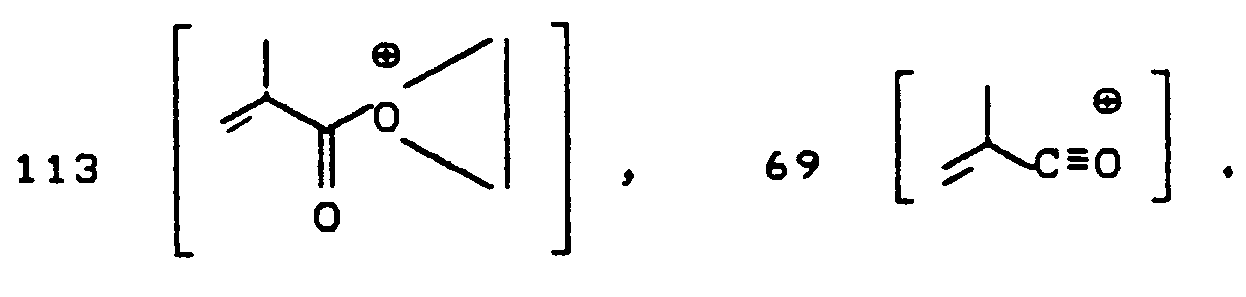
- 65,20 g (500 mmol) HEMA, 60,80 g (600 mmol) trockenes Triethylamin und 50 mg 2,6-Di-tert.butyl-kresol wurden zusammen in 250 ml trockenem Methylenchlorid vorgelegt und bei -30°C mit einer Lösung aus 121,30 g (250 mmol) Säurechlorid B in 200 ml Methylenchlorid versetzt. Es wurde zwei Stunden bei -30°C gerührt, der ausgefallene Niederschlag bei 0°C abgesaugt und das erhaltene Filtrat wäßrig extrahiert. Die getrocknete organische Phase wurde mit 50 mg Hydrochinonmonomethylether versetzt und zu 157,20 g (93 % d. Th.) eines hellen Öles an Produkt "B-HEMA₂" (s. vorn) eingeengt.
- IR (Film):
- ν = 2940, 1720, 1618, 1602, 1500, 1445, 1270, 1150, 1002, 978, 940, 845, 809, 760 cm⁻¹.
- ¹H-NMR (CDCl₃, 200 MHz):
- δ = 1.96 (bs, 6 H, CH₃), 4.50 (m, 8 H, CH₂), 5.61, 6.13 (2 m, je 2 H, vinyl. H), 6.78, 7.82 (2 m, je 4 H, ar. H) ppm.
- 114,00 g (500 mmol) Glycerindimethacrylat, 60,80 g (600 mmol) trockenes Triethylamin und 50 mg 2,6-Di-tert.butyl-p-kresol wurden zusammen in 250 ml trockenem Methylenchlorid vorgelegt und bei -30°C mit einer Lösung aus 121,30 g (250 mmol) Säurechlorid B in 250 ml Methylenchlorid versetzt. Es wurde nun wie in Beispiel 3 verfahren und 205,56 g (94 % d. Th.) eines hellen Öles an Produkt "B-GDMA₂" (s. vorn) erhalten.
- IR (Film):
- ν = 2960, 1730, 1640, 1605, 1500, 1350, 1321, 1295, 1267, 1205, 1157, 1110, 1005, 979, 942, 847, 810, 759, 730 cm⁻¹.
- ¹H-NMR (CDCl₃, 200 MHz):
- δ = 1.93 (bs, 12 H, CH₃), 4.40 (m, 10 H, CH₂-CH-CH₂), 5.61, 6.11 (2 m, je 4 H, vinyl. H), 6.77, 7.86 (2 m, je 4 H, ar. H) ppm.
- Zu einer Lösung aus 57,83 g (100 mmol) Isocyanat C in 120 ml trockenem Chloroform wurde unter Rühren bei Raumtemperatur eine Lösung aus 14,42 g (100 mmol) HPMA und 22,82 g (100 mmol) GDMA in 10 ml trockenem Chloroform getropft. Es wurde vier Stunden lang auf 40°C erwärmt und anschließend zu 91,10 g (96 % der Theorie) eines gelblichen Öles eingeengt, das aus den drei Reaktionsprodukten "C-GDMA-HPMA", "C-HPMA₂" und "C-GDMA₂" (s. vorn) bestand.
- IR (Film):
- ν = 3300, 2940, 1710, 1620, 1540, 1492, 1420, 1320, 1200, 1130, 1044, 1000, 973, 940, 752 cm⁻¹.
- ¹H-NMR (CDCl₃, 200 MHz):
- δ = 1.3 (OCH-CH₃), 1.98 (=CCH₃), 3.6-4.6 (OCH₂, OCH), 5.6, 6.15 (= CH₂), 6.8-7.7 (ar.-H, NH) ppm.
- 3 Teile des erfindungsgemäßen (Meth)acrylsäureesters nach Beispiel 1 und 1 Teil Triethylenglykoldimethacrylat werden versetzt mit 0,2 Gew.-% Campherchinon und 0,5 Gew.-% 4-N,N-Dimethylaminobenzolsulfonsäurebisallylamid und unter Lichtausschluß zu einer aktivierten Monomermischung (D) verarbeitet. Diese härtet durch sichtbares Licht bei einer Belichtungsdauer von 60 s zu einem Kunststoff hoher mechanischer Stabilität aus und ist als Verschlußmaterial im Dentalbereich (Sealer, Liner, Zahnlack) verwendbar.
- Zur Herstellung einer Zahnfüllmasse werden 29 Gewichtsteile der aktivierten nicht polymerisierten Monomermischung und 71 Gewichtsteile einer von mit 3-Methacryloyloxypropyltrimethoxysilan silanisierten Mischung aus pyrogener Kieselsäure und gemahlenem Quarzglas in einem handelsüblichen Kneter bei Raumtemperatur zu einer Paste verarbeitet. Ein nach DIN 13 922 mit einer handelsüblichen Dentallampe (Translux®) ausgehärteter Probekörper, der aus dieser Paste hergestellt wurde, zeigt neben einer hohen Biegefestigkeit und geringen Wasseraufnahme auch eine gute Abrasionsbeständigkeit.

worin unabhängig voneinander

Claims (9)
- Verfahren zur Herstellung von (Meth)acrylsäureestern substituierter 1,2-Bis-(phenoxy)-3,3,4,4,5,5-hexafluor-1-cyclopentene der Formel (I)
 R¹, R² C₁- bis C₄-Alkyl, C₁- bis C₄-Halogenalkyl oder Wasserstoff bedeuten,R³, R⁴ (n + 1)- bzw. (m + 1)-wertige, geradkettige oder verzweigte Kohlenwasserstoffreste mit 2 bis 15 Kohlenstoffatomen, die gegebenenfalls 1 bis 3 Sauerstoffbrücken enthalten können, bedeuten,R⁵, R⁶ Wasserstoff oder Methyl bedeuten undX für
 n und m ganze Zahlen von 1 bis 5 bedeuten,dadurch gekennzeichnet, daß man 1,2-Bis(phenoxy)-3,3,4,4,5,5-hexaflour-1-cyclopentene der Formel (II)
 R¹, R² unabhängig voneinander C₁- bis C₄-Alkyl, C₁- bis C₄-Halogenalkyl oder Wasserstoff bedeuten undY für Isocyanato (-NCO) oder Chlorocarbonyl (-COCl) steht,mit mindestens einem OH-funktionellen (Meth)acrylsäure-Derivat der Formel
 R³, R⁴ (n + 1)- bzw. (m + 1)-wertige, geradkettige oder verzweigte Kohlenwasserstoffreste mit 2 bis 15 Kohlenstoffatomen, die gegebenenfalls 1 bis 3 Sauerstoffbrücken enthalten können, bedeuten,R⁵, R⁶ Wasserstoff oder Methyl bedeuten undn und m ganze Zahlen von 1 bis 5 bedeutenin einem inerten Lösungsmittel, im Temperaturbereich zwischen -40 und +100°C, gegebenenfalls in Gegenwart eines Katalysators und/oder einer Base sowie gegebenenfalls in Gegenwart eines Polymerisationsinhibitors umsetzt.
 - Verwendung von (Meth)acrylsäureestern substituierter 1,2-Bis(phenoxy)-3,3,4,4,5,5-hexafluor-1-cyclopentene der Formel
 R¹, R² C₁- bis C₄-Alkyl, C₁- bis C₄-Halogenalkyl oder Wasserstoff bedeuten,R³, R⁴ (n + 1)- bzw. (m + 1)-wertige, geradkettige oder verzweigte Kohlenwasserstoffreste mit 2 bis 15 Kohlenstoffatomen, die gegebenenfalls 1 bis 3 Sauerstoffbrücken enthalten können, bedeuten,R⁵, R⁶ Wasserstoff oder Methyl bedeuten undX für
 n und m ganze Zahlen von 1 bis 5 bedeuten, im Dentalbereich.
 - Verwendung nach Anspruch 2, dadurch gekennzeichnet, daß die (Meth)acrylsäureester substituierter 1,2-bis(phenoxy)-3,3,4,4,5,5-hexafluor-1-cyclopentene in Zahnfüllmassen eingesetzt werden.
- Verwendung nach Anspruch 2, dadurch gekennzeichnet, daß die (Meth)acrylsäureester substituierter 1,2-Bis(phenoxy)-3,3,4,4,5,5-hexafluor-1-cyclopentene in Beschichtungsmitteln für Zähne eingesetzt werden.
- Verwendung nach Anspruch 2, dadurch gekennzeichnet, daß die (Meth)acrylsäureester substituierter 1,2-Bis(phenoxy)-3,3,4,4,5,5-hexafluor-1-cyclopentene für die Herstellung von Kunststoffzähnen eingesetzt werden.
Applications Claiming Priority (2)
| Application Number | Priority Date | Filing Date | Title |
|---|---|---|---|
| DE4005231 | 1990-02-20 | ||
| DE4005231A DE4005231A1 (de) | 1990-02-20 | 1990-02-20 | Dentalwerkstoffe |
Publications (3)
| Publication Number | Publication Date |
|---|---|
| EP0443370A2 EP0443370A2 (de) | 1991-08-28 |
| EP0443370A3 EP0443370A3 (en) | 1992-05-20 |
| EP0443370B1 true EP0443370B1 (de) | 1994-08-24 |
Family
ID=6400526
Family Applications (1)
| Application Number | Title | Priority Date | Filing Date |
|---|---|---|---|
| EP91101639A Expired - Lifetime EP0443370B1 (de) | 1990-02-20 | 1991-02-07 | Dentalwerkstoffe |
Country Status (9)
| Country | Link |
|---|---|
| US (1) | US5132335A (de) |
| EP (1) | EP0443370B1 (de) |
| JP (1) | JPH04211045A (de) |
| AT (1) | ATE110360T1 (de) |
| DE (2) | DE4005231A1 (de) |
| DK (1) | DK0443370T3 (de) |
| ES (1) | ES2058945T3 (de) |
| IE (1) | IE910566A1 (de) |
| PT (1) | PT96800B (de) |
Families Citing this family (6)
| Publication number | Priority date | Publication date | Assignee | Title |
|---|---|---|---|---|
| DE4129877A1 (de) * | 1991-09-09 | 1993-03-11 | Bayer Ag | Adhaesivkomponente zur restaurierung der zahnhartsubstanz |
| DE4428889C1 (de) * | 1994-08-18 | 1996-01-11 | Heraeus Kulzer Gmbh | Haftvermittler |
| EP0762214A1 (de) | 1995-09-05 | 1997-03-12 | Agfa-Gevaert N.V. | Lichtempfindliches Element, das eine Bildaufbauschicht und eine photopolymerisierbare Schicht enthält |
| JP2003234180A (ja) * | 2002-02-08 | 2003-08-22 | Nippon Zeon Co Ltd | 有機エレクトロルミネッセンス素子用カバー膜、並びにそれを用いた有機エレクトロルミネッセンス素子及びその製造方法 |
| DE102008010464A1 (de) | 2008-02-21 | 2009-08-27 | Alldent Gmbh | Verwendung von fluorierten Urethan(meth)acrylaten zur Herstellung von Dentalwerkstoffen und die erhaltenen Dentalwerkstoffe |
| JP6905330B2 (ja) * | 2015-12-09 | 2021-07-21 | 住友化学株式会社 | 化合物、樹脂、レジスト組成物及びレジストパターンの製造方法 |
Family Cites Families (12)
| Publication number | Priority date | Publication date | Assignee | Title |
|---|---|---|---|---|
| US3923740A (en) * | 1969-05-14 | 1975-12-02 | Espe Pharm Praep | Compositions for use in prosthodontia |
| US3962187A (en) * | 1970-07-20 | 1976-06-08 | The Goodyear Tire & Rubber Company | Stabilized polymers of ditertiary alkyl-4-hydroxybenzyloxy alkyl acrylates and dienes |
| GB2074590B (en) * | 1980-04-29 | 1984-02-22 | Kuraray Co | Acrylate urethane binders in dental cement compositions |
| US4985473A (en) * | 1980-05-20 | 1991-01-15 | Minnesota Mining And Manufacturing Company | Compositions for providing abherent coatings |
| US4356296A (en) * | 1981-02-25 | 1982-10-26 | The United States Of America As Represented By The Secretary Of The Navy | Fluorinated diacrylic esters and polymers therefrom |
| US4616073A (en) * | 1984-08-09 | 1986-10-07 | The United States Of America As Represented By The Department Of Health And Human Services | Hydrophobic dental composites based on a polyfluorinated dental resin |
| DE3516256A1 (de) * | 1985-05-07 | 1986-11-13 | Bayer Ag, 5090 Leverkusen | (meth)-acrylsaeureester und ihre verwendung |
| DE3516257A1 (de) * | 1985-05-07 | 1986-11-13 | Bayer Ag, 5090 Leverkusen | (meth)-acrylsaeureester und ihre verwendung |
| US4839401A (en) * | 1985-07-12 | 1989-06-13 | Jeneric/Pentron, Inc. | Light curable dental pit and fissure sealant |
| JPH0696485B2 (ja) * | 1987-08-28 | 1994-11-30 | ダイキン工業株式会社 | 歯科用材料 |
| DE3817626A1 (de) * | 1988-05-25 | 1989-11-30 | Bayer Ag | Fluorierte bis-aryloxy-substituierte alkene, verfahren zu deren herstellung und deren verwendung |
| DE3917320A1 (de) * | 1989-05-27 | 1990-12-20 | Bayer Ag | Harnstoffgruppen enthaltende (meth)-acrylsaeure-derivate von triisocyanaten und ihre verwendung |
-
1990
- 1990-02-20 DE DE4005231A patent/DE4005231A1/de not_active Withdrawn
-
1991
- 1991-02-07 DK DK91101639.2T patent/DK0443370T3/da active
- 1991-02-07 ES ES91101639T patent/ES2058945T3/es not_active Expired - Lifetime
- 1991-02-07 AT AT91101639T patent/ATE110360T1/de not_active IP Right Cessation
- 1991-02-07 DE DE59102587T patent/DE59102587D1/de not_active Expired - Fee Related
- 1991-02-07 EP EP91101639A patent/EP0443370B1/de not_active Expired - Lifetime
- 1991-02-11 US US07/653,397 patent/US5132335A/en not_active Expired - Fee Related
- 1991-02-18 PT PT96800A patent/PT96800B/pt not_active IP Right Cessation
- 1991-02-18 JP JP3045813A patent/JPH04211045A/ja active Pending
- 1991-02-19 IE IE056691A patent/IE910566A1/en unknown
Also Published As
| Publication number | Publication date |
|---|---|
| PT96800A (pt) | 1991-10-31 |
| JPH04211045A (ja) | 1992-08-03 |
| ES2058945T3 (es) | 1994-11-01 |
| DE59102587D1 (de) | 1994-09-29 |
| US5132335A (en) | 1992-07-21 |
| EP0443370A2 (de) | 1991-08-28 |
| IE910566A1 (en) | 1991-08-28 |
| EP0443370A3 (en) | 1992-05-20 |
| ATE110360T1 (de) | 1994-09-15 |
| DE4005231A1 (de) | 1991-08-22 |
| PT96800B (pt) | 1998-07-31 |
| DK0443370T3 (da) | 1994-12-19 |
Similar Documents
| Publication | Publication Date | Title |
|---|---|---|
| EP0254185B1 (de) | Urethangruppen enthaltende (Meth)-acrylsäurederivate von Tricyclo [5.2.1.02.6]decanen | |
| EP0201778B1 (de) | (Meth)-Acrylsäureester und ihre Verwendung | |
| EP0201031B1 (de) | (Meth)-Acrylsäureester und ihre Verwendung | |
| EP0254950B1 (de) | (Meth)-acrylsäureester | |
| EP0209700B1 (de) | (Meth)-acrylsäure-Derivate von Tricyclodecanen und ihre Verwendung | |
| DE19961342B4 (de) | Radikalisch härtbare Urethanpräpolymere und deren Verwendung | |
| EP0206074B1 (de) | (Meth)-acrylsäureester und ihre Verwendung | |
| DE19803979C2 (de) | Zusammensetzungen enthaltend Urethandi(meth)acrylat-Derivate von 1,3-Bis (1-isocyanato-1-methylethyl)benzol | |
| EP0635478B1 (de) | Acrylate und Methacrylate auf Basis von Cyclohexyldiphenolen | |
| EP0264551A2 (de) | Urethangruppen enthaltende (Meth)-acrylsäurederivate | |
| EP0779290A1 (de) | Urethan-(Meth)acrylate mit cyclischen Carbonatgruppen und deren Verwendung zur Herstellung von Dentalwerkstoffen oder lithographischen Druckplatten | |
| EP0693487B1 (de) | Di(meth)acrylate mit cyclischen Carbonatgruppen | |
| EP0321841B1 (de) | Ester-Urethan-(Meth)-acrylsäurederivate | |
| EP0261520B1 (de) | (Meth)-acrysäureester von Tricyclodecangruppen enthaltenden Siloxanen | |
| EP0400383B1 (de) | Harnstoffgruppen enthaltende (Meth)-Acrylsäure-Derivate von Triisocyanaten und ihre Verwendung | |
| EP0443370A2 (de) | Dentalwerkstoffe | |
| EP0266589B1 (de) | (Meth)-Acrylsäure-Derivate von Triisocyanaten und ihre Verwendung | |
| EP0273245B1 (de) | (Meth)-Acrylsäure-Derivate von Triisocyanaten und ihre Verwendung |
Legal Events
| Date | Code | Title | Description |
|---|---|---|---|
| PUAI | Public reference made under article 153(3) epc to a published international application that has entered the european phase |
Free format text: ORIGINAL CODE: 0009012 |
|
| AK | Designated contracting states |
Kind code of ref document: A2 Designated state(s): AT BE CH DE DK ES FR GB GR IT LI LU NL SE |
|
| PUAL | Search report despatched |
Free format text: ORIGINAL CODE: 0009013 |
|
| AK | Designated contracting states |
Kind code of ref document: A3 Designated state(s): AT BE CH DE DK ES FR GB GR IT LI LU NL SE |
|
| 17P | Request for examination filed |
Effective date: 19920610 |
|
| 17Q | First examination report despatched |
Effective date: 19940201 |
|
| GRAA | (expected) grant |
Free format text: ORIGINAL CODE: 0009210 |
|
| AK | Designated contracting states |
Kind code of ref document: B1 Designated state(s): AT BE CH DE DK ES FR GB GR IT LI LU NL SE |
|
| REF | Corresponds to: |
Ref document number: 110360 Country of ref document: AT Date of ref document: 19940915 Kind code of ref document: T |
|
| REF | Corresponds to: |
Ref document number: 59102587 Country of ref document: DE Date of ref document: 19940929 |
|
| GBT | Gb: translation of ep patent filed (gb section 77(6)(a)/1977) |
Effective date: 19940901 |
|
| ET | Fr: translation filed | ||
| ITF | It: translation for a ep patent filed | ||
| REG | Reference to a national code |
Ref country code: ES Ref legal event code: FG2A Ref document number: 2058945 Country of ref document: ES Kind code of ref document: T3 |
|
| REG | Reference to a national code |
Ref country code: DK Ref legal event code: T3 |
|
| EAL | Se: european patent in force in sweden |
Ref document number: 91101639.2 |
|
| REG | Reference to a national code |
Ref country code: GR Ref legal event code: FG4A Free format text: 3014084 |
|
| PLBE | No opposition filed within time limit |
Free format text: ORIGINAL CODE: 0009261 |
|
| STAA | Information on the status of an ep patent application or granted ep patent |
Free format text: STATUS: NO OPPOSITION FILED WITHIN TIME LIMIT |
|
| 26N | No opposition filed | ||
| PGFP | Annual fee paid to national office [announced via postgrant information from national office to epo] |
Ref country code: DE Payment date: 19960112 Year of fee payment: 6 |
|
| PGFP | Annual fee paid to national office [announced via postgrant information from national office to epo] |
Ref country code: SE Payment date: 19960117 Year of fee payment: 6 |
|
| PGFP | Annual fee paid to national office [announced via postgrant information from national office to epo] |
Ref country code: GR Payment date: 19960124 Year of fee payment: 6 |
|
| PGFP | Annual fee paid to national office [announced via postgrant information from national office to epo] |
Ref country code: GB Payment date: 19960129 Year of fee payment: 6 |
|
| PGFP | Annual fee paid to national office [announced via postgrant information from national office to epo] |
Ref country code: FR Payment date: 19960130 Year of fee payment: 6 |
|
| PGFP | Annual fee paid to national office [announced via postgrant information from national office to epo] |
Ref country code: ES Payment date: 19960212 Year of fee payment: 6 |
|
| PGFP | Annual fee paid to national office [announced via postgrant information from national office to epo] |
Ref country code: AT Payment date: 19960219 Year of fee payment: 6 |
|
| PGFP | Annual fee paid to national office [announced via postgrant information from national office to epo] |
Ref country code: BE Payment date: 19960221 Year of fee payment: 6 |
|
| PGFP | Annual fee paid to national office [announced via postgrant information from national office to epo] |
Ref country code: DK Payment date: 19960223 Year of fee payment: 6 |
|
| PGFP | Annual fee paid to national office [announced via postgrant information from national office to epo] |
Ref country code: NL Payment date: 19960229 Year of fee payment: 6 |
|
| PGFP | Annual fee paid to national office [announced via postgrant information from national office to epo] |
Ref country code: CH Payment date: 19960318 Year of fee payment: 6 |
|
| PGFP | Annual fee paid to national office [announced via postgrant information from national office to epo] |
Ref country code: LU Payment date: 19960601 Year of fee payment: 6 |
|
| PG25 | Lapsed in a contracting state [announced via postgrant information from national office to epo] |
Ref country code: LU Free format text: LAPSE BECAUSE OF NON-PAYMENT OF DUE FEES Effective date: 19970207 Ref country code: GB Effective date: 19970207 Ref country code: DK Effective date: 19970207 Ref country code: AT Effective date: 19970207 |
|
| REG | Reference to a national code |
Ref country code: DK Ref legal event code: EBP |
|
| PG25 | Lapsed in a contracting state [announced via postgrant information from national office to epo] |
Ref country code: SE Effective date: 19970208 Ref country code: ES Free format text: LAPSE BECAUSE OF NON-PAYMENT OF DUE FEES Effective date: 19970208 |
|
| PG25 | Lapsed in a contracting state [announced via postgrant information from national office to epo] |
Ref country code: LI Effective date: 19970228 Ref country code: CH Effective date: 19970228 Ref country code: BE Effective date: 19970228 |
|
| BERE | Be: lapsed |
Owner name: BAYER A.G. Effective date: 19970228 |
|
| PG25 | Lapsed in a contracting state [announced via postgrant information from national office to epo] |
Ref country code: GR Free format text: THE PATENT HAS BEEN ANNULLED BY A DECISION OF A NATIONAL AUTHORITY Effective date: 19970831 |
|
| PG25 | Lapsed in a contracting state [announced via postgrant information from national office to epo] |
Ref country code: NL Effective date: 19970901 |
|
| GBPC | Gb: european patent ceased through non-payment of renewal fee |
Effective date: 19970207 |
|
| REG | Reference to a national code |
Ref country code: GR Ref legal event code: MM2A Free format text: 3014084 |
|
| REG | Reference to a national code |
Ref country code: CH Ref legal event code: PL |
|
| PG25 | Lapsed in a contracting state [announced via postgrant information from national office to epo] |
Ref country code: FR Effective date: 19971030 |
|
| PG25 | Lapsed in a contracting state [announced via postgrant information from national office to epo] |
Ref country code: DE Effective date: 19971101 |
|
| EUG | Se: european patent has lapsed |
Ref document number: 91101639.2 |
|
| NLV4 | Nl: lapsed or anulled due to non-payment of the annual fee |
Effective date: 19970901 |
|
| REG | Reference to a national code |
Ref country code: FR Ref legal event code: ST |
|
| REG | Reference to a national code |
Ref country code: ES Ref legal event code: FD2A Effective date: 19990503 |
|
| PG25 | Lapsed in a contracting state [announced via postgrant information from national office to epo] |
Ref country code: IT Free format text: LAPSE BECAUSE OF NON-PAYMENT OF DUE FEES;WARNING: LAPSES OF ITALIAN PATENTS WITH EFFECTIVE DATE BEFORE 2007 MAY HAVE OCCURRED AT ANY TIME BEFORE 2007. THE CORRECT EFFECTIVE DATE MAY BE DIFFERENT FROM THE ONE RECORDED. Effective date: 20050207 |