EP0442740B1 - Festoxidbrennstoffzellen - Google Patents
Festoxidbrennstoffzellen Download PDFInfo
- Publication number
- EP0442740B1 EP0442740B1 EP91301208A EP91301208A EP0442740B1 EP 0442740 B1 EP0442740 B1 EP 0442740B1 EP 91301208 A EP91301208 A EP 91301208A EP 91301208 A EP91301208 A EP 91301208A EP 0442740 B1 EP0442740 B1 EP 0442740B1
- Authority
- EP
- European Patent Office
- Prior art keywords
- gas feed
- feed pipe
- fuel cell
- support tube
- oxidizing gas
- Prior art date
- Legal status (The legal status is an assumption and is not a legal conclusion. Google has not performed a legal analysis and makes no representation as to the accuracy of the status listed.)
- Expired - Lifetime
Links
- 239000000446 fuel Substances 0.000 title claims description 95
- 239000007787 solid Substances 0.000 title claims description 21
- 239000007789 gas Substances 0.000 claims description 171
- 230000001590 oxidative effect Effects 0.000 claims description 127
- 239000007784 solid electrolyte Substances 0.000 claims description 15
- 239000002737 fuel gas Substances 0.000 claims description 14
- 230000002093 peripheral effect Effects 0.000 claims description 12
- 239000011148 porous material Substances 0.000 claims description 4
- 210000004027 cell Anatomy 0.000 description 48
- 239000001301 oxygen Substances 0.000 description 36
- 229910052760 oxygen Inorganic materials 0.000 description 36
- QVGXLLKOCUKJST-UHFFFAOYSA-N atomic oxygen Chemical compound [O] QVGXLLKOCUKJST-UHFFFAOYSA-N 0.000 description 25
- 238000006243 chemical reaction Methods 0.000 description 24
- VNWKTOKETHGBQD-UHFFFAOYSA-N methane Chemical compound C VNWKTOKETHGBQD-UHFFFAOYSA-N 0.000 description 15
- 238000010248 power generation Methods 0.000 description 14
- -1 oxygen ions Chemical class 0.000 description 11
- 230000009257 reactivity Effects 0.000 description 7
- 229910002328 LaMnO3 Inorganic materials 0.000 description 6
- MCMNRKCIXSYSNV-UHFFFAOYSA-N ZrO2 Inorganic materials O=[Zr]=O MCMNRKCIXSYSNV-UHFFFAOYSA-N 0.000 description 6
- 239000011195 cermet Substances 0.000 description 6
- 230000035882 stress Effects 0.000 description 6
- 230000007423 decrease Effects 0.000 description 5
- 230000000694 effects Effects 0.000 description 5
- 230000000149 penetrating effect Effects 0.000 description 5
- 230000036647 reaction Effects 0.000 description 5
- 230000003247 decreasing effect Effects 0.000 description 4
- 238000010304 firing Methods 0.000 description 4
- 229910002969 CaMnO3 Inorganic materials 0.000 description 3
- 229910002254 LaCoO3 Inorganic materials 0.000 description 3
- 229910002262 LaCrO3 Inorganic materials 0.000 description 3
- 229910002340 LaNiO3 Inorganic materials 0.000 description 3
- OKKJLVBELUTLKV-UHFFFAOYSA-N Methanol Chemical compound OC OKKJLVBELUTLKV-UHFFFAOYSA-N 0.000 description 3
- 230000002035 prolonged effect Effects 0.000 description 3
- 229910052712 strontium Inorganic materials 0.000 description 3
- CIOAGBVUUVVLOB-UHFFFAOYSA-N strontium atom Chemical compound [Sr] CIOAGBVUUVVLOB-UHFFFAOYSA-N 0.000 description 3
- 238000013459 approach Methods 0.000 description 2
- 210000005056 cell body Anatomy 0.000 description 2
- 238000010276 construction Methods 0.000 description 2
- 230000001419 dependent effect Effects 0.000 description 2
- 230000003292 diminished effect Effects 0.000 description 2
- 238000003487 electrochemical reaction Methods 0.000 description 2
- 238000003411 electrode reaction Methods 0.000 description 2
- 230000006872 improvement Effects 0.000 description 2
- 239000004615 ingredient Substances 0.000 description 2
- 238000005259 measurement Methods 0.000 description 2
- 238000000034 method Methods 0.000 description 2
- 230000035699 permeability Effects 0.000 description 2
- BASFCYQUMIYNBI-UHFFFAOYSA-N platinum Chemical compound [Pt] BASFCYQUMIYNBI-UHFFFAOYSA-N 0.000 description 2
- 230000000630 rising effect Effects 0.000 description 2
- 229910002076 stabilized zirconia Inorganic materials 0.000 description 2
- 238000003756 stirring Methods 0.000 description 2
- 241000220317 Rosa Species 0.000 description 1
- 230000015572 biosynthetic process Effects 0.000 description 1
- 239000003054 catalyst Substances 0.000 description 1
- 239000000919 ceramic Substances 0.000 description 1
- 239000003245 coal Substances 0.000 description 1
- 238000002485 combustion reaction Methods 0.000 description 1
- 239000000470 constituent Substances 0.000 description 1
- 238000001816 cooling Methods 0.000 description 1
- RKTYLMNFRDHKIL-UHFFFAOYSA-N copper;5,10,15,20-tetraphenylporphyrin-22,24-diide Chemical compound [Cu+2].C1=CC(C(=C2C=CC([N-]2)=C(C=2C=CC=CC=2)C=2C=CC(N=2)=C(C=2C=CC=CC=2)C2=CC=C3[N-]2)C=2C=CC=CC=2)=NC1=C3C1=CC=CC=C1 RKTYLMNFRDHKIL-UHFFFAOYSA-N 0.000 description 1
- 238000005336 cracking Methods 0.000 description 1
- 230000008030 elimination Effects 0.000 description 1
- 238000003379 elimination reaction Methods 0.000 description 1
- 239000000945 filler Substances 0.000 description 1
- 239000000295 fuel oil Substances 0.000 description 1
- 238000010574 gas phase reaction Methods 0.000 description 1
- 230000020169 heat generation Effects 0.000 description 1
- 238000010438 heat treatment Methods 0.000 description 1
- 230000007774 longterm Effects 0.000 description 1
- 230000000873 masking effect Effects 0.000 description 1
- 239000000463 material Substances 0.000 description 1
- 239000003345 natural gas Substances 0.000 description 1
- 229910000510 noble metal Inorganic materials 0.000 description 1
- 229910052697 platinum Inorganic materials 0.000 description 1
- 230000010287 polarization Effects 0.000 description 1
- 230000009467 reduction Effects 0.000 description 1
- 230000001105 regulatory effect Effects 0.000 description 1
- 239000000126 substance Substances 0.000 description 1
- 230000008646 thermal stress Effects 0.000 description 1
- 238000011144 upstream manufacturing Methods 0.000 description 1
- 229910001233 yttria-stabilized zirconia Inorganic materials 0.000 description 1
Images



Classifications
-
- H—ELECTRICITY
- H01—ELECTRIC ELEMENTS
- H01M—PROCESSES OR MEANS, e.g. BATTERIES, FOR THE DIRECT CONVERSION OF CHEMICAL ENERGY INTO ELECTRICAL ENERGY
- H01M8/00—Fuel cells; Manufacture thereof
- H01M8/24—Grouping of fuel cells, e.g. stacking of fuel cells
- H01M8/241—Grouping of fuel cells, e.g. stacking of fuel cells with solid or matrix-supported electrolytes
- H01M8/2425—High-temperature cells with solid electrolytes
- H01M8/243—Grouping of unit cells of tubular or cylindrical configuration
-
- H—ELECTRICITY
- H01—ELECTRIC ELEMENTS
- H01M—PROCESSES OR MEANS, e.g. BATTERIES, FOR THE DIRECT CONVERSION OF CHEMICAL ENERGY INTO ELECTRICAL ENERGY
- H01M8/00—Fuel cells; Manufacture thereof
- H01M8/10—Fuel cells with solid electrolytes
- H01M8/12—Fuel cells with solid electrolytes operating at high temperature, e.g. with stabilised ZrO2 electrolyte
- H01M8/1231—Fuel cells with solid electrolytes operating at high temperature, e.g. with stabilised ZrO2 electrolyte with both reactants being gaseous or vaporised
-
- H—ELECTRICITY
- H01—ELECTRIC ELEMENTS
- H01M—PROCESSES OR MEANS, e.g. BATTERIES, FOR THE DIRECT CONVERSION OF CHEMICAL ENERGY INTO ELECTRICAL ENERGY
- H01M8/00—Fuel cells; Manufacture thereof
- H01M8/24—Grouping of fuel cells, e.g. stacking of fuel cells
- H01M8/241—Grouping of fuel cells, e.g. stacking of fuel cells with solid or matrix-supported electrolytes
- H01M8/2425—High-temperature cells with solid electrolytes
- H01M8/2428—Grouping by arranging unit cells on a surface of any form, e.g. planar or tubular
-
- Y—GENERAL TAGGING OF NEW TECHNOLOGICAL DEVELOPMENTS; GENERAL TAGGING OF CROSS-SECTIONAL TECHNOLOGIES SPANNING OVER SEVERAL SECTIONS OF THE IPC; TECHNICAL SUBJECTS COVERED BY FORMER USPC CROSS-REFERENCE ART COLLECTIONS [XRACs] AND DIGESTS
- Y02—TECHNOLOGIES OR APPLICATIONS FOR MITIGATION OR ADAPTATION AGAINST CLIMATE CHANGE
- Y02E—REDUCTION OF GREENHOUSE GAS [GHG] EMISSIONS, RELATED TO ENERGY GENERATION, TRANSMISSION OR DISTRIBUTION
- Y02E60/00—Enabling technologies; Technologies with a potential or indirect contribution to GHG emissions mitigation
- Y02E60/30—Hydrogen technology
- Y02E60/50—Fuel cells
Definitions
- the present invention relates to solid oxide fuel cells.
- fuel cells have been noted as power generating equipments. Since the fuel cell is an equipment capable of directly converting chemical energy possessed by fuel to electric energy and the fuel cell is free from limitation of Carnot's cycle, the cell is an extremely promising technique in that the fuel cell essentially has a high energy conversion efficiency, a variety of fuels (naphtha, natural gas, methanol, coal reformed gas, heavy oil, etc.) may be used, the cell provokes less public nuisance, and its power generating efficiency is not influenced by the scale of the equipment.
- fuels naphtha, natural gas, methanol, coal reformed gas, heavy oil, etc.
- SOFC solid oxide fuel cell
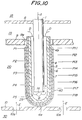
- Fig. 10 is a schematic sectional view illustrating an example of such an SOFC.
- reference numerals 1, 4, 5 and 6 are an oxidizing gas feed pipe for the introduction of an oxidizing gas such as air, a bottom-provided porous support tube, an air electrode, and a solid electrolyte, respectively.
- Reference numerals 7, 8, 9 and 10 are a fuel electrode, an upper plate for holding the oxidizing gas feed pipe 1 and separating an oxidizing gas chamber 18 from an exhaust gas chamber 19, a plate having a gas outflow hole 9a and separating the exhaust gas chamber 19 from a fuel reacting chamber 20, and a bottom plate provided with fuel inflow holes 10a and adapted for holding an SOFC element 40 and separating a cell reacting chamber 20 and a fuel chamber 30, respectively.
- the power generation amount of the SOFC is greatly influenced by the amount of oxygen permeating the bottom-provided porous support tube 4.
- the concentration of oxygen is still high near the oxidizing gas feed opening 1a, the amount of oxygen ions reaching the fuel electrode 7 near there is great, so that the reacting rate between the oxygen ions and the fuel on the surface of the fuel electrode 7 is large to raise the temperature. With this increase in temperature, the reaction on the fuel electrode between the oxygen ions and the fuel gas is further activated.
- the concentration of oxygen in the gas decreases. Consequently, the amount of oxygen ions reaching the surface of the fuel electrode 7 near the gas outflow hole 9a decreases, so that the reaction amount between the oxygen ions and the fuel on the fuel electrode 7 is small to lower the elevation of the temperature. As a result, the reaction is further inactivated due to its lower temperature. This tendency becomes more conspicuous when the bottom-provided SOFC element becomes longer.
- the present invention provides a solid oxide fuel cell as set out in claim 1.
- the present inventors have solved this problem by varying the open porosity of the porous support tube 4 of the SOFC element to make the permeating amount of oxygen substantially uniform in the longitudinal direction.
- the length of the SOFC element 40 becomes further greater, it is necessary to correspondingly increase the open porosity of the porous support tube 4 on the downstream side of the oxidizing gas.
- the strength of the support tube 4 drops. Therefore, there is a limit on the open porosity in the longitudinal direction which the above-mentioned porous support tube 4 is allowed to have.
- the present inventors can realize the elimination of non-uniformity in the reactivity and temperature in the longitudinal direction of the cell and the reduction in the thermal strain and stress, the prolongation of the use life of the cell, and the improvement of the power generation efficiency by this aspect of the present invention in view of the above problems.
- Fig. 1 is a longitudinal sectional view of an embodiment of the SOFC according to the present invention.
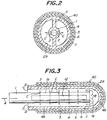
- Fig. 2 is a sectional view of Fig. 1 taken along a line II-II. Same reference numerals as in the SOFC of Fig. 10 are given to the same functional members in this embodiment.
- a plurality of circular holes 2 having the same diameter are arranged in the lateral surface of an oxidizing gas feed pipe 1 in the longitudinal direction thereof.
- Flat plate-like ribs 3 are provided between the outer peripheral surface of the oxidizing gas feed pipe 1 and a porous support tube 4.
- two rows of the flat plate-like ribs are provided as shown in Fig. 2. Therefore, an oxidizing gas fed into the oxidizing gas feed pipe 1 is blown out successively through the circular holes 2 as shown by arrows C.
- the oxidizing gas is utilized for power generation, and then mixed with one coming through an oxidizing gas feed opening la at the tip of the oxidizing gas feed pipe 1 and discharged to an exhaust gas chamber 19 as shown by arrows D.
- An air electrode 5 may be made of LaMnO 3 , CaMnO 3 , LaNiO 3 , LaCoO 3 , LaCrO 3 or the like doped or not doped. Among them, LaMnO 3 added with strontium.
- a solid electrolyte 6 may be generally produced from yttoria-stabilized zirconia or the like.
- a fuel electrode 7 may be generally made of nickel-zirconia cermet or cobalt-zirconia cermet.
- each of the circular holes 2 functions as an oxidizing gas feeding portion, so that fresh oxidizing gas is fed through each of these circular holes 2. Therefore, since fresh oxidizing gas is fed over the entire cylindrical space 29, and is mixed with oxidizing gas having the concentration reduced, the gradient of the concentration of oxygen decreases also due to turbulence of the mixed gas stream. Consequently, the reaction on the electrode is made uniform, and the temperature is also made uniform. Owing to this, the thermal strain and stress can be reduced as a whole, and the electric power generating efficiency can be totally enhanced.
- the oxidizing gas feed pipe 1 is provided separately from the SOFC element 40 in the case of the SOFC having the structure shown in Fig. 10, it is difficult to accurately locate the oxidizing gas feed pipe 1 inside the cylindrical space 29. For this reason, since the location of the oxidizing gas feed pipe 1 varies inside the cylindrical space 29, it changes the flow of the oxidizing gas rising between the outer peripheral surface of the oxidizing gas feed pipe 1 and the inner peripheral surface of the porous support tube 4, which results in variations in the performances among fuel cells.
- the structure is integrated by connecting the oxidizing gas feed pipe 1 with the SOFC element 40 by the flat-plate like ribs 3 in this embodiment, the oxidizing gas feed pipe 1 can be assuredly located inside the cylindrical space 29, so that variations in the performances resulting from changes in positional relationship between the oxidizing gas feed pipe 1 and the SOFC element 40 can completely be diminished.
- the flat plate-like ribs extend radially from the oxidizing gas feed pipe 1, the mechanical strength of the SOFC element 40 can greatly be increased from the standpoint of the structural mechanics.
- a slit 12 having a slender rectangular shape is provided in a lateral face 1b of the oxidizing gas feed pipe 1 as the oxidizing gas feeding portion instead of a plurality of the circular holes, and fresh oxidizing gas is flown out through the slit 12.
- This slit 12 is provided for each of sections divided by the flat plate-like ribs 3.
- a plurality of circular holes 22 are provided, as an oxidizing feeding portion, in the lateral face of an oxidizing gas feed pipe 1, and the diameter of the circular holes 22 is gradually increased from the vicinity of an opening of the SOFC element 40 toward the bottom portion thereof. Accordingly, a phenomenon that since a majority part of the oxidizing gas is flown out through the circular holes 22 near the opening of the SOFC element so that a sufficient amount of the oxidizing gas will not be fed to the vicinity of the bottom portion can be prevented.
- the concentration of the oxidizing gas inside the cylindrical space 29 can be regulated by adjusting the diameter of the circular holes 22.
- a slit 32 is provided as an oxidizing gas feeding portion in the lateral face of an oxidizing gas feed pipe 1 as in the SOFC shown in Fig. 3.
- the width of the slit 32 is decreased near the opening of the SOFC element 40, and gradually increased toward the bottom portion of the SOFC element 40.
- flat plate-like ribs 3A are extended outside from the cylindrical space 29 up to the base portion of the oxidizing gas feed pipe 1. Since the rows of the ribs thus shaped functions as heat-emitting fins, the extended portions can enhance heat exchange efficiency between the oxidizing gas flowing through the oxidizing gas feed pipe 1 and the combustion exhaust gas flowing outside the SOFC element when the oxidizing gas fed through the oxidizing gas feed pipe 1 is to be preliminarily heated at the base portion of the feed pipe. Therefore, since the temperature of the oxidizing gas to be fed into the cylindrical space 29 can further be raised, the heat exchange efficiency of the entire fuel cell can be further improved.
- Fig. 7 is a partially sectional view of a so-called multi-cell type SOFC to which the present invention is applied.
- a plurality of air electrodes 15 are provided on the surface of a bottom-provided porous support tube 4 at a specific interval, and a solid electrolyte 16 and a fuel electrode 17 are successively formed on each of the air electrodes 15.
- the fuel electrodes 17 are successively electrically connected to the adjacent air electrodes 15 by interconnectors 28, respectively.
- the orientation of the circular hole 2 is aligned with a normal to the wall surface of the oxidizing gas feed pipe 1, the oxidizing gas flows out through the circular hole 2 horizontally in Fig. 1.
- the circular hole 2 may be inclined to the normal to the wall surface of the oxidizing gas feed pipe 1 at a given angle.
- the oxidizing gas upwardly or downwardly flows out.
- the orientation of the circular hole is inclined to the normal to the wall surface of the oxidizing feed pipe 1 in the radial direction of the feed pipe 1 (in the lateral direction in Fig. 1), the oxidizing gas flows out in a deviated fashion to the left or the right.
- the fuel cell 7, 17b is positioned outside the air electrode 5, 15 in the above-mentioned embodiments, this electrode arrangement may be reversed. In such a case, the fuel gas is fed into the annular space 29, and the oxidizing gas is fed outside the SOFC element.
- Fig. 1 although the fuel cell element 40 is vertically supported, the entire power generator may be arranged horizontally or inclined at a given angle.
- the air electrode itself is made as a rigid body so that the cell element itself can be structurally independently used.
- the SOFC element can easily be fixed to the fuel cell body by fitting the flange portion to the upper plate 8 when it is used as a fuel cell as shown in Fig. 1.
- the cylindrical space 29 between the oxidizing gas feed pipe and the porous support tube 4 is divided by the flat plate-like ribs 3, it may be possible to extend the flat plate-like ribs to the center of the oxidizing gas feed pipe so that the interior of the oxidizing gas feed pipe may be divided into plural chambers defined by the ribs.
- the circular holes 2, 22, or the slits 12, 32 provided in the lateral face of the oxidizing gas feed pipe 1 are employed as the oxidizing gas feeding portion
- an oxidizing gas feed portion having other constructions may be employed.
- a number of small holes may be provided at random. In this case, if the density of the small holes is increased as the location approaches the bottom portion, effects similar to those in the embodiments of Figs. 4 and 5 can be obtained.
- the SOFC may be fitted not only horizontally or vertically, but also inclined to the fuel cell body at a given angle.
- the gas feed portion for feeding oxidizing gas or fuel gas into the cylindrical space is provided in at least the lateral face of the gas feed pipe, fresh oxidizing gas or fuel gas is fed through the gas feeding portion at the lateral face, and mixed with the gas having the concentration already reduced. Consequently, since the gradient of the concentration of oxygen in the annular space is reduced, the reactivity of the reaction and the temperature on the electrode may be made uniform. Thereby, the thermal stress can be totally reduced, and the entire electric power generation efficiency can be enhanced.
- the open porosity of the bottom-provided porous support tube 4 it is preferable to set the open porosity of the bottom-provided porous support tube 4 to 20-50% at every location. In addition, it is also preferable to set the diameter of pores therein at 1 to 10 ⁇ m.
- the open porosity of the bottom-provided porous support tube 4 is set at more than 50%, strength of the support tube 4 greatly lowers and reliability in long term durability disappears. On the other hand, if the open porosity is set at less than 20%, the power generating efficiency of the SOFC element drops. If the pore diameter of the support tube is more than 10 ⁇ m, strength of the support tube 4 drops, and portions of the fuel cell which contribute to power generation are localized. On the other hand, if it is less than 1 ⁇ m, the permeating amount of the gas drops.
- the bottom-provided porous support tube 4 is assembled on a ceramic setter, and fired inside a furnace.
- Firing conditions of the support tube 4 are appropriately set, although depending upon a desired porosity thereof, such that the heating rate is 20-100°C/h, the firing temperature is 1,400-1,600°C, the firing temperature-keeping time is 30 minutes to 4 hours, and the cooling rate is 20-100°C/h.
- the bottom-provided porous support tube is once fired, and after firing, open pores of the support tube are impregnated and filled with a filler. Then, the support tube is dried or fired.
- An air electrode 5 is made of LaMnO 3 , CaMnO 3 , LaNiO 3 , LaCoO 3 , LaCrO 3 or the like doped or not doped. Among them, LaMnO 3 added with strontium is preferred.
- a solid electrolyte 6 may be generally produced from yttoria-stabilized zirconia or the like.
- a fuel electrode 7 is generally made of nickel-zirconia cermet or cobalt-zirconia cermet.
- air electrodes are provided on the surface of a cylindrical porous support tube at plural locations at a specific interval, a solid electrolyte and a fuel electrode are successively provided on each of the air electrodes, and fuel electrodes are successively electrically connected to the adjacent air electrodes through interconnectors, respectively.
- the porous support tube may be a cylindrical shape, a cylindrical shape with a bottom, a tetragonal prismatic shape, a hexagonal prism or the like.
- a calibrated line showing a relationship between the average open porosity of the bottom-provided porous support tube and the permeating amount of the oxidizing gas is shown in Fig. 9.
- bottom-provided porous support tubes of Figs. 1 and 10 having a length of 1,500 mm were prepared, and an air electrode, a solid electrolyte and a fuel electrode were formed on each of the support tubes to form SOFC elements shown in Figs. 1 and 10.
- each of the SOFC element of the present invention and the conventional SOFC element was placed inside a reacting chamber 20 of a cell.
- the interior of the cell reacting chamber 20 was heated to 1,000°C, and air and methane were fed into the oxidizing gas feed pipe 1 and through the fuel inflow holes 10a, respectively, at their respective constant flow rates. Thereby, oxygen ions were reacted with methane on the surface of the fuel electrode of each of the SOFC elements.
- Temperatures on the surface of the fuel electrode were measured during the reaction at measuring locations P1, P2, P3, P4 and P5, which divided a straight portion of each of the SOFC elements shown in Figs. 1 and 10 into four equal portions, by using thermocouples, and the concentrations of oxygen at locations inside the cylindrical space 29 corresponding to the locations of P1, P2, P3, P4 and P5, respectively were measured by using an O 2 meter. Then, the SOFC element was cooled to room temperature, and the fuel electrode, the solid electrolyte and the air electrode were removed, and the open porosity at P1, P2, P3, P4 and P5 were measured.
- the amount of oxygen penetrated through the bottom-provided porous support tube and applied for the power generation can be made uniform over every location of the bottom-provided porous support tube, and accordingly excellent oxygen-permeability can be imparted upon the support tube.
- the cell reactivity can be made uniform in the longitudinal direction of the SOFC element, and the distribution of temperature can also be made uniform in the longitudinal direction, so that occurrence of cracks can be prevented.
- Figs. 1 and 2 are a longitudinal sectional view of an embodiment of the SOFC element according to this other aspect of the present invention, and a sectional view of Fig. 1 taken along a line II, respectively.
- a plurality of circular holes 2 having the same diameter are provided in the lateral face 1b of an oxidizing gas feed pipe 1 in the longitudinal direction, and flat plate-like ribs 3 are provided between the peripheral surface of the oxidizing gas feed pipe 1 and a porous support tube 4, for example, in two rows. Therefore, the oxidizing gas fed inside the oxidizing gas feed pipe 1 is successively blown out through the circular holes 2 as shown by arrows C. After the oxidizing gas is used for the power generation, the gas is mixed with the oxidizing gas coming out from an oxidizing gas feed opening la, and discharged to the exhaust gas chamber 19 as shown by arrows D.
- the open porosity of the bottom-provided porous support tube 4 is made smaller on the upstream side of the stream of the oxidizing gas flowing inside the cylindrical space 29, and made greater within a given range on the downstream side.
- the air electrode 5 is made of LaMnO 3 , CaMnO 3 , LaNiO 3 , LaCoO 3 , LaCrO 3 or the like doped or not doped. Among them, LaMnO 3 added with strontium is preferred.
- the solid electrolyte 6 may be generally made of yttriastabilized zirconia or the like.
- the fuel electrode 7 may be generally made of nickel-zirconia cermet or cobalt-zirconia cermet.
- each of the circular holes 2 functions as the oxidizing gas feeding portion, so that fresh oxidizing gas is fed through each of the circular holes 2. Therefore, fresh oxidizing gas is fed over the entire cylindrical space 29, and is mixed with the oxidizing gas having the concentration already reduced, so that the gradient of the concentration of oxygen can be reduced also due to the turbulence of the mixed gas stream.
- the porosity of the bottom-provided porous support tube 4 is important to vary from the side of the bottom portion 4a to the side of the end portion 4b for the power generating portion. As shown in Fig. 9, the porosity of the bottom-provided support tube and the permeating amount of the oxidizing gas have the almost straight relationship.
- bottom-provided porous support tubes of Figs. 1 and 10 having a length of 3,000 mm were prepared, and an air electrode, a solid electrolyte and a fuel electrode were formed on each of the support tubes to produce SOFC elements shown in Figs. 1 and 10.
- Each of the invention SOFC element and the conventional SOFC element was placed in a reacting chamber 20 of a cell. Then, the interior of the reacting chamber 20 was heated to 1,000°C, and air and methane were fed to the oxidizing gas feed pipe 1 and through the fuel inflow holes 10a, respectively, at their respective flow rates, so that oxygen ions and methane were reacted on the surface of the fuel electrode of the SOFC element.
- temperatures of the surface of the fuel electrode were measured during the reaction at measuring locations P11, P12, P13, P14, P15, P16, P17 and P18 dividing a straight liner portion of the SOFC element 40 into seven equal portions, by thermocouples, and at the same time the concentrations of oxygen were measured at locations inside the cylindrical space corresponding to the locations of P11, P12, P13, P14, P15, P16, P17 and P18, respectively, by using an O 2 meter. Then, the SOFC element was cooled to room temperature, and the open porosities at the locations P11, P12, P13, P14, P15, P16, P17 and P18 of the bottom-provided porous support tube 4 were measured in the same manner as mentioned before.
- the permeating amounts of the oxidizing gas were calculated from the measurement values of the open porosities at the above locations and the calibration line in Fig. 9, and the permeating amount of oxygen at each location was determined as a produce between the permeating amount of the oxidizing gas and the concentration of oxygen. These results are shown in Tables 3, 4 and 5.
- Table 3 shows results with respect to the case where the open porosity was almost constant in the longitudinal direction of the bottom-provided porous support tube 4, and air was fed through the oxidizing gas feed opening la of the oxidizing gas feed pipe 1 (Fig. 10).
- Table 4 shows the results with respect to the case where the open porosity of the bottom-provided porous support tube 4 in the longitudinal direction was made greater on the portion facing the downstream side of the oxidizing gas and smaller, and the oxidizing gas was fed through the oxidizing gas feed opening la of the oxidizing gas feed pipe 1.
- Table 5 shows results with respect to the case where the open porosity of the bottom-provided porous support tube 4 in the longitudinal direction was made greater in the portion facing the downstream side of the oxidizing gas, and air was fed through the oxidizing gas feed opening 1a of the oxidizing gas feed pipe 1 and the circular holes 2 of the lateral face 1b (Fig. 1).
- Table 5 shows results for the case where the SOFC element employing the support tube 4 produced according to the present invention was used, and air was fed through the gas feed opening la of the gas feed pipe 1 and the circular holes 2 for the measurement. It is seen from Table 5 that since the temperatures of the surface of the fuel cell at the locations Pll through P18 were higher than that of the atmosphere inside the cell reacting chamber 20, and almost identical over the entire surface, the power was almost uniformly generated inside the SOFC element. Further, since the cell reaction occurred at substantially the same temperature in the longitudinal direction of the SOFC element, occurrence of cracks in the SOFC element can be prevented, and reliability in long use can be enhanced.
- Table 6 the relationship between the open porosity and the mechanical strength of the bottom-provided porous support tube is shown in Table 6.
- the flexural strength of the bottom-provided porous support tube was expressed by relative ratio by taking that of the support tube having the average open porosity being 35% as 100.
- Table 6 Open porosity (%) 35.0 42.3 46.8 52.3 Flexural strength 100 89.0 78.0 72.0
- the open porosity of the porous support tube 4 in the longitudinal direction is set at not more than 50%, and the oxidizing gas is fed through the circular holes 2 at the lateral face of the oxidizing gas feed pipe 1 to increase the concentration of oxygen and make the cell reaction in the longitudinal direction of the SOFC element uniform.
- the strength of the SOFC element is maintained high, the concentration of oxygen in the oxidizing gas inside the cylindrical space 29 is made uniform, and the permeability of the oxidizing gas penetrating through the bottom-provided porous support tube 4 from the side of the cylindrical space is controlled.
- the non-uniformity of the electrode reaction can be corrected by skillfully combining these techniques.
- the oxidizing gas feed pipe 1 can be accurately located inside the cylindrical space 29, so that variations in the performances resulting from changes in the positional relationship between the oxidizing gas feed pipe 1 and the SOFC element 40 can be completely diminished.
- the flat plate-like ribs 3 radially extend from the oxidizing gas feed pipe 1, the mechanical strength of the SOFC element 40 is conspicuously increased from the standpoint of the structural mechanics.
- the mechanical strength, particularly, the radial crushing strength of the SOFC element can be favorably further increased.
Landscapes
- Life Sciences & Earth Sciences (AREA)
- Engineering & Computer Science (AREA)
- Manufacturing & Machinery (AREA)
- Sustainable Development (AREA)
- Sustainable Energy (AREA)
- Chemical & Material Sciences (AREA)
- Chemical Kinetics & Catalysis (AREA)
- Electrochemistry (AREA)
- General Chemical & Material Sciences (AREA)
- Fuel Cell (AREA)
Claims (9)
- Festoxid-Brennstoffzelle, umfassend ein zylindrisches Festoxid-Brennstoffzellenelement mit einem geschlossenen Ende, das zumindest eine Luftelektrode (5, 15, 25), einen Trockenelektrolyten (6, 16, 26) und eine Brennstoffelektrode (7, 17, 27) umfaßt, sowie ein Gaszufuhrrohr (1, 61), das in den zylindrischen Raum des Elements eingesetzt ist und einen Gaszufuhrabschnitt aufweist, der zumindest eine Öffnung (2, 12, 22, 32, 42) zur Zufuhr eines Oxidationsgases oder eines Brennstoffgases in den zylindrischen Raum umfaßt, worin der Gaszufuhrabschnitt zumindest teilweise in einer Seitenwand des Gaszufuhrrohres (1, 61) vorgesehen ist, dadurch gekennzeichnet, daß der Gaszufuhrabschnitt zumindest teilweise von (i) einer Reihe von Öffnungen, die aus einer Vielzahl von Öffnungen (2, 22, 42) im Gaszufuhrrohr (1) besteht, welche Öffnungen in Längsrichtung des Rohres voneinander beabstandet sind, oder von (ii) zumindest einer schlitzförmigen Öffnung (12, 32) gebildet ist, deren Schlitzrichtung sich in Längsrichtung des Rohres (1) erstreckt, wobei sich die Reihe von Öffnungen oder die schlitzförmige Öffnung über jenen gesamten Abschnitt des Gaszufuhrrohres erstreckt, wo die Elektroden (5, 15, 25, 7,17, 27) am Brennstoffzellenelement vorgesehen sind, und wobei zumindest im Fall (ii) das Ende des Gaszufuhrrohres (1), das sich in den zylindrischen Raum hinein erstreckt, vom geschlossenen Ende des Brennstoffzellenelements beabstandet ist.
- Festoxid-Brennstoffzelle nach Anspruch 1, worin der Gaszufuhrabschnitt zumindest teilweise von einem der folgenden gebildet ist:(a) einer Vielzahl von kreisförmigen Öffnungen (2) mit dem gleichen Durchmesser, die in der Seitenwand des Gaszufuhrrohres (1) vorgesehen und in dessen Längsrichtung voneinander beabstandet sind,(b) zumindest einer schlitzförmigen Öffnung (12) mit schmaler, rechteckiger Form, die in der Seitenwand des Gaszufuhrrohres (1) vorgesehen ist und sich in dessen Längsrichtung erstreckt,(c) einer Vielzahl von kreisförmigen Öffnungen (22), die in der Seitenwand des Gaszufuhrrohres (1) vorgesehen und in dessen Lägsrichtung voneinander beabstandet sind, wobei die Durchmesser der kreisförmigen Löcher (22) zum geschlossenen Ende des Brennstoffzellenelements hin größer werden,(d) zumindest einer schlitzförmigen Öffnung (32), die in der Seitenwand des Gaszufuhrrohres (1) vorgesehen ist und sich in dessen Längsrichtung erstreckt, wobei die Breite der schlitzförmigen Öffnung (32) von der Seite des Brennstoffzellenelements weg zum geschlossenen Ende hin größer wird, und(e) einer Vielzahl von Gaszufuhröffnungen (42), die in der Seitenwand des Gaszufuhrrohres (1) vorgesehen sind, wobei die Gaszufuhröffnungen (42) in radial nach außen gerichteter Richtung zum geschlossenen Ende des Brennstoffzellenelements hin geneigt sind.
- Festoxid-Brennstoffzelle nach Anspruch 1 oder 2, worin zumindest zwei ebene Wände (3, 3A) vorgesehen sind, die sich in Längsrichtung des zylindrischen Raumes erstrecken, um die innere Umfangsfläche des Festoxid-Brennstoffzellenelements mit der äußeren Umfangsfläche des Gaszufuhrrohres (1) zu verbinden, und worin der Gaszufuhrabschnitt jedem der durch die innere Umfangsfläche des Zellenelements, die äußere Umfangsfläche des Gaszufuhrrohres (1) und die ebenen Wände (3, 3A) definierten Räume Gas zuführt.
- Festoxid-Brennstoffzelle nach einem der Ansprüche 1 bis 3, bei der eine Vielzahl Luftelektroden (15) an der äußeren Umfangsfläche des Brennstoffzellenelements an mehreren Stellen in Intervallen in dessen Längsrichtung ausgebildet ist, eine Vielzahl Trockenelektrolyten (16) und Brennstoffelektroden (17) in dieser Reihenfolge nacheinander auf den Luftelektroden (15) ausgebildet ist, um Zelleinheiten zu bilden, und die Brennstoffeleketrode (17) jeder Zelleinheit über einen Zwischenverbinder (28) elektrisch mit der Luftelektrode (15) einer angrenzenden Zelleinheit verbunden ist.
- Festoxid-Brennstoffzelle nach einem der Ansprüche 1 bis 4, worin das Festoxid-Brennstoffelement ein poröses, zylindrisches Stützrohr (4, 24) mit einem geschlossenen Ende umfaßt, wobei die Luftelektrode (5, 25), der Trockenelektrolyt (6, 26) und die Brennstoffelektrode (7, 27) an einer äußeren Umfangsfläche des Stützrohres (4, 24) ausgebildet sind, wobei die Zelle im Betrieb eine Gasströmung vom Gaszufuhrrohr (1, 16) aufnimmt, wobei die Strömung in der Richtung vom geschlossenen Ende weg den zylindrischen Raum (29) innerhalb des porösen, zylindrischen Stützrohres entlang fließt, und worin die Gasdurchtrittsrate durch einen ersten Abschnitt des porösen, zylindrischen Stützrohres (4, 24) hindurch kleiner ist als die Gasdurchtrittsrate durch einen zweiten Abschnitt des porösen, zylindrischen Stützrohres (4, 24) hindurch, der vom geschlossenen Ende weiter entfernt ist als der erste Abschnitt.
- Festoxid-Brennstoffzelle nach Anspruch 5, worin die offene Porosität des porösen, zylindrischen Stützrohres (4, 24) in dessen erstem Abschnitt kleiner ist als in dessen zweitem Abschnitt.
- Festoxid-Brennstoffzelle nach Anspruch 6, worin die offene Porosität des porösen Stützrohres (4, 24) in jedem Abschnitt davon im Bereich von 20-50% liegt.
- Festoxid-Brennstoffzelle nach Anspruch 6 oder 7, worin der Porendurchmesser des porösen Stützrohres im Bereich von 1-10 µm liegt.
- Festoxid-Brennstoffzelle nach einem der Ansprüche 6 bis 8, worin die Differenz der offenen Porosität zwischen einem Bodenbschnitt und einem Endabschnitt an einer Öffnungsseite eines Stromerzeugungsabschnitts des porösen Stützrohres (4) den folgenden Beziehungen entspricht: wenn 1,0≤x≤2,2 ist, gilt 2,3x2-1,2≤y≤3,4x2-1,7, und wenn 2,2<x≤3,0 ist, gilt x2+5,1<y≤1,5, wobei x die Länge (m) des Stützrohres ist und y die Differenz (in %) der offenen Porosität zwischen dem Bodenabschnitt und dem offenen Endabschnitt ist.
Applications Claiming Priority (6)
| Application Number | Priority Date | Filing Date | Title |
|---|---|---|---|
| JP32383/90 | 1990-02-15 | ||
| JP2032383A JPH0758618B2 (ja) | 1990-02-15 | 1990-02-15 | 固体電解質型燃料電池 |
| JP2075601A JP2597730B2 (ja) | 1990-03-27 | 1990-03-27 | 固体電解質型燃料電池用の有底多孔質支持管の製造方法 |
| JP75601/90 | 1990-03-27 | ||
| JP2076710A JPH03280359A (ja) | 1990-03-28 | 1990-03-28 | 固体電解質型燃料電池 |
| JP76710/90 | 1990-03-28 |
Publications (2)
| Publication Number | Publication Date |
|---|---|
| EP0442740A1 EP0442740A1 (de) | 1991-08-21 |
| EP0442740B1 true EP0442740B1 (de) | 1996-09-04 |
Family
ID=27287677
Family Applications (1)
| Application Number | Title | Priority Date | Filing Date |
|---|---|---|---|
| EP91301208A Expired - Lifetime EP0442740B1 (de) | 1990-02-15 | 1991-02-14 | Festoxidbrennstoffzellen |
Country Status (4)
| Country | Link |
|---|---|
| US (1) | US5158837A (de) |
| EP (1) | EP0442740B1 (de) |
| CA (1) | CA2036258C (de) |
| DE (1) | DE69121735T2 (de) |
Families Citing this family (16)
| Publication number | Priority date | Publication date | Assignee | Title |
|---|---|---|---|---|
| US5677265A (en) * | 1995-03-03 | 1997-10-14 | Northeastern University | Process for oxygenation of ceramic high Tc superconductors |
| US5595834A (en) * | 1995-09-01 | 1997-01-21 | The Regents Of The University Of Calif. | Annular feed air breathing fuel cell stack |
| US5514486A (en) * | 1995-09-01 | 1996-05-07 | The Regents Of The University Of California, Office Of Technology Transfer | Annular feed air breathing fuel cell stack |
| US6379485B1 (en) * | 1998-04-09 | 2002-04-30 | Siemens Westinghouse Power Corporation | Method of making closed end ceramic fuel cell tubes |
| US6383350B1 (en) * | 2000-07-26 | 2002-05-07 | Northrop Grumman Corporation | Thin film modular electrochemical apparatus and method of manufacture therefor |
| DE10136710A1 (de) * | 2001-07-27 | 2003-02-13 | Siemens Ag | Hochtemperatur-Brennstoffzellen-Reaktor mit HPD-Zellen |
| DE10229820B4 (de) * | 2002-06-28 | 2004-12-30 | Deutsches Zentrum für Luft- und Raumfahrt e.V. | Gasverteilungsvorrichtung für eine elektrochemische Elektrode und Verfahren zur Reaktionsgasbeaufschlagung einer elektrochemischen Elektrode |
| EP1469542A1 (de) * | 2003-04-09 | 2004-10-20 | Matsushita Electric Industrial Co., Ltd. | Polymerelektrolytmembran-Brennstoffzelle |
| JP4617711B2 (ja) * | 2004-04-30 | 2011-01-26 | 日産自動車株式会社 | 燃料電池 |
| JP4965066B2 (ja) * | 2004-08-19 | 2012-07-04 | 株式会社日立製作所 | 燃料電池 |
| US7966830B2 (en) * | 2006-06-29 | 2011-06-28 | The Boeing Company | Fuel cell/combustor systems and methods for aircraft and other applications |
| US8048583B2 (en) * | 2006-07-20 | 2011-11-01 | Modine Manufacturing Company | Compact air preheater for solid oxide fuel cell systems |
| US20090253007A1 (en) * | 2008-04-04 | 2009-10-08 | Mergler Christopher M | Method and apparatus for anode oxidation prevention and cooling of a solid-oxide fuel cell stack |
| US20160329587A1 (en) * | 2015-05-07 | 2016-11-10 | Lg Fuel Cell Systems, Inc. | Fuel cell system |
| CN111403763B (zh) * | 2020-03-31 | 2021-05-18 | 西安交通大学 | 金属薄壁管支撑型微管固体氧化物燃料电池、电池堆结构 |
| CN114122471B (zh) * | 2021-11-26 | 2023-12-19 | 江苏科技大学 | 一种甲醇固体氧化物燃料电池及含该燃料电池的发电系统 |
Family Cites Families (10)
| Publication number | Priority date | Publication date | Assignee | Title |
|---|---|---|---|---|
| FR35016E (de) * | 1929-10-30 | |||
| BE639862A (de) * | 1961-12-05 | 1900-01-01 | ||
| DE2614727A1 (de) * | 1976-04-06 | 1977-10-27 | Bbc Brown Boveri & Cie | Festelektrolyt-batterie |
| ZA814990B (en) * | 1980-12-22 | 1982-11-24 | Westinghouse Electric Corp | Fuel cell generator |
| US4463067A (en) * | 1982-09-30 | 1984-07-31 | Engelhard Corporation | Fuel cell and system for supplying electrolyte thereto utilizing cascade feed |
| JPS5963664A (ja) * | 1982-10-01 | 1984-04-11 | Kureha Chem Ind Co Ltd | 燃料電池用電極基板 |
| US4522895A (en) * | 1982-10-05 | 1985-06-11 | Kureha Kagaku Kogyo Kabushiki Kaisha | Multilayer fuel cell electrode substrate having elongated holes for feeding reactant gases |
| US4664986A (en) * | 1986-04-16 | 1987-05-12 | Westinghouse Electric Corp. | High thermal conductivity gas feeder system |
| US4751152A (en) * | 1987-04-06 | 1988-06-14 | Westinghouse Electric Corp. | High bulk self-supporting electrode with integral gas feed conduit for solid oxide fuel cells |
| DE68908140T2 (de) * | 1988-12-22 | 1994-02-03 | Ngk Insulators Ltd | Keramikrohr mit einseitig geschlossenem Rohrmantel und Verfahren zu dessen Herstellung. |
-
1991
- 1991-02-07 US US07/651,799 patent/US5158837A/en not_active Expired - Fee Related
- 1991-02-13 CA CA002036258A patent/CA2036258C/en not_active Expired - Fee Related
- 1991-02-14 DE DE69121735T patent/DE69121735T2/de not_active Expired - Fee Related
- 1991-02-14 EP EP91301208A patent/EP0442740B1/de not_active Expired - Lifetime
Also Published As
| Publication number | Publication date |
|---|---|
| DE69121735D1 (de) | 1996-10-10 |
| US5158837A (en) | 1992-10-27 |
| CA2036258A1 (en) | 1991-08-16 |
| EP0442740A1 (de) | 1991-08-21 |
| DE69121735T2 (de) | 1997-02-13 |
| CA2036258C (en) | 1997-06-03 |
Similar Documents
| Publication | Publication Date | Title |
|---|---|---|
| EP0442740B1 (de) | Festoxidbrennstoffzellen | |
| EP0442743B1 (de) | Festoxidbrennstoffzelle | |
| EP0442742B1 (de) | Festoxidbrennstoffzelle | |
| EP1796192B1 (de) | Festoxidbrennstoffzellenmodul, Brennstoffzellensystem damit und Herstellungsverfahren dafür | |
| US5336569A (en) | Power generating equipment | |
| EP0505186A1 (de) | Festelektrolytbrennstoffzelle | |
| EP0328812A1 (de) | Elektrochemische Generatoren von rechteckiger Form mit Heizung in den Eckbereichen | |
| EP0355420A1 (de) | Brennstoffzelle mit einem festen Elektrolyten | |
| EP0191229A1 (de) | Elektrochemische Generatoren | |
| EP0442741B1 (de) | Festoxidbrennstoffzelle | |
| US8026011B2 (en) | Fuel cell assembly | |
| EP0740358A2 (de) | Zelleinheiten für Festoxidbrennstoffzellen und Energiegeneratoren die diese Zelleinheiten verwenden | |
| JP3545958B2 (ja) | 固体電解質型燃料電池 | |
| JP3516325B2 (ja) | ハニカム構造固体電解質型燃料電池 | |
| EP1970988A1 (de) | Brennstoffzelle | |
| JP2698482B2 (ja) | 発電装置 | |
| JPH03280359A (ja) | 固体電解質型燃料電池 | |
| JP3346784B2 (ja) | 縦縞円筒型固体電解質燃料電池 | |
| JP2597730B2 (ja) | 固体電解質型燃料電池用の有底多孔質支持管の製造方法 | |
| JPH0758618B2 (ja) | 固体電解質型燃料電池 | |
| US20050031923A1 (en) | Solid state electrolytic fuel cell | |
| JP3585363B2 (ja) | 固体電解質型燃料電池 | |
| JP2698481B2 (ja) | 発電装置 | |
| JP3389481B2 (ja) | 固体電解質型燃料電池 | |
| US20070190381A1 (en) | Solid oxide fuel cell electric power generation apparatus |
Legal Events
| Date | Code | Title | Description |
|---|---|---|---|
| PUAI | Public reference made under article 153(3) epc to a published international application that has entered the european phase |
Free format text: ORIGINAL CODE: 0009012 |
|
| AK | Designated contracting states |
Kind code of ref document: A1 Designated state(s): BE DE FR GB |
|
| 17P | Request for examination filed |
Effective date: 19920211 |
|
| 17Q | First examination report despatched |
Effective date: 19940627 |
|
| GRAH | Despatch of communication of intention to grant a patent |
Free format text: ORIGINAL CODE: EPIDOS IGRA |
|
| GRAH | Despatch of communication of intention to grant a patent |
Free format text: ORIGINAL CODE: EPIDOS IGRA |
|
| GRAA | (expected) grant |
Free format text: ORIGINAL CODE: 0009210 |
|
| AK | Designated contracting states |
Kind code of ref document: B1 Designated state(s): BE DE FR GB |
|
| REF | Corresponds to: |
Ref document number: 69121735 Country of ref document: DE Date of ref document: 19961010 |
|
| ET | Fr: translation filed | ||
| PLBE | No opposition filed within time limit |
Free format text: ORIGINAL CODE: 0009261 |
|
| STAA | Information on the status of an ep patent application or granted ep patent |
Free format text: STATUS: NO OPPOSITION FILED WITHIN TIME LIMIT |
|
| 26N | No opposition filed | ||
| PGFP | Annual fee paid to national office [announced via postgrant information from national office to epo] |
Ref country code: GB Payment date: 20010202 Year of fee payment: 11 |
|
| PGFP | Annual fee paid to national office [announced via postgrant information from national office to epo] |
Ref country code: FR Payment date: 20010216 Year of fee payment: 11 |
|
| PGFP | Annual fee paid to national office [announced via postgrant information from national office to epo] |
Ref country code: DE Payment date: 20010220 Year of fee payment: 11 |
|
| PGFP | Annual fee paid to national office [announced via postgrant information from national office to epo] |
Ref country code: BE Payment date: 20010228 Year of fee payment: 11 |
|
| REG | Reference to a national code |
Ref country code: GB Ref legal event code: IF02 |
|
| PG25 | Lapsed in a contracting state [announced via postgrant information from national office to epo] |
Ref country code: GB Free format text: LAPSE BECAUSE OF NON-PAYMENT OF DUE FEES Effective date: 20020214 |
|
| PG25 | Lapsed in a contracting state [announced via postgrant information from national office to epo] |
Ref country code: BE Free format text: LAPSE BECAUSE OF NON-PAYMENT OF DUE FEES Effective date: 20020228 |
|
| BERE | Be: lapsed |
Owner name: NGK INSULATORS LTD Effective date: 20020228 |
|
| PG25 | Lapsed in a contracting state [announced via postgrant information from national office to epo] |
Ref country code: DE Free format text: LAPSE BECAUSE OF NON-PAYMENT OF DUE FEES Effective date: 20020903 |
|
| GBPC | Gb: european patent ceased through non-payment of renewal fee |
Effective date: 20020214 |
|
| PG25 | Lapsed in a contracting state [announced via postgrant information from national office to epo] |
Ref country code: FR Free format text: LAPSE BECAUSE OF NON-PAYMENT OF DUE FEES Effective date: 20021031 |
|
| REG | Reference to a national code |
Ref country code: FR Ref legal event code: ST |