EP0442001B1 - Comparator circuit - Google Patents
Comparator circuit Download PDFInfo
- Publication number
- EP0442001B1 EP0442001B1 EP90102815A EP90102815A EP0442001B1 EP 0442001 B1 EP0442001 B1 EP 0442001B1 EP 90102815 A EP90102815 A EP 90102815A EP 90102815 A EP90102815 A EP 90102815A EP 0442001 B1 EP0442001 B1 EP 0442001B1
- Authority
- EP
- European Patent Office
- Prior art keywords
- transistor
- conductivity type
- base
- resistor
- emitter
- Prior art date
- Legal status (The legal status is an assumption and is not a legal conclusion. Google has not performed a legal analysis and makes no representation as to the accuracy of the status listed.)
- Expired - Lifetime
Links
- 238000002347 injection Methods 0.000 description 9
- 239000007924 injection Substances 0.000 description 9
- 230000001419 dependent effect Effects 0.000 description 5
- 230000006978 adaptation Effects 0.000 description 1
- 238000010276 construction Methods 0.000 description 1
- 238000011161 development Methods 0.000 description 1
- 230000018109 developmental process Effects 0.000 description 1
- 239000012530 fluid Substances 0.000 description 1
- 239000004065 semiconductor Substances 0.000 description 1
- 230000007704 transition Effects 0.000 description 1
Images
Classifications
-
- H—ELECTRICITY
- H03—ELECTRONIC CIRCUITRY
- H03K—PULSE TECHNIQUE
- H03K5/00—Manipulating of pulses not covered by one of the other main groups of this subclass
- H03K5/22—Circuits having more than one input and one output for comparing pulses or pulse trains with each other according to input signal characteristics, e.g. slope, integral
- H03K5/24—Circuits having more than one input and one output for comparing pulses or pulse trains with each other according to input signal characteristics, e.g. slope, integral the characteristic being amplitude
- H03K5/2409—Circuits having more than one input and one output for comparing pulses or pulse trains with each other according to input signal characteristics, e.g. slope, integral the characteristic being amplitude using bipolar transistors
- H03K5/2418—Circuits having more than one input and one output for comparing pulses or pulse trains with each other according to input signal characteristics, e.g. slope, integral the characteristic being amplitude using bipolar transistors with at least one differential stage
-
- G—PHYSICS
- G05—CONTROLLING; REGULATING
- G05F—SYSTEMS FOR REGULATING ELECTRIC OR MAGNETIC VARIABLES
- G05F3/00—Non-retroactive systems for regulating electric variables by using an uncontrolled element, or an uncontrolled combination of elements, such element or such combination having self-regulating properties
- G05F3/02—Regulating voltage or current
- G05F3/08—Regulating voltage or current wherein the variable is DC
- G05F3/10—Regulating voltage or current wherein the variable is DC using uncontrolled devices with non-linear characteristics
- G05F3/16—Regulating voltage or current wherein the variable is DC using uncontrolled devices with non-linear characteristics being semiconductor devices
- G05F3/20—Regulating voltage or current wherein the variable is DC using uncontrolled devices with non-linear characteristics being semiconductor devices using diode- transistor combinations
- G05F3/26—Current mirrors
- G05F3/265—Current mirrors using bipolar transistors only
-
- H—ELECTRICITY
- H03—ELECTRONIC CIRCUITRY
- H03K—PULSE TECHNIQUE
- H03K17/00—Electronic switching or gating, i.e. not by contact-making and –breaking
- H03K17/14—Modifications for compensating variations of physical values, e.g. of temperature
Definitions
- the invention relates to a comparator circuit according to the preamble of claim 1.
- Comparators are often used in analog integrated circuits to compare two voltages. The result of this comparison is displayed at the output of the comparator by a certain switching state.
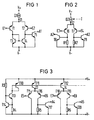
- the basic cell of a comparator consists, according to FIG. 1 of the drawing, for example of two emitter-coupled pnp transistors T1 and T2, at the bases of which input signals E1 and E2 are present as voltages occurring with respect to a reference potential, of a current mirror having two npn transistors T3 and T4, the base of which with the negative pole V- of the supply voltage source and the input or output of which is connected to the collector of one of the two transistors T1 and T2, from an npn transistor T5, the base of which is connected to the output of the current mirror and the emitter of which is connected to the negative pole V -
- the supply voltage source is connected and from a current injection Q1, which is connected between the positive pole V + of the supply voltage source and the coupled emitters of the transistors T1 and T2.
- the collector of the transistor T5 is here, like the bases of the transistors T1 and T2, optionally coupled to further switching elements.
- the one from the Current injection Q1 current I1 is essentially constant and depends on the temperature.
- a current mirror is usually used as such a load in comparator circuits.
- a common comparator circuit is known for example from LP 265 / LP 365 micropower programmable quad comparator, Linear Databook 1, National Semiconductor Corporation, Santa Clara, USA, pp. 4-67ff. If several comparators are now required in an integrated circuit, the current mirror with its two transistors represents a considerable amount of circuitry.
- the object of the invention is therefore to provide a comparator circuit with less effort.
- the comparator circuit according to the invention has two emitter-coupled pnp transistors T6 and T7.
- An input signal E3 is applied to the base of transistor T6 and an input signal E4 is applied to the base of transistor T7.
- the two input signals E3, E4 are voltages.
- the collectors of both transistors are each via a resistor R1 or R2 with the negative pole V- one not shown in the drawing Supply voltage source connected.
- the two resistors R1 and R2 are constructed identically, so that they have the same resistance value and the same temperature response.
- the resistors R1 and R2 are each connected in parallel with the base-emitter paths of two npn transistors T8 and T9.
- the switching state of the transistors T8 and T9 which represents the comparison result, can be picked off as signals A2 or A3 at the collector of the respective transistor.
- the coupled emitters of the transistors T6 and T7 are connected to the positive pole V + of the supply voltage source via a current injection Q2.
- the value of the current I2 impressed by the current impression Q2 and its dependence on the temperature T will be discussed in more detail elsewhere.
- the exemplary embodiment according to FIG. 3 shows an embodiment with several comparators, but only two are shown in the drawing. These each have two emitter-coupled pnp transistors T15, T16; T18, T19, at the bases of which input signals E5 to E8 are applied.
- In the collector line of a transistor T16; T19 are resistors R5; R6 switched, each of which the base-emitter path of an npn transistor T17; T20 is parallel.
- the emitters of the transistors T17; T20 are just like the collectors of the other transistors T15; T18 of the emitter-coupled transistors connected to the negative pole V- of the supply voltage source.
- the collectors of the transistors T16; T19 carry output signals A4 and A5.
- the coupled emitters of the transistors T15, T16; T18, T19 are each across the emitter-collector path of a pnp transistor T11; T12 connected to the positive pole V + of the supply voltage source.
- the coupled bases of the transistors T11; T12 are connected to the cathode of a diode leading to the positive pole V + of the supply voltage.
- the diode is formed by a pnp transistor T10, the base and the collector of which are connected to one another.
- the cathode of this diode is also across the collector-emitter path of an npn transistor T13 and a resistor R4 with the negative Pole V- of the supply voltage source coupled.
- Resistor R4 is connected in parallel with the base-emitter path of an npn transistor T14, the collector of which is connected to the base of transistor T13 and a resistor R3 leading to the positive pole V + of the supply voltage source.
- the diode-emitter formed by transistor T10 has the base-emitter paths of further pnp transistors connected in parallel, which form current impressions for further comparators, not shown in the drawing. All comparators, like the current impressions, are constructed identically. However, a different construction is possible to the same extent. However, this requires an adaptation, for example, via the transistors forming the current impressions.
- a very simple comparator uses only an ohmic resistance as a load instead of a current mirror between the emitter and the base of the output switching transistor - in the present exemplary embodiment, these are, for example, the transistors T8, T9, T17, T20.
- the load resistor - in the present exemplary embodiment these are the resistors R1, R2, R5, R6 - taking into account that in this case the collector currents of the two emitter-coupled transistors are each equal to half due to the current injection impressed current are dimensioned such that the respective load resistance is equal to the emitter-base threshold voltage of the respective output switching transistor divided by half the impressed current. Since the emitter-base threshold voltage of a transistor drops with increasing temperature, but resistors in integrated circuits have a positive temperature coefficient, ie have an increasing resistance with increasing temperature, the switching threshold of this simple comparator would be very temperature-dependent.
- the impressed current of the comparators is now - in the exemplary embodiment, these are the current I2 and the collector currents I3 and I4 of the transistors T11 and T12 - with the temperature so that the comparator switches independent of temperature if the input signal voltages are the same.
- the impressed current is now equal to the double quotient of the temperature-dependent emitter-base threshold voltage of the output switching transistor and the temperature-dependent load resistance and has the same temperature dependency.
- the value for the resistor R4 is equal to half the value of the load resistor, that is to say the value of the resistor R5 or R6.
- This half resistance value can easily be achieved, for example, by connecting two resistors which are constructed identically to the load resistor (ie resistor R5 or R6) in parallel.
- circuitry complexity in a comparator circuit according to the invention is considerably less than in known ones.
- the replacement of the current mirror, which still requires two transistor structures, with an easily implemented, low-cost resistor in the integrated circuit significantly reduces the space required in the integrated circuit, especially since the effort for temperature-dependent current injection does not increase compared to the previously used, temperature-independent current injection.
Landscapes
- Engineering & Computer Science (AREA)
- Physics & Mathematics (AREA)
- Microelectronics & Electronic Packaging (AREA)
- Nonlinear Science (AREA)
- Electromagnetism (AREA)
- General Physics & Mathematics (AREA)
- Radar, Positioning & Navigation (AREA)
- Automation & Control Theory (AREA)
- Measurement Of Current Or Voltage (AREA)
- Manipulation Of Pulses (AREA)
- Measuring Temperature Or Quantity Of Heat (AREA)
Description
Die Erfindung betrifft eine Komparatorschaltung gemäß dem Oberbegriff des Anspruchs 1.The invention relates to a comparator circuit according to the preamble of claim 1.
Aus "Modern Electronic Circuits Reference Manual", 1980, McGraw-Hill, New York, Seite 3 von J.MARKUS und aus der US-A-3 588 535 sind zum einen eine derartige Komparatorschaltung sowie Maßnahmen zur Temperaturkompensation bekannt.Such a comparator circuit and measures for temperature compensation are known from "Modern Electronic Circuits Reference Manual", 1980, McGraw-Hill, New York, page 3 of J.MARKUS and from US-A-3 588 535.
In analogen integrierten Schaltungen werden häufig Komparatoren verwendet, um zwei Spannungen miteinander zu vergleichen. Das Ergebnis dieses Vergleichs wird am Ausgang des Komparators durch einen bestimmten Schaltzustand angezeigt. Die Grundzelle eine Komparators besteht gemäß Figur 1 der Zeichnung beispielsweise aus zwei emittergekoppelten pnp-Transistoren T1 und T2, an deren Basen Eingangssignale E1 und E2 als gegenüber einem Referenzpotential auftretende Spannungen anliegen, aus einem zwei npn-Transistoren T3 und T4 aufweisendem Stromspiegel, dessen Fußpunkt mit dem negativen Pol V- der Versorgungsspannungsquelle und dessen Eingang bzw. Ausgang jeweils mit dem Kollektor eines der beiden Transistoren T1 und T2 verbunden ist, aus einem npn-Transistor T5, dessen Basis mit dem Ausgang des Stromspiegels und dessen Emitter mit dem negativen Pol V- der Versorgungsspannungsquelle verbunden ist und aus einer Stromeinprägung Q1, die zwischen den positiven Pol V+ der Versorgungsspannungsquelle und den gekoppelten Emittern der Transistoren T1 und T2 geschaltet ist. Der Kollektor des Transistors T5, dessen Schaltzustand als Ausgangssignal A1 das Vergleichsergebnis darstellt, ist dabei ebenso wie die Basen der Transistoren T1 und T2 gegebenenfalls mit weiteren Schaltelementen gekoppelt. Der von der Stromeinprägung Q1 eingeprägte Strom I1 ist im wesentlichen konstant und von der Temperatur abhängig.Comparators are often used in analog integrated circuits to compare two voltages. The result of this comparison is displayed at the output of the comparator by a certain switching state. The basic cell of a comparator consists, according to FIG. 1 of the drawing, for example of two emitter-coupled pnp transistors T1 and T2, at the bases of which input signals E1 and E2 are present as voltages occurring with respect to a reference potential, of a current mirror having two npn transistors T3 and T4, the base of which with the negative pole V- of the supply voltage source and the input or output of which is connected to the collector of one of the two transistors T1 and T2, from an npn transistor T5, the base of which is connected to the output of the current mirror and the emitter of which is connected to the negative pole V - The supply voltage source is connected and from a current injection Q1, which is connected between the positive pole V + of the supply voltage source and the coupled emitters of the transistors T1 and T2. The collector of the transistor T5, the switching state of which represents the comparison result as the output signal A1, is here, like the bases of the transistors T1 and T2, optionally coupled to further switching elements. The one from the Current injection Q1 current I1 is essentially constant and depends on the temperature.
Aufgrund der endlichen Steilheit der Transistoren T1 und T2 ist der Übergang des Transistors T5 vom leitenden zum gesperrten Zustand in dem Bereich, in dem die Spannungen der Eingangssignale E1 und E2 ungefähr gleich sein, fließend. Deshalb ist an der Basis des Transistors T5 eine Last erforderlich, die an der Basis des Transistors T5 eine Spannung in Höhe der typischen Basis-Emitter-Schwellspannung dann zuläßt, wenn der Kollektorstrom des Transistors T2 größer ist als der Kollektorstrom des Transistors T1. Als derartige Last wird bei Komparatorschaltungen üblicherweise ein Stromspiegel verwendet. Eine gebräuchliche Komparatorschaltung ist beispielsweise aus LP 265/LP 365 Mikropower Programmable Quad Comparator, Linear Databook 1, National Semiconductor Corporation, Santa Clara, USA, S. 4-67ff bekannt. Werden nun in einer integrierten Schaltung mehrere Komparatoren benötigt, so stellt der Stromspiegel mit seinen beiden Transistoren einen erheblichen Schaltungsaufwand dar.Due to the finite steepness of the transistors T1 and T2, the transition of the transistor T5 from the conductive to the blocked state is fluid in the region in which the voltages of the input signals E1 and E2 are approximately equal. Therefore, a load is required at the base of the transistor T5, which at the base of the transistor T5 permits a voltage at the level of the typical base-emitter threshold voltage when the collector current of the transistor T2 is greater than the collector current of the transistor T1. A current mirror is usually used as such a load in comparator circuits. A common comparator circuit is known for example from LP 265 / LP 365 micropower programmable quad comparator, Linear Databook 1, National Semiconductor Corporation, Santa Clara, USA, pp. 4-67ff. If several comparators are now required in an integrated circuit, the current mirror with its two transistors represents a considerable amount of circuitry.
Aufgabe der Erfindung ist es daher, eine Komparatorschaltung mit geringerem Aufwand anzugeben.The object of the invention is therefore to provide a comparator circuit with less effort.
Diese Aufgabe wird durch eine Komparatorschaltung gemäß Patentanspruch 1 gelöst. Ausgestaltungen und Weiterbildungen des Erfindungsgedankens sind in Unteransprüchen gekennzeichnet.This object is achieved by a comparator circuit according to claim 1. Refinements and developments of the inventive concept are characterized in the subclaims.
Die Erfindung wird nachfolgend anhand der in den Figuren der Zeichnung dargestellten Ausführungsbeispiele näher erläutert. Es zeigt:
- FIG 1
- eine bekannte Komparatorschaltung,
- FIG 2
- eine allgemeine Ausführungsform des Prinzips der erfindungsgemäßen Komparatorschaltung und
- FIG 3
- eine Ausführungsform mit mehreren Komparatorschaltungen mit der erfindungsgemäßen Ausführungsform der Stromeinprägung.
- FIG. 1
- a known comparator circuit,
- FIG 2
- a general embodiment of the principle of the comparator circuit according to the invention and
- FIG 3
- an embodiment with several comparator circuits with the embodiment of the current injection according to the invention.
In dem Ausführungsbeispiel nach FIG 2 weist die erfindungsgemäße Komparatorschaltung zwei emittergekoppelte pnp-Transistoren T6 und T7 auf. An die Basis des Transistors T6 ist ein Eingangssignal E3 und an die Basis des Transistors T7 ein Eingangssignal E4 gelegt. Bei den beiden Eingangssignalen E3, E4 handelt es sich dabei um Spannungen. Die Kollektoren beider Transistoren sind jeweils über einem Widerstand R1 bzw. R2 mit dem negativen Pol V- einer in der Zeichnung nicht näher dargestellten Versorgungsspannungsquelle verbunden. Die beiden Widerstände R1 und R2 sind dabei identisch aufgebaut, so daß sie einen gleichen Widerstandswert und einen gleichen Temperaturgang aufweisen. Den Widerständen R1 und R2 sind jeweils die Basis-Emitter-Strecken zweier npn-Transistoren T8 und T9 parallel geschaltet. Der das Vergleichsergebnis repräsentierende Schaltzustand der Transistoren T8 und T9 ist als Signal A2 bzw. A3 an dem Kollektor des jeweiligen Transistors abgreifbar. Die gekoppelten Emitter der Transistoren T6 und T7 sind über eine Stromeinprägung Q2 mit dem positiven Pol V+ der Versorgungsspannungsquelle verbunden. Über den Wert des von der Stromeinprägung Q2 eingeprägten Stromes I2 und dessen Abhängigkeit von der Temperatur T wird an anderer Stelle noch näher eingegangen.In the exemplary embodiment according to FIG. 2, the comparator circuit according to the invention has two emitter-coupled pnp transistors T6 and T7. An input signal E3 is applied to the base of transistor T6 and an input signal E4 is applied to the base of transistor T7. The two input signals E3, E4 are voltages. The collectors of both transistors are each via a resistor R1 or R2 with the negative pole V- one not shown in the drawing Supply voltage source connected. The two resistors R1 and R2 are constructed identically, so that they have the same resistance value and the same temperature response. The resistors R1 and R2 are each connected in parallel with the base-emitter paths of two npn transistors T8 and T9. The switching state of the transistors T8 and T9, which represents the comparison result, can be picked off as signals A2 or A3 at the collector of the respective transistor. The coupled emitters of the transistors T6 and T7 are connected to the positive pole V + of the supply voltage source via a current injection Q2. The value of the current I2 impressed by the current impression Q2 and its dependence on the temperature T will be discussed in more detail elsewhere.
Das Ausführungsbeispiel gemäß FIG 3 zeigt eine Ausführungsform mit mehreren Komparatoren, wobei jedoch nur zwei in der Zeichnung dargestellt sind. Diese weisen jeweils zwei emittergekoppelte pnp-Transistoren T15, T16; T18, T19 auf, an deren Basen jeweils Eingangssignale E5 bis E8 gelegt sind. In die Kollektorleitung jeweils eines Transistors T16; T19 sind Widerstände R5; R6 geschaltet, denen die Basis-Emitter-Strecke jeweils eines npn-Transistors T17; T20 parallel liegt. Die Emitter der Transistoren T17; T20 sind ebenso wie die Kollektoren der jeweils anderen Transistoren T15; T18 der emittergekoppelten Transistoren mit dem negativen Pol V- der Versorgungsspannungsquelle verbunden. Die Kollektoren der Transistoren T16; T19 führen Ausgangssignale A4 und A5. Die gekoppelten Emitter der Transistoren T15, T16; T18, T19 sind jeweils über die Emitter-Kollektor-Strecke eines pnp-Transistors T11; T12 mit dem positiven Pol V+ der Versorgungsspannungsquelle verbunden. Die gekoppelten Basen der Transistoren T11; T12 sind mit der Kathode einer auf den positiven Pol V+ der Versorgungsspannung führenden Diode verschaltet. Die Diode wird im vorliegenden Ausführungsbeispiel durch einen pnp-Transistor T10 gebildet, dessen Basis und dessen Kollektor miteinander verbunden sind. Die Kathode dieser Diode ist zudem über die Kollektor-Emitter-Strecke eines npn-Transistors T13 und einen Widerstand R4 mit dem negativen Pol V- der Versorgungsspannungsquelle gekoppelt. Dem Widerstand R4 liegt die Basis-Emitter-Strecke eines npn-Transistors T14 parallel, dessen Kollektor mit der Basis des Transistors T13 und einem auf den positiven Pol V+ der Versorgungsspannungsquelle führenden Widerstand R3 verschaltet ist. Der durch den Transistor T10 gebildeten Diode sind die Basis-Emitter-Strecken weiterer pnp-Transistoren parallelgeschaltet, die Stromeinprägungen für weitere, in der Zeichnung nicht näher dargestellte Komparatoren bilden. Alle Komparatoren sind dabei ebenso wie die Stromeinprägungen identisch aufgebaut. Jedoch ist in gleichem Maße ein voneinander abweichender Aufbau möglich. Dazu ist jedoch eine Anpassung beispielsweise über die jeweils die Stromeinprägungen bildenden Transistoren notwendig.The exemplary embodiment according to FIG. 3 shows an embodiment with several comparators, but only two are shown in the drawing. These each have two emitter-coupled pnp transistors T15, T16; T18, T19, at the bases of which input signals E5 to E8 are applied. In the collector line of a transistor T16; T19 are resistors R5; R6 switched, each of which the base-emitter path of an npn transistor T17; T20 is parallel. The emitters of the transistors T17; T20 are just like the collectors of the other transistors T15; T18 of the emitter-coupled transistors connected to the negative pole V- of the supply voltage source. The collectors of the transistors T16; T19 carry output signals A4 and A5. The coupled emitters of the transistors T15, T16; T18, T19 are each across the emitter-collector path of a pnp transistor T11; T12 connected to the positive pole V + of the supply voltage source. The coupled bases of the transistors T11; T12 are connected to the cathode of a diode leading to the positive pole V + of the supply voltage. In the present exemplary embodiment, the diode is formed by a pnp transistor T10, the base and the collector of which are connected to one another. The cathode of this diode is also across the collector-emitter path of an npn transistor T13 and a resistor R4 with the negative Pole V- of the supply voltage source coupled. Resistor R4 is connected in parallel with the base-emitter path of an npn transistor T14, the collector of which is connected to the base of transistor T13 and a resistor R3 leading to the positive pole V + of the supply voltage source. The diode-emitter formed by transistor T10 has the base-emitter paths of further pnp transistors connected in parallel, which form current impressions for further comparators, not shown in the drawing. All comparators, like the current impressions, are constructed identically. However, a different construction is possible to the same extent. However, this requires an adaptation, for example, via the transistors forming the current impressions.
Die Funktionsweise einer erfindungsgemäßen Komparatorschaltung beruht auf folgenden Überlegungen: Ein sehr einfacher Komparator verwendet als Last statt einem Stromspiegel lediglich einen ohmschen Widerstand zwischen Emitter und Basis des Ausgangsschalttransistors - im vorliegenden Ausführungsbeispiel sind dies beispielsweise die Transistoren T8, T9, T17, T20. Damit der Komparator bei Gleichheit der Eingangssignalspannungen schaltet, muß der Lastwiderstand - im vorliegenden Ausführungsbeispiel sind dies die Widerstände R1, R2, R5, R6 - unter Berücksichtigung dessen, daß in diesem Falle die Kollektorströme der beiden emittergekoppelten Transistoren jeweils gleich dem halben, durch die Stromeinprägung eingeprägten Strom sind, so dimensioniert werden, daß der jeweilige Lastwiderstand gleich der Emitter-Basis-Schwellspannung des jeweiligen Ausgangsschalttransistors geteilt durch den halben, eingeprägten Strom ist. Da die Emitter-Basis-Schwellspannung eines Transistors mit zunehmender Temperatur abfällt, Widerstände in integrierten Schaltungen aber einen positiven Temperaturkoeffizienten aufweisen, d. h. mit zunehmender Temperatur einen zunehmenden Widerstand aufweisen, wäre die Schaltschwelle dieses einfachen Komparators sehr stark temperaturabhängig. Erfindungsgemäß wird nun der eingeprägte Strom der Komparatoren - im Ausführungsbeispiel sind dies der Strom I2 sowie die Kollektorströme I3 und I4 der Transistoren T11 und T12 - mit der Temperatur so geführt, daß der Komparator temperaturunabhängig bei Gleichheit der Eingangssignalspannungen schaltet. Der eingeprägte Strom ist erfindungsgemäß nun gleich dem doppelten Quotienten aus der temperaturabhängigen Emitter-Basis-Schwellspannung des Ausgangsschalttransistors und aus dem temperaturabhängigen Lastwiderstand und weist die gleiche Temperaturabhängigkeit auf. Dabei kann bei der Realisierung der Stromeinprägung in guter Näherung für gleich aufgebaute Transistoren und gleich aufgebaute Widerstände ein identisches Temperaturverhalten angenommen werden. Für die davon ausgehende und in FIG 3 gezeigte Ausführungsform einer temperaturabhängigen Stromeinprägung ergibt sich für den Widerstand R4 ein Wert der gleich dem halben Wert des Lastwiderstandes, also des Wertes des Widerstandes R5 bzw. R6, ist. Dieser halbe Widerstandswert läßt sich leicht, beispielsweise durch Parallelschalten zweier identisch mit dem Lastwiderstand (also dem Widerstand R5 bzw. R6) aufgebauter Widerstände erzielen.The operation of a comparator circuit according to the invention is based on the following considerations: A very simple comparator uses only an ohmic resistance as a load instead of a current mirror between the emitter and the base of the output switching transistor - in the present exemplary embodiment, these are, for example, the transistors T8, T9, T17, T20. In order for the comparator to switch when the input signal voltages are the same, the load resistor - in the present exemplary embodiment these are the resistors R1, R2, R5, R6 - taking into account that in this case the collector currents of the two emitter-coupled transistors are each equal to half due to the current injection impressed current are dimensioned such that the respective load resistance is equal to the emitter-base threshold voltage of the respective output switching transistor divided by half the impressed current. Since the emitter-base threshold voltage of a transistor drops with increasing temperature, but resistors in integrated circuits have a positive temperature coefficient, ie have an increasing resistance with increasing temperature, the switching threshold of this simple comparator would be very temperature-dependent. According to the invention, the impressed current of the comparators is now - in the exemplary embodiment, these are the current I2 and the collector currents I3 and I4 of the transistors T11 and T12 - with the temperature so that the comparator switches independent of temperature if the input signal voltages are the same. According to the invention, the impressed current is now equal to the double quotient of the temperature-dependent emitter-base threshold voltage of the output switching transistor and the temperature-dependent load resistance and has the same temperature dependency. When realizing the current injection, an identical temperature behavior can be assumed for transistors and resistors of the same structure. For the embodiment of a temperature-dependent current injection which is based on this and shown in FIG. 3, the value for the resistor R4 is equal to half the value of the load resistor, that is to say the value of the resistor R5 or R6. This half resistance value can easily be achieved, for example, by connecting two resistors which are constructed identically to the load resistor (ie resistor R5 or R6) in parallel.
Der schaltungstechnische Aufwand ist bei einer erfindungsgemäßen Komparatorschaltung wesentlich geringer als bei bekannten. Der Ersatz des Stromspiegels, der immerhin zwei Transistorstrukturen benötigt, durch einen leicht realisierbaren, aufwandsarmen Widerstand in der integrierten Schaltung verringert den Platzbedarf in der integrierten Schaltung wesentlich, zumal sich der Aufwand für die temperaturabhängige Stromeinprägung gegenüber den bisher gebräuchlichen, temperaturunabhängigen Stromeinprägungen nicht erhöht.The circuitry complexity in a comparator circuit according to the invention is considerably less than in known ones. The replacement of the current mirror, which still requires two transistor structures, with an easily implemented, low-cost resistor in the integrated circuit significantly reduces the space required in the integrated circuit, especially since the effort for temperature-dependent current injection does not increase compared to the previously used, temperature-independent current injection.
Claims (3)
- Comparator circuit having a first and a second transistor (T6, T7; T15, T16; T18, T19) of one conductivity type to whose bases input signals (E3, E4; E5, E6; E7, E8) are applied and whose collectors are connected to a first terminal (V-) of a supply voltage source, having a first resistor (R2; R5, R6) which is connected into the collector lead (T7, T16, T19) of the two transistors of the one conductivity type, and having a first transistor (T9, T17; T20) on the other conductivity type whose base -emitter paths are or is connected in parallel with the first resistor (R2; R5, R6) and to whose collector an output signal (A3; A4, A5) is applied, characterized in that a current-impressing means (Q2,; T10...T14, R3, R4) is provided which is connected between the coupled emitters of the first and second transistors (T6, T7; T15, T16; T18, T19) of the one conductivity type and a second terminal (V+) of the supply voltage source, the current (I2; I3, I4) impressed by the current-impressing means (Q2; T10...T14, R3, R4) being equal for each operating temperature to twice the quotient of the base-to-emitter voltage at the operating point of the first transistor (T9; T17, T20) of the other conductivity type and the first resistor (R2; R5, R6), and the current-impressing means being provided as a third transistor (T11, T12) of the one conductivity type whose emitter is connected to the second terminal (V+) of the supply voltage source and whose collector is connected to the coupled emitters of the first and second transistor (T6, T7; T15, T16, T18 or T19) on the one conductivity type, in that the base of the third transistor (T11, T12) of the one conductivity type is, on the one hand, connected via a diode (T10) in the conducting direction to the second terminal (V+) of the supply voltage source and, on the other hand, is connected via the collector-to-emitter path of a second transistor (T13) of the other conductivity type and via a second resistor (R4) to the first terminal (V-) of the supply voltage source, in that the base of the second transistor (T13) of the other conductivity type is connected, on the one hand, via a third resistor (R3) to the other terminal (V+) of the supply voltage source and is connected, on the other hand, via the collector-to-emitter path of a third transistor (T14) of the other conductivity type to the one terminal (V-) of the supply voltage source, and in that the base-to-emitter path of the third transistor (T14) of the other conductivity type is connected in parallel with the second resistor (R4).
- Comparator circuit according to Claim 1, characterized in that a fourth resistor (R1) having the same resistance value and the same temperature response as the first resistor (R2) is connected into the collector lead of the other transistor (T6) of the one conductivity type, and in that there is connected in parallel with the fourth resistor (R1) the base-to-emitter path of a fourth transistor (T8) of the other conductivity type having the same base-to-emitter voltage and the same temperature response as the first transistor (T9) of the other conductivity type to whose collector a further output signal (A2) is applied.
- Comparator circuit according to one of Claims 1 or 2, characterized in that the base-to-emitter paths of further transistors (T12) of the one conductivity type are connected in parallel with the base-to-emitter path of the third transistor (T11) of the one conductivity type, the further transistors (T12) being provided as current-impressing means of further comparator circuits (T18, T19, T20, R6).
Priority Applications (4)
| Application Number | Priority Date | Filing Date | Title |
|---|---|---|---|
| ES90102815T ES2077594T3 (en) | 1990-02-13 | 1990-02-13 | COMPARATOR CIRCUIT. |
| EP90102815A EP0442001B1 (en) | 1990-02-13 | 1990-02-13 | Comparator circuit |
| DE59009720T DE59009720D1 (en) | 1990-02-13 | 1990-02-13 | Comparator circuit. |
| US07/654,739 US5146114A (en) | 1990-02-13 | 1991-02-13 | Comparator circuit |
Applications Claiming Priority (1)
| Application Number | Priority Date | Filing Date | Title |
|---|---|---|---|
| EP90102815A EP0442001B1 (en) | 1990-02-13 | 1990-02-13 | Comparator circuit |
Publications (2)
| Publication Number | Publication Date |
|---|---|
| EP0442001A1 EP0442001A1 (en) | 1991-08-21 |
| EP0442001B1 true EP0442001B1 (en) | 1995-09-27 |
Family
ID=8203645
Family Applications (1)
| Application Number | Title | Priority Date | Filing Date |
|---|---|---|---|
| EP90102815A Expired - Lifetime EP0442001B1 (en) | 1990-02-13 | 1990-02-13 | Comparator circuit |
Country Status (4)
| Country | Link |
|---|---|
| US (1) | US5146114A (en) |
| EP (1) | EP0442001B1 (en) |
| DE (1) | DE59009720D1 (en) |
| ES (1) | ES2077594T3 (en) |
Cited By (1)
| Publication number | Priority date | Publication date | Assignee | Title |
|---|---|---|---|---|
| DE19708203A1 (en) * | 1997-02-28 | 1998-09-03 | Siemens Ag | Comparator circuit |
Families Citing this family (4)
| Publication number | Priority date | Publication date | Assignee | Title |
|---|---|---|---|---|
| US7084674B1 (en) | 2004-08-16 | 2006-08-01 | Analog Devices, Inc. | Differential amplifier with reduced common-mode and method |
| US20130292221A1 (en) * | 2012-05-01 | 2013-11-07 | James Ryan | Compact luggage |
| US11595033B2 (en) * | 2020-11-17 | 2023-02-28 | Texas Instruments Incorporated | Comparator architecture for reduced delay and lower static current |
| DE102020216233A1 (en) * | 2020-12-18 | 2022-06-23 | Zf Friedrichshafen Ag | Analog comparator circuit for in-vehicle communication interfaces |
Family Cites Families (12)
| Publication number | Priority date | Publication date | Assignee | Title |
|---|---|---|---|---|
| US3330972A (en) * | 1964-10-09 | 1967-07-11 | Gen Dynamics Corp | Sine wave threshold and phase comparator |
| US3588535A (en) * | 1967-08-22 | 1971-06-28 | Westinghouse Electric Corp | Control circuit with temperature compensation |
| JPS52114260A (en) * | 1976-03-22 | 1977-09-24 | Hitachi Ltd | Standard voltage generation circuit |
| JPS57557A (en) * | 1980-05-26 | 1982-01-05 | Toshiba Corp | Voltage comparator |
| JPS5711525A (en) * | 1980-06-25 | 1982-01-21 | Nec Corp | Comparing circuit |
| US4580069A (en) * | 1981-01-29 | 1986-04-01 | Motorola, Inc. | Comparator |
| JPS57173220A (en) * | 1981-04-17 | 1982-10-25 | Toshiba Corp | Comparator circuit |
| US4458201A (en) * | 1982-04-05 | 1984-07-03 | Burr-Brown Research Corp. | Digitally controlled precision current source with an open loop compensation circuit |
| JPS6054513A (en) * | 1983-09-06 | 1985-03-29 | Nec Corp | Differential input comparator |
| US4542303A (en) * | 1983-10-03 | 1985-09-17 | Motorola, Inc. | Comparator circuit |
| JPS61116665A (en) * | 1984-11-12 | 1986-06-04 | Fanuc Ltd | Low power consumption type voltage comparator circuit |
| GB2197555B (en) * | 1986-10-02 | 1990-11-21 | Seikosha Kk | Comparator |
-
1990
- 1990-02-13 EP EP90102815A patent/EP0442001B1/en not_active Expired - Lifetime
- 1990-02-13 ES ES90102815T patent/ES2077594T3/en not_active Expired - Lifetime
- 1990-02-13 DE DE59009720T patent/DE59009720D1/en not_active Expired - Lifetime
-
1991
- 1991-02-13 US US07/654,739 patent/US5146114A/en not_active Expired - Lifetime
Non-Patent Citations (2)
| Title |
|---|
| J.MARKUS: "Modern Electronic Circuit Reference Manual", McGraw-Hill, 1980, New York, US; Seite 3 * |
| P.HOROWITZ and W.HILL: "The Art of Electronics", Cambridge University Press, 1980, Cambridge, GB; Seiten 67-68 und 80-83 * |
Cited By (3)
| Publication number | Priority date | Publication date | Assignee | Title |
|---|---|---|---|---|
| DE19708203A1 (en) * | 1997-02-28 | 1998-09-03 | Siemens Ag | Comparator circuit |
| DE19708203C2 (en) * | 1997-02-28 | 1998-12-03 | Siemens Ag | Comparator circuit |
| US6064240A (en) * | 1997-02-28 | 2000-05-16 | Siemens Aktiengesellschaft | Comparator circuit with low current consumption |
Also Published As
| Publication number | Publication date |
|---|---|
| US5146114A (en) | 1992-09-08 |
| DE59009720D1 (en) | 1995-11-02 |
| EP0442001A1 (en) | 1991-08-21 |
| ES2077594T3 (en) | 1995-12-01 |
Similar Documents
| Publication | Publication Date | Title |
|---|---|---|
| EP0288016B1 (en) | Comparator with enlarged range for input common mode signal | |
| EP0153492A1 (en) | Protection circuit for apparatus controlled by electrical signals | |
| AT392375B (en) | ELECTRONIC CIRCUIT WITH A PROTECTED TRANSISTOR | |
| DE2416534C3 (en) | Transistor circuit for reversing the direction of current in a consumer | |
| DE3486360T2 (en) | Differential switch. | |
| DE3012812C2 (en) | ||
| DE19624676C1 (en) | Circuit arrangement for generation of reference voltage | |
| EP0442001A1 (en) | Comparator circuit | |
| DE2804064A1 (en) | AMPLIFIER CIRCUIT ARRANGEMENT FOR APERIODIC SIGNALS | |
| US4418321A (en) | Feedback amplifier or threshold value switch for a current feed differential stage | |
| EP0421016A1 (en) | ECL-TTL signal level converter | |
| DE2335314B2 (en) | Semiconductor amplifier for small signals | |
| DE3318957A1 (en) | MONOLITHICALLY INTEGRATED, BISTABLE MULTIVIBRATOR CIRCUIT WITH AN OUTPUT ADJUSTABLE | |
| EP0246689B1 (en) | Circuit for converting three-state signals into binary signals | |
| DE2322466C3 (en) | Operational amplifier | |
| USRE32479E (en) | Feedback amplifier or threshold value switch for a current feed differential stage | |
| DE1246027B (en) | Logical circuit made up of two transistors connected in a power takeover circuit | |
| DE2612548C3 (en) | Integrated driver module with bipolar transistors, especially for controlling bipolar telephone relays | |
| DE1638010C3 (en) | Solid-state circuit for reference amplifiers | |
| DE3301800A1 (en) | Protection circuit which can be integrated | |
| DE3418191C2 (en) | ||
| EP0792021A1 (en) | Driving circuit | |
| DE19928796B4 (en) | Electronic switch for switching a load | |
| DE1638049C3 (en) | Circuit arrangement for an electronic switch | |
| DE1800207A1 (en) | Logic circuit with a pair of transistors in a power take-off circuit |
Legal Events
| Date | Code | Title | Description |
|---|---|---|---|
| PUAI | Public reference made under article 153(3) epc to a published international application that has entered the european phase |
Free format text: ORIGINAL CODE: 0009012 |
|
| 17P | Request for examination filed |
Effective date: 19901205 |
|
| AK | Designated contracting states |
Kind code of ref document: A1 Designated state(s): AT BE CH DE DK ES FR GB GR IT LI LU NL SE |
|
| RBV | Designated contracting states (corrected) |
Designated state(s): BE DE ES FR GB IT NL SE |
|
| 17Q | First examination report despatched |
Effective date: 19931117 |
|
| GRAA | (expected) grant |
Free format text: ORIGINAL CODE: 0009210 |
|
| AK | Designated contracting states |
Kind code of ref document: B1 Designated state(s): BE DE ES FR GB IT NL SE |
|
| REF | Corresponds to: |
Ref document number: 59009720 Country of ref document: DE Date of ref document: 19951102 |
|
| REG | Reference to a national code |
Ref country code: ES Ref legal event code: FG2A Ref document number: 2077594 Country of ref document: ES Kind code of ref document: T3 |
|
| ITF | It: translation for a ep patent filed | ||
| GBT | Gb: translation of ep patent filed (gb section 77(6)(a)/1977) |
Effective date: 19951212 |
|
| ET | Fr: translation filed | ||
| PLBE | No opposition filed within time limit |
Free format text: ORIGINAL CODE: 0009261 |
|
| STAA | Information on the status of an ep patent application or granted ep patent |
Free format text: STATUS: NO OPPOSITION FILED WITHIN TIME LIMIT |
|
| 26N | No opposition filed | ||
| PGFP | Annual fee paid to national office [announced via postgrant information from national office to epo] |
Ref country code: ES Payment date: 19970213 Year of fee payment: 8 Ref country code: SE Payment date: 19970213 Year of fee payment: 8 |
|
| PGFP | Annual fee paid to national office [announced via postgrant information from national office to epo] |
Ref country code: BE Payment date: 19970221 Year of fee payment: 8 |
|
| PGFP | Annual fee paid to national office [announced via postgrant information from national office to epo] |
Ref country code: NL Payment date: 19970225 Year of fee payment: 8 |
|
| PG25 | Lapsed in a contracting state [announced via postgrant information from national office to epo] |
Ref country code: SE Free format text: LAPSE BECAUSE OF NON-PAYMENT OF DUE FEES Effective date: 19980214 Ref country code: ES Free format text: LAPSE BECAUSE OF NON-PAYMENT OF DUE FEES Effective date: 19980214 |
|
| PG25 | Lapsed in a contracting state [announced via postgrant information from national office to epo] |
Ref country code: BE Free format text: LAPSE BECAUSE OF NON-PAYMENT OF DUE FEES Effective date: 19980228 |
|
| BERE | Be: lapsed |
Owner name: SIEMENS A.G. Effective date: 19980228 |
|
| PG25 | Lapsed in a contracting state [announced via postgrant information from national office to epo] |
Ref country code: NL Free format text: LAPSE BECAUSE OF NON-PAYMENT OF DUE FEES Effective date: 19980901 |
|
| EUG | Se: european patent has lapsed |
Ref document number: 90102815.9 |
|
| NLV4 | Nl: lapsed or anulled due to non-payment of the annual fee |
Effective date: 19980901 |
|
| REG | Reference to a national code |
Ref country code: ES Ref legal event code: FD2A Effective date: 20000403 |
|
| PGFP | Annual fee paid to national office [announced via postgrant information from national office to epo] |
Ref country code: GB Payment date: 20010208 Year of fee payment: 12 |
|
| REG | Reference to a national code |
Ref country code: GB Ref legal event code: IF02 |
|
| PG25 | Lapsed in a contracting state [announced via postgrant information from national office to epo] |
Ref country code: GB Free format text: LAPSE BECAUSE OF NON-PAYMENT OF DUE FEES Effective date: 20020213 |
|
| GBPC | Gb: european patent ceased through non-payment of renewal fee |
Effective date: 20020213 |
|
| PGFP | Annual fee paid to national office [announced via postgrant information from national office to epo] |
Ref country code: IT Payment date: 20090221 Year of fee payment: 20 Ref country code: DE Payment date: 20090416 Year of fee payment: 20 |
|
| PGFP | Annual fee paid to national office [announced via postgrant information from national office to epo] |
Ref country code: FR Payment date: 20090213 Year of fee payment: 20 |
|
| PG25 | Lapsed in a contracting state [announced via postgrant information from national office to epo] |
Ref country code: DE Free format text: LAPSE BECAUSE OF EXPIRATION OF PROTECTION Effective date: 20100213 |