EP0439552B1 - Extension deceleration orthosis - Google Patents
Extension deceleration orthosis Download PDFInfo
- Publication number
- EP0439552B1 EP0439552B1 EP89913140A EP89913140A EP0439552B1 EP 0439552 B1 EP0439552 B1 EP 0439552B1 EP 89913140 A EP89913140 A EP 89913140A EP 89913140 A EP89913140 A EP 89913140A EP 0439552 B1 EP0439552 B1 EP 0439552B1
- Authority
- EP
- European Patent Office
- Prior art keywords
- arms
- elongated
- connector
- members
- elongated member
- Prior art date
- Legal status (The legal status is an assumption and is not a legal conclusion. Google has not performed a legal analysis and makes no representation as to the accuracy of the status listed.)
- Expired - Lifetime
Links
- 239000000463 material Substances 0.000 claims description 3
- 238000006073 displacement reaction Methods 0.000 claims 4
- 210000003414 extremity Anatomy 0.000 abstract description 13
- 210000003127 knee Anatomy 0.000 abstract description 4
- 230000007613 environmental effect Effects 0.000 abstract 1
- 210000003041 ligament Anatomy 0.000 abstract 1
- 230000003449 preventive effect Effects 0.000 abstract 1
- 230000009467 reduction Effects 0.000 description 5
- 238000004519 manufacturing process Methods 0.000 description 4
- 230000006378 damage Effects 0.000 description 3
- 230000000694 effects Effects 0.000 description 3
- 210000004417 patella Anatomy 0.000 description 3
- 206010060820 Joint injury Diseases 0.000 description 2
- 239000004677 Nylon Substances 0.000 description 2
- 208000027418 Wounds and injury Diseases 0.000 description 2
- 230000000386 athletic effect Effects 0.000 description 2
- 230000036541 health Effects 0.000 description 2
- 230000006872 improvement Effects 0.000 description 2
- 208000014674 injury Diseases 0.000 description 2
- 238000000034 method Methods 0.000 description 2
- 229920001778 nylon Polymers 0.000 description 2
- 206010020772 Hypertension Diseases 0.000 description 1
- 229910000639 Spring steel Inorganic materials 0.000 description 1
- 230000008859 change Effects 0.000 description 1
- 230000001143 conditioned effect Effects 0.000 description 1
- 210000002310 elbow joint Anatomy 0.000 description 1
- 238000005538 encapsulation Methods 0.000 description 1
- 230000001771 impaired effect Effects 0.000 description 1
- 230000000266 injurious effect Effects 0.000 description 1
- 210000000629 knee joint Anatomy 0.000 description 1
- 210000002414 leg Anatomy 0.000 description 1
- 239000002184 metal Substances 0.000 description 1
- 210000003205 muscle Anatomy 0.000 description 1
- 230000037074 physically active Effects 0.000 description 1
- 230000002265 prevention Effects 0.000 description 1
- 230000008569 process Effects 0.000 description 1
- 230000000452 restraining effect Effects 0.000 description 1
- 125000006850 spacer group Chemical group 0.000 description 1
- 239000000725 suspension Substances 0.000 description 1
Images

Classifications
-
- A—HUMAN NECESSITIES
- A61—MEDICAL OR VETERINARY SCIENCE; HYGIENE
- A61F—FILTERS IMPLANTABLE INTO BLOOD VESSELS; PROSTHESES; DEVICES PROVIDING PATENCY TO, OR PREVENTING COLLAPSING OF, TUBULAR STRUCTURES OF THE BODY, e.g. STENTS; ORTHOPAEDIC, NURSING OR CONTRACEPTIVE DEVICES; FOMENTATION; TREATMENT OR PROTECTION OF EYES OR EARS; BANDAGES, DRESSINGS OR ABSORBENT PADS; FIRST-AID KITS
- A61F5/00—Orthopaedic methods or devices for non-surgical treatment of bones or joints; Nursing devices ; Anti-rape devices
- A61F5/01—Orthopaedic devices, e.g. long-term immobilising or pressure directing devices for treating broken or deformed bones such as splints, casts or braces
- A61F5/0102—Orthopaedic devices, e.g. long-term immobilising or pressure directing devices for treating broken or deformed bones such as splints, casts or braces specially adapted for correcting deformities of the limbs or for supporting them; Ortheses, e.g. with articulations
- A61F5/0123—Orthopaedic devices, e.g. long-term immobilising or pressure directing devices for treating broken or deformed bones such as splints, casts or braces specially adapted for correcting deformities of the limbs or for supporting them; Ortheses, e.g. with articulations for the knees
-
- A—HUMAN NECESSITIES
- A61—MEDICAL OR VETERINARY SCIENCE; HYGIENE
- A61F—FILTERS IMPLANTABLE INTO BLOOD VESSELS; PROSTHESES; DEVICES PROVIDING PATENCY TO, OR PREVENTING COLLAPSING OF, TUBULAR STRUCTURES OF THE BODY, e.g. STENTS; ORTHOPAEDIC, NURSING OR CONTRACEPTIVE DEVICES; FOMENTATION; TREATMENT OR PROTECTION OF EYES OR EARS; BANDAGES, DRESSINGS OR ABSORBENT PADS; FIRST-AID KITS
- A61F5/00—Orthopaedic methods or devices for non-surgical treatment of bones or joints; Nursing devices ; Anti-rape devices
- A61F5/01—Orthopaedic devices, e.g. long-term immobilising or pressure directing devices for treating broken or deformed bones such as splints, casts or braces
- A61F5/0102—Orthopaedic devices, e.g. long-term immobilising or pressure directing devices for treating broken or deformed bones such as splints, casts or braces specially adapted for correcting deformities of the limbs or for supporting them; Ortheses, e.g. with articulations
- A61F2005/0132—Additional features of the articulation
- A61F2005/0137—Additional features of the articulation with two parallel pivots
-
- A—HUMAN NECESSITIES
- A61—MEDICAL OR VETERINARY SCIENCE; HYGIENE
- A61F—FILTERS IMPLANTABLE INTO BLOOD VESSELS; PROSTHESES; DEVICES PROVIDING PATENCY TO, OR PREVENTING COLLAPSING OF, TUBULAR STRUCTURES OF THE BODY, e.g. STENTS; ORTHOPAEDIC, NURSING OR CONTRACEPTIVE DEVICES; FOMENTATION; TREATMENT OR PROTECTION OF EYES OR EARS; BANDAGES, DRESSINGS OR ABSORBENT PADS; FIRST-AID KITS
- A61F5/00—Orthopaedic methods or devices for non-surgical treatment of bones or joints; Nursing devices ; Anti-rape devices
- A61F5/01—Orthopaedic devices, e.g. long-term immobilising or pressure directing devices for treating broken or deformed bones such as splints, casts or braces
- A61F5/0102—Orthopaedic devices, e.g. long-term immobilising or pressure directing devices for treating broken or deformed bones such as splints, casts or braces specially adapted for correcting deformities of the limbs or for supporting them; Ortheses, e.g. with articulations
- A61F2005/0132—Additional features of the articulation
- A61F2005/0179—Additional features of the articulation with spring means
Definitions
- This invention relates to orthoses for the prevention or rehabilitation of joint injuries. It relates to an orthotic fulcrum, and for point design Particularly to decelerate in one direction for eliminating instability and motion problems with respect to joint extension, hypertension, or flexion.
- braces for the leg and arm. Joint-extension in physically active individuals, such as athletes, or in people having joint injuries, can introduce instability and the risk of injury or further injury due to the increased angular limb velocities associated with their activities or relative to their disability. Joint flexion in these people can also place severe energy and fatigue costs on their quadriceps or triceps muscles. While prior art braces include desirable features for providing extension stability, for limiting hyperextension, and for providing flexion mobility, they have the kinds of problems described below. Such a prior art orthotic device is known from, for example, US-A-4 524 764 which discloses a device as defined in the preamble of present Claim 1.
- the device includes adjustable and adaptable spring rods attached near brace fulcrum point(s) with a novel post and pivot arrangement, as depicted in the drawings.
- An the hinge is rotated toward the fully extended position; i.e., so that the arms form an angle of 180 degrees with each other, twin posts engage the spring rods to cause deceleration of the angular motion.
- One embodiment includes conventional upper and lower rigid, elongated arms with geared ends and integral stops for limiting rotation beyond 180 degrees, together with means for linking the arms adjacently and for rotating the arms in the same plane about a pivot or pivot points.
- An assembly of plates, spacers, bushings and screws is provided to secure the arms and to ensure they rotate in the same plane.
- the assembly is designed both to permit the arms to be locked in any position during manufacture, while fitting the orthotic fulcrum assembly to an orthosis, and also to permit free motion of the arms during usage so that the speed of motion of the ranging of the joint is not reduced or impaired.
- a lightweight spring rod is serpentinely assembled to the orthotic fulcrum's outer connecting plate by means of friction reduction roller posts and a central pivot screw.
- Placement of the roller posts controls the point during limb extension when the spring rod is activated, with roller post positioning being determined during manufacture of the needs of the user with respect to limitation of the range of motion, the point at which deceleration of limb angular motion is required and the like. Since the spring rod mechanically dampens the rate of angular motion of the hinge, adjustment of the rate of deceleration is controlled by adjusting the material or cross-sectional area of the spring rod to change the force required. Adjustment of the point at which deceleration starts is controlled by the variable placement of the roller posts so as to engage the spring rod sooner or later during the extension process. As shown in the drawings, the spring assembly can be easily adapted to a variety of different hinges and braces.
- An orthotic fulcrum 10 includes an elongated, rigid, thin, flat lower bar 11 and an elongated, rigid, thin, flat upper bar 12.
- the bars are also called arms in the art. These arms, which should be of equal thickness, lie in the same plane and engage each other adjacently by means of gear teeth on each of their ends at 12a (see FIG. 3) in the polycentric orthotic fulcrum design.
- the polycentric orthotic fulcrum is known in the art.
- the arms are connected by rigid, inner plate 13 on the inside of the orthotic fulcrum and rigid, outer plate 14 on the outside of the orthotic fulcrum point so as to overlap the arms' engaged gear teeth.
- the arms and plates are fastened together by screws 15 and 16. These screws pass through fulcrum point bushings 17 and 18 and fit into threaded holes in inner plate 13.
- the orthotic fulcrum bushings 17 and 18 serve as pivot points for the orthotic fulcrum assembly.
- the length of hinge bushings 17 and 18 should be slightly shorter than the combined thickness of either arm plus the outer plate 14, since such design permits locking of the orthotic fulcrum in any position to facilitate manufacture, assembly, and fitting into a larger assembly, such as an orthosis.
- the screws 15 and 16 are adjusted so as to permit the fulcrum point 10 to move freely over its range of motion, and then lock screw 19, which is positioned to simultaneously clamp a shoulder on each of screws 15 and 16, is tightened into a threaded hole in outer plate 14 so as to prevent screws 15 and 16 from turning.
- Stops are provided on the geared ends of arms 11 and 12 so as to limit their range of motion.
- a deceleration means is provided, which is the principle improvement in the art, as described below.
- Post 20 passes through friction reduction roller 21 and into a variably placed threaded hole in upper arm 12, to which it is tightened and adjusted so as to allow the roller 21 to turn freely.
- Post 22 passes through friction reduction roller 23 and into a variably placed hole in lower arm 11, to which it is tightened and adjusted so as to allow the roller 23 to turn freely.
- Pivot screw 24 passes through friction reduction roller 25 and is tightened into a threaded hole in outer plate 14, which hole is centered between assembled screws 15 and 16 on a line tangential to the adjacent pitch diameters of the gears on the ends of the assembled arms 11 and 12.
- a spring steel wire is formed serpentinely to make spring rod 26, which is assembled to fit around pivot screw 24 and roller 25.
- a shoulder on pivot screw 24 acts as a retainer to hold spring rod 26 against outer plate 14 and against the edges of screws 15 and 16.
- Spring rod 26 is curved to fit around screws 15 and 16 and is curved conversely to fit around friction reduction roller posts 20 and 22, the ends of spring rod 26 contact rollers 21 and 23 during extension of the orthotic fulcrum, resulting in deceleration of the angular velocity of the orthotic fulcrum and parts.
- the material and cross-sectional area of spring rod 26 can be varied to suit differences in user's activity level and state of health and to suit required rates of deceleration of the angular motion of the hinge.
- the angle of curvature of spring rod 26 can be varied to adjust the point when deceleration occurs, which is a function of when rollers 21 and 23 first contact spring rod 26 during orthotic extension.
- Upright arms 12 are attached to each other by means of a thin metal band 27, varying in thickness, width and length, each determined by requirements of individual appendage size, usually one-half the circumference of the appendage at the same length proximal to the fulcrum point.
- the fastening means is rivets 40 drilled and pinned through both arm 12 and band 27.
- Band 28 is fastened to medial and lateral lower arms 11 in the same method as band 27 is fastened to the upper arms. Together with the arms 11 and 12, bands 27 and 28 make up the skeletal structure of the orthosis.
- Proximal circumference strap 29 encapsulates the appendage to the orthosis along with the distal circumference strap 30. These straps are compressive and hold the appendage firmly inside the orthosis. This is achieved by fastening strap 29 to band 27 at one end by permanent fixation to interface or pad 39 and removable fastener 31 to fixed fastener 32 at the other end for circumferential wrap. The same arrangement is used for the attachment of strap 30
- patella straps 33 and 36 Two more prehension straps are used to encapsulate the appendage, and they are the patella straps 33 and 36.
- Strap 33 is attached to pad 39 and arm 12 by nylon thread on one end and to truss clip 34 on the other. Truss clip 34 is attached to member 35 with nylon thread in a reinforce stitch pattern, completing the encapsulation of the knee, and also providing suspension.
- Member 35 is a pelite thermo pad that acts as an attachment point for patella straps 33 and 36. Strap 36 attaches to pad 38 in the same way patella strap 33 attaches to pad 39.
- Strap 37 is an anti-rotation strap and runs up through the orthosis and around the medial or lateral or both sides of the knee in a spiraling wrap attaching the band 27 with the origin of the band 28. This resists rotary forces at the fulcrum point of the orthosis when applied to a flexing and extending appendage.
Landscapes
- Health & Medical Sciences (AREA)
- Nursing (AREA)
- Orthopedic Medicine & Surgery (AREA)
- Engineering & Computer Science (AREA)
- Biomedical Technology (AREA)
- Heart & Thoracic Surgery (AREA)
- Vascular Medicine (AREA)
- Life Sciences & Earth Sciences (AREA)
- Animal Behavior & Ethology (AREA)
- General Health & Medical Sciences (AREA)
- Public Health (AREA)
- Veterinary Medicine (AREA)
- Orthopedics, Nursing, And Contraception (AREA)
- Optical Fibers, Optical Fiber Cores, And Optical Fiber Bundles (AREA)
- Door And Window Frames Mounted To Openings (AREA)
- Soil Working Implements (AREA)
Abstract
Description
- This invention relates to orthoses for the prevention or rehabilitation of joint injuries. It relates to an orthotic fulcrum, and for point design Particularly to decelerate in one direction for eliminating instability and motion problems with respect to joint extension, hypertension, or flexion.
- Just as there are many indications for orthotic management of knee and elbow joints so are there many varieties of braces for the leg and arm. Joint-extension in physically active individuals, such as athletes, or in people having joint injuries, can introduce instability and the risk of injury or further injury due to the increased angular limb velocities associated with their activities or relative to their disability. Joint flexion in these people can also place severe energy and fatigue costs on their quadriceps or triceps muscles. While prior art braces include desirable features for providing extension stability, for limiting hyperextension, and for providing flexion mobility, they have the kinds of problems described below. Such a prior art orthotic device is known from, for example, US-A-4 524 764 which discloses a device as defined in the preamble of present Claim 1.
- Means for limiting hyperextension, such as pins abutting edges, co-engaging recesses and shoulders, and stops near the fulcrum to limit angular motion, themselves provide the fulcrum about which accelerating and extending limbs can rotate into injurious hyperextension. In other words, the braces themselves can do harm. Free motion braces have similar problems. Friction control arrangements, while slowing limb extension, have the disadvantage of requiring force to overcame the designed-in friction forces when the limb is flexed, a disadvantage to athletes needing quick reaction and to patients needing to conserve energy stores and avoid undue fatigue. Also, stops, pins, edges, shoulders and the like tend to add undesirable weight to a brace, increasing fatigue, slowing motion, and adding discomfort. Finally, the kinds of features described in the prior art for extension/flexion stability/mobility generally are uniquely built into the knee or elbow brace design and are thus neither economically adaptable to a wide variety of other braces nor easily adjustable to wearer, medical or athletic needs.
- The foregoing problems suggest the following minimal design criteria for an orthotic device providing extension stability, limiting hyperextension, and providing flexion mobility.
- 1. Should automatically decelerate the angular velocity of the limb during the last fifteen to twenty degrees of design motion prior to contact with any stop, pin, shoulder or similar stopping means.
- 2. Should not slow the speed of ranging of the joint other than as specified in 1 above.
- 3. Should be lightweight.
- 4. Should be economically adaptable to a wide range of braces.
- 5. Should be economical of manufacture and assembly.
- 6. Should be adjustable with respect to the range of motion within which it operates.
- 7. Should be adjustable with respect to the forces expected to be encountered by the limb, as conditioned by the user's activity level, state of health, weight, and usage environment; e.g., the playing surface as in the case of athletics.
- It is the object of this invention to meet the foregoing design requirements with features which solve the problems heretofore described, which also renders it a vast improvement on its original merits over prior art.
- An orthotic device with a particularly designed fulcrum point which limits hyperextension, provides extension stability, and facilitates flexion mobility is provided. The device includes adjustable and adaptable spring rods attached near brace fulcrum point(s) with a novel post and pivot arrangement, as depicted in the drawings. An the hinge is rotated toward the fully extended position; i.e., so that the arms form an angle of 180 degrees with each other, twin posts engage the spring rods to cause deceleration of the angular motion.
- One embodiment includes conventional upper and lower rigid, elongated arms with geared ends and integral stops for limiting rotation beyond 180 degrees, together with means for linking the arms adjacently and for rotating the arms in the same plane about a pivot or pivot points. An assembly of plates, spacers, bushings and screws is provided to secure the arms and to ensure they rotate in the same plane. The assembly is designed both to permit the arms to be locked in any position during manufacture, while fitting the orthotic fulcrum assembly to an orthosis, and also to permit free motion of the arms during usage so that the speed of motion of the ranging of the joint is not reduced or impaired. In one embodiment, a lightweight spring rod is serpentinely assembled to the orthotic fulcrum's outer connecting plate by means of friction reduction roller posts and a central pivot screw. Placement of the roller posts controls the point during limb extension when the spring rod is activated, with roller post positioning being determined during manufacture of the needs of the user with respect to limitation of the range of motion, the point at which deceleration of limb angular motion is required and the like. Since the spring rod mechanically dampens the rate of angular motion of the hinge, adjustment of the rate of deceleration is controlled by adjusting the material or cross-sectional area of the spring rod to change the force required. Adjustment of the point at which deceleration starts is controlled by the variable placement of the roller posts so as to engage the spring rod sooner or later during the extension process. As shown in the drawings, the spring assembly can be easily adapted to a variety of different hinges and braces.
- These, and other features and benefits of this invention, will be obvious from the drawings and disclosure which follow.
-
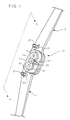
- FIG. 1 is a perspective view of an extension deceleration orthotic hinge according to the principles of this invention;
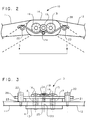
- FIG. 2 is a front elevation view taken on line 2-2 of FIG. 1;
- FIG. 3 is a side elevation view taken on line 3-3 of FIG. 2; and
- FIG. 4 is a fragmentary perspective vied showing how the spring rod, roller posts, and pivot screw assembly is adapted to a centric, single axis hinge.
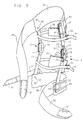
- FIG. 5 is a complete overview of the Extension Deceleration Orthosis showing individual components of the orthosis.
- An
orthotic fulcrum 10 according to principles of this invention includes an elongated, rigid, thin, flatlower bar 11 and an elongated, rigid, thin, flatupper bar 12. The bars are also called arms in the art. These arms, which should be of equal thickness, lie in the same plane and engage each other adjacently by means of gear teeth on each of their ends at 12a (see FIG. 3) in the polycentric orthotic fulcrum design. The polycentric orthotic fulcrum is known in the art. The arms are connected by rigid,inner plate 13 on the inside of the orthotic fulcrum and rigid,outer plate 14 on the outside of the orthotic fulcrum point so as to overlap the arms' engaged gear teeth. The arms and plates are fastened together byscrews inner plate 13. - The orthotic fulcrum bushings 17 and 18 serve as pivot points for the orthotic fulcrum assembly. The length of
hinge bushings outer plate 14, since such design permits locking of the orthotic fulcrum in any position to facilitate manufacture, assembly, and fitting into a larger assembly, such as an orthosis. When assembled for use, thescrews fulcrum point 10 to move freely over its range of motion, and then lockscrew 19, which is positioned to simultaneously clamp a shoulder on each ofscrews outer plate 14 so as to preventscrews - Stops are provided on the geared ends of
arms -
Post 20 passes throughfriction reduction roller 21 and into a variably placed threaded hole inupper arm 12, to which it is tightened and adjusted so as to allow theroller 21 to turn freely.Post 22 passes throughfriction reduction roller 23 and into a variably placed hole inlower arm 11, to which it is tightened and adjusted so as to allow theroller 23 to turn freely.Pivot screw 24 passes throughfriction reduction roller 25 and is tightened into a threaded hole inouter plate 14, which hole is centered between assembledscrews arms spring rod 26, which is assembled to fit aroundpivot screw 24 androller 25. A shoulder onpivot screw 24 acts as a retainer to holdspring rod 26 againstouter plate 14 and against the edges ofscrews Spring rod 26 is curved to fit around screws 15 and 16 and is curved conversely to fit around friction reduction roller posts 20 and 22, the ends ofspring rod 26contact rollers spring rod 26 can be varied to suit differences in user's activity level and state of health and to suit required rates of deceleration of the angular motion of the hinge. The angle of curvature ofspring rod 26 can be varied to adjust the point when deceleration occurs, which is a function of whenrollers contact spring rod 26 during orthotic extension. -
Upright arms 12 are attached to each other by means of athin metal band 27, varying in thickness, width and length, each determined by requirements of individual appendage size, usually one-half the circumference of the appendage at the same length proximal to the fulcrum point. The fastening means is rivets 40 drilled and pinned through botharm 12 andband 27.Band 28 is fastened to medial and laterallower arms 11 in the same method asband 27 is fastened to the upper arms. Together with thearms bands Proximal circumference strap 29 encapsulates the appendage to the orthosis along with thedistal circumference strap 30. These straps are compressive and hold the appendage firmly inside the orthosis. This is achieved by fasteningstrap 29 to band 27 at one end by permanent fixation to interface orpad 39 andremovable fastener 31 to fixedfastener 32 at the other end for circumferential wrap. The same arrangement is used for the attachment ofstrap 30 toband 28. - Two more prehension straps are used to encapsulate the appendage, and they are the patella straps 33 and 36.
Strap 33 is attached to pad 39 andarm 12 by nylon thread on one end and totruss clip 34 on the other.Truss clip 34 is attached tomember 35 with nylon thread in a reinforce stitch pattern, completing the encapsulation of the knee, and also providing suspension.Member 35 is a pelite thermo pad that acts as an attachment point for patella straps 33 and 36.Strap 36 attaches to pad 38 in the sameway patella strap 33 attaches to pad 39.Strap 37 is an anti-rotation strap and runs up through the orthosis and around the medial or lateral or both sides of the knee in a spiraling wrap attaching theband 27 with the origin of theband 28. This resists rotary forces at the fulcrum point of the orthosis when applied to a flexing and extending appendage. - Although this invention has been described in the context of an orthotic device, it should be understood that it also has application to any orthotic fulcrum contrivance, such as an orthotic power assisted arm, where it is desirable to decelerate the angular momentum of the orthotic's fulcrum motion before a stop is contacted or before any restraining devices are excessively stretched.
Claims (10)
- An orthotic device for providing extension stability and limiting hyperextension while providing flexion mobility, said device including:a. an array of elongated, first and second arms (11,12);b. means (29,30,37,38,39) for attaching said arms to the body of a user on opposite sides of a joint that is to be protected by the device;c. connector means (13,14,15,16) at the apposite ends of said arms which connect said arms together for relative angular movement limited to a plane common to said arms; and characterized by further including :d. deceleration means for reducing the relative rate of movement between said arms over only that part of the relative movement of said arms which concludes with the maximum angular displacement between said arms, said deceleration means including: an elongated, energy-absorbing member (26) capable of generating a reactive force that is proportional to the displacement of one end of the member relative to the other, means (19,24) at a point intermediate the opposite ends of the elongated member (26) for fixing said elongated member against movement relative to said connector means, and first and second stop means (20,22) so located on said first and second arms as to be engageable only at particular times by opposite ends of said elongated member, said stop means being so relatively located and said elongated member being so contoured that both of said stop means are engageable by said elongated member only with the relative angle between said arms approaching a maximum, whereby: (a) said deceleration means remains inoperative and said elongated arms can angularly move freely relative to each other as long as the relative angular displacement of said arms remains small enough that said elongated member does not simultaneously engage both of said stop means, but (b) both of said stop means will be engaged and the relative rate of angular movement between said elongated arms increasingly reduced as the angular displacement between said arms is thereafter increased.
- An orthotic device as defined in claim 1 wherein:a. said connector means includes meshing gear means on the apposite ends of said elongated arms, first and second connector members (13,14) so disposed on opposite sides of the array of elongated arms as to prevent relative sideways movement of said arms, and members (15,16) which extend through and span said connector members near the apposite ends of said arms to couple together said members and said arms and to provide shafts about which said arms can rotate; andb. said deceleration means also includes means (19,24) fixing said elongated member at approximately its midpoint and as aforesaid to one of said first and second connector members.
- An orthotic device as defined in claim 2 where in:a. the connector means comprises a first headed member (19) with a head that is engageable with said shaft providing members to prevent rotation of said shaft providing members;b. said elongated member (26) is trapped against said one connector member (14) by said first headed member; andc. the means for fixing said elongated member to said one connector member (14) comprises a second headed member (24) also confining said elongated member against said one connector member, said second headed member being so located on the opposite side of the elongated member from the first headed member as to trap the elongated member against the first headed member.
- An orthotic device as defined in claim 2 which includes bushings (17,18) supported from said one connector member and engageable by said elongated member to increase the resistance to relative angular movement of the arms afforded by said elongated member.
- An orthotic device as defined in claim 4 in which the shaft-providing members (15,16) extend through said bushings and fix said bushings to said one connector member.
- An orthotic device as defined in claim 3 in which said shaft-providing members are threaded into the second of said connector members (13) whereby, with said members locked against rotation, said connector members can move apart to an extent which is sufficient to prevent said members from frictionally restricting the relative rotation of said arms.
- An orthotic device as defined in claim 3 in which:a. said first headed member is located along a line extending between the axes of elongation of the shaft-providing members and approximately midway between said axes; andb. the second headed member is located along a second line extending normally to the first-mentioned line and passing through the axis of elongation of the first headed member.
- An orthotic device as defined in claim 2 in which:a. the apposite end portions of said arms have parallel sides and are of equal thickness; andb. said connector members (13,14) are flat plates.
- An orthotic device as defined in any of the preceding claims 1-8 in which said elongated member (26) is fabricated of a resiliently deformable material and has a serpentine configuration.
- An orthotic device as defined in any of the preceding claims 1-8 in which:a. the end portions of the elongated member are trained around the first and second stop means (20,22) when they are engaged with said stop means as aforesaid; andb. said stop means comprise rollers (21,23) so engageable by said elongated member end portions as to minimize friction between said elongated member and said stop means and there provide for flexion mobility in said device.
Applications Claiming Priority (3)
| Application Number | Priority Date | Filing Date | Title |
|---|---|---|---|
| US07/260,943 US4865024A (en) | 1988-10-21 | 1988-10-21 | Extension deceleration orthosis |
| US260943 | 1988-10-21 | ||
| PCT/US1989/004770 WO1990004371A1 (en) | 1988-10-21 | 1989-10-20 | Extension deceleration orthosis |
Publications (3)
| Publication Number | Publication Date |
|---|---|
| EP0439552A1 EP0439552A1 (en) | 1991-08-07 |
| EP0439552A4 EP0439552A4 (en) | 1991-11-21 |
| EP0439552B1 true EP0439552B1 (en) | 1995-03-29 |
Family
ID=22991296
Family Applications (1)
| Application Number | Title | Priority Date | Filing Date |
|---|---|---|---|
| EP89913140A Expired - Lifetime EP0439552B1 (en) | 1988-10-21 | 1989-10-20 | Extension deceleration orthosis |
Country Status (7)
| Country | Link |
|---|---|
| US (1) | US4865024A (en) |
| EP (1) | EP0439552B1 (en) |
| JP (1) | JPH0813307B2 (en) |
| AT (1) | ATE120357T1 (en) |
| CA (1) | CA1319870C (en) |
| DE (1) | DE68921986D1 (en) |
| WO (1) | WO1990004371A1 (en) |
Cited By (2)
| Publication number | Priority date | Publication date | Assignee | Title |
|---|---|---|---|---|
| US9737431B1 (en) | 2013-09-27 | 2017-08-22 | Weber Orthopedic, Inc. | Wrist-forearm-elbow anti-rotation orthosis |
| US9782285B1 (en) | 2013-09-27 | 2017-10-10 | Weber Orthopedic, Inc. | Elbow-forearm anti-rotation orthosis |
Families Citing this family (93)
| Publication number | Priority date | Publication date | Assignee | Title |
|---|---|---|---|---|
| US5358469A (en) * | 1990-02-09 | 1994-10-25 | Ultraflex Systems, Inc. | Dynamic splint |
| US5658241A (en) * | 1990-02-09 | 1997-08-19 | Ultraflex Systems, Inc. | Multi-functional dynamic splint |
| US5749840A (en) * | 1989-12-07 | 1998-05-12 | Ultraflex Systems, Inc. | Dynamic splint |
| US5036837A (en) * | 1990-02-09 | 1991-08-06 | Bio-Tec, Inc. | Dynamic extension splint |
| US5022390A (en) * | 1990-05-11 | 1991-06-11 | Whiteside Stacey A | Orthotic device for limiting limb notion at a joint |
| US5167612A (en) * | 1990-07-30 | 1992-12-01 | Bonutti Peter M | Adjustable orthosis |
| US5520627A (en) * | 1993-06-30 | 1996-05-28 | Empi, Inc. | Range-of-motion ankle splint |
| US5437619A (en) * | 1993-06-30 | 1995-08-01 | Empi, Inc. | Range-of-motion splint with eccentric spring |
| US5571078A (en) * | 1993-06-30 | 1996-11-05 | Empi, Inc. | Range-of-motion ankle splint |
| US5399154A (en) * | 1993-06-30 | 1995-03-21 | Empi, Inc. | Constant torque range-of-motion splint |
| US5437611A (en) * | 1993-12-01 | 1995-08-01 | Orthotic Rehabilitation Products, Inc. | Dynamic brace joint |
| CA2186227C (en) * | 1994-03-22 | 1999-09-28 | Mark Deharde | Multi-functional dynamic splint |
| DE4418382A1 (en) * | 1994-05-26 | 1995-11-30 | Michael Klopf | Orthesis for supporting foot, esp. in paralysis |
| US5575764A (en) * | 1994-12-14 | 1996-11-19 | Van Dyne; Leonard A. | Prosthetic joint with dynamic torque compensator |
| US5891061A (en) * | 1997-02-20 | 1999-04-06 | Jace Systems, Inc. | Brace for applying a dynamic force to a jointed limb |
| US5891068A (en) * | 1997-03-28 | 1999-04-06 | Kenney; John P. | Orthotic device for treating contractures due to immobility |
| US6064912A (en) | 1997-03-28 | 2000-05-16 | Kenney; John P. | Orthotic/electrotherapy for treating contractures due to immobility |
| US6206846B1 (en) * | 1997-03-28 | 2001-03-27 | John P. Kenney | Orthotic device for treating contractures due to immobility |
| US6010474A (en) * | 1997-06-06 | 2000-01-04 | Wycoki; Michael | Orthopedic brace for legs |
| US6074355A (en) * | 1998-02-06 | 2000-06-13 | Bartlett; Edwin Clary | Knee brace |
| US6113562A (en) | 1998-06-01 | 2000-09-05 | Peter M. Bonutti | Shoulder orthosis |
| WO1999065429A1 (en) * | 1998-06-19 | 1999-12-23 | Tamotsu Sakima | Knee outfit and joint supporting member |
| DE29822445U1 (en) * | 1998-12-17 | 1999-02-25 | IPOS Gesellschaft für integrierte Prothesen-Entwicklung und orthopädietechnischen Service mbH & Co KG, 21337 Lüneburg | Knee brace |
| US6039707A (en) * | 1999-02-16 | 2000-03-21 | Crawford; Michael K. | Pelvic support and walking assistance device |
| DE59912937D1 (en) * | 1999-12-29 | 2006-01-19 | Roland Peter Jakob | Device for exercising a static or dynamic front, resp. posterior translational force on the knee joint |
| US6589195B1 (en) * | 2000-05-26 | 2003-07-08 | Orthomerica Products, Inc. | Modular adjustable prophylactic hip orthosis and adduction/abduction joint |
| US6502577B1 (en) | 2000-09-18 | 2003-01-07 | Peter M. Bonutti | Method for moving finger joints |
| US6503213B2 (en) | 2000-12-01 | 2003-01-07 | Peter M. Bonutti | Method of using a neck brace |
| US6575926B2 (en) | 2000-12-15 | 2003-06-10 | Bonutti 2003 Trust-A | Myofascial strap |
| US6752774B2 (en) * | 2001-06-08 | 2004-06-22 | Townsend Design | Tension assisted ankle joint and orthotic limb braces incorporating same |
| US7048704B2 (en) * | 2001-09-28 | 2006-05-23 | Sieller Richard T | Orthotic device |
| US6969363B2 (en) * | 2002-02-15 | 2005-11-29 | Thuasne | Bicentric hinge for use in a brace |
| US7488300B2 (en) | 2002-02-15 | 2009-02-10 | Thusane | Bicentric hinge for use in a brace |
| US8100844B2 (en) * | 2002-04-25 | 2012-01-24 | Ultraflex Systems, Inc. | Ambulating ankle and knee joints with bidirectional dampening and assistance using elastomeric restraint |
| PT1503707E (en) * | 2002-04-25 | 2012-03-08 | Ultraflex Systems Inc | Ambulating knee joint |
| US7736394B2 (en) | 2002-08-22 | 2010-06-15 | Victhom Human Bionics Inc. | Actuated prosthesis for amputees |
| EP1531766B1 (en) | 2002-08-22 | 2012-08-01 | Victhom Human Bionics Inc. | Actuated leg prosthesis for above-knee amputees |
| EP1547568B1 (en) | 2002-08-30 | 2013-01-02 | Honda Giken Kogyo Kabushiki Kaisha | Speed reducer for walk assist apparatus |
| US7192407B2 (en) * | 2003-01-30 | 2007-03-20 | Djo, Llc | Motion controlling hinge for orthopedic brace |
| US7150721B2 (en) * | 2003-06-30 | 2006-12-19 | Thuasne | Knee brace with dynamic counterforce |
| US20050107889A1 (en) | 2003-11-18 | 2005-05-19 | Stephane Bedard | Instrumented prosthetic foot |
| US7815689B2 (en) | 2003-11-18 | 2010-10-19 | Victhom Human Bionics Inc. | Instrumented prosthetic foot |
| WO2005067827A2 (en) * | 2004-01-07 | 2005-07-28 | Dj Orthopedics, Llc | Knee brace hinges having dual axes of rotation |
| DE602005009135D1 (en) * | 2004-01-07 | 2008-10-02 | Djo Llc | KNEE HATCHES WITH ADAPTIVE MOTION |
| US7637959B2 (en) | 2004-02-12 | 2009-12-29 | össur hf | Systems and methods for adjusting the angle of a prosthetic ankle based on a measured surface angle |
| US8066656B2 (en) | 2005-10-28 | 2011-11-29 | Bonutti Research, Inc. | Range of motion device |
| US7452342B2 (en) | 2004-03-08 | 2008-11-18 | Bonutti Research Inc. | Range of motion device |
| US20050273025A1 (en) * | 2004-05-19 | 2005-12-08 | Houser Guy M | Braces having an assembly for exerting a manually adjustable force on a limb of a user |
| US7811242B2 (en) * | 2004-06-24 | 2010-10-12 | Djo, Llc | Motion controlling hinge for orthopedic brace |
| CA2592042C (en) | 2004-12-22 | 2014-12-16 | Oessur Hf | Systems and methods for processing limb motion |
| US20060142680A1 (en) * | 2004-12-29 | 2006-06-29 | Iarocci Michael A | Active assist for the ankle, knee and other human joints |
| US8801802B2 (en) | 2005-02-16 | 2014-08-12 | össur hf | System and method for data communication with a mechatronic device |
| SE528516C2 (en) | 2005-04-19 | 2006-12-05 | Lisa Gramnaes | Combined active and passive leg prosthesis system and a method for performing a movement cycle with such a system |
| US8012108B2 (en) | 2005-08-12 | 2011-09-06 | Bonutti Research, Inc. | Range of motion system and method |
| EP1942843B1 (en) | 2005-09-01 | 2017-03-01 | Össur hf | System and method for determining terrain transitions |
| WO2007108551A1 (en) * | 2006-03-20 | 2007-09-27 | Japan Labour Health And Welfare Organization | Long leg brace with load brake |
| RU2309708C1 (en) * | 2006-03-20 | 2007-11-10 | Государственное образовательное учреждение высшего профессионального образования Марийский государственный технический университет | Orthopedic apparatus for knee joint |
| US7544174B2 (en) * | 2006-09-29 | 2009-06-09 | Djo, Llc | Quiet flexion/extension stop for orthopedic brace and orthopedic brace incorporating a quiet flexion/extension stop |
| WO2008080232A1 (en) | 2007-01-05 | 2008-07-10 | Victhom Human Bionics Inc. | High torque active mechanism for orthotic and/or prosthetic devices |
| WO2008080234A1 (en) | 2007-01-05 | 2008-07-10 | Victhom Human Bionics Inc. | Joint actuation mechanism for a prosthetic and/or orthotic device having a compliant transmission |
| EP2107896A4 (en) | 2007-02-05 | 2010-03-10 | Bonutti Res Inc | Knee orthosis |
| US7553289B2 (en) * | 2007-02-20 | 2009-06-30 | Gregory Cadichon | Method, apparatus, and system for bracing a knee |
| US20110098618A1 (en) * | 2007-05-03 | 2011-04-28 | Darren Fleming | Cable Knee Brace System |
| US8273043B2 (en) | 2007-07-25 | 2012-09-25 | Bonutti Research, Inc. | Orthosis apparatus and method of using an orthosis apparatus |
| JP2009090042A (en) | 2007-10-12 | 2009-04-30 | Honda Motor Co Ltd | Walking assist device |
| US8905950B2 (en) | 2008-03-04 | 2014-12-09 | Bonutti Research, Inc. | Shoulder ROM orthosis |
| WO2009120637A1 (en) | 2008-03-24 | 2009-10-01 | Ossur Hf | Transfemoral prosthetic systems and methods for operating the same |
| US7963933B2 (en) * | 2008-04-09 | 2011-06-21 | Nace Richard A | Osteoarthritis knee orthosis |
| US10085869B2 (en) * | 2008-05-20 | 2018-10-02 | Medical Alliance, S.A. | Knee orthosis for treatment of PCL injury |
| US8308669B2 (en) * | 2008-05-20 | 2012-11-13 | Nace Richard A | Knee orthosis with hinged shin and thigh cuff |
| US9089403B2 (en) * | 2009-05-20 | 2015-07-28 | Medical Alliance Sa | Knee orthosis with hinged shin and thigh cuffs |
| US8308671B2 (en) * | 2008-08-28 | 2012-11-13 | Nace Richard A | Knee orthosis |
| WO2010087602A2 (en) * | 2009-02-02 | 2010-08-05 | Cho Kyung Il | Knee brace that is attachable/detachable to/from an ankle brace |
| US9289640B2 (en) | 2009-03-23 | 2016-03-22 | Steven M. Cersonsky | Resistance brace |
| US20110065553A1 (en) * | 2009-03-23 | 2011-03-17 | Cersonsky Steven M | Body Mounted Muscular Brace |
| WO2012014164A2 (en) * | 2010-07-28 | 2012-02-02 | Indaco S.R.L. | Support for human joints |
| WO2012037275A1 (en) | 2010-09-16 | 2012-03-22 | Steadman Philippon Research Institute | Posterior cruciate ligament support brace |
| US8882688B1 (en) | 2010-11-15 | 2014-11-11 | Craig Ancinec | Orthotic joint stabilizing assembly |
| EP2773301B1 (en) | 2011-10-31 | 2016-03-16 | Ossur Hf | Orthopedic device for dynamically treating the knee |
| US10413437B2 (en) | 2013-01-25 | 2019-09-17 | Ossur Iceland Ehf | Orthopedic device having a dynamic control system and method for using the same |
| WO2014117109A1 (en) | 2013-01-25 | 2014-07-31 | Ossur Hf | Orthopedic device having a dynamic control system |
| US9539135B2 (en) | 2013-01-25 | 2017-01-10 | Ossur Hf | Orthopedic device having a dynamic control system and method for using the same |
| US9402759B2 (en) | 2013-02-05 | 2016-08-02 | Bonutti Research, Inc. | Cervical traction systems and method |
| EP2961355B1 (en) | 2013-02-26 | 2018-08-22 | Össur hf | Prosthetic foot with enhanced stability and elastic energy return |
| WO2014205103A1 (en) | 2013-06-21 | 2014-12-24 | Ossur Hf | Dynamic tension system for orthopedic device |
| EP3036068B1 (en) | 2013-08-22 | 2018-09-19 | Ossur Iceland EHF | Torque limiting tool and method for using the same |
| CN106456339B (en) | 2014-04-11 | 2020-02-07 | 奥索有限责任公司 | Prosthetic foot with removable flexible member |
| US10512305B2 (en) | 2014-07-11 | 2019-12-24 | Ossur Hf | Tightening system with a tension control mechanism |
| US10653546B2 (en) | 2014-10-31 | 2020-05-19 | Ossur Hf | Orthopedic device having a dynamic control system |
| WO2019104302A2 (en) | 2017-11-27 | 2019-05-31 | Ossur Iceland Ehf | Orthopedic device having a suspension element |
| CN109172286B (en) * | 2018-07-25 | 2020-10-02 | 福州大学 | Lower limb rehabilitation walking aid device and working method thereof |
| DE102020001327A1 (en) * | 2020-02-28 | 2021-09-02 | Bernhard Sacherer | Orthosis joint to create a functional position with spring-loaded deflection. |
| JP7718783B2 (en) * | 2021-11-10 | 2025-08-05 | 株式会社キトー | knee brace |
Family Cites Families (13)
| Publication number | Priority date | Publication date | Assignee | Title |
|---|---|---|---|---|
| GB813501A (en) * | 1954-09-25 | 1959-05-21 | William Louis Cresswell | Improvements in or relating to apparatus for use by disabled persons |
| US817785A (en) * | 1906-02-23 | 1906-04-17 | Charles E Kritsch | Joint for artificial limbs. |
| US1072369A (en) * | 1913-04-26 | 1913-09-02 | Edward Spahn | Knee and ankle brace. |
| DE3040595C1 (en) * | 1980-10-29 | 1982-01-21 | Harald 2359 Henstedt-Ulzburg Lodenkämper | Stabilizing bandage for the knee joint |
| US4370977A (en) * | 1981-05-04 | 1983-02-01 | Kenneth D. Driver | Knee and elbow brace |
| GB2098490A (en) * | 1981-05-19 | 1982-11-24 | Gavan John | Body support |
| US4524764A (en) * | 1983-09-06 | 1985-06-25 | Miller Harold E | Knee brace |
| DE3344422A1 (en) * | 1983-12-08 | 1985-06-20 | S + G Implants GmbH, 2400 Lübeck | ORTHOSIS FOR KNEE JOINTS |
| FR2559394B1 (en) * | 1984-02-10 | 1986-07-11 | Carsalade Charles | APPARATUS TO FACILITATE THE PRACTICE OF ALPINE SKIING IN PARTICULAR |
| US4829989A (en) * | 1985-06-17 | 1989-05-16 | Deamer Richard M | Stoop laborer's body support having hinge with adjustable spring biasing |
| US4803975A (en) * | 1987-03-31 | 1989-02-14 | Meyers Andrew H | Orthotic device for controlling knee instabilities |
| US4751920A (en) * | 1987-01-20 | 1988-06-21 | 3D Orthopedic, Inc. | Pivoting knee brace with rotating and translating tibia collar |
| US4961416A (en) * | 1989-06-12 | 1990-10-09 | Orthopedic Systems, Inc. | Knee brace |
-
1988
- 1988-10-21 US US07/260,943 patent/US4865024A/en not_active Ceased
-
1989
- 1989-09-25 CA CA000612888A patent/CA1319870C/en not_active Expired - Fee Related
- 1989-10-20 JP JP2500080A patent/JPH0813307B2/en not_active Expired - Lifetime
- 1989-10-20 DE DE68921986T patent/DE68921986D1/en not_active Expired - Lifetime
- 1989-10-20 AT AT89913140T patent/ATE120357T1/en not_active IP Right Cessation
- 1989-10-20 WO PCT/US1989/004770 patent/WO1990004371A1/en not_active Ceased
- 1989-10-20 EP EP89913140A patent/EP0439552B1/en not_active Expired - Lifetime
Cited By (2)
| Publication number | Priority date | Publication date | Assignee | Title |
|---|---|---|---|---|
| US9737431B1 (en) | 2013-09-27 | 2017-08-22 | Weber Orthopedic, Inc. | Wrist-forearm-elbow anti-rotation orthosis |
| US9782285B1 (en) | 2013-09-27 | 2017-10-10 | Weber Orthopedic, Inc. | Elbow-forearm anti-rotation orthosis |
Also Published As
| Publication number | Publication date |
|---|---|
| DE68921986D1 (en) | 1995-05-04 |
| JPH0813307B2 (en) | 1996-02-14 |
| US4865024A (en) | 1989-09-12 |
| JPH04501227A (en) | 1992-03-05 |
| CA1319870C (en) | 1993-07-06 |
| EP0439552A1 (en) | 1991-08-07 |
| ATE120357T1 (en) | 1995-04-15 |
| EP0439552A4 (en) | 1991-11-21 |
| WO1990004371A1 (en) | 1990-05-03 |
Similar Documents
| Publication | Publication Date | Title |
|---|---|---|
| CA1319870C (en) | Extension deceleration orthotic hinge | |
| USRE37209E1 (en) | Extension deceleration orthosis | |
| US4508111A (en) | Adjustable splint | |
| US4657000A (en) | Adjustable splint and securing means therefor | |
| US4433679A (en) | Knee and elbow brace | |
| CA1185136A (en) | Adjustable splint | |
| USRE37297E1 (en) | Dynamic orthopedic knee brace assembly | |
| US4370977A (en) | Knee and elbow brace | |
| CA2066151C (en) | Orthosis with joint distraction | |
| US5358469A (en) | Dynamic splint | |
| CA1314779C (en) | Cuff device | |
| US4538600A (en) | Adjustable splint | |
| US4751920A (en) | Pivoting knee brace with rotating and translating tibia collar | |
| US5658241A (en) | Multi-functional dynamic splint | |
| AU559360B2 (en) | Adjustable splint | |
| JPH02502258A (en) | self-adjusting cuff device | |
| US20040267179A1 (en) | Knee unloading orthotic device and method | |
| US7850632B2 (en) | Knee brace having an adaptable thigh pad | |
| WO1999039668A1 (en) | Knee brace | |
| EP1861051B1 (en) | Adjustable knee brace | |
| CN215228891U (en) | Device for providing active assistance to body joints | |
| JPS62102756A (en) | Knee joint soft revolving mount jig | |
| EP4464286A1 (en) | Orthosis | |
| US20050148914A1 (en) | Adjustable range of motion limiter | |
| CA2263040C (en) | Multi-functional dynamic splint |
Legal Events
| Date | Code | Title | Description |
|---|---|---|---|
| PUAI | Public reference made under article 153(3) epc to a published international application that has entered the european phase |
Free format text: ORIGINAL CODE: 0009012 |
|
| 17P | Request for examination filed |
Effective date: 19910422 |
|
| AK | Designated contracting states |
Kind code of ref document: A1 Designated state(s): AT BE CH DE FR GB IT LI LU NL SE |
|
| A4 | Supplementary search report drawn up and despatched |
Effective date: 19911001 |
|
| AK | Designated contracting states |
Kind code of ref document: A4 Designated state(s): AT BE CH DE FR GB IT LI LU NL SE |
|
| 17Q | First examination report despatched |
Effective date: 19940225 |
|
| GRAA | (expected) grant |
Free format text: ORIGINAL CODE: 0009210 |
|
| AK | Designated contracting states |
Kind code of ref document: B1 Designated state(s): AT BE CH DE FR GB IT LI LU NL SE |
|
| PG25 | Lapsed in a contracting state [announced via postgrant information from national office to epo] |
Ref country code: IT Free format text: LAPSE BECAUSE OF FAILURE TO SUBMIT A TRANSLATION OF THE DESCRIPTION OR TO PAY THE FEE WITHIN THE PRE;WARNING: LAPSES OF ITALIAN PATENTS WITH EFFECTIVE DATE BEFORE 2007 MAY HAVE OCCURRED AT ANY TIME BEFORE 2007. THE CORRECT EFFECTIVE DATE MAY BE DIFFERENT FROM THE ONE RECORDED.SCRIBED TIME-LIMIT Effective date: 19950329 Ref country code: BE Effective date: 19950329 Ref country code: FR Effective date: 19950329 Ref country code: NL Free format text: LAPSE BECAUSE OF NON-PAYMENT OF DUE FEES Effective date: 19950329 Ref country code: AT Effective date: 19950329 Ref country code: CH Effective date: 19950329 Ref country code: LI Effective date: 19950329 |
|
| REF | Corresponds to: |
Ref document number: 120357 Country of ref document: AT Date of ref document: 19950415 Kind code of ref document: T |
|
| REF | Corresponds to: |
Ref document number: 68921986 Country of ref document: DE Date of ref document: 19950504 |
|
| PG25 | Lapsed in a contracting state [announced via postgrant information from national office to epo] |
Ref country code: SE Effective date: 19950629 |
|
| PG25 | Lapsed in a contracting state [announced via postgrant information from national office to epo] |
Ref country code: DE Effective date: 19950630 |
|
| REG | Reference to a national code |
Ref country code: CH Ref legal event code: PL |
|
| EN | Fr: translation not filed | ||
| NLV1 | Nl: lapsed or annulled due to failure to fulfill the requirements of art. 29p and 29m of the patents act | ||
| PG25 | Lapsed in a contracting state [announced via postgrant information from national office to epo] |
Ref country code: GB Effective date: 19951020 |
|
| PG25 | Lapsed in a contracting state [announced via postgrant information from national office to epo] |
Ref country code: LU Free format text: LAPSE BECAUSE OF NON-PAYMENT OF DUE FEES Effective date: 19951031 |
|
| PLBE | No opposition filed within time limit |
Free format text: ORIGINAL CODE: 0009261 |
|
| STAA | Information on the status of an ep patent application or granted ep patent |
Free format text: STATUS: NO OPPOSITION FILED WITHIN TIME LIMIT |
|
| 26N | No opposition filed | ||
| GBPC | Gb: european patent ceased through non-payment of renewal fee |
Effective date: 19951020 |