EP0436249B1 - Photographic emulsions sensitized by the introduction of oligomers - Google Patents
Photographic emulsions sensitized by the introduction of oligomers Download PDFInfo
- Publication number
- EP0436249B1 EP0436249B1 EP90203321A EP90203321A EP0436249B1 EP 0436249 B1 EP0436249 B1 EP 0436249B1 EP 90203321 A EP90203321 A EP 90203321A EP 90203321 A EP90203321 A EP 90203321A EP 0436249 B1 EP0436249 B1 EP 0436249B1
- Authority
- EP
- European Patent Office
- Prior art keywords
- group viii
- metal ions
- further characterized
- emulsion according
- viii metal
- Prior art date
- Legal status (The legal status is an assumption and is not a legal conclusion. Google has not performed a legal analysis and makes no representation as to the accuracy of the status listed.)
- Expired - Lifetime
Links
- 239000000839 emulsion Substances 0.000 title claims abstract description 65
- 229910021645 metal ion Inorganic materials 0.000 claims abstract description 52
- 229910052709 silver Inorganic materials 0.000 claims abstract description 46
- 239000004332 silver Substances 0.000 claims abstract description 46
- -1 silver halide Chemical class 0.000 claims abstract description 46
- 239000013078 crystal Substances 0.000 claims abstract description 30
- 150000001768 cations Chemical group 0.000 claims abstract description 18
- 239000003446 ligand Substances 0.000 claims description 36
- 238000000034 method Methods 0.000 claims description 20
- 229910052741 iridium Inorganic materials 0.000 claims description 17
- 150000004820 halides Chemical class 0.000 claims description 15
- GKOZUEZYRPOHIO-UHFFFAOYSA-N iridium atom Chemical group [Ir] GKOZUEZYRPOHIO-UHFFFAOYSA-N 0.000 claims description 14
- 150000001450 anions Chemical class 0.000 claims description 12
- 230000005855 radiation Effects 0.000 claims description 9
- 125000000129 anionic group Chemical group 0.000 claims description 7
- 150000002500 ions Chemical class 0.000 claims description 6
- 230000001747 exhibiting effect Effects 0.000 claims description 5
- XFXPMWWXUTWYJX-UHFFFAOYSA-N Cyanide Chemical compound N#[C-] XFXPMWWXUTWYJX-UHFFFAOYSA-N 0.000 claims description 4
- ZMZDMBWJUHKJPS-UHFFFAOYSA-N hydrogen thiocyanate Natural products SC#N ZMZDMBWJUHKJPS-UHFFFAOYSA-N 0.000 claims description 4
- CRDYSYOERSZTHZ-UHFFFAOYSA-M selenocyanate Chemical compound [Se-]C#N CRDYSYOERSZTHZ-UHFFFAOYSA-M 0.000 claims description 4
- ZMZDMBWJUHKJPS-UHFFFAOYSA-M Thiocyanate anion Chemical compound [S-]C#N ZMZDMBWJUHKJPS-UHFFFAOYSA-M 0.000 claims description 3
- XLJMAIOERFSOGZ-UHFFFAOYSA-M cyanate Chemical compound [O-]C#N XLJMAIOERFSOGZ-UHFFFAOYSA-M 0.000 claims description 3
- 230000001235 sensitizing effect Effects 0.000 abstract description 2
- 229910052751 metal Inorganic materials 0.000 description 39
- 239000002184 metal Substances 0.000 description 39
- 125000004429 atom Chemical group 0.000 description 34
- CPELXLSAUQHCOX-UHFFFAOYSA-M Bromide Chemical compound [Br-] CPELXLSAUQHCOX-UHFFFAOYSA-M 0.000 description 15
- BQCADISMDOOEFD-UHFFFAOYSA-N Silver Chemical compound [Ag] BQCADISMDOOEFD-UHFFFAOYSA-N 0.000 description 14
- XLYOFNOQVPJJNP-UHFFFAOYSA-N water Chemical compound O XLYOFNOQVPJJNP-UHFFFAOYSA-N 0.000 description 9
- VEXZGXHMUGYJMC-UHFFFAOYSA-M Chloride anion Chemical compound [Cl-] VEXZGXHMUGYJMC-UHFFFAOYSA-M 0.000 description 8
- XMBWDFGMSWQBCA-UHFFFAOYSA-N hydrogen iodide Chemical compound I XMBWDFGMSWQBCA-UHFFFAOYSA-N 0.000 description 8
- 238000010348 incorporation Methods 0.000 description 8
- 239000000203 mixture Substances 0.000 description 6
- 238000002360 preparation method Methods 0.000 description 6
- ADZWSOLPGZMUMY-UHFFFAOYSA-M silver bromide Chemical compound [Ag]Br ADZWSOLPGZMUMY-UHFFFAOYSA-M 0.000 description 6
- 108010010803 Gelatin Proteins 0.000 description 5
- 239000008273 gelatin Substances 0.000 description 5
- 229920000159 gelatin Polymers 0.000 description 5
- 235000019322 gelatine Nutrition 0.000 description 5
- 235000011852 gelatine desserts Nutrition 0.000 description 5
- 239000000243 solution Substances 0.000 description 5
- 206010070834 Sensitisation Diseases 0.000 description 4
- 150000002503 iridium Chemical class 0.000 description 4
- 150000002739 metals Chemical class 0.000 description 4
- 230000005070 ripening Effects 0.000 description 4
- 230000008313 sensitization Effects 0.000 description 4
- ZUNKMNLKJXRCDM-UHFFFAOYSA-N silver bromoiodide Chemical compound [Ag].IBr ZUNKMNLKJXRCDM-UHFFFAOYSA-N 0.000 description 4
- FOIXSVOLVBLSDH-UHFFFAOYSA-N Silver ion Chemical compound [Ag+] FOIXSVOLVBLSDH-UHFFFAOYSA-N 0.000 description 3
- 230000015572 biosynthetic process Effects 0.000 description 3
- 150000004696 coordination complex Chemical class 0.000 description 3
- 230000000051 modifying effect Effects 0.000 description 3
- 238000001556 precipitation Methods 0.000 description 3
- 230000004044 response Effects 0.000 description 3
- 239000007787 solid Substances 0.000 description 3
- 238000000108 ultra-filtration Methods 0.000 description 3
- JKFYKCYQEWQPTM-UHFFFAOYSA-N 2-azaniumyl-2-(4-fluorophenyl)acetate Chemical compound OC(=O)C(N)C1=CC=C(F)C=C1 JKFYKCYQEWQPTM-UHFFFAOYSA-N 0.000 description 2
- VEXZGXHMUGYJMC-UHFFFAOYSA-N Hydrochloric acid Chemical compound Cl VEXZGXHMUGYJMC-UHFFFAOYSA-N 0.000 description 2
- FZERHIULMFGESH-UHFFFAOYSA-N N-phenylacetamide Chemical compound CC(=O)NC1=CC=CC=C1 FZERHIULMFGESH-UHFFFAOYSA-N 0.000 description 2
- MWUXSHHQAYIFBG-UHFFFAOYSA-N Nitric oxide Chemical group O=[N] MWUXSHHQAYIFBG-UHFFFAOYSA-N 0.000 description 2
- KDLHZDBZIXYQEI-UHFFFAOYSA-N Palladium Chemical compound [Pd] KDLHZDBZIXYQEI-UHFFFAOYSA-N 0.000 description 2
- 229910021607 Silver chloride Inorganic materials 0.000 description 2
- 229910021612 Silver iodide Inorganic materials 0.000 description 2
- NINIDFKCEFEMDL-UHFFFAOYSA-N Sulfur Chemical compound [S] NINIDFKCEFEMDL-UHFFFAOYSA-N 0.000 description 2
- 238000002835 absorbance Methods 0.000 description 2
- 239000007864 aqueous solution Substances 0.000 description 2
- 229940006460 bromide ion Drugs 0.000 description 2
- 239000011248 coating agent Substances 0.000 description 2
- 238000000576 coating method Methods 0.000 description 2
- 150000001875 compounds Chemical class 0.000 description 2
- 230000029087 digestion Effects 0.000 description 2
- 239000012153 distilled water Substances 0.000 description 2
- 230000000694 effects Effects 0.000 description 2
- PCHJSUWPFVWCPO-UHFFFAOYSA-N gold Chemical compound [Au] PCHJSUWPFVWCPO-UHFFFAOYSA-N 0.000 description 2
- 229910052737 gold Inorganic materials 0.000 description 2
- 239000010931 gold Substances 0.000 description 2
- 239000012528 membrane Substances 0.000 description 2
- BASFCYQUMIYNBI-UHFFFAOYSA-N platinum Chemical compound [Pt] BASFCYQUMIYNBI-UHFFFAOYSA-N 0.000 description 2
- 230000008569 process Effects 0.000 description 2
- 238000000746 purification Methods 0.000 description 2
- 238000011160 research Methods 0.000 description 2
- 238000000926 separation method Methods 0.000 description 2
- 229940045105 silver iodide Drugs 0.000 description 2
- HKZLPVFGJNLROG-UHFFFAOYSA-M silver monochloride Chemical compound [Cl-].[Ag+] HKZLPVFGJNLROG-UHFFFAOYSA-M 0.000 description 2
- 235000002639 sodium chloride Nutrition 0.000 description 2
- 239000000126 substance Substances 0.000 description 2
- 238000006467 substitution reaction Methods 0.000 description 2
- 239000011593 sulfur Substances 0.000 description 2
- 229910052717 sulfur Inorganic materials 0.000 description 2
- 238000003786 synthesis reaction Methods 0.000 description 2
- 238000002411 thermogravimetry Methods 0.000 description 2
- LIQFCELSAWJXJN-UHFFFAOYSA-N 1,4,10,13-tetraoxa-7,16-dithiacyclooctadecane Chemical compound C1COCCSCCOCCOCCSCCO1 LIQFCELSAWJXJN-UHFFFAOYSA-N 0.000 description 1
- KAMCBFNNGGVPPW-UHFFFAOYSA-N 1-(ethenylsulfonylmethoxymethylsulfonyl)ethene Chemical compound C=CS(=O)(=O)COCS(=O)(=O)C=C KAMCBFNNGGVPPW-UHFFFAOYSA-N 0.000 description 1
- ZCYVEMRRCGMTRW-UHFFFAOYSA-N 7553-56-2 Chemical compound [I] ZCYVEMRRCGMTRW-UHFFFAOYSA-N 0.000 description 1
- QGZKDVFQNNGYKY-UHFFFAOYSA-O Ammonium Chemical group [NH4+] QGZKDVFQNNGYKY-UHFFFAOYSA-O 0.000 description 1
- WKBOTKDWSSQWDR-UHFFFAOYSA-N Bromine atom Chemical compound [Br] WKBOTKDWSSQWDR-UHFFFAOYSA-N 0.000 description 1
- UGFAIRIUMAVXCW-UHFFFAOYSA-N Carbon monoxide Chemical compound [O+]#[C-] UGFAIRIUMAVXCW-UHFFFAOYSA-N 0.000 description 1
- 229920002284 Cellulose triacetate Polymers 0.000 description 1
- ZAMOUSCENKQFHK-UHFFFAOYSA-N Chlorine atom Chemical compound [Cl] ZAMOUSCENKQFHK-UHFFFAOYSA-N 0.000 description 1
- KRHYYFGTRYWZRS-UHFFFAOYSA-M Fluoride anion Chemical compound [F-] KRHYYFGTRYWZRS-UHFFFAOYSA-M 0.000 description 1
- OOJBNMKZXWRVBR-UHFFFAOYSA-N I.C1=CC=C2N(C)CSC2=C1 Chemical compound I.C1=CC=C2N(C)CSC2=C1 OOJBNMKZXWRVBR-UHFFFAOYSA-N 0.000 description 1
- ZLMJMSJWJFRBEC-UHFFFAOYSA-N Potassium Chemical compound [K] ZLMJMSJWJFRBEC-UHFFFAOYSA-N 0.000 description 1
- KJTLSVCANCCWHF-UHFFFAOYSA-N Ruthenium Chemical compound [Ru] KJTLSVCANCCWHF-UHFFFAOYSA-N 0.000 description 1
- 229920005654 Sephadex Polymers 0.000 description 1
- 239000012507 Sephadex™ Substances 0.000 description 1
- FAPWRFPIFSIZLT-UHFFFAOYSA-M Sodium chloride Chemical compound [Na+].[Cl-] FAPWRFPIFSIZLT-UHFFFAOYSA-M 0.000 description 1
- NNLVGZFZQQXQNW-ADJNRHBOSA-N [(2r,3r,4s,5r,6s)-4,5-diacetyloxy-3-[(2s,3r,4s,5r,6r)-3,4,5-triacetyloxy-6-(acetyloxymethyl)oxan-2-yl]oxy-6-[(2r,3r,4s,5r,6s)-4,5,6-triacetyloxy-2-(acetyloxymethyl)oxan-3-yl]oxyoxan-2-yl]methyl acetate Chemical compound O([C@@H]1O[C@@H]([C@H]([C@H](OC(C)=O)[C@H]1OC(C)=O)O[C@H]1[C@@H]([C@@H](OC(C)=O)[C@H](OC(C)=O)[C@@H](COC(C)=O)O1)OC(C)=O)COC(=O)C)[C@@H]1[C@@H](COC(C)=O)O[C@@H](OC(C)=O)[C@H](OC(C)=O)[C@H]1OC(C)=O NNLVGZFZQQXQNW-ADJNRHBOSA-N 0.000 description 1
- 229960001413 acetanilide Drugs 0.000 description 1
- 238000013019 agitation Methods 0.000 description 1
- 229910052783 alkali metal Inorganic materials 0.000 description 1
- 150000001340 alkali metals Chemical group 0.000 description 1
- 150000001540 azides Chemical class 0.000 description 1
- JEAOWHXKYRRYHF-UHFFFAOYSA-N benzene-1,4-diol;4-(dimethylamino)phenol Chemical compound OC1=CC=C(O)C=C1.CN(C)C1=CC=C(O)C=C1 JEAOWHXKYRRYHF-UHFFFAOYSA-N 0.000 description 1
- 125000002619 bicyclic group Chemical group 0.000 description 1
- GDTBXPJZTBHREO-UHFFFAOYSA-N bromine Substances BrBr GDTBXPJZTBHREO-UHFFFAOYSA-N 0.000 description 1
- 229910052794 bromium Inorganic materials 0.000 description 1
- 150000001649 bromium compounds Chemical class 0.000 description 1
- 125000002915 carbonyl group Chemical group [*:2]C([*:1])=O 0.000 description 1
- 229920002301 cellulose acetate Polymers 0.000 description 1
- 150000001793 charged compounds Chemical class 0.000 description 1
- 238000006243 chemical reaction Methods 0.000 description 1
- 239000003153 chemical reaction reagent Substances 0.000 description 1
- 239000003795 chemical substances by application Substances 0.000 description 1
- 229910052801 chlorine Inorganic materials 0.000 description 1
- 239000000460 chlorine Substances 0.000 description 1
- 238000013375 chromatographic separation Methods 0.000 description 1
- 238000004587 chromatography analysis Methods 0.000 description 1
- 238000007796 conventional method Methods 0.000 description 1
- 238000002425 crystallisation Methods 0.000 description 1
- 230000008025 crystallization Effects 0.000 description 1
- 125000004122 cyclic group Chemical group 0.000 description 1
- 238000011161 development Methods 0.000 description 1
- 239000000539 dimer Substances 0.000 description 1
- 238000010828 elution Methods 0.000 description 1
- 238000001704 evaporation Methods 0.000 description 1
- 230000008020 evaporation Effects 0.000 description 1
- 238000001914 filtration Methods 0.000 description 1
- 238000010575 fractional recrystallization Methods 0.000 description 1
- 239000012634 fragment Substances 0.000 description 1
- 230000006870 function Effects 0.000 description 1
- 239000000499 gel Substances 0.000 description 1
- 125000005843 halogen group Chemical group 0.000 description 1
- 238000010438 heat treatment Methods 0.000 description 1
- 229910052739 hydrogen Inorganic materials 0.000 description 1
- 239000001257 hydrogen Substances 0.000 description 1
- 125000004435 hydrogen atom Chemical group [H]* 0.000 description 1
- XLYOFNOQVPJJNP-UHFFFAOYSA-M hydroxide Chemical compound [OH-] XLYOFNOQVPJJNP-UHFFFAOYSA-M 0.000 description 1
- 229910052740 iodine Inorganic materials 0.000 description 1
- 239000011630 iodine Substances 0.000 description 1
- 230000007246 mechanism Effects 0.000 description 1
- 238000012986 modification Methods 0.000 description 1
- 230000004048 modification Effects 0.000 description 1
- 239000000178 monomer Substances 0.000 description 1
- 239000012452 mother liquor Substances 0.000 description 1
- 229910052762 osmium Inorganic materials 0.000 description 1
- SYQBFIAQOQZEGI-UHFFFAOYSA-N osmium atom Chemical compound [Os] SYQBFIAQOQZEGI-UHFFFAOYSA-N 0.000 description 1
- 230000003647 oxidation Effects 0.000 description 1
- 238000007254 oxidation reaction Methods 0.000 description 1
- 230000001590 oxidative effect Effects 0.000 description 1
- 229910052763 palladium Inorganic materials 0.000 description 1
- 230000000737 periodic effect Effects 0.000 description 1
- 239000012466 permeate Substances 0.000 description 1
- 125000000951 phenoxy group Chemical group [H]C1=C([H])C([H])=C(O*)C([H])=C1[H] 0.000 description 1
- 229910052697 platinum Inorganic materials 0.000 description 1
- 239000004848 polyfunctional curative Substances 0.000 description 1
- 229910052700 potassium Inorganic materials 0.000 description 1
- 239000011591 potassium Substances 0.000 description 1
- 239000000843 powder Substances 0.000 description 1
- 125000002577 pseudohalo group Chemical group 0.000 description 1
- 239000010453 quartz Substances 0.000 description 1
- 238000002601 radiography Methods 0.000 description 1
- 230000009467 reduction Effects 0.000 description 1
- 238000012552 review Methods 0.000 description 1
- 229910052703 rhodium Inorganic materials 0.000 description 1
- 239000010948 rhodium Substances 0.000 description 1
- MHOVAHRLVXNVSD-UHFFFAOYSA-N rhodium atom Chemical compound [Rh] MHOVAHRLVXNVSD-UHFFFAOYSA-N 0.000 description 1
- 229910052707 ruthenium Inorganic materials 0.000 description 1
- 150000003839 salts Chemical class 0.000 description 1
- 229920006395 saturated elastomer Polymers 0.000 description 1
- 230000035945 sensitivity Effects 0.000 description 1
- VYPSYNLAJGMNEJ-UHFFFAOYSA-N silicon dioxide Inorganic materials O=[Si]=O VYPSYNLAJGMNEJ-UHFFFAOYSA-N 0.000 description 1
- 239000011780 sodium chloride Substances 0.000 description 1
- VGTPCRGMBIAPIM-UHFFFAOYSA-M sodium thiocyanate Chemical compound [Na+].[S-]C#N VGTPCRGMBIAPIM-UHFFFAOYSA-M 0.000 description 1
- PODWXQQNRWNDGD-UHFFFAOYSA-L sodium thiosulfate pentahydrate Chemical compound O.O.O.O.O.[Na+].[Na+].[O-]S([S-])(=O)=O PODWXQQNRWNDGD-UHFFFAOYSA-L 0.000 description 1
- 239000007858 starting material Substances 0.000 description 1
- 238000012719 thermal polymerization Methods 0.000 description 1
- 229910001428 transition metal ion Inorganic materials 0.000 description 1
Images
Classifications
-
- G—PHYSICS
- G03—PHOTOGRAPHY; CINEMATOGRAPHY; ANALOGOUS TECHNIQUES USING WAVES OTHER THAN OPTICAL WAVES; ELECTROGRAPHY; HOLOGRAPHY
- G03C—PHOTOSENSITIVE MATERIALS FOR PHOTOGRAPHIC PURPOSES; PHOTOGRAPHIC PROCESSES, e.g. CINE, X-RAY, COLOUR, STEREO-PHOTOGRAPHIC PROCESSES; AUXILIARY PROCESSES IN PHOTOGRAPHY
- G03C1/00—Photosensitive materials
- G03C1/005—Silver halide emulsions; Preparation thereof; Physical treatment thereof; Incorporation of additives therein
- G03C1/06—Silver halide emulsions; Preparation thereof; Physical treatment thereof; Incorporation of additives therein with non-macromolecular additives
- G03C1/08—Sensitivity-increasing substances
- G03C1/09—Noble metals or mercury; Salts or compounds thereof; Sulfur, selenium or tellurium, or compounds thereof, e.g. for chemical sensitising
-
- G—PHYSICS
- G03—PHOTOGRAPHY; CINEMATOGRAPHY; ANALOGOUS TECHNIQUES USING WAVES OTHER THAN OPTICAL WAVES; ELECTROGRAPHY; HOLOGRAPHY
- G03C—PHOTOSENSITIVE MATERIALS FOR PHOTOGRAPHIC PURPOSES; PHOTOGRAPHIC PROCESSES, e.g. CINE, X-RAY, COLOUR, STEREO-PHOTOGRAPHIC PROCESSES; AUXILIARY PROCESSES IN PHOTOGRAPHY
- G03C1/00—Photosensitive materials
- G03C1/005—Silver halide emulsions; Preparation thereof; Physical treatment thereof; Incorporation of additives therein
- G03C1/035—Silver halide emulsions; Preparation thereof; Physical treatment thereof; Incorporation of additives therein characterised by the crystal form or composition, e.g. mixed grain
Definitions
- the invention relates to photography. More specifically, the invention relates to photographic silver halide emulsions and to processes for their preparation.
- silver halide emulsions can be sensitized by adding to the emulsion at any stage of preparation-i.e., before or during precipitation of the silver halide grains, before or during the first digestion (physical ripening), before or during the second digestion (chemical ripening), or just before coating, a compound of a metal having an atomic weight greater than 100 chosen from group VIII of the periodic table of elements, such as those identified by the formula: (I) R2MX6 wherein R represents hydrogen, alkali metal, or ammonium, M represents a group VIII , period 5 or 6, metal (i.e., ruthenium, rhodium, palladium, osmium, iridium, or platinum), and X represents a halogen atom.
- Useful concentrations are taught to be as low as 0.8 mg/100 g of silver.
- group VIII 5/6 metals Although all of the group VIII, period 5 and 6 metals (hereinafter generically referred to as group VIII 5/6 metals), have been shown to be effective in modifying the properties of silver halide emulsions, iridium has been most extensively used and studied. B. H. Carroll, "Iridium Sensitization: A Literature Review", Photographic Science and Engineering , Vol. 24, No. 6, Nov./Dec. 1980, pp. 265-267, is cited for further background on conventional photographic uses of iridium.
- the first object of this invention is satisfied by a photographic silver halide emulsion comprised of radiation sensitive silver halide grains exhibiting a face centered cubic crystal lattice structure containing at adjacent cation sites of the crystal lattice metal ions chosen from group VIII, periods 5 and 6.
- the second object of the invention is satisfied by a method of preparing a photographic emulsion comprising forming radiation sensitive silver halide grains exhibiting a face centered cubic crystal lattice structure containing metal ions chosen from group VIII, periods 5 and 6.
- the method is characterized in that the group VIII metal ions are supplied in the form of oligomers each containing at least two of the group VIII metal ions.
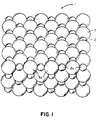
- Figure 1 is a schematic view of a silver bromide crystal structure with the upper layer of ions lying along a ⁇ 100 ⁇ crystallographic face.
- the present invention is based on the discovery that the photographic effect of group VIII 5/6 metal ions associated with radiation sensitive silver halide grains can be dramatically enhanced by positioning the group VIII 5/6 metal ions in adjacent cation positions in the face centered cubic crystal lattice structure of the grains.
- silver chloride and silver bromide form a face centered cubic crystal lattice structure of the rock salt type.
- Figure 1 four lattice planes of a crystal structure 1 of silver ions 2 and bromide ions 3 is shown, where the upper layer of ions lies in a ⁇ 100 ⁇ crystallographic plane.
- the four rows of ions shown counting from the bottom of Figure 1 lie in a ⁇ 100 ⁇ crystallographic plane which perpendicularly intersects the ⁇ 100 ⁇ crystallographic plane occupied by the upper layer of ions.
- the row containing silver ions 2a and bromide ions 3a lies in both intersecting planes.
- each silver ion and each bromide ion lies next adjacent to four bromide ions and four silver ions, respectively.
- each interior silver ion lies next adjacent to six bromide ions, four in the same ⁇ 100 ⁇ crystallographic plane and one on each side of the plane.
- ions in a silver chloride crystal is the same as that shown in Figure 1, except that chloride ions are smaller than bromide ions.
- Silver halide grains in photographic emulsions can be formed of bromide ions as the sole halide, chloride ions as the sole halide, or any mixture of the two. It is also common practice to incorporate minor amounts of iodide ions in photographic silver halide grains. Since chlorine, bromine, and iodine are 3rd, 4th, and 5th period elements, respectively, the iodide ions are larger than the bromide ions.
- iodide ions As much as 40 mole percent of the total halide in a silver bromide cubic crystal lattice structure can be accounted for by iodide ions before silver iodide separates as a separate phase. In photographic emulsions iodide concentrations in silver halide grains seldom exceed 20 mole percent and are typically less than 10 mole percent, based on silver. However, specific applications differ widely in their use of iodide. Silver bromoiodide emulsions are employed in high speed (ASA 100 or greater) camera films, since the presence of iodide allows higher speeds to be realized at any given level of granularity.
- ASA 100 or greater high speed
- Silver bromide emulsions or silver bromoiodide emulsions containing less than 5 mole percent iodide are customarily employed for radiography.
- Emulsions employed for graphic arts and color paper typically contain greater than 50 mole percent, preferably greater than 70 mole percent, and optimally greater than 85 mole percent, chloride, but less than 5 mole percent, preferably less than 2 mole percent, iodide, any balance of the halide not accounted for by chloride or iodide being bromide.
- the present invention is based on the discovery that, when adjacent cation positions of the face centered cubic crystal structure of silver halide grains are occupied by group VIII 5/6 metal ions, they exhibit a disproportionately large effect on photographic performance as compared to that demonstrated by photographic emulsions in which the same group VIII 5/6 metal ions have been similarly introduced, but without any mechanism to achieve adjacent cation lattice placement. While a single pair, on average, of adjacent group VIII 5/6 metal ions incorporated in the crystal lattice of the radiation sensitive grains of an emulsion is effective to enhance photographic performance, it is preferred to incorporate at least five pairs, on average, of adjacent group VIII 5/6 metal ions in the radiation sensitive grains, preferably at least ten pairs, on average.
- Average pair incorporations can be determined merely by dividing half the number of metal ions incorporated by the number of radiation sensitive silver halide grains present in the emulsion. The latter can be determined from a knowledge of mean grain size, grain shape, and the halide and silver content of the emulsion. The actual distribution of group VIII 5/6 metal ions within the grains can be expected to follow a Poisson error function distribution with the mean metal ion incorporation corresponding to the distribution mode.
- the minimum group VIII 5/6 metal ion incorporations per grain satisfying the requirements of this invention are far below the minimum concentration levels of group VIII 5/6 metal ions taught to be effective by the art.
- Smith and Trivelli disclose a minimum concentration of group VIII 5/6 metal coordination complex of 0.8 mg/100 grams of silver.
- the coordination complex concentration in mg/100 grams of silver is still less than a 1/3 the minimum level taught to be effective by Smith and Trivelli.
- group VIII 5/6 metal ions Once a sufficient number of adjacent pairs of group VIII 5/6 metal ions are incorporated into the grains to achieve maximum photographic efficiency, no useful purpose is realized by further increasing the presence of group VIII 5/6 metal ions.
- the present invention does not, however, prevent the inclusion of group VIII 5/6 metal ions, incorporated entirely or only partially as adjacent lattice position pairs, up to the maximum useful concentration levels taught in the art for group VIII 5/6 metal ion incorporation.
- group VIII metal ions from period 5 are incorporated at the concentration limit of Smith and Trivelli, less than approximately 40 mg/100 grams of silver, only elementary calculations are required to observe that there are only about 4 atoms of the period 5 group VIII metal per 10,000 atoms of silver.
- group VIII metal is chosen from period 6, this number is reduced by half to about 2 atoms per 10,000 atoms of silver.
- Smith and Trivelli set out as a preferred maximum less than approximately 20 mg/100 grams of silver, which amounts to only about 2 atoms of group VIII 5 metal or 1 atom of group VIII 6 metal per 10,000 atoms of silver.
- oligomeric hexacoordination complex containing at least two group VIII 5/6 metal atoms.
- polymeric and oligomeric hexacoordination complexes are known having a higher number of group VIII 5/6 metal ions, those oligomers are preferred which contain up to about 20 group VIII 5/6 metal atoms. Specifically preferred are oligomers that contain about 6 to 10 group VIII 5/6 metal atoms.
- the oligomeric coordination complexes contain two or more group VIII 5/6 metal atoms linked by bridging ligands.
- the compound of formula (I) above when dissolved, it dissociates into an anionic hexacoordination complex satisfying the following formula: (II) MX6 wherein M is a group VIII 5/6 atom and X is a halide ligand.
- the six halide ligands are positioned around the group VIII 5/6 metal atom in the same way that the halide ions are positioned around a single silver ion in the face centered crystal lattice structure of Figure 1.
- a corresponding anionic hexacoordination complex containing two group VIII 5/6 metal atoms is represented by the following formula: (III) M2L10 wherein M is as previously defined and L is a halide or other bridging ligand.
- M is as previously defined and L is a halide or other bridging ligand.
- oligomeric anions satisfying the requirements of the invention containing 6, 8 or 10 group VIII 5/6 metal atoms: (V) M6L24 (VI) M8L32 (VII) M10L38 wherein M and L are as previously defined.
- Other oligomeric forms containing 6, 8 or 10 group VIII 5/6 metal atoms are, of course, possible.
- the oligomers are capable of presenting the group VIII metal atoms of the oligomers to the surface of the crystal lattice structure as it is being formed so that adjacent group VIII 5/6 atoms are oriented to occupy adjacent cation sites of the crystal lattice structure.
- group VIII metal atoms employing oligomeric tetracoordination complexes in place of hexacoordination complexes.
- the bridging ligands are capable of forming covalent bonds with two adjacent group VIII 5/6 metal atoms.
- the ligands can be halides, such as fluoride, chloride, bromide, or iodide atoms.
- the ligands are preferably chloride or bromide ligands.
- aquo (H2O) ligands can be substituted for halide ligands.
- Pseudohalogen ligands such as cyanide (CN), cyanate (OCN), thiocyanate (SCN), selenocyanate (SeCN), and tellurocyanate (TeCN) ligands are contemplated.
- Still other ligands such as nitrosyl (NO), thionitrosyl (NS), azide (N3), oxo (O), and carbonyl (CO) ligands are possible.
- ligands other than halide and aquo ligands it must be borne in mind that the ligands can themselves affect photographic performance.
- modifying effects are entirely attributable to the group VIII 5/6 metal ions incorporated.
- aquo ligands have not been reported to produce modifying effects.
- the anionic hexacoordination complexes paired with one or more charge satisfying cations can be introduced as a particulate solid or in solution at any stage of emulsion preparation employing any convenient conventional technique for hexacoordination complex addition-e.g., as taught by Smith and Trivelli, cited above.
- any convenient conventional technique for hexacoordination complex addition e.g., as taught by Smith and Trivelli, cited above.
- the group VIII 5/6 metal can be effectively incorporated by having the complex present while surface ripening of the grains is occurring-i.e., having the complex and one or more ripening agents concurrently present in the emulsion.
- the emulsions can take any convenient conventional form.
- Conventional features of photographic emulsions and photographic elements constructed from these emulsions are summarized in Research Disclosure , Vol. 307, Nov. 1989, Item 307105, pp. 863-885.
- Research Disclosure is published by Kenneth Mason Publications, Ltd., Dudley Annex, 21a North Street, Emsworth, Hampshire PO10 7DQ, England.
- OHCC-1 was prepared by the procedure of N.M. Sinitzyn et al, cited above. This was a solid state thermal polymerization of aquated monomers using thermo-gravimetric analysis (TGA) profile information to establish the desired heat range. The basis of the reaction was to generate proximal coordinatively unsaturated fragments which subsequently dimerize through a pair of mu-2 halide linkages.
- TGA thermo-gravimetric analysis
- a temperature-controlled tube furnace operation at 285°C was used to heat 1.455 g of recrystallized K2IrCl5(H2O) in a quartz tube in air for 45 minutes with observable amounts of water condensing on the cool portions of the tube.
- the resulting green powder (as opposed to the brown starting material) weighed 1.372 g after heating (5.7% wt. loss). This was near the expected value of 4 percent.
- the solid was readily soluble in water to give a solution with an absorbance peak at 404 nm (173 M ⁇ 1cm ⁇ 1) with a high absorbance slope toward 300 nm (545 M ⁇ 1cm ⁇ 1 at 300 nm).
- OHCC-3, -4, -5, and -6 were isolated in yields of from about 0.5 to 3% by wt of iridium by ultrafiltration of impure solutions of K3IrCl6 through UM-20 or YC05 AmiconTM membranes.
- the K3IrCl6 was obtained in the following manner: One gram of IrCl3nH2O and 0.2 g KCl were heated in 20 mL of 0.1 N HCl for 30 minutes. The mixture was then taken to dryness on a rotary evaporator. The dried residue was heated at 160°C for 4 hours. Concentrated HCl (10 mL) was added to the residue and the mixture was refluxed overnight, cooled and diluted with 10 mL distilled water. The solution was adjusted to pH 2 (approx.) with KOH. The precipitated K3IrCl6 was then separated by filtration. The remaining mother liquor was subjected to ultrafiltration with water washes to yield 35 mg of the iridium oligomers. The yellow-brown solution of oligomers were unable to permeate the ultrafiltration membrane while the simple salts and monomeric iridium complexes did.
- a Sephadex G-25TM gel permeation chromatographic separation was used to isolate the individual iridium oligomer components. Careful chromatography using long thin channel-free columns (approx. 400 X 5 mm) loaded to less than 5 mm from the top with saturated aqueous solutions with water elution rates of 0.1 to 1 mL per minute coupled with experienced observation to detect and collect the central parts of the incompletely resolved bands permitted separation. A central "band" in the column consisting of three poorly resolved component bands contained the four iridium oligomers identified above.
- a monodisperse silver bromide octahedral emulsion of 0.28 ⁇ m edge length was prepared by a double-jet precipitation technique. Portions of the emulsion were then chemically sensitized with a variety of iridium complexes by means of the following bromide shelling technique:
- the emulsion was melted at 40°C, the pH adjusted to 6.2, the pBr adjusted to 2.0, and 83 molar parts per million of 1,10-dithia-4,7,13,16-tetraoxacyclooctadecane was added.
- a constant volume of various iridium sensitizers (10 ⁇ 7 to 10 ⁇ 10 M in Ir) or distilled water were added to aliquots of the emulsion, and the emulsions were held for 10 minutes at 40°C.
- a very fine grain, ⁇ 0.05 ⁇ m, silver bromide emulsion was then added in an amount equal to 10 percent of the portion of the aliquots, the pH and pBr were adjusted as above, and the emulsions were held, with constant agitation for 30 minutes at 40°C.
- the chemically sensitized emulsions were then coated on a cellulose triacetate film support at coverages of 1.07 g silver per square meter, and 7.53 g of gelatin per square meter.
- the resulting photographic elements were exposed for 1 second to a 5500°K light source through a graduated density filter and developed for 24 minutes in Kodak Rapid X-RayTM developer, a hydroquinone-N,N-dimethyl- p -aminophenol hemisulfate developer.
- a tabular grain silver bromoiodide (1.5 mole percent iodide) emulsion having a mean equivalent circular diameter of 5.3 ⁇ m and a mean grain thickness of 0.10 ⁇ m (>50% of total grain projected area accounted for by tabular grains) was prepared by a method similar to that described in Example 1 of Solberg et al U.S. Patent 4,433,048.
- a portion of the emulsion was chemically sensitized by adding 10.8 mg of 3-methyl-1,3-benzothiazole iodide, 100 mg of sodium thiocyanate, 200 mg of anhydro-5,5, '-dichloro-3,3'-bis(3-sulfopropyl)thiacyanine hydroxide, 0.5 mg of sodium thiosulfate pentahydrate, and 1.0 mg of potassium tetrachloraurate, per silver mole. The emulsion was then heated to 70°C and digested for 10 minutes.
- a second portion of the emulsion was chemically sensitized in the same manner, except that the sulfur and gold sensitizing reagents were replaced by 5.0 micrograms of OHCC-3.
- the resulting chemically and spectrally sensitized tabular grain emulsions were each coated on cellulose acetate film supports.
- the coating format was an emulsion layer comprising tabular silver bromoiodide grains (1.35 g/m2), gelatin (2.5 g/m2), and the yellow dye-forming coupler ⁇ -pivalyl- ⁇ -[4-(4-hydroxybenzenesulfonyl)phenoxy]-2-chloro-5-( n -hexadecanesulfonamido)acetanilide (0.91 g/m2), a gelatin overcoat layer comprising gelatin (0.54g/m2), and the hardener bis(vinylsulfonylmethyl) ether at a level of 0.5 percent, based on total gelatin.
- the coated photographic elements were evaluated for reciprocity response by giving them a series of calibrated (total energy) exposures ranging from 1/10,000th of a second to 10 seconds, followed by development for 6 minutes in Kodak Rapid X-RayTM developer.
- a threshold speed point was obtained by extrapolating the lower scale of the sensitometric curve and taking as the speed point the point at which the extrapolated line intercepted the minimum density.
- Example 4 When Example 4 was repeated, but using a mixture of OHCC-3 and OHCC-4, similar results were obtained, indicating that satisfactory results can be achieved with mixtures of oligomers. This is important because this allows the oligomer preparation steps to be simplified by omitting oligomer separation and purification steps.
- Example 5 was repeated, but with OHCC-3 and OHCC-4 modified by the substitution of bromide ligands for chloride ligands.
- the photographic response was essentially similar, indicating that bromide and chloride ligands are equally attractive.
Landscapes
- Chemical & Material Sciences (AREA)
- Physics & Mathematics (AREA)
- Chemical Kinetics & Catalysis (AREA)
- Engineering & Computer Science (AREA)
- Materials Engineering (AREA)
- General Physics & Mathematics (AREA)
- Spectroscopy & Molecular Physics (AREA)
- Crystallography & Structural Chemistry (AREA)
- Silver Salt Photography Or Processing Solution Therefor (AREA)
- Processes Of Treating Macromolecular Substances (AREA)
Applications Claiming Priority (2)
| Application Number | Priority Date | Filing Date | Title |
|---|---|---|---|
| US461504 | 1990-01-05 | ||
| US07/461,504 US5024931A (en) | 1990-01-05 | 1990-01-05 | Photographic emulsions sensitized by the introduction of oligomers |
Publications (2)
| Publication Number | Publication Date |
|---|---|
| EP0436249A1 EP0436249A1 (en) | 1991-07-10 |
| EP0436249B1 true EP0436249B1 (en) | 1995-09-13 |
Family
ID=23832821
Family Applications (1)
| Application Number | Title | Priority Date | Filing Date |
|---|---|---|---|
| EP90203321A Expired - Lifetime EP0436249B1 (en) | 1990-01-05 | 1990-12-13 | Photographic emulsions sensitized by the introduction of oligomers |
Country Status (6)
| Country | Link |
|---|---|
| US (1) | US5024931A (enExample) |
| EP (1) | EP0436249B1 (enExample) |
| JP (1) | JPH04211244A (enExample) |
| AT (1) | ATE127941T1 (enExample) |
| CA (1) | CA2018998A1 (enExample) |
| DE (1) | DE69022384T2 (enExample) |
Families Citing this family (5)
| Publication number | Priority date | Publication date | Assignee | Title |
|---|---|---|---|---|
| US5320938A (en) * | 1992-01-27 | 1994-06-14 | Eastman Kodak Company | High chloride tabular grain emulsions and processes for their preparation |
| EP0617317A1 (en) * | 1993-03-22 | 1994-09-28 | Eastman Kodak Company | Oligomer modified tabular grain emulsions |
| DE69517373T2 (de) | 1994-08-26 | 2001-02-08 | Eastman Kodak Co., Rochester | Emulsionen mit ultradünnen tafelförmigen Körnern und Dotierungsmitteln auf ausgewählten Stellen |
| EP0699944B1 (en) | 1994-08-26 | 2000-06-07 | Eastman Kodak Company | Tabular grain emulsions with sensitization enhancements |
| US6162599A (en) * | 1998-01-30 | 2000-12-19 | Agfa-Gevaert, N.V. | Photosensitive image-forming element containing silver halide crystals which are internally modified with a metal ligand complex forming deep electron traps |
Family Cites Families (4)
| Publication number | Priority date | Publication date | Assignee | Title |
|---|---|---|---|---|
| US2448060A (en) * | 1945-08-30 | 1948-08-31 | Eastman Kodak Co | Photographic emulsions sensitized with salts of metals of group viii of the periodicarrangement of the elements |
| US4937180A (en) * | 1988-04-08 | 1990-06-26 | Eastman Kodak Company | Photographic emulsions containing internally modified silver halide grains |
| US4835093A (en) * | 1988-04-08 | 1989-05-30 | Eastman Kodak Company | Internally doped silver halide emulsions |
| US4933272A (en) * | 1988-04-08 | 1990-06-12 | Eastman Kodak Company | Photographic emulsions containing internally modified silver halide grains |
-
1990
- 1990-01-05 US US07/461,504 patent/US5024931A/en not_active Expired - Lifetime
- 1990-06-14 CA CA002018998A patent/CA2018998A1/en not_active Abandoned
- 1990-12-13 AT AT90203321T patent/ATE127941T1/de not_active IP Right Cessation
- 1990-12-13 EP EP90203321A patent/EP0436249B1/en not_active Expired - Lifetime
- 1990-12-13 DE DE69022384T patent/DE69022384T2/de not_active Expired - Fee Related
-
1991
- 1991-01-04 JP JP3052356A patent/JPH04211244A/ja active Pending
Also Published As
| Publication number | Publication date |
|---|---|
| CA2018998A1 (en) | 1991-07-05 |
| DE69022384T2 (de) | 1996-05-15 |
| EP0436249A1 (en) | 1991-07-10 |
| US5024931A (en) | 1991-06-18 |
| ATE127941T1 (de) | 1995-09-15 |
| DE69022384D1 (de) | 1995-10-19 |
| JPH04211244A (ja) | 1992-08-03 |
Similar Documents
| Publication | Publication Date | Title |
|---|---|---|
| EP0336425B1 (en) | Photographic emulsions containing internally modified silver halide grains | |
| EP0336426B1 (en) | Photographic emulsions containing internally modified silver halide grains | |
| EP0336427B1 (en) | Photographic emulsions containing internally modified silver halide grains | |
| US4835093A (en) | Internally doped silver halide emulsions | |
| EP0288949B1 (en) | Process for the preparation of tabular silver chloride emulsions | |
| US5360712A (en) | Internally doped silver halide emulsions and processes for their preparation | |
| US5462849A (en) | Silver halide emulsions with doped epitaxy | |
| US4643966A (en) | Emulsions and photographic elements containing ruffled silver halide grains | |
| EP0560209B1 (en) | Photographic silver halide material comprising novel gold compound | |
| EP0415481B1 (en) | Photographic emulsions containing internally modified silver halide grains | |
| EP0415480B1 (en) | Photographic emulsions containing internally modified silver halide grains | |
| US5024931A (en) | Photographic emulsions sensitized by the introduction of oligomers | |
| EP0809137A1 (en) | Tellurium complexes as chemical sensitizers for silver halides | |
| US5759760A (en) | Aqueous solid particle dispersions in chemical sensitization | |
| JPH05508036A (ja) | ハロゲン化銀中のニトロシルリガンドを有する遷移金属錯体ドーパント及びイリジウムドーパントの組合せ | |
| US4902611A (en) | Preparation of silver halide emulsions containing iridium | |
| GB2316184A (en) | Sensitising silver halide emulsions with palladium compounds | |
| EP0215612B1 (en) | Silver halide photographic emulsions with novel grain faces (5) | |
| EP0568092A2 (en) | Silver halide emulsion sensitized with a heavy metal compound and a thiourea compound | |
| US5558982A (en) | High chloride (100) tabular grain emulsions with modified edge structures | |
| US4335202A (en) | Tetraazaundecane and complexes as sensitizers for silver halide emulsion | |
| DE69900693T2 (de) | Photoempfindliches bilderzeugendes Material, das tafelförmige Silber(iodo)bromidkristalle enthält, die mit einem Metall-Ligandenkomplex dotiert sind, der tiefe Elektronenfallen erzeugt | |
| EP0809138A1 (en) | Xanthate salts as chemical sensitizers for silver halides | |
| EP0709724A2 (en) | Silver halide emulsions with doped epitaxy | |
| Farnell et al. | The Influence of Thallous Ions on the Properties of Silver Halide Emulsions |
Legal Events
| Date | Code | Title | Description |
|---|---|---|---|
| PUAI | Public reference made under article 153(3) epc to a published international application that has entered the european phase |
Free format text: ORIGINAL CODE: 0009012 |
|
| AK | Designated contracting states |
Kind code of ref document: A1 Designated state(s): AT BE CH DE DK ES FR GB GR IT LI LU NL SE |
|
| 17P | Request for examination filed |
Effective date: 19911219 |
|
| 17Q | First examination report despatched |
Effective date: 19941206 |
|
| GRAA | (expected) grant |
Free format text: ORIGINAL CODE: 0009210 |
|
| AK | Designated contracting states |
Kind code of ref document: B1 Designated state(s): AT BE CH DE DK ES FR GB GR IT LI LU NL SE |
|
| PG25 | Lapsed in a contracting state [announced via postgrant information from national office to epo] |
Ref country code: IT Free format text: LAPSE BECAUSE OF FAILURE TO SUBMIT A TRANSLATION OF THE DESCRIPTION OR TO PAY THE FEE WITHIN THE PRESCRIBED TIME-LIMIT;WARNING: LAPSES OF ITALIAN PATENTS WITH EFFECTIVE DATE BEFORE 2007 MAY HAVE OCCURRED AT ANY TIME BEFORE 2007. THE CORRECT EFFECTIVE DATE MAY BE DIFFERENT FROM THE ONE RECORDED. Effective date: 19950913 Ref country code: AT Effective date: 19950913 Ref country code: BE Effective date: 19950913 Ref country code: ES Free format text: THE PATENT HAS BEEN ANNULLED BY A DECISION OF A NATIONAL AUTHORITY Effective date: 19950913 Ref country code: GR Free format text: LAPSE BECAUSE OF FAILURE TO SUBMIT A TRANSLATION OF THE DESCRIPTION OR TO PAY THE FEE WITHIN THE PRESCRIBED TIME-LIMIT Effective date: 19950913 Ref country code: DK Effective date: 19950913 Ref country code: NL Free format text: LAPSE BECAUSE OF NON-PAYMENT OF DUE FEES Effective date: 19950913 |
|
| REF | Corresponds to: |
Ref document number: 127941 Country of ref document: AT Date of ref document: 19950915 Kind code of ref document: T |
|
| REF | Corresponds to: |
Ref document number: 69022384 Country of ref document: DE Date of ref document: 19951019 |
|
| PG25 | Lapsed in a contracting state [announced via postgrant information from national office to epo] |
Ref country code: SE Effective date: 19951213 |
|
| ET | Fr: translation filed | ||
| PG25 | Lapsed in a contracting state [announced via postgrant information from national office to epo] |
Ref country code: LU Free format text: LAPSE BECAUSE OF NON-PAYMENT OF DUE FEES Effective date: 19951231 |
|
| PGFP | Annual fee paid to national office [announced via postgrant information from national office to epo] |
Ref country code: CH Payment date: 19951231 Year of fee payment: 6 |
|
| REG | Reference to a national code |
Ref country code: CH Ref legal event code: PL |
|
| NLV1 | Nl: lapsed or annulled due to failure to fulfill the requirements of art. 29p and 29m of the patents act | ||
| PLBE | No opposition filed within time limit |
Free format text: ORIGINAL CODE: 0009261 |
|
| STAA | Information on the status of an ep patent application or granted ep patent |
Free format text: STATUS: NO OPPOSITION FILED WITHIN TIME LIMIT |
|
| 26N | No opposition filed | ||
| PG25 | Lapsed in a contracting state [announced via postgrant information from national office to epo] |
Ref country code: LI Free format text: LAPSE BECAUSE OF FAILURE TO SUBMIT A TRANSLATION OF THE DESCRIPTION OR TO PAY THE FEE WITHIN THE PRESCRIBED TIME-LIMIT Effective date: 19961231 Ref country code: CH Free format text: LAPSE BECAUSE OF FAILURE TO SUBMIT A TRANSLATION OF THE DESCRIPTION OR TO PAY THE FEE WITHIN THE PRESCRIBED TIME-LIMIT Effective date: 19961231 |
|
| REG | Reference to a national code |
Ref country code: GB Ref legal event code: IF02 |
|
| PGFP | Annual fee paid to national office [announced via postgrant information from national office to epo] |
Ref country code: GB Payment date: 20041104 Year of fee payment: 15 |
|
| PGFP | Annual fee paid to national office [announced via postgrant information from national office to epo] |
Ref country code: FR Payment date: 20041201 Year of fee payment: 15 |
|
| PGFP | Annual fee paid to national office [announced via postgrant information from national office to epo] |
Ref country code: DE Payment date: 20041230 Year of fee payment: 15 |
|
| PG25 | Lapsed in a contracting state [announced via postgrant information from national office to epo] |
Ref country code: GB Free format text: LAPSE BECAUSE OF NON-PAYMENT OF DUE FEES Effective date: 20051213 |
|
| PG25 | Lapsed in a contracting state [announced via postgrant information from national office to epo] |
Ref country code: DE Free format text: LAPSE BECAUSE OF NON-PAYMENT OF DUE FEES Effective date: 20060701 |
|
| GBPC | Gb: european patent ceased through non-payment of renewal fee |
Effective date: 20051213 |
|
| PG25 | Lapsed in a contracting state [announced via postgrant information from national office to epo] |
Ref country code: FR Free format text: LAPSE BECAUSE OF NON-PAYMENT OF DUE FEES Effective date: 20060831 |
|
| REG | Reference to a national code |
Ref country code: FR Ref legal event code: ST Effective date: 20060831 |