EP0430516A2 - Periodische Gruppe mit einem fast idealen Elementendiagramm - Google Patents
Periodische Gruppe mit einem fast idealen Elementendiagramm Download PDFInfo
- Publication number
- EP0430516A2 EP0430516A2 EP90312521A EP90312521A EP0430516A2 EP 0430516 A2 EP0430516 A2 EP 0430516A2 EP 90312521 A EP90312521 A EP 90312521A EP 90312521 A EP90312521 A EP 90312521A EP 0430516 A2 EP0430516 A2 EP 0430516A2
- Authority
- EP
- European Patent Office
- Prior art keywords
- waveguide
- waveguides
- waveguide array
- predetermined
- array
- Prior art date
- Legal status (The legal status is an assumption and is not a legal conclusion. Google has not performed a legal analysis and makes no representation as to the accuracy of the status listed.)
- Granted
Links
Images
Classifications
-
- H—ELECTRICITY
- H01—ELECTRIC ELEMENTS
- H01P—WAVEGUIDES; RESONATORS, LINES, OR OTHER DEVICES OF THE WAVEGUIDE TYPE
- H01P3/00—Waveguides; Transmission lines of the waveguide type
- H01P3/20—Quasi-optical arrangements for guiding a wave, e.g. focusing by dielectric lenses
-
- H—ELECTRICITY
- H01—ELECTRIC ELEMENTS
- H01Q—ANTENNAS, i.e. RADIO AERIALS
- H01Q25/00—Antennas or antenna systems providing at least two radiating patterns
- H01Q25/04—Multimode antennas
-
- H—ELECTRICITY
- H01—ELECTRIC ELEMENTS
- H01Q—ANTENNAS, i.e. RADIO AERIALS
- H01Q21/00—Antenna arrays or systems
- H01Q21/06—Arrays of individually energised antenna units similarly polarised and spaced apart
- H01Q21/061—Two dimensional planar arrays
- H01Q21/064—Two dimensional planar arrays using horn or slot aerials
Definitions
- This invention relates to waveguides, and more particularly, a technique for maximinng the efficiency of an array of waveguides.
- Waveguide arrays are used in a wide variety of applications such as phased array antennas and optical star couplers.
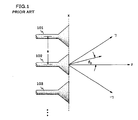
- FIG. 1 shows one such waveguide array comprising three waveguides 101-103 directed into the x-z plane as shown. The waveguides are separated by a distance "a" between the central axis of adjacent waveguides, as shown.
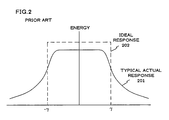
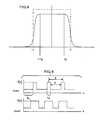
- a figure of merit for such a waveguide array is the radiated power density P( ⁇ ) as a function of ⁇ , the angle from the z-axis. This is measured by exciting one of the waveguides in the array, i.e. waveguide 102, with the fundamental input mode of the waveguide, and then measuring the radiated pattern. Ideally, it is desired to produce a uniform power distribution as shown in ideal response 202 of FIG.
- phased array antenna The operation of a prior art phased array antenna can be described as follows.
- the input to each waveguide of FIG. 1 is excited with the fundamental mode of the input waveguides.
- the signal supplied to each waveguide is initially uncoupled from the signals supplied to the other waveguides and at a separate phase, such that a constant phase difference ⁇ is produced between adjacent waveguides.
- waveguide 101 could be excited with a signal at zero phase, waveguide 102 with the same signal, at 5° phase, waveguide 103 with the same signal at 10° phase, and so forth for the remaining waveguides in the array (not shown). This would imply a phase difference of 5° between any two adjacent waveguides.
- the input wave produced by this excitation is known as the fundamental Bloch mode, or linear phase progression excitation.
- the direction of ⁇ 0, and consequently of all the other plane waves emanating from the waveguide array, can be adjusted by adjusting the phase difference ⁇ between the inputs to adjacent elements. It can be shown that the fraction of the power radiated at direction ⁇ 0 when the inputs are excited in a linear phase progression is N( ⁇ ), defined previously herein for the case of excitation of only one of the waveguides with the fundamental mode.
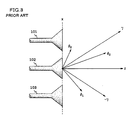
- the fractional radiated power outside the central Brillouin zone of FIG. 2, or equivalently, the percentage of the power radiated in directions other than ⁇ 0 in FIG. 3, should be minimized in order to maximize performance.
- false detection could result from the power radiated in directions other than ⁇ 0.
- the wavefront in the direction ⁇ 1 of FIG. 3 comprises most of the unwanted power.
- the problem that remains in the prior art is to provide a waveguide array which, when excited with a Bloch mode, can confine a large portion of its radiated power to the direction ⁇ 0 without using a large number of waveguides. Equivalently, the problem is to provide a waveguide array such that when one waveguide is excited with the fundamental mode, a large portion of the radiated power will be uniformly distributed over the central Brillouin zone.
- the foregoing problem in the prior art has been solved in accordance with the present invention which relates to a highly efficient waveguide array formed by shaping each of the waveguides in an appropriate manner, or equivalently, aligning the waveguides in accordance with a predetermined pattern.
- the predetermined shape or alignment serves to gradually increase the coupling between each waveguide and the adjacent waveguides as the wave propagates through the waveguide array towards the radiating end of the array. The efficiency is maintained regardless of waveguide spacing.
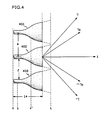
- FIG. 4 shows a waveguide array in accordance with the present invention comprising three waveguides 401-403.
- a ⁇ 0 is chosen, and represents some field of view within the central Brillouin zone over which it is desired to maximize performance.
- the choice of ⁇ 0 will effect the level to which performance can be maximized.
- FIG. 5 shows the response curve of FIG. 2, with an exemplary choice of ⁇ 0. Assuming ⁇ 0 has been chosen, the design of the array is more fully described below.
- the energy in each waveguide is gradually coupled with the energy in the other waveguides.
- This coupling produces a plane wave in a specified direction which is based on the phase difference of the input signals.
- the gradual transition from uncoupled signals to a plane wave also causes unwanted higher order Bloch modes to be generated in the waveguide array, and each unwanted mode produces a plane wave in an undesired direction.
- the directions of these unwanted modes are specified by Equation (2) above.
- These unwanted plane waves, called space harmonics reduce the power in the desired direction.
- the efficiency of the waveguide my is substantially maximized by recognizing that most of the energy radiated in the unwanted directions is radiated in the direction of ⁇ 1.
- the design philosophy is to minimize the energy transferred from the fundamental Bloch mode to the first higher order Bloch mode, denoted the first unwanted mode, as the energy propagates through the waveguide my. This is accomplished by taking advantage of the difference in propagation constants of the fundamental mode and the first unwanted mode.
- each waveguide shown in FIG. 4
- the gradual taper in each waveguide can be viewed as an infinite series of infinitely small discontinuities, each of which causes some energy to be transferred from the fundamental mode to the first unwanted mode.
- the energy transferred from the fundamental mode to the first unwanted mode by each discontinuity will reach the aperture end of the waveguide array at a different phase.
- the waveguide taper should be designed such that the phase of the energy shifted into the first unwanted mode by the different discontinuities is essentially uniformly distributed between zero and 2 ⁇ . If the foregoing condition is satisfied, all the energy in the first unwanted mode will destructively interfere. The design procedure for the taper is more fully described below.
- each of the graphs of FIG. 6 is defined herein as a refractive-space profile of the waveguide array.
- the designations n1 and n2 in FIG. 6 represent the index of refraction between waveguides and within waveguides respectively.
- each plot is a periodic square wave with amplitude proportional to the square of the index of refraction at the particular point in question along the x axis.
- Specifying the shape of these plots at various closely spaced points along the z-axis uniquely determines the shape of the waveguides to be used.
- the problem reduces to one of specifying the plots of FIG. 6 at small intervals along the length of the waveguide. The closer the spacing of the intervals, the more accurate the design. In practical applications, fifty or more such plots, equally spaced, will suffice.
- V(z) the coefficient of the lowest order Fourier term
- V(z) is of interest for the following reasons:
- the phase difference v between the first unwanted mode produced by the aperture of the waveguide array and the first unwanted mode produced by a section dz located at some arbitrary point along the waveguide array is ⁇ (B0 - B1)dz. (4) where the integral is taken over the distance from the arbitrary point to the array aperture, and B0 and B1 are the propagation constants of the fundamental and first unwanted mode respectively.
- Equation 12 can be utilized to specify l(z) at various points along the z axis and thereby define the shape of the waveguides.
- equation (3) becomes where a x is the spacing between waveguide centers in the x direction, and a y is the spacing between waveguide centers in the y direction.
- V 1,0 the first order Fourier coefficient in the x direction.
- this coefficient is calculated by using a two-dimensional Fourier transform.
- the method set forth previously can be utilized to maximize the efficiency in the x direction.
- a x in the left side of equation (14) can be replaced by a y , the spacing between waveguide centers in the second dimension, and the same methods applied to the second dimension.
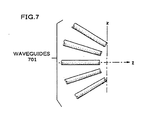
- the waveguides need not be aligned in perpendicular rows and columns of the x,y plane. Rather, they may be aligned in several rows which are offset from one another or in any planar pattern. However, in that case, the exponent of the two-dimensional Fourier series of equation (14) would be calculated in a slightly different manner in order to account for the angle between the x and y axes. Techniques for calculating a two-dimensional Fourier series when the basis is not two perpendicular vectors are well-known in the art and can be used to practice this invention.
Landscapes
- Variable-Direction Aerials And Aerial Arrays (AREA)
- Optical Integrated Circuits (AREA)
- Optical Fibers, Optical Fiber Cores, And Optical Fiber Bundles (AREA)
- Optical Communication System (AREA)
- Light Guides In General And Applications Therefor (AREA)
- Control Of Motors That Do Not Use Commutators (AREA)
Applications Claiming Priority (2)
| Application Number | Priority Date | Filing Date | Title |
|---|---|---|---|
| US07/440,825 US5039993A (en) | 1989-11-24 | 1989-11-24 | Periodic array with a nearly ideal element pattern |
| US440825 | 1989-11-24 |
Publications (3)
| Publication Number | Publication Date |
|---|---|
| EP0430516A2 true EP0430516A2 (de) | 1991-06-05 |
| EP0430516A3 EP0430516A3 (en) | 1991-12-18 |
| EP0430516B1 EP0430516B1 (de) | 1997-08-20 |
Family
ID=23750330
Family Applications (1)
| Application Number | Title | Priority Date | Filing Date |
|---|---|---|---|
| EP90312521A Expired - Lifetime EP0430516B1 (de) | 1989-11-24 | 1990-11-16 | Periodische Gruppe mit einem fast idealen Elementendiagramm |
Country Status (6)
| Country | Link |
|---|---|
| US (1) | US5039993A (de) |
| EP (1) | EP0430516B1 (de) |
| JP (1) | JPH03201705A (de) |
| KR (1) | KR940002994B1 (de) |
| CA (1) | CA2030640C (de) |
| DE (1) | DE69031299T2 (de) |
Families Citing this family (31)
| Publication number | Priority date | Publication date | Assignee | Title |
|---|---|---|---|---|
| US5136671A (en) * | 1991-08-21 | 1992-08-04 | At&T Bell Laboratories | Optical switch, multiplexer, and demultiplexer |
| US5412744A (en) * | 1994-05-02 | 1995-05-02 | At&T Corp. | Frequency routing device having a wide and substantially flat passband |
| US5467418A (en) * | 1994-09-02 | 1995-11-14 | At&T Ipm Corp. | Frequency routing device having a spatially filtered optical grating for providing an increased passband width |
| US5926298A (en) * | 1996-08-30 | 1999-07-20 | Lucent Technologies Inc. | Optical multiplexer/demultiplexer having a broadcast port |
| CN1179348C (zh) * | 1996-11-07 | 2004-12-08 | 皇家菲利浦电子有限公司 | 比特流信号的数据处理 |
| US6016375A (en) * | 1997-01-08 | 2000-01-18 | Hill; Kenneth O. | Wavelength selective fiber to fiber optical tap |
| US6049644A (en) * | 1997-05-13 | 2000-04-11 | Lucent Technologies Inc. | Optical routing device having a substantially flat passband |
| US5889906A (en) * | 1997-05-28 | 1999-03-30 | Lucent Technologies Inc. | Signal router with coupling of multiple waveguide modes for provicing a shaped multi-channel radiation pattern |
| US6043791A (en) * | 1998-04-27 | 2000-03-28 | Sensis Corporation | Limited scan phased array antenna |
| US6211837B1 (en) * | 1999-03-10 | 2001-04-03 | Raytheon Company | Dual-window high-power conical horn antenna |
| US6553165B1 (en) | 2000-07-14 | 2003-04-22 | Applied Wdm, Inc. | Optical waveguide gratings |
| US6434303B1 (en) | 2000-07-14 | 2002-08-13 | Applied Wdm Inc. | Optical waveguide slab structures |
| US6493487B1 (en) | 2000-07-14 | 2002-12-10 | Applied Wdm, Inc. | Optical waveguide transmission devices |
| US6563997B1 (en) | 2000-11-28 | 2003-05-13 | Lighteross, Inc. | Formation of a surface on an optical component |
| US6596185B2 (en) | 2000-11-28 | 2003-07-22 | Lightcross, Inc. | Formation of optical components on a substrate |
| US7113704B1 (en) | 2000-11-28 | 2006-09-26 | Kotura, Inc. | Tunable add/drop node for optical network |
| US6823096B2 (en) * | 2001-01-05 | 2004-11-23 | Lucent Technologies Inc. | Broadband optical switching arrangements with very low crosstalk |
| US6792180B1 (en) | 2001-03-20 | 2004-09-14 | Kotura, Inc. | Optical component having flat top output |
| US20020158047A1 (en) * | 2001-04-27 | 2002-10-31 | Yiqiong Wang | Formation of an optical component having smooth sidewalls |
| US20020158046A1 (en) * | 2001-04-27 | 2002-10-31 | Chi Wu | Formation of an optical component |
| US6853773B2 (en) * | 2001-04-30 | 2005-02-08 | Kotusa, Inc. | Tunable filter |
| US6614965B2 (en) | 2001-05-11 | 2003-09-02 | Lightcross, Inc. | Efficient coupling of optical fiber to optical component |
| US20020181869A1 (en) * | 2001-06-01 | 2002-12-05 | Wenhua Lin | Tunable dispersion compensator |
| US6674929B2 (en) | 2001-06-01 | 2004-01-06 | Lightcross, Inc. | Tunable optical filter |
| US20030012537A1 (en) * | 2001-07-11 | 2003-01-16 | Chi Wu | Method of forming an optical component |
| US6614951B2 (en) | 2001-08-06 | 2003-09-02 | Lightcross, Inc. | Optical component having a flat top output |
| US6853797B2 (en) * | 2001-11-05 | 2005-02-08 | Kotura, Inc. | Compact optical equalizer |
| US20030091291A1 (en) * | 2001-11-15 | 2003-05-15 | Sam Keo | Smoothing facets on an optical component |
| US6714704B2 (en) | 2001-11-29 | 2004-03-30 | Lightcross, Inc. | Optical component having selected bandwidth |
| US6810168B1 (en) | 2002-05-30 | 2004-10-26 | Kotura, Inc. | Tunable add/drop node |
| US6885795B1 (en) | 2002-05-31 | 2005-04-26 | Kotusa, Inc. | Waveguide tap monitor |
Family Cites Families (14)
| Publication number | Priority date | Publication date | Assignee | Title |
|---|---|---|---|---|
| USRE23051E (en) * | 1948-11-23 | Broadcast antenna | ||
| US2920322A (en) * | 1956-08-28 | 1960-01-05 | Jr Burton P Brown | Antenna system |
| US3243713A (en) * | 1962-12-31 | 1966-03-29 | United Aircraft Corp | Integrated magneto-hydrodynamic generator-radio frequency generator |
| JPS4859754A (de) * | 1971-11-25 | 1973-08-22 | ||
| US3977006A (en) * | 1975-05-12 | 1976-08-24 | Cutler-Hammer, Inc. | Compensated traveling wave slotted waveguide feed for cophasal arrays |
| JPS5344151A (en) * | 1976-10-04 | 1978-04-20 | Mitsubishi Electric Corp | Horn-type antenna |
| GB1562904A (en) * | 1977-06-15 | 1980-03-19 | Marconi Co Ltd | Horns |
| US4259674A (en) * | 1979-10-24 | 1981-03-31 | Bell Laboratories | Phased array antenna arrangement with filtering to reduce grating lobes |
| US4369413A (en) * | 1981-02-03 | 1983-01-18 | The United States Of America As Represented By The Secretary Of The Navy | Integrated dual taper waveguide expansion joint |
| FR2518826A1 (fr) * | 1981-12-18 | 1983-06-24 | Thomson Csf | Cornet rayonnant monomode hyperfrequence |
| US4878059A (en) * | 1983-08-19 | 1989-10-31 | Spatial Communications, Inc. | Farfield/nearfield transmission/reception antenna |
| JPS60196003A (ja) * | 1984-03-19 | 1985-10-04 | Nippon Telegr & Teleph Corp <Ntt> | 低サイドロ−ブマルチビ−ムアンテナ |
| US4737004A (en) * | 1985-10-03 | 1988-04-12 | American Telephone And Telegraph Company, At&T Bell Laboratories | Expanded end optical fiber and associated coupling arrangements |
| JP2585268B2 (ja) * | 1987-05-15 | 1997-02-26 | 株式会社東芝 | 反射鏡アンテナ |
-
1989
- 1989-11-24 US US07/440,825 patent/US5039993A/en not_active Expired - Lifetime
-
1990
- 1990-11-16 DE DE69031299T patent/DE69031299T2/de not_active Expired - Fee Related
- 1990-11-16 EP EP90312521A patent/EP0430516B1/de not_active Expired - Lifetime
- 1990-11-22 JP JP2320534A patent/JPH03201705A/ja active Pending
- 1990-11-22 CA CA002030640A patent/CA2030640C/en not_active Expired - Fee Related
- 1990-11-23 KR KR1019900019060A patent/KR940002994B1/ko not_active Expired - Fee Related
Also Published As
| Publication number | Publication date |
|---|---|
| KR940002994B1 (ko) | 1994-04-09 |
| DE69031299T2 (de) | 1997-12-18 |
| US5039993A (en) | 1991-08-13 |
| EP0430516B1 (de) | 1997-08-20 |
| CA2030640C (en) | 1995-01-17 |
| CA2030640A1 (en) | 1991-05-25 |
| JPH03201705A (ja) | 1991-09-03 |
| DE69031299D1 (de) | 1997-09-25 |
| EP0430516A3 (en) | 1991-12-18 |
| KR910010769A (ko) | 1991-06-29 |
Similar Documents
| Publication | Publication Date | Title |
|---|---|---|
| US5039993A (en) | Periodic array with a nearly ideal element pattern | |
| EP0563067B1 (de) | Optische anordnung | |
| Yeh et al. | The essence of dielectric waveguides | |
| US5002350A (en) | Optical multiplexer/demultiplexer | |
| Rahman et al. | Analysis of optical waveguide discontinuities | |
| Chiou et al. | Analysis of optical waveguide discontinuities using the Padé approximants | |
| US4091387A (en) | Beam forming network | |
| EP0308502B1 (de) | Ideal verteilte bragg-reflektoren und resonatoren | |
| Skobelev et al. | Optimum geometry and performance of a dual-mode horn modification | |
| Yoneta et al. | Combination of beam propagation method and finite element method for optical beam propagation analysis | |
| Bird | Mode matching analysis of arrays of stepped rectangular horns and application to satellite antenna design | |
| Kalhor et al. | Scattering of waves by gratings of conducting cylinders | |
| Makeev et al. | Analysis and optimization of an array of miltimode plane waveguides excited by TM waves in order to form sectorial partial directional patterns | |
| Encinar | Analysis and CAD techniques for periodic leaky‐wave printed antennas: Numerical and experimental results | |
| Provalov et al. | Investigations of the fields in a bounded planar dielectric waveguide | |
| Dubost et al. | Propagation along two radiating coupled waveguides: Applications to a multimode radiating array | |
| Sammut et al. | Graded monomode fibres and planar waveguides | |
| Miyanaga et al. | Intensity profiles of outgoing beams from tapered grating couplers | |
| Checcacci et al. | Modes and instabilities of modes of the flat-roof open resonator | |
| Shishegar et al. | A hybrid analysis method for planar lens-like structures | |
| Vorobjov et al. | A quasioptical directional coupler on diffraction-coupled transmission lines | |
| Vzyatyshev et al. | Dielectric waveguides and waveguide devices for microwave applications | |
| Granet et al. | New method for analysis of constrained metal plate lens | |
| Kryzhanovsky et al. | Resonant Properties of the Structure" Planar Dielectric Waveguide-Comb" | |
| Kusano et al. | Bending loss formulas for step‐index optical fiber and their applicable regions |
Legal Events
| Date | Code | Title | Description |
|---|---|---|---|
| PUAI | Public reference made under article 153(3) epc to a published international application that has entered the european phase |
Free format text: ORIGINAL CODE: 0009012 |
|
| AK | Designated contracting states |
Kind code of ref document: A2 Designated state(s): DE GB IT NL |
|
| PUAL | Search report despatched |
Free format text: ORIGINAL CODE: 0009013 |
|
| AK | Designated contracting states |
Kind code of ref document: A3 Designated state(s): DE GB IT NL |
|
| 17P | Request for examination filed |
Effective date: 19920610 |
|
| 17Q | First examination report despatched |
Effective date: 19940422 |
|
| RAP3 | Party data changed (applicant data changed or rights of an application transferred) |
Owner name: AT&T CORP. |
|
| GRAG | Despatch of communication of intention to grant |
Free format text: ORIGINAL CODE: EPIDOS AGRA |
|
| GRAH | Despatch of communication of intention to grant a patent |
Free format text: ORIGINAL CODE: EPIDOS IGRA |
|
| GRAH | Despatch of communication of intention to grant a patent |
Free format text: ORIGINAL CODE: EPIDOS IGRA |
|
| GRAA | (expected) grant |
Free format text: ORIGINAL CODE: 0009210 |
|
| AK | Designated contracting states |
Kind code of ref document: B1 Designated state(s): DE GB IT NL |
|
| ITF | It: translation for a ep patent filed | ||
| REF | Corresponds to: |
Ref document number: 69031299 Country of ref document: DE Date of ref document: 19970925 |
|
| PLBE | No opposition filed within time limit |
Free format text: ORIGINAL CODE: 0009261 |
|
| STAA | Information on the status of an ep patent application or granted ep patent |
Free format text: STATUS: NO OPPOSITION FILED WITHIN TIME LIMIT |
|
| 26N | No opposition filed | ||
| PGFP | Annual fee paid to national office [announced via postgrant information from national office to epo] |
Ref country code: GB Payment date: 19991026 Year of fee payment: 10 |
|
| PGFP | Annual fee paid to national office [announced via postgrant information from national office to epo] |
Ref country code: NL Payment date: 19991027 Year of fee payment: 10 |
|
| PGFP | Annual fee paid to national office [announced via postgrant information from national office to epo] |
Ref country code: DE Payment date: 19991231 Year of fee payment: 10 |
|
| PG25 | Lapsed in a contracting state [announced via postgrant information from national office to epo] |
Ref country code: GB Free format text: LAPSE BECAUSE OF NON-PAYMENT OF DUE FEES Effective date: 20001116 |
|
| PG25 | Lapsed in a contracting state [announced via postgrant information from national office to epo] |
Ref country code: NL Free format text: LAPSE BECAUSE OF NON-PAYMENT OF DUE FEES Effective date: 20010601 |
|
| GBPC | Gb: european patent ceased through non-payment of renewal fee |
Effective date: 20001116 |
|
| NLV4 | Nl: lapsed or anulled due to non-payment of the annual fee |
Effective date: 20010601 |
|
| PG25 | Lapsed in a contracting state [announced via postgrant information from national office to epo] |
Ref country code: DE Free format text: LAPSE BECAUSE OF NON-PAYMENT OF DUE FEES Effective date: 20010801 |
|
| PG25 | Lapsed in a contracting state [announced via postgrant information from national office to epo] |
Ref country code: IT Free format text: LAPSE BECAUSE OF NON-PAYMENT OF DUE FEES;WARNING: LAPSES OF ITALIAN PATENTS WITH EFFECTIVE DATE BEFORE 2007 MAY HAVE OCCURRED AT ANY TIME BEFORE 2007. THE CORRECT EFFECTIVE DATE MAY BE DIFFERENT FROM THE ONE RECORDED. Effective date: 20051116 |