EP0425158A1 - Starter motor for an internal combustion engine - Google Patents
Starter motor for an internal combustion engine Download PDFInfo
- Publication number
- EP0425158A1 EP0425158A1 EP90311288A EP90311288A EP0425158A1 EP 0425158 A1 EP0425158 A1 EP 0425158A1 EP 90311288 A EP90311288 A EP 90311288A EP 90311288 A EP90311288 A EP 90311288A EP 0425158 A1 EP0425158 A1 EP 0425158A1
- Authority
- EP
- European Patent Office
- Prior art keywords
- assembly
- abutments
- resilient element
- solenoid
- starter motor
- Prior art date
- Legal status (The legal status is an assumption and is not a legal conclusion. Google has not performed a legal analysis and makes no representation as to the accuracy of the status listed.)
- Withdrawn
Links
- 239000007858 starting material Substances 0.000 title claims abstract description 30
- 238000002485 combustion reaction Methods 0.000 title claims abstract description 5
- 238000004804 winding Methods 0.000 claims description 6
- 239000002184 metal Substances 0.000 claims description 3
- 238000010276 construction Methods 0.000 description 7
- 230000009471 action Effects 0.000 description 3
- 230000000712 assembly Effects 0.000 description 3
- 238000000429 assembly Methods 0.000 description 3
- 239000000463 material Substances 0.000 description 3
- 229910001209 Low-carbon steel Inorganic materials 0.000 description 2
- 229910000639 Spring steel Inorganic materials 0.000 description 2
- 238000005452 bending Methods 0.000 description 2
- 238000011065 in-situ storage Methods 0.000 description 2
- 230000009467 reduction Effects 0.000 description 2
- 229920003002 synthetic resin Polymers 0.000 description 2
- 239000000057 synthetic resin Substances 0.000 description 2
- 239000004677 Nylon Substances 0.000 description 1
- 229910000831 Steel Inorganic materials 0.000 description 1
- 239000002131 composite material Substances 0.000 description 1
- 230000008878 coupling Effects 0.000 description 1
- 238000010168 coupling process Methods 0.000 description 1
- 238000005859 coupling reaction Methods 0.000 description 1
- 230000001815 facial effect Effects 0.000 description 1
- 239000011521 glass Substances 0.000 description 1
- 230000004048 modification Effects 0.000 description 1
- 238000012986 modification Methods 0.000 description 1
- 229920001778 nylon Polymers 0.000 description 1
- 230000036316 preload Effects 0.000 description 1
- 238000005086 pumping Methods 0.000 description 1
- 239000012858 resilient material Substances 0.000 description 1
- 230000000717 retained effect Effects 0.000 description 1
- 239000010959 steel Substances 0.000 description 1
Images


Classifications
-
- F—MECHANICAL ENGINEERING; LIGHTING; HEATING; WEAPONS; BLASTING
- F02—COMBUSTION ENGINES; HOT-GAS OR COMBUSTION-PRODUCT ENGINE PLANTS
- F02N—STARTING OF COMBUSTION ENGINES; STARTING AIDS FOR SUCH ENGINES, NOT OTHERWISE PROVIDED FOR
- F02N15/00—Other power-operated starting apparatus; Component parts, details, or accessories, not provided for in, or of interest apart from groups F02N5/00 - F02N13/00
- F02N15/02—Gearing between starting-engines and started engines; Engagement or disengagement thereof
- F02N15/04—Gearing between starting-engines and started engines; Engagement or disengagement thereof the gearing including disengaging toothed gears
- F02N15/06—Gearing between starting-engines and started engines; Engagement or disengagement thereof the gearing including disengaging toothed gears the toothed gears being moved by axial displacement
- F02N15/067—Gearing between starting-engines and started engines; Engagement or disengagement thereof the gearing including disengaging toothed gears the toothed gears being moved by axial displacement the starter comprising an electro-magnetically actuated lever
Definitions
- This invention relates to a starter motor for an internal combustion engine, and to a lever assembly for transmitting movement from the solenoid to the pinion assembly of such a starter motor.
- a "pre-engaged" starter motor the axially moveable pinion assembly of the starter motor is moved along its driving shaft from a rest position to a position in which the pinion gear wheel of the assembly can mesh with the ring gear of the engine to be started, by movement of the axially movable armature of a solenoid.
- the solenoid armature is coupled to the pinion assembly by a lever arrangement and within the coupling between the solenoid armature and the pinion assembly it is necessary to provide for "lost-motion" so that in the event that the pinion gear wheel meets the engine ring gear in tooth-to-tooth abutment, the solenoid armature can still move to close the starter motor energizing switch contacts even though the pinion assembly is held against further movement. It has previously been proposed to provide the "lost-motion" by flexure of the lever arrangement which couples the solenoid armature to the pinion assembly.
- French Patent Specification 1424804 shows, in Figure 5, an arrangement wherein the solenoid armature is coupled to the starter motor pinion assembly by means of a composite lever, that it to say a lever incorporating more than one element.
- the lever of Figure 5 of French Specification 1424804 has its individual elements secured together by means of a rivet at their midpoint. Such an construction is inherently disadvantageous since the operation of producing a hole, and introducing a rivet, inevitability weakens the lever construction and produces a region at which the lever may fracture in use. Nevertheless the concept shown in Figure 5 of French Specification 1424804 is interesting since it would be possible, by judicious construction of the individual elements of the lever, to permit a pre-loading to be built into the lever during its construction.
- a starter motor for use with an internal combustion engine, comprising an electric motor, an axially movable pinion assembly rotatable by said motor, a solenoid spaced from the pinion assembly axis and including an armature moveable from a rest position towards an operative position by energization of an electromagnet winding of the solenoid, and, a lever assembly mounted for pivotal movement about an axis passing between the axes of said solenoid and said pinion assembly, said lever assembly linking the armature of said solenoid and said pinion assembly such that movement of the armature is transmitted to the pinion assembly to move the pinion assembly axially from a rest position towards an operative position, said lever assembly comprising a rigid element supported for pivotal movement about said axis, and a resilient element carried by said rigid element and coupled at one end to said armature, the end of the lever assembly remote from said solenoid cooperating with said pinion assembly for moving said pinion assembly axially,
- said third abutment is defined by a transversely extending pin whereby the lever assembly is mounted for pivotal movement about said axis.
- the position of at least one of said first and second abutments in relation to the position of the other abutments is adjustable.
- the end of the lever assembly remote from said solenoid cooperates with said pinion assembly by way of the other end of said resilient element.
- the rigid element is a sheet metal pressing.
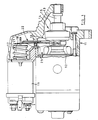
- the starter motor is, with the exception of the lever assembly, of a generally conventional form comprising a housing 11 containing a d.c., permanent magnet field, electric motor 12, the rotor shaft 13 of which carries a pinion assembly 14.
- the pinion assembly 14 comprises a pinion gear wheel 15 which is mounted on the shaft 13 for both rotational and axial movement relative to the shaft 13, and a unidirectional roller clutch 16 the input member of which is axially moveable on the shaft 13 by way of a splined connection.
- the pinion gear wheel 15 is coupled to the output member of the clutch 16 and thus rotation of the shaft 13 in one direction is transmitted to the pinion gear wheel 15 by the clutch 16.
- the pinion assembly 14 is moveable axially on the shaft 13 from a rest position (as shown in Figure 1) to an operative position in which, in use, the pinion gear wheel 15 meshes with the ring gear of an engine to be started.
- a solenoid 17 is provided for moving the pinion assembly 14 from its rest position to its operative position, the solenoid 17 including an axially moveable armature 18 and a fixed electromagnet winding 19 which, when energized, causes retraction of the armature 18 against the action of a return spring 21.
- the axis of the solenoid 17 is parallel to and spaced from the axis of the shaft 13, the solenoid 17 being secured to the housing 11.
- a lever assembly 22 is coupled at one end to the armature 18 and coupled at its opposite end to the pinion assembly 14. Intermediate its ends the lever assembly 22 is pivotally mounted on the housing 11 for pivotal movement about an axis passing between, and lying at right angles to, the axes of the solenoid 17 and the shaft 13.
- the lever assembly 22 comprises a rigid element 23, a resilient element 24, and a pivot pin 25.
- the rigid element 23 is formed as a pressing from mild steel sheet and is generally in the form of an inverted Y.
- the element 23 includes a planar leg portion 23 a having upstanding parallel sidewalls 27 such that the leg portion 23 a is of channel-shaped cross-section.
- the sidewalls 27 are continued as a pair of oppositely curved limbs 23 b terminating in parallel regions 28 the marginal edges of which are turned inwardly such that the regions 28 are of channel-shaped cross-section.
- the regions 28 are each closed at their free end by an upturned tag 28 a .
- the sidewalls 27 Adjacent the junction of the limbs 23 b and the sidewalls 27 the sidewalls 27 are drilled to receive the pivot pin 25 which is in the form of a length or steel bar of circular cross-section.
- the spacing between the regions 28 of the limbs 23 b is such that the limbs 28 can be positioned on opposite sides respectively of the input member of the roller clutch 16 of the pinion assembly 14.
- the resilient element 24 of the lever assembly is formed from a planar piece of spring steel or similar resilient material and comprises a leg portion 24 a having a longitudinally extending integral tongue 29 at one end and a pair of integral divergent limbs 31 at its opposite end. The free ends of the limbs 31 terminate in inturned portions 32.
- the resilient element 24 is introduced into the rigid element 23 such that the free end regions of the limbs 31 are received within the channel-section portions 28 and the leg portion 24 is received between the upstanding sidewalls 27.
- the tongue 29 seats against the upstanding abutment 26.
- the projecting tongue 28 of the lever assembly is engaged in a stirrup projecting from the end of the armature 18, the laterally projecting ends of the pivot pin 25 are received in appropriate recesses of the housing 11, and the inwardly projecting portions 32 of the element 24 are received between appropriately positioned pairs of abutments on the roller clutch input member of the pinion gear wheel assembly 14.
- the solenoid 17 is energized the magnetic field generated by the energized winding 19 causes retraction of the armature 18, and provided that the pinion gear wheel 15 of the pinion assembly 14 can make meshing engagement with the ring gear of the engine then the lever assembly 22 acts as a rigid lever to transmit movement of the armature 18 to the pinion assembly 14 to move the pinion assembly 14 to its operative position.
- Full retraction of the armature 18 causes closure of an electrical switch which in turn controls energization of the electric motor 12.
- the motor 12 is energized to rotate the pinion gear wheel 15, and with it the ring gear of the engine to be started.
- axial movement of the pinion assembly 14 is prevented at a point before the armature 18 will have been fully retracted.
- the armature 18 continues to retract thereby flexing the element 24 of the lever in a direction to move the tongue 29 away from the abutment 26.
- the pre-stressing of the resilient element 24 of the lever provides an initial pre-loading of the element in relation to the flexure which is caused in the tooth-to-tooth abutment condition.
- the pre-stressing of the element 24 permits a lower rate spring to be employed in the construction of the lever assembly 22 thereby affording greater control over the axial loading applied to the pinion in the tooth-to-tooth abutment condition, optimisation of solenoid electromagnet winding size, and avoiding an increase in overall starter motor length, as compared with a lever assembly design which does not embody pre-stressing, it being understood that in a lever design without pre-stressing then a much higher rate resilient element would be needed in order to ensure that no deflection of the resilient element occurs during normal operation of the starter motor.
- the lever assembly 22 acts as a rigid lever in the event that there is no tooth-to-tooth abutment and thus when used in, for example, a starter motor for a high powered diesel engine, where pinion "pumping" can be a problem, the axial reciprocation of the pinion is limited in one direction by an end stop on the pinion shaft and in the other direction by the lever assembly.
- the reciprocation does not include "float” arising from flexure in the lever assembly 22 as could arise if the resilient element 24 of the lever assembly were not pre-stressed.
- Figures 7 to 10 illustrate modification in which the pinion assembly of the starter motor is carried on an axially moveable lay-shaft rather than upon the rotor shaft of the electric motor.
- the starter motor includes a housing 11 containing an electric motor 12 the output shaft 13 of which drives a pinion assembly 14 through a reduction gearing 31.
- the reduction gearing 31 includes a gear wheel 32 on the shaft 13 and gear teeth 33 formed in the exterior of the large diameter outer member of the roller clutch 16.
- the pinion gear wheel 15 of the pinion assembly 14 is carried by an axially moveable lay-shaft 34 moveable from a rest position (as shown in Figure 7) to an operative position in which the pinion gear wheel 15 meshes with the engine ring gear, by operation of a solenoid 17.
- the structural arrangement of the solenoid 17 differs from the solenoid illustrated in Figure 1, although the differences are not of significance to the present invention.
- the solenoid 17 still includes an armature 18 which is retracted upon energization of an electromagnet winding 19 and a lever assembly 42 pivotally supported by the housing 11 intermediate the axes of the solenoid 17 and the shaft 34, transmits movement of the armature 18 to the shaft 34.
- the lever assembly 42 bears against an end of the lay-shaft 34, and thus there is no necessity for one end of the lever assembly to be bifurcated as is the case in the arrangement of Figure 1.
- the lever assembly 42 comprises a rigid element 43, a resilient element 44 and a pivot pin 45.
- the rigid element 44 is a pressing or stamping formed from mild steel sheet and comprises a planar base 43 a having integral, parallel, upstanding sidewalls 47 such that the element 43 is of channel-shaped cross-section throughout its length. At one end the channel is closed by an upturned end wall 48 a and at its opposite end the channel is partially closed by a pair of inturned tags 49 formed at the ends of the sidewalls 47.
- the base 43 a is formed with a circular aperture 51.
- the base 43 a is cut to define first and second integral tangs 52, 53 which are bent upwardly to project into the channel section of the element 43.
- the resilient element 44 is a strip of spring steel having an integral, longitudinally extending tongue 44 a at one end thereof.
- the element 44 is introduced into the element 43 so as to rest on the free ends of the tangs 52, 53.
- One end of the element 44 is adjacent the end wall 48 a of the element 43 and the tongue 44 a at the opposite end of the element 44 projects from the element 43 between the inturned tags 49.
- the element 44 partially obstructs the apertures destined to receive the pivot pin 45, and thus before the pivot pin 45 can be introduced the element 44 must be flexed, between the tangs 52, 53, to depress the element 44 towards the base 43 a . Thereafter the pivot pin 45 can be introduced and will retain the element 44 in the pre-stressed condition.
- one, or both of the abutments constituted by the tangs 52, 53 can be bent to adjust the pre-stressing of the element 44.
- the projecting tongue 44 a of the element 44 engages in a stirrup of the armature 18, the projecting ends of the pivot pin 45 are received in corresponding recesses of the housing 11 to pivotally mount the lever, and a bearing member provided at one end of the lay-shaft 34 extends through the aperture 51 to abut the end of the element 44 remote from the tongue 44 a during retraction of the armature 18.
- the pre-stressing of the element 44 ensures that the element 44 acts as a rigid lever in transmitting the movement of the armature 18 to the shaft 34 and thus the pinion assembly 14.
- the element 44 flexes so permitting the armature 18 to continue to move even though the pinion assembly has been arrested.
- the restoration of the resilient element 44 drives the shaft 34 and thus the pinion gear wheel 15 to its operative position.
- both the lever assembly 22 and the lever assembly 42 can be pre-assembled provided that the projecting ends of the pivot pin 25 or 45 can be appropriately received by the housing 11. It would of course be possible to construct the lever assemblies in situ although it is preferable to pre-assemble them. Moreover, adjustment of the pre-stressing of the resilient elements of the levers is again preferably preformed prior to introduction of the lever assembly into the starter motor, but can, if desired, be performed by appropriate bending of the abutment 26 or one or more of the tangs 52, 53 in situ.
- Figure 1 and Figure 7 appear to show the resilient elements of the lever assemblies as a two layer configuration. The intention in each view is to show the median plane of each resilient element, but it is to be understood that if desired each resilient element could comprise a pair of resilient strips in facial contact.
- the rigid elements 23, 43 of the lever assemblies could be moulded in a synthetic resin material, for example a glass filled nylon material but it will be understood that there must be other provision for adjustment of the resilient element pre-load since the resilient element abutments would not be bendable as is the case with a metal element 23 or 43.
- the elements 24, 44 could be formed from a suitable synthetic resin material.
- the invention resides not only in a starter motor utilising such lever assembles, but also in the lever assembles themselves.
Landscapes
- Engineering & Computer Science (AREA)
- Chemical & Material Sciences (AREA)
- Combustion & Propulsion (AREA)
- Mechanical Engineering (AREA)
- General Engineering & Computer Science (AREA)
- Connection Of Motors, Electrical Generators, Mechanical Devices, And The Like (AREA)
Applications Claiming Priority (2)
| Application Number | Priority Date | Filing Date | Title |
|---|---|---|---|
| GB8923764 | 1989-10-21 | ||
| GB898923764A GB8923764D0 (en) | 1989-10-21 | 1989-10-21 | Starter motor for an internal combustion engine |
Publications (1)
| Publication Number | Publication Date |
|---|---|
| EP0425158A1 true EP0425158A1 (en) | 1991-05-02 |
Family
ID=10664968
Family Applications (1)
| Application Number | Title | Priority Date | Filing Date |
|---|---|---|---|
| EP90311288A Withdrawn EP0425158A1 (en) | 1989-10-21 | 1990-10-16 | Starter motor for an internal combustion engine |
Country Status (5)
| Country | Link |
|---|---|
| EP (1) | EP0425158A1 (https=) |
| BR (1) | BR9005340A (https=) |
| GB (1) | GB8923764D0 (https=) |
| IN (1) | IN179422B (https=) |
| ZA (1) | ZA908353B (https=) |
Cited By (1)
| Publication number | Priority date | Publication date | Assignee | Title |
|---|---|---|---|---|
| EP1116880A3 (en) * | 2000-01-17 | 2003-04-23 | Denso Corporation | Starter having resilient shift lever for driving pinion gear |
Citations (3)
| Publication number | Priority date | Publication date | Assignee | Title |
|---|---|---|---|---|
| FR1424804A (fr) * | 1965-02-16 | 1966-01-14 | Bosch Gmbh Robert | Moteur électrique de démarrage pour moteurs à combustion interne |
| US3283595A (en) * | 1964-08-11 | 1966-11-08 | Nippon Denso Co | Engine starter |
| EP0349281A1 (en) * | 1988-06-28 | 1990-01-03 | Magneti Marelli Electrical Limited | Starter motor for an internal combustion engine |
-
1989
- 1989-10-21 GB GB898923764A patent/GB8923764D0/en active Pending
-
1990
- 1990-10-16 EP EP90311288A patent/EP0425158A1/en not_active Withdrawn
- 1990-10-18 ZA ZA908353A patent/ZA908353B/xx unknown
- 1990-10-18 IN IN836MA1990 patent/IN179422B/en unknown
- 1990-10-22 BR BR909005340A patent/BR9005340A/pt not_active IP Right Cessation
Patent Citations (3)
| Publication number | Priority date | Publication date | Assignee | Title |
|---|---|---|---|---|
| US3283595A (en) * | 1964-08-11 | 1966-11-08 | Nippon Denso Co | Engine starter |
| FR1424804A (fr) * | 1965-02-16 | 1966-01-14 | Bosch Gmbh Robert | Moteur électrique de démarrage pour moteurs à combustion interne |
| EP0349281A1 (en) * | 1988-06-28 | 1990-01-03 | Magneti Marelli Electrical Limited | Starter motor for an internal combustion engine |
Non-Patent Citations (1)
| Title |
|---|
| PATENT ABSTRACTS OF JAPAN vol. 8, no. 244 (M-337)(1681) 09 November 1984, & JP-A-59 122778 (NIPPON DENSO K.K.) 16 July 1984, * |
Cited By (3)
| Publication number | Priority date | Publication date | Assignee | Title |
|---|---|---|---|---|
| EP1116880A3 (en) * | 2000-01-17 | 2003-04-23 | Denso Corporation | Starter having resilient shift lever for driving pinion gear |
| US6658949B2 (en) | 2000-01-17 | 2003-12-09 | Denso Corporation | Starter having resilient shift lever for driving pinion gear |
| US6959619B2 (en) | 2000-01-17 | 2005-11-01 | Denso Corporation | Starter having resilient shift lever for driving pinion gear |
Also Published As
| Publication number | Publication date |
|---|---|
| GB8923764D0 (en) | 1989-12-06 |
| IN179422B (https=) | 1997-10-04 |
| BR9005340A (pt) | 1991-09-17 |
| ZA908353B (en) | 1991-08-28 |
Similar Documents
| Publication | Publication Date | Title |
|---|---|---|
| KR100393694B1 (ko) | 전기구동모터와그구동모터에부속된웜기어를갖는구동유닛 | |
| JP4377067B2 (ja) | 電気式の駆動ユニット | |
| JPH09323622A (ja) | モータ付き減速ギアユニット | |
| US4475374A (en) | Small press | |
| JP3059368B2 (ja) | 電磁連結装置 | |
| JPH09310666A (ja) | スタータ | |
| US4958097A (en) | Starter with flexing solenoid lever | |
| EP0425158A1 (en) | Starter motor for an internal combustion engine | |
| US3955427A (en) | Starter motors | |
| US4490907A (en) | Shaving apparatus | |
| US5920158A (en) | Multi-functional vehicle apparatus | |
| SU824896A3 (ru) | Стартер дл двигател внутреннего сгорани | |
| JP2996387B2 (ja) | 電磁連結装置 | |
| KR950003171B1 (ko) | 중간기어부착 시동전동기 | |
| US4262546A (en) | Starter motor for an internal combustion engine | |
| EP0770795A3 (en) | Motion transforming apparatus | |
| US4661715A (en) | Electric roller clutch starter drive | |
| EP2784311B1 (en) | Actuator device | |
| DE69712960T2 (de) | Fernsteuerungsvorrichtung mit Getriebemotor mit einer Fliehkraftkupplung | |
| US1609934A (en) | Engine-starting apparatus | |
| JPH0754742A (ja) | スタータ | |
| JP3461869B2 (ja) | クラッチ | |
| JPS6218357A (ja) | ワイパ装置 | |
| DE69400689T2 (de) | Anlassvorrichtung für Verbrennungsmotor eines Kraftfahrzeugs | |
| KR930003122B1 (ko) | 동축형 스타터 |
Legal Events
| Date | Code | Title | Description |
|---|---|---|---|
| PUAI | Public reference made under article 153(3) epc to a published international application that has entered the european phase |
Free format text: ORIGINAL CODE: 0009012 |
|
| AK | Designated contracting states |
Kind code of ref document: A1 Designated state(s): DE ES FR GB IT |
|
| 17P | Request for examination filed |
Effective date: 19910723 |
|
| 17Q | First examination report despatched |
Effective date: 19920203 |
|
| STAA | Information on the status of an ep patent application or granted ep patent |
Free format text: STATUS: THE APPLICATION IS DEEMED TO BE WITHDRAWN |
|
| 18D | Application deemed to be withdrawn |
Effective date: 19920616 |