EP0425073B1 - Copper paste composition - Google Patents
Copper paste composition Download PDFInfo
- Publication number
- EP0425073B1 EP0425073B1 EP90307467A EP90307467A EP0425073B1 EP 0425073 B1 EP0425073 B1 EP 0425073B1 EP 90307467 A EP90307467 A EP 90307467A EP 90307467 A EP90307467 A EP 90307467A EP 0425073 B1 EP0425073 B1 EP 0425073B1
- Authority
- EP
- European Patent Office
- Prior art keywords
- copper
- powder
- weight
- paste composition
- parts
- Prior art date
- Legal status (The legal status is an assumption and is not a legal conclusion. Google has not performed a legal analysis and makes no representation as to the accuracy of the status listed.)
- Expired - Lifetime
Links
Images
Classifications
-
- H—ELECTRICITY
- H05—ELECTRIC TECHNIQUES NOT OTHERWISE PROVIDED FOR
- H05K—PRINTED CIRCUITS; CASINGS OR CONSTRUCTIONAL DETAILS OF ELECTRIC APPARATUS; MANUFACTURE OF ASSEMBLAGES OF ELECTRICAL COMPONENTS
- H05K1/00—Printed circuits
- H05K1/02—Details
- H05K1/09—Use of materials for the conductive, e.g. metallic pattern
- H05K1/092—Dispersed materials, e.g. conductive pastes or inks
-
- B—PERFORMING OPERATIONS; TRANSPORTING
- B22—CASTING; POWDER METALLURGY
- B22F—WORKING METALLIC POWDER; MANUFACTURE OF ARTICLES FROM METALLIC POWDER; MAKING METALLIC POWDER; APPARATUS OR DEVICES SPECIALLY ADAPTED FOR METALLIC POWDER
- B22F1/00—Metallic powder; Treatment of metallic powder, e.g. to facilitate working or to improve properties
- B22F1/10—Metallic powder containing lubricating or binding agents; Metallic powder containing organic material
-
- C—CHEMISTRY; METALLURGY
- C04—CEMENTS; CONCRETE; ARTIFICIAL STONE; CERAMICS; REFRACTORIES
- C04B—LIME, MAGNESIA; SLAG; CEMENTS; COMPOSITIONS THEREOF, e.g. MORTARS, CONCRETE OR LIKE BUILDING MATERIALS; ARTIFICIAL STONE; CERAMICS; REFRACTORIES; TREATMENT OF NATURAL STONE
- C04B35/00—Shaped ceramic products characterised by their composition; Ceramics compositions; Processing powders of inorganic compounds preparatory to the manufacturing of ceramic products
- C04B35/01—Shaped ceramic products characterised by their composition; Ceramics compositions; Processing powders of inorganic compounds preparatory to the manufacturing of ceramic products based on oxide ceramics
- C04B35/45—Shaped ceramic products characterised by their composition; Ceramics compositions; Processing powders of inorganic compounds preparatory to the manufacturing of ceramic products based on oxide ceramics based on copper oxide or solid solutions thereof with other oxides
-
- C—CHEMISTRY; METALLURGY
- C04—CEMENTS; CONCRETE; ARTIFICIAL STONE; CERAMICS; REFRACTORIES
- C04B—LIME, MAGNESIA; SLAG; CEMENTS; COMPOSITIONS THEREOF, e.g. MORTARS, CONCRETE OR LIKE BUILDING MATERIALS; ARTIFICIAL STONE; CERAMICS; REFRACTORIES; TREATMENT OF NATURAL STONE
- C04B35/00—Shaped ceramic products characterised by their composition; Ceramics compositions; Processing powders of inorganic compounds preparatory to the manufacturing of ceramic products
- C04B35/622—Forming processes; Processing powders of inorganic compounds preparatory to the manufacturing of ceramic products
- C04B35/626—Preparing or treating the powders individually or as batches ; preparing or treating macroscopic reinforcing agents for ceramic products, e.g. fibres; mechanical aspects section B
- C04B35/63—Preparing or treating the powders individually or as batches ; preparing or treating macroscopic reinforcing agents for ceramic products, e.g. fibres; mechanical aspects section B using additives specially adapted for forming the products, e.g.. binder binders
- C04B35/632—Organic additives
- C04B35/636—Polysaccharides or derivatives thereof
- C04B35/6365—Cellulose or derivatives thereof
-
- C—CHEMISTRY; METALLURGY
- C22—METALLURGY; FERROUS OR NON-FERROUS ALLOYS; TREATMENT OF ALLOYS OR NON-FERROUS METALS
- C22C—ALLOYS
- C22C32/00—Non-ferrous alloys containing at least 5% by weight but less than 50% by weight of oxides, carbides, borides, nitrides, silicides or other metal compounds, e.g. oxynitrides, sulfides, whether added as such or formed in situ
- C22C32/001—Non-ferrous alloys containing at least 5% by weight but less than 50% by weight of oxides, carbides, borides, nitrides, silicides or other metal compounds, e.g. oxynitrides, sulfides, whether added as such or formed in situ with only oxides
- C22C32/0015—Non-ferrous alloys containing at least 5% by weight but less than 50% by weight of oxides, carbides, borides, nitrides, silicides or other metal compounds, e.g. oxynitrides, sulfides, whether added as such or formed in situ with only oxides with only single oxides as main non-metallic constituents
- C22C32/0021—Matrix based on noble metals, Cu or alloys thereof
-
- H—ELECTRICITY
- H01—ELECTRIC ELEMENTS
- H01B—CABLES; CONDUCTORS; INSULATORS; SELECTION OF MATERIALS FOR THEIR CONDUCTIVE, INSULATING OR DIELECTRIC PROPERTIES
- H01B1/00—Conductors or conductive bodies characterised by the conductive materials; Selection of materials as conductors
- H01B1/14—Conductive material dispersed in non-conductive inorganic material
- H01B1/16—Conductive material dispersed in non-conductive inorganic material the conductive material comprising metals or alloys
Definitions
- the present invention relates to copper paste compositions, in particular, copper paste compositions that are suited to low temperature firing at 550°C to 750°C.
- Copper pastes can be fired onto ceramic or other refractory substrates to form a "thick film" conductor. Copper pastes for low temperature firing are disclosed in Japanese Patent Provisional Publication No. SHO-62-110202, equivalent U.S. Patent No. 4,521,329 and equivalent EP-A-0 131 778, all relating to a conductor element.
- the conductor element described is made by kneading a composition including an organic medium containing an organic resin and firing the composition onto a ceramic substrate to pyrolyze the organic resin, leaving a conductive copper film.
- the composition is composed of metallic copper in the form of metallic copper coated with a copper oxide coating, copper oxide particles, and an inorgainc binder, as follows: (a) 0.2 weight percent or more of oxygen in the form of a copper oxide coating, (b) copper oxide particles in an amount of 15 weight percent or less of the metallic copper, (c) an inorganic binder including copper oxide particles (d), the weight ratio of the copper oxide particles (d) to the copper oxide coating being 0 to 0.5 and the ratio of the total sum of copper oxide, as particles and coating, to the weight of oxide coated copper metal being 0 to 15 parts by weight of copper oxide to 100 parts by weight of oxide coated copper metal.
- the publications describe the oxygen in the metallic copper oxide coating and the oxygen in the copper oxide particles as sources for supplying oxygen for pyrolysis or combustion of the resin in the organic medium of the paste composition.
- cuprous oxide is used as an additive in copper pastes.
- high temperature firing applications 850°C to about 1000°C
- cuprous oxide and cupric oxide since both equally form chemical bonds with ceramic substrates. Therefore, the mixing ratio of the cuprous oxide and cupric oxide does not matter as practiced in the prior art.
- low temperature firing as described below, it has been found that the effect of cuprous oxide on the solderability, initial joint strength, and strength after aging differs from that of cupric oxide.
- the present invention has been made in view of such problems of the prior art. It is intended to provide copper paste compositions having, after low temperature firing, a high degree of sintering, good solderability, high initial joint strength, and high joint strength after aging.
- a copper paste composition comprising about 95 to about 70 percent by weight of inorganic components and about 5 to about 30 percent by weight of organic vehicle components, the inorganic components comprising a powdered refractory material, and copper powder including cuprous oxide powder and cupric oxide powder in amounts such that about 10 to about 15 parts by weight of cuprous oxide powder, about 12 to about 17 parts by weight of cupric oxide powder, and about 7 to about 12 parts by weight of refractory powder, are included for each 100 parts by weight of copper powder.
- the average particle size of the copper powder is about 0.5 to about 3 »m and that the oxygen content of the copper powder is about 0.05 to about 0.15 weight percent.
- a method of making a thick film conductor on a substrate comprising applying to the substrate a paste comprising copper powder, a binder, a solvent and a powdered refractory material, the copper powder including about 10 to about 15 parts by weight of cuprous oxide powder and about 12 to about 17 parts by weight of cupric oxide powder for each 100 parts by weight of copper powder and firing at a temperature sufficient to remove the solvent and the binder from the copper powder and the powdered refractory material and to adhere the copper powder, bound in the refractory material, to the substrate.
- Copper powder having a sufficient oxygen content may be obtained, for example, by reducing cuprous oxide with hydrazine and then reducing with hydrogen.
- the average particle size of the cuprous oxide powder is desirably within a range from about 0.5 to »m about 5 »m, and in particular, the range from about 0.5 »m to about 2 »m is specially desired.
- the range is desirably from about 0.5 »m to about 5 »m.
- the softening point of the glass powder is preferably in a range from about 300°C to about 600°C due to reasons discussed below.
- the softening poing is more preferably in a range from about 300°C to about 550°C.
- the particle size range is desirably between about 1 »m and about 10 »m.
- the organic vehicle may be any commonly used organic vehicle.
- the organic vehicle typically is comprised of a solvent and a resin.
- Suitable resins include ethyl cellulose, acrylic resins, methacrylic resins, terpene resins and mixtures thereof.
- Suitable solvents include terpineol, C10 to C18 alcohols and mixtures thereof.
- the organic vehicle optionally can include a suitable plasticizer such as dibutyl phthalate.
- Additives to the above-mentioned components can include about 5 parts or less by weight of inorganic oxides, particularly metal oxides such as vanadium oxide, lead oxide, antimony oxide and mixtures thereof per 100 parts by weight of the copper powder. Furthermore, surfactants such as a dispersant for maintaining stability of the paste and a thickener optionally may be added.
- the paste is typically prepared by mixing the required amounts of the components in any mixing device designed for pastes, such as in a universal mixer, until they form a paste, and then continuing homoginization of the composition, such as in a three roller mill.
- One method for making a thick-film circuit from the prepared paste is to print the paste in an appropriate pattern on a refractory substrate (made of alumina in many cases) by means of a screen printing machine, dry the printed substrate, and then fire the printed substrate in a belt furnace filled with N2 or other inert gas for a cycle of about 40 minutes to about 60 minutes.
- the peak temperature is from about 550°C to about 750°C, and preferably from about 580°C to about 650°C, and the time for keeping the printed substrate at the peak temperature is from about 5 minutes to about 10 minutes.
- the oxygen content in the copper powder should be kept within the appropriate range. If the oxygen content in the copper powder exceeds about 0.15 weight percent, sintering will become deficient, and in turn, solder wettability will be degraded, and the strength after aging will be deteriorated significantly. On the other hand, it is difficult and not practical to produce copper powder having an oxygen content less than about 0.05 weight percent.
- the average particle size of the copper powder having the above-mentioned oxygen content should be within a range from about 0.5 »m to about 3 »m. If the size exceeds about 3 »m, sintering will be deficient, and if the size is less than about 0.5 »m, it will be difficult to make the powder into a paste, and evaporation of the organic vehicle will be deficient.
- Cuprous oxide has a strong affinity with copper. Hence, cuprous oxide functions as a sintering agent, and after sintering, remains in the sintered particle boundary and prevents penetration of solder, and partly reacts with the substrate to form chemical bonds and improve the joint strength. To secure these effects, it is necessary to add about 10 parts or more by weight of cuprous oxide powder to each 100 parts by weight of copper powder. However, if more than about 15 parts by weight of cuprous oxide powder are added, the solder wettability will be deteriorated, and the strength after aging will be degraded.
- the average particle size of the cuprous oxide powder is too coarse, the above-mentioned functions and effects will not be achieved. It, therefore, is desirable to set the average particle size of the cuprous oxide powder at or less than about 5 »m, and perferably, at or less than about 2 »m.
- Cupric oxide provides oxygen to the organic vehicle in the firing process, and therefore will be reduced. In this way, cupric oxide assists the combustion of the organic vehicle. To this end, the addition of about 12 parts or more by weight of cupric oxide powder to each 100 parts by weight of copper powder achieves efficient pyrolysis of the organic vehicle during the firing process. If about 17 parts or more by weight of cupric oxide powder is added, sintering of the copper particle will be hindered.
- the glass powder or other powdered refractory material serves to wet the surface of the substrate and to facilitate the sintering of the copper powder through liquid-phase sintering. Therefore, it is desirable to add about 7 to about 12 parts by weight of glass powder, or other refractory powder, to each 100 parts by weight of copper powder. To attain an appropriate wettability, it is desirable to select glass powder having a softening point of about 600°C or less, preferably having a softening point of about 550°C or less.
- the amount of the organic vehicle components relative to all the inorganic components depends on the particular vehicle used. To assure complete evaporation of the organic vehicle, the amount of the organic vehicle components should be from about 5 to about 30 parts by weight organic vehicle components to about 95 to about 70 parts by weight of other inorganic components. To achieve the full advantage of the present invention in improving the wettability, and in assuring complete evaporation of the organic vehicle, the amount of the resin is desirably about 10 parts or less by weight to 100 parts by weight of the organic vehicle.
- the pastes having the compositions as shown in Table 1 were printed in an appropriate pattern on 96 % alumina ceramic substrates by means of a screen printing machine, and then dried at 120°C for 10 minutes.
- the printed substrates then were fired in a nitrogen environment under the following conditions: peak firing temperature -- 600°C; peak temperature time --10 minutes; heating-cooling cycle time -- 60 minutes; and 02 concentration in the firing zone -- 5 ppm.
- the conductor pads obtained under these conditions were measured for solder wettability, initial joint strength, and joint strength after aging. The results of the measurements are shown in Table 3.
- Table 2 describes the characteristics of the materials listed in Table 1.
- a sample to which a soldering flux (Tamura Kaken XA-100) had been applied was immersed in a solder bath at 230°C ⁇ 5°C for 5 + 0.5 seconds, and then was taken out of the bath.
- the average solder wet area of ten conductor pads was measured.
- a sample having a wet area ratio of 90% or more was judged to pass the test, and a sample having a ratio of less than 90% was judged to fail the test.
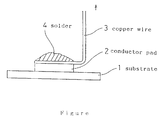
- soldering flux A sample to which the above-mentioned soldering flux had been applied was immersed in a solder bath at 230°C ⁇ 5°C for 5 ⁇ 0.5°C seconds. Then 0.65 mm diameter tinned copper wires were attached to eight 2 mm x 2 mm conductor pads by means of a soldering iron, as shown in the drawing.
- 1 represents a substrate, 2 a conductor pad, 3 copper wire, and 4 solder.
- the soldered copper wire 3 then was pulled by a tension tester in a direction perpendicular to the substrate 1 (in the direction of the arrow) at a velocity of 10 mm/sec to measure the strength needed to separate the conductor pad 2 from the substrate 1. A sample was judged to pass the test when the average of the eight pad measurements was 3 kg or more and the minimum pad measurement was 2.5 kg or more.
- the figure is an explanatory cross-sectional side view illustrating the method for measuring joint strength.
- the copper paste compositions according to the present invention are applicable, in addition to thick film circuits, as electrode materials for ceramic parts, such as various capacitors.
Landscapes
- Chemical & Material Sciences (AREA)
- Engineering & Computer Science (AREA)
- Ceramic Engineering (AREA)
- Materials Engineering (AREA)
- Manufacturing & Machinery (AREA)
- Organic Chemistry (AREA)
- Dispersion Chemistry (AREA)
- Inorganic Chemistry (AREA)
- Structural Engineering (AREA)
- Microelectronics & Electronic Packaging (AREA)
- Metallurgy (AREA)
- Mechanical Engineering (AREA)
- Parts Printed On Printed Circuit Boards (AREA)
- Conductive Materials (AREA)
Description
- The present invention relates to copper paste compositions, in particular, copper paste compositions that are suited to low temperature firing at 550°C to 750°C.
- Copper pastes can be fired onto ceramic or other refractory substrates to form a "thick film" conductor. Copper pastes for low temperature firing are disclosed in Japanese Patent Provisional Publication No. SHO-62-110202, equivalent U.S. Patent No. 4,521,329 and equivalent EP-A-0 131 778, all relating to a conductor element. The conductor element described is made by kneading a composition including an organic medium containing an organic resin and firing the composition onto a ceramic substrate to pyrolyze the organic resin, leaving a conductive copper film. The composition is composed of metallic copper in the form of metallic copper coated with a copper oxide coating, copper oxide particles, and an inorgainc binder, as follows: (a) 0.2 weight percent or more of oxygen in the form of a copper oxide coating, (b) copper oxide particles in an amount of 15 weight percent or less of the metallic copper, (c) an inorganic binder including copper oxide particles (d), the weight ratio of the copper oxide particles (d) to the copper oxide coating being 0 to 0.5 and the ratio of the total sum of copper oxide, as particles and coating, to the weight of oxide coated copper metal being 0 to 15 parts by weight of copper oxide to 100 parts by weight of oxide coated copper metal. The publications describe the oxygen in the metallic copper oxide coating and the oxygen in the copper oxide particles as sources for supplying oxygen for pyrolysis or combustion of the resin in the organic medium of the paste composition.
- It is generally well known that copper oxide is used as an additive in copper pastes. For high temperature firing applications (850°C to about 1000°C) there is no need to distinguish cuprous oxide and cupric oxide since both equally form chemical bonds with ceramic substrates. Therefore, the mixing ratio of the cuprous oxide and cupric oxide does not matter as practiced in the prior art. However, for low temperature firing, as described below, it has been found that the effect of cuprous oxide on the solderability, initial joint strength, and strength after aging differs from that of cupric oxide.
- It should be noted that oxygen in copper powder is present in the form of cuprous oxide rather than cupric oxide, and that this cuprous oxide does not directly contribute to combustion of the organic medium as an oxidizing agent, and lowers the degree of sintering when present in excess. Hence prior art copper pastes using copper powder with an oxygen content of 0.2 % or more by weight do not produce sufficient sintering after low temperature firing. As a result, the product has low resistance to soldering and, in particular, its strength after aging is significantly deteriorated.
- The present invention has been made in view of such problems of the prior art. It is intended to provide copper paste compositions having, after low temperature firing, a high degree of sintering, good solderability, high initial joint strength, and high joint strength after aging.
- According to the present invention, there is provided a copper paste composition comprising about 95 to about 70 percent by weight of inorganic components and about 5 to about 30 percent by weight of organic vehicle components, the inorganic components comprising a powdered refractory material, and copper powder including cuprous oxide powder and cupric oxide powder in amounts such that about 10 to about 15 parts by weight of cuprous oxide powder, about 12 to about 17 parts by weight of cupric oxide powder, and about 7 to about 12 parts by weight of refractory powder, are included for each 100 parts by weight of copper powder.
- In a preferred embodiment of the average particle size of the copper powder is about 0.5 to about 3 »m and that the oxygen content of the copper powder is about 0.05 to about 0.15 weight percent.
- Also according to the invention there is provided a method of making a thick film conductor on a substrate, comprising applying to the substrate a paste comprising copper powder, a binder, a solvent and a powdered refractory material, the copper powder including about 10 to about 15 parts by weight of cuprous oxide powder and about 12 to about 17 parts by weight of cupric oxide powder for each 100 parts by weight of copper powder and firing at a temperature sufficient to remove the solvent and the binder from the copper powder and the powdered refractory material and to adhere the copper powder, bound in the refractory material, to the substrate.
- Copper powder having a sufficient oxygen content, as described below, may be obtained, for example, by reducing cuprous oxide with hydrazine and then reducing with hydrogen.
- Due to reasons discussed below the average particle size of the cuprous oxide powder is desirably within a range from about 0.5 to »m about 5 »m, and in particular, the range from about 0.5 »m to about 2 »m is specially desired.
- There is no special need to limit the average particle size of the cupric oxide powder. The range, however, is desirably from about 0.5 »m to about 5 »m.
- The softening point of the glass powder is preferably in a range from about 300°C to about 600°C due to reasons discussed below. The softening poing is more preferably in a range from about 300°C to about 550°C. There is no particular reason to limit the average particle size of the glass powder. The particle size range, however, is desirably between about 1 »m and about 10 »m.
- The organic vehicle may be any commonly used organic vehicle. The organic vehicle typically is comprised of a solvent and a resin. For reasons discussed below, desirably there will be about 10 parts oor less by weight of the resin for every 100 parts by weight of the organic vehicle. Suitable resins include ethyl cellulose, acrylic resins, methacrylic resins, terpene resins and mixtures thereof. Suitable solvents include terpineol, C₁₀ to C₁₈ alcohols and mixtures thereof. Additionally, the organic vehicle optionally can include a suitable plasticizer such as dibutyl phthalate.
- Additives to the above-mentioned components can include about 5 parts or less by weight of inorganic oxides, particularly metal oxides such as vanadium oxide, lead oxide, antimony oxide and mixtures thereof per 100 parts by weight of the copper powder. Furthermore, surfactants such as a dispersant for maintaining stability of the paste and a thickener optionally may be added.
- The paste is typically prepared by mixing the required amounts of the components in any mixing device designed for pastes, such as in a universal mixer, until they form a paste, and then continuing homoginization of the composition, such as in a three roller mill.
- One method for making a thick-film circuit from the prepared paste is to print the paste in an appropriate pattern on a refractory substrate (made of alumina in many cases) by means of a screen printing machine, dry the printed substrate, and then fire the printed substrate in a belt furnace filled with N₂ or other inert gas for a cycle of about 40 minutes to about 60 minutes. The peak temperature is from about 550°C to about 750°C, and preferably from about 580°C to about 650°C, and the time for keeping the printed substrate at the peak temperature is from about 5 minutes to about 10 minutes.
- In low temperature firing of a copper paste, proper attention should be given to raising the degree of sintering, and to allowing easier evaporation of the organic vehicle. To achieve these objectives, the oxygen content in the copper powder should be kept within the appropriate range. If the oxygen content in the copper powder exceeds about 0.15 weight percent, sintering will become deficient, and in turn, solder wettability will be degraded, and the strength after aging will be deteriorated significantly. On the other hand, it is difficult and not practical to produce copper powder having an oxygen content less than about 0.05 weight percent.
- The average particle size of the copper powder having the above-mentioned oxygen content should be within a range from about 0.5 »m to about 3 »m. If the size exceeds about 3 »m, sintering will be deficient, and if the size is less than about 0.5 »m, it will be difficult to make the powder into a paste, and evaporation of the organic vehicle will be deficient.
- Cuprous oxide has a strong affinity with copper. Hence, cuprous oxide functions as a sintering agent, and after sintering, remains in the sintered particle boundary and prevents penetration of solder, and partly reacts with the substrate to form chemical bonds and improve the joint strength. To secure these effects, it is necessary to add about 10 parts or more by weight of cuprous oxide powder to each 100 parts by weight of copper powder. However, if more than about 15 parts by weight of cuprous oxide powder are added, the solder wettability will be deteriorated, and the strength after aging will be degraded.
- If the average particle size of the cuprous oxide powder is too coarse, the above-mentioned functions and effects will not be achieved. It, therefore, is desirable to set the average particle size of the cuprous oxide powder at or less than about 5 »m, and perferably, at or less than about 2 »m.
- Cupric oxide provides oxygen to the organic vehicle in the firing process, and therefore will be reduced. In this way, cupric oxide assists the combustion of the organic vehicle. To this end, the addition of about 12 parts or more by weight of cupric oxide powder to each 100 parts by weight of copper powder achieves efficient pyrolysis of the organic vehicle during the firing process. If about 17 parts or more by weight of cupric oxide powder is added, sintering of the copper particle will be hindered.
- The glass powder or other powdered refractory material serves to wet the surface of the substrate and to facilitate the sintering of the copper powder through liquid-phase sintering. Therefore, it is desirable to add about 7 to about 12 parts by weight of glass powder, or other refractory powder, to each 100 parts by weight of copper powder. To attain an appropriate wettability, it is desirable to select glass powder having a softening point of about 600°C or less, preferably having a softening point of about 550°C or less.
- The amount of the organic vehicle components relative to all the inorganic components depends on the particular vehicle used. To assure complete evaporation of the organic vehicle, the amount of the organic vehicle components should be from about 5 to about 30 parts by weight organic vehicle components to about 95 to about 70 parts by weight of other inorganic components. To achieve the full advantage of the present invention in improving the wettability, and in assuring complete evaporation of the organic vehicle, the amount of the resin is desirably about 10 parts or less by weight to 100 parts by weight of the organic vehicle.
- The present invention will be explained with reference to preferred embodiments according to the present invention. It should be noted that the present invention is in no way limited by these embodiments.
- To form conductor pads, the pastes having the compositions as shown in Table 1 were printed in an appropriate pattern on 96 % alumina ceramic substrates by means of a screen printing machine, and then dried at 120°C for 10 minutes. The printed substrates then were fired in a nitrogen environment under the following conditions: peak firing temperature -- 600°C; peak temperature time --10 minutes; heating-cooling cycle time -- 60 minutes; and 0₂ concentration in the firing zone -- 5 ppm. The conductor pads obtained under these conditions were measured for solder wettability, initial joint strength, and joint strength after aging. The results of the measurements are shown in Table 3. Table 2 describes the characteristics of the materials listed in Table 1.
- A sample to which a soldering flux (Tamura Kaken XA-100) had been applied was immersed in a solder bath at 230°C ± 5°C for 5 + 0.5 seconds, and then was taken out of the bath. The average solder wet area of ten conductor pads (each pad measuring 2 mm x 2 mm) was measured. A sample having a wet area ratio of 90% or more was judged to pass the test, and a sample having a ratio of less than 90% was judged to fail the test.
- A sample to which the above-mentioned soldering flux had been applied was immersed in a solder bath at 230°C ± 5°C for 5 ± 0.5°C seconds. Then 0.65 mm diameter tinned copper wires were attached to eight 2 mm x 2 mm conductor pads by means of a soldering iron, as shown in the drawing. In the drawing, 1 represents a substrate, 2 a conductor pad, 3 copper wire, and 4 solder.
- The soldered
copper wire 3 then was pulled by a tension tester in a direction perpendicular to the substrate 1 (in the direction of the arrow) at a velocity of 10 mm/sec to measure the strength needed to separate theconductor pad 2 from thesubstrate 1. A sample was judged to pass the test when the average of the eight pad measurements was 3 kg or more and the minimum pad measurement was 2.5 kg or more. - In the same manner as the initial joint strength measurements, copper wires were attached to the conductor pads formed on the substrates and then the said substrates were subjected to a temperature of 150°C for 250 hours and then the strength of each joint was measured in the same manner as described for initial joint strength. A sample was judged to pass the test when the average of the eight pad measurements was 2.5 kg or more and the minimum pad measurement was 2.0 kg or more.
- The figure is an explanatory cross-sectional side view illustrating the method for measuring joint strength.


- Table 3 clearly indicates the following points:
- 1)
Embodiments 1 through 10 included copper powder having a mean partticle size and an oxygen content within the ranges according to the present invention, and appropriate amounts of cuprous oxide powder, cupric oxide powder and glass powder were mixed, and the ratio of the inorganic components and the organic vehicle components was appropriate. Accordingly, the evaporation of the organic vehicle was complete, and sintering of the copper powder was sufficient. As a result, the solder wettability was satisfactory, and the initial joint strength and the strength after aging were high, and all of the values of such characteristics were at or above the pass level. - 2) In the case of Control 1 (C1), the mixing ratio of cuprous oxide is less than the lower limit according to the present invention. Accordingly, the initial joint strength and the strength after aging were low, and failed to attain the respective pass levels.
- 3) In the case of Control 2 (C2), the mixing ratio of cupric oxide was less than the lower limit according to the present invention, and the evaporation of the organic vehicle was deficient, and the sample failed to pass the solder wettability test. As a result, both the initial joint strength and the strength after aging were low and failed to attain the respective pass levels.
- 4) In the case of Control 3 (C3), no cupric oxide powder was mixed. Hence the organic vehicle did not evaporate, and the solder wettability was extremely low and failed to pass the test. As a result, the initial joint strength and the strength after aging were considerably low and failed to pass the tests.
- 5) In the case of Control 4 (C4) , no cuprous oxide was mixed. As a result, both the initial joint strength and the strength after aging were extremely low and failed to pass the tests.
- 6) In the case of Control 5 (C5), the mixing ratio of cuprous oxide was greater than the upper limit according to the present invention. As a result, the solder wettability failed to pass the test, and the strength after aging was also low and failed to pass the test.
- The copper paste compositions according to the present invention are applicable, in addition to thick film circuits, as electrode materials for ceramic parts, such as various capacitors.
- It has therefore been shown that very useful copper paste compositions in practical applications, having satisfactory solder wettability and high initial joint strength and joint strength after aging, can be provided by using copper powder having an oxygen content and a mean particle size within the respective ranges according to the present invention and by controlling the mixing ratios of cuprous oxide powder to cupric oxide powder, glass powder to said copper powder, and the ratio of the organic vehicle components to the inorganic components within the respective ranges according to the present invention.
Claims (16)
- A copper paste composition comprising 95 to 70 percent by weight of inorganic components and 5 to 30 percent by weight of organic vehicle components, the inorganic components comprising a powdered refractory material, and copper powder including cuprous oxide powder and cupric oxide powder in amounts such that 10 to 15 parts by weight of cuprous oxide powder, 12 to 17 parts by weight of cupric oxide power, and 7 to 12 parts by weight of refractory powder, are included for each 100 parts by weight of copper powder.
- The copper paste composition of Claim 1 wherein the copper powder has a mean particle size of 0.5 to 3 »m and an oxygen content between 0.05 and 0.15 percent by weight.
- The copper paste composition of Claim 2 wherein the cuprous oxide powder has a particle size range from 0.5 to 5 »m.
- The copper paste composition of Claim 3 wherein the cuprous oxide powder has a particle size range from 0.5 to 2 »m.
- The copper paste composition of any of claims 2 to 4 further comprising 5 parts or less by weight of an inorganic oxide per 100 parts by weight of the copper powder.
- The copper paste composition of Claim 5 wherein the inorganic oxide is vanadium oxide, lead oxide, antimony oxide or mixtures thereof.
- The copper paste composition of any preceding claim wherein the organic vehicle components include a solvent and a resin.
- The copper paste composition of Claim 7 wherein the solvent is terpineol, C₁₀ to C₁₈ alcohols, or mixtures thereof.
- The copper paste composition of Claim 7 or Claim 8 wherein the organic vehicle components further include a plasticizer.
- The copper paste composition of Claim 9 wherein the plasticizer is dibutyl phthalate.
- The copper paste composition of any of claims 7 to 10 wherein the resin is cellulosic resin, acrylic resin, methacrylic resin, terpene resin or mixtures thereof.
- The copper paste composition of any of claims 7 to 11 wherein the organic vehicle components include 10 percent or less by weight of resin.
- The copper paste composition of any preceding claim wherein the powdered refractory material is glass.
- The copper paste composition of Claim 13 wherein the glass powder has a softening point of between 300°C and 600°C
- A method of making a thick film conductor on a substrate, comprising applying to the substrate a paste comprising copper powder, a binder, a solvent and a powdered refractory material, the copper powder including 10 to 15 parts by weight of cuprous oxide powder and 12 to 17 parts by weight of cupric oxide powder for each 100 parts by weight of copper powder and firing at a temperature sufficient to remove the solvent and the binder from the copper powder and the powdered refractory material and to adhere the copper powder, bound in the refractory material, to the substrate.
- A method as claimed in Claim 15 in which the temperature of firing is 550°C to 750°C.
Applications Claiming Priority (2)
| Application Number | Priority Date | Filing Date | Title |
|---|---|---|---|
| JP280048/89 | 1989-10-27 | ||
| JP1280048A JP2788510B2 (en) | 1989-10-27 | 1989-10-27 | Copper paste composition |
Publications (2)
| Publication Number | Publication Date |
|---|---|
| EP0425073A1 EP0425073A1 (en) | 1991-05-02 |
| EP0425073B1 true EP0425073B1 (en) | 1995-01-18 |
Family
ID=17619572
Family Applications (1)
| Application Number | Title | Priority Date | Filing Date |
|---|---|---|---|
| EP90307467A Expired - Lifetime EP0425073B1 (en) | 1989-10-27 | 1990-07-09 | Copper paste composition |
Country Status (4)
| Country | Link |
|---|---|
| US (1) | US5035837A (en) |
| EP (1) | EP0425073B1 (en) |
| JP (1) | JP2788510B2 (en) |
| DE (1) | DE69016156T2 (en) |
Cited By (1)
| Publication number | Priority date | Publication date | Assignee | Title |
|---|---|---|---|---|
| US11802330B1 (en) * | 2022-08-22 | 2023-10-31 | The Royal Institution for the Advancement of Learning/McGill Concordia University | Gas turbine engine component with copper oxide coating |
Families Citing this family (31)
| Publication number | Priority date | Publication date | Assignee | Title |
|---|---|---|---|---|
| EP0452118B1 (en) * | 1990-04-12 | 1996-08-21 | Matsushita Electric Industrial Co., Ltd. | Conductive ink composition and method of forming a conductive thick film pattern |
| JP2657008B2 (en) * | 1991-06-26 | 1997-09-24 | 日本特殊陶業株式会社 | Metallized composition for ceramics |
| US5242623A (en) * | 1991-08-13 | 1993-09-07 | E. I. Du Pont De Nemours And Company | Screen-printable thick film paste composition |
| JPH05190375A (en) * | 1992-01-09 | 1993-07-30 | Murata Mfg Co Ltd | Method for manufacturing copper multilayer ceramic substrate and copper paste used therefor |
| JPH05235497A (en) * | 1992-02-20 | 1993-09-10 | Murata Mfg Co Ltd | Copper conductive paste |
| JPH06318403A (en) * | 1993-05-07 | 1994-11-15 | Murata Mfg Co Ltd | Copper paste for forming conductive coating film |
| JPH0817241A (en) * | 1994-06-30 | 1996-01-19 | Mitsuboshi Belting Ltd | Method for producing copper conductor paste and copper conductor film |
| US5976628A (en) * | 1995-12-08 | 1999-11-02 | Mitsuboshi Belting Ltd. | Copper conductor paste and production method of copper conductor film |
| JPH10172345A (en) * | 1996-12-04 | 1998-06-26 | Murata Mfg Co Ltd | Conductive paste and method for manufacturing ceramic substrate using the same |
| US6909185B1 (en) | 1998-12-07 | 2005-06-21 | Hitachi, Ltd. | Composite material including copper and cuprous oxide and application thereof |
| US6833617B2 (en) | 2001-12-18 | 2004-12-21 | Hitachi, Ltd. | Composite material including copper and cuprous oxide and application thereof |
| US7083744B2 (en) * | 2003-01-24 | 2006-08-01 | E. I. Du Pont De Nemours And Company | Terminal electrode compositions for multilayer ceramic capacitors |
| KR100841665B1 (en) | 2003-05-16 | 2008-06-26 | 하리마 카세이 가부시키가이샤 | Method of forming fine-shaped conductor of copper fine particle sintered body, method of forming copper fine wiring and copper thin film using the method |
| US7388296B2 (en) * | 2005-06-09 | 2008-06-17 | Ngk Spark Plug Co., Ltd. | Wiring substrate and bonding pad composition |
| JP4821537B2 (en) * | 2006-09-26 | 2011-11-24 | 株式会社デンソー | Electronic control unit |
| JP2012122132A (en) * | 2010-11-18 | 2012-06-28 | Mitsubishi Materials Corp | Clayish composition for forming sintered body, powder for clayish composition for forming sintered body, method for manufacturing clayish composition for forming sintered body, copper sintered body and method for manufacturing the copper sintered body |
| CN102060573B (en) * | 2010-11-30 | 2013-07-03 | 南京航空航天大学 | Manufacture method for copper-coated ceramic substrate on basis of electronic paste |
| US9772149B2 (en) * | 2012-07-10 | 2017-09-26 | Intramicron, Inc. | Method for improving wall heat transfer in a chemical reactor |
| EP3010870A1 (en) | 2013-06-05 | 2016-04-27 | CeramTec GmbH | Metal coating on ceramic substrates |
| JP5766336B1 (en) * | 2014-06-16 | 2015-08-19 | 株式会社マテリアル・コンセプト | Copper paste firing method |
| JP5941588B2 (en) * | 2014-09-01 | 2016-06-29 | Dowaエレクトロニクス株式会社 | Bonding material and bonding method using the same |
| US9775252B2 (en) * | 2015-11-03 | 2017-09-26 | GM Global Technology Operations LLC | Method for soldering shape memory alloys |
| GB201520077D0 (en) | 2015-11-13 | 2015-12-30 | Johnson Matthey Plc | Conductive track or coating |
| US10454147B2 (en) | 2015-11-19 | 2019-10-22 | Intramicron, Inc. | Battery pack for energy storage devices |
| JP6885188B2 (en) | 2017-04-28 | 2021-06-09 | 住友金属鉱山株式会社 | Method for manufacturing conductive composition and terminal electrode |
| JP6879035B2 (en) | 2017-04-28 | 2021-06-02 | 住友金属鉱山株式会社 | Conductive composition, method of manufacturing conductors, and method of forming wiring for electronic components |
| TWI736695B (en) * | 2017-10-24 | 2021-08-21 | 啟耀光電股份有限公司 | Electronic device and manufacturing method thereof |
| CN108455854B (en) * | 2018-04-23 | 2020-11-10 | 卢群海 | Preparation method of copper purple glaze on ceramic surface |
| JP7332128B2 (en) * | 2019-01-10 | 2023-08-23 | 株式会社マテリアル・コンセプト | Electronic parts and manufacturing methods thereof |
| CN110665504A (en) * | 2019-10-22 | 2020-01-10 | 合盛硅业股份有限公司 | Preparation method of composite ternary copper powder |
| US11794286B2 (en) * | 2020-08-20 | 2023-10-24 | Toyota Motor Engineering & Manufacturing North America, Inc. | Copper solder formulation |
Family Cites Families (8)
| Publication number | Priority date | Publication date | Assignee | Title |
|---|---|---|---|---|
| US3516949A (en) * | 1966-10-10 | 1970-06-23 | Du Pont | Copper/vanadium oxide compositions |
| US4172919A (en) * | 1977-04-22 | 1979-10-30 | E. I. Du Pont De Nemours And Company | Copper conductor compositions containing copper oxide and Bi2 O3 |
| US4511601A (en) * | 1983-05-13 | 1985-04-16 | North American Philips Corporation | Copper metallization for dielectric materials |
| US4521329A (en) * | 1983-06-20 | 1985-06-04 | E. I. Du Pont De Nemours And Company | Copper conductor compositions |
| JPS62263894A (en) * | 1986-05-09 | 1987-11-16 | Dai Ichi Kogyo Seiyaku Co Ltd | Conductive copper paste |
| JPS6355807A (en) * | 1986-08-27 | 1988-03-10 | 古河電気工業株式会社 | Conducting paste |
| JP2518839B2 (en) * | 1987-03-20 | 1996-07-31 | 富士通株式会社 | Conductor paste composition |
| US4877555A (en) * | 1987-04-13 | 1989-10-31 | Matsushita Electric Industrial Co., Ltd. | Conductor composition and method of manufacturing a ceramic multilayer structure using the same |
-
1989
- 1989-10-27 JP JP1280048A patent/JP2788510B2/en not_active Expired - Lifetime
-
1990
- 1990-06-28 US US07/544,973 patent/US5035837A/en not_active Expired - Lifetime
- 1990-07-09 DE DE69016156T patent/DE69016156T2/en not_active Expired - Lifetime
- 1990-07-09 EP EP90307467A patent/EP0425073B1/en not_active Expired - Lifetime
Cited By (1)
| Publication number | Priority date | Publication date | Assignee | Title |
|---|---|---|---|---|
| US11802330B1 (en) * | 2022-08-22 | 2023-10-31 | The Royal Institution for the Advancement of Learning/McGill Concordia University | Gas turbine engine component with copper oxide coating |
Also Published As
| Publication number | Publication date |
|---|---|
| DE69016156D1 (en) | 1995-03-02 |
| DE69016156T2 (en) | 1995-07-20 |
| US5035837A (en) | 1991-07-30 |
| JPH03141502A (en) | 1991-06-17 |
| EP0425073A1 (en) | 1991-05-02 |
| JP2788510B2 (en) | 1998-08-20 |
Similar Documents
| Publication | Publication Date | Title |
|---|---|---|
| US5035837A (en) | Copper paste composition | |
| US4122232A (en) | Air firable base metal conductors | |
| EP0135174B1 (en) | Thick film conductor composition | |
| EP0131778B2 (en) | Copper-containing thick-film conductor compositions | |
| KR970008549B1 (en) | Silver-rich conductor compositions for high thermal cycled and aged adhesion | |
| CA1278912C (en) | Overprint copper composition | |
| US5202153A (en) | Method for making thick film/solder joints | |
| US4540604A (en) | Thick film conductor compositions | |
| CA1149150A (en) | Mixed oxide bonded copper conductor compositions | |
| JPH07302510A (en) | Conductive paste composition | |
| US4623482A (en) | Copper conductive paint for porcelainized metal substrates | |
| US4865772A (en) | Copper thick film conductor composition | |
| JPH04277406A (en) | Copper conductor paste | |
| JP2795467B2 (en) | Good adhesive metal paste | |
| JP2003132735A (en) | Thick film conductor paste and electronic component using the same | |
| JP2550630B2 (en) | Copper paste for conductive film formation | |
| JPH10233119A (en) | Copper conductor paste and substrate printed therewith | |
| JPH04308605A (en) | Copper conductive paste | |
| JPH01107592A (en) | Electric circuit board | |
| JP2992958B2 (en) | Conductive paste for low-temperature fired multilayer wiring boards | |
| JPH0465010A (en) | Copper conductive paste | |
| JPH0850806A (en) | Composition for thick film conductor | |
| KR800001624B1 (en) | Air firable base metal condoctors | |
| JP2743558B2 (en) | Copper conductor paste | |
| JPH05314811A (en) | Ag-pd conductor paste |
Legal Events
| Date | Code | Title | Description |
|---|---|---|---|
| PUAI | Public reference made under article 153(3) epc to a published international application that has entered the european phase |
Free format text: ORIGINAL CODE: 0009012 |
|
| 17P | Request for examination filed |
Effective date: 19900714 |
|
| AK | Designated contracting states |
Kind code of ref document: A1 Designated state(s): DE FR GB |
|
| 17Q | First examination report despatched |
Effective date: 19930831 |
|
| GRAA | (expected) grant |
Free format text: ORIGINAL CODE: 0009210 |
|
| AK | Designated contracting states |
Kind code of ref document: B1 Designated state(s): DE FR GB |
|
| REF | Corresponds to: |
Ref document number: 69016156 Country of ref document: DE Date of ref document: 19950302 |
|
| ET | Fr: translation filed | ||
| PLBE | No opposition filed within time limit |
Free format text: ORIGINAL CODE: 0009261 |
|
| STAA | Information on the status of an ep patent application or granted ep patent |
Free format text: STATUS: NO OPPOSITION FILED WITHIN TIME LIMIT |
|
| 26N | No opposition filed | ||
| REG | Reference to a national code |
Ref country code: GB Ref legal event code: IF02 |
|
| PGFP | Annual fee paid to national office [announced via postgrant information from national office to epo] |
Ref country code: FR Payment date: 20090710 Year of fee payment: 20 |
|
| PGFP | Annual fee paid to national office [announced via postgrant information from national office to epo] |
Ref country code: GB Payment date: 20090708 Year of fee payment: 20 Ref country code: DE Payment date: 20090702 Year of fee payment: 20 |
|
| REG | Reference to a national code |
Ref country code: GB Ref legal event code: PE20 Expiry date: 20100708 |
|
| PG25 | Lapsed in a contracting state [announced via postgrant information from national office to epo] |
Ref country code: GB Free format text: LAPSE BECAUSE OF EXPIRATION OF PROTECTION Effective date: 20100708 |
|
| PG25 | Lapsed in a contracting state [announced via postgrant information from national office to epo] |
Ref country code: DE Free format text: LAPSE BECAUSE OF EXPIRATION OF PROTECTION Effective date: 20100709 |