EP0423950B1 - Purification of propylene oxide using an aqueous acetone extractive distillation agent - Google Patents
Purification of propylene oxide using an aqueous acetone extractive distillation agent Download PDFInfo
- Publication number
- EP0423950B1 EP0423950B1 EP90310399A EP90310399A EP0423950B1 EP 0423950 B1 EP0423950 B1 EP 0423950B1 EP 90310399 A EP90310399 A EP 90310399A EP 90310399 A EP90310399 A EP 90310399A EP 0423950 B1 EP0423950 B1 EP 0423950B1
- Authority
- EP
- European Patent Office
- Prior art keywords
- propylene oxide
- fraction
- acetone
- distillation column
- distillation
- Prior art date
- Legal status (The legal status is an assumption and is not a legal conclusion. Google has not performed a legal analysis and makes no representation as to the accuracy of the status listed.)
- Expired - Lifetime
Links
- CSCPPACGZOOCGX-UHFFFAOYSA-N Acetone Chemical compound CC(C)=O CSCPPACGZOOCGX-UHFFFAOYSA-N 0.000 title claims description 175
- GOOHAUXETOMSMM-UHFFFAOYSA-N Propylene oxide Chemical compound CC1CO1 GOOHAUXETOMSMM-UHFFFAOYSA-N 0.000 title claims description 97
- 238000000895 extractive distillation Methods 0.000 title claims description 30
- 239000003795 chemical substances by application Substances 0.000 title claims description 17
- 238000000746 purification Methods 0.000 title description 11
- OKKJLVBELUTLKV-UHFFFAOYSA-N Methanol Chemical compound OC OKKJLVBELUTLKV-UHFFFAOYSA-N 0.000 claims description 100
- 238000004821 distillation Methods 0.000 claims description 51
- XLYOFNOQVPJJNP-UHFFFAOYSA-N water Substances O XLYOFNOQVPJJNP-UHFFFAOYSA-N 0.000 claims description 40
- 238000000034 method Methods 0.000 claims description 21
- TZIHFWKZFHZASV-UHFFFAOYSA-N methyl formate Chemical compound COC=O TZIHFWKZFHZASV-UHFFFAOYSA-N 0.000 claims description 20
- 239000000203 mixture Substances 0.000 claims description 16
- 238000010992 reflux Methods 0.000 claims description 14
- 239000012535 impurity Substances 0.000 claims description 12
- QQONPFPTGQHPMA-UHFFFAOYSA-N propylene Natural products CC=C QQONPFPTGQHPMA-UHFFFAOYSA-N 0.000 claims description 9
- 125000004805 propylene group Chemical group [H]C([H])([H])C([H])([*:1])C([H])([H])[*:2] 0.000 claims description 9
- IKHGUXGNUITLKF-UHFFFAOYSA-N Acetaldehyde Chemical compound CC=O IKHGUXGNUITLKF-UHFFFAOYSA-N 0.000 claims description 8
- 238000006735 epoxidation reaction Methods 0.000 claims description 8
- DKGAVHZHDRPRBM-UHFFFAOYSA-N Tert-Butanol Chemical compound CC(C)(C)O DKGAVHZHDRPRBM-UHFFFAOYSA-N 0.000 claims description 7
- IKHGUXGNUITLKF-XPULMUKRSA-N acetaldehyde Chemical compound [14CH]([14CH3])=O IKHGUXGNUITLKF-XPULMUKRSA-N 0.000 claims description 5
- 239000003054 catalyst Substances 0.000 claims description 5
- 238000006243 chemical reaction Methods 0.000 claims description 5
- 239000007795 chemical reaction product Substances 0.000 claims description 5
- CIHOLLKRGTVIJN-UHFFFAOYSA-N tert‐butyl hydroperoxide Chemical compound CC(C)(C)OO CIHOLLKRGTVIJN-UHFFFAOYSA-N 0.000 claims description 5
- 239000000356 contaminant Substances 0.000 claims description 2
- 239000012223 aqueous fraction Substances 0.000 claims 1
- 238000004064 recycling Methods 0.000 claims 1
- 239000002351 wastewater Substances 0.000 claims 1
- DNIAPMSPPWPWGF-UHFFFAOYSA-N Propylene glycol Chemical compound CC(O)CO DNIAPMSPPWPWGF-UHFFFAOYSA-N 0.000 description 19
- 239000002904 solvent Substances 0.000 description 19
- LYCAIKOWRPUZTN-UHFFFAOYSA-N Ethylene glycol Chemical compound OCCO LYCAIKOWRPUZTN-UHFFFAOYSA-N 0.000 description 5
- 150000002432 hydroperoxides Chemical class 0.000 description 5
- 239000000047 product Substances 0.000 description 5
- 235000013772 propylene glycol Nutrition 0.000 description 5
- 239000000463 material Substances 0.000 description 4
- 238000011084 recovery Methods 0.000 description 4
- LFQSCWFLJHTTHZ-UHFFFAOYSA-N Ethanol Chemical compound CCO LFQSCWFLJHTTHZ-UHFFFAOYSA-N 0.000 description 3
- QVGXLLKOCUKJST-UHFFFAOYSA-N atomic oxygen Chemical compound [O] QVGXLLKOCUKJST-UHFFFAOYSA-N 0.000 description 3
- 238000002474 experimental method Methods 0.000 description 3
- 229910052760 oxygen Inorganic materials 0.000 description 3
- 239000001301 oxygen Substances 0.000 description 3
- 239000011541 reaction mixture Substances 0.000 description 3
- MHAJPDPJQMAIIY-UHFFFAOYSA-N Hydrogen peroxide Chemical compound OO MHAJPDPJQMAIIY-UHFFFAOYSA-N 0.000 description 2
- KFZMGEQAYNKOFK-UHFFFAOYSA-N Isopropanol Chemical compound CC(C)O KFZMGEQAYNKOFK-UHFFFAOYSA-N 0.000 description 2
- ZOKXTWBITQBERF-UHFFFAOYSA-N Molybdenum Chemical compound [Mo] ZOKXTWBITQBERF-UHFFFAOYSA-N 0.000 description 2
- XBDQKXXYIPTUBI-UHFFFAOYSA-M Propionate Chemical compound CCC([O-])=O XBDQKXXYIPTUBI-UHFFFAOYSA-M 0.000 description 2
- NBBJYMSMWIIQGU-UHFFFAOYSA-N Propionic aldehyde Chemical compound CCC=O NBBJYMSMWIIQGU-UHFFFAOYSA-N 0.000 description 2
- KXKVLQRXCPHEJC-UHFFFAOYSA-N acetic acid trimethyl ester Natural products COC(C)=O KXKVLQRXCPHEJC-UHFFFAOYSA-N 0.000 description 2
- 150000001298 alcohols Chemical class 0.000 description 2
- -1 aliphatic alcohols Chemical class 0.000 description 2
- 238000009835 boiling Methods 0.000 description 2
- 230000003247 decreasing effect Effects 0.000 description 2
- 229930195733 hydrocarbon Natural products 0.000 description 2
- 150000002430 hydrocarbons Chemical class 0.000 description 2
- 150000002576 ketones Chemical class 0.000 description 2
- 229910052750 molybdenum Inorganic materials 0.000 description 2
- 239000011733 molybdenum Substances 0.000 description 2
- 239000000243 solution Substances 0.000 description 2
- GQNOPVSQPBUJKQ-UHFFFAOYSA-N 1-hydroperoxyethylbenzene Chemical compound OOC(C)C1=CC=CC=C1 GQNOPVSQPBUJKQ-UHFFFAOYSA-N 0.000 description 1
- XRXANEMIFVRKLN-UHFFFAOYSA-N 2-hydroperoxy-2-methylbutane Chemical compound CCC(C)(C)OO XRXANEMIFVRKLN-UHFFFAOYSA-N 0.000 description 1
- 239000004215 Carbon black (E152) Substances 0.000 description 1
- 239000003513 alkali Substances 0.000 description 1
- 239000008346 aqueous phase Substances 0.000 description 1
- 239000007864 aqueous solution Substances 0.000 description 1
- 230000033228 biological regulation Effects 0.000 description 1
- ZTQSAGDEMFDKMZ-UHFFFAOYSA-N butyric aldehyde Natural products CCCC=O ZTQSAGDEMFDKMZ-UHFFFAOYSA-N 0.000 description 1
- 150000001735 carboxylic acids Chemical class 0.000 description 1
- 150000001875 compounds Chemical class 0.000 description 1
- 238000010908 decantation Methods 0.000 description 1
- 230000007423 decrease Effects 0.000 description 1
- 150000002148 esters Chemical class 0.000 description 1
- 238000000605 extraction Methods 0.000 description 1
- 238000004508 fractional distillation Methods 0.000 description 1
- 238000010438 heat treatment Methods 0.000 description 1
- 230000036571 hydration Effects 0.000 description 1
- 238000006703 hydration reaction Methods 0.000 description 1
- WGCNASOHLSPBMP-UHFFFAOYSA-N hydroxyacetaldehyde Natural products OCC=O WGCNASOHLSPBMP-UHFFFAOYSA-N 0.000 description 1
- 239000007791 liquid phase Substances 0.000 description 1
- 238000000622 liquid--liquid extraction Methods 0.000 description 1
- 230000003647 oxidation Effects 0.000 description 1
- 238000007254 oxidation reaction Methods 0.000 description 1
- 150000002924 oxiranes Chemical class 0.000 description 1
- 238000002360 preparation method Methods 0.000 description 1
- 125000002924 primary amino group Chemical group [H]N([H])* 0.000 description 1
- 238000000638 solvent extraction Methods 0.000 description 1
- 239000011877 solvent mixture Substances 0.000 description 1
- 239000000126 substance Substances 0.000 description 1
Images
Classifications
-
- B—PERFORMING OPERATIONS; TRANSPORTING
- B01—PHYSICAL OR CHEMICAL PROCESSES OR APPARATUS IN GENERAL
- B01D—SEPARATION
- B01D3/00—Distillation or related exchange processes in which liquids are contacted with gaseous media, e.g. stripping
- B01D3/34—Distillation or related exchange processes in which liquids are contacted with gaseous media, e.g. stripping with one or more auxiliary substances
- B01D3/40—Extractive distillation
-
- C—CHEMISTRY; METALLURGY
- C07—ORGANIC CHEMISTRY
- C07D—HETEROCYCLIC COMPOUNDS
- C07D301/00—Preparation of oxiranes
- C07D301/32—Separation; Purification
Definitions
- This invention relates to the purification of propylene oxide. More particularly, this invention relates to a distillation process for removing contaminating quantities of methanol and, if present, acetone, from an impure propylene oxide feedstock. Still more particularly, this invention relates to a method wherein an impure propylene oxide feedstock contaminated with from about 50 to about 1000 ppm of methanol and from about 0 to about 1 wt.% of acetone is purified in an extractive distillation column using an extractive distillation agent consisting of an acetone/water blend ranging from about 20 to 30 wt.% acetone and, correspondingly, 80 to 70 wt.% water.
- Mitchell et al. U. S. Patent No. 2,550,847 is directed to a process for separating purified propylene oxide from a crude propylene oxide product contaminated with acetaldehyde, methyl formate, methanol, etc., by treating the crude mixture with an aqueous basic substance followed by recovery of the purified propylene oxide by any suitable means such as by decantation.
- Mitchell et al. reported a recovery of a product containing 78 to 82 wt.% of propylene oxide which, they stated, could be increased in purity to about 95 to 99% by fractional distillation.
- U. S. Patent No. 2,622,060 discloses a process for the purification of propylene oxide contaminated with impurities, including methanol, hy subjecting the impure propylene oxide to distillation in the presence of an extractive distillation agent comprising an aqueous solution of an alkali.
- the inventors report in Example 1 of their patent a method wherein 500 parts by weight of a crude propylene oxide fraction was extractively distilled in accordance with their invention to obtain 325 parts by weight of a product containing about 99.6 wt.% of propylene oxide.
- a significant loss of propylene oxide occurred during the process.
- Hamlin et al. in U. S. Patent No. 3,409,513 disclose the hydro-extractive distillation of mixtures comprising acetone, lower aliphatic alcohols and esters of lower aliphatic alcohols with carboxylic acids. It is pointed out by the patentees that acetone, methyl acetate and methanol form an azeotrope boiling at 55.5-56.5°C. Williams et al. propose to recover partially purified acetone from such a terniary azeotrope by liquid-liquid extraction with water followed by hydro-extractive distillation of the aqueous phase in order to obtain a partially purified acetone fraction.
- Washall U. S. Patent No. 3,578,568 discloses a process for removing oxygen-containing impurities such as acetone, acetaldehyde and methanol from impure propylene oxide using a glycol such as ethylene glycol or propylene glycol as an extractive distillation agent.
- Heary and Newman U. S. Patent No. 3,632,482 is directed to a propylene oxide recovery process by extractive distillation using an alcohol-ketone-hydrocarbon solvent.
- the invention relates to a method for the purification of crude propylene oxide contained in a mixture produced by the epoxidation of propylene with an organic hydroperoxide and calls for extractive distillation of the crude propylene oxide in a plurality of successive extractive distillation zones with the aid of a solvent mixture consisting essentially of hydrocarbons, alcohols, and/or ketones corresponding to the organic hydroperoxide employed in producing the propylene oxide.
- the extractive distillation agent is a recycle fraction from a three column distillation sequence wherein the bottoms from the third distillation column are flashed to obtain an overhead composed of hydrocarbons, alcohols and/or ketones which is recycled as an extractive distillation agent to the three distillation columns involved in the propylene oxide purification sequence.
- U. S. Patent No. 3,715,284 discloses a process for the purification of impure propylene oxide using acetone or a mixture of acetone with methanol which is introduced into a distillation column either below or together with the impure propylene oxide.
- Schmidt U. S. Patent No. 3,881,996 is directed to a distillation sequence employing at least three and optionally four columns for the purification of crude propylene oxide, one of the columns optionally being an extractive distillation column wherein a hydrocarbon such as octane is used as the extractive distillation agent.
- Schmidt U. S. Patent No. 4,140,588 discloses a process for the purification of propylene oxide contaminated with methanol and acetone using water as an extractive distillation agent, the water being introduced into the distillation column above the point of introduction of the crude propylene oxide feed.
- the acetone serves as a buffer section in the tower between the PO and water (a high concentration of water is in the reboiler and a high concentration of PO is above the acetone. buffer zone).
- the acetone buffer zone limits the contact of PO with a high concentration of water. It is apparent that the additional acetone makes its presence known in the reboiler as well as evidenced by lower reboiler temperatures. This also helps reduce PO to PG conversion as the reaction rate increases with increasing temperature. Any PO making its way to the reboiler will see a lower temperature, thus reducing its conversion to PG.
- Seifert et al. U. S. Patent No. 4,369,096 is directed to a process for the purification of epoxides wherein the purification is effected by treatment with compounds containing at least one primary amine group.
- an impure propylene oxide feedstock contaminated with from 50 to 1000 ppm of methanol and from 0 to 1 wt.% of acetone is charged to the lower half of an extractive distillation column containing at least 25 theoretical plates and an extractive distillation agent consisting essentially of a blend of acetone and water (acetone/water blend) containing 20 to 30 wt.% of acetone and, correspondingly, 80 to 70 wt.% of water is charged to the tower at a point 4 to 7 theoretical stages above the impure propylene oxide feed point.
- the extractive distillation agent is introduced into the extractive distillation column in the ratio of said feedstock to said extractive distillation agent of from 5:1 to 20:1, whereby an overhead distillate fraction is obtained consisting essentially of propylene oxide contaminated with not more than 60 ppm of methanol, not more than 0.02 wt.% of acetone and not more than 0.3 wt.% of water.
- reaction mixture comprising propylene oxide, an alcohol corresponding to the organic hydroperoxide feedstock and impurities including methyl formate, acetaldehyde, acetone and methanol.
- a minor amount of water will also frequently be present in the reaction mixture.
- the impure propylene oxide obtained in this fashion will normally be composed of about 95 wt.% or more of propylene oxide, the oxygen-containing impurities such as those mentioned above, are removed from the propylene oxide only with difficulty.
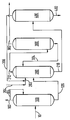
- the drawing is a schematic flow sheet with conventional parts omitted showing the general recovery sequence that is used in accordance with the present invention in purifying propylene oxide.
- the present invention is illustrated in connection with a process wherein the propylene oxide is prepared by the epoxidation of propylene with tertiary butyl hydroperoxide to provide a reaction product comprising propylene oxide and additional tertiary butyl alcohol formed.
- the propylene oxide is prepared by the epoxidation of propylene with tertiary butyl hydroperoxide to provide a reaction product comprising propylene oxide and additional tertiary butyl alcohol formed.
- hydroperoxides such as ethyl benzene hydroperoxide, tertiary amyl hydroperoxide, etc., may be used in the preparation of propylene oxide.
- propylene oxide is separated in a first distillation zone (not shown) from other components of an epoxidation reaction mixture in order to provide an impure propylene oxide fraction contaminated with oxygen-containing impurities such as acetaldehyde, methyl formate, propionaldehyde, acetone, methanol, isopropanol, tertiary butyl alcohol, etc.
- oxygen-containing impurities such as acetaldehyde, methyl formate, propionaldehyde, acetone, methanol, isopropanol, tertiary butyl alcohol, etc.
- the impure propylene oxide feedstock that is thus provided from the first distillation zone is then purified in a second distillation zone, which in accordance with the preferred embodiment of the present invention, comprises four distillation columns, each of which is equipped with an appropriate reflux condensing means and an appropriate reboiler heating means.
- an impure propylene oxide fraction contaminated with impurities including methyl formate, acetaldehyde, acetone, methanol and water is charged by a charge line 10 to a first distillation column 100 which is operated so as to remove methyl formate as an overhead distillate fraction by way of a methyl formate discharge line 102, the methyl formate also containing substantially all of the acetaldehyde initially present in the fraction 10.
- the first distillation column 100 is operated at a pressure of 0.17 to 0.58 MPa (10 to 70 psig) with a reboiler temperature of 50 to 90°C.
- distillation conditions being selected so as to obtain substantially complete removal of the acetaldehyde and methyl formate impurities overhead by way of a line 102.
- a portion of the fraction 102 is returned to the tower 100 as reflux by line 104.
- the heavier distillation fraction 120 discharged from the column 100 comprises substantially all of the propylene oxide charged to the distillation column 100 by the charge line 10 and is contaminated with from 50 to 1000 ppm of methanol and from 0 to 1 wt.% of acetone; the heavier fraction being discharged by way of a line 120 leading to a second distillation column 200 which, in accordance with the present invention, will preferably be a column containing at least 25 theoretical plates and more preferably, from 30 to 50 theoretical plates.
- the column 200 is suitably operated under distillation conditions including a pressure of 0.1 to 0.3 MPa (0 to 30 psig), a reflux ratio of from 5:1 to 10:1, a reboiler temperature within the range of 60° to 100°C. and a top temperature of 35° to 70°C.
- the impure propylene oxide is preferably charged to the distillation column 200 in the lower half thereof.
- An extractive distillation agent composed of an acetone/water blend consisting of 20-30 wt.% acetone and 80-70 wt.% of water is charged to the upper half of the distillation column 200 by an extractive distillation charge line 202 to which water is charged by a line 204 and to which acetone is charged by a recycle line 206.
- Reflux is provided by a recycle fraction 304 obtained in a manner to be described.
- substantially all of the methanol, water and acetone introduced into the column 200 by the line 120 and the extractive distillation agent charge line 202 are removed as a heavier distillation fraction 210 and a partially purified propylene oxide fraction is removed overhead by a line 212, the partially purified propylene oxide fraction containing not more than about 60 ppm of methanol, not more than about 0.02 wt.% of acetone and not more than about 0.3 wt.% of water.
- the thus further purified propylene oxide in the line 212 is charged to a third distillation column 300 which is suitably operated under distillation conditions, at about atmospheric pressure including a reflux temperature of about 40 to about 45°C. and a reboiler temperature of about 45 to about 50°C. selected to provide a purified substantially anhydrous propylene oxide distillate fraction which is withdrawn by way of an overhead line 302 and a recycle fraction 304 comprising water and acetone and residual amounts of methanol, if any, which is recycled to the distillation column 200 as reflux as noted above.
- a third distillation column 300 which is suitably operated under distillation conditions, at about atmospheric pressure including a reflux temperature of about 40 to about 45°C. and a reboiler temperature of about 45 to about 50°C. selected to provide a purified substantially anhydrous propylene oxide distillate fraction which is withdrawn by way of an overhead line 302 and a recycle fraction 304 comprising water and acetone and residual amounts of methanol, if any,
- the heavier distillation fraction 210 from the column 200 comprising water, methanol and acetone is charged to a fourth distillation column 400 wherein the acetone is separated overhead as a distillate fraction 206 for recycle to the extractive distillation column 200 by way of the extraction agent charge line 202.
- a heavier distillation fraction 402 is discharged from the distillation column 400 comprising heavier impurities such as water, methanol, propylene glycols, etc.
- the fourth distillation column 400 is operated under distillation conditions including a reflux temperature of about 60° to about 65°C., a reboiler temperature of about 115° to about 125°C. and at about atmospheric pressure.
- Table I is a summary of distillation conditions. The percent methanol reduction with respect to the feed in the overhead product is given and the consequent loss of propylene oxide is also set forth. The percent propylene oxide lost is that which is converted to propylene glycol plus that leaving the bottom of the tower as propylene oxide.
- Trial 6204-09-20 is a control experiment at 0.25 MPa (36 psia) when water was used as the extractive solvent.
- an acetone/water blend was used as the solvent. Up to a four-fold reduction in propylene oxide loss was achieved.
- Trial 6204-08-05 is the control experiment at 0.12 MPa (18 psia) when water was used as the extractive solvent.
- Trial 6204-28-20 an acetone/water blend was used as the solvent. An eight-fold reduction in propylene oxide loss is apparent.
- Table II is a presentation of the percent propylene oxide loss with respect to the location where the acetone enters the tower.
- the percent acetone is expressed as the amount of acetone entering the column at the feed and solvent locations to the total amount of feed and solvent over the material balance period in question. It is clear from the data that propylene oxide loss is decreased as the percentage of acetone in the system is increased for a given set of operating parameters.
- Trials 6243-14-08 and 6243-14-16 were conducted to test if there was any advantage to adding the acetone to the solvent over simply adding it to the feed.
- the starting feed material consisted only of methanol and propylene oxide. It is apparent that only a slight advantage, if any at all, is gained when acetone is added to the solvent instead of the feed. Notes:
Landscapes
- Chemical & Material Sciences (AREA)
- Organic Chemistry (AREA)
- Chemical Kinetics & Catalysis (AREA)
- Epoxy Compounds (AREA)
- Vaporization, Distillation, Condensation, Sublimation, And Cold Traps (AREA)
Applications Claiming Priority (2)
| Application Number | Priority Date | Filing Date | Title |
|---|---|---|---|
| US07/424,423 US4971661A (en) | 1989-10-20 | 1989-10-20 | Purification of propylene oxide using an aqueous acetone extractive distillatin agent |
| US424423 | 1989-10-20 |
Publications (3)
| Publication Number | Publication Date |
|---|---|
| EP0423950A2 EP0423950A2 (en) | 1991-04-24 |
| EP0423950A3 EP0423950A3 (en) | 1991-07-03 |
| EP0423950B1 true EP0423950B1 (en) | 1995-11-15 |
Family
ID=23682586
Family Applications (1)
| Application Number | Title | Priority Date | Filing Date |
|---|---|---|---|
| EP90310399A Expired - Lifetime EP0423950B1 (en) | 1989-10-20 | 1990-09-21 | Purification of propylene oxide using an aqueous acetone extractive distillation agent |
Country Status (5)
| Country | Link |
|---|---|
| US (1) | US4971661A (enExample) |
| EP (1) | EP0423950B1 (enExample) |
| JP (1) | JP2903690B2 (enExample) |
| CA (1) | CA2027824A1 (enExample) |
| DE (1) | DE69023607T2 (enExample) |
Families Citing this family (19)
| Publication number | Priority date | Publication date | Assignee | Title |
|---|---|---|---|---|
| US5127997A (en) * | 1991-05-09 | 1992-07-07 | Texaco Chemical Company | Purification of propylene oxide by liquid extraction |
| US5106458A (en) * | 1991-07-26 | 1992-04-21 | Texaco Chemical Company | Method for the purification of propylene oxide |
| US5139622A (en) * | 1991-10-03 | 1992-08-18 | Texaco Chemical Company | Purification of propylene oxide by extractive distillation |
| US5145561A (en) * | 1991-11-01 | 1992-09-08 | Texaco Chemical Company | Removal of water and methanol from propylene oxide by extractive distillation |
| US5116466A (en) * | 1991-11-01 | 1992-05-26 | Texaco Chemical Company | Propylene oxide purification by extractive distillation |
| US5116467A (en) * | 1991-11-01 | 1992-05-26 | Texaco Chemical Company | Water and acetone removal from propylene oxide by extractive distillation |
| US5262017A (en) * | 1993-04-19 | 1993-11-16 | Texaco Chemical Company | Plural stage purification of propylene oxide |
| US5354431A (en) * | 1993-09-23 | 1994-10-11 | Texaco Chemical Company | Plural stage drying and purification of propylene oxide |
| US5354430A (en) * | 1993-10-26 | 1994-10-11 | Texaco Chemical Company | Staged purification of contaminated propylene oxide |
| JP3301245B2 (ja) * | 1994-03-24 | 2002-07-15 | 住友化学工業株式会社 | プロピレンオキシドの回収方法 |
| CA2159281A1 (en) * | 1995-01-25 | 1996-07-26 | Huntsman Specialty Chemicals Corporation | Controlled continuous purification of propylene oxide bt extractive distillation |
| US5772854A (en) * | 1995-08-17 | 1998-06-30 | Huntsman Specialty Chemicals Corporation | Use of paired reboilers in the purification of propylene oxide by extractive distillation |
| US6024840A (en) * | 1997-08-08 | 2000-02-15 | Arco Chemical Technology, L.P. | Propylene oxide purification |
| US5863391A (en) * | 1997-08-15 | 1999-01-26 | Arco Chemical Technology, L.P. | Purification of a methanol stream |
| US5958192A (en) * | 1997-08-27 | 1999-09-28 | Huntsman Specialty Chemicals Corporation | Purification of propylene oxide using ethylene glycol monomethyl ether as an extractive distillation agent |
| US5849938A (en) * | 1997-09-02 | 1998-12-15 | Arco Chemical Technology, L.P. | Separation of methanol and propylene oxide from a reaction mixture |
| EP2168953A1 (en) * | 2003-03-18 | 2010-03-31 | Dow Global Technologies Inc. | Purification of propylene oxide resulting from epoxidation of propylene with hydrogen peroxide |
| CN102295627B (zh) * | 2010-06-24 | 2013-12-04 | 中国石油化工股份有限公司 | 制备1,2-环氧环己烷和过氧化二异丙苯的方法 |
| US9382485B2 (en) | 2010-09-14 | 2016-07-05 | Saudi Arabian Oil Company | Petroleum upgrading process |
Family Cites Families (10)
| Publication number | Priority date | Publication date | Assignee | Title |
|---|---|---|---|---|
| US2622060A (en) * | 1950-01-26 | 1952-12-16 | Celanese Corp | Purification of 1,2-propylene oxide |
| US3059037A (en) * | 1959-09-01 | 1962-10-16 | Exxon Research Engineering Co | Extractive distillation process |
| US3350418A (en) * | 1964-02-12 | 1967-10-31 | Monsanto Co | Production and recovery of propylene oxide by plural distillation |
| AT282574B (de) * | 1968-09-18 | 1970-07-10 | Degussa | Verfahren zur kontinuierlichen destillativen Abtrennung von Propylenoxid aus Gemischen mit Propylen |
| US3632482A (en) * | 1969-09-09 | 1972-01-04 | Shell Oil Co | Propylene oxide recovery from propylene by extractive distillation with an alcohol-ketone-hydrocarbon solvent |
| US3715284A (en) * | 1970-09-16 | 1973-02-06 | Jefferson Chem Co Inc | Recovery of propylene oxide from contaminants by distillation in the presence of acetone or acetone-methanol mixtures |
| US3881996A (en) * | 1973-11-21 | 1975-05-06 | Oxirane Corp | Recovery of propylene oxide by plural stage distillation |
| JPS5363303A (en) * | 1976-11-15 | 1978-06-06 | Showa Denko Kk | Purification of olefin oxides |
| US4140588A (en) * | 1977-08-05 | 1979-02-20 | Halcon Research And Development Corporation | Purification of propylene oxide by extractive distillation |
| FR2453166A1 (fr) * | 1979-04-06 | 1980-10-31 | Propylox Sa | Procede pour l'epuration d'oxydes d'olefines |
-
1989
- 1989-10-20 US US07/424,423 patent/US4971661A/en not_active Expired - Fee Related
-
1990
- 1990-09-21 DE DE69023607T patent/DE69023607T2/de not_active Expired - Fee Related
- 1990-09-21 EP EP90310399A patent/EP0423950B1/en not_active Expired - Lifetime
- 1990-10-17 CA CA002027824A patent/CA2027824A1/en not_active Abandoned
- 1990-10-19 JP JP2279469A patent/JP2903690B2/ja not_active Expired - Lifetime
Also Published As
| Publication number | Publication date |
|---|---|
| EP0423950A3 (en) | 1991-07-03 |
| JP2903690B2 (ja) | 1999-06-07 |
| DE69023607D1 (de) | 1995-12-21 |
| DE69023607T2 (de) | 1996-04-18 |
| CA2027824A1 (en) | 1991-04-21 |
| JPH03135974A (ja) | 1991-06-10 |
| EP0423950A2 (en) | 1991-04-24 |
| US4971661A (en) | 1990-11-20 |
Similar Documents
| Publication | Publication Date | Title |
|---|---|---|
| EP0535949B1 (en) | Purification of propylene oxide by extractive distillation | |
| CA2300083C (en) | Propylene oxide purification | |
| US4971661A (en) | Purification of propylene oxide using an aqueous acetone extractive distillatin agent | |
| EP1009746B1 (en) | Separation of methanol and propylene oxide from a reaction mixture | |
| EP1475375B1 (en) | Method of purifying propylene oxide | |
| US5340446A (en) | Purification of propylene oxide by cosolvent extractive distillation | |
| EP0524816B1 (en) | Purification of propylene oxide | |
| EP0540225B1 (en) | Purification of propylene oxide by extractive distillation | |
| US5489366A (en) | Recovery of purified and substantially anhydrous propylene oxide | |
| EP0540224B1 (en) | Purification of propylene oxide by extractive distillation | |
| US5145563A (en) | Dehydration of propylene oxide by extracting distillation | |
| US5116466A (en) | Propylene oxide purification by extractive distillation | |
| US5154803A (en) | Purification of contaminated propylene oxide by extractive distillation | |
| US5958192A (en) | Purification of propylene oxide using ethylene glycol monomethyl ether as an extractive distillation agent | |
| US5154804A (en) | Removal of water, acetone and methanol from propylene oxide by extractive distillation | |
| US5620568A (en) | Extractive distillation of propylene oxide using propanol | |
| US5453160A (en) | Use of mixed polyoxypropylene glycols in the extractive distillation of propylene oxide | |
| US5116465A (en) | Removal of water, methanol and acetone from propylene oxide by extractive distillation | |
| US5116467A (en) | Water and acetone removal from propylene oxide by extractive distillation | |
| EP0710640B1 (en) | Recovery and purification of tertiary butyl alcohol | |
| MXPA00001292A (en) | Propylene oxide purification |
Legal Events
| Date | Code | Title | Description |
|---|---|---|---|
| PUAI | Public reference made under article 153(3) epc to a published international application that has entered the european phase |
Free format text: ORIGINAL CODE: 0009012 |
|
| AK | Designated contracting states |
Kind code of ref document: A2 Designated state(s): BE DE FR GB NL |
|
| PUAL | Search report despatched |
Free format text: ORIGINAL CODE: 0009013 |
|
| AK | Designated contracting states |
Kind code of ref document: A3 Designated state(s): BE DE FR GB NL |
|
| 17P | Request for examination filed |
Effective date: 19911205 |
|
| 17Q | First examination report despatched |
Effective date: 19940524 |
|
| GRAA | (expected) grant |
Free format text: ORIGINAL CODE: 0009210 |
|
| RAP1 | Party data changed (applicant data changed or rights of an application transferred) |
Owner name: TEXACO CHEMICAL INC. |
|
| AK | Designated contracting states |
Kind code of ref document: B1 Designated state(s): BE DE FR GB NL |
|
| REF | Corresponds to: |
Ref document number: 69023607 Country of ref document: DE Date of ref document: 19951221 |
|
| ET | Fr: translation filed | ||
| PLBE | No opposition filed within time limit |
Free format text: ORIGINAL CODE: 0009261 |
|
| STAA | Information on the status of an ep patent application or granted ep patent |
Free format text: STATUS: NO OPPOSITION FILED WITHIN TIME LIMIT |
|
| 26N | No opposition filed | ||
| REG | Reference to a national code |
Ref country code: GB Ref legal event code: 732E |
|
| REG | Reference to a national code |
Ref country code: FR Ref legal event code: TP |
|
| NLS | Nl: assignments of ep-patents |
Owner name: HUNTSMAN SPECIALTY CHEMICALS CORPORATION |
|
| PGFP | Annual fee paid to national office [announced via postgrant information from national office to epo] |
Ref country code: NL Payment date: 19990630 Year of fee payment: 10 |
|
| PGFP | Annual fee paid to national office [announced via postgrant information from national office to epo] |
Ref country code: GB Payment date: 19990806 Year of fee payment: 10 |
|
| PGFP | Annual fee paid to national office [announced via postgrant information from national office to epo] |
Ref country code: FR Payment date: 19990901 Year of fee payment: 10 |
|
| PGFP | Annual fee paid to national office [announced via postgrant information from national office to epo] |
Ref country code: DE Payment date: 19990927 Year of fee payment: 10 |
|
| PGFP | Annual fee paid to national office [announced via postgrant information from national office to epo] |
Ref country code: BE Payment date: 19991015 Year of fee payment: 10 |
|
| REG | Reference to a national code |
Ref country code: GB Ref legal event code: 732E |
|
| PG25 | Lapsed in a contracting state [announced via postgrant information from national office to epo] |
Ref country code: GB Free format text: LAPSE BECAUSE OF NON-PAYMENT OF DUE FEES Effective date: 20000921 |
|
| PG25 | Lapsed in a contracting state [announced via postgrant information from national office to epo] |
Ref country code: BE Free format text: LAPSE BECAUSE OF NON-PAYMENT OF DUE FEES Effective date: 20000930 |
|
| BERE | Be: lapsed |
Owner name: HUNTSMAN SPECIALTY CHEMICALS CORP. Effective date: 20000930 |
|
| PG25 | Lapsed in a contracting state [announced via postgrant information from national office to epo] |
Ref country code: NL Free format text: LAPSE BECAUSE OF NON-PAYMENT OF DUE FEES Effective date: 20010401 |
|
| GBPC | Gb: european patent ceased through non-payment of renewal fee |
Effective date: 20000921 |
|
| PG25 | Lapsed in a contracting state [announced via postgrant information from national office to epo] |
Ref country code: FR Free format text: LAPSE BECAUSE OF NON-PAYMENT OF DUE FEES Effective date: 20010531 |
|
| NLV4 | Nl: lapsed or anulled due to non-payment of the annual fee |
Effective date: 20010401 |
|
| PG25 | Lapsed in a contracting state [announced via postgrant information from national office to epo] |
Ref country code: DE Free format text: LAPSE BECAUSE OF NON-PAYMENT OF DUE FEES Effective date: 20010601 |
|
| REG | Reference to a national code |
Ref country code: FR Ref legal event code: ST |