EP0422493B1 - Verfahren zur Herstellung von Cyclohexantrioncarbonsäurethiolestern und neue Zwischenprodukte - Google Patents
Verfahren zur Herstellung von Cyclohexantrioncarbonsäurethiolestern und neue Zwischenprodukte Download PDFInfo
- Publication number
- EP0422493B1 EP0422493B1 EP90118944A EP90118944A EP0422493B1 EP 0422493 B1 EP0422493 B1 EP 0422493B1 EP 90118944 A EP90118944 A EP 90118944A EP 90118944 A EP90118944 A EP 90118944A EP 0422493 B1 EP0422493 B1 EP 0422493B1
- Authority
- EP
- European Patent Office
- Prior art keywords
- alkyl
- halogen
- alkoxy
- unsubstituted
- substituted
- Prior art date
- Legal status (The legal status is an assumption and is not a legal conclusion. Google has not performed a legal analysis and makes no representation as to the accuracy of the status listed.)
- Expired - Lifetime
Links
- -1 cyclohexane trione carboxylic acid thiol esters Chemical class 0.000 title claims abstract description 40
- 238000000034 method Methods 0.000 title claims description 23
- 238000002360 preparation method Methods 0.000 title abstract description 6
- 239000013067 intermediate product Substances 0.000 title description 4
- 150000001875 compounds Chemical class 0.000 claims abstract description 24
- 239000002253 acid Substances 0.000 claims abstract description 22
- 125000001797 benzyl group Chemical group [H]C1=C([H])C([H])=C(C([H])=C1[H])C([H])([H])* 0.000 claims abstract description 19
- 125000001997 phenyl group Chemical group [H]C1=C([H])C([H])=C(*)C([H])=C1[H] 0.000 claims abstract description 19
- DQPBABKTKYNPMH-UHFFFAOYSA-N amino hydrogen sulfate Chemical compound NOS(O)(=O)=O DQPBABKTKYNPMH-UHFFFAOYSA-N 0.000 claims abstract description 14
- LSDPWZHWYPCBBB-UHFFFAOYSA-N Methanethiol Chemical compound SC LSDPWZHWYPCBBB-UHFFFAOYSA-N 0.000 claims abstract description 11
- 229910052739 hydrogen Inorganic materials 0.000 claims abstract description 6
- 239000001257 hydrogen Substances 0.000 claims abstract description 6
- AVXURJPOCDRRFD-UHFFFAOYSA-N Hydroxylamine Chemical compound ON AVXURJPOCDRRFD-UHFFFAOYSA-N 0.000 claims abstract description 5
- 239000012442 inert solvent Substances 0.000 claims abstract description 4
- 230000003301 hydrolyzing effect Effects 0.000 claims abstract 2
- 229910052736 halogen Inorganic materials 0.000 claims description 29
- 150000002367 halogens Chemical group 0.000 claims description 29
- 125000000229 (C1-C4)alkoxy group Chemical group 0.000 claims description 24
- 238000006243 chemical reaction Methods 0.000 claims description 20
- 125000004178 (C1-C4) alkyl group Chemical group 0.000 claims description 18
- VEXZGXHMUGYJMC-UHFFFAOYSA-N Hydrochloric acid Chemical group Cl VEXZGXHMUGYJMC-UHFFFAOYSA-N 0.000 claims description 17
- 125000004093 cyano group Chemical group *C#N 0.000 claims description 17
- 125000005913 (C3-C6) cycloalkyl group Chemical group 0.000 claims description 15
- 125000000449 nitro group Chemical group [O-][N+](*)=O 0.000 claims description 13
- IXCSERBJSXMMFS-UHFFFAOYSA-N hydrogen chloride Substances Cl.Cl IXCSERBJSXMMFS-UHFFFAOYSA-N 0.000 claims description 10
- 229910000041 hydrogen chloride Inorganic materials 0.000 claims description 10
- 125000004169 (C1-C6) alkyl group Chemical group 0.000 claims description 8
- 230000007062 hydrolysis Effects 0.000 claims description 8
- 238000006460 hydrolysis reaction Methods 0.000 claims description 8
- 125000004765 (C1-C4) haloalkyl group Chemical group 0.000 claims description 7
- 125000003837 (C1-C20) alkyl group Chemical group 0.000 claims description 6
- CPELXLSAUQHCOX-UHFFFAOYSA-M Bromide Chemical compound [Br-] CPELXLSAUQHCOX-UHFFFAOYSA-M 0.000 claims description 6
- 125000003358 C2-C20 alkenyl group Chemical group 0.000 claims description 6
- 125000000882 C2-C6 alkenyl group Chemical group 0.000 claims description 6
- 125000002887 hydroxy group Chemical group [H]O* 0.000 claims description 6
- 125000003601 C2-C6 alkynyl group Chemical group 0.000 claims description 5
- VEXZGXHMUGYJMC-UHFFFAOYSA-M Chloride anion Chemical compound [Cl-] VEXZGXHMUGYJMC-UHFFFAOYSA-M 0.000 claims description 5
- 150000002431 hydrogen Chemical group 0.000 claims description 5
- 238000002955 isolation Methods 0.000 claims description 5
- CPELXLSAUQHCOX-UHFFFAOYSA-N Hydrogen bromide Chemical compound Br CPELXLSAUQHCOX-UHFFFAOYSA-N 0.000 claims description 4
- VLTRZXGMWDSKGL-UHFFFAOYSA-N perchloric acid Chemical compound OCl(=O)(=O)=O VLTRZXGMWDSKGL-UHFFFAOYSA-N 0.000 claims description 4
- 239000000543 intermediate Substances 0.000 claims description 3
- VLTRZXGMWDSKGL-UHFFFAOYSA-M perchlorate Inorganic materials [O-]Cl(=O)(=O)=O VLTRZXGMWDSKGL-UHFFFAOYSA-M 0.000 claims description 3
- 229910019142 PO4 Inorganic materials 0.000 claims description 2
- QAOWNCQODCNURD-UHFFFAOYSA-L Sulfate Chemical compound [O-]S([O-])(=O)=O QAOWNCQODCNURD-UHFFFAOYSA-L 0.000 claims description 2
- 239000008346 aqueous phase Substances 0.000 claims description 2
- 229910000042 hydrogen bromide Inorganic materials 0.000 claims description 2
- NBIIXXVUZAFLBC-UHFFFAOYSA-K phosphate Chemical compound [O-]P([O-])([O-])=O NBIIXXVUZAFLBC-UHFFFAOYSA-K 0.000 claims description 2
- 239000010452 phosphate Substances 0.000 claims description 2
- 150000001450 anions Chemical class 0.000 claims 1
- 238000004519 manufacturing process Methods 0.000 claims 1
- 150000007970 thio esters Chemical class 0.000 abstract description 5
- 125000003342 alkenyl group Chemical group 0.000 abstract description 2
- SUEVWEWAIVZWCQ-UHFFFAOYSA-N cyclohexane-1,2,3-trione Chemical compound O=C1CCCC(=O)C1=O SUEVWEWAIVZWCQ-UHFFFAOYSA-N 0.000 abstract 2
- HTSGKJQDMSTCGS-UHFFFAOYSA-N 1,4-bis(4-chlorophenyl)-2-(4-methylphenyl)sulfonylbutane-1,4-dione Chemical compound C1=CC(C)=CC=C1S(=O)(=O)C(C(=O)C=1C=CC(Cl)=CC=1)CC(=O)C1=CC=C(Cl)C=C1 HTSGKJQDMSTCGS-UHFFFAOYSA-N 0.000 abstract 1
- 125000000304 alkynyl group Chemical group 0.000 abstract 1
- 125000000753 cycloalkyl group Chemical group 0.000 abstract 1
- 125000004435 hydrogen atom Chemical class [H]* 0.000 abstract 1
- 125000000547 substituted alkyl group Chemical group 0.000 abstract 1
- RTZKZFJDLAIYFH-UHFFFAOYSA-N Diethyl ether Chemical compound CCOCC RTZKZFJDLAIYFH-UHFFFAOYSA-N 0.000 description 25
- XLYOFNOQVPJJNP-UHFFFAOYSA-N water Substances O XLYOFNOQVPJJNP-UHFFFAOYSA-N 0.000 description 19
- UHOVQNZJYSORNB-UHFFFAOYSA-N Benzene Chemical compound C1=CC=CC=C1 UHOVQNZJYSORNB-UHFFFAOYSA-N 0.000 description 9
- YMWUJEATGCHHMB-UHFFFAOYSA-N Dichloromethane Chemical compound ClCCl YMWUJEATGCHHMB-UHFFFAOYSA-N 0.000 description 9
- YXFVVABEGXRONW-UHFFFAOYSA-N Toluene Chemical compound CC1=CC=CC=C1 YXFVVABEGXRONW-UHFFFAOYSA-N 0.000 description 9
- 125000001495 ethyl group Chemical group [H]C([H])([H])C([H])([H])* 0.000 description 8
- 125000002496 methyl group Chemical group [H]C([H])([H])* 0.000 description 8
- 125000001436 propyl group Chemical group [H]C([*])([H])C([H])([H])C([H])([H])[H] 0.000 description 7
- HEDRZPFGACZZDS-UHFFFAOYSA-N Chloroform Chemical compound ClC(Cl)Cl HEDRZPFGACZZDS-UHFFFAOYSA-N 0.000 description 6
- XEKOWRVHYACXOJ-UHFFFAOYSA-N Ethyl acetate Chemical compound CCOC(C)=O XEKOWRVHYACXOJ-UHFFFAOYSA-N 0.000 description 6
- 239000011541 reaction mixture Substances 0.000 description 6
- QAOWNCQODCNURD-UHFFFAOYSA-N Sulfuric acid Chemical compound OS(O)(=O)=O QAOWNCQODCNURD-UHFFFAOYSA-N 0.000 description 5
- 125000001449 isopropyl group Chemical group [H]C([H])([H])C([H])(*)C([H])([H])[H] 0.000 description 5
- 239000000203 mixture Substances 0.000 description 5
- 125000001280 n-hexyl group Chemical group C(CCCCC)* 0.000 description 5
- 239000002244 precipitate Substances 0.000 description 5
- 239000007787 solid Substances 0.000 description 5
- BDQHLTBFCBJEEE-UHFFFAOYSA-N 3,5-dioxo-4-propanoylcyclohexane-1-carbonitrile Chemical compound CCC(=O)C1C(=O)CC(C#N)CC1=O BDQHLTBFCBJEEE-UHFFFAOYSA-N 0.000 description 4
- 150000001735 carboxylic acids Chemical class 0.000 description 4
- 238000001816 cooling Methods 0.000 description 4
- DNJIEGIFACGWOD-UHFFFAOYSA-N ethanethiol Chemical compound CCS DNJIEGIFACGWOD-UHFFFAOYSA-N 0.000 description 4
- 125000000959 isobutyl group Chemical group [H]C([H])([H])C([H])(C([H])([H])[H])C([H])([H])* 0.000 description 4
- 125000004108 n-butyl group Chemical group [H]C([H])([H])C([H])([H])C([H])([H])C([H])([H])* 0.000 description 4
- 125000000740 n-pentyl group Chemical group [H]C([H])([H])C([H])([H])C([H])([H])C([H])([H])C([H])([H])* 0.000 description 4
- 239000002904 solvent Substances 0.000 description 4
- 239000007858 starting material Substances 0.000 description 4
- VZGDMQKNWNREIO-UHFFFAOYSA-N tetrachloromethane Chemical compound ClC(Cl)(Cl)Cl VZGDMQKNWNREIO-UHFFFAOYSA-N 0.000 description 4
- FYSNRJHAOHDILO-UHFFFAOYSA-N thionyl chloride Chemical compound ClS(Cl)=O FYSNRJHAOHDILO-UHFFFAOYSA-N 0.000 description 4
- FSTXUPPLCGTYAO-UHFFFAOYSA-N 2,3,4-trioxocyclohexane-1-carbonitrile Chemical compound O=C1CCC(C#N)C(=O)C1=O FSTXUPPLCGTYAO-UHFFFAOYSA-N 0.000 description 3
- 125000003903 2-propenyl group Chemical group [H]C([*])([H])C([H])=C([H])[H] 0.000 description 3
- NJBNCNLUBDKLGG-UHFFFAOYSA-N 4-hexadecanoyl-3,5-dioxocyclohexane-1-carbonitrile Chemical compound CCCCCCCCCCCCCCCC(=O)C1C(=O)CC(C#N)CC1=O NJBNCNLUBDKLGG-UHFFFAOYSA-N 0.000 description 3
- QTBSBXVTEAMEQO-UHFFFAOYSA-N Acetic acid Chemical compound CC(O)=O QTBSBXVTEAMEQO-UHFFFAOYSA-N 0.000 description 3
- WFDIJRYMOXRFFG-UHFFFAOYSA-N Acetic anhydride Chemical compound CC(=O)OC(C)=O WFDIJRYMOXRFFG-UHFFFAOYSA-N 0.000 description 3
- OKKJLVBELUTLKV-UHFFFAOYSA-N Methanol Chemical compound OC OKKJLVBELUTLKV-UHFFFAOYSA-N 0.000 description 3
- JCXJVPUVTGWSNB-UHFFFAOYSA-N Nitrogen dioxide Chemical class O=[N]=O JCXJVPUVTGWSNB-UHFFFAOYSA-N 0.000 description 3
- NBIIXXVUZAFLBC-UHFFFAOYSA-N Phosphoric acid Chemical compound OP(O)(O)=O NBIIXXVUZAFLBC-UHFFFAOYSA-N 0.000 description 3
- HEMHJVSKTPXQMS-UHFFFAOYSA-M Sodium hydroxide Chemical compound [OH-].[Na+] HEMHJVSKTPXQMS-UHFFFAOYSA-M 0.000 description 3
- 239000002585 base Substances 0.000 description 3
- 239000007795 chemical reaction product Substances 0.000 description 3
- 125000000113 cyclohexyl group Chemical group [H]C1([H])C([H])([H])C([H])([H])C([H])(*)C([H])([H])C1([H])[H] 0.000 description 3
- 239000012153 distilled water Substances 0.000 description 3
- 150000002148 esters Chemical class 0.000 description 3
- NLFBCYMMUAKCPC-KQQUZDAGSA-N ethyl (e)-3-[3-amino-2-cyano-1-[(e)-3-ethoxy-3-oxoprop-1-enyl]sulfanyl-3-oxoprop-1-enyl]sulfanylprop-2-enoate Chemical compound CCOC(=O)\C=C\SC(=C(C#N)C(N)=O)S\C=C\C(=O)OCC NLFBCYMMUAKCPC-KQQUZDAGSA-N 0.000 description 3
- 238000000605 extraction Methods 0.000 description 3
- VLKZOEOYAKHREP-UHFFFAOYSA-N n-Hexane Chemical compound CCCCCC VLKZOEOYAKHREP-UHFFFAOYSA-N 0.000 description 3
- 239000012071 phase Substances 0.000 description 3
- 125000002914 sec-butyl group Chemical group [H]C([H])([H])C([H])([H])C([H])(*)C([H])([H])[H] 0.000 description 3
- 125000000999 tert-butyl group Chemical group [H]C([H])([H])C(*)(C([H])([H])[H])C([H])([H])[H] 0.000 description 3
- SCYULBFZEHDVBN-UHFFFAOYSA-N 1,1-Dichloroethane Chemical compound CC(Cl)Cl SCYULBFZEHDVBN-UHFFFAOYSA-N 0.000 description 2
- 125000004974 2-butenyl group Chemical group C(C=CC)* 0.000 description 2
- 125000004200 2-methoxyethyl group Chemical group [H]C([H])([H])OC([H])([H])C([H])([H])* 0.000 description 2
- 125000001494 2-propynyl group Chemical group [H]C#CC([H])([H])* 0.000 description 2
- 125000004975 3-butenyl group Chemical group C(CC=C)* 0.000 description 2
- DGTKGDYARMSLRQ-UHFFFAOYSA-N 4-acetyl-3,5-dioxocyclohexane-1-carbonitrile Chemical compound CC(=O)C1C(=O)CC(C#N)CC1=O DGTKGDYARMSLRQ-UHFFFAOYSA-N 0.000 description 2
- WKBOTKDWSSQWDR-UHFFFAOYSA-N Bromine atom Chemical compound [Br] WKBOTKDWSSQWDR-UHFFFAOYSA-N 0.000 description 2
- ZAMOUSCENKQFHK-UHFFFAOYSA-N Chlorine atom Chemical compound [Cl] ZAMOUSCENKQFHK-UHFFFAOYSA-N 0.000 description 2
- XDTMQSROBMDMFD-UHFFFAOYSA-N Cyclohexane Chemical compound C1CCCCC1 XDTMQSROBMDMFD-UHFFFAOYSA-N 0.000 description 2
- LFQSCWFLJHTTHZ-UHFFFAOYSA-N Ethanol Chemical compound CCO LFQSCWFLJHTTHZ-UHFFFAOYSA-N 0.000 description 2
- OFBQJSOFQDEBGM-UHFFFAOYSA-N Pentane Chemical compound CCCCC OFBQJSOFQDEBGM-UHFFFAOYSA-N 0.000 description 2
- KWYUFKZDYYNOTN-UHFFFAOYSA-M Potassium hydroxide Chemical compound [OH-].[K+] KWYUFKZDYYNOTN-UHFFFAOYSA-M 0.000 description 2
- UIIMBOGNXHQVGW-UHFFFAOYSA-M Sodium bicarbonate Chemical compound [Na+].OC([O-])=O UIIMBOGNXHQVGW-UHFFFAOYSA-M 0.000 description 2
- WYURNTSHIVDZCO-UHFFFAOYSA-N Tetrahydrofuran Chemical compound C1CCOC1 WYURNTSHIVDZCO-UHFFFAOYSA-N 0.000 description 2
- DTQVDTLACAAQTR-UHFFFAOYSA-M Trifluoroacetate Chemical compound [O-]C(=O)C(F)(F)F DTQVDTLACAAQTR-UHFFFAOYSA-M 0.000 description 2
- DTQVDTLACAAQTR-UHFFFAOYSA-N Trifluoroacetic acid Chemical compound OC(=O)C(F)(F)F DTQVDTLACAAQTR-UHFFFAOYSA-N 0.000 description 2
- 150000001299 aldehydes Chemical class 0.000 description 2
- 125000006350 alkyl thio alkyl group Chemical group 0.000 description 2
- 150000008064 anhydrides Chemical class 0.000 description 2
- 239000007864 aqueous solution Substances 0.000 description 2
- 125000003118 aryl group Chemical group 0.000 description 2
- GDTBXPJZTBHREO-UHFFFAOYSA-N bromine Substances BrBr GDTBXPJZTBHREO-UHFFFAOYSA-N 0.000 description 2
- 229910052794 bromium Inorganic materials 0.000 description 2
- 125000004106 butoxy group Chemical group [*]OC([H])([H])C([H])([H])C(C([H])([H])[H])([H])[H] 0.000 description 2
- 125000000484 butyl group Chemical group [H]C([*])([H])C([H])([H])C([H])([H])C([H])([H])[H] 0.000 description 2
- 239000003153 chemical reaction reagent Substances 0.000 description 2
- 150000008280 chlorinated hydrocarbons Chemical class 0.000 description 2
- 239000000460 chlorine Substances 0.000 description 2
- 229910052801 chlorine Inorganic materials 0.000 description 2
- 125000001511 cyclopentyl group Chemical group [H]C1([H])C([H])([H])C([H])([H])C([H])(*)C1([H])[H] 0.000 description 2
- 125000001559 cyclopropyl group Chemical group [H]C1([H])C([H])([H])C1([H])* 0.000 description 2
- 125000001028 difluoromethyl group Chemical group [H]C(F)(F)* 0.000 description 2
- 239000003085 diluting agent Substances 0.000 description 2
- 150000002170 ethers Chemical class 0.000 description 2
- 125000006232 ethoxy propyl group Chemical group [H]C([H])([H])C([H])([H])OC([H])([H])C([H])([H])C([H])([H])* 0.000 description 2
- 125000005745 ethoxymethyl group Chemical group [H]C([H])([H])C([H])([H])OC([H])([H])* 0.000 description 2
- 125000006351 ethylthiomethyl group Chemical group [H]C([H])([H])C([H])([H])SC([H])([H])* 0.000 description 2
- 230000007717 exclusion Effects 0.000 description 2
- 238000001914 filtration Methods 0.000 description 2
- 239000007789 gas Substances 0.000 description 2
- BDAGIHXWWSANSR-UHFFFAOYSA-N methanoic acid Natural products OC=O BDAGIHXWWSANSR-UHFFFAOYSA-N 0.000 description 2
- 125000004184 methoxymethyl group Chemical group [H]C([H])([H])OC([H])([H])* 0.000 description 2
- 125000004372 methylthioethyl group Chemical group [H]C([H])([H])SC([H])([H])C([H])([H])* 0.000 description 2
- 125000004092 methylthiomethyl group Chemical group [H]C([H])([H])SC([H])([H])* 0.000 description 2
- 125000004373 methylthiopropyl group Chemical group [H]C([H])([H])SC([H])([H])C([H])([H])C([H])([H])* 0.000 description 2
- 239000003960 organic solvent Substances 0.000 description 2
- CTSLXHKWHWQRSH-UHFFFAOYSA-N oxalyl chloride Chemical compound ClC(=O)C(Cl)=O CTSLXHKWHWQRSH-UHFFFAOYSA-N 0.000 description 2
- XHXFXVLFKHQFAL-UHFFFAOYSA-N phosphoryl trichloride Chemical compound ClP(Cl)(Cl)=O XHXFXVLFKHQFAL-UHFFFAOYSA-N 0.000 description 2
- BWHMMNNQKKPAPP-UHFFFAOYSA-L potassium carbonate Chemical compound [K+].[K+].[O-]C([O-])=O BWHMMNNQKKPAPP-UHFFFAOYSA-L 0.000 description 2
- 239000000243 solution Substances 0.000 description 2
- 150000003573 thiols Chemical class 0.000 description 2
- 125000003866 trichloromethyl group Chemical group ClC(Cl)(Cl)* 0.000 description 2
- 125000002023 trifluoromethyl group Chemical group FC(F)(F)* 0.000 description 2
- 239000008096 xylene Substances 0.000 description 2
- 150000003738 xylenes Chemical class 0.000 description 2
- JNGDZDGLMDOATH-UHFFFAOYSA-N (imino-lambda4-sulfanylidene)methanol Chemical compound N=S=CO JNGDZDGLMDOATH-UHFFFAOYSA-N 0.000 description 1
- WSLDOOZREJYCGB-UHFFFAOYSA-N 1,2-Dichloroethane Chemical compound ClCCCl WSLDOOZREJYCGB-UHFFFAOYSA-N 0.000 description 1
- RYHBNJHYFVUHQT-UHFFFAOYSA-N 1,4-Dioxane Chemical compound C1COCCO1 RYHBNJHYFVUHQT-UHFFFAOYSA-N 0.000 description 1
- 125000000069 2-butynyl group Chemical group [H]C([H])([H])C#CC([H])([H])* 0.000 description 1
- 125000003006 2-dimethylaminoethyl group Chemical group [H]C([H])([H])N(C([H])([H])[H])C([H])([H])C([H])([H])* 0.000 description 1
- 125000000954 2-hydroxyethyl group Chemical group [H]C([*])([H])C([H])([H])O[H] 0.000 description 1
- SDBASMOESMGLFP-UHFFFAOYSA-N 3,5-dioxo-4-propanoylcyclohexane-1-carbaldehyde Chemical compound CCC(=O)C1C(=O)CC(C=O)CC1=O SDBASMOESMGLFP-UHFFFAOYSA-N 0.000 description 1
- BMYNFMYTOJXKLE-UHFFFAOYSA-N 3-azaniumyl-2-hydroxypropanoate Chemical compound NCC(O)C(O)=O BMYNFMYTOJXKLE-UHFFFAOYSA-N 0.000 description 1
- 125000000474 3-butynyl group Chemical group [H]C#CC([H])([H])C([H])([H])* 0.000 description 1
- OSWFIVFLDKOXQC-UHFFFAOYSA-N 4-(3-methoxyphenyl)aniline Chemical compound COC1=CC=CC(C=2C=CC(N)=CC=2)=C1 OSWFIVFLDKOXQC-UHFFFAOYSA-N 0.000 description 1
- AQULYGYZDJZXGU-UHFFFAOYSA-N 4-acetyl-3,5-dioxocyclohexane-1-carbaldehyde Chemical compound CC(=O)C1C(=O)CC(C=O)CC1=O AQULYGYZDJZXGU-UHFFFAOYSA-N 0.000 description 1
- 125000006283 4-chlorobenzyl group Chemical group [H]C1=C([H])C(=C([H])C([H])=C1Cl)C([H])([H])* 0.000 description 1
- SSHOUGOSAZVLNI-UHFFFAOYSA-N 4-hexadecanoyl-3,5-dioxocyclohexane-1-carbaldehyde Chemical compound CCCCCCCCCCCCCCCC(=O)C1C(=O)CC(C=O)CC1=O SSHOUGOSAZVLNI-UHFFFAOYSA-N 0.000 description 1
- 125000004172 4-methoxyphenyl group Chemical group [H]C1=C([H])C(OC([H])([H])[H])=C([H])C([H])=C1* 0.000 description 1
- 125000006181 4-methyl benzyl group Chemical group [H]C1=C([H])C(=C([H])C([H])=C1C([H])([H])[H])C([H])([H])* 0.000 description 1
- PBJJXGSXNTXUML-UHFFFAOYSA-N 6-oxocyclohexene-1-carbonitrile Chemical compound O=C1CCCC=C1C#N PBJJXGSXNTXUML-UHFFFAOYSA-N 0.000 description 1
- VHUUQVKOLVNVRT-UHFFFAOYSA-N Ammonium hydroxide Chemical compound [NH4+].[OH-] VHUUQVKOLVNVRT-UHFFFAOYSA-N 0.000 description 1
- JFBDGPDLSDISBB-UHFFFAOYSA-N Cl[BrH]F Chemical compound Cl[BrH]F JFBDGPDLSDISBB-UHFFFAOYSA-N 0.000 description 1
- RWSOTUBLDIXVET-UHFFFAOYSA-N Dihydrogen sulfide Chemical class S RWSOTUBLDIXVET-UHFFFAOYSA-N 0.000 description 1
- PXGOKWXKJXAPGV-UHFFFAOYSA-N Fluorine Chemical compound FF PXGOKWXKJXAPGV-UHFFFAOYSA-N 0.000 description 1
- UFHFLCQGNIYNRP-UHFFFAOYSA-N Hydrogen Chemical compound [H][H] UFHFLCQGNIYNRP-UHFFFAOYSA-N 0.000 description 1
- RFEIPFIDRWTAHX-UHFFFAOYSA-N O=C=C1N=C(C2=NNC=N2)NN1 Chemical compound O=C=C1N=C(C2=NNC=N2)NN1 RFEIPFIDRWTAHX-UHFFFAOYSA-N 0.000 description 1
- YGYAWVDWMABLBF-UHFFFAOYSA-N Phosgene Chemical compound ClC(Cl)=O YGYAWVDWMABLBF-UHFFFAOYSA-N 0.000 description 1
- QPQGTZMAQRXCJW-UHFFFAOYSA-N [chloro(phenyl)phosphoryl]benzene Chemical compound C=1C=CC=CC=1P(=O)(Cl)C1=CC=CC=C1 QPQGTZMAQRXCJW-UHFFFAOYSA-N 0.000 description 1
- 150000007513 acids Chemical class 0.000 description 1
- 230000003213 activating effect Effects 0.000 description 1
- 230000004913 activation Effects 0.000 description 1
- 239000007825 activation reagent Substances 0.000 description 1
- 229910052783 alkali metal Inorganic materials 0.000 description 1
- 229910000288 alkali metal carbonate Inorganic materials 0.000 description 1
- 150000008041 alkali metal carbonates Chemical class 0.000 description 1
- 150000008044 alkali metal hydroxides Chemical class 0.000 description 1
- 229910001860 alkaline earth metal hydroxide Inorganic materials 0.000 description 1
- 229910000147 aluminium phosphate Inorganic materials 0.000 description 1
- 239000000908 ammonium hydroxide Substances 0.000 description 1
- 150000001491 aromatic compounds Chemical class 0.000 description 1
- 150000004945 aromatic hydrocarbons Chemical class 0.000 description 1
- 230000004071 biological effect Effects 0.000 description 1
- GRSTVVGJSKHCCS-UHFFFAOYSA-N bis(1h-imidazol-2-yl)methanone Chemical compound N=1C=CNC=1C(=O)C1=NC=CN1 GRSTVVGJSKHCCS-UHFFFAOYSA-N 0.000 description 1
- 239000000872 buffer Substances 0.000 description 1
- 125000004369 butenyl group Chemical group C(=CCC)* 0.000 description 1
- AXCZMVOFGPJBDE-UHFFFAOYSA-L calcium dihydroxide Chemical compound [OH-].[OH-].[Ca+2] AXCZMVOFGPJBDE-UHFFFAOYSA-L 0.000 description 1
- 239000000920 calcium hydroxide Substances 0.000 description 1
- 229910001861 calcium hydroxide Inorganic materials 0.000 description 1
- 229910052799 carbon Inorganic materials 0.000 description 1
- 125000002915 carbonyl group Chemical group [*:2]C([*:1])=O 0.000 description 1
- 150000003857 carboxamides Chemical class 0.000 description 1
- 230000003197 catalytic effect Effects 0.000 description 1
- 238000009833 condensation Methods 0.000 description 1
- 230000005494 condensation Effects 0.000 description 1
- 239000013078 crystal Substances 0.000 description 1
- FWFSEYBSWVRWGL-UHFFFAOYSA-N cyclohex-2-enone Chemical class O=C1CCCC=C1 FWFSEYBSWVRWGL-UHFFFAOYSA-N 0.000 description 1
- 230000002349 favourable effect Effects 0.000 description 1
- 229910052731 fluorine Inorganic materials 0.000 description 1
- 239000011737 fluorine Substances 0.000 description 1
- 235000019253 formic acid Nutrition 0.000 description 1
- 150000004820 halides Chemical class 0.000 description 1
- 150000008282 halocarbons Chemical class 0.000 description 1
- 230000002140 halogenating effect Effects 0.000 description 1
- 238000010438 heat treatment Methods 0.000 description 1
- 229930195733 hydrocarbon Natural products 0.000 description 1
- 150000002430 hydrocarbons Chemical class 0.000 description 1
- 150000002464 imidothioesters Chemical class 0.000 description 1
- 229910052500 inorganic mineral Inorganic materials 0.000 description 1
- VTHJTEIRLNZDEV-UHFFFAOYSA-L magnesium dihydroxide Chemical compound [OH-].[OH-].[Mg+2] VTHJTEIRLNZDEV-UHFFFAOYSA-L 0.000 description 1
- 239000000347 magnesium hydroxide Substances 0.000 description 1
- 229910001862 magnesium hydroxide Inorganic materials 0.000 description 1
- 238000002844 melting Methods 0.000 description 1
- 230000008018 melting Effects 0.000 description 1
- 239000011707 mineral Substances 0.000 description 1
- 235000010755 mineral Nutrition 0.000 description 1
- 238000002156 mixing Methods 0.000 description 1
- 150000002825 nitriles Chemical class 0.000 description 1
- ODUCDPQEXGNKDN-UHFFFAOYSA-N nitroxyl Chemical compound O=N ODUCDPQEXGNKDN-UHFFFAOYSA-N 0.000 description 1
- 238000005580 one pot reaction Methods 0.000 description 1
- 239000012074 organic phase Substances 0.000 description 1
- 125000003854 p-chlorophenyl group Chemical group [H]C1=C([H])C(*)=C([H])C([H])=C1Cl 0.000 description 1
- 125000001037 p-tolyl group Chemical group [H]C1=C([H])C(=C([H])C([H])=C1*)C([H])([H])[H] 0.000 description 1
- 239000003208 petroleum Substances 0.000 description 1
- PGYIKLBGEVSGSN-UHFFFAOYSA-N phosphoric acid cyanide Chemical compound N#[C-].OP(O)(O)=O PGYIKLBGEVSGSN-UHFFFAOYSA-N 0.000 description 1
- 229910000027 potassium carbonate Inorganic materials 0.000 description 1
- 239000000047 product Substances 0.000 description 1
- 150000003254 radicals Chemical class 0.000 description 1
- 150000003839 salts Chemical class 0.000 description 1
- 229910000030 sodium bicarbonate Inorganic materials 0.000 description 1
- 235000017557 sodium bicarbonate Nutrition 0.000 description 1
- 238000010561 standard procedure Methods 0.000 description 1
- 125000001424 substituent group Chemical group 0.000 description 1
- YBBRCQOCSYXUOC-UHFFFAOYSA-N sulfuryl dichloride Chemical compound ClS(Cl)(=O)=O YBBRCQOCSYXUOC-UHFFFAOYSA-N 0.000 description 1
- 239000000725 suspension Substances 0.000 description 1
- 125000006337 tetrafluoro ethyl group Chemical group 0.000 description 1
- YLQBMQCUIZJEEH-UHFFFAOYSA-N tetrahydrofuran Natural products C=1C=COC=1 YLQBMQCUIZJEEH-UHFFFAOYSA-N 0.000 description 1
- 150000003566 thiocarboxylic acids Chemical class 0.000 description 1
- 150000007944 thiolates Chemical class 0.000 description 1
- 125000000391 vinyl group Chemical group [H]C([*])=C([H])[H] 0.000 description 1
- 229920002554 vinyl polymer Polymers 0.000 description 1
Classifications
-
- C—CHEMISTRY; METALLURGY
- C07—ORGANIC CHEMISTRY
- C07C—ACYCLIC OR CARBOCYCLIC COMPOUNDS
- C07C327/00—Thiocarboxylic acids
- C07C327/02—Monothiocarboxylic acids
- C07C327/04—Monothiocarboxylic acids having carbon atoms of thiocarboxyl groups bound to hydrogen atoms or to acyclic carbon atoms
- C07C327/08—Monothiocarboxylic acids having carbon atoms of thiocarboxyl groups bound to hydrogen atoms or to acyclic carbon atoms to carbon atoms of a saturated carbon skeleton containing rings
-
- C—CHEMISTRY; METALLURGY
- C07—ORGANIC CHEMISTRY
- C07C—ACYCLIC OR CARBOCYCLIC COMPOUNDS
- C07C327/00—Thiocarboxylic acids
- C07C327/58—Derivatives of thiocarboxylic acids, the doubly-bound oxygen atoms being replaced by nitrogen atoms, e.g. imino-thio ethers
-
- C—CHEMISTRY; METALLURGY
- C07—ORGANIC CHEMISTRY
- C07C—ACYCLIC OR CARBOCYCLIC COMPOUNDS
- C07C327/00—Thiocarboxylic acids
- C07C327/20—Esters of monothiocarboxylic acids
- C07C327/24—Esters of monothiocarboxylic acids having carbon atoms of esterified thiocarboxyl groups bound to carbon atoms of rings other than six-membered aromatic rings
-
- C—CHEMISTRY; METALLURGY
- C07—ORGANIC CHEMISTRY
- C07C—ACYCLIC OR CARBOCYCLIC COMPOUNDS
- C07C327/00—Thiocarboxylic acids
- C07C327/20—Esters of monothiocarboxylic acids
- C07C327/28—Esters of monothiocarboxylic acids having sulfur atoms of esterified thiocarboxyl groups bound to carbon atoms of hydrocarbon radicals substituted by singly-bound oxygen atoms
Definitions
- the invention relates to the preparation of cyclohexanetrionecarboxylate of general formula I. in the R1 for C1-C20-alkyl, C2-C20-alkenyl, C2-C20-alkynyl or C3-C6-cycloalkyl, each unsubstituted or substituted by halogen, C1-C4-alkyloxy, C1-C4-alkylthio, benzyl or phenyl each unsubstituted or substituted by halogen, cyano, C1-C4-alkyl, C1-C4-alkoxy, C1-C4-haloalkyl or nitro and R2 is hydrogen, C1-C6-alkyl, C2-C6-alkenyl, C2-C6-alkynyl and C3-C6-cycloalkyl, in each case unsubstituted or by C1-C4-alkoxy, C1-C4-alkylthi
- Cyclohexanetrioncarbonklathiolester I are highly effective bioregulators as is apparent from EP-A 293 817. There are various ways of representing thiolesters. Some methods are shown below.
- activating reagents are diphenylphosphinic acid chloride (Monthly Chem. 110, 759 (1979)), phosphoric acid cyanide diethyl ester (Tetrahedron Lett. 1973, 1595)). Carbonyl-bis-imidazolide and carbonyl-bis-triazolide (Angew. Chem. 89, 251 (1977); J. Am. Chem. Soc. 93, 1419 (1971)) in question.
- route A expensive or difficult to access activation reagents that preclude commercial use are used.
- route C the aldehyde component is used in high excess or as a solvent, which makes the process uneconomical for expensive aldehydes.
- Route B the reaction with acid halides or anhydrides, is a standard method for the preparation of thiol esters.
- cyclohexane trions there is a risk that with the common halogenating reagents such as thionyl chloride, phosphorus oxychloride, sulfuryl chloride, oxalyl chloride or phosgene, the vinyl OH function against halogen, e.g. Chlorine, bromine, is exchanged.
- the invention was based on the object of finding a process for the preparation of the cyclohexanetrionecarboxylic acid thiolester I defined at the outset which is simple and can be carried out on an industrial scale, gives the product of value I in good yields and requires few process steps.
- reaction sequence of the method according to the invention is shown using the following scheme; methyl being chosen for R 1, ethyl for R 2 and hydrogen chloride as acid in the second process stage.
- the formyl compound II which is obtainable as described in DE-A 233 568, is reacted with hydroxylamine-O-sulfonic acid or hydroxylamine under condensation conditions in an inert solvent at temperatures from 0 to 150, in particular 20 to 80 ° C. implemented. It has proven to be particularly favorable to react with hydroxylamine-O-sulfonic acid in water, e.g. with 1 to 100 parts by weight of water, based on the formyl compound II.
- the reaction can be carried out in a homogeneous or heterogeneous aqueous phase, optionally with the addition of a buffer, the pH range generally being 1 to 9, in particular 3 to 8.
- the procedure is such that the formyl compound II is suspended in water or by adding a water-miscible organic solvent such as e.g. Brings methanol, ethanol into solution.
- a water-miscible organic solvent such as e.g. Brings methanol, ethanol into solution.
- water-immiscible solvents such as ethers, e.g. Diethyl ether; chlorinated hydrocarbons such as methylene chloride, chloroform, dichloroethane; Dissolve esters such as ethyl acetate or aromatic compounds such as benzene, toluene, xylenes.
- the hydroxylamine-O-sulfonic acid is added to the mixture of solvent and starting material II in solid form or as an aqueous solution.
- reaction is carried out in a heterogeneous phase, it is advantageous to ensure thorough mixing of the phases.
- reaction components In order to achieve complete conversion to cyano compound III, it is advisable to use the reaction components in equimolar amounts. For procedural reasons, it may be advisable to use an excess of the formyl compound II or the hydroxylamine-O-sulfonic acid, e.g. from 1 to 100 mol%. The hydroxylamine-O-sulfonic acid is preferably used in an excess of 10 to 20 mol%.
- reaction temperatures of up to 60 ° C, in particular 20 to 40 ° C, are sufficient for a complete reaction.
- Suitable bases are, for example, alkali metal hydroxides such as NaOH or KOH, ammonium hydroxide, alkaline earth metal hydroxides such as magnesium hydroxide or calcium hydroxide, alkali metal carbonates or alkali metal hydrogen carbonates such as potassium carbonate or sodium hydrogen carbonate. Basically amounts of 0 to 3 equivalents, based on the starting material II, can be used.
- the reaction can be carried out under normal pressure, overpressure or underpressure, continuously or batchwise according to the usual techniques.
- the isolation of the cyanocyclohexenone compound III from the crude reaction mixture can be carried out in a conventional manner, e.g. by extraction or filtration.
- hydroxylamine can also be reacted with the starting material II and then in the usual manner, e.g. Eliminate water by heating with acetic anhydride or thionyl chloride at temperatures of approx. 80 to 150 ° C.
- the cyanocyclohexanetrione III is reacted with a mercaptan R2-SH IV in the presence of an anhydrous acid with the exclusion of water.
- anhydrous acid e.g. Hydrogen chloride, hydrobromic acid, sulfuric acid, perchloric acid or tetrafluoroboric acid or strong carboxylic acids such as trifluoroacetic acid. Hydrogen bromide and in particular hydrogen chloride are particularly preferred.
- the mercaptan IV and the cyano compound III make sense to use the mercaptan IV and the cyano compound III in equimolar amounts. For procedural reasons, it can be advantageous to use one of the two components in excess.
- the mercaptan is preferably used in an excess of 0 to 200 mol%, preferably 5 to 100 mol%.
- Preferred radicals R 2 in mercaptan are: methyl, ethyl, propyl, i-propyl, t-butyl, n-hexyl, allyl, butenyl, methoxyethyl, 3-chloropropyl, 2-dimethylaminoethyl, 2-hydroxyethyl, cyclohexyl, benzyl, 4-methylbenzyl , 4-chlorobenzyl, phenyl, p-tolyl, 4-chlorophenyl, 4-methoxyphenyl, 3-nitrophenyl.
- the reaction of the cyanocyclohexanetrione compound III with the mercaptan IV is advantageously carried out in an aprotic organic diluent.
- Suitable for this are e.g. Ethers such as diethyl ether, tetrahydrofuran, dioxane; Hydrocarbons such as pentane, hexane, cyclohexane, petroleum ether, benzene, toluene; halogenated hydrocarbons such as methylene chloride, chloroform, carbon tetrachloride, 1,2-dichloroethane.
- the reaction can be carried out in a temperature range from ⁇ 20 ° C. to 100 ° C., preferably between 0 ° C. and + 40 ° C. under normal pressure, overpressure or underpressure, according to the usual techniques.
- the reaction is expediently carried out in the form that the cyanocyclohexanetrione compound III, together with the mercaptan IV, is initially introduced in the diluent with the substantial exclusion of water and the acid is introduced at low temperature, e.g. Added dropwise or introduces gaseous. To complete the reaction, the temperature can then be raised to e.g. 20 to 40 ° C to be heated.
- the isolation of the imido thioester salt V which generally precipitates in crystalline or oil form, can be carried out in a manner known per se, e.g. by filtration or extraction. If one is not interested in the isolation of the intermediate products V, these can be converted into the end products I by aqueous extraction with simultaneous hydrolysis.
- the hydrolysis of the intermediates V can be carried out in water, preferably in the presence of an acid or preferably in dilute aqueous mineral acid e.g. Hydrochloric acid, sulfuric acid, phosphoric acid or dilute carboxylic acids such as acetic acid or formic acid.
- an acid or preferably in dilute aqueous mineral acid e.g. Hydrochloric acid, sulfuric acid, phosphoric acid or dilute carboxylic acids such as acetic acid or formic acid.
- the amount of acid is not particularly critical and is generally 0 to 100 parts by weight of acid, based on V.
- the concentration of the acid is between 0 and 20% by weight, aqueous solutions with 0 to 10% by weight are preferred. Acid used.
- the pH of the reaction mixture is preferably from 1 to 7, in particular below 2.
- reaction temperatures are also not very critical and are usually 0 to 100, in particular 10 to 40 ° C.
- the thiolesters of the general formula I are not soluble in water (solubility 100 mg / l), they are obtained after the hydrolysis of V as an oil or solid.
- a water-immiscible solvent such as ether e.g. Diethyl ether; Esters e.g. Ethyl acetate; chlorinated hydrocarbons e.g. Methylene chloride, chloroform, carbon tetrachloride, dichloroethane; aromatic hydrocarbons e.g. Benzene, toluene, xylenes
- the hydrolysis can take place in a two-phase system, which advantageously means that the reaction product I can be isolated directly from the organic phase.
- organic solvents to isolate I to the reaction mixture only after the hydrolysis.
- R1 is particularly preferably C1-C4-alkyl, C3-C6-cycloalkyl or phenyl, R2 for C1-C6-alkyl, C3-C4-alkenyl, C3-C4-alkynyl, C2-C6-alkoxyalkyl or benzyl and X for chloride .
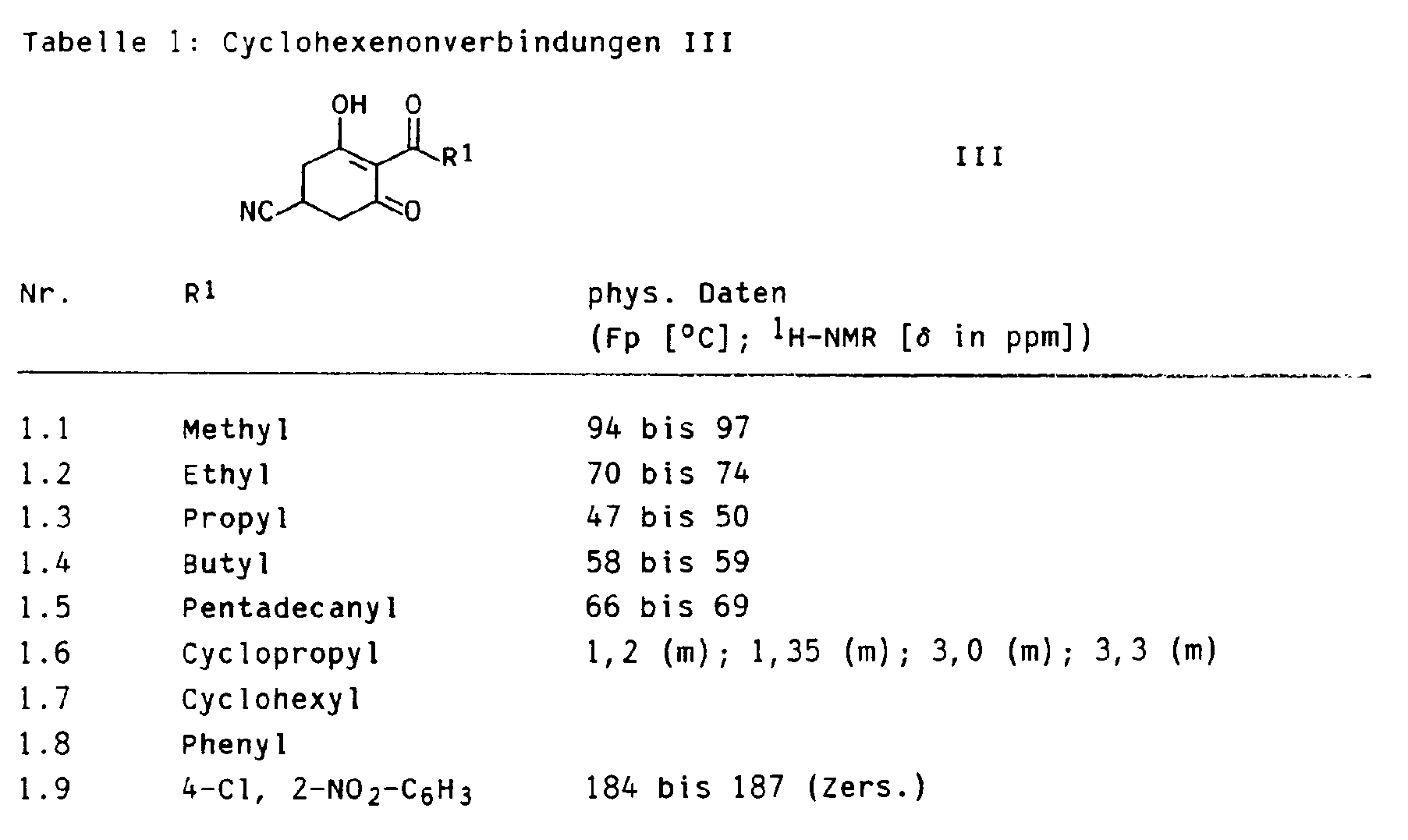
- the cyclohexenone compounds III shown in Table 1 can be prepared in an analogous manner.
- the imidothioesters V listed in Table 2 can be prepared analogously.
Landscapes
- Chemical & Material Sciences (AREA)
- Organic Chemistry (AREA)
- Organic Low-Molecular-Weight Compounds And Preparation Thereof (AREA)
Description
- Die Erfindung betrifft die Herstellung von Cyclohexantrioncarbonsäurethiolestern der allgemeinen Formel I

in der
R¹ für C₁-C₂₀-Alkyl, C₂-C₂₀-Alkenyl, C₂-C₂₀-Alkinyl oder C₃-C₆-Cycloalkyl, jeweils unsubstituiert oder durch Halogen, C₁-C₄-Alkyloxy, C₁-C₄-Alkylthio substituiert, Benzyl oder Phenyl jeweils unsubstituiert oder substituiert durch Halogen, Cyano, C₁-C₄-Alkyl, C₁-C₄-Alkoxy, C₁-C₄-Halogenalkyl oder Nitro und
R² für Wasserstoff, C₁-C₆-Alkyl, C₂-C₆-Alkenyl, C₂-C₆-Alkinyl und C₃-C₆-Cycloalkyl, jeweils unsubstituiert oder durch C₁-C₄-Alkoxy, C₁-C₄-Alkylthio, C₁-C₄-Dialkylamino, Hydroxy, Halogen substituiert; Benzyl oder Phenyl, jeweils unsubstituiert oder substituiert durch Halogen, Cyano, C₁-C₄-Alkyl, C₁-C₄-Alkoxy oder Nitro
stehen. - Weiterhin werden erfindungsgemäß neue Zwischenprodukte zur Verfügung gestellt.
- Cyclohexantrioncarbonsäurethiolester I sind hochwirksame Bioregulatoren wie aus EP-A 293 817 hervorgeht. Zur Darstellung von Thiolestern stehen verschiedene Möglichkeiten zur Verfügung. Einige Methoden sind im folgenden dargestellt.
- Aus Carbonsäuren mit Thiolen unter Carbonylaktivierung. Als aktivierende Reagenzien kommen z.B. Diphenylphosphinsäure-chlorid (Monatsh. Chem. 110, 759 (1979)), Phosphorsäure-cyaniddiethylester (Tetrahedron Lett. 1973, 1595)). Carbonyl-bis-imidazolid und Carbonyl-bis-triazolid (Angew. Chem. 89, 251 (1977); J. Am. Chem. Soc. 93, 1419 (1971)) in Frage.
- Aus Carbonsäurehalogeniden, -anhydriden und -estern mit Thiolen bzw. Thiolaten gegebenenfalls in Gegenwart einer Base (Houben-Weyl, Methoden der organischen Chemie, Bd 9, Seiten 753-760, 1955).
- Durch radikalische Substitution an Aldehyden mit organischen Disulfiden unter UV-Licht-Katalyse bzw. mit Radikalstartern wie Azobisisobutyronitril (Bull. Chem. Soc. Jpn. 53, 1982 (1980)).
- Alle diese Verfahren weisen einen oder mehrere schwerwiegende Nachteile auf. Gemäß Weg A werden teure oder schwer zugängliche Aktivierungsreagenzien, die eine kommerzielle Nutzung ausschließen, verwendet. Gemäß Weg C wird die Aldehydkomponente in hohem Überschuß bzw. als Lösungsmittel verwendet, wodurch das Verfahren bei teuren Aldehyden unwirtschaftlich ist.
- Weg B, die Umsetzung mit Säurehalogeniden bzw. -anhydriden, ist eine Standardmethode zur Herstellung von Thiolestern. Bei den vorliegenden Cyclohexantrionen besteht aber die Gefahr, daß mit den gängigen Halogenierungsreagenzien, wie Thionylchlorid, Phosphoroxychlorid, Sulfurylchlorid, Oxalylchlorid oder Phosgen, auch die vinylische OH-Funktion gegen Halogen z.B. Chlor, Brom, ausgetauscht wird.
- Aus der Literatur ist ferner bekannt, daß sich Mercaptane in Gegenwart von Chlorwasserstoff an Nitrile addieren. Die dabei entstehenden Imino-thiocarbonsäure-S-ester können zu Thiocarbonsäure-S-estern hydrolysiert werden (A. Pinner, Die Iminoether, S. 80 Verlag R. Oppenheim, Berlin 1892). Wegen der konkurrierenden Hydrolyse zu Carbonsäureamiden bzw. Carbonsäuren werden aber im allgemeinen nur mäßige Ausbeuten von ca. 10 bis 25 % erzielt (siehe z.B. US 2 458 075 (1946) Philipps Petrol Co, Erfinder: Ch. M. Himel, CA 43, 3444 (1949) oder Ber. Dt. Chem. Ges. 69, 2352 (1936)), weshalb dieser Reaktionsfolge keine präparative Bedeutung zugemessen wird (Houben-Weyl, Methoden der organischen Chemie, E5/I S. 876, 1985).
- Der Erfindung lag nun die Aufgabe zugrunde, ein Verfahren zur Herstellung der eingangs definierten Cyclohexantrioncarbonsäurethiolester I zu finden, das einfach und im technischen Maßstab durchführbar ist, das Wertprodukt I in guten Ausbeuten liefert und wenige Verfahrensstufen erfordert.
- Demgemäß wurde ein Verfahren zur Herstellung von Cyclohexantrioncarbonsäurethiolestern der Formel I

in der
R¹ für C₁-C₂₀-Alkyl, C₂-C₂₀-Alkenyl, C₂-C₂₀-Alkinyl oder C₃-C₆-Cycloalkyl, jeweils unsubstituiert oder durch Halogen, C₁-C₄-Alkyloxy, C₁-C₄-Alkylthio substituiert, Benzyl oder Phenyl jeweils unsubstituiert oder substituiert durch Halogen, Cyano, C₁-C₄-Alkyl, C₁-C₄-Alkoxy, C₁-C₄-Halogenalkyl oder Nitro und
R² für Wasserstoff, C₁-C₆-Alkyl, C₂-C₆-Alkenyl, C₂-C₆-Alkinyl und C₃-C₆-Cycloalkyl, jeweils unsubstituiert oder durch C₁-C₄-Alkoxy, C₁-C₄-Alkylthio, C₁-C₄-Dialkylamino, Hydroxy, Halogen substituiert; Benzyl oder Phenyl, jeweils unsubstituiert oder substituiert durch Halogen, Cyano, C₁-C₄-Alkyl, C₁-C₄-Alkoxy oder Nitro
stehen; gefunden, das dadurch gekennzeichnet ist, daß man in einer ersten Stufe eine Verbindung der allgemeinen Formel II
in der R¹ die oben angegebene Bedeutung hat, mit Hydroxylamin oder Hydroxylamin-O-sulfonsäure in einem inerten Lösungsmittel bei Temperaturen von 0 bis 150°C zu Verbindungen der allgemeinen Formel III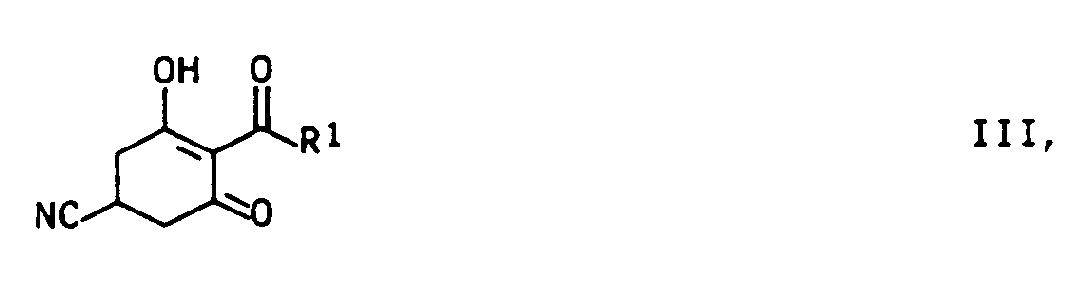
in der R¹ die oben angegebene Bedeutung hat, umsetzt,
in einer zweiten Stufe diese Cyanoverbindungen der Formel III dann mit einem Mercaptan der allgemeinen Formel IV
R²-SH IV
in der R² die oben angegebene Bedeutung hat, in Gegenwart einer Säure HX, zu einer Verbindung der allgemeinen Formel V
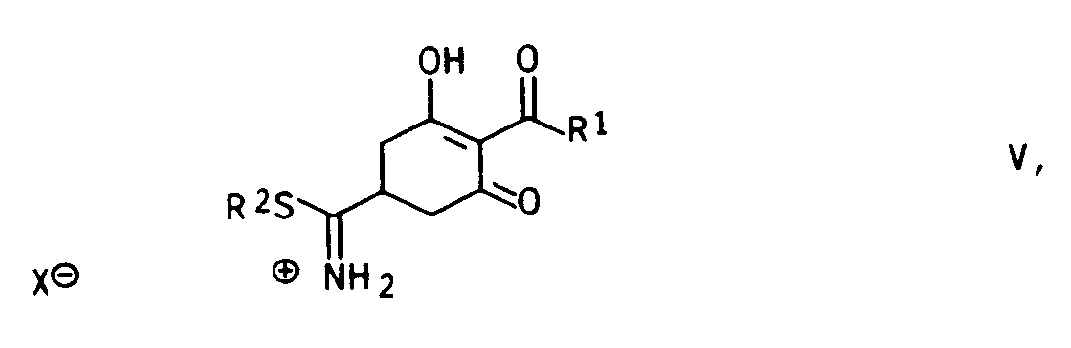
in der R¹ und R² die oben angegebene Bedeutung haben und X für einen Säurerest steht, umsetzt und
in einer dritten Stufe die Verbindungen der Formel V durch Hydrolyse in die Verbindungen der allgemeinen Formel I überführt. - Die Reaktionssequenz des erfindungsgemäßen Verfahrens ist anhand des folgenden Schemas dargestellt; wobei für R¹ Methyl, für R² Ethyl und als Säure in der zweiten Verfahrensstufe Chlorwasserstoff gewählt wurde.
-


- In der ersten Verfahrensstufe wird die Formylverbindung II, die wie in DE-A 233 568 beschrieben, zugänglich ist, mit Hydroxylamin-O-sulfonsäure oder Hydroxylamin unter Kondensationsbedingungen in einem inerten Lösungsmittel bei Temperaturen von 0 bis 150, insbesondere 20 bis 80°C, umgesetzt. Als besonders günstig hat es sich erwiesen, die Umsetzung mit Hydroxylamin-O-sulfonsäure in Wasser, z.B. mit 1 bis 100 Gew.-Teilen Wasser, bezogen auf die Formylverbindung II, vorzunehmen.
- Die Umsetzung kann in homogener oder heterogener wäßriger Phase, ggf. unter Zusatz eines Puffers, durchgeführt werden, wobei der pH-Bereich im allgemeinen bei 1 bis 9, insbesondere 3 bis 8, liegt.
- Zweckmäßigerweise verfährt man in der Weise, daß man die Formylverbindung II in Wasser suspendiert oder durch Zusatz eines wassermischbaren organischen Lösungsmittels wie z.B. Methanol, Ethanol in Lösung bringt. Es ist auch möglich, den Ausgangsstoff II in wassernichtmischbaren Lösungsmitteln wie Ethern, z.B. Diethylether; chlorierten Kohlenwasserstoffen wie Methylenchlorid, Chloroform, Dichlorethan; Estern wie Essigester oder aromatischen Verbindungen wie Benzol, Toluol, Xylole zu lösen. Zu der Mischung aus Lösungsmittel und Ausgangsstoff II gibt man die Hydroxylamin-O-sulfonsäure in fester Form oder als wäßrige Lösung.
- Wenn die Umsetzung in heterogener Phase vorgenommen wird, ist es vorteilhaft für eine intensive Durchmischung der Phasen zu sorgen.
- Um eine vollständige Umsetzung zur Cyanoverbindung III zu erreichen, empfiehlt es sich die Reaktionskomponenten in äquimolaren Mengen einzusetzen. Aus verfahrenstechnischen Gründen kann es ratsam sein die Formylverbindung II oder die Hydroxylamin-O-sulfonsäure im Überschuß z.B. von 1 bis 100 Mol.% einzusetzen. Vorzugsweise verwendet man die Hydroxylamin-O-sulfonsäure in einem Überschuß von 10 bis 20 Mol.%.
- In der Regel sind Reaktionstemperaturen bis 60°C, insbesondere 20 bis 40°C, für eine vollständige Umsetzung ausreichend.
- In manchen Fällen kann es vorteilhaft sein, die Reaktion durch Zugabe katalytischer Mengen einer Base zu beschleunigen.
- Geeignete Basen sind z.B. Alkalihydroxide wie NaOH oder KOH, Ammoniumhydroxid, Erdalkalihydroxide wie Magnesiumhydroxid oder Calciumhydroxid, Alkalicarbonate oder Alkalihydrogencarbonate wie Kaliumcarbonat oder Natriumhydrogencarbonat. Üblicherweise können Basenmengen von 0 bis 3 Äquvivalenten, bezogen auf den Ausgangsstoff II, verwendet werden.
- Die Umsetzung kann bei Normaldruck, Über- oder Unterdruck, kontinuierlich oder diskontinuierlich nach den dafür üblichen Techniken durchgeführt werden.
- Die Isolierung der Cyanocyclohexenonverbindung III aus dem rohen Reaktionsgemisch kann in üblicher Weise, z.B. durch Extraktion oder Filtration erfolgen.
- Anstelle von Hydroxylamin-O-sulfonsäure kann man auch Hydroxylamin mit dem Ausgangsstoff II umsetzen und anschließend in üblicher Weise, z.B. durch erhitzen mit Essigsäureanhydrid oder Thionylchlorid bei Temperaturen von ca. 80 bis 150°C Wasser eliminieren.
- In der zweiten Verfahrensstufe wird unter Wasserausschluß das Cyanocyclohexantrion III mit einem Mercaptan R²-SH IV in Gegenwart einer wasserfreien Säure umgesetzt. Solche Säuren sind z.B. Chlorwasserstoff, Bromwasserstoffsäure, Schwefelsäure, Perchlorsäure oder Tetrafluorborsäure oder starke Carbonsäuren wie Trifluoressigsäure. Besonders bevorzugt sind Bromwasserstoff und insbesondere Chlorwasserstoff.
- Um eine vollständige Umsetzung zu erreichen, ist es sinnvoll das Mercaptan IV und die Cyanoverbindung III in äquimolaren Mengen einzusetzen. Aus verfahrenstechnischen Gründen kann es vorteilhaft sein, eine der beiden Komponenten im Überschuß einzusetzen. Vorzugsweise wird das Mercaptan in einem Überschuß von 0 bis 200 Mol.%, bevorzugt von 5 bis 100 Mol.% verwendet.
- Bevorzugte Reste R² im Mercaptan sind: Methyl, Ethyl, Propyl, i-Propyl, t-Butyl, n-Hexyl, Allyl, Butenyl, Methoxyethyl, 3-Chlorpropyl, 2-Dimethylaminoethyl, 2-Hydroxyethyl, Cyclohexyl, Benzyl, 4-Methylbenzyl, 4-Chlorbenzyl, Phenyl, p-Tolyl, 4-Chlorphenyl, 4-Methoxyphenyl, 3-Nitrophenyl.
- Die Umsetzung der Cyanocyclohexantrionverbindung III mit dem Mercaptan IV wird zweckmäßigerweise in einem aprotischen organischen Verdünnungsmittel durchgeführt. Hierfür geeignet sind z.B. Ether wie Diethylether, Tetrahydrofuran, Dioxan; Kohlenwasserstoffe wie Pentan, Hexan, Cyclohexan, Petrolether, Benzol, Toluol; halogenierte Kohlenwasserstoffe wie Methylenchlorid, Chloroform, Tetrachlorkohlenstoff, 1,2-Dichlorethan.
- Die Umsetzung kann in einem Temperaturbereich von -20°C bis 100°C vorzugsweise zwischen 0°C und +40°C bei Normaldruck, Über- oder Unterdruck nach den dafür üblichen Techniken durchgeführt werden.
- Zweckmäßigerweise führt man die Umsetzung in der Form durch, daß man die Cyanocyclohexantrionverbindung III zusammen mit dem Mercaptan IV im Verdünnungsmittel unter weitgehendem Ausschluß von Wasser vorlegt und die Säure bei tiefer Temperatur, z.B. 0°C hinzutropft oder gasförmig einleitet. Zur Vervollständigung der Umsetzung kann dann auf höhere Temperaturen, z.B. 20 bis 40°C erwärmt werden.
- Die Isolierung des Imido-thioester-salzes V, welches sich im allgemeinen kristallin oder als Öl abscheidet, kann in an sich bekannter Weise, z.B. durch Filtration oder Extraktion, erfolgen. Ist man an der Isolierung der Zwischenprodukte V nicht interessiert, so können diese durch wäßrige Extraktion bei gleichzeitiger Hydrolyse in die Endprodukte I überführt werden.
- Die Hydrolyse der Zwischenprodukte V kann in Wasser, vorzugsweise in Gegenwart einer Säure oder bevorzugt in verdünnter wäßriger Mineralsäure z.B. Salzsäure, Schwefelsäure, Phosphorsäure oder verdünnten Carbonsäuren wie Essigsäure oder Ameisensäure vorgenommen werden.
- Die Säuremenge ist nicht besonders kritisch und liegt im allgemeinen bei 0 bis 100 Gew.-teile Säure, bezogen auf V. Die Konzentration der Säure liegt zwischen 0 und 20 Gew.-%, bevorzugt werden wäßrige Lösungen mit 0 bis 10 Gew.-% Säure verwendet. Bevorzugt liegt der pH-Wert des Reaktionsgemisches bei 1 bis 7, insbesondere unter 2.
- Die Reaktionstemperaturen sind ebenfalls wenig kritisch und liegen in der Regel bei 0 bis 100, insbesondere 10 bis 40°C.
- Da die Thiolester der allgemeinen Formel I, in Wasser nicht löslich sind (Löslichkeit 100 mg/l), fallen sie nach der Hydrolyse von V als Öl oder Feststoff an. Durch Zugabe eines mit Wasser nichtmischbaren Lösungsmittels wie Ether z.B. Diethylether; Ester z.B. Essigester; chlorierte Kohlenwasserstoffe z.B. Methylenchlorid, Chloroform, Tetrachlorkohlenstoff, Dichlorethan; aromatische Kohlenwasserstoffe z.B. Benzol, Toluol, Xylole kann die Hydrolyse in einem Zweiphasensystem ablaufen, was vorteilhaft dazu führt, daß das Reaktionsprodukt I direkt aus der organischen Phase isoliert werden kann. Natürlich ist es auch möglich, erst im Anschluß an die Hydrolyse dem Reaktionsgemisch organische Lösungsmittel zur Isolierung von I zuzusetzen.
- Im übrigen weist das Verfahren, welches auch als Eintopfverfahren ohne Isolierung der beschriebenen Zwischenprodukte III und V durchgeführt werden kann, keine verfahrenstechnischen Besonderheiten auf.
- Erfindungsgemäß werden neue Zwischenprodukte V zur Verfügung gestellt.
- Die Cyclohexantrionimidothioestersalze V werden durch folgende Formel charakterisiert:

in der - R¹
- für C₁-C₂₀-Alkyl, C₂-C₂₀-Alkenyl, C₂-C₂₀-Alkinyl oder C₃-C₆-Cycloalkyl, jeweils unsubstituiert oder durch Halogen, C₁-C₄-Alkyloxy, C₁-C₄-Alkylthio substituiert, Benzyl oder Phenyl jeweils unsubstituiert oder substituiert durch Halogen, Cyano, C₁-C₄-Alkyl, C₁-C₄-Alkoxy, C₁-C₄-Halogenalkyl oder Nitro;
- R²
- für Wasserstoff, C₁-C₆-Alkyl, C₂-C₆-Alkenyl, C₂-C₆-Alkinyl und C₃-C₆-Cycloalkyl, jeweils unsubstituiert oder durch C₁-C₄-Alkoxy, C₁-C₄-Alkylthio, C₁-C₄-Dialkylamino, Hydroxy, Halogen substituiert; Benzyl oder Phenyl, jeweils unsubstituiert oder substituiert durch Halogen, Cyano, C₁-C₄-Alkyl, C₁-C₄-Alkoxy oder Nitro und
- X
- für einen Säurerest aus der Gruppe Chlorid, Bromid, Sulfat, Phosphat, Tetrafluoroborat, Perchlorat und Trifluoracetat
- Im Hinblick auf die biologische Wirksamkeit der Endprodukte I haben in Formel V die Substituenten R¹ und R² sowie X die folgende bevorzugte Bedeutung:
- R¹
- - C₁-C₆-Alkyl wie Methyl, Ethyl, Propyl, Isopropyl, n-Butyl, iso-Butyl, s-Butyl, t-Butyl, n-Pentyl, n-Hexyl
- C₃- bis C₆-Cycloalkyl wie Cyclopropyl, Cyclopentyl, Cyclohexyl
- C₂- bis C₆-Alkoxyalkyl, z.B. C₁-C₄-Alkoxy-C₁-C₄-Alkyl wie Methoxymethyl, Ethoxymethyl, Propyloxymethyl, 2-Methoxyethyl, 2-Ethoxyethyl, 2-Propyloxyethyl, Methoxypropyl, Ethoxypropyl,
- C₂- bis C₆-Alkylthioalkyl z.B. Methylthiomethyl, Ethylthiomethyl, Methylthioethyl, Ethylthioethyl, Methylthiopropyl, Ethylthiopropyl,
- Benzyl oder Phenyl, wobei die aromatischen Kerne ggf. ein- bis dreifach durch Halogen wie Chlor, Brom, Fluor, durch Cyano, Nitro, C₁-C₄-Alkyl wie Methyl, Ethyl, Propyl oder Butyl, C₁-C₄-Alkoxy wie Methoxy, Ethoxy, Propoxy oder Butoxy; C₁-C₄-Halogenalkyl wie Trifluormethyl, Difluorchlormethyl, Difluormethyl, Trichlormethyl, Tetrafluorethyl substituiert sind, - R²
- - C₁-C₆-Alkyl wie Methyl, Ethyl, Propyl, iso-Propyl, n-Butyl, iso-Butyl, sec.-Butyl, n-Pentyl und n-Hexyl,
- C₃-C₅-Alkenyl wie Allyl, But-2-enyl oder But-3-enyl, Pent-2-enyl,
- C₃- oder C₄-Alkinyl wie Propargyl, But-2-inyl, But-3-inyl,
- C₃-C₆-Cycloalkyl wie für R¹ genannt,
- C₂-C₆-Alkoxyalkyl oder Alkylthioalkyl jeweils wie für R¹ genannt,
- Phenyl oder Benzyl, wobei die aromatischen Kerne wie für R¹ genannt substituiert sein können; - X
- - Chlorid oder Bromid
- Besonders bevorzugt stehen R¹ für C₁-C₄-Alkyl, C₃-C₆-Cycloalkyl oder Phenyl, R² für C₁-C₆-Alkyl, C₃-C₄-Alkenyl, C₃-C₄-Alkinyl, C₂-C₆-Alkoxyalkyl oder Benzyl und X für Chlorid.
- 19,3 g (0,11 Mol) 5-Formyl-2-acetyl-cyclohexan-1,3-dion wurden in 200 ml destilliertem Wasser vorgelegt und bei Raumtemperatur mit 14,7 g (0,13 Mol) Hydroxylamin-O-sulfonsäure versetzt. Anschließend wurde 17 h bei Raumtemperatur nachgerührt. Der Niederschlag wurde abgesaugt, mit Wasser gewaschen und getrocknet. Es wurden 11,5 g (61 % d. Th.) 3,5-Dioxo-4-acetyl-cyclohexancarbonsäurenitril erhalten (Fp. 94 bis 97°C).
- 30,7 g (0,16 Mol) 5-Formyl-2-propionyl-cyclohexan-1,3-dion wurden in 150 ml destilliertem Wasser vorgelegt und bei Raumtemperatur mit 21,0 g (0,19 Mol) Hydroxylamin-O-sulfonsäure versetzt. Anschließend wurde über Nacht bei Raumtemperatur nachgerührt. Der Niederschlag wurde abgesaugt, mit Wasser gewaschen und getrocknet. Es wurden 23,8 g (71 % d. Th.) 3,5-Dioxo-4-propionyl-cyclohexancarbonsäurenitril erhalten (Fp. 70 bis 74°C).
- 43 g (0,12 Mol) 5-Formyl-2-palmitoyl-cyclohexan-1,3-dion wurden in 150 ml destilliertem Wasser suspendiert. Hierzu gab man 15,7 g (0,14 Mol) Hydroxylamin-O-sulfonsäure, gelöst in 50 ml Wasser. Das heterogene Reaktionsgemisch wurde über Nacht bei Raumtemperatur gerührt. Der erhaltene Feststoff wurde abgesaugt, mit Wasser gewaschen und getrocknet. Es wurden 37,7 g (86 % d. Th.) 3,5-Dioxo-4-palmitoyl-cyclohexancarbonsäurenitril isoliert (Fp. 66 bis 69°C).
- Die in Tabelle 1 dargestellten Cyclohexenonverbindungen III lassen sich auf analogem Wege herstellen.
- 5,0 g (0,026 Mol) 3,5-Dioxo-4-propionyl-cyclohexancarbonsäurenitril und 1,37 g (0,028 Mol) Methylmercaptan wurden in 100 ml trockenem Diethylether gelöst. Nach dem Abkühlen auf 0°C wurde ein kräftiger, trockener Chlorwasserstoffstrom durch die Lösung geleitet. Nach 0,5 h wurde der Gasstrom abgestellt und das Reaktionsgemisch langsam auf Raumtemperatur erwärmt. Erneut wurde auf 0°C abgekühlt, Chlorwasserstoff eingeleitet (0,5 h), danach die Kühlung entfernt und über Nacht stehen gelassen. Die abgeschiedenen Kristalle wurden abgesaugt und im Vakuum getrocknet: 5,4 g (74 % d. Th.) der Verbindung 2.1 [Fp. 161°C (Zers.)].
- 19,3 g (0,1 Mol) 3,5-Dioxo-4-propionyl-cyclohexancarbonsäurenitril und 6,5 g (0,105 Mol) Ethylmercaptan wurden in 800 ml trockenem Diethylether gelöst und wie in Beispiel 2.1 beschrieben mit Chlorwasserstoff umgesetzt. 20,7 g (71 % d. Th.) der Verbindung 2.2 [Fp. 180-185°C (Zers.)].
- 7,5 g (0,02 Mol) 3,5-Dioxo-4-palmitoyl-cyclohexancarbonsaurenitril und 1,86 g (0,03 Mol) Ethylmercaptan wurden in 150 ml trockenem Diethylether suspendiert. Nach dem Abkühlen auf 0°C wurde ein kräftiger, trockener Chlorwasserstoffstrom (konz. Schwefelsäure) durch die Suspension geleitet. Nach 0,5 h wird der Gasstrom abgestellt und das Reaktionsgemisch langsam auf Raumtemperatur erwärmt. Dann wurde erneut auf 0°C abgekühlt, Chlorwasserstoff eingeleitet, die Kühlung entfernt und nach insgesamt 6 h der Feststoff abfiltriert, mit Ether gewaschen und getrocknet: 7,3 g (77 % d. Th.) der Verbindung 2.3 [Fp. 65-68 (Zers.)].
- Analog können die in Tabelle 2 aufgeführten Imidothioester V hergestellt werden.

- 2,8 g (0,01 Mol) der Verbindung 2.1 wurden in 50 ml 10 %iger Salzsäure gelöst und über Nacht bei Raumtemperatur gerührt. Der weipe Niederschlag wurde abfiltriert, mit Wasser gewaschen und im Vakuum getrocknet: 1,95 g (80 % d. Th.) der Verbindung 3.1 (Fp. 81°C).
- 5,8 g (0,02 Mol) von Verbindung 2.2 wurden in 100 ml 10 %iger Salzsäure gelöst und über Nacht bei Raumtemperatur gerührt. Der weiße Niederschlag wurde abfiltriert, mit Wasser gewaschen und im Vakuum getrocknet: 4,1 g (80 % d. Th.) der Verbindung 3.2 (Fp. 70°C).
- 3,0 g (6,3 mmol) der Verbindung 2.3 wurden in 50 ml Wasser suspendiert und über Nacht bei Raumtemperatur kräftig gerührt. Der Feststoff wurde abfiltriert, mit Wasser gewaschen und im Vakuum getrocknet: 2,4 g (86 % d. Th.) der Verbindung 3.3 (Fp. 56-58°C).
- Die in der nachfolgenden Tabelle 3 aufgeführten Verbindungen I wurden analog hergestellt.

stehen.
Claims (10)
- Verfahren zur Herstellung von Cyclohexantrioncarbonsäurethiolestern der allgemeinen Formel I

R¹ für C₁-C₂₀-Alkyl, C₂-C₂₀-Alkenyl, C₂-C₂₀-Alkinyl oder C₃-C₆-Cycloalkyl, jeweils unsubstituiert oder durch Halogen, C₁-C₄-Alkyloxy, C₁-C₄-Alkylthio substituiert, Benzyl oder Phenyl jeweils unsubstituiert oder substituiert durch Halogen, Cyano, C₁-C₄-Alkyl, C₁-C₄-Alkoxy, C₁-C₄-Halogenalkyl oder Nitro und
R² für Wasserstoff, C₁-C₆-Alkyl, C₂-C₆-Alkenyl, C₂-C₆-Alkinyl und C₃-C₆-Cycloalkyl, jeweils unsubstituiert oder durch C₁-C₄-Alkoxy, C₁-C₄-Alkylthio, C₁-C₄-Dialkylamino, Hydroxy, Halogen substituiert; Benzyl oder Phenyl, jeweils unsubstituiert oder substituiert durch Halogen, Cyano, C₁-C₄-Alkyl, C₁-C₄-Alkoxy oder Nitro
stehen; dadurch gekennzeichnet, daß man in einer ersten Stufe eine Verbindung der allgemeinen Formel II

in einer zweiten Stufe diese Cyanoverbindungen der Formel III dann mit einem Mercaptan der allgemeinen Formel IV
R²-SH IV
in der R² die oben angegebene Bedeutung hat, in Gegenwart einer wasserfreien Säure HX, zu einer Verbindung der allgemeinen Formel V
in einer dritten Stufe die Verbindungen der Formel V durch Hydrolyse in die Verbindungen der allgemeinen Formel I überführt. - Verfahren nach Anspruch 1, dadurch gekennzeichnet, daß man in der ersten Verfahrensstufe Verbindung I mit Hydroxylamin-O-sulfonsäure in homogener oder heterogener wäßriger Phase in einem pH-Bereich von 1 bis 9 umsetzt.
- Verfahren nach den Ansprüchen 1 und 2, dadurch gekennzeichnet, daß man die Umsetzung mit Hydroxylamin-O-sulfonsäure in einem pH-Bereich von 3 bis 8 vornimmt.
- Verfahren nach den Ansprüchen 1 bis 3, dadurch gekennzeichnet, daß die Umsetzungstemperatur in der ersten Verfahrensstufe 20 bis 80°C beträgt.
- Verfahren nach Anspruch 1, dadurch gekennzeichnet, daß man als Säure in der zweiten Verfahrensstufe Chlorwasserstoff oder Bromwasserstoff verwendet.
- Verfahren nach den Ansprüchen 1 und 5, dadurch gekennzeichnet, daß man die Umsetzung der zweiten Verfahrensstufe bei einer Temperatur von -20 bis 100°C vornimmt.
- Verfahren nach Anspruch 1, dadurch gekennzeichnet, daß man die Hydrolyse der Verbindung V bei einem pH zwischen 1 und 7 und einer Temperatur von 0 bis 100°C durchführt.
- Verfahren nach den Ansprüchen 1 bis 8, dadurch gekennzeichnet, daß man die Verfahrensstufen 1 bis 3 ohne Isolierung der Zwischenverbindungen III und V durchführt.
- Cyclohexantrionverbindungen der allgemeinen Formel V
 R¹ für C₁-C₂₀-Alkyl, C₂-C₂₀-Alkenyl, C₂-C₂₀-Alkinyl oder C₃-C₆-Cycloalkyl, jeweils unsubstituiert oder durch Halogen, C₁-C₄-Alkyloxy, C₁-C₄-Alkylthio substituiert, Benzyl oder Phenyl jeweils unsubstituiert oder substituiert durch Halogen, Cyano, C₁-C₄-Alkyl, C₁-C₄-Alkoxy, C₁-C₄-Halogenalkyl oder Nitro;R² für Wasserstoff, C₁-C₆-Alkyl, C₂-C₆-Alkenyl, C₂-C₆-Alkinyl und C₃-C₆-Cycloalkyl, jeweils unsubstituiert oder durch C₁-C₄-Alkoxy, C₁-C₄-Alkylthio, C₁-C₄-Dialkylamino, Hydroxy, Halogen substituiert; Benzyl oder Phenyl, jeweils unsubstituiert oder substituiert durch Halogen, Cyano, C₁-C₄-Alkyl, C₁-C₄-Alkoxy oder Nitro undX für einen Säurerest aus der Gruppe Chlorid, Bromid, Sulfat, Phosphat, Tetrafluoroborat, Perchlorat und Trifluoracetatstehen.
 - Cyclohexantrionverbindungen der allgemeinen Formel V gemäß Anspruch 9, in derR¹ für C₁-C₄-Alkyl, C₃-C₆-Cycloalkyl, C₂-C₆-Alkoxyalkyl, C₂-C₆-Alkylthioalkyl, Benzyl oder Phenyl unsubstituiert oder ein- bis dreifach substituiert durch Halogen, Cyano, C₁-C₄-Alkyl, C₁-C₄-Alkoxy, C₁-C₄-Halogenalkyl oder Nitro;R² für C₁-C₆-Alkyl, C₃-C₅-Alkenyl, C₃-C₄-Alkinyl, C₃-C₆-Cycloalkyl, C₂-C₆-Alkoxyalkyl, C₂-C₆-Alkylthioalkyl, Benzyl oder Phenyl unsubstituiert oder ein- bis dreifach substituiert durch Halogen, Cyano, C₁-C₄-Alkyl, C₁-C₄-Alkoxy oder Nitro undX für Chlorid oder Bromidstehen.
Priority Applications (1)
| Application Number | Priority Date | Filing Date | Title |
|---|---|---|---|
| AT90118944T ATE99293T1 (de) | 1989-10-13 | 1990-10-04 | Verfahren zur herstellung von cyclohexantrioncarbonsaeurethiolestern und neue zwischenprodukte. |
Applications Claiming Priority (2)
| Application Number | Priority Date | Filing Date | Title |
|---|---|---|---|
| DE3934205 | 1989-10-13 | ||
| DE3934205A DE3934205A1 (de) | 1989-10-13 | 1989-10-13 | Verfahren zur herstellung von cyclohexantrioncarbonsaeurethiolestern und neue zwischenprodukte |
Publications (2)
| Publication Number | Publication Date |
|---|---|
| EP0422493A1 EP0422493A1 (de) | 1991-04-17 |
| EP0422493B1 true EP0422493B1 (de) | 1993-12-29 |
Family
ID=6391400
Family Applications (1)
| Application Number | Title | Priority Date | Filing Date |
|---|---|---|---|
| EP90118944A Expired - Lifetime EP0422493B1 (de) | 1989-10-13 | 1990-10-04 | Verfahren zur Herstellung von Cyclohexantrioncarbonsäurethiolestern und neue Zwischenprodukte |
Country Status (11)
| Country | Link |
|---|---|
| US (1) | US5130453A (de) |
| EP (1) | EP0422493B1 (de) |
| JP (1) | JP2806440B2 (de) |
| KR (1) | KR0162645B1 (de) |
| AT (1) | ATE99293T1 (de) |
| CA (1) | CA2026410C (de) |
| DE (2) | DE3934205A1 (de) |
| DK (1) | DK0422493T3 (de) |
| ES (1) | ES2062245T3 (de) |
| HU (1) | HU205897B (de) |
| TW (1) | TW198016B (de) |
Families Citing this family (1)
| Publication number | Priority date | Publication date | Assignee | Title |
|---|---|---|---|---|
| CN116813516B (zh) * | 2023-05-23 | 2025-07-18 | 浙江理工大学 | 一种羰基化制备α,β-不饱和硫酯化合物的方法 |
Family Cites Families (3)
| Publication number | Priority date | Publication date | Assignee | Title |
|---|---|---|---|---|
| US2458075A (en) * | 1946-01-10 | 1949-01-04 | Phillips Petroleum Co | Process for preparation of thiolesters |
| NZ207964A (en) * | 1983-05-06 | 1987-03-31 | Ici Australia Ltd | 5-heteroaryl-cyclohexane-1,3-dione derivatives |
| DE3718899A1 (de) * | 1987-06-05 | 1988-12-22 | Basf Ag | Cyclohexenonverbindungen, ein verfahren zu ihrer herstellung sowie ihre verwendung als herbizide oder das pflanzenwachstum regulierende mittel |
-
1989
- 1989-10-13 DE DE3934205A patent/DE3934205A1/de not_active Withdrawn
-
1990
- 1990-09-27 CA CA002026410A patent/CA2026410C/en not_active Expired - Fee Related
- 1990-10-03 US US07/592,298 patent/US5130453A/en not_active Expired - Fee Related
- 1990-10-04 TW TW079108297A patent/TW198016B/zh active
- 1990-10-04 DK DK90118944.9T patent/DK0422493T3/da active
- 1990-10-04 DE DE90118944T patent/DE59004022D1/de not_active Expired - Lifetime
- 1990-10-04 EP EP90118944A patent/EP0422493B1/de not_active Expired - Lifetime
- 1990-10-04 ES ES90118944T patent/ES2062245T3/es not_active Expired - Lifetime
- 1990-10-04 AT AT90118944T patent/ATE99293T1/de not_active IP Right Cessation
- 1990-10-12 JP JP2272479A patent/JP2806440B2/ja not_active Expired - Lifetime
- 1990-10-12 HU HU906442A patent/HU205897B/hu not_active IP Right Cessation
- 1990-10-13 KR KR1019900016375A patent/KR0162645B1/ko not_active Expired - Fee Related
Also Published As
| Publication number | Publication date |
|---|---|
| ATE99293T1 (de) | 1994-01-15 |
| HU205897B (en) | 1992-07-28 |
| TW198016B (de) | 1993-01-11 |
| KR0162645B1 (ko) | 1999-01-15 |
| DK0422493T3 (da) | 1994-01-24 |
| EP0422493A1 (de) | 1991-04-17 |
| JP2806440B2 (ja) | 1998-09-30 |
| HU906442D0 (en) | 1991-04-29 |
| CA2026410C (en) | 2002-04-16 |
| CA2026410A1 (en) | 1991-04-14 |
| DE59004022D1 (de) | 1994-02-10 |
| US5130453A (en) | 1992-07-14 |
| JPH03133953A (ja) | 1991-06-07 |
| ES2062245T3 (es) | 1994-12-16 |
| DE3934205A1 (de) | 1991-04-18 |
| HUT54980A (en) | 1991-04-29 |
| KR910007872A (ko) | 1991-05-30 |
Similar Documents
| Publication | Publication Date | Title |
|---|---|---|
| EP0595130A1 (de) | N-Phenylacetaminonitrile und ihre Verwendung des Zwischenprodukte zur Synthese von Insektiziden und Herbiziden 3-Aryl-pyrrolidin-2,4-dionen | |
| EP0293711A1 (de) | Verfahren zur Herstellung von 3-Cyano-4-aryl-pyrrolen | |
| DE3132332C2 (de) | ||
| EP0370391A2 (de) | Verfahren zur Herstellung von 4,5-Dichlor-6-ethylpyrimidin | |
| DE69632919T2 (de) | Verfahren zur herstellung von 2-chlor-5-chloromethyl-thiazol | |
| DE60314410T2 (de) | Verfahren zur herstellung von modafinil | |
| EP0132733A2 (de) | Neue Fluorpivalsäurefluoride und Verfahren zu ihrer Herstellung | |
| AT400717B (de) | Neue guanidin- und amidinsalze von 7-amino-3- hydroxymethyl-3-cephem-4-carbonsäure | |
| EP0564984B1 (de) | O-Iminooxymethylbenzoesäuren, Verfahren zu ihrer Herstellung und ihre Verwendung als Zwischenprodukte | |
| EP0187285B1 (de) | Verfahren zur Herstellung von substituierten Phenylhydrazinen | |
| EP0695744B1 (de) | Verfahren zur Herstellung von Cyanimino-1,3-thiazolidinen | |
| EP0422493A1 (de) | Verfahren zur Herstellung von Cyclohexantrioncarbonsäurethiolestern und neue Zwischenprodukte | |
| DE69524644T2 (de) | Verfahren zur Herstellung von Alkoxycarbonylthioarylverbindungen | |
| US4327033A (en) | Process for the production of methomyl oxime | |
| DD201792A5 (de) | Verfahren zur herstellung der 2,3,4,5-tetrahydro-1-benzoxepin-3,5-dion-derivate | |
| DE2143989C3 (de) | Verfahren zur Herstellung von 2-Methyl-pyridin-3-ol-Derivaten | |
| EP0500639B1 (de) | Verfahren zur herstellung von alkyl-[3-chlorphenyl]-sulfonen | |
| DD209443A5 (de) | Verfahren zur herstellung von acylaminoderivaten von 1-(aryl- oder subst.-aryl)amino-1-thioalkancarboxysaeuren | |
| EP0985668A1 (de) | Verfahren zur Herstellung von 1,3-Dimethyl-imidazolium-4-carboxylat | |
| EP1833814B1 (de) | Verfahren zur herstellung von substituierten 2-alkoxycarbonyl-3-aminothiophenen | |
| EP0150026A2 (de) | Chemisches Verfahren | |
| DE112020000596T5 (de) | Herstellungsverfahren für chlorbenzolverbindung | |
| EP0114289B1 (de) | Verfahren zur Herstellung von 2-Alkylthiomethyl-4-hydroxypyrimidinen | |
| DE69303352T2 (de) | Verfahren zur Herstellung 5-Pyrazolomerkaptan-Derivate und dessen zwischenprodukte | |
| EP0591763A1 (de) | Verwendung von Thioalkandionen als Aromastoffe |
Legal Events
| Date | Code | Title | Description |
|---|---|---|---|
| PUAI | Public reference made under article 153(3) epc to a published international application that has entered the european phase |
Free format text: ORIGINAL CODE: 0009012 |
|
| 17P | Request for examination filed |
Effective date: 19901227 |
|
| AK | Designated contracting states |
Kind code of ref document: A1 Designated state(s): AT BE CH DE DK ES FR GB GR IT LI NL SE |
|
| 17Q | First examination report despatched |
Effective date: 19921211 |
|
| GRAA | (expected) grant |
Free format text: ORIGINAL CODE: 0009210 |
|
| AK | Designated contracting states |
Kind code of ref document: B1 Designated state(s): AT BE CH DE DK ES FR GB GR IT LI NL SE |
|
| PG25 | Lapsed in a contracting state [announced via postgrant information from national office to epo] |
Ref country code: SE Effective date: 19931229 Ref country code: NL Effective date: 19931229 Ref country code: GR Free format text: LAPSE BECAUSE OF FAILURE TO SUBMIT A TRANSLATION OF THE DESCRIPTION OR TO PAY THE FEE WITHIN THE PRESCRIBED TIME-LIMIT Effective date: 19931229 |
|
| REF | Corresponds to: |
Ref document number: 99293 Country of ref document: AT Date of ref document: 19940115 Kind code of ref document: T |
|
| REG | Reference to a national code |
Ref country code: DK Ref legal event code: T3 |
|
| REF | Corresponds to: |
Ref document number: 59004022 Country of ref document: DE Date of ref document: 19940210 |
|
| ITF | It: translation for a ep patent filed | ||
| GBT | Gb: translation of ep patent filed (gb section 77(6)(a)/1977) |
Effective date: 19940114 |
|
| ET | Fr: translation filed | ||
| NLV1 | Nl: lapsed or annulled due to failure to fulfill the requirements of art. 29p and 29m of the patents act | ||
| PG25 | Lapsed in a contracting state [announced via postgrant information from national office to epo] |
Ref country code: DK Effective date: 19941004 Ref country code: AT Effective date: 19941004 |
|
| REG | Reference to a national code |
Ref country code: DK Ref legal event code: EBP |
|
| PLBE | No opposition filed within time limit |
Free format text: ORIGINAL CODE: 0009261 |
|
| STAA | Information on the status of an ep patent application or granted ep patent |
Free format text: STATUS: NO OPPOSITION FILED WITHIN TIME LIMIT |
|
| REG | Reference to a national code |
Ref country code: ES Ref legal event code: FG2A Ref document number: 2062245 Country of ref document: ES Kind code of ref document: T3 |
|
| 26N | No opposition filed | ||
| PGFP | Annual fee paid to national office [announced via postgrant information from national office to epo] |
Ref country code: ES Payment date: 19991013 Year of fee payment: 10 |
|
| PG25 | Lapsed in a contracting state [announced via postgrant information from national office to epo] |
Ref country code: ES Free format text: LAPSE BECAUSE OF NON-PAYMENT OF DUE FEES Effective date: 20001005 |
|
| REG | Reference to a national code |
Ref country code: GB Ref legal event code: IF02 |
|
| PGFP | Annual fee paid to national office [announced via postgrant information from national office to epo] |
Ref country code: FR Payment date: 20020920 Year of fee payment: 13 |
|
| PGFP | Annual fee paid to national office [announced via postgrant information from national office to epo] |
Ref country code: CH Payment date: 20020930 Year of fee payment: 13 |
|
| PGFP | Annual fee paid to national office [announced via postgrant information from national office to epo] |
Ref country code: GB Payment date: 20021003 Year of fee payment: 13 |
|
| PGFP | Annual fee paid to national office [announced via postgrant information from national office to epo] |
Ref country code: BE Payment date: 20021022 Year of fee payment: 13 |
|
| PGFP | Annual fee paid to national office [announced via postgrant information from national office to epo] |
Ref country code: DE Payment date: 20021116 Year of fee payment: 13 |
|
| PG25 | Lapsed in a contracting state [announced via postgrant information from national office to epo] |
Ref country code: GB Free format text: LAPSE BECAUSE OF NON-PAYMENT OF DUE FEES Effective date: 20031004 |
|
| PG25 | Lapsed in a contracting state [announced via postgrant information from national office to epo] |
Ref country code: LI Free format text: LAPSE BECAUSE OF NON-PAYMENT OF DUE FEES Effective date: 20031031 Ref country code: CH Free format text: LAPSE BECAUSE OF NON-PAYMENT OF DUE FEES Effective date: 20031031 Ref country code: BE Free format text: LAPSE BECAUSE OF NON-PAYMENT OF DUE FEES Effective date: 20031031 |
|
| PG25 | Lapsed in a contracting state [announced via postgrant information from national office to epo] |
Ref country code: DE Free format text: LAPSE BECAUSE OF THE APPLICANT RENOUNCES Effective date: 20031117 |
|
| REG | Reference to a national code |
Ref country code: ES Ref legal event code: FD2A Effective date: 20011113 |
|
| BERE | Be: lapsed |
Owner name: *BASF A.G. Effective date: 20031031 |
|
| GBPC | Gb: european patent ceased through non-payment of renewal fee |
Effective date: 20031004 |
|
| REG | Reference to a national code |
Ref country code: CH Ref legal event code: PL |
|
| PG25 | Lapsed in a contracting state [announced via postgrant information from national office to epo] |
Ref country code: FR Free format text: LAPSE BECAUSE OF NON-PAYMENT OF DUE FEES Effective date: 20040630 |
|
| REG | Reference to a national code |
Ref country code: FR Ref legal event code: ST |
|
| PG25 | Lapsed in a contracting state [announced via postgrant information from national office to epo] |
Ref country code: IT Free format text: LAPSE BECAUSE OF NON-PAYMENT OF DUE FEES;WARNING: LAPSES OF ITALIAN PATENTS WITH EFFECTIVE DATE BEFORE 2007 MAY HAVE OCCURRED AT ANY TIME BEFORE 2007. THE CORRECT EFFECTIVE DATE MAY BE DIFFERENT FROM THE ONE RECORDED. Effective date: 20051004 |