EP0416516B1 - A method of forming a foamed gasket - Google Patents
A method of forming a foamed gasket Download PDFInfo
- Publication number
- EP0416516B1 EP0416516B1 EP90116917A EP90116917A EP0416516B1 EP 0416516 B1 EP0416516 B1 EP 0416516B1 EP 90116917 A EP90116917 A EP 90116917A EP 90116917 A EP90116917 A EP 90116917A EP 0416516 B1 EP0416516 B1 EP 0416516B1
- Authority
- EP
- European Patent Office
- Prior art keywords
- radicals
- radical
- forming
- ingredient
- foamed gasket
- Prior art date
- Legal status (The legal status is an assumption and is not a legal conclusion. Google has not performed a legal analysis and makes no representation as to the accuracy of the status listed.)
- Expired - Lifetime
Links
Images


Classifications
-
- C—CHEMISTRY; METALLURGY
- C09—DYES; PAINTS; POLISHES; NATURAL RESINS; ADHESIVES; COMPOSITIONS NOT OTHERWISE PROVIDED FOR; APPLICATIONS OF MATERIALS NOT OTHERWISE PROVIDED FOR
- C09K—MATERIALS FOR MISCELLANEOUS APPLICATIONS, NOT PROVIDED FOR ELSEWHERE
- C09K3/00—Materials not provided for elsewhere
- C09K3/10—Materials in mouldable or extrudable form for sealing or packing joints or covers
- C09K3/1006—Materials in mouldable or extrudable form for sealing or packing joints or covers characterised by the chemical nature of one of its constituents
- C09K3/1018—Macromolecular compounds having one or more carbon-to-silicon linkages
-
- B—PERFORMING OPERATIONS; TRANSPORTING
- B29—WORKING OF PLASTICS; WORKING OF SUBSTANCES IN A PLASTIC STATE IN GENERAL
- B29B—PREPARATION OR PRETREATMENT OF THE MATERIAL TO BE SHAPED; MAKING GRANULES OR PREFORMS; RECOVERY OF PLASTICS OR OTHER CONSTITUENTS OF WASTE MATERIAL CONTAINING PLASTICS
- B29B7/00—Mixing; Kneading
- B29B7/30—Mixing; Kneading continuous, with mechanical mixing or kneading devices
- B29B7/34—Mixing; Kneading continuous, with mechanical mixing or kneading devices with movable mixing or kneading devices
- B29B7/38—Mixing; Kneading continuous, with mechanical mixing or kneading devices with movable mixing or kneading devices rotary
- B29B7/40—Mixing; Kneading continuous, with mechanical mixing or kneading devices with movable mixing or kneading devices rotary with single shaft
- B29B7/401—Mixing; Kneading continuous, with mechanical mixing or kneading devices with movable mixing or kneading devices rotary with single shaft having a casing closely surrounding the rotor, e.g. with a plunger for feeding the material
-
- B—PERFORMING OPERATIONS; TRANSPORTING
- B29—WORKING OF PLASTICS; WORKING OF SUBSTANCES IN A PLASTIC STATE IN GENERAL
- B29B—PREPARATION OR PRETREATMENT OF THE MATERIAL TO BE SHAPED; MAKING GRANULES OR PREFORMS; RECOVERY OF PLASTICS OR OTHER CONSTITUENTS OF WASTE MATERIAL CONTAINING PLASTICS
- B29B7/00—Mixing; Kneading
- B29B7/30—Mixing; Kneading continuous, with mechanical mixing or kneading devices
- B29B7/34—Mixing; Kneading continuous, with mechanical mixing or kneading devices with movable mixing or kneading devices
- B29B7/38—Mixing; Kneading continuous, with mechanical mixing or kneading devices with movable mixing or kneading devices rotary
- B29B7/40—Mixing; Kneading continuous, with mechanical mixing or kneading devices with movable mixing or kneading devices rotary with single shaft
- B29B7/405—Mixing heads
- B29B7/407—Mixing heads with a casing closely surrounding the rotor, e.g. with conical rotor
-
- B—PERFORMING OPERATIONS; TRANSPORTING
- B29—WORKING OF PLASTICS; WORKING OF SUBSTANCES IN A PLASTIC STATE IN GENERAL
- B29B—PREPARATION OR PRETREATMENT OF THE MATERIAL TO BE SHAPED; MAKING GRANULES OR PREFORMS; RECOVERY OF PLASTICS OR OTHER CONSTITUENTS OF WASTE MATERIAL CONTAINING PLASTICS
- B29B7/00—Mixing; Kneading
- B29B7/74—Mixing; Kneading using other mixers or combinations of mixers, e.g. of dissimilar mixers ; Plant
- B29B7/7404—Mixing devices specially adapted for foamable substances
-
- B—PERFORMING OPERATIONS; TRANSPORTING
- B29—WORKING OF PLASTICS; WORKING OF SUBSTANCES IN A PLASTIC STATE IN GENERAL
- B29B—PREPARATION OR PRETREATMENT OF THE MATERIAL TO BE SHAPED; MAKING GRANULES OR PREFORMS; RECOVERY OF PLASTICS OR OTHER CONSTITUENTS OF WASTE MATERIAL CONTAINING PLASTICS
- B29B7/00—Mixing; Kneading
- B29B7/80—Component parts, details or accessories; Auxiliary operations
- B29B7/802—Constructions or methods for cleaning the mixing or kneading device
- B29B7/803—Cleaning of mixers of the gun type, stream-impigement type, mixing heads
- B29B7/805—Cleaning of the mixing conduit, module or chamber part
-
- B—PERFORMING OPERATIONS; TRANSPORTING
- B29—WORKING OF PLASTICS; WORKING OF SUBSTANCES IN A PLASTIC STATE IN GENERAL
- B29B—PREPARATION OR PRETREATMENT OF THE MATERIAL TO BE SHAPED; MAKING GRANULES OR PREFORMS; RECOVERY OF PLASTICS OR OTHER CONSTITUENTS OF WASTE MATERIAL CONTAINING PLASTICS
- B29B7/00—Mixing; Kneading
- B29B7/80—Component parts, details or accessories; Auxiliary operations
- B29B7/88—Adding charges, i.e. additives
- B29B7/94—Liquid charges
-
- B—PERFORMING OPERATIONS; TRANSPORTING
- B29—WORKING OF PLASTICS; WORKING OF SUBSTANCES IN A PLASTIC STATE IN GENERAL
- B29C—SHAPING OR JOINING OF PLASTICS; SHAPING OF MATERIAL IN A PLASTIC STATE, NOT OTHERWISE PROVIDED FOR; AFTER-TREATMENT OF THE SHAPED PRODUCTS, e.g. REPAIRING
- B29C44/00—Shaping by internal pressure generated in the material, e.g. swelling or foaming ; Producing porous or cellular expanded plastics articles
- B29C44/02—Shaping by internal pressure generated in the material, e.g. swelling or foaming ; Producing porous or cellular expanded plastics articles for articles of definite length, i.e. discrete articles
- B29C44/022—Foaming unrestricted by cavity walls, e.g. without using moulds or using only internal cores
-
- C—CHEMISTRY; METALLURGY
- C08—ORGANIC MACROMOLECULAR COMPOUNDS; THEIR PREPARATION OR CHEMICAL WORKING-UP; COMPOSITIONS BASED THEREON
- C08L—COMPOSITIONS OF MACROMOLECULAR COMPOUNDS
- C08L83/00—Compositions of macromolecular compounds obtained by reactions forming in the main chain of the macromolecule a linkage containing silicon with or without sulfur, nitrogen, oxygen or carbon only; Compositions of derivatives of such polymers
- C08L83/04—Polysiloxanes
-
- B—PERFORMING OPERATIONS; TRANSPORTING
- B29—WORKING OF PLASTICS; WORKING OF SUBSTANCES IN A PLASTIC STATE IN GENERAL
- B29B—PREPARATION OR PRETREATMENT OF THE MATERIAL TO BE SHAPED; MAKING GRANULES OR PREFORMS; RECOVERY OF PLASTICS OR OTHER CONSTITUENTS OF WASTE MATERIAL CONTAINING PLASTICS
- B29B7/00—Mixing; Kneading
- B29B7/74—Mixing; Kneading using other mixers or combinations of mixers, e.g. of dissimilar mixers ; Plant
- B29B7/7471—Mixers in which the mixing takes place at the inlet of a mould, e.g. mixing chambers situated in the mould opening
-
- B—PERFORMING OPERATIONS; TRANSPORTING
- B29—WORKING OF PLASTICS; WORKING OF SUBSTANCES IN A PLASTIC STATE IN GENERAL
- B29L—INDEXING SCHEME ASSOCIATED WITH SUBCLASS B29C, RELATING TO PARTICULAR ARTICLES
- B29L2031/00—Other particular articles
- B29L2031/26—Sealing devices, e.g. packaging for pistons or pipe joints
-
- B—PERFORMING OPERATIONS; TRANSPORTING
- B29—WORKING OF PLASTICS; WORKING OF SUBSTANCES IN A PLASTIC STATE IN GENERAL
- B29L—INDEXING SCHEME ASSOCIATED WITH SUBCLASS B29C, RELATING TO PARTICULAR ARTICLES
- B29L2031/00—Other particular articles
- B29L2031/26—Sealing devices, e.g. packaging for pistons or pipe joints
- B29L2031/265—Packings, Gaskets
-
- C—CHEMISTRY; METALLURGY
- C08—ORGANIC MACROMOLECULAR COMPOUNDS; THEIR PREPARATION OR CHEMICAL WORKING-UP; COMPOSITIONS BASED THEREON
- C08G—MACROMOLECULAR COMPOUNDS OBTAINED OTHERWISE THAN BY REACTIONS ONLY INVOLVING UNSATURATED CARBON-TO-CARBON BONDS
- C08G77/00—Macromolecular compounds obtained by reactions forming a linkage containing silicon with or without sulfur, nitrogen, oxygen or carbon in the main chain of the macromolecule
- C08G77/04—Polysiloxanes
- C08G77/12—Polysiloxanes containing silicon bound to hydrogen
-
- C—CHEMISTRY; METALLURGY
- C08—ORGANIC MACROMOLECULAR COMPOUNDS; THEIR PREPARATION OR CHEMICAL WORKING-UP; COMPOSITIONS BASED THEREON
- C08G—MACROMOLECULAR COMPOUNDS OBTAINED OTHERWISE THAN BY REACTIONS ONLY INVOLVING UNSATURATED CARBON-TO-CARBON BONDS
- C08G77/00—Macromolecular compounds obtained by reactions forming a linkage containing silicon with or without sulfur, nitrogen, oxygen or carbon in the main chain of the macromolecule
- C08G77/04—Polysiloxanes
- C08G77/14—Polysiloxanes containing silicon bound to oxygen-containing groups
- C08G77/16—Polysiloxanes containing silicon bound to oxygen-containing groups to hydroxy groups
-
- C—CHEMISTRY; METALLURGY
- C08—ORGANIC MACROMOLECULAR COMPOUNDS; THEIR PREPARATION OR CHEMICAL WORKING-UP; COMPOSITIONS BASED THEREON
- C08G—MACROMOLECULAR COMPOUNDS OBTAINED OTHERWISE THAN BY REACTIONS ONLY INVOLVING UNSATURATED CARBON-TO-CARBON BONDS
- C08G77/00—Macromolecular compounds obtained by reactions forming a linkage containing silicon with or without sulfur, nitrogen, oxygen or carbon in the main chain of the macromolecule
- C08G77/04—Polysiloxanes
- C08G77/20—Polysiloxanes containing silicon bound to unsaturated aliphatic groups
-
- C—CHEMISTRY; METALLURGY
- C08—ORGANIC MACROMOLECULAR COMPOUNDS; THEIR PREPARATION OR CHEMICAL WORKING-UP; COMPOSITIONS BASED THEREON
- C08G—MACROMOLECULAR COMPOUNDS OBTAINED OTHERWISE THAN BY REACTIONS ONLY INVOLVING UNSATURATED CARBON-TO-CARBON BONDS
- C08G77/00—Macromolecular compounds obtained by reactions forming a linkage containing silicon with or without sulfur, nitrogen, oxygen or carbon in the main chain of the macromolecule
- C08G77/04—Polysiloxanes
- C08G77/22—Polysiloxanes containing silicon bound to organic groups containing atoms other than carbon, hydrogen and oxygen
- C08G77/24—Polysiloxanes containing silicon bound to organic groups containing atoms other than carbon, hydrogen and oxygen halogen-containing groups
-
- C—CHEMISTRY; METALLURGY
- C08—ORGANIC MACROMOLECULAR COMPOUNDS; THEIR PREPARATION OR CHEMICAL WORKING-UP; COMPOSITIONS BASED THEREON
- C08G—MACROMOLECULAR COMPOUNDS OBTAINED OTHERWISE THAN BY REACTIONS ONLY INVOLVING UNSATURATED CARBON-TO-CARBON BONDS
- C08G77/00—Macromolecular compounds obtained by reactions forming a linkage containing silicon with or without sulfur, nitrogen, oxygen or carbon in the main chain of the macromolecule
- C08G77/04—Polysiloxanes
- C08G77/22—Polysiloxanes containing silicon bound to organic groups containing atoms other than carbon, hydrogen and oxygen
- C08G77/26—Polysiloxanes containing silicon bound to organic groups containing atoms other than carbon, hydrogen and oxygen nitrogen-containing groups
-
- C—CHEMISTRY; METALLURGY
- C08—ORGANIC MACROMOLECULAR COMPOUNDS; THEIR PREPARATION OR CHEMICAL WORKING-UP; COMPOSITIONS BASED THEREON
- C08G—MACROMOLECULAR COMPOUNDS OBTAINED OTHERWISE THAN BY REACTIONS ONLY INVOLVING UNSATURATED CARBON-TO-CARBON BONDS
- C08G77/00—Macromolecular compounds obtained by reactions forming a linkage containing silicon with or without sulfur, nitrogen, oxygen or carbon in the main chain of the macromolecule
- C08G77/70—Siloxanes defined by use of the MDTQ nomenclature
Definitions
- the present invention relates to a method of forming a foamed gasket applied on a sealing surface of various kinds of articles, such as waterproof cases for containing electronic parts of cars, head lights of cars, or lids of various containers, and more particularly, a method of forming a foamed gasket in which expandable materials of two-liquid type are used as a raw material, which are long in pot life, short in curing time and high in the rate of closed cells, and in which these two liquids may be homogeneously and rapidly mixed by a simple step, and thus becoming excellent in workability and capable of applying to on-line systems.
- foamed gaskets are formed by on-line gasket system (OLGS), respectively.
- the urethane foams are gelled in the mixing chamber since the pot life of the urethane foams is short at several seconds to 2 minutes, and thus, the mixing of the main agent and the curing agent becomes difficult in the on-line system, and moreover, it is difficult to keep the shapes unchanged between the starting time and the ending time of the coatings since the reaction thereof immediately starts after the coating, and furthermore, it is necessary to prepare spaces for curing since the curing time is long at 60 minutes to 24 hours, and accordingly, it can be said that it is difficult to mix them homogeneously and rapidly with a simple step, and thus, they become inferior in workability.
- the rate of closed cells thereof is low at below 20 percents, and thus, the sealing level becomes inferior, and further, the heatproof temperature is low in the range from -20 to 100°C, and thus, the availability thereof becomes limited.
- the afore-mentioned urethane foams can only be used limitedly to the parts in which the sealing grooves are large or the high gasket efficiency is not required.
- EP-A- 416 229 discloses a method for making a fine-pore soft-elastic sealing foam for seals for lids, casings and the like, wherein the reaction components of a silicon sealing foam are processed by means of low pressure-two component mixing and dosing plant.
- the silicon material which is to be foamed and to form said components includes a silicon polymer with at least two double bonds in the molecule, preferably vinyl groups, hydrogen siloxan as a linking component, water as an additional linking and propellant material, and possibly further additives, such as filling, amplifying, thickening, adhesion improving and life extending materials as well colour pigments.
- the silicon material according to this citation contains silicon-polymer with vinyl groups.
- JP-A- 64-69659 discloses organopolysiloxan-composition which comprises
- DE-A- 19 49 756 shows an apparatus for mixing two or more liquid plastic components comprising a driving unit with a motor, a casing with a mixing chamber and a rotator within the mixing chamber, inlet valves for the plastic components and an outlet nozzle.
- Said apparatus assists in avoiding larger damages if the supply of flushing or solving material is stopped and allows the user, if a warning signal is generated in view of the interruption of the flushing and solving material supply, to disassemble the mixing apparatus very easily and at high speed.
- a method of forming a foamed gasket having organopolysiloxanes as a main ingredient which comprises the steps of separately introducing a composition of expandable polysiloxanes which is composed of two liquids of a main agent and a curing agent into a mixing chamber, said mixing chamber having a rotor secured in the inside thereof and a nozzle formed on the bottom thereof, said rotor being cut on the surface thereof to form grooves, mixing the both liquids in the mixing chamber by rotating the rotor, discharging the obtained mixture on the sealing part of an article to be coated through said nozzle, and foaming and curing it to form a foamed gasket.
- Fig.1 shows a sectional view of one embodiment of the apparatus for practising the method of the present invention.
- the reference numeral 1 shows a mixing chamber.
- a rotor 2 is secured, and on the bottom 3 thereof, a nozzle 4 is formed.
- tanks 7 and 8 are installed to be connected to the inside 1a of the mixing chamber 1 through pipes 5 and 6, and also pumps 9 and 10 are installed on the desired positions of the pipes 5 and 6.
- the rotor 2 is in a cylindrical shape tapered at the end 2a as indicated in Fig.1, having a spindle 11 in a central axis, and is rotatably hung in the inside 1a of the mixing chamber 1 by piercing the top 12 of the mixing chamber 1 with an upper part of the spindle 11.
- grooves 13 are cut.
- the grooves 13 may be in various shapes, such as spiral grooves 13 as mentioned in Fig.1, or combined grooves of plural and longitudinal grooves 14 cut with a desired distance and spiral grooves 13 as indicated in Fig.2.
- the reference numeral 15 is a tank in which washing solvents, such as toluene, or trichlene are contained, and it is connected to the inside 1a of the mixing chamber 1 through pipe 16. On the pipe 16, pump 17 is installed.
- a composition of expandable polysiloxanes composed of two liquids of a main agent and a curing agent is separately introduced, respectively, and mixed.
- composition of expandable polysiloxanes used in the present invention is indicated as the following [I] and [II].
- [I] The composition composed of the following ingredients (a) to (d).
- ingredients (a), (b) and (c) are provided as a main agent and ingredient (d) is provided as a curing agent, and these main agent and curing agent are separately contained in the tanks 7 and 8, respectively.
- ingredients (a) to (d) are exemplarily shown as follows.
- the organopolysiloxanes used as ingredient (a) are explained as the compounds having alkenyl radicals bonded to at least two silicon atoms in one molecule, and are designated as the formulas of or in which R1 indicates alkyl radicals having 1 to 6 of carbons, such as methyl radical, ethyl radical, propyl radical, or butyl radical; aryl radicals such as phenyl radical,or tolyl radical; or same or different kinds of non-substituted or substituted monohydrocarbon radicals except aliphatic unsaturated radicals, selected from chloromethyl radical, trifluoropropyl radical, or cyanoethyl radical and the like, which are obtained by substituting a part or whole of hydrogen atoms bonded to the carbon atoms of said radicals with halogen atoms, cyano radicals and the like, R indicates alkenyl radicals, such as vinyl radical, or allyl radical etc., m is 50 to 100000, and is shown as
- the organopolysiloxanes having silanol radicals bonded to at least one silicon atom in one molecule as ingredient (b) of the present invention act as a blowing agent in the composition by reacting with ingredient (d) to generate hydrogen gas, or act as a crosslinking agent together with the blowing agent in case of the organopolysiloxanes having silanol radicals bonded to more than three silicon atoms.
- They may preferably have molecular weights lower than ingredient (a) to be compatible with ingredient (a).
- They may be chain compounds, and are exemplarily shown as follows.
- R1 indicates alkyl radicals having 1 to 6 of carbons, such as methyl radical, ethyl radical, propyl radical, or butyl radical; aryl radicals such as phenyl radical, or tolyl radical, or same or different kinds of non-substituted or substituted monohydrocarbon radicals except aliphatic unsaturated radicals, selected from chloromethyl radical, trifluoropropyl radical, and cyanoethyl radical, which are obtained by substituting a part or whole of hydrogen atoms bonded to the carbon atoms of said radicals with halogen atoms or cyano radicals, l is 1 to 1000, m and n are 1 to 50, and is such that it can contain at least one hydroxyl radical in one molecule.
- the curing catalysts as ingredient (c) of the present invention act as catalyzers for the addition reaction of ingredients (a) and (d) and the condensation reaction of ingredients (b) and (d), and they may be well known platinum or platinum compounds, and platinum complexes, and accordingly they are exemplarily indicated as catalyzers obtained by supporting platinum black or platinum to silica, or carbon black , or platinum compounds, such as chloroplatinic acid, alchohol solution of chloroplatinic acid, complex of chloroplatinic acid and olefins or vinylsiloxanes.
- organohydrogensiloxanes or organohydrogenpolysiloxanes used as ingredient (d) act as a blowing agent in the composition by reacting with ingredient (b) behaving in condensation reaction to generate hydrogen gas, and at the same time, act as a crosslinking agent by reacting with ingredient (a) in addition reaction.
- They may be mono, di, or tri-hydroxysilane, or chain or cyclo-hydrogenpolysiloxane, and may preferably have molecular weights lower than ingredient (a) to be compatible with the compositions.
- the blending amounts of ingredient (d) are such that if the amounts of SiH combination therein are less than 1 mol to the total of the alkenyl radicals contained in ingredient (a) and the silanol radicals contained in ingredient (b), the addition reaction with ingredient (a) and the condensation reaction with ingredient (b) become inadequate, and thus, the expansion ratio becomes inadequate, and if the amounts of SiH combination therein are more than 50 mol, the product obtained by the reactions becomes brittle, or the excessive SiH combination remains in the composition, and the composition is varied as the time proceeds, and thus the desired expandable composition can not be obtained, and then the amounts of SiH combination therein are within the range of 1 to 50 times mols, preferably 3 to 10 times mols to the total of alkenyl radicals contained in ingredient (a) and silanol radicals contained in ingredient(b).
- the composition of the present invention is obtained as a two-liquids type room temperature curing composition by homogeneously mixing desired amounts of ingredients (a), (b) and (c) to prepare a main agent, and by homogeneously mixing desired amounts of ingredient (a) and (d) to prepare a curing agent.
- the composition is subjected to an expanding reaction and a crosslinking reaction by mixing the main agent with the curing agent in a desired amount ratio to be cured as a foamed rubber elastomer.
- the following additives may be added: fillers such as zinc oxide, magnesium oxide, or calcium carbonate, reinforcements such as aerosol silica, precipitated silica, titanium dioxide, aluminium oxide, powdered quartz, talc, or bentonite, fibrous fillers such as asbestos, glass fibers, or organic fibers, colorants such as pigments, dyestuffs, and the like, agents for improving heat resistance, such as red oxide or selium oxide, agents for improving low-temperature resistance, thixotropic agents such as polyethers, rust inhibitors, agents for improving adhesion force, such as ⁇ -acryloxypropyltrimethoxysilane, liquid reinforcements, such as network polysiloxanes consisting of triorganosiloxy units and SiO2 units, and the like, thickeners (viscosity controlling agent ) such as non-functional silicone oils.
- fillers such as zinc oxide, magnesium oxide, or calcium carbonate
- reinforcements such as aerosol silica, precipitated silica, titanium dioxide, aluminiu
- This composition is a room-temperature curing expandable composition excellent in expansion ratio and foam stabilization.
- the four ingredients (A), (B), (D) and (E) are provided as a main agent, and the two ingredients (A) and (C) are provided as a curing agent, and these main agent and curing agent are separately contained in tanks 7 and 8 of Fig.1, respectively.
- the ⁇ , ⁇ -dihydroxyorganopolysiloxanes represented by a general formula of HO ( ⁇ SiR 1 R 2 O) ⁇ L H used as said ingredient (A) necessarily have the degree of polymerization L ranging from 200 to 3000, preferably from 300 to 2000 for giving mechanical strength to the cured polysiloxane foams.
- L degree of polymerization
- R1 and R are same or different kinds of substituted or non-substituted monohydrocarbon radicals except aliphatic unsaturated hydrocarbon radicals, and these radicals are exemplarily designated as alkyl radicals such as methyl radical, ethyl radical, propyl radical, butyl radical, benzyl radical, or hexyl radical; aryl radicals, such as phenyl radical, tolyl radical, or naphthyl radical , and substituted monohydrocarbon radicals, such as chloromethyl radical, or 3, 3, 3 trifluoropropyl radical and said R1 and R may be same or different kinds.
- said both of R1 and R are preferably methyl radicals by the reason of the ease to obtain and the viscosity of the composition.
- said ingredient (B) acts to increase the expansion ratio of the expandable polysiloxane composition by the hydroxyl radicals therein, and further, gives excellent foam stability to the composition by giving thixotropic property thereto, and is exemplarily shown as organopolyhydroxypolysiloxanes represented by a general formula of in which R3, R4 and R5 are different or same kinds of substituted or non-substituted monohydrocarbon radicals except aliphatic unsaturated hydrocarbon radicals, and preferably, R3, R4 and R5 are all methyl radicals by the reason of the ease to obtain and the viscosity of the composition.
- M is an integer of 2 to 20
- N is an integer of 3 to 20
- M and / or N are within the range from 10 to 20.
- N is less than 3
- the expansion ratio becomes low, and thus, the room-temperature curing expandable polysiloxanes composition excellent in expansion ratio can not be obtained.
- the ratio of M/N is preferably more than 1.
- the ratio of M/N is less than 1, the silanol radicals in the parts of become comparatively unstable, and thus, it sometimes becomes difficult to obtain stable expansion ratio and foam stability.
- the amounts of ingredient (B) to be added are 1 to 50 parts by weight to 100 parts by weight of ingredient (A), preferably 1 to 20 parts by weight.
- the amounts of ingredient (B) to be added are less than 1 part by weight, the expansion ratio becomes low, and thus, the room-temperature curing polysiloxanes composition excellent in expansion ratio can not be obtained.
- the amounts are more than 50 parts by weight, the mechanical strength of the polysiloxane foams becomes inadequate.
- the afore-mentioned ingredient (C) is a compound having hydrogen atoms directly bonded to silicone atoms, and generates hydrogen gas by the dehydrogenation reaction with organic silicone compounds having hydroxyl radicals directly bonded to silicon atoms in the ingredients (A) and (B), and further, contributes to the crosslinking reaction.
- This ingredient (C) is polyorganohydrogensiloxanes having at least two of the unit represented by a general fornula of R 6 aHb SiO 4- a+b 2 in which a is a number selected from 0, 1 or 2, b is a number selected from 1, 2 or 3, a+b is a number selected from 1, 2 or 3, R6 shows monohydrocarbon radicals except aliphatic unsaturated hydrocarbon radicals, and is exemplarily shown as alkyl radicals having 1 to 6 of carbons, such as methyl radical, ethyl radical, propyl radical, benzyl radical, or hexyl radical. Especially, the R6 is preferably methyl radical by the reason of the ease to obtain.
- the hydrogen atoms directly bonded to silicon atoms may be in the terminals or side chains of the molecule, and moreover, the molecule may be in the shape of chain, ring or branch.
- the amounts of ingredient (C) to be used are such that SiH radicals are within the range from 0. 5 to 30 mol, preferably from 2 to 20 mol to 1 mol of the total amounts of silanol radicals in the ingredients (A) and (B).
- the amounts are less than 0.5 mol, the room-temperature curing expandable polysiloxanes composition excellent in expansion ratio and foam stabilization can not be obtained.
- the amounts are more than 30 mol, the mechanical strength of the polysiloxane foams is inadequate.
- the ingredient (D) is platinum or platinum compound to accelerate the dehydrogenation reaction of ingredient (A) or (B) with ingredient (C), and is exemplified as platinum metal, chloroplatinic acid, complexes of platinum and olefin compounds, complexes of platinum and silanes containing vinyl radicals or siloxanes, or phosphite complexes of platinum.
- chloroplatinic acid and complexes of platinum and olefin compounds are preferable because they give the stabilization to the composition prior to the curing, and moreover, give an adequate foaming speed.
- the amounts of said ingredient (D) to be used are in the range from 0.
- the ingredient (E) is generally used as controlling agent for the addition type RTV, and designated as general formulas of or in which R7, R8, R9, R10 and R11 are respectively hydrogen atoms or aliphatic monohydrocarbon radicals having 1 to 10 of carbons, for example, alkyl radicals, such as methyl radical, ethyl radical, propyl radical, or butyl radical; aryl radicals, such as phenyl radical, or tolyl radical, alkenyl radicals such as allyl radical.
- R7, R8, R9, R10 and R11 are respectively hydrogen atoms or aliphatic monohydrocarbon radicals having 1 to 10 of carbons, for example, alkyl radicals, such as methyl radical, ethyl radical, propyl radical, or butyl radical; aryl radicals, such as phenyl radical, or tolyl radical, alkenyl radicals such as allyl radical.
- Said derivatives of acetylene alcohol contribute to the improvements of the reaction control of foams and the foam stability, based on SiH/SiOH dehydrogenation reaction of the present invention, and the most characteristic feature of said composition [II] resides in the combined use of said ingredient.
- the amounts of said organic silicone compounds to be added are within the range from 0. 001 to 10 parts by weight, preferably 0.001 to 1.0 parts by weight to 100 parts by weight of the total amounts of said ingredients (A), (B), (C) and (D).
- the amounts are less than 0.001 parts by weight, the workability goes down since the viscosity of said composition greatly increases within a short time, and when the amounts are more than 10 parts by weight, the curability of the composition extremely lowers.
- low molecular siloxanes containing vinyl radical may be furthermore used as controlling agents, but these are slightly inferior to the derivatives of acetylene alcohol concerning the foam stability.
- polyorganosilylsiloxanes closed at both terminals or one side terminal with triorganosilyl radicals, silanes containing vinyl radicals, or siloxanes may be added into either the main agent or the curing agent according to demand with the limitation that the effects are not damaged, and further, the additives, such as fillers, pigments, dyest ff, heat resistants, or fire retardants may be used at the same time.
- the main agent and the curing agent are respectively and separately introduced into the inside 1a of the mixing chamber 1 from the tanks 7 and 8 by the operations of the pumps 9 and 10 through the pipes 5 and 6.
- the ratio of the main agent and the curing agent is predetermined to be reacted with equal amounts since it is easily handled to introduce the main agent and the curing agent in about equal amounts.
- spindle 11 is rotated at 50 ⁇ 1000 rpm, preferably 100 ⁇ 300 rpm to rotate rotor 2, and said both liquids are mixed in the mixing chamber 1.
- the obtained mixture is descended along with the spiral grooves 13, discharged to make a shape of a sealant on the sealing part 18a (sealing groove) of an article 18 to be coated (for example, a water prooof case for containing electronic parts of a car shown in Fig.1) from the tip 4a of a nozzle 4, and foamed and cured to form a foamed gasket 19.
- Fig.3 shows a head light of a car as an article to be coated.
- the mixture of the present invention is discharged from the tip 4a of a nozzle 4 as same as Fig.1 to fill a sealing groove 21 of the article to be coated 20 (a head light body) with the mixture, and to form a foamed gasket 22.
- the reference numeral 23 is a glass cap of the head light body 20.
- the main agent and the curing agent respectively contained in tanks 7 and 8 are introduced into the mixing chamber 1 in about equal amounts through pipes 5 and 6 by the operation of pumps 9 and 10.
- the introduced both liquids are homogeneously and rapidly mixed by the spiral grooves 13 formed on the surface of the rotor 2 by a simple step that the rotor 2 is rotated.
- the obtained mixture is descended along with the spiral grooves 13, discharged from the tip 4a of the nozzle 4 on the sealing groove 18a of the article to be coated, foamed and cured to form a foamed gasket 19.
- expandable polysiloxanes of two-liquids type are used as a raw material for forming said main agent and curing agent, which are long in pot life at 30 seconds to 10 minutes, short in curing time at 3 to 30 minutes, and high in the rate of closed cells at above 50 percents.
- the final products are obtained within a short time because the curing times of the materials are short, and as a result, becoming capable of eliminating the space for curing. Furthermore, the compressive and restoring property thereof is high because the rate of closed cells is high, and thus becoming excellent in sealability. Accordingly, the present invention is excellent in workability and may be applied to the on-line system, and the obtained foamed gasket is excellent in sealability.
- the mixture is only resided in the grooves of the rotor, and never stayed into the mixing chamber 1.
- the composition of the present invention is long in pot life, and thus it may be foamed with enough leveling after coating by the robot, and as a result, the obtained foamed gasket is excellent in accuracy of the shape, stable in the quality, and capable of applying to various fields since the heatproof temperature thereof is wide in the range from -40 to 200°C.
- the pot life of the mixture was 3 minutes and the curing time thereof was ten minutes.
- the washing liquid such as toluene, or trichlene was introduced into the mixing chamber 1 by the operation of a pump 17 through a pipe 16 from a tank 15 to wash the inside of the mixing chamber 1, the rotor and grooves 13.
- the mixture was not gelled in the mixing chamber since the pot life of the mixture was 3 minutes, and the final product was quickly obtained since the curing time thereof was ten minutes. Moreover, the obtained foamed gasket had more than 90 percents of the rate of closed cells, and thus, it was excellent in sealability and complete in waterproof effect.
- Organopolyhydroxypolysiloxane having a viscosity of 150 cs at 25°C represented by the formula of (CH3)3SiO(Si(CH3)2O)10 (SiCH3(OH)O)5-SiO(CH3)3.
- Polyorganohydrogensiloxane represented by the average formula of (CH3)3SiO(SiCH3(H)O)38SiO(CH3)3.
- Tetramethyltetravinylcyclotetrasiloxane represented by the structural formula of
- the pot life of the mixture was 3 minutes and the curing time thereof was ten minutes.
- the cleaning liquid (such as toluene, trichlene and the like) was introduced into the mixing chamber 1 by the operation of a pump 17 through a pipe 16 from a tank 15 to wash the inside of the mixing chamber 1, the rotor, and grooves 13.
- the mixture was not gelled in the mixing chamber since the pot life of the mixture was 3 minutes, and the final product was quickly obtained since the curing time thereof was ten minutes. Moreover, the obtained foamed gasket had more than 90 percents of the rate of closed cells, and thus, it was excellent in sealability and complete in waterproof effect.
- the expandable polysiloxanes of two- liquids type are used as a raw material for forming said main agent and curing agent, which are long in pot life at 30 seconds to 10 minutes, short in curing time at 3 to 30 minutes, and high in the rate of closed cells at above 50 percents, and thus, there is no possibility of gelling or thickening in the mixing chamber because of the long pot life of the material, and as a result, the mixing of the main agent and the curing agent is easily accomplished in the on-line system, and the final products are obtained within a short time because the curing times of the materials are short, and as a result, becoming capable of eliminating the space for curing, and furthermore, the compressive and restoring property thereof is high because the rate of closed cells is high, and as a result, becoming excellent in sealability, and accordingly, the present invention is excellent in workability and may be applied to the on-line system, and the obtained foamed gasket is excellent in sealability.
- the mixture is only resided in the grooves of the rotor, and never stayed into the mixing chamber 1.
- the composition of the present invention is long in pot life, and thus it may be foamed with enough leveling after coating by the robot, and as a result, the obtained foamed gasket is excellent in accuracy of the shape, stable in the quality, and capable of applying to various fields since the heatproof temperature thereof is wide in the range from -40 to 200°C.
Landscapes
- Engineering & Computer Science (AREA)
- Chemical & Material Sciences (AREA)
- Mechanical Engineering (AREA)
- Organic Chemistry (AREA)
- Medicinal Chemistry (AREA)
- Chemical Kinetics & Catalysis (AREA)
- Health & Medical Sciences (AREA)
- Polymers & Plastics (AREA)
- Materials Engineering (AREA)
- Manufacture Of Porous Articles, And Recovery And Treatment Of Waste Products (AREA)
- Application Of Or Painting With Fluid Materials (AREA)
- Compositions Of Macromolecular Compounds (AREA)
- Sealing Material Composition (AREA)
Description
- The present invention relates to a method of forming a foamed gasket applied on a sealing surface of various kinds of articles, such as waterproof cases for containing electronic parts of cars, head lights of cars, or lids of various containers, and more particularly, a method of forming a foamed gasket in which expandable materials of two-liquid type are used as a raw material, which are long in pot life, short in curing time and high in the rate of closed cells, and in which these two liquids may be homogeneously and rapidly mixed by a simple step, and thus becoming excellent in workability and capable of applying to on-line systems.
- On the sealing surfaces of waterproof cases of cars, head lights or lids of various containers, foamed gaskets are formed.
- Exemplarily, on the contacting part between the body and the lid of the waterproof case, such as on the sealing groove as indicated in Fig. 1, moreover, on the contacting part between the body and the glass cap of the head light, such as on the sealing groove of the body as indicated in Fig.3, and furthermore, on the contacting part between the lid and the body of the various containers, foamed gaskets are formed by on-line gasket system (OLGS), respectively.
- In the past, urethane foams have been used as the afore-mentioned foamed gasket.
- However, it is feared that the urethane foams are gelled in the mixing chamber since the pot life of the urethane foams is short at several seconds to 2 minutes, and thus, the mixing of the main agent and the curing agent becomes difficult in the on-line system, and moreover, it is difficult to keep the shapes unchanged between the starting time and the ending time of the coatings since the reaction thereof immediately starts after the coating, and furthermore, it is necessary to prepare spaces for curing since the curing time is long at 60 minutes to 24 hours, and accordingly, it can be said that it is difficult to mix them homogeneously and rapidly with a simple step, and thus, they become inferior in workability. Moreover, the rate of closed cells thereof is low at below 20 percents, and thus, the sealing level becomes inferior, and further, the heatproof temperature is low in the range from -20 to 100°C, and thus, the availability thereof becomes limited.
- Therefore, the afore-mentioned urethane foams can only be used limitedly to the parts in which the sealing grooves are large or the high gasket efficiency is not required.
- EP-A- 416 229 discloses a method for making a fine-pore soft-elastic sealing foam for seals for lids, casings and the like, wherein the reaction components of a silicon sealing foam are processed by means of low pressure-two component mixing and dosing plant. The silicon material which is to be foamed and to form said components includes a silicon polymer with at least two double bonds in the molecule, preferably vinyl groups, hydrogen siloxan as a linking component, water as an additional linking and propellant material, and possibly further additives, such as filling, amplifying, thickening, adhesion improving and life extending materials as well colour pigments. The silicon material according to this citation contains silicon-polymer with vinyl groups.
- JP-A- 64-69659 discloses organopolysiloxan-composition which comprises
- (i) vinyl radical - containing organosiloxane,
- (ii) organohydroxysiloxane,
- (iii) organohydrogensiloxane,
- (iv) curing catalysts,
- (v) siloxane copolymers selected from the group consisting of a copolymer (I) which is composed of ingredients (A), (B) and (C), and a copolymer (II) which is composed of ingredients (A), (B), (C) and (D), said ingredients being respectively
- (A) R'n (R - C - O)3-n S i (CH₂)m R4 2 S i O 0,5 CHR
- (B) R⁵ ₃ S i O 0,5
- (C) S i O ₂
- (D) R⁶ ₂ S i O
- DE-A- 19 49 756 shows an apparatus for mixing two or more liquid plastic components comprising a driving unit with a motor, a casing with a mixing chamber and a rotator within the mixing chamber, inlet valves for the plastic components and an outlet nozzle. Said apparatus assists in avoiding larger damages if the supply of flushing or solving material is stopped and allows the user, if a warning signal is generated in view of the interruption of the flushing and solving material supply, to disassemble the mixing apparatus very easily and at high speed. There is no mentioning of the method of forming a foamed gasket using as raw material expandable materials of two-liquid type.
- It is an object of the present invention to provide a method of forming a foamed gasket wherein the disadvantages found in the prior art are overcome.
- It is another object of the present invention to provide such a method wherein expandable polysiloxanes of two-liquids type are used as a raw material, which are long in pot life at 30 seconds to 10 minutes, short in curing time at 3 to 30 minutes, and high in the rate of closed cells at above 50 percents.
- It is furthermore another object of the present invention to provide such a method wherein there is no possibility of gelling or thickening in the mixing chamber because of the long pot life of the materials, and thus becoming easy to mix a main agent and a curing agent in on-line systems.
- It is moreover another object of the present invention to provide such a method wherein the materials may be foamed with enough leveling after the coating by a robot because of the long pot life thereof, and thus, becoming high in accuracy of the shape of the gasket and capable of stabilizing the quality thereof.
- It is further another object of the present invention to provide such a method wherein final products are obtained within a short time because the curing times of the materials are short, and thus, becoming capable of eliminating the space for curing.
- It is furthermore another object of the present invention to provide such a method wherein the compressive and restoring property of the gasket is high because the rate of closed cells is high, and thus, becoming excellent in sealability.
- It is moreover another object of the present invention to provide such a method wherein the heatproof temperature of the gasket is wide in the range from -40 to 200°C, and thus becoming excellent in availability.
- According to the present invention, the above objects are accomplished by providing a method of forming a foamed gasket having organopolysiloxanes as a main ingredient which comprises the steps of separately introducing a composition of expandable polysiloxanes which is composed of two liquids of a main agent and a curing agent into a mixing chamber, said mixing chamber having a rotor secured in the inside thereof and a nozzle formed on the bottom thereof, said rotor being cut on the surface thereof to form grooves, mixing the both liquids in the mixing chamber by rotating the rotor, discharging the obtained mixture on the sealing part of an article to be coated through said nozzle, and foaming and curing it to form a foamed gasket.
-
- Fig.1 shows a sectional view of one embodiment of the apparatus for practising the method of the present invention,
- Fig.2 shows an another embodiment of the rotor in the apparatus of Fig.1, and Fig.3 shows a partially omitted view of a head light of a car as an article to be coated.
- The present invention is illustrated in detail with the attached drawings as follows.
- Fig.1 shows a sectional view of one embodiment of the apparatus for practising the method of the present invention. The reference numeral 1 shows a mixing chamber. In the inside 1a thereof, a
rotor 2 is secured, and on the bottom 3 thereof, anozzle 4 is formed. Moreover, tanks 7 and 8 are installed to be connected to the inside 1a of the mixing chamber 1 throughpipes pumps 9 and 10 are installed on the desired positions of thepipes - The
rotor 2 is in a cylindrical shape tapered at theend 2a as indicated in Fig.1, having a spindle 11 in a central axis, and is rotatably hung in the inside 1a of the mixing chamber 1 by piercing thetop 12 of the mixing chamber 1 with an upper part of the spindle 11. - On the surface of the
rotor 2,grooves 13 are cut. Thegrooves 13 may be in various shapes, such asspiral grooves 13 as mentioned in Fig.1, or combined grooves of plural andlongitudinal grooves 14 cut with a desired distance andspiral grooves 13 as indicated in Fig.2. - Additionally, the
reference numeral 15 is a tank in which washing solvents, such as toluene, or trichlene are contained, and it is connected to the inside 1a of the mixing chamber 1 throughpipe 16. On thepipe 16,pump 17 is installed. - Into said mixing chamber 1, a composition of expandable polysiloxanes composed of two liquids of a main agent and a curing agent is separately introduced, respectively, and mixed.
- The composition of expandable polysiloxanes used in the present invention is indicated as the following [I] and [II]. [I] The composition composed of the following ingredients (a) to (d).
- (a) Organopolysiloxanes having at least two or more alkenyl radicals in one molecule,
- (b) Organopolysiloxanes having silanol radicals in the molecules,
- (c) Curing catalysts,
- (d) Organopolysiloxanes having hydroxysilyl radicals in the molecules.
- In the afore-mentioned ingredients, ingredients (a), (b) and (c) are provided as a main agent and ingredient (d) is provided as a curing agent, and these main agent and curing agent are separately contained in the tanks 7 and 8, respectively.
- The afore-mentioned ingredients (a) to (d) are exemplarily shown as follows.
- The organopolysiloxanes used as ingredient (a) are explained as the compounds having alkenyl radicals bonded to at least two silicon atoms in one molecule, and are designated as the formulas of


- The organopolysiloxanes having silanol radicals bonded to at least one silicon atom in one molecule as ingredient (b) of the present invention act as a blowing agent in the composition by reacting with ingredient (d) to generate hydrogen gas, or act as a crosslinking agent together with the blowing agent in case of the organopolysiloxanes having silanol radicals bonded to more than three silicon atoms. They may preferably have molecular weights lower than ingredient (a) to be compatible with ingredient (a). They may be chain compounds, and are exemplarily shown as follows.

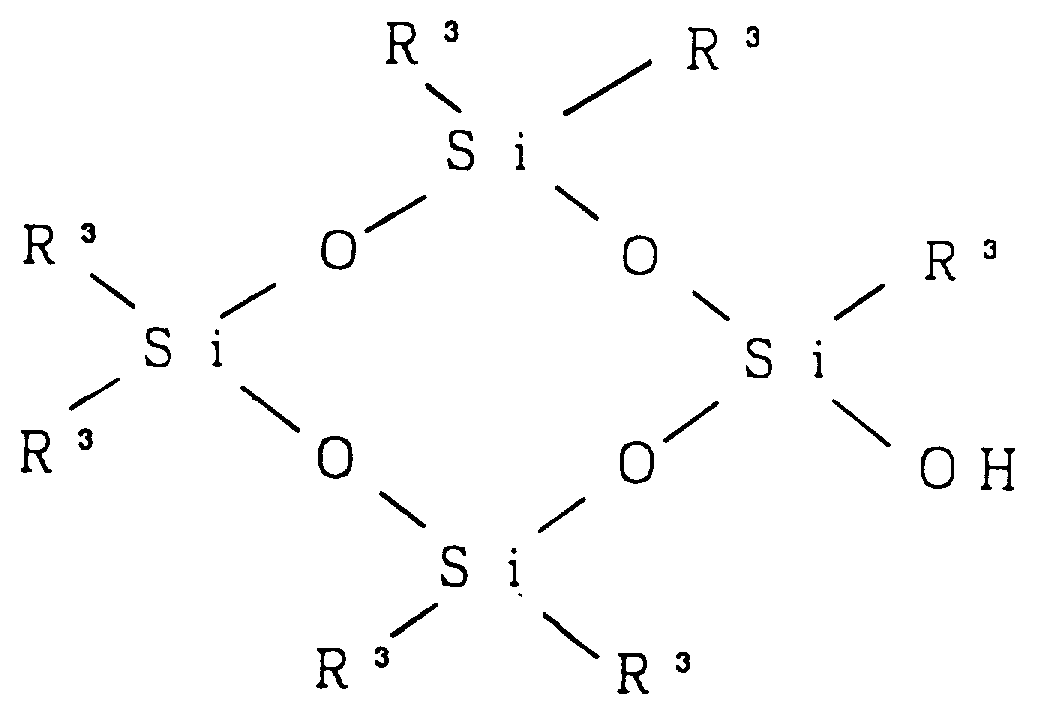


- In the formulas, R¹ indicates alkyl radicals having 1 to 6 of carbons, such as methyl radical, ethyl radical, propyl radical, or butyl radical; aryl radicals such as phenyl radical, or tolyl radical, or same or different kinds of non-substituted or substituted monohydrocarbon radicals except aliphatic unsaturated radicals, selected from chloromethyl radical, trifluoropropyl radical, and cyanoethyl radical, which are obtained by substituting a part or whole of hydrogen atoms bonded to the carbon atoms of said radicals with halogen atoms or cyano radicals, l is 1 to 1000, m and n are 1 to 50, and is such that it can contain at least one hydroxyl radical in one molecule.
- The curing catalysts as ingredient (c) of the present invention act as catalyzers for the addition reaction of ingredients (a) and (d) and the condensation reaction of ingredients (b) and (d), and they may be well known platinum or platinum compounds, and platinum complexes, and accordingly they are exemplarily indicated as catalyzers obtained by supporting platinum black or platinum to silica, or carbon black , or platinum compounds, such as chloroplatinic acid, alchohol solution of chloroplatinic acid, complex of chloroplatinic acid and olefins or vinylsiloxanes.
- Moreover, organohydrogensiloxanes or organohydrogenpolysiloxanes used as ingredient (d) act as a blowing agent in the composition by reacting with ingredient (b) behaving in condensation reaction to generate hydrogen gas, and at the same time, act as a crosslinking agent by reacting with ingredient (a) in addition reaction.
- They may be mono, di, or tri-hydroxysilane, or chain or cyclo-hydrogenpolysiloxane, and may preferably have molecular weights lower than ingredient (a) to be compatible with the compositions.
- The blending amounts of ingredient (d) are such that if the amounts of SiH combination therein are less than 1 mol to the total of the alkenyl radicals contained in ingredient (a) and the silanol radicals contained in ingredient (b), the addition reaction with ingredient (a) and the condensation reaction with ingredient (b) become inadequate, and thus, the expansion ratio becomes inadequate, and if the amounts of SiH combination therein are more than 50 mol, the product obtained by the reactions becomes brittle, or the excessive SiH combination remains in the composition, and the composition is varied as the time proceeds, and thus the desired expandable composition can not be obtained, and then the amounts of SiH combination therein are within the range of 1 to 50 times mols, preferably 3 to 10 times mols to the total of alkenyl radicals contained in ingredient (a) and silanol radicals contained in ingredient(b).
- The composition of the present invention is obtained as a two-liquids type room temperature curing composition by homogeneously mixing desired amounts of ingredients (a), (b) and (c) to prepare a main agent, and by homogeneously mixing desired amounts of ingredient (a) and (d) to prepare a curing agent. The composition is subjected to an expanding reaction and a crosslinking reaction by mixing the main agent with the curing agent in a desired amount ratio to be cured as a foamed rubber elastomer.
- Additionally, into the composition, the following additives may be added: fillers such as zinc oxide, magnesium oxide, or calcium carbonate, reinforcements such as aerosol silica, precipitated silica, titanium dioxide, aluminium oxide, powdered quartz, talc, or bentonite, fibrous fillers such as asbestos, glass fibers, or organic fibers, colorants such as pigments, dyestuffs, and the like, agents for improving heat resistance, such as red oxide or selium oxide, agents for improving low-temperature resistance, thixotropic agents such as polyethers, rust inhibitors, agents for improving adhesion force, such as γ-acryloxypropyltrimethoxysilane, liquid reinforcements, such as network polysiloxanes consisting of triorganosiloxy units and SiO₂ units, and the like, thickeners (viscosity controlling agent ) such as non-functional silicone oils. These additives may be added in a desired amount when necessary.
-
- (A)α,ω-dihydroxyorganopolysiloxanes represented by a general formula of

- (B) Organopolyhydroxypolysiloxanes represented by a general formula of

- (C) Polyorganohydrogensiloxanes having at least two of the unit represented by a general formula of

- (D) Platinum or platinum compounds.
- (E) Organic silicone compounds represented by a general formula of


- This composition is a room-temperature curing expandable composition excellent in expansion ratio and foam stabilization. In the composition, the four ingredients (A), (B), (D) and (E) are provided as a main agent, and the two ingredients (A) and (C) are provided as a curing agent, and these main agent and curing agent are separately contained in tanks 7 and 8 of Fig.1, respectively.
- The α,ω-dihydroxyorganopolysiloxanes represented by a general formula of

- In the general formula, R¹ and R are same or different kinds of substituted or non-substituted monohydrocarbon radicals except aliphatic unsaturated hydrocarbon radicals, and these radicals are exemplarily designated as alkyl radicals such as methyl radical, ethyl radical, propyl radical, butyl radical, benzyl radical, or hexyl radical; aryl radicals, such as phenyl radical, tolyl radical, or naphthyl radical , and substituted monohydrocarbon radicals, such as chloromethyl radical, or 3, 3, 3 trifluoropropyl radical and said R¹ and R may be same or different kinds. Especially, said both of R¹ and R are preferably methyl radicals by the reason of the ease to obtain and the viscosity of the composition.
- Moreover, said ingredient (B) acts to increase the expansion ratio of the expandable polysiloxane composition by the hydroxyl radicals therein, and further, gives excellent foam stability to the composition by giving thixotropic property thereto, and is exemplarily shown as organopolyhydroxypolysiloxanes represented by a general formula of


- The amounts of ingredient (B) to be added are 1 to 50 parts by weight to 100 parts by weight of ingredient (A), preferably 1 to 20 parts by weight. When the amounts of ingredient (B) to be added are less than 1 part by weight, the expansion ratio becomes low, and thus, the room-temperature curing polysiloxanes composition excellent in expansion ratio can not be obtained. Moreover, when the amounts are more than 50 parts by weight, the mechanical strength of the polysiloxane foams becomes inadequate.
- The afore-mentioned ingredient (C) is a compound having hydrogen atoms directly bonded to silicone atoms, and generates hydrogen gas by the dehydrogenation reaction with organic silicone compounds having hydroxyl radicals directly bonded to silicon atoms in the ingredients (A) and (B), and further, contributes to the crosslinking reaction. This ingredient (C) is polyorganohydrogensiloxanes having at least two of the unit represented by a general fornula of

- The hydrogen atoms directly bonded to silicon atoms may be in the terminals or side chains of the molecule, and moreover, the molecule may be in the shape of chain, ring or branch.
- The amounts of ingredient (C) to be used are such that SiH radicals are within the range from 0. 5 to 30 mol, preferably from 2 to 20 mol to 1 mol of the total amounts of silanol radicals in the ingredients (A) and (B). When the amounts are less than 0.5 mol, the room-temperature curing expandable polysiloxanes composition excellent in expansion ratio and foam stabilization can not be obtained. When the amounts are more than 30 mol, the mechanical strength of the polysiloxane foams is inadequate.
- The ingredient (D) is platinum or platinum compound to accelerate the dehydrogenation reaction of ingredient (A) or (B) with ingredient (C), and is exemplified as platinum metal, chloroplatinic acid, complexes of platinum and olefin compounds, complexes of platinum and silanes containing vinyl radicals or siloxanes, or phosphite complexes of platinum. In these examples, chloroplatinic acid and complexes of platinum and olefin compounds are preferable because they give the stabilization to the composition prior to the curing, and moreover, give an adequate foaming speed. The amounts of said ingredient (D) to be used are in the range from 0. 1 to 200 ppm, preferably from 1 to 50 ppm as platinum metal to the total weight of said ingredients (A), (B) and (C). When the amounts are less than 0.1 ppm, the dehydrogenation reaction becomes slow, and when the amounts are beyond 200 ppm, specially new effects do not be expected, and thus, they are economically disadvantageous.
- The ingredient (E) is generally used as controlling agent for the addition type RTV, and designated as general formulas of
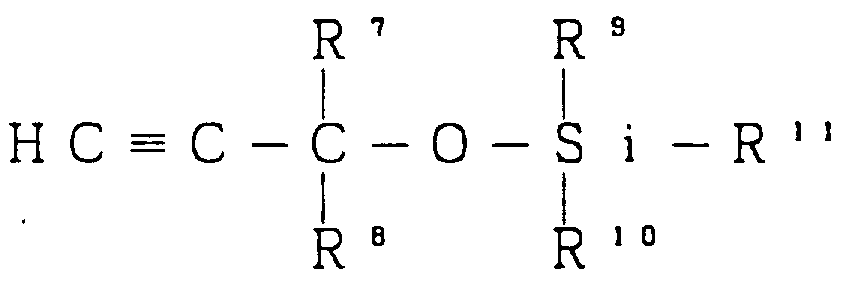

- The examples of ingredient (E) are shown as follows.


- The amounts of said organic silicone compounds to be added are within the range from 0. 001 to 10 parts by weight, preferably 0.001 to 1.0 parts by weight to 100 parts by weight of the total amounts of said ingredients (A), (B), (C) and (D). When the amounts are less than 0.001 parts by weight, the workability goes down since the viscosity of said composition greatly increases within a short time, and when the amounts are more than 10 parts by weight, the curability of the composition extremely lowers.
- In said composition [II], low molecular siloxanes containing vinyl radical may be furthermore used as controlling agents, but these are slightly inferior to the derivatives of acetylene alcohol concerning the foam stability.
- Moreover, in said expandable polysiloxanes composition, polyorganosilylsiloxanes closed at both terminals or one side terminal with triorganosilyl radicals, silanes containing vinyl radicals, or siloxanes may be added into either the main agent or the curing agent according to demand with the limitation that the effects are not damaged, and further, the additives, such as fillers, pigments, dyest ff, heat resistants, or fire retardants may be used at the same time.
- And then, the main agent and the curing agent are respectively and separately introduced into the inside 1a of the mixing chamber 1 from the tanks 7 and 8 by the operations of the
pumps 9 and 10 through thepipes - At this time, the ratio of the main agent and the curing agent is predetermined to be reacted with equal amounts since it is easily handled to introduce the main agent and the curing agent in about equal amounts.
- Moreover, spindle 11 is rotated at 50∼1000 rpm, preferably 100∼300 rpm to rotate
rotor 2, and said both liquids are mixed in the mixing chamber 1. The obtained mixture is descended along with thespiral grooves 13, discharged to make a shape of a sealant on the sealingpart 18a (sealing groove) of anarticle 18 to be coated (for example, a water prooof case for containing electronic parts of a car shown in Fig.1) from thetip 4a of anozzle 4, and foamed and cured to form a foamedgasket 19. - Fig.3 shows a head light of a car as an article to be coated. In Fig.3, the mixture of the present invention is discharged from the
tip 4a of anozzle 4 as same as Fig.1 to fill a sealinggroove 21 of the article to be coated 20 (a head light body) with the mixture, and to form a foamedgasket 22. Thereference numeral 23 is a glass cap of the headlight body 20. - The functions of the present invention are as follows.
- In Fig.1, the main agent and the curing agent respectively contained in tanks 7 and 8 are introduced into the mixing chamber 1 in about equal amounts through
pipes pumps 9 and 10. In the inside 1a of the mixing chamber 1, the introduced both liquids are homogeneously and rapidly mixed by thespiral grooves 13 formed on the surface of therotor 2 by a simple step that therotor 2 is rotated. The obtained mixture is descended along with thespiral grooves 13, discharged from thetip 4a of thenozzle 4 on the sealinggroove 18a of the article to be coated, foamed and cured to form a foamedgasket 19. - In the present invention, expandable polysiloxanes of two-liquids type are used as a raw material for forming said main agent and curing agent, which are long in pot life at 30 seconds to 10 minutes, short in curing time at 3 to 30 minutes, and high in the rate of closed cells at above 50 percents.
- Thus, there is no possibility of gelling or thickening in the mixing chamber because of the long pot life of the material, and as a result, the mixing of the main agent and the curing agent is easily accomplished in the on-line system with a mixing chamber having a rotor secured in the inside thereof, on the surface of said rotor, grooves being cut.
- Moreover, the final products are obtained within a short time because the curing times of the materials are short, and as a result, becoming capable of eliminating the space for curing. Furthermore, the compressive and restoring property thereof is high because the rate of closed cells is high, and thus becoming excellent in sealability. Accordingly, the present invention is excellent in workability and may be applied to the on-line system, and the obtained foamed gasket is excellent in sealability.
- Moreover, in the present invention, the mixture is only resided in the grooves of the rotor, and never stayed into the mixing chamber 1.
- Furthermore, the composition of the present invention is long in pot life, and thus it may be foamed with enough leveling after coating by the robot, and as a result, the obtained foamed gasket is excellent in accuracy of the shape, stable in the quality, and capable of applying to various fields since the heatproof temperature thereof is wide in the range from -40 to 200°C.
- α, ω-dihydroxyorganopolysiloxane having a viscosity of 20,000cs at 25°C represented by the average structural formula of

- Organopolyhydroxypolysiloxane having a viscosity of 150cs at 25°C represented by the average structural formula of

- Polyorganohydrogensiloxane represented by the avarage structural formula of

- Isopropyl alcohol solution containing 2% of chloroplatinic acid.
- Silicone compound having acetylenic unsaturated radicals represented by the structural formula of

- The afore-mentioned ingredients (A), (B), (D) and (E) amounting, respectively, 90.0 parts by weight of the ingredient (A), 5.0 parts by weight of ingredient (B), 1.0 part by weight of the ingredient (D) and 0.05 parts by weight of the ingredient (E), and moreover, 20 parts by weight of dimethylpolysiloxane oil and 10 parts by weight of aerosol silica were blended to prepare a main agent, and the afore-mentioned ingredients (A) and (C) amounting, respectively, 90 parts by weight of the ingredient (A) and 20.0 parts by weight of ingredient (C), and moreover, 20 parts by weight of dimethylpolysiloxane oil and 10 parts by weight of aerosol silica were blended to prepare a curing agent, and these two liquids of the main agent and the curing agent were respectively contained into tanks 7 and 8 in Fig.1. Then, these main agent and curing agent were respectively and separately introduced into the inside 1a of the mixing chamber 1 with equal amounts through the
pipes pumps 9 and 10, and at the same time, the spindle 11 of therotor 2 was rotated with the speed of about 200 rpm to mix the both liquids. The obtained mixture was descended through thespiral grooves 13, discharged on the sealinggroove 18a of thewaterproof case 18 for cars through thetip 4a of thenozzle 4, foamed and cured after 3 minutes to form the foamedgasket 19. - The pot life of the mixture was 3 minutes and the curing time thereof was ten minutes.
- After the finish, the washing liquid (such as toluene, or trichlene was introduced into the mixing chamber 1 by the operation of a
pump 17 through apipe 16 from atank 15 to wash the inside of the mixing chamber 1, the rotor andgrooves 13. - The mixture was not gelled in the mixing chamber since the pot life of the mixture was 3 minutes, and the final product was quickly obtained since the curing time thereof was ten minutes. Moreover, the obtained foamed gasket had more than 90 percents of the rate of closed cells, and thus, it was excellent in sealability and complete in waterproof effect.
- The following ingredients (a) to (e) were used.
- α, ω-divinylpolysiloxane having a viscosity of 10,000 cs at 25°C represented by the average structural formula of H₂C=CH-(Si(CH₃)₂O)₅₀₀-Si(CH₃)₂CH=CH₂.
- Organopolyhydroxypolysiloxane having a viscosity of 150 cs at 25°C represented by the formula of (CH₃)₃SiO(Si(CH₃)₂O)₁₀ (SiCH₃(OH)O)₅-SiO(CH₃)₃.
- Isopropylalcohol solution containing 2% of chloroplatinic acid.
- Polyorganohydrogensiloxane represented by the average formula of (CH₃)₃SiO(SiCH₃(H)O)₃₈SiO(CH₃)₃.
- Tetramethyltetravinylcyclotetrasiloxane represented by the structural formula of

- In the afore-mentioned ingredients, 100 parts by weight of the ingredient (a), 10 parts by weight of the ingredient (b), 0.8 parts by weight of the ingredient (c) and 2 parts by weight of the ingredient (e), and moreover, 10 parts by weight of dimethylpolysiloxane oil and 10 parts by weight of aerosol silica were blended to prepare a main agent, and moreover, 100 parts by weight of the ingredient (a), 18 parts by weight of the ingredient (d), 10 parts by weight of dimethylpolysiloxane oil and 10 parts by weight of aerosol silica were blended to prepare a curing agent, and these two liquids of the main agent and the curing agent were respectively contained into tanks 7 and 8 in Fig.1. Then, these main agent and curing agent were respectively and separately introduced into the inside 1a of the mixing chamber 1 with equal amounts through the
pipes pumps 9 and 10, and at the same time, the spindle 11 of therotor 2 was rotated with the speed of about 200 rpm to mix the both liquids. The obtained mixture was descended through thespiral grooves 13, discharged on the sealinggroove 18a of thewaterproof case 18 for cars through thetip 4a of thenozzle 4, foamed and cured after 3 minutes to form the foamedgasket 19. - The pot life of the mixture was 3 minutes and the curing time thereof was ten minutes.
- After the finish, the cleaning liquid (such as toluene, trichlene and the like) was introduced into the mixing chamber 1 by the operation of a
pump 17 through apipe 16 from atank 15 to wash the inside of the mixing chamber 1, the rotor, andgrooves 13. - The mixture was not gelled in the mixing chamber since the pot life of the mixture was 3 minutes, and the final product was quickly obtained since the curing time thereof was ten minutes. Moreover, the obtained foamed gasket had more than 90 percents of the rate of closed cells, and thus, it was excellent in sealability and complete in waterproof effect.
- The effects of the present invention are as follows.
- According to the afore-mentioned present invention, the expandable polysiloxanes of two- liquids type are used as a raw material for forming said main agent and curing agent, which are long in pot life at 30 seconds to 10 minutes, short in curing time at 3 to 30 minutes, and high in the rate of closed cells at above 50 percents, and thus, there is no possibility of gelling or thickening in the mixing chamber because of the long pot life of the material, and as a result, the mixing of the main agent and the curing agent is easily accomplished in the on-line system, and the final products are obtained within a short time because the curing times of the materials are short, and as a result, becoming capable of eliminating the space for curing, and furthermore, the compressive and restoring property thereof is high because the rate of closed cells is high, and as a result, becoming excellent in sealability, and accordingly, the present invention is excellent in workability and may be applied to the on-line system, and the obtained foamed gasket is excellent in sealability.
- Moreover, according to the present invention, the mixture is only resided in the grooves of the rotor, and never stayed into the mixing chamber 1.
- Furthermore, the composition of the present invention is long in pot life, and thus it may be foamed with enough leveling after coating by the robot, and as a result, the obtained foamed gasket is excellent in accuracy of the shape, stable in the quality, and capable of applying to various fields since the heatproof temperature thereof is wide in the range from -40 to 200°C.
Claims (21)
- A method of forming a foamed gasket having polysiloxanes as a main ingredient which comprises the steps of:separately introducing a composition of expandable polysiloxanes consisting of two liquids of a main agent and a curing agent into a mixing chamber having a rotor secured in the inside thereof and a nozzle formed on the bottom thereof, said rotor being cut on the surface thereof to form grooves,mixing the both liquids in the mixing chamber by rotating the rotor,discharging the obtained mixture on the sealing part of an article to be coated through said nozzle, andfoaming and curing the mixture to form a foamed gasket,said composition of expandable polysiloxanes being composed of the ingredients,(a) organopolysiloxanes having at least two or more of a alkenyl radicals in one molecule,(b) organopolysiloxanes having silanol radicals in the molecules,(c) curing catalysts, and(d) organopolysiloxanes having hydroxysilyl radicals in the molecules, and,said ingredients (a) , (b) and (c) being provided as said main agent and said ingredient (d) being provided as said curing agent.
- The method of forming a foamed gasket according to claim 1, wherein said two liquids of the main agent and the curing agent are separately introduced into the mixing chamber in about equal amounts.
- The method of forming a foamed gasket according to claim 1, wherein said ingredient (a) is a compound having alkenyl radicals bonded to at least two silicon atoms in one molecule, and are designated as the formulas of


- The method of forming a foamed gasket according to claim 3, wherein said alkyl radicals having 1 to 6 of carbons are methyl radical, ethyl radical, propyl radical, and butyl radical.
- The method of forming a foamed gasket according to claim 3, wherein said aryl radicals are phenyl radical, and tolyl radical.
- The method of forming a foamed gasket according to claim 3, wherein said alkenyl radicals are vinyl radical, and allyl radical.
- The method of forming a foamed gacket according to claim 1, wherein said ingredient (b) is a chain compound selected from the group consisting of


- The method of forming a foamed gasket according to claim 7, wherein said alkyl radicals having 1 to 6 of carbons are methyl radical, ethyl radical, propyl radical and butyl radical.
- The method of forming a foamed gasket according to claim 7, wherein said aryl radicals are phenyl radical, and tolyl radical.
- The method of forming a foamed gasket according to claim 1, wherein said ingredient (c) is platinum, platinum compounds, or platinum complexes.
- The method of forming a foamed gasket according to claim 1, wherein said ingredient (d) is mono, di, or tri-hydroxlysilane, or chain or cyclohydrogenpolysiolxane.
- The method of forming a foamed gasket according to claim 1, wherein said rotor is cut on the surface thereof to form spiral grooves.
- The method of forming a foamed gasket according to claim 1, wherein said rotor is cut on the surface thereof to form combined grooves of longitudinal plural grooves and spiral grooves.
- A method of forming a foamed gasket having polysiloxanes as a main ingredient which comprises the steps of:separately introducing a composition of expandable polysiloxanes consisting of two liquids of a main agent and a curing agent into a mixing chamber having a rotor secured in the inside thereof and a nozzle formed on the bottom thereof, said rotor being cut on the surface thereof to form grooves,mixing the both liquids in the mixing chamber by rotating the rotor,discharging the obtained mixture on the sealing part of an article to be coated through said nozzle, andfoaming and curing the mixture to form a foamed gasket, said composition of expandable polysiloxanes being composed of the ingredients,(A) α, ω-dihydroxyorganopolysiloxanes represented by a general formula of
HO (SiR¹RO) L H
in which R¹ and R are different or same kinds of substituted or non-substituted monohydrocarbon radicals except aliphatic unsaturated hydrocarbon radicals, L is an integer of 200 to 3000, (B) organopolyhydroxypolysiloxanes represented by a general formula of
R³SiO(̵SiR³R⁴O)̵M(̵SiR⁵(OH)O)̵NSiR³
in which R³, R⁴ and R⁵ are same or different kinds of substituted or non-substituted monohydrocarbon radicals except aliphatic unsaturated radicals, M is an integer of 2 to 20, N is an integer of 3 to 20,(C) polyorganohydrogensiloxanes having at least two of the unit represented by a general formula of (D) platinum or platinum compounds, and(B) organic silicone compounds represented by a general fomula of
 said ingredients (A), (B), (D) and (E) being provided as said main agent, and said ingredients (A) and (C) being provided as said curing agent.
 - The method of forming a foamed gasket according to claim 14, wherein said two liquids of the main agent and the curing agent are separately introduced into the mixing chamber in about equal amounts.
- The method of forming a foamed gasket according to claim 14, wherein the amounts of ingredient (B) to be used are 1 to 50 parts by weight to 100 parts by weight of ingredient (A).
- The method of forming a foamed gasket according to claim 14, wherein the amounts of ingredient (C) to be used are such that SiH radicals are within the range from 0.5 to 30 mol to 1 mol of the total amounts of silanol radicals in the ingredients (A) and (B).
- The method of forming a foamed gasket according to claim 14, wherein the amounts of ingredient (D) to be used are in the range from 0.1 to 200 ppm as platinum metal to the total weight of said ingredients (A), (B) and (C).
- The method of forming a foamed gasket according to claim 14, wherein the amounts of ingredient (E) to be used are in the range from 0.001 to 10 parts by weight to 100 parts by weight of the total amounts of said ingredients (A), (B) (C) and (D).
- The method of forming a foamed gasket according to claim 14, wherein said rotor is cut on the surface thereof to form spiral grooves.
- The method of forming a foamed gasket according to claim 14, wherein said rotor is cut on the surface thereof to form combined grooves of longitudinal plural grooves and spiral grooves.
Applications Claiming Priority (2)
| Application Number | Priority Date | Filing Date | Title |
|---|---|---|---|
| JP230980/89 | 1989-09-06 | ||
| JP1230980A JPH0721079B2 (en) | 1989-09-06 | 1989-09-06 | Method for forming gasket foam |
Publications (3)
| Publication Number | Publication Date |
|---|---|
| EP0416516A2 EP0416516A2 (en) | 1991-03-13 |
| EP0416516A3 EP0416516A3 (en) | 1991-12-18 |
| EP0416516B1 true EP0416516B1 (en) | 1996-03-13 |
Family
ID=16916340
Family Applications (1)
| Application Number | Title | Priority Date | Filing Date |
|---|---|---|---|
| EP90116917A Expired - Lifetime EP0416516B1 (en) | 1989-09-06 | 1990-09-04 | A method of forming a foamed gasket |
Country Status (4)
| Country | Link |
|---|---|
| US (1) | US5139715A (en) |
| EP (1) | EP0416516B1 (en) |
| JP (1) | JPH0721079B2 (en) |
| DE (1) | DE69025830T2 (en) |
Families Citing this family (19)
| Publication number | Priority date | Publication date | Assignee | Title |
|---|---|---|---|---|
| FR2697532B1 (en) * | 1992-10-30 | 1994-12-16 | Rhone Poulenc Chimie | Use of silicone compositions for the treatment of flat seals, in particular cylinder head seals. |
| JPH06200066A (en) * | 1992-12-28 | 1994-07-19 | Toray Dow Corning Silicone Co Ltd | Method for forming foam gasket |
| US5564714A (en) * | 1993-02-23 | 1996-10-15 | Three Bond Co., Ltd. | Rubber-like molded product with support frame |
| DE4320257C2 (en) * | 1993-06-18 | 1998-09-03 | Herbert Hollfelder | Process for applying seals with a defined cross-section to objects |
| US5480597A (en) * | 1993-09-28 | 1996-01-02 | Dow Corning Toray Silicone Co., Ltd. | Method for blending a gas into a high viscosity liquid |
| JPH0912764A (en) * | 1995-06-27 | 1997-01-14 | Toray Dow Corning Silicone Co Ltd | Method for producing silicone foam |
| EP0854893B1 (en) * | 1995-10-11 | 1999-03-10 | Heidelberger Bauchemie GmbH | Process for foaming acyloxysilane-containing silicone materials |
| WO1997016085A1 (en) * | 1995-11-03 | 1997-05-09 | Marmon Holdings, Inc. | Anti-vibration hand covering |
| US5948476A (en) * | 1996-11-08 | 1999-09-07 | Matsushita Electric Industrial Co., Ltd. | Method and apparatus for producing molecular film |
| GB2334956A (en) * | 1998-03-04 | 1999-09-08 | Canning Plc W | Forming an expanded polymer gasket in situ |
| US6247908B1 (en) | 1998-03-05 | 2001-06-19 | Seiko Instruments Inc. | Micropump |
| DE19855912A1 (en) * | 1998-12-03 | 2000-06-08 | Wacker Chemie Gmbh | Silicone rubber composition for the production of cables or profiles with functional integrity in the event of a fire |
| WO2001029457A1 (en) * | 1999-10-15 | 2001-04-26 | Siemens Canada Limited | Method to create a hot melt form for use with an air induction assembly |
| JP2002086047A (en) * | 2000-09-11 | 2002-03-26 | Tdk Corp | Coating method and tool therefor |
| US6595525B2 (en) | 2001-01-25 | 2003-07-22 | Glen D. Schmidt | Attachable sealant bead and strip for use with a vehicle part |
| JP4199102B2 (en) * | 2003-12-18 | 2008-12-17 | 東京エレクトロン株式会社 | Substrate processing method, substrate processing system, and developer supply nozzle |
| US7621417B2 (en) * | 2004-10-13 | 2009-11-24 | Rubbermaid Incorporated | Container with integral foam gasket |
| US7992904B2 (en) * | 2007-06-06 | 2011-08-09 | Ductmate Industries, Inc. | Sealing mechanism for ductwork |
| KR101254144B1 (en) | 2010-12-29 | 2013-04-18 | 충북대학교 산학협력단 | Molding device and method for controlling thereof and method for processing water-proofing using the molding device |
Citations (1)
| Publication number | Priority date | Publication date | Assignee | Title |
|---|---|---|---|---|
| EP0416229A2 (en) * | 1989-09-01 | 1991-03-13 | ERNST SONDERHOFF GmbH & Co. KG | Process for preparing a soft elastic sealing foam with fine pores for sealing covers and casings |
Family Cites Families (11)
| Publication number | Priority date | Publication date | Assignee | Title |
|---|---|---|---|---|
| US3524825A (en) * | 1957-05-29 | 1970-08-18 | Gen Motors Corp | Polyurethane foam and method for making same |
| DE1949756A1 (en) * | 1969-10-02 | 1971-04-08 | Zippel & Co Kg R | Device for mixing two or more liquid plastic components |
| US3923705A (en) * | 1974-10-30 | 1975-12-02 | Dow Corning | Method of preparing fire retardant siloxane foams and foams prepared therefrom |
| GB2065661B (en) * | 1979-12-17 | 1984-02-15 | Gen Electric | Silicone foam compositions with burn resistant properties |
| JPS63191859A (en) * | 1987-02-03 | 1988-08-09 | Shin Etsu Chem Co Ltd | Organopolysiloxane composition |
| JPS6411160A (en) * | 1987-07-03 | 1989-01-13 | Toshiba Silicone | Organopolysiloxane composition |
| DE3722050A1 (en) * | 1987-07-03 | 1989-01-19 | Berstorff Gmbh Masch Hermann | METHOD AND EXTRUDER SYSTEM FOR PRODUCING A FOAMABLE PLASTIC MIXTURE |
| JPS6414272A (en) * | 1987-07-08 | 1989-01-18 | Shinetsu Chemical Co | Room-temperature-curable organopolysiloxane composition |
| JPS6469659A (en) * | 1987-09-10 | 1989-03-15 | Shinetsu Chemical Co | Organopolysiloxane composition |
| EP0314874B1 (en) * | 1987-11-05 | 1992-11-11 | Herbert Prignitz | Method for delivering a foamable mixture, especially a temperature insulation material, using a mixing head for at least two reactive components in a low-pressure method |
| JPH02242830A (en) * | 1989-03-16 | 1990-09-27 | Shin Etsu Chem Co Ltd | Expandable polysiloxane composition |
-
1989
- 1989-09-06 JP JP1230980A patent/JPH0721079B2/en not_active Expired - Lifetime
-
1990
- 1990-09-04 EP EP90116917A patent/EP0416516B1/en not_active Expired - Lifetime
- 1990-09-04 DE DE69025830T patent/DE69025830T2/en not_active Expired - Fee Related
- 1990-09-05 US US07/577,659 patent/US5139715A/en not_active Expired - Fee Related
Patent Citations (1)
| Publication number | Priority date | Publication date | Assignee | Title |
|---|---|---|---|---|
| EP0416229A2 (en) * | 1989-09-01 | 1991-03-13 | ERNST SONDERHOFF GmbH & Co. KG | Process for preparing a soft elastic sealing foam with fine pores for sealing covers and casings |
Also Published As
| Publication number | Publication date |
|---|---|
| DE69025830D1 (en) | 1996-04-18 |
| EP0416516A2 (en) | 1991-03-13 |
| DE69025830T2 (en) | 1996-10-31 |
| JPH0721079B2 (en) | 1995-03-08 |
| JPH0394876A (en) | 1991-04-19 |
| US5139715A (en) | 1992-08-18 |
| EP0416516A3 (en) | 1991-12-18 |
Similar Documents
| Publication | Publication Date | Title |
|---|---|---|
| US5139715A (en) | Method of forming a foamed gasket | |
| US4229548A (en) | Process for the preparation of organopolysiloxane moulding compositions which give fine-pored elastomeric foam mouldings | |
| US5614563A (en) | Method for the preparation of silicone foam | |
| CN101054468B (en) | Crosslinkable substances based on organosilicon compound | |
| US5126171A (en) | Method of forming a sealant having organopolysiloxanes as a main ingredient | |
| JPH0641562B2 (en) | Curable organopolysiloxane composition | |
| EP1149871B1 (en) | Silicone rubber sponge composition, sponge, and process for making | |
| US5948856A (en) | Organosiloxane compositions yielding machinable erosion resistant elastomers | |
| KR840001758B1 (en) | Flame Retardant Silicone Foam Composition | |
| EP0604926B1 (en) | Method for fabricating foam gaskets from polyorganosiloxane compositions | |
| KR930005403B1 (en) | Formable organosiloxane compositions | |
| JPH06166821A (en) | Composition for molding elastomer | |
| JPS62135561A (en) | Curable organopolysiloxane composition | |
| GB2288406A (en) | One part room temperature vulcanizable silicones | |
| KR940003264B1 (en) | Low density silicone foam | |
| US4968760A (en) | Paintable organopolysiloxane compositions which crosslink at room temperature to form elastomers | |
| EP0179488B1 (en) | Novel fluorinated organosiloxane copolymers | |
| KR0143233B1 (en) | Silicone foams | |
| CA1195795A (en) | Organopolysiloxane molding compositions | |
| US20010027222A1 (en) | Silicone rubber sponge composition and sponge articles therefrom | |
| EP0146950B1 (en) | Compositions producing aminofunctional silicone foams and coatings | |
| US6031026A (en) | Process for the continuous production of RTV silicone rubber compositions | |
| US5424374A (en) | Heat curable organopolysiloxane compositions | |
| ES2280204T3 (en) | COMPOSITION OF THE SILICONE ELASTOMERO THAT DOES NOT DRINK, RETIMABLE BY POLYADITION, AND ITS APPLICATIONS, AND ITS USES FOR THE MANUFACTURE OF JOINTS IN SITU, AS WELL AS ADHESIVE IN PARTICULAR FOR THE GUARNICIONERIA. | |
| JP3841914B2 (en) | Method for forming foam gasket |
Legal Events
| Date | Code | Title | Description |
|---|---|---|---|
| PUAI | Public reference made under article 153(3) epc to a published international application that has entered the european phase |
Free format text: ORIGINAL CODE: 0009012 |
|
| 17P | Request for examination filed |
Effective date: 19901228 |
|
| AK | Designated contracting states |
Kind code of ref document: A2 Designated state(s): DE FR GB |
|
| PUAL | Search report despatched |
Free format text: ORIGINAL CODE: 0009013 |
|
| AK | Designated contracting states |
Kind code of ref document: A3 Designated state(s): DE FR GB |
|
| 17Q | First examination report despatched |
Effective date: 19940222 |
|
| GRAA | (expected) grant |
Free format text: ORIGINAL CODE: 0009210 |
|
| AK | Designated contracting states |
Kind code of ref document: B1 Designated state(s): DE FR GB |
|
| REF | Corresponds to: |
Ref document number: 69025830 Country of ref document: DE Date of ref document: 19960418 |
|
| ET | Fr: translation filed | ||
| PGFP | Annual fee paid to national office [announced via postgrant information from national office to epo] |
Ref country code: DE Payment date: 19960822 Year of fee payment: 7 |
|
| PGFP | Annual fee paid to national office [announced via postgrant information from national office to epo] |
Ref country code: GB Payment date: 19960827 Year of fee payment: 7 |
|
| PGFP | Annual fee paid to national office [announced via postgrant information from national office to epo] |
Ref country code: FR Payment date: 19960910 Year of fee payment: 7 |
|
| PLBE | No opposition filed within time limit |
Free format text: ORIGINAL CODE: 0009261 |
|
| STAA | Information on the status of an ep patent application or granted ep patent |
Free format text: STATUS: NO OPPOSITION FILED WITHIN TIME LIMIT |
|
| 26N | No opposition filed | ||
| PG25 | Lapsed in a contracting state [announced via postgrant information from national office to epo] |
Ref country code: GB Free format text: LAPSE BECAUSE OF NON-PAYMENT OF DUE FEES Effective date: 19970904 |
|
| PG25 | Lapsed in a contracting state [announced via postgrant information from national office to epo] |
Ref country code: FR Free format text: THE PATENT HAS BEEN ANNULLED BY A DECISION OF A NATIONAL AUTHORITY Effective date: 19970930 |
|
| GBPC | Gb: european patent ceased through non-payment of renewal fee |
Effective date: 19970904 |
|
| PG25 | Lapsed in a contracting state [announced via postgrant information from national office to epo] |
Ref country code: DE Free format text: LAPSE BECAUSE OF NON-PAYMENT OF DUE FEES Effective date: 19980603 |
|
| REG | Reference to a national code |
Ref country code: FR Ref legal event code: ST |