EP0411252B1 - Verfahren zur Herstellung von fluorierten Benzoesäuren - Google Patents
Verfahren zur Herstellung von fluorierten Benzoesäuren Download PDFInfo
- Publication number
- EP0411252B1 EP0411252B1 EP90108226A EP90108226A EP0411252B1 EP 0411252 B1 EP0411252 B1 EP 0411252B1 EP 90108226 A EP90108226 A EP 90108226A EP 90108226 A EP90108226 A EP 90108226A EP 0411252 B1 EP0411252 B1 EP 0411252B1
- Authority
- EP
- European Patent Office
- Prior art keywords
- denotes
- ppm
- formula
- compound
- chloride
- Prior art date
- Legal status (The legal status is an assumption and is not a legal conclusion. Google has not performed a legal analysis and makes no representation as to the accuracy of the status listed.)
- Expired - Lifetime
Links
- 238000000034 method Methods 0.000 title claims description 30
- 238000002360 preparation method Methods 0.000 title claims description 5
- 239000002253 acid Substances 0.000 title description 5
- 150000007513 acids Chemical class 0.000 title 1
- 239000000460 chlorine Substances 0.000 claims description 62
- 229910052801 chlorine Inorganic materials 0.000 claims description 53
- 229910052731 fluorine Inorganic materials 0.000 claims description 47
- 150000001875 compounds Chemical class 0.000 claims description 33
- 238000006243 chemical reaction Methods 0.000 claims description 26
- FBCCMZVIWNDFMO-UHFFFAOYSA-N dichloroacetyl chloride Chemical compound ClC(Cl)C(Cl)=O FBCCMZVIWNDFMO-UHFFFAOYSA-N 0.000 claims description 25
- 229910052739 hydrogen Inorganic materials 0.000 claims description 24
- 229910052794 bromium Inorganic materials 0.000 claims description 20
- CRWJEUDFKNYSBX-UHFFFAOYSA-N sodium;hypobromite Chemical compound [Na+].Br[O-] CRWJEUDFKNYSBX-UHFFFAOYSA-N 0.000 claims description 16
- VGCXGMAHQTYDJK-UHFFFAOYSA-N Chloroacetyl chloride Chemical compound ClCC(Cl)=O VGCXGMAHQTYDJK-UHFFFAOYSA-N 0.000 claims description 15
- ZAMOUSCENKQFHK-UHFFFAOYSA-N Chlorine atom Chemical compound [Cl] ZAMOUSCENKQFHK-UHFFFAOYSA-N 0.000 claims description 14
- 239000001257 hydrogen Substances 0.000 claims description 14
- 239000003054 catalyst Substances 0.000 claims description 10
- IMACFCSSMIZSPP-UHFFFAOYSA-N phenacyl chloride Chemical class ClCC(=O)C1=CC=CC=C1 IMACFCSSMIZSPP-UHFFFAOYSA-N 0.000 claims description 9
- 239000011737 fluorine Substances 0.000 claims description 8
- PXGOKWXKJXAPGV-UHFFFAOYSA-N Fluorine Chemical compound FF PXGOKWXKJXAPGV-UHFFFAOYSA-N 0.000 claims description 7
- 150000001559 benzoic acids Chemical class 0.000 claims description 6
- 238000002955 isolation Methods 0.000 claims description 3
- 238000004519 manufacturing process Methods 0.000 claims description 2
- 125000004435 hydrogen atom Chemical class [H]* 0.000 claims 5
- NLFBCYMMUAKCPC-KQQUZDAGSA-N ethyl (e)-3-[3-amino-2-cyano-1-[(e)-3-ethoxy-3-oxoprop-1-enyl]sulfanyl-3-oxoprop-1-enyl]sulfanylprop-2-enoate Chemical compound CCOC(=O)\C=C\SC(=C(C#N)C(N)=O)S\C=C\C(=O)OCC NLFBCYMMUAKCPC-KQQUZDAGSA-N 0.000 claims 1
- HEDRZPFGACZZDS-MICDWDOJSA-N Trichloro(2H)methane Chemical compound [2H]C(Cl)(Cl)Cl HEDRZPFGACZZDS-MICDWDOJSA-N 0.000 description 40
- VSCWAEJMTAWNJL-UHFFFAOYSA-K aluminium trichloride Chemical compound Cl[Al](Cl)Cl VSCWAEJMTAWNJL-UHFFFAOYSA-K 0.000 description 33
- 239000000203 mixture Substances 0.000 description 26
- VEXZGXHMUGYJMC-UHFFFAOYSA-N Hydrochloric acid Chemical compound Cl VEXZGXHMUGYJMC-UHFFFAOYSA-N 0.000 description 25
- 239000012074 organic phase Substances 0.000 description 17
- 238000004293 19F NMR spectroscopy Methods 0.000 description 16
- 238000003756 stirring Methods 0.000 description 15
- 229910052727 yttrium Inorganic materials 0.000 description 14
- 239000000243 solution Substances 0.000 description 13
- HRZFUMHJMZEROT-UHFFFAOYSA-L sodium disulfite Chemical compound [Na+].[Na+].[O-]S(=O)S([O-])(=O)=O HRZFUMHJMZEROT-UHFFFAOYSA-L 0.000 description 12
- 235000010262 sodium metabisulphite Nutrition 0.000 description 12
- OPQMRQYYRSTBME-UHFFFAOYSA-N 4-chloro-1,2-difluorobenzene Chemical compound FC1=CC=C(Cl)C=C1F OPQMRQYYRSTBME-UHFFFAOYSA-N 0.000 description 11
- UFHFLCQGNIYNRP-UHFFFAOYSA-N Hydrogen Chemical compound [H][H] UFHFLCQGNIYNRP-UHFFFAOYSA-N 0.000 description 11
- XLYOFNOQVPJJNP-UHFFFAOYSA-N water Chemical compound O XLYOFNOQVPJJNP-UHFFFAOYSA-N 0.000 description 11
- GOYDNIKZWGIXJT-UHFFFAOYSA-N 1,2-difluorobenzene Chemical compound FC1=CC=CC=C1F GOYDNIKZWGIXJT-UHFFFAOYSA-N 0.000 description 10
- CGFMLBSNHNWJAW-UHFFFAOYSA-N 2-chloro-4,5-difluorobenzoic acid Chemical compound OC(=O)C1=CC(F)=C(F)C=C1Cl CGFMLBSNHNWJAW-UHFFFAOYSA-N 0.000 description 9
- YMWUJEATGCHHMB-UHFFFAOYSA-N Dichloromethane Chemical compound ClCCl YMWUJEATGCHHMB-UHFFFAOYSA-N 0.000 description 9
- 230000010933 acylation Effects 0.000 description 8
- 238000005917 acylation reaction Methods 0.000 description 8
- 239000008346 aqueous phase Substances 0.000 description 8
- PEBWOGPSYUIOBP-UHFFFAOYSA-N 1,2,4-trifluorobenzene Chemical compound FC1=CC=C(F)C(F)=C1 PEBWOGPSYUIOBP-UHFFFAOYSA-N 0.000 description 7
- 238000004128 high performance liquid chromatography Methods 0.000 description 7
- JGJLWPGRMCADHB-UHFFFAOYSA-N hypobromite Inorganic materials Br[O-] JGJLWPGRMCADHB-UHFFFAOYSA-N 0.000 description 7
- 239000007788 liquid Substances 0.000 description 7
- 239000000725 suspension Substances 0.000 description 7
- 0 *C1C=C(*)CCC1F Chemical compound *C1C=C(*)CCC1F 0.000 description 6
- HEMHJVSKTPXQMS-UHFFFAOYSA-M Sodium hydroxide Chemical compound [OH-].[Na+] HEMHJVSKTPXQMS-UHFFFAOYSA-M 0.000 description 6
- 239000002585 base Substances 0.000 description 6
- 230000007717 exclusion Effects 0.000 description 6
- 150000002431 hydrogen Chemical class 0.000 description 6
- 230000007062 hydrolysis Effects 0.000 description 6
- 238000006460 hydrolysis reaction Methods 0.000 description 6
- 150000003254 radicals Chemical class 0.000 description 6
- 239000011541 reaction mixture Substances 0.000 description 6
- SUKJFIGYRHOWBL-UHFFFAOYSA-N sodium hypochlorite Chemical compound [Na+].Cl[O-] SUKJFIGYRHOWBL-UHFFFAOYSA-N 0.000 description 6
- AKAMNXFLKYKFOJ-UHFFFAOYSA-N 2,4,5-trifluorobenzoic acid Chemical compound OC(=O)C1=CC(F)=C(F)C=C1F AKAMNXFLKYKFOJ-UHFFFAOYSA-N 0.000 description 5
- YMQPKONILWWJQG-UHFFFAOYSA-N 4-bromo-1,2-difluorobenzene Chemical compound FC1=CC=C(Br)C=C1F YMQPKONILWWJQG-UHFFFAOYSA-N 0.000 description 5
- 239000005708 Sodium hypochlorite Substances 0.000 description 5
- WETWJCDKMRHUPV-UHFFFAOYSA-N acetyl chloride Chemical compound CC(Cl)=O WETWJCDKMRHUPV-UHFFFAOYSA-N 0.000 description 5
- 239000012346 acetyl chloride Substances 0.000 description 5
- QUGUFLJIAFISSW-UHFFFAOYSA-N 1,4-difluorobenzene Chemical compound FC1=CC=C(F)C=C1 QUGUFLJIAFISSW-UHFFFAOYSA-N 0.000 description 4
- 238000005160 1H NMR spectroscopy Methods 0.000 description 4
- -1 alkali metal hypobromite Chemical class 0.000 description 4
- 239000007795 chemical reaction product Substances 0.000 description 4
- 238000002290 gas chromatography-mass spectrometry Methods 0.000 description 4
- WQYVRQLZKVEZGA-UHFFFAOYSA-N hypochlorite Inorganic materials Cl[O-] WQYVRQLZKVEZGA-UHFFFAOYSA-N 0.000 description 4
- 239000005457 ice water Substances 0.000 description 4
- 230000003647 oxidation Effects 0.000 description 4
- 238000007254 oxidation reaction Methods 0.000 description 4
- DGCBGBZYTNTZJH-UHFFFAOYSA-N 2-bromo-4,5-difluorobenzoic acid Chemical compound OC(=O)C1=CC(F)=C(F)C=C1Br DGCBGBZYTNTZJH-UHFFFAOYSA-N 0.000 description 3
- XWCKSJOUZQHFKI-UHFFFAOYSA-N 2-chloro-1,4-difluorobenzene Chemical compound FC1=CC=C(F)C(Cl)=C1 XWCKSJOUZQHFKI-UHFFFAOYSA-N 0.000 description 3
- FPENCTDAQQQKNY-UHFFFAOYSA-N 3,4-difluorobenzoic acid Chemical compound OC(=O)C1=CC=C(F)C(F)=C1 FPENCTDAQQQKNY-UHFFFAOYSA-N 0.000 description 3
- WKBOTKDWSSQWDR-UHFFFAOYSA-N Bromine atom Chemical compound [Br] WKBOTKDWSSQWDR-UHFFFAOYSA-N 0.000 description 3
- ZLMJMSJWJFRBEC-UHFFFAOYSA-N Potassium Chemical compound [K] ZLMJMSJWJFRBEC-UHFFFAOYSA-N 0.000 description 3
- 229910052783 alkali metal Inorganic materials 0.000 description 3
- 229910052784 alkaline earth metal Inorganic materials 0.000 description 3
- 150000001342 alkaline earth metals Chemical class 0.000 description 3
- GDTBXPJZTBHREO-UHFFFAOYSA-N bromine Substances BrBr GDTBXPJZTBHREO-UHFFFAOYSA-N 0.000 description 3
- 125000001153 fluoro group Chemical group F* 0.000 description 3
- 239000000543 intermediate Substances 0.000 description 3
- 238000002844 melting Methods 0.000 description 3
- 230000008018 melting Effects 0.000 description 3
- PYLWMHQQBFSUBP-UHFFFAOYSA-N monofluorobenzene Chemical compound FC1=CC=CC=C1 PYLWMHQQBFSUBP-UHFFFAOYSA-N 0.000 description 3
- LQNUZADURLCDLV-UHFFFAOYSA-N nitrobenzene Chemical compound [O-][N+](=O)C1=CC=CC=C1 LQNUZADURLCDLV-UHFFFAOYSA-N 0.000 description 3
- 239000000047 product Substances 0.000 description 3
- 238000000746 purification Methods 0.000 description 3
- SCYULBFZEHDVBN-UHFFFAOYSA-N 1,1-Dichloroethane Chemical compound CC(Cl)Cl SCYULBFZEHDVBN-UHFFFAOYSA-N 0.000 description 2
- BNODNMUCMFITCS-UHFFFAOYSA-N 1-(2-chloro-4,5-difluorophenyl)ethanone Chemical compound CC(=O)C1=CC(F)=C(F)C=C1Cl BNODNMUCMFITCS-UHFFFAOYSA-N 0.000 description 2
- LBQMIAVIGLLBGW-UHFFFAOYSA-N 2,5-difluorobenzoic acid Chemical compound OC(=O)C1=CC(F)=CC=C1F LBQMIAVIGLLBGW-UHFFFAOYSA-N 0.000 description 2
- PEPCYJSDHYMIFN-UHFFFAOYSA-N 4-chloro-2,5-difluorobenzoic acid Chemical compound OC(=O)C1=CC(F)=C(Cl)C=C1F PEPCYJSDHYMIFN-UHFFFAOYSA-N 0.000 description 2
- 238000005727 Friedel-Crafts reaction Methods 0.000 description 2
- QAOWNCQODCNURD-UHFFFAOYSA-N Sulfuric acid Chemical compound OS(O)(=O)=O QAOWNCQODCNURD-UHFFFAOYSA-N 0.000 description 2
- 150000008044 alkali metal hydroxides Chemical class 0.000 description 2
- 239000007864 aqueous solution Substances 0.000 description 2
- WPYMKLBDIGXBTP-UHFFFAOYSA-N benzoic acid Chemical compound OC(=O)C1=CC=CC=C1 WPYMKLBDIGXBTP-UHFFFAOYSA-N 0.000 description 2
- WTEOIRVLGSZEPR-UHFFFAOYSA-N boron trifluoride Chemical compound FB(F)F WTEOIRVLGSZEPR-UHFFFAOYSA-N 0.000 description 2
- 239000003795 chemical substances by application Substances 0.000 description 2
- 238000010790 dilution Methods 0.000 description 2
- 239000012895 dilution Substances 0.000 description 2
- 150000008423 fluorobenzenes Chemical class 0.000 description 2
- 239000007789 gas Substances 0.000 description 2
- 239000003701 inert diluent Substances 0.000 description 2
- 229910052500 inorganic mineral Inorganic materials 0.000 description 2
- RBTARNINKXHZNM-UHFFFAOYSA-K iron trichloride Chemical compound Cl[Fe](Cl)Cl RBTARNINKXHZNM-UHFFFAOYSA-K 0.000 description 2
- 239000012263 liquid product Substances 0.000 description 2
- 239000011707 mineral Substances 0.000 description 2
- 235000010755 mineral Nutrition 0.000 description 2
- 239000011591 potassium Substances 0.000 description 2
- 229910052700 potassium Inorganic materials 0.000 description 2
- KWYUFKZDYYNOTN-UHFFFAOYSA-M potassium hydroxide Inorganic materials [OH-].[K+] KWYUFKZDYYNOTN-UHFFFAOYSA-M 0.000 description 2
- 239000002244 precipitate Substances 0.000 description 2
- 239000007787 solid Substances 0.000 description 2
- JIAARYAFYJHUJI-UHFFFAOYSA-L zinc dichloride Chemical compound [Cl-].[Cl-].[Zn+2] JIAARYAFYJHUJI-UHFFFAOYSA-L 0.000 description 2
- UOCLXMDMGBRAIB-UHFFFAOYSA-N 1,1,1-trichloroethane Chemical compound CC(Cl)(Cl)Cl UOCLXMDMGBRAIB-UHFFFAOYSA-N 0.000 description 1
- HTSGKJQDMSTCGS-UHFFFAOYSA-N 1,4-bis(4-chlorophenyl)-2-(4-methylphenyl)sulfonylbutane-1,4-dione Chemical compound C1=CC(C)=CC=C1S(=O)(=O)C(C(=O)C=1C=CC(Cl)=CC=1)CC(=O)C1=CC=C(Cl)C=C1 HTSGKJQDMSTCGS-UHFFFAOYSA-N 0.000 description 1
- IRKLZIBIWDAFDS-UHFFFAOYSA-N 1-chloro-4,5-difluoro-2-(trifluoromethyl)benzene Chemical compound FC1=CC(Cl)=C(C(F)(F)F)C=C1F IRKLZIBIWDAFDS-UHFFFAOYSA-N 0.000 description 1
- OAMHTTBNEJBIKA-UHFFFAOYSA-N 2,2,2-trichloro-1-phenylethanone Chemical compound ClC(Cl)(Cl)C(=O)C1=CC=CC=C1 OAMHTTBNEJBIKA-UHFFFAOYSA-N 0.000 description 1
- CERJZAHSUZVMCH-UHFFFAOYSA-N 2,2-dichloro-1-phenylethanone Chemical compound ClC(Cl)C(=O)C1=CC=CC=C1 CERJZAHSUZVMCH-UHFFFAOYSA-N 0.000 description 1
- NHROTQIETDGGMP-UHFFFAOYSA-N 6-fluoro-2-oxo-1h-quinoline-3-carboxylic acid Chemical class FC1=CC=C2NC(=O)C(C(=O)O)=CC2=C1 NHROTQIETDGGMP-UHFFFAOYSA-N 0.000 description 1
- 229910015900 BF3 Inorganic materials 0.000 description 1
- 239000005711 Benzoic acid Substances 0.000 description 1
- ZKQDCIXGCQPQNV-UHFFFAOYSA-N Calcium hypochlorite Chemical compound [Ca+2].Cl[O-].Cl[O-] ZKQDCIXGCQPQNV-UHFFFAOYSA-N 0.000 description 1
- KRHYYFGTRYWZRS-UHFFFAOYSA-N Fluorane Chemical compound F KRHYYFGTRYWZRS-UHFFFAOYSA-N 0.000 description 1
- 229910021578 Iron(III) chloride Inorganic materials 0.000 description 1
- 239000002841 Lewis acid Substances 0.000 description 1
- 229910004879 Na2S2O5 Inorganic materials 0.000 description 1
- 229910019093 NaOCl Inorganic materials 0.000 description 1
- 229910021627 Tin(IV) chloride Inorganic materials 0.000 description 1
- 150000001340 alkali metals Chemical class 0.000 description 1
- 230000000844 anti-bacterial effect Effects 0.000 description 1
- 235000010233 benzoic acid Nutrition 0.000 description 1
- 238000004061 bleaching Methods 0.000 description 1
- 239000007844 bleaching agent Substances 0.000 description 1
- 238000009835 boiling Methods 0.000 description 1
- 150000001732 carboxylic acid derivatives Chemical class 0.000 description 1
- 239000003153 chemical reaction reagent Substances 0.000 description 1
- 239000012043 crude product Substances 0.000 description 1
- 230000007423 decrease Effects 0.000 description 1
- 239000003085 diluting agent Substances 0.000 description 1
- 238000002845 discoloration Methods 0.000 description 1
- WBZKQQHYRPRKNJ-UHFFFAOYSA-L disulfite Chemical compound [O-]S(=O)S([O-])(=O)=O WBZKQQHYRPRKNJ-UHFFFAOYSA-L 0.000 description 1
- 238000001035 drying Methods 0.000 description 1
- 238000000806 fluorine-19 nuclear magnetic resonance spectrum Methods 0.000 description 1
- 150000008282 halocarbons Chemical class 0.000 description 1
- 229910052736 halogen Inorganic materials 0.000 description 1
- 150000002367 halogens Chemical class 0.000 description 1
- 229910000040 hydrogen fluoride Inorganic materials 0.000 description 1
- CUILPNURFADTPE-UHFFFAOYSA-N hypobromous acid Chemical class BrO CUILPNURFADTPE-UHFFFAOYSA-N 0.000 description 1
- 239000012535 impurity Substances 0.000 description 1
- 238000011065 in-situ storage Methods 0.000 description 1
- 150000007517 lewis acids Chemical class 0.000 description 1
- 239000000395 magnesium oxide Substances 0.000 description 1
- CPLXHLVBOLITMK-UHFFFAOYSA-N magnesium oxide Inorganic materials [Mg]=O CPLXHLVBOLITMK-UHFFFAOYSA-N 0.000 description 1
- AXZKOIWUVFPNLO-UHFFFAOYSA-N magnesium;oxygen(2-) Chemical compound [O-2].[Mg+2] AXZKOIWUVFPNLO-UHFFFAOYSA-N 0.000 description 1
- 239000000463 material Substances 0.000 description 1
- 239000007800 oxidant agent Substances 0.000 description 1
- 239000012071 phase Substances 0.000 description 1
- 238000001556 precipitation Methods 0.000 description 1
- 238000000425 proton nuclear magnetic resonance spectrum Methods 0.000 description 1
- 230000035484 reaction time Effects 0.000 description 1
- 238000010992 reflux Methods 0.000 description 1
- 238000001226 reprecipitation Methods 0.000 description 1
- 238000000926 separation method Methods 0.000 description 1
- PUGUQINMNYINPK-UHFFFAOYSA-N tert-butyl 4-(2-chloroacetyl)piperazine-1-carboxylate Chemical compound CC(C)(C)OC(=O)N1CCN(C(=O)CCl)CC1 PUGUQINMNYINPK-UHFFFAOYSA-N 0.000 description 1
- HPGGPRDJHPYFRM-UHFFFAOYSA-J tin(iv) chloride Chemical compound Cl[Sn](Cl)(Cl)Cl HPGGPRDJHPYFRM-UHFFFAOYSA-J 0.000 description 1
- XJDNKRIXUMDJCW-UHFFFAOYSA-J titanium tetrachloride Chemical compound Cl[Ti](Cl)(Cl)Cl XJDNKRIXUMDJCW-UHFFFAOYSA-J 0.000 description 1
- PVFOMCVHYWHZJE-UHFFFAOYSA-N trichloroacetyl chloride Chemical compound ClC(=O)C(Cl)(Cl)Cl PVFOMCVHYWHZJE-UHFFFAOYSA-N 0.000 description 1
- 238000010626 work up procedure Methods 0.000 description 1
- 239000011592 zinc chloride Substances 0.000 description 1
- 235000005074 zinc chloride Nutrition 0.000 description 1
Classifications
-
- C—CHEMISTRY; METALLURGY
- C07—ORGANIC CHEMISTRY
- C07C—ACYCLIC OR CARBOCYCLIC COMPOUNDS
- C07C51/00—Preparation of carboxylic acids or their salts, halides or anhydrides
- C07C51/16—Preparation of carboxylic acids or their salts, halides or anhydrides by oxidation
- C07C51/29—Preparation of carboxylic acids or their salts, halides or anhydrides by oxidation with halogen-containing compounds which may be formed in situ
Definitions
- the compounds of formula I are known and are e.g. used as intermediates for the production of antibacterial 6-fluoro-quinolonecarboxylic acids (see EP-A2-303 291, page 5, lines 25 ff, and EP-A2-342 849, page 10, lines 30 ff).
- 2-chloro-4,5-difluorobenzoic acid is prepared by converting 1-chloro-3,4-difluorobenzene to 2-chloro-4,5-difluoroacetophenone in a yield of 82 % of theory is acylated and then oxidized with sodium hypochlorite to 2-chloro-4,5-difluorobenzoic acid in a yield of 85.1% of theory.
- the overall yield of this process is therefore only about 70% of theory, based on the 1-chloro-3,4-difluorobenzene as the starting product.
- a further disadvantage of this process is that, according to the exemplary embodiment, the acylation must be carried out at a temperature of 120 ° C.
- 2-chloro-4,5-difluorobenzoic acid is made from 2-chloro-4,5-difluoro-benzotrifluoride, and 2,4,5-trifluoro-benzoic acid from 2.4.
- 5-trifluoro-benzotrifluoride prepared by reaction with sulfuric acid at temperatures from 100 to 140 ° C.
- a disadvantage of this process is the release of hydrogen fluoride at temperatures above 100 ° C, which requires special reactor materials.
- Example 14 of EP-A2-342 849 1-bromo-3,4-difluorobenzene is reacted with acetyl chloride and aluminum chloride (molar ratio 1: 1.5: 2.5) at 120 ° C. for 2 hours.
- Excess reagents and the Friedel-Crafts complex are hydrolyzed in ice and then the reaction product 2-bromo-4,5-difluoroacetophenone is extracted with methylene chloride. After the methylene chloride has been evaporated off, the 2-bromo-4,5-difluoroacetophenone is oxidized to the acid with excess industrial bleaching solution (sodium hypochlorite solution) by refluxing for two hours. After customary work-up and reprecipitation, 2-bromo-4,5-difluorobenzoic acid is obtained in a yield of 50% of theory. The melting point is only 102 to 104 ° C due to the presence of impurities.
- the object of the present invention is to provide a process for the preparation of compounds of the formula I which does not have the disadvantages of the previous processes.
- the process according to the invention is to provide the compounds of the formula I more economically and in high yields and purities under milder conditions.
- Y is preferably fluorine and X is fluorine or chlorine, in the formula II Z is also preferably chlorine.
- the hypohalite can be, for example, an alkaline earth metal hypohalite, e.g. Calcium hypochlorite, or especially an alkali metal hypohalite, e.g. an alkali metal hypobromite or alkali metal hypochlorite.
- Hypochlorites and especially hypobromites are preferred as hypohalites.
- suitable hypohalites are: potassium and sodium hypochlorite (e.g. also in the form of the so-called chlorine solution or chlorine bleach), potassium and sodium hypobromite, of which sodium hypobromite is preferred.
- the hypohalite can also be generated in situ from the halogen, in particular chlorine or bromine, and an aqueous solution of an alkaline earth metal or alkali metal hydroxide, in particular potassium or sodium hydroxide solution.
- halogen in particular chlorine or bromine
- an aqueous solution of an alkaline earth metal or alkali metal hydroxide in particular potassium or sodium hydroxide solution.
- a mixture of a hypohalite with an alkaline earth metal and / or alkali metal hydroxide and / or a mixture of different hypohalites can also be used as hypohalite be used.
- the oxidation of the fluorinated chloroacetophenones of the formula II with the hypohalite is advantageously carried out in the aqueous phase and at temperatures from 0 ° C. to 100 ° C., preferably from 10 to 80 ° C. and very particularly preferably from 20 to 60 ° C.
- An aqueous solution of the hypohalite is preferably initially introduced and the compound of the formula II is added, in particular added dropwise or metered in. It is expedient to use at least 2 mol of hypohalite in the compounds of the formula I when converting 1 mol of ⁇ , ⁇ -dichloroacetophenone of the formula II (Z in this context means chlorine in the formula II).
- hypohalite For the conversion of 1 mol of chloroacetophenone of the formula II (Z in this case means hydrogen in formula II), at least 3 mol of hypohalite are advantageously used. If an excess of hypohalite is required at all compared to the minimum amounts mentioned in the practical implementation of the method according to the invention, only a minimal excess is usually required.
- hypochlorite e.g. of sodium hypochlorite
- a larger excess is required than when using a hypobromite, e.g. of sodium hypobromite.
- hypochlorite e.g. of sodium hypochlorite
- a hypobromite e.g. of sodium hypobromite
- the compounds of the formula I can be isolated from the reaction mixture in a customary manner, for example by precipitation with a mineral acid, such as, for example, hydrochloric acid.
- a mineral acid such as, for example, hydrochloric acid.
- a disulfite such as sodium disulfite, (Na2S2O5) to prevent discoloration that can otherwise occur due to the reaction of excess hypobromite with the acid with the release of bromine.
- Lewis acids such as e.g. Aluminum chloride, aluminum bromide, zinc chloride, boron trifluoride, iron (III) chloride, tin (IV) chloride, titanium tetrachloride and other so-called Friedel-Crafts catalysts are suitable.
- Aluminum chloride is usually used.
- the acylation catalysts mentioned are used, as usual, in anhydrous form.
- the fluorobenzenes of the formula III are known or can be prepared by processes known per se.
- Mono- and dichloroacetyl chloride are known compounds.
- fluorobenzene of the formula III, mono- or dichloroacetyl chloride and acylation catalyst are expediently used in a molar ratio of 1: (1 to 2): (1.2 to 3), preferably 1: (1 to 1.6): (1.3 to 2.5) used.
- dichloroacetyl chloride the molar ratio of fluorobenzene of the formula III: dichloroacetyl chloride: acylation catalyst is in many cases 1: (1.1 to 1.6): (1.3 to 2.1).
- the compounds of the formula II are obtained in excellent yields of usually 89% of theory and more under mild conditions and can, as a rule, without further purification in the subsequent oxidation can be used with hypohalite.
- the reaction of 1,2,4-trifluorobenzene with chloroacetyl chloride to 2,4,5-trifluoro- ⁇ -chloroacetophenone according to the invention takes place in yields of 89 to 90% of theory even at mild temperatures.
- yields of 95% of theory and more are obtained at mild temperatures.
- dichloroacetyl chloride which is preferred, not only can the temperature required when using acetyl chloride in the reaction of the same fluorobenzenes of the formula III be partially reduced considerably, but moreover, only small excesses of acylating agent and / or acylation catalyst are often required .
- the present invention makes it possible, starting from compounds of the formula III, to produce fluorinated benzoic acids of the formula I in excellent yields and purities, without having to use temperatures above 100 ° C. in the course of the overall process.
- the method according to the invention also has e.g. the advantage that at least one oxidation equivalent has already been introduced into the side chain of the compounds of the formula II, so that the hypohalite oxidation can be carried out more gently and with less hypohalite than was previously possible in comparable cases.
- the almost colorless aqueous phase is brought to pH 1 with 130 ml of hydrochloric acid at 50 ° C. with the addition of sodium disulfite.
- the almost colorless aqueous phase is adjusted to pH 1 with 126 ml of hydrochloric acid at 50 ° C. with the addition of sodium disulfite.
- the yield is 364 g of 3,4-difluoro- ⁇ -chloroacetophenone, which corresponds to 95.5% of theory, based on 1,2-difluorobenzene.
- the 3,4-difluoro- ⁇ -chloroacetophenone can be converted to 3,4-difluorobenzoic acid analogously to Examples 2 and 4.
- the aqueous phase is brought to pH 1 at about 40 ° C. with 140 ml of hydrochloric acid (32% strength) with the addition of sodium disulfite.
- a suspension of 66.1 g (0.5 mol) of 1,2,4-trifluorobenzene and 133.4 g (1 mol) of aluminum chloride is heated to 55 ° C. At this temperature, 110 g (0.75 mol) of dichloroacetyl chloride are metered into the suspension with exclusion of moisture and with stirring within 2 h. A continuous stream of HCl gas develops.
- the mixture is left to after-react at 60 ° C. for about 2 hours.
- the evolution of HCl gas decreases significantly towards the end of the reaction.
- the liquid reaction mixture is poured into 1 liter of water for hydrolysis. It is stirred well. After hydrolysis is complete, the organic phase is separated off at 40 ° C.
- the aqueous phase is brought to pH 1 at about 40 ° C. with 125 ml of hydrochloric acid (32% strength) with the addition of sodium disulfite.
- 101 g of 2-bromo-4,5-difluorobenzoic acid are obtained, which corresponds to 85% of theory, based on 1-bromo-3,4-difluorobenzene in Example 11.
- Content (from HPLC) 94% Melting point: 108 to 111 ° C.
- Example 15 The 3,4-difluoro- ⁇ , ⁇ -dichloroacetophenone obtained in Example 15 is oxidized to 3,4-difluorobenzoic acid without intermediate purification with sodium hypobromite solution according to the procedure in Example 10.
- a suspension of 57 g (0.5 mol) of 1,4-difluorobenzene and 93.4 g (0.7 mol) of anhydrous aluminum trichloride is heated to 45 ° C. At this temperature, with exclusion of moisture and with stirring, 88.4 g (0.6 mol) of dichloroacetyl chloride are metered into the suspension within 2 h.
- the mixture After dilution with 250 ml of water, the mixture is adjusted to pH 6 with 75 ml of hydrochloric acid (32%) with the addition of sodium disulfite and the organic phase is separated off. The pH is then adjusted to 1 with 50 ml of hydrochloric acid (32%) with the addition of sodium disulfite.
Landscapes
- Chemical & Material Sciences (AREA)
- Organic Chemistry (AREA)
- Engineering & Computer Science (AREA)
- Oil, Petroleum & Natural Gas (AREA)
- Organic Low-Molecular-Weight Compounds And Preparation Thereof (AREA)
- Low-Molecular Organic Synthesis Reactions Using Catalysts (AREA)
- Catalysts (AREA)
Description
- Die Erfindung betrifft ein Verfahren zur Herstellung von fluorierten Benzoesäuren der Formel I

worin - X =
- Br, Cl, F,
- Y =
- Cl, F und
- Die Verbindungen der Formel I sind bekannt und werden z.B. als Zwischenprodukte zur Herstellung von antibacteriell wirkenden 6-Fluor-chinoloncarbonsäuren eingesetzt (vergl. EP-A2-303 291, Seite 5, Zeilen 25 ff, und EP-A2-342 849, Seite 10, Zeilen 30 ff).
- Nach dem aus der EP-A2-303 291 bekannten Verfahren wird 2-Chlor-4,5-difluorbenzoesäure dadurch hergestellt, daß 1-Chlor-3,4-difluorbenzol zu 2-Chlor-4,5-difluoracetophenon mit einer Ausbeute von 82 % der Theorie acyliert und anschließend mit Natriumhypochlorit zu 2-Chlor-4,5-difluorbenzoesäure in einer Ausbeute von 85,1% der Theorie oxidiert wird. Die Gesamtausbeute dieses Verfahrens beläuft sich somit nur auf ca. 70% der Theorie, bezogen auf das 1-Chlor-3,4-difluorbenzol als Ausgangsprodukt. Nachteilig bei diesem Verfahren ist ferner, daß gemäß dem Ausführungsbeispiel die Acylierung bei einer Temperatur von 120°C durchgeführt werden muß.
- Nach dem Verfahren der ungeprüften Japanischen Patentpublikation Nr. 108839/1987 wird 2-Chlor-4,5-difluorbenzoesäure aus 2-Chlor-4,5-difluor-benzotrifluorid, und 2,4,5-Trifluor-benzoesäure aus 2,4,5-Trifluor-benzotrifluorid durch Umsetzung mit Schwefelsäure bei Temperaturen von 100 bis 140°C hergestellt. Nachteilig bei diesem Verfahren ist das Freiwerden von Fluorwasserstoff bei Temperaturen über 100°C, wodurch besondere Reaktormaterialien erforderlich werden.
- In Beispiel 14 der EP-A2-342 849 wird 1-Brom-3,4-difluorbenzol mit Acetylchlorid und Aluminiumchlorid (Molverhältnis 1 : 1,5 : 2,5) 2 Stunden bei 120°C umgesetzt. Man hydrolisiert überschüssige Reagenzien und den Friedel-Crafts Komplex in Eis und extrahiert dann das Reaktionsprodukt 2-Brom-4,5-difluoracetophenon mit Methylenchlorid. Nach dem Abdampfen des Methylenchlorids wird das 2-Brom-4,5-difluoracetophenon mit überschüssiger industrieller Bleichlauge (Natriumhypochloritlösung) durch zweistündiges Kochen am Rückfluß zur Säure oxidiert. Nach üblicher Aufarbeitung und einer Umfällung erhält man die 2-Brom-4,5-difluorbenzoesäure in einer Ausbeute von 50 % der Theorie. Der Schmelzpunkt beträgt wegen vorhandener Verunreinigungen lediglich 102 bis 104°C.
- Aufgabe der vorliegenden Erfindung ist es, ein Verfahren zur Herstellung von Verbindungen der Formel I anzugeben, das die Nachteile der bisherigen Verfahren nicht besitzt. Insbesondere soll das erfindungsgemäße Verfahren die Verbindungen der Formel I unter milderen Bedingungen wirtschaftlicher und in hohen Ausbeuten und Reinheiten liefern.
- Es wurde überraschenderweise gefunden, daß fluorierte Chloracetophenone der Formel II

worin - X =
- Br, Cl, F,
- Y =
- Cl, F,
- Z =
- H oder Cl und
- X =
- Br, Cl, F,
- Y =
- Cl, F
- Die Erfindung betrifft daher ein Verfahren zur Herstellung der fluorierten Benzoesäuren der Formel I

worin - X =
- Br, Cl, F,
- Y =
- Cl, F
- X =
- Br, Cl, F,
- Y =
- Cl, F,
- Z =
- H oder Cl und
- Vorzugsweise bedeuten in den Formeln I, II und III Y Fluor und X Fluor oder Chlor, in der Formel II bedeutet darüberhinaus Z vorzugsweise Chlor.
- Das Hypohalogenit kann beispielsweise ein Erdalkalimetallhypohalogenit, wie z.B. Calciumhypochlorit, oder insbesondere ein Alkalimetallhypohalogenit, z.B. ein Alkalimetallhypobromit oder Alkalimetallhypochlorit, sein. Als Hypohalogenite werden die Hypochlorite und insbesondere Hypobromite bevorzugt. Weitere Beispiele für geeignete Hypohalogenite sind: Kalium- und Natriumhypochlorit, (z.B. auch in Form der sogenannten Chlorlauge oder Chlorbleichlauge), Kalium- und Natriumhypobromit, von denen das Natriumhypobromit bevorzugt ist.
- Das Hypohalogenit kann auch in situ aus dem Halogen, insbesondere Chlor oder Brom, und einer wäßrigen Lösung eines Erdalkalimetall- oder Alkalimetall-hydroxids, insbesondere Kali- oder Natronlauge, erzeugt werden. Als Hypohalogenit kann auch ein Gemisch eines Hypohalogenits mit einem Erdalkalimetall- und/oder Alkalimetall-hydroxid und/oder ein Gemisch verschiedener Hypohalogenite eingesetzt werden.
- Die Oxidation der fluorierten Chloracetophenone der Formel II mit dem Hypohalogenit wird zweckmäßigerweise in wäßriger Phase und bei Temperaturen von 0°C bis 100°C, vorzugsweise von 10 bis 80°C und ganz besonders bevorzugt von 20 bis 60°C durchgeführt. Vorzugsweise wird dabei eine wäßrige Lösung des Hypohalogenits vorgelegt und die Verbindung der Formel II zugegeben, insbesondere zugetropft oder zudosiert. Es ist zweckmäßig, bei der Überführung von 1 mol α,α-Dichloracetophenon der Formel II (Z bedeutet dabei in Formel II Chlor) in die Verbindungen der Formel I mindestens 2 mol Hypohalogenit einzusetzen. Für die Überführung von 1 mol Chloracetophenon der Formel II (Z bedeutet dabei in Formel II Wasserstoff) werden zweckmäßigerweise mindestens 3 mol Hypohalogenit eingesetzt. Sofern bei der praktischen Durchführung des erfindungsgemäßen Verfahrens überhaupt gegenüber den genannten Mindestmengen ein Überschuß an Hypohalogenit erforderlich ist, wird zumeist nur ein minimaler Überschuß benötigt.
- In manchen Fällen wird bei der Verwendung eines Hypochlorits, z.B. von Natriumhypochlorit, ein größerer Überschuß benötigt als bei der Verwendung eines Hypobromits, z.B. von Natriumhypobromit. Selbstverständlich ist die Verwendung eines größeren Überschusses an Hypohalogenit allgemein möglich, aber nicht erforderlich bzw. aus wirtschaftlichen Gründen nicht zweckmäßig.
- Aus dem Reaktionsgemisch können die Verbindungen der Formel I in üblicher Weise, z.B. durch Ausfällen mit einer Mineralsäure, wie z.B. Salzsäure, isoliert werden. Bei dem Ausfällen der Verbindungen der Formel I mit einer Mineralsäure ist es z.B. bei der Verwendung von Hypobromit als Oxidationsmittel zweckmäßig, ein Disulfit, z.B. Natriumdisulfit, (Na₂S₂O₅) zuzusetzen, um Verfärbungen zu verhindern, die sonst durch Reaktion von überschüssigem Hypobromit mit der Säure unter Freisetzung von Brom auftreten können.
- Die fluorierten Chloracetophenone (α-Chloracetophenone und α,α-Dichloracetophenone) der Formel IIa

worin entweder a): - Z =
- Cl und
- X =
- Br, Cl, F,
- Y =
- Cl, F und
- Z =
- H und
- X =
- Cl und
- Y =
- F, oder
- X =
- Br und
- Y =
- Cl, F oder H bedeuten,
- Als Acylierungskatalysator sind Lewis-Säuren, wie z.B. Aluminiumchlorid, Aluminiumbromid, Zinkchlorid, Bortrifluorid, Eisen(III)chlorid, Zinn(IV)chlorid, Titantetrachlorid und andere sogenannte Friedel-Crafts-Katalysatoren geeignet. Üblicherweise wird Aluminiumchlorid verwendet. Die genannten Acylierungskatalysatoren werden, wie üblich, in wasserfreier Form eingesetzt.
- Die Fluorbenzole der Formel III sind bekannt bzw. können nach an sich bekannten Verfahren hergestellt werden. Mono- und Dichloracetylchlorid sind bekannte Verbindungen. Zweckmäßigerweise werden bei der Umsetzung Fluorbenzol der Formel III, Mono- oder Dichloracetylchlorid und Acylierungskatalysator im Molverhältnis 1 : (1 bis 2) : (1,2 bis 3), vorzugsweise 1 : (1 bis 1,6) : (1,3 bis 2,5) eingesetzt. Bei der Verwendung von Dichloracetylchlorid beträgt das Molverhältnis Fluorbenzol der Formel III : Dichloracetylchlorid : Acylierungskatalysator in vielen Fällen 1 : (1,1 bis 1,6) : (1,3 bis 2,1).
- Die Verbindungen der Formel II werden in hervorragenden Ausbeuten von üblicherweise 89 % der Theorie und mehr unter milden Bedingungen erhalten und können in der Regel ohne weitere Reinigung bei der nachfolgenden Oxidation mit Hypohalogenit eingesetzt werden. Die erfindungsgemäße Umsetzung des 1,2,4-Trifluorbenzols mit Chloracetylchlorid zu 2,4,5-Trifluor-α-chloracetophenon verläuft schon bei milden Temperaturen in Ausbeuten von 89 bis 90% der Theorie. Bei der erfindungsgemäßen Umsetzung von 1-Chlor-3,4-difluorbenzol mit Chloracetylchlorid zu 2-Chlor-4,5-difluor-α-chloracetophenon werden bei milden Temperaturen sogar Ausbeuten von 95 % der Theorie und mehr erhalten. Dies war in hohem Maße überraschend, da z.B. bei der Umsetzung von 1-Chlor-3,4-difluorbenzol mit Acetylchlorid unter vergleichbaren Bedingungen 2-Chlor-4,5-difluoracetophenon nur in wesentlich geringeren Ausbeuten erhalten werden kann und 1,2,4-Trifluorbenzol mit Trichloracetylchlorid unter vergleichbaren Bedingungen überhaupt nicht zu dem gewünschten α,α,α-Trichloracetophenon reagiert.
- Durch die Verwendung von Dichloracetylchlorid, das bevorzugt ist, kann nicht nur die bei der Verwendung von Acetylchlorid bei der Umsetzung gleicher Fluorbenzole der Formel III erforderliche Temperatur z.T. erheblich abgesenkt werden, sondern es sind darüberhinaus oftmals auch nur geringere Überschüsse an Acylierungsmittel und/oder Acylierungskatalysator erforderlich. So wird bei dem Verfahren der EP-A2-303 291 1-Chlor-3,4-difluorbenzol mit Acetylchlorid in Gegenwart von Aluminiumchlorid im Molverhältnis 1 : 1,5 : 1,5 umgesetzt, während nach der vorliegenden Erfindung 1-Chlor-3,4-difluorbenzol mit Dichloracetylchlorid in Gegenwart von Aluminiumchlorid im Molverhältnis 1 : 1,2 : 1,5 (vgl. nachfolgendes Beispiel 6) umgesetzt werden kann, was eine Reduzierung der Menge des Acylierungsmittels um 20 % bedeutet.
- Bei dem Verfahren der EP-A2-342 849 wird 1-Brom-3,4-difluorbenzol mit Acetylchlorid in Gegenwart von Aluminiumchlorid im Molverhältnis 1 : 1,5 : 2,5 umgesetzt, während nach dem Verfahren der vorliegenden Erfindung 1-Brom-3,4-difluorbenzol mit Dichloracetylchlorid in Gegenwart von Aluminiumchlorid im Molverhältnis 1 : 1,5 : 2,0 (vgl. nachfolgendes Beispiel 11) umgesetzt wird, was eine Reduzierung der Menge des Acylierungskatalysators um 20 % bedeutet.
- Durch die vorliegende Erfindung ist es möglich, ausgehend von Verbindungen der Formel III fluorierte Benzoesäuren der Formel I in hervorragenden Ausbeuten und Reinheiten herzustellen, ohne daß im Verlaufe des Gesamtverfahrens Temperaturen über 100°C angewandt werden müssen. Das erfindungsgemäße Verfahren weist weiterhin z.B. den Vorteil auf, daß in der Seitenkette der Verbindungen der Formel II bereits mindestens ein Oxidationsäquivalent eingebracht worden ist, so daß die Hypohalogenit-Oxidation schonender und mit weniger Hypohalogenit durchgeführt werden kann, als dies in vergleichbaren Fällen bisher möglich war.
- Bei einer anschließenden Umsetzung der erhaltenen Verbindungen der Formel II mit Hypohalogenit werden Ausbeuten an den fluorierten Benzoesäuren der Formel I erhalten, die, bezogen auf eingesetztes Fluorbenzol der Formel III, normalerweise bei 80 % der Theorie und darüber liegen.
- In den nachfolgenden Beispielen wird die Erfindung weiter erläutert. Soweit nichts anderes angegeben ist, bedeuten Prozentangaben Gewichtsprozente. Das verwendete Aluminiumchlorid wird in wasserfreier Form eingesetzt. Die ¹H- und ¹⁹F-NMR Spektren wurden mit einem 60 MHz-Gerät aufgenommen.
- In 99 g (0,75 mol) 1,2,4-Trifluorbenzol werden 239 g (1,79 mol) Aluminiumchlorid bei 20°C eingetragen. In die Suspension dosiert man unter Rühren bei 60°C innerhalb von 2 Stunden 130 g Chloracetylchlorid (1,15 mol). Man läßt 1 h bei 80°C nachreagieren und gießt anschließend das flüssige Reaktionsprodukt auf 1 l Eiswasser. Das Reaktionsprodukt wird dreimal mit insgesamt 300 ml Dichlormethan aus der wäßrigen Phase extrahiert. Die vereinigten organischen Phasen werden über Magnesiumoxid getrocknet und eingedampft. Anschließend wird das feste Rohprodukt über eine Vigreuxkolonne destilliert (Kp.: 104°C, 20 mbar).
- Man erhält 139 g festes 2,4,5-Trifluor-α-chloracetophenon, das entspricht 89% der Theorie, bezogen auf 1,2,4-Trifluorbenzol.
- Fp.:
- 71 - 73°C
- GC:
- 98,5 %
- IR:
- 1704 cm⁻¹ (〉C=0)
- GC/MS:
- Molmassenpeak M⁺: m/e 208 (Hauptprodukt)
M⁺ - ClCH₂ = m/e 159
M⁺ - (ClCH₂-CO) = m/e 131 - Zu 846 g Natriumhypobromitlösung (12,7%ig an NaOBr) werden unter Rühren innerhalb von 2 h bei 30°C 62,6 g (0,3 mol) aufgeschmolzenes 2,4,5-Trifluor-α-chloracetophenon, hergestellt entsprechend Beispiel 1, zugetropft. Man rührt 30 min bei 30°C und anschließend 2 h bei 50°C nach.
- Nach Abtrennen der organischen Phase wird die fast farblose wäßrige Phase mit 130 ml Salzsäure bei 50°C unter Zusatz von Natriumdisulfit auf pH 1 gebracht.
- Auf diese Weise erhält man 48,0 g 2,4,5-Trifluorbenzoesäure, das sind 81,0 % der Theorie, bezogen auf 1,2,4-Trifluorbenzol unter Berücksichtigung der Acylierungsausbeute aus Beispiel 1.
Fp.: 96 - 98°C - Zu 45,4 g (0,3 mol) 1-Chlor-3,4-difluorbenzol und 97,5 g (0,73 mol) Aluminiumchlorid läßt man innerhalb von 2 1/2 h bei 65°C 50,8 g (0,45 mol) Chloracetylchlorid zutropfen. Man rührt anschließend 1 h bei 65°C und weitere 1 1/2 h bei 80°C nach. Der Ansatz wird bei ca. 70°C auf 625 g Eiswasser gegossen. Man trennt bei Raumtemperatur die Phasen und wäscht die organische Phase mit 50 ml (2 x 25 ml) Wasser. Nach der Trennung erhält man 65,8 g flüssiges Produkt, das entspricht 95,7 % der Theorie. (GC-Gehalt: 96 %). Kp: 120 - 123°C (14,67 mbar)
- IR:
- 1700 cm⁻¹ (〉C=0)
- GC/MS:
- Molmassenpeak M⁺: m/e 224 (Hauptprodukt)
M⁺ - ClCH₂ = m/e 175 Basispeak
M⁺ - (ClCH₂-CO) = m/e 147 - Zu 846 g Natriumhypobromitlösung (12,7%ig an NaOBr) werden unter Rühren innerhalb von 1 ¹/2 h bei 30°C 67,5 g (0,3 mol) 2-Chlor-4,5-difluor-α-chloracetophenon (hergestellt entsprechend Beispiel 3) zugetropft. Man rührt 30 min bei 30°C und anschließend 2 h bei 50°C nach.
- Nach Abtrennen der organischen Phase wird die fast farblose wäßrige Phase mit 126 ml Salzsäure bei 50°C unter Zusatz von Natriumdisulfit auf pH 1 gestellt.
- Auf diese Weise erhält man 52,0 g 2-Chlor-4,5-difluorbenzoesäure, das sind 86 % der Theorie, bezogen auf 1-Chlor-3,4-difluorbenzol. Fp.: 103 - 105°C.
-
- 566 g (4,24 mol) Aluminiumchlorid werden in 228 g (2 mol) 1,2-Difluorbenzol unter Rühren vorgelegt. Bei 35°C läßt man innerhalb von 2 1/2 h 226 g (2 mol) Chloracetylchlorid zutropfen. Man rührt 20 min nach und erwärmt anschließend 1 h bei 40°C. Der Ansatz wird dann in 2000g Eiswasser hydrolysiert. Daraufhin trennt man die organische Phase bei 40°C ab. Die organische Phase wird bei Raumtemperatur fest und weist nach GC/MS einen Gehalt von 99 % auf.
- Die Ausbeute beträgt 364 g 3,4-Difluor-α-chloracetophenon, das entspricht 95,5 % d.Th., bezogen auf 1,2-Difluorbenzol.
- GC/MS:
- Molmassenpeak M⁺:
- m/e 190
- M⁺ - (ClCH₂) =
- m/e 141
- M⁺ - (ClCH₂-CO) =
- m/e 113
- Das 3,4-Difluor-α-chloracetophenon kann analog den Beispielen 2 und 4 zur 3,4-Difluorbenzoesäure umgesetzt werden.
- In 74,3 g (0,5 mol) 1-Chlor-3,4-difluorbenzol trägt man bei Raumtemperatur unter Rühren auf einmal 100 g (0,75 mol) wasserfreies Aluminiumchlorid ein. Man erwärmt die Suspension auf 65°C und tropft unter Feuchtigkeitsausschluß 89 g (0,6 mol) Dichloracetylchlorid innerhalb von 3 h zu. Die Temperatur wird bei 65°C gehalten. Man läßt 4 h bei 65°C nachreagieren und gießt das olivgrüne flüssige Reaktionsgemisch anschließend zur Hydrolyse in 1 l Wasser. Dabei wird gut gerührt, und man läßt die Temperatur bis ca. 60°C ansteigen. Die organische Phase wird im Scheidetrichter bei ca. 50°C abgetrennt. Man erhält 125 g 2-Chlor-4,5-difluor-α,α-dichloracetophenon, das entspricht 96,4 % der Theorie, bezogen auf 1-Chlor-3,4-difluorbenzol.
- Gehalt (aus GC/MS)
- = 91 %
- MS: Molmassenpeak M⁺
- = m/e 258 (260)
- M⁺ - CO-³⁵Cl
- = m/e 195
- M⁺ - CHCl₂
- = m/e 175 Basispeak
- M⁺ - (CHCl₂-CO)
- = m/e 174
- Zu 1258 g Natriumhypobromitlösung (hergestellt aus 114 g Natriumhydroxid und 984 g H₂O unter Zugabe von 160 g Brom bei 0 bis 10°C) werden unter Rühren innerhalb von ca. 2 h bei 30°C 125 g 2-Chlor-4,5-difluor-α,α-dichloracetophenon aus Beispiel 6 zugetropft. Man rührt 45 min bei 30°C und anschließend 3 h bei 50°C nach.
- Nach Abtrennen der organischen Phase wird die wäßrige Phase bei ca. 40°C mit 140 ml Salzsäure (32%ig) unter Zusatz von Natriumdisulfit auf pH 1 gebracht.
- Auf diese Weise erhält man 83 g 2-Chlor-4,5-difluorbenzoesäure, das entspricht 86 % der Theorie, bezogen auf 1-Chlor-3,4-difluorbenzol im Beispiel 6.
Gehalt (aus HPLC) = 99 %,
Fp.: 103 bis 105°C. -
- Zu 1000 g Natriumhypochloritlösung (12%ig an NaOCl) werden unter Rühren innerhalb von 1,5 h bei 60°C 125 g 2-Chlor-4,5-difluor-α,α-dichloracetophenon, hergestellt entsprechend Beispiel 6, zugetropft. Man rührt 30 min bei 60°C nach und erwärmt für 2 ¹/2 h zum Sieden, dabei wird die entstehende organische Phase über einen Flüssigkeitsabscheider abgetrennt.
- Die wäßrige Phase wird bei ca. 40°C mit 80 ml Salzsäure (32%ig) unter Zusatz von Natriumdisulfit auf pH 1 gebracht. Nach üblicher Isolierung und Trocknung erhält man 82 g 2-Chlor-4,5-difluorbenzoesäure, das entspricht 85 % der Theorie, bezogen auf 1-Chlor-3,4-difluorbenzol. Gehalt (aus HPLC) = 99,3 %
- Eine Suspension aus 66,1 g (0,5 mol) 1,2,4-Trifluorbenzol und 133,4 g (1 mol) Aluminiumchlorid wird auf 55°C erwärmt. Bei dieser Temperatur dosiert man unter Feuchtigkeitsausschluß und unter Rühren innerhalb von 2 h 110 g (0,75 mol) Dichloracetylchlorid zu der Suspension. Es entwickelt sich ein kontinuierlicher HCl-Gasstrom.
- Zur Vervollständigung der Reaktion läßt man ca. 2 h bei 60°C nachreagieren. Die HCl-Gasentwicklung läßt gegen Ende der Reaktion deutlich nach. Das flüssige Reaktionsgemisch wird zur Hydrolyse in 1 l Wasser eingegossen. Dabei wird gut durchgerührt. Nach vollendeter Hydrolyse wird die organische Phase bei 40°C abgetrennt.
- Ohne weitere Zwischenaufreinigung erhält man 116 g der Titelverbindung, das entspricht 95,5 % der Theorie. Gehalt (aus GC/MS) = 95 %.
- MS: Molmassenpeak M⁺
- = m/e 242 (244)
- M⁺ - CO-Cl
- = m/e 179
- M⁺ - CHCl₂
- = m/e 159
- M⁺ - (CHCl₂CO)
- = m/e 131
- Zu 1258 g Natriumhypobromitlösung (9,5 %ig an NaOBr, entsprechend 1 mol) werden unter Rühren innerhalb von ca. 2 h bei 30°C 116 g 2,4,5-Trifluor-α,α-dichloracetophenon (aus Beispiel 9) zugetropft. Man rührt 30 min bei 30°C und anschließend 3 h bei 50°C nach. Nach Abtrennen der organischen Phase wird die wäßrige Phase mit 250 ml Wasser verdünnt und mit 145 ml Salzsäure (32%ig) bei 40°C unter Zusatz von Natriumdisulfit auf pH 1 gebracht.
- Auf diese Weise erhält man 72 g 2,4,5-Trifluorbenzoesäure, das entspricht 82 % der Theorie, bezogen auf 1,2,4-Trifluorbenzol in Beispiel 9.
Gehalt (aus HPLC) = 99 %.
Fp.: 96 bis 98°C - Zu 96,5 g (0,5 mol) 3,4-Difluorbrombenzol werden unter Rühren bei Raumtemperatur 133,4 g (1 mol) Aluminiumchlorid gegeben. Die Suspension wird auf 70°C erwärmt und unter Feuchtigkeitsausschluß innerhalb von 2 h mit 110 g (0,75 mol) Dichloracetylchlorid tropfenweise versetzt. Zur Vervollständigung der Reaktion wird 1 h bei 70°C nachgerührt. Nach Beendigung der Reaktion wird das flüssige Reaktionsgemisch zur Hydrolyse in 1 l Wasser eingegossen. Dabei wird gut gerührt, und man läßt die Temperatur bis ca. 60°C ansteigen. Die organische Phase wird bei ca. 50°C abgetrennt.
- Man erhält 151 g 2-Brom-4,5-difluor-α,α-dichloracetophenon, das entspricht 99 % der Theorie.
- Gehalt (aus GC/MS)
- = 80 %
- MS: Molmassenpeak M⁺
- = m/e 302/304
- M⁺ - CO-Cl
- = m/e 239/241
- M⁺ - CHCl₂
- = m/e 219 Basispeak /m/e 221
- M⁺ - (CHCl₂CO)
- = m/e 191/193
- Zu 1258 g Natriumhypobromitlösung (9,5 %ig an NaOBr, entsprechend 1 mol) werden unter Rühren innerhalb von ca. 1 1/4 h bei 30°C 151 g 2-Brom-4,5-difluor-α,α-dichloracetophenon zugetropft. Man rührt 30 min bei 30°C und anschließend 3 h bei 50°C nach.
- Nach Abtrennen der organischen Phase wird die wäßrige Phase bei ca. 40°C mit 125 ml Salzsäure (32%ig) unter Zusatz von Natriumdisulfit auf pH 1 gebracht. Nach üblicher Isolierung erhält man 101 g 2-Brom-4,5-difluorbenzoesäure, das entspricht 85 % der Theorie, bezogen auf 1-Brom-3,4-difluorbenzol in Beispiel 11.
Gehalt (aus HPLC) = 94 %
Schmelzpunkt Fp.: 108 bis 111°C. - 74,3 g (0,5 mol) 1-Chlor-2,5-difluorbenzol und 133,4 g (1 mol) Aluminiumchlorid werden entsprechend Beispiel 6 bei 65°C zur Reaktion gebracht. Man tropft unter Feuchtigkeitsausschluß 89 g (0,6 mol) Dichloracetylchlorid innerhalb von 3 h zu und läßt 2 h bei 70°C nachrühren, so daß die Gesamtreaktionszeit 4,5 h beträgt. Es wird in 1 l Wasser hydrolisiert und die organische Phase bei 40°C im Scheidetrichter abgetrennt. Man erhält 124 g flüssiges Reaktionsprodukt, das sind 95 % der Theorie, bezogen auf 1-Chlor-2,5-difluorbenzol.
Gehalt (aus GC/MS) = 93 % - MS: Molmassenpeak M⁺
- = m/e 258 (260)
- M⁺ - CO-Cl
- = m/e 195
- M⁺ - CHCl₂
- = m/e 175 Basispeak
- M⁺ - (CHCl₂CO)
- = m/e 147
- Zu 1258 g Natriumhypobromitlösung (9,5 %ig) werden innerhalb von 1 h bei 30°C 124 g 4-Chlor-2,5-difluor-α,α-dichloracetophenon aus Beispiel 13 unter Rühren zugetropft. Man rührt 45 min bei 30°C und anschließend 3 h bei 50°C nach.
- Nach Verdünnen mit 1500 ml Wasser wird der Ansatz mit 70 ml Salzsäure (32 %) unter Zusatz von Natriumdisulfit auf pH 6 gestellt und die organische Phase abgetrennt. Anschließend wird mit 50 ml Salzsäure (32 %) unter Zusatz von Natriumdisulfit die Benzoesäure bis pH 1 gefällt. Auf diese Weise erhält man 77,3 g 4-Chlor-2,5-difluorbenzoesäure, das entspricht 80,3 % der Theorie, bezogen auf 0,5 mol eingesetztes 1-Chlor-2,5-difluorbenzol in Beispiel 13.
Gehalt (aus HPLC): 99,5 %
Fp.: 153 bis 155°C - 57 g (0,5 mol) 1,2-Difluorbenzol und 93,4 g (0,7 mol) Aluminiumchlorid werden bei 30°C unter Feuchtigkeitsausschluß mit 88,4 g (0,6 mol) Dichloracetylchlorid unter Rühren zur Reaktion gebracht. Einschließlich Dosierzeit wird insgesamt 3 h bei 30°C erwärmt. Gegen Ende der Reaktion läßt die HCl-Entwicklung deutlich nach. Das Reaktionsgemisch gießt man zur Hydrolyse unter Rühren in 1 l Eiswasser. Das flüssige Produkt wird im Scheidetrichter bei 25°C abgetrennt.
- Man erhält 105 g der Titelverbindung, das entspricht 93 % der Theorie, bezogen auf 1,2-Difluorbenzol.
Gehalt (aus GC/MS) = 96 % - MS: Molmassenpeak M⁺
- = m/e 224 (226) mit ³⁵Cl
- M⁺ - CO-³⁵Cl
- = m/e 161
- M⁺ - CHCl₂
- = m/e 141 Basispeak
- M⁺ - (CHCl₂CO)
- = m/e 113
- Das in Beispiel 15 erhaltene 3,4-Difluor-α,α-dichloracetophenon wird ohne Zwischenaufreinigung mit Natriumhypobromitlösung gemäß der Arbeitsweise in Beispiel 10 zur 3,4-Difluorbenzoesäure oxidiert.
- Man erhält 68 g der Titelverbindung, das entspricht 86 % der Theorie, bezogen auf eingesetztes 1,2-Difluorbenzol in Beispiel 15.
Gehalt (aus HPLC) = 99 %
Fp.: 120 bis 122°C. - Eine Suspension aus 57 g (0,5 mol) 1,4-Difluorbenzol und 93,4 g (0,7 mol) wasserfreiem Aluminiumtrichlorid wird auf 45°C erwärmt. Bei dieser Temperatur dosiert man unter Feuchtigkeitsausschluß und unter Rühren innerhalb von 2 h 88,4 g (0,6 mol) Dichloracetylchlorid zu der Suspension.
- Zur Vervollständigung der Reaktion läßt man 1 h bei 45°C nachreagieren. Nach Beendigung der Reaktion wird das flüssige Reaktionsgemisch zur Hydrolyse in 1 l Wasser eingegossen. Dabei wird gut gerührt und man läßt die Temperatur bis 40°C ansteigen. Die organische Phase wird bei ca. 40°C scharf abgetrennt. Man erhält 96 g 2,5-Difluor-α,α-dichloracetophenon, das entspricht 85,3 % der Theorie, bezogen auf eingesetztes 1,4-Difluorbenzol.
Gehalt (aus GC/MS): 93,5 % (6,1 % 1,4-Difluorbenzol) - MS: Molmassenpeak M⁺
- = m/e 224 (226) mit ³⁵Cl
- M⁺ - CO-³⁵Cl
- = m/e 161
- M⁺ - CHCl₂
- = m/e 141 Basispeak
- M⁺ - (CHCl₂CO)
- = m/e 113
- Zu 1258 g Natriumhypobromitlösung (9,5 %ig) werden unter Rühren innerhalb von ca. 1 1/4 h bei 30°C 96 g 2,5-Difluor-α,α-dichloracetophenon aus Beispiel 17 zugetropft. Man rührt 45 min bei 30°C und anschließend 3 h bei 50°C nach.
- Nach Verdünnen mit 250 ml Wasser wird der Ansatz mit 75 ml Salzsäure (32 %) unter Zusatz von Natriumdisulfit auf pH 6 gestellt und die organische Phase abgetrennt. Anschließend wird mit 50 ml Salzsäure (32 %) unter Zusatz von Natriumdisulfit auf pH 1 gestellt.
- Man erhält 63,6 g 2,5-Difluorbenzoesäure, das entspricht 80,5 % d.Th., bezogen auf 0,5 mol eingesetztes 1,4-Difluorbenzol in Beispiel 17.
Gehalt (aus HPLC): 99,6 %,
Schmelzpunkt Fp.: 128 bis 130°C.
einer der Reste X oder Y auch Wasserstoff bedeuten.
einer der Reste X oder Y auch Wasserstoff bedeuten, durch Umsetzung von Verbindungen der Formel III

worin
und einer der Reste X oder Y auch Wasserstoff bedeuten, mit Mono- oder Dichloracetylchorid bei Temperaturen von 20 bis 100°C in hervorragenden Ausbeuten hergestellt und anschließend in hervorragenden Ausbeuten mit einem Hypohalogenit zu den fluorierten Benzoesäuren der Formel I umgesetzt werden können.
und einer der Reste X oder Y auch Wasserstoff bedeuten, und ist dadurch gekennzeichnet, daß ein fluoriertes Chloracetophenon der Formel II

worin
einer der Reste X oder Y auch Wasserstoff bedeuten, mit einem Hypohalogenit umgesetzt wird. Bei dieser Umsetzung wird die Verbindung II zu der entsprechenden Carbonsäure I oxidiert.
einer der Reste X oder Y auch Wasserstoff bedeuten, oder b):
sind neu und werden im Rahmen der vorliegenden Erfindung beansprucht. Bevorzugt sind solche Verbindungen der Formel IIa, bei denen Y Fluor und X Fluor oder Chlor und Z Wasserstoff oder insbesondere Chlor bedeuten. Die Verbindungen der Formeln II und IIa werden in hervorragenden Ausbeuten dadurch erhalten, daß eine Verbindung der Formel III

worin
X und Y die im Zusammenhang mit den Verbindungen der Formeln II und IIa angegebenen Bedeutungen besitzen, mit Mono- oder Dichloracetylchlorid in Gegenwart eines Acylierungskatalysators umgesetzt wird. Die Umsetzung mit Monochloracetylchlorid liefert die Verbindungen der Formeln II und IIa mit Z = Wasserstoff, und die Umsetzung mit Dichloracetylchlorid liefert die Verbindungen der Formeln II und IIa mit Z = Chlor, jeweils in hervorragenden Ausbeuten. In beiden Fällen kann die Umsetzung normalerweise bei einer Temperatur von 20 bis 100°C durchgeführt werden. Die Anwendung von Temperaturen über 100°C ist nicht erforderlich. Vorzugsweise wird die Umsetzung bei einer Temperatur von 20 bis 90°C und ganz besonders bevorzugt bei 20 bis 80°C durchgeführt. Bei der Umsetzung der Verbindungen der Formel III mit Dichloracetylchlorid können häufig Temperaturen von 20 bis 70°C zur Anwendung kommen. Die Reaktion kann auch in einem inerten Verdünnungsmittel durchgeführt werden, so z.B. in Nitrobenzol oder einem Halogenkohlenwasserstoff, wie z.B. Dichlorethan oder Trichlorethan oder in einem Gemisch inerter Verdünnungsmittel. Die Reaktion wird jedoch vorzugsweise ohne Verdünnungsmittel durchgeführt.
¹H-NMR (CDCl₃) δ ppm, bezogen auf TMS
6,9 - 7,4 ppm (1 H, m)
7,7 - 8,1 ppm (1 H, m)
4,7 - 4,8 ppm (2 H, s aufgespalten)
¹⁹F-NMR (CDCl₃) δ ppm, bezogen auf C₆F₆
-21,8 bis -22,8 ppm (1 F, m)
-38,9 bis -39,8 ppm (1 F, m)
-53 bis -54 ppm (1 F, m).
¹H-NMR (CDCl₃) δ ppm, bezogen auf TMS
4,8 ppm (2 H, s)
7,25 - 7,75 ppm (2 H, m)
¹⁹F-NMR (CDCl₃) δ ppm, bezogen auf C₆F₆
-24,7 bis -25,8 ppm (1 F, m)
-33,4 bis -34,4 ppm (1 F, m)
¹⁹F-NMR (CDCl₃) δ ppm, bezogen auf C₆F₆
-25,5 ppm bis -26,6 ppm (1 F, m)
-34,6 ppm bis -35,6 ppm (1 F, m)
¹⁹F-NMR (CDCl₃) δ ppm, bezogen auf C₆F₆
-22,4 ppm bis -23,4 ppm (1 F, m)
-40,4 ppm bis -41,4 ppm (1 F, m)
-53,7 ppm bis -54,7 ppm (1 F, m)
¹⁹F-NMR (CDCl₃) δ ppm, bezogen auf C₆F₆
-25,8 ppm bis -26,6 ppm (1 F, m)
-33,5 ppm bis -34,5 ppm (1 F, m)
¹⁹F-NMR (CDCl₃) δ ppm, bezogen auf C₆F₆
-43,7 ppm bis -44,6 ppm (1 F, m)
-50,6 ppm bis -51,4 ppm (1 F, m)
¹⁹F-NMR (CDCl₃) δ ppm, bezogen auf C₆F₆
-27,1 ppm bis -28,1 ppm (1 F, m)
-35,4 ppm bis -36,6 ppm (1 F, m)
¹⁹F-NMR (CDCl₃) δ ppm, bezogen auf C₆F₆
-45,7 ppm bis -46,6 ppm (1 F, m)
-48 ppm bis -48,9 ppm (1 F, m)
Claims (13)
- Verfahren zur Herstellung von fluorierten Benzoesäuren der Formel I
 X = Br, Cl, F,Y = Cl, Fund einer der Reste X oder Y auch Wasserstoff bedeuten, dadurch gekennzeichnet, daß ein fluoriertes Chloracetophenon der Formel II
 X = Br, Cl, F,Y = Cl, F,Z = H oder Cl undeiner der Reste X oder Y auch Wasserstoff bedeuten, mit einem Hypohalogenit umgesetzt wird.
 - Verfahren nach Anspruch 1, dadurch gekennzeichnet, daß die Verbindung der Formel II mit Natriumhypobromit umgesetzt wird.
- Verfahren nach Anspruch 1 und/oder 2, dadurch gekennzeichnet, daß die Umsetzung bei einer Temperatur von 0°C bis 100°C, vorzugsweise von 10 bis 80°C, und ganz besonders bevorzugt von 20 bis 60°C durchgeführt wird.
- Verfahren nach einem oder mehreren der Ansprüche 1 bis 3, dadurch gekennzeichnet, daß eine Verbindung der Formel III
 X = Br, Cl, F,Y = Cl, Fund einer der Reste X oder Y auch Wasserstoff bedeuten, mit Mono- oder Dichloracetylchlorid in Gegenwart eines Acylierungskatalysators zu einer Verbindung der Formel II umgesetzt und diese, gegebenenfalls nach ihrer Isolierung, mit dem Hypohalogenit umgesetzt wird.
 - Verfahren nach Anspruch 4, dadurch gekennzeichnet, daß die Umsetzung der Verbindung III mit Mono- oder Dichloracetylchlorid bei einer Temperatur von 20 bis 100°C, insbesondere von 20 bis 90°C, bevorzugt von 20 bis 80°C, und besonders bevorzugt von 20 bis 70°C durchgeführt wird.
- Verfahren nach einem oder mehreren der Ansprüche 1 bis 5, dadurch gekennzeichnet, daß eine Verbindung der Formel II bzw. III eingesetzt wird, bei der Y Fluor und X Fluor oder Chlor bedeuten.
- Verfahren zur Herstellung fluorierter Chloracetophenone der Formel IIa
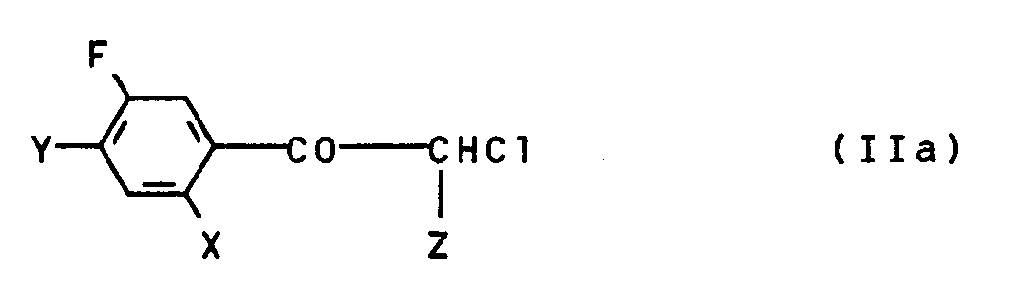 Z = Cl undX = Br, Cl, F,Y = Cl, F undeiner der Reste X oder Y auch Wasserstoff bedeuten oder b):Z = H undX = Cl oder F undY = F, oderX = Br undY = Cl, F oder Hbedeuten, dadurch gekennzeichnet, daß a) für den Fall, daß eine Verbindung der Formel II mit Z = Cl hergestellt werden soll, eine Verbindung der Formel III
 X = Br, Cl, F,Y = Cl, Fund einer der Reste X oder Y auch Wasserstoff bedeuten, mit Dichloracetylchlorid in Gegenwart eines Acylierungskatalysators umgesetzt wird,
oder daß b) für den Fall, daß eine Verbindung der Formel II mit Z = H hergestellt werden soll, eine Verbindung der Formel III X = Cl oder F undY = F oderX = Br undY = Cl, F oder Hbedeuten, mit Monochloracetylchlorid in Gegenwart eines Acylierungskatalysators umgesetzt wird.
 - Verfahren nach Anspruch 7, dadurch gekennzeichnet, daß die Umsetzung bei einer Temperatur von 20 bis 100°C, insbesondere von 20 bis 90°C, und bevorzugt von 20 bis 80°C durchgeführt wird.
- Verfahren nach Anspruch 7 und/oder 8, dadurch gekennzeichnet, daß eine Verbindung der Formel III mit Dichloracetylchlorid bei einer Temperatur von 20 bis 70°C umgesetzt wird.
- Verfahren nach einem oder mehreren der Ansprüche 7 bis 9, dadurch gekennzeichnet, daß Monochloracetylchlorid eingesetzt wird.
- Verfahren nach einem oder mehreren der Ansprüche 7 bis 9, dadurch gekennzeichnet, daß Dichloracetylchlorid eingesetzt wird.
- Verfahren nach einem oder mehreren der Ansprüche 7 bis 11, dadurch gekennzeichnet, daß eine Verbindung der Formel III eingesetzt wird, bei der Y Fluor und X Fluor oder Chlor bedeuten.
Priority Applications (2)
| Application Number | Priority Date | Filing Date | Title |
|---|---|---|---|
| JP2196399A JP2935436B2 (ja) | 1989-07-28 | 1990-07-26 | フッ素化された安息香酸の製造方法 |
| IE273890A IE63918B1 (en) | 1989-07-28 | 1990-07-27 | Process for the preparation of fluorinated benzoic acids |
Applications Claiming Priority (2)
| Application Number | Priority Date | Filing Date | Title |
|---|---|---|---|
| DE3925036 | 1989-07-28 | ||
| DE3925036A DE3925036A1 (de) | 1989-07-28 | 1989-07-28 | Verfahren zur herstellung von fluorierten benzoesaeuren |
Publications (2)
| Publication Number | Publication Date |
|---|---|
| EP0411252A1 EP0411252A1 (de) | 1991-02-06 |
| EP0411252B1 true EP0411252B1 (de) | 1993-11-03 |
Family
ID=6386053
Family Applications (1)
| Application Number | Title | Priority Date | Filing Date |
|---|---|---|---|
| EP90108226A Expired - Lifetime EP0411252B1 (de) | 1989-07-28 | 1990-04-30 | Verfahren zur Herstellung von fluorierten Benzoesäuren |
Country Status (7)
| Country | Link |
|---|---|
| US (1) | US5093529A (de) |
| EP (1) | EP0411252B1 (de) |
| JP (1) | JP2935436B2 (de) |
| DE (2) | DE3925036A1 (de) |
| DK (1) | DK0411252T3 (de) |
| ES (1) | ES2059871T3 (de) |
| IE (1) | IE63918B1 (de) |
Families Citing this family (6)
| Publication number | Priority date | Publication date | Assignee | Title |
|---|---|---|---|---|
| DE4123322C2 (de) * | 1991-07-13 | 2003-04-03 | Clariant Gmbh | 2-Chlor-3,4,5-trifluorbenzoesäure 2,2'-Dichlor-3,4,5-trifluoracetophenon, 2,2',2'-Trichlor-3,4,5-trifluoracetophenon, 5,2'-Dichlor-2,3,4-trifluoracetophenon und 5,2',2'-Trichlor-2,3,4-trifluoracetophenon und Verfahren zur Herstellung dieser Verbindungen und der isomeren 5-Chlor-2,3,4-trifluorbenzoesäure |
| US5532416A (en) * | 1994-07-20 | 1996-07-02 | Monsanto Company | Benzoyl derivatives and synthesis thereof |
| DE4202567A1 (de) * | 1992-01-30 | 1993-08-05 | Basf Ag | Verfahren zur herstellung von 2,4,6-trimethylbenzoesaeure |
| US5869688A (en) * | 1994-07-20 | 1999-02-09 | Monsanto Company | Preparation of substituted 3-aryl-5-haloalkyl-pyrazoles having herbicidal activity |
| DE19617558A1 (de) * | 1996-05-02 | 1997-11-06 | Hoechst Ag | Verfahren zur Herstellung von 4,5-Dichlor-2-methylbenzoesäure |
| US5698708A (en) * | 1996-06-20 | 1997-12-16 | Monsanto Company | Preparation of substituted 3-aryl-5-haloalkyl-pyrazoles having herbicidal activity |
Family Cites Families (4)
| Publication number | Priority date | Publication date | Assignee | Title |
|---|---|---|---|---|
| DE3435392A1 (de) * | 1984-09-27 | 1986-04-03 | Bayer Ag, 5090 Leverkusen | Verfahren zur herstellung von 2,4-dichlor-5-fluor-benzoesaeure |
| DE3529259A1 (de) * | 1985-08-16 | 1987-02-26 | Bayer Ag | Verfahren zur herstellung von halogensubstituierten benzoylacetonitrilen, 1-chlor-2-(2,4-dichlor-5-fluorphenyl)-ethan-2-on und seine herstellung |
| ES2074047T3 (es) * | 1987-08-14 | 1995-09-01 | Asahi Glass Co Ltd | Compuestos de benzoilo fluorados. |
| EP0342849A3 (de) * | 1988-05-19 | 1990-03-14 | Pfizer Inc. | Zwischenstufen für die Herstellung von Estern von 1,4-Dihydro-4-oxo-Chinolin-3-carbonsäuren |
-
1989
- 1989-07-28 DE DE3925036A patent/DE3925036A1/de not_active Withdrawn
-
1990
- 1990-04-30 DE DE90108226T patent/DE59003308D1/de not_active Expired - Fee Related
- 1990-04-30 EP EP90108226A patent/EP0411252B1/de not_active Expired - Lifetime
- 1990-04-30 ES ES90108226T patent/ES2059871T3/es not_active Expired - Lifetime
- 1990-04-30 DK DK90108226.3T patent/DK0411252T3/da active
- 1990-07-16 US US07/553,262 patent/US5093529A/en not_active Expired - Lifetime
- 1990-07-26 JP JP2196399A patent/JP2935436B2/ja not_active Expired - Fee Related
- 1990-07-27 IE IE273890A patent/IE63918B1/en not_active IP Right Cessation
Also Published As
| Publication number | Publication date |
|---|---|
| US5093529A (en) | 1992-03-03 |
| EP0411252A1 (de) | 1991-02-06 |
| DK0411252T3 (da) | 1994-02-28 |
| DE59003308D1 (de) | 1993-12-09 |
| IE902738A1 (en) | 1991-02-27 |
| DE3925036A1 (de) | 1991-01-31 |
| ES2059871T3 (es) | 1994-11-16 |
| JP2935436B2 (ja) | 1999-08-16 |
| IE63918B1 (en) | 1995-06-14 |
| JPH0368534A (ja) | 1991-03-25 |
Similar Documents
| Publication | Publication Date | Title |
|---|---|---|
| DE3420796A1 (de) | 2,4,5-trihalogen- bzw. 2,3,4,5-tetrahalogenbenzolderivate und verfahren zu ihrer herstellung | |
| EP0009205B1 (de) | Verfahren zur Herstellung von gegebenenfalls substituiertem Benzoylchlorid | |
| EP0607824B1 (de) | Verfahren zur Herstellung mehrfach halogenierter Benzotrichloride und Benzoylchloride sowie neue, mehrfach halogenierte Benzotrichloride | |
| EP0034741B1 (de) | Verfahren zur Herstellung eines substituierten Bromfluorbenzols und 3-Brom-4-fluorbenzonitril | |
| DE2546532C2 (de) | Verfahren zur Herstellung von Trichlormethyl-trifluormethylbenzolen | |
| EP0411252A1 (de) | Verfahren zur Herstellung von fluorierten Benzoesäuren | |
| DE2614240C3 (de) | Verfahren zur Herstellung von Acylcyaniden | |
| DE69522561T2 (de) | Verfahren zur herstellung von benzophentionen und benzophenonen | |
| EP0037960B1 (de) | Verfahren zur Herstellung von Trichlorbenzolen | |
| EP0063740B1 (de) | Verfahren zur Herstellung von tertiären Alkylcyaniden | |
| DE3332017A1 (de) | Verfahren zur herstellung von 3,4-dichlorbenzotrihalogeniden | |
| DE3529259A1 (de) | Verfahren zur herstellung von halogensubstituierten benzoylacetonitrilen, 1-chlor-2-(2,4-dichlor-5-fluorphenyl)-ethan-2-on und seine herstellung | |
| EP0537540B1 (de) | Verfahren zur radikalischen Chlorierung oder Bromierung von Methylaromaten | |
| EP0048370A1 (de) | Verfahren zur Herstellung von trans-3-(Z-2-Chlor-2-aryl-vinyl)-2,2-dimethyl-cyclopropan-1-carbon-säure-derivaten, neue Zwischenprodukte hierfür, Verfahren zu deren Herstellung und Verwendung von Zwischenprodukten in Schädlingsbekämpfungsmitteln | |
| EP0157022B1 (de) | Verfahren zur Herstellung von 4-Chlor-bzw.4-Bromnaphthal säureanhydrid | |
| DE3144316A1 (de) | Verfahren zur herstellung von benzoylchlorid | |
| EP0041672B1 (de) | Verfahren zur Herstellung von aromatischen Aldehyden | |
| DE4123322C2 (de) | 2-Chlor-3,4,5-trifluorbenzoesäure 2,2'-Dichlor-3,4,5-trifluoracetophenon, 2,2',2'-Trichlor-3,4,5-trifluoracetophenon, 5,2'-Dichlor-2,3,4-trifluoracetophenon und 5,2',2'-Trichlor-2,3,4-trifluoracetophenon und Verfahren zur Herstellung dieser Verbindungen und der isomeren 5-Chlor-2,3,4-trifluorbenzoesäure | |
| DE69209855T2 (de) | Verfahren zur Herstellung von 4,4'-Bis(4-chlorobenzoyl)benzophenon | |
| DE2943433A1 (de) | Verfahren zur herstellung von carbonsaeurehalogeniden | |
| CH630592A5 (de) | Verfahren zur herstellung von 2-halogen-4-bromphenolen. | |
| DE60007861T2 (de) | Verfahren zur herstellung von tetrafluorhalogen-benzolen | |
| DE69908131T2 (de) | Verfahren zur Herstellung von fluoroaromatischen Verbindungen | |
| DE102008040736B4 (de) | Verfahren zur Herstellung Alkoxy-substituierter 1-Indanone | |
| DE4227371A1 (de) | Verfahren zur Herstellung von 2,3,4-Trichlor-5-fluor-benzoylchlorid |
Legal Events
| Date | Code | Title | Description |
|---|---|---|---|
| PUAI | Public reference made under article 153(3) epc to a published international application that has entered the european phase |
Free format text: ORIGINAL CODE: 0009012 |
|
| AK | Designated contracting states |
Kind code of ref document: A1 Designated state(s): BE CH DE DK ES FR GB IT LI |
|
| 17P | Request for examination filed |
Effective date: 19910102 |
|
| 17Q | First examination report despatched |
Effective date: 19920923 |
|
| GRAA | (expected) grant |
Free format text: ORIGINAL CODE: 0009210 |
|
| AK | Designated contracting states |
Kind code of ref document: B1 Designated state(s): BE CH DE DK ES FR GB IT LI |
|
| ITF | It: translation for a ep patent filed | ||
| REF | Corresponds to: |
Ref document number: 59003308 Country of ref document: DE Date of ref document: 19931209 |
|
| GBT | Gb: translation of ep patent filed (gb section 77(6)(a)/1977) |
Effective date: 19940111 |
|
| REG | Reference to a national code |
Ref country code: DK Ref legal event code: T3 |
|
| ET | Fr: translation filed | ||
| K2C3 | Correction of patent specification (complete document) published |
Effective date: 19931103 |
|
| PLBE | No opposition filed within time limit |
Free format text: ORIGINAL CODE: 0009261 |
|
| STAA | Information on the status of an ep patent application or granted ep patent |
Free format text: STATUS: NO OPPOSITION FILED WITHIN TIME LIMIT |
|
| 26N | No opposition filed | ||
| REG | Reference to a national code |
Ref country code: ES Ref legal event code: FG2A Ref document number: 2059871 Country of ref document: ES Kind code of ref document: T3 |
|
| REG | Reference to a national code |
Ref country code: GB Ref legal event code: IF02 |
|
| PGFP | Annual fee paid to national office [announced via postgrant information from national office to epo] |
Ref country code: DK Payment date: 20030314 Year of fee payment: 14 |
|
| PGFP | Annual fee paid to national office [announced via postgrant information from national office to epo] |
Ref country code: ES Payment date: 20030428 Year of fee payment: 14 |
|
| PGFP | Annual fee paid to national office [announced via postgrant information from national office to epo] |
Ref country code: BE Payment date: 20030514 Year of fee payment: 14 |
|
| PG25 | Lapsed in a contracting state [announced via postgrant information from national office to epo] |
Ref country code: DK Free format text: LAPSE BECAUSE OF NON-PAYMENT OF DUE FEES Effective date: 20040430 Ref country code: BE Free format text: LAPSE BECAUSE OF NON-PAYMENT OF DUE FEES Effective date: 20040430 |
|
| PG25 | Lapsed in a contracting state [announced via postgrant information from national office to epo] |
Ref country code: ES Free format text: LAPSE BECAUSE OF NON-PAYMENT OF DUE FEES Effective date: 20040503 |
|
| BERE | Be: lapsed |
Owner name: *RIEDEL-DE HAEN A.G. Effective date: 20040430 |
|
| PGFP | Annual fee paid to national office [announced via postgrant information from national office to epo] |
Ref country code: GB Payment date: 20050314 Year of fee payment: 16 |
|
| PGFP | Annual fee paid to national office [announced via postgrant information from national office to epo] |
Ref country code: FR Payment date: 20050401 Year of fee payment: 16 |
|
| PGFP | Annual fee paid to national office [announced via postgrant information from national office to epo] |
Ref country code: DE Payment date: 20050429 Year of fee payment: 16 |
|
| PGFP | Annual fee paid to national office [announced via postgrant information from national office to epo] |
Ref country code: CH Payment date: 20050613 Year of fee payment: 16 |
|
| REG | Reference to a national code |
Ref country code: ES Ref legal event code: FD2A Effective date: 20040503 |
|
| PG25 | Lapsed in a contracting state [announced via postgrant information from national office to epo] |
Ref country code: LI Free format text: LAPSE BECAUSE OF NON-PAYMENT OF DUE FEES Effective date: 20060430 Ref country code: GB Free format text: LAPSE BECAUSE OF NON-PAYMENT OF DUE FEES Effective date: 20060430 Ref country code: CH Free format text: LAPSE BECAUSE OF NON-PAYMENT OF DUE FEES Effective date: 20060430 |
|
| PGFP | Annual fee paid to national office [announced via postgrant information from national office to epo] |
Ref country code: IT Payment date: 20060430 Year of fee payment: 17 |
|
| PG25 | Lapsed in a contracting state [announced via postgrant information from national office to epo] |
Ref country code: DE Free format text: LAPSE BECAUSE OF NON-PAYMENT OF DUE FEES Effective date: 20061101 |
|
| REG | Reference to a national code |
Ref country code: CH Ref legal event code: PL |
|
| GBPC | Gb: european patent ceased through non-payment of renewal fee |
Effective date: 20060430 |
|
| REG | Reference to a national code |
Ref country code: FR Ref legal event code: ST Effective date: 20061230 |
|
| PG25 | Lapsed in a contracting state [announced via postgrant information from national office to epo] |
Ref country code: FR Free format text: LAPSE BECAUSE OF NON-PAYMENT OF DUE FEES Effective date: 20060502 |
|
| PG25 | Lapsed in a contracting state [announced via postgrant information from national office to epo] |
Ref country code: IT Free format text: LAPSE BECAUSE OF NON-PAYMENT OF DUE FEES Effective date: 20070430 |