EP0408213B1 - Verfahren zur Herstellung einer Silberbromjodidemulsion mit tafelförmigen Körnern und dadurch hergestellte Emulsionen - Google Patents
Verfahren zur Herstellung einer Silberbromjodidemulsion mit tafelförmigen Körnern und dadurch hergestellte Emulsionen Download PDFInfo
- Publication number
- EP0408213B1 EP0408213B1 EP90307002A EP90307002A EP0408213B1 EP 0408213 B1 EP0408213 B1 EP 0408213B1 EP 90307002 A EP90307002 A EP 90307002A EP 90307002 A EP90307002 A EP 90307002A EP 0408213 B1 EP0408213 B1 EP 0408213B1
- Authority
- EP
- European Patent Office
- Prior art keywords
- silver
- iodide
- emulsion
- tabular grains
- process according
- Prior art date
- Legal status (The legal status is an assumption and is not a legal conclusion. Google has not performed a legal analysis and makes no representation as to the accuracy of the status listed.)
- Expired - Lifetime
Links
- 239000000839 emulsion Substances 0.000 title claims description 183
- ZUNKMNLKJXRCDM-UHFFFAOYSA-N silver bromoiodide Chemical compound [Ag].IBr ZUNKMNLKJXRCDM-UHFFFAOYSA-N 0.000 title claims description 80
- 238000000034 method Methods 0.000 title claims description 34
- 230000008569 process Effects 0.000 title claims description 26
- XMBWDFGMSWQBCA-UHFFFAOYSA-N hydrogen iodide Chemical compound I XMBWDFGMSWQBCA-UHFFFAOYSA-N 0.000 claims description 71
- 229910052709 silver Inorganic materials 0.000 claims description 47
- 239000004332 silver Substances 0.000 claims description 47
- BQCADISMDOOEFD-UHFFFAOYSA-N Silver Chemical compound [Ag] BQCADISMDOOEFD-UHFFFAOYSA-N 0.000 claims description 37
- JKFYKCYQEWQPTM-UHFFFAOYSA-N 2-azaniumyl-2-(4-fluorophenyl)acetate Chemical compound OC(=O)C(N)C1=CC=C(F)C=C1 JKFYKCYQEWQPTM-UHFFFAOYSA-N 0.000 claims description 21
- 229910021612 Silver iodide Inorganic materials 0.000 claims description 21
- 230000002093 peripheral effect Effects 0.000 claims description 21
- 229940045105 silver iodide Drugs 0.000 claims description 21
- 238000002360 preparation method Methods 0.000 claims description 20
- 230000035945 sensitivity Effects 0.000 claims description 20
- ADZWSOLPGZMUMY-UHFFFAOYSA-M silver bromide Chemical compound [Ag]Br ADZWSOLPGZMUMY-UHFFFAOYSA-M 0.000 claims description 15
- 238000000151 deposition Methods 0.000 claims description 14
- GGCZERPQGJTIQP-UHFFFAOYSA-N sodium;9,10-dioxoanthracene-2-sulfonic acid Chemical compound [Na+].C1=CC=C2C(=O)C3=CC(S(=O)(=O)O)=CC=C3C(=O)C2=C1 GGCZERPQGJTIQP-UHFFFAOYSA-N 0.000 claims description 14
- CPELXLSAUQHCOX-UHFFFAOYSA-M Bromide Chemical compound [Br-] CPELXLSAUQHCOX-UHFFFAOYSA-M 0.000 claims description 8
- 150000004820 halides Chemical class 0.000 claims description 8
- NLKNQRATVPKPDG-UHFFFAOYSA-M potassium iodide Chemical compound [K+].[I-] NLKNQRATVPKPDG-UHFFFAOYSA-M 0.000 claims description 6
- 230000001376 precipitating effect Effects 0.000 claims description 4
- 229910001516 alkali metal iodide Inorganic materials 0.000 claims description 2
- 239000013078 crystal Substances 0.000 description 20
- SQGYOTSLMSWVJD-UHFFFAOYSA-N silver(1+) nitrate Chemical compound [Ag+].[O-]N(=O)=O SQGYOTSLMSWVJD-UHFFFAOYSA-N 0.000 description 20
- -1 iodide ions Chemical class 0.000 description 19
- JHJLBTNAGRQEKS-UHFFFAOYSA-M sodium bromide Chemical compound [Na+].[Br-] JHJLBTNAGRQEKS-UHFFFAOYSA-M 0.000 description 16
- 239000007864 aqueous solution Substances 0.000 description 14
- 238000000586 desensitisation Methods 0.000 description 14
- 230000006870 function Effects 0.000 description 11
- FOIXSVOLVBLSDH-UHFFFAOYSA-N Silver ion Chemical compound [Ag+] FOIXSVOLVBLSDH-UHFFFAOYSA-N 0.000 description 10
- 230000008021 deposition Effects 0.000 description 10
- 229910001961 silver nitrate Inorganic materials 0.000 description 10
- 230000015572 biosynthetic process Effects 0.000 description 8
- 230000008901 benefit Effects 0.000 description 7
- 238000001556 precipitation Methods 0.000 description 6
- 150000004694 iodide salts Chemical group 0.000 description 5
- 239000000243 solution Substances 0.000 description 5
- 108010010803 Gelatin Proteins 0.000 description 4
- 238000000576 coating method Methods 0.000 description 4
- 230000000694 effects Effects 0.000 description 4
- 238000000407 epitaxy Methods 0.000 description 4
- 229920000159 gelatin Polymers 0.000 description 4
- 239000008273 gelatin Substances 0.000 description 4
- 235000019322 gelatine Nutrition 0.000 description 4
- 235000011852 gelatine desserts Nutrition 0.000 description 4
- 230000006872 improvement Effects 0.000 description 4
- 238000011160 research Methods 0.000 description 4
- 206010070834 Sensitisation Diseases 0.000 description 3
- HEMHJVSKTPXQMS-UHFFFAOYSA-M Sodium hydroxide Chemical compound [OH-].[Na+] HEMHJVSKTPXQMS-UHFFFAOYSA-M 0.000 description 3
- HHUTZTRHRFFOBJ-UHFFFAOYSA-M [Ag+].[I-].IBr Chemical compound [Ag+].[I-].IBr HHUTZTRHRFFOBJ-UHFFFAOYSA-M 0.000 description 3
- 229940006460 bromide ion Drugs 0.000 description 3
- 239000000975 dye Substances 0.000 description 3
- 230000001747 exhibiting effect Effects 0.000 description 3
- 230000008313 sensitization Effects 0.000 description 3
- 230000003595 spectral effect Effects 0.000 description 3
- CIWBSHSKHKDKBQ-JLAZNSOCSA-N Ascorbic acid Chemical compound OC[C@H](O)[C@H]1OC(=O)C(O)=C1O CIWBSHSKHKDKBQ-JLAZNSOCSA-N 0.000 description 2
- FFEARJCKVFRZRR-BYPYZUCNSA-N L-methionine Chemical compound CSCC[C@H](N)C(O)=O FFEARJCKVFRZRR-BYPYZUCNSA-N 0.000 description 2
- 238000005452 bending Methods 0.000 description 2
- 150000003842 bromide salts Chemical class 0.000 description 2
- 238000006243 chemical reaction Methods 0.000 description 2
- AGOYDEPGAOXOCK-KCBOHYOISA-N clarithromycin Chemical compound O([C@@H]1[C@@H](C)C(=O)O[C@@H]([C@@]([C@H](O)[C@@H](C)C(=O)[C@H](C)C[C@](C)([C@H](O[C@H]2[C@@H]([C@H](C[C@@H](C)O2)N(C)C)O)[C@H]1C)OC)(C)O)CC)[C@H]1C[C@@](C)(OC)[C@@H](O)[C@H](C)O1 AGOYDEPGAOXOCK-KCBOHYOISA-N 0.000 description 2
- 239000011248 coating agent Substances 0.000 description 2
- 230000000052 comparative effect Effects 0.000 description 2
- 230000007547 defect Effects 0.000 description 2
- 238000011161 development Methods 0.000 description 2
- XLYOFNOQVPJJNP-UHFFFAOYSA-M hydroxide Chemical compound [OH-] XLYOFNOQVPJJNP-UHFFFAOYSA-M 0.000 description 2
- 238000003384 imaging method Methods 0.000 description 2
- XMBWDFGMSWQBCA-UHFFFAOYSA-M iodide Chemical compound [I-] XMBWDFGMSWQBCA-UHFFFAOYSA-M 0.000 description 2
- 229920000126 latex Polymers 0.000 description 2
- 238000004519 manufacturing process Methods 0.000 description 2
- 229930182817 methionine Natural products 0.000 description 2
- 238000012545 processing Methods 0.000 description 2
- 230000005855 radiation Effects 0.000 description 2
- 230000009467 reduction Effects 0.000 description 2
- 230000004044 response Effects 0.000 description 2
- 230000005070 ripening Effects 0.000 description 2
- 150000003839 salts Chemical class 0.000 description 2
- 159000000000 sodium salts Chemical class 0.000 description 2
- 239000007858 starting material Substances 0.000 description 2
- 238000003756 stirring Methods 0.000 description 2
- 239000000126 substance Substances 0.000 description 2
- ZFIQGRISGKSVAG-UHFFFAOYSA-N 4-methylaminophenol Chemical compound CNC1=CC=C(O)C=C1 ZFIQGRISGKSVAG-UHFFFAOYSA-N 0.000 description 1
- QGZKDVFQNNGYKY-UHFFFAOYSA-O Ammonium Chemical compound [NH4+] QGZKDVFQNNGYKY-UHFFFAOYSA-O 0.000 description 1
- 239000004606 Fillers/Extenders Substances 0.000 description 1
- 241001562081 Ikeda Species 0.000 description 1
- 206010027476 Metastases Diseases 0.000 description 1
- CERQOIWHTDAKMF-UHFFFAOYSA-M Methacrylate Chemical compound CC(=C)C([O-])=O CERQOIWHTDAKMF-UHFFFAOYSA-M 0.000 description 1
- NINIDFKCEFEMDL-UHFFFAOYSA-N Sulfur Chemical compound [S] NINIDFKCEFEMDL-UHFFFAOYSA-N 0.000 description 1
- 229910052770 Uranium Inorganic materials 0.000 description 1
- 230000001154 acute effect Effects 0.000 description 1
- 230000002411 adverse Effects 0.000 description 1
- 229910001513 alkali metal bromide Inorganic materials 0.000 description 1
- 238000004458 analytical method Methods 0.000 description 1
- 150000001450 anions Chemical class 0.000 description 1
- 238000013459 approach Methods 0.000 description 1
- 229960005070 ascorbic acid Drugs 0.000 description 1
- 235000010323 ascorbic acid Nutrition 0.000 description 1
- 239000011668 ascorbic acid Substances 0.000 description 1
- 239000011230 binding agent Substances 0.000 description 1
- 230000005540 biological transmission Effects 0.000 description 1
- 238000005345 coagulation Methods 0.000 description 1
- 230000015271 coagulation Effects 0.000 description 1
- 239000000084 colloidal system Substances 0.000 description 1
- 238000007796 conventional method Methods 0.000 description 1
- 230000001186 cumulative effect Effects 0.000 description 1
- 238000005034 decoration Methods 0.000 description 1
- 229940061607 dibasic sodium phosphate Drugs 0.000 description 1
- BNIILDVGGAEEIG-UHFFFAOYSA-L disodium hydrogen phosphate Chemical compound [Na+].[Na+].OP([O-])([O-])=O BNIILDVGGAEEIG-UHFFFAOYSA-L 0.000 description 1
- 238000009826 distribution Methods 0.000 description 1
- 230000005670 electromagnetic radiation Effects 0.000 description 1
- 238000005516 engineering process Methods 0.000 description 1
- 230000009477 glass transition Effects 0.000 description 1
- PCHJSUWPFVWCPO-UHFFFAOYSA-N gold Chemical compound [Au] PCHJSUWPFVWCPO-UHFFFAOYSA-N 0.000 description 1
- 239000010931 gold Substances 0.000 description 1
- 229910052737 gold Inorganic materials 0.000 description 1
- 238000011835 investigation Methods 0.000 description 1
- 150000002500 ions Chemical class 0.000 description 1
- 239000004816 latex Substances 0.000 description 1
- 230000009401 metastasis Effects 0.000 description 1
- 238000012986 modification Methods 0.000 description 1
- 230000004048 modification Effects 0.000 description 1
- 230000006911 nucleation Effects 0.000 description 1
- 238000010899 nucleation Methods 0.000 description 1
- 229920000058 polyacrylate Polymers 0.000 description 1
- 238000002601 radiography Methods 0.000 description 1
- 238000001953 recrystallisation Methods 0.000 description 1
- 102220047090 rs6152 Human genes 0.000 description 1
- 230000001235 sensitizing effect Effects 0.000 description 1
- 238000000926 separation method Methods 0.000 description 1
- MSFPLIAKTHOCQP-UHFFFAOYSA-M silver iodide Chemical compound I[Ag] MSFPLIAKTHOCQP-UHFFFAOYSA-M 0.000 description 1
- 239000011593 sulfur Substances 0.000 description 1
- 229910052717 sulfur Inorganic materials 0.000 description 1
- 239000000725 suspension Substances 0.000 description 1
- 238000000108 ultra-filtration Methods 0.000 description 1
- 238000005406 washing Methods 0.000 description 1
- XLYOFNOQVPJJNP-UHFFFAOYSA-N water Substances O XLYOFNOQVPJJNP-UHFFFAOYSA-N 0.000 description 1
Images

Classifications
-
- G—PHYSICS
- G03—PHOTOGRAPHY; CINEMATOGRAPHY; ANALOGOUS TECHNIQUES USING WAVES OTHER THAN OPTICAL WAVES; ELECTROGRAPHY; HOLOGRAPHY
- G03C—PHOTOSENSITIVE MATERIALS FOR PHOTOGRAPHIC PURPOSES; PHOTOGRAPHIC PROCESSES, e.g. CINE, X-RAY, COLOUR, STEREO-PHOTOGRAPHIC PROCESSES; AUXILIARY PROCESSES IN PHOTOGRAPHY
- G03C1/00—Photosensitive materials
- G03C1/005—Silver halide emulsions; Preparation thereof; Physical treatment thereof; Incorporation of additives therein
- G03C1/0051—Tabular grain emulsions
Definitions
- the invention relates to a process of preparing camera speed photographic emulsions and to the emulsions so produced. More specifically, the invention relates to a process for the preparation of tabular grain silver bromoiodide emulsions and to the emulsions produced thereby.
- the highest speed photographic emulsions are recognized to be silver bromoiodide emulsions. Because of their larger size, the presence of iodide ions in the silver bromide crystal structure of the grains is recognized to produce lattice irregularities that enhance latent image formation (observed as increased imaging sensitivity) on exposure to electromagnetic radiation.
- tabular grain emulsion designates any emulsion in which at least 50 percent of the total grain projected area is accounted for by tabular grains. Whereas tabular grains have long been recognized to exist to some degree in conventional emulsions, only recently has the photographically advantageous role of the tabular grain shape been appreciated.
- Tabular grain silver bromoiodide emulsions exhibiting particularly advantageous photographic properties include (i) high aspect ratio tabular grain silver halide emulsions and (ii) thin, intermediate aspect ratio tabular grain silver halide emulsions.
- High aspect ratio tabular grain emulsions are those in which the tabular grains exhibit an average aspect ratio of greater than 8:1.
- Thin, intermediate aspect ratio tabular grain emulsions are those in which the tabular grain emulsions of a thickness of less than 0.2 ⁇ m have an average aspect ratio in the range of from 5:1 to 8:1.
- tabular grain emulsions The common feature of high aspect ratio and thin, intermediate aspect ratio tabular grain emulsions, hereinafter collectively referred to as "recent tabular grain emulsions", is that tabular grain thickness is reduced in relation to the equivalent circular diameter of the tabular grains. Most of the recent tabular grain emulsions can be differentiated from those known in the art for many years by the following relationship: (1) ECD/t 2 > 25 where
- the recent tabular grain emulsions have been observed to provide a large variety of photographic advantages, including, but not limited to, improved speed-granularity relationships, increased image sharpness, a capability for more rapid processing, increased covering power, reduced covering power loss at higher levels of forehardening, higher gamma for a given level of grain size dispersity, less image variance as a function of processing time and/or temperature variances, higher separations of blue and minus blue speeds, the capability of optimizing light transmission or reflectance as a function of grain thickness, and reduced susceptibility to background radiation damage in very high speed emulsions.
- this invention is directed to a process for the preparation of a silver bromoiodide emulsion comprising providing a host emulsion comprised of a dispersing medium and silver bromide grains optionally including iodide in which greater than 50 percent of the total grain projected area is accounted for by tabular grains satisfying the relationship ECD/t 2 > 25 where
- the invention is directed to tabular grain silver bromoiodide emulsions prepared by the processes of this invention.
- the present invention is based on the discovery that the sensitivity advantages of the recent tabular grain silver bromoiodide emulsion technology can be realized while at the same time achieving sensitivity levels that are more nearly constant as a function of applied pressure than have been characteristic of recent tabular grain silver bromoiodide emulsions heretofore available to those skilled in the art.
- the present invention is based on the discovery of recent tabular grain emulsions and methods for their manufacture which are less susceptible to pressure desensitization. Pressure desensitization can arise from bending, kinking, spooling, dragging across out of adjustment transport rolls, any type of compressive force, and any other manipulation that applies pressure to the emulsion layer or layers of a photographic element. While pressure desensitization can occur over all or part of the photographic element, localized pressure desensitization is most objectionable, since it is highly visible as a local defect in the photographic image.
- the present invention is predicated on the discovery of a selected set of conditions for forming silver bromoiodide laminae on the major surfaces of tabular grains. Specifically, achieving both high levels of sensitivity and resistance to pressure desensitization results from first depositing iodide at the edges or corners of the tabular grains under conditions known to promote high levels of sensitivity and then recrystallizing the iodide under newly identified and selected conditions so that it is distributed within the laminae on the major faces of the grains. In a specifically preferred form of the invention the iodide forming the laminae is both initially deposited and recrystallized under the newly identified and selected conditions.
- Recrystallization is undertaken under conditions more nearly approaching the equivalence point than have heretofore been employed in forming tabular grain silver bromoiodide laminae.
- the equivalence point is a 1:1 atomic ratio of silver ion to halide ion in solution.
- photographic silver halide emulsions are precipitated on the halide side of the equivalence point (with an excess of halide ions as compared to silver ions). This is undertaken to avoid occlusions within the grains of excess silver ion, thereby guarding against elevated minimum densities (i.e., fog).
- the tabular grains of the emulsions prepared according to this invention can exhibit a distinctive and novel edge contour.
- This novel edge contour provides a convenient identification signature of emulsions prepared according a preferred preparation process of this invention.
- No tabular grain silver bromoiodide emulsion having a similar grain edge configuration is known to have been prepared by a process other than that of the present invention; however, similarly advantageous results have been achieved in emulsions contemporaneously prepared lacking the novel tabular grain edge contour.
- the first step in the preparation of an emulsion demonstrating the advantages of this invention is the preparation or selection for use as a host emulsion of a recent tabular grain emulsion containing a dispersing medium and silver bromide grains optionally containing iodide satisfying relationships (1) and (3) above.
- Any convenient conventional emulsion of this type can be prepared or selected.
- Preferred emulsions are illustrated by the teachings of R-1 to R-11, cited above and here incorporated by reference.
- the preparation of tabular grain silver bromoiodide emulsions can be readily adapted to forming tabular grain silver bromide emulsions merely by omitting iodide from the precipitation process.
- the tabular grains of the silver bromoiodide product emulsions exhibit somewhat greater thickness than the host tabular grains from which they are prepared. Where the silver bromoiodide laminae are of minimum thickness, about 5 percent to total tabular grain thickness, the increased thickness of the silver bromoiodide product emulsion tabular grains is generally negligible.
- the ratio of tabular grain diameter to thickness of the host emulsion reflected in relationships (1) and (3) is increased somewhat above the minimum values indicated above.
- the tabular grain diameter to thickness ratio of relationships (1) and (3) is greater than 40 and optimally greater than 80.
- Preferred host tabular grain emulsions are those in which the mean tabular grain thickness is less than 0.2 ⁇ m. Since the benefits of the invention are provided by tabular grains, it is preferred that tabular grains account for at least 70 percent and optimally at least 90 percent of the total grain projected area of the host emulsion.
- the tabular grain host emulsion is generally chosen to provide a mean tabular grain effective circular diameter at least 50 percent, preferably at least 90 percent, that of the silver bromoiodide product emulsion. It is possible to form the silver bromoiodide product emulsion without increasing the mean effective circular diameter of the product emulsion as compared to that of host emulsion.
- the host emulsion can account for as little as 10 percent, based on silver, of the silver bromoiodide product emulsion.
- Host emulsions in which the tabular grains are relatively thin particularly lend themselves to forming product emulsions in which silver bromoiodide laminae account for most of the silver.
- the host emulsion can account for up to 94.9 percent of the total silver forming the silver bromoiodide product emulsion.
- the host emulsion preferably accounts for from 40 percent to 90 percent of the total silver forming the silver bromoiodide product emulsion.
- any conventional approach for depositing iodide as a silver salt at peripheral sites on tabular grains of the host emulsion can be employed in the practice of this invention. Since the disproportionate diameter of tabular grains in relation to their thickness is the result of selective growth at the edges of the tabular grains, it is apparent that iodide can be readily directed to peripheral sites on the tabular grains.
- the techniques taught by R-12 (Solberg Piggin et al), cited above and here incorporated by reference, for abruptly introducing iodide salts during tabular grain precipitation are compatible with the practice of this invention.
- iodide is generally introduced abruptly-that is, over a relatively short period, less 10 minutes, preferably less than 1 minute, and optimally less than 10 seconds.
- Abruptly introduced iodide is sometimes referred to as "dump iodide", since the preferred practice is to introduce the iodide as quickly as the halide salt delivery apparatus permits.
- a simple way of accomplishing this is to turn the iodide delivery jet to its full open position while stirring the host emulsion.
- silver counter ions For a silver salt of iodide to be deposited, silver counter ions must be provided. Silver can be introduced concurrently with iodide introduction or immediately following iodide introduction.
- the bromide ion is provided by the stoichiometric excess of bromide ion present in the host emulsion at the preferred pAg conditions for iodide introduction.
- soluble silver and iodide salts are alternatively possible. While any soluble silver salt known to be useful in silver halide precipitations can be employed, silver nitrate is almost universally employed in the art. Similarly, while any soluble iodide salt known to be useful in precipitating silver iodide emulsions can be employed, alkali metal iodide salts, particularly potassium iodide, are preferred. When a soluble iodide salt is employed, it is generally a practical convenience to first introduce the dump iodide followed by immediate adjustment of silver ion concentrations by correlating silver ion addition with the silver electrode potential, which in turn correlates with the emulsion pAg.
- the peripheral iodide When iodide is added as a soluble salt, the peripheral iodide appears to be deposited as a silver iodide or a high iodide silver bromoiodide.
- high iodide silver bromoiodide indicates a silver iodide crystal lattice in which iodide accounts for at least 90 percent of the total halide, based on silver. This is an entirely different crystalline structure than exhibited by ordinary photographic silver bromoiodides.
- Iodide depositions ranging from 0.1 to 30 percent, preferably 0.5 to 4 percent, based on total silver of the product emulsion are contemplated.
- R-12 (Solberg Piggin et al) observed both continuous and discontinuous peripheral iodide epitaxy. Either (a) corner or (b) edge and corner epitaxial deposition of silver iodide onto the host tabular grains is possible. It is preferred to achieve peripheral iodide deposition at or near the corners of the host tabular grains, as described below.
- the next step of the process is to redistribute the iodide over the major faces of the host tabular grains as part of silver bromoiodide laminae.
- realization of the advantages of the invention requires the laminae to be formed within a selected pAg range.
- the pAg employed for silver bromoiodide laminae formation is that indicated by the higher and lower pAg boundaries indicated by Curve A, with the higher and lower pAg boundaries of Curve B defining preferred pAg ranges.
- the temperature limits of 30 to 90°C for Curve A and 40 to 80°C for Curve B are not critical, but are selected to reflect the temperature ranges most commonly and conveniently employed in preparing photographic emulsions.
- K sp solubility product constant of silver bromide
- one of the features of the present invention is that the silver bromoiodide laminae are formed on the halide side of, but nearer, the equivalence point than prior art emulsions.
- the lower boundaries of Curves A and B must be varied as a function of temperature to insure that they remain in a fixed relationship with the equivalence point of the emulsion at each temperature within the range.
- silver bromide is precipitated onto the major faces of the tabular grains employing any convenient conventional silver bromide precipitation technique.
- silver and bromide soluble salts typically silver nitrate and an ammonium or alkali metal bromide, are concurrently introduced through separate silver and bromide jets.
- the peripheral iodide enters solution and is redeposited with the silver bromide to form the silver bromoiodide laminae.
- Deposition of the silver bromoiodide laminae is preferably continued until the peripheral iodide has been entirely redistributed over the major faces of the host tabular grains. At a minimum at least 5 percent, preferably at least 10 percent, of the silver introduced in forming the silver bromoiodide product emulsion is introduced during the formation of the silver bromoiodide laminae. From silver ranges of the host emulsion and the peripheral iodide silver salt, it is apparent that the silver bromoiodide can account for as much as 89.9 (preferably as much as 59.5 percent) of the total silver forming the silver bromoiodide product emulsion.
- bromide as the sole halide salt during formation of the silver bromoiodide laminae
- any additional amount of iodide compatible with redistributing the peripheral iodide Iodide introduced into the emulsion during silver bromoiodide laminae formation is preferably limited to less than 5 percent, preferably less than 1 percent, of total halide introduced during laminae formation.
- the reason for limiting iodide introduction is to allow peripheral iodide redistribution at a maximum or near maximum rate. With lowered rates of silver bromide addition, a longer time period for iodide redistribution is provided and elevated levels of iodide introduction with the bromide salt are considered feasible.
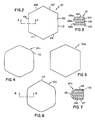
- FIG. 2 A preferred mode of practicing the invention is illustrated by reference to Figures 2 to 7 inclusive.
- a tabular grain 101 of a host emulsion is shown. Referring to Figure 3, it is apparent that the tabular grain has two parallel major crystal faces 102 and 103. Running through the grain parallel to the major crystal faces are parallel twin planes 104 and 105.
- Edge 106 shown in section in Figure 3, consists of three separate crystal facets 106a, 106b, and 106c. Crystal facet 106a extends from the upper major crystal face to the upper twin plane 104, crystal facet 106b extends from the upper twin plane 104 to the lower twin plane 105, and crystal face 106c extends from the lower twin plane to the lower major crystal face 103.
- Edges 106, 107, and 108 are identical. Edges 109, 110, and 111 are like edges 106, 107, and 108, except that the crystal facets form an acute angle with the upper major crystal face and an obtuse angle of intersection with the lower major crystal face. Stated another way, if the reference numerals 102 and 103 were reversed, Figure 3 would constitute an accurate representation of the edges 109, 110, and 111.
- While host tabular grain 102 is for simplicity shown to have regular hexagonal major crystal faces and to contain two twin planes, it is appreciated that the major crystal faces of tabular grains commonly take alternative forms and the number of twin planes vary. For example, grains containing an uneven number of twin planes often have triangular major crystal faces or three edges of one length alternated with three edges of a different length. Other tabular grain shapes, including trapezoidal shapes are known. A discussion of the correlation of tabular grain shapes and their occluded twin planes is provided by Maskasky U.S. Patent 4,684,607.
- the iodide When a silver salt of iodide is precipitated onto the tabular grain brought the boundary of Curve A or B in Figure 1 by silver ion addition, the iodide selectively deposits at the rounded corners. If continued, the silver iodide can restore the original projected profile of the tabular grain.
- the grain 101b as shown in Figure 5 appears similar to grain 101 from which it was derived. Grain 101b is, however, significantly different from the grain 101 in Figure 2 from which it is produced, since the corners of the tabular grain 101b consists of the later precipitated silver salt of iodide.
- the tabular grain 101b can retain some rounding of the corners, like grain 101a; exactly fill in the corners of the grains, as shown in Figure 5; or can contain more silver salt at the corners than can be accommodated within the original projected profile of the grains.
- the peripheral iodide can appear as castellations adjacent the corners of the grains. With relatively high proportions of later deposited silver salt the castellations can form a continuous peripheral decoration of the tabular grain structure.
- the corners of the tabular grains do not become rounded as shown in Figure 2 and the later precipitated silver salt of iodide has not been observed to seek out the corners of the tabular grains, but rather to deposit along the edges of the tabular grains.
- the silver ion concentration of the emulsion can be increased without silver ion addition by any convenient conventional technique, such as ultrafiltration, as taught by Mignot U.S. Patent 4,334,012 and Research Disclosure , Vol. 102, October 1972, Item 10208, and Vol. 131, March 1975, Item 13122 or coagulation washing, as taught by Yutzy and Russell U.S. Patent 2,614,929.
- FIG. 6 shows grain 101c after completion of laminae formation.
- the tabular grain exhibits rounded corners 114, indicative of redistribution of silver iodide epitaxy.
- the edges of the grain 101c are also entirely changed in shape, as shown in Figure 7.
- the edges of the tabular grain do not exhibit distinct crystal facets as shown in Figure 3. Rather the tabular grain exhibits rounded edges 115.
- Silver bromoiodide lamina 116 is present on the upper major face 102 of the host tabular grain, thereby forming a new upper major face of the product tabular grain.
- Similar silver bromoiodide lamina 117 is present on the lower major face 103 of the host tabular grain, thereby forming a new lower major face of the product tabular grain. From cross-sections of tabular grains it is believed that the upper and lower laminae are at least in some instances joined along the rounded edges 115. Since ripening occurs at the edges of the tabular grains as they are formed, the mean effective diameter of the tabular grains of the silver bromoiodide product emulsion need not be larger than that of the host tabular grains.
- the process of the invention can begin using tabular grains with silver iodide epitaxy at peripheral sites as starting materials.
- the tabular grain emulsions of R-12 can be employed as a starting material, effectively taking the place of tabular grain 101b in the process sequence described above.
- the dispersing medium in which the tabular grains are formed is the dispersing medium in which the tabular grains are formed. Any conventional dispersing medium can be employed during preparation of the tabular grain silver bromoiodide emulsions of this invention. Since a peptizer must be present to hold the tabular host grains in suspension as the tabular host grains are grown, it is common practice to include at least a small amount of peptizer in the reaction vessel from the outset of precipitation. Low methionine gelatin (less than 30 micromoles methionine per gram of gelatin) as taught by R-10 (Maskasky) constitutes a specifically preferred peptizer. The peptizer present during emulsion preparation described can range up to 30 percent by weight, preferably 0.5 to 20 percent by weight, of the total contents of the reaction vessel.
- any conventional vehicle typically a hydrophilic colloid
- vehicle extender typically a latex
- any conventional vehicle typically a hydrophilic colloid
- vehicle extender typically a latex
- Dappen et al U.S. Patent 5,015,566 that the inclusion in the emulsion vehicle of methacrylate and acrylate polymer latices having glass transition temperatures of less than 50°C and 10°C, respectively, are effective to reduce pressure desensitization of tabular grain emulsions.
- the emulsions of this invention are highly suitable for camera speed photographic applications, such as conventional black-and-white and color photography and radiography.
- the surface speed of the emulsions described below were evaluated in each instance as an emulsion layer on a photographic film support, the emulsion layer exhibiting a coating density of 21.5 mg/dm 2 silver.
- the emulsion layer was exposed through a graduated density step tablet for 0.1 second by a 365 nm line radiation source and then processed for 10 minutes in the following developer: Developer Elon TM ( p -N-methylaminophenol hemisulfate) 4.0 gms Ascorbic acid 5.0 gm KCl 0.4 gm Dibasic sodium phosphate 12.8 gm NaOH (50% by wt.) 1.6 cc Water to 1 to liter total volume pH 7.3 at 20.5°C.
- Pressure desensitization was measured by comparing the speed difference between coatings with and without the application of 25 psi roller pressure before exposure. To avoid any possibility of attributing differences in response to pressure to differences in sensitization, the emulsions were coated and compared without undertaking chemical or spectral sensitization.
- This comparative example illustrates the properties of a recent tabular grain silver bromoiodide emulsion containing non-uniform iodide prepared according to the teachings of R-12 (Solberg Piggin et al).
- a 2.1M sodium bromide aqueous solution and a 1.88M silver nitrate aqueous solution were added by double jet addition utilizing accelerated flow (97X increase in flow rate from start to finish) for 55 minutes at pAg 8.80 at 75°C, consuming 65.7% of the total silver used.
- the pAg was then adjusted to 9.52 with sodium bromide solution.
- the emulsion was held for five minutes after 0.088 mole of silver iodide Lippmann emulsion was added.
- a 1.88M silver nitrate solution was added to the element until the pAg reached 8.03 at 75°C, consuming 31.6% of the total silver used. Approximately 3.23 moles of silver were used to prepare this emulsion.
- the resultant high aspect ratio tabular grain silver bromoiodide emulsion had an average grain diameter of 4.0 ⁇ m and a mean tabular grain thickness of 0.14 ⁇ m ⁇ thus D/t 2 was 200. Tabular grains accounted for about 90 percent of total grain projected area. The average tabular grain aspect ratio was 28.
- This emulsion exhibited a fully acceptable imaging speed when no pressure was applied, but demonstrated no measureable photographic speed in areas to which pressure was applied. This indicated a high level of pressure sensitivity.
- this emulsion was assigned a relative log speed of 100 when no pressure was applied. Since only the difference is speeds is important in comparing emulsions, the relative log speed of 100 is an arbitrarily assigned number. The units of relative log speed are such that 100 relative log speed units difference in speed amount to a speed difference of 1.00 log E, where E is exposure in meter-candle-seconds.
- This example demonstrates an improvement in speed, but no reduction in pressure sensitivity when silver bromoiodide laminae are formed on the major faces of the host tabular grains at a higher pAg than required by the invention.
- Emulsion 1 The preparation procedure of Emulsion 1 was repeated through the five minute hold following addition of the silver iodide Lippmann emulsion.
- a 0.5M silver nitrate aqueous solution and a 0.6M sodium bromide aqueous solution were added by double jet addition at a constant flow rate for 24 minutes at a pAg of 8.80 at 75°C (note point C-2 in Figure 1), consuming 31.6% of the total silver used. Approximately 3.23 moles of silver were used to prepare this emulsion.
- the resultant high aspect ratio tabular grain silver bromoiodide emulsion had an average grain diameter of 3.9 ⁇ m and a mean tabular grain thickness of 0.12 ⁇ m ⁇ thus D/t 2 was 271. Tabular grains accounted for about 90 percent of total grain projected area.
- the average tabular grain aspect ratio was 33.
- This emulsion exhibited a relative log speed of 12 when no pressure was applied, but demonstrated no measureable photographic speed in areas to which pressure was applied. This indicated a high level of pressure sensitivity.
- This example demonstrates a high level of pressure desensitization when silver bromoiodide laminae are formed on the major faces of the host tabular grains at a higher pAg than required by the invention.
- Emulsion 1 The preparation procedure of Emulsion 1 was repeated through the five minute hold following addition of the silver iodide Lippmann emulsion.
- a 0.5M silver nitrate aqueous solution and a 0.6M sodium bromide aqueous solution were added by double jet addition at a constant flow rate for 39 minutes at a pAg of 7.68 at 75°C (note point C-3 in Figure 1), consuming 31.6% of the total silver used. Approximately 3.23 moles of silver were used to prepare this emulsion.
- the resultant high aspect ratio tabular grain silver bromoiodide emulsion had an average grain diameter of 3.9 ⁇ m and a mean tabular grain thickness of 0.12 ⁇ m ⁇ thus D/t 2 was 271. Tabular grains accounted for about 90 percent of total grain projected area.
- the average tabular grain aspect ratio was 33.
- This emulsion exhibited a relative log speed of 187 and a speed loss of 110 relative log speed units in areas subjected to the pressure.
- Example 4 (Example Emulsion, pAg 6.88)
- This example demonstrates an improvement in speed and negligible pressure desensitization when silver bromoiodide laminae are formed on the major faces of the host tabular grains within the pAg range required by the invention.
- Emulsion 1 The preparation procedure of Emulsion 1 was repeated through the five minute hold following addition of the silver iodide Lippmann emulsion.
- a 0.5M silver nitrate aqueous solution and a 0.5M sodium bromide aqueous solution were added by double jet addition at a constant flow rate for 52 minutes at a pAg of 6.88 at 75°C (note point E-4 in Figure 1), consuming 31.6% of the total silver used. Approximately 3.23 moles of silver were used to prepare this emulsion.
- the resultant high aspect ratio tabular grain silver bromoiodide emulsion had an average grain diameter of 3.8 ⁇ m and a mean tabular grain thickness of 0.14 ⁇ m ⁇ thus D/t 2 was 195. Tabular grains accounted for about 90 percent of total grain projected area. The average tabular grain aspect ratio was 27.
- This emulsion exhibited a relative log speed of 218 and a speed loss of only 4 relative log speed units in areas subjected to the pressure. This speed difference between areas free of and subjected to pressure was so small as to be negligible.
- Example 5 (Example Emulsion, pAg 6.48)
- This example demonstrates an improvement in speed and negligible pressure desensitization when silver bromoiodide laminae are formed on the major faces of the host tabular grains within the pAg range required by the invention.
- Emulsion 1 The preparation procedure of Emulsion 1 was repeated through the five minute hold following addition of the silver iodide Lippmann emulsion.
- a 0.5M silver nitrate aqueous solution and a 0.5M sodium bromide aqueous solution were added by double jet addition at a constant flow rate for 52 minutes at a pAg of 6.48 at 75°C (note point E-5 in Figure 1), consuming 31.6% of the total silver used. Approximately 3.23 moles of silver were used to prepare this emulsion.
- the resultant high aspect ratio tabular grain silver bromoiodide emulsion had an average grain diameter of 3.9 ⁇ m and a mean tabular grain thickness of 0.13 ⁇ m ⁇ thus D/t 2 was 236. Tabular grains accounted for about 90 percent of total grain projected area. The average tabular grain aspect ratio was 30.
- This emulsion exhibited a relative log speed of 221 and a speed loss of only 3 relative log speed units in areas subjected to the pressure. This speed difference between areas free of and subjected to pressure was so small as to be negligible.
- Example 6 (Example Emulsion, pAg 6.09)
- This example demonstrates significant pressure desensitization when silver bromoiodide laminae are formed on the major faces of the host tabular grains at a lower pAg than required by the invention.
- Emulsion 1 The preparation procedure of Emulsion 1 was repeated through the five minute hold following addition of the silver iodide Lippmann emulsion.
- a 0.5M silver nitrate aqueous solution and a 0.5M sodium bromide aqueous solution were added by double jet addition at a constant flow rate for 26 minutes at a pAg of 6.09 at 75°C, consuming 31.6% of the total silver used.
- Approximately 3.23 moles of silver were used to prepare this emulsion.
- the resultant high aspect ratio tabular grain silver bromoiodide emulsion had an average grain diameter of 4.1 ⁇ m and a mean tabular grain thickness of 0.13 ⁇ m ⁇ thus D/t 2 was 248. Tabular grains accounted for about 90 percent of total grain projected area. The average tabular grain aspect ratio was 32.
- Example 6 is a novel emulsion further removed from the prior art than the remaining emulsions of this invention-e.g., Examples 4 and 5.
- Example 1 control emulsion (hereinafter referred to as C-1) and the Example 4 emulsion of this invention (hereinafter referred to as E-4) were each optimally sulfur and gold chemically sensitized and then each optimally spectrally sensitized with the same combination of the following spectral sensitizing dyes:
- C-1 and E-4 optimally chemically and spectrally sensitized, were each blended with a magenta dye-forming coupler and coated on a photographic film support at a silver coverage of 10.76 mg/dm 2 .
- the coatings were exposed to daylight at a color temperature of 5500°K for 0.01 second, followed by development for 2 minutes 30 seconds using the Kodak Flexicolor C-41TM process (described in British Journal of Photography Annual , 1977, pp. 201-206).
- E-4 exhibited a relative speed of 225 without pressure application and a granularity 4 rms grain units less than C-1, indicating a superior speed-granularity position for E-4 as compared to C-1.
- C-1 and E-4 were coated in their primitive states (i.e., without chemical or spectral sensitization) and compared similarly as Examples 1 to 6 above, C-1 showed a total loss of sensitivity following pressure application whereas E-4 demonstrated a speed reduction of 3 relative log speed units attributable to pressure application.
Landscapes
- Chemical & Material Sciences (AREA)
- Chemical Kinetics & Catalysis (AREA)
- Engineering & Computer Science (AREA)
- Materials Engineering (AREA)
- Physics & Mathematics (AREA)
- General Physics & Mathematics (AREA)
- Silver Salt Photography Or Processing Solution Therefor (AREA)
Claims (13)
- Verfahren zur Herstellung einer Silberbromoiodidemulsion, bei dem man
eine Wirtsemulsion bereitstellt aus einem Dispersionsmedium und Silberbromidkörnern, die gegebenenfalls Iodid enthalten, in der mehr als 50 % der gesamten projizierten Kornfläche auf tafelförmige Körner zurückzuführen sind, die der Beziehung genügen: ECD der mittlere effektive Kreisdurchmesser in µm der tafelförmigen Körner, undt die mittlere Dicke der tafelförmigen Körner in µm, und bei dem manSilberbromoiodidschichten auf den Hauptflächen der tafelförmigen Körner erzeugt,dadurch gekennzeichnet, daß man die Empfindlichkeit als Funktion des auf die Silberbromoiodidemulsion ausgeübten Druckes mehr nahezu konstant macht, durch Ausbildung der Silberbromoiodidschichten auf den Hauptflächen der tafelförmigen Körner durch die Stufen(a) Abscheidung von Iodid als Silbersalz an den peripheren Stellen auf den tafelförmigen Wirtskörnern, und(b) Ausfällung von Silberbromoiodid auf die Hauptflächen der tafelförmigen Wirtskörner innerhalb der pAg- und Temperaturgrenzen, die definiert werden durch die Kurve A in Figur 1, wobei der primäre Lieferant des Iodides das Iodid ist, das in Stufe (a) abgeschieden wurde.
 - Verfahren nach Anspruch 1, weiter dadurch gekennzeichnet, daß die Silberbromoiodidschichten auf den Hauptflächen der tafelförmigen Körner innerhalb der pAg- und Temperaturgrenzen erzeugt werden, die durch die Kurve B in Figur 1 definiert werden.
- Verfahren nach Anspruch 1 oder 2, weiter dadurch gekennzeichnet, daß Iodid in Stufe (a) als Alkalimetalliodid eingeführt wird.
- Verfahren nach einem der Ansprüche 1-3, weiter dadurch gekennzeichnet, daß Iodid in Stufe (a) als Kaliumiodid eingeführt wird.
- Verfahren nach einem der Ansprüche 1-4, weiter dadurch gekennzeichnet, daß Iodid in Stufe (a) in Form einer Silberiodid-Lippmannemulsion eingeführt wird.
- Verfahren nach einem der Ansprüche 1-5, weiter dadurch gekennzeichnet, daß das Iodid, das während der Stufe (a) eingeführt wird, 0,1 bis 40 Mol-%, vorzugsweise 0,5 bis 4 Mol-%, bezogen auf Silber, des gesamten Halogenides, das die Silberbromoiodidemulsion bildet, ausmacht.
- Verfahren nach einem der Ansprüche 1-6, weiter dadurch gekennzeichnet, daß die Stufe (a) in weniger als 10 Minuten, vorzugsweise in weniger als 1 Minute, beendet wird.
- Verfahren nach Anspruch 7, weiter dadurch gekennzeichnet, daß die Stufe (a) in weniger als 10 Sekunden beendet wird.
- Verfahren nach einem der Ansprüche 1-8, weiter dadurch gekennzeichnet, daß das Iodid weniger als 5 Mol-%, vorzugsweise weniger als 1 Mol-%, des gesamten Halogenides ausmacht, das während der Stufe (b) eingeführt wird.
- Verfahren nach einem der Ansprüche 1-9, weiter dadurch gekennzeichnet, daß Bromid das einzige Halogenid ist, das während der Stufe (b) eingeführt wird.
- Verfahren nach einem der Ansprüche 1-10, weiter dadurch gekennzeichnet, daß die Stufe (b) fortgesetzt wird, bis das Iodid, das während der Stufe (a) eingeführt wurde, wieder über den Hauptflächen der tafelförmigen Körner verteilt worden ist.
- Verfahren nach einem der Ansprüche 1-11, weiter dadurch gekennzeichnet, daß mindestens 5 %, vorzugsweise mindestens 10 %, des gesamten Silbers, das die Silberbromoiodidemulsion bildet, während der Stufe (b) eingeführt wird.
- Verfahren nach einem der Ansprüche 1-12, weiter dadurch gekennzeichnet, daß der pAg-Wert der Wirtsemulsion vor Durchführung der Stufe (a) eingestellt wird derart, daß er in den Bereich fällt, der durch die Kurve A von Figur 1 definiert wird, vorzugsweise in den Bereich, der durch die Kurve B in Figur 1 definiert ist.
Applications Claiming Priority (2)
| Application Number | Priority Date | Filing Date | Title |
|---|---|---|---|
| GB898916042A GB8916042D0 (en) | 1989-07-13 | 1989-07-13 | Process of preparing a tabular grain silver bromoiodide emulsion and emulsions produced thereby |
| GB8916042 | 1989-07-13 |
Publications (3)
| Publication Number | Publication Date |
|---|---|
| EP0408213A2 EP0408213A2 (de) | 1991-01-16 |
| EP0408213A3 EP0408213A3 (en) | 1992-05-13 |
| EP0408213B1 true EP0408213B1 (de) | 1997-05-02 |
Family
ID=10659989
Family Applications (1)
| Application Number | Title | Priority Date | Filing Date |
|---|---|---|---|
| EP90307002A Expired - Lifetime EP0408213B1 (de) | 1989-07-13 | 1990-06-27 | Verfahren zur Herstellung einer Silberbromjodidemulsion mit tafelförmigen Körnern und dadurch hergestellte Emulsionen |
Country Status (6)
| Country | Link |
|---|---|
| US (1) | US5061616A (de) |
| EP (1) | EP0408213B1 (de) |
| JP (1) | JP2788540B2 (de) |
| CA (1) | CA2020395A1 (de) |
| DE (1) | DE69030603T2 (de) |
| GB (1) | GB8916042D0 (de) |
Families Citing this family (21)
| Publication number | Priority date | Publication date | Assignee | Title |
|---|---|---|---|---|
| US5273873A (en) * | 1990-12-06 | 1993-12-28 | Eastman Kodak Company | Control of surface iodide using post precipitation KC1 treatment |
| US5385815A (en) | 1992-07-01 | 1995-01-31 | Eastman Kodak Company | Photographic elements containing loaded ultraviolet absorbing polymer latex |
| US5372927A (en) * | 1993-10-21 | 1994-12-13 | Eastman Kodak Company | Process for the low pag preparation of high aspect ratio tabular grain emulsions with reduced grain thicknesses |
| JPH08101477A (ja) | 1994-08-01 | 1996-04-16 | Eastman Kodak Co | 水性写真用コーティング組成物 |
| EP0699949B1 (de) | 1994-08-26 | 2000-06-07 | Eastman Kodak Company | Emulsionen mit ultradünnen tafelförmigen Körnern und Dotierungsmitteln auf ausgewählten Stellen |
| DE69517372T2 (de) | 1994-08-26 | 2001-02-15 | Eastman Kodak Co., Rochester | Tafelkornemulsionen mit verbesserter Sensibilisierung |
| DE69517109T2 (de) | 1994-08-26 | 2001-02-01 | Eastman Kodak Co., Rochester | Emulsionen mit ultradünnen tafelförmigen Körnern und neuer Behandlung von Dotiermitteln |
| DE69519906T2 (de) | 1994-08-26 | 2001-07-19 | Eastman Kodak Co., Rochester | Ultradünne Tafelkorn-Emulsionen mit Sensibilisierungs-Steigerungen (II) |
| US5476760A (en) * | 1994-10-26 | 1995-12-19 | Eastman Kodak Company | Photographic emulsions of enhanced sensitivity |
| US5567580A (en) * | 1994-10-26 | 1996-10-22 | Eastman Kodak Company | Radiographic elements for medical diagnostic imaging exhibiting improved speed-granularity characteristics |
| US5709988A (en) * | 1995-03-07 | 1998-01-20 | Eastman Kodak Company | Tabular grain emulsions exhibiting relatively constant high sensitivities |
| US5604086A (en) * | 1995-03-29 | 1997-02-18 | Eastman Kodak Company | Tabular grain emulsions containing a restricted high iodide surface phase |
| US5576172A (en) * | 1995-05-15 | 1996-11-19 | Eastman Kodak Company | Elevated iodide surface laminae tabular grain emulsions |
| US5641618A (en) * | 1995-05-15 | 1997-06-24 | Eastman Kodak Company | Epitaxially sensitized ultrathin dump iodide tabular grain emulsions |
| US5728517A (en) * | 1995-06-30 | 1998-03-17 | Eastman Kodak Company | Photographic emulsions of enhanced sensitivity |
| FR2737588B1 (fr) * | 1995-08-01 | 2001-11-02 | Kodak Pathe | Nouveau produit pour radiographie industrielle |
| US5667955A (en) | 1995-08-10 | 1997-09-16 | Eastman Kodak Company | High bromide ultrathin tabular emulsions improved by peptizer modification |
| JPH09189974A (ja) * | 1996-01-10 | 1997-07-22 | Fuji Photo Film Co Ltd | ハロゲン化銀写真乳剤、その製造方法及びこの乳剤を用いた感光材料 |
| US5695922A (en) * | 1996-08-30 | 1997-12-09 | Eastman Kodak Company | High chloride 100 tabular grain emulsions containing a high iodide internal expitaxial phase |
| GB2328755A (en) * | 1997-08-25 | 1999-03-03 | Eastman Kodak Co | Image stability using alkynylamines, reductones and iodide emulsions |
| US7135054B2 (en) * | 2001-09-26 | 2006-11-14 | Northwestern University | Nanoprisms and method of making them |
Family Cites Families (16)
| Publication number | Priority date | Publication date | Assignee | Title |
|---|---|---|---|---|
| US4184877A (en) * | 1976-06-10 | 1980-01-22 | Ciba-Geigy Ag | Process for the manufacture of photographic silver halide emulsions containing silver halide crystals of the twinned type |
| DE2828112A1 (de) * | 1978-06-27 | 1980-01-10 | Agfa Gevaert Ag | Lichtempfindliches photographisches material |
| US4433048A (en) * | 1981-11-12 | 1984-02-21 | Eastman Kodak Company | Radiation-sensitive silver bromoiodide emulsions, photographic elements, and processes for their use |
| US4414304A (en) * | 1981-11-12 | 1983-11-08 | Eastman Kodak Company | Forehardened high aspect ratio silver halide photographic elements and processes for their use |
| US4434226A (en) * | 1981-11-12 | 1984-02-28 | Eastman Kodak Company | High aspect ratio silver bromoiodide emulsions and processes for their preparation |
| US4439520A (en) * | 1981-11-12 | 1984-03-27 | Eastman Kodak Company | Sensitized high aspect ratio silver halide emulsions and photographic elements |
| US4425425A (en) * | 1981-11-12 | 1984-01-10 | Eastman Kodak Company | Radiographic elements exhibiting reduced crossover |
| US4414310A (en) * | 1981-11-12 | 1983-11-08 | Eastman Kodak Company | Process for the preparation of high aspect ratio silver bromoiodide emulsions |
| US4425426A (en) * | 1982-09-30 | 1984-01-10 | Eastman Kodak Company | Radiographic elements exhibiting reduced crossover |
| US4478929A (en) * | 1982-09-30 | 1984-10-23 | Eastman Kodak Company | Dye image transfer film unit with tabular silver halide |
| JPS5999433A (ja) * | 1982-11-29 | 1984-06-08 | Fuji Photo Film Co Ltd | ハロゲン化銀写真感光材料 |
| US4693964A (en) * | 1985-10-23 | 1987-09-15 | Eastman Kodak Company | Multicolor photographic element with a tabular grain emulsion layer overlying a minus blue recording emulsion layer |
| US4672027A (en) * | 1985-10-23 | 1987-06-09 | Eastman Kodak Company | Multicolor photographic element with a minus blue recording tabular grain emulsion layer overlying a blue recording emulsion layer |
| CA1284050C (en) * | 1985-12-19 | 1991-05-14 | Joe E. Maskasky | Process for precipitating a tabular grain emulsion in the presence of a gelatino-peptizer and an emulsion produced thereby |
| JPH0774888B2 (ja) * | 1986-10-24 | 1995-08-09 | 富士写真フイルム株式会社 | 平板状ハロゲン化銀乳剤 |
| JPH0670708B2 (ja) * | 1987-03-10 | 1994-09-07 | 富士写真フイルム株式会社 | ハロゲン化銀乳剤及びそれを用いた写真感光材料 |
-
1989
- 1989-07-13 GB GB898916042A patent/GB8916042D0/en active Pending
- 1989-10-04 US US07/417,106 patent/US5061616A/en not_active Expired - Fee Related
-
1990
- 1990-06-27 EP EP90307002A patent/EP0408213B1/de not_active Expired - Lifetime
- 1990-06-27 DE DE69030603T patent/DE69030603T2/de not_active Expired - Fee Related
- 1990-07-04 CA CA002020395A patent/CA2020395A1/en not_active Abandoned
- 1990-07-12 JP JP2182855A patent/JP2788540B2/ja not_active Expired - Fee Related
Also Published As
| Publication number | Publication date |
|---|---|
| CA2020395A1 (en) | 1991-01-14 |
| DE69030603T2 (de) | 1997-12-04 |
| GB8916042D0 (en) | 1989-08-31 |
| DE69030603D1 (de) | 1997-06-05 |
| EP0408213A2 (de) | 1991-01-16 |
| US5061616A (en) | 1991-10-29 |
| JPH03136032A (ja) | 1991-06-10 |
| EP0408213A3 (en) | 1992-05-13 |
| JP2788540B2 (ja) | 1998-08-20 |
Similar Documents
| Publication | Publication Date | Title |
|---|---|---|
| EP0408213B1 (de) | Verfahren zur Herstellung einer Silberbromjodidemulsion mit tafelförmigen Körnern und dadurch hergestellte Emulsionen | |
| EP0408214B1 (de) | Verfahren zur Herstellung einer Silberbromjodidemulsion mit tafelförmigem Korn und dadurch hergestellte Emulsionen | |
| GB2132372A (en) | Controlled site epitaxial sensitization of limited iodine silver halide emulsions | |
| US5498511A (en) | Silver halide photographic material | |
| EP0617318B1 (de) | Digitale Bildherstellung mit Emulsionen tafelförmiger Körner | |
| EP0617319B1 (de) | Film und Kamera | |
| EP0606894B1 (de) | Photographische Emulsionen mit im Inneren und Äusseren modifizierten Silberhalogenidkörnern | |
| EP0736198B1 (de) | Photographische emulsionen von gesteigerter empfindlichkeit | |
| EP0606895B1 (de) | Photographische Emulsionen, die intern und extern modifizierte Silberhalogenidkörner enthalten | |
| EP0650085B1 (de) | Chloridhaltige Hochbromidemulsionen mit ultradünnem tafelförmigem Korn | |
| EP0486629B1 (de) | Fotografische filme enthaltend silberhalogenidkörner mit geringen zwillingsebenenabständen | |
| EP0606893B1 (de) | Photographische Silberhalogenidemulsion, die kontraststeigernde Modifikatoren der Kornoberfläche enthält | |
| EP0699950B1 (de) | Emulsionen mit ultradünnen tafelförmigen Körnern und neuer Behandlung von Dotiermitteln | |
| EP0699948B1 (de) | Epitaxial sensibilisierte Emulsionen mit ultradünnen tafelförmigen Körnern, wobei das Iodid sehr schnell zugefügt wird | |
| JP3393260B2 (ja) | 感光性ハロゲン化銀乳剤、ハロゲン化銀写真感光材料、及びハロゲン化銀写真感光材料の処理方法 | |
| US5667954A (en) | Photographic emulsions of enhanced sensitivity and reduced contrast | |
| US5840474A (en) | Preparation method for (100) tabular silver halide grains rich in chloride in silica sol as binder | |
| JP3270614B2 (ja) | 中位アスペクト比平板状粒子乳剤 | |
| EP0462528B1 (de) | Verfahren zur Herstellung einer Silberhalogenidemulsion | |
| EP0523464B1 (de) | Krater- oder Trichterstruktur aufweisende Körner enthaltende Silberhalogenidemulsion und Verfahren zu ihrer Herstellung | |
| EP0871063B1 (de) | Verfahren zur Herstellung einer Silberhalogenidemulsion | |
| US6083678A (en) | Method for preparing a light-sensitive emulsion having (100) tabular grains rich in silver chloride | |
| US5273873A (en) | Control of surface iodide using post precipitation KC1 treatment | |
| EP0767400A1 (de) | Herstellungsverfahren für chloridreiche (100)-Tafelkörner mit Kieselsäuresol als Bindemittel | |
| EP0466919B1 (de) | Photographisches silberhalogenidmaterial und verfahren zur erzeugung von umkehrbildern |
Legal Events
| Date | Code | Title | Description |
|---|---|---|---|
| PUAI | Public reference made under article 153(3) epc to a published international application that has entered the european phase |
Free format text: ORIGINAL CODE: 0009012 |
|
| AK | Designated contracting states |
Kind code of ref document: A2 Designated state(s): AT BE CH DE DK ES FR GB GR IT LI LU NL SE |
|
| PUAL | Search report despatched |
Free format text: ORIGINAL CODE: 0009013 |
|
| AK | Designated contracting states |
Kind code of ref document: A3 Designated state(s): AT BE CH DE DK ES FR GB GR IT LI LU NL SE |
|
| 17P | Request for examination filed |
Effective date: 19921022 |
|
| 17Q | First examination report despatched |
Effective date: 19951130 |
|
| GRAG | Despatch of communication of intention to grant |
Free format text: ORIGINAL CODE: EPIDOS AGRA |
|
| GRAH | Despatch of communication of intention to grant a patent |
Free format text: ORIGINAL CODE: EPIDOS IGRA |
|
| GRAH | Despatch of communication of intention to grant a patent |
Free format text: ORIGINAL CODE: EPIDOS IGRA |
|
| RAP1 | Party data changed (applicant data changed or rights of an application transferred) |
Owner name: KODAK LIMITED Owner name: EASTMAN KODAK COMPANY |
|
| RBV | Designated contracting states (corrected) |
Designated state(s): DE FR GB |
|
| GRAH | Despatch of communication of intention to grant a patent |
Free format text: ORIGINAL CODE: EPIDOS IGRA |
|
| GRAA | (expected) grant |
Free format text: ORIGINAL CODE: 0009210 |
|
| AK | Designated contracting states |
Kind code of ref document: B1 Designated state(s): DE FR GB |
|
| REF | Corresponds to: |
Ref document number: 69030603 Country of ref document: DE Date of ref document: 19970605 |
|
| ET | Fr: translation filed | ||
| PLBE | No opposition filed within time limit |
Free format text: ORIGINAL CODE: 0009261 |
|
| STAA | Information on the status of an ep patent application or granted ep patent |
Free format text: STATUS: NO OPPOSITION FILED WITHIN TIME LIMIT |
|
| 26N | No opposition filed | ||
| PGFP | Annual fee paid to national office [announced via postgrant information from national office to epo] |
Ref country code: GB Payment date: 19980505 Year of fee payment: 9 |
|
| PGFP | Annual fee paid to national office [announced via postgrant information from national office to epo] |
Ref country code: FR Payment date: 19980603 Year of fee payment: 9 |
|
| PGFP | Annual fee paid to national office [announced via postgrant information from national office to epo] |
Ref country code: DE Payment date: 19980625 Year of fee payment: 9 |
|
| PG25 | Lapsed in a contracting state [announced via postgrant information from national office to epo] |
Ref country code: GB Free format text: LAPSE BECAUSE OF NON-PAYMENT OF DUE FEES Effective date: 19990627 |
|
| PG25 | Lapsed in a contracting state [announced via postgrant information from national office to epo] |
Ref country code: FR Free format text: THE PATENT HAS BEEN ANNULLED BY A DECISION OF A NATIONAL AUTHORITY Effective date: 19990630 |
|
| GBPC | Gb: european patent ceased through non-payment of renewal fee |
Effective date: 19990627 |
|
| PG25 | Lapsed in a contracting state [announced via postgrant information from national office to epo] |
Ref country code: DE Free format text: LAPSE BECAUSE OF NON-PAYMENT OF DUE FEES Effective date: 20000503 |
|
| REG | Reference to a national code |
Ref country code: FR Ref legal event code: ST |