EP0402318A2 - Verfahren zur Herstellung von faserreaktiven Formazanverbindungen - Google Patents
Verfahren zur Herstellung von faserreaktiven Formazanverbindungen Download PDFInfo
- Publication number
- EP0402318A2 EP0402318A2 EP90810394A EP90810394A EP0402318A2 EP 0402318 A2 EP0402318 A2 EP 0402318A2 EP 90810394 A EP90810394 A EP 90810394A EP 90810394 A EP90810394 A EP 90810394A EP 0402318 A2 EP0402318 A2 EP 0402318A2
- Authority
- EP
- European Patent Office
- Prior art keywords
- formula
- sulfo
- alkyl
- independently
- compound
- Prior art date
- Legal status (The legal status is an assumption and is not a legal conclusion. Google has not performed a legal analysis and makes no representation as to the accuracy of the status listed.)
- Granted
Links
- 150000001875 compounds Chemical class 0.000 title claims abstract description 66
- 238000000034 method Methods 0.000 title claims abstract description 45
- 239000000835 fiber Substances 0.000 title description 4
- 238000005859 coupling reaction Methods 0.000 claims abstract description 18
- 239000002253 acid Substances 0.000 claims abstract description 16
- BOLDJAUMGUJJKM-LSDHHAIUSA-N renifolin D Natural products CC(=C)[C@@H]1Cc2c(O)c(O)ccc2[C@H]1CC(=O)c3ccc(O)cc3O BOLDJAUMGUJJKM-LSDHHAIUSA-N 0.000 claims abstract description 15
- 230000008878 coupling Effects 0.000 claims abstract description 11
- 238000010168 coupling process Methods 0.000 claims abstract description 11
- 229910001385 heavy metal Inorganic materials 0.000 claims abstract description 11
- 125000002924 primary amino group Chemical group [H]N([H])* 0.000 claims abstract description 11
- 239000000975 dye Substances 0.000 claims abstract description 10
- VMGAPWLDMVPYIA-HIDZBRGKSA-N n'-amino-n-iminomethanimidamide Chemical class N\N=C\N=N VMGAPWLDMVPYIA-HIDZBRGKSA-N 0.000 claims abstract description 8
- 239000003795 chemical substances by application Substances 0.000 claims abstract description 4
- -1 alkoxy radical Chemical class 0.000 claims description 78
- 125000002496 methyl group Chemical group [H]C([H])([H])* 0.000 claims description 34
- UHOVQNZJYSORNB-UHFFFAOYSA-N monobenzene Natural products C1=CC=CC=C1 UHOVQNZJYSORNB-UHFFFAOYSA-N 0.000 claims description 31
- 125000000020 sulfo group Chemical group O=S(=O)([*])O[H] 0.000 claims description 29
- 125000004178 (C1-C4) alkyl group Chemical group 0.000 claims description 26
- 150000003254 radicals Chemical class 0.000 claims description 23
- 125000001997 phenyl group Chemical group [H]C1=C([H])C([H])=C(*)C([H])=C1[H] 0.000 claims description 20
- 229910052739 hydrogen Inorganic materials 0.000 claims description 18
- 239000001257 hydrogen Substances 0.000 claims description 18
- 125000004435 hydrogen atom Chemical group [H]* 0.000 claims description 18
- 229910052736 halogen Inorganic materials 0.000 claims description 16
- UFWIBTONFRDIAS-UHFFFAOYSA-N Naphthalene Chemical class C1=CC=CC2=CC=CC=C21 UFWIBTONFRDIAS-UHFFFAOYSA-N 0.000 claims description 15
- 125000001495 ethyl group Chemical group [H]C([H])([H])C([H])([H])* 0.000 claims description 15
- 150000002367 halogens Chemical group 0.000 claims description 15
- 125000001424 substituent group Chemical group 0.000 claims description 13
- 238000002360 preparation method Methods 0.000 claims description 11
- 125000000229 (C1-C4)alkoxy group Chemical group 0.000 claims description 10
- 125000000956 methoxy group Chemical group [H]C([H])([H])O* 0.000 claims description 10
- 229910004727 OSO3H Inorganic materials 0.000 claims description 9
- 125000000217 alkyl group Chemical group 0.000 claims description 9
- 125000000391 vinyl group Chemical group [H]C([*])=C([H])[H] 0.000 claims description 9
- 229920002554 vinyl polymer Polymers 0.000 claims description 9
- 239000000460 chlorine Substances 0.000 claims description 8
- 229910052801 chlorine Inorganic materials 0.000 claims description 8
- 125000001309 chloro group Chemical group Cl* 0.000 claims description 8
- ZAMOUSCENKQFHK-UHFFFAOYSA-N Chlorine atom Chemical compound [Cl] ZAMOUSCENKQFHK-UHFFFAOYSA-N 0.000 claims description 7
- PXGOKWXKJXAPGV-UHFFFAOYSA-N Fluorine Chemical compound FF PXGOKWXKJXAPGV-UHFFFAOYSA-N 0.000 claims description 7
- 125000005708 carbonyloxy group Chemical group [*:2]OC([*:1])=O 0.000 claims description 6
- 229910052731 fluorine Inorganic materials 0.000 claims description 6
- 239000011737 fluorine Substances 0.000 claims description 6
- PXHVJJICTQNCMI-UHFFFAOYSA-N nickel Substances [Ni] PXHVJJICTQNCMI-UHFFFAOYSA-N 0.000 claims description 6
- 125000001820 oxy group Chemical group [*:1]O[*:2] 0.000 claims description 6
- RJSYPKWVIJGNLO-UHFFFAOYSA-N CCOClOC Chemical group CCOClOC RJSYPKWVIJGNLO-UHFFFAOYSA-N 0.000 claims description 5
- JPVYNHNXODAKFH-UHFFFAOYSA-N Cu2+ Chemical compound [Cu+2] JPVYNHNXODAKFH-UHFFFAOYSA-N 0.000 claims description 5
- 229910001431 copper ion Inorganic materials 0.000 claims description 5
- 238000007127 saponification reaction Methods 0.000 claims description 5
- PENGHVVNPVWBMD-UHFFFAOYSA-N OS(=O)(=O)Cl[N+]([O-])=O Chemical group OS(=O)(=O)Cl[N+]([O-])=O PENGHVVNPVWBMD-UHFFFAOYSA-N 0.000 claims description 4
- 125000002490 anilino group Chemical group [H]N(*)C1=C([H])C([H])=C([H])C([H])=C1[H] 0.000 claims description 4
- 150000001879 copper Chemical class 0.000 claims description 4
- 125000004093 cyano group Chemical group *C#N 0.000 claims description 4
- 125000004573 morpholin-4-yl group Chemical group N1(CCOCC1)* 0.000 claims description 4
- 125000005184 naphthylamino group Chemical group C1(=CC=CC2=CC=CC=C12)N* 0.000 claims description 4
- 125000000449 nitro group Chemical group [O-][N+](*)=O 0.000 claims description 4
- XTHPWXDJESJLNJ-UHFFFAOYSA-N sulfurochloridic acid Chemical group OS(Cl)(=O)=O XTHPWXDJESJLNJ-UHFFFAOYSA-N 0.000 claims description 4
- 125000002023 trifluoromethyl group Chemical group FC(F)(F)* 0.000 claims description 4
- WODYTBFTEOAGQT-UHFFFAOYSA-N C(=O)(O)Cl(N)S(=O)(=O)O Chemical compound C(=O)(O)Cl(N)S(=O)(=O)O WODYTBFTEOAGQT-UHFFFAOYSA-N 0.000 claims description 3
- VYZAMTAEIAYCRO-UHFFFAOYSA-N Chromium Chemical compound [Cr] VYZAMTAEIAYCRO-UHFFFAOYSA-N 0.000 claims description 3
- PWHULOQIROXLJO-UHFFFAOYSA-N Manganese Chemical compound [Mn] PWHULOQIROXLJO-UHFFFAOYSA-N 0.000 claims description 3
- HCHKCACWOHOZIP-UHFFFAOYSA-N Zinc Chemical compound [Zn] HCHKCACWOHOZIP-UHFFFAOYSA-N 0.000 claims description 3
- 150000007513 acids Chemical class 0.000 claims description 3
- 125000006615 aromatic heterocyclic group Chemical group 0.000 claims description 3
- 125000003178 carboxy group Chemical group [H]OC(*)=O 0.000 claims description 3
- 229910052804 chromium Inorganic materials 0.000 claims description 3
- 239000011651 chromium Substances 0.000 claims description 3
- 229910017052 cobalt Inorganic materials 0.000 claims description 3
- 239000010941 cobalt Substances 0.000 claims description 3
- GUTLYIVDDKVIGB-UHFFFAOYSA-N cobalt atom Chemical compound [Co] GUTLYIVDDKVIGB-UHFFFAOYSA-N 0.000 claims description 3
- 235000014113 dietary fatty acids Nutrition 0.000 claims description 3
- 239000000194 fatty acid Substances 0.000 claims description 3
- 229930195729 fatty acid Natural products 0.000 claims description 3
- 150000004665 fatty acids Chemical class 0.000 claims description 3
- 229910052500 inorganic mineral Inorganic materials 0.000 claims description 3
- 150000002500 ions Chemical class 0.000 claims description 3
- 239000011572 manganese Substances 0.000 claims description 3
- GRVDJDISBSALJP-UHFFFAOYSA-N methyloxidanyl Chemical compound [O]C GRVDJDISBSALJP-UHFFFAOYSA-N 0.000 claims description 3
- 239000011707 mineral Substances 0.000 claims description 3
- 125000001624 naphthyl group Chemical group 0.000 claims description 3
- 229910052759 nickel Inorganic materials 0.000 claims description 3
- 125000003107 substituted aryl group Chemical group 0.000 claims description 3
- 229910052727 yttrium Inorganic materials 0.000 claims description 3
- 239000011701 zinc Substances 0.000 claims description 3
- 229910052725 zinc Inorganic materials 0.000 claims description 3
- 125000004769 (C1-C4) alkylsulfonyl group Chemical group 0.000 claims description 2
- 150000001555 benzenes Chemical class 0.000 claims description 2
- 125000001797 benzyl group Chemical group [H]C1=C([H])C([H])=C(C([H])=C1[H])C([H])([H])* 0.000 claims description 2
- 125000000951 phenoxy group Chemical group [H]C1=C([H])C([H])=C(O*)C([H])=C1[H] 0.000 claims description 2
- 125000003170 phenylsulfonyl group Chemical group C1(=CC=CC=C1)S(=O)(=O)* 0.000 claims description 2
- 229910001437 manganese ion Inorganic materials 0.000 claims 1
- WCYWZMWISLQXQU-UHFFFAOYSA-N methyl Chemical compound [CH3] WCYWZMWISLQXQU-UHFFFAOYSA-N 0.000 claims 1
- 238000006243 chemical reaction Methods 0.000 abstract description 10
- 238000001465 metallisation Methods 0.000 abstract description 3
- 125000006239 protecting group Chemical group 0.000 abstract description 3
- 238000005904 alkaline hydrolysis reaction Methods 0.000 abstract description 2
- HEMHJVSKTPXQMS-UHFFFAOYSA-M sodium hydroxide Inorganic materials [OH-].[Na+] HEMHJVSKTPXQMS-UHFFFAOYSA-M 0.000 description 25
- VEXZGXHMUGYJMC-UHFFFAOYSA-N Hydrochloric acid Chemical compound Cl VEXZGXHMUGYJMC-UHFFFAOYSA-N 0.000 description 10
- RLGHWJVBICGXRA-UHFFFAOYSA-N n'-amino-n-hydrazinylidenemethanimidamide Chemical class NN=CN=NN RLGHWJVBICGXRA-UHFFFAOYSA-N 0.000 description 8
- 239000011541 reaction mixture Substances 0.000 description 8
- KWYUFKZDYYNOTN-UHFFFAOYSA-M Potassium hydroxide Chemical compound [OH-].[K+] KWYUFKZDYYNOTN-UHFFFAOYSA-M 0.000 description 6
- 239000000985 reactive dye Substances 0.000 description 6
- 230000007935 neutral effect Effects 0.000 description 5
- QGZKDVFQNNGYKY-UHFFFAOYSA-N Ammonia Chemical compound N QGZKDVFQNNGYKY-UHFFFAOYSA-N 0.000 description 4
- VEXZGXHMUGYJMC-UHFFFAOYSA-M Chloride anion Chemical compound [Cl-] VEXZGXHMUGYJMC-UHFFFAOYSA-M 0.000 description 4
- WHXSMMKQMYFTQS-UHFFFAOYSA-N Lithium Chemical compound [Li] WHXSMMKQMYFTQS-UHFFFAOYSA-N 0.000 description 4
- QAOWNCQODCNURD-UHFFFAOYSA-L Sulfate Chemical compound [O-]S([O-])(=O)=O QAOWNCQODCNURD-UHFFFAOYSA-L 0.000 description 4
- 230000002378 acidificating effect Effects 0.000 description 4
- 229910052783 alkali metal Inorganic materials 0.000 description 4
- 239000002585 base Substances 0.000 description 4
- 125000000664 diazo group Chemical group [N-]=[N+]=[*] 0.000 description 4
- 239000002657 fibrous material Substances 0.000 description 4
- WMFOQBRAJBCJND-UHFFFAOYSA-M lithium hydroxide Inorganic materials [Li+].[OH-] WMFOQBRAJBCJND-UHFFFAOYSA-M 0.000 description 4
- 238000000746 purification Methods 0.000 description 4
- LPXPTNMVRIOKMN-UHFFFAOYSA-M sodium nitrite Chemical compound [Na+].[O-]N=O LPXPTNMVRIOKMN-UHFFFAOYSA-M 0.000 description 4
- QTBSBXVTEAMEQO-UHFFFAOYSA-M Acetate Chemical compound CC([O-])=O QTBSBXVTEAMEQO-UHFFFAOYSA-M 0.000 description 3
- OAKJQQAXSVQMHS-UHFFFAOYSA-N Hydrazine Chemical compound NN OAKJQQAXSVQMHS-UHFFFAOYSA-N 0.000 description 3
- UFHFLCQGNIYNRP-UHFFFAOYSA-N Hydrogen Chemical compound [H][H] UFHFLCQGNIYNRP-UHFFFAOYSA-N 0.000 description 3
- DGAQECJNVWCQMB-PUAWFVPOSA-M Ilexoside XXIX Chemical compound C[C@@H]1CC[C@@]2(CC[C@@]3(C(=CC[C@H]4[C@]3(CC[C@@H]5[C@@]4(CC[C@@H](C5(C)C)OS(=O)(=O)[O-])C)C)[C@@H]2[C@]1(C)O)C)C(=O)O[C@H]6[C@@H]([C@H]([C@@H]([C@H](O6)CO)O)O)O.[Na+] DGAQECJNVWCQMB-PUAWFVPOSA-M 0.000 description 3
- 125000003277 amino group Chemical group 0.000 description 3
- 238000004140 cleaning Methods 0.000 description 3
- 125000002485 formyl group Chemical class [H]C(*)=O 0.000 description 3
- 230000007062 hydrolysis Effects 0.000 description 3
- 238000006460 hydrolysis reaction Methods 0.000 description 3
- RAXXELZNTBOGNW-UHFFFAOYSA-N imidazole Natural products C1=CNC=N1 RAXXELZNTBOGNW-UHFFFAOYSA-N 0.000 description 3
- 238000002955 isolation Methods 0.000 description 3
- 125000001449 isopropyl group Chemical group [H]C([H])([H])C([H])(*)C([H])([H])[H] 0.000 description 3
- BDAGIHXWWSANSR-UHFFFAOYSA-N methanoic acid Natural products OC=O BDAGIHXWWSANSR-UHFFFAOYSA-N 0.000 description 3
- 239000000203 mixture Substances 0.000 description 3
- 125000004123 n-propyl group Chemical group [H]C([H])([H])C([H])([H])C([H])([H])* 0.000 description 3
- 150000003839 salts Chemical class 0.000 description 3
- QGZKDVFQNNGYKY-UHFFFAOYSA-O Ammonium Chemical compound [NH4+] QGZKDVFQNNGYKY-UHFFFAOYSA-O 0.000 description 2
- WKBOTKDWSSQWDR-UHFFFAOYSA-N Bromine atom Chemical compound [Br] WKBOTKDWSSQWDR-UHFFFAOYSA-N 0.000 description 2
- BDAGIHXWWSANSR-UHFFFAOYSA-M Formate Chemical compound [O-]C=O BDAGIHXWWSANSR-UHFFFAOYSA-M 0.000 description 2
- YLQBMQCUIZJEEH-UHFFFAOYSA-N Furan Chemical compound C=1C=COC=1 YLQBMQCUIZJEEH-UHFFFAOYSA-N 0.000 description 2
- JUJWROOIHBZHMG-UHFFFAOYSA-N Pyridine Chemical compound C1=CC=NC=C1 JUJWROOIHBZHMG-UHFFFAOYSA-N 0.000 description 2
- KAESVJOAVNADME-UHFFFAOYSA-N Pyrrole Chemical compound C=1C=CNC=1 KAESVJOAVNADME-UHFFFAOYSA-N 0.000 description 2
- SMWDFEZZVXVKRB-UHFFFAOYSA-N Quinoline Chemical compound N1=CC=CC2=CC=CC=C21 SMWDFEZZVXVKRB-UHFFFAOYSA-N 0.000 description 2
- FAPWRFPIFSIZLT-UHFFFAOYSA-M Sodium chloride Chemical compound [Na+].[Cl-] FAPWRFPIFSIZLT-UHFFFAOYSA-M 0.000 description 2
- YTPLMLYBLZKORZ-UHFFFAOYSA-N Thiophene Chemical compound C=1C=CSC=1 YTPLMLYBLZKORZ-UHFFFAOYSA-N 0.000 description 2
- 125000002777 acetyl group Chemical group [H]C([H])([H])C(*)=O 0.000 description 2
- 230000021736 acetylation Effects 0.000 description 2
- 238000006640 acetylation reaction Methods 0.000 description 2
- 230000010933 acylation Effects 0.000 description 2
- 238000005917 acylation reaction Methods 0.000 description 2
- 150000001340 alkali metals Chemical class 0.000 description 2
- 150000001412 amines Chemical class 0.000 description 2
- 229910021529 ammonia Inorganic materials 0.000 description 2
- 125000003118 aryl group Chemical group 0.000 description 2
- 230000015572 biosynthetic process Effects 0.000 description 2
- GDTBXPJZTBHREO-UHFFFAOYSA-N bromine Substances BrBr GDTBXPJZTBHREO-UHFFFAOYSA-N 0.000 description 2
- 229910052794 bromium Inorganic materials 0.000 description 2
- 150000004649 carbonic acid derivatives Chemical class 0.000 description 2
- 229920002678 cellulose Polymers 0.000 description 2
- 239000001913 cellulose Substances 0.000 description 2
- 238000009833 condensation Methods 0.000 description 2
- 230000005494 condensation Effects 0.000 description 2
- ARUVKPQLZAKDPS-UHFFFAOYSA-L copper(II) sulfate Chemical compound [Cu+2].[O-][S+2]([O-])([O-])[O-] ARUVKPQLZAKDPS-UHFFFAOYSA-L 0.000 description 2
- VMKJWLXVLHBJNK-UHFFFAOYSA-N cyanuric fluoride Chemical compound FC1=NC(F)=NC(F)=N1 VMKJWLXVLHBJNK-UHFFFAOYSA-N 0.000 description 2
- 238000010438 heat treatment Methods 0.000 description 2
- 125000000959 isobutyl group Chemical group [H]C([H])([H])C([H])(C([H])([H])[H])C([H])([H])* 0.000 description 2
- 125000003253 isopropoxy group Chemical group [H]C([H])([H])C([H])(O*)C([H])([H])[H] 0.000 description 2
- 229910052744 lithium Inorganic materials 0.000 description 2
- 229910052748 manganese Inorganic materials 0.000 description 2
- 238000004519 manufacturing process Methods 0.000 description 2
- 125000004108 n-butyl group Chemical group [H]C([H])([H])C([H])([H])C([H])([H])C([H])([H])* 0.000 description 2
- 125000003506 n-propoxy group Chemical group [H]C([H])([H])C([H])([H])C([H])([H])O* 0.000 description 2
- 238000005185 salting out Methods 0.000 description 2
- 125000002914 sec-butyl group Chemical group [H]C([H])([H])C([H])([H])C([H])(*)C([H])([H])[H] 0.000 description 2
- 235000010288 sodium nitrite Nutrition 0.000 description 2
- 238000003756 stirring Methods 0.000 description 2
- 239000000725 suspension Substances 0.000 description 2
- 125000000999 tert-butyl group Chemical group [H]C([H])([H])C(*)(C([H])([H])[H])C([H])([H])[H] 0.000 description 2
- VXNZUUAINFGPBY-UHFFFAOYSA-N 1-Butene Chemical group CCC=C VXNZUUAINFGPBY-UHFFFAOYSA-N 0.000 description 1
- HYZJCKYKOHLVJF-UHFFFAOYSA-N 1H-benzimidazole Chemical compound C1=CC=C2NC=NC2=C1 HYZJCKYKOHLVJF-UHFFFAOYSA-N 0.000 description 1
- PCHBPTWCDKWOOW-UHFFFAOYSA-N 2-[2-(2-chloroethylsulfonyl)ethoxy]ethanamine;hydrochloride Chemical compound Cl.NCCOCCS(=O)(=O)CCCl PCHBPTWCDKWOOW-UHFFFAOYSA-N 0.000 description 1
- 0 CC=**C=N* Chemical compound CC=**C=N* 0.000 description 1
- 244000025254 Cannabis sativa Species 0.000 description 1
- 235000012766 Cannabis sativa ssp. sativa var. sativa Nutrition 0.000 description 1
- 235000012765 Cannabis sativa ssp. sativa var. spontanea Nutrition 0.000 description 1
- KXDHJXZQYSOELW-UHFFFAOYSA-M Carbamate Chemical compound NC([O-])=O KXDHJXZQYSOELW-UHFFFAOYSA-M 0.000 description 1
- 229920003043 Cellulose fiber Polymers 0.000 description 1
- 229920000742 Cotton Polymers 0.000 description 1
- VGGSQFUCUMXWEO-UHFFFAOYSA-N Ethene Chemical compound C=C VGGSQFUCUMXWEO-UHFFFAOYSA-N 0.000 description 1
- 239000005977 Ethylene Substances 0.000 description 1
- CKRZKMFTZCFYGB-UHFFFAOYSA-N N-phenylhydroxylamine Chemical compound ONC1=CC=CC=C1 CKRZKMFTZCFYGB-UHFFFAOYSA-N 0.000 description 1
- IOVCWXUNBOPUCH-UHFFFAOYSA-M Nitrite anion Chemical compound [O-]N=O IOVCWXUNBOPUCH-UHFFFAOYSA-M 0.000 description 1
- 239000004952 Polyamide Substances 0.000 description 1
- ZLMJMSJWJFRBEC-UHFFFAOYSA-N Potassium Chemical compound [K] ZLMJMSJWJFRBEC-UHFFFAOYSA-N 0.000 description 1
- WTKZEGDFNFYCGP-UHFFFAOYSA-N Pyrazole Chemical compound C=1C=NNC=1 WTKZEGDFNFYCGP-UHFFFAOYSA-N 0.000 description 1
- JIAARYAFYJHUJI-UHFFFAOYSA-L Zinc chloride Inorganic materials [Cl-].[Cl-].[Zn+2] JIAARYAFYJHUJI-UHFFFAOYSA-L 0.000 description 1
- 125000000738 acetamido group Chemical group [H]C([H])([H])C(=O)N([H])[*] 0.000 description 1
- 150000001242 acetic acid derivatives Chemical class 0.000 description 1
- MQRWBMAEBQOWAF-UHFFFAOYSA-N acetic acid;nickel Chemical compound [Ni].CC(O)=O.CC(O)=O MQRWBMAEBQOWAF-UHFFFAOYSA-N 0.000 description 1
- 239000003513 alkali Substances 0.000 description 1
- 125000005236 alkanoylamino group Chemical group 0.000 description 1
- 125000004453 alkoxycarbonyl group Chemical group 0.000 description 1
- 150000003863 ammonium salts Chemical class 0.000 description 1
- 125000003710 aryl alkyl group Chemical group 0.000 description 1
- 125000004429 atom Chemical group 0.000 description 1
- 235000009120 camo Nutrition 0.000 description 1
- 235000005607 chanvre indien Nutrition 0.000 description 1
- 239000007795 chemical reaction product Substances 0.000 description 1
- 229910021563 chromium fluoride Inorganic materials 0.000 description 1
- 229940011182 cobalt acetate Drugs 0.000 description 1
- 229940044175 cobalt sulfate Drugs 0.000 description 1
- QAHREYKOYSIQPH-UHFFFAOYSA-L cobalt(II) acetate Chemical compound [Co+2].CC([O-])=O.CC([O-])=O QAHREYKOYSIQPH-UHFFFAOYSA-L 0.000 description 1
- 238000001816 cooling Methods 0.000 description 1
- 239000010949 copper Substances 0.000 description 1
- 229940116318 copper carbonate Drugs 0.000 description 1
- 229910000365 copper sulfate Inorganic materials 0.000 description 1
- 229910000366 copper(II) sulfate Inorganic materials 0.000 description 1
- GEZOTWYUIKXWOA-UHFFFAOYSA-L copper;carbonate Chemical compound [Cu+2].[O-]C([O-])=O GEZOTWYUIKXWOA-UHFFFAOYSA-L 0.000 description 1
- 238000002425 crystallisation Methods 0.000 description 1
- 230000008025 crystallization Effects 0.000 description 1
- 238000001035 drying Methods 0.000 description 1
- 238000004043 dyeing Methods 0.000 description 1
- 125000001301 ethoxy group Chemical group [H]C([H])([H])C([H])([H])O* 0.000 description 1
- 125000003754 ethoxycarbonyl group Chemical group C(=O)(OCC)* 0.000 description 1
- 125000006260 ethylaminocarbonyl group Chemical group [H]N(C(*)=O)C([H])([H])C([H])([H])[H] 0.000 description 1
- 125000006125 ethylsulfonyl group Chemical group 0.000 description 1
- 238000000605 extraction Methods 0.000 description 1
- 238000001914 filtration Methods 0.000 description 1
- 235000019253 formic acid Nutrition 0.000 description 1
- 239000011487 hemp Substances 0.000 description 1
- 150000002429 hydrazines Chemical class 0.000 description 1
- 150000007857 hydrazones Chemical class 0.000 description 1
- 125000002887 hydroxy group Chemical group [H]O* 0.000 description 1
- 125000002510 isobutoxy group Chemical group [H]C([H])([H])C([H])(C([H])([H])[H])C([H])([H])O* 0.000 description 1
- 239000010985 leather Substances 0.000 description 1
- 239000000463 material Substances 0.000 description 1
- 150000007522 mineralic acids Chemical class 0.000 description 1
- 125000006606 n-butoxy group Chemical group 0.000 description 1
- 229940078494 nickel acetate Drugs 0.000 description 1
- 150000007524 organic acids Chemical class 0.000 description 1
- 229920002647 polyamide Polymers 0.000 description 1
- 229910052700 potassium Inorganic materials 0.000 description 1
- 239000011591 potassium Substances 0.000 description 1
- 159000000001 potassium salts Chemical class 0.000 description 1
- 239000000047 product Substances 0.000 description 1
- 125000004805 propylene group Chemical group [H]C([H])([H])C([H])([*:1])C([H])([H])[*:2] 0.000 description 1
- UMJSCPRVCHMLSP-UHFFFAOYSA-N pyridine Natural products COC1=CC=CN=C1 UMJSCPRVCHMLSP-UHFFFAOYSA-N 0.000 description 1
- 239000000376 reactant Substances 0.000 description 1
- 230000035484 reaction time Effects 0.000 description 1
- 239000004627 regenerated cellulose Substances 0.000 description 1
- YGSDEFSMJLZEOE-UHFFFAOYSA-M salicylate Chemical compound OC1=CC=CC=C1C([O-])=O YGSDEFSMJLZEOE-UHFFFAOYSA-M 0.000 description 1
- 229960001860 salicylate Drugs 0.000 description 1
- 125000005920 sec-butoxy group Chemical group 0.000 description 1
- 238000000926 separation method Methods 0.000 description 1
- 229910052708 sodium Inorganic materials 0.000 description 1
- 239000011734 sodium Substances 0.000 description 1
- 239000011780 sodium chloride Substances 0.000 description 1
- 238000001694 spray drying Methods 0.000 description 1
- 238000003786 synthesis reaction Methods 0.000 description 1
- 125000004213 tert-butoxy group Chemical group [H]C([H])([H])C(O*)(C([H])([H])[H])C([H])([H])[H] 0.000 description 1
- 239000004753 textile Substances 0.000 description 1
- 229930192474 thiophene Natural products 0.000 description 1
- 125000004306 triazinyl group Chemical group 0.000 description 1
- FTBATIJJKIIOTP-UHFFFAOYSA-K trifluorochromium Chemical compound F[Cr](F)F FTBATIJJKIIOTP-UHFFFAOYSA-K 0.000 description 1
- 238000005406 washing Methods 0.000 description 1
- XLYOFNOQVPJJNP-UHFFFAOYSA-N water Substances O XLYOFNOQVPJJNP-UHFFFAOYSA-N 0.000 description 1
- 210000002268 wool Anatomy 0.000 description 1
- NWONKYPBYAMBJT-UHFFFAOYSA-L zinc sulfate Chemical compound [Zn+2].[O-]S([O-])(=O)=O NWONKYPBYAMBJT-UHFFFAOYSA-L 0.000 description 1
- 229910000368 zinc sulfate Inorganic materials 0.000 description 1
- 229960001763 zinc sulfate Drugs 0.000 description 1
Classifications
-
- C—CHEMISTRY; METALLURGY
- C09—DYES; PAINTS; POLISHES; NATURAL RESINS; ADHESIVES; COMPOSITIONS NOT OTHERWISE PROVIDED FOR; APPLICATIONS OF MATERIALS NOT OTHERWISE PROVIDED FOR
- C09B—ORGANIC DYES OR CLOSELY-RELATED COMPOUNDS FOR PRODUCING DYES, e.g. PIGMENTS; MORDANTS; LAKES
- C09B62/00—Reactive dyes, i.e. dyes which form covalent bonds with the substrates or which polymerise with themselves
- C09B62/44—Reactive dyes, i.e. dyes which form covalent bonds with the substrates or which polymerise with themselves with the reactive group not directly attached to a heterocyclic ring
- C09B62/4401—Reactive dyes, i.e. dyes which form covalent bonds with the substrates or which polymerise with themselves with the reactive group not directly attached to a heterocyclic ring with two or more reactive groups at least one of them being directly attached to a heterocyclic system and at least one of them being directly attached to a non-heterocyclic system
- C09B62/4403—Reactive dyes, i.e. dyes which form covalent bonds with the substrates or which polymerise with themselves with the reactive group not directly attached to a heterocyclic ring with two or more reactive groups at least one of them being directly attached to a heterocyclic system and at least one of them being directly attached to a non-heterocyclic system the heterocyclic system being a triazine ring
- C09B62/4407—Formazane dyes
-
- C—CHEMISTRY; METALLURGY
- C09—DYES; PAINTS; POLISHES; NATURAL RESINS; ADHESIVES; COMPOSITIONS NOT OTHERWISE PROVIDED FOR; APPLICATIONS OF MATERIALS NOT OTHERWISE PROVIDED FOR
- C09B—ORGANIC DYES OR CLOSELY-RELATED COMPOUNDS FOR PRODUCING DYES, e.g. PIGMENTS; MORDANTS; LAKES
- C09B62/00—Reactive dyes, i.e. dyes which form covalent bonds with the substrates or which polymerise with themselves
- C09B62/02—Reactive dyes, i.e. dyes which form covalent bonds with the substrates or which polymerise with themselves with the reactive group directly attached to a heterocyclic ring
- C09B62/04—Reactive dyes, i.e. dyes which form covalent bonds with the substrates or which polymerise with themselves with the reactive group directly attached to a heterocyclic ring to a triazine ring
- C09B62/046—Specific dyes not provided for in group C09B62/06 - C09B62/10
Definitions
- the present invention relates to a process for the preparation of aminoformazan compounds and their further conversion to fiber-reactive formazan dyes.
- Halotriazines and especially fluorotriazines are to be reacted: If considerable losses in the yield of reactive dye caused by hydrolysis of the reactive residue are to be avoided, it is necessary to remove the acetates resulting from the alkaline hydrolysis before the further reaction by means of, in some cases, complex cleaning and separation processes .
- aminoformazan compounds which can optionally be further processed into reactive dyes without further purification, can be synthesized with a clearly improved space-time yield if the amino group (s) are protected by carbamate formation instead of acetylation.
- D in formula (1) represents the residue of a benzene or naphthalene, it is, for example, a benzene or naphthalene residue which, in addition to - (NH2) q, can additionally be substituted by further residues;
- Suitable substituents on the radical D are, for example: C1-C4- Alkyl, which is generally understood to mean methyl, ethyl, n- or iso-propyl, or n-, iso-, sec- or tert-butyl; C1-C4 alkoxy, which generally includes methoxy, ethoxy, n- or iso-propoxy or n-, iso-, sec- or tert-butoxy; Halogen such as fluorine, chlorine or bromine; Hydroxy; Carboxy; C2-C5 alkoxycarbonyl, for example methoxy or ethoxycarbonyl; C2-C5 alkanoylamino, for example acetylamino or pro
- the benzene or naphthalene radical D in formula (1) preferably has no further substituents apart from - (NH2) q or is further substituted, for example by sulfo, chlorine, methyl and / or methoxy.
- D in formula (1) particularly preferably represents the remainder of a benzene which, apart from - (NH2) q, has no further substituents or is further substituted by sulfo.
- D in formula (1) denotes the residue of a heterocyclic aromatic compound, this can e.g. the rest of a furan, thiophene, pyrrole, imidazole, pyrazole, pyridine, quinoline or benzimidazole.
- the rings (A) and (B) can carry further substituents in addition to the groups mentioned in formula (1).
- substituents examples are halogen, C1-C4-alkyl, C1-C4-alkoxy, nitro, cyano, trifluoromethyl, carboxy, sulfo, sulfamoyl, N-mono- or N, N-di-C1-C4-alkylsulfamoyl, C1-C4-alkylsulfonyl , e.g. Methyl or ethylsulfonyl, phenylsulfonyl and phenoxy.
- the rings (A) and (B) in formula (1) independently of one another preferably carry no further substituents apart from - (NH2) r or - (NH2) p or are further substituted, for example, by sulfo, nitro, chlorine, methyl and / or methoxy .
- rings (A) and (B) in formula (1) apart from - (NH2) r or - (NH2) p, have no further substituents or are further substituted by sulfo.
- X preferably represents the oxy group and particularly preferably the carbonyloxy group.
- Me is, for example, a chromium, cobalt, nickel, zinc, manganese and particularly preferably a copper ion.
- the compounds of formula (1) e.g. 1 to 4, preferably 2 or 3, and particularly preferably 2 sulfo groups; these can be located on the ring (A), ring (B) and / or on the rest D.
- p, q and r independently of one another each preferably represent the number 0 or 1, the sum of (p + q + r) being equal to the number 1.
- a preferred embodiment of the method according to the invention relates to the use of compounds of the formulas (2) and (3), in which q is 0 and one of the variables p and r stands for the number 1 and the other for the number 0; it is particularly preferred here that q and r each represent the number 0 and p represents the number 1.
- X1 is a halogen e.g. for chlorine or fluorine.
- Suitable amino residues Y are, for example: Amino, N-C1-C4-alkyl- or N, N-di-C1-C4-alkylamino, where the alkyl is optionally substituted by sulfo, sulfato, hydroxy, carboxy or phenyl, cyclohexylamino, phenyl- or naphthylamino, which is optionally substituted by C1-C4-alkyl, C1-C4-alkoxy, amino, carboxy, sulfo and / or halogen is substituted, N-C1-C4-alkyl-N-phenylamino, where the alkyl and phenyl are each unsubstituted or independently, for example as described above are substituted, morpholino or a radical of the formula -NR6- (KJ-O) w -alk′-SO2-Z (9), wherein R6 and R7 are each independently hydrogen or C1-
- Y is an alkoxy radical, this is e.g. a C1-C4 alkoxy radical.
- Suitable amino and alkoxy radicals Y are thus amino, methylamino, ethylamino, ⁇ -hydroxyethylamino, N, N-di- ⁇ -hydroxyethylamino, ⁇ -sulfoethylamino, cyclohexylamino, morpholino, o-, m- or ⁇ -methylphenylamino, o- , m or p-methoxyphenylamino, o-, m- or p-chlorophenylamino, o-, m- or p-sulfophenylamino, disulfophenylamino, o-carboxyphenylamino, 1- or 2-naphthylamino, 1-sulfo-2-naphthylamino, 4, 8-disulfo-2-naphthylamino, N-ethyl-N-phenylamino, N-
- Y is preferably the radical -NH2 or a radical of the formula -NH- (CH2-CH2-O-) w CH2-CH2-Z ′ (9 ′) wherein R5 has the meaning given above, Z 'is vinyl or a radical -CH2-CH2-Y'1, Y'1 is -Cl, -OSO3H or -OCOCH3, R2 and R3 independently of one another are hydrogen, sulfo, carboxy, amino, Are chlorine, methoxy or methyl, R4 is hydrogen or C1-C4-alkyl and w is 0 or 1.
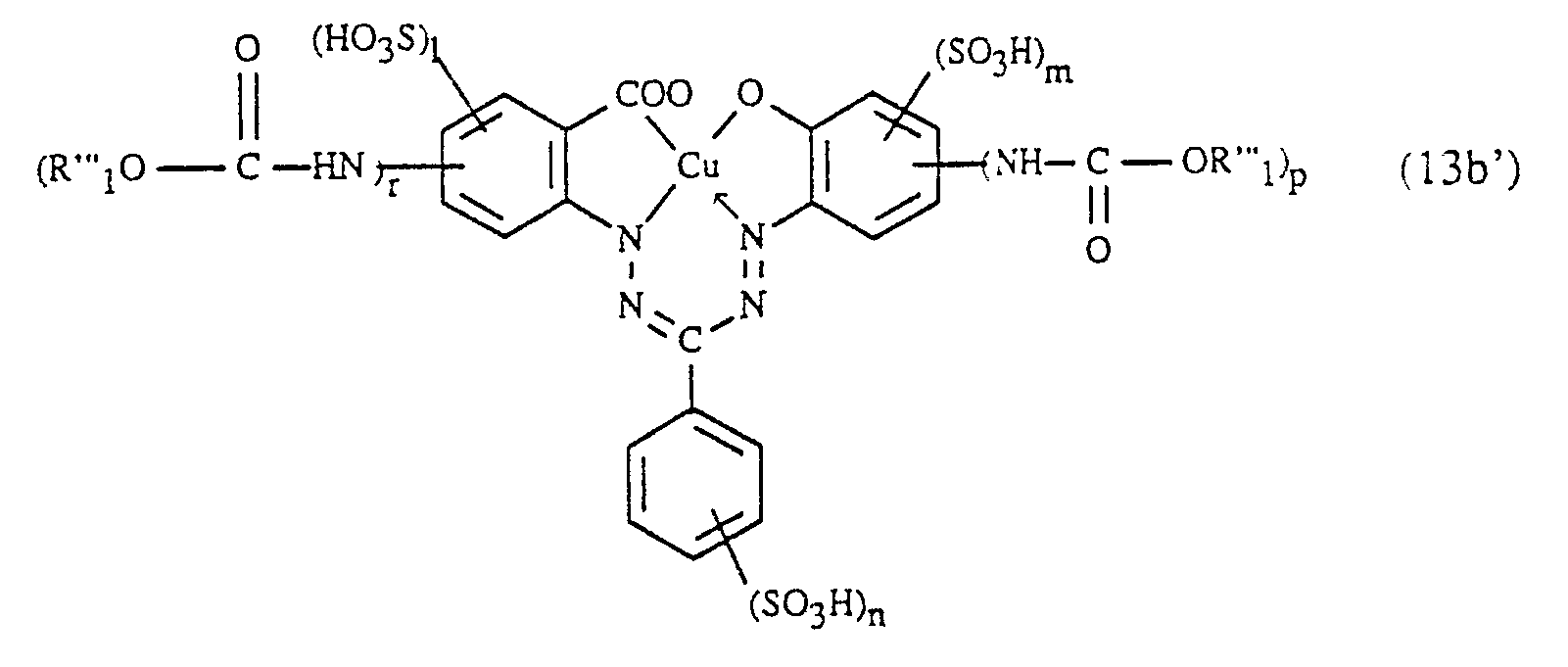
- the inventive method is particularly suitable for the production of Ver bonds in the form of the free acid of the formula correspond, in which the meanings and preferences mentioned apply to X1 and Y, l, m and n independently of one another denote the number 0, 1 or 2 and the sum of (l + m + n) is an integer from 1 to 4, preferably 2 or 3 and particularly preferably 2, and one of the two variables p and r denotes the number 1 and the other the number 0.
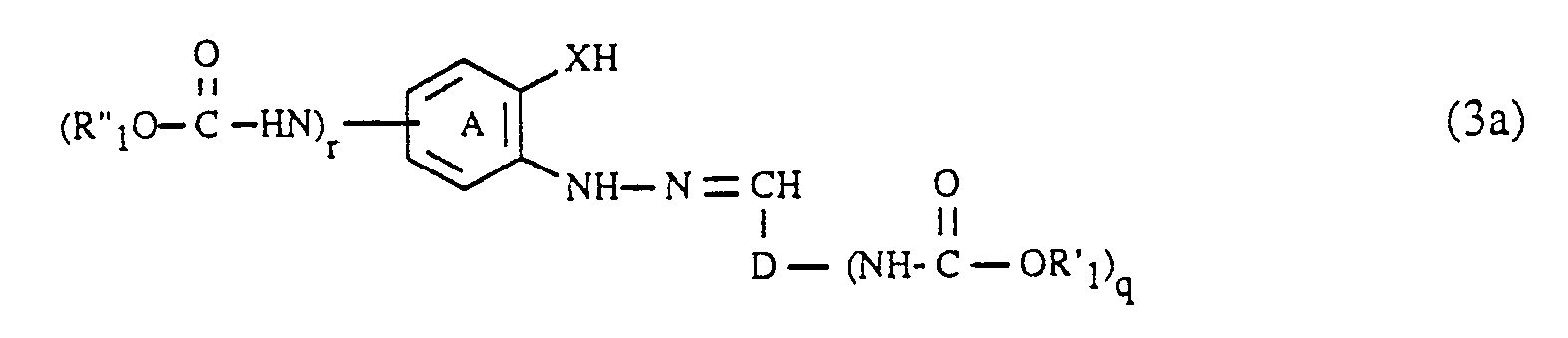
- R, R ′ and / or R ⁇ in the compounds of the formula (2), (3) or (13a) represent optionally substituted C1-C4alkyl, it is e.g. around unsubstituted or e.g. methyl, ethyl, n- or iso-propyl or n-, iso-, sec- or tert-butyl substituted by hydroxy, carboxy, cyano, sulfo, sulfato or halogen.
- R, R ′ and R ⁇ here independently of one another preferably represent unsubstituted C1-C4 alkyl;
- R, R 'and R ⁇ as alkyl are particularly preferably methyl, ethyl, n-propyl or iso-propyl and particularly preferably ethyl.
- R, R ′ and / or R ⁇ represent optionally substituted aryl, it is e.g. around unsubstituted or e.g. naphthyl or phenyl substituted by C1-C4-alkyl, C1-C4-alkoxy, halogen, sulfo and / or carboxy.
- R, R ′ and R ⁇ represent as aryl preferably phenyl which is unsubstituted or substituted by methyl, ethyl, methoxy, ethoxy, chlorine and / or sulfo and particularly preferably unsubstituted phenyl.
- R, R ′ and / or R ⁇ are aralkyl, this is e.g. Benzyl.
- radicals R, R 'and R ⁇ can be different or the same and are preferably the same.
- the acylation takes place e.g. in an aqueous or aqueous-organic medium at a temperature of -5 to 50 ° C and preferably 0 to 30 ° C, the pH being kept neutral to slightly acidic.
- the pH range from 3 to 5 has proven to be particularly feasible; the setting of appropriate pH values can e.g. by adding ammonium or alkali metal bases, e.g. Ammonia, lithium, sodium or potassium hydroxide or the corresponding carbonates.
- the formic acid ester of the formula (5) is preferably used in equimolar amounts or in a slight excess, based on the compound of the formula (4).
- the coupling components of the formula (3) can be prepared in a manner known per se will. They are obtained, for example, by using an aldehyde of the formula (R′O -HN) D-CHO (6), wherein, D, R 'and q each have the meaning given above, with a hydrazine of the formula wherein (A), R ⁇ , X and r each have the meaning given above, condensed to an arylhydrazone of the formula (3).
- the condensation of the aldehydes of the formula (6) with the hydrazines of the formula (7) is carried out very easily, for example by heating in an aqueous or organic solution.
- the compounds of the formulas (6) and (7), in which q and r is 1, can be carried out analogously to the procedure described for the diazo components by acylation of a compound of the formula H2N-D-CHO (6a) respectively. with a compound of the formula or a compound of the formula getting produced; Hal, R ′, R ⁇ , (A), D and X in the formulas (5a), (5b), (6a) and (7a) each have the meaning given above.
- the formic acid esters of the formula (5a) or (5b) are generally at least in equimolar amounts and preferably in an up to 5-fold molar excess, based on the compound of the formula (6a) or (7a); A 10 to 50 mol% and preferably 15 to 35 mol% excess of the compound of the formula (5a) or (5b) relative to the compound of the formula (6a) or (7a) has proven to be particularly advantageous.
- the compound of formula (2) is used in a manner known per se, for example with a nitrite, e.g. with an alkali metal nitrite such as sodium nitrite, under acidic conditions, preferably in a hydrochloric acid medium, at temperatures from -5 to 25 ° C and preferably 0 to 10 ° C, diazotized.
- a nitrite e.g. with an alkali metal nitrite such as sodium nitrite
- acidic conditions preferably in a hydrochloric acid medium, at temperatures from -5 to 25 ° C and preferably 0 to 10 ° C, diazotized.
- the amine of the formula (2) is advantageously used in approximately stoichiometric amounts, based on the coupling component of the formula (3).
- the coupling step is also carried out under conventional conditions known per se. It is expedient to work at a slightly acidic, neutral or slightly alkaline pH and temperatures of approximately 0 to 40 ° C. and preferably 5 to 30 ° C.
- An approximately neutral medium is preferred for the coupling reaction, which medium e.g. has a pH of 6 to 8; the adjustment of the pH value can e.g. by adding ammonium or alkali metal bases, e.g. Ammonia, lithium, sodium or potassium hydroxide or the corresponding carbonates.
- a heavy metal donor is added to the reaction mixture before, during or after the coupling; here it is preferred to use the latter together with one of the reactants, e.g. the coupling component of the formula (3) or the diazotized compound of the formula (2) to be used in the coupling reaction or to add the heavy metal donor during the coupling.
- the reactants e.g. the coupling component of the formula (3) or the diazotized compound of the formula (2) to be used in the coupling reaction or to add the heavy metal donor during the coupling.
- the heavy metal Me releasing agents used are the customary, expediently water-soluble, simple or complex salts of the heavy metals of atomic numbers 24 to 30 of organic or inorganic acids.
- the water-soluble chromium, cobalt, nickel, zinc, manganese and especially the copper salts come from Mineral acids or lower fatty acids.
- Examples are: chromium fluoride, sulfate, acetate, formate or salicylate; Cobalt acetate, sulfate or chloride; Nickel acetate, formate, sulfate or chloride; Zinc sulfate or chloride; Copper carbonate, chloride, sulfate or acetate.
- copper salts are particularly preferred, and in particular the use of copper sulfate or acetate.
- the heavy metal donor is preferably used in approximately stoichiometric amounts so that one atom of heavy metal is present per mole of dye.
- the metallization usually takes place quantitatively at room temperature; however, heating up to approx. 80 ° C is often necessary.
- the metallization is expediently carried out at a pH of 4 to 8.
- the saponification of the compound of formula (13a) according to step b) is preferably carried out at elevated temperature, e.g. at 50 to 120 ° C, preferably at 60 to 100 ° C and particularly preferably at 80 to 100 ° C. It is advisable to use a strongly alkaline medium, e.g. has a pH of 12 to 14 and preferably 13 to 14.
- the alkaline medium is e.g. by means of an alkali base, e.g. Lithium, potassium or preferably sodium hydroxide, which is used in excess.
- the time required for complete saponification is e.g. 30 minutes to 2 hours, preferably 30 to 90 minutes and particularly preferably 30 to 60 minutes.
- the compounds of formula (13) can be prepared from the reaction mixture obtained according to b) in a conventional manner, e.g. be isolated and purified by means of salting out, filtration, crystallization, extraction, washing, etc., being obtained in the form of their salts, in particular alkali metal salts, especially lithium, sodium or potassium salts, or ammonium salts.
- reaction of the aminoformazan compounds of the formula (13) with the triazinyl compounds of the formula (8) to the reactive dyes of the formula (1) is known per se or can be carried out by methods known per se.
- An advantageous variant consists in reacting the reaction mixture obtained in the preparation of the compounds of formula (13) in reaction step b) directly with the compound of formula (8) without further purification and / or isolation of the aminoformazan compound.
- the reaction is usually carried out in an aqueous or aqueous-organic medium at temperatures from -10 to 100 ° C and preferably 0 to 50 ° C; the pH value is advantageous e.g. kept neutral to acidic by one of the aforementioned bases; the preferred pH range in this condensation step is accordingly e.g. between 3 and 7.
- the reactive dyes of the formula (1) are suitable for dyeing and printing a wide variety of materials, such as silk, leather, wool, polyamide fibers and all kinds of cellulose-containing fiber materials.
- Such fiber materials are e.g. the natural cellulose fibers such as cotton, linen and hemp, cellulose and regenerated cellulose, as well as mixed fibers that contain one of the fibers mentioned.
- the fiber materials are preferably present as textile fiber materials in a wide variety of processing states.
- the reactive dyes produced by the process according to the invention are equal to or superior to conventionally produced dyes in terms of application and fastness.
- aminoformazan compounds and, as a subsequent reaction, fiber-reactive formazan dyes can be prepared with a space-time yield which is greatly increased compared to known processes; This is primarily due to the fact that the amino protective groups according to the invention can be easily removed again after the coupling reaction has taken place and on the other hand do not interfere with any subsequent reaction with hydrolysis-sensitive reactive compounds. A complex cleaning of the aminoformazan compound is thus omitted and the latter can be used without any cleaning or e.g. precipitated only crude with salt and filtered to react with the reactive compound.
- the mixture is stirred for a further 5 minutes and then 40 ml of 30% sodium hydroxide solution are added to the reaction mixture; This is then heated to 100 ° C. within 30 to 45 minutes and kept at this temperature for about 15 minutes.
- the saponification is then complete and the aminoazo dye is salted out with sodium chloride after cooling to about 70 ° C.
- Hydrochloric acid first to 7 and then by further dropping conc. Hydrochloric acid gradually to 4.
- the mixture is stirred for an hour and then the product is filtered off. After drying, the compound of the formula is obtained with a yield of 91%.
- cyanuric fluoride 105 parts of cyanuric fluoride are run in at 0 to 5 ° C. with stirring to a neutral solution of 388 parts of the aminoformazan compound prepared above in approx. 3000 parts of water and the pH is brought to approx. 6 by adding sodium hydroxide solution held.
- cyanuric fluoride addition 60 parts of 32% hydrochloric acid are added and the mixture is stirred for about 30 minutes.
Landscapes
- Chemical & Material Sciences (AREA)
- Organic Chemistry (AREA)
- Organic Low-Molecular-Weight Compounds And Preparation Thereof (AREA)
- Coloring (AREA)
Abstract
Description
- Die vorliegende Erfindung betrifft ein Verfahren zur Herstellung von Aminoformazanverbindungen sowie deren weitere Umsetzung zu faserreaktiven Formazanfarbstoffen.
- Es ist bereits z.B. aus der EP-A 0 280 139 bekannt, Aminoformazanfarbstoffe durch Umsetzung von einem Arylhydrazon mit einem diazotierten o-Hydroxyaminobenzol herzustellen; im Endprodukt vorhandene Aminogruppen müssen dabei vor der Reaktion z.B. mittels Acetylierung geschützt und die Acetyl-Schutzgruppe anschliessend wieder abgespalten werden. Bei dieser Vorgehensweise wirkt sich nachteilig aus, dass die Abspaltung der Acetylgruppe im alkalischen Medium nur sehr langsam abläuft und dieser Schritt dementsprechend lange Reaktionszeiten beansprucht. Ein weiterer Nachteil der bekannten Verfahren ergibt sich für den Fall, dass der Aminoformazanfarbstoff anschliessend mit Hydrolyse-empfindlichen faserreaktiven Verbindungen, z.B. Halotriazinen und insbesondere Fluorotriazinen, umgesetzt werden soll: Will man erhebliche Ausbeuteverluste an Reaktivfarbstoff, hervorgerufen durch Hydrolyse des Reaktivrestes, vermeiden, so ist es notwendig, die bei der alkalischen Hydrolyse anfallenden Acetationen vor der weiteren Umsetzung mittels zum Teil aufwendiger Reinigungs- und Trennverfahren zu entfernen.
- Es besteht daher das Bedürfnis nach einem verbesserten Herstellungsverfahren für Aminoformazanverbindungen, welches die genannten Probleme umgeht und insbesondere die Synthese von Aminoformazanverbindungen und deren weitere Umsetzung zu Reaktivfarbstoffen mit einer besonders hohen Raum-Zeit-Ausbeute ermöglicht.
- Es wurde nun gefunden, dass man Aminoformazanverbindungen, die gegebenenfalls ohne weitere Reinigung zu Reaktivfarbstoffen weiterverarbeitet werden können, mit deutlich verbesserter Raum-Zeit-Ausbeute synthetisieren kann, wenn man anstelle einer Acetylierung die Aminogruppe(n) durch Carbamatbildung schützt.
- Gegenstand der Erfindung ist daher ein Verfahren zur Herstellung von faserreaktiven Formazanverbindungen, die in Form der freien Säure der Formel

D der Rest eines gegebenenfalls weitersubstituierten Benzols oder Naphthalins oder der Rest einer heterocyclisch-aromatischen Verbindung ist,
X eine Sulfogruppe oder eine Oxy- oder Carbonyloxygruppe bedeutet,
Me ein Schwermetallion der Atomnummern 24 bis 30 darstellt,
p, q und r unabhängig voneinander jeweils die Zahl 0 oder 1 bedeuten, wobei die Summe von (p+q+r) 1 oder 2 ist, X₁ Halogen darstellt, Y unabhängig die Bedeutung von X₁ hat oder einen Amino- oder Alkoxyrest bedeutet und die Ringe (A) und (B) neben den eingezeichneten Gruppen weitere Substituenten tragen können,
dadurch gekennzeichnet, dass man - a) eine Verbindung der Formel
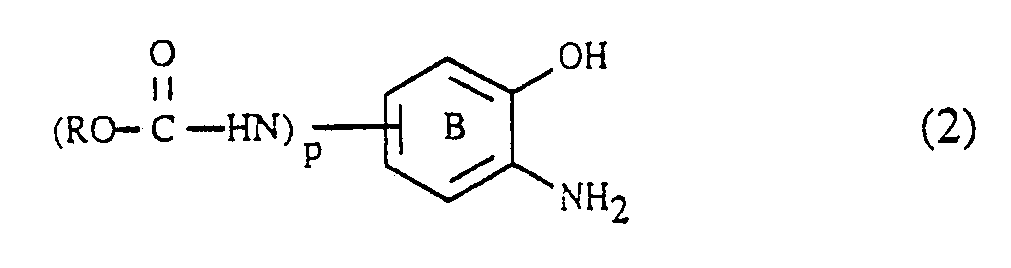

- b) die gemäss a) erhaltene Formazanverbindung, die in Form der freien Säure der Formel
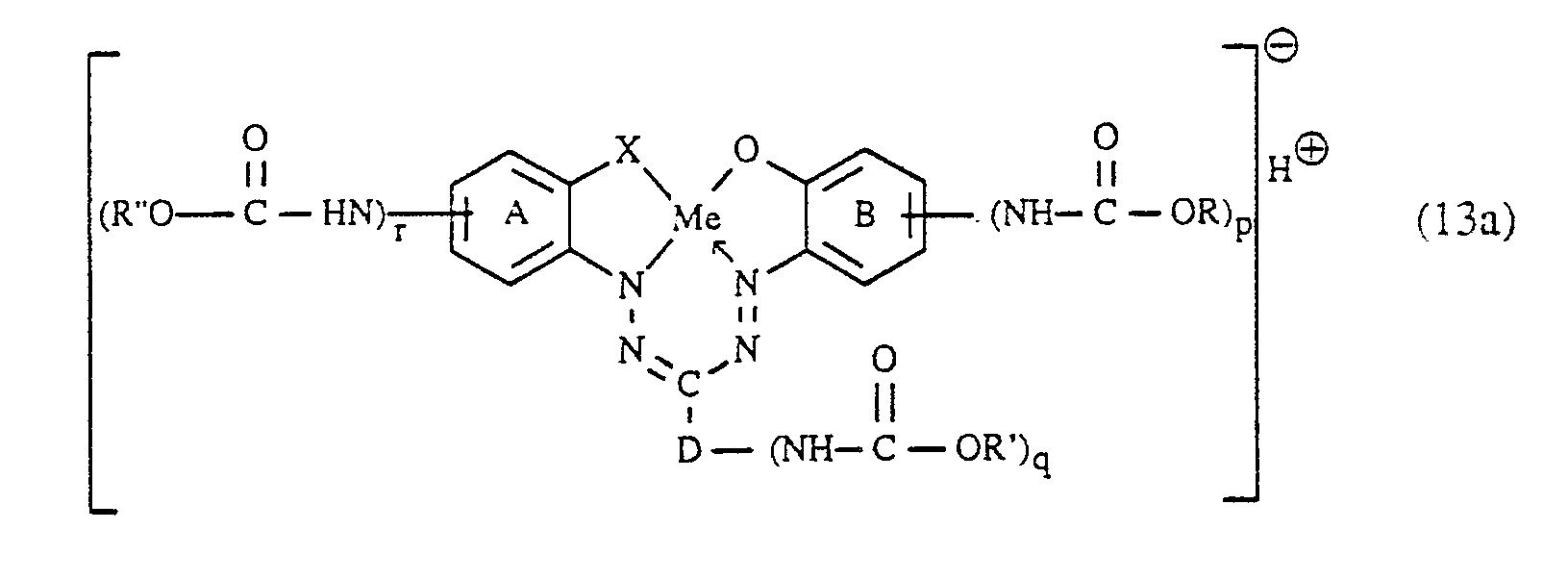
- c) die gemäss b) erhaltene Verbindung der Formel


- Steht D in Formel (1) für den Rest eines Benzols oder Naphthalins, handelt es sich z.B. um einen Benzol- oder Naphthalinrest, welcher ausser durch -(NH₂)q zusätzlich durch weitere Reste substituiert sein kann; geeignete Substituenten am Rest D sind z.B.: C₁-C₄- Alkyl, worunter generell Methyl, Ethyl, n- oder iso-Propyl, oder n-, iso-, sec.- oder tert.-Butyl zu verstehen ist; C₁-C₄-Alkoxy, womit generell Methoxy, Ethoxy, n- oder iso-Propoxy oder n-, iso-, sec.- oder tert.-Butoxy umfasst ist; Halogen wie Fluor, Chlor oder Brom; Hydroxy; Carboxy; C₂-C₅-Alkoxycarbonyl, z.B. Methoxy- oder Ethoxycarbonyl; C₂-C₅-Alkanoylamino, z.B. Acetylamino oder Propionylamino; Sulfo; Nitro; Cyano; Trifluormethyl.
- Der Benzol- oder Napthalinrest D in Formel (1) trägt vorzugsweise ausser -(NH₂)q keine weiteren Substituenten oder ist z.B. durch Sulfo, Chlor, Methyl und/oder Methoxy weitersubstituiert.
- D in Formel (1) steht besonders bevorzugt für den Rest eines Benzols, das ausser -(NH₂)q keine weiteren Substituenten trägt oder durch Sulfo weitersubstituiert ist.
- Bedeutet D in Formel (1) den Rest einer heterocyclisch-aromatischen Verbindung, so kann dies z.B. der Rest eines Furans, Thiophens, Pyrrols, Imidazols, Pyrazols, Pyridins, Chinolins oder Benzimidazols sein.
- Die Ringe (A) und (B) können ausser den in Formel (1) genannten Gruppen weitere Substituenten tragen. Beispiele sind Halogen, C₁-C₄-Alkyl, C₁-C₄-Alkoxy, Nitro, Cyano, Trifluormethyl, Carboxy, Sulfo, Sulfamoyl, N-Mono- oder N,N-Di-C₁-C₄-Alkylsulfamoyl, C₁-C₄-Alkylsulfonyl, z.B. Methyl- oder Ethylsulfonyl, Phenylsulfonyl und Phenoxy.
- Die Ringe (A) und (B) in Formel (1) tragen unabhängig voneinander vorzugsweise ausser -(NH₂)r bzw. -(NH₂)p keine weiteren Substituenten oder sind z.B. durch Sulfo, Nitro, Chlor, Methyl und/oder Methoxy weitersubstituiert.
- Besonders bevorzugt tragen die Ringe (A) und (B) in Formel (1) ausser -(NH₂)r bzw. -(NH₂)p keine weiteren Substituenten oder sind durch Sulfo weitersubstituiert.
- X steht vorzugsweise für die Oxygruppe und besonders bevorzugt für die Carbonyloxygruppe.
- Bei Me handelt es sich z.B. um ein Chrom-, Kobalt-, Nickel-, Zink-, Mangan- und besonders bevorzugt um ein Kupferion.
- Die Verbindungen der Formel (1) weisen z.B. 1 bis 4, vorzugsweise 2 oder 3, und besonders bevorzugt 2 Sulfogruppen auf; diese können am Ring (A), Ring (B) und/oder am Rest D lokalisiert sein.
- p, q und r stehen unabhängig voneinander jeweils vorzugsweise für die Zahl 0 oder 1, wobei die Summe von (p+q+r) gleich der Zahl 1 ist.
- Eine bevorzugte Ausführungsform des erfindungsgemässen Verfahrens betrifft die Verwendung von Verbindungen der Formeln (2) und (3), worin q 0 ist und eine der Variablen p und r für die Zahl 1 und die andere für die Zahl 0 steht; hierbei ist es insbesondere bevorzugt, dass q und r je die Zahl 0 bedeuten und p für die Zahl 1 steht.
- X₁ steht als Halogen z.B. für Chlor oder Fluor.
- Geeignete Aminoreste Y sind z.B.:
Amino, N-C₁-C₄-Alkyl- oder N,N-Di-C₁-C₄-Alkylamino, wobei das Alkyl gegebenenfalls durch Sulfo, Sulfato, Hydroxy, Carboxy oder Phenyl substituiert ist, Cyclohexylamino, Phenyl- oder Naphthylamino, welches gegebenenfalls durch C₁-C₄-Alkyl, C₁-C₄-Alkoxy, Amino, Carboxy, Sulfo und/oder Halogen substituiert ist, N-C₁-C₄-Alkyl-N-phenylamino, wobei das Alkyl und Phenyl jeweils unsubstituiert oder unabhängig voneinander z.B. wie oben geschildert substituiert sind, Morpholino oder ein Rest der Formel
-NR₆-(KJ-O)w-alk′-SO₂-Z (9),
- Handelt es sich bei Y um einen Alkoxyrest, so ist dies z.B. ein C₁-C₄-Alkoxyrest.
- Beispiele für geeignete Amino- und Alkoxyreste Y sind somit Amino, Methylamino, Ethylamino, β-Hydroxyethylamino, N,N-Di-β-hydroxyethylamino, β-Sulfoethylamino, Cyclohexylamino, Morpholino, o-, m- oder β-Methylphenylamino, o-, m oder p-Methoxyphenylamino, o-, m- oder p-Chlorphenylamino, o-, m- oder p-Sulfophenylamino, Disulfophenylamino, o-Carboxyphenylamino, 1- oder 2-Naphthylamino, 1-Sulfo-2-naphthylamino, 4,8-Disulfo-2-naphthylamino, N-Ethyl-N-phenylamino, N-Methyl-N-phenylamino, Methoxy, Ethoxy, n- oder iso-Propoxy, 2-(2′-Sulfatoethylsulfonyl)-ethylamino, 2-(2′-Chlorethylsulfonyl)-ethylamino, 2-(Vinylsulfonyl)-ethylamino, 2-[2′-(2˝-Chlorethylsulfonyl)-ethoxy]-ethylamino, 2-(2′-Vinylsulfonylethoxy)-ethylamino, 3- oder 4-(2′-Sulfatoethylsulfonyl)-phenylamino, 3-(Vinylsulfonyl)-6-sulfophenylamino, 3- oder 4-[2′-(2˝-Chlorethylsulfonyl)-ethylaminocarbonyl]-phenylamino, 3-[2′-(2˝-Chlorethylsulfonyl)-ethylaminocarbonyl]-6-sulfophenylamino.
- Vorzugsweise steht Y für den Rest -NH₂ oder für einen Rest der Formel
-NH-(CH₂-CH₂-O-)wCH₂-CH₂-Z′ (9′)
- Das erfindungsgemässe Verfahren ist insbesondere geeignet für die Herstellung von Ver bindungen, die in Form der freien Säure der Formel

- Stehen R, R′ und/oder R˝ in den Verbindungen der Formel (2), (3) oder (13a) für gegebenenfalls substituiertes C₁-C₄-Alkyl, handelt es sich z.B. um unsubstituiertes oder z.B. durch Hydroxy, Carboxy, Cyano, Sulfo, Sulfato oder Halogen substituiertes Methyl, Ethyl, n- oder iso-Propyl oder n-, iso-, sec.- oder tert.-Butyl.
- R, R′ und R˝ stellen hierbei unabhängig voneinander bevorzugt unsubstituiertes C₁-C₄-Alkyl dar; bei R, R′ und R˝ als Alkyl handelt es sich besonders bevorzugt um Methyl, Ethyl, n-Propyl oder iso-Propyl und insbesondere bevorzugt um Ethyl.
- Stehen R, R′ und/oder R˝ für gegebenenfalls substituiertes Aryl, handelt es sich z.B. um unsubstituiertes oder z.B. durch C₁-C₄-Alkyl, C₁-C₄-Alkoxy, Halogen, Sulfo und/oder Carboxy substituiertes Naphthyl oder Phenyl.
- R, R′ und R˝ stellen als Aryl bevorzugt unsubstituiertes oder durch Methyl, Ethyl, Methoxy, Ethoxy, Chlor und/oder Sulfo substituiertes Phenyl und besonders bevorzugt unsubstituiertes Phenyl dar.
- Stehen R, R′ und/oder R˝ für Aralkyl, so ist dies z.B. Benzyl.
- In einer besonders bevorzugten Ausführungsform der vorliegenden Erfindung setzt man Verbindungen der Formel (2) und (3), worin R, R′ und/oder R˝ Phenyl oder insbesondere Ethyl sind, in das Verfahren ein.
- Die Reste R, R′ und R˝ können verschieden oder gleich sein und sind vorzugsweise gleich.
- Die Verbindungen der Formel (2) mit p = 1 können in an sich bekannter Weise durch Acylierung einer Verbindung der Formel


- Die Acylierung findet dabei z.B. in einem wässrigen oder wässrig-organischen Medium bei einer Temperatur von -5 bis 50°C und vorzugsweise 0 bis 30°C statt, wobei der pH-Wert neutral bis leicht sauer gehalten wird. Als gut gangbar erweist sich insbesondere der pH-Bereich von 3 bis 5; die Einstellung entsprechender pH-Werte kann z.B. durch Zugabe von Ammonium- oder Alkalimetallbasen, z.B. Ammoniak, Lithium-, Natrium- oder Kaliumhydroxid oder die entsprechenden Carbonate, erfolgen.
- Der Ameisensäureester der Formel (5) wird vorzugsweise in äquimolaren Mengen oder in geringem Ueberschuss, bezogen auf die Verbindung der Formel (4), eingesetzt.
- Die Verbindungen der Formel (2), worin p = 1 ist, werden vorteilhaft direkt nach ihrer Herstellung ohne Reinigung und/oder Isolierung gemäss Verfahrensschritt a) weiterverarbeitet. Die Verbindungen der Formel (2) mit p = 0 sind an sich bekannt.
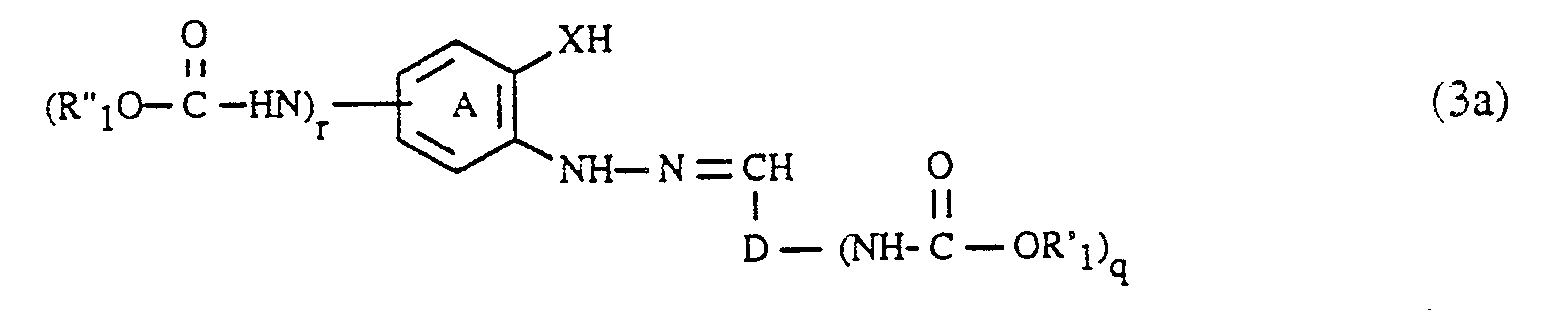
- Die Kupplungskomponenten der Formel (3) können in an sich bekannter Weise hergestellt werden. Man erhält sie z.B., indem man einen Aldehyd der Formel
(R′O-HN) D-CHO (6),
worin, D, R′ und q jeweils die zuvor angegebene Bedeutung haben, mit einem Hydrazin der Formel
- Die Verbindungen der Formeln (6) und (7), worin q und r jeweil 0 sind, sind an sich bekannt oder können nach an sich bekannten Methoden hergestellt werden.
- Die Verbindungen der Formeln (6) und (7), worin q bzw. r 1 ist, können analog zu der für die Diazokomponenten beschriebenen Prozedur durch Acylierung einer Verbindung der Formel
H₂N-D-CHO (6a)
bzw.


- Die Ameisensäureester der Formel (5a) bzw. (5b) werden im allgemeinen mindestens in äquimolaren Mengen und vorzugsweise in einem bis zu 5fachen molaren Ueberschuss, bezogen auf die Verbindung der Formel (6a) bzw. (7a) eingesetzt; als besonders günstig erweist sich ein 10 bis 50 Mol% und vorzugsweise 15 bis 35 Mol-% betragender Ueberschuss der Verbindung der Formel (5a) bzw. (5b) relativ zur Verbindung der Formel (6a) bzw. (7a).
- Die Verbindungen der Formeln (6) und (7), worin p 1 ist, werden vorteilhaft direkt nach ihrer Herstellung ohne Reinigung und/oder Isolierung gemäss Verfahrensschritt a) weiterverarbeitet.
- Die Verbindung der Formel (2) wird in an sich bekannter Weise, etwa mit einem Nitrit, z.B. mit einem Alkalimetallnitrit wie Natriumnitrit, unter sauren Bedingungen, vorzugsweise in salzsaurem Medium, bei Temperaturen von -5 bis 25°C und vorzugsweise 0 bis 10°C, diazotiert.
- Man setzt das Amin der Formel (2) vorteilhaft in etwa stöchiometrischen Mengen, bezogen auf die Kupplungskomponente der Formel (3), ein.
- Der Kupplungsschritt wird ebenfalls unter üblichen, an sich bekannten, Bedingungen durchgeführt. Man arbeitet zweckmässig bei einem leicht sauren, neutralen oder leicht alkalischen pH-Wert und Temperaturen von ca. 0 bis 40°C und vorzugsweise 5 bis 30°C. Bevorzugt ist für die Kupplungsreaktion ein in etwa neutrales Medium, welches z.B. einen pH-Wert von 6 bis 8 aufweist; die Einstellung des pH-Werts kann z.B. durch Zugabe von Ammonium- oder Alkalimetallbasen, z.B. Ammoniak, Lithium-, Natrium- oder Kaliumhydroxid oder die entsprechenden Carbonate, erfolgen.
- Das Reaktionsgemisch wird vor, während oder nach der Kupplung mit einem Schwermetall-abgebenden Mittel versetzt; hierbei ist es bevorzugt, letzteres zusammen mit einem der Reaktionspartner, z.B. der Kupplungskomponente der Formel (3) oder der diazotierten Verbindung der Formel (2), in die Kupplungsreaktion einzusetzen oder aber das Schwermetallabgebende Mittel während der Kupplung zuzusetzen.
- Als Schwermetall Me abgebende Mittel verwendet man die üblichen, zweckmässig wasserlöslichen, einfachen oder komplexen Salze der Schwermetalle der Atomnummern 24 bis 30 von organischen oder anorganischen Säuren. Dabei kommen z.B. die wasserlöslichen Chrom-, Kobalt-, Nickel-, Zink-, Mangan- und vor allem die Kupfersalze von Mineralsäuren oder niederen Fettsäuren in Betracht.
- Beispiele sind: Chromfluorid, -sulfat, -acetat, -formiat oder -salicylat; Kobaltacetat, -sulfat oder -chlorid; Nickelacetat, -formiat, -sulfat oder -chlorid; Zinksulfat oder -chlorid; Kupfercarbonat, -chlorid, -sulfat oder -acetat.
- Besonders bevorzugt ist die Verwendung von Kupfersalzen und hierbei insbesondere die Verwendung von Kupfersulfat oder -acetat.
- Das Schwermetall-abgebende Mittel wird vorzugsweise in etwa stöchiometrischen Mengen verwendet, sodass pro Mol Farbstoff ein Atom Schwermetall vorhanden ist.
- Die Metallisierung geht üblicherweise schon bei Raumtemperatur quantitativ vor sich; vielfach ist aber ein Erwärmen bis auf ca. 80°C erforderlich. Man führt die Metallisierung zweckmässig bei einem pH-Wert von 4 bis 8 durch.
- Die Verseifung der Verbindung der Formel (13a) gemäss Schritt b) wird vorzugsweise bei erhöhter Temperatur, z.B. bei 50 bis 120°C, vorzugsweise bei 60 bis 100°C und besonders bevorzugt bei 80 bis 100°C, durchgeführt. Man verwendet zweckmässig ein stark alkalisches Medium, welches z.B. einen pH-Wert von 12 bis 14 und vorzugsweise 13 bis 14 aufweist. Das alkalische Medium wird z.B. mittels einer Alkalibase, z.B. Lithium-, Kalium- oder vorzugsweise Natriumhydroxid, welche im Ueberschuss eingesetzt wird, hergestellt.
- Die für die vollständige Verseifung benötigte Zeit beträgt z.B. 30 Minuten bis 2 Stunden, vorzugsweise 30 bis 90 Minuten und besonders bevorzugt 30 bis 60 Minuten.
- Die Verbindungen der Formel (13) können aus dem gemäss b) anfallenden Reaktionsgemisch in üblicher Weise, z.B. mittels Aussalzens, Filtration, Kristallisation, Extraktion, Waschen usw. isoliert und gereinigt werden, wobei sie in Fom ihrer Salze, insbesondere Alkali-, vor allem Lithium-, Natrium- oder Kaliumsalze, oder Ammoniumsalze anfallen.
- Die Umsetzung der Aminoformazanverbindungen der Formel (13) mit den Triazinylverbindungen der Formel (8) zu den Reaktivfarbstoffen der Formel (1) ist an sich bekannt oder kann nach an sich bekannten Methoden durchgeführt werden.
- Eine vorteilhafte Variante besteht darin, dass man das bei der Herstellung der Verbindungen der Formel (13) im Reaktionsschritt b) erhaltene Reaktionsgemisch ohne weitere Reinigung und/oder Isolierung der Aminoformazanverbindung direkt mit der Verbindung der Formel (8) umsetzt. Die Umsetzung erfolgt üblicherweise in einem wässrigen oder wässrig-organischen Medium bei Temperaturen von -10 bis 100°C und vorzugsweise 0 bis 50°C; der pH-Wert wird dabei vorteilhaft z.B. durch eine der zuvor genannten Basen neutral bis sauer gehalten; der bevorzugte pH-Bereich in diesem Kondensationsschritt liegt dementsprechend z.B. zwischen 3 und 7. Man setzt im allgemeinen pro im Molekül der Formel (13) vorhandener freier Aminogruppe mindestens 1 Aequivalent der Verbindung der Formel (8) ein; insgesamt werden also mindestens (p+q+r) Aequivalente der Verbindung der Formel (8) pro Aequivalent Verbindung der Formel (13) benötigt, wobei p, q und r jeweils die zuvor angegebene Bedeutung haben. Vorzugsweise wird jedoch die Verbindung der Formel (8) in einem gewissen Ueberschuss, bezogen auf die Verbindung der Formel (13), eingesetzt.
- Eine bevorzugte Ausführungsform der vorliegenden Erfindung betrifft ein Verfahren zur Herstellung von Verbindungen der zuvor angegebenen Formel (13), welche 2 oder 3 Sulfogruppen aufweisen und worin D ein unsubstituierter oder durch Sulfo, Chlor, Methyl und/oder Methoxy substituierter Rest eines Benzols oder Naphthalins ist, die Ringe (A) und (B) unabhängig voneinander keine weiteren Substituenten tragen oder durch Sulfo, Nitro, Chlor, Methyl und/oder Methoxy weitersubstituiert sind, X die Oxy- oder Carbonyloxygruppe bedeutet, Me für ein Kupferion steht, p, q und r unabhängig voneinander jeweils die Zahl 0 oder 1 bedeuten, wobei die Summe von (p+q+r) gleich der Zahl 1 ist, X₁ Chlor oder Fluor ist, und Y Amino, N-C₁-C₄-Alkyl- oder N,N-Di-C₁-C₄-Alkylamino, wobei das Alkyl gegebenenfalls durch Sulfo, Sulfato, Hydroxy, Carboxy oder Phenyl substituiert ist, Cyclohexylamino, Phenyl- oder Naphthylamino, welches gegebenenfalls durch C₁-C₄-Alkyl, C₁-C₄-Alkoxy, Amino, Carboxy, Sulfo und/oder Halogen substituiert ist, N-C₁-C₄-Alkyl-N-phenylamino, wobei das Alkyl und Phenyl jeweils unsubstituiert oder unabhängig voneinander wie oben geschildert substituiert sind, Morpholino oder einen Rest der Formel
-NR₆-(alk-O)walk′-SO₂-Z (9),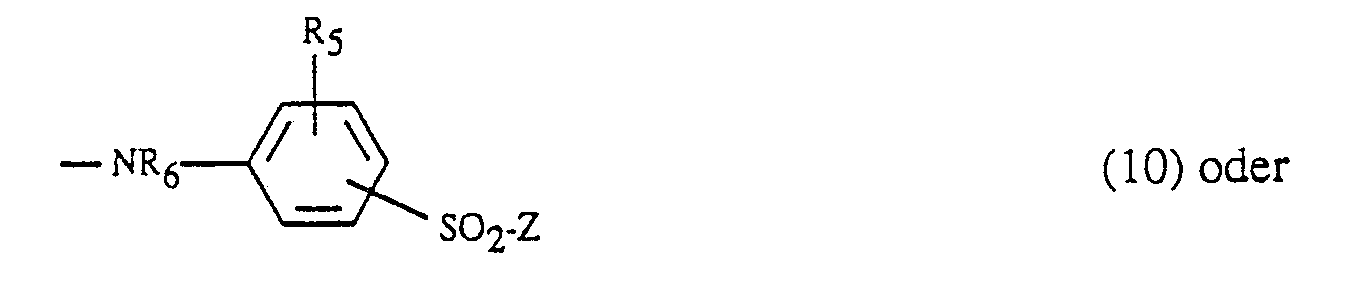

- a) eine Verbindung der Formel

- b) die gemäss a) erhaltene Formazanverbindung, die in Form der freien Säure der Formel

- c) die gemäss b) erhaltene Aminoformazanverbindung bei einem pH-Wert von 3 bis 7 und einer Temperatur von 0 bis 50°C mit einer Verbindung

- Eine besonders bevorzugte Ausführungsform der vorliegenden Erfindung betrifft ein Verfahren zur Herstellung von Verbindungen der zuvor angegebenen Formel (1′), welches dadurch gekennzeichnet ist, dass man
- a) eine Verbindung der Formel
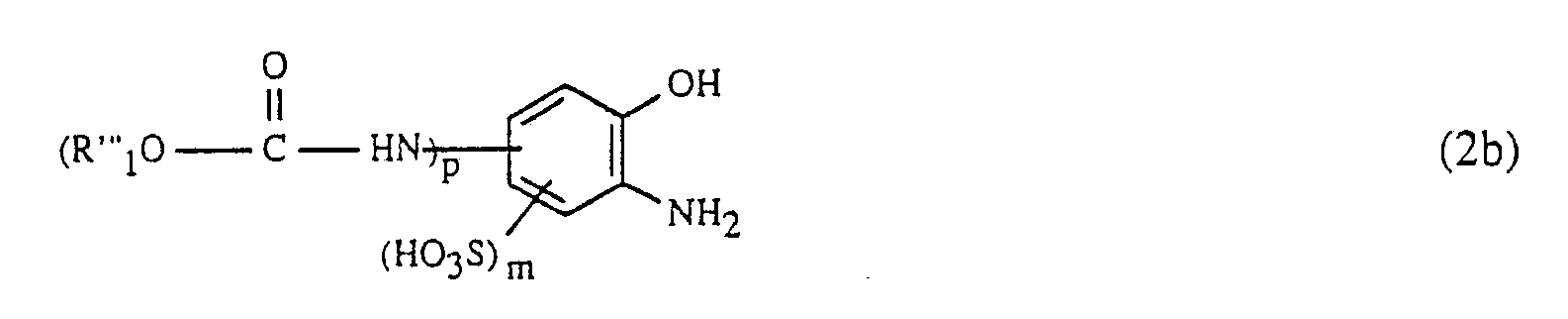

- b) die gemäss a) erhaltene Formazanverbindung, die in Form der freien Säure der Formel

- c) die gemäss b) erhaltene Aminoformazanverbindung bei einem pH-Wert von 3 bis 7 und einer Temperatur von 0 bis 50°C mit einer Verbindung der Formel

-NH-(CH₂-CH₂-O-)wCH₂-CH₂-Z′ (9′)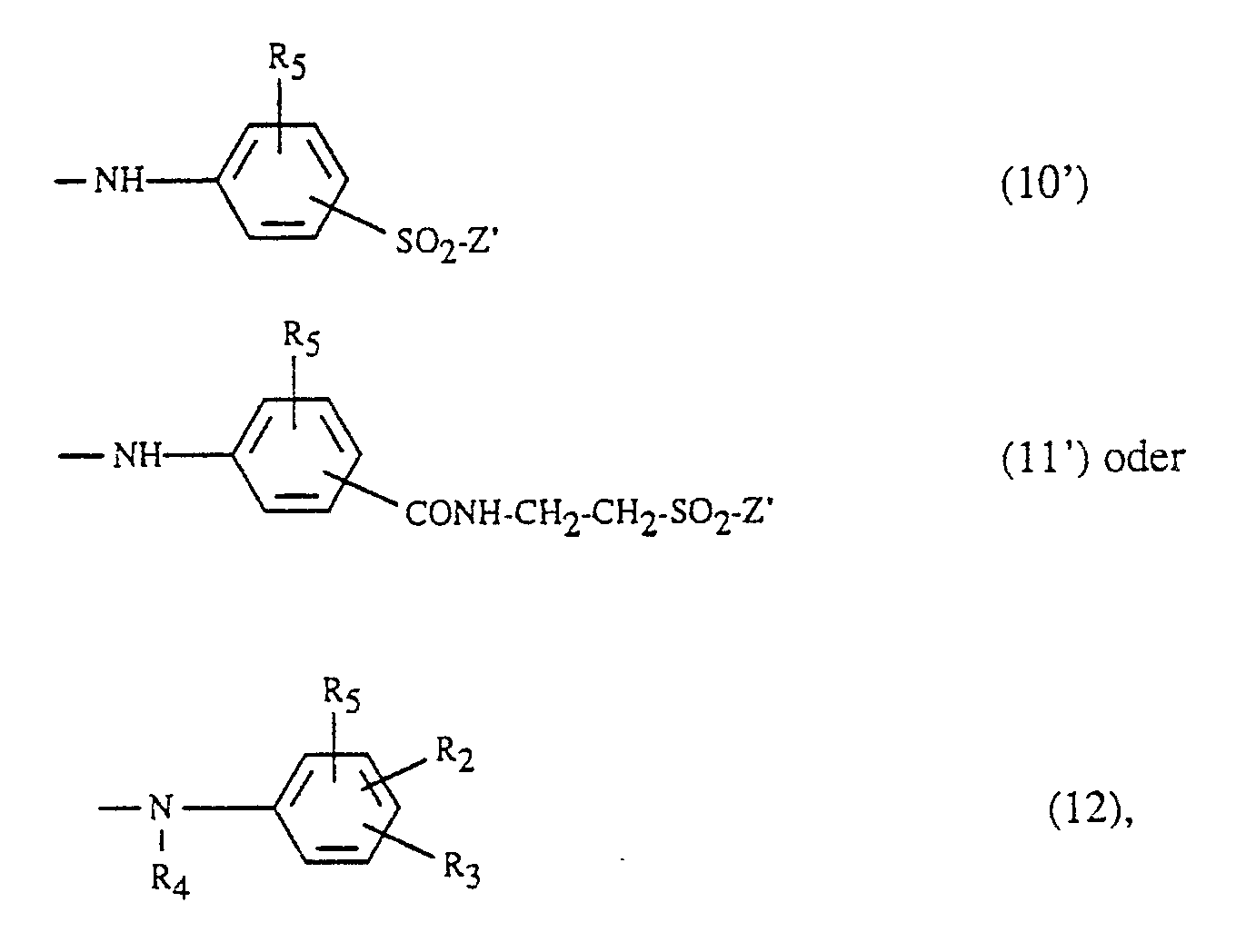
- Die Reaktivfarbstoffe der Formel (1) eignen sich zum Färben und Bedrucken der verschiedensten Materialien, wie Seide, Leder, Wolle, Polyamidfasern und besonders cellulosehaltiger Fasermaterialien aller Art. Solche Fasermaterialien sind z.B. die natürlichen Cellulosefasern wie Baumwolle, Leinen und Hanf, Zellstoff und regenerierte Cellulose, sowie Mischfasern, die eine der genannten Fasern enthalten. Die Fasermaterialien liegen vorzugsweise als textile Fasermaterialien in den verschiedensten Verarbeitungszuständen vor. Die nach dem erfindungsgemässen Verfahren hergestellten Reaktivfarbstoffe sind den konventionell hergestellten im Hinblick auf die Applikation und Echtheiten ebenbürtig oder überlegen.
- Nach dem erfindungsgemässen Verfahren lassen sich Aminoformazanverbindungen sowie als Folgereaktion faserreaktive Formazanfarbstoffe mit einer gegenüber bekannten Verfahren stark erhöhten Raum-Zeitausbeute herstellen; dies ist vor allem dadurch bedingt, dass die erfindungsgemässen Amino-Schutzgruppen zum einen nach erfolgter Kupplungsreaktion leicht wieder entfernt werden können und zum anderen eine gegebenenfalls nachfolgende Umsetzung mit hydrolyseempfindlichen Reaktivverbindungen nicht stören. Eine aufwendige Reinigung der Aminoformazanverbindung entfällt somit und letztere kann ohne jede Reinigung oder z.B. lediglich roh mit Salz ausgefällt und abfiltriert mit der Reaktivverbindung umgesetzt werden.
- Die Verbindungen der zuvor angegebenen Formel (13a), ausgenommen solche, worin R˝ Methyl bedeutet, sind neu und stellen einen weiteren Gegenstand der Erfindung dar.
- Die nachfolgenden Beispiele dienen der Erläuterung der Erfindung, ohne sie darauf zu beschränken. Teile bedeuten Gewichtsteile und Prozente Gewichtsprozente.
- 132,6 g 2-Carboethoxyamido-6-aminophenol-4-sulfonsäure werden in salzsaurem Medium mit Natriumnitrit in an sich bekannter Weise diazotiert. In die Diazosuspension werden 120 g CuSO₄·5H₂O eingetragen und anschliessend der pH-Wert mit 30%-iger Natriumhydroxidlösung auf 7 gestellt. Man lässt die Cu-Ionen enthaltende Diazosuspension rasch zu einer 40°C warmen Lösung von 159,6 g des Hydrazons der Formel


- 105 Teile Cyanurfluorid werden bei 0 bis 5°C unter Rühren zu einer neutralen Lösung von 388 Teilen der oben hergestellten Aminoformazanverbindung in ca. 3000 Teilen Wasser zulaufen gelassen und der pH-Wert durch Zugabe von Natriumhydroxidlösung auf ca. 6 gehalten. Nach beendeter Cyanurfluorid-Zugabe setzt man 60 Teile 32%-ige Salzsäure zu und lässt ca. 30 Minuten nachrühren. Dann werden 133 Teile 2-(2-Aminoethoxy)-2′-chlordiethylsulfon-Hydrochlorid bei 0 bis 5°C zum Reaktionsgemisch gegeben, danach der pH-Wert mit Natriumhydroxidlösung auf 8 eingestellt und ca. 1,5 Stunden bei 0 bis 5°C und anschliessend ca. 15 Minuten bei ca. 15°C nachgerührt; während der Nachrührzeit wird der pH-Wert des Reaktionsgemisches durch Zugabe von Natriumhydroxidlösung bei 8 gehalten. Am Schluss wird der pH-Wert des Reaktionsgemisches durch Zugabe von Natriumhydroxid auf 10 eingestellt und ca. 20 Minuten bei diesem Wert gehalten. Der Formazanfarbstoff, der in Form der freien Säure der Formel

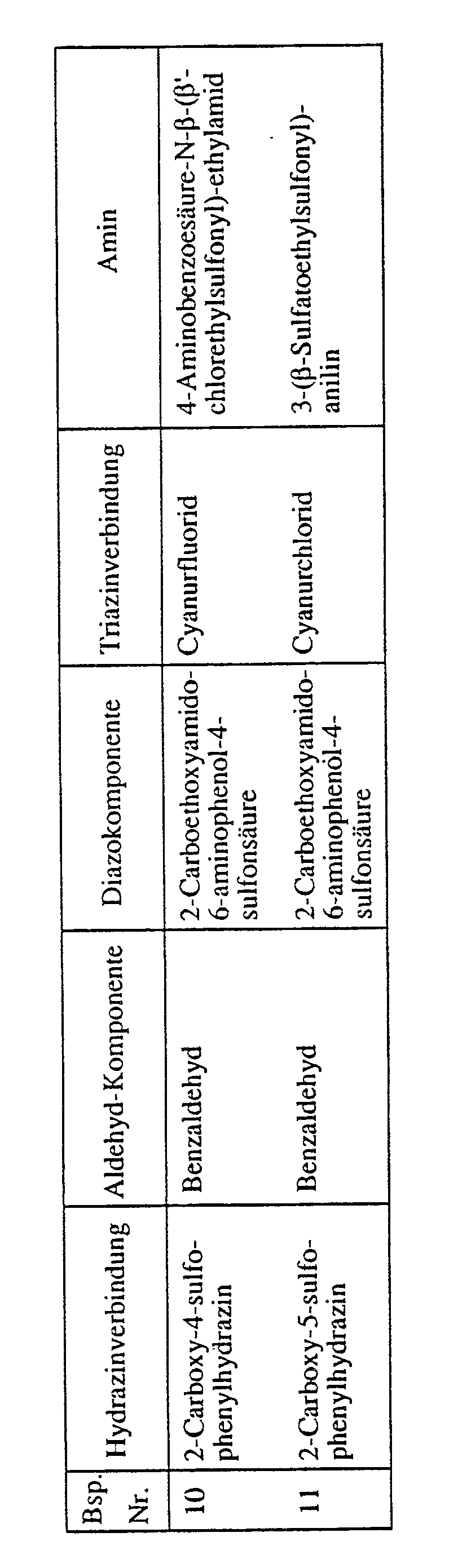
- Verfährt man wie im Beispiel 1 beschrieben, verwendet jedoch äquivalente Mengen der aus der Tabelle ersichtlichen Komponenten (Hydrazinverbindung, Aldehyd-Komponente, Diazokomponente, Triazinverbindung und gegebenenfalls Amin), erhält man analoge faserreaktive Formazanverbindungen:

Claims (25)
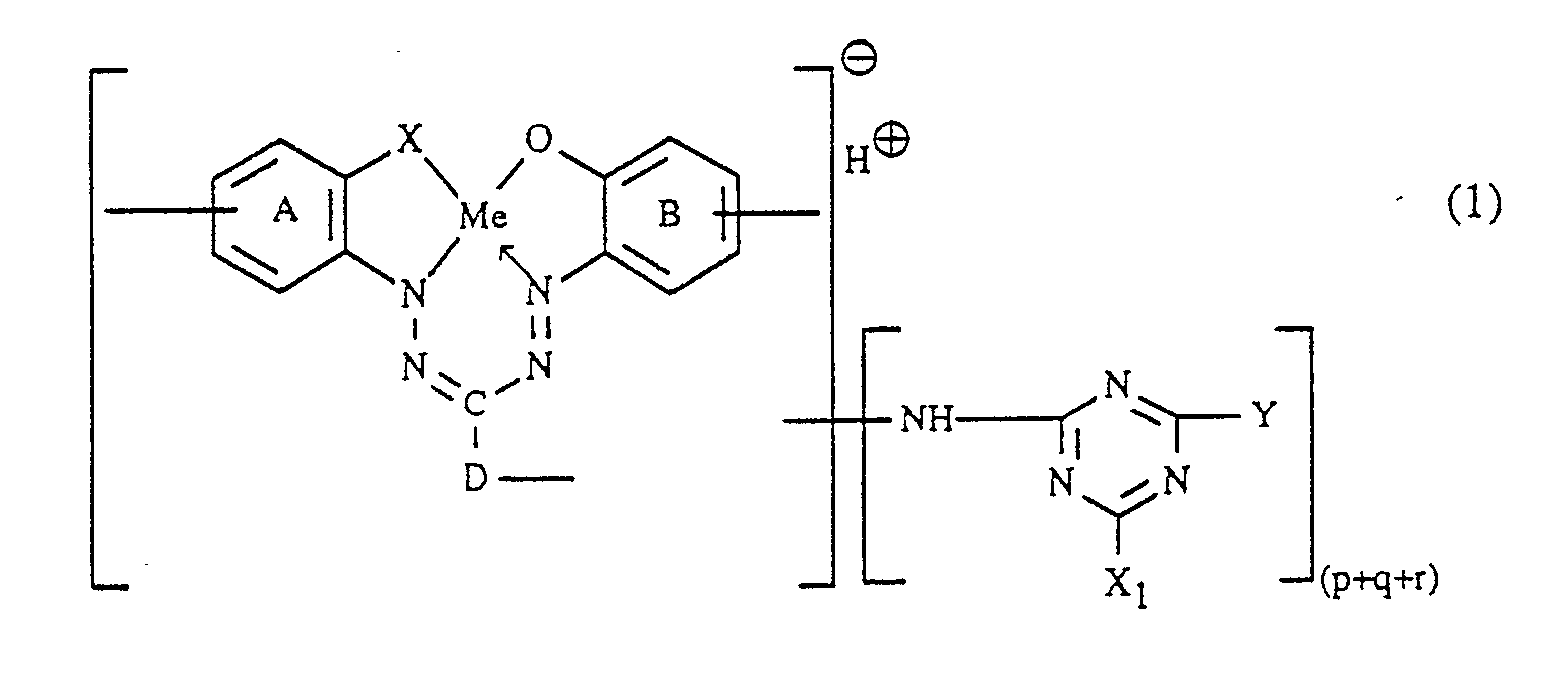
D der Rest eines gegebenenfalls weitersubstituierten Benzols oder Naphthalins oder der Rest einer heterocyclisch-aromatischen Verbindung ist,
X eine Sulfogruppe oder eine Oxy- oder Carbonyloxygruppe bedeutet,
Me ein Schwermetallion der Atomnummern 24 bis 30 darstellt,
p, q und r unabhängig voneinander jeweils die Zahl 0 oder 1 bedeuten, wobei die Summe von (p+q+r) 1 oder 2 ist, X₁ Halogen darstellt, Y unabhängig die Bedeutung von X₁ hat oder einen Amino- oder Alkoxyrest bedeutet und die Ringe (A) und (B) neben den eingezeichneten Gruppen weitere Substituenten tragen können,
dadurch gekennzeichnet, dass man
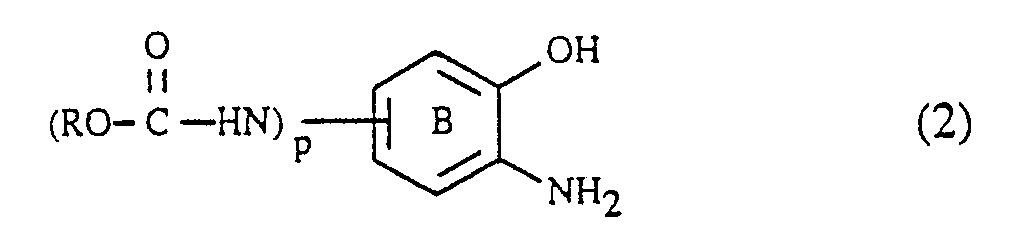
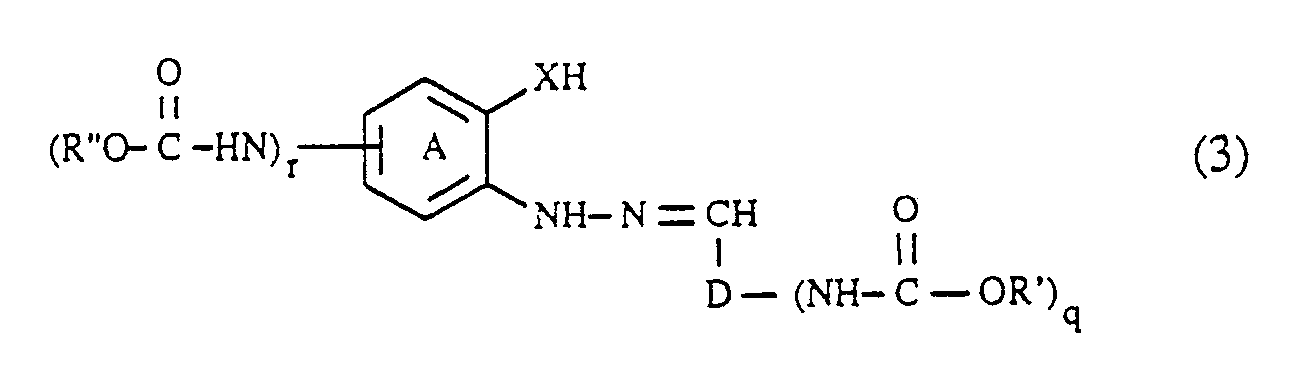


-NH-(CH₂-CH₂-O-)wCH₂-CH₂-Z′ (9′)

-NR₆-(alk-O)w-alk′-SO₂-Z (9),





-NH-(CH₂-CH₂-O-)wCH₂-CH₂-Z′ (9′)


Applications Claiming Priority (2)
| Application Number | Priority Date | Filing Date | Title |
|---|---|---|---|
| CH215389 | 1989-06-08 | ||
| CH2153/89 | 1989-06-08 |
Publications (3)
| Publication Number | Publication Date |
|---|---|
| EP0402318A2 true EP0402318A2 (de) | 1990-12-12 |
| EP0402318A3 EP0402318A3 (de) | 1991-03-20 |
| EP0402318B1 EP0402318B1 (de) | 1994-04-20 |
Family
ID=4227122
Family Applications (1)
| Application Number | Title | Priority Date | Filing Date |
|---|---|---|---|
| EP19900810394 Expired - Lifetime EP0402318B1 (de) | 1989-06-08 | 1990-05-29 | Verfahren zur Herstellung von faserreaktiven Formazanverbindungen |
Country Status (3)
| Country | Link |
|---|---|
| EP (1) | EP0402318B1 (de) |
| JP (1) | JPH0326766A (de) |
| DE (1) | DE59005407D1 (de) |
Cited By (2)
| Publication number | Priority date | Publication date | Assignee | Title |
|---|---|---|---|---|
| DE4221543C1 (de) * | 1992-07-01 | 1993-08-26 | Basf Ag, 6700 Ludwigshafen, De | |
| EP0555699A3 (en) * | 1992-02-10 | 1994-05-25 | Bayer Ag | Aromatic compounds substituted by an urethane group and by an amino group |
Families Citing this family (1)
| Publication number | Priority date | Publication date | Assignee | Title |
|---|---|---|---|---|
| ATE541013T1 (de) * | 2004-10-19 | 2012-01-15 | Huntsman Adv Mat Switzerland | Reaktivfarbstoffe, deren herstellung und deren verwendung |
Citations (1)
| Publication number | Priority date | Publication date | Assignee | Title |
|---|---|---|---|---|
| EP0280139A2 (de) | 1987-02-24 | 1988-08-31 | Hoechst Aktiengesellschaft | Kupferkomplex-Formazan-Verbindungen, Verfahren zu ihrer Herstellung und ihre Verwendung als Farbstoffe |
Family Cites Families (2)
| Publication number | Priority date | Publication date | Assignee | Title |
|---|---|---|---|---|
| DE3023855A1 (de) * | 1980-06-25 | 1982-01-14 | Bayer Ag, 5090 Leverkusen | Reaktivfarbstoffe, verfahren zu ihrer herstellung und ihre verwendung zum faerben und bedrucken hydroxylgruppenhaltiger oder stickstoffhaltiger fasermaterialien |
| DE58907709D1 (de) * | 1988-06-29 | 1994-06-30 | Ciba Geigy | Faserreaktive Formazanfarbstoffe, Verfahren zu deren Herstellung und deren Verwendung. |
-
1990
- 1990-05-29 DE DE59005407T patent/DE59005407D1/de not_active Expired - Fee Related
- 1990-05-29 EP EP19900810394 patent/EP0402318B1/de not_active Expired - Lifetime
- 1990-06-08 JP JP2148841A patent/JPH0326766A/ja active Pending
Patent Citations (1)
| Publication number | Priority date | Publication date | Assignee | Title |
|---|---|---|---|---|
| EP0280139A2 (de) | 1987-02-24 | 1988-08-31 | Hoechst Aktiengesellschaft | Kupferkomplex-Formazan-Verbindungen, Verfahren zu ihrer Herstellung und ihre Verwendung als Farbstoffe |
Cited By (4)
| Publication number | Priority date | Publication date | Assignee | Title |
|---|---|---|---|---|
| EP0555699A3 (en) * | 1992-02-10 | 1994-05-25 | Bayer Ag | Aromatic compounds substituted by an urethane group and by an amino group |
| DE4221543C1 (de) * | 1992-07-01 | 1993-08-26 | Basf Ag, 6700 Ludwigshafen, De | |
| EP0576997A1 (de) * | 1992-07-01 | 1994-01-05 | BASF Aktiengesellschaft | Verfahren zur Herstellung von Aminoformazanen |
| US5391719A (en) * | 1992-07-01 | 1995-02-21 | Basf Aktiengesellschaft | Preparation of aminoformazans |
Also Published As
| Publication number | Publication date |
|---|---|
| JPH0326766A (ja) | 1991-02-05 |
| EP0402318A3 (de) | 1991-03-20 |
| DE59005407D1 (de) | 1994-05-26 |
| EP0402318B1 (de) | 1994-04-20 |
Similar Documents
| Publication | Publication Date | Title |
|---|---|---|
| DE3102287A1 (de) | Wasserloesliche monoazoverbindungen, verfahren zu ihrer herstellung und ihre verwendung als farbstoffe | |
| EP0028787B1 (de) | Kupfer-Formazanverbindungen, Verfahren zu ihrer Herstellung und ihre Verwendung als Farbstoffe | |
| EP0783028A1 (de) | Wasserlösliche Azofarbstoffe, Verfahren zu ihrer Herstellung und ihre Verwendung | |
| EP0231837B1 (de) | Verfahren zur Herstellung von wasserlöslichen Phthalocyaninfarbstoffen | |
| EP0402318B1 (de) | Verfahren zur Herstellung von faserreaktiven Formazanverbindungen | |
| EP0175225A2 (de) | Faserreaktive Triazinverbindungen, Verfahren zu ihrer Herstellung und ihre Verwendung | |
| EP0345577B1 (de) | Reaktivfarbstoffe | |
| EP0168703A2 (de) | Reaktivfarbstoffe | |
| EP0603116B1 (de) | Azoreaktivfarbstoffe | |
| EP0280139A2 (de) | Kupferkomplex-Formazan-Verbindungen, Verfahren zu ihrer Herstellung und ihre Verwendung als Farbstoffe | |
| EP0371332B1 (de) | Reaktivfarbstoffe | |
| EP0382111B1 (de) | Kupferkomplex-Formazanverbindungen, Verfahren zu ihrer Herstellung und ihre Verwendung als Farbstoffe | |
| EP0794233B1 (de) | Anionische Säurefarbstoffe, Verfahren zu deren Herstellung und deren Verwendung | |
| EP0437699B1 (de) | Phenylazo- oder Naphthylazobenzole mit mehreren reaktiven Gruppen sowie deren Zwischenprodukte | |
| EP0794234A1 (de) | Farbstoffmischungen, Verfahren zu deren Herstellung und deren Verwendung | |
| DE2657218A1 (de) | Unsymmetrische xanthenfarbstoffe, verfahren zu ihrer herstellung und ihre verwendung | |
| EP0108924B1 (de) | Schwermetallhaltige Formazanfarbstoffe, Verfahren zu ihrer Herstellung und ihre Verwendung zum Färben und Bedrucken von Fasermaterialien | |
| EP0574799B1 (de) | Verfahren zur Herstellung von faserreaktiven Formazanfarbstoffen sowie Aminophenole | |
| EP0595768A1 (de) | Azofarbstoffe, Verfahren zu deren Herstellung und deren Verwendung | |
| EP0357554A2 (de) | Metallkomplexverbindungen | |
| DE2617062C2 (de) | Wasserlösliche Hydrazone der Phthalocyaninreihe, ihre Herstellung und Verwendung | |
| EP0592980A2 (de) | Reaktivfarbstoffe auf Formazanbasis, die mindestens zwei reaktive Gruppen aufweisen, sowie Aminophenole | |
| EP0213485B1 (de) | Verfahren zur Herstellung von Arylamino-nitro-phenyl-oxethylsulfonen | |
| EP0026913B1 (de) | Kupferkomplex-Naphthylazonaphthyl-Verbindungen, Verfahren zu ihrer Herstellung und ihre Verwendung zum Färben und Bedrucken von Fasermaterialien und Leder | |
| DE19636483C2 (de) | Wasserlösliche Azoverbindungen, Verfahren zu ihrer Herstellung und ihre Verwendung als Farbstoffe |
Legal Events
| Date | Code | Title | Description |
|---|---|---|---|
| PUAI | Public reference made under article 153(3) epc to a published international application that has entered the european phase |
Free format text: ORIGINAL CODE: 0009012 |
|
| 17P | Request for examination filed |
Effective date: 19900531 |
|
| AK | Designated contracting states |
Kind code of ref document: A2 Designated state(s): CH DE FR GB LI |
|
| PUAL | Search report despatched |
Free format text: ORIGINAL CODE: 0009013 |
|
| AK | Designated contracting states |
Kind code of ref document: A3 Designated state(s): CH DE FR GB LI |
|
| 17Q | First examination report despatched |
Effective date: 19930713 |
|
| GRAA | (expected) grant |
Free format text: ORIGINAL CODE: 0009210 |
|
| AK | Designated contracting states |
Kind code of ref document: B1 Designated state(s): CH DE FR GB LI |
|
| ET | Fr: translation filed | ||
| REF | Corresponds to: |
Ref document number: 59005407 Country of ref document: DE Date of ref document: 19940526 |
|
| GBT | Gb: translation of ep patent filed (gb section 77(6)(a)/1977) |
Effective date: 19940609 |
|
| PLBE | No opposition filed within time limit |
Free format text: ORIGINAL CODE: 0009261 |
|
| STAA | Information on the status of an ep patent application or granted ep patent |
Free format text: STATUS: NO OPPOSITION FILED WITHIN TIME LIMIT |
|
| 26N | No opposition filed | ||
| REG | Reference to a national code |
Ref country code: CH Ref legal event code: PUE Owner name: CIBA-GEIGY AG TRANSFER- CIBA SC HOLDING AG |
|
| REG | Reference to a national code |
Ref country code: FR Ref legal event code: TP |
|
| PGFP | Annual fee paid to national office [announced via postgrant information from national office to epo] |
Ref country code: FR Payment date: 19970319 Year of fee payment: 8 |
|
| PGFP | Annual fee paid to national office [announced via postgrant information from national office to epo] |
Ref country code: DE Payment date: 19970411 Year of fee payment: 8 |
|
| PGFP | Annual fee paid to national office [announced via postgrant information from national office to epo] |
Ref country code: GB Payment date: 19970421 Year of fee payment: 8 |
|
| PGFP | Annual fee paid to national office [announced via postgrant information from national office to epo] |
Ref country code: CH Payment date: 19970423 Year of fee payment: 8 |
|
| REG | Reference to a national code |
Ref country code: CH Ref legal event code: PFA Free format text: CIBA SC HOLDING AG TRANSFER- CIBA SPECIALTY CHEMICALS HOLDING INC. |
|
| REG | Reference to a national code |
Ref country code: GB Ref legal event code: 732E |
|
| REG | Reference to a national code |
Ref country code: FR Ref legal event code: CD |
|
| PG25 | Lapsed in a contracting state [announced via postgrant information from national office to epo] |
Ref country code: GB Free format text: LAPSE BECAUSE OF NON-PAYMENT OF DUE FEES Effective date: 19980529 |
|
| PG25 | Lapsed in a contracting state [announced via postgrant information from national office to epo] |
Ref country code: LI Free format text: LAPSE BECAUSE OF NON-PAYMENT OF DUE FEES Effective date: 19980531 Ref country code: FR Free format text: LAPSE BECAUSE OF NON-PAYMENT OF DUE FEES Effective date: 19980531 Ref country code: CH Free format text: LAPSE BECAUSE OF NON-PAYMENT OF DUE FEES Effective date: 19980531 |
|
| REG | Reference to a national code |
Ref country code: CH Ref legal event code: PL |
|
| GBPC | Gb: european patent ceased through non-payment of renewal fee |
Effective date: 19980529 |
|
| PG25 | Lapsed in a contracting state [announced via postgrant information from national office to epo] |
Ref country code: DE Free format text: LAPSE BECAUSE OF NON-PAYMENT OF DUE FEES Effective date: 19990302 |
|
| REG | Reference to a national code |
Ref country code: FR Ref legal event code: ST |