EP0400789B1 - Assignment-dependant method of allocating manufacturing resources - Google Patents
Assignment-dependant method of allocating manufacturing resources Download PDFInfo
- Publication number
- EP0400789B1 EP0400789B1 EP90303719A EP90303719A EP0400789B1 EP 0400789 B1 EP0400789 B1 EP 0400789B1 EP 90303719 A EP90303719 A EP 90303719A EP 90303719 A EP90303719 A EP 90303719A EP 0400789 B1 EP0400789 B1 EP 0400789B1
- Authority
- EP
- European Patent Office
- Prior art keywords
- cost
- resource
- manufacturing
- complex
- assignment
- Prior art date
- Legal status (The legal status is an assumption and is not a legal conclusion. Google has not performed a legal analysis and makes no representation as to the accuracy of the status listed.)
- Expired - Lifetime
Links
Images
Classifications
-
- G—PHYSICS
- G06—COMPUTING OR CALCULATING; COUNTING
- G06Q—INFORMATION AND COMMUNICATION TECHNOLOGY [ICT] SPECIALLY ADAPTED FOR ADMINISTRATIVE, COMMERCIAL, FINANCIAL, MANAGERIAL OR SUPERVISORY PURPOSES; SYSTEMS OR METHODS SPECIALLY ADAPTED FOR ADMINISTRATIVE, COMMERCIAL, FINANCIAL, MANAGERIAL OR SUPERVISORY PURPOSES, NOT OTHERWISE PROVIDED FOR
- G06Q10/00—Administration; Management
- G06Q10/06—Resources, workflows, human or project management; Enterprise or organisation planning; Enterprise or organisation modelling
-
- G—PHYSICS
- G06—COMPUTING OR CALCULATING; COUNTING
- G06F—ELECTRIC DIGITAL DATA PROCESSING
- G06F17/00—Digital computing or data processing equipment or methods, specially adapted for specific functions
-
- G—PHYSICS
- G05—CONTROLLING; REGULATING
- G05B—CONTROL OR REGULATING SYSTEMS IN GENERAL; FUNCTIONAL ELEMENTS OF SUCH SYSTEMS; MONITORING OR TESTING ARRANGEMENTS FOR SUCH SYSTEMS OR ELEMENTS
- G05B19/00—Program-control systems
- G05B19/02—Program-control systems electric
- G05B19/418—Total factory control, i.e. centrally controlling a plurality of machines, e.g. direct or distributed numerical control [DNC], flexible manufacturing systems [FMS], integrated manufacturing systems [IMS] or computer integrated manufacturing [CIM]
- G05B19/41865—Total factory control, i.e. centrally controlling a plurality of machines, e.g. direct or distributed numerical control [DNC], flexible manufacturing systems [FMS], integrated manufacturing systems [IMS] or computer integrated manufacturing [CIM] characterised by job scheduling, process planning, material flow
-
- Y—GENERAL TAGGING OF NEW TECHNOLOGICAL DEVELOPMENTS; GENERAL TAGGING OF CROSS-SECTIONAL TECHNOLOGIES SPANNING OVER SEVERAL SECTIONS OF THE IPC; TECHNICAL SUBJECTS COVERED BY FORMER USPC CROSS-REFERENCE ART COLLECTIONS [XRACs] AND DIGESTS
- Y02—TECHNOLOGIES OR APPLICATIONS FOR MITIGATION OR ADAPTATION AGAINST CLIMATE CHANGE
- Y02P—CLIMATE CHANGE MITIGATION TECHNOLOGIES IN THE PRODUCTION OR PROCESSING OF GOODS
- Y02P90/00—Enabling technologies with a potential contribution to greenhouse gas [GHG] emissions mitigation
- Y02P90/02—Total factory control, e.g. smart factories, flexible manufacturing systems [FMS] or integrated manufacturing systems [IMS]
Definitions
- the present invention relates to manufacturing and, more particularly, to the allocation of manufacturing resources in the manufacture of products.
- GAP Generalized Assignment Problem
- an operational cost and an operational time are assigned to the performance of a given operation on a given resource, i.e., to a given operation-resource pair.
- An objective, such as cost minimization is then selected.
- assignments can be made with the objective of minimizing the total manufacturing time. More generally, both time and cost are den into account. For example, in a "capacity constrained resource problem", assignments can be made with the objective of minimizing cost but completing manufacturing by a certain deadline.
- the generalized assignment problem has been studied very extensively. It is solvable using straight forward techniques, provided the number of variables is small or where capacity constraints are absent or so lax as to be negligible. For example, it is impracticable to solve a capacity-constrained generalized assignment problem optimally where there are, for instance, 20 or more resources, 500 or more products, an average of 10 or more operations per product, and an average of 5 or more resources compatible with each operation. Given a problem of this magnitude, a typical manufacturing deadline could pass before a computer generated the optimal solution.
- a more basic problem is that the formalization of a real manufacturing situation as a generalized assignment problem is an oversimplification which can introduce considerable error between the calculated solution and the actual optimal allocation.
- an operation is to be performed on a resource which has just been used to complete the previous operation for the same product.
- the product is already in place for the operation to be performed, in the other case, the product must be moved and configured for the second resource.
- the movement incurs a cost which is not incurred when a single resource is used for successive operations.
- the generalized assignment problem does not take this dependence into account, and thus its solutions are potentially compromised. While there may be ad hoc approaches to dealing with this compromise, such methods have not provided elegant optimal or near-optimal solutions.
- S.Gupta discusses a generalised search strategy for finding a set of n good solutions, rather than a unique best solution to a problem.
- the approach is to break a large problem down into a set of smaller problems, each of which can be solved by existing heuristic search algorithms, and then combining the n solutions of these smaller problems into a single new problem and again applying a heuristic search algorithm to solve this new problem.
- techniques such as this have not provided optimal solutions to the general assignment problem.
- ISTAR project management system
- ISTAR which is directed to project management rather than manufacturing, collects and arranges data and presents the data to the manager for his/her use in managing a project.
- One part of ISTAR consists of a scheduling tool that assists the manager in allocating resources. This scheduling tool is described as being similar to other project planning tools.
- An activity network is derived, activity durations are calculated, and then the durations are summed to obtain a total critical path completion time. If this total time turns out to be unacceptably long, the manager is given the option of changing one or more of six "key factors" in an attempt to reduce the total time.
- the ISTAR database presents the manager with a list of available resources in terms of those hours during which each resource will be available to work on the task at various hours during the day.
- the ISTAR scheduling tool does not appear to address the general assignment problem in manufacturing.
- the improved method should include a formalisation which takes into account dependencies in the time and cost of the assignment of an operation to a resource. Specifically, the formalisation should take into account dependencies of one assignment on other assignments of operations to resources. Furthermore, the method should permit problems of realistic complexity to be solved in a reasonable time using affordable computational resources.
- an improved resource allocation method combines an assignment-dependent formalization with an iterative minimum penalty heuristic including a re-evaluation step.
- the inventive method is referred to as the assignment dependent resource allocation method" or "ADRAM". This method approximates, in a reasonable time, an optimal solution to a formalization which responds to the limitations reported by users of the generalized assignment problem formalization.
- ADRAM shares certain formal characteristics with the generalized assignment problem formalization. Plural products are to be manufactured on plural resources. A respective set of one or more operations must be performed on the resources for the product's manufacture. Each operation is compatible with, i.e., can be performed on, at least one resource.
- the objective of ADRAM is to assign all operations to compatible resources to meet some objective or to optimize some parameter.
- ADRAM Complex cost can be used in formalizing an ADRAM problem.
- the objective is to minimize cost within certain resource availability limitations expressed in time.
- ADRAM is equally applicable to minimizing time within set money-cost constraints. In this sense, cost and time are formally interchangeable.
- a problem can be stated in terms of minimizing a combination of time and money under both time and money constraints. These constraints are incorporated into the parameter definition for the heuristic employed in the ADRAM. While ADRAM problems can be formalized in terms of complex cost, there is always an alternative formalization in which time and money are treated separately.
- ADRAM operations are assigned to resources one at a time. At any given time, the operations are classified into two sets: an assigned set comprising operations which have already been assigned to resources, and an unassigned set comprising operations which have not yet been assigned to resources. Either set can be empty when the other contains all the operations. Typically, the assigned set is initially empty. Once all operations have been assigned, the unassigned set is empty and a solution is attained. Each assignment of an operation to a resource results in an operation-resource pair. Each operation-resource pair has an associated product-resource pair which contains the product to which the assigned resource belongs and the operation to which it was assigned.
- a first step in a seven-step ADRAM heuristic involves attributing a complex cost to each potential assignment of an unassigned operation to a resource.
- “Complex cost” is an expression for a two-parameter quantity, with one parameter being cost and the other time. Except when qualified by “complex” or when otherwise indicated herein, "cost” refers to simple cost, also referred to as “money-cost” and “cost-in-money”. Time is also referred to as "cost-in-time”, when contrasted with money-cost as a component of complex cost. Attributing a complex cost is the same as attributing a money-cost and a time to each operation-resource pair. Attribution of complex cost is also a step in the generalized assignment problem, although it is not usually expressed in this way.
- the objective of ADRAM is to maximize complex-cost effectiveness, i.e., manufacturing effectiveness taking into account both total cost and total manufacturing time.
- assignment dependence implies that there is at least one operation-resource pair that has at least two different complex costs which can be attributed to it depending on the contents of the current assigned set. Since the assigned set defines a mapping of operations to resources, each assigned set corresponds to a respective assignment map. Thus, assignment dependence implies that complex cost varies as a function of the current assignment map. Another approach to assignment dependence is that the complex cost of a potential assignment is dependent on the prior history of assignments. In addition, assignment-dependence implies that complex cost for a given potential operation-resource pair is well-defined given the current assignment.
- GAP cost and time attribution are not assignment dependent. Each operation-resource pair has an operational cost and an operational time which are irrespective of the other assignments.
- GAP represents a degenerate case of the ADRAM formalization; although this degenerate case is excluded from the scope of the present invention since there are no variations by assignment map.
- the degeneracy relationship helps explain the superiority of the ADRAM formalization in providing a correspondence to reality; ADRAM has an additional degree of freedom--that of specifying how complex cost depends on prior assignments.
- the ADRAM formalization permits one to take into account assignment-dependent set-up costs and set-up times in optimizing resource allocation, while GAP does not.
- costs which are conventionally referred to as "set-up” costs, but which are not assignment dependent are included in operational costs.
- assignment-independent set-up times are included in operational times.
- set-up refers exclusively to assignment-dependent set-up costs and times.
- a parameter which relates to manufacturing effectiveness can be cost, time, a function of cost alone, a function of time alone, or a function of both cost and time.
- cost the parameter
- each potential assignment can be evaluated to determine its cost. In the case of cost, this evaluation is very simple: cost is simply the first component of complex cost.
- the parameter can reflect capacity constraints by assigning a high or infinite time-component value when the usage of a resource exceeds its availability threshold. Generally, evaluation of a potential assignment according to a selected parameter results in a parameter value.
- a most effective resource and a second most effective resource are determined for each operation.
- the parameter is selected so that it is negatively correlated with effectiveness. For example, increased cost and increased time correspond to a less effective allocation of resources.
- the resource associated with the lowest parameter value is the most effective resource R 1 , i.e., the best resource for performing that operation ignoring other constraints.
- the resource associated with the second lowest parameter value is the second most effective resource R 2 .
- the detriment incurred by selecting the second most effective resource for an given operation in favor of first most effective resource defines the "penalty" associated with that operation.
- the unassigned operation associated with the maximum penalty is identified.
- a comparison function Associated with the selected parameter. Where the selected parameter varies linearly with effectiveness, the comparison function can yield a difference (subtraction). Otherwise, a quotient (division), or some other comparison function can be used.
- the comparison function is used to generate a comparison value for each operation by comparing its lowest and second lowest parameter values. This comparison value is a measure of the penalty that would apply to the selection of the second most effective resource instead of the most effective resource for a given parameter. The greatest comparison value corresponds to the greatest penalty; the associated operation is identified in this step as the maximum penalty operation.
- the maximum penalty operation is assigned to its most-effective resource. This assignment avoids the greatest penalty. Assignment of the maximum penalty operation moves it from the unassigned set to the assigned set. A new assignment map, including the new operation-resource pair, is established
- any required adjustments in complex costs attributed to potential assignments are made. Changes in complex costs require adjustments in parameter values. The changes can be incremental or, in the case of a capacity constraint, dramatic. Assignment dependence requires that such an adjustment occur at least once during the series of assignments leading to a solution. However, some assignments may not require any adjustments. Therefore, re-evaluation can be considered conditional for a given operation, although required at least once during execution of the method.
- a seventh step the third through sixth steps are iterated. Iteration ceases when all operations have been assigned to resources, in which case a final assignment map is reported. In addition, a sum of the parameters values associated with each assignment can be reported as a measure of the overall effectiveness of the solution represented by the final assignment map. Iteration also can be halted whenever an operation is determined to be incompatible with available resources. In this case, the incompatibility can be reported.
- the major distinction between the ADRAM problem formalization and the GAP problem formalization is assignment dependence.
- the present invention couples the ADRAM formalization with the described minimum-maximum, "minimax” penalty heuristic to provide a practicable solution. While minimax penalty, and related "minimum regret" heuristics are known, the present invention adapts the heuristics by including the re-evaluations required by assignment dependence.
- ADRAM ADRAM
- solution time is basically linearly dependent on the number of operations to be performed. This contrasts with integer programming-based approaches, in which solution time increases exponentially with the number of operations. Therefore, the advantages of the present invention become more significant when handling the large problems found in practical settings.
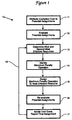
- FIGURE 1 is a flow chart in accordance with the method of the present invention.
- An assignment-dependent resource allocation method 10 can be characterized by a sequence of steps 11-17 embodying an iterative loop 18.
- the first step 11 is to attribute a complex cost to potential assignments of unassigned operations to available resources. Expressions of the method need not refer explicitly to complex cost: an equivalent formulation attributes cost and time to each potential assignment.
- the second step 12 involves evaluation of potential assignments according to a parameter which is a function of complex cost, i.e., a function of cost and/or time.
- the third step 13 is to determine the most and second most effective resources for each unassigned operation.
- the fourth step 14 is to identify the maximum penalty operation.
- the fifth step 15 is to assign the maximum penalty operation to its most effective resource.
- the sixth step 16 is to re-evaluate potential assignments, in the light of the assignment in the preceding step.
- the seventh step 17 initiates iterative loop 18 to third step 13 as long as there are unassigned operations and available, compatible resources. Once all operations are assigned, the final assignment map is reported. Preferably, the incompatibility of an unassigned resource with any available operation is also reported as a failure to converge on a solution.
- P 1 and P 2 are two products to be manufactured.
- the manufacture of P 1 requires the performance of three operations, Q 11 , Q 12 and Q 13 .
- the manufacture of P 2 requires the performance of two operations, Q 21 , and Q 22 .
- Available for manufacturing products P 1 and P 2 are three resources R 1 , R 2 , and R 3 . Any operation can be performed on any resource with the restrictions that Q 11 cannot be performed on R 2 and Q 22 cannot be performed on R 3 .
- C s pr (M s pr , T s pr ) associated with setting up product P p on resource R r .
- This set up complex cost is incurred only when at least one operation for product P p is performed on resource R r and is incurred at most once, even when multiple operations of product P p are performed on resource R r .
- ADRAM Advanced Driver RAM
- ADRAM requires re-evaluations during at least some iterations to adjust the value of a complex cost which is assignment dependent.
- the operational complex costs and the set-up complex costs defined above are not assignment dependent. However, operational and set-up costs are combined in an assignment dependent manner to yield an assignment dependent complex cost as follows.
- a combined complex cost C pqr (M pqr , T pqr ) is associated with the assignment of operation Q pq to resource R r .
- C pqr C o pqr + C s pr if Q pq is the first operation of product P p to be assigned to resource R r .
- C pqr C o pqr when another operation of product P p has been assigned to resource R r .
- combined complex cost C 111 is assignment dependent.
- Resource allocation methods attempt to provide an optimal allocation of resources.
- the criterion for "optimal" is situation dependent. It may be optimal to minimize total manufacturing money-cost. It may be optimal to minimize manufacturing time. More commonly, both time and money must be taken into the definition of optimal.
- optimal may mean manufacturing products within a fixed amount of time for minimum cost. In the example, a minimum money-cost is sought with the proviso that total manufacturing time must not exceed one hour. If the lowest cost allocation requires more than one hour, it is not optimal; otherwise, it is optimal.
- ADRAM requires that it be represented by a parameter V.
- This parameter V is a function of combined complex cost that can be used to assign a unique value V apqr to the assignment of an operation Q pq to resource R r given an existing assignment map A a .
- V can be combined money-cost, combined time, the product of combined money-cost and combined time, money-cost divided by time remaining before a deadline or resource capacity exceeded, or any number of other parameters.
- the parameter is combined money-cost.
- the iterative assignment process can begin. Typically, and in the present case, there are no assignments initially. Alternatively, ADRAM can be applied to case where some assignments are mandated. In either case, there is an original assignment map A 0 . In the typical case, assignment map A 0 includes no assignments. The first iteration establishes the first assignment map A 1 . The subscript can indicate the number of iterations completed and, typically, the number of operations assigned.
- Assignment map A 5 will be the ADRAM solution, while assignment maps A 1 -A 4 represent partial solutions.. Each assignment is selected on the basis of parameter values V apqr associated with each of the operations-resource pairs. Since time is of secondary importance for the sample problem, the following table includes operational money-cost and set-up money-costs used to calculate combined costs. More generally, such a table would also include times.
- Set-up costs are listed in columns with the headings P 1 and P 2 , while operational costs are listed in the "Q" columns. This table provides the attribution of complex cost required in first step 11. Note that it is not necessary to calculate the complex cost to have it attributed. All that is required is that the data and procedure for calculating complex cost be defined.
- the "complex cost" table can be used to generate a table for combined money-cost M pqr for each assignment map.
- combined money-cost is the parameter V referred to in second step 12.
- the table V 0 for parameter V given the initial assignment map A 0 is: Table V0 Product P 1 Product P 2 Q 11 Q 12 Q 13 Q 21 Q 22 R 1 14 13 16 26 28 R 2 X 34 33 25 22 R 3 34 31 34 12 X D 20 18 17 13 6 where the initial assignment map is: Assignment Map A 0 Q 11 unassigned Q 12 unassigned Q 13 unassigned Q 21 unassigned Q 22 unassigned
- operation Q 11 can be performed at the lowest combined money cost of 14 dollars on resource R 1 . Not performing Q 11 , on R 1 would incur require a performance money-cost of at least 34 dollars on R 3 .
- the penalty for not assigning Q 11 to its lowest cost resource is 20 dollars, as indicated by difference D in the above table for assignment map A 0 .
- the penalties for each of the operations are listed.
- the twenty-dollar penalty associated with operation Q 11 is the largest of the penalties associated with the operations.
- Q 11 is the maximum penalty operation of fourth step 14.
- Minimizing penalty means, in effect, avoiding the largest penalties. The minimum penalty heuristic thus assigns the greatest penalty operation Q 11 , to its lowest cost resource R 1 .
- Table V 1 differs from Table V 0 in two significant respects. First, there is no column for Q 11 , which has been assigned and therefore cannot be considered for the next assignment. Second, the combined costs associated with the assignments of Q 12 and Q 13 to resource R 1 have been re-evaluated, in accordance with sixth step 16, to take into account the assignment represented in map A 1 . In particular, set-up times have been subtracted from the corresponding table entries.
- Seventh step 17 then initiates iterative loop 18. New assignment map A 1 and the corresponding combined costs are then used in the second iteration of third step 13. The changes in combined costs greatly increase the favorability of assigning a product P 1 operation to resource R 1 to avoid additional set-up tune. Examination of the difference row D indicates an assignment of Q 12 to resource R 1 to incur minimum penalty.
- Assignment of Q 12 to R 1 causes the column corresponding to Q 12 to be removed in the table for map A 2 .
- No entries in row R 1 are changed.
- the row R 1 column Q 13 is not changed because set-up time is not included in this entry.
- R 1 columns Q 21 and Q 22 are not changed because they represent operations of product P 2 rather than product P 1 to which assigned operation Q 12 belongs. Thus, no recalculation is required at this iteration. While the invention requires value adjustments for at least one step, adjustments are not required at every step.
- Table V2 represents the results after two iterations of the heuristic.
- R 1 may be a resource which is only available part time due to maintenance or other consideration. If Q 11 and Q 12 have consumed too much of the time available on R 1 , then Q 13 would become incompatible with R 1 . This is indicated in the revised Table V 2 ' below: Table V 2 ' Product P 1 Product P 2 Q 13 Q 21 Q 22 R 1 X 26 28 R 2 33 25 22 R 3 34 12 X D 1 13 6
- a preferred formalization for a capacitated manufacturing resource problem defines an optimal resource allocation as one that minimizes total money-cost, while observing capacity limitations on resources and taking set-up costs and times into account along with operational costs and times.
- Expression 1 describes the total production cost including operational costs and setup costs.
- the symbols of expression 1 are used as follows:
- Expression 2 requires that resource capacity constraints be met. While listed as an equation, it is preferable to treat the relationship as greater than " ⁇ " in an optimal iterative solution procedure. Variables included in expression 2, other than those just defined, are defined as follows:
- Expression 3 requires that all operations be performed.
- Expression 4 requires that set-up costs be attributed when a product is first assigned to a resource. Note that while complex cost is not made explicit in this formalization, it is implicit in the use of its components: money-cost and time. However, as the heuristics make clear, the assignment dependence appears in the form of the recalculations after each assignment is made.
- the cost-based heuristic attempts to minimize total money-cost of production, as defined in expression 1, by assigning operations to resources seriatim .
- the first operation assigned is the one for which a failure to be assigned to its most cost-effective resource would incur the largest penalty.
- a second assignment is made from the remaining operations and resources. This assignment and re-evaluation process is iterated until all operations are assigned, with cost-effectiveness being re-evaluated as necessary alter each assignment.
- This cost-based heuristic can be described more formally as follows.
- Step 1 Attribute an operational cost and an operational time to each operation-resource pair; likewise, attribute a set-up cost and a set-up time to each product-resource pair. This is equivalent to attributing a complex cost to each potential operation-resource pair.
- the complex cost is the vector sum of a combined cost and a combined time for each operation-resource pair.
- the combined cost is equal to the operational cost plus the set-up cost for a given operation-resource pair when no other same-product operation has been previously assigned to the same resource. Otherwise, combined cost is equal to operational cost.
- combined cost is assignment dependent, even though operational cost and set-up cost are not. A similar relationship holds for combined time.
- the vector sum of combined cost and combined time which is complex cost, is assignment dependent.
- a capacitated resource allocation problem i.e., one in which there are time limitations on resource availability
- combined cost is a function of time as well as of cost.
- step 2T Prior assignments affect the time available on a given resource. When this time falls below that required for a given unassigned operation to be performed on that resource, the resulting incompatibility affects the next assignment.
- the heuristic can represent the incompatibility by an incompatibility status flag, e.g., "X" in table A o above, or by setting combined cost a infinity or some very large number.
- the parameter In a capacity-constrained problem, the parameter really has three potential components, an operation cost, a set-up cost and a cost tied to available capacity.
- the parameter can be considered a capacity-qualified combined cost.
- the last cost can be zero or infinite depending on whether capacity is available.
- Intermediate values can also be provided for where a formula is provided for equating time and money.
- time is a better parameter than money for problems with tight capacity constraints.
- Operations are assigned to resources seriatim , as with the cost-based heuristic.
- the objective of each assignment is to avoid time penalties rather than cost penalties.
- the time based heuristic can be described more formally as follows.
- cost-based and time-based heuristics described above are, in a sense, extremes. In the first case, cost is considered without much sensitivity to time and, in the second case, time is considered without regard to cost. In many situations, both time and cost must be considered in finding an optimal production solution. Selecting a parameter which takes both time and money into account can provide an optimal solution when capacity constraints are of intermediate severity. Accordingly, a cost-time-quotient heuristic can be formalized as follows.
- the cost-time-product heuristic takes both time and cost into account, but with increased emphasis on time.
- the cost-and-time-product-based heuristic is more similar to the time-based heuristic than to the cost-based heuristic, and is best suited for situations with very tight capacity constraints.
- this heuristic is the same as the cost-time-quotient heuristic except that the comparison D generated in step 4 is (M pq2 x T pq2 ) - (M pq1 x T pq1 ) for all operations, where the subtrahend is the second minimum capacity-qualified product and the minuend is the minimum capacity-qualified product for each operation.
- V Cost Qualified by Remaining Capacity
- B 1 represents the initial capacity of the lowest cost resource for operation a of product p.
- the double sum in the numerator represents the total time taken by other operations assigned to this lowest cost resource.
- the right-hand expression in the numerator represents the remaining capacity available to the lowest cost resource. Note that the indices p and q in the double summation are in italics to distinguish them from the indices p and q outside the double summation.
- the five parameters and heuristics described above generate five different solutions. Since some of the heuristics may fail to find a existing solution, the use of multiple parameters increases the probability that at least one solution will be found. Of course, if the problem is infeasible, none of the heuristics will yield a solution. In addition, the use of multiple heuristics increases the likelihood that a near optimal solution will be found. Each solution will result in an associated total money cost and a total time, making selection of a best result among the five rather straightforward. No ad hoc juggling of results is required to make this selection.
- the foregoing heuristics are formalized in the form that is best suited for the objective of minimizing expression 1.
- a different formalization is required to provide the full generality of the ADRAM.
- the first step is to divide all operations into two sets, assigned operations and unassigned operations. Each of these sets has a whole number of elements at any given time. Each assignment of an operation to a resource transfers one operation from the unassigned set to the assigned set.
- the assigned set corresponds to an assignment map A a of operation-resource pairs A pqr .
- the assignment of a given unassigned operation to a resource has an associated complex cost C apqr , which is a function of the current assignment map A a , the q th operation of product p, and the resource r to which the operation is assigned.
- Complex cost is a two-dimensional construct encompassing money-cost and time-cost. Thus, an equivalent formalization can address complex cost implicitly by referring to simple cost and time.
- the assigned sets and the assignment maps have been unordered.
- the dependence of the effectiveness-related parameter depends only on the contents of the assignment map.
- the invention also provides for assignment dependence where the parameter is a function not only of the contents of the assignment map but also on the order in which the operation-resource pairs were entered into the assignment map.
- ADRAM optimization achieved by ADRAM is dependent on the parameter selected to evaluate operation-resource pairs, the intra-operation comparison function used to measure differences between pairs associated with the same operation, and the inter-operation comparison function used to select a "worst" penalty to avoid.
- the parameter is selected to be a function of complex cost. As such, it can be a function of money-cost alone, time alone, or a combination of time and money. Furthermore, the parameter should be selected so that a best and a second best value can be identified. In all the foregoing examples, the lowest value was the best value. However, ADRAM works just as well by taking the inverse of each value and selecting the highest value as the best. More generally, the best, or most "profitable" value can assume positions other than highest or lowest. In any case, any parameter for which best values can be determined can be converted to a parameter in which the best values are the lowest. Hence, it is sufficient to require that the parameter be selected so that best is lowest, requiring alternative formalizations be mathematically equivalent.
- Parameter selection determines which resource is the best resource and which is the second best resource. Selection of the comparison function determines how the worst penalty is determined.
- the first comparison is an intra-operation comparison function used to measure the penalty involved in selecting the second best resource instead of the best resource for a given operation.
- the comparison functions for the cost over set-up time and the cost-and-remaining capacity heuristics were used with more complex intra-operation comparison functions.
- the methods described above are applied to resource allocation.
- The can be applied for any planning period or set of jobs.
- the speed and economy with which solution can be attained permits their application to short-term planning problems which could not be solved previously using conventional methods.
- longer term problems which where too expensive to solve can be addressed economically by ADRAM.
- the present invention can also be used for several other related purposes.
- the methods are useful for determining which resources should be purchased.
- Capital purchase decisions can be implemented by including in the initial cost associated with an operation-resource pair the purchase price of a resource, e.g., machine. Once that resource has had an operation assigned to it, the purchase price of the resource is eliminated from consideration in determining maximum penalties in the assignment of other operations.
- ADRAM accommodates "fixed-cost" considerations, as well as set-up cost. On a larger scale, ADRAM can be used for factory design. In addition, ADRAM can be used to choose between making and buying certain products.
- the invention In addition to handling relatively conventional formalizations where cost is to be minimized subject to time-capacity constraints, the invention also handles different problem definitions. For example, time can be minimized subject to cost limitations on the use of particular resources.
Landscapes
- Engineering & Computer Science (AREA)
- Physics & Mathematics (AREA)
- Business, Economics & Management (AREA)
- General Physics & Mathematics (AREA)
- Human Resources & Organizations (AREA)
- Economics (AREA)
- Strategic Management (AREA)
- Theoretical Computer Science (AREA)
- Entrepreneurship & Innovation (AREA)
- Quality & Reliability (AREA)
- General Engineering & Computer Science (AREA)
- Educational Administration (AREA)
- Marketing (AREA)
- Development Economics (AREA)
- Automation & Control Theory (AREA)
- General Business, Economics & Management (AREA)
- Manufacturing & Machinery (AREA)
- Game Theory and Decision Science (AREA)
- Tourism & Hospitality (AREA)
- Operations Research (AREA)
- Software Systems (AREA)
- Mathematical Physics (AREA)
- Data Mining & Analysis (AREA)
- Databases & Information Systems (AREA)
- Management, Administration, Business Operations System, And Electronic Commerce (AREA)
- General Factory Administration (AREA)
- Feedback Control In General (AREA)
Applications Claiming Priority (2)
| Application Number | Priority Date | Filing Date | Title |
|---|---|---|---|
| US346850 | 1989-05-03 | ||
| US07/346,850 US5077661A (en) | 1989-05-03 | 1989-05-03 | Assignment-dependent resource allocation method |
Publications (3)
| Publication Number | Publication Date |
|---|---|
| EP0400789A2 EP0400789A2 (en) | 1990-12-05 |
| EP0400789A3 EP0400789A3 (en) | 1992-10-21 |
| EP0400789B1 true EP0400789B1 (en) | 1997-08-06 |
Family
ID=23361285
Family Applications (1)
| Application Number | Title | Priority Date | Filing Date |
|---|---|---|---|
| EP90303719A Expired - Lifetime EP0400789B1 (en) | 1989-05-03 | 1990-04-06 | Assignment-dependant method of allocating manufacturing resources |
Country Status (6)
| Country | Link |
|---|---|
| US (1) | US5077661A (enExample) |
| EP (1) | EP0400789B1 (enExample) |
| JP (1) | JP2825611B2 (enExample) |
| KR (1) | KR900018859A (enExample) |
| DE (1) | DE69031195T2 (enExample) |
| NL (1) | NL9001062A (enExample) |
Cited By (1)
| Publication number | Priority date | Publication date | Assignee | Title |
|---|---|---|---|---|
| DE10001668A1 (de) * | 2000-01-17 | 2001-09-27 | Reinhard Boltin | Verfahren zur rechnergestützten Informationsverwaltung und -bereitstellung |
Families Citing this family (55)
| Publication number | Priority date | Publication date | Assignee | Title |
|---|---|---|---|---|
| JP3230813B2 (ja) * | 1990-07-11 | 2001-11-19 | 株式会社日立製作所 | 物品の複数作業種の作業容易性の総合評価方法およびその装置 |
| US5235508A (en) * | 1990-05-31 | 1993-08-10 | At&T Bell Laboratories | Automated resource allocation cutting stock arrangement using random cut patterns |
| JP2818016B2 (ja) * | 1990-08-09 | 1998-10-30 | 株式会社日立製作所 | プロセス並列実行方法および装置 |
| US5258915A (en) * | 1990-09-28 | 1993-11-02 | Hewlett-Packard Company | System and method for optimum operation assignments in printed circuit board manufacturing |
| US5511218A (en) * | 1991-02-13 | 1996-04-23 | Hughes Aircraft Company | Connectionist architecture for weapons assignment |
| US5289370A (en) * | 1991-05-31 | 1994-02-22 | At&T Bell Laboratories | Automated resource allocation method employing a learning arrangement |
| JPH07102495B2 (ja) * | 1991-08-21 | 1995-11-08 | 松下電工株式会社 | 生産計画立案方法 |
| US5471564A (en) * | 1992-07-10 | 1995-11-28 | Microsoft Corporation | System and method for dynamic printer timeout |
| US5490097A (en) * | 1993-03-22 | 1996-02-06 | Fujitsu Limited | System and method for modeling, analyzing and executing work process plans |
| JPH06337729A (ja) * | 1993-05-27 | 1994-12-06 | Fujitsu Ltd | ネットワークサービスシステム |
| GB9326354D0 (en) * | 1993-12-23 | 1994-02-23 | British Aerospace | Methods and apparatus for the testing,monitoring and improvement of manufacturing process effectiveness |
| US5467268A (en) * | 1994-02-25 | 1995-11-14 | Minnesota Mining And Manufacturing Company | Method for resource assignment and scheduling |
| US5963911A (en) * | 1994-03-25 | 1999-10-05 | British Telecommunications Public Limited Company | Resource allocation |
| JPH09511080A (ja) * | 1994-03-25 | 1997-11-04 | ブリティッシュ・テレコミュニケーションズ・パブリック・リミテッド・カンパニー | 資源割当 |
| US5444632A (en) * | 1994-04-28 | 1995-08-22 | Texas Instruments Incorporated | Apparatus and method for controlling and scheduling processing machines |
| WO1996010219A1 (en) * | 1994-09-26 | 1996-04-04 | Kabushiki Kaisha Toshiba | Method and system for optimizing plant utility |
| US5715165A (en) * | 1994-12-23 | 1998-02-03 | The University Of Connecticut | Method and system for scheduling using a facet ascending algorithm or a reduced complexity bundle method for solving an integer programming problem |
| US5608621A (en) * | 1995-03-24 | 1997-03-04 | Panduit Corporation | System and method for controlling the number of units of parts in an inventory |
| US5734592A (en) * | 1995-07-13 | 1998-03-31 | Nec Research Institute, Inc. | Method for determining a ranked set of associations |
| US5946661A (en) * | 1995-10-05 | 1999-08-31 | Maxager Technology, Inc. | Method and apparatus for identifying and obtaining bottleneck cost information |
| US5826238A (en) * | 1996-04-02 | 1998-10-20 | Taiwan Semiconductor Manufacturing | Daily target generation and machine allocation with priority |
| US6049774A (en) * | 1996-07-08 | 2000-04-11 | At&T Corp. | Machine, method and medium for dynamic optimization for resource allocation |
| US5889673A (en) * | 1996-12-27 | 1999-03-30 | Vanguard International Semiconductor Corporation | Manufacturing method and system for dynamic dispatching of integrated circuit wafer lots |
| JPH11232324A (ja) * | 1998-02-16 | 1999-08-27 | Nec Yamagata Ltd | 負荷区分型生産管理方式および生産管理方法 |
| US6128540A (en) * | 1998-02-20 | 2000-10-03 | Hagen Method Pty. Ltd. | Method and computer system for controlling an industrial process using financial analysis |
| US6144893A (en) * | 1998-02-20 | 2000-11-07 | Hagen Method (Pty) Ltd. | Method and computer system for controlling an industrial process by analysis of bottlenecks |
| US6035277A (en) * | 1998-04-03 | 2000-03-07 | International Business Machines Corporation | Approximation method for efficient resource allocation |
| US6198980B1 (en) | 1998-11-06 | 2001-03-06 | John Costanza Institute Of Technology | System and method for designing a mixed-model manufacturing process |
| EP1014238B1 (de) * | 1998-12-17 | 2003-08-06 | Thamrat Vechviroon | Verfahren zur Prozessoptimierung |
| US6594535B1 (en) | 1999-01-11 | 2003-07-15 | Demand Flow Institute, Llc | Material and inventory control system for a demand flow process |
| WO2001093171A2 (en) * | 2000-05-31 | 2001-12-06 | Northeast Equipment, Inc. Doing Business As Delta Mechanical Seals | Resource management system |
| US20020059089A1 (en) * | 2000-08-31 | 2002-05-16 | Toyota Jidosha Kabushiki Kaisha | Supply plan drafting device, method of drafting supply plan, program for drafting supply plan, and method of drafting production plan |
| US20020069143A1 (en) * | 2000-12-06 | 2002-06-06 | Cepeda Jose Alberto | System and method for allocating operating expenses |
| US7117060B2 (en) | 2001-01-26 | 2006-10-03 | International Business Machines Corporation | Method of improving production through cost of yield measurement |
| US7472084B2 (en) * | 2001-08-16 | 2008-12-30 | Gravity Investments, Llc | Method and apparatus for creating and managing a visual representation of a portfolio and determining an efficient allocation |
| US6961732B2 (en) | 2001-12-18 | 2005-11-01 | General Electric Company | Web based process capability data collection and reporting system |
| US20030191674A1 (en) * | 2002-04-05 | 2003-10-09 | Hale Don E. | Financial flow business model for virtual vertically integrated network-based business |
| US20040143617A1 (en) * | 2002-10-23 | 2004-07-22 | Wolf Kohn | Method and system for encoding and fast-convergent solving general constrained systems |
| AU2003291662A1 (en) * | 2002-10-23 | 2004-05-13 | Hynomics Corporation | Demand-based resource scheduling method and system |
| AU2003271658A1 (en) | 2003-09-30 | 2005-05-11 | Telecom Italia S.P.A. | Method and system for tuning a taskscheduling process |
| JP4300275B2 (ja) * | 2004-10-21 | 2009-07-22 | 義昭 垣野 | 工程設計方法、工程設計装置及びコンピュータプログラム |
| US7644410B1 (en) * | 2004-11-23 | 2010-01-05 | Hewlett-Packard Development Company, L.P. | Resource management for shared computing environment |
| US8214461B1 (en) | 2004-11-23 | 2012-07-03 | Hewlett-Packard Development Company, L.P. | Method of processing request by server computer system |
| KR100678438B1 (ko) * | 2004-12-21 | 2007-02-02 | 한국생산기술연구원 | 웹기반 금형 유휴 설비 실시간 활용 시스템을 통한금형가공 수발주 연계 방법 |
| US20060161467A1 (en) * | 2005-01-14 | 2006-07-20 | Tarun Kumar | System and method for strategic budgeting of initial response for managing wildfires |
| CN100401219C (zh) * | 2005-10-20 | 2008-07-09 | 同济大学 | 基于遗传算法的可重组生产线调度方法 |
| US7719983B2 (en) * | 2006-01-06 | 2010-05-18 | International Business Machines Corporation | Method for autonomic system management using adaptive allocation of resources |
| US10846626B2 (en) * | 2006-03-27 | 2020-11-24 | British Telecommunications Plc | Task dispatching system |
| US8805919B1 (en) * | 2006-04-21 | 2014-08-12 | Fredric L. Plotnick | Multi-hierarchical reporting methodology |
| US20080195449A1 (en) * | 2007-02-08 | 2008-08-14 | Microsoft Corporation | Techniques to manage cost resources |
| US20080221967A1 (en) * | 2007-03-09 | 2008-09-11 | Microsoft Corporation | Attribute-Based Ordering System |
| US8156030B2 (en) * | 2008-04-03 | 2012-04-10 | Gravity Investments Llc | Diversification measurement and analysis system |
| CN103258247A (zh) * | 2013-05-17 | 2013-08-21 | 广东工业大学 | 一种基于目标级联分析法的碳排放优化方法 |
| US9853863B1 (en) | 2014-10-08 | 2017-12-26 | Servicenow, Inc. | Collision detection using state management of configuration items |
| CN115730775A (zh) * | 2021-08-25 | 2023-03-03 | 中国航发商用航空发动机有限责任公司 | 一种直接维修成本指标分配方法、计算机可读介质 |
Family Cites Families (6)
| Publication number | Priority date | Publication date | Assignee | Title |
|---|---|---|---|---|
| US4642766A (en) * | 1985-03-06 | 1987-02-10 | Phillips Petroleum Company | Method and means of control for multi-source feedstock distribution system including optimization of supplies |
| US4744028A (en) * | 1985-04-19 | 1988-05-10 | American Telephone And Telegraph Company, At&T Bell Laboratories | Methods and apparatus for efficient resource allocation |
| US4744026A (en) * | 1986-04-11 | 1988-05-10 | American Telephone And Telegraph Company, At&T Bell Laboratories | Methods and apparatus for efficient resource allocation |
| US4744027A (en) * | 1986-08-22 | 1988-05-10 | American Telephone And Telegraph Company, At&T Bell Laboratories | Method and apparatus for optimizing system operational parameters |
| US4885686A (en) * | 1987-01-12 | 1989-12-05 | American Telephone And Telegraph At&T Bell Laboratories | Methods and apparatus for efficient resource allocation |
| US4944386A (en) * | 1990-01-08 | 1990-07-31 | Martin Engineering Company | Scraper for conveyor belts |
-
1989
- 1989-05-03 US US07/346,850 patent/US5077661A/en not_active Expired - Fee Related
-
1990
- 1990-04-06 DE DE69031195T patent/DE69031195T2/de not_active Expired - Fee Related
- 1990-04-06 EP EP90303719A patent/EP0400789B1/en not_active Expired - Lifetime
- 1990-05-01 KR KR1019900006190A patent/KR900018859A/ko not_active Withdrawn
- 1990-05-03 NL NL9001062A patent/NL9001062A/nl not_active Application Discontinuation
- 1990-05-07 JP JP11727290A patent/JP2825611B2/ja not_active Expired - Lifetime
Cited By (1)
| Publication number | Priority date | Publication date | Assignee | Title |
|---|---|---|---|---|
| DE10001668A1 (de) * | 2000-01-17 | 2001-09-27 | Reinhard Boltin | Verfahren zur rechnergestützten Informationsverwaltung und -bereitstellung |
Also Published As
| Publication number | Publication date |
|---|---|
| US5077661A (en) | 1991-12-31 |
| NL9001062A (nl) | 1990-12-03 |
| KR900018859A (ko) | 1990-12-22 |
| JPH02302872A (ja) | 1990-12-14 |
| DE69031195D1 (de) | 1997-09-11 |
| JP2825611B2 (ja) | 1998-11-18 |
| EP0400789A3 (en) | 1992-10-21 |
| DE69031195T2 (de) | 1997-12-11 |
| EP0400789A2 (en) | 1990-12-05 |
Similar Documents
| Publication | Publication Date | Title |
|---|---|---|
| US5077661A (en) | Assignment-dependent resource allocation method | |
| CA1276730C (en) | Methods and apparatus for efficient resource allocation | |
| US5946212A (en) | Method of allocating work in capacity planning | |
| US4744028A (en) | Methods and apparatus for efficient resource allocation | |
| US7379206B2 (en) | Methods and systems for determining resource capabilities for a lean production environment | |
| US20060235557A1 (en) | Associated systems and methods for improving planning, scheduling, and supply chain management | |
| Cochran et al. | Optimum junction point location and inventory levels in serial hybrid push/pull production systems | |
| Gupta et al. | A new possibilistic programming approach for solving fuzzy multiobjective assignment problem | |
| Lesnevski et al. | Simulation of coherent risk measures based on generalized scenarios | |
| Rötzer et al. | Cost optimization of product families using solution spaces | |
| US7664858B2 (en) | Method for balancing load between processors in a multi-processor environment | |
| Saouabi et al. | A two-level evolutionary algorithm for dynamic scheduling in flexible job shop environment | |
| CN110751292A (zh) | 一种基于遗传算法的云制造多视角协同调度优化方法 | |
| Gong et al. | Simple Policies for Serial Inventory Systems with Lost Sales: Beyond the Echelon Base-Stock Policy | |
| Bai et al. | A bi-agent single-processor scheduling to minimize the sum of maximum lateness with release dates | |
| US8078738B2 (en) | Systems and methods for calculating a distribution | |
| US20080294486A1 (en) | Method for substitution of employees in a service engagement | |
| XueNing et al. | Partners selection for virtual enterprises | |
| Fang et al. | Iterative Critique-and-Routing Controller for Multi-Agent Systems with Heterogeneous LLMs | |
| CN116841263B (zh) | 多目标柔性车间调度方法 | |
| Song et al. | Optimal Manufacturing Load Balancing in High-Mix Production Lines by Leader-Follower Hierarchical Game Decision Making | |
| CN122453087B (zh) | 一种多目标动态排产决策方法及系统 | |
| Ramos et al. | A sustainable multi-objective multi-mode resource-constrained project scheduling problem solved by a new Reduced Bucket Search matheuristic algorithm | |
| Yağmur | Bi-objective Optimization for Joint Production | |
| Wang et al. | Rescheduling with Controllable Processing Times and Preventive Maintenance in the Presence of New Arrival Jobs and Deterioration Effect |
Legal Events
| Date | Code | Title | Description |
|---|---|---|---|
| PUAI | Public reference made under article 153(3) epc to a published international application that has entered the european phase |
Free format text: ORIGINAL CODE: 0009012 |
|
| AK | Designated contracting states |
Kind code of ref document: A2 Designated state(s): DE FR GB |
|
| PUAL | Search report despatched |
Free format text: ORIGINAL CODE: 0009013 |
|
| AK | Designated contracting states |
Kind code of ref document: A3 Designated state(s): DE FR GB |
|
| 17P | Request for examination filed |
Effective date: 19930217 |
|
| 17Q | First examination report despatched |
Effective date: 19940829 |
|
| GRAG | Despatch of communication of intention to grant |
Free format text: ORIGINAL CODE: EPIDOS AGRA |
|
| GRAH | Despatch of communication of intention to grant a patent |
Free format text: ORIGINAL CODE: EPIDOS IGRA |
|
| GRAH | Despatch of communication of intention to grant a patent |
Free format text: ORIGINAL CODE: EPIDOS IGRA |
|
| GRAA | (expected) grant |
Free format text: ORIGINAL CODE: 0009210 |
|
| AK | Designated contracting states |
Kind code of ref document: B1 Designated state(s): DE FR GB |
|
| PG25 | Lapsed in a contracting state [announced via postgrant information from national office to epo] |
Ref country code: FR Free format text: THE PATENT HAS BEEN ANNULLED BY A DECISION OF A NATIONAL AUTHORITY Effective date: 19970806 |
|
| REF | Corresponds to: |
Ref document number: 69031195 Country of ref document: DE Date of ref document: 19970911 |
|
| ET | Fr: translation filed | ||
| PG25 | Lapsed in a contracting state [announced via postgrant information from national office to epo] |
Ref country code: GB Free format text: LAPSE BECAUSE OF NON-PAYMENT OF DUE FEES Effective date: 19980406 |
|
| PLBE | No opposition filed within time limit |
Free format text: ORIGINAL CODE: 0009261 |
|
| STAA | Information on the status of an ep patent application or granted ep patent |
Free format text: STATUS: NO OPPOSITION FILED WITHIN TIME LIMIT |
|
| 26N | No opposition filed | ||
| GBPC | Gb: european patent ceased through non-payment of renewal fee |
Effective date: 19980406 |
|
| PG25 | Lapsed in a contracting state [announced via postgrant information from national office to epo] |
Ref country code: DE Free format text: LAPSE BECAUSE OF NON-PAYMENT OF DUE FEES Effective date: 19990202 |
|
| REG | Reference to a national code |
Ref country code: FR Ref legal event code: ST |