EP0394930B1 - Hair treatment composition, bleaching composition and hair color tone modifier composition - Google Patents
Hair treatment composition, bleaching composition and hair color tone modifier composition Download PDFInfo
- Publication number
- EP0394930B1 EP0394930B1 EP90107678A EP90107678A EP0394930B1 EP 0394930 B1 EP0394930 B1 EP 0394930B1 EP 90107678 A EP90107678 A EP 90107678A EP 90107678 A EP90107678 A EP 90107678A EP 0394930 B1 EP0394930 B1 EP 0394930B1
- Authority
- EP
- European Patent Office
- Prior art keywords
- hair
- composition
- acid
- treatment
- chelate
- Prior art date
- Legal status (The legal status is an assumption and is not a legal conclusion. Google has not performed a legal analysis and makes no representation as to the accuracy of the status listed.)
- Expired - Lifetime
Links
- 239000000203 mixture Substances 0.000 title claims abstract description 162
- 238000011282 treatment Methods 0.000 title claims abstract description 82
- 238000004061 bleaching Methods 0.000 title claims abstract description 63
- 230000037308 hair color Effects 0.000 title claims abstract description 17
- 239000003607 modifier Substances 0.000 title claims abstract description 17
- 239000003795 chemical substances by application Substances 0.000 claims abstract description 81
- MHAJPDPJQMAIIY-UHFFFAOYSA-N Hydrogen peroxide Chemical compound OO MHAJPDPJQMAIIY-UHFFFAOYSA-N 0.000 claims abstract description 59
- 150000001875 compounds Chemical class 0.000 claims abstract description 54
- BAUYGSIQEAFULO-UHFFFAOYSA-L iron(2+) sulfate (anhydrous) Chemical compound [Fe+2].[O-]S([O-])(=O)=O BAUYGSIQEAFULO-UHFFFAOYSA-L 0.000 claims abstract description 40
- CWYNVVGOOAEACU-UHFFFAOYSA-N Fe2+ Chemical compound [Fe+2] CWYNVVGOOAEACU-UHFFFAOYSA-N 0.000 claims abstract description 28
- 229910001448 ferrous ion Inorganic materials 0.000 claims abstract description 27
- XLYOFNOQVPJJNP-UHFFFAOYSA-N water Substances O XLYOFNOQVPJJNP-UHFFFAOYSA-N 0.000 claims abstract description 17
- 239000013522 chelant Substances 0.000 claims abstract description 15
- 239000000982 direct dye Substances 0.000 claims abstract description 13
- 125000004432 carbon atom Chemical group C* 0.000 claims abstract description 11
- 125000001183 hydrocarbyl group Chemical group 0.000 claims abstract description 5
- DHXVGJBLRPWPCS-UHFFFAOYSA-N Tetrahydropyran Chemical group C1CCOCC1 DHXVGJBLRPWPCS-UHFFFAOYSA-N 0.000 claims abstract description 3
- 238000004043 dyeing Methods 0.000 claims description 29
- 238000000034 method Methods 0.000 claims description 16
- JVTAAEKCZFNVCJ-UHFFFAOYSA-N lactic acid Chemical compound CC(O)C(O)=O JVTAAEKCZFNVCJ-UHFFFAOYSA-N 0.000 claims description 15
- AEMRFAOFKBGASW-UHFFFAOYSA-N Glycolic acid Chemical compound OCC(O)=O AEMRFAOFKBGASW-UHFFFAOYSA-N 0.000 claims description 14
- 239000000975 dye Substances 0.000 claims description 9
- RGHNJXZEOKUKBD-SQOUGZDYSA-N D-gluconic acid Chemical compound OC[C@@H](O)[C@@H](O)[C@H](O)[C@@H](O)C(O)=O RGHNJXZEOKUKBD-SQOUGZDYSA-N 0.000 claims description 8
- 239000004310 lactic acid Substances 0.000 claims description 8
- 235000014655 lactic acid Nutrition 0.000 claims description 8
- 230000001590 oxidative effect Effects 0.000 claims description 6
- RBNPOMFGQQGHHO-UHFFFAOYSA-N -2,3-Dihydroxypropanoic acid Natural products OCC(O)C(O)=O RBNPOMFGQQGHHO-UHFFFAOYSA-N 0.000 claims description 4
- SJZRECIVHVDYJC-UHFFFAOYSA-N 4-hydroxybutyric acid Chemical compound OCCCC(O)=O SJZRECIVHVDYJC-UHFFFAOYSA-N 0.000 claims description 4
- RGHNJXZEOKUKBD-UHFFFAOYSA-N D-gluconic acid Natural products OCC(O)C(O)C(O)C(O)C(O)=O RGHNJXZEOKUKBD-UHFFFAOYSA-N 0.000 claims description 4
- RBNPOMFGQQGHHO-UWTATZPHSA-N D-glyceric acid Chemical compound OC[C@@H](O)C(O)=O RBNPOMFGQQGHHO-UWTATZPHSA-N 0.000 claims description 4
- IAJILQKETJEXLJ-UHFFFAOYSA-N Galacturonsaeure Natural products O=CC(O)C(O)C(O)C(O)C(O)=O IAJILQKETJEXLJ-UHFFFAOYSA-N 0.000 claims description 4
- IAJILQKETJEXLJ-QTBDOELSSA-N aldehydo-D-glucuronic acid Chemical compound O=C[C@H](O)[C@@H](O)[C@H](O)[C@H](O)C(O)=O IAJILQKETJEXLJ-QTBDOELSSA-N 0.000 claims description 4
- 125000003342 alkenyl group Chemical group 0.000 claims description 4
- 125000000217 alkyl group Chemical group 0.000 claims description 4
- 239000003638 chemical reducing agent Substances 0.000 claims description 4
- 239000000174 gluconic acid Substances 0.000 claims description 4
- 235000012208 gluconic acid Nutrition 0.000 claims description 4
- 229940097043 glucuronic acid Drugs 0.000 claims description 4
- ZQHYXNSQOIDNTL-UHFFFAOYSA-N 3-hydroxyglutaric acid Chemical compound OC(=O)CC(O)CC(O)=O ZQHYXNSQOIDNTL-UHFFFAOYSA-N 0.000 claims description 2
- HWXBTNAVRSUOJR-UHFFFAOYSA-N alpha-hydroxyglutaric acid Natural products OC(=O)C(O)CCC(O)=O HWXBTNAVRSUOJR-UHFFFAOYSA-N 0.000 claims description 2
- 125000004435 hydrogen atom Chemical group [H]* 0.000 claims description 2
- 125000002887 hydroxy group Chemical group [H]O* 0.000 claims description 2
- UFHFLCQGNIYNRP-UHFFFAOYSA-N Hydrogen Chemical compound [H][H] UFHFLCQGNIYNRP-UHFFFAOYSA-N 0.000 claims 1
- 229910052739 hydrogen Inorganic materials 0.000 claims 1
- 239000001257 hydrogen Substances 0.000 claims 1
- 239000000047 product Substances 0.000 description 44
- 230000000694 effects Effects 0.000 description 21
- CIWBSHSKHKDKBQ-JLAZNSOCSA-N Ascorbic acid Chemical compound OC[C@H](O)[C@H]1OC(=O)C(O)=C1O CIWBSHSKHKDKBQ-JLAZNSOCSA-N 0.000 description 15
- 239000007844 bleaching agent Substances 0.000 description 15
- 239000000835 fiber Substances 0.000 description 15
- HEMHJVSKTPXQMS-UHFFFAOYSA-M Sodium hydroxide Chemical compound [OH-].[Na+] HEMHJVSKTPXQMS-UHFFFAOYSA-M 0.000 description 12
- 239000007864 aqueous solution Substances 0.000 description 12
- 238000012360 testing method Methods 0.000 description 12
- 230000000052 comparative effect Effects 0.000 description 11
- 230000006378 damage Effects 0.000 description 11
- XVOYSCVBGLVSOL-UHFFFAOYSA-N cysteic acid Chemical compound OC(=O)C(N)CS(O)(=O)=O XVOYSCVBGLVSOL-UHFFFAOYSA-N 0.000 description 10
- KRKNYBCHXYNGOX-UHFFFAOYSA-N citric acid Chemical compound OC(=O)CC(O)(C(O)=O)CC(O)=O KRKNYBCHXYNGOX-UHFFFAOYSA-N 0.000 description 9
- 238000009472 formulation Methods 0.000 description 9
- 235000010323 ascorbic acid Nutrition 0.000 description 8
- 239000011668 ascorbic acid Substances 0.000 description 8
- 229960005070 ascorbic acid Drugs 0.000 description 8
- 230000003750 conditioning effect Effects 0.000 description 8
- -1 ferrous compound Chemical class 0.000 description 7
- 239000006210 lotion Substances 0.000 description 7
- 239000006071 cream Substances 0.000 description 6
- 239000011790 ferrous sulphate Substances 0.000 description 6
- 235000003891 ferrous sulphate Nutrition 0.000 description 6
- 229910000359 iron(II) sulfate Inorganic materials 0.000 description 6
- 230000002378 acidificating effect Effects 0.000 description 5
- 230000015572 biosynthetic process Effects 0.000 description 5
- 150000003839 salts Chemical class 0.000 description 5
- VEXZGXHMUGYJMC-UHFFFAOYSA-N Hydrochloric acid Chemical compound Cl VEXZGXHMUGYJMC-UHFFFAOYSA-N 0.000 description 4
- FZERHIULMFGESH-UHFFFAOYSA-N N-phenylacetamide Chemical compound CC(=O)NC1=CC=CC=C1 FZERHIULMFGESH-UHFFFAOYSA-N 0.000 description 4
- 206010040880 Skin irritation Diseases 0.000 description 4
- 239000003093 cationic surfactant Substances 0.000 description 4
- LNTHITQWFMADLM-UHFFFAOYSA-N gallic acid Chemical compound OC(=O)C1=CC(O)=C(O)C(O)=C1 LNTHITQWFMADLM-UHFFFAOYSA-N 0.000 description 4
- 238000007254 oxidation reaction Methods 0.000 description 4
- 239000002304 perfume Substances 0.000 description 4
- 229920000642 polymer Polymers 0.000 description 4
- 239000008213 purified water Substances 0.000 description 4
- 231100000475 skin irritation Toxicity 0.000 description 4
- 230000036556 skin irritation Effects 0.000 description 4
- 239000000243 solution Substances 0.000 description 4
- QTBSBXVTEAMEQO-UHFFFAOYSA-N Acetic acid Chemical compound CC(O)=O QTBSBXVTEAMEQO-UHFFFAOYSA-N 0.000 description 3
- MUBZPKHOEPUJKR-UHFFFAOYSA-N Oxalic acid Chemical compound OC(=O)C(O)=O MUBZPKHOEPUJKR-UHFFFAOYSA-N 0.000 description 3
- KWYUFKZDYYNOTN-UHFFFAOYSA-M Potassium hydroxide Chemical compound [OH-].[K+] KWYUFKZDYYNOTN-UHFFFAOYSA-M 0.000 description 3
- 239000002253 acid Substances 0.000 description 3
- 239000000443 aerosol Substances 0.000 description 3
- 235000015165 citric acid Nutrition 0.000 description 3
- 239000003086 colorant Substances 0.000 description 3
- 230000003203 everyday effect Effects 0.000 description 3
- 231100000640 hair analysis Toxicity 0.000 description 3
- 239000000118 hair dye Substances 0.000 description 3
- 238000010438 heat treatment Methods 0.000 description 3
- XEEYBQQBJWHFJM-UHFFFAOYSA-N iron Substances [Fe] XEEYBQQBJWHFJM-UHFFFAOYSA-N 0.000 description 3
- 230000000622 irritating effect Effects 0.000 description 3
- 230000007794 irritation Effects 0.000 description 3
- 239000002736 nonionic surfactant Substances 0.000 description 3
- 238000002360 preparation method Methods 0.000 description 3
- 238000003756 stirring Methods 0.000 description 3
- VBICKXHEKHSIBG-UHFFFAOYSA-N 1-monostearoylglycerol Chemical compound CCCCCCCCCCCCCCCCCC(=O)OCC(O)CO VBICKXHEKHSIBG-UHFFFAOYSA-N 0.000 description 2
- IJGRMHOSHXDMSA-UHFFFAOYSA-N Atomic nitrogen Chemical compound N#N IJGRMHOSHXDMSA-UHFFFAOYSA-N 0.000 description 2
- CURLTUGMZLYLDI-UHFFFAOYSA-N Carbon dioxide Chemical compound O=C=O CURLTUGMZLYLDI-UHFFFAOYSA-N 0.000 description 2
- FEWJPZIEWOKRBE-JCYAYHJZSA-N Dextrotartaric acid Chemical compound OC(=O)[C@H](O)[C@@H](O)C(O)=O FEWJPZIEWOKRBE-JCYAYHJZSA-N 0.000 description 2
- KCXVZYZYPLLWCC-UHFFFAOYSA-N EDTA Chemical compound OC(=O)CN(CC(O)=O)CCN(CC(O)=O)CC(O)=O KCXVZYZYPLLWCC-UHFFFAOYSA-N 0.000 description 2
- 206010015150 Erythema Diseases 0.000 description 2
- WZUVPPKBWHMQCE-UHFFFAOYSA-N Haematoxylin Chemical compound C12=CC(O)=C(O)C=C2CC2(O)C1C1=CC=C(O)C(O)=C1OC2 WZUVPPKBWHMQCE-UHFFFAOYSA-N 0.000 description 2
- 102000011782 Keratins Human genes 0.000 description 2
- 108010076876 Keratins Proteins 0.000 description 2
- XUMBMVFBXHLACL-UHFFFAOYSA-N Melanin Chemical compound O=C1C(=O)C(C2=CNC3=C(C(C(=O)C4=C32)=O)C)=C2C4=CNC2=C1C XUMBMVFBXHLACL-UHFFFAOYSA-N 0.000 description 2
- GQPLMRYTRLFLPF-UHFFFAOYSA-N Nitrous Oxide Chemical compound [O-][N+]#N GQPLMRYTRLFLPF-UHFFFAOYSA-N 0.000 description 2
- NBIIXXVUZAFLBC-UHFFFAOYSA-N Phosphoric acid Chemical compound OP(O)(O)=O NBIIXXVUZAFLBC-UHFFFAOYSA-N 0.000 description 2
- QAOWNCQODCNURD-UHFFFAOYSA-N Sulfuric acid Chemical compound OS(O)(=O)=O QAOWNCQODCNURD-UHFFFAOYSA-N 0.000 description 2
- FEWJPZIEWOKRBE-UHFFFAOYSA-N Tartaric acid Natural products [H+].[H+].[O-]C(=O)C(O)C(O)C([O-])=O FEWJPZIEWOKRBE-UHFFFAOYSA-N 0.000 description 2
- 229960001413 acetanilide Drugs 0.000 description 2
- 239000000654 additive Substances 0.000 description 2
- 239000003513 alkali Substances 0.000 description 2
- QVGXLLKOCUKJST-UHFFFAOYSA-N atomic oxygen Chemical compound [O] QVGXLLKOCUKJST-UHFFFAOYSA-N 0.000 description 2
- 239000000981 basic dye Substances 0.000 description 2
- 239000000986 disperse dye Substances 0.000 description 2
- 239000000839 emulsion Substances 0.000 description 2
- 231100000321 erythema Toxicity 0.000 description 2
- 150000002148 esters Chemical class 0.000 description 2
- 229960002089 ferrous chloride Drugs 0.000 description 2
- 229940074391 gallic acid Drugs 0.000 description 2
- 235000004515 gallic acid Nutrition 0.000 description 2
- 229910052742 iron Inorganic materials 0.000 description 2
- NMCUIPGRVMDVDB-UHFFFAOYSA-L iron dichloride Chemical compound Cl[Fe]Cl NMCUIPGRVMDVDB-UHFFFAOYSA-L 0.000 description 2
- LXCFILQKKLGQFO-UHFFFAOYSA-N methylparaben Chemical compound COC(=O)C1=CC=C(O)C=C1 LXCFILQKKLGQFO-UHFFFAOYSA-N 0.000 description 2
- 238000002156 mixing Methods 0.000 description 2
- DNIAPMSPPWPWGF-UHFFFAOYSA-N monopropylene glycol Natural products CC(O)CO DNIAPMSPPWPWGF-UHFFFAOYSA-N 0.000 description 2
- 239000001005 nitro dye Substances 0.000 description 2
- 230000003647 oxidation Effects 0.000 description 2
- 239000001301 oxygen Substances 0.000 description 2
- 229910052760 oxygen Inorganic materials 0.000 description 2
- 150000002978 peroxides Chemical class 0.000 description 2
- 230000002035 prolonged effect Effects 0.000 description 2
- MCJGNVYPOGVAJF-UHFFFAOYSA-N quinolin-8-ol Chemical class C1=CN=C2C(O)=CC=CC2=C1 MCJGNVYPOGVAJF-UHFFFAOYSA-N 0.000 description 2
- 239000011975 tartaric acid Substances 0.000 description 2
- 235000002906 tartaric acid Nutrition 0.000 description 2
- ISIJQEHRDSCQIU-UHFFFAOYSA-N tert-butyl 2,7-diazaspiro[4.5]decane-7-carboxylate Chemical compound C1N(C(=O)OC(C)(C)C)CCCC11CNCC1 ISIJQEHRDSCQIU-UHFFFAOYSA-N 0.000 description 2
- 238000005303 weighing Methods 0.000 description 2
- 239000000230 xanthan gum Substances 0.000 description 2
- 229920001285 xanthan gum Polymers 0.000 description 2
- 229940082509 xanthan gum Drugs 0.000 description 2
- 235000010493 xanthan gum Nutrition 0.000 description 2
- BJEPYKJPYRNKOW-REOHCLBHSA-N (S)-malic acid Chemical compound OC(=O)[C@@H](O)CC(O)=O BJEPYKJPYRNKOW-REOHCLBHSA-N 0.000 description 1
- AZQWKYJCGOJGHM-UHFFFAOYSA-N 1,4-benzoquinone Chemical compound O=C1C=CC(=O)C=C1 AZQWKYJCGOJGHM-UHFFFAOYSA-N 0.000 description 1
- TUSDEZXZIZRFGC-UHFFFAOYSA-N 1-O-galloyl-3,6-(R)-HHDP-beta-D-glucose Natural products OC1C(O2)COC(=O)C3=CC(O)=C(O)C(O)=C3C3=C(O)C(O)=C(O)C=C3C(=O)OC1C(O)C2OC(=O)C1=CC(O)=C(O)C(O)=C1 TUSDEZXZIZRFGC-UHFFFAOYSA-N 0.000 description 1
- RFVNOJDQRGSOEL-UHFFFAOYSA-N 2-hydroxyethyl octadecanoate Chemical compound CCCCCCCCCCCCCCCCCC(=O)OCCO RFVNOJDQRGSOEL-UHFFFAOYSA-N 0.000 description 1
- HIQIXEFWDLTDED-UHFFFAOYSA-N 4-hydroxy-1-piperidin-4-ylpyrrolidin-2-one Chemical compound O=C1CC(O)CN1C1CCNCC1 HIQIXEFWDLTDED-UHFFFAOYSA-N 0.000 description 1
- FJKROLUGYXJWQN-UHFFFAOYSA-N 4-hydroxybenzoic acid Chemical compound OC(=O)C1=CC=C(O)C=C1 FJKROLUGYXJWQN-UHFFFAOYSA-N 0.000 description 1
- NIXOWILDQLNWCW-UHFFFAOYSA-N Acrylic acid Chemical compound OC(=O)C=C NIXOWILDQLNWCW-UHFFFAOYSA-N 0.000 description 1
- 239000004925 Acrylic resin Substances 0.000 description 1
- 241000700198 Cavia Species 0.000 description 1
- LFQSCWFLJHTTHZ-UHFFFAOYSA-N Ethanol Chemical compound CCO LFQSCWFLJHTTHZ-UHFFFAOYSA-N 0.000 description 1
- KMTRUDSVKNLOMY-UHFFFAOYSA-N Ethylene carbonate Chemical compound O=C1OCCO1 KMTRUDSVKNLOMY-UHFFFAOYSA-N 0.000 description 1
- 239000001263 FEMA 3042 Substances 0.000 description 1
- WQZGKKKJIJFFOK-GASJEMHNSA-N Glucose Natural products OC[C@H]1OC(O)[C@H](O)[C@@H](O)[C@@H]1O WQZGKKKJIJFFOK-GASJEMHNSA-N 0.000 description 1
- 240000007829 Haematoxylum campechianum Species 0.000 description 1
- 241001465754 Metazoa Species 0.000 description 1
- QPCDCPDFJACHGM-UHFFFAOYSA-N N,N-bis{2-[bis(carboxymethyl)amino]ethyl}glycine Chemical compound OC(=O)CN(CC(O)=O)CCN(CC(=O)O)CCN(CC(O)=O)CC(O)=O QPCDCPDFJACHGM-UHFFFAOYSA-N 0.000 description 1
- 229910002651 NO3 Inorganic materials 0.000 description 1
- 229930192627 Naphthoquinone Natural products 0.000 description 1
- NHNBFGGVMKEFGY-UHFFFAOYSA-N Nitrate Chemical compound [O-][N+]([O-])=O NHNBFGGVMKEFGY-UHFFFAOYSA-N 0.000 description 1
- LRBQNJMCXXYXIU-PPKXGCFTSA-N Penta-digallate-beta-D-glucose Natural products OC1=C(O)C(O)=CC(C(=O)OC=2C(=C(O)C=C(C=2)C(=O)OC[C@@H]2[C@H]([C@H](OC(=O)C=3C=C(OC(=O)C=4C=C(O)C(O)=C(O)C=4)C(O)=C(O)C=3)[C@@H](OC(=O)C=3C=C(OC(=O)C=4C=C(O)C(O)=C(O)C=4)C(O)=C(O)C=3)[C@H](OC(=O)C=3C=C(OC(=O)C=4C=C(O)C(O)=C(O)C=4)C(O)=C(O)C=3)O2)OC(=O)C=2C=C(OC(=O)C=3C=C(O)C(O)=C(O)C=3)C(O)=C(O)C=2)O)=C1 LRBQNJMCXXYXIU-PPKXGCFTSA-N 0.000 description 1
- KDYFGRWQOYBRFD-UHFFFAOYSA-N Succinic acid Natural products OC(=O)CCC(O)=O KDYFGRWQOYBRFD-UHFFFAOYSA-N 0.000 description 1
- LSNNMFCWUKXFEE-UHFFFAOYSA-N Sulfurous acid Chemical compound OS(O)=O LSNNMFCWUKXFEE-UHFFFAOYSA-N 0.000 description 1
- 239000006096 absorbing agent Substances 0.000 description 1
- MCDLETWIOVSGJT-UHFFFAOYSA-N acetic acid;iron Chemical compound [Fe].CC(O)=O.CC(O)=O MCDLETWIOVSGJT-UHFFFAOYSA-N 0.000 description 1
- 239000003929 acidic solution Substances 0.000 description 1
- 150000007513 acids Chemical class 0.000 description 1
- 230000000996 additive effect Effects 0.000 description 1
- BJEPYKJPYRNKOW-UHFFFAOYSA-N alpha-hydroxysuccinic acid Natural products OC(=O)C(O)CC(O)=O BJEPYKJPYRNKOW-UHFFFAOYSA-N 0.000 description 1
- 229910000147 aluminium phosphate Inorganic materials 0.000 description 1
- 150000001413 amino acids Chemical class 0.000 description 1
- 239000012298 atmosphere Substances 0.000 description 1
- KDYFGRWQOYBRFD-NUQCWPJISA-N butanedioic acid Chemical compound O[14C](=O)CC[14C](O)=O KDYFGRWQOYBRFD-NUQCWPJISA-N 0.000 description 1
- 239000001569 carbon dioxide Substances 0.000 description 1
- 229910002092 carbon dioxide Inorganic materials 0.000 description 1
- BVKZGUZCCUSVTD-UHFFFAOYSA-N carbonic acid Chemical compound OC(O)=O BVKZGUZCCUSVTD-UHFFFAOYSA-N 0.000 description 1
- 229920006317 cationic polymer Polymers 0.000 description 1
- 239000001913 cellulose Substances 0.000 description 1
- 239000012185 ceresin wax Substances 0.000 description 1
- 239000002738 chelating agent Substances 0.000 description 1
- 238000006243 chemical reaction Methods 0.000 description 1
- 239000000470 constituent Substances 0.000 description 1
- 238000001816 cooling Methods 0.000 description 1
- 230000002354 daily effect Effects 0.000 description 1
- 229960000735 docosanol Drugs 0.000 description 1
- NOPFSRXAKWQILS-UHFFFAOYSA-N docosanyl alcohol Natural products CCCCCCCCCCCCCCCCCCCCCCO NOPFSRXAKWQILS-UHFFFAOYSA-N 0.000 description 1
- 238000001035 drying Methods 0.000 description 1
- 239000007789 gas Substances 0.000 description 1
- 239000008103 glucose Substances 0.000 description 1
- 229940075507 glyceryl monostearate Drugs 0.000 description 1
- 150000002334 glycols Chemical class 0.000 description 1
- 229940093915 gynecological organic acid Drugs 0.000 description 1
- 230000003700 hair damage Effects 0.000 description 1
- 238000009897 hydrogen peroxide bleaching Methods 0.000 description 1
- 239000004615 ingredient Substances 0.000 description 1
- 150000002500 ions Chemical class 0.000 description 1
- 150000002505 iron Chemical class 0.000 description 1
- 229910021506 iron(II) hydroxide Inorganic materials 0.000 description 1
- NCNCGGDMXMBVIA-UHFFFAOYSA-L iron(ii) hydroxide Chemical compound [OH-].[OH-].[Fe+2] NCNCGGDMXMBVIA-UHFFFAOYSA-L 0.000 description 1
- 239000007788 liquid Substances 0.000 description 1
- 229940057995 liquid paraffin Drugs 0.000 description 1
- 239000001630 malic acid Substances 0.000 description 1
- 235000011090 malic acid Nutrition 0.000 description 1
- 238000004519 manufacturing process Methods 0.000 description 1
- 239000000463 material Substances 0.000 description 1
- 229910052751 metal Inorganic materials 0.000 description 1
- 239000002184 metal Substances 0.000 description 1
- 239000004292 methyl p-hydroxybenzoate Substances 0.000 description 1
- 235000010270 methyl p-hydroxybenzoate Nutrition 0.000 description 1
- 229960002216 methylparaben Drugs 0.000 description 1
- 230000000051 modifying effect Effects 0.000 description 1
- 239000001788 mono and diglycerides of fatty acids Substances 0.000 description 1
- 150000002791 naphthoquinones Chemical class 0.000 description 1
- 230000007935 neutral effect Effects 0.000 description 1
- 229910052757 nitrogen Inorganic materials 0.000 description 1
- 239000001272 nitrous oxide Substances 0.000 description 1
- 150000007524 organic acids Chemical class 0.000 description 1
- 235000005985 organic acids Nutrition 0.000 description 1
- 235000006408 oxalic acid Nutrition 0.000 description 1
- 239000007800 oxidant agent Substances 0.000 description 1
- 229960003540 oxyquinoline Drugs 0.000 description 1
- 239000012188 paraffin wax Substances 0.000 description 1
- 230000035515 penetration Effects 0.000 description 1
- 229960003330 pentetic acid Drugs 0.000 description 1
- 150000003018 phosphorus compounds Chemical class 0.000 description 1
- 239000000049 pigment Substances 0.000 description 1
- 239000001816 polyoxyethylene sorbitan tristearate Substances 0.000 description 1
- 235000010988 polyoxyethylene sorbitan tristearate Nutrition 0.000 description 1
- 239000002244 precipitate Substances 0.000 description 1
- 239000003755 preservative agent Substances 0.000 description 1
- 239000003380 propellant Substances 0.000 description 1
- 239000012266 salt solution Substances 0.000 description 1
- 239000003352 sequestering agent Substances 0.000 description 1
- 229940080236 sodium cetyl sulfate Drugs 0.000 description 1
- GGHPAKFFUZUEKL-UHFFFAOYSA-M sodium;hexadecyl sulfate Chemical compound [Na+].CCCCCCCCCCCCCCCCOS([O-])(=O)=O GGHPAKFFUZUEKL-UHFFFAOYSA-M 0.000 description 1
- 239000007787 solid Substances 0.000 description 1
- 239000007921 spray Substances 0.000 description 1
- 238000013112 stability test Methods 0.000 description 1
- 235000015523 tannic acid Nutrition 0.000 description 1
- LRBQNJMCXXYXIU-NRMVVENXSA-N tannic acid Chemical compound OC1=C(O)C(O)=CC(C(=O)OC=2C(=C(O)C=C(C=2)C(=O)OC[C@@H]2[C@H]([C@H](OC(=O)C=3C=C(OC(=O)C=4C=C(O)C(O)=C(O)C=4)C(O)=C(O)C=3)[C@@H](OC(=O)C=3C=C(OC(=O)C=4C=C(O)C(O)=C(O)C=4)C(O)=C(O)C=3)[C@@H](OC(=O)C=3C=C(OC(=O)C=4C=C(O)C(O)=C(O)C=4)C(O)=C(O)C=3)O2)OC(=O)C=2C=C(OC(=O)C=3C=C(O)C(O)=C(O)C=3)C(O)=C(O)C=2)O)=C1 LRBQNJMCXXYXIU-NRMVVENXSA-N 0.000 description 1
- 229940033123 tannic acid Drugs 0.000 description 1
- 229920002258 tannic acid Polymers 0.000 description 1
- 239000002562 thickening agent Substances 0.000 description 1
- 230000001256 tonic effect Effects 0.000 description 1
- 229940099259 vaseline Drugs 0.000 description 1
- 239000011782 vitamin Substances 0.000 description 1
- 229940088594 vitamin Drugs 0.000 description 1
- 229930003231 vitamin Natural products 0.000 description 1
- 235000013343 vitamin Nutrition 0.000 description 1
- 229920003169 water-soluble polymer Polymers 0.000 description 1
- 239000000080 wetting agent Substances 0.000 description 1
Images


Classifications
-
- A—HUMAN NECESSITIES
- A61—MEDICAL OR VETERINARY SCIENCE; HYGIENE
- A61K—PREPARATIONS FOR MEDICAL, DENTAL OR TOILETRY PURPOSES
- A61K8/00—Cosmetics or similar toiletry preparations
- A61K8/18—Cosmetics or similar toiletry preparations characterised by the composition
- A61K8/19—Cosmetics or similar toiletry preparations characterised by the composition containing inorganic ingredients
-
- A—HUMAN NECESSITIES
- A61—MEDICAL OR VETERINARY SCIENCE; HYGIENE
- A61K—PREPARATIONS FOR MEDICAL, DENTAL OR TOILETRY PURPOSES
- A61K8/00—Cosmetics or similar toiletry preparations
- A61K8/18—Cosmetics or similar toiletry preparations characterised by the composition
- A61K8/30—Cosmetics or similar toiletry preparations characterised by the composition containing organic compounds
- A61K8/33—Cosmetics or similar toiletry preparations characterised by the composition containing organic compounds containing oxygen
- A61K8/36—Carboxylic acids; Salts or anhydrides thereof
- A61K8/365—Hydroxycarboxylic acids; Ketocarboxylic acids
-
- A—HUMAN NECESSITIES
- A61—MEDICAL OR VETERINARY SCIENCE; HYGIENE
- A61K—PREPARATIONS FOR MEDICAL, DENTAL OR TOILETRY PURPOSES
- A61K8/00—Cosmetics or similar toiletry preparations
- A61K8/18—Cosmetics or similar toiletry preparations characterised by the composition
- A61K8/30—Cosmetics or similar toiletry preparations characterised by the composition containing organic compounds
- A61K8/67—Vitamins
- A61K8/676—Ascorbic acid, i.e. vitamin C
-
- A—HUMAN NECESSITIES
- A61—MEDICAL OR VETERINARY SCIENCE; HYGIENE
- A61Q—SPECIFIC USE OF COSMETICS OR SIMILAR TOILETRY PREPARATIONS
- A61Q5/00—Preparations for care of the hair
- A61Q5/06—Preparations for styling the hair, e.g. by temporary shaping or colouring
- A61Q5/065—Preparations for temporary colouring the hair, e.g. direct dyes
-
- A—HUMAN NECESSITIES
- A61—MEDICAL OR VETERINARY SCIENCE; HYGIENE
- A61Q—SPECIFIC USE OF COSMETICS OR SIMILAR TOILETRY PREPARATIONS
- A61Q5/00—Preparations for care of the hair
- A61Q5/08—Preparations for bleaching the hair
-
- A—HUMAN NECESSITIES
- A61—MEDICAL OR VETERINARY SCIENCE; HYGIENE
- A61K—PREPARATIONS FOR MEDICAL, DENTAL OR TOILETRY PURPOSES
- A61K2800/00—Properties of cosmetic compositions or active ingredients thereof or formulation aids used therein and process related aspects
- A61K2800/40—Chemical, physico-chemical or functional or structural properties of particular ingredients
- A61K2800/51—Chelating agents
Definitions
- This invention relates to a hair-treatment composition, a bleaching composition and a hair color tone modifier composition. It relates in particular to a hair-treatment composition capable of supplying ferrous ions in a stable state to the horny fibers under weakly acidic mild conditions; a bleaching composition whereby the horny fibers such as the hair or idle hair can be bleached without giving much damage thereto under weakly acidic mild conditions while scarcely irritating, for example, the skin during the bleaching process; and a hair color tone modifier composition (hair dyeing composition) obtained by adding a hair dye to said bleaching composition.
- Known bleaching agents for horny fibers such as the hair or idle hair contain hydrogen peroxide as an essential constituent.
- said hydrogen peroxide including perborates and percarbonates capable of liberating hydrogen peroxide at the application, exerts a bleaching effect in an aqueous state so as to oxidize and bleach melanine contained in the horny fibers such as the hair or idle hair.
- Such a bleaching agent is generally applied in the form of an alkaline aqueous solution (pH 8 to 11) in order to fully achieve the bleaching effect of the hydrogen peroxide.
- an alkaline aqueous solution pH 8 to 11
- a bleaching agent containing hydrogen peroxide is frequently supplied in the form of a one-pack powdery bleaching agent, which is to be dissolved so as to give an alkaline aqueous solution at the application, or a two-pack bleaching agent, wherein a powdery or aqueous alkaline agent composition is to be mixed with a water-soluble hydrogen peroxide composition immediately before the application.
- a powdery or aqueous alkaline agent composition is to be mixed with a water-soluble hydrogen peroxide composition immediately before the application.
- it is required to elevate the pH value within an alkaline region or to increase the hydrogen peroxide content at the application.
- these treatments namely, the elevated pH value or increased hydrogen peroxide content irritate the skin and mucosae so as to damage fibers including the hair.
- U.S. Patent No. 3,632,295 discloses a two-stage method for bleaching the hair comprising applying a primary agent containing a ferrous salt to the hair and then applying an alkaline aqueous solution of hydrogen peroxide (of pH 8 to 11) to the hair as a secondary agent;
- Japanese Patent Publication No. 37004/1987 discloses a three-pack bleaching agent which consists of a primary agent containing a sulfite, a secondary agent containing a ferrous salt and a tertiary agent containing unstable hydrogen peroxide; and Japanese Patent Publication No.
- 55483/1986 discloses a two-pack hair dye consisting of a primary agent in the form of a commonly used hair tonic containing a ferrous salt and a secondary agent which is in the form of a hair conditioner containing a color former and may be used at an appropriate stage thereafter.
- German Patent No. 3,149,978 discloses a method comprising applying a ferrous compound as a reducing agent together with phosphorous acid to keratin fibers and then bleaching the keratin fibers with hydrogen peroxide.
- An aqueous solution of a ferrous salt to be used as a pretreatment agent suffers from some troubles such that it hardly forms soluble ferrous hydroxide at a pH value of 5 or higher and that it irritates the skin or mucosae at a pH value of 3.0 or lower.
- US-A-3632295 discloses a hair treatment composition which comprises a ferrous salt, a chelate-forming compound, such as ascorbic acid, having a chelate formation constant with ferrous ion such that log K MA is from 2 to 8, the total ionic strength of the ferrous salt solution being from 0.5 to 2.5.
- DE-A-3149978 discloses a process for bleaching by use of a ferrous salt in the presence of a reducing phosphorous compound and optionally a chelate-forming compound.
- Said chelate-forming agent may be oxalic acid, tartaric acid, citric acid, ascorbic acid, ethylenediaminotetraacetic acid or diethylene triaminepentaacetic acid.
- GB-A-2192645 discloses a process for dyeing human keratinous fibres comprising applying to the fibres in separate stages a composition comprising a metal salt, such as an iron salt and a composition comprising at least one dye such as a benzoquinone or naphthoquinone.
- DE-A-2028818 discloses a process for dyeing of human hair comprising pretreating the hair with an aqueous solution of ions, such as iron ions, and subsequently treating the hair with a specific dye.
- a hair-treatment composition comprising:
- This hair-treatment composition will be called the first hair-treatment composition hereinafter.
- the present invention provides another hair-treatment composition comprising:
- This hair-treatment composition will be called the second hair-treatment composition hereinafter.
- the present invention furthermore provides a bleaching composition which comprises the above-mentioned first or second hair-treatment composition as a primary agent and an aqueous composition containing 0.01 to 3% by weight of hydrogen peroxide and having a pH value of from 3 to 6 as a secondary agent.
- the present invention furthermore provides a hair color tone modifier composition obtained by adding a direct dye to the above-mentioned primary agent and/or the secondary agent of the above-mentioned bleaching composition.
- the hair-treatment compositions of the present invention in which ferrous ions are stably blended, can supply the ferrous ions in a stable state to horny fibers.
- the hair can be excellently bleached or dyed without being damaged.
- these compositions are adjusted to a pH value of from 3 to 6 and thus scarcely irritate the skin or mucosae.
- the bleaching composition of the present invention is highly safe to the skin and mucosae and exerts a bleaching effect superior to those of known alkali-hydrogen peroxide bleaching agents. In addition, it can be readily handled while scarcely damaging the hair.
- the hair color tone modifier composition of the present invention is highly safe to the skin and mucosae and can be easily handled so as to widely modify the color tone of the hair.
- the first or second hair-treatment composition of the present invention may be used in the following manner. First, said composition is applied to horny fibers such as the hair and then slightly rinsed. Thus the ferrous salt penetrates into the hair and prevents the hair from being damaged in the subsequent bleaching or dyeing step. In addition, the bleaching and dyeing can be excellently conducted.
- the bleaching composition of the present invention may be used a follows. First, horny fibers such as the hair are treated with the primary agent and weakly rinsed. Next, the secondary agent is applied to the hair, which is allowed to dry as such or dried by heating with, for example, a blower. Thus the hair is bleached. Alternately, the secondary agent may be washed away after the completion of the bleaching, if desired.
- the hair color tone modifier composition of the present invention may be used in the following manner. First, the hair is treated with the primary agent and weakly rinsed. Next, the secondary agent is applied as such to the hair, which is allowed to dry as such or dried by heating with, for example, a blower. Thus the color tone of the hair can be modified and dyeing can be excellently conducted.
- Figs. 1 and 2 are each a graph showing a relationship between the lightening effect observed in the bleached hair and the content of cysteic acid.
- the first hair-treatment composition of the present invention comprises an aqueous composition containing a ferrous salt and having a pH value adjusted to 3 to 6.
- ferrous salt examples include ferrous acetate, ferrous nitrate, ferrous sulfate and ferrous chloride. Among these compounds, ferrous sulfate and ferrous chloride are preferable from the viewpoints of, for example, odor.
- the ferrous salt may be preferably contained in the first hair-treatment composition of the present invention in an amount of from 0.01 to 10% by weight.
- the pH value of the first hair-treatment composition of the present invention may be adjusted to from 3 to 6 by using a commonly employed acid such as hydrochloric or sulfuric acid or a common alkaline aqueous solution such as a sodium hyroxide or potassium hydroxide aqueous solution.
- the first hair-treatment composition of the present invention further contains a nonreducing organic chelate-forming compound of the general formula (II) capable of forming a chelate compound with a ferrous ion.
- the stability constant [K1; refer to Chaberek; "Organic Sequestering Agents", published by John Wiley (1959)] between said ferrous ion and said nonreducing organic chelate-forming compound is lower than 3 and the ferrous salt, which is the chelate compound of the above-mentioned ferrous ion and the above-mentioned nonreducing organic chelate-forming compound, is highly soluble in water.
- the expression “highly soluble in water” means that the solubility of said ferrous salt in purified water at 20°C is 0.1% by weight or more.
- the stability constant (K1) of the ferrous salt namely, the above-mentioned chelate compound
- the ferrous salt can be more stably blended and stored in the form of an aqueous solution.
- the above-mentioned nonreducing organic chelate-forming compound is a compound which forms a chelate compound with a ferrous ion, suppresses the formation of a hydroxo complex of said ferrous ion, which is insoluble and forms a precipitate, and promotes the effective and rapid penetration of the ferrous ion into the hair.
- nonreducing organic chelate-forming compounds examples include organic acids such as lactic acid, glycolic acid, hydroxybutyric acid, glyceric acid, ⁇ -hydroxyglutaric acid, gluconic acid and glucuronic acid.
- organic acids such as lactic acid, glycolic acid, hydroxybutyric acid, glyceric acid, ⁇ -hydroxyglutaric acid, gluconic acid and glucuronic acid.
- a hydroxy carboxylic acid such as lactic acid or glycolic acid.
- organic chelate-forming compounds for example, citric acid, its salts, ethylenediaminetetraacetic acid or its salts, since each of these compounds has a stability constant (K1) with a ferrous ion exceeding 3 and the formation of a complex of said compound with a ferrous ion lowers the oxidation potential of the complex. Consequently, when the composition thus obtained is stored, in particular at a high temperature, the complex is partially oxidized by contact with the dissolved oxygen in the composition or with the
- succinic acid, malic acid and tartaric acid each form a complex salt with a ferrous ion.
- this complex salt has a stability constant (K1) lower than 3, it has only a low solubility in water and thus can be hardly obtained in the form of a stable aqueous composition. Thus it is also undesirable to use these acids.
- the above-mentioned nonreducing organic chelate-forming compound is preferably contained in the first hair-treatment composition of the present invention in an amount of 0.1 to 10.0% by weight.
- a nonreducing organic chelate-forming compound which has a stability constant (K1) lower than 3 and forms a chelate compound (i.e., a ferrous salt) highly soluble in water, can be used together with an organic reducing agent such as ascorbic acid.
- the third hair-treatment composition of the present invention is an aqueous composition containing a ferrous salt and having a pH value adjusted to from 3 to 6.
- ferrous salt those described with respect to the above-mentioned first hair-treatment composition may be used. Similar to the case of the above-mentioned first hair-treatment composition, the ferrous salt may be preferably contained in the composition in an amount of from 0.01 to 10% by weight.
- the pH value of the third hair-treatment composition of the present invention may be adjusted in the same manner as the one employed in the case of the above-mentioned first hair-treatment composition.
- nonreducing organic chelate-forming compound of the above-mentioned general formula (I) to be used in the second hair-treatment composition of the present invention lactic acid, glycolic acid, hydroxybutyric acid, glyceric acid, gluconic acid and glucuronic acid may be used. By taking the odor into consideration, it is still preferable to use lactic acid or glycolic acid.
- This nonreducing organic chelate-forming compound (I) may be preferably contained in the second hair-treatment composition of the present invention in an amount of from 0.1 to 10.0% by weight.
- the second hair-treatment composition of the present invention may further contain an organic reducing agent such as ascorbic acid as another chelate-forming compound.
- compositions of the present invention it is preferable to add a cationic polymer and/or a cationic surfactant to the above-mentioned first and second hair-treatment compositions of the present invention to thereby improve the texture of the hair.
- these compositions may be formulated into an emulsion by optionally adding appropriate additive(s) such as a higher alcohol.
- first and second hair-treatment compositions of the present invention may be processed into various forms, for example, rinse, treatment or preshampoo treatment.
- various additives commonly used in the production of these products for example, UV absorbers, cationic surfactants, nonionic surfactants, wetting agents, thickeners such as water-soluble polymers, pearlescent pigments such as glycol esters, antidandruff agents, medical ingredients such as vitamins, preservatives such as paraben, hair-setting polymers such as acrylic acid resin solutions, various perfumes and colorants may be added thereto, as long as the effects of the present invention are not deteriorated thereby.
- first and second hair-treatment compositions of the present invention In order to maintain the first and second hair-treatment compositions of the present invention in a stable state for a prolonged period of time, it is preferable to prevent these compositions from contact with external air. Therefore they may be preferably filled in hermetically sealed containers such as a laminate tube or an aerosol container.
- hermetically sealed containers such as a laminate tube or an aerosol container.
- these containers include a double-wall aerosol container of a piston can type filled with a liquefied gas, for example, carbon dioxide, nitrogen, nitrous oxide, Freon, LPG or a mixture thereof, a nonaerosol double-well container of a piston can type, a batting can and an Excel System (mfd.
- Container Industries Inc. where a container is directly pressurized with a rubber so as to extrude its contents, which are substitutes for the above-mentioned piston cans, a laminate tube made of a gas-impermeable material and a unit-dose package.
- the first and second hair-treatment compositions of the present invention may be used in, for example, the following manner.
- the first or second hair-treatment composition of the present invention is applied to the hair of the body to be treated allowed to stand for a while, and weakly rinsed. This procedure is repeated so as to penetrate the ferrous salt into the hair. Subsequently, the bleaching treatment (oxidizing treatment) according to an oxidization with the use of peroxide such as hydrogen peroxide or an oxidization with the use of air (oxygen) is conducted. In this case, since the hair is pretreated with the above-mentioned first or second composition of the present invention, this treatment enhances the bleaching effect and prevent the hair from being damaged.
- the hair to which the ferrous salt has been thus penetrated is subsequently dyed with a dye composition containing a colorant such as tannic acid or gallic acid, alternately, the color is developed by the reaction with iron which has penetrated by the pretreatment with the first or second hair-treatment composition of the present invention.
- a dye composition containing a colorant such as tannic acid or gallic acid
- the bleaching composition of the present invention comprises the above-mentioned first or second hair-treatment composition as a primary agent together with an aqueous composition containing hydrogen peroxide as a secondary agent.
- the above-mentioned secondary agent of the bleaching composition of the present invention is an aqueous composition which is employed as a bleaching agent after treating the hair with the above-mentioned primary agent.
- the secondary agent contains hydrogen peroxide at a concentration of from 0.01 to 3% by weight and has a pH value adjusted to 3 to 6. When the hydrogen peroxide concentration exceeds 3%, the hair might be damaged. When the pH value falls within the range as specified above, the composition can exert an excellent bleaching effect while lowering the damage to the hair and the irritation on the skin and mucosae in the treatment with the secondary agent.
- the pH value of this secondary agent can be adjusted in the same manner as that employed in adjusting the pH value of the above-mentioned first or second hair-treatment composition, namely, the primary agent.
- the secondary agent can further contain a chelating agent, for example, EDTA, an oxyquinoline salt or acetanilide so as to stabilize the hydrogen peroxide.
- a chelating agent for example, EDTA, an oxyquinoline salt or acetanilide so as to stabilize the hydrogen peroxide.
- the above-mentioned secondary agent may contain a polymer stable in the hydrogen peroxide system, for example, a specific ester type polymer having the following structural formula as a styling agent:
- the above-mentioned ester polymer can impart a stable hair styling effect to the secondary agent containing hydrogen peroxide.
- the secondary agent can be applied not only to a preparation to be used exclusively for bleaching but also to a commonly available hair styling agent which also exerts a bleaching effect and can be repeatedly used everyday, as will be shown hereinafter.
- the bleaching composition of the present invention which scarcely damages horny fibers, can be widely used as, for example, a pretreatment agent to be used prior to bleaching or dyeing the fibers. Since it scarcely irritates the skin and mucosae, it is particularly suitable for treating idle hair and the hair.
- the primary agent of the bleaching composition of the present invention can be emulsified so as to give an aqueous gel, a cream or an emulsion. Furthermore, it can be formulated into a mousee by blending with a propellant.
- the secondary agent of the bleaching composition of the present invention may be used in the form of an aqueous liquid or a gel. Thus it can be applied to the hair as such. Alternately, it may be filled in a spray container or an aerosol container and sprayed at the time of use.
- hair color tone modifier composition hair dyeing composition
- the hair color tone modifier composition of the present invention which is obtained by applying the above-mentioned bleaching composition, is prepared by adding a direct dye to the above-mentioned primary and/or secondary agent of the bleaching composition.
- a direct dye to the above-mentioned primary and/or secondary agent of the bleaching composition.
- the addition of the dye to the primary and/or secondary agent of the bleaching composition makes it possible to bleach and lighten the inherent color of the hair as well as to dye the hair with the direct dye to thereby give a desired color during the bleaching stage.
- it is highly safe to the skin and mucosae and scarcely damage the hair.
- the hair color tone modifier composition of the present invention can modify the color tone of the hair over a wide range of dark colors, including dark blond, dark brown and black, compared with a conventional hair color tone modifier composition which contains not an oxidation dye but a direct dye alone and exclusively depends on the dyeing effect of said dye.
- Examples of the direct dye to be used in the hair color tone modifier composition of the present invention include basic direct dyes, acidic direct dyes, disperse dyes and nitro dyes. It is particularly preferable to use a basic dye such as an allyanol basic dye, a disperse dye, a nitro dye or a mixture thereof as the direct dye to be added to the secondary agent, since such a dye should be stable to the oxidizing agent.
- a basic dye such as an allyanol basic dye, a disperse dye, a nitro dye or a mixture thereof as the direct dye to be added to the secondary agent, since such a dye should be stable to the oxidizing agent.
- the above-mentioned direct dye when it is to be added to the primary agent of the bleaching composition alone, it may be preferably contained in the primary agent in an amount of from 0.0001 to 5% by weight.
- the secondary agent of the bleaching composition alone when it is added to the secondary agent of the bleaching composition alone, it may be preferably contained in the secondary agent in an amount of from 0.0001 to 5% by weight.
- it is added to both of the primary and secondary agents it may be preferably contained in the primary agent in an amount of from 0.0001 to 5% by weight and in the secondary agent in an amount of from 0.0001 to 5% by weight.
- Example 1 Bleaching test of a bleaching composition
- products 1 to 6 according to the invention each consisting of the primary and secondary agents listed in Table 1, were prepared and subjected to the following test.
- Undamaged black hair of a German was used as the test hair.
- Samples each weighing 1 g were taken from the test hair and treated with each primary agent specified in Table 1 at 55°C for 60 minutes.
- the hair sample was washed with warm water for one minute and the excess moisture was removed. Then it was treated with the corresponding secondary agent specified in Table 1 at 55°C for 60 minutes.
- the change in the color tone of the above-mentioned black hair thus treated with the primary and secondary agents was measured.
- the change in the color tone was determined by measuring the lightness (L) in the Hunter color difference meter and expressed by the change in the lightness ( ⁇ L) which is employed as a measure. Table 1 gives the results.
- the damage to the hair caused by the above-mentioned bleaching procedure was examined by using the content of cysteic acid formed by the treatment as a measure. Namely, the bleached hair was hydrolyzed and the content (% by mol) of the cysteic acid determined with an amino acid analyzer was compared. Table 1 gives the results.
- Example 2 Bleaching test of a bleaching composition
- products 7 to 9 according to the invention each consisting of the primary and secondary agents listed in the following Table 2 were prepared and subjected to the following bleaching test.
- Example 2 Similar to Example 2, 1 g of undamaged black hair of a German was treated with each primary agent listed in Table 3 at 35°C for five minutes. Next, it was rinsed and the excess moisture was removed. Then the corresponding secondary agent listed in Table 3 was applied to the hair and dried by allowing it to stand overnight, as in the case of the application of a conventional set lotion. This procedure was repeated ten times in total every day with the use of the primary agent together with the secondary agent. In the cases of the comparative products 3 to 5, the secondary agent listed in Table 3 was used alone in the treatment. Table 3 gives the results.
- Example 4 The irritating effects on the skin of the products 13 and 14 according to the invention, each obtained in Example 4, were evaluated in the following manner.
- hair-dyeing cream of the following formulation was prepared.
- Formulation of hair-dyeing cream % by wt. (1) self-emulsifiable glyceryl monostearate 4.5 (2) ethylene glycol monostearate 3.5 (3) polyoxyethylene sorbitan tristearate 1.0 (4) paraffin wax 3.0 (5) liquid paraffin 25.0 (6) vaseline 5.0 (7) ceresin wax 2.0 (8) isopropyl myristate 4.5 (9) sodium cetyl sulfate 1.5 (10) gallic acid 1.0 (11) ferrous sulfate 1.0 (12) ascorbic acid 0.2 (13) citric acid 0.2 (14) ethylene carbonate 10.0 (15) water 37.1 (16) perfume 0.5 total 100.0
- the above-mentioned components (9), (10) and (13) were homogeneously dissolved in part of the water at approximately 80°C.
- the above components (1) to (8) were molten by heating to approximately 90°C and then added to the mixture solution obtained above under stirring. The resulting mixture was homogeneously stirred and cooled.
- the above-mentioned components (11) and (12) were homogeneously dissolved in the rest of the water and then added together with the component (14) to the mixture obtained above at 50°C. After mixing and cooling, the mixture was filled in an Excel bottle to thereby give a creamy hair-dye (hair-dyeing cream).
- a hair-dyeing lotion of the following formulation was prepared by the following method.
- Formulation % by wt. (1) solid logwood extract (hematoxylin content: ca. 50%) 2.0 (2) glucose 1.0 (3) perfume 0.5 (4) purified water 96.5 total 100.00
- the above-mentioned component (1) was dissolved in the component (4) under stirring. Next, the components (2) and (3) were added thereto and stirring to thereby give a transparent aqueous solution (a hair-dyeing lotion).
- Example 6 the conditioning effects of the products 15 and 16 according to the invention obtained in Example 6 was tested.
- the products 15 and 16 and the comparative product 13 were applied to the hair. Then the touch of the hair at the application and after drying was organoleptically evaluated to determine the conditioning effect of each product. Table 7 gives the results.
- Table 7 indicates, the products 15 and 16 according to the invention showed each an excellent conditioning effect.
- Table 7 Product according to the invention 15 16 Formulation (% by wt.) ferrous sulfate (7H2o) 0.98 0.98 ascorbic acid 0.6 0.6 lactic acidid 4.5 4.5 cationized cellulose 1) - 0.5 cationic surfactant 2) 5.4 1.1 cationic surfactant 3) 2.0 - nonionic surfactant 4) - 0.5 nonionic surfactant 5) 1.0 - behenyl alcohol 2.0 - propylene glycol 10.0 4.0 perfume 0.2 0.2 methylparaben 0.3 0.3 sodium hydroxide q.s. q.s. purified water balance balance pH of cmposition 3.8 3.8 Form of composition creamy transparent Conditioning effect O O Note: 1) to 5) are as defined above in Table 6.
- products 18 and 19 of the formulations specified in the following Table 8 were prepared.
- the first agents of the products 18 and 19 were each hermetically sealed in an Excel bottle.
Landscapes
- Health & Medical Sciences (AREA)
- Life Sciences & Earth Sciences (AREA)
- Animal Behavior & Ethology (AREA)
- General Health & Medical Sciences (AREA)
- Public Health (AREA)
- Veterinary Medicine (AREA)
- Birds (AREA)
- Epidemiology (AREA)
- Chemical & Material Sciences (AREA)
- Inorganic Chemistry (AREA)
- Emergency Medicine (AREA)
- Cosmetics (AREA)
Abstract
Description
- This invention relates to a hair-treatment composition, a bleaching composition and a hair color tone modifier composition. It relates in particular to a hair-treatment composition capable of supplying ferrous ions in a stable state to the horny fibers under weakly acidic mild conditions; a bleaching composition whereby the horny fibers such as the hair or idle hair can be bleached without giving much damage thereto under weakly acidic mild conditions while scarcely irritating, for example, the skin during the bleaching process; and a hair color tone modifier composition (hair dyeing composition) obtained by adding a hair dye to said bleaching composition.
- Known bleaching agents for horny fibers such as the hair or idle hair contain hydrogen peroxide as an essential constituent. In most cases, said hydrogen peroxide, including perborates and percarbonates capable of liberating hydrogen peroxide at the application, exerts a bleaching effect in an aqueous state so as to oxidize and bleach melanine contained in the horny fibers such as the hair or idle hair. Such a bleaching agent is generally applied in the form of an alkaline aqueous solution (
pH 8 to 11) in order to fully achieve the bleaching effect of the hydrogen peroxide. However there is a problem that hydrogen peroxide contained in an alkaline aqueous composition is unstable, which makes it difficult to store such a composition for a prolonged period of time. - Thus a bleaching agent containing hydrogen peroxide is frequently supplied in the form of a one-pack powdery bleaching agent, which is to be dissolved so as to give an alkaline aqueous solution at the application, or a two-pack bleaching agent, wherein a powdery or aqueous alkaline agent composition is to be mixed with a water-soluble hydrogen peroxide composition immediately before the application. In order to fully achieve the bleaching effect of these powdery one-pack and two-pack bleaching agents, it is required to elevate the pH value within an alkaline region or to increase the hydrogen peroxide content at the application. However these treatments, namely, the elevated pH value or increased hydrogen peroxide content irritate the skin and mucosae so as to damage fibers including the hair.
- Thus a pretreatment with ferrous ions has been conducted before bleaching or dyeing horny fibers such as the hair or idle hair in order to minimize the damage to the hair or improve the bleaching or dyeing effect.
- For example, U.S. Patent No. 3,632,295 discloses a two-stage method for bleaching the hair comprising applying a primary agent containing a ferrous salt to the hair and then applying an alkaline aqueous solution of hydrogen peroxide (of
pH 8 to 11) to the hair as a secondary agent; Japanese Patent Publication No. 37004/1987 discloses a three-pack bleaching agent which consists of a primary agent containing a sulfite, a secondary agent containing a ferrous salt and a tertiary agent containing unstable hydrogen peroxide; and Japanese Patent Publication No. 55483/1986 discloses a two-pack hair dye consisting of a primary agent in the form of a commonly used hair tonic containing a ferrous salt and a secondary agent which is in the form of a hair conditioner containing a color former and may be used at an appropriate stage thereafter. - Furthermore, German Patent No. 3,149,978 discloses a method comprising applying a ferrous compound as a reducing agent together with phosphorous acid to keratin fibers and then bleaching the keratin fibers with hydrogen peroxide.
- An aqueous solution of a ferrous salt to be used as a pretreatment agent suffers from some troubles such that it hardly forms soluble ferrous hydroxide at a pH value of 5 or higher and that it irritates the skin or mucosae at a pH value of 3.0 or lower.
- US-A-3632295 discloses a hair treatment composition which comprises a ferrous salt, a chelate-forming compound, such as ascorbic acid, having a chelate formation constant with ferrous ion such that log KMA is from 2 to 8, the total ionic strength of the ferrous salt solution being from 0.5 to 2.5.
- When an alkaline aqueous solution of hydrogen peroxide is used as a bleaching agent, as in the case of the above-mentioned method of US-A-3632295, the hydrogen peroxide in said alkaline aqueous solution of hydrogen peroxide is unstable. Thus it is difficult to provide a stable aqueous composition available in practice unless the product is formulated into a three-pack composition wherein an alkali composition ( a secondary agent) is mixed with a water-soluble hydrogen peroxide composition (a tertiary agent) immediately before the application.
- On the other hand, the above-mentioned three-pack bleaching agent of Japanese Patent Publication No. 37004/1987 cannot always be convenient, since it requires a complicated bleaching procedure and a long treatment period.
- DE-A-3149978 discloses a process for bleaching by use of a ferrous salt in the presence of a reducing phosphorous compound and optionally a chelate-forming compound. Said chelate-forming agent may be oxalic acid, tartaric acid, citric acid, ascorbic acid, ethylenediaminotetraacetic acid or diethylene triaminepentaacetic acid.
- In the case of the above-mentioned bleaching method described in German Patent No. 3,149,978, furthermore, sufficient care should be taken in the pretreatment conducted under strongly acidic conditions and in the rinsing with an acidic solution such as phosphoric acid for removing the remaining phosphorous acid. Further, this product sometimes causes significant irritation of the skin and mucosae when applied to the body.
- When a hydrogen peroxide solution alone is used within a weakly acidic or neutral region, a satisfactory bleaching effect can scarely be achieved. When the hydrogen peroxide concentration is increased or the solution is repeatedly used in order to enhance the bleaching effect, fibers including the hair are frequently damaged.
- GB-A-2192645 discloses a process for dyeing human keratinous fibres comprising applying to the fibres in separate stages a composition comprising a metal salt, such as an iron salt and a composition comprising at least one dye such as a benzoquinone or naphthoquinone.
- DE-A-2028818 discloses a process for dyeing of human hair comprising pretreating the hair with an aqueous solution of ions, such as iron ions, and subsequently treating the hair with a specific dye.
- It is the object of the present invention to provide a hair-treatment composition which is capable of excellent bleaching or dyeing without hair damage by applying to the hair prior to an oxidizing treatment and/or a dyeing treatment and scarcely irritates the skin and mucosae, to provide an aqueous bleaching composition, which has a high safety to the skin and mucosae, exerts a bleaching effect superior to those of known alkalihydrogen peroxide bleaching agents and can be easily handled, as well as to provide a hair tone modifier composition (hair dyeing composition) whereby the color tone of the hair can be modified.
- Said objects are achieved by a hair-treatment composition comprising:
- (1) a ferrous salt, and
- (2) an organic chelate-forming compound capable of forming a chelate compound with a ferrous ion,
- This hair-treatment composition will be called the first hair-treatment composition hereinafter.
- Furthermore, the present invention provides another hair-treatment composition comprising:
- (1) a ferrous salt, and
- (2) an organic chelate-forming compound capable of forming a chelate compound with a ferrous ion,
- This hair-treatment composition will be called the second hair-treatment composition hereinafter.
- The present invention furthermore provides a bleaching composition which comprises the above-mentioned first or second hair-treatment composition as a primary agent and an aqueous composition containing 0.01 to 3% by weight of hydrogen peroxide and having a pH value of from 3 to 6 as a secondary agent.
- The present invention furthermore provides a hair color tone modifier composition obtained by adding a direct dye to the above-mentioned primary agent and/or the secondary agent of the above-mentioned bleaching composition.
- The hair-treatment compositions of the present invention, in which ferrous ions are stably blended, can supply the ferrous ions in a stable state to horny fibers. Thus the hair can be excellently bleached or dyed without being damaged. Further these compositions are adjusted to a pH value of from 3 to 6 and thus scarcely irritate the skin or mucosae.
- Further, the bleaching composition of the present invention is highly safe to the skin and mucosae and exerts a bleaching effect superior to those of known alkali-hydrogen peroxide bleaching agents. In addition, it can be readily handled while scarcely damaging the hair.
- Furthermore, the hair color tone modifier composition of the present invention is highly safe to the skin and mucosae and can be easily handled so as to widely modify the color tone of the hair.
- The first or second hair-treatment composition of the present invention may be used in the following manner. First, said composition is applied to horny fibers such as the hair and then slightly rinsed. Thus the ferrous salt penetrates into the hair and prevents the hair from being damaged in the subsequent bleaching or dyeing step. In addition, the bleaching and dyeing can be excellently conducted.
- The bleaching composition of the present invention may be used a follows. First, horny fibers such as the hair are treated with the primary agent and weakly rinsed. Next, the secondary agent is applied to the hair, which is allowed to dry as such or dried by heating with, for example, a blower. Thus the hair is bleached. Alternately, the secondary agent may be washed away after the completion of the bleaching, if desired.
- The hair color tone modifier composition of the present invention may be used in the following manner. First, the hair is treated with the primary agent and weakly rinsed. Next, the secondary agent is applied as such to the hair, which is allowed to dry as such or dried by heating with, for example, a blower. Thus the color tone of the hair can be modified and dyeing can be excellently conducted.
- Figs. 1 and 2 are each a graph showing a relationship between the lightening effect observed in the bleached hair and the content of cysteic acid.
- The first hair-treatment composition of the present invention comprises an aqueous composition containing a ferrous salt and having a pH value adjusted to 3 to 6.
- Examples of the ferrous salt include ferrous acetate, ferrous nitrate, ferrous sulfate and ferrous chloride. Among these compounds, ferrous sulfate and ferrous chloride are preferable from the viewpoints of, for example, odor. The ferrous salt may be preferably contained in the first hair-treatment composition of the present invention in an amount of from 0.01 to 10% by weight.
- When the pH value of said hair-treatment composition is adjusted within the range as specified above, said composition becomes safe to the skin and mucosae during the treatment of the hair therewith. Further, it scarcely damages fibers and the ferrous ions of the ferrous salt can be readily incorporated into the hair to form a complex with melanin. The pH value of the first hair-treatment composition of the present invention may be adjusted to from 3 to 6 by using a commonly employed acid such as hydrochloric or sulfuric acid or a common alkaline aqueous solution such as a sodium hyroxide or potassium hydroxide aqueous solution.
- The first hair-treatment composition of the present invention further contains a nonreducing organic chelate-forming compound of the general formula (II) capable of forming a chelate compound with a ferrous ion. The stability constant [K₁; refer to Chaberek; "Organic Sequestering Agents", published by John Wiley (1959)] between said ferrous ion and said nonreducing organic chelate-forming compound is lower than 3 and the ferrous salt, which is the chelate compound of the above-mentioned ferrous ion and the above-mentioned nonreducing organic chelate-forming compound, is highly soluble in water. The expression "highly soluble in water " as used herein means that the solubility of said ferrous salt in purified water at 20°C is 0.1% by weight or more.
- When the stability constant (K₁) of the ferrous salt, namely, the above-mentioned chelate compound is adjusted to lower than 3, the ferrous salt can be more stably blended and stored in the form of an aqueous solution. The above-mentioned nonreducing organic chelate-forming compound is a compound which forms a chelate compound with a ferrous ion, suppresses the formation of a hydroxo complex of said ferrous ion, which is insoluble and forms a precipitate, and promotes the effective and rapid penetration of the ferrous ion into the hair.
- Examples of such nonreducing organic chelate-forming compounds include organic acids such as lactic acid, glycolic acid, hydroxybutyric acid, glyceric acid, β-hydroxyglutaric acid, gluconic acid and glucuronic acid. By taking the odor into consideration, it is preferable to use a hydroxy carboxylic acid such as lactic acid or glycolic acid. It is undesirable to use commonly employed organic chelate-forming compounds, for example, citric acid, its salts, ethylenediaminetetraacetic acid or its salts, since each of these compounds has a stability constant (K₁) with a ferrous ion exceeding 3 and the formation of a complex of said compound with a ferrous ion lowers the oxidation potential of the complex. Consequently, when the composition thus obtained is stored, in particular at a high temperature, the complex is partially oxidized by contact with the dissolved oxygen in the composition or with the atmosphere, which frequently causes coloration and the formation of a Fe³⁺ complex.
- Furthermore, succinic acid, malic acid and tartaric acid each form a complex salt with a ferrous ion. Although this complex salt has a stability constant (K₁) lower than 3, it has only a low solubility in water and thus can be hardly obtained in the form of a stable aqueous composition. Thus it is also undesirable to use these acids.
- The above-mentioned nonreducing organic chelate-forming compound is preferably contained in the first hair-treatment composition of the present invention in an amount of 0.1 to 10.0% by weight.
- A nonreducing organic chelate-forming compound, which has a stability constant (K₁) lower than 3 and forms a chelate compound (i.e., a ferrous salt) highly soluble in water, can be used together with an organic reducing agent such as ascorbic acid.
- Now the second hair-treatment composition of the present invention will be described in detail.
- Similar to the above-mentioned first hair-treatment composition, the third hair-treatment composition of the present invention is an aqueous composition containing a ferrous salt and having a pH value adjusted to from 3 to 6.
- As said ferrous salt, those described with respect to the above-mentioned first hair-treatment composition may be used. Similar to the case of the above-mentioned first hair-treatment composition, the ferrous salt may be preferably contained in the composition in an amount of from 0.01 to 10% by weight.
- The pH value of the third hair-treatment composition of the present invention may be adjusted in the same manner as the one employed in the case of the above-mentioned first hair-treatment composition.
- As the nonreducing organic chelate-forming compound of the above-mentioned general formula (I) to be used in the second hair-treatment composition of the present invention, lactic acid, glycolic acid, hydroxybutyric acid, glyceric acid, gluconic acid and glucuronic acid may be used. By taking the odor into consideration, it is still preferable to use lactic acid or glycolic acid. This nonreducing organic chelate-forming compound (I) may be preferably contained in the second hair-treatment composition of the present invention in an amount of from 0.1 to 10.0% by weight. The second hair-treatment composition of the present invention may further contain an organic reducing agent such as ascorbic acid as another chelate-forming compound.
- It is preferable to add a cationic polymer and/or a cationic surfactant to the above-mentioned first and second hair-treatment compositions of the present invention to thereby improve the texture of the hair. In order to further improve this conditioning effect, these compositions may be formulated into an emulsion by optionally adding appropriate additive(s) such as a higher alcohol.
- Furthermore, the above-mentioned first and second hair-treatment compositions of the present invention may be processed into various forms, for example, rinse, treatment or preshampoo treatment. Thus various additives commonly used in the production of these products, for example, UV absorbers, cationic surfactants, nonionic surfactants, wetting agents, thickeners such as water-soluble polymers, pearlescent pigments such as glycol esters, antidandruff agents, medical ingredients such as vitamins, preservatives such as paraben, hair-setting polymers such as acrylic acid resin solutions, various perfumes and colorants may be added thereto, as long as the effects of the present invention are not deteriorated thereby.
- In order to maintain the first and second hair-treatment compositions of the present invention in a stable state for a prolonged period of time, it is preferable to prevent these compositions from contact with external air. Therefore they may be preferably filled in hermetically sealed containers such as a laminate tube or an aerosol container. Examples of these containers include a double-wall aerosol container of a piston can type filled with a liquefied gas, for example, carbon dioxide, nitrogen, nitrous oxide, Freon, LPG or a mixture thereof, a nonaerosol double-well container of a piston can type, a batting can and an Excel System (mfd. by Container Industries Inc.) where a container is directly pressurized with a rubber so as to extrude its contents, which are substitutes for the above-mentioned piston cans, a laminate tube made of a gas-impermeable material and a unit-dose package.
- The first and second hair-treatment compositions of the present invention may be used in, for example, the following manner.
- The first or second hair-treatment composition of the present invention is applied to the hair of the body to be treated allowed to stand for a while, and weakly rinsed. This procedure is repeated so as to penetrate the ferrous salt into the hair. Subsequently, the bleaching treatment (oxidizing treatment) according to an oxidization with the use of peroxide such as hydrogen peroxide or an oxidization with the use of air (oxygen) is conducted. In this case, since the hair is pretreated with the above-mentioned first or second composition of the present invention, this treatment enhances the bleaching effect and prevent the hair from being damaged. When the hair to which the ferrous salt has been thus penetrated is subsequently dyed with a dye composition containing a colorant such as tannic acid or gallic acid, alternately, the color is developed by the reaction with iron which has penetrated by the pretreatment with the first or second hair-treatment composition of the present invention. Thus the hair can be excellently dyed.
- Now the bleaching composition of the present invention will be described in detail.
- The bleaching composition of the present invention comprises the above-mentioned first or second hair-treatment composition as a primary agent together with an aqueous composition containing hydrogen peroxide as a secondary agent.
- The above-mentioned secondary agent of the bleaching composition of the present invention is an aqueous composition which is employed as a bleaching agent after treating the hair with the above-mentioned primary agent. The secondary agent contains hydrogen peroxide at a concentration of from 0.01 to 3% by weight and has a pH value adjusted to 3 to 6. When the hydrogen peroxide concentration exceeds 3%, the hair might be damaged. When the pH value falls within the range as specified above, the composition can exert an excellent bleaching effect while lowering the damage to the hair and the irritation on the skin and mucosae in the treatment with the secondary agent. The pH value of this secondary agent can be adjusted in the same manner as that employed in adjusting the pH value of the above-mentioned first or second hair-treatment composition, namely, the primary agent.
- The secondary agent can further contain a chelating agent, for example, EDTA, an oxyquinoline salt or acetanilide so as to stabilize the hydrogen peroxide.
- When this bleaching composition is to be applied to the hair, the above-mentioned secondary agent may contain a polymer stable in the hydrogen peroxide system, for example, a specific ester type polymer having the following structural formula as a styling agent:

The above-mentioned ester polymer can impart a stable hair styling effect to the secondary agent containing hydrogen peroxide. Thus the secondary agent can be applied not only to a preparation to be used exclusively for bleaching but also to a commonly available hair styling agent which also exerts a bleaching effect and can be repeatedly used everyday, as will be shown hereinafter. - Thus the bleaching composition of the present invention, which scarcely damages horny fibers, can be widely used as, for example, a pretreatment agent to be used prior to bleaching or dyeing the fibers. Since it scarcely irritates the skin and mucosae, it is particularly suitable for treating idle hair and the hair.
- Further, the primary agent of the bleaching composition of the present invention can be emulsified so as to give an aqueous gel, a cream or an emulsion. Furthermore, it can be formulated into a mousee by blending with a propellant. On the other hand, the secondary agent of the bleaching composition of the present invention may be used in the form of an aqueous liquid or a gel. Thus it can be applied to the hair as such. Alternately, it may be filled in a spray container or an aerosol container and sprayed at the time of use.
- Now the hair color tone modifier composition (hair dyeing composition) of the present invention will be described in detail.
- The hair color tone modifier composition of the present invention, which is obtained by applying the above-mentioned bleaching composition, is prepared by adding a direct dye to the above-mentioned primary and/or secondary agent of the bleaching composition. The addition of the dye to the primary and/or secondary agent of the bleaching composition makes it possible to bleach and lighten the inherent color of the hair as well as to dye the hair with the direct dye to thereby give a desired color during the bleaching stage. In addition, it is highly safe to the skin and mucosae and scarcely damage the hair. Therefore, the hair color tone modifier composition of the present invention can modify the color tone of the hair over a wide range of dark colors, including dark blond, dark brown and black, compared with a conventional hair color tone modifier composition which contains not an oxidation dye but a direct dye alone and exclusively depends on the dyeing effect of said dye.
- Examples of the direct dye to be used in the hair color tone modifier composition of the present invention include basic direct dyes, acidic direct dyes, disperse dyes and nitro dyes. It is particularly preferable to use a basic dye such as an allyanol basic dye, a disperse dye, a nitro dye or a mixture thereof as the direct dye to be added to the secondary agent, since such a dye should be stable to the oxidizing agent.
- When the above-mentioned direct dye is to be added to the primary agent of the bleaching composition alone, it may be preferably contained in the primary agent in an amount of from 0.0001 to 5% by weight. When it is added to the secondary agent of the bleaching composition alone, it may be preferably contained in the secondary agent in an amount of from 0.0001 to 5% by weight. When it is added to both of the primary and secondary agents, it may be preferably contained in the primary agent in an amount of from 0.0001 to 5% by weight and in the secondary agent in an amount of from 0.0001 to 5% by weight.
- To further illustrate the present invention the following Examples will be given.
- In this Example, products 1 to 6 according to the invention, each consisting of the primary and secondary agents listed in Table 1, were prepared and subjected to the following test.
- Undamaged black hair of a German was used as the test hair. Samples each weighing 1 g were taken from the test hair and treated with each primary agent specified in Table 1 at 55°C for 60 minutes. Next, the hair sample was washed with warm water for one minute and the excess moisture was removed. Then it was treated with the corresponding secondary agent specified in Table 1 at 55°C for 60 minutes. The change in the color tone of the above-mentioned black hair thus treated with the primary and secondary agents was measured. The change in the color tone was determined by measuring the lightness (L) in the Hunter color difference meter and expressed by the change in the lightness (Δ L) which is employed as a measure. Table 1 gives the results. The damage to the hair caused by the above-mentioned bleaching procedure was examined by using the content of cysteic acid formed by the treatment as a measure. Namely, the bleached hair was hydrolyzed and the content (% by mol) of the cysteic acid determined with an amino acid analyzer was compared. Table 1 gives the results.
- The irritation on the skin was evaluated in the following manner. Each of the primary and secondary agents was subjected to a closed patch test for 24 hours with the use of Guinea gigs (N = 4 or 5). 48 hours thereafter, the average scores were compared with each other.
-: 0, ± : 1, +: 2, and ++: 3. - In a comparative case, an aqueous solution of hydrogen peroxide was mixed with an alkali solution immediately before the use to thereby prepare the secondary agent (cf. Table 1), which was then applied to the hair so as to examine the effect of a conventional alkaline bleaching agent.
The results given in Table 1 suggest the following facts. - (1) The products 1 to 6 according to the invention showed each a large change in L (ΔL), which gave a remarkable lightening (bleaching) effect compared with the comparative product 1.
- (2) The products 1 to 6 according to the invention had each a low cysteic acid content, and gave a slight damage to the hair compared with the comparative product 1. Furthermore, the products 1 to 6 according to the invention gave each a slight irritating effect on the skin compared with the comparative product 1.
- In this Example, products 7 to 9 according to the invention each consisting of the primary and secondary agents listed in the following Table 2 were prepared and subjected to the following bleaching test.
- Similar to Example 1, samples, each weighing 1 g, of undamaged black hair of a German were prepared and treated with each primary agent listed in Table 2 at 55°C for 60 minutes. Next, it was rinsed and the excess moisture was removed. Then the corresponding secondary agent listed in Table 2 was applied to the hair sample thus treated and dried by allowing it to stand overnight, as in the case of the application of a conventional set lotion. Subsequently, this treatment with the secondary agent was repeated every day. Thus the treatment with the secondary agent was conducted ten times in total. In a comparative case, a hair sample was treated with the secondary agent of the comparative product 2 (listed in Table 2) in the same manner as the one described above. The results are given in Table 2 and Fig. 1.
- The results given in Table 2 and Fig. 1 indicate that the products 7 to 9 according to the invention gave each a slight damage to the formation of cysteic acid, when compared with the
comparative product 2 at the point giving the same bleaching effect.Table 2 Composition (%) Product according to the invention Comparative product 2 7 8 9 Primary agent ferrous sulfate (7H₂O) 0.027 0.27 2.70 - ascorbic acid 0.6 0.6 0.6 - lactic acid 4.5 4.5 4.5 - sodium hydroxide q.s. q.s. q.s. - xanthan gum 0.3 0.3 0.3 - water balance balance balance - pH 3.6 3.6 3.6 - Secondary agent hydrogen peroxide 1.0 1.0 1.0 1.0 (30%) acetic acid 7.2 7.2 7.2 7.2 acetanilide 0.02 0.02 0.02 0.02 oxyquinoline 0.01 0.01 0.01 0.01 sodium hydroxide q.s. q.s. q.s. q.s. water balance balance balance balance pH 3.6 3.6 3.6 3.6 Skin irritation score Primary agent 0.2 0 0 - Secondary agent 0.2 0.2 0.2 0.2 - In this Example,
products 10 to 12 according to the invention consisting of the primary and secondary agents listed in the following Table 3 were prepared and subjected to the following bleaching test. - Similar to Example 2, 1 g of undamaged black hair of a German was treated with each primary agent listed in Table 3 at 35°C for five minutes. Next, it was rinsed and the excess moisture was removed. Then the corresponding secondary agent listed in Table 3 was applied to the hair and dried by allowing it to stand overnight, as in the case of the application of a conventional set lotion. This procedure was repeated ten times in total every day with the use of the primary agent together with the secondary agent. In the cases of the
comparative products 3 to 5, the secondary agent listed in Table 3 was used alone in the treatment. Table 3 gives the results. - The results given in Table 3 and Fig. 2 indicate that the
products 10 to 12 according to the invention gave each slight damage to the hair, when compared with thecomparative products 3 to 5 at the point giving the same bleaching effect.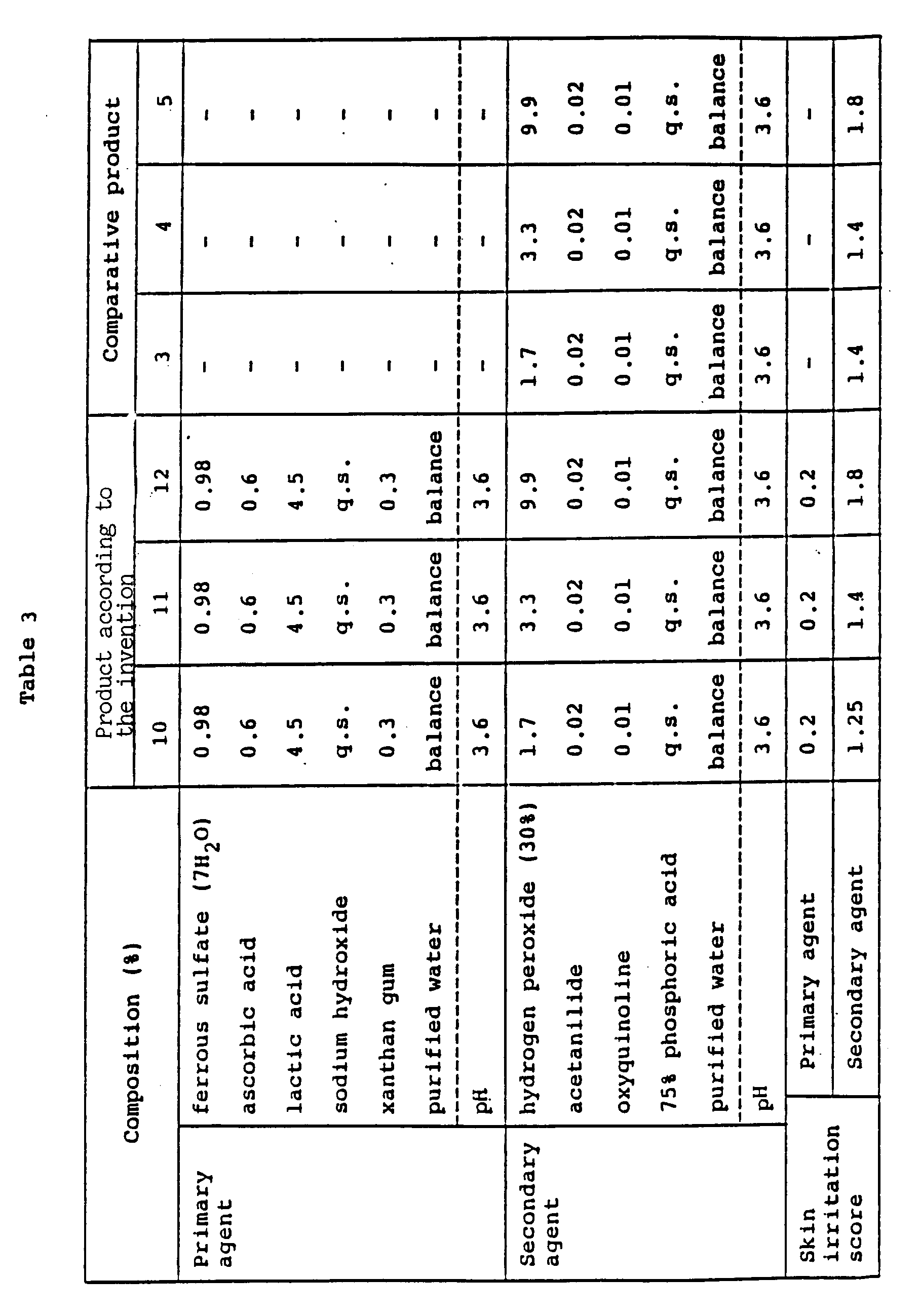
- Hair-treatment compositions of formulations specified in the following Table 4 (invention products 13 and 14) were prepared. Then the stability of each product to a ferrous salt was tested. The stability was evaluated by determining the solubility of the ferrous salt when added to each product and observing the coloration of each product when stored at 40°C for 20 days. Table 4 summarizes the results.
Table 4 product according to the invention 13 14 Formulation (% by wt.) ferrous sulfate (7H₂O) 0.98 0.98 lactic acid 4.5 4.5 glycolic acid - 3.8 ascorbic acid 0.40 0.40 sodium hydroxide q.s. q.s. hydrochloric acid - - xanthan gum 0.3 0.3 purified water balance balance pH 3.6 3.6 Stability coloration no change no change solubility soluble soluble - As Table 4 shows, the ferrous salt was stably contained in each hair-treatment composition of the invention.
-
- The irritating effects on the skin of the products 13 and 14 according to the invention, each obtained in Example 4, were evaluated in the following manner. A closed patch test was conducted with the use of Guinea pigs (N = 4 or 5) for 24 hours. 48 hours later, the conditions of the animals were observed with the naked eye and evaluated according to the following criteria.
Table 5 gives the results. -
- 0:
- no change,
- 1:
- slight erythema, and
- 2:
- significant erythema.
-
Table 5 product 13 product 14 Skin irritation score 0 0 - As Table 5 shows, the products of the invention showed no skin irritation.
-
- Hair-treatment compositions of the formulations specified in the following Table 6 (the
products 15 to 17 according to the invention) were prepared.

- Further, a hair-dyeing cream of the following formulation was prepared.
Formulation of hair-dyeing cream % by wt. (1) self-emulsifiable glyceryl monostearate 4.5 (2) ethylene glycol monostearate 3.5 (3) polyoxyethylene sorbitan tristearate 1.0 (4) paraffin wax 3.0 (5) liquid paraffin 25.0 (6) vaseline 5.0 (7) ceresin wax 2.0 (8) isopropyl myristate 4.5 (9) sodium cetyl sulfate 1.5 (10) gallic acid 1.0 (11) ferrous sulfate 1.0 (12) ascorbic acid 0.2 (13) citric acid 0.2 (14) ethylene carbonate 10.0 (15) water 37.1 (16) perfume 0.5 total 100.0 - The above-mentioned components (9), (10) and (13) were homogeneously dissolved in part of the water at approximately 80°C. The above components (1) to (8) were molten by heating to approximately 90°C and then added to the mixture solution obtained above under stirring. The resulting mixture was homogeneously stirred and cooled. The above-mentioned components (11) and (12) were homogeneously dissolved in the rest of the water and then added together with the component (14) to the mixture obtained above at 50°C. After mixing and cooling, the mixture was filled in an Excel bottle to thereby give a creamy hair-dye (hair-dyeing cream).
- The effect of the product according to the invention given in Table 6 was examined in the following manner. An appropriate amount of said product given in Table 6 (a conditioning composition) was applied to gray hair after shampooing and allowed to stand for several minutes. Then it was rinsed away and the hair was further treated with the above-mentioned hair-dyeing cream. This procedure was repeated. Thus the white hair slowly turned black in very excellent conditions.
- A hair-dyeing lotion of the following formulation was prepared by the following method.
Formulation % by wt. (1) solid logwood extract (hematoxylin content: ca. 50%) 2.0 (2) glucose 1.0 (3) perfume 0.5 (4) purified water 96.5 total 100.00 - The above-mentioned component (1) was dissolved in the component (4) under stirring. Next, the components (2) and (3) were added thereto and stirring to thereby give a transparent aqueous solution (a hair-dyeing lotion).
- Another effect of the product obtained in the above-mentioned Example 6 was examined in the following manner. An appropriate amount of the product according to the invention given in Table 6 (conditioning composition) was applied to white hair after shampooing. Then it was allowed to stand for several minutes and rinsed away. Next, an appropriate amount of the above-mentioned hair-dyeing lotion was applied to the white hair. After being allowed to stand for several minutes, it was rinsed away. This procedure was repeated. Thus the white hair slowly turned black in very excellent conditions.
- In this Example, the conditioning effects of the
products 15 and 16 according to the invention obtained in Example 6 was tested. - The
products 15 and 16 and the comparative product 13 were applied to the hair. Then the touch of the hair at the application and after drying was organoleptically evaluated to determine the conditioning effect of each product. Table 7 gives the results. - As Table 7 indicates, the
products 15 and 16 according to the invention showed each an excellent conditioning effect.Table 7 Product according to the invention 15 16 Formulation (% by wt.) ferrous sulfate (7H₂o) 0.98 0.98 ascorbic acid 0.6 0.6 lactic acidid 4.5 4.5 cationized cellulose1) - 0.5 cationic surfactant2) 5.4 1.1 cationic surfactant3) 2.0 - nonionic surfactant4) - 0.5 nonionic surfactant5) 1.0 - behenyl alcohol 2.0 - propylene glycol 10.0 4.0 perfume 0.2 0.2 methylparaben 0.3 0.3 sodium hydroxide q.s. q.s. purified water balance balance pH of cmposition 3.8 3.8 Form of composition creamy transparent Conditioning effect Ⓞ Ⓞ Note:
1) to 5) are as defined above in Table 6. - In this Example, products 18 and 19 of the formulations specified in the following Table 8 were prepared. The product 18 according to the invention, wherein a direct dye was directly added to the primary agent, was a treatment suitable for daily use. The product 19 according to the invention, wherein a direct dye was directly added to the secondary agent, was a set lotion having a hair color tone modifying effect. The color tone of the hair could be excellently modified by using either of these compositions.
- The first agents of the products 18 and 19 were each hermetically sealed in an Excel bottle.


said composition being applied to the hair prior to an oxidizing treatment and/or dyeing treatment,
characterized in that said organic chelate-forming compound is a non-reducing compound of the general formula (II)

wherein R¹ and R² may be either the same or different from each other and R¹ represents a hydrogen atom, a straight-chain or branded alkyl group having 1 to 5 carbon atoms or an alkenyl group having 1 to 5 carbon atoms, R² represents a straight-chain or branched alkyl group having 1 to 5 carbon atoms or an alkenyl group having 1 to 5 carbon atoms, n is from 0 to 2 and m is from 0 to 6.
characterized in that said organic chelate-forming compound is a non-reducing compound of the general formula (I)

wherein R represents a straight-chain or branched hydrocarbon group having 1 to 10 carbon atoms or an oxane ring, and m is an integer from 1 to 6, wherein the hydroxyl group may be bound to any position of the hydrocarbon group R.

Claims (10)
- A hair-treatment composition comprising:(1) a ferrous salt, and(2) an organic chelate-forming compound capable of forming a chelate compound with a ferrous ion,said composition having a pH value of from 3 to 6, wherein the stability constant (K₁) between said ferrous ion and said organic chelate-forming compound is lower than 3 and the ferrous salt, which is the chelate compound of said ferrous ion with said organic chelate-forming compound, is highly soluble in water,
said composition being applied to the hair prior to an oxidizing treatment and/or dyeing treatment,
characterized in that said organic chelate-forming compound is a non-reducing compound of the general formula (II)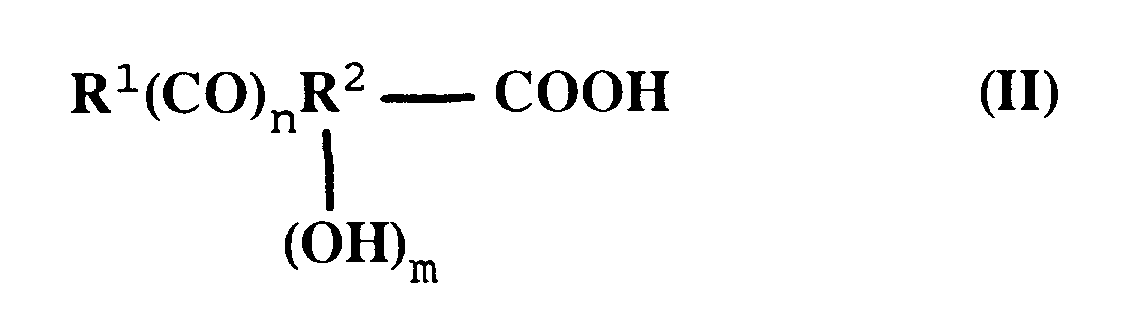
- The hair-treatment composition of claim 1, wherein non-reducing organic chelate-forming compound is selected from the group consisting of lactic acid, glycolic acid, hydroxybutyric acid, glyceric acid, β-hydroxyglutaric acid, gluconic acid and glucuronic acid.
- A hair-treatment composition comprising:(1) a ferrous salt, and(2) an organic chelate-forming compound capable of forming a chelate compound with a ferrous ion,said composition having a pH value of from 3 to 6 and being applied to the hair prior to an oxidizing treatment and/or dyeing treatment,
characterized in that said organic chelate-forming compound is a non-reducing compound of the general formula (I)
- The hair-treatment composition of claim 3, wherein the non-reducing organic chelate-forming compound is selected from the group consisting of lactic acid, glycolic acid, hydroxybutyric acid, glyceric acid, gluconic acid and glucuronic acid.
- The hair-treatment composition of any of claims 1 to 4, wherein the non-reducing organic chelate-forming compound is contained in an amount of 0.1 to 10.0% by weight.
- The hair-treatment composition of any of claims 1 to 5, further comprising an organic reducing agent.
- A bleaching composition comprising the hair-treatment composition of any of claims 1 to 6 as a primary agent together with an aqueous composition containing 0.01 to 3% by weight of hydrogen perioxide and having a pH value of from 3 to 6 as a secondary agent.
- A hair color tone modifier composition obtained by adding a direct dye to the primary and/or secondary agent of the bleaching composition of claim 7.
- The hair color tone modifier composition of claim 8, containing the dye in an amount of 0.0001 to 5% by weight in the primary and/or secondary agent.
- A method for bleaching hair, which comprises the following steps:a) applying to the hair the hair treatment composition of any claims 1 to 6, andb) subsequently applying to the hair an aqueous composition containing 0.01 to 3% by weight of hydrogen peroxide and having a pH value of from 3 to 6.
Applications Claiming Priority (2)
| Application Number | Priority Date | Filing Date | Title |
|---|---|---|---|
| JP10397789 | 1989-04-24 | ||
| JP103977/89 | 1989-04-24 |
Publications (2)
| Publication Number | Publication Date |
|---|---|
| EP0394930A1 EP0394930A1 (en) | 1990-10-31 |
| EP0394930B1 true EP0394930B1 (en) | 1994-07-13 |
Family
ID=14368385
Family Applications (1)
| Application Number | Title | Priority Date | Filing Date |
|---|---|---|---|
| EP90107678A Expired - Lifetime EP0394930B1 (en) | 1989-04-24 | 1990-04-23 | Hair treatment composition, bleaching composition and hair color tone modifier composition |
Country Status (5)
| Country | Link |
|---|---|
| US (1) | US5064441A (en) |
| EP (1) | EP0394930B1 (en) |
| JP (1) | JPH0669941B2 (en) |
| AT (1) | ATE108323T1 (en) |
| DE (1) | DE69010551T2 (en) |
Cited By (1)
| Publication number | Priority date | Publication date | Assignee | Title |
|---|---|---|---|---|
| DE102010038962A1 (en) | 2010-08-05 | 2011-08-25 | Henkel AG & Co. KGaA, 40589 | Treating keratin fibers, comprises applying a colorant for keratin fibers, and subsequently applying an iron salt- and/or copper salt-containing composition, comprising iron- and/or copper salt |
Families Citing this family (24)
| Publication number | Priority date | Publication date | Assignee | Title |
|---|---|---|---|---|
| KR100195650B1 (en) * | 1991-04-17 | 1999-06-15 | 야마모토시게요시 | Hair coloring composition |
| DE69232049T2 (en) * | 1991-12-13 | 2002-06-06 | Vitachlor Corp | AGENT AND METHOD FOR REMOVING MINERALS FROM HAIR |
| JP3148365B2 (en) * | 1992-06-29 | 2001-03-19 | 花王株式会社 | Keratinous fiber modifier kit |
| US5254336A (en) * | 1992-09-24 | 1993-10-19 | Helene Curtis, Inc. | Method of increasing hair shine and repairing alkaline-damaged hair |
| EP0681465A4 (en) * | 1993-01-28 | 1996-08-21 | Ccp Inc | POWDER DISCOLORING COMPOSITIONS FOR HAIR AND METHODS OF USE THEREOF. |
| FR2708197B1 (en) * | 1993-07-28 | 1995-09-08 | Oreal | New compositions based on hydrogen peroxide and their use as fixers for perms. |
| US5782933A (en) * | 1997-04-30 | 1998-07-21 | Bristol-Myers Squibb Company | Ascorbic and isoascorbic acids to remove or adjust oxidative color in hair |
| US6274126B1 (en) * | 1998-08-21 | 2001-08-14 | Helene Curtis, Inc. | Composition for lightening and highlighting hair |
| JP2000128750A (en) * | 1998-10-23 | 2000-05-09 | Seniru Laboratories:Kk | Hair dye composition |
| JP4471051B2 (en) * | 1999-06-22 | 2010-06-02 | ライオン株式会社 | Hair dye composition and method for producing the same |
| US6770103B2 (en) * | 2001-03-19 | 2004-08-03 | Unilever Home & Personal Care Usa, Division Of Conopco, Inc. | Method and composition for the gradual permanent coloring of hair |
| JP4403214B2 (en) * | 2001-03-22 | 2010-01-27 | 山田化学工業株式会社 | Method for dyeing synthetic polyamide fibers |
| US6758867B2 (en) * | 2001-12-28 | 2004-07-06 | Unilever Home & Personal Care Usa, Division Of Conopco, Inc. | Gradual permanent coloring of hair using dye intermediates in a shampoo base |
| US6726729B2 (en) * | 2001-12-28 | 2004-04-27 | Unilever Home & Personal Care Usa, Division Of Conopco, Inc. | Gradual permanent coloring of hair using dye intermediates in a shampoo base |
| US6736860B2 (en) | 2002-03-12 | 2004-05-18 | Unilever Home & Personal Care Usa Division Of Conopco, Inc. | Gradual permanent coloring of hair using dye intermediates dissolved in alkaline water with fatty alcohol |
| US6743265B2 (en) * | 2002-03-13 | 2004-06-01 | Unilever Home & Personal Care Usa Division Of Conopco, Inc. | Gradual permanent coloring of hair using dye intermediates dissolved in alkaline water with a gelling agent |
| JP2004067518A (en) * | 2002-08-01 | 2004-03-04 | Kanebo Ltd | Method for treating hair |
| FR2848843B1 (en) * | 2002-12-20 | 2005-07-01 | Oreal | PULP ANHYDROUS COMPOSITION FOR THE DECOLORATION AND SIMULTANEOUS COLORING OF HUMAN KERATIN FIBERS. |
| FR2852836B1 (en) * | 2003-03-25 | 2008-02-15 | Oreal | USE OF HYDROXYCARBOXYLIC ACIDS AND THEIR SALTS AS COMPLEXING AGENTS IN REDUCING COMPOSITIONS FOR THE PERMANENT DECOLORATION OR DEFORMATION OF KERATIN FIBERS |
| JP2007197326A (en) * | 2006-01-23 | 2007-08-09 | Hoyu Co Ltd | Method for treating hair |
| CN102238932B (en) | 2008-12-05 | 2014-03-12 | 荷兰联合利华有限公司 | Coloring of keratin fibers using a pretreatment agent comprising iron salts and a developer comprising hydrolyzable tannins |
| WO2013167350A2 (en) | 2012-05-08 | 2013-11-14 | Unilever N.V. | A method of colouring keratinous fibers |
| CN106637905A (en) * | 2017-01-16 | 2017-05-10 | 许昌学院 | Bleaching reagent as well as preparation method and application thereof, and application of peracetic acid A liquid |
| WO2022169633A1 (en) | 2021-02-02 | 2022-08-11 | Federici Brands, Llc | Composition comprising a hydrolyzed keratin and a silane crosslinking agent and process for hair protection during bleaching |
Family Cites Families (12)
| Publication number | Priority date | Publication date | Assignee | Title |
|---|---|---|---|---|
| US3632295A (en) * | 1969-04-29 | 1972-01-04 | Gillette Co | Method of bleaching hair or wool |
| FR2045991A7 (en) * | 1969-06-11 | 1971-03-05 | Gillette Co | Hair tinting preparations with reduced - amounts of peroxide |
| US3838966A (en) * | 1970-05-25 | 1974-10-01 | Mennen Co | Permanent but removable hair-coloring system |
| JPS54129134A (en) * | 1978-03-28 | 1979-10-06 | Shiseido Co Ltd | Hair-bleaching agent |
| US4302199A (en) * | 1980-12-29 | 1981-11-24 | The Procter & Gamble Company | Hair dyeing method |
| DE3149978C2 (en) * | 1981-12-17 | 1985-09-05 | Deutsches Wollforschungsinstitut an der Rheinisch-Westfälischen Technischen Hochschule Aachen e.V., 5100 Aachen | Process for bleaching natural fibers and feathers containing keratin |
| US4609475A (en) * | 1984-02-24 | 1986-09-02 | Halliburton Company | Method of improving the permeability of a subterranean formation by removal of polymeric materials therefrom |
| JPS6155483A (en) * | 1984-08-27 | 1986-03-19 | Taiyo Tekko Kk | Pilot type solenoid operated valve |
| CA1241423A (en) * | 1985-08-08 | 1988-08-30 | Ditmar K. Tillmann | Switchable receptacle unit |
| LU86521A1 (en) * | 1986-07-18 | 1988-02-02 | Oreal | HAIR DYEING PROCESS WITH HYDROXYQUINONIC DYES AND METAL SALTS |
| GB8802455D0 (en) * | 1988-02-04 | 1988-03-02 | Beecham Group Plc | Dye compositions |
| CA1324320C (en) * | 1988-03-31 | 1993-11-16 | Thomas M. Schultz | Use of n-substituted-5,6-dihydroxyindoles as a hair coloring agent |
-
1990
- 1990-03-26 JP JP2076220A patent/JPH0669941B2/en not_active Expired - Fee Related
- 1990-04-19 US US07/511,216 patent/US5064441A/en not_active Expired - Lifetime
- 1990-04-23 EP EP90107678A patent/EP0394930B1/en not_active Expired - Lifetime
- 1990-04-23 AT AT90107678T patent/ATE108323T1/en not_active IP Right Cessation
- 1990-04-23 DE DE69010551T patent/DE69010551T2/en not_active Expired - Fee Related
Cited By (1)
| Publication number | Priority date | Publication date | Assignee | Title |
|---|---|---|---|---|
| DE102010038962A1 (en) | 2010-08-05 | 2011-08-25 | Henkel AG & Co. KGaA, 40589 | Treating keratin fibers, comprises applying a colorant for keratin fibers, and subsequently applying an iron salt- and/or copper salt-containing composition, comprising iron- and/or copper salt |
Also Published As
| Publication number | Publication date |
|---|---|
| ATE108323T1 (en) | 1994-07-15 |
| JPH0669941B2 (en) | 1994-09-07 |
| JPH0347113A (en) | 1991-02-28 |
| DE69010551T2 (en) | 1994-11-10 |
| EP0394930A1 (en) | 1990-10-31 |
| US5064441A (en) | 1991-11-12 |
| DE69010551D1 (en) | 1994-08-18 |
Similar Documents
| Publication | Publication Date | Title |
|---|---|---|
| US5064441A (en) | Hair treatment composition, bleaching composition and hair color tone modifier composition | |
| US5196029A (en) | Hair-treatment composition, bleaching composition and hair color tone modifier composition | |
| US4826681A (en) | Anhydrous solution of hydrogen peroxide in an organic solvent and the use of the same in therapeutic and cosmetic formulations | |
| DE3886867T2 (en) | HAIR CARE PRODUCTS. | |
| US4620850A (en) | Composition and process for the oxidative dyeing of hair | |
| US5520706A (en) | Process for the oxidation dyeing of keratinous fibers using water vapor | |
| AU705136B2 (en) | Synthesis of quaternary melanin compounds and their use as hair dyes or for skin treatment | |
| WO1988000186A1 (en) | Compositions used in permanent structure altering of hair | |
| US4381920A (en) | Method and composition for dyeing human hair | |
| EP1037591A1 (en) | Cosmetic preparations containing a special combination of active agents | |
| US5961991A (en) | Melanoquaternary compounds and their use as hair dyes and for skin treatment | |
| CA2018791C (en) | Hair treatment composition | |
| WO1987003196A1 (en) | Hair treatment | |
| CA2145860A1 (en) | Hair treatment preparations | |
| DE4109976A1 (en) | METHOD FOR PERMANENTLY DEFORMING HAIR | |
| AU8278587A (en) | Composition used in permanent alteration of hair colour comprising quaternized amino lactam | |
| EP4454633A1 (en) | Solid colouring agent emulsion for manufacturing hair dye | |
| JP3424086B2 (en) | Hair dye composition | |
| EP0742709B1 (en) | Complex of active ingredients for hair conditioners | |
| EP1501471B1 (en) | Use of alpha-dialdehydes in the presence of an ammonium salt of a brönsted acid for dyeing keratin fibres | |
| EP4659737A1 (en) | Hair dyeing method | |
| JPH09175962A (en) | Hair dye composition | |
| JPH02138206A (en) | Hair dyeing agent composition | |
| KR20230159026A (en) | A stepwise hair color composition and a cosmetic composition comprising the same | |
| AU6730287A (en) | Hair treatment |
Legal Events
| Date | Code | Title | Description |
|---|---|---|---|
| PUAI | Public reference made under article 153(3) epc to a published international application that has entered the european phase |
Free format text: ORIGINAL CODE: 0009012 |
|
| AK | Designated contracting states |
Kind code of ref document: A1 Designated state(s): AT CH DE GB LI NL |
|
| 17P | Request for examination filed |
Effective date: 19910308 |
|
| 17Q | First examination report despatched |
Effective date: 19920508 |
|
| GRAA | (expected) grant |
Free format text: ORIGINAL CODE: 0009210 |
|
| AK | Designated contracting states |
Kind code of ref document: B1 Designated state(s): AT CH DE GB LI NL |
|
| REF | Corresponds to: |
Ref document number: 108323 Country of ref document: AT Date of ref document: 19940715 Kind code of ref document: T |
|
| REF | Corresponds to: |
Ref document number: 69010551 Country of ref document: DE Date of ref document: 19940818 |
|
| PLBE | No opposition filed within time limit |
Free format text: ORIGINAL CODE: 0009261 |
|
| STAA | Information on the status of an ep patent application or granted ep patent |
Free format text: STATUS: NO OPPOSITION FILED WITHIN TIME LIMIT |
|
| 26N | No opposition filed | ||
| REG | Reference to a national code |
Ref country code: GB Ref legal event code: IF02 |
|
| PGFP | Annual fee paid to national office [announced via postgrant information from national office to epo] |
Ref country code: AT Payment date: 20020411 Year of fee payment: 13 |
|
| PGFP | Annual fee paid to national office [announced via postgrant information from national office to epo] |
Ref country code: GB Payment date: 20020417 Year of fee payment: 13 |
|
| PGFP | Annual fee paid to national office [announced via postgrant information from national office to epo] |
Ref country code: NL Payment date: 20020426 Year of fee payment: 13 |
|
| PGFP | Annual fee paid to national office [announced via postgrant information from national office to epo] |
Ref country code: CH Payment date: 20020430 Year of fee payment: 13 |
|
| PG25 | Lapsed in a contracting state [announced via postgrant information from national office to epo] |
Ref country code: GB Free format text: LAPSE BECAUSE OF NON-PAYMENT OF DUE FEES Effective date: 20030423 Ref country code: AT Free format text: LAPSE BECAUSE OF NON-PAYMENT OF DUE FEES Effective date: 20030423 |
|
| PG25 | Lapsed in a contracting state [announced via postgrant information from national office to epo] |
Ref country code: LI Free format text: LAPSE BECAUSE OF NON-PAYMENT OF DUE FEES Effective date: 20030430 Ref country code: CH Free format text: LAPSE BECAUSE OF NON-PAYMENT OF DUE FEES Effective date: 20030430 |
|
| PG25 | Lapsed in a contracting state [announced via postgrant information from national office to epo] |
Ref country code: NL Free format text: LAPSE BECAUSE OF NON-PAYMENT OF DUE FEES Effective date: 20031101 |
|
| NLV4 | Nl: lapsed or anulled due to non-payment of the annual fee |
Effective date: 20031101 |
|
| GBPC | Gb: european patent ceased through non-payment of renewal fee |
Effective date: 20030423 |
|
| REG | Reference to a national code |
Ref country code: CH Ref legal event code: PL |
|
| PGFP | Annual fee paid to national office [announced via postgrant information from national office to epo] |
Ref country code: DE Payment date: 20070419 Year of fee payment: 18 |
|
| PG25 | Lapsed in a contracting state [announced via postgrant information from national office to epo] |
Ref country code: DE Free format text: LAPSE BECAUSE OF NON-PAYMENT OF DUE FEES Effective date: 20081101 |