EP0393735A1 - Wall on which vegetation can grow - Google Patents
Wall on which vegetation can grow Download PDFInfo
- Publication number
- EP0393735A1 EP0393735A1 EP90200610A EP90200610A EP0393735A1 EP 0393735 A1 EP0393735 A1 EP 0393735A1 EP 90200610 A EP90200610 A EP 90200610A EP 90200610 A EP90200610 A EP 90200610A EP 0393735 A1 EP0393735 A1 EP 0393735A1
- Authority
- EP
- European Patent Office
- Prior art keywords
- wall
- panel
- capillary
- mineral wool
- liquid
- Prior art date
- Legal status (The legal status is an assumption and is not a legal conclusion. Google has not performed a legal analysis and makes no representation as to the accuracy of the status listed.)
- Granted
Links
- 239000011490 mineral wool Substances 0.000 claims abstract description 36
- 239000000463 material Substances 0.000 claims abstract description 27
- 239000007788 liquid Substances 0.000 claims abstract description 22
- 239000000758 substrate Substances 0.000 claims abstract description 7
- 229920003023 plastic Polymers 0.000 claims description 7
- 239000011148 porous material Substances 0.000 claims description 6
- 239000011888 foil Substances 0.000 claims description 5
- 230000000630 rising effect Effects 0.000 claims description 5
- 239000000835 fiber Substances 0.000 claims description 4
- 230000000007 visual effect Effects 0.000 claims description 4
- 239000011521 glass Substances 0.000 claims description 3
- 210000001736 capillary Anatomy 0.000 claims 7
- 239000010410 layer Substances 0.000 description 39
- XLYOFNOQVPJJNP-UHFFFAOYSA-N water Substances O XLYOFNOQVPJJNP-UHFFFAOYSA-N 0.000 description 13
- 238000004519 manufacturing process Methods 0.000 description 4
- 238000000926 separation method Methods 0.000 description 4
- 238000001704 evaporation Methods 0.000 description 2
- 230000008020 evaporation Effects 0.000 description 2
- 238000002474 experimental method Methods 0.000 description 2
- 235000015097 nutrients Nutrition 0.000 description 2
- 239000000080 wetting agent Substances 0.000 description 2
- 230000002745 absorbent Effects 0.000 description 1
- 239000002250 absorbent Substances 0.000 description 1
- 238000010276 construction Methods 0.000 description 1
- 230000000694 effects Effects 0.000 description 1
- 239000011491 glass wool Substances 0.000 description 1
- 230000002209 hydrophobic effect Effects 0.000 description 1
- 239000002184 metal Substances 0.000 description 1
- 229920000573 polyethylene Polymers 0.000 description 1
- 235000020681 well water Nutrition 0.000 description 1
- 239000002349 well water Substances 0.000 description 1
Images


Classifications
-
- E—FIXED CONSTRUCTIONS
- E01—CONSTRUCTION OF ROADS, RAILWAYS, OR BRIDGES
- E01F—ADDITIONAL WORK, SUCH AS EQUIPPING ROADS OR THE CONSTRUCTION OF PLATFORMS, HELICOPTER LANDING STAGES, SIGNS, SNOW FENCES, OR THE LIKE
- E01F8/00—Arrangements for absorbing or reflecting air-transmitted noise from road or railway traffic
- E01F8/02—Arrangements for absorbing or reflecting air-transmitted noise from road or railway traffic specially adapted for sustaining vegetation or for accommodating plants ; Embankment-type or crib-type noise barriers; Retaining walls specially adapted to absorb or reflect noise
- E01F8/027—Arrangements for absorbing or reflecting air-transmitted noise from road or railway traffic specially adapted for sustaining vegetation or for accommodating plants ; Embankment-type or crib-type noise barriers; Retaining walls specially adapted to absorb or reflect noise with external support, e.g. wall facing
-
- A—HUMAN NECESSITIES
- A01—AGRICULTURE; FORESTRY; ANIMAL HUSBANDRY; HUNTING; TRAPPING; FISHING
- A01G—HORTICULTURE; CULTIVATION OF VEGETABLES, FLOWERS, RICE, FRUIT, VINES, HOPS OR SEAWEED; FORESTRY; WATERING
- A01G9/00—Cultivation in receptacles, forcing-frames or greenhouses; Edging for beds, lawn or the like
- A01G9/02—Receptacles, e.g. flower-pots or boxes; Glasses for cultivating flowers
- A01G9/022—Pots for vertical horticulture
- A01G9/025—Containers and elements for greening walls
-
- Y—GENERAL TAGGING OF NEW TECHNOLOGICAL DEVELOPMENTS; GENERAL TAGGING OF CROSS-SECTIONAL TECHNOLOGIES SPANNING OVER SEVERAL SECTIONS OF THE IPC; TECHNICAL SUBJECTS COVERED BY FORMER USPC CROSS-REFERENCE ART COLLECTIONS [XRACs] AND DIGESTS
- Y02—TECHNOLOGIES OR APPLICATIONS FOR MITIGATION OR ADAPTATION AGAINST CLIMATE CHANGE
- Y02P—CLIMATE CHANGE MITIGATION TECHNOLOGIES IN THE PRODUCTION OR PROCESSING OF GOODS
- Y02P60/00—Technologies relating to agriculture, livestock or agroalimentary industries
- Y02P60/20—Reduction of greenhouse gas [GHG] emissions in agriculture, e.g. CO2
Definitions
- the present invention relates to a wall on which vegetation can grow.
- a wall comprises a vegetation substrate in which the vegetation can thrive and in addition means for adding liquid, for instance water to which nutrients have been added, to the panel.
- liquid for instance water to which nutrients have been added
- a panel-like vegetation substrate a mineral wool is employed, the problem arises that in practical conditions insufficient water can be added to such a panel of mineral wool in order to achieve an average moisture content of at least roughly 30% by vol over the height of the panel. This minimal moisture content is essential for the purpose of providing a panel where vegetation can thrive over the panel height.
- the present invention is based on the observation that in a panel of mineral wool, as a result of capillary rising, a bottom layer is present that is provided with water.
- a layered panel results in which the layers are each provided with water over a determined rise height as a consequence of capillary rising.
- the wall coverable with vegetation comprises a frame, at least one panel carried by the frame and containing a vegetation substrate, means for adding liquid at the top of the panel, means for collecting liquid at the bottom of the panel, and is characterized in that the panel is built up of layers of mineral wool which are mutually separated by a capillary separating material.
- a layer of mineral wool suitable for vegetation substrate is a mineral wool, such as rockwool, provided with a wetting agent, which results in the mineral wool becoming more water absorbent (see the Netherlands patent no. 165789). Glass wool is also suitable.
- the capillary rising height of liquid in the mineral wool depends on the one hand on the wetting agent used and on the other on the density of the mineral wool. With the use of rockwool the density must be greater than 30 kg per m3 and preferably greater than 50 kg per m3, while very satisfactory results are achieved with densities greater than 70 and preferably greater than 90 kg per m3.
- a capillary separating material are those materials which can establish a capillary separation between layers of mineral wool, that is, that the suction pressure prevailing in a layer cannot exert any influence on the layers of mineral wool located above and below it.
- these capillary separating materials must be water permeable, although it is in principle possible to distribute the liquid through each underlying layer in turn.
- Use can be made as capillary separating material of for instance the curing profile which can be present in the manufacture of the mineral wool as blanket on the lying blanket surfaces.
- the oven profile and the manufacture of such mineral wool blankets reference is made to the European patent application EP-A-277. 397.
- a bottom curing profile is used since its capillary separating character is comparatively great, while as a web the profile is relatively well water permeable.
- the capillary separating material may consist of a skin provided with pores, or more particularly the material can be selected from a coarse-mesh tissue or net, a plastic foil provided with pores or a (glass) fibre web.
- capillary separating material can be fixedly connected to the layer of mineral wool.
- a (glass) fibre web or other plastic foil can be attached fixedly during its manufacture to the mineral wool blanket from which the layers are cut.
- the layer thickness is approximately equal to 2-10 cm, and preferably 3-7 cm, for instance 5 cm.
- the number of layers in a panel amounts to 2-40, preferably 5-30 and more preferivelyably 7-15.
- At least the upper panels are provided with drippers arranged spread along the length of and above the panel. These drippers can be connected to a central feed line which may optionally be incorporated in a circuit, which will result in comparatively little water being able to dissipate into the environment. Minimal evaporation and a selected visual surface for the wall are obtained if more preferably a visual plate provided with plant holes is arranged in front of the panel.
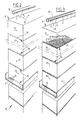
- FIG. 1 shows a wall 2 covered with vegetation 1 such as plants as according to the invention.
- the wall 2 comprises a frame 3 consisting of upright posts 4 having beams 5-7 arranged between them.
- the beams are gutter-shaped, while the beams 6 and 7 are provided with holes 14 which allow passage of liquid.
- the beams 6 and 7 bear a panel 8 which serves as vegetation substrate.
- a drip line 10 Disposed above each panel 8 is a drip line 10 which is provided with drip openings or drippers 9 and which is connected to a central liquid feed line 11 which is joined via a pump 12 to a liquid reservoir 13.
- the liquid consists of water to which nutrients may optionally be added periodically.
- Liquid 18 that is delivered through the openings 9 seeps through the panel 8 is collected in the beam 6 and is subsequently fed to the panel 15 lying beneath and distributed through it via the holes 14, is collected after seeping through panel 15 in the beam 7 and after distribution via the holes 14 is fed to the panel 16 lying below that, and so on.
- the liquid 18 is collected via the lowest beam 17 and returned via a line (not shown) to the reservoir 13, and if desired the liquid 18 can be discharged to the ground.
- the wall 2 is closed off with a visual wall 19 which is provided with plant holes 20, through which the vegetation 1 emerges to the outside.
- FIG. 2 shows in more detail the construction of the packages 8 and 15.
- the package 8 is built up of 6-12 stacked layers 21-24 of mineral wool which are mutually separated by a capillary separating material 25.
- the capillary separating material 25 consists of a curing oven profile 26 that is fixedly connected to the layer of mineral wool and possesses in contrast thereto a skin-like, hydrophobic form which is however water permeable.
- the package 8 consists of layers 27-30 of mineral wool which are mutually separated by a capillary separating material 25 which consists in this case of a coarse-mesh net 31 of plastic fibres, for instance a net woven from polyethene threads, obtainable on the market under the trade name Ostend Net R or Enka drain.
- Figure 4 shows a layer of mineral wool 32 which is provided with a fibre web 33 fused thereto during manufacture.
- the layer of mineral wool 34 shown in figure 5 is provided on the bottom with a plastic foil 35 provided with pores.
- stacks of mineral wool layers and interposed capillary separation material are formed and these stacks are kept together using straps 42 slung around the stacks and/or metal or plastic pins 43 extending through the stacks (see figure 7).
- Figure 6 shows a panel 36 according to the invention that is assembled from a number of layers of mineral wool 37 which are in turn mutually separated by a layer of capillary separating material 25.
- This package 36 is formed into a very manageable product because it is arranged in a very coarse-mesh net 38 stretched around it, which, if desired, need not be removed during arranging of the panel 36 in the wall 1 according to the invention.
- figure 7 shows another package 39 according to the invention in which the layers 40 of mineral wool are mutually separated by a plastic foil 41 provided with pores which is arranged between the layers 40 in zig-zag manner.
- the moisture content in each layer, and ultimately in the whole panel depends on the capillary suction capacity of each layer and the effectiveness of the separation by the capillary separating material.
- the capillary suction height is determined among other things by the density of the mineral wool. In this way it is possible in the case of a mineral wool with a very good suction capacity to use a less good or completely separating capillary separating material, or vice-versa.
- the wall shown in figure 1 was used in an experiment.
- Each package 8, 15 and 16 consisted of 16 layers of mineral wool with a density of around 90 kg/m3 and a layer height of 3 cm.
- water was dripped on via the drip line 10 (121/hour).
- the moisture content in the bottom layer 24 amounted to 79% by vol, while the moisture content of the layers above 21-23 varied from 50 to 79% by vol.
- the water supply was subsequently discontinued for two days.
- the moisture content of the bottom layer remained the same, as did the moisture content in the layers above. Only in the case of the top layer 21 did the moisture content decrease slightly to about 62% by vol.
Landscapes
- Engineering & Computer Science (AREA)
- Architecture (AREA)
- Civil Engineering (AREA)
- Structural Engineering (AREA)
- Life Sciences & Earth Sciences (AREA)
- Environmental Sciences (AREA)
- Hydroponics (AREA)
- Cultivation Receptacles Or Flower-Pots, Or Pots For Seedlings (AREA)
Abstract
Description
- The present invention relates to a wall on which vegetation can grow. Such a wall comprises a vegetation substrate in which the vegetation can thrive and in addition means for adding liquid, for instance water to which nutrients have been added, to the panel. If for such a panel-like vegetation substrate a mineral wool is employed, the problem arises that in practical conditions insufficient water can be added to such a panel of mineral wool in order to achieve an average moisture content of at least roughly 30% by vol over the height of the panel. This minimal moisture content is essential for the purpose of providing a panel where vegetation can thrive over the panel height.
- The present invention is based on the observation that in a panel of mineral wool, as a result of capillary rising, a bottom layer is present that is provided with water. By constructing the panel from layers of mineral wool that are in mutual capillary separation using a capillary separating material a layered panel results in which the layers are each provided with water over a determined rise height as a consequence of capillary rising.
- The wall coverable with vegetation according to the invention comprises a frame, at least one panel carried by the frame and containing a vegetation substrate, means for adding liquid at the top of the panel, means for collecting liquid at the bottom of the panel, and is characterized in that the panel is built up of layers of mineral wool which are mutually separated by a capillary separating material.
- What might be understood by a layer of mineral wool suitable for vegetation substrate is a mineral wool, such as rockwool, provided with a wetting agent, which results in the mineral wool becoming more water absorbent (see the Netherlands patent no. 165789). Glass wool is also suitable.
- The capillary rising height of liquid in the mineral wool depends on the one hand on the wetting agent used and on the other on the density of the mineral wool. With the use of rockwool the density must be greater than 30 kg per m³ and preferably greater than 50 kg per m³, while very satisfactory results are achieved with densities greater than 70 and preferably greater than 90 kg per m³.
- In accordance with the invention what is understood by a capillary separating material are those materials which can establish a capillary separation between layers of mineral wool, that is, that the suction pressure prevailing in a layer cannot exert any influence on the layers of mineral wool located above and below it. In addition these capillary separating materials must be water permeable, although it is in principle possible to distribute the liquid through each underlying layer in turn. Use can be made as capillary separating material of for instance the curing profile which can be present in the manufacture of the mineral wool as blanket on the lying blanket surfaces. For a description of the oven profile and the manufacture of such mineral wool blankets reference is made to the European patent application EP-A-277. 397. In preference a bottom curing profile is used since its capillary separating character is comparatively great, while as a web the profile is relatively well water permeable.
- According to another embodiment the capillary separating material may consist of a skin provided with pores, or more particularly the material can be selected from a coarse-mesh tissue or net, a plastic foil provided with pores or a (glass) fibre web.
- In addition to the curing oven profile other types of capillary separating material can be fixedly connected to the layer of mineral wool. So for example a (glass) fibre web or other plastic foil can be attached fixedly during its manufacture to the mineral wool blanket from which the layers are cut. As a result a very easily handled material is provided for the assembly of the package.
- Since the capillary rising height directly determines the moisture content in the layer and with an eye to the minimal moisture contents through the panel and the layers, the layer thickness is approximately equal to 2-10 cm, and preferably 3-7 cm, for
instance 5 cm. The number of layers in a panel amounts to 2-40, preferably 5-30 and more preferably 7-15. - For the erecting of walls of relatively great height it is recommended to dispose a number of panels under each other, whereby for the distribution of the liquid through the panels disposed under each other these panels are more preferably separated from each other by liquid discharge and supply means.
- For a uniform and reliable distribution over the whole length of a panel it is recommended that at least the upper panels are provided with drippers arranged spread along the length of and above the panel. These drippers can be connected to a central feed line which may optionally be incorporated in a circuit, which will result in comparatively little water being able to dissipate into the environment. Minimal evaporation and a selected visual surface for the wall are obtained if more preferably a visual plate provided with plant holes is arranged in front of the panel.
- Mentioned and other features of the wall coverable with vegetation according to the invention will be further elucidated hereinafter on the basis of a number of embodiments which are described with reference to the annexed drawings, in which:
- figure 1 is a perspective, partly broken away view of a wall according to the invention;
- figures 2 and 3 each show an enlarged detail from figure 1 for different embodiments;
- figures 4 and 5 show mineral wool layers each of which is provided with a different capillary separating material;
- figure 6 shows a perspective view of a panel package in which a panel according to the invention is arranged in a coarse-mesh net; and
- figure 7 shows in front view another embodiment in which the separating material is arranged between the layers of mineral wool in zig-zag fashion.
- Figure 1 shows a wall 2 covered with
vegetation 1 such as plants as according to the invention. The wall 2 comprises a frame 3 consisting of upright posts 4 having beams 5-7 arranged between them. The beams are gutter-shaped, while thebeams 6 and 7 are provided withholes 14 which allow passage of liquid. Thebeams 6 and 7 bear a panel 8 which serves as vegetation substrate. Disposed above each panel 8 is adrip line 10 which is provided with drip openings ordrippers 9 and which is connected to a central liquid feed line 11 which is joined via a pump 12 to a liquid reservoir 13. The liquid consists of water to which nutrients may optionally be added periodically.Liquid 18 that is delivered through theopenings 9 seeps through the panel 8, is collected in thebeam 6 and is subsequently fed to thepanel 15 lying beneath and distributed through it via theholes 14, is collected after seeping throughpanel 15 in the beam 7 and after distribution via theholes 14 is fed to thepanel 16 lying below that, and so on. Theliquid 18 is collected via the lowest beam 17 and returned via a line (not shown) to the reservoir 13, and if desired theliquid 18 can be discharged to the ground. In order to counter evaporation and temperature variations the wall 2 is closed off with avisual wall 19 which is provided with plant holes 20, through which thevegetation 1 emerges to the outside. - Figure 2 shows in more detail the construction of the
packages 8 and 15. The package 8 is built up of 6-12 stacked layers 21-24 of mineral wool which are mutually separated by a capillary separatingmaterial 25. In the case of the embodiment of figures 1 and 2 the capillary separatingmaterial 25 consists of acuring oven profile 26 that is fixedly connected to the layer of mineral wool and possesses in contrast thereto a skin-like, hydrophobic form which is however water permeable. - In the embodiment shown in figure 3 the package 8 consists of layers 27-30 of mineral wool which are mutually separated by a capillary separating
material 25 which consists in this case of a coarse-mesh net 31 of plastic fibres, for instance a net woven from polyethene threads, obtainable on the market under the trade name Ostend NetR or Enka drain. - Figure 4 shows a layer of
mineral wool 32 which is provided with afibre web 33 fused thereto during manufacture. - The layer of
mineral wool 34 shown in figure 5 is provided on the bottom with aplastic foil 35 provided with pores. - Although not stated in as many words, it will be apparent that layers with capillary separating material arranged sandwich-like thereon can be used alternately with layers of mineral wool because in this configuration the layers are also divided in each case by a capillary separating
material 25. - For easy handling of the packages, stacks of mineral wool layers and interposed capillary separation material are formed and these stacks are kept together using straps 42 slung around the stacks and/or metal or plastic pins 43 extending through the stacks (see figure 7).
- Figure 6 shows a
panel 36 according to the invention that is assembled from a number of layers ofmineral wool 37 which are in turn mutually separated by a layer of capillary separatingmaterial 25. Thispackage 36 is formed into a very manageable product because it is arranged in a very coarse-mesh net 38 stretched around it, which, if desired, need not be removed during arranging of thepanel 36 in thewall 1 according to the invention. - Finally, figure 7 shows another
package 39 according to the invention in which thelayers 40 of mineral wool are mutually separated by aplastic foil 41 provided with pores which is arranged between thelayers 40 in zig-zag manner. - As mentioned, the moisture content in each layer, and ultimately in the whole panel, depends on the capillary suction capacity of each layer and the effectiveness of the separation by the capillary separating material. The capillary suction height is determined among other things by the density of the mineral wool. In this way it is possible in the case of a mineral wool with a very good suction capacity to use a less good or completely separating capillary separating material, or vice-versa.
- The wall shown in figure 1 was used in an experiment. Each
package bottom layer 24 amounted to 79% by vol, while the moisture content of the layers above 21-23 varied from 50 to 79% by vol. The water supply was subsequently discontinued for two days. The moisture content of the bottom layer remained the same, as did the moisture content in the layers above. Only in the case of thetop layer 21 did the moisture content decrease slightly to about 62% by vol. - In order to illustrate the effect of the drip frequency, experiments were performed whereby water was supplied for one two-hour period every twenty-four hours, twice for a one-hour period every twelve hours and four times for half an hour every six hours. The mean moisture percentages at a water delivery of 25 litres amounted respectively to 37, 36 and 38% by vol.
Claims (14)
Applications Claiming Priority (2)
| Application Number | Priority Date | Filing Date | Title |
|---|---|---|---|
| NL8900665 | 1989-03-17 | ||
| NL8900665A NL8900665A (en) | 1989-03-17 | 1989-03-17 | VEGETATION GROWTHABLE WALL. |
Publications (2)
| Publication Number | Publication Date |
|---|---|
| EP0393735A1 true EP0393735A1 (en) | 1990-10-24 |
| EP0393735B1 EP0393735B1 (en) | 1994-06-08 |
Family
ID=19854312
Family Applications (1)
| Application Number | Title | Priority Date | Filing Date |
|---|---|---|---|
| EP90200610A Expired - Lifetime EP0393735B1 (en) | 1989-03-17 | 1990-03-14 | Wall on which vegetation can grow |
Country Status (3)
| Country | Link |
|---|---|
| EP (1) | EP0393735B1 (en) |
| ES (1) | ES2054211T3 (en) |
| NL (1) | NL8900665A (en) |
Cited By (22)
| Publication number | Priority date | Publication date | Assignee | Title |
|---|---|---|---|---|
| WO1994003679A1 (en) * | 1992-08-03 | 1994-02-17 | Grodania A/S | Method for production of noise shield and noise shield |
| US5361537A (en) * | 1992-06-23 | 1994-11-08 | Wolfgang Behrens | Noise protection wall |
| WO1998000607A1 (en) * | 1996-06-28 | 1998-01-08 | Rockwool International A/S | A sound absorbing and/or reducing wall or baffle |
| DE19840626A1 (en) * | 1998-09-05 | 2000-03-09 | Thomas Koehle | Covering of greenery for vertical wall consists of cover and protective layer, with wat er-supplied compartment filled with substrate |
| DE19953101A1 (en) * | 1999-09-20 | 2001-03-22 | Askari Osman | Sound-absorbing system consists of plants grown in vertical bed of growing medium with watering system behind and fastened to support wall by nails |
| FR2828990A1 (en) * | 2001-08-31 | 2003-03-07 | Gilles Martineau | Wall panel, e.g. for interior decoration, is molded to form recesses, projecting troughs or combination of two, in which plants are grown |
| FR2872382A1 (en) * | 2004-06-30 | 2006-01-06 | Soprema Sa | MODULAR VEGETATION DEVICE FOR FACADES, WALLS OR THE LIKE |
| EP1770216A1 (en) | 2005-09-29 | 2007-04-04 | Rockwool International A/S | A noise absorbing element and a noise screen with such elements |
| GB2457537A (en) * | 2008-02-19 | 2009-08-26 | Richard Alexander Sabin | Wall component for growing plants |
| US7703239B2 (en) * | 2007-02-14 | 2010-04-27 | Christopher James Steele | Vertical-mount laminar planter |
| EP2213801A1 (en) * | 2009-02-03 | 2010-08-04 | PERLITE ITALIANA S.r.l. | A structural element for vertical partition walls of adjoining inner and outer environments, said partition walls being made green by plant species |
| BE1018499A3 (en) * | 2009-02-13 | 2011-02-01 | Groendaken Bv Met Beperkte Aansprakelijkheid | ELEMENT FOR BUILDING UP A STANDING WALL FOR A GROWTH WITH LIVING PLANTS AND A WALL BUILT FROM SUCH ELEMENTS. |
| DE102010018586A1 (en) * | 2010-04-27 | 2011-10-27 | Helix Pflanzen Gmbh | Process for the construction of a structure and a structure of technical and plant components |
| FR2959387A1 (en) * | 2010-04-28 | 2011-11-04 | Sidelsky David Daniel Gilles | Vertical cultivation module for plants i.e. vegetable plants, has front wall comprising opening to allow passage of plant, and fixation unit fixed on rear module for defining substrate bag that receives housing with rear module |
| WO2012034652A1 (en) * | 2010-09-17 | 2012-03-22 | Zinco Gmbh | Planting system for installing vegetation on vertical and pitched surfaces |
| WO2012089990A1 (en) * | 2010-12-31 | 2012-07-05 | Biotecture Design Limited | Wall planter with water evaporator |
| EP2564689A1 (en) * | 2011-08-30 | 2013-03-06 | Saint-Gogain Cultilene BV | Vegetated panel and associated vegetated wall |
| EP2564688A1 (en) * | 2011-08-30 | 2013-03-06 | Saint-Gogain Cultilene BV | Vegetated panel and associated vegetated wall |
| GB2497634A (en) * | 2011-11-21 | 2013-06-19 | Armando Said Raish | Hoarding panel for growing vines on |
| EP2688392A4 (en) * | 2011-03-24 | 2014-09-03 | Dirtt Environmental Solutions Inc | MODULAR WALLS WITH INCORPORATED GARDENERS |
| CN104206201A (en) * | 2013-11-18 | 2014-12-17 | 方小玲 | Cultivating wall for dendrobium |
| EP3747258A1 (en) * | 2019-06-03 | 2020-12-09 | Byggros A/S | Agricultural prefabricated wall panel, an agricultural wall panel system and a method for erecting an agricultural wall panel system |
Families Citing this family (3)
| Publication number | Priority date | Publication date | Assignee | Title |
|---|---|---|---|---|
| CN102356735A (en) * | 2011-08-21 | 2012-02-22 | 陈国柱 | Three-dimensional paddy field |
| EP4663005A1 (en) | 2024-06-10 | 2025-12-17 | SingularGreen S.L. | Multi-layer cultivation configuration for vertical gardens and sloping vegetated surfaces |
| DE102024129659A1 (en) * | 2024-10-14 | 2026-04-16 | Karlsruher Institut für Technologie, Körperschaft des öffentlichen Rechts | Sandwich element for greening as a building element, sandwich element system and method for manufacturing a sandwich element |
Citations (4)
| Publication number | Priority date | Publication date | Assignee | Title |
|---|---|---|---|---|
| US3894355A (en) * | 1974-01-28 | 1975-07-15 | Charles H Carothers | Method and means for automatic field growing of crops using solid and liquid waste |
| DE3144353A1 (en) * | 1981-05-06 | 1983-01-13 | Behrens, Wolfgang, 2833 Groß Ippener | Plant bed, in particular for planting noise protection walls |
| EP0209958A1 (en) * | 1985-07-22 | 1987-01-28 | Rockwool Lapinus B.V. | Water-absorbing porous product for the cultivation of plants and method for the cultivation of plants by means of a water-absorbing product |
| NL8601019A (en) * | 1986-04-21 | 1987-11-16 | Hollandsche Betongroep Nv | Sound attenuating wall - has vertical supports divided by horizontal beams, forming plant troughs with overflows |
-
1989
- 1989-03-17 NL NL8900665A patent/NL8900665A/en unknown
-
1990
- 1990-03-14 EP EP90200610A patent/EP0393735B1/en not_active Expired - Lifetime
- 1990-03-14 ES ES90200610T patent/ES2054211T3/en not_active Expired - Lifetime
Patent Citations (4)
| Publication number | Priority date | Publication date | Assignee | Title |
|---|---|---|---|---|
| US3894355A (en) * | 1974-01-28 | 1975-07-15 | Charles H Carothers | Method and means for automatic field growing of crops using solid and liquid waste |
| DE3144353A1 (en) * | 1981-05-06 | 1983-01-13 | Behrens, Wolfgang, 2833 Groß Ippener | Plant bed, in particular for planting noise protection walls |
| EP0209958A1 (en) * | 1985-07-22 | 1987-01-28 | Rockwool Lapinus B.V. | Water-absorbing porous product for the cultivation of plants and method for the cultivation of plants by means of a water-absorbing product |
| NL8601019A (en) * | 1986-04-21 | 1987-11-16 | Hollandsche Betongroep Nv | Sound attenuating wall - has vertical supports divided by horizontal beams, forming plant troughs with overflows |
Cited By (28)
| Publication number | Priority date | Publication date | Assignee | Title |
|---|---|---|---|---|
| US5361537A (en) * | 1992-06-23 | 1994-11-08 | Wolfgang Behrens | Noise protection wall |
| WO1994003679A1 (en) * | 1992-08-03 | 1994-02-17 | Grodania A/S | Method for production of noise shield and noise shield |
| WO1998000607A1 (en) * | 1996-06-28 | 1998-01-08 | Rockwool International A/S | A sound absorbing and/or reducing wall or baffle |
| DE19840626A1 (en) * | 1998-09-05 | 2000-03-09 | Thomas Koehle | Covering of greenery for vertical wall consists of cover and protective layer, with wat er-supplied compartment filled with substrate |
| DE19953101A1 (en) * | 1999-09-20 | 2001-03-22 | Askari Osman | Sound-absorbing system consists of plants grown in vertical bed of growing medium with watering system behind and fastened to support wall by nails |
| FR2828990A1 (en) * | 2001-08-31 | 2003-03-07 | Gilles Martineau | Wall panel, e.g. for interior decoration, is molded to form recesses, projecting troughs or combination of two, in which plants are grown |
| FR2872382A1 (en) * | 2004-06-30 | 2006-01-06 | Soprema Sa | MODULAR VEGETATION DEVICE FOR FACADES, WALLS OR THE LIKE |
| WO2006010860A1 (en) * | 2004-06-30 | 2006-02-02 | Soprema | Modular greening device for façades, walls or the like |
| US7757436B2 (en) | 2004-06-30 | 2010-07-20 | Soprema | Modular greening device for facades, walls or the like |
| EP1770216A1 (en) | 2005-09-29 | 2007-04-04 | Rockwool International A/S | A noise absorbing element and a noise screen with such elements |
| US7703239B2 (en) * | 2007-02-14 | 2010-04-27 | Christopher James Steele | Vertical-mount laminar planter |
| GB2457537A (en) * | 2008-02-19 | 2009-08-26 | Richard Alexander Sabin | Wall component for growing plants |
| EP2213801A1 (en) * | 2009-02-03 | 2010-08-04 | PERLITE ITALIANA S.r.l. | A structural element for vertical partition walls of adjoining inner and outer environments, said partition walls being made green by plant species |
| ITMI20090132A1 (en) * | 2009-02-03 | 2010-08-04 | Perlite Italiana S R L | STRUCTURAL ELEMENT FOR VERTICAL BULKHEADS INVERTER OF INTERNAL AND EXTERNAL CONFINED ENVIRONMENTS. |
| BE1018499A3 (en) * | 2009-02-13 | 2011-02-01 | Groendaken Bv Met Beperkte Aansprakelijkheid | ELEMENT FOR BUILDING UP A STANDING WALL FOR A GROWTH WITH LIVING PLANTS AND A WALL BUILT FROM SUCH ELEMENTS. |
| DE102010018586A1 (en) * | 2010-04-27 | 2011-10-27 | Helix Pflanzen Gmbh | Process for the construction of a structure and a structure of technical and plant components |
| EP2382859A3 (en) * | 2010-04-27 | 2013-11-06 | Helix Pflanzen GmbH | Method for producing a structure and structure comprising technical and plant components |
| DE102010018586A8 (en) * | 2010-04-27 | 2019-02-14 | Helix Pflanzen Gmbh | Process for the production of a building and a structure of technical and plant components |
| FR2959387A1 (en) * | 2010-04-28 | 2011-11-04 | Sidelsky David Daniel Gilles | Vertical cultivation module for plants i.e. vegetable plants, has front wall comprising opening to allow passage of plant, and fixation unit fixed on rear module for defining substrate bag that receives housing with rear module |
| WO2012034652A1 (en) * | 2010-09-17 | 2012-03-22 | Zinco Gmbh | Planting system for installing vegetation on vertical and pitched surfaces |
| WO2012089990A1 (en) * | 2010-12-31 | 2012-07-05 | Biotecture Design Limited | Wall planter with water evaporator |
| US9307701B2 (en) | 2011-03-24 | 2016-04-12 | Dirtt Environmental Solutions, Ltd | Modular walls with incorporated planters |
| EP2688392A4 (en) * | 2011-03-24 | 2014-09-03 | Dirtt Environmental Solutions Inc | MODULAR WALLS WITH INCORPORATED GARDENERS |
| EP2564689A1 (en) * | 2011-08-30 | 2013-03-06 | Saint-Gogain Cultilene BV | Vegetated panel and associated vegetated wall |
| EP2564688A1 (en) * | 2011-08-30 | 2013-03-06 | Saint-Gogain Cultilene BV | Vegetated panel and associated vegetated wall |
| GB2497634A (en) * | 2011-11-21 | 2013-06-19 | Armando Said Raish | Hoarding panel for growing vines on |
| CN104206201A (en) * | 2013-11-18 | 2014-12-17 | 方小玲 | Cultivating wall for dendrobium |
| EP3747258A1 (en) * | 2019-06-03 | 2020-12-09 | Byggros A/S | Agricultural prefabricated wall panel, an agricultural wall panel system and a method for erecting an agricultural wall panel system |
Also Published As
| Publication number | Publication date |
|---|---|
| EP0393735B1 (en) | 1994-06-08 |
| NL8900665A (en) | 1990-10-16 |
| ES2054211T3 (en) | 1994-08-01 |
Similar Documents
| Publication | Publication Date | Title |
|---|---|---|
| EP0393735B1 (en) | Wall on which vegetation can grow | |
| US4299056A (en) | Self-watering plant growing bag | |
| EP2885460B1 (en) | Plantsurface structure, method for forming the same and module for such a structure | |
| EP0619940B1 (en) | A container for the purpose of humidifying vessels of flowers and plants and vessels capable of humidifying flowers and or plants | |
| US4578899A (en) | Set of growing cells for the growing of plants | |
| KR20180090398A (en) | Plant cultivation system, cultivation method utilizing same and manufacturing method therefor | |
| EP0363773B1 (en) | Mulch mat for covering cultures | |
| US4955158A (en) | Plant watering mat | |
| US5213857A (en) | Wall material for a cell-structure plant growing container and a cell-structure growing container made of the material | |
| EP0474071B1 (en) | Assembly of pots for raising and transplantation | |
| US5172516A (en) | Device for horticulture | |
| RU2000124864A (en) | Method and device for creating vegetation plots | |
| US6606821B1 (en) | Horticultural drainage method and system | |
| JP6992278B2 (en) | Planting base and greening equipment | |
| US20160128287A1 (en) | Composite mat for water distribution and self-watering of potted plants | |
| DE202024105159U1 (en) | device for greening a wall | |
| EP0654103B1 (en) | Method for production of noise shield and noise shield | |
| CN107950239B (en) | Combined plant planting container | |
| US20100005717A1 (en) | System and method for potting plants | |
| KR200308881Y1 (en) | Plantation mat for building top floor | |
| JP3133024B2 (en) | Elevated cultivation equipment | |
| EP0200813A2 (en) | Banking device for the cultivation of plants or sowings | |
| DE3828697C2 (en) | Hydroponic plant container | |
| JP2004180575A (en) | Plant growing equipment | |
| DE102024125613A1 (en) | Device for greening a wall |
Legal Events
| Date | Code | Title | Description |
|---|---|---|---|
| PUAI | Public reference made under article 153(3) epc to a published international application that has entered the european phase |
Free format text: ORIGINAL CODE: 0009012 |
|
| AK | Designated contracting states |
Kind code of ref document: A1 Designated state(s): BE ES FR LU NL |
|
| 17P | Request for examination filed |
Effective date: 19910424 |
|
| 17Q | First examination report despatched |
Effective date: 19920717 |
|
| GRAA | (expected) grant |
Free format text: ORIGINAL CODE: 0009210 |
|
| AK | Designated contracting states |
Kind code of ref document: B1 Designated state(s): BE ES FR LU NL |
|
| REG | Reference to a national code |
Ref country code: ES Ref legal event code: FG2A Ref document number: 2054211 Country of ref document: ES Kind code of ref document: T3 |
|
| ET | Fr: translation filed | ||
| PG25 | Lapsed in a contracting state [announced via postgrant information from national office to epo] |
Ref country code: LU Free format text: LAPSE BECAUSE OF NON-PAYMENT OF DUE FEES Effective date: 19950331 |
|
| PLBE | No opposition filed within time limit |
Free format text: ORIGINAL CODE: 0009261 |
|
| STAA | Information on the status of an ep patent application or granted ep patent |
Free format text: STATUS: NO OPPOSITION FILED WITHIN TIME LIMIT |
|
| 26N | No opposition filed | ||
| PGFP | Annual fee paid to national office [announced via postgrant information from national office to epo] |
Ref country code: ES Payment date: 19970331 Year of fee payment: 8 |
|
| NLS | Nl: assignments of ep-patents |
Owner name: ROCKWOOL INTERNATIONAL A/S |
|
| REG | Reference to a national code |
Ref country code: FR Ref legal event code: TP |
|
| PG25 | Lapsed in a contracting state [announced via postgrant information from national office to epo] |
Ref country code: ES Free format text: LAPSE BECAUSE OF EXPIRATION OF PROTECTION Effective date: 19980316 |
|
| REG | Reference to a national code |
Ref country code: ES Ref legal event code: FD2A Effective date: 20000301 |
|
| REG | Reference to a national code |
Ref country code: FR Ref legal event code: CL |
|
| PGFP | Annual fee paid to national office [announced via postgrant information from national office to epo] |
Ref country code: NL Payment date: 20070304 Year of fee payment: 18 |
|
| PGFP | Annual fee paid to national office [announced via postgrant information from national office to epo] |
Ref country code: BE Payment date: 20070514 Year of fee payment: 18 |
|
| PGFP | Annual fee paid to national office [announced via postgrant information from national office to epo] |
Ref country code: FR Payment date: 20070308 Year of fee payment: 18 |
|
| BERE | Be: lapsed |
Owner name: *ROCKWOOL INTERNATIONAL A/S Effective date: 20080331 |
|
| PG25 | Lapsed in a contracting state [announced via postgrant information from national office to epo] |
Ref country code: NL Free format text: LAPSE BECAUSE OF NON-PAYMENT OF DUE FEES Effective date: 20081001 |
|
| NLV4 | Nl: lapsed or anulled due to non-payment of the annual fee |
Effective date: 20081001 |
|
| REG | Reference to a national code |
Ref country code: FR Ref legal event code: ST Effective date: 20081125 |
|
| PG25 | Lapsed in a contracting state [announced via postgrant information from national office to epo] |
Ref country code: BE Free format text: LAPSE BECAUSE OF NON-PAYMENT OF DUE FEES Effective date: 20080331 |
|
| PG25 | Lapsed in a contracting state [announced via postgrant information from national office to epo] |
Ref country code: FR Free format text: LAPSE BECAUSE OF NON-PAYMENT OF DUE FEES Effective date: 20080331 |