EP0391434B1 - Thermosensitive recording sheet - Google Patents
Thermosensitive recording sheet Download PDFInfo
- Publication number
- EP0391434B1 EP0391434B1 EP90106652A EP90106652A EP0391434B1 EP 0391434 B1 EP0391434 B1 EP 0391434B1 EP 90106652 A EP90106652 A EP 90106652A EP 90106652 A EP90106652 A EP 90106652A EP 0391434 B1 EP0391434 B1 EP 0391434B1
- Authority
- EP
- European Patent Office
- Prior art keywords
- bis
- methyl
- thermosensitive recording
- hydroxy
- recording sheet
- Prior art date
- Legal status (The legal status is an assumption and is not a legal conclusion. Google has not performed a legal analysis and makes no representation as to the accuracy of the status listed.)
- Expired - Lifetime
Links
Classifications
-
- B—PERFORMING OPERATIONS; TRANSPORTING
- B41—PRINTING; LINING MACHINES; TYPEWRITERS; STAMPS
- B41M—PRINTING, DUPLICATING, MARKING, OR COPYING PROCESSES; COLOUR PRINTING
- B41M5/00—Duplicating or marking methods; Sheet materials for use therein
- B41M5/26—Thermography ; Marking by high energetic means, e.g. laser otherwise than by burning, and characterised by the material used
- B41M5/30—Thermography ; Marking by high energetic means, e.g. laser otherwise than by burning, and characterised by the material used using chemical colour formers
- B41M5/333—Colour developing components therefor, e.g. acidic compounds
- B41M5/3333—Non-macromolecular compounds
- B41M5/3335—Compounds containing phenolic or carboxylic acid groups or metal salts thereof
- B41M5/3336—Sulfur compounds, e.g. sulfones, sulfides, sulfonamides
Definitions
- thermosensitive recording sheet relates to a thermosensitive recording sheet, and more specifically, to a thermosensitive recording sheet which is suitable for high-density and high-speed recording and has excellent image storage stability.
- thermosensitive recording sheets which utilize a coloring reaction under heat between a normally colorless or light-colored basic leuco dye and an organic color developer such as phenols and organic acids are disclosed, for example, in Japanese Patent Publication No. 14039/1970 and Japanese Laid-Open Patent Publication No. 27736/1973, and have gained widespread commercial acceptance.
- the thermosensitive recording sheets are obtained by grinding the colorless to light-colored basic leuco dye and the organic color developer into fine particles, mixing these particles, adding a binder, a filler, a sensitivity increasing agent, a lubricant and other auxiliary agents to the mixture to form a coating composition, and applying the coating composition in a thin layer to a support such as paper or a plastic film.
- the thermosensitive color developer layer forms a color imagewise by an instantaneous chemical reaction induced by heating and thereby permits recording of the image. Images of various colors can be obtained by properly selecting the type of the leuco dye.
- thermosensitive recording sheets have been finding applications, for example, in measuring and recording instruments in the medical or industrial field, terminal devices of computers and information communication devices, facsimile devices, printers of electronic portable calculators, automatic ticket vendors, bar cord labels, etc.
- thermosensitive recording method has gained widespread acceptance and found a diversity of applications, and it has been considered important to increase not only the speed of recording but also the density of recording for higher resolution or enhanced image quality.
- the thermal energy of a thermal printhead in a recording device tends to become increasingly low, and therefore, thermosensitive recording sheets used in it are required to have color forming sensitivity sufficient to obtain clear recorded color images even when the amount of thermal energy is low.
- thermosensitive recording sheets having excellent storage stability such as water resistance and oil resistance are required.
- thermosensitive recording sheet having excellent storage property of a colored image. It has been found however that the image in this case is stabilized, but backgrounding coloration in the early stage and with the passage of time decreases.
- thermosensitive recording sheet which satisfies all of the color formability, water resistance, oil resistance and backgrounding coloration.
- thermosennsitive recording sheet which is suitable for high density recording at high speed.
- thermosensitive recording sheet comprising a support and a thermosensitive color developer layer thereon containing a basic leuco dye and an organic color developer, said layer containing a bis-phenylsulfone compound which is bis-(2-methyl-4-hydroxy-5-cyclohexylphenyl)sulfone as the organic color developer.
- the main feature of the present invention is that the organic color developer bis-(2-methyl-4-hydroxy-5-cyclohexylphenyl)sulfone is used in the thermosensitive color developer layer.
- the above bis-(4-hydroxyphenyl)sulfone is novel and not described in the prior literature. It may be produced, for example, by oxidizing the corresponding bis(4-hydroxyphenyl)sulfide compound using, for example, hydrogen peroxide, peracid, hydroperoxide, ozone, oxygen and a transiiton metal catalyst, potassium peroxosulfate, potassium permanganage, chromic acid, sodium hypochloride, nitric acid, dinitrogen tetroxide, sodium metaperiodate, ruthenium oxide and osmium (VIII) oxide.
- the oxidation reaction may generally be carried out advantageously by using 0.5 to 10 equivalents of the oxidizing agent per mole of of the sulfide compound at a temperature of -70° to 100°C. Specific production methods of the above compound are described in detail in Synthesis Example 1.
- the compound used in the organic color developer in this invention has- the advantage that it has a very high rate of melting or dissolving diffusion and a very high saturation,solubility with respect to the basic leuco dyes used in the thermosensitive recording layer. Accordingly, the above compound as color developer reacts rapidly on heating with basic leuco dyes to form a colored composition. In addition, it has been found that this colored composition is very stable to water, a plasticizer and oils and fats. As a result, the present invention can provides a thermosensitive recording material which is suitable for high density and high speed recording and has excellent color formability, water resistance, oil resistance, thermal response, and storage stability of the colored image.
- the above bis-phenyl sulfone compound as color developer which leads to the above advantages is conveniently used in an amount of generally 1 to 12 parts by weight, preferably 2 to 6 parts by weight, more preferably 3 to 4 parts by weight, per part by weight of the basic leuco dye in the thermosensitive color developer layer.
- the "basic leuco dye” used in the thermosensitive recording sheet of this invention is a basic dye having the property of being normally colorless or light-colored but upon contact with the aforesaid color developers under heat, forming a color.
- the basic leuco dye used in this invention and any basic leuco dyes heretofore used in thermosensitive recording sheets can equally be used.
- leuco dyes of the triphenylmethane, fluorane and azaphthalide types are preferred. Specific examples are shown below.
- triphenylmethane-type, fluorane-type dyes and fluorene-type dyes are preferred.
- thermosensitive recording sheet having a markedly high dynamic image density can be obtained by using 3-diethylamino-6-methyl-7-anilinofluorane, 3-(N-cyclohexyl-N-methylamino)-6-methyl-7-anilinofluorane and 3-(N-ethyl-N-isoamyl)amino-6-methyl-7-anilinofluorane singly as the basic leuco dye.
- thermosensitive color developer layer in accordance with this invention may contain, in addition to the bis-phenyl sulfone compound, at least one another organic color developer whose type and amount does not substantially adversely affect the effects of this invention.
- the organic color developers that can be used in combination with the compound above in the thermosensitive color developing layer in accordance with this invention may be any organic color developer heretofore used in the thermosensitive color developing layer of a thermosensitive recording sheet.
- examples include bisphenol A compounds, 4-hydroxybenzoic acid esters, 4-hydroxyphthalic acid diesters, phthalic acid monoesters, bis-(hydroxyphenyl) sulfides, 4-hydroxyphenylarylsulfones, 4-hydroxyphenylarylsulfonates, 1,3-di[2-(hydroxyphenyl)-2-propyl] benzenes, 4-hydroxybenzoyloxybenzoic acid esters, bisphenolsulfones, and other color developers. Specific examples are given below.
- 4,4'-Isopropylidene diphenol also called bisphenol A
- 4,4'-cyclohexylidene diphenol 4,4'-cyclohexylidene diphenol
- p,p'-(1-methyl-n-hexylidene)diphenol 4,4'-Isopropylidene diphenol (also called bisphenol A)
- 4,4'-cyclohexylidene diphenol 4,4'-cyclohexylidene diphenol
- p,p'-(1-methyl-n-hexylidene)diphenol 4,4'-Isopropylidene diphenol (also called bisphenol A)
- 4,4'-cyclohexylidene diphenol 4,4'-cyclohexylidene diphenol
- p,p'-(1-methyl-n-hexylidene)diphenol 4,4'-Isopropylidene diphenol (also called bisphenol A)
- Benzyl 4-hydroxybenzoyloxybenzoate methyl 4-hydroxybenzoyloxybenzoate, ethyl 4-hydroxybenzoyloxybenzoate, propyl 4-hydroxybenzoyloxybenzoate, butyl 4-hydroxybenzoyloxybenzoate, isopropyl 4-hydroxybenzoyloxybenzoate, tert-butyl 4-hydroxybenzoyloxybenzoate, hexyl 4-hydroxybenzoyloxybenzoate, octyl 4-hydroxybenzoyloxybenzoate, nonyl 4-hydroxybenzoyloxyenzoate, cyclohexyl 4-hydroxybenzoyloxybenzoate, beta-phenethyl 4-hydroxybenzoyloxybenzoate, phenyl 4-hydroxybenzoyloxybenzoate, alpha-naphthyl 4-hydroxybenzoyloxybenzoate, beta-naphthyl 4-hydroxybenzoyloxybenzoate, and sec-butyl 4-hydroxybenzo
- organic color developers which can be used preferably in combination with the above bis-(2-methyl-4-hydroxy-5-cyclohexylphenyl)sulfone include benzyl 4-hydroxybenzoate, 4-hydroxyphenyl 2'-naphthalenesulfonate, 4,4'-isopropylidene diphenol and 4-hydroxy-4'-isopropoxydiphenylsulfone.
- the other organic color developer When the other organic color developer is to be used in combination with the above bis-phenyl sulfone compound, its amount is not critical and can be varied depending the type of the leuco dye and the type of the color developer. Generally, the weight ratio of the above bis-phenyl sulfone compound to the other organic color developer is desirably from 1/1 to 10/1, preferably from 5/2 to 5/1.
- the color developer and the basic leuco dye are reduced to fine particles having a particle diameter of less than several microns by a grinding machine such as a ball mill, an attriter or a sand grinder, or a suitable emulsifying device, and according to the purpose for which the final product is used, a binder, a sensitizer and various additives may be added.
- the resulting coating composition is coated on a substrate such as paper or a plastic film, and dried to form a thermosensitive recording layer whose amount of coating is 4 to 10 g/m2 (in a dry condition). As a result, the thermosensitive recording sheet of this invention can be obtained.
- Suitable binders that can be used in this invention include, for example, completely saponified polyvinyl alcohol having a degree of polymerization of 200 to 1900, partially saponified polyvinyl alcohol, carboxy-modified polyvinyl alcohol, amide-modified polyvinyl alcohol, sulfonic acid-modified polyvinyl alcohol, butyral-modified polyvinyl alcohol, other modified polyvinyl alcohols, hydroxyethyl cellulose, methyl cellulose, carboxymethyl cellulose, styrene/maleic anhydride copolymer, styrene/butadiene copolymer, cellulose derivatives (e.g, ethyl cellulose and acetyl cellulose), polyvinyl chloride, polyvinyl acetate, polyacrylamide, polyacrylates, polyvinylbutyral, polystyrol, copolymers of these, polyamide resins, silicone resins, petroleum resins, terpene resins, ketone resins
- polymeric binders can be used as solutions in water, alcohols, ketones, esters and hydrocarbons, or as emulsions or pastes dispersed in water or other media, according to the required qualities.
- the suitable amount of the binder is generally 8 to 20 % by weight, preferably 9 to 15 % by weight, more preferably 10 to 13 % by weight based on the total solid content.
- a sensitizer normally may be included in the thermosensitive color developer layer in accordance with the invention.
- the sensitizer include fatty acid amides such as stearamide and paltitamide, ethylene bisamide, montan waxes, polyethylene waxes, dibenzyl terephthalate, benzyl p-benzyloxybenzoate, di-p-tolyl carbonate, p-benzyl biphenyl, phenyl alpha-naphthylcarbonate, 1,4-diethoxynaphthalene, phenyl 1-hydroxy-2-naphthoate, 1,2-di-(3-methylphenoxy)ethane, bis[2-(4-methoxyphenoxy)ethane, bis[2-(4-methoxyphenoxy)ethyl]ether, dibenzyl-4,4'-ethylenedioxy dibenzoate and m-terphenyl.
- the amount of the sensitizer used is not critical and can be varied depending upon its type. It is generally 0.2 to 5 parts by weight, preferably 0.4 to 3 parts by weight, especially preferably 0.5 to 2.5 parts by weigt, per part by weight of the basic leuco dye.
- the additive which can also be blended with the basic leuco dye and the color developer may be those which are used in conventional thermosensitive recording sheets.
- examples include inorganic or organic fillers such as fine particles of clay, talc, silica, magnesium carbonate, alumina, aluminum hydroxide, magnesium hydroxide, barium sulfate, kaolin, titanium oxide, zinc oxide, calcium carbonate, aluminum oxide, urea, formalin resins, polystyrene and phenol resins, which are used usually in paper finishing; mold-releasing agents such as fatty acid metal salts; lubricants for preventing pressure coloration, such as fatty acid amides, ethylene bisamide, montan waxes and polyethylene waxes; dispersing agents such as sodium hexametaphosphate, sodium polycarboxylates, sodium dioctylsulfosuccinate, sodium dodecylbenzenesulfonate, sodium laurate, sodium salt of lauryl sulfate and alginate;
- the amounts of these additives are determined depending upon the properties required of the product, its recording suitability, etc., and are not particularly restricted. As tentative standards, the amount of the fillers is, for example, 1 to 20 parts by weight per part by weight of the leuco dye. The other components may be used in amounts normally used.
- thermosensitive color-forming layer For the purpose of increasing storage stability, an overcoat layer of a polymer etc. may be provided on the thermosensitive color-forming layer.
- thermosensitive recording sheet of this invention The characteristics and advantage of the thermosensitive recording sheet of this invention are as follows:-
- thermosensitive recording sheet Production of a thermosensitive recording sheet:-
- the above dispersions A and B were individually grounds to particles with a size of 1 microns by means of a sand grinder, and then mixed in the following proportions to form a coating solution.
- the coating solution having a basis weight of 50 g/m2 was coated on one surface of a substrate sheet at a rate of 6.0 g/m2, and dried.
- the sheet was super-calendered to a degree of smoothness of 400 to 500 seconds to obtain a black coloring thermosensitive recording sheets.
- Example 1 was repeated except that the color developer dispersion C was used instead of the color developer dispersion B.
- thermosensitive recording sheets obtained in the above Example and Comparative Examples were subjected to the following quality tests. The results are shown in Table 1.
Landscapes
- Chemical & Material Sciences (AREA)
- Chemical Kinetics & Catalysis (AREA)
- General Chemical & Material Sciences (AREA)
- Physics & Mathematics (AREA)
- Optics & Photonics (AREA)
- Heat Sensitive Colour Forming Recording (AREA)
- Organic Low-Molecular-Weight Compounds And Preparation Thereof (AREA)
Description
- This invention relates to a thermosensitive recording sheet, and more specifically, to a thermosensitive recording sheet which is suitable for high-density and high-speed recording and has excellent image storage stability.
- Thermosensitive recording sheets which utilize a coloring reaction under heat between a normally colorless or light-colored basic leuco dye and an organic color developer such as phenols and organic acids are disclosed, for example, in Japanese Patent Publication No. 14039/1970 and Japanese Laid-Open Patent Publication No. 27736/1973, and have gained widespread commercial acceptance. Generally, the thermosensitive recording sheets are obtained by grinding the colorless to light-colored basic leuco dye and the organic color developer into fine particles, mixing these particles, adding a binder, a filler, a sensitivity increasing agent, a lubricant and other auxiliary agents to the mixture to form a coating composition, and applying the coating composition in a thin layer to a support such as paper or a plastic film. The thermosensitive color developer layer forms a color imagewise by an instantaneous chemical reaction induced by heating and thereby permits recording of the image. Images of various colors can be obtained by properly selecting the type of the leuco dye.
- These thermosensitive recording sheets have been finding applications, for example, in measuring and recording instruments in the medical or industrial field, terminal devices of computers and information communication devices, facsimile devices, printers of electronic portable calculators, automatic ticket vendors, bar cord labels, etc.
- In recent years, the thermosensitive recording method has gained widespread acceptance and found a diversity of applications, and it has been considered important to increase not only the speed of recording but also the density of recording for higher resolution or enhanced image quality. As a result, the thermal energy of a thermal printhead in a recording device tends to become increasingly low, and therefore, thermosensitive recording sheets used in it are required to have color forming sensitivity sufficient to obtain clear recorded color images even when the amount of thermal energy is low. On the other hand, thermosensitive recording sheets having excellent storage stability such as water resistance and oil resistance are required.
- In the past, bisphenol A, p-hydroxybenzoate esters and bis-(4-hydroxyphenyl)sulfones have been used as color developers for leuco dyes. However, these phenols have a high color-formation density but the formed images lack storage stability. Accordingly, their density decreases on spontaneous standing, and their density decreases when finger prints, etc. contact oils and fats and a plasticizer. For example, Japanese Laid-Open Patent Publication No. 27991/1989 proposes the use of bis(3-chloro-4-hydroxyphenyl)sulfone as a color developer which gives an image of good stability. An image obtained by using this compound as a color developer has excellent oil resistance and plasticizer resistance, but since its water resistance is very inferior, its application to a thermosensitive recording material is virtually difficult. The present applicant suggested in Japanese Laid-Open Patent Publication No. 230983/1986 that the use of bis(3-tertiary butyl-4-hydroxy-6-methylphenyl)sulfone as a color former would give a thermosensitive recording sheet having excellent storage property of a colored image. It has been found however that the image in this case is stabilized, but backgrounding coloration in the early stage and with the passage of time decreases.
- To date, therefore, no thermosensitive recording sheet has been obtained which satisfies all of the color formability, water resistance, oil resistance and backgrounding coloration.
- It is a primary object of this invention to provide a thermosennsitive recording sheet which is suitable for high density recording at high speed.
- Other objects of the invention along with its features will become apparent from the following description.
- According to the invention, there is provided a thermosensitive recording sheet comprising a support and a thermosensitive color developer layer thereon containing a basic leuco dye and an organic color developer, said layer containing a bis-phenylsulfone compound which is bis-(2-methyl-4-hydroxy-5-cyclohexylphenyl)sulfone as the organic color developer.
- The main feature of the present invention is that the organic color developer bis-(2-methyl-4-hydroxy-5-cyclohexylphenyl)sulfone is used in the thermosensitive color developer layer.
- The above bis-(4-hydroxyphenyl)sulfone is novel and not described in the prior literature. It may be produced, for example, by oxidizing the corresponding bis(4-hydroxyphenyl)sulfide compound using, for example, hydrogen peroxide, peracid, hydroperoxide, ozone, oxygen and a transiiton metal catalyst, potassium peroxosulfate, potassium permanganage, chromic acid, sodium hypochloride, nitric acid, dinitrogen tetroxide, sodium metaperiodate, ruthenium oxide and osmium (VIII) oxide.
- The oxidation reaction may generally be carried out advantageously by using 0.5 to 10 equivalents of the oxidizing agent per mole of of the sulfide compound at a temperature of -70° to 100°C. Specific production methods of the above compound are described in detail in Synthesis Example 1.
- The compound used in the organic color developer in this invention has- the advantage that it has a very high rate of melting or dissolving diffusion and a very high saturation,solubility with respect to the basic leuco dyes used in the thermosensitive recording layer. Accordingly, the above compound as color developer reacts rapidly on heating with basic leuco dyes to form a colored composition. In addition, it has been found that this colored composition is very stable to water, a plasticizer and oils and fats. As a result, the present invention can provides a thermosensitive recording material which is suitable for high density and high speed recording and has excellent color formability, water resistance, oil resistance, thermal response, and storage stability of the colored image.
- The above bis-phenyl sulfone compound as color developer which leads to the above advantages is conveniently used in an amount of generally 1 to 12 parts by weight, preferably 2 to 6 parts by weight, more preferably 3 to 4 parts by weight, per part by weight of the basic leuco dye in the thermosensitive color developer layer.
- The "basic leuco dye" used in the thermosensitive recording sheet of this invention is a basic dye having the property of being normally colorless or light-colored but upon contact with the aforesaid color developers under heat, forming a color. There is no particular restriction on the basic leuco dye used in this invention and any basic leuco dyes heretofore used in thermosensitive recording sheets can equally be used. Generally, leuco dyes of the triphenylmethane, fluorane and azaphthalide types are preferred. Specific examples are shown below.
- 3,3-bis(p-Dimethylaminophenyl)-6-dimethylaminophthalide (also called Crystal Violet Lactone).
- 3-Diethylamino-6-methyl-7-anilinofluorane,
3-(N-ethyl-p-toluidino)-6-methyl-7-anilinofluorane,
3-(N-ethyl-N-isoamyl)amino-6-methyl-7-anilinofluorane,
3-diethylamino-6-methyl-7-(o,p-dimethylanilino)fluorane,
3-pyrolidino-6-methyl-7-anilinofluorane,
3-piperidino-6-methyl-7-anilinofluorane,
3-(N-cyclohexyl-N-methylamino)-6-methyl-7-anilinofluorane,
3-diethylamino-7-(m-trifluoromethylanilino)fluorane,
3-N-n-dibutylamino-7-(o-chloroanilino)fluorane,
3-(N-ethyl-N-tetrahydrofurylamino)-6-methyl-7-anilinofluorane,
3-dibutylamino-6-methyl-7-(o,p-dimethylanilino)fluorane,
3-(N-methyl-N-propylamino)-6-methyl-7-anilinofluorane,
3-diethylamino-6-chloro-7-anilinofluorane,
3-dibutylamino-7-(o-chloroanilino) fluorane,
3-diethylamino-6-methyl-chlorofluorane,
3-diethylamino-6-methyl-fluorane,
3-cyclohexylamino-6-chlorofluorane,
3-diethylamino-7-(o-chloroanilino)fluorane, and
3-diethylamino-benzo[a]-fluorane. - 3-(4-Diethylamino-2-ethoxyphenyl)-3-(1-ethyl-2-methylindol-3-yl)-4-azaphthalide,
3-(4-diethylamino-2-ethoxyphenyl)-3-(1-ethyl-2-methylindol-3-yl)-7-azaphthalide,
3-(4-diethylamino-2-ethoxyphenyl)-3-(1-octyl-2-methylindol-3-yl)-4-azaphthalide, and
3-(4-N-cyclohexyl-N-methylamino-2-methoxyphenyl)-3-(1-ethyl-2-methylindol-3-yl)-4-azaphthalide. - 3,6,6'-tris(dimethylamino)spiro[fluorene-9,3'-phthalide], and
3,6,6'-tris(diethylamino)spiro[fluorene-9,3'-phthalide]. - Of the basic leuco dyes described above, triphenylmethane-type, fluorane-type dyes and fluorene-type dyes are preferred.
- These dyes may also be used singly or in combination. In the present invention, a thermosensitive recording sheet having a markedly high dynamic image density can be obtained by using 3-diethylamino-6-methyl-7-anilinofluorane, 3-(N-cyclohexyl-N-methylamino)-6-methyl-7-anilinofluorane and 3-(N-ethyl-N-isoamyl)amino-6-methyl-7-anilinofluorane singly as the basic leuco dye.
- The thermosensitive color developer layer in accordance with this invention may contain, in addition to the bis-phenyl sulfone compound, at least one another organic color developer whose type and amount does not substantially adversely affect the effects of this invention.
- The organic color developers that can be used in combination with the compound above in the thermosensitive color developing layer in accordance with this invention may be any organic color developer heretofore used in the thermosensitive color developing layer of a thermosensitive recording sheet. Examples include bisphenol A compounds, 4-hydroxybenzoic acid esters, 4-hydroxyphthalic acid diesters, phthalic acid monoesters, bis-(hydroxyphenyl) sulfides, 4-hydroxyphenylarylsulfones, 4-hydroxyphenylarylsulfonates, 1,3-di[2-(hydroxyphenyl)-2-propyl] benzenes, 4-hydroxybenzoyloxybenzoic acid esters, bisphenolsulfones, and other color developers. Specific examples are given below.
- 4,4'-Isopropylidene diphenol (also called bisphenol A),
4,4'-cyclohexylidene diphenol, and
p,p'-(1-methyl-n-hexylidene)diphenol. - Benzyl 4-hydroxybenzoate,
ethyl 4-hydroxybenzoate,
propyl 4-hydroxybenzoate,
isopropyl 4-hydroxybenzoate,
butyl 4-hydroxybenzoate,
isobutyl 4-hydroxybenzoate, and
methylbenzyl 4-hydroxybenzoate. - Dimethyl 4-hydroxyphthalate,
diisopropyl 4-hydroxyphthalate,
dibenzyl 4-hydroxyphthalate, and
dihexyl 4-hydroxyphthalate. - Monobenzyl phthalate,
monocyclohexyl phthalate,
monophenyl phthalate,
monomethylphenyl phthalate,
monoethylphenyl phthalate,
monoalkylbenzyl phthalates,
monohalobenzyl phthalates, and
monoalkoxybenzyl phthalates. - bis-(4-Hydroxy-3-tert-butyl-6-methylphenyl)sulfide,
bis-(4-hydroxy-2,5-dimethylphenyl)sulfide,
bis-(4-hydroxy-2-methyl-5-ethylphenyl)sulfide,
bis-(4-hydroxy-2-methyl-5-isopropylphenyl) sulfide,
bis-(4-hydroxy-2,3-dimethylphenyl)sulfide,
bis-(4-hydroxy-2,5-diethylphenyl)sulfide,
bis-(4-hydroxy-2,5-diisopropylphenyl)sulfide,
bis-(4-hydroxy-2,3,6-trimethylphenyl)sulfide,
bis-(2,4,5-trihydroxyphenyl)sulfide,
bis-(4-hydroxy-2-cyclohexyl-5-methylphenyl)sulfide,
bis-(2,3,4-trihydroxyphenyl)sulfide,
bis-(4,5-dihydroxy-2-tert-butylphenyl)sulfide,
bis-(4-hydroxy-2,5-diphenylphenyl)sulfide, and
bis-(4-hydroxy-2-tert-octyl-5-methylphenyl)sulfide. - 4-hydroxy-4'-isopropoxydiphenylsulfone,
4-hydroxy-4'-methyldiphenylsulfone, and
4-hydroxy-4'-n-butyloxydiphenylsulfone. - 4-Hydroxyphenyl benzenesulfonate,
4-hydroxphenyl p-tolylsulfonate,
4-hydroxyphenyl mesitylenesulfonate,
4-hydroxyphenyl p-chlorobenzenesulfonate,
4-hydroxyphenyl p-tert-butylbenzenesulfonate,
4-hydroxyphenyl p-isopropoxybenzenesulfonate,
4-hydroxyphenyl 1'-naphthalenesulfonate, and
4-hydroxyphenyl 2'-naphthalenesulfonate. - 1,3-Di[2-(4-hydroxyphenyl)-2-propyl]benzene,
1,3-di[2-(4-hydroxy-3-alkylphenyl)-2-propyl]benzene,
1,3-di[2-(2,4-dihydroxyphenyl)-2-propyl]benzene, and
1,3-di[2-(2-hydroxy-5-methylphenyl)-2-propyl]benzene. - 1,3-Dihydroxy-6(alpha,alpha-dimethylbenzyl) benzene.
- Benzyl 4-hydroxybenzoyloxybenzoate,
methyl 4-hydroxybenzoyloxybenzoate,
ethyl 4-hydroxybenzoyloxybenzoate,
propyl 4-hydroxybenzoyloxybenzoate,
butyl 4-hydroxybenzoyloxybenzoate,
isopropyl 4-hydroxybenzoyloxybenzoate,
tert-butyl 4-hydroxybenzoyloxybenzoate,
hexyl 4-hydroxybenzoyloxybenzoate,
octyl 4-hydroxybenzoyloxybenzoate,
nonyl 4-hydroxybenzoyloxyenzoate,
cyclohexyl 4-hydroxybenzoyloxybenzoate,
beta-phenethyl 4-hydroxybenzoyloxybenzoate,
phenyl 4-hydroxybenzoyloxybenzoate,
alpha-naphthyl 4-hydroxybenzoyloxybenzoate,
beta-naphthyl 4-hydroxybenzoyloxybenzoate, and
sec-butyl 4-hydroxybenzoyloxybenzoate. - bis-(3-1-butyl-4-hydroxy-6-methylphenyl)sulfone,
bis-(3-ethyl-4-hydroxyphenyl)sulfone,
bis-(3-propyl-4-hydroxyphenyl)sulfone,
bis-(3-methyl-4-hydroxyphenyl)sulfone,
bis-(2-isopropyl-4-hydroxyphenyl)sulfone,
bis-(2-ethyl-4-hydroxyphenyl)sulfone,
bis-(3-chloro-4-hydroxyphenyl)sulfone,
bis-(2,3-dimethyl-4-hydroxyphenyl)sulfone,
bis-(2,5-dimethyl-4-hydroxyphenyl)sulfone,
bis-(3-methoxy-4-hydroxyphenyl)sulfone,
4-hydroxyphenyl-2'-ethyl-4'-hydroxyphenylsulfone,
4-hydroxyphenyl-2'-isopropyl-4'-hydroxyphenylsulfone,
4-hydroxyphenyl-3'-isopropyl-4'-hydroxyphenylsulfone,
4-hydroxyphenyl-3'-sec-butyl-4'-hydroxyphenylsulfone,
3-chloro-4-hydroxyphenyl-3'-isopropyl-4'-hydroxyphenylsulfone,
2-hydroxy-5-t-butylphenyl-4'-hydroxyphenylsulfone,
2-hydroxy-5-t-aminophenyl-4'-hydroxyphenylsulfone,
2-hydroxy-5-isopropylphenyl-4'-hydroxyphenylsulfone,
2-hydroxy-5-t-octylphenyl-4'-hydroxyphenylsulfone,
2-hydroxy-5-t-butylphenyl-3'-chloro-4'-hydroxyphenylsulfone,
2-hydroxy-5-t-butylphenyl-3'-methyl-4'-hydroxyphenylsulfone,
2-hydroxy-5-t-butylphenyl-3'-isopropyl-4'-hydroxyphenylsulfone,
2-hydroxy-5-t-butylphenyl-3'-chloro-4'-hydroxyphenylsulfone,
2-hydroxy-5-t-butylphenyl-3'-methyl-4'-hydroxyphenylsulfone,
2-hydroxy-5-t-butylphenyl-3'-isopropyl-4'-hydroxyphenylsulfone, and
2-hydroxy-5-t-butylphenyl-2'-methyl-4'-hydroxyphenylsulfone. - 4,4'-Sulfonyldiphenol,
2,4'-sulfonyldiphenol,
3,3'-dichloro-4,4'-sulfonyldiphenol,
3,3'-dibromo-4,4'-sulfonyldiphenol,
3,3',5,5'-tetrabromo-4,4'-sulfonyldiphenol, and
3,3'-diamino-4,4'-sulfonyldiphenol. - p-tert-Butylphenol,
2,4-dihydroxybenzophenone,
novolak-type phenolic resins,
4-hydroxyacetophenone,
p-phenylphenol,
benzyl-4-hydroxyphenylacetate, and
p-benzylphenol. - Other organic color developers which can be used preferably in combination with the above bis-(2-methyl-4-hydroxy-5-cyclohexylphenyl)sulfone include benzyl 4-hydroxybenzoate, 4-hydroxyphenyl 2'-naphthalenesulfonate, 4,4'-isopropylidene diphenol and 4-hydroxy-4'-isopropoxydiphenylsulfone.
- When the other organic color developer is to be used in combination with the above bis-phenyl sulfone compound, its amount is not critical and can be varied depending the type of the leuco dye and the type of the color developer. Generally, the weight ratio of the above bis-phenyl sulfone compound to the other organic color developer is desirably from 1/1 to 10/1, preferably from 5/2 to 5/1.
- The color developer and the basic leuco dye are reduced to fine particles having a particle diameter of less than several microns by a grinding machine such as a ball mill, an attriter or a sand grinder, or a suitable emulsifying device, and according to the purpose for which the final product is used, a binder, a sensitizer and various additives may be added. The resulting coating composition is coated on a substrate such as paper or a plastic film, and dried to form a thermosensitive recording layer whose amount of coating is 4 to 10 g/m² (in a dry condition). As a result, the thermosensitive recording sheet of this invention can be obtained.
- Suitable binders that can be used in this invention include, for example, completely saponified polyvinyl alcohol having a degree of polymerization of 200 to 1900, partially saponified polyvinyl alcohol, carboxy-modified polyvinyl alcohol, amide-modified polyvinyl alcohol, sulfonic acid-modified polyvinyl alcohol, butyral-modified polyvinyl alcohol, other modified polyvinyl alcohols, hydroxyethyl cellulose, methyl cellulose, carboxymethyl cellulose, styrene/maleic anhydride copolymer, styrene/butadiene copolymer, cellulose derivatives (e.g, ethyl cellulose and acetyl cellulose), polyvinyl chloride, polyvinyl acetate, polyacrylamide, polyacrylates, polyvinylbutyral, polystyrol, copolymers of these, polyamide resins, silicone resins, petroleum resins, terpene resins, ketone resins and coumarone resins. These polymeric binders can be used as solutions in water, alcohols, ketones, esters and hydrocarbons, or as emulsions or pastes dispersed in water or other media, according to the required qualities. The suitable amount of the binder is generally 8 to 20 % by weight, preferably 9 to 15 % by weight, more preferably 10 to 13 % by weight based on the total solid content.
- Furthermore, a sensitizer normally may be included in the thermosensitive color developer layer in accordance with the invention. Examples of the sensitizer include fatty acid amides such as stearamide and paltitamide, ethylene bisamide, montan waxes, polyethylene waxes, dibenzyl terephthalate, benzyl p-benzyloxybenzoate, di-p-tolyl carbonate, p-benzyl biphenyl, phenyl alpha-naphthylcarbonate, 1,4-diethoxynaphthalene, phenyl 1-hydroxy-2-naphthoate, 1,2-di-(3-methylphenoxy)ethane, bis[2-(4-methoxyphenoxy)ethane, bis[2-(4-methoxyphenoxy)ethyl]ether, dibenzyl-4,4'-ethylenedioxy dibenzoate and m-terphenyl. They may be used singly or in combination. The amount of the sensitizer used is not critical and can be varied depending upon its type. It is generally 0.2 to 5 parts by weight, preferably 0.4 to 3 parts by weight, especially preferably 0.5 to 2.5 parts by weigt, per part by weight of the basic leuco dye.
- The additive which can also be blended with the basic leuco dye and the color developer may be those which are used in conventional thermosensitive recording sheets. Examples include inorganic or organic fillers such as fine particles of clay, talc, silica, magnesium carbonate, alumina, aluminum hydroxide, magnesium hydroxide, barium sulfate, kaolin, titanium oxide, zinc oxide, calcium carbonate, aluminum oxide, urea, formalin resins, polystyrene and phenol resins, which are used usually in paper finishing; mold-releasing agents such as fatty acid metal salts; lubricants for preventing pressure coloration, such as fatty acid amides, ethylene bisamide, montan waxes and polyethylene waxes; dispersing agents such as sodium hexametaphosphate, sodium polycarboxylates, sodium dioctylsulfosuccinate, sodium dodecylbenzenesulfonate, sodium laurate, sodium salt of lauryl sulfate and alginate; ultraviolet absorbers such as benzophenone compounds and triazole compounds; water proofing agents such as glyoxal; defoamers such as acetylene glycol; flourescent bleaching agents; and stabilizers such as phthalic acid monoester metal salts, p-tertiary butylbenzoic acid metal salts and nitrobenzoic acid metal salts. The amounts of these additives are determined depending upon the properties required of the product, its recording suitability, etc., and are not particularly restricted. As tentative standards, the amount of the fillers is, for example, 1 to 20 parts by weight per part by weight of the leuco dye. The other components may be used in amounts normally used.
- For the purpose of increasing storage stability, an overcoat layer of a polymer etc. may be provided on the thermosensitive color-forming layer.
- The characteristics and advantage of the thermosensitive recording sheet of this invention are as follows:-
- (1) Because of its excellent thermal response characteristics, it can give clear images of high density even in high-speed high-density recording (high sensitivity).
- (2) Even upon contact with a plasticizer, salad oil, vinegar, itc., the printed portion (colored portion) scarcely fades (oil resistance).
- (3) Even on contact with water, the printed portion scarcely fades (water resistance).
- (4) Under high temperature conditions, the background remains stable (white sheet storage stability).
- The following examples illustrate the present invention specifically. All parts in these examples are by weight.
- Five grams of bis-(2-methyl-4-hydroxy-5-cyclohexylphenyl)sulfide was dissolved in 40 ml of glacial acid, and 27.5 ml of 30 % aqueous hydrogen peroxide was added. With stirring, the mixture was boiled for 2 hours to complete the reaction. After cooling, 100 ml of ether was added to the reaction mixture to extract it. The ether layer was neutralized with a 5 % aqueous solution of sodium hydrogen carbonate, then washed with water and dried over anhydrous sodium sulfate. The ether was removed and the residue was concentrated under reduced pressure to give pale yellow crystals. Recrystalization of the crystals from ether/hexane gave colorless crystals. Yielded amount 5.2 g, mp. 300-301 °C.
- Production of a thermosensitive recording sheet:-
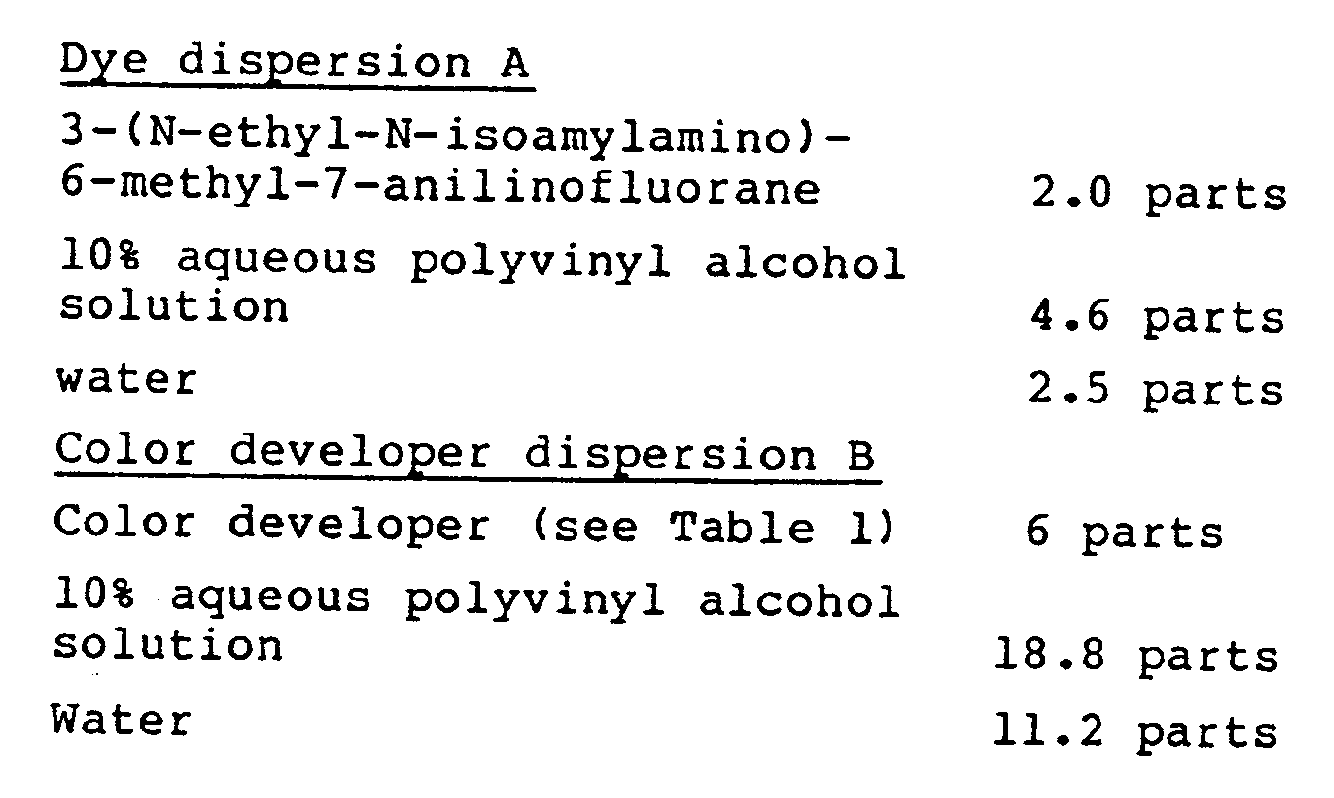
- The above dispersions A and B were individually grounds to particles with a size of 1 microns by means of a sand grinder, and then mixed in the following proportions to form a coating solution.
- Dye dispersion A
- 9.1 parts
- Color developer dispersion B
- 36 parts
- Kaolin clay (50 % dispersion)
- 12 parts
- The coating solution having a basis weight of 50 g/m² was coated on one surface of a substrate sheet at a rate of 6.0 g/m², and dried. The sheet was super-calendered to a degree of smoothness of 400 to 500 seconds to obtain a black coloring thermosensitive recording sheets.
-

- Example 1 was repeated except that the color developer dispersion C was used instead of the color developer dispersion B.
- The thermosensitive recording sheets obtained in the above Example and Comparative Examples were subjected to the following quality tests. The results are shown in Table 1.


Claims (5)
- A thermosensitive recording sheet comprising a support and a thermosensitive color developer layer thereon containing a basic leuco dye and an organic color developer, said layer containing a bis-phenyl sulfone compound which is bis-(2-methyl-4-hydroxy-5-cyclohexylphenyl)sulfone as the organic color developer.
- The thermosensitive recording sheet of claim 1 wherein the amount of the bis-phenyl sulfone compound is 1 to 12 parts by weight per part by weight of the basic leuco dye.
- The thermosensitive recording sheet of claim 2 wherein the amount of the bis-phenyl sulfone compound is 2 to 6 parts by weight per part by weight of the basic leuco dye.
- The thermosensitive recording sheet of claim 1 wherein the basic leuco dye is selected from triphenylmethane-type dyes, fluorane-type dyes and fluorene-type dyes.
- The thermosensitive recording sheet of claim 1 wherein the basic leuco dye is selected from 3-diethylamino-6-methyl-7-anilinofluorane, 3-(N-cyclohexyl-N-methylamino)-6-methyl-7-anilinofluorane and 3-(N-ethyl-N-isoamyl)amino-6-methyl-7-anilinofluorane.
Applications Claiming Priority (2)
| Application Number | Priority Date | Filing Date | Title |
|---|---|---|---|
| JP89030/89 | 1989-04-07 | ||
| JP1089030A JPH0745265B2 (en) | 1989-04-07 | 1989-04-07 | Thermal recording paper |
Publications (2)
| Publication Number | Publication Date |
|---|---|
| EP0391434A1 EP0391434A1 (en) | 1990-10-10 |
| EP0391434B1 true EP0391434B1 (en) | 1993-06-30 |
Family
ID=13959503
Family Applications (1)
| Application Number | Title | Priority Date | Filing Date |
|---|---|---|---|
| EP90106652A Expired - Lifetime EP0391434B1 (en) | 1989-04-07 | 1990-04-06 | Thermosensitive recording sheet |
Country Status (5)
| Country | Link |
|---|---|
| US (1) | US5096873A (en) |
| EP (1) | EP0391434B1 (en) |
| JP (1) | JPH0745265B2 (en) |
| CA (1) | CA2013896A1 (en) |
| DE (1) | DE69002073T2 (en) |
Families Citing this family (3)
| Publication number | Priority date | Publication date | Assignee | Title |
|---|---|---|---|---|
| JPH082106A (en) * | 1994-06-24 | 1996-01-09 | Nippon Kayaku Co Ltd | Marking composition and laser marking method |
| EP1280923A2 (en) * | 2000-04-28 | 2003-02-05 | Millennium Pharmaceuticals, Inc. | 14094, a human trypsin family member and uses thereof |
| US7270943B2 (en) * | 2004-07-08 | 2007-09-18 | Hewlett-Packard Development Company, L.P. | Compositions, systems, and methods for imaging |
Family Cites Families (2)
| Publication number | Priority date | Publication date | Assignee | Title |
|---|---|---|---|---|
| JPS57137184A (en) * | 1981-01-13 | 1982-08-24 | Kanzaki Paper Mfg Co Ltd | Heat-sensitive recording material |
| JPS60228188A (en) * | 1984-04-26 | 1985-11-13 | Sanyo Kokusaku Pulp Co Ltd | Thermal recording material |
-
1989
- 1989-04-07 JP JP1089030A patent/JPH0745265B2/en not_active Expired - Fee Related
-
1990
- 1990-04-04 US US07/503,972 patent/US5096873A/en not_active Expired - Fee Related
- 1990-04-05 CA CA002013896A patent/CA2013896A1/en not_active Abandoned
- 1990-04-06 EP EP90106652A patent/EP0391434B1/en not_active Expired - Lifetime
- 1990-04-06 DE DE90106652T patent/DE69002073T2/en not_active Expired - Fee Related
Also Published As
| Publication number | Publication date |
|---|---|
| DE69002073T2 (en) | 1993-12-09 |
| CA2013896A1 (en) | 1990-10-07 |
| JPH0745265B2 (en) | 1995-05-17 |
| EP0391434A1 (en) | 1990-10-10 |
| US5096873A (en) | 1992-03-17 |
| DE69002073D1 (en) | 1993-08-05 |
| JPH02266981A (en) | 1990-10-31 |
Similar Documents
| Publication | Publication Date | Title |
|---|---|---|
| JP6211744B2 (en) | Thermal recording material | |
| EP2774916A1 (en) | Phenolsulfonic acid aryl ester, developing agent, and heat-sensitive recording material | |
| JP6781356B2 (en) | Thermal recording body | |
| EP0189760A1 (en) | Thermosensitive recording sheet | |
| US5096873A (en) | Thermosensitive recording sheet | |
| JP6773544B2 (en) | Thermal recording body | |
| US4918044A (en) | Thermosensitive recording sheet | |
| JP2500550B2 (en) | Thermal recording sheet | |
| EP0559386B1 (en) | Thermal recording sheet | |
| JP2967708B2 (en) | Thermal recording medium | |
| JP2967709B2 (en) | Thermal recording medium | |
| JP3446662B2 (en) | Thermal recording medium | |
| JPH05254247A (en) | Thermal recording sheet | |
| JPH0976633A (en) | Thermosensitive recording sheet | |
| JPH05262047A (en) | Thermal recording sheet | |
| JPH0571395B2 (en) | ||
| JPH05193261A (en) | Thermal recording sheet | |
| JPH0672037A (en) | Thermal recording sheet | |
| JPH05262036A (en) | Thermal recording sheet | |
| JPH05262045A (en) | Thermal recording sheet | |
| JPH05262046A (en) | Thermal recording sheet | |
| JPH054455A (en) | Heat0sensitive recording sheet | |
| JPH05201145A (en) | Heat-sensitive recording material | |
| JPH05193266A (en) | Thermal recording sheet | |
| JPH0740667A (en) | Thermal recording |
Legal Events
| Date | Code | Title | Description |
|---|---|---|---|
| PUAI | Public reference made under article 153(3) epc to a published international application that has entered the european phase |
Free format text: ORIGINAL CODE: 0009012 |
|
| AK | Designated contracting states |
Kind code of ref document: A1 Designated state(s): BE DE FR GB IT SE |
|
| 17P | Request for examination filed |
Effective date: 19901220 |
|
| 17Q | First examination report despatched |
Effective date: 19921030 |
|
| GRAA | (expected) grant |
Free format text: ORIGINAL CODE: 0009210 |
|
| ITF | It: translation for a ep patent filed | ||
| AK | Designated contracting states |
Kind code of ref document: B1 Designated state(s): BE DE FR GB IT SE |
|
| REF | Corresponds to: |
Ref document number: 69002073 Country of ref document: DE Date of ref document: 19930805 |
|
| ET | Fr: translation filed | ||
| PLBE | No opposition filed within time limit |
Free format text: ORIGINAL CODE: 0009261 |
|
| STAA | Information on the status of an ep patent application or granted ep patent |
Free format text: STATUS: NO OPPOSITION FILED WITHIN TIME LIMIT |
|
| 26N | No opposition filed | ||
| EAL | Se: european patent in force in sweden |
Ref document number: 90106652.2 |
|
| REG | Reference to a national code |
Ref country code: FR Ref legal event code: CD |
|
| PGFP | Annual fee paid to national office [announced via postgrant information from national office to epo] |
Ref country code: BE Payment date: 19970529 Year of fee payment: 8 |
|
| PG25 | Lapsed in a contracting state [announced via postgrant information from national office to epo] |
Ref country code: BE Free format text: LAPSE BECAUSE OF NON-PAYMENT OF DUE FEES Effective date: 19980430 |
|
| BERE | Be: lapsed |
Owner name: YOSHITOMI PHARMACEUTICAL INDUSTRIES LTD Effective date: 19980430 Owner name: NIPPON PAPER INDUSTRIES CO. LTD Effective date: 19980430 |
|
| REG | Reference to a national code |
Ref country code: FR Ref legal event code: CD |
|
| REG | Reference to a national code |
Ref country code: GB Ref legal event code: IF02 |
|
| PGFP | Annual fee paid to national office [announced via postgrant information from national office to epo] |
Ref country code: GB Payment date: 20020404 Year of fee payment: 13 |
|
| PGFP | Annual fee paid to national office [announced via postgrant information from national office to epo] |
Ref country code: SE Payment date: 20020405 Year of fee payment: 13 |
|
| PGFP | Annual fee paid to national office [announced via postgrant information from national office to epo] |
Ref country code: FR Payment date: 20020410 Year of fee payment: 13 Ref country code: DE Payment date: 20020410 Year of fee payment: 13 |
|
| REG | Reference to a national code |
Ref country code: GB Ref legal event code: 732E |
|
| REG | Reference to a national code |
Ref country code: FR Ref legal event code: TQ |
|
| PG25 | Lapsed in a contracting state [announced via postgrant information from national office to epo] |
Ref country code: GB Free format text: LAPSE BECAUSE OF NON-PAYMENT OF DUE FEES Effective date: 20030406 |
|
| PG25 | Lapsed in a contracting state [announced via postgrant information from national office to epo] |
Ref country code: SE Free format text: LAPSE BECAUSE OF NON-PAYMENT OF DUE FEES Effective date: 20030407 |
|
| REG | Reference to a national code |
Ref country code: FR Ref legal event code: CD Ref country code: FR Ref legal event code: CA |
|
| PG25 | Lapsed in a contracting state [announced via postgrant information from national office to epo] |
Ref country code: DE Free format text: LAPSE BECAUSE OF NON-PAYMENT OF DUE FEES Effective date: 20031101 |
|
| GBPC | Gb: european patent ceased through non-payment of renewal fee |
Effective date: 20030406 |
|
| EUG | Se: european patent has lapsed | ||
| PG25 | Lapsed in a contracting state [announced via postgrant information from national office to epo] |
Ref country code: FR Free format text: LAPSE BECAUSE OF NON-PAYMENT OF DUE FEES Effective date: 20031231 |
|
| REG | Reference to a national code |
Ref country code: FR Ref legal event code: ST |
|
| PG25 | Lapsed in a contracting state [announced via postgrant information from national office to epo] |
Ref country code: IT Free format text: LAPSE BECAUSE OF NON-PAYMENT OF DUE FEES;WARNING: LAPSES OF ITALIAN PATENTS WITH EFFECTIVE DATE BEFORE 2007 MAY HAVE OCCURRED AT ANY TIME BEFORE 2007. THE CORRECT EFFECTIVE DATE MAY BE DIFFERENT FROM THE ONE RECORDED. Effective date: 20050406 |