EP0378567B1 - Synthetic yeast leader peptides - Google Patents
Synthetic yeast leader peptides Download PDFInfo
- Publication number
- EP0378567B1 EP0378567B1 EP88908171A EP88908171A EP0378567B1 EP 0378567 B1 EP0378567 B1 EP 0378567B1 EP 88908171 A EP88908171 A EP 88908171A EP 88908171 A EP88908171 A EP 88908171A EP 0378567 B1 EP0378567 B1 EP 0378567B1
- Authority
- EP
- European Patent Office
- Prior art keywords
- sequence
- dna
- peptide
- leader
- yeast
- Prior art date
- Legal status (The legal status is an assumption and is not a legal conclusion. Google has not performed a legal analysis and makes no representation as to the accuracy of the status listed.)
- Expired - Lifetime
Links
- 108010076504 Protein Sorting Signals Proteins 0.000 title claims abstract description 70
- 240000004808 Saccharomyces cerevisiae Species 0.000 title claims abstract description 49
- 108090000623 proteins and genes Proteins 0.000 claims abstract description 58
- 102000004169 proteins and genes Human genes 0.000 claims abstract description 49
- 108091028043 Nucleic acid sequence Proteins 0.000 claims abstract description 37
- 230000028327 secretion Effects 0.000 claims abstract description 21
- 239000013598 vector Substances 0.000 claims abstract description 10
- 238000004519 manufacturing process Methods 0.000 claims abstract description 5
- 238000011144 upstream manufacturing Methods 0.000 claims abstract description 5
- 235000014680 Saccharomyces cerevisiae Nutrition 0.000 claims description 44
- 238000000034 method Methods 0.000 claims description 16
- 108090000765 processed proteins & peptides Proteins 0.000 claims description 14
- 239000002773 nucleotide Substances 0.000 claims description 13
- 125000003729 nucleotide group Chemical group 0.000 claims description 13
- 125000000539 amino acid group Chemical group 0.000 claims description 7
- 239000001963 growth medium Substances 0.000 claims description 5
- 239000012634 fragment Substances 0.000 description 61
- NOESYZHRGYRDHS-UHFFFAOYSA-N insulin Chemical compound N1C(=O)C(NC(=O)C(CCC(N)=O)NC(=O)C(CCC(O)=O)NC(=O)C(C(C)C)NC(=O)C(NC(=O)CN)C(C)CC)CSSCC(C(NC(CO)C(=O)NC(CC(C)C)C(=O)NC(CC=2C=CC(O)=CC=2)C(=O)NC(CCC(N)=O)C(=O)NC(CC(C)C)C(=O)NC(CCC(O)=O)C(=O)NC(CC(N)=O)C(=O)NC(CC=2C=CC(O)=CC=2)C(=O)NC(CSSCC(NC(=O)C(C(C)C)NC(=O)C(CC(C)C)NC(=O)C(CC=2C=CC(O)=CC=2)NC(=O)C(CC(C)C)NC(=O)C(C)NC(=O)C(CCC(O)=O)NC(=O)C(C(C)C)NC(=O)C(CC(C)C)NC(=O)C(CC=2NC=NC=2)NC(=O)C(CO)NC(=O)CNC2=O)C(=O)NCC(=O)NC(CCC(O)=O)C(=O)NC(CCCNC(N)=N)C(=O)NCC(=O)NC(CC=3C=CC=CC=3)C(=O)NC(CC=3C=CC=CC=3)C(=O)NC(CC=3C=CC(O)=CC=3)C(=O)NC(C(C)O)C(=O)N3C(CCC3)C(=O)NC(CCCCN)C(=O)NC(C)C(O)=O)C(=O)NC(CC(N)=O)C(O)=O)=O)NC(=O)C(C(C)CC)NC(=O)C(CO)NC(=O)C(C(C)O)NC(=O)C1CSSCC2NC(=O)C(CC(C)C)NC(=O)C(NC(=O)C(CCC(N)=O)NC(=O)C(CC(N)=O)NC(=O)C(NC(=O)C(N)CC=1C=CC=CC=1)C(C)C)CC1=CN=CN1 NOESYZHRGYRDHS-UHFFFAOYSA-N 0.000 description 42
- 239000013612 plasmid Substances 0.000 description 38
- 239000002243 precursor Substances 0.000 description 27
- 229940125396 insulin Drugs 0.000 description 19
- 239000000047 product Substances 0.000 description 19
- 102000004877 Insulin Human genes 0.000 description 18
- 108090001061 Insulin Proteins 0.000 description 18
- 238000010276 construction Methods 0.000 description 17
- 108020004414 DNA Proteins 0.000 description 9
- 210000004027 cell Anatomy 0.000 description 8
- 238000003776 cleavage reaction Methods 0.000 description 8
- 238000012545 processing Methods 0.000 description 7
- 230000007017 scission Effects 0.000 description 7
- 238000000338 in vitro Methods 0.000 description 6
- 101150033985 TPI gene Proteins 0.000 description 5
- IXKSXJFAGXLQOQ-XISFHERQSA-N WHWLQLKPGQPMY Chemical compound C([C@@H](C(=O)N[C@@H](CC=1C2=CC=CC=C2NC=1)C(=O)N[C@@H](CC(C)C)C(=O)N[C@@H](CCC(N)=O)C(=O)N[C@@H](CC(C)C)C(=O)N1CCC[C@H]1C(=O)NCC(=O)N[C@@H](CCC(N)=O)C(=O)N[C@@H](CC(O)=O)C(=O)N1CCC[C@H]1C(=O)N[C@@H](CCSC)C(=O)N[C@@H](CC=1C=CC(O)=CC=1)C(O)=O)NC(=O)[C@@H](N)CC=1C2=CC=CC=C2NC=1)C1=CNC=N1 IXKSXJFAGXLQOQ-XISFHERQSA-N 0.000 description 5
- 150000001413 amino acids Chemical class 0.000 description 5
- 239000004026 insulin derivative Substances 0.000 description 5
- 239000004382 Amylase Substances 0.000 description 4
- 108010065511 Amylases Proteins 0.000 description 4
- 102000013142 Amylases Human genes 0.000 description 4
- 108090000769 Isomerases Proteins 0.000 description 4
- 235000019418 amylase Nutrition 0.000 description 4
- 238000006243 chemical reaction Methods 0.000 description 4
- 150000003641 trioses Chemical class 0.000 description 4
- 241000588724 Escherichia coli Species 0.000 description 3
- 101000976075 Homo sapiens Insulin Proteins 0.000 description 3
- 241000235087 Lachancea kluyveri Species 0.000 description 3
- KDXKERNSBIXSRK-UHFFFAOYSA-N Lysine Natural products NCCCCC(N)C(O)=O KDXKERNSBIXSRK-UHFFFAOYSA-N 0.000 description 3
- PBGKTOXHQIOBKM-FHFVDXKLSA-N insulin (human) Chemical compound C([C@@H](C(=O)N[C@@H](CC(C)C)C(=O)N[C@H]1CSSC[C@H]2C(=O)N[C@H](C(=O)N[C@@H](CO)C(=O)N[C@H](C(=O)N[C@H](C(N[C@@H](CO)C(=O)N[C@@H](CC(C)C)C(=O)N[C@@H](CC=3C=CC(O)=CC=3)C(=O)N[C@@H](CCC(N)=O)C(=O)N[C@@H](CC(C)C)C(=O)N[C@@H](CCC(O)=O)C(=O)N[C@@H](CC(N)=O)C(=O)N[C@@H](CC=3C=CC(O)=CC=3)C(=O)N[C@@H](CSSC[C@H](NC(=O)[C@H](C(C)C)NC(=O)[C@H](CC(C)C)NC(=O)[C@H](CC=3C=CC(O)=CC=3)NC(=O)[C@H](CC(C)C)NC(=O)[C@H](C)NC(=O)[C@H](CCC(O)=O)NC(=O)[C@H](C(C)C)NC(=O)[C@H](CC(C)C)NC(=O)[C@H](CC=3NC=NC=3)NC(=O)[C@H](CO)NC(=O)CNC1=O)C(=O)NCC(=O)N[C@@H](CCC(O)=O)C(=O)N[C@@H](CCCNC(N)=N)C(=O)NCC(=O)N[C@@H](CC=1C=CC=CC=1)C(=O)N[C@@H](CC=1C=CC=CC=1)C(=O)N[C@@H](CC=1C=CC(O)=CC=1)C(=O)N[C@@H]([C@@H](C)O)C(=O)N1[C@@H](CCC1)C(=O)N[C@@H](CCCCN)C(=O)N[C@@H]([C@@H](C)O)C(O)=O)C(=O)N[C@@H](CC(N)=O)C(O)=O)=O)CSSC[C@@H](C(N2)=O)NC(=O)[C@H](CCC(N)=O)NC(=O)[C@H](CCC(O)=O)NC(=O)[C@H](C(C)C)NC(=O)[C@@H](NC(=O)CN)[C@@H](C)CC)[C@@H](C)CC)[C@@H](C)O)NC(=O)[C@H](CCC(N)=O)NC(=O)[C@H](CC(N)=O)NC(=O)[C@@H](NC(=O)[C@@H](N)CC=1C=CC=CC=1)C(C)C)C1=CN=CN1 PBGKTOXHQIOBKM-FHFVDXKLSA-N 0.000 description 3
- 239000002609 medium Substances 0.000 description 3
- 230000037361 pathway Effects 0.000 description 3
- 230000010076 replication Effects 0.000 description 3
- 230000003248 secreting effect Effects 0.000 description 3
- 101150028074 2 gene Proteins 0.000 description 2
- 108010039627 Aprotinin Proteins 0.000 description 2
- 239000004475 Arginine Substances 0.000 description 2
- 102000005367 Carboxypeptidases Human genes 0.000 description 2
- 108010006303 Carboxypeptidases Proteins 0.000 description 2
- 108020004705 Codon Proteins 0.000 description 2
- 108700007698 Genetic Terminator Regions Proteins 0.000 description 2
- 102000051325 Glucagon Human genes 0.000 description 2
- 108060003199 Glucagon Proteins 0.000 description 2
- 102000004195 Isomerases Human genes 0.000 description 2
- NPBGTPKLVJEOBE-IUCAKERBSA-N Lys-Arg Chemical compound NCCCC[C@H](N)C(=O)N[C@H](C(O)=O)CCCNC(N)=N NPBGTPKLVJEOBE-IUCAKERBSA-N 0.000 description 2
- 101710089743 Mating factor alpha Proteins 0.000 description 2
- NBIIXXVUZAFLBC-UHFFFAOYSA-N Phosphoric acid Chemical compound OP(O)(O)=O NBIIXXVUZAFLBC-UHFFFAOYSA-N 0.000 description 2
- 239000002253 acid Substances 0.000 description 2
- 229960004405 aprotinin Drugs 0.000 description 2
- ODKSFYDXXFIFQN-UHFFFAOYSA-N arginine Natural products OC(=O)C(N)CCCNC(N)=N ODKSFYDXXFIFQN-UHFFFAOYSA-N 0.000 description 2
- 230000001413 cellular effect Effects 0.000 description 2
- 239000013613 expression plasmid Substances 0.000 description 2
- MASNOZXLGMXCHN-ZLPAWPGGSA-N glucagon Chemical compound C([C@@H](C(=O)N[C@H](C(=O)N[C@@H](CCC(N)=O)C(=O)N[C@@H](CC=1C2=CC=CC=C2NC=1)C(=O)N[C@@H](CC(C)C)C(=O)N[C@@H](CCSC)C(=O)N[C@@H](CC(N)=O)C(=O)N[C@@H]([C@@H](C)O)C(O)=O)C(C)C)NC(=O)[C@H](CC(O)=O)NC(=O)[C@H](CCC(N)=O)NC(=O)[C@H](C)NC(=O)[C@H](CCCNC(N)=N)NC(=O)[C@H](CCCNC(N)=N)NC(=O)[C@H](CO)NC(=O)[C@H](CC(O)=O)NC(=O)[C@H](CC(C)C)NC(=O)[C@H](CC=1C=CC(O)=CC=1)NC(=O)[C@H](CCCCN)NC(=O)[C@H](CO)NC(=O)[C@H](CC=1C=CC(O)=CC=1)NC(=O)[C@H](CC(O)=O)NC(=O)[C@H](CO)NC(=O)[C@@H](NC(=O)[C@H](CC=1C=CC=CC=1)NC(=O)[C@@H](NC(=O)CNC(=O)[C@H](CCC(N)=O)NC(=O)[C@H](CO)NC(=O)[C@@H](N)CC=1NC=NC=1)[C@@H](C)O)[C@@H](C)O)C1=CC=CC=C1 MASNOZXLGMXCHN-ZLPAWPGGSA-N 0.000 description 2
- 229960004666 glucagon Drugs 0.000 description 2
- ZPNFWUPYTFPOJU-LPYSRVMUSA-N iniprol Chemical compound C([C@H]1C(=O)NCC(=O)NCC(=O)N[C@H]2CSSC[C@H]3C(=O)N[C@@H](CCCCN)C(=O)N[C@@H](C)C(=O)N[C@@H](CCCNC(N)=N)C(=O)N[C@H](C(N[C@H](C(=O)N[C@@H](CCCNC(N)=N)C(=O)N[C@@H](CC=4C=CC(O)=CC=4)C(=O)N[C@@H](CC=4C=CC=CC=4)C(=O)N[C@@H](CC=4C=CC(O)=CC=4)C(=O)N[C@@H](CC(N)=O)C(=O)N[C@@H](C)C(=O)N[C@@H](CCCCN)C(=O)N[C@@H](C)C(=O)NCC(=O)N[C@@H](CC(C)C)C(=O)N[C@@H](CSSC[C@H](NC(=O)[C@H](CC(O)=O)NC(=O)[C@H](CCC(O)=O)NC(=O)[C@H](C)NC(=O)[C@H](CO)NC(=O)[C@H](CCCCN)NC(=O)[C@H](CC=4C=CC=CC=4)NC(=O)[C@H](CC(N)=O)NC(=O)[C@H](CC(N)=O)NC(=O)[C@H](CCCNC(N)=N)NC(=O)[C@H](CCCCN)NC(=O)[C@H](C)NC(=O)[C@H](CCCNC(N)=N)NC2=O)C(=O)N[C@@H](CCSC)C(=O)N[C@@H](CCCNC(N)=N)C(=O)N[C@@H]([C@@H](C)O)C(=O)N[C@@H](CSSC[C@H](NC(=O)[C@H](CC=2C=CC=CC=2)NC(=O)[C@H](CC(O)=O)NC(=O)[C@H]2N(CCC2)C(=O)[C@@H](N)CCCNC(N)=N)C(=O)N[C@@H](CC(C)C)C(=O)N[C@@H](CCC(O)=O)C(=O)N2[C@@H](CCC2)C(=O)N2[C@@H](CCC2)C(=O)N[C@@H](CC=2C=CC(O)=CC=2)C(=O)N[C@@H]([C@@H](C)O)C(=O)NCC(=O)N2[C@@H](CCC2)C(=O)N3)C(=O)NCC(=O)NCC(=O)N[C@@H](C)C(O)=O)C(=O)N[C@@H](CCC(N)=O)C(=O)N[C@H](C(=O)N[C@@H](CC=2C=CC=CC=2)C(=O)N[C@H](C(=O)N1)C(C)C)[C@@H](C)O)[C@@H](C)CC)=O)[C@@H](C)CC)C1=CC=C(O)C=C1 ZPNFWUPYTFPOJU-LPYSRVMUSA-N 0.000 description 2
- 238000002955 isolation Methods 0.000 description 2
- 239000000463 material Substances 0.000 description 2
- 239000012528 membrane Substances 0.000 description 2
- 229930182817 methionine Natural products 0.000 description 2
- 238000002264 polyacrylamide gel electrophoresis Methods 0.000 description 2
- 229920001184 polypeptide Polymers 0.000 description 2
- 102000004196 processed proteins & peptides Human genes 0.000 description 2
- 230000005945 translocation Effects 0.000 description 2
- SBKVPJHMSUXZTA-MEJXFZFPSA-N (2S)-2-[[(2S)-2-[[(2S)-1-[(2S)-5-amino-2-[[2-[[(2S)-1-[(2S)-6-amino-2-[[(2S)-2-[[(2S)-5-amino-2-[[(2S)-2-[[(2S)-2-[[(2S)-2-[[(2S)-2-amino-3-(1H-indol-3-yl)propanoyl]amino]-3-(1H-imidazol-4-yl)propanoyl]amino]-3-(1H-indol-3-yl)propanoyl]amino]-4-methylpentanoyl]amino]-5-oxopentanoyl]amino]-4-methylpentanoyl]amino]hexanoyl]pyrrolidine-2-carbonyl]amino]acetyl]amino]-5-oxopentanoyl]pyrrolidine-2-carbonyl]amino]-4-methylsulfanylbutanoyl]amino]-3-(4-hydroxyphenyl)propanoic acid Chemical compound C([C@@H](C(=O)N[C@@H](CC=1C2=CC=CC=C2NC=1)C(=O)N[C@@H](CC(C)C)C(=O)N[C@@H](CCC(N)=O)C(=O)N[C@@H](CC(C)C)C(=O)N[C@@H](CCCCN)C(=O)N1CCC[C@H]1C(=O)NCC(=O)N[C@@H](CCC(N)=O)C(=O)N1CCC[C@H]1C(=O)N[C@@H](CCSC)C(=O)N[C@@H](CC=1C=CC(O)=CC=1)C(O)=O)NC(=O)[C@@H](N)CC=1C2=CC=CC=C2NC=1)C1=CNC=N1 SBKVPJHMSUXZTA-MEJXFZFPSA-N 0.000 description 1
- 108020004635 Complementary DNA Proteins 0.000 description 1
- 102000053602 DNA Human genes 0.000 description 1
- 102000005593 Endopeptidases Human genes 0.000 description 1
- 108010059378 Endopeptidases Proteins 0.000 description 1
- 102000004190 Enzymes Human genes 0.000 description 1
- 108090000790 Enzymes Proteins 0.000 description 1
- 241000206602 Eukaryota Species 0.000 description 1
- 108050001049 Extracellular proteins Proteins 0.000 description 1
- WQZGKKKJIJFFOK-GASJEMHNSA-N Glucose Natural products OC[C@H]1OC(O)[C@H](O)[C@@H](O)[C@@H]1O WQZGKKKJIJFFOK-GASJEMHNSA-N 0.000 description 1
- 102100027612 Kallikrein-11 Human genes 0.000 description 1
- 125000000570 L-alpha-aspartyl group Chemical group [H]OC(=O)C([H])([H])[C@]([H])(N([H])[H])C(*)=O 0.000 description 1
- FFEARJCKVFRZRR-BYPYZUCNSA-N L-methionine Chemical compound CSCC[C@H](N)C(O)=O FFEARJCKVFRZRR-BYPYZUCNSA-N 0.000 description 1
- 239000004472 Lysine Substances 0.000 description 1
- XUYPXLNMDZIRQH-LURJTMIESA-N N-acetyl-L-methionine Chemical compound CSCC[C@@H](C(O)=O)NC(C)=O XUYPXLNMDZIRQH-LURJTMIESA-N 0.000 description 1
- 230000004988 N-glycosylation Effects 0.000 description 1
- 125000001429 N-terminal alpha-amino-acid group Chemical group 0.000 description 1
- 108091034117 Oligonucleotide Proteins 0.000 description 1
- 241000283973 Oryctolagus cuniculus Species 0.000 description 1
- 102000035195 Peptidases Human genes 0.000 description 1
- 108091005804 Peptidases Proteins 0.000 description 1
- 102000003992 Peroxidases Human genes 0.000 description 1
- 108010021757 Polynucleotide 5'-Hydroxyl-Kinase Proteins 0.000 description 1
- 102000008422 Polynucleotide 5'-hydroxyl-kinase Human genes 0.000 description 1
- 241000235070 Saccharomyces Species 0.000 description 1
- 241000582914 Saccharomyces uvarum Species 0.000 description 1
- 241000235347 Schizosaccharomyces pombe Species 0.000 description 1
- 101710152431 Trypsin-like protease Proteins 0.000 description 1
- 101500022170 Ustilago maydis (strain 521 / FGSC 9021) Rep1-3 Proteins 0.000 description 1
- JLCPHMBAVCMARE-UHFFFAOYSA-N [3-[[3-[[3-[[3-[[3-[[3-[[3-[[3-[[3-[[3-[[3-[[5-(2-amino-6-oxo-1H-purin-9-yl)-3-[[3-[[3-[[3-[[3-[[3-[[5-(2-amino-6-oxo-1H-purin-9-yl)-3-[[5-(2-amino-6-oxo-1H-purin-9-yl)-3-hydroxyoxolan-2-yl]methoxy-hydroxyphosphoryl]oxyoxolan-2-yl]methoxy-hydroxyphosphoryl]oxy-5-(5-methyl-2,4-dioxopyrimidin-1-yl)oxolan-2-yl]methoxy-hydroxyphosphoryl]oxy-5-(6-aminopurin-9-yl)oxolan-2-yl]methoxy-hydroxyphosphoryl]oxy-5-(6-aminopurin-9-yl)oxolan-2-yl]methoxy-hydroxyphosphoryl]oxy-5-(6-aminopurin-9-yl)oxolan-2-yl]methoxy-hydroxyphosphoryl]oxy-5-(6-aminopurin-9-yl)oxolan-2-yl]methoxy-hydroxyphosphoryl]oxyoxolan-2-yl]methoxy-hydroxyphosphoryl]oxy-5-(5-methyl-2,4-dioxopyrimidin-1-yl)oxolan-2-yl]methoxy-hydroxyphosphoryl]oxy-5-(4-amino-2-oxopyrimidin-1-yl)oxolan-2-yl]methoxy-hydroxyphosphoryl]oxy-5-(5-methyl-2,4-dioxopyrimidin-1-yl)oxolan-2-yl]methoxy-hydroxyphosphoryl]oxy-5-(5-methyl-2,4-dioxopyrimidin-1-yl)oxolan-2-yl]methoxy-hydroxyphosphoryl]oxy-5-(6-aminopurin-9-yl)oxolan-2-yl]methoxy-hydroxyphosphoryl]oxy-5-(6-aminopurin-9-yl)oxolan-2-yl]methoxy-hydroxyphosphoryl]oxy-5-(4-amino-2-oxopyrimidin-1-yl)oxolan-2-yl]methoxy-hydroxyphosphoryl]oxy-5-(4-amino-2-oxopyrimidin-1-yl)oxolan-2-yl]methoxy-hydroxyphosphoryl]oxy-5-(4-amino-2-oxopyrimidin-1-yl)oxolan-2-yl]methoxy-hydroxyphosphoryl]oxy-5-(6-aminopurin-9-yl)oxolan-2-yl]methoxy-hydroxyphosphoryl]oxy-5-(4-amino-2-oxopyrimidin-1-yl)oxolan-2-yl]methyl [5-(6-aminopurin-9-yl)-2-(hydroxymethyl)oxolan-3-yl] hydrogen phosphate Polymers Cc1cn(C2CC(OP(O)(=O)OCC3OC(CC3OP(O)(=O)OCC3OC(CC3O)n3cnc4c3nc(N)[nH]c4=O)n3cnc4c3nc(N)[nH]c4=O)C(COP(O)(=O)OC3CC(OC3COP(O)(=O)OC3CC(OC3COP(O)(=O)OC3CC(OC3COP(O)(=O)OC3CC(OC3COP(O)(=O)OC3CC(OC3COP(O)(=O)OC3CC(OC3COP(O)(=O)OC3CC(OC3COP(O)(=O)OC3CC(OC3COP(O)(=O)OC3CC(OC3COP(O)(=O)OC3CC(OC3COP(O)(=O)OC3CC(OC3COP(O)(=O)OC3CC(OC3COP(O)(=O)OC3CC(OC3COP(O)(=O)OC3CC(OC3COP(O)(=O)OC3CC(OC3COP(O)(=O)OC3CC(OC3COP(O)(=O)OC3CC(OC3CO)n3cnc4c(N)ncnc34)n3ccc(N)nc3=O)n3cnc4c(N)ncnc34)n3ccc(N)nc3=O)n3ccc(N)nc3=O)n3ccc(N)nc3=O)n3cnc4c(N)ncnc34)n3cnc4c(N)ncnc34)n3cc(C)c(=O)[nH]c3=O)n3cc(C)c(=O)[nH]c3=O)n3ccc(N)nc3=O)n3cc(C)c(=O)[nH]c3=O)n3cnc4c3nc(N)[nH]c4=O)n3cnc4c(N)ncnc34)n3cnc4c(N)ncnc34)n3cnc4c(N)ncnc34)n3cnc4c(N)ncnc34)O2)c(=O)[nH]c1=O JLCPHMBAVCMARE-UHFFFAOYSA-N 0.000 description 1
- 238000000137 annealing Methods 0.000 description 1
- 238000013459 approach Methods 0.000 description 1
- 108010051210 beta-Fructofuranosidase Proteins 0.000 description 1
- 230000015572 biosynthetic process Effects 0.000 description 1
- 210000004899 c-terminal region Anatomy 0.000 description 1
- 238000010804 cDNA synthesis Methods 0.000 description 1
- 125000003178 carboxy group Chemical group [H]OC(*)=O 0.000 description 1
- 210000000170 cell membrane Anatomy 0.000 description 1
- 210000002421 cell wall Anatomy 0.000 description 1
- 238000005119 centrifugation Methods 0.000 description 1
- 239000007795 chemical reaction product Substances 0.000 description 1
- 239000003153 chemical reaction reagent Substances 0.000 description 1
- 239000002299 complementary DNA Substances 0.000 description 1
- 150000001875 compounds Chemical class 0.000 description 1
- ATDGTVJJHBUTRL-UHFFFAOYSA-N cyanogen bromide Chemical compound BrC#N ATDGTVJJHBUTRL-UHFFFAOYSA-N 0.000 description 1
- 238000012217 deletion Methods 0.000 description 1
- 230000037430 deletion Effects 0.000 description 1
- 230000003297 denaturating effect Effects 0.000 description 1
- 230000000694 effects Effects 0.000 description 1
- 230000002255 enzymatic effect Effects 0.000 description 1
- 229940088598 enzyme Drugs 0.000 description 1
- 238000002474 experimental method Methods 0.000 description 1
- 239000008103 glucose Substances 0.000 description 1
- 210000002288 golgi apparatus Anatomy 0.000 description 1
- 238000004128 high performance liquid chromatography Methods 0.000 description 1
- 230000002209 hydrophobic effect Effects 0.000 description 1
- 238000003119 immunoblot Methods 0.000 description 1
- 238000003780 insertion Methods 0.000 description 1
- 230000037431 insertion Effects 0.000 description 1
- 239000001573 invertase Substances 0.000 description 1
- 235000011073 invertase Nutrition 0.000 description 1
- 230000004807 localization Effects 0.000 description 1
- 238000010369 molecular cloning Methods 0.000 description 1
- 238000002703 mutagenesis Methods 0.000 description 1
- 231100000350 mutagenesis Toxicity 0.000 description 1
- 108040007629 peroxidase activity proteins Proteins 0.000 description 1
- 150000008300 phosphoramidites Chemical class 0.000 description 1
- 230000002797 proteolythic effect Effects 0.000 description 1
- 229940024999 proteolytic enzymes for treatment of wounds and ulcers Drugs 0.000 description 1
- 210000003660 reticulum Anatomy 0.000 description 1
- 238000012163 sequencing technique Methods 0.000 description 1
- 230000006641 stabilisation Effects 0.000 description 1
- 238000011105 stabilization Methods 0.000 description 1
- 239000006228 supernatant Substances 0.000 description 1
- 238000003786 synthesis reaction Methods 0.000 description 1
- 230000001131 transforming effect Effects 0.000 description 1
- 210000003934 vacuole Anatomy 0.000 description 1
- 239000007222 ypd medium Substances 0.000 description 1
Images





Classifications
-
- C—CHEMISTRY; METALLURGY
- C07—ORGANIC CHEMISTRY
- C07K—PEPTIDES
- C07K14/00—Peptides having more than 20 amino acids; Gastrins; Somatostatins; Melanotropins; Derivatives thereof
- C07K14/435—Peptides having more than 20 amino acids; Gastrins; Somatostatins; Melanotropins; Derivatives thereof from animals; from humans
- C07K14/575—Hormones
- C07K14/62—Insulins
-
- C—CHEMISTRY; METALLURGY
- C12—BIOCHEMISTRY; BEER; SPIRITS; WINE; VINEGAR; MICROBIOLOGY; ENZYMOLOGY; MUTATION OR GENETIC ENGINEERING
- C12N—MICROORGANISMS OR ENZYMES; COMPOSITIONS THEREOF; PROPAGATING, PRESERVING, OR MAINTAINING MICROORGANISMS; MUTATION OR GENETIC ENGINEERING; CULTURE MEDIA
- C12N15/00—Mutation or genetic engineering; DNA or RNA concerning genetic engineering, vectors, e.g. plasmids, or their isolation, preparation or purification; Use of hosts therefor
- C12N15/09—Recombinant DNA-technology
- C12N15/11—DNA or RNA fragments; Modified forms thereof; Non-coding nucleic acids having a biological activity
- C12N15/62—DNA sequences coding for fusion proteins
- C12N15/625—DNA sequences coding for fusion proteins containing a sequence coding for a signal sequence
-
- C—CHEMISTRY; METALLURGY
- C12—BIOCHEMISTRY; BEER; SPIRITS; WINE; VINEGAR; MICROBIOLOGY; ENZYMOLOGY; MUTATION OR GENETIC ENGINEERING
- C12N—MICROORGANISMS OR ENZYMES; COMPOSITIONS THEREOF; PROPAGATING, PRESERVING, OR MAINTAINING MICROORGANISMS; MUTATION OR GENETIC ENGINEERING; CULTURE MEDIA
- C12N15/00—Mutation or genetic engineering; DNA or RNA concerning genetic engineering, vectors, e.g. plasmids, or their isolation, preparation or purification; Use of hosts therefor
- C12N15/09—Recombinant DNA-technology
- C12N15/63—Introduction of foreign genetic material using vectors; Vectors; Use of hosts therefor; Regulation of expression
- C12N15/79—Vectors or expression systems specially adapted for eukaryotic hosts
- C12N15/80—Vectors or expression systems specially adapted for eukaryotic hosts for fungi
- C12N15/81—Vectors or expression systems specially adapted for eukaryotic hosts for fungi for yeasts
- C12N15/815—Vectors or expression systems specially adapted for eukaryotic hosts for fungi for yeasts for yeasts other than Saccharomyces
-
- C—CHEMISTRY; METALLURGY
- C07—ORGANIC CHEMISTRY
- C07K—PEPTIDES
- C07K2319/00—Fusion polypeptide
- C07K2319/01—Fusion polypeptide containing a localisation/targetting motif
- C07K2319/036—Fusion polypeptide containing a localisation/targetting motif targeting to the medium outside of the cell, e.g. type III secretion
-
- C—CHEMISTRY; METALLURGY
- C07—ORGANIC CHEMISTRY
- C07K—PEPTIDES
- C07K2319/00—Fusion polypeptide
- C07K2319/70—Fusion polypeptide containing domain for protein-protein interaction
- C07K2319/74—Fusion polypeptide containing domain for protein-protein interaction containing a fusion for binding to a cell surface receptor
- C07K2319/75—Fusion polypeptide containing domain for protein-protein interaction containing a fusion for binding to a cell surface receptor containing a fusion for activation of a cell surface receptor, e.g. thrombopoeitin, NPY and other peptide hormones
Definitions
- the present invention relates to synthetic yeast leader peptides, DNA-sequences encoding such leader peptides, vectors and transformed yeast strains.
- Yeast organisms produce a number of proteins synthesized intracellularly, but having a function outside the cell. Such extra-cellular proteins are referred to as secreted proteins. These secreted proteins are expressed initially inside the cell in a precursor or a pre-protein form containing a presequence ensuring effective direction of the expressed product across the membrane of the endoplasmatic reticulum (ER).
- the presequence normally named a signal peptide, is generally cleaved off from the desired product during translocation. Once entered in the secretory pathway, the protein is transported to the Golgi apparatus.
- the protein can follow different routes that lead to compartments such as the cell vacuole or the cell membrane, or it can be routed out of the cell to be secreted to the external medium (Pfeffer, S.R. and Rothman, J.E. Ann. Rev. Biochem. 56 (1987) 829-852).
- European published patent application No. 0088632A describes a process by which proteins heterologous to yeast are expressed, processed and secreted by transforming a yeast organism with an expression vehicle harbouring DNA encoding the desired protein and a signal peptide, preparing a culture of the transformed organism, growing the culture and recovering the protein from the culture medium.
- the signal peptide may be the desired protein's own signal peptide, a heterologous signal peptide or a hybrid of native and heterologous signal peptide.
- a problem encountered with the use of signal peptides heterologous to yeast might be that the heterologous signal peptide does not ensure efficient translocation and/or cleavage after the signal peptide.
- the S . cerevisiae MF ⁇ ( ⁇ -factor) is synthesized as a prepro form of 165 amino acids comprising a 19 amino acid long signal-or prepeptide followed by a 64 amino acid long "leader-" or propeptide, encompassing three N-linked glycosylation sites followed by (LysArg(Asp/Glu,Ala)2 ⁇ 3 ⁇ -factor)4 (Kurjan, J. and Herskowitz, I. Cell 30 (1982) 933-943).
- the signal-leader part of the preproMF ⁇ has been widely applied to obtain synthesis and secretion of heterologous proteins in S . cerevisiae .
- a number of secreted proteins are routed so as to be exposed to a proteolytic processing system which can cleave the peptide bond at the carboxy end of two consecutive basic amino acids.
- This enzymatic activity is in S . cerevisiae encoded by the KEX 2 gene (Julius, D.A. et al., Cell 37 (1984b), 1075). Processing of the product by the KEX 2 gene product is needed for the secretion of active S . cerevisiae mating factor ⁇ (MF ⁇ or ⁇ -factor) but is not involved in the secretion of active S . cerevisiae mating factor a.
- a further object of the present invention is to provide a secretion system for heterologous proteins in yeast ensuring a highly efficient processing of the mature protein by means of a KEX 2 encoded endopeptidase at a dibasic sequence thus improving the yield of the mature product.
- a novel synthetic leader peptide having the following formula (I) wherein X1 is Ala or Gln; X2 is Ile, a peptide chain with up to 10 amino acid residues, or a peptide bond; X3 is a peptide chain with up to 5 amino acid residues or a peptide bond, X4 and X5 are Lys or Arg.
- leader peptides are the following According to a second aspect of the present invention there is provided DNA-sequences encoding leader peptides with the above formula (I).
- a replicable yeast vector containing a DNA-sequence encoding a leader peptide with the above formula (I) positioned upstream to a DNA-sequence encoding the desired product and operably connected with suitable promoter and signal sequences.
- the promoter may be any DNA-sequence that shows transscriptional activity in yeast and may be derived from genes encoding proteins either homologous or heterologous to yeast.
- the promoter is preferably derived from a gene encoding a protein homologous to yeast. Examples of suitable promoter is the Saccharomyces cerevisiae MF ⁇ 1 promoter. Other suitable promoters may be S . cerevisiae TPI, ADH or PGK promoters.
- the vector according to the present invention will normally contain a signal peptide sequence positioned upstream to the DNA-sequence encoding the above leader peptide (I).
- the signal peptide may be any signal peptide ensuring effective direction of the expressed product into the secretory pathway of the cell.
- the signal peptide may be a naturally occuring signal peptide or functional parts thereof or a synthetic peptide.
- Suitable signal peptides have shown to be the ⁇ -factor signal peptide, the signal peptide from mouse salivary amylase or a modified carboxypeptidase signal.
- the mouse salivary amylase signal sequence is described by O. Hagenbüchle et al., Nature (1981) 289 , 643-646.
- the carboxypeptidase signal is described by L.A. Valls et al., Cell 48 (1987) 887-897.
- Genes encoding the desired product and the signal/leader sequence are combined with fragments coding for a promoter, e.g. the TPI promoter (P TPI ), and a terminator, e.g. the TPI terminator (T TPI ) (T. Alber and G. Kawasaki: Nucleotide Sequence of the Triose Phosphat Isomerase Gene of Saccharomyces cerevisiae J. Mol. Applied Genet 1 (1982) 419-434).
- a promoter e.g. the TPI promoter (P TPI )
- T TPI terminator T TPI terminator
- the expression plasmids will further comprise the yeast 2 ⁇ replication genes REP1-3 and origin of replication and one or more selectable markers, e.g. the Saccharomyces pombe TPI gene as described in EP patent application No. 85303702.6.
- yeast strains being transformed with a vector according to the present invention.
- a method for producing proteins in yeast by which a yeast strain transformed with a vector containing a DNA-sequence encoding a leader peptide with the above formula (I) positioned upstream to a DNA-sequence encoding the desired product and operably connected with suitable promoter and signal sequences is cultured in a suitable medium whereupon the secreted product is isolated from the culture medium.
- the yeast organism used in the process according to the present invention may be any suitable yeast organism which produces high amounts of the desired protein.
- Preferred yeast organisms are Saccharomyces cerevisiae and Saccharomyces kluyveri , although other yeast organisms may be used, e.g. Schizosaccharomyces pombe and Saccharomyces uvarum .
- the method according to the present invention allows production of many different proteins or polypeptides in yeast.
- examples of such compounds are human insulin precursors, insulin analogue precursors as described in EP patent application No. 163,529, 194,864 and 214,826 and glucagon and aprotinin.
- a DNA-sequence encoding a leader peptide with the above formula (I) will be connected directly to the gene for the desired product.
- the leader peptide will be cleaved off from the expressed product enabling isolation of the desired product (e.g. glucagon or aprotinin) from the culture medium without the need for further in vitro conversion.
- the desired product e.g. glucagon or aprotinin
- the desired product may be express with an additional N-terminal amino acid sequence.
- This additional amino acid sequence must then later on be cleaved off from the remaining part of the molecule by in vitro conversion.
- the additional peptide chain may be provided with a selective cleavage site positioned N-terminally to the desired product. If the desired product does not contain methionine, cyanogen bromid cleavage at methionin adjacent to the desired protein would be operative.
- contemplated is arginine - or lysine-cleavage at an arginine or lysine adjacent to the desired protein by means of trypsinlike protease.
- additional peptide chain may be cleaved off in vitro by other suitable proteolytic enzymes provided that it constitutes a cleavage site for such enzymes.
- proteins heterologous to yeast means proteins not produced by the yeast organism.
- “Secretion” means exportation of an expressed product through the cell wall into the medium or at least past the cellular membrane.
- Processing means cellular cleavage of the signal/leader peptide from the mature protein so as to produce the heterologous protein unaccompanied by any portion of the signal/leader peptide.
- “Signal/leader peptide” means a preproregion ensuring direction of the expressed product into the secretory pathway of the cell and consisting of an N-terminal signal sequence of hydrophobic composition followed by a hydrophilic leader region.
- “Mature protein” means the protein encoded for by the DNA sequence inserted in the expression vehicle. The mature protein may be an active protein or polypeptide or a precursor thereof which is further converted into the active end product by in vitro conversion.
- the present invention will be exemplified by the following examples showing the production of certain insulin precursors.
- All expression plasmids are of the C-POT type. Such plasmids are described in EP patent application No. 85303702.6 and are characterized in containing the S . pombe triose phosphat isomerase gene (POT) for the purpose of plasmid stabilization.
- POT S . pombe triose phosphat isomerase gene
- a plasmid containing the POT-gene is available from a deposited E . coli strain (ATCC 39685).
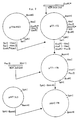
- the plasmids will furthermore contain the S . cerevisiae triose phosphat isomerase promoter and terminator (P TPI and T TPI ). They are identical to pMT743 (M. Egel-Mitani et al. GENE (1988) (in press) (see fig. 1) except for the region defined by the EcoRI-XbaI restriction site encoding a signal/leader/insulin precursor sequence.
- This plasmid (see fig. 1) is a pBR322 derivative in which the EcoRI site has been eliminated by religating the EcoRI cut, with Klenow polymerase and dNTP flushended plasmid, and in which the BamHI-SphI fragment has been replaced by the 2.2 kb SphI-BamHI fragment of the above pMT743.
- This latter fragment contains a sequence encoding an insulin precursor B(1-29)-Ala-Ala-Lys-A(1-21) linked to the MF ⁇ leader and signal and the S .
- the synthetic DNA-fragments were synthesized on an automatic DNA synthesizer (Applied Biosystems Model 380A) using phosphoramidite chemistry and commercially available reagents (S.L. Beaucage and M.H. Caruthers (1981) Tetrahedron Letters 22 , 1859-1869).
- the oligonucleotides were purified by polyacryl amide gel electrophoresis under denaturating conditions.
- examples 1 - 4 illustrate the expression and secretion of insulin precursors of the type B(1-29)-Ala-Ala-Lys-A(1-21) by means of various of the signal-leader sequences according to the present invention and example 5 illustrate the expression and secretion of an insulin precursor of the aforementioned type, but in which the amino acid residue in position B(27) has been substituted with Arg and the amino acid residue in position A(21) has been substituted with Gly.
- B(1-29) means a shortened B chain of human insulin from B(1)Phe to B(29)Lys
- A(1-21) means the A chain of human insulin.
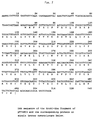
- Plasmid pLaC193 encodes the following leader sequence:
- the signal sequence is a codon optimized S . cerevisiae signal sequence (see Michi Egel Mitani et al. (1988) supra ).
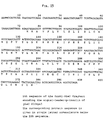
- the DNA-sequence of the EcoRI-XbaI fragment of pT7-193 is shown in fig. 9.
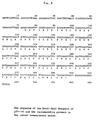
- Plasmid pLaC194 encodes the following leader sequence:
- the signal sequence is as above.
- the DNA-sequence of the EcoRI-XbaI fragment of pT7-194 is shown in fig. 10.
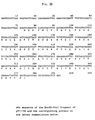
- Plasmid pLaC195 encodes the following leader sequence:
- the signal sequence is as above.
- the DNA-sequence of the EcoRI-XbaI fragment of pT7-195 is shown in fig. 11.
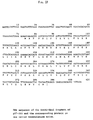
- Plasmid pLaC200 encodes the following leader sequence:
- the signal sequence is the same as in example 1.
- the DNA-sequence of the EcoRI-XbaI fragment of pT7-200 is shown in fig. 12.
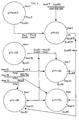
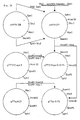
- Plasmid pT7-178 was in vitro mutagenized by the double primer method applying the synthetic DNA NOR544: 3' CTTACTTTCAGAAGATAAAAATGACG 5' essentially as described by K. Norris et al. (1983) Nucl. Acid Res. 11 5103-5112 (fig. 5).
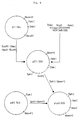
- the resulting plasmid now contains a XmnI cleavage site enabling the isolation of a 82 bp EcoRI-XmnI fragment, which together with the 37 bp XmnI-ApaI fragment from pMSA104 (O. Hagenbüchle et al. Nature (1981) 289 , 643-646) encoding the mouse salivary amylase signal peptide residue three to fifteen, was joined in a ligation further including the 251 bp MspI-Xba and the 5.6 kb EcoRI-Xba fragments of pT7-178 and the synthetic DNA fragment NOR217/218: resulting in the plasmid pT7-196 (fig. 5) containing a modified mouse salivary signal (amino acid residues 3-15).
- the modified mouse salivary amylase signal peptide was further mutagenized by replacing the XmnI-ApaI fragment of pLaC196 with the synthetic adaptors NOR520T or 521T (fig. 6a) produced from where the nucleotides in small letters were incorporated from pools composed of 91% of the nucleotide indicated and 3% of each of the other nucleotides.
- NOR520 and 521 were auto annealed (underlined 3' end), extended by klenow polymerase and dNTP, resulting in double stranded DNA fragments of 90 and 72 bp, respectively. These fragments were cleaved by ApaI and the resulting fragments NOR521T of 47 bp and NOR521T of 38 bp were purified by polyacrylamide gelelectrophoresis.
- Plasmids resulting from this procedure were isolated from transformants of an E . coli strain and individually transformed into the S . cerevisiae strain MT663.
- the resulting yeast transformants were screened for insulin precursor secretion by colony immunoblotting with a monoclonal mouse anti insulin precursor and decorated with horsradish peroxidase conjugated rabbit anti mouse IgG.
- the transformants giving the strongest response were further analyzed.
- the exact nucleotide sequence as determined by Maxam-Gilbert sequencing from the EcoRI site towards XabI is given in fig. 13.
- the spx3 signal peptide is in the above context approximately a factor of two superior to the original signal peptide of pLaC196 as estimated from secreted insulin precursor levels obtained.
- spx3 originating from the NOR520T mutagenesis is two codon shorter than would be expected, the only explanation for this must be length heterogeneity in the original single strands of NOR520, or by a polymerase jump in the extension reaction en route to NOR520T.
- Plasmid pLaC212spx3 encodes the following leader sequence:
- the signal sequence is the mutated mouse salivari signal.
- the DNA-sequence of the EcoRi-XbaI fragment of pLaC212spx3 is shown in fig. 13.
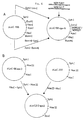
- DNA encoding a precursor of an insulin analogue having Gln in position B(12), Arg in position B(27) and Gly in position A(21) respectively, was derived from plasmid pKFN126 (Markussen et al. (1987) Protein Engineering: 1 , 215-223) by replacing the 90 bp Stul-XbaI fragment with the following synthetic DNA: From the resulting plasmid pKFN371 the 124 bp HindIII-XbaI fragment was isolated and used to replace the analogous HindIII-XbaI fragment of pT7212spx3 and pT7 ⁇ MI3 (see fig. 14).
- Plasmids prepared as described above were transformed into S . cerevisiae strains carrying deletions in the TPI gene by selecting for growth on glucose.
- the transformed yeast strain were grown on YPD medium (Sherman, F. et al., Methods in Yeast Genetics, Cold Spring Harbor Laboratory 1981). For each strain 6 individual 5 ml cultures were shaken at 30°C until they reached an OD600 of approx. 15 (approx. 48 hours). After centrifugation the supernatant was removed for HPLC analysis by which method the concentration of secreted insulin precursor was measured by a method as described by Leo Snel et al. (1987) Chromotographia 24 , 329-332.
- the expression level of the insulin precursors by use of a leader sequence according to the present invention is indicated in percentage of the expression level of the same insulin precursor expressed and secreted in the same yeast strain, however by use of the MF ⁇ signal/leader sequence.
- Table 2 Expression levels of insulin precursors wherein B(27) is Arg and A(21) is Gly. Plasmid Expression level** pKFN216 100% pLaC212spx3-0174 150% ** The expression levels are indicated in percentage of the expression level of pKFN216 which is arbitrarily set to 100%.
Landscapes
- Health & Medical Sciences (AREA)
- Life Sciences & Earth Sciences (AREA)
- Genetics & Genomics (AREA)
- Chemical & Material Sciences (AREA)
- Engineering & Computer Science (AREA)
- Organic Chemistry (AREA)
- Biomedical Technology (AREA)
- Zoology (AREA)
- Wood Science & Technology (AREA)
- Biotechnology (AREA)
- General Engineering & Computer Science (AREA)
- Molecular Biology (AREA)
- Bioinformatics & Cheminformatics (AREA)
- Biophysics (AREA)
- Biochemistry (AREA)
- General Health & Medical Sciences (AREA)
- Microbiology (AREA)
- Plant Pathology (AREA)
- Physics & Mathematics (AREA)
- Mycology (AREA)
- Diabetes (AREA)
- Endocrinology (AREA)
- Toxicology (AREA)
- Gastroenterology & Hepatology (AREA)
- Medicinal Chemistry (AREA)
- Proteomics, Peptides & Aminoacids (AREA)
- Preparation Of Compounds By Using Micro-Organisms (AREA)
- Micro-Organisms Or Cultivation Processes Thereof (AREA)
- Peptides Or Proteins (AREA)
Priority Applications (1)
| Application Number | Priority Date | Filing Date | Title |
|---|---|---|---|
| AT88908171T ATE98691T1 (de) | 1987-09-07 | 1988-09-06 | Synthetische hefe-signalpeptide. |
Applications Claiming Priority (2)
| Application Number | Priority Date | Filing Date | Title |
|---|---|---|---|
| DK4638/87 | 1987-09-07 | ||
| DK463887A DK463887D0 (da) | 1987-09-07 | 1987-09-07 | Gaerleader |
Publications (2)
| Publication Number | Publication Date |
|---|---|
| EP0378567A1 EP0378567A1 (en) | 1990-07-25 |
| EP0378567B1 true EP0378567B1 (en) | 1993-12-15 |
Family
ID=8135352
Family Applications (1)
| Application Number | Title | Priority Date | Filing Date |
|---|---|---|---|
| EP88908171A Expired - Lifetime EP0378567B1 (en) | 1987-09-07 | 1988-09-06 | Synthetic yeast leader peptides |
Country Status (6)
| Country | Link |
|---|---|
| US (2) | US5162498A (enExample) |
| EP (1) | EP0378567B1 (enExample) |
| JP (1) | JP2708518B2 (enExample) |
| DE (1) | DE3886408T2 (enExample) |
| DK (1) | DK463887D0 (enExample) |
| WO (1) | WO1989002463A1 (enExample) |
Families Citing this family (60)
| Publication number | Priority date | Publication date | Assignee | Title |
|---|---|---|---|---|
| DK463887D0 (da) * | 1987-09-07 | 1987-09-07 | Novo Industri As | Gaerleader |
| US5759802A (en) * | 1988-10-26 | 1998-06-02 | Tonen Corporation | Production of human serum alubumin A |
| DK105489D0 (da) * | 1989-03-03 | 1989-03-03 | Novo Nordisk As | Polypeptid |
| IT1229996B (it) * | 1989-04-20 | 1991-09-20 | Cesare Sirtori | Espressione di apolipoproteina ai e apolipoproteina ai-milano in lievito e composizioni farmaceutiche che contengono dette apolipoproteine. |
| CA2025180A1 (en) * | 1989-10-12 | 1991-04-13 | William G. Weisburg | Nucleic acid probes and methods for detecting pathogenic candida yeasts |
| DK0574402T3 (da) | 1990-11-26 | 1998-05-18 | Chiron Corp | Ekspression af PACE i værtsceller og fremgangsmåder til anvendelse deraf |
| DK300090D0 (da) * | 1990-12-19 | 1990-12-19 | Novo Nordisk As | Fremgangsmaade til fremstilling af leadersekvenser |
| DK6893D0 (da) * | 1993-01-21 | 1993-01-21 | Novo Nordisk As | Peptid |
| US5538863A (en) * | 1993-07-01 | 1996-07-23 | Immunex Corporation | Expression system comprising mutant yeast strain and expression vector encoding synthetic signal peptide |
| DE4417353A1 (de) * | 1994-05-18 | 1996-01-25 | Bayer Ag | Verfahren zur Herstellung von rekombinantem Aprotinin und rekombinanten Aprotinin Varianten mit der natürlichen N-terminlaen Sequenz |
| WO1996029397A1 (en) | 1995-03-17 | 1996-09-26 | Novo Nordisk A/S | Novel endoglucanases |
| EP2295453A3 (en) | 1996-03-01 | 2011-03-30 | Novo Nordisk A/S | An appetite-suppressing peptide, its compositions and use |
| DE19629982A1 (de) | 1996-07-25 | 1998-01-29 | Bayer Ag | Aprotinin-Varianten mit verbesserten Eigenschaften |
| DE69841807D1 (de) | 1997-11-06 | 2010-09-16 | Novartis Vaccines & Diagnostic | Neisseriale antigene |
| ATE446368T1 (de) | 1998-01-14 | 2009-11-15 | Novartis Vaccines & Diagnostic | Antigene aus neisseria meningitidis |
| GB9808932D0 (en) | 1998-04-27 | 1998-06-24 | Chiron Spa | Polyepitope carrier protein |
| CA2650642A1 (en) | 1998-05-01 | 1999-11-11 | Chiron Corporation | Neisseria meningitidis antigens and compositions |
| US6190883B1 (en) | 1998-09-09 | 2001-02-20 | Novo Nordisk A/S | Method for the production of heterologous polypeptides in transformed yeast cells |
| EP2278007B1 (en) | 1999-04-30 | 2014-04-16 | Novartis Vaccines and Diagnostics S.r.l. | Conserved neisserial antigens |
| GB9911683D0 (en) | 1999-05-19 | 1999-07-21 | Chiron Spa | Antigenic peptides |
| JP2003504046A (ja) | 1999-07-09 | 2003-02-04 | ノボザイムス アクティーゼルスカブ | グルコアミラーゼ変異体 |
| GB9916529D0 (en) | 1999-07-14 | 1999-09-15 | Chiron Spa | Antigenic peptides |
| EP2275552B1 (en) | 1999-10-29 | 2015-09-09 | GlaxoSmithKline Biologicals SA | Neisserial antigenic peptides |
| ATE474930T1 (de) | 1999-12-29 | 2010-08-15 | Novo Nordisk As | Verfahren zur herstellung von insulinvorläufern und analogen von insulinvorläufern mit verbesserter fermentationsausbeute in hefe |
| DK1897555T3 (da) | 2000-01-17 | 2014-10-13 | Novartis Vaccines & Diagnostic | Kompletteret OMV-vaccine mod meningococcus |
| WO2002034771A2 (en) | 2000-10-27 | 2002-05-02 | Chiron Srl | Nucleic acids and proteins from streptococcus groups a & b |
| RU2338752C2 (ru) | 2001-03-22 | 2008-11-20 | Ново Нордиск Хелт Кэр Аг | Производные фактора vii свертывания крови |
| GB0107658D0 (en) | 2001-03-27 | 2001-05-16 | Chiron Spa | Streptococcus pneumoniae |
| GB0107661D0 (en) | 2001-03-27 | 2001-05-16 | Chiron Spa | Staphylococcus aureus |
| US20030082671A1 (en) * | 2001-07-24 | 2003-05-01 | Thomas Hoeg-Jensen | Method for making acylated polypeptides |
| US7595172B2 (en) | 2001-07-24 | 2009-09-29 | Novo Nordisk A/S | Method for making acylated polypeptides |
| JP4537059B2 (ja) | 2001-09-27 | 2010-09-01 | ノボ ノルディスク ヘルス ケア アクチェンゲゼルシャフト | ヒト凝固第vii因子ポリペプチド |
| ATE406912T1 (de) | 2001-12-12 | 2008-09-15 | Novartis Vaccines & Diagnostic | Immunisierung gegen chlamydia tracheomatis |
| CA2498017C (en) | 2002-09-13 | 2016-06-14 | Cornell Research Foundation, Inc. | Using mutations to improve aspergillus phytases |
| EP2279746B1 (en) | 2002-11-15 | 2013-10-02 | Novartis Vaccines and Diagnostics S.r.l. | Surface proteins in neisseria meningitidis |
| GB0308198D0 (en) | 2003-04-09 | 2003-05-14 | Chiron Srl | ADP-ribosylating bacterial toxin |
| CN1863908B (zh) | 2003-09-09 | 2010-08-04 | 诺和诺德医疗保健公司 | 凝固因子ⅶ多肽 |
| US20050084495A1 (en) * | 2003-09-23 | 2005-04-21 | Favrille, Inc. | Altering A B cell pathology using self-derived antigens in conjunction with specific-binding cytoreductive agent |
| EP1687428A1 (en) | 2003-11-14 | 2006-08-09 | Novo Nordisk A/S | Processes for making acylated insulin |
| ES2369895T3 (es) | 2003-12-03 | 2011-12-07 | Novo Nordisk A/S | Insulina monocatenaria. |
| CA2604222A1 (en) | 2005-04-18 | 2006-10-26 | Novo Nordisk A/S | Il-21 variants |
| ATE513921T1 (de) | 2005-08-16 | 2011-07-15 | Novo Nordisk As | Verfahren zur herstellung reifer insulinpolypeptide |
| EP2316930A1 (en) | 2005-09-14 | 2011-05-04 | Novo Nordisk Health Care AG | Human coagulation factor VII polypeptides |
| JP5202338B2 (ja) | 2006-02-27 | 2013-06-05 | ノボ・ノルデイスク・エー/エス | 新規インシュリン誘導体 |
| CN101541830A (zh) | 2006-09-22 | 2009-09-23 | 诺沃-诺迪斯克有限公司 | 蛋白酶抗性的胰岛素类似物 |
| EP2069502B1 (en) | 2006-09-27 | 2014-02-26 | Novo Nordisk A/S | Method for making maturated insulin polypeptides |
| US7795411B2 (en) * | 2006-10-05 | 2010-09-14 | Fred Hutchinson Cancer Research Center | Vectors for expressing in vivo biotinylated recombinant proteins |
| WO2009010428A1 (en) | 2007-07-16 | 2009-01-22 | Novo Nordisk A/S | Protease stabilized, pegylated insulin analogues |
| PT2910570T (pt) | 2008-03-18 | 2017-01-24 | Novo Nordisk As | Análogos de insulina acilados, estabilizados contra proteases |
| US20120107267A1 (en) | 2009-03-11 | 2012-05-03 | Novo Nordisk A/S | Interleukin-21 variants having antagonistic binding to the il-21 receptor |
| WO2010103546A2 (en) * | 2009-03-12 | 2010-09-16 | Bigtec Private Limited | A polynucleotide and polypeptide sequence and methods thereof |
| US20120282285A1 (en) | 2009-07-17 | 2012-11-08 | Rigshospitalet | Masp isoforms as inhibitors of complement activation |
| US9096843B2 (en) | 2009-12-01 | 2015-08-04 | Novo Nordisk A/S | Peptidyl α-hydroxyglycine α-amidating lyases |
| EP2542569B1 (en) | 2010-03-05 | 2020-09-16 | Omeros Corporation | Chimeric inhibitor molecules of complement activation |
| CN104136041B (zh) | 2012-02-09 | 2021-06-29 | Var2制药有限公司 | 靶向硫酸软骨素聚糖 |
| EP2906693A1 (en) | 2012-10-15 | 2015-08-19 | Novo Nordisk Health Care AG | Coagulation factor vii polypeptides |
| EP2925345B1 (en) | 2012-12-03 | 2018-09-05 | Merck Sharp & Dohme Corp. | Method for making o-glycosylated carboxy terminal portion (ctp) peptide-based insulin and insulin analogues |
| CN105308067B (zh) | 2013-06-07 | 2020-07-24 | 诺和诺德股份有限公司 | 制备成熟胰岛素多肽的方法 |
| EP3268384B1 (en) | 2015-03-10 | 2021-11-03 | Merck Sharp & Dohme Corp. | Process for preparing recombinant insulin using microfiltration |
| EP3821244A1 (en) | 2018-07-13 | 2021-05-19 | Varct Diagnostics ApS | Isolation of circulating cells of fetal origin using recombinant malaria protein var2csa |
Family Cites Families (5)
| Publication number | Priority date | Publication date | Assignee | Title |
|---|---|---|---|---|
| US4546082A (en) * | 1982-06-17 | 1985-10-08 | Regents Of The Univ. Of California | E. coli/Saccharomyces cerevisiae plasmid cloning vector containing the alpha-factor gene for secretion and processing of hybrid proteins |
| US5015575A (en) * | 1983-04-07 | 1991-05-14 | Chiron Corporation | Hybrid DNA synthesis of insulin |
| DK58285D0 (da) * | 1984-05-30 | 1985-02-08 | Novo Industri As | Peptider samt fremstilling og anvendelse deraf |
| AU5912586A (en) * | 1985-06-20 | 1986-12-24 | Salk Institute Biotechnology/Industrial Associates, Inc., The | Alpha-factor leader peptide-facilitated secretion from transformed s cerevisiae |
| DK463887D0 (da) * | 1987-09-07 | 1987-09-07 | Novo Industri As | Gaerleader |
-
1987
- 1987-09-07 DK DK463887A patent/DK463887D0/da not_active Application Discontinuation
-
1988
- 1988-09-06 DE DE88908171T patent/DE3886408T2/de not_active Expired - Fee Related
- 1988-09-06 WO PCT/DK1988/000147 patent/WO1989002463A1/en not_active Ceased
- 1988-09-06 EP EP88908171A patent/EP0378567B1/en not_active Expired - Lifetime
- 1988-09-06 JP JP63507561A patent/JP2708518B2/ja not_active Expired - Fee Related
-
1989
- 1989-09-12 US US07/406,392 patent/US5162498A/en not_active Expired - Fee Related
-
1992
- 1992-11-09 US US07/973,483 patent/US5316923A/en not_active Expired - Fee Related
Non-Patent Citations (3)
| Title |
|---|
| Chemical Abstracts, Vol. 103 (1985), abstract No. 117421z, (Stepien, P.0.), Short Rep. 1984, 1 (Adv. Gene Technol.), 240-1 (Eng). * |
| Chemical Abstracts, Vol. 108 (1988), abstract No. 17032h, (Egel-Mitani, Michi et al), Nucleic Acids Res. 1987, 15(15), 6303 (Eng). * |
| Science 235 (1987), 312-317) * |
Also Published As
| Publication number | Publication date |
|---|---|
| DE3886408T2 (de) | 1994-05-11 |
| DE3886408D1 (en) | 1994-01-27 |
| JPH03500171A (ja) | 1991-01-17 |
| US5316923A (en) | 1994-05-31 |
| US5162498A (en) | 1992-11-10 |
| WO1989002463A1 (en) | 1989-03-23 |
| JP2708518B2 (ja) | 1998-02-04 |
| DK463887D0 (da) | 1987-09-07 |
| EP0378567A1 (en) | 1990-07-25 |
Similar Documents
| Publication | Publication Date | Title |
|---|---|---|
| US5316923A (en) | Synthetic yeast leader peptides | |
| US5795746A (en) | Synthetic leader peptide sequences | |
| JP3730255B2 (ja) | イーストにおいて発現されたn末端に伸長した蛋白質 | |
| US6214547B1 (en) | Synthetic leader peptide sequences | |
| US5726038A (en) | DNA construct encoding the YAP3 signal peptide | |
| AU660161B2 (en) | A method of constructing synthetic leader sequences | |
| US6500645B1 (en) | N-terminally extended proteins expressed in yeast | |
| AU624694B2 (en) | Yeast processing system comprising a negatively charged amino acid adjacent to the processing site | |
| EP0946735B1 (en) | N-terminally extended proteins expressed in yeast | |
| EP0868523B1 (en) | Vector for expression of n-terminally extended proteins in yeast cell | |
| US20020192753A1 (en) | Method of making proteins in transformed yeast cells | |
| EP1097228A1 (en) | Method of making proteins in transformed yeast cells | |
| DK164874B (da) | Syntetiske gaer-leader-peptider, dna-sekvens, der indkoder saadanne leader-peptider, vektorer og transformerede gaerstammer samt en fremgangsmaade til fremstilling af proteiner i gaer |
Legal Events
| Date | Code | Title | Description |
|---|---|---|---|
| PUAI | Public reference made under article 153(3) epc to a published international application that has entered the european phase |
Free format text: ORIGINAL CODE: 0009012 |
|
| 17P | Request for examination filed |
Effective date: 19900212 |
|
| AK | Designated contracting states |
Kind code of ref document: A1 Designated state(s): AT BE CH DE FR GB IT LI LU NL SE |
|
| RAP1 | Party data changed (applicant data changed or rights of an application transferred) |
Owner name: NOVO NORDISK A/S |
|
| 17Q | First examination report despatched |
Effective date: 19920522 |
|
| GRAA | (expected) grant |
Free format text: ORIGINAL CODE: 0009210 |
|
| AK | Designated contracting states |
Kind code of ref document: B1 Designated state(s): AT BE CH DE FR GB IT LI LU NL SE |
|
| REF | Corresponds to: |
Ref document number: 98691 Country of ref document: AT Date of ref document: 19940115 Kind code of ref document: T |
|
| REF | Corresponds to: |
Ref document number: 3886408 Country of ref document: DE Date of ref document: 19940127 |
|
| ITF | It: translation for a ep patent filed | ||
| ET | Fr: translation filed | ||
| PLBE | No opposition filed within time limit |
Free format text: ORIGINAL CODE: 0009261 |
|
| STAA | Information on the status of an ep patent application or granted ep patent |
Free format text: STATUS: NO OPPOSITION FILED WITHIN TIME LIMIT |
|
| 26N | No opposition filed | ||
| EAL | Se: european patent in force in sweden |
Ref document number: 88908171.7 |
|
| REG | Reference to a national code |
Ref country code: GB Ref legal event code: IF02 |
|
| PGFP | Annual fee paid to national office [announced via postgrant information from national office to epo] |
Ref country code: SE Payment date: 20020904 Year of fee payment: 15 Ref country code: GB Payment date: 20020904 Year of fee payment: 15 |
|
| PGFP | Annual fee paid to national office [announced via postgrant information from national office to epo] |
Ref country code: FR Payment date: 20020910 Year of fee payment: 15 |
|
| PGFP | Annual fee paid to national office [announced via postgrant information from national office to epo] |
Ref country code: DE Payment date: 20020911 Year of fee payment: 15 Ref country code: AT Payment date: 20020911 Year of fee payment: 15 |
|
| PGFP | Annual fee paid to national office [announced via postgrant information from national office to epo] |
Ref country code: CH Payment date: 20020916 Year of fee payment: 15 |
|
| PGFP | Annual fee paid to national office [announced via postgrant information from national office to epo] |
Ref country code: LU Payment date: 20020918 Year of fee payment: 15 |
|
| PGFP | Annual fee paid to national office [announced via postgrant information from national office to epo] |
Ref country code: NL Payment date: 20020930 Year of fee payment: 15 |
|
| PGFP | Annual fee paid to national office [announced via postgrant information from national office to epo] |
Ref country code: BE Payment date: 20021129 Year of fee payment: 15 |
|
| PG25 | Lapsed in a contracting state [announced via postgrant information from national office to epo] |
Ref country code: LU Free format text: LAPSE BECAUSE OF NON-PAYMENT OF DUE FEES Effective date: 20030906 Ref country code: GB Free format text: LAPSE BECAUSE OF NON-PAYMENT OF DUE FEES Effective date: 20030906 Ref country code: AT Free format text: LAPSE BECAUSE OF NON-PAYMENT OF DUE FEES Effective date: 20030906 |
|
| PG25 | Lapsed in a contracting state [announced via postgrant information from national office to epo] |
Ref country code: SE Free format text: LAPSE BECAUSE OF NON-PAYMENT OF DUE FEES Effective date: 20030907 |
|
| PG25 | Lapsed in a contracting state [announced via postgrant information from national office to epo] |
Ref country code: LI Free format text: LAPSE BECAUSE OF NON-PAYMENT OF DUE FEES Effective date: 20030930 Ref country code: CH Free format text: LAPSE BECAUSE OF NON-PAYMENT OF DUE FEES Effective date: 20030930 Ref country code: BE Free format text: LAPSE BECAUSE OF NON-PAYMENT OF DUE FEES Effective date: 20030930 |
|
| BERE | Be: lapsed |
Owner name: *NOVO NORDISK A/S Effective date: 20030930 |
|
| PG25 | Lapsed in a contracting state [announced via postgrant information from national office to epo] |
Ref country code: NL Free format text: LAPSE BECAUSE OF NON-PAYMENT OF DUE FEES Effective date: 20040401 Ref country code: DE Free format text: LAPSE BECAUSE OF NON-PAYMENT OF DUE FEES Effective date: 20040401 |
|
| GBPC | Gb: european patent ceased through non-payment of renewal fee |
Effective date: 20030906 |
|
| EUG | Se: european patent has lapsed | ||
| REG | Reference to a national code |
Ref country code: CH Ref legal event code: PL |
|
| PG25 | Lapsed in a contracting state [announced via postgrant information from national office to epo] |
Ref country code: FR Free format text: LAPSE BECAUSE OF NON-PAYMENT OF DUE FEES Effective date: 20040528 |
|
| NLV4 | Nl: lapsed or anulled due to non-payment of the annual fee |
Effective date: 20040401 |
|
| REG | Reference to a national code |
Ref country code: FR Ref legal event code: ST |
|
| PG25 | Lapsed in a contracting state [announced via postgrant information from national office to epo] |
Ref country code: IT Free format text: LAPSE BECAUSE OF NON-PAYMENT OF DUE FEES;WARNING: LAPSES OF ITALIAN PATENTS WITH EFFECTIVE DATE BEFORE 2007 MAY HAVE OCCURRED AT ANY TIME BEFORE 2007. THE CORRECT EFFECTIVE DATE MAY BE DIFFERENT FROM THE ONE RECORDED. Effective date: 20050906 |