EP0375030B1 - Method and tray system for use in hatching operations - Google Patents
Method and tray system for use in hatching operations Download PDFInfo
- Publication number
- EP0375030B1 EP0375030B1 EP89203166A EP89203166A EP0375030B1 EP 0375030 B1 EP0375030 B1 EP 0375030B1 EP 89203166 A EP89203166 A EP 89203166A EP 89203166 A EP89203166 A EP 89203166A EP 0375030 B1 EP0375030 B1 EP 0375030B1
- Authority
- EP
- European Patent Office
- Prior art keywords
- tray
- eggs
- hatching
- insert
- trays
- Prior art date
- Legal status (The legal status is an assumption and is not a legal conclusion. Google has not performed a legal analysis and makes no representation as to the accuracy of the status listed.)
- Expired - Lifetime
Links
- 230000012447 hatching Effects 0.000 title claims abstract description 40
- 238000000034 method Methods 0.000 title claims abstract description 32
- 235000013601 eggs Nutrition 0.000 claims abstract description 60
- 238000011534 incubation Methods 0.000 claims abstract description 25
- 238000005192 partition Methods 0.000 claims abstract description 5
- 230000000694 effects Effects 0.000 abstract description 3
- 244000144977 poultry Species 0.000 abstract description 3
- 230000035939 shock Effects 0.000 abstract description 3
- 241000287828 Gallus gallus Species 0.000 description 10
- 235000013330 chicken meat Nutrition 0.000 description 10
- 230000000384 rearing effect Effects 0.000 description 3
- 102000002322 Egg Proteins Human genes 0.000 description 2
- 108010000912 Egg Proteins Proteins 0.000 description 2
- 238000004140 cleaning Methods 0.000 description 2
- 230000018109 developmental process Effects 0.000 description 2
- 210000003278 egg shell Anatomy 0.000 description 2
- 239000000463 material Substances 0.000 description 2
- 235000013594 poultry meat Nutrition 0.000 description 2
- 230000000284 resting effect Effects 0.000 description 2
- 230000003292 diminished effect Effects 0.000 description 1
- 238000006073 displacement reaction Methods 0.000 description 1
- 239000000428 dust Substances 0.000 description 1
- 238000002347 injection Methods 0.000 description 1
- 239000007924 injection Substances 0.000 description 1
- 210000000629 knee joint Anatomy 0.000 description 1
- 238000004519 manufacturing process Methods 0.000 description 1
- 238000004659 sterilization and disinfection Methods 0.000 description 1
- 238000009423 ventilation Methods 0.000 description 1
Images
Classifications
-
- A—HUMAN NECESSITIES
- A01—AGRICULTURE; FORESTRY; ANIMAL HUSBANDRY; HUNTING; TRAPPING; FISHING
- A01K—ANIMAL HUSBANDRY; AVICULTURE; APICULTURE; PISCICULTURE; FISHING; REARING OR BREEDING ANIMALS, NOT OTHERWISE PROVIDED FOR; NEW BREEDS OF ANIMALS
- A01K41/00—Incubators for poultry
- A01K41/06—Egg-turning appliances for incubators
- A01K41/065—Egg drawers
Definitions
- the process is rationalized in hatcheries which handle eggs from several egg producers.
- the eggs are collected and placed in trays which are stacked in such a manner that they can be transported on pallets or bag trucks.
- the trays which can possibly be hooked together in threes, are then placed on shelves in incubation carriages, which are portable racks with tiltable shelves.
- the eggs are introduced in suitable lots into an incubator, which is a chamber in which under air circulation there are maintained temperatures and humidity suitable for the hatching process, which for hens' eggs extends over approximately 18 days.
- the shelves with the trays are tilted slowly from side to side, and the eggs, which are placed in the trays with the "pointed" end downwards, are therefore fixed in openings or with guide pins in the trays.
- the eggs are taken out of the incubator, possibly placed in special hatching trays with high side-edges, and placed in the hatching cabinet, which is chamber with slightly different conditions of temperature and humidity.
- the trays are constantly held in the horizontal position, and the eggs are held lying on their sides as if on a flat underlayer for the three days it takes for the hatching to occur.
- Such a system consisting of a tray with insert and such a method during the use of the tray system is known from US Patent publication 4,398,499.
- the known tray is arranged to be used in a work cycle which does not demand removal or handling of the eggs between the incubation and the hatching.
- the tray is arranged as a hatching tray, in which the eggs can lie on their sides in separate compartments.
- the trays are stacked, and between each stacked tray above and below there is provided a cover with openings slightly larger than the maximum diameter (at right angles to the egg's horizontal axis) of the relevant eggs.
- the flat extension of the cover is disposed at a distance from the overlying bottom, which has downwardly extending pins.
- the tray system functions by the trays being placed with the bottom upwards, and the eggs being placed in the cover openings with their pointed ends resting on the pins.
- the stacks of trays are run through the incubation process, where the stacks are rocked as described above. Before the hatching process, the stacks are turned slowly 180°, so that the eggs fall or glide from their standing position in the covers to their horizontal position in the separate compartments in the bottoms of the trays. After hatching, the chickens can be removed by emptying the trays, starting from the tops of the stacks. The trays can then be returned to the egg producer to be filled with eggs.
- the object of the invention is to provide a method and a tray system which, during the hatching process, can contain a greater number of eggs in relation to the area than hitherto known tray systems, and that in the use of the tray in the method of the mentioned kind it is not necessary to use more time in positioning the eggs before incubation or before hatching, and where the shock effect on the eggs is avoided just prior to the hatching process.
- the tray as revealed in claim 5, whereby ledges or the like in the slots can receive the insert or pins on the insert, thus enabling the insert to rest in a raised position during the hatching process.
- the raised position of the insert is thus independent of means outside the tray.
- the tray 1 is injection moulded in plastic material and provided with perforations 13 in the bottom and openings 16 in the sides 11 to allow the passage of air.
- a grid-shaped insert 3 with square openings 5 stands on feet 7 on the bottom 9 of the tray. The dimension of the openings allows the passage of the largest possible eggs derived from the relevant kind of poultry.
- the tray has sides 11 upwards to open slots 15 with ledges 17.
- Projections 19 extending from the insert 3 rest in or merely project through the slots 15.
- the insert 3 can be lifted by the projections 19 and possibly placed near to the upper edge of the tray, in that the projections 19 rest on the ledges 17.
- the slots 15 could be closed at the top so that the insert 3 is not able to fall out of the tray.
- the tray could be without slots and the insert without the projections, in that the insert 3 is removed completely when the eggs are to assume the hatching position.
- the tray according to the invention can be provided with not-shown projections or flanges along the upper edge, or with pins and holes corresponding to the pins in the bottom, thus enabling the trays to be arranged in stacks which can easily be handled during the whole sequence of operations from when the eggs are introduced at the producer to the delivery of chickens to the place of rearing.
- the trays can be provided with not-shown hook elements at the sides, hereby enabling several trays 1 to be hooked together out of regard for placing in the incubators etc.
- the insert 3 can be configured with openings 21 of different shapes, e.g. circular, honeycomb-shaped or parallelogram-shaped.
- the holes 13 in the bottom 9 of the tray are dimensioned so that the chickens cannot get their knee joints locked in them, but are still large enough to allow most of the smaller pieces of eggshell to pass through during mechanical cleaning of the trays.
- the eggs are placed in the trays 1 with inserts 3 at the producers, the trays are stacked and driven to the hatchery.
- they are put through the process as described in the introduction and in the principle with the trays in stacks, in that the eggs are disinfected and placed in the incubator.
- the trays can be placed on tiltable shelves in the incubator carriage in the same manner as with hitherto-known techniques, or, in a further development, whole stacks of trays are placed in special tilting racks which, during the period of incubation, tilt the stacks in the same way as hitherto known.
- the inserts 3 are produced with not-shown yielding projections which extend from the wall of the insert into the openings 5 in such a manner that the eggs are supported laterally but still remain in the tray 1 when the insert 3 is lifted.
- the trays 1 are taken down on the light cabinet as per hitherto-known incubation trays, and in ordet to increase the translucence through the bottom 9, the tray can be made of a relatively translucent material.
- a tray with insert as shown in fig. 3, and the inserts are removed from each tray, whereupon the eggs roll on to their sides.
- a tray as shown in figs. 1-2 is used, where the projections 19 are operated by being lifted upwards with automatically-controlled elements arranged in the carriages the trays are standing in, or possiblly by means of elements in the hatching cabinet, which possibly can be a further development of the hitherto-known incubator.
- the hatching can proceed in the normal manner with the eggs in the lying position.
- the chickens can be removed manually from the trays, which are then cleaned of shell, dust etc., and the chickens are counted and transferred to the cleaned trays of the same kind as the incubation/hatching trays.
- the trays with the chickens are then stacked again on pallets or in wheeled crates for dispatch by truck to the place of rearing.
- the invention provides the possibility of the chickens being able to be dispatched immediately after being hatched in the trays in which the hatching has taken place, i.e. without cleaning of the trays, possibly merely after the removal of unhatched eggs and larger pieces of egg-shell.
Landscapes
- Life Sciences & Earth Sciences (AREA)
- Environmental Sciences (AREA)
- Animal Husbandry (AREA)
- Biodiversity & Conservation Biology (AREA)
- Packaging Frangible Articles (AREA)
- Telephonic Communication Services (AREA)
- Coloring Foods And Improving Nutritive Qualities (AREA)
- Coating With Molten Metal (AREA)
- Hardware Redundancy (AREA)
- Wrapping Of Specific Fragile Articles (AREA)
Abstract
Description
- In the hatching of eggs for the mass production of chickens and other poultry, the process is rationalized in hatcheries which handle eggs from several egg producers. At the producers, the eggs are collected and placed in trays which are stacked in such a manner that they can be transported on pallets or bag trucks. The trays, which can possibly be hooked together in threes, are then placed on shelves in incubation carriages, which are portable racks with tiltable shelves. After a disinfection with gas, the eggs are introduced in suitable lots into an incubator, which is a chamber in which under air circulation there are maintained temperatures and humidity suitable for the hatching process, which for hens' eggs extends over approximately 18 days. During the process, the shelves with the trays are tilted slowly from side to side, and the eggs, which are placed in the trays with the "pointed" end downwards, are therefore fixed in openings or with guide pins in the trays.
- After a period of time in the incubator, typically after 8 days, the eggs are examined to determine whether or not they are fertilized. This is effected by placing each tray over a light source. The un-fertilized eggs will show themselves by being translucent, and are removed manually or mechanically. The incubation is then continued.
- On the 18th day, the eggs are taken out of the incubator, possibly placed in special hatching trays with high side-edges, and placed in the hatching cabinet, which is chamber with slightly different conditions of temperature and humidity. Here, the trays are constantly held in the horizontal position, and the eggs are held lying on their sides as if on a flat underlayer for the three days it takes for the hatching to occur.
- The trays with the hatched chickens are then taken out, and the chickens are counted during transfer to special transport trays. These transport trays, which can be stacked, have high sides and perforated bottoms, and with the known technique they are used only for the transport from the hatchery to the place of rearing, and are therefore returned empty to the hatchery.
- The invention relates to a method as defined in the preamble of
claim 1 and a tray system as defined in the preamble ofclaim 3. - Such a system consisting of a tray with insert and such a method during the use of the tray system is known from US Patent publication 4,398,499. The known tray is arranged to be used in a work cycle which does not demand removal or handling of the eggs between the incubation and the hatching. In principle, the tray is arranged as a hatching tray, in which the eggs can lie on their sides in separate compartments. In their functional position, the trays are stacked, and between each stacked tray above and below there is provided a cover with openings slightly larger than the maximum diameter (at right angles to the egg's horizontal axis) of the relevant eggs. The flat extension of the cover is disposed at a distance from the overlying bottom, which has downwardly extending pins. The tray system functions by the trays being placed with the bottom upwards, and the eggs being placed in the cover openings with their pointed ends resting on the pins. The stacks of trays are run through the incubation process, where the stacks are rocked as described above. Before the hatching process, the stacks are turned slowly 180°, so that the eggs fall or glide from their standing position in the covers to their horizontal position in the separate compartments in the bottoms of the trays. After hatching, the chickens can be removed by emptying the trays, starting from the tops of the stacks. The trays can then be returned to the egg producer to be filled with eggs. Although the eggs are not damaged externally by being turned in the trays, they are nevertheless exposed to a greater shock effect than with other known methods, where the eggs are supported during the turning or change of position. For the reason that with the special turning according to this US publication it is necessary to prevent the eggs from sliding along the bottom at 90° turning of the trays, it is necessary to arrange special compartments with partition walls for the hatching position. These partition walls take up extra space.
- Other attempts to reduce the handling of the eggs between the incubation and the hatching are known, e.g. from US Patent publication no. 2,266,648 and no. 2.087.044, where a tray is arranged with displaceable side part or parts, so that the bottom area can be changed. Before the hatching, the eggs are placed vertically on the tray's flat bottom all supported by each other and by the sides of the tray and the displaceabele part or parts. Before the hatching, the tray is enlarged, upon which the eggs lie on their sides by virtue of the larger space provided hereby. The disadvantage with this technique is that each tray must be completely filled in order for the eggs to stand securely, and that in filling the trays the eggs must first be placed in the trays and then each egg must be turned up on end when the tray is nearly full. This is a time-consuming process. Moreover in US patent no. 2.266.648, the bottom of the tray is at least partly double during the incubation process, which even with perforated bottoms will result in a diminished possibility for passage of the ventilation air.
- The object of the invention is to provide a method and a tray system which, during the hatching process, can contain a greater number of eggs in relation to the area than hitherto known tray systems, and that in the use of the tray in the method of the mentioned kind it is not necessary to use more time in positioning the eggs before incubation or before hatching, and where the shock effect on the eggs is avoided just prior to the hatching process.
- This is achieved according to the invention with a method and a tray system of the above-mentioned kind, and as characterized in
claim - The method according to the invention is characteristic in that before incubation and after hatching the inserts are displaced upwards, whereby openings in the inserts pass the eggs which thereafter tilt to lie on the bottoms of the trays, without loosing contact with the bottom.
- Since there are no partition walls in the bottom for the hatching position, as is the case in the first -mentioned US Patent publication, there is room for a larger number of eggs in the tray. When the inserts, which during the incubation support the eggs in their upright position, are lifted or displaced upwards to a position above the eggs, or possibly removed completely, the eggs roll over on to their sides in the hatching position. There is hereby achieved a more gentle handling of the eggs than by the invention's prior conditions, besides which the rational operation by using the same trays during the incubation and hatching process is maintained.
- By the method as revealed in claim 2, whereby the inserts are raised by means placed at or through the sides of the tray, it is avoided that the trays are separated by the lifting of the inserts, in that this movement can be effected from outside the tray, possibly with automatic control elements.
- As revealed in claim 4, the tray can be configured with slots in the sides so that the displacement of the inserts can be carried out with means outside the tray, e.g. remotely-controlled pins on a carriage for the tray, which can enter into engagement with the insert. It is thus avoided that the insert has to be removed completely from each single tray between the incubation and the hatching process.
- Furthermore, it is advantageous to configure the tray as revealed in
claim 5, whereby ledges or the like in the slots can receive the insert or pins on the insert, thus enabling the insert to rest in a raised position during the hatching process. The raised position of the insert is thus independent of means outside the tray. - Embodiments of the invention will now be described in more detail with reference to the drawing, where
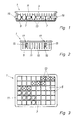
- fig. 1
- shows a tray with insert according to the invention in a first embodiment seen in section,
- fig. 2
- shows the same as in fig. 1, but at right angles hereto and not in section,
- fig. 3
- shows a second embodiment of the tray according to the invention seen from above, and
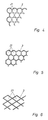
- fig. 4 - 6
- show different other embodiments of the insert for the tray.
- In a first embodiment of the invention, the
tray 1 is injection moulded in plastic material and provided withperforations 13 in the bottom andopenings 16 in thesides 11 to allow the passage of air. A grid-shaped insert 3 withsquare openings 5 stands onfeet 7 on the bottom 9 of the tray. The dimension of the openings allows the passage of the largest possible eggs derived from the relevant kind of poultry. - In the embodiment shown, the tray has
sides 11 upwards to openslots 15 withledges 17.Projections 19 extending from theinsert 3 rest in or merely project through theslots 15. Theinsert 3 can be lifted by theprojections 19 and possibly placed near to the upper edge of the tray, in that theprojections 19 rest on theledges 17. - In other embodiments, the
slots 15 could be closed at the top so that theinsert 3 is not able to fall out of the tray. Moreover, as shown in fig. 3, the tray could be without slots and the insert without the projections, in that theinsert 3 is removed completely when the eggs are to assume the hatching position. - Furthermore, the tray according to the invention can be provided with not-shown projections or flanges along the upper edge, or with pins and holes corresponding to the pins in the bottom, thus enabling the trays to be arranged in stacks which can easily be handled during the whole sequence of operations from when the eggs are introduced at the producer to the delivery of chickens to the place of rearing. Moreover, the trays can be provided with not-shown hook elements at the sides, hereby enabling
several trays 1 to be hooked together out of regard for placing in the incubators etc. - As shown in figs. 4-6, the
insert 3 can be configured withopenings 21 of different shapes, e.g. circular, honeycomb-shaped or parallelogram-shaped. - The
holes 13 in the bottom 9 of the tray are dimensioned so that the chickens cannot get their knee joints locked in them, but are still large enough to allow most of the smaller pieces of eggshell to pass through during mechanical cleaning of the trays. - With the method according to the invention, the eggs are placed in the
trays 1 withinserts 3 at the producers, the trays are stacked and driven to the hatchery. Here, they are put through the process as described in the introduction and in the principle with the trays in stacks, in that the eggs are disinfected and placed in the incubator. Here, the trays can be placed on tiltable shelves in the incubator carriage in the same manner as with hitherto-known techniques, or, in a further development, whole stacks of trays are placed in special tilting racks which, during the period of incubation, tilt the stacks in the same way as hitherto known. If, during the incubation, it is desired to avoid movement of the eggs in relation to theinserts 3, it is possible for theinserts 3 to be produced with not-shown yielding projections which extend from the wall of the insert into theopenings 5 in such a manner that the eggs are supported laterally but still remain in thetray 1 when theinsert 3 is lifted. For the transillumination, thetrays 1 are taken down on the light cabinet as per hitherto-known incubation trays, and in ordet to increase the translucence through the bottom 9, the tray can be made of a relatively translucent material. - After incubation, one can proceed with the hatching process in two ways. With the first, there is used a tray with insert as shown in fig. 3, and the inserts are removed from each tray, whereupon the eggs roll on to their sides. With the second way, a tray as shown in figs. 1-2 is used, where the
projections 19 are operated by being lifted upwards with automatically-controlled elements arranged in the carriages the trays are standing in, or possiblly by means of elements in the hatching cabinet, which possibly can be a further development of the hitherto-known incubator. Thus with theprojections 19 resting on theledges 17, the hatching can proceed in the normal manner with the eggs in the lying position. Hereafter, the chickens can be removed manually from the trays, which are then cleaned of shell, dust etc., and the chickens are counted and transferred to the cleaned trays of the same kind as the incubation/hatching trays. The trays with the chickens are then stacked again on pallets or in wheeled crates for dispatch by truck to the place of rearing. The invention provides the possibility of the chickens being able to be dispatched immediately after being hatched in the trays in which the hatching has taken place, i.e. without cleaning of the trays, possibly merely after the removal of unhatched eggs and larger pieces of egg-shell.
Claims (5)
- Method for use in hatching operations, during which there is used a tray system for the transport, incubation and hatching of eggs, comprising the process stages of incubation and hatching, in which the eggs are allowed to remain in the same trays (1), standing upright on their tapered ends during the incubation and lying on their sides during the hatching, and where before the incubation the eggs are placed in the trays (1), each of which is provided with an insert (3) for the supporting of the eggs and which transversely to its extent has openings (5) characterized in that during incubation the eggs rest on an even bottom of the trays, and that after incubation and before the hatching the inserts (3) are displaced upwards in relation to the bottom (9) of a tray, whereby the openings (5) in the inserts (3) pass around the eggs which thereafter tilt to lie on the bottom (9) of the trays (1).
- Method according to claim 1, characterized in that the inserts (3) are lifted up by means disposed at or through the sides of the tray.
- Tray system for use in the transport, incubation and hatching of eggs during hatchery operations in the methods according to claim 1, and comprising trays (1) provided with a perforated bottom (9), in relation to which sides (11) along the edges extend uniformly upwards, and where in each tray (1) there is placed an insert (3) which is parallel with the bottom (9), said insert (3) having an extent which is substantially the same as said bottom (9), and which transversely to its extent has openings (5) arranged to support eggs standing upright on their tapered ends, characterized in that the bottom of each tray is substantially even and without pins or partition walls, and in that the insert (3) is loosely supported by the bottom (9) or by the sides (11) at a distance from the upwardly-facing free edges of the sides, whereby the insert (3) is displaceable upwards in relation to the bottom (9) of the tray.
- Tray system according to claim 3, characterized in that the sides (11) of a tray (1) have slots (15) through which the insert (3) can be made to move in relation to the bottom (9) by means outside the tray (1).
- Tray system according to claim 4, characterized in that the slots (15) near the free edge of the sides have a ledge (17) or similar means on which projections (19) on the insert (3) can be supported.
Priority Applications (1)
| Application Number | Priority Date | Filing Date | Title |
|---|---|---|---|
| AT89203166T ATE95380T1 (en) | 1988-12-20 | 1989-12-11 | PROCEDURES AND RECORDS FOR USE DURING HATCHING. |
Applications Claiming Priority (2)
| Application Number | Priority Date | Filing Date | Title |
|---|---|---|---|
| DK7108/88 | 1988-12-20 | ||
| DK710888A DK163095C (en) | 1988-12-20 | 1988-12-20 | BAKING SYSTEM FOR USE IN BACKGROUND OPERATION, PROCEDURE FOR USING THE BAKING SYSTEM AND USING A BAKING SYSTEM |
Publications (2)
| Publication Number | Publication Date |
|---|---|
| EP0375030A1 EP0375030A1 (en) | 1990-06-27 |
| EP0375030B1 true EP0375030B1 (en) | 1993-10-06 |
Family
ID=8149211
Family Applications (1)
| Application Number | Title | Priority Date | Filing Date |
|---|---|---|---|
| EP89203166A Expired - Lifetime EP0375030B1 (en) | 1988-12-20 | 1989-12-11 | Method and tray system for use in hatching operations |
Country Status (6)
| Country | Link |
|---|---|
| US (1) | US5046454A (en) |
| EP (1) | EP0375030B1 (en) |
| AT (1) | ATE95380T1 (en) |
| CA (1) | CA2005929A1 (en) |
| DE (2) | DE68909761D1 (en) |
| DK (1) | DK163095C (en) |
Cited By (1)
| Publication number | Priority date | Publication date | Assignee | Title |
|---|---|---|---|---|
| US7861673B2 (en) | 2006-04-11 | 2011-01-04 | Life-Science Innovations, Llc | Egg incubation transport system and methods regarding same |
Families Citing this family (18)
| Publication number | Priority date | Publication date | Assignee | Title |
|---|---|---|---|---|
| JPH08502882A (en) * | 1989-03-16 | 1996-04-02 | ザ マーモン コーポレイション オブ カナダ,リミテッド | Method and apparatus for incubating and hatching eggs |
| US5146871A (en) * | 1991-09-24 | 1992-09-15 | Chick Master Incubator Company | Incubator and hatcher tray |
| USD346324S (en) | 1992-06-17 | 1994-04-26 | Warren Steve R | Incubator egg tray |
| DE4407407C2 (en) * | 1994-03-05 | 1995-12-14 | Rainer Dratt | Method and device for incubating eggs |
| AU733629B2 (en) * | 1996-06-25 | 2001-05-17 | Foster Poultry Farms. | Stacking trays |
| DE19750398C1 (en) * | 1997-11-14 | 1999-07-01 | Rainer Dratt | Breeding process and device for the continuous incubation of eggs of all types of poultry |
| FR2838605B1 (en) * | 2002-04-18 | 2004-07-16 | Hubbard Isa | METHOD OF INCUBATING AND HATCHING BIRD EGGS AND DEVICE FOR IMPLEMENTING SAME |
| RU2253968C2 (en) * | 2002-12-17 | 2005-06-20 | Южно-Российский государственный технический университет (Новочеркасский политехнический институт) ЮРГТУ (НПИ) | Incubator for producing of farm bird stock |
| PT1909561E (en) * | 2005-07-25 | 2010-05-06 | Basf Se | A method for providing and analyzing an animal population having an essentially identical metabolome |
| NL1029714C2 (en) * | 2005-08-11 | 2007-02-19 | Ven Beheer B V Van De | Method and system for hatching eggs. |
| NL2010301C2 (en) * | 2013-02-14 | 2014-08-18 | Hatchtech Group Bv | Tray for incubating eggs. |
| CN104585071A (en) * | 2015-01-05 | 2015-05-06 | 青岛平度市金巢机械有限责任公司 | Hatching egg conveying device for laying nest |
| CN107801695A (en) * | 2016-09-09 | 2018-03-16 | 深圳华云生物科技有限公司 | It is a kind of using kitchen garbage automatic feeding and hatch black soldier flies method and system |
| NL2021127B1 (en) * | 2018-06-15 | 2019-12-20 | Hatchtech Group Bv | Egg tray for supporting eggs in an incubation chamber |
| CN109006680B (en) * | 2018-08-14 | 2020-12-08 | 六安联众工业自动化技术有限公司 | Method for improving hatching rate of egg poultry |
| CN109122396B (en) * | 2018-08-14 | 2020-09-08 | 浏阳市月亮岛农业科技开发有限公司 | Egg livestock hatching apparatus based on internet |
| CN110521634B (en) * | 2019-10-11 | 2021-08-24 | 湖南鸿羽溆浦鹅业发展有限公司 | Hatching machine |
| CN113341809B (en) * | 2021-06-08 | 2023-02-03 | 仲恺农业工程学院 | Young pigeon incubation information acquisition system and acquisition method |
Family Cites Families (16)
| Publication number | Priority date | Publication date | Assignee | Title |
|---|---|---|---|---|
| US389625A (en) * | 1888-09-18 | Egg-testing packet | ||
| US1203938A (en) * | 1915-12-10 | 1916-11-07 | Joseph Andrew Terrio | Egg-handling device. |
| US1369323A (en) * | 1920-03-10 | 1921-02-22 | Clairemont Victor | Apparatus for preserving eggs |
| US1501292A (en) * | 1922-06-10 | 1924-07-15 | Smith Seward | Egg-turning device |
| US1564217A (en) * | 1925-03-30 | 1925-12-08 | Harrison G Dotterer | Egg tray |
| US1672774A (en) * | 1927-08-11 | 1928-06-05 | Charles T Patterson | Egg tray |
| US2087044A (en) * | 1936-05-25 | 1937-07-13 | Herbert H Reiners | Incubator egg tray |
| US2255036A (en) * | 1939-08-15 | 1941-09-09 | Buckeye Incubator Company | Incubator tray |
| US2266648A (en) * | 1940-08-17 | 1941-12-16 | Henry C Mack | Expansible egg incubator and hatcher tray |
| US2846976A (en) * | 1955-01-31 | 1958-08-12 | Martin T Moller | Egg holder for incubator tray |
| US3003463A (en) * | 1958-01-15 | 1961-10-10 | Rijcke Norbert Cyriel De | Hatching drawers |
| CH424402A (en) * | 1964-08-03 | 1966-11-15 | Burckhardt Ag Maschf | Concentric suction and pressure valve |
| US4250834A (en) * | 1979-06-20 | 1981-02-17 | Stephen Cheselka | Pet sanitary facility |
| US4398499A (en) * | 1982-04-07 | 1983-08-16 | Blakely John R | Poultry incubation and hatching tray |
| CA1169308A (en) * | 1982-06-25 | 1984-06-19 | Justus A. Derx | Litter box |
| US4615300A (en) * | 1985-05-13 | 1986-10-07 | Mcdonough John P | Litter box liner |
-
1988
- 1988-12-20 DK DK710888A patent/DK163095C/en not_active IP Right Cessation
-
1989
- 1989-12-11 AT AT89203166T patent/ATE95380T1/en active
- 1989-12-11 EP EP89203166A patent/EP0375030B1/en not_active Expired - Lifetime
- 1989-12-11 DE DE89203166A patent/DE68909761D1/en not_active Expired - Fee Related
- 1989-12-11 DE DE68909761T patent/DE68909761T4/en not_active Expired - Lifetime
- 1989-12-13 US US07/450,595 patent/US5046454A/en not_active Expired - Fee Related
- 1989-12-19 CA CA002005929A patent/CA2005929A1/en not_active Abandoned
Cited By (2)
| Publication number | Priority date | Publication date | Assignee | Title |
|---|---|---|---|---|
| US7861673B2 (en) | 2006-04-11 | 2011-01-04 | Life-Science Innovations, Llc | Egg incubation transport system and methods regarding same |
| US8069819B2 (en) | 2006-04-11 | 2011-12-06 | Life-Science Innovations, Llc | Egg incubation transport system and methods regarding same |
Also Published As
| Publication number | Publication date |
|---|---|
| US5046454A (en) | 1991-09-10 |
| DE68909761T2 (en) | 1994-05-05 |
| DE68909761D1 (en) | 1993-11-11 |
| CA2005929A1 (en) | 1990-06-20 |
| DK163095B (en) | 1992-01-20 |
| DK710888A (en) | 1990-06-21 |
| DK163095C (en) | 1992-06-15 |
| DK710888D0 (en) | 1988-12-20 |
| ATE95380T1 (en) | 1993-10-15 |
| EP0375030A1 (en) | 1990-06-27 |
| DE68909761T4 (en) | 1995-10-19 |
Similar Documents
| Publication | Publication Date | Title |
|---|---|---|
| US5046454A (en) | Tray system for incubation and hatching operations, method during use of the tray system and use of the tray system | |
| US11832599B2 (en) | Insect breeding | |
| US5179913A (en) | Method and apparatus for incubating and hatching eggs | |
| US10595517B2 (en) | Insect spawning container, facility and method for breeding insects | |
| NL2014513B1 (en) | Method and facility for breeding insects. | |
| RU2650688C2 (en) | Pallet for eggs incubation | |
| US20180055021A1 (en) | Method and facility for breeding insects | |
| CN107072176B (en) | Egg tray, components including the same, and method of hatching a plurality of eggs | |
| US9737056B2 (en) | Portable basket colony for growing and transport and method of use | |
| US4398499A (en) | Poultry incubation and hatching tray | |
| US3888211A (en) | Poultry raising system and process | |
| RU2129360C1 (en) | Egg incubation method and apparatus | |
| WO2018002901A1 (en) | Container for hatching of incubated eggs in a poultry house | |
| US20240099280A1 (en) | Installation for rearing arthropods in multi-tiered modules | |
| US5146871A (en) | Incubator and hatcher tray | |
| US3777710A (en) | Automated systems for raising and transporting broilers | |
| EP0184266B1 (en) | Device for keeping animals | |
| IE950096A1 (en) | A poultry egg processing system | |
| EP3632204B1 (en) | Device for transporting and hatching eggs on farm breeding | |
| RU2791877C2 (en) | Device for transportation and incubation of eggs in farms | |
| US11484013B1 (en) | Portable basket colony for growing and transport with stackable standoff | |
| BE1025719B1 (en) | Improved hatching process of eggs in hatcheries. | |
| WO2007018430A1 (en) | Method and system for incubating and hatching of eggs | |
| WO2015153879A2 (en) | Portable basket colony for growing and transport and method of use | |
| WO2021110892A1 (en) | Hatching tray assembly |
Legal Events
| Date | Code | Title | Description |
|---|---|---|---|
| PUAI | Public reference made under article 153(3) epc to a published international application that has entered the european phase |
Free format text: ORIGINAL CODE: 0009012 |
|
| AK | Designated contracting states |
Kind code of ref document: A1 Designated state(s): AT BE CH DE ES FR GB GR IT LI LU NL SE |
|
| 17P | Request for examination filed |
Effective date: 19900727 |
|
| 17Q | First examination report despatched |
Effective date: 19911106 |
|
| GRAA | (expected) grant |
Free format text: ORIGINAL CODE: 0009210 |
|
| AK | Designated contracting states |
Kind code of ref document: B1 Designated state(s): AT BE CH DE ES FR GB GR IT LI LU NL SE |
|
| PG25 | Lapsed in a contracting state [announced via postgrant information from national office to epo] |
Ref country code: IT Free format text: LAPSE BECAUSE OF FAILURE TO SUBMIT A TRANSLATION OF THE DESCRIPTION OR TO PAY THE FEE WITHIN THE PRE;WARNING: LAPSES OF ITALIAN PATENTS WITH EFFECTIVE DATE BEFORE 2007 MAY HAVE OCCURRED AT ANY TIME BEFORE 2007. THE CORRECT EFFECTIVE DATE MAY BE DIFFERENT FROM THE ONE RECORDED.SCRIBED TIME-LIMIT Effective date: 19931006 Ref country code: GR Free format text: LAPSE BECAUSE OF FAILURE TO SUBMIT A TRANSLATION OF THE DESCRIPTION OR TO PAY THE FEE WITHIN THE PRESCRIBED TIME-LIMIT Effective date: 19931006 Ref country code: SE Effective date: 19931006 Ref country code: AT Effective date: 19931006 Ref country code: ES Free format text: THE PATENT HAS BEEN ANNULLED BY A DECISION OF A NATIONAL AUTHORITY Effective date: 19931006 Ref country code: BE Effective date: 19931006 Ref country code: FR Effective date: 19931006 Ref country code: CH Effective date: 19931006 Ref country code: NL Effective date: 19931006 Ref country code: LI Effective date: 19931006 |
|
| REF | Corresponds to: |
Ref document number: 95380 Country of ref document: AT Date of ref document: 19931015 Kind code of ref document: T |
|
| REF | Corresponds to: |
Ref document number: 68909761 Country of ref document: DE Date of ref document: 19931111 |
|
| PG25 | Lapsed in a contracting state [announced via postgrant information from national office to epo] |
Ref country code: LU Free format text: LAPSE BECAUSE OF NON-PAYMENT OF DUE FEES Effective date: 19931231 |
|
| PG25 | Lapsed in a contracting state [announced via postgrant information from national office to epo] |
Ref country code: GB Effective date: 19940106 |
|
| REG | Reference to a national code |
Ref country code: CH Ref legal event code: PL |
|
| EN | Fr: translation not filed | ||
| NLV1 | Nl: lapsed or annulled due to failure to fulfill the requirements of art. 29p and 29m of the patents act | ||
| PLBE | No opposition filed within time limit |
Free format text: ORIGINAL CODE: 0009261 |
|
| STAA | Information on the status of an ep patent application or granted ep patent |
Free format text: STATUS: NO OPPOSITION FILED WITHIN TIME LIMIT |
|
| GBPC | Gb: european patent ceased through non-payment of renewal fee |
Effective date: 19940106 |
|
| 26N | No opposition filed | ||
| PGFP | Annual fee paid to national office [announced via postgrant information from national office to epo] |
Ref country code: DE Payment date: 19961129 Year of fee payment: 8 |
|
| PG25 | Lapsed in a contracting state [announced via postgrant information from national office to epo] |
Ref country code: DE Free format text: LAPSE BECAUSE OF NON-PAYMENT OF DUE FEES Effective date: 19980901 |