EP0374548B1 - System for package multiplexing in transmission of data streams generated by the same algorithm - Google Patents
System for package multiplexing in transmission of data streams generated by the same algorithm Download PDFInfo
- Publication number
- EP0374548B1 EP0374548B1 EP89122217A EP89122217A EP0374548B1 EP 0374548 B1 EP0374548 B1 EP 0374548B1 EP 89122217 A EP89122217 A EP 89122217A EP 89122217 A EP89122217 A EP 89122217A EP 0374548 B1 EP0374548 B1 EP 0374548B1
- Authority
- EP
- European Patent Office
- Prior art keywords
- data
- data streams
- information
- transmission
- package
- Prior art date
- Legal status (The legal status is an assumption and is not a legal conclusion. Google has not performed a legal analysis and makes no representation as to the accuracy of the status listed.)
- Expired - Lifetime
Links
- 230000005540 biological transmission Effects 0.000 title claims description 15
- 238000012937 correction Methods 0.000 claims description 4
- 238000012545 processing Methods 0.000 claims description 3
- 238000010420 art technique Methods 0.000 description 4
- 238000000034 method Methods 0.000 description 3
- 238000010276 construction Methods 0.000 description 2
- 230000006978 adaptation Effects 0.000 description 1
- 230000003044 adaptive effect Effects 0.000 description 1
- 238000004891 communication Methods 0.000 description 1
- 238000000605 extraction Methods 0.000 description 1
- 238000007781 pre-processing Methods 0.000 description 1
Images

Classifications
-
- H—ELECTRICITY
- H04—ELECTRIC COMMUNICATION TECHNIQUE
- H04N—PICTORIAL COMMUNICATION, e.g. TELEVISION
- H04N21/00—Selective content distribution, e.g. interactive television or video on demand [VOD]
- H04N21/20—Servers specifically adapted for the distribution of content, e.g. VOD servers; Operations thereof
- H04N21/23—Processing of content or additional data; Elementary server operations; Server middleware
- H04N21/238—Interfacing the downstream path of the transmission network, e.g. adapting the transmission rate of a video stream to network bandwidth; Processing of multiplex streams
- H04N21/2383—Channel coding or modulation of digital bit-stream, e.g. QPSK modulation
-
- H—ELECTRICITY
- H04—ELECTRIC COMMUNICATION TECHNIQUE
- H04N—PICTORIAL COMMUNICATION, e.g. TELEVISION
- H04N21/00—Selective content distribution, e.g. interactive television or video on demand [VOD]
- H04N21/20—Servers specifically adapted for the distribution of content, e.g. VOD servers; Operations thereof
- H04N21/23—Processing of content or additional data; Elementary server operations; Server middleware
- H04N21/236—Assembling of a multiplex stream, e.g. transport stream, by combining a video stream with other content or additional data, e.g. inserting a URL [Uniform Resource Locator] into a video stream, multiplexing software data into a video stream; Remultiplexing of multiplex streams; Insertion of stuffing bits into the multiplex stream, e.g. to obtain a constant bit-rate; Assembling of a packetised elementary stream
-
- H—ELECTRICITY
- H04—ELECTRIC COMMUNICATION TECHNIQUE
- H04N—PICTORIAL COMMUNICATION, e.g. TELEVISION
- H04N21/00—Selective content distribution, e.g. interactive television or video on demand [VOD]
- H04N21/40—Client devices specifically adapted for the reception of or interaction with content, e.g. set-top-box [STB]; Operations thereof
- H04N21/43—Processing of content or additional data, e.g. demultiplexing additional data from a digital video stream; Elementary client operations, e.g. monitoring of home network or synchronising decoder's clock; Client middleware
- H04N21/434—Disassembling of a multiplex stream, e.g. demultiplexing audio and video streams, extraction of additional data from a video stream; Remultiplexing of multiplex streams; Extraction or processing of SI; Disassembling of packetised elementary stream
-
- H—ELECTRICITY
- H04—ELECTRIC COMMUNICATION TECHNIQUE
- H04N—PICTORIAL COMMUNICATION, e.g. TELEVISION
- H04N21/00—Selective content distribution, e.g. interactive television or video on demand [VOD]
- H04N21/40—Client devices specifically adapted for the reception of or interaction with content, e.g. set-top-box [STB]; Operations thereof
- H04N21/43—Processing of content or additional data, e.g. demultiplexing additional data from a digital video stream; Elementary client operations, e.g. monitoring of home network or synchronising decoder's clock; Client middleware
- H04N21/438—Interfacing the downstream path of the transmission network originating from a server, e.g. retrieving encoded video stream packets from an IP network
- H04N21/4382—Demodulation or channel decoding, e.g. QPSK demodulation
-
- H—ELECTRICITY
- H04—ELECTRIC COMMUNICATION TECHNIQUE
- H04N—PICTORIAL COMMUNICATION, e.g. TELEVISION
- H04N7/00—Television systems
- H04N7/24—Systems for the transmission of television signals using pulse code modulation
Definitions
- the present invention relates to a system for the transmission of e.g. a video signal coming from a source and processed by means of an algorithm which, to minimise the data to be transmitted (values and parameters) and then reduce the bands necessary for transmission or storage, generates values that can be encoded and then multiplexed or stored.
- Digital transmission systems for television signals generally use algorithms for redundancy reduction which mainly aim at reducing the volume of data to be transmitted with respect to the quantity of data generated by the video source.
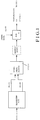
- These systems particularly those of the adaptive type (see Figure 1), generate two data streams, when an algorithm A(2) is applied to the source of the television signal S(1).
- the first data stream VN(3) generally encoded with variable length, corresponds to the video source signal subjected to the algorithm processing;
- the second data stream PA(4) describes the manner in which the algorithm used for redundancy reduction has processed the video source signal within each half-frame or suitable blocks in which the video signal was subdivided, and further information relating to the correspondence among the encoded data VN(3) and the blocks in which the source signal was divided, among other data.
- a video frame former TV(24) that alternately processes the signals VN(3) corresponding to the single video information, which have synchronisation words or special words delimiting the video data blocks inserted at suitable intervals, and the ancillary data PA(4) which describe, for suitable blocks of video signal points (at an upper limit, the whole television half-frame) the parameters of data that describe the condition of the mechanism used for redundancy reduction. Therefore, the prior-art techniques utilise a video frame former TV(24) which mixes two data streams VN(3) and PA(4) into a single data stream, and apply particular provisions so that, during reception, it is possible to separate the two data streams.
- the information stream generated by TV(24) is generally sent to a buffer B(25) and a multiplexer MUX 5 that generates a frame including further data AD(9) (e.g. audio channels) and an error correction code, for transmitting or storing all information.
- AD(9) e.g. audio channels
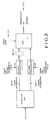
- the lateral information SIA(7) and the value information SN(6) follow separate paths and are mixed within a multiplexer MUX′ 8 that is provided on the transmission or storage line. It can be seen in Figure 2 that the source data values SN(6) and ancillary lateral information values SIA(7), before entering the multiplexer MUX′ 8, are each subjected to a pre-processing named "package construction" CP1, respectively CP2 which involves substantially the following operations:
- MUX′ 8 which may be implemented by any well known technique, carries out the data transmission or the storage T/M′(10′) after other necessary or optional data AD′(9′), as shown in Figure 1 at AD(9), have been added.
- the package CP2 is transmitted with priority as soon as the source SIA(7) has generated a sufficient amount of data to fill one package, so that this priority information is available at the reception in advance of the information SN(6), which is generally subjected to a transmission delay via a buffer BN(11) that further suspends the transmission of packages CP1 when the transmission of packages CP2 is required with priority.
- the packages corresponding to the lateral data are introduced into the frame of the line multiplexer in predetermined positions, or they are fixed with respect to the frame to simplify their extraction from the reception multiplexer.
- Figure 2 shows that the construction of packages is made for both data streams SN(6) and SIA(7), as this is the preferred embodiment of the invention, even if it is generally sufficient to packetise only the data SIA(7) to obtain the great advantage of avoiding mixing of the data.
- an error correction code for protecting the source signal is used, and this code generates a data block
- data block can be used in an efficient manner as a data package (see e.g. W.W. Peterson and E.U. Woldon, "Error Correcting Codes", Second Edition, MIT Press).
- BCH code Base-Chaudhuri-Hocquenghem
- Figure 3 shows the information block corresponding to the BCH block (239, 255) with interleaving 16.
- 16 words are typically used for the redundancy information necessary for error correction.
- the other 239 available words are the specific information (values or lateral information), the source information, the frame information and the other information necessary for the package management.
- the first word P(21) can be used for recognising the type of source signal, for example SN(6) or SIA(7);
- the second word P(22) can be used for recognising the first information transmitted in the package;
- the third word P(23) can be a buffer padding (if present); the fourth the package numbering, if necessary. All information coming from the source are successively written into the package until it is full.
- the "package constructors" CP1 and CP2 used in the invention can be made using prior-art techniques and very simple conventional means, for example a dual-port RAM and a memory controller.
- the controller emits the data coming from the algorithm in the dual-port RAM, inserts frame and management information at predetermined positions the package source and transfers the packages successively to the buffer or directly to the multiplexer.
- the controller can be made with registers and flip-flops or, using a more advanced implementation, with a program-controlled microprocessor which carries out the management of the dual-port RAM, where the package is stored before being transmitted to the multiplexer or to the buffer.
- the RAM can be made of a standard RAM.
Landscapes
- Engineering & Computer Science (AREA)
- Multimedia (AREA)
- Signal Processing (AREA)
- Time-Division Multiplex Systems (AREA)
- Compression Or Coding Systems Of Tv Signals (AREA)
- Compression, Expansion, Code Conversion, And Decoders (AREA)
- Data Exchanges In Wide-Area Networks (AREA)
Description
- The present invention relates to a system for the transmission of e.g. a video signal coming from a source and processed by means of an algorithm which, to minimise the data to be transmitted (values and parameters) and then reduce the bands necessary for transmission or storage, generates values that can be encoded and then multiplexed or stored.
- Digital transmission systems for television signals generally use algorithms for redundancy reduction which mainly aim at reducing the volume of data to be transmitted with respect to the quantity of data generated by the video source. These systems, particularly those of the adaptive type (see Figure 1), generate two data streams, when an algorithm A(2) is applied to the source of the television signal S(1). The first data stream VN(3), generally encoded with variable length, corresponds to the video source signal subjected to the algorithm processing; the second data stream PA(4) describes the manner in which the algorithm used for redundancy reduction has processed the video source signal within each half-frame or suitable blocks in which the video signal was subdivided, and further information relating to the correspondence among the encoded data VN(3) and the blocks in which the source signal was divided, among other data.
- To transmit the information generated by the algorithm (VN(3)+PA(4)) according to prior-art techniques, a video frame former TV(24) is used that alternately processes the signals VN(3) corresponding to the single video information, which have synchronisation words or special words delimiting the video data blocks inserted at suitable intervals, and the ancillary data PA(4) which describe, for suitable blocks of video signal points (at an upper limit, the whole television half-frame) the parameters of data that describe the condition of the mechanism used for redundancy reduction. Therefore, the prior-art techniques utilise a video frame former TV(24) which mixes two data streams VN(3) and PA(4) into a single data stream, and apply particular provisions so that, during reception, it is possible to separate the two data streams. These provisions are simpler if the alternation between VN(3) and PA(4) is made at each half-frame, but in this case, disadvantageously a whole television half-frame must be stored before that all lateral data are known and available for transmission. Further, according to prior-art techniques, the information stream generated by TV(24) is generally sent to a buffer B(25) and a
multiplexer MUX 5 that generates a frame including further data AD(9) (e.g. audio channels) and an error correction code, for transmitting or storing all information. - The general technique of packetising several separate data streams for subsequent multiplexing is known in the field of data communication, specifically in connection with video transmission; compare IEEE GLOBAL TELECOMMUNICATIONS CONFERENCE & EXHIBITION, Hollywood, FL, 28th November - 1st December 1988, vol. 2, pages 767-772: IEEE TRANSACTIONS ON COMMUNICATIONS, vol. 36, No. 7, July 1988, pages 834-842: and GLOBECOM 1985, IEEE GLOBAL TELECOMMUNICATIONS CONFERENCE, New Orleans, 2nd - 5th December 1985, vol. 1, pages 363-367.
- It is an object of the present invention to provide a data packet transmission system which is less sensitive to transmission errors, yet allows implementation by comparatively inexpensive circuitry. This object is met by the system set forth in
claim 1. - The present invention will become apparent from the following description in conjunction with the accompanying drawings, in which:
- Figure 1
- shows the prior art system for transmitting television signals discussed above;
- Figure 2
- illustrates the preferred embodiment of the present invention; and
- Figure 3
- shows a block of information transmitted with the system of the present invention.
- As shown in Figure 2, the lateral information SIA(7) and the value information SN(6) follow separate paths and are mixed within a
multiplexer MUX′ 8 that is provided on the transmission or storage line. It can be seen in Figure 2 that the source data values SN(6) and ancillary lateral information values SIA(7), before entering the multiplexer MUX′ 8, are each subjected to a pre-processing named "package construction" CP1, respectively CP2 which involves substantially the following operations: - (1) subdividing the information into parts having the same length for forming the packages CP1;
- (2) adding the source and frame information ITS(1) and ITS(2) to each package CP1 and CP2, respectively, so that the meaning of the transmitted information can be recognised at reception;
- (3) adding to the packages CP1 and CP2 information necessary for its management (not shown).
- The packages CP1, CP2, which are formed in this manner, enter a multiplexer MUX′ 8, which may be implemented by any well known technique, carries out the data transmission or the storage T/M′(10′) after other necessary or optional data AD′(9′), as shown in Figure 1 at AD(9), have been added.
- It must be emphasised that the package CP2 is transmitted with priority as soon as the source SIA(7) has generated a sufficient amount of data to fill one package, so that this priority information is available at the reception in advance of the information SN(6), which is generally subjected to a transmission delay via a buffer BN(11) that further suspends the transmission of packages CP1 when the transmission of packages CP2 is required with priority.
- The packages corresponding to the lateral data are introduced into the frame of the line multiplexer in predetermined positions, or they are fixed with respect to the frame to simplify their extraction from the reception multiplexer.
- Figure 2 shows that the construction of packages is made for both data streams SN(6) and SIA(7), as this is the preferred embodiment of the invention, even if it is generally sufficient to packetise only the data SIA(7) to obtain the great advantage of avoiding mixing of the data.
- Further, if an error correction code for protecting the source signal is used, and this code generates a data block, such data block can be used in an efficient manner as a data package (see e.g. W.W. Peterson and E.U. Woldon, "Error Correcting Codes", Second Edition, MIT Press). For example, if BCH code (Base-Chaudhuri-Hocquenghem) (239, 255) is used with interleaving 16, a structure can be provided which is similar to that represented in Figure 3 for defining the package. Figure 3 shows the information block corresponding to the BCH block (239, 255) with interleaving 16.
- In the case shown, the block is made up of 255 words (code length = LG), each word P(21) being formed of 16 bits. Among these 255 words, 16 words are typically used for the redundancy information necessary for error correction. The other 239 available words are the specific information (values or lateral information), the source information, the frame information and the other information necessary for the package management. For example, the first word P(21) can be used for recognising the type of source signal, for example SN(6) or SIA(7); the second word P(22) can be used for recognising the first information transmitted in the package; the third word P(23) can be a buffer padding (if present); the fourth the package numbering, if necessary. All information coming from the source are successively written into the package until it is full.
- The system of the embodiment shown in Figure 2 has many advantages with respect to the classic structures (e.g. the one of Figure 1) in that:
- (1) it avoids mixing of data with different meaning (values and lateral information), thus making the data streams completed in the above manner resistant to errors;
- (2) it allows, during the reconstruction phase, an easy assignment of the data, as the source and frame information is associated to each package, without needing complex frames;
- (3) it allows an easy adaptation of the system to various transmission or storage speeds, although data streams of constant speed (e.g. lateral information) and data streams of a variable speed occur at the multiplexer input.
- The "package constructors" CP1 and CP2 used in the invention can be made using prior-art techniques and very simple conventional means, for example a dual-port RAM and a memory controller. The controller emits the data coming from the algorithm in the dual-port RAM, inserts frame and management information at predetermined positions the package source and transfers the packages successively to the buffer or directly to the multiplexer. The controller can be made with registers and flip-flops or, using a more advanced implementation, with a program-controlled microprocessor which carries out the management of the dual-port RAM, where the package is stored before being transmitted to the multiplexer or to the buffer. Alternatively, if the speed of data stream allows, the RAM can be made of a standard RAM.
Claims (2)
- A system for transmitting a signal (S1) from a signal source, including means for processing the signal with a redundancy reduction algorithm (A2), thereby forming at least two data streams (SN6, SIA7), one representing value information of the signal and another one representing lateral information relating to the algorithm used, means for encoding the data streams, and means (8) for multiplexing the data prior to transmission or storage, characterised in that each of the two data streams formed from the same signal by said algorithm processing is separately ordered in packages (CP1, CP2) with the addition of information necessary to define the source, frame and management of each package, and that the sequences of packages thus formed are supplied to said multiplexing means (8).
- The system of claim 1 wherein, in forming said packages, an error correction code is used which is in the form of a block code predetermined for all data streams.
Applications Claiming Priority (2)
| Application Number | Priority Date | Filing Date | Title |
|---|---|---|---|
| IT8823036A IT1228109B (en) | 1988-12-21 | 1988-12-21 | PACKAGE PREMULTIPLATION SYSTEM AND DEVICE FOR TRANSMISSION OF MULTIPLE DATA FLOWS GENERATED BY A SINGLE ALGORITHM |
| IT2303688 | 1988-12-21 |
Publications (3)
| Publication Number | Publication Date |
|---|---|
| EP0374548A2 EP0374548A2 (en) | 1990-06-27 |
| EP0374548A3 EP0374548A3 (en) | 1990-12-12 |
| EP0374548B1 true EP0374548B1 (en) | 1995-11-08 |
Family
ID=11203133
Family Applications (1)
| Application Number | Title | Priority Date | Filing Date |
|---|---|---|---|
| EP89122217A Expired - Lifetime EP0374548B1 (en) | 1988-12-21 | 1989-12-01 | System for package multiplexing in transmission of data streams generated by the same algorithm |
Country Status (5)
| Country | Link |
|---|---|
| US (1) | US4970590A (en) |
| EP (1) | EP0374548B1 (en) |
| JP (1) | JP3011338B2 (en) |
| DE (1) | DE68924764T2 (en) |
| IT (1) | IT1228109B (en) |
Families Citing this family (15)
| Publication number | Priority date | Publication date | Assignee | Title |
|---|---|---|---|---|
| IT1228109B (en) | 1988-12-21 | 1991-05-28 | Telettra Spa M | PACKAGE PREMULTIPLATION SYSTEM AND DEVICE FOR TRANSMISSION OF MULTIPLE DATA FLOWS GENERATED BY A SINGLE ALGORITHM |
| DK0441168T3 (en) * | 1990-02-06 | 1996-11-18 | Alcatel Italia | System, packet structure and device for processing outgoing information from a signal encoder |
| JPH04117882A (en) * | 1990-09-07 | 1992-04-17 | Matsushita Electric Ind Co Ltd | Moving picture coder |
| USRE35093E (en) * | 1990-12-03 | 1995-11-21 | The Trustees Of Columbia University In The City Of New York | Systems and methods for coding even fields of interlaced video sequences |
| US5193004A (en) * | 1990-12-03 | 1993-03-09 | The Trustees Of Columbia University In The City Of New York | Systems and methods for coding even fields of interlaced video sequences |
| US5289276A (en) * | 1992-06-19 | 1994-02-22 | General Electric Company | Method and apparatus for conveying compressed video data over a noisy communication channel |
| US5442626A (en) * | 1993-08-24 | 1995-08-15 | At&T Corp. | Digital communications system with symbol multiplexers |
| US5376969A (en) * | 1993-11-15 | 1994-12-27 | Rca Thomson Licensing Corporation | Method and apparatus for conveying compressed video data over a noisy communication channel |
| US6020086A (en) * | 1996-04-11 | 2000-02-01 | U.S. Philips Corporation | Accumulator device for an electric and/or electronic apparatus having a curved shape |
| US6219100B1 (en) | 1996-05-30 | 2001-04-17 | U.S. Philips Corporation | Communication method between stations |
| US6351471B1 (en) | 1998-01-14 | 2002-02-26 | Skystream Networks Inc. | Brandwidth optimization of video program bearing transport streams |
| US6351474B1 (en) * | 1998-01-14 | 2002-02-26 | Skystream Networks Inc. | Network distributed remultiplexer for video program bearing transport streams |
| US8880709B2 (en) | 2001-09-12 | 2014-11-04 | Ericsson Television Inc. | Method and system for scheduled streaming of best effort data |
| WO2004095759A2 (en) * | 2003-04-22 | 2004-11-04 | Vitesse Semiconductor Corporation | Concatenated iterative forward error correction coding |
| US7693222B2 (en) * | 2003-08-13 | 2010-04-06 | Ericsson Television Inc. | Method and system for re-multiplexing of content-modified MPEG-2 transport streams using PCR interpolation |
Family Cites Families (5)
| Publication number | Priority date | Publication date | Assignee | Title |
|---|---|---|---|---|
| DE3029190A1 (en) * | 1980-08-01 | 1982-03-18 | Licentia Patent-Verwaltungs-Gmbh, 6000 Frankfurt | Differential PCM system for TV line reduction code - uses transform coding and spectral coefficient prediction to reduce TV transmitted line code |
| NL8600980A (en) * | 1986-04-18 | 1987-11-16 | Philips Nv | METHOD FOR TRANSMITTING UPDATE INFORMATION FOR A STILL VIDEO IMAGE |
| JPH0624341B2 (en) * | 1986-12-18 | 1994-03-30 | 三菱電機株式会社 | Multimedia data transmission system |
| GB8722394D0 (en) * | 1987-09-23 | 1987-10-28 | British Telecomm | Video coder |
| IT1228109B (en) | 1988-12-21 | 1991-05-28 | Telettra Spa M | PACKAGE PREMULTIPLATION SYSTEM AND DEVICE FOR TRANSMISSION OF MULTIPLE DATA FLOWS GENERATED BY A SINGLE ALGORITHM |
-
1988
- 1988-12-21 IT IT8823036A patent/IT1228109B/en active
-
1989
- 1989-12-01 EP EP89122217A patent/EP0374548B1/en not_active Expired - Lifetime
- 1989-12-01 DE DE68924764T patent/DE68924764T2/en not_active Expired - Lifetime
- 1989-12-21 JP JP1332465A patent/JP3011338B2/en not_active Expired - Lifetime
- 1989-12-21 US US07/454,682 patent/US4970590A/en not_active Expired - Lifetime
Also Published As
| Publication number | Publication date |
|---|---|
| JP3011338B2 (en) | 2000-02-21 |
| EP0374548A2 (en) | 1990-06-27 |
| IT1228109B (en) | 1991-05-28 |
| IT8823036A0 (en) | 1988-12-21 |
| DE68924764T2 (en) | 1996-07-11 |
| DE68924764D1 (en) | 1995-12-14 |
| JPH02271729A (en) | 1990-11-06 |
| EP0374548A3 (en) | 1990-12-12 |
| US4970590A (en) | 1990-11-13 |
Similar Documents
| Publication | Publication Date | Title |
|---|---|---|
| US5675585A (en) | Method and system for interleaving and deinterleaving SDH frames | |
| US6735213B2 (en) | Processing of telephony samples | |
| US4970590A (en) | System and device for package multiplexing in transmission of many data flows generated by a sole algorithm | |
| US4734768A (en) | Method for transmitting differential pulse code modulation (DPCM) values | |
| EP0978175B1 (en) | Apparatus and method for updating a program map table in a demultiplexer | |
| US6259703B1 (en) | Time slot assigner for communication system | |
| CA2472980A1 (en) | Communications system | |
| US5471477A (en) | Logical machine for processing control information of telecommunication transmission frames | |
| EP0818900B1 (en) | Digital signal multiplexing apparatus | |
| US7496656B2 (en) | Processing instruction words | |
| KR960000934B1 (en) | Transmission system using forward error correction | |
| JP3169350B2 (en) | Packet transmission system and packet transmission method | |
| US20020024969A1 (en) | Method and system for transmitting at least one client signal within a server signal | |
| JP3158758B2 (en) | Terminal adapter device and data transmission method | |
| JPH05344089A (en) | Radio transmission system | |
| KR930003202B1 (en) | Transmitting apparatus of digital picture image signal | |
| KR100237456B1 (en) | Frame structure for time divisional multiplex | |
| JP2728410B2 (en) | Frame synchronizer | |
| JPH0629952A (en) | Crc check system for time division multiplex line | |
| US8458761B2 (en) | Receiver | |
| US7071861B2 (en) | Apparatus and method for transmitting a digitized signal, and a data source and data sink to implement the method | |
| KR0171279B1 (en) | Error-correcting method of high bit rate digital subscriber loop | |
| JPH0653939A (en) | Parity counting system | |
| JPS6226930A (en) | Error correction decoder | |
| JP2002158710A (en) | Data transmitter |
Legal Events
| Date | Code | Title | Description |
|---|---|---|---|
| PUAI | Public reference made under article 153(3) epc to a published international application that has entered the european phase |
Free format text: ORIGINAL CODE: 0009012 |
|
| AK | Designated contracting states |
Kind code of ref document: A2 Designated state(s): BE CH DE ES FR GB GR LI NL SE |
|
| PUAL | Search report despatched |
Free format text: ORIGINAL CODE: 0009013 |
|
| RHK1 | Main classification (correction) |
Ipc: H04N 7/137 |
|
| AK | Designated contracting states |
Kind code of ref document: A3 Designated state(s): BE CH DE ES FR GB GR LI NL SE |
|
| 17P | Request for examination filed |
Effective date: 19910524 |
|
| RAP1 | Party data changed (applicant data changed or rights of an application transferred) |
Owner name: ALCATEL ITALIA SOCIETA PER AZIONI |
|
| 17Q | First examination report despatched |
Effective date: 19930708 |
|
| GRAA | (expected) grant |
Free format text: ORIGINAL CODE: 0009210 |
|
| AK | Designated contracting states |
Kind code of ref document: B1 Designated state(s): BE CH DE ES FR GB GR LI NL SE |
|
| PG25 | Lapsed in a contracting state [announced via postgrant information from national office to epo] |
Ref country code: BE Effective date: 19951108 Ref country code: ES Free format text: THE PATENT HAS BEEN ANNULLED BY A DECISION OF A NATIONAL AUTHORITY Effective date: 19951108 Ref country code: GR Free format text: LAPSE BECAUSE OF FAILURE TO SUBMIT A TRANSLATION OF THE DESCRIPTION OR TO PAY THE FEE WITHIN THE PRESCRIBED TIME-LIMIT Effective date: 19951108 |
|
| REF | Corresponds to: |
Ref document number: 68924764 Country of ref document: DE Date of ref document: 19951214 |
|
| PGFP | Annual fee paid to national office [announced via postgrant information from national office to epo] |
Ref country code: CH Payment date: 19951231 Year of fee payment: 7 |
|
| ET | Fr: translation filed | ||
| REG | Reference to a national code |
Ref country code: CH Ref legal event code: PL |
|
| PLBE | No opposition filed within time limit |
Free format text: ORIGINAL CODE: 0009261 |
|
| STAA | Information on the status of an ep patent application or granted ep patent |
Free format text: STATUS: NO OPPOSITION FILED WITHIN TIME LIMIT |
|
| 26N | No opposition filed | ||
| PG25 | Lapsed in a contracting state [announced via postgrant information from national office to epo] |
Ref country code: LI Free format text: LAPSE BECAUSE OF FAILURE TO SUBMIT A TRANSLATION OF THE DESCRIPTION OR TO PAY THE FEE WITHIN THE PRESCRIBED TIME-LIMIT Effective date: 19961231 Ref country code: CH Free format text: LAPSE BECAUSE OF FAILURE TO SUBMIT A TRANSLATION OF THE DESCRIPTION OR TO PAY THE FEE WITHIN THE PRESCRIBED TIME-LIMIT Effective date: 19961231 |
|
| PGFP | Annual fee paid to national office [announced via postgrant information from national office to epo] |
Ref country code: NL Payment date: 19991122 Year of fee payment: 11 |
|
| PG25 | Lapsed in a contracting state [announced via postgrant information from national office to epo] |
Ref country code: NL Free format text: LAPSE BECAUSE OF NON-PAYMENT OF DUE FEES Effective date: 20010701 |
|
| NLV4 | Nl: lapsed or anulled due to non-payment of the annual fee |
Effective date: 20010701 |
|
| REG | Reference to a national code |
Ref country code: GB Ref legal event code: IF02 |
|
| PGFP | Annual fee paid to national office [announced via postgrant information from national office to epo] |
Ref country code: SE Payment date: 20081212 Year of fee payment: 20 |
|
| PGFP | Annual fee paid to national office [announced via postgrant information from national office to epo] |
Ref country code: FR Payment date: 20081212 Year of fee payment: 20 |
|
| PGFP | Annual fee paid to national office [announced via postgrant information from national office to epo] |
Ref country code: DE Payment date: 20081219 Year of fee payment: 20 |
|
| PGFP | Annual fee paid to national office [announced via postgrant information from national office to epo] |
Ref country code: GB Payment date: 20081216 Year of fee payment: 20 |
|
| REG | Reference to a national code |
Ref country code: GB Ref legal event code: PE20 Expiry date: 20091130 |
|
| PG25 | Lapsed in a contracting state [announced via postgrant information from national office to epo] |
Ref country code: GB Free format text: LAPSE BECAUSE OF EXPIRATION OF PROTECTION Effective date: 20091130 |