EP0370435A2 - Bildvorverarbeitungsgerät - Google Patents
Bildvorverarbeitungsgerät Download PDFInfo
- Publication number
- EP0370435A2 EP0370435A2 EP89121455A EP89121455A EP0370435A2 EP 0370435 A2 EP0370435 A2 EP 0370435A2 EP 89121455 A EP89121455 A EP 89121455A EP 89121455 A EP89121455 A EP 89121455A EP 0370435 A2 EP0370435 A2 EP 0370435A2
- Authority
- EP
- European Patent Office
- Prior art keywords
- image
- medium
- small
- preprocessing
- inference
- Prior art date
- Legal status (The legal status is an assumption and is not a legal conclusion. Google has not performed a legal analysis and makes no representation as to the accuracy of the status listed.)
- Withdrawn
Links
Images


Classifications
-
- G—PHYSICS
- G06—COMPUTING OR CALCULATING; COUNTING
- G06T—IMAGE DATA PROCESSING OR GENERATION, IN GENERAL
- G06T7/00—Image analysis
- G06T7/0002—Inspection of images, e.g. flaw detection
- G06T7/0004—Industrial image inspection
-
- G—PHYSICS
- G06—COMPUTING OR CALCULATING; COUNTING
- G06T—IMAGE DATA PROCESSING OR GENERATION, IN GENERAL
- G06T2207/00—Indexing scheme for image analysis or image enhancement
- G06T2207/10—Image acquisition modality
- G06T2207/10024—Color image
-
- G—PHYSICS
- G06—COMPUTING OR CALCULATING; COUNTING
- G06T—IMAGE DATA PROCESSING OR GENERATION, IN GENERAL
- G06T2207/00—Indexing scheme for image analysis or image enhancement
- G06T2207/30—Subject of image; Context of image processing
- G06T2207/30108—Industrial image inspection
- G06T2207/30141—Printed circuit board [PCB]
Definitions
- This invention relates to an image preprocessor used to preprocess a video signal, which represents an input image obtained by imaging an object of recognition, in various types of inspection apparatus such as apparatus for inspecting substrates or printed-circuit boards, printing, blood, etc.
- a substrate inspecting apparatus is adapted to inspect a substrate by imaging an area of a substrate on which parts are mounted and determining, based on the image obtained, whether any of the mounted parts are missing, the acceptability of the mounted parts and the acceptability of soldering.
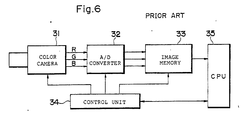
- the construction of such an apparatus basically is as shown in Fig. 6.
- a color camera 31 which includes a solid-state image pick-up device such as a CCD responds to an instruction from a CPU 35 by imaging a substrate undergoing inspection and outputting a video signal indicative of the image.
- the color camera 31 outputs color video signals R, G, B of the three primary colors. These signals represent the input image.
- An A/D converter 32 converts the color video signals R, G, B, which are analog quantities, into, say, six-bit digital signals at high speed and stores its output in an image memory 33 at a storage location thereof designated by an address corresponding to the X and Y coordinates of the input image.
- the data stored in the image memory 33 is subsequently processed by the CPU 35.
- the CPU 35 issues a command to the control unit 34 to accept the next image.
- processing for determining, based on the luminance and hue of each pixel, which pixel represents what portion of a part must be executed before judging whether the mounted parts are acceptable or not.
- preprocessing for noise cancelling, edge emphasis, contour following and the like it is also necessary to execute preprocessing for noise cancelling, edge emphasis, contour following and the like.
- image preprocessors available in the prior art are for executing noise cancelling, edge emphasis, contour following, etc. These devices execute absolutely no preprocessing such as that for generating, in advance, data useful in terms of image recognition.
- An object of the present invention is to provide a novel image processor in which an image memory with a small capacity will suffice, and in which processing time can be greatly curtailed.
- Another object of the present invention is to provide an image processor in which, by making it possible to set and alter a rule, the particulars of preprocessing can be simply altered in conformity with the set or altered rule.
- an image preprocessor for preprocessing a video signal which represents an image to be recognized, comprising imaging means for imaging an object of recognition and outputting a video signal representing an image of the object, inference means for preprocessing the video signal by an inference based on settable processing rules and outputting results of the inference as preprocessing data, and memory means for storing the preprocessing data for the purpose of recognition processing.
- the present invention is so adapted that inference is performed using fuzzy processing rules as the processing rules.
- the inference means of the present invention employs means for converting each pixel of an image into a code representing a region of the object of recognition, the code being delivered as an output.
- the inference means performs an inference based on the predetermined processing rules to execute preprocessing of the image with regard to the video signal, outputted by the imaging means, indicative of the object of recognition.
- the preprocessing data is stored in the memory means.
- the results of the inference are coded to enable compression of the input image data, thereby making it possible to reduce the capacity of the memory means and curtain processing time.
- preprocessing useful in terms of image recognition is possible. For example, if it is arranged to indicate, by the aforementioned codes, which pixel of the image is what portion of the object of recognition, subsequent recognition processing can be executed in rapid fashion.
- fuzzy processing rules When fuzzy processing rules are employed as the processing rules in the inference means, the latter can be constructed using a high-speed fuzzy processor, thus making high-speed, highly sophisticated processing possible. Moreover, altering the particulars of preprocessing can be achieved with ease by interchanging fuzzy processing rules or modifying the form of membership functions.
- Fig. 1 shows an example in which the image preprocessor of the present invention is applied to a substrate inspecting apparatus.
- the image preprocessor includes a color camera 1 including a CCD, a fuzzy inference unit 2, an image memory 3, a control unit 4 and a CPU 5.
- This substrate inspecting apparatus is adapted to perform inspection by judging the acceptability of parts mounted on a substrate, i.e., by determining whether predetermined parts [square chips, cylindrical chips, IC's (integrated circuits), etc.] are mounted appropriately on a substrate.
- the present invention is not limited to a substrate inspecting apparatus but can also be applied to various other types of inspecting apparatus, such as apparatus for examining the acceptability of printing and apparatus for examining the state of blood.
- the color camera 1 in response to an instruction from the CPU 5, successively images the parts mounted on the substrate undergoing examination and outputs a video signal indicative of the image obtained.
- the color camera 1 In synchronization with a synchronizing signal provided by the control unit 4, the color camera 1 outputs color video signals R (red), G (green), B (blue) of the three primary colors. These signals represent the input image and are applied to the fuzzy inference unit 2.
- the synchronizing signal is delivered from the control unit 4 to the color camera 1.
- the fuzzy inference unit 2 performs preprocessing with regard to each pixel of the input image by performing an inference based on a predetermined fuzzy inference rule, outputs, as the preprocessing data, a code in which one pixel is expressed by four bits.
- the code is delivered to and stored in the image memory 3.
- the data stored in the image memory 3 is accepted by the CPU 5, where it is subjected to recognition processing. At the conclusion of processing, the CPU 5 commands the control unit 4 to accept the next image.
- Fig. 2 illustrates an example of the construction of the fuzzy inference unit 2, which includes an adder 6, a subtractor 7, a fuzzy processing unit 8 and a determination unit 9.
- fuzzy inference unit 2 is illustrated in Fig. 2 as having an analog-type fuzzy architecture, it goes without saying that a digital-type arrangement can be employed, and that binary computer can be adopted which is programmed to execute fuzzy inference processing.
- the adder 6 is for producing a luminance signal Y by adding the color signals R, G, B from the color camera 1 at a predetermined ratio. If the color camera 1 possesses a function for generating the luminance signal Y, then the adder 6 need not be provided.
- the subtractor 7 receives the color signals R, G, B as inputs and performs subtraction in suitable fashion to produce color-difference signals R-G, G-B and B-R.
- the fuzzy processing unit 8 receives the luminance signal Y and the color-difference signals R-G, G-B, B-R as inputs, performs a fuzzy inference operation in accordance with a predetermined fuzzy processing rule, and outputs analog signals a through d indicating whether each pixel is one representing an area which is a substrate, land, part electrode or part body.
- Fig. 3 illustrates a chip part 10, which is mounted on a substrate, as an example of an object undergoing inspection. Shown in Fig. 3 are a substrate 11, an electrode 12 of the chip part 10, a body 13 of the chip part, lands 14 and silk-printed characters 15.
- the substrate 11 is such that the color of a resist is green, while the surface of the lands 14 is copper- colored.
- the electrode 12 of the chip part 10 is an achromatic color and shows up white, and the body 13 is an achromatic color and shows up black. Accordingly, in the case of the substrate 11, by way of example, the luminance thereof is somewhat low or medium. When the colors red and green are compared, green is somewhat intense; when the colors green and blue are compared, green is somewhat intense, and when the colors blue and red are compared, both are about the same in intensity.
- fuzzy processing rules referred to as "if..., then... rules", examples of which will be given below, are set in the fuzzy inference unit 2.
- this pixel is one which represents the substrate.
- this pixel is one which represents a land.
- this pixel is one which represents the electrode.
- this pixel is one which represents the body.
- fuzzy labels These items of vague linguistic information such as “low” and “high” are referred to as fuzzy labels.
- PB positive big
- PM positive medium
- PS positive small
- ZO almost zero
- NS negative small
- NM negative medium
- NB negative big
- An example of membership functions represented by these fuzzy labels is shown in Fig. 4.
- the horizontal axis expresses the level of luminance and the color-difference signals.
- the luminance signal Y takes on values from ZO to PB, and the color-difference signals R-G, G-B, B-R take on values from NB to PB.
- the vertical axis represents the membership function values.
- the fuzzy processing unit 8 finds the degree to which the input data relating to the luminance signal Y and color-difference signals R-G, G-B, B-R conform to the corresponding membership functions of the fuzzy processing rules. (In other words, the fuzzy processing unit 8 obtains the degree of membership in the fuzzy set.)]
- Rule 1 is a rule concerning the degree to which an object possesses the inherent quality of the substrate, or "substrate-ness”.
- This rule has four fuzzy propositions, namely a fuzzy proposition relating to the luminance signal (whether the luminance signal level is low or medium), and fuzzy propositions relating to the color-difference signals R-G, G-B and B-R.
- the abovementioned degree of conformity is obtained for each and every one of these propositions, and the minimum degree of conformity is selected (MIN operation).
- the minimum degree of conformity selected is outputted as the analog signal a , which represents the degree of "substrate-ness".
- a predetermined operation e.g., a MAX operation
- the minimum degrees of conformity in each rule is outputted as the signal a representing "substrate-ness".
- signal b representing the degree to which an object possesses the quality of the land based on Rule 2
- signals c , d representing the degree to which an object possesses the qualities of the electrode and the body, respectively, based on Rules 3 and 4.
- These signals are outputted by the fuzzy processing unit 8 and applied to the determination unit 9, which compares the signals with a predetermined threshold value and forms a coded signal in conformity with the results of the comparison.
- the coded signal is outputted to the CPU 5.
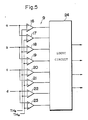
- Fig. 5 illustrates a specific example of the determination unit 9, which comprises eight comparators 16 - 23 for outputting logical "1" or "0" upon comparing each of the signals a through d with a high (big)-level threshold value TH B and a medium-level threshold value TH M , and a logic circuit 24 for producing a predetermined code based on the output from each of the comparators.
- the degree of "substrate-ness” is high (big) when the level of the signal a indicative of the degree of "substrate-ness is higher than the high-level threshold value TH B , that the degree of "substrate-ness” is medium when the level of the signal a is lower than the high-level threshold value TH B and higher than the medium-level threshold value TH M , and that the degree of "substrate-ness” is low (small) when the level of the signal a is lower than the medium-level threshold value TH M .
- the codes are stored in the image memory 3 for each and every pixel. As a result, it is clear, depending upon the code, whether each pixel of the input image belongs to the substrate, the land, the electrode or the body. It is also permissible to adopt an arrangement in which the abovementioned processing is performed for each specific area rather than for each pixel.
- the CPU 5 is capable of determining what the mounted part is and of judging whether it is acceptable or not.
- the particulars of the fuzzy processing rules and the form of the membership functions are decided by human beings based on repeated trial and error.
- rules other than fuzzy processing rules can be used, and membership function can take on any form besides the triangular form illustrated.
Landscapes
- Engineering & Computer Science (AREA)
- Quality & Reliability (AREA)
- Computer Vision & Pattern Recognition (AREA)
- Physics & Mathematics (AREA)
- General Physics & Mathematics (AREA)
- Theoretical Computer Science (AREA)
- Supply And Installment Of Electrical Components (AREA)
- Closed-Circuit Television Systems (AREA)
- Image Analysis (AREA)
- Image Input (AREA)
- Devices For Executing Special Programs (AREA)
- Image Processing (AREA)
Applications Claiming Priority (2)
| Application Number | Priority Date | Filing Date | Title |
|---|---|---|---|
| JP294372/88 | 1988-11-21 | ||
| JP63294372A JPH02140886A (ja) | 1988-11-21 | 1988-11-21 | 画像の前処理装置 |
Publications (2)
| Publication Number | Publication Date |
|---|---|
| EP0370435A2 true EP0370435A2 (de) | 1990-05-30 |
| EP0370435A3 EP0370435A3 (de) | 1991-12-04 |
Family
ID=17806863
Family Applications (1)
| Application Number | Title | Priority Date | Filing Date |
|---|---|---|---|
| EP19890121455 Withdrawn EP0370435A3 (de) | 1988-11-21 | 1989-11-20 | Bildvorverarbeitungsgerät |
Country Status (2)
| Country | Link |
|---|---|
| EP (1) | EP0370435A3 (de) |
| JP (1) | JPH02140886A (de) |
Cited By (2)
| Publication number | Priority date | Publication date | Assignee | Title |
|---|---|---|---|---|
| EP0594146A3 (de) * | 1992-10-22 | 1994-12-07 | Advanced Interconnection Tech | Einrichtung und Verfahren zur automatischen optischen Prüfung. |
| EP4056992A4 (de) * | 2019-11-06 | 2022-11-30 | Fuji Corporation | Bildverarbeitungsvorrichtung, komponentenmontagesystem und bildverarbeitungsverfahren |
Families Citing this family (1)
| Publication number | Priority date | Publication date | Assignee | Title |
|---|---|---|---|---|
| JPH04199259A (ja) * | 1990-11-26 | 1992-07-20 | Hitachi Ltd | ニューラルネットワーク、ニューラルネットワークの想起方法および学習方法または装置 |
Family Cites Families (1)
| Publication number | Priority date | Publication date | Assignee | Title |
|---|---|---|---|---|
| DE3750285T2 (de) * | 1986-10-03 | 1995-03-30 | Omron Tateisi Electronics Co | Gerät zur Untersuchung einer elektronischen Vorrichtung in fester Baugruppe. |
-
1988
- 1988-11-21 JP JP63294372A patent/JPH02140886A/ja active Pending
-
1989
- 1989-11-20 EP EP19890121455 patent/EP0370435A3/de not_active Withdrawn
Cited By (4)
| Publication number | Priority date | Publication date | Assignee | Title |
|---|---|---|---|---|
| EP0594146A3 (de) * | 1992-10-22 | 1994-12-07 | Advanced Interconnection Tech | Einrichtung und Verfahren zur automatischen optischen Prüfung. |
| US5483603A (en) * | 1992-10-22 | 1996-01-09 | Advanced Interconnection Technology | System and method for automatic optical inspection |
| EP4056992A4 (de) * | 2019-11-06 | 2022-11-30 | Fuji Corporation | Bildverarbeitungsvorrichtung, komponentenmontagesystem und bildverarbeitungsverfahren |
| US12223687B2 (en) | 2019-11-06 | 2025-02-11 | Fuji Corporation | Image processing device, component mounting system, and image processing method |
Also Published As
| Publication number | Publication date |
|---|---|
| JPH02140886A (ja) | 1990-05-30 |
| EP0370435A3 (de) | 1991-12-04 |
Similar Documents
| Publication | Publication Date | Title |
|---|---|---|
| US5430810A (en) | Real time implementation of the hough transform | |
| US6463173B1 (en) | System and method for histogram-based image contrast enhancement | |
| Martinkauppi et al. | Behavior of skin color under varying illumination seen by different cameras at different color spaces | |
| US5434683A (en) | Color image editing apparatus | |
| US5226095A (en) | Method of detecting the position of an object pattern in an image | |
| US7577311B2 (en) | Color fringe desaturation for electronic imagers | |
| US6674896B1 (en) | Device for applying accurate color thresholds in real time | |
| US5224483A (en) | Adaptive contrast enhancement for scanned ultrasonic image | |
| US7110607B2 (en) | Image processing apparatus | |
| CN111626967A (zh) | 图像增强方法、装置、计算机装置及可读存储介质 | |
| US6320977B1 (en) | Method and apparatus for positional detection using pattern matching process | |
| US5489997A (en) | Color image processing apparatus | |
| EP0370435A2 (de) | Bildvorverarbeitungsgerät | |
| EP0717275B1 (de) | Gerät zur Anpassung von Farben in Bildsignalen | |
| US6842181B2 (en) | Euler vector for color images | |
| Misaka et al. | FPGA implementation of an algorithm that enables color constancy | |
| US5063525A (en) | Picture processing apparatus including data conversion table for performing convolutional processing | |
| JPH0291505A (ja) | 回路基板の半田面検査装置 | |
| Hujanen et al. | Extending the SKIPSM binary skeletonization implementation | |
| JP3466655B2 (ja) | 画像処理装置 | |
| JP3147593B2 (ja) | 色編集用画像処理装置 | |
| JPH05236340A (ja) | 画像処理方法および装置 | |
| KR0155925B1 (ko) | 디지탈 칼라 영상의 참조변환을 통한 화소 색상 분류방법 | |
| Andreadis et al. | Coloured object recognition using invariant spectral features | |
| JPH06251202A (ja) | 文字認識装置 |
Legal Events
| Date | Code | Title | Description |
|---|---|---|---|
| PUAI | Public reference made under article 153(3) epc to a published international application that has entered the european phase |
Free format text: ORIGINAL CODE: 0009012 |
|
| 17P | Request for examination filed |
Effective date: 19891120 |
|
| AK | Designated contracting states |
Kind code of ref document: A2 Designated state(s): AT BE CH DE ES FR GB GR IT LI NL SE |
|
| PUAL | Search report despatched |
Free format text: ORIGINAL CODE: 0009013 |
|
| AK | Designated contracting states |
Kind code of ref document: A3 Designated state(s): AT BE CH DE ES FR GB GR IT LI NL SE |
|
| STAA | Information on the status of an ep patent application or granted ep patent |
Free format text: STATUS: THE APPLICATION HAS BEEN WITHDRAWN |
|
| 18W | Application withdrawn |
Withdrawal date: 19930329 |