EP0366115B1 - Système de collation de séquences pour la recherche d'une séquence de caractères à longueur arbitraire dans une distance donnée d'une séquence de référence - Google Patents
Système de collation de séquences pour la recherche d'une séquence de caractères à longueur arbitraire dans une distance donnée d'une séquence de référence Download PDFInfo
- Publication number
- EP0366115B1 EP0366115B1 EP89119841A EP89119841A EP0366115B1 EP 0366115 B1 EP0366115 B1 EP 0366115B1 EP 89119841 A EP89119841 A EP 89119841A EP 89119841 A EP89119841 A EP 89119841A EP 0366115 B1 EP0366115 B1 EP 0366115B1
- Authority
- EP
- European Patent Office
- Prior art keywords
- character
- cell
- string
- character string
- collated
- Prior art date
- Legal status (The legal status is an assumption and is not a legal conclusion. Google has not performed a legal analysis and makes no representation as to the accuracy of the status listed.)
- Expired - Lifetime
Links
Images

Classifications
-
- G—PHYSICS
- G06—COMPUTING OR CALCULATING; COUNTING
- G06F—ELECTRIC DIGITAL DATA PROCESSING
- G06F7/00—Methods or arrangements for processing data by operating upon the order or content of the data handled
- G06F7/02—Comparing digital values
-
- G—PHYSICS
- G06—COMPUTING OR CALCULATING; COUNTING
- G06F—ELECTRIC DIGITAL DATA PROCESSING
- G06F16/00—Information retrieval; Database structures therefor; File system structures therefor
- G06F16/90—Details of database functions independent of the retrieved data types
- G06F16/903—Querying
- G06F16/90335—Query processing
- G06F16/90344—Query processing by using string matching techniques
-
- G—PHYSICS
- G06—COMPUTING OR CALCULATING; COUNTING
- G06F—ELECTRIC DIGITAL DATA PROCESSING
- G06F2207/00—Indexing scheme relating to methods or arrangements for processing data by operating upon the order or content of the data handled
- G06F2207/02—Indexing scheme relating to groups G06F7/02 - G06F7/026
- G06F2207/025—String search, i.e. pattern matching, e.g. find identical word or best match in a string
-
- Y—GENERAL TAGGING OF NEW TECHNOLOGICAL DEVELOPMENTS; GENERAL TAGGING OF CROSS-SECTIONAL TECHNOLOGIES SPANNING OVER SEVERAL SECTIONS OF THE IPC; TECHNICAL SUBJECTS COVERED BY FORMER USPC CROSS-REFERENCE ART COLLECTIONS [XRACs] AND DIGESTS
- Y10—TECHNICAL SUBJECTS COVERED BY FORMER USPC
- Y10S—TECHNICAL SUBJECTS COVERED BY FORMER USPC CROSS-REFERENCE ART COLLECTIONS [XRACs] AND DIGESTS
- Y10S707/00—Data processing: database and file management or data structures
- Y10S707/99931—Database or file accessing
- Y10S707/99937—Sorting
Definitions
- the present invention relates to an information retrieval system, and more specifically to a string collating system for searching for a character string of arbitrary length within a given distance from a reference character string.
- character string collating systems have been used for retrieval of text data base, collation of feature sequence in pattern recognition systems, extraction of key words from texts drafted by use of word processors, aid of language translation, address filtering of electronic mail, etc.
- the string collating systems are indispensable to current data processing systems.
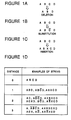
- distance As one means for measuring the degree of similarity between a reference character string and character strings to be collated, the conception called "distance" has been used. This distance means that assuming that a unitary operation is defined by deletion of one character, substitution of one character, or insertion of one character, a distance between two given character strings is defined by a minimum number of unitary operations required for changing one of the two given character strings to the other.
- FIG. 1D there are shown a table indicating examples of character strings separate from a character string "ABCD” within an extent of distance "3". It will be seen from Figure 1D that "AB C ⁇ D” is separate from the character string “ABCD” by a distance "1”, and therefore, is nearer to the character string "ABCD” than "ACXD” which is separate from the character string "ABCD” by a distance "2".
- Japanese Patent Application Laid-open No. 61-95442 and a corresponding European Patent Application laid-open No. 0178651 disclose a character string collating system capable of searching for a character string within an extent of a distance "1" from a reference string.
- the extraction of character strings within an extent of a distance "1" is not sufficient in order to use the character string collating system in a pattern recognition system for voice recognition or handwritten letter recognition.
- voice recognition for example, a feature sequence extracted from a given voice (the feature sequence corresponds to a string to be collated) involves various fluctuations due to differences in age, the distinction of sex, native place, etc. of a speaker.
- the string collating system disclosed in above mentioned laid-open application can search for a character string "AXBXCXD” separate from a reference string "ABCD” by a distance "3".
- the string collating system disclosed in above mentioned laid-open application does not take deletion of character (which is one of the unitary operation) into consideration, it cannot search for a character string "AD” separate from a reference string "ABCD” by a distance "2".
- the string collating system disclosed in above mentioned laid-open application cannot evenly extract all character strings of different lengths within a predetermined distance from a reference string. It can be said from a different viewpoint that the string collating system disclosed in above mentioned laid-open application cannot extract a character string having a high degree of similarity to a reference string, but often searches for only a character string having a low degree of similarity
- Another object of the present invention is to provide a string collating system capable of evenly extracting all character strings of arbitrary lengths within a predetermined distance from a reference string.
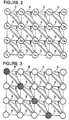
- FIG 2 there is shown a conceptual diagram illustrating a principle of the string collating method in accordance with the present invention.
- the shown example illustrates a case in which a string collation is performed for a reference string "ABCD" by using a cell array having four rows and five columns.
- the shown cell array can extract strings of arbitrary lengths within an extent of distance "3" from the reference string "ABCD”.
- Each cell f i,j is coupled to a rightward adjacent cell f i,j+1 through a first transfer means indicated by a solid line arrow which rightward extends in a row direction and which is given A, B, C or D.
- each cell f i,j is coupled to a downwardly adjacent cell f i+1,j through a second transfer means indicated by a solid line arrow which downwardly extends in a column direction.
- Each cell f i,j is also coupled to a rightdownward adjacent cell f i+1,j+1 through a third transfer means indicated by a solid arced line arrow which right-downwardly extends in a diagonal direction and which is given A ⁇ , B ⁇ , C ⁇ or D ⁇ . Furthermore, each cell f i,j is coupled to a rightdownward adjacent cell f i+1,j+1 through an automatic setting means indicated by a solid doubled line arrow which right-downwardly extends in a diagonal direction.
- the first and third transfer means operate to transfer data stored in one cell to another cell in accordance with the direction of each arrow only when a character (to be collated) indicated for each arrow is given to the one cell.
- the second transfer means operates to transfer data stored in one cell to another cell in accordance with the direction of each arrow when a character to be collated is given to the one cell, regardless of the content of the given character to be collated.
- each cell has an input means for receiving data fed through the respective transfer means, and each cell stores data "1" when data "1" is supplied to the cell through at least one of all transfer means coupled to the cell. On the other hand, each cell stores data "0" when data "1" is not supplied to the cell through anyone of all transfer means coupled to the cell.
- the automatic setting means is one feature of the present invention. If one cell stores the data "1", all cells diagonally downstream of the one cell having stored the data "1" in the direction of the doubled line arrow are set to store the data "1", regardless of data given to the input means of each of the diagonally downstream cell. For example, if the cell f 12 stores the data "1", the cell f 23 , f 34 and f 45 are simultaneously set to store the data "1". If the cell f 22 stores the data "1", the cell f33 and f44 are simultaneously set to store the data "1".
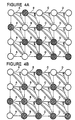
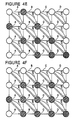
- FIG. 3 and Figures 4A to 4H shows the same cell structure as that shown in Figure 2, but for simplification of drawings, the Reference Characters to be given to the cells are omitted. Therefore, a cell shown in Figure 3 and Figures 4A to 4H should be deemed to be given the same Reference Character as that given to the cell located at a corresponding position in Figure 2.
- a hatched cell indicates that the cell stores data "1”
- a blanked or white cell indicates that the cell stores data "0".
- Figure 3 shows an initial condition of the cell array before a collation operation is started.
- the cell f 11 is set to store data "1"
- the cells f 22 , f 33 and f 44 are automatically set to store the data "1" by means of the automatic setting means.
- the other cells are set to store data "0".
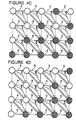
- Figures 4A to 4D illustrate a string collating procedure or sequence for comparing a character string "ABCD” with a reference string "ABCD” in the named order of A, B, C and D.
- Figures 4A to 4D show conditions at each time one character is inputted.
- the condition shown in each of Figures4A to 4D indicates a result of collation between the reference string "ABCD” and characters which have been inputted from the start of one collation operation until a character is newly inputted in the figure concerned.
- the data stored in the cells of the fifth column represents the result of collation. Namely, among the cells included in the fifth column and storing the data "1", the cell positioned at a row having a minimum row number is found out.
- the found-out cell is the cell f15, the distance between the reference string and the string to be collated is "0". If the found-out cell is the cell f25, the distance is "1". The cell f35 shows the distance "2", and the cell f 45 indicates the distance "3". If no cell storing the data "1" is found out in the fifth column, the distance between the reference string and the string to be collated is considered to be not less than "4".
- a character "B" to be collated is inputted to the cell array, and as a result, the cell array is changed from the condition shown in Figure 4A to the condition shown in Figure 4B.
- the condition shown in Figure 4B represents a result of collation between the reference string "ABCD” and the characters “AB” of the string "ABCD” to be collated.
- the cell f 35 in the fifth column is set to "1". This means that "AB” is separate from “ABCD” by the distance "2".
- the intermediate results and the final result of the collation operation can be sequentially obtained.
- the result thus obtained indicates a correct distance between the reference string and the string to be collated.
- the character "A” to be collated corresponds to one that is obtained by executing the deletion of one character (unitary operation) for "ABCD" three times, and the characters "AB", "ABC” and "ABCD” to be collated respectively correspond to ones that are obtained by executing the deletion of one character for "ABCD” two times, one time or zero time, respectively.
- Figures 4E to 4H correspond to Figure 4A to 4D, respectively, but show a case in which a character string "ACXD” is collated under the same condition as that of the example shown in FigureS 4A to 4D.
- Figure 4E shows that a character “A” to be collated is separate from the reference string “ABCD” by a distance "3".
- Figures 4F, 4G and 4H respectively show that character strings “AC”, “ACX” and “ACXD” are separate from the reference string "ABCD” by a distance "2”, respectively. It would be apparent that the results of collation shown in these figures respectively indicate correct distances between the reference string and the respective strings to be collated.
- the cell array having the structure shown in Figure 2 can discriminate whether or not a given string to be collated is within an extent of a distance "3" from the reference string "ABCD". Therefore, if a plurality of strings to be collated are sequentially inputted to the cell array, it is possible to extract all strings of arbitrary length within the extent of the distance "3" from the reference string "ABCD". Therefore, it is possible to perform a collation operation on the basis of a reference string of arbitrary length by modifying the cell array so as to have the number of columns corresponding to the length of the reference string and the number of rows corresponding to a maximum distance to be detected.
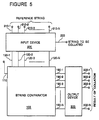
- FIG. 5 there is shown a block diagram of an embodiment of the string collating system in accordance with the present invention.
- the shown system includes a string comparator 100, an input device 200, and an output device 300 coupled to each other as shown.
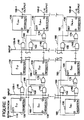
- Each of the registers 130 has a data input terminal D, a data output terminal Q and a set terminal SET for setting the data output terminal Q to "1".
- the data output terminal Q of the register 130 (f ij ) positioned at a (i)th row and a (j)th column is also connected to one input of a second AND gate 150, which in turn has another inverted input connected to the input terminal 120-j and an output connected through a corresponding OR gate 170 to the data input terminal D of the register 130 (f i+1,j+1 ) positioned at a next (i+1)th row and at a next (j+1)th column.
- the data output terminal Q of the register 130 (f ij ) positioned at a (i)th row and a (j)th column is also connected through a corresponding transfer line 180 to the set terminal SET of the register 130 (f i+1,j+1 ) positioned at a next (i+1)th row and at a next (j+1)th column.
- the data output terminals Q of the registers 130 (f i,N+1 ) in the (N+1)th column are connected to output terminals 190-j, respectively.
- each register 130 corresponds to the cell f ij shown in Figure 2.
- the first AND gate 140, the second AND gate 150 and the transfer line 160 correspond to the first, third and second transfer means shown in Figure 2, respectively.
- the OR gate 170 constitutes the input means of each cell f ij shown in Figure 2.
- the transfer line 180 provides for the setting means shown in Figure 2.
- the AND gate 150 operates to transfer the content of the register f ij 130 to the register f i+1,j+1 130 only when the (j)th character of the reference string is not consistent with a character to be collated. If the (j)th character of the reference string is consistent with a character to be collated, the second AND gate 150 operates to output the data "0". From these functions of the AND gates 140 and 150, it would be understood that the first AND gate 140 and the second AND gate 150 correspond to the first transfer means and the third transfer means shown in Figure 2, respectively.
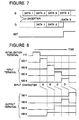
- FIG. 7 there is shown a waveform diagram illustrating the change of the data output terminal Q of each register 130 provided in the string comparator shown in Figure 6, in response to a signal applied to the data input terminal D and in response to a level at the set terminal SET.
- the register 130 if the set terminal SET of the register 130 is at "0", the register 130 operates to output from its output terminal Q the data applied to the data input D after a delay of one period. However, if the set terminal SET is brought to "1", the register 130 operates to output "1" from its output terminal Q regardless of data applied to the data input D.
- Each register having the above mentioned function can be formed of a master-slave flipflop having a set terminal.
- the result of collation between the reference string "ABCD” and strings "A”, “AB” and “ABC” to be collated can be obtained from the output terminals 190-1 to 190-4 in the way of the collating operation, and the result of collation between the reference string “ABCD” and the string “ABCD” can be obtained from the output terminals 190-1 to 190-4 as the final result of the collating operation.
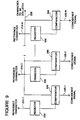
- FIG. 9 there is shown a block diagram of one example of the input device provided in the string collating system shown in Figure 5.
- the shown input device has N reference character input terminals 210-1 to 210-N for receiving in parallel all characters of a reference string, and a collation character input terminal 220 for sequentially receiving characters of a string to be collated, one by one.
- the input terminals 210-1 to 210-N are connected to N registers 230 in a one-to-one relation.
- An output of each register 230 is connected to one input of a corresponding comparator 240, which in turn has another input connected commonly to the collation character input terminal 220.
- An output of each comparator 240 is connected to a corresponding one of the input terminals 120-1 to 120-N of the string comparator 100.
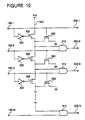
- FIG. 10 there is shown a block diagram of one example of the output device provided in the string collating system shown in Figure 5.
- the output terminal 190-1 of the string comparator 100 is connected directly to a collation result output terminal 300-1, and the output terminals 190-2 to 190-N of the string comparator 100 are connected to one input of corresponding AND gates 310, whose outputs are connected to collation result output terminals 300-2 to 300-N, respectively.
- the output terminals 190-1 to 190-N-1 are connected to inverters 320 in a one-to-one relation.
- NMOS path transistors 330 are connected in series between a voltage supply terminal Vcc, 340 and the other input of the AND gate 310 connected to the output terminal 300-N.
- An output of each inverter 320 is connected to a gate of a corresponding one of the series connected NMOS path transistors 330.
- N-1 source-grounded NMOS pull-down transistors 350 having a gate connected to a corresponding one of the output terminals 190-1 to 190-N-1 of the string comparator 100 and a drain connected to a corresponding one of series connection nodes of the series connected NMOS path transistors 330.
- the series connection nodes of the series connected NMOS path transistors 330 are connected to a second input of a corresponding AND gates 310, respectively.
- the string collating system in accordance with the present invention comprises a string comparator composed of a cell array in which cells are interconnected by the transfer means and the automatic set means.
- the interconnection of cells by the automatic set means is one important feature of the present invention.
- the interconnection of cells is limited to the interconnection of adjacent cells in a localized area. Namely, remote cells are not interconnected. Secondly, the interconnection of cells is regular, and the cells are interconnected in the same pattern anywhere within the cell array.
- the cell array having the above advantages makes it possible (a) to construct a string collating system capable of performing collation of a string of arbitrary length, (b) to construct a "simple" string collating system capable of complying an arbitrary collation distance, (c) to easily change a length of a reference string and a collation distance, and (d) to shorten a time for designing an integrated circuit for a string collating system and to integrate the string collating system in a reduced chip area.
- the above mentioned advantages (a) and (b) mean that the length N of the reference string and the collation distance M can be easily changed only by modifying the column number and the row number.
- the hardware amount of the string collation cell array in accordance with the present invention is in proportion to the product of N ⁇ M. However, even if N and/or M is increased, the string collation cell array never becomes suddenly complicated. This feature is given by the above mentioned first and second advantages, namely, the localization of the interconnection of cells and the regularity of the interconnection of adjacent cells.
- the above mentioned advantage (c) means that a long reference string or a long collation distance which cannot be handled by a single string collating system can be easily handled by simply coupling a required number of string collating systems of the present invention in a row direction or in a column direction. This feature is also given by the above mentioned first and second advantages. In actual applications, since the reference string length and/or a long collation distance would not be fixed, this flexibility is indispensable to the string collating systems.
- the above mentioned advantage (d) gives a high degree of utility to the present invention.
- a regular construction of circuit will make it possible to shorten the design time and reduce the required chip area.
- the above mentioned second advantage, namely, the regularity of the interconnection of adjacent cells is very convenient to the assemble into an integrated circuit, and the first advantage, namely, the localization of the interconnection of cells, can shorten the length of required wiring.
- the string collation system in accordance with the present invention has a high degree of function, a high degree of flexibility and a high degree of utility.
- the registers 130 have been formed of a master-slave flipflop.
- the registers can be formed of any circuit that fulfills the input and output conditions shown in Figure 7.
- the first and third transfer means have been composed of the AND gates 140 and 150, respectively.
- these transfer means may be of any circuit that has a switching function to open or close dependent upon whether or not a character to be collated is consistent with a reference character.
- an output signal will appear on a corresponding output.
- the circuit may be such that an output signal will appear on a corresponding output before an input of a signal has been completed.
Landscapes
- Engineering & Computer Science (AREA)
- Theoretical Computer Science (AREA)
- General Physics & Mathematics (AREA)
- Physics & Mathematics (AREA)
- Databases & Information Systems (AREA)
- General Engineering & Computer Science (AREA)
- Mathematical Analysis (AREA)
- Pure & Applied Mathematics (AREA)
- Mathematical Optimization (AREA)
- Computational Linguistics (AREA)
- Computational Mathematics (AREA)
- Data Mining & Analysis (AREA)
- Information Retrieval, Db Structures And Fs Structures Therefor (AREA)
Claims (3)
- Système de collationnement de chaîne de caractères comprenant :un dispositif d'entrée (200) qui reçoit une chaîne de caractères de référence sous forme parallèle et qui reçoit sous forme série une chaîne de caractères à collationner, dans l'ordre et caractère par caractère, ledit dispositif d'entrée (200) générant un signal de coïncidence pour chaque caractère constitutif de ladite chaîne de caractères de référence lorsqu'un caractère reçu sous forme série de ladite chaîne de caractères à collationner coïncide avec un caractère constitutif correspondant de ladite chaîne de caractères de référence ; etun comparateur de chaîne de caractères (100) composé de cellules (130) fij avec i=1 à M et j=1 à N, agencées sous la forme d'une matrice comportant N colonnes et M rangées où M et N sont des entiers, les cellules (130) fij dans chaque colonne étant couplées audit dispositif d'entrée (200) de manière à recevoir le signal de coïncidence pour un caractère constitutif correspondant de ladite chaîne de caractères de référence ;chaque cellule (130) fij avec i=1 à M et j=1 à N-1 étant couplée à une cellule adjacente vers la droite fi,j+1 par l'intermédiaire de premiers moyens de transfert (140) qui fonctionnent pour transférer des données stockées dans ladite cellule fij à la cellule fi,j+1 lorsque le même caractère que le j-ième caractère de ladite chaîne de caractères de référence est appliqué sur ledit dispositif d'entrée (200) en tant qu'un caractère à collationner ;chaque cellule (130) fij avec i=1 à M-1 et j=1 à N étant également couplée à une cellule adjacente vers le bas fi+1,j par l'intermédiaire de seconds moyens de transfert (160) qui fonctionnent pour transférer des données stockées dans la cellule fi,j à ladite cellule fi,j+1 chaque fois qu'un caractère à collationner est appliqué sur ledit dispositif d'entrée (200) ;chaque cellule (130) fi,j avec i=1 à M-1 et j=1 à N-1 étant en outre couplée à une cellule adjacente vers le bas vers la droite fi+1,j+1 par l'intermédiaire de troisièmes moyens de transfert (150) qui fonctionnent pour transférer des données stockées dans la cellule fi,j à ladite cellule fi+1,j+1 si un caractère différent du j-ième caractère de la chaîne de caractères de référence est appliqué sur ledit dispositif d'entrée (200) en tant qu'un caractère à collationner chaque fois qu'un caractère à collationner est appliqué sur ledit dispositif d'entrée (200),caractérisé en ce que chaque cellule (130) fi,j avec i=1 à M-1 et j=1 à N-1 est également couplée à la même cellule adjacente vers le bas vers la droite fi+1,j+1 par l'intermédiaire de moyens d'établissement automatique (180) qui fonctionnent pour établir la cellule fi+1,j+1 vers le bas vers la droite d'une cellule établie fij suivant une direction de couplage vers le bas vers la droite après que chaque caractère à collationner est appliqué sur ledit dispositif d'entrée (200)
et ainsi, les cellules fi,N dans la N-ième colonne émettent en sortie le résultat de distance du collationnement. - Système selon la revendication 1, dans lequel le comparateur de chaîne (100) inclut des moyens (110) pour initialiser la cellule f11 positionnée au niveau d'une première colonne et au niveau d'une première rangée.
- Procédé de détermination de la distance d'une chaîne de caractères à collationner par rapport à une chaîne de caractères de référence dans un système de collationnement de chaîne de caractères incluant un dispositif d'entrée (200) et un comparateur de chaîne de caractères (100) composé de cellules (130) fi,j avec i=1 à M et j=1 à N agencées sous la forme d'une matrice comportant N colonnes et M rangées (où M et N sont des entiers), le procédé comprenant les étapes de :stockage de la chaîne de caractères de référence sous forme parallèle dans le dispositif d'entrée (200) ;réception sous forme série de la chaîne de caractères à collationner dans le dispositif d'entrée (200) ;le dispositif d'entrée (200) générant un signal de coïncidence lorsqu'un caractère particulier de la chaîne de caractères à collationner est le même qu'un caractère correspondant de la chaîne de caractères de référence et appliquant le signal de coïncidence sur une colonne de cellules fi,j associée au caractère correspondant de la chaîne de caractères de référence ;chaque cellule (130) fi,j avec i=1 à M et j=1 à N-1 transférant des données stockées dedans sur une cellule adjacente vers la droite fi,j+1 suite à la réception d'un signal de coïncidence ;chaque cellule fi,j avec i=1 à M-1 et j=1 à N transférant des données stockées dedans sur une cellule adjacente vers le bas fi+1,j chaque fois que le dispositif d'entrée (200) reçoit un caractère de la chaîne de caractères à collationner ;chaque cellule (130) fi,j avec i=1 à M-1 et j=1 à N-1 transférant des données stockées dedans sur une cellule adjacente vers le bas vers la droite (130) fi+1,j+1 lorsque le signal de coïncidence n'est pas présent et que le dispositif d'entrée (200) reçoit un caractère de la chaîne de caractères à collationner ; etcaractérisé en ce que chaque cellule (130) fi,j avec i=1 à M-1 et j=1 à N, lorsqu'elle est dans un état établi, transfère des données stockées dedans à des cellules (130) fi+1,j+1 suivant une direction de couplage vers le bas vers la droite lorsque le dispositif d'entrée (200) reçoit un caractère de la chaîne de caractères à collationner ;
dans lequel les cellules fi,N de la N-ième colonne produisent une indication de la distance entre la chaîne de caractères de référence et les caractères de la chaîne de caractères à collationner reçus par le dispositif d'entrée (200).
Applications Claiming Priority (2)
| Application Number | Priority Date | Filing Date | Title |
|---|---|---|---|
| JP63269746A JP2737173B2 (ja) | 1988-10-25 | 1988-10-25 | 記号列照合装置とその制御方法 |
| JP269746/88 | 1988-10-25 |
Publications (3)
| Publication Number | Publication Date |
|---|---|
| EP0366115A2 EP0366115A2 (fr) | 1990-05-02 |
| EP0366115A3 EP0366115A3 (fr) | 1991-11-21 |
| EP0366115B1 true EP0366115B1 (fr) | 1997-01-08 |
Family
ID=17476579
Family Applications (1)
| Application Number | Title | Priority Date | Filing Date |
|---|---|---|---|
| EP89119841A Expired - Lifetime EP0366115B1 (fr) | 1988-10-25 | 1989-10-25 | Système de collation de séquences pour la recherche d'une séquence de caractères à longueur arbitraire dans une distance donnée d'une séquence de référence |
Country Status (4)
| Country | Link |
|---|---|
| US (1) | US5377349A (fr) |
| EP (1) | EP0366115B1 (fr) |
| JP (1) | JP2737173B2 (fr) |
| DE (1) | DE68927625T2 (fr) |
Families Citing this family (19)
| Publication number | Priority date | Publication date | Assignee | Title |
|---|---|---|---|---|
| JPH0460871A (ja) * | 1990-06-29 | 1992-02-26 | Nec Corp | 記号列照合装置の制御方式 |
| US5511159A (en) * | 1992-03-18 | 1996-04-23 | At&T Corp. | Method of identifying parameterized matches in a string |
| US5553272A (en) * | 1994-09-30 | 1996-09-03 | The University Of South Florida | VLSI circuit structure for determining the edit distance between strings |
| US5864683A (en) * | 1994-10-12 | 1999-01-26 | Secure Computing Corporartion | System for providing secure internetwork by connecting type enforcing secure computers to external network for limiting access to data based on user and process access rights |
| US5913024A (en) | 1996-02-09 | 1999-06-15 | Secure Computing Corporation | Secure server utilizing separate protocol stacks |
| US6144934A (en) * | 1996-09-18 | 2000-11-07 | Secure Computing Corporation | Binary filter using pattern recognition |
| US6072942A (en) * | 1996-09-18 | 2000-06-06 | Secure Computing Corporation | System and method of electronic mail filtering using interconnected nodes |
| EP0859332A1 (fr) * | 1997-02-12 | 1998-08-19 | STMicroelectronics S.r.l. | Méthode et appareil de reconnaissance de mots |
| CN1092362C (zh) * | 1998-02-10 | 2002-10-09 | 北京多思科技工业园股份有限公司 | 阵列错位比较装置及用来实现查询的方法 |
| US7031002B1 (en) | 1998-12-31 | 2006-04-18 | International Business Machines Corporation | System and method for using character set matching to enhance print quality |
| US7039637B2 (en) * | 1998-12-31 | 2006-05-02 | International Business Machines Corporation | System and method for evaluating characters in an inputted search string against a character table bank comprising a predetermined number of columns that correspond to a plurality of pre-determined candidate character sets in order to provide enhanced full text search |
| US7191114B1 (en) | 1999-08-27 | 2007-03-13 | International Business Machines Corporation | System and method for evaluating character sets to determine a best match encoding a message |
| JP2001291060A (ja) * | 2000-04-04 | 2001-10-19 | Toshiba Corp | 単語列照合装置および単語列照合方法 |
| JP4740060B2 (ja) * | 2006-07-31 | 2011-08-03 | 富士通株式会社 | 重複データ検出プログラム、重複データ検出方法および重複データ検出装置 |
| DE102007010259A1 (de) | 2007-03-02 | 2008-09-04 | Volkswagen Ag | Sensor-Auswertevorrichtung und Verfahren zum Auswerten von Sensorsignalen |
| EP4273372A3 (fr) | 2010-01-21 | 2024-01-24 | The Abell Foundation Inc. | Centrale de conversion d'énergie thermique marine |
| US8872888B2 (en) | 2010-10-01 | 2014-10-28 | Sony Corporation | Content transmission apparatus, content transmission method, content reproduction apparatus, content reproduction method, program and content delivery system |
| US10528556B1 (en) * | 2017-12-31 | 2020-01-07 | Allscripts Software, Llc | Database methodology for searching encrypted data records |
| CN112637600B (zh) * | 2020-12-14 | 2024-04-05 | 绍兴文理学院 | 对数据进行有损或无损压缩的编码、解码的方法或装置 |
Family Cites Families (5)
| Publication number | Priority date | Publication date | Assignee | Title |
|---|---|---|---|---|
| US3584205A (en) * | 1968-10-14 | 1971-06-08 | Ibm | Binary arithmetic and logic manipulator |
| US4630234A (en) * | 1983-04-11 | 1986-12-16 | Gti Corporation | Linked list search processor |
| JPS6195442A (ja) * | 1984-10-16 | 1986-05-14 | Nec Corp | 記号列照合装置 |
| DE3750277T2 (de) * | 1986-02-14 | 1994-11-17 | Hitachi Ltd | Verfahren und Vorrichtung zur Rückgewinnung von Symbolketten aus Daten. |
| US4823306A (en) * | 1987-08-14 | 1989-04-18 | International Business Machines Corporation | Text search system |
-
1988
- 1988-10-25 JP JP63269746A patent/JP2737173B2/ja not_active Expired - Fee Related
-
1989
- 1989-10-25 EP EP89119841A patent/EP0366115B1/fr not_active Expired - Lifetime
- 1989-10-25 DE DE68927625T patent/DE68927625T2/de not_active Expired - Fee Related
-
1992
- 1992-10-08 US US07/958,467 patent/US5377349A/en not_active Expired - Fee Related
Also Published As
| Publication number | Publication date |
|---|---|
| JPH02115973A (ja) | 1990-04-27 |
| EP0366115A3 (fr) | 1991-11-21 |
| US5377349A (en) | 1994-12-27 |
| JP2737173B2 (ja) | 1998-04-08 |
| DE68927625T2 (de) | 1997-08-14 |
| DE68927625D1 (de) | 1997-02-20 |
| EP0366115A2 (fr) | 1990-05-02 |
Similar Documents
| Publication | Publication Date | Title |
|---|---|---|
| US5377349A (en) | String collating system for searching for character string of arbitrary length within a given distance from reference string | |
| JPS60501921A (ja) | 並列テキスト照合の方法および装置 | |
| JPH08272811A (ja) | 文書管理方法及びその装置 | |
| JP2681663B2 (ja) | 日本文訂正候補文字抽出方法 | |
| JP2729491B2 (ja) | 可変長文字列検出装置 | |
| EP0178651B1 (fr) | Appareil de recherche de données | |
| JPH0670788B2 (ja) | 巣語辞書検索装置 | |
| JP2773657B2 (ja) | 文字列検索装置 | |
| KR19990015114A (ko) | 문자연결 정보를 이용한 문자인식기 | |
| JP3924899B2 (ja) | テキスト検索装置およびテキスト検索方法 | |
| Yamada et al. | A character string search processor | |
| JP2526678B2 (ja) | 単語辞書検索装置 | |
| SU696443A1 (ru) | Устройство дл поиска перфокарт | |
| JPS60147888A (ja) | 文字認識後処理方法及びその装置 | |
| JP2526670B2 (ja) | 単語辞書検索装置 | |
| JPH04340166A (ja) | 単語辞書検索装置 | |
| JPH0268663A (ja) | 文字列検索装置 | |
| JPH0670789B2 (ja) | 単語辞書検索装置 | |
| JPH0233185B2 (fr) | ||
| JPS6128134A (ja) | 記号列照合装置とその制御方式 | |
| JPH1196308A (ja) | 文字情報読取装置および宛名読取装置 | |
| JPH0527150B2 (fr) | ||
| JPH0484367A (ja) | 記号列照合装置の制御方式 | |
| JPH03208172A (ja) | 記号列照合装置の制御方式 | |
| JPS6120178A (ja) | 記号列識別装置とその制御方式 |
Legal Events
| Date | Code | Title | Description |
|---|---|---|---|
| PUAI | Public reference made under article 153(3) epc to a published international application that has entered the european phase |
Free format text: ORIGINAL CODE: 0009012 |
|
| AK | Designated contracting states |
Kind code of ref document: A2 Designated state(s): DE FR GB |
|
| 17P | Request for examination filed |
Effective date: 19900705 |
|
| PUAL | Search report despatched |
Free format text: ORIGINAL CODE: 0009013 |
|
| AK | Designated contracting states |
Kind code of ref document: A3 Designated state(s): DE FR GB |
|
| 17Q | First examination report despatched |
Effective date: 19940926 |
|
| GRAG | Despatch of communication of intention to grant |
Free format text: ORIGINAL CODE: EPIDOS AGRA |
|
| GRAH | Despatch of communication of intention to grant a patent |
Free format text: ORIGINAL CODE: EPIDOS IGRA |
|
| GRAH | Despatch of communication of intention to grant a patent |
Free format text: ORIGINAL CODE: EPIDOS IGRA |
|
| GRAH | Despatch of communication of intention to grant a patent |
Free format text: ORIGINAL CODE: EPIDOS IGRA |
|
| GRAA | (expected) grant |
Free format text: ORIGINAL CODE: 0009210 |
|
| AK | Designated contracting states |
Kind code of ref document: B1 Designated state(s): DE FR GB |
|
| REF | Corresponds to: |
Ref document number: 68927625 Country of ref document: DE Date of ref document: 19970220 |
|
| ET | Fr: translation filed | ||
| PLBE | No opposition filed within time limit |
Free format text: ORIGINAL CODE: 0009261 |
|
| STAA | Information on the status of an ep patent application or granted ep patent |
Free format text: STATUS: NO OPPOSITION FILED WITHIN TIME LIMIT |
|
| 26N | No opposition filed | ||
| REG | Reference to a national code |
Ref country code: GB Ref legal event code: IF02 |
|
| PGFP | Annual fee paid to national office [announced via postgrant information from national office to epo] |
Ref country code: FR Payment date: 20051010 Year of fee payment: 17 |
|
| PGFP | Annual fee paid to national office [announced via postgrant information from national office to epo] |
Ref country code: GB Payment date: 20051019 Year of fee payment: 17 |
|
| PGFP | Annual fee paid to national office [announced via postgrant information from national office to epo] |
Ref country code: DE Payment date: 20051020 Year of fee payment: 17 |
|
| PG25 | Lapsed in a contracting state [announced via postgrant information from national office to epo] |
Ref country code: DE Free format text: LAPSE BECAUSE OF NON-PAYMENT OF DUE FEES Effective date: 20070501 |
|
| GBPC | Gb: european patent ceased through non-payment of renewal fee |
Effective date: 20061025 |
|
| REG | Reference to a national code |
Ref country code: FR Ref legal event code: ST Effective date: 20070629 |
|
| PG25 | Lapsed in a contracting state [announced via postgrant information from national office to epo] |
Ref country code: GB Free format text: LAPSE BECAUSE OF NON-PAYMENT OF DUE FEES Effective date: 20061025 |
|
| PG25 | Lapsed in a contracting state [announced via postgrant information from national office to epo] |
Ref country code: FR Free format text: LAPSE BECAUSE OF NON-PAYMENT OF DUE FEES Effective date: 20061031 |