EP0363383B1 - Plastiques degradables - Google Patents
Plastiques degradables Download PDFInfo
- Publication number
- EP0363383B1 EP0363383B1 EP88904254A EP88904254A EP0363383B1 EP 0363383 B1 EP0363383 B1 EP 0363383B1 EP 88904254 A EP88904254 A EP 88904254A EP 88904254 A EP88904254 A EP 88904254A EP 0363383 B1 EP0363383 B1 EP 0363383B1
- Authority
- EP
- European Patent Office
- Prior art keywords
- polymer
- oxidant
- polymer composition
- natural
- pro
- Prior art date
- Legal status (The legal status is an assumption and is not a legal conclusion. Google has not performed a legal analysis and makes no representation as to the accuracy of the status listed.)
- Expired - Lifetime
Links
Images

Classifications
-
- C—CHEMISTRY; METALLURGY
- C08—ORGANIC MACROMOLECULAR COMPOUNDS; THEIR PREPARATION OR CHEMICAL WORKING-UP; COMPOSITIONS BASED THEREON
- C08K—Use of inorganic or non-macromolecular organic substances as compounding ingredients
- C08K5/00—Use of organic ingredients
-
- C—CHEMISTRY; METALLURGY
- C08—ORGANIC MACROMOLECULAR COMPOUNDS; THEIR PREPARATION OR CHEMICAL WORKING-UP; COMPOSITIONS BASED THEREON
- C08K—Use of inorganic or non-macromolecular organic substances as compounding ingredients
- C08K5/00—Use of organic ingredients
- C08K5/0008—Organic ingredients according to more than one of the "one dot" groups of C08K5/01 - C08K5/59
- C08K5/0033—Additives activating the degradation of the macromolecular compound
-
- C—CHEMISTRY; METALLURGY
- C08—ORGANIC MACROMOLECULAR COMPOUNDS; THEIR PREPARATION OR CHEMICAL WORKING-UP; COMPOSITIONS BASED THEREON
- C08L—COMPOSITIONS OF MACROMOLECULAR COMPOUNDS
- C08L57/00—Compositions of unspecified polymers obtained by reactions only involving carbon-to-carbon unsaturated bonds
Definitions
- This invention relates to degradable synthetic polymer compositions.
- packaging items such as bags and containers are destined, after a relatively short functional life, to arrive as a significant component of urban garbage or, to a much lesser extent, in the form of litter.
- packaging items are being manufactured from plastics, that is to say from synthetic polymer compositions, which, whilst being cheap and having the physical properties which make them highly suitable for such packaging purposes, have the disadvantage, as components of waste or garbage, of being highly resistant to destruction by the chemical and physical actions to which they are subject in the natural environment and thereby such components constitute a mounting nuisance.
- Biodegradability can be defined as the degradation at the molecular level of substances by the action of enzymes themselves derived from the metabolic processes of micro-organisms. Such very specific interactions as have long been familiar in the case of natural polymers, for example that between cellulose and wood-decaying fungi, can be cited. In the field of synthetic polymers one can also find examples such as the destruction of certain polyester type polyurethanes by fungi, in particular Ulocladium chartarum.
- the present invention to provide a synthetic polymer capable of undergoing degradation under the conditions to which items made therefrom are subject when they form a component of garbage disposed of by the landfill or composting route of garbage disposal.
- a degradable polymer composition comprising a blend of
- the presence together of the anti-oxidant and the pro-oxidant gives rise to a period of induction before a sharp loss of physical strength occurs, whereby the period of induction can be exploited as the effective working life of the polymer composition.
- the stable polymer is preferably a polyethylene such as low-density polyethylene, linear low-density polyethylene or high density polyethylene.
- the stable polymer may be polypropylene or polystyrene.
- compositions embodying the invention form a class of polymer formulations, the lifetime of which is divided into two zones. This is achieved by exploiting the phenomenon of the induction period which can be noted when an oxidation sensitive material is protected by selected types of protective chemical additives generally called antioxidants.
- antioxidants are a normal ingredient of most packaging polymer formulations, being required initially to protect the polymer during the extreme thermal stresses of compounding and conversion processing.
- compositions in accordance with the invention can be produced which, whilst being adequately stable for the duration of the essentially anaerobic conversion processing in enclosed machinery such as extruders, will subsequently reach the point at which the anti-oxidant is expended and the system enters into its second time zone during which oxidation takes place.
- This oxidation ideally commences after a passage of time which, at normal room temperature, safely exceeds the normal functional life of such products.
- compositions embodying the invention substances capable of autoxidation because such substances are more readily initiated into the oxidation process by virtue of their unsaturation and, once initiated, the chemical processes can involve the more resistant saturated molecular structures of the common packaging thermoplastics such as the polyolefines.
- the unsaturated polymeric component of a composition embodying the invention natural rubber or particular styrene-butadiene elastomers, are used, which not only provide adequate levels of autoxidisable unsaturation but also greatly improve some of the physical properties of the products especially their impact strength.
- Transition metal salts are used as pro-oxidants for these degradable compositions and it has been found that, provided that the anti-oxidant and pro-oxidant types and ratios are correctly selected and adhered to, then transition metal compounds capable of the oxygen transfer chemistry can be incorporated into polymer compositions jointly with anti-oxidant ingredients in the compounding operation.
- transition metal salts used in preferred embodiments are salts formed by combining transition metals such as cobalt, manganese and copper with organic acids of sufficiently high molecular weight to give salts soluble in the host polymer blends used.
- transition metal as used herein means an element having greater than 8 and less than 18 electrons in the outer group of the ion. Transition metals are thus usually capable of electron transitions between their outer shells and the variable valency states resulting render them capable of inducing oxidation reactions. In practice, those transition elements which are highly toxic, radioactive, are extremely rare and costly are not normally encountered in industrial use as oxidation catalysts. Typical transition metals whose salts and complexes do feature in such applications and could be considered for use in carrying out the present invention are Ce, Zn, Cu, Ag, Ni, Co, Fe, Mn, Cr, and V.
- salts typically display an adequate level of solubility in polymer melts, typically stearates, oleates, behenates, myristates, erucates, linoleates, or naphthenates, or complexes such as acetonylacetates, 8-hydroxyquinolinates, metal-amine salt complexes and the like.
- transition metal salts may be used in quantities such as to provide from 0.001% to 1% by weight of the metal in the composition, depending upon the desired oxidation rate.
- the anti-oxidant used is generally that incorporated as a matter of course in the manufacture of the respective chemically saturated polymer.
- commercially supplied polyolefine materials are normally sold containing a variety of well established anti-oxidants and any of these antioxidants can be used in the compositions of this invention.
- Typical of such anti-oxidants is the ICI product Topanol (4-methyl-1, 6-di(2-hydroxy-3-tertbutyl-5-methylbenzyl)phenol used for stabilising most low-density polyethylene (LDPE) materials.
- the proportion of the unsaturated polymer or copolymer in a composition embodying the invention may be in the range 0.5% to 50% by weight of the composition, preferably between 2% and 15% in order to balance the factors of cost, adequate oxidation effect, and adequate restoration of strength loss due to the presence of starch where used.
- the starch content may be from 0.5 to 50% by weight of the composition, although mechanical strength of the composition at the higher end of this range tends to be low.
- the starch content is from 2% to 15% by weight of the composition.
- compositions embodying the invention when items formed from compositions embodying the invention are buried or composted with other garbage, degradation commences early in the second time zone, with oxidation following depletion of the antioxidant. Also commencing early in the second time zone is the interaction between the micro-organisms occurring profusely in the garbage environment and the partly oxidised polymers. It has been observed that the inclusion of starch into synthetic polymer formulations can have an accelerating effect on the biological breakdown of those polymers which are themselves intrinsically sensitive to direct enzyme chain scission.
- compositions embodying the invention are disclosed, by way of illustration, in the examples in the following description.
- Polyethylene of melt flow index 2 and density 0.916 which would have contained a normal complement of heat stabiliser, was hot compounded on a two-roll mill at 150° Centigrade with its own weight of maize starch which had previously been oven dried to about 1% moisture content. The hide stripped from the mill was cooled and out into granules to provide a starch masterbatch. Further polyethylene of melt flow index 2 and density 0.916 was compounded on the mill with its own weight of a granular block copolymer of styrene and butadiene containing 40% of styrene and reported by its manufacturers, Phillips Petroleum, to have a molecular weight of 130,000.
- the hide stripped from the mill was again cooled and cut into granules to provide a synthetic rubber masterbatch.
- a cold mix of granules was prepared containing 10% of dry starch and 5% of the synthetic rubber.
- a quantity of a solution of cobalt naphthenate in white spirit was added calculated to provide a cobalt concentration of 0.01% in the total mix by virtue of the cobalt content of the white spirit solution being 10%.
- a pilot plant for film blowing was set up working with the same polyethylene grade as was used for the blend of masterbatches so that the film thickness was close to 50 micrometers and, when the operating conditions were stable, the feed hopper was emptied and the cold blend of masterbatches and polyethylene was introduced into the hopper.
- the operation of one machine continued undisturbed by the change of material and it was easy, knowing the characteristics of the particular machine, to collect film samples which had essentially the same composition as the feed blend material. Samples were cut from this film for test purposes some of which were tested for tensile properties immediately and others suspended in an incubator maintained at 70° Centigrade with internal forced air circulation so that samples could be withdrawn every 24 hours for testing.
- the test temperature was chosen as representative of typical thermal conditions in garbage composting.
- Standard shape dumb bell samples were punched from the samples and they were tested essentially in accord with ASTM D.882-64T. It was very obvious that the tensile behaviour of the incubated material changed very little for about one week at the end of which time its ultimate tensile strength collapsed to a level so low that it could not be measured in the customary equipment. At the end of a further week the samples could not be picked up in the fingers without crumbling into fragments.
- a roll of 50 micron thick low density polyethylene film was prepared exactly as described in Example I using the same formulation. From the roll rectangular sample pieces were out measuring about 8cms by 20 cms in such a manner as to ensure that the extrusion direction of the film coincided in every case with the longer dimension of the test pieces thus ensuring that the subsequent strength measurements were strictly comparable in terms of possible extrusion orientation effects. In order to expose these film samples to comparable soil burial conditions they were all interred in the same plot of earth.
- This plot was created by clearing a mature loam garden bed in the County of Surrey, U.K., of the previous year's growth, sieving the soil to a depth of about 20 cms through a 1 ⁇ 2 inch riddle to remove large stones, raking the surface smooth to avoid the local collection of rainwater, and providing a horizontal wire mesh screen held clear of the surface by a light wooden frame to prevent digging or burrowing by cats, dogs, or rabbits.
- the plastic film samples were buried individually in the test plot with each sample set on edge to ensure free drainage of water and to ensure all-round contact with the earth. The top edge of each sample was about 5 cms below the surface of the earth.
- Control samples of LDPE film extrusion blown at the same thickness and from the same base polymer but without the starch, elastomer and prodegradant (pro-oxidant and starch) additives were buried at the same time and in the same manner. All the test samples were buried on the same day in the month of May and groups of samples were removed from the plot at intervals as required for testing. The disinterred samples were washed free of adhering soil particles and dried by exposing them in the test room environment at about 50% relative humidity after blotting them free from surface moisture.
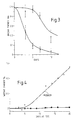
- the technique of plotting breaking energy against time of exposure to test conditions has the advantage that it takes into account both the loss in tensile strength and the reduction of elongation at break which are commonly observed consequences of the oxidative degradation processes.
- the pro-oxidant such as a transition metal salt
- the pro-oxidant may be omitted from the polymer composition, and the presence of iron salts in the soil, or in the other garbage with which packaging or the like made from the polymer composition is buried or composted may be relied upon to promote oxidation of the unsaturated polymer or copolymer in the composition blend whereby degradation may be initiated by the act of burying or composting the garbage.
- a composition embodying the invention may be made into a degradable product comprising a thin film or sheet adapted for the manufacture of bags and wrappings, the thin film or sheet having been formed by extrusion, extrusion blowing, film casting or calendering the polymer composition.
- a composition embodying the invention may alternatively be formed into three-dimensional objects such as containers or vessels, or disposable utility items, by injection moulding, blow moulding, compression moulding, thermoforming or rotational casting of the polymer composition.
Landscapes
- Chemical & Material Sciences (AREA)
- Chemical Kinetics & Catalysis (AREA)
- Medicinal Chemistry (AREA)
- Polymers & Plastics (AREA)
- Organic Chemistry (AREA)
- Health & Medical Sciences (AREA)
- Compositions Of Macromolecular Compounds (AREA)
- Biological Depolymerization Polymers (AREA)
- Addition Polymer Or Copolymer, Post-Treatments, Or Chemical Modifications (AREA)
- Treatments Of Macromolecular Shaped Articles (AREA)
- Processes Of Treating Macromolecular Substances (AREA)
- Macromonomer-Based Addition Polymer (AREA)
- Materials For Medical Uses (AREA)
- Polymerisation Methods In General (AREA)
Claims (4)
- Composition polymère dégradable comprenant un mélange de:(a) un polymère saturé chimiquement choisi dans le groupe comprenant polyéthylène, polypropylène ou polystyrène,(b) un composé chimique insaturé choisi dans le groupe comprenant caoutchouc naturel, élastomères styrène-butadiène, un copolymère séquencé styrène et butadiène,(c) un anti-oxydant actif sur une période limitée,(d) un pro-oxydant sous la forme d'un sel de métal de transition et(e) une charge comprenant de l'amidon naturel sec.
- Une composition selon la revendication 1 dans laquelle la composition de polymère comprend 10% en poids d'amidon sec, 5% en poids de caoutchouc synthétique sous la forme de polymère séquencé de styrène et de butadiène, dans lesquels leurs pourcentages en poids sont exprimés par rapport au poids total de la composition.
- Une composition de polymère selon la revendication 2, dans laquelle l'anti-oxydant est du type sacrificiel et est un composé organique plus facilement oxydable que le mélange polymère hôte et le pro-oxydant est un catalyseur d'oxydation du type obtenu par la combinaison d'un métal de transition avec un acide organique de poids moléculaire suffisant pour donner un sel soluble dans le mélange polymère hôte.
- Un produit dégradable obtenu à partir d'une composition polymère selon l'une quelconque des revendications 1 à 3, comprenant un film ou une feuille mince convenant à la fabrication de sacs et d'emballages.
Applications Claiming Priority (3)
| Application Number | Priority Date | Filing Date | Title |
|---|---|---|---|
| GB8712009 | 1987-05-21 | ||
| GB878712009A GB8712009D0 (en) | 1987-05-21 | 1987-05-21 | Degradable plastics |
| PCT/GB1988/000386 WO1988009354A1 (fr) | 1987-05-21 | 1988-05-16 | Plastiques degradables |
Publications (2)
| Publication Number | Publication Date |
|---|---|
| EP0363383A1 EP0363383A1 (fr) | 1990-04-18 |
| EP0363383B1 true EP0363383B1 (fr) | 1995-09-06 |
Family
ID=10617692
Family Applications (1)
| Application Number | Title | Priority Date | Filing Date |
|---|---|---|---|
| EP88904254A Expired - Lifetime EP0363383B1 (fr) | 1987-05-21 | 1988-05-16 | Plastiques degradables |
Country Status (12)
| Country | Link |
|---|---|
| US (1) | US4983651A (fr) |
| EP (1) | EP0363383B1 (fr) |
| JP (1) | JPH02504037A (fr) |
| KR (1) | KR970004917B1 (fr) |
| AT (1) | ATE127497T1 (fr) |
| AU (1) | AU626260B2 (fr) |
| CA (1) | CA1335005C (fr) |
| DE (1) | DE3854431T2 (fr) |
| FI (1) | FI98732C (fr) |
| GB (1) | GB8712009D0 (fr) |
| IL (1) | IL86522A (fr) |
| WO (1) | WO1988009354A1 (fr) |
Families Citing this family (65)
| Publication number | Priority date | Publication date | Assignee | Title |
|---|---|---|---|---|
| US5212219A (en) * | 1987-05-21 | 1993-05-18 | Epron Industries Limited | Degradable plastics |
| GB2207439B (en) * | 1987-07-27 | 1992-02-12 | Metal Box Plc | Improvements in and relating to packaging |
| US6159404A (en) * | 1989-06-15 | 2000-12-12 | Eastman Chemical Company | Low temperature, high speed extrusion coating process and polyethylene compositions useful therefor containing a thermally sensitive additive |
| US5070122A (en) * | 1989-06-15 | 1991-12-03 | Eastman Kodak Company | Environmentally degradable polymer blends |
| US5112424A (en) * | 1989-09-01 | 1992-05-12 | Eastman Kodak Company | Low temperature multi-layer extrusion coating process |
| FI91643C (fi) * | 1989-10-05 | 1994-07-25 | Biostor Oy | Biologisesti hajoava kalvo ja menetelmä sellaisen valmistamiseksi |
| GB8923797D0 (en) * | 1989-10-23 | 1989-12-13 | Kent Cartridge Mfg | Self-lubricating cartridge wads |
| WO1991006601A1 (fr) * | 1989-11-02 | 1991-05-16 | Allied-Signal Inc. | Matieres polymeres biodegradables et articles fabriques a partir de celles-ci |
| US4985024A (en) * | 1989-12-01 | 1991-01-15 | Minnesota Mining And Manufacturing Company | Disposable diaper having fastening means that are degradable |
| CA2040993C (fr) * | 1990-04-25 | 2001-08-07 | Yoshiaki Inoue | Composition qui absorbe l'oxygene et methode de conservation d'un article grace a cette composition |
| CA2062083C (fr) * | 1991-04-02 | 2002-03-26 | Drew Ve Speer | Compositions, systemes et methodes pour eliminer l'oxygene |
| ZA921914B (en) * | 1991-04-02 | 1993-09-16 | Grace W R & Co | Compositions, articles and methods for scavenging oxygen |
| US5111933A (en) * | 1991-04-16 | 1992-05-12 | Mobil Oil Corporation | Kit providing thermally degradable compost bag |
| JPH04318042A (ja) * | 1991-04-16 | 1992-11-09 | Nittetsu Mining Co Ltd | 分解性プラスチック用充填剤 |
| US5145779A (en) * | 1991-05-03 | 1992-09-08 | Iowa State University Research Foundation, Inc. | Process of biodegradation of high molecular weight polyethylene by aerobic lignolytic microorganisms |
| DE4119915C2 (de) * | 1991-06-17 | 1994-07-21 | Inventa Ag | Stärke-Polymer-Mischung, Verfahren zu ihrer Herstellung sowie ihre Verwendung |
| US5217803A (en) * | 1991-06-26 | 1993-06-08 | Tredegar Industries, Inc. | Disposable absorbent articles with biodegradable backsheets |
| US5254607A (en) * | 1991-06-26 | 1993-10-19 | Tredegar Industries, Inc. | Biodegradable, liquid impervious films |
| WO1993000399A1 (fr) * | 1991-06-26 | 1993-01-07 | The Procter & Gamble Company | Films biodegradables impermeables au liquide |
| BR9206214A (pt) * | 1991-06-26 | 1994-12-13 | Procter & Gamble | Artigo absorvente |
| GB9114242D0 (en) * | 1991-07-02 | 1991-08-21 | Epron Ind Ltd | Hydrodegradable moulding materials |
| US5252271A (en) * | 1991-10-22 | 1993-10-12 | Bio-Products International | Biodegradable packaging foam and method of preparation |
| US5308906A (en) * | 1991-12-11 | 1994-05-03 | Kimberly-Clark Corporation | Extrudable elastomeric composition having controlled rate of degradation |
| US5216043A (en) * | 1991-12-12 | 1993-06-01 | Minnesota Mining And Manufacturing Company | Degradable thermophastic compositions and blends with naturally biodegradable polymers |
| US5258422A (en) * | 1992-05-05 | 1993-11-02 | Tredegar Industries, Inc. | Compostable thermoplastic compositions |
| ES2113542T3 (es) * | 1992-06-26 | 1998-05-01 | Procter & Gamble | Composiciones para peliculas multicapa biodegradables e impermeables a los liquidos. |
| US5399289A (en) * | 1992-10-01 | 1995-03-21 | W. R. Grace & Co.-Conn. | Compositions, articles and methods for scavenging oxygen which have improved physical properties |
| US5310497A (en) * | 1992-10-01 | 1994-05-10 | W. R. Grace & Co.-Conn. | Oxygen scavenging compositions for low temperature use |
| US5352716A (en) * | 1992-12-16 | 1994-10-04 | Ecostar International, L.P. | Degradable synthetic polymeric compounds |
| US5322866A (en) * | 1993-01-29 | 1994-06-21 | The United States Of America As Represented By The Secretary Of The Army | Method of producing biodegradable starch-based product from unprocessed raw materials |
| US5374671A (en) * | 1993-02-16 | 1994-12-20 | The Goodyear Tire & Rubber Company | Hydrophilic polymer composite and product containing same |
| US5393831A (en) * | 1993-05-05 | 1995-02-28 | Kimberly-Clark Corporation | Shelf stable nonwoven fabrics and films |
| GB2290741A (en) * | 1994-06-28 | 1996-01-10 | Frank Huang | Disposable receptacle and method of forming the same |
| US5429073A (en) * | 1993-10-26 | 1995-07-04 | Shakespeare Company | Bedding materials for animals |
| CA2177033C (fr) * | 1993-12-20 | 2000-06-27 | Robert S. Honkonen | Compositions polymeres a ph modifie presentant une biodegradabilite amelioree |
| US5759569A (en) * | 1995-01-10 | 1998-06-02 | The Procter & Gamble Company | Biodegradable articles made from certain trans-polymers and blends thereof with other biodegradable components |
| US5986000A (en) | 1995-05-22 | 1999-11-16 | Playtex Products, Inc. | Soft, flexible composition and method for making same |
| FR2741627B1 (fr) | 1995-11-27 | 1997-12-19 | Poudres & Explosifs Ste Nale | Compositions entierement biodegradables utiles pour fabriquer des cartouches de chasse et de tir |
| US6025417A (en) * | 1996-02-28 | 2000-02-15 | Biotechnology Research & Development Corp. | Biodegradable polyester compositions with natural polymers and articles thereof |
| US5852078A (en) * | 1996-02-28 | 1998-12-22 | The United States Of America As Represented By The Secretary Of Agriculture | Biodegradable polyester compositions with natural polymers and articles thereof |
| US5861216A (en) * | 1996-06-28 | 1999-01-19 | The United States Of America As Represented By The Secretary Of Agriculture | Biodegradable polyester and natural polymer laminates |
| US5665786A (en) * | 1996-05-24 | 1997-09-09 | Bradley University | Biodegradable polyester and natural polymer compositions and expanded articles therefrom |
| US5821286A (en) * | 1996-05-24 | 1998-10-13 | The United States Of America As Represented By The Secretary Of The Agriculture | Biodegradable polyester and natural polymer compositions and films therefrom |
| US6893527B1 (en) | 1996-06-28 | 2005-05-17 | William M. Doane | Biodegradable polyester and natural polymer laminates |
| US6254803B1 (en) * | 1998-03-25 | 2001-07-03 | Cryovac, Inc. | Oxygen scavengers with reduced oxidation products for use in plastic films |
| US6080805A (en) * | 1998-11-02 | 2000-06-27 | Polymer Process Technologies, Inc. | Polymer modifying agent |
| US6136897A (en) * | 1998-11-02 | 2000-10-24 | Polymer Process Technologies, Inc. | Rubber processing additive |
| US6133362A (en) * | 1998-11-02 | 2000-10-17 | Polymer Process Technologies, Inc | Chemical aid for use of scrap plastics in rubber formulations |
| US6482872B2 (en) | 1999-04-01 | 2002-11-19 | Programmable Materials, Inc. | Process for manufacturing a biodegradable polymeric composition |
| CN1121452C (zh) * | 2000-11-23 | 2003-09-17 | 许浩 | 生物降解环保型餐具的配方及生产工艺 |
| US7402618B2 (en) * | 2000-11-23 | 2008-07-22 | Hao Xu | Biodegradable composition for the preparation of tableware, drink container, mulching film and package and method for preparing the same |
| US20020183418A1 (en) * | 2001-02-02 | 2002-12-05 | Oren Rosen | Design and synthesis of instant-degradable plastics |
| KR20020029050A (ko) * | 2002-03-29 | 2002-04-17 | 주식회사 나선하이테크 | 분해성 수지 및 그 제조방법 |
| US20030236325A1 (en) * | 2002-05-30 | 2003-12-25 | Michela Bonora | Agricultural articles |
| NO324368B1 (no) * | 2003-04-23 | 2007-10-01 | Normors As | Fremgangsmate for fremstilling av tilsetningsmiddel til termoplaster og slik fremstilt tilsetningsmiddel samt termoplast inneholdende slikt tilsetningsmiddel. |
| US20040259974A1 (en) * | 2003-06-18 | 2004-12-23 | Gerald Scott | Biodegradable polymer compositions with controlled lifetimes |
| US20070227087A1 (en) * | 2003-10-24 | 2007-10-04 | Crane Plastics Company Llc | Method of manufacturing simulated stone, brick, and masonry panels and wall structures |
| US20050087908A1 (en) * | 2003-10-24 | 2005-04-28 | Moe Nasr | Simulated stone and masonry and brick textured siding panels |
| US20090062413A1 (en) * | 2003-10-24 | 2009-03-05 | Crane Building Products Llc | Composition of fillers with plastics for producing superior building materials |
| US7052628B2 (en) * | 2003-11-19 | 2006-05-30 | Chevron Phillips Chemical Company, Lp | Transition metal carboxylates as catalysts for oxygen scavenging |
| JP5484161B2 (ja) | 2010-03-31 | 2014-05-07 | 小林製薬株式会社 | 生分解性使い捨てカイロ |
| FR3010410B1 (fr) | 2013-09-06 | 2016-12-23 | Jerome Chiesa | Composition thermoplastique biodegradable utilisable pour la fabrication de munitions de chasse |
| US10400105B2 (en) | 2015-06-19 | 2019-09-03 | The Research Foundation For The State University Of New York | Extruded starch-lignin foams |
| WO2018124122A1 (fr) | 2016-12-28 | 2018-07-05 | ユニ・チャーム株式会社 | Article absorbant |
| JP6529550B2 (ja) | 2016-12-28 | 2019-06-12 | ユニ・チャーム株式会社 | 吸収性物品 |
Family Cites Families (27)
| Publication number | Priority date | Publication date | Assignee | Title |
|---|---|---|---|---|
| US2027962A (en) * | 1933-03-03 | 1936-01-14 | Nat Carbon Co Inc | Production of articles from plastic compositions |
| US2623025A (en) * | 1949-02-11 | 1952-12-23 | Libbey Owens Ford Glass Co | Production of stable thermosetting compositions |
| CH340626A (de) * | 1955-09-13 | 1959-08-31 | Lonza Ag | Vinylpolymerisat oder -mischpolymerisat und Füllstoff enthaltende Kunststoffmasse |
| LU37997A1 (fr) * | 1959-12-01 | |||
| US3276899A (en) * | 1962-05-22 | 1966-10-04 | Nat Starch Chem Corp | Substrate with a precoat of resin polymer and starch granules and a topcoat of vinylidene chloride resin |
| US3468724A (en) * | 1966-03-31 | 1969-09-23 | Amchem Prod | Metal coating process |
| US3361690A (en) * | 1966-09-08 | 1968-01-02 | Weyerhaeuser Co | Polyester molding composition containing aqueous-alkaliextracted-douglas fir bark fiber as a reinforcing agent |
| US3634562A (en) * | 1969-01-27 | 1972-01-11 | Nat Gypsum Co | Method of making acoustic tiles having voids containing shrunken beads |
| US3767604A (en) * | 1969-07-15 | 1973-10-23 | Penick & Ford Ltd | Compatible mixtures of modified starch and polyvinyl alcohol |
| BE789277A (fr) * | 1971-09-27 | 1973-03-26 | Union Carbide Corp | Composition de polymere d'ethylene degradable sous l'action desintemperies |
| BE791912A (fr) * | 1971-11-24 | 1973-05-24 | Ici Ltd | Compositions de matiere plastique |
| US3797690A (en) * | 1971-12-08 | 1974-03-19 | Owens Illinois Inc | Preparation of degradable polymeric material |
| US4016117A (en) * | 1972-05-18 | 1977-04-05 | Coloroll Limited | Biodegradable synthetic resin sheet material containing starch and a fatty material |
| US4021388A (en) * | 1972-05-18 | 1977-05-03 | Coloroll Limited | Synthetic resin sheet material |
| US3867324A (en) * | 1972-07-28 | 1975-02-18 | Union Carbide Corp | Environmentally degradable-biodegradable blend of an oxyalkanoyl polymer and an environmentally degradable ethylene polymer |
| US3856747A (en) * | 1972-08-07 | 1974-12-24 | Mobil Oil Corp | Programmed degradation of polyolefins |
| FR2200299B1 (fr) * | 1972-09-20 | 1978-10-20 | Huels Chemische Werke Ag | |
| US3952347A (en) * | 1973-12-13 | 1976-04-27 | Personal Products Company | Biodegradable barrier film and absorbent pad utilizing same |
| US4125495A (en) * | 1974-11-25 | 1978-11-14 | Coloroll Limited | Synthetic/resin based compositions |
| US3949145A (en) * | 1975-02-27 | 1976-04-06 | The United States Of America As Represented By The Secretary Of Agriculture | Degradable starch-based agricultural mulch film |
| US4026849A (en) * | 1975-10-03 | 1977-05-31 | The United States Of America As Represented By The Secretary Of Agriculture | Composite compositions from graft polymerized rigid fillers |
| CA1051136A (fr) * | 1976-02-27 | 1979-03-20 | Suezone Chow | Extendeur et charge pour adhesif a bois |
| GB1600496A (en) * | 1977-09-16 | 1981-10-14 | Coloroll Ltd | Plasticsbased composition |
| US4519161A (en) * | 1977-09-21 | 1985-05-28 | Dan Gilead | Agricultural process using controllably degradable polymer composition film |
| IL52974A0 (en) * | 1977-09-21 | 1977-11-30 | Plastopil Hazorea | Agricultural process film products for carrying out the process and controllably degradable polymer compositions for making said film products |
| ZA815185B (en) * | 1980-08-06 | 1982-09-29 | Coloroll Ltd | Plastics based composition |
| CH671961A5 (fr) * | 1987-02-27 | 1989-10-13 | Amrotex Ag |
-
1987
- 1987-05-21 GB GB878712009A patent/GB8712009D0/en active Pending
-
1988
- 1988-04-18 US US07/182,949 patent/US4983651A/en not_active Expired - Lifetime
- 1988-05-16 AT AT88904254T patent/ATE127497T1/de not_active IP Right Cessation
- 1988-05-16 EP EP88904254A patent/EP0363383B1/fr not_active Expired - Lifetime
- 1988-05-16 JP JP63504017A patent/JPH02504037A/ja active Pending
- 1988-05-16 WO PCT/GB1988/000386 patent/WO1988009354A1/fr not_active Ceased
- 1988-05-16 KR KR1019890700106A patent/KR970004917B1/ko not_active Expired - Fee Related
- 1988-05-16 DE DE3854431T patent/DE3854431T2/de not_active Expired - Fee Related
- 1988-05-16 AU AU17161/88A patent/AU626260B2/en not_active Ceased
- 1988-05-20 CA CA000567389A patent/CA1335005C/fr not_active Expired - Lifetime
- 1988-05-26 IL IL86522A patent/IL86522A/xx not_active IP Right Cessation
-
1989
- 1989-11-20 FI FI895517A patent/FI98732C/fi not_active IP Right Cessation
Non-Patent Citations (1)
| Title |
|---|
| Chemical Abstracts, volume 80, no. 20, 20 May 1974, (Columbus, Ohio, US), see page 34, abstract 109315j, & JP A 7375639 * |
Also Published As
| Publication number | Publication date |
|---|---|
| FI98732C (fi) | 1997-08-11 |
| AU1716188A (en) | 1988-12-21 |
| FI895517A0 (fi) | 1989-11-20 |
| FI98732B (fi) | 1997-04-30 |
| KR890701673A (ko) | 1989-12-21 |
| GB8712009D0 (en) | 1987-06-24 |
| CA1335005C (fr) | 1995-03-28 |
| DE3854431T2 (de) | 1996-04-04 |
| WO1988009354A1 (fr) | 1988-12-01 |
| EP0363383A1 (fr) | 1990-04-18 |
| AU626260B2 (en) | 1992-07-30 |
| IL86522A (en) | 1992-07-15 |
| ATE127497T1 (de) | 1995-09-15 |
| KR970004917B1 (ko) | 1997-04-08 |
| DE3854431D1 (de) | 1995-10-12 |
| JPH02504037A (ja) | 1990-11-22 |
| US4983651A (en) | 1991-01-08 |
Similar Documents
| Publication | Publication Date | Title |
|---|---|---|
| US4983651A (en) | Degradable plastics | |
| US5212219A (en) | Degradable plastics | |
| Zhong et al. | Biodegradable polymers and green-based antimicrobial packaging materials: A mini-review | |
| AU594864B2 (en) | Degradable thermoplastic compositions | |
| US5854304A (en) | Degradable/compostable concentrates, process for making degradable/compostable packaging materials and the products thereof | |
| US3867324A (en) | Environmentally degradable-biodegradable blend of an oxyalkanoyl polymer and an environmentally degradable ethylene polymer | |
| US5258422A (en) | Compostable thermoplastic compositions | |
| EP0616622B1 (fr) | Compositions et melanges thermoplastiques degradables | |
| KR100958855B1 (ko) | 생분해성 플라스틱 조성물, 그것의 성형물, 및 생분해율을조절하는 방법 | |
| DE602004005721T2 (de) | Blockcopolymere als Sauerstofffänger und diese enthaltende Zusammensetzungen | |
| JP5053500B2 (ja) | 生分解性ポリマー及び生分解性ポリマー組成物の分解速度の減速方法並びにそれらの組成物 | |
| US5342862A (en) | Process for controlling the photodegradation of mulch film | |
| US3886683A (en) | Degradable plastic | |
| EP1270659A1 (fr) | Composition de polyester aliphatique et produits flexibles | |
| CA2098911A1 (fr) | Composition plastique photodegradable | |
| KR100368738B1 (ko) | 생/광분해성 농업용 멀칭필름 조성물과 이의 제조방법 및 이로 부터 제조된 성형물 | |
| Sable et al. | Preparation and characterization of oxo-degradable polypropylene composites containing a modified pro-oxidant | |
| JPH04173868A (ja) | 生物分解性樹脂組成物およびその製品 | |
| US3903029A (en) | Biodegradable alpha polyolefin compositions containing a mixture of para-alkanolamino phenols | |
| KR101856468B1 (ko) | 항균제, 아세틴계 친환경 가소제, 아세틸계 생분해 촉매제 및 바이오매스를 이용한 항균 롤백, 위생백 및 위생장갑 용도의 바이오 비닐용 조성물 | |
| Sipinen et al. | A study of the oxidative degradation of polyolefins | |
| DK173143B1 (da) | Nedbrydeligt polymermateriale samt nedbrydeligt produkt fremstillet deraf | |
| KR100288054B1 (ko) | 열화성폴리올레핀수지조성물과그의제조방법 | |
| KR101944088B1 (ko) | 생분해 촉매제를 이용한 항균 롤백, 위생백 및 위생장갑 용도의 바이오 비닐용 조성물 | |
| US20060160922A1 (en) | Biodegradable polymer compositions with controlled lifetimes |
Legal Events
| Date | Code | Title | Description |
|---|---|---|---|
| PUAI | Public reference made under article 153(3) epc to a published international application that has entered the european phase |
Free format text: ORIGINAL CODE: 0009012 |
|
| 17P | Request for examination filed |
Effective date: 19891115 |
|
| AK | Designated contracting states |
Kind code of ref document: A1 Designated state(s): AT BE CH DE FR GB IT LI LU NL SE |
|
| 17Q | First examination report despatched |
Effective date: 19920604 |
|
| GRAA | (expected) grant |
Free format text: ORIGINAL CODE: 0009210 |
|
| AK | Designated contracting states |
Kind code of ref document: B1 Designated state(s): AT BE CH DE FR GB IT LI LU NL SE |
|
| REF | Corresponds to: |
Ref document number: 127497 Country of ref document: AT Date of ref document: 19950915 Kind code of ref document: T |
|
| REF | Corresponds to: |
Ref document number: 3854431 Country of ref document: DE Date of ref document: 19951012 |
|
| ET | Fr: translation filed | ||
| ITF | It: translation for a ep patent filed | ||
| PLBE | No opposition filed within time limit |
Free format text: ORIGINAL CODE: 0009261 |
|
| STAA | Information on the status of an ep patent application or granted ep patent |
Free format text: STATUS: NO OPPOSITION FILED WITHIN TIME LIMIT |
|
| 26N | No opposition filed | ||
| REG | Reference to a national code |
Ref country code: GB Ref legal event code: IF02 |
|
| PGFP | Annual fee paid to national office [announced via postgrant information from national office to epo] |
Ref country code: LU Payment date: 20020725 Year of fee payment: 15 |
|
| PGFP | Annual fee paid to national office [announced via postgrant information from national office to epo] |
Ref country code: DE Payment date: 20020829 Year of fee payment: 15 Ref country code: AT Payment date: 20020829 Year of fee payment: 15 |
|
| PG25 | Lapsed in a contracting state [announced via postgrant information from national office to epo] |
Ref country code: AT Free format text: LAPSE BECAUSE OF NON-PAYMENT OF DUE FEES Effective date: 20030516 Ref country code: LU Free format text: LAPSE BECAUSE OF NON-PAYMENT OF DUE FEES Effective date: 20030516 |
|
| PG25 | Lapsed in a contracting state [announced via postgrant information from national office to epo] |
Ref country code: DE Free format text: LAPSE BECAUSE OF NON-PAYMENT OF DUE FEES Effective date: 20031202 |
|
| PGFP | Annual fee paid to national office [announced via postgrant information from national office to epo] |
Ref country code: FR Payment date: 20040708 Year of fee payment: 17 |
|
| PGFP | Annual fee paid to national office [announced via postgrant information from national office to epo] |
Ref country code: CH Payment date: 20040715 Year of fee payment: 17 |
|
| PGFP | Annual fee paid to national office [announced via postgrant information from national office to epo] |
Ref country code: NL Payment date: 20040727 Year of fee payment: 17 |
|
| PGFP | Annual fee paid to national office [announced via postgrant information from national office to epo] |
Ref country code: SE Payment date: 20040728 Year of fee payment: 17 |
|
| PGFP | Annual fee paid to national office [announced via postgrant information from national office to epo] |
Ref country code: BE Payment date: 20040813 Year of fee payment: 17 |
|
| PG25 | Lapsed in a contracting state [announced via postgrant information from national office to epo] |
Ref country code: IT Free format text: LAPSE BECAUSE OF NON-PAYMENT OF DUE FEES;WARNING: LAPSES OF ITALIAN PATENTS WITH EFFECTIVE DATE BEFORE 2007 MAY HAVE OCCURRED AT ANY TIME BEFORE 2007. THE CORRECT EFFECTIVE DATE MAY BE DIFFERENT FROM THE ONE RECORDED. Effective date: 20050516 |
|
| PG25 | Lapsed in a contracting state [announced via postgrant information from national office to epo] |
Ref country code: SE Free format text: LAPSE BECAUSE OF NON-PAYMENT OF DUE FEES Effective date: 20050517 |
|
| PG25 | Lapsed in a contracting state [announced via postgrant information from national office to epo] |
Ref country code: BE Free format text: LAPSE BECAUSE OF NON-PAYMENT OF DUE FEES Effective date: 20050531 Ref country code: LI Free format text: LAPSE BECAUSE OF NON-PAYMENT OF DUE FEES Effective date: 20050531 Ref country code: CH Free format text: LAPSE BECAUSE OF NON-PAYMENT OF DUE FEES Effective date: 20050531 |
|
| BERE | Be: lapsed |
Owner name: *EPRON INDUSTRIES LTD Effective date: 20050531 |
|
| PG25 | Lapsed in a contracting state [announced via postgrant information from national office to epo] |
Ref country code: NL Free format text: LAPSE BECAUSE OF NON-PAYMENT OF DUE FEES Effective date: 20051201 |
|
| REG | Reference to a national code |
Ref country code: CH Ref legal event code: PL |
|
| EUG | Se: european patent has lapsed | ||
| PG25 | Lapsed in a contracting state [announced via postgrant information from national office to epo] |
Ref country code: FR Free format text: LAPSE BECAUSE OF NON-PAYMENT OF DUE FEES Effective date: 20060131 |
|
| NLV4 | Nl: lapsed or anulled due to non-payment of the annual fee |
Effective date: 20051201 |
|
| REG | Reference to a national code |
Ref country code: FR Ref legal event code: ST Effective date: 20060131 |
|
| PGFP | Annual fee paid to national office [announced via postgrant information from national office to epo] |
Ref country code: GB Payment date: 20060510 Year of fee payment: 19 |
|
| BERE | Be: lapsed |
Owner name: *EPRON INDUSTRIES LTD Effective date: 20050531 |
|
| GBPC | Gb: european patent ceased through non-payment of renewal fee |
Effective date: 20070516 |
|
| PG25 | Lapsed in a contracting state [announced via postgrant information from national office to epo] |
Ref country code: GB Free format text: LAPSE BECAUSE OF NON-PAYMENT OF DUE FEES Effective date: 20070516 |