EP0362452A2 - Gelenkige Konstruktionen - Google Patents
Gelenkige Konstruktionen Download PDFInfo
- Publication number
- EP0362452A2 EP0362452A2 EP88420279A EP88420279A EP0362452A2 EP 0362452 A2 EP0362452 A2 EP 0362452A2 EP 88420279 A EP88420279 A EP 88420279A EP 88420279 A EP88420279 A EP 88420279A EP 0362452 A2 EP0362452 A2 EP 0362452A2
- Authority
- EP
- European Patent Office
- Prior art keywords
- bars
- structures
- pyramids
- square
- equal
- Prior art date
- Legal status (The legal status is an assumption and is not a legal conclusion. Google has not performed a legal analysis and makes no representation as to the accuracy of the status listed.)
- Withdrawn
Links
Images
















Classifications
-
- E—FIXED CONSTRUCTIONS
- E04—BUILDING
- E04B—GENERAL BUILDING CONSTRUCTIONS; WALLS, e.g. PARTITIONS; ROOFS; FLOORS; CEILINGS; INSULATION OR OTHER PROTECTION OF BUILDINGS
- E04B1/00—Constructions in general; Structures which are not restricted either to walls, e.g. partitions, or floors or ceilings or roofs
- E04B1/18—Structures comprising elongated load-supporting parts, e.g. columns, girders, skeletons
- E04B1/19—Three-dimensional [3D] framework structures
-
- E—FIXED CONSTRUCTIONS
- E04—BUILDING
- E04B—GENERAL BUILDING CONSTRUCTIONS; WALLS, e.g. PARTITIONS; ROOFS; FLOORS; CEILINGS; INSULATION OR OTHER PROTECTION OF BUILDINGS
- E04B1/00—Constructions in general; Structures which are not restricted either to walls, e.g. partitions, or floors or ceilings or roofs
- E04B1/18—Structures comprising elongated load-supporting parts, e.g. columns, girders, skeletons
- E04B1/19—Three-dimensional [3D] framework structures
- E04B2001/1924—Struts specially adapted therefor
- E04B2001/1927—Struts specially adapted therefor of essentially circular cross section
-
- E—FIXED CONSTRUCTIONS
- E04—BUILDING
- E04B—GENERAL BUILDING CONSTRUCTIONS; WALLS, e.g. PARTITIONS; ROOFS; FLOORS; CEILINGS; INSULATION OR OTHER PROTECTION OF BUILDINGS
- E04B1/00—Constructions in general; Structures which are not restricted either to walls, e.g. partitions, or floors or ceilings or roofs
- E04B1/18—Structures comprising elongated load-supporting parts, e.g. columns, girders, skeletons
- E04B1/19—Three-dimensional [3D] framework structures
- E04B2001/1981—Three-dimensional [3D] framework structures characterised by the grid type of the outer planes of the framework
-
- E—FIXED CONSTRUCTIONS
- E04—BUILDING
- E04B—GENERAL BUILDING CONSTRUCTIONS; WALLS, e.g. PARTITIONS; ROOFS; FLOORS; CEILINGS; INSULATION OR OTHER PROTECTION OF BUILDINGS
- E04B1/00—Constructions in general; Structures which are not restricted either to walls, e.g. partitions, or floors or ceilings or roofs
- E04B1/18—Structures comprising elongated load-supporting parts, e.g. columns, girders, skeletons
- E04B1/19—Three-dimensional [3D] framework structures
- E04B2001/1981—Three-dimensional [3D] framework structures characterised by the grid type of the outer planes of the framework
- E04B2001/1984—Three-dimensional [3D] framework structures characterised by the grid type of the outer planes of the framework rectangular, e.g. square, grid
Definitions
- Two elements are considered rigid in this structure, the cockpit or the hanging machine, the base or the block - possibly the wheels - resting on the ground.
- the proposed suspension allows a distribution of the movements of a support on the other supports. There is only one elastic element which is stressed whatever the support concerned by a displacement. Its deformation causes the displacement of the center of mass of the structure. We must be able to count on the same distribution with regard to efforts and therefore have equal reactions under each support. This equality is verified when there is a symmetry of revolution. We will propose a solution to achieve equality under each support when there is no symmetry of revolution.
- the suspension is therefore a set of isostatic structures built around an elastic central element with adequate damping articulated on the suspended assembly and on its support so that, essentially, the joints are located in two parallel planes perpendicular to the field. of preponderant force.
- this elastic core can be made of synthetic material or rubber. It can be made up of several skins.
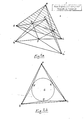
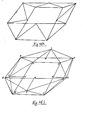
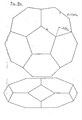
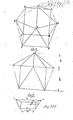
- Figure 3a the vertices of the pyramids are outside the prism.
- Figure 3b shows that the bars can be spindles.
- the spindles can possibly be limited to two arcs whose section is vertical and evolves according to a Gauss curve in this direction when one traverses the arc. As the height of the section decreases from the middle of the arc towards the ends, its width increases in the same mode.
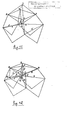
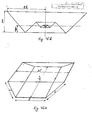
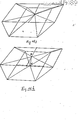
- Figures 4 differ from Figures 2 in that the vertices of the pyramids are outside.
- the arcs IJ, JK, KI do not pass through the vertices A, B, C they are located in a different plane, in principle parallel to A B C. ( Figure 4 of sheet 4/38).
- the ground can be considered as a set of bars; since there are four articulation supports the ground is equivalent to 6 bars number of sides of a tetrahedron. It will be preferable that these supports are not in the same plane.
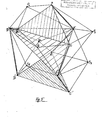
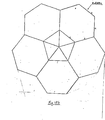
- the four pentagons have their five vertices, each meeting in four pyramids. These can be inbound or outbound.
- Figure 7. (sheet 7/38).
- Three pyramids adjacent to four bars, eight bars, the fourth to five bars its top is connected to that of the adjacent pyramids pae a bar.
- the continuous plate is associated with posts ending in a pyramid such as SE "'F"B'H. These posts can be composed of pyramidal elements and paving stones such as A "B'C D" G 'H to avoid their buckling.
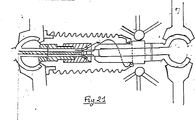
- the articulated structures pose the problem of making all-round joints. These will be studied later.
- an isostatic structure therefore having no elastic energy to release during a possible deformation, having two polygons in parallel planes, sees these remain hemothetic to themselves when it undergoes a perpendicular load at the planes of the polygons and distributed between their joints.
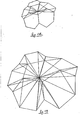
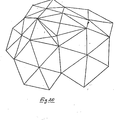
- FIGS. 2a, 16a, 14, 18 and others may be suitable for producing a hydraulic cylinder because they are deformable by a fluid. The problem is then to find the structure which will have a degree of instability while retaining a center of symmetry. Figure 20 q satisfies this exi ence. by doubling it.
- the rotation of these cams can be driven by a pneumatic system, a compressed air duct actuating a turbine secured to the cam.
- This duct is formed of several sections fitted into each other by conical fitting for example: when there is tightness, the compressed air goes to the end of the pipe and turns the second cam, when the fitting is disconnected , it lets pass the air which will activate the turbine located immediately after it.
- an axial control comprising a cable with an extendable lead at its end, a decreasing progressiveness in the effort necessary to separate the shanks, one can rotate the elementary articulation structure which one has chosen. It is enough to position the lead in the pipe and to draw it from the sufficient distance.
- the deformable structure in rotation has other applications when it does not admit a center of symmetry. Indeed, in Figure 1 rotating along an axis perpendicular to the triangles if one of the vertices of the pyramid is further from the axis of rotation, vertex having a mass, there will be deformation of the structure. If the vertex in question is in the plane parallel to the triangle containing the other vertices but offset angularly with respect to the perpendicular passing through the center of its base and if, in fact, all the vertices have the same angular phase shift relative to this straight line , the phase shift in question will vary when the structure becomes flattened following an increase in the speed of rotation. It is this variation of phase shift which will be used to obtain a variable ignition advance which system seems a priori better than vacuum systems.
- the bars are not strictly equal going outward, at least in a variant, when the cohesion of together. These are tire carcasses and a line of structures among those using pentagons.
- the keystone is formed by a tetrahedron framed by two adjacent pyramids, that is to say coinciding by one face with it and two other inverted pyramids, adjacent in the perpendicular direction and coinciding each by one of the two faces remained free on the tetrahedron.
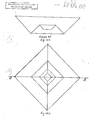
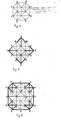
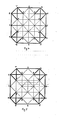
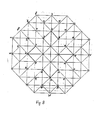
- the following structure, to which the desired concentric development leads, is obtained as follows: the three bars are placed, two of which form the base of a pyramid having a common angle with the previous square. This operation is carried out eight times to obtain central symmetry, the structure is then always isostatic, it becomes hyperstatic when four bars are applied, making it possible to obtain an octagonal outline from above. If you want isostaticity and in order to keep the central symmetry, you can remove one of the following two bars as desired: the parallel slash, in top view, to the slash belonging to the outer contour for example AF or BG, the perpendicular and mediating horizontal bar in top view of a bar forming the end of the central cross example Il or JJ '.
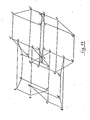
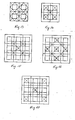
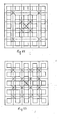
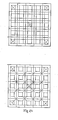
- THE best solution is as follows: 24 connecting bars between small peripheral tiles, 16 connecting bars perpendicular to the sides of the square formed by the structure, 5 cross-pieces forming the edges of a pyramid. This solution is shown in Figure 18 of sheet 32/38. It is not obvious that the above solution is the best because, apart from the central cross, it too favors the frame added on the 2x2 to make the 4x4 in bar density at the expense of the latter. However, it is also not obvious that a solution keeping 2x2 in the state it was defined above is a good solution. This solution would connect the latter to the outer frame of the 4x4 which would have 24 connecting bars by four crosspieces located at each corner.
- the object of these new constructions therefore eligible for invention, relates to structures based on a pentagon, pentagonal pyramid or pentagonal frame made up of two pentagons, one on side 1, the other on side 2 and connected by a triangulation.
- a bar remains to be removed so that the structure is isostatic. It can be removed in a pyramid with 5 edge bars, or even in the central pentagon.
- the provision providing tirans between the vertices of the pyramid is also envisaged for concentric structures formed of frames.
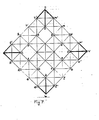
- this category of structures it is envisaged to have two thicknesses of the same structure coincidence by the small or by the large squares. We can then remove bars in the frames and obtain diamonds.
- modules can be assembled into crowns in two ways: either the square of the inner polygon of the crown is the side common to the two squares AB, or it is an outer side of one of the squares DC or FE.
- the module admits two planes of symmetry, therefore, an axis of symmetry.
- the common sides for associating two modules in a crown are the sides coming from the ends of the side considered for the distinction of the two cases, which make between them an angle of 36 °.
- the crown can include 10 modules, or even 8 or even 9 or even 7 or 6. In some cases, we have isosceles trapezoids instead of squares. In the case of 10 modules, the plane of symmetry, mediating plane on the common side of the squares, partitions the space into 10 dihedrons of 36 °.
- the plane of the crown is, in one of the ways distinguished at the start, the other plane of symmetry of the modules, in the other way, its plane is the plane of a pentagon.
- the rhombohedrons have diamond faces, composed of two equilateral triangles, it is easy to block or unblock them by removing the diagonal.
- phase shift of the flanges is linked to the volume of the square prisms which evolve from the square to any rhombohedra. This fact can be used to make pumps, press control systems and other applications.
- the crowns envisaged are designed to act as a tire carcass. They suppress inflation.
Landscapes
- Engineering & Computer Science (AREA)
- Architecture (AREA)
- Physics & Mathematics (AREA)
- Electromagnetism (AREA)
- Civil Engineering (AREA)
- Structural Engineering (AREA)
- Toys (AREA)
- Vehicle Body Suspensions (AREA)
Applications Claiming Priority (6)
| Application Number | Priority Date | Filing Date | Title |
|---|---|---|---|
| FR8711389 | 1987-08-06 | ||
| FR8711389 | 1987-08-06 | ||
| FR8801222 | 1988-01-29 | ||
| FR8801222 | 1988-01-29 | ||
| FR8808712 | 1988-06-27 | ||
| FR8808712 | 1988-06-27 |
Publications (2)
| Publication Number | Publication Date |
|---|---|
| EP0362452A2 true EP0362452A2 (de) | 1990-04-11 |
| EP0362452A3 EP0362452A3 (de) | 1990-10-31 |
Family
ID=27251494
Family Applications (1)
| Application Number | Title | Priority Date | Filing Date |
|---|---|---|---|
| EP19880420279 Withdrawn EP0362452A3 (de) | 1987-08-06 | 1988-08-08 | Gelenkige Konstruktionen |
Country Status (1)
| Country | Link |
|---|---|
| EP (1) | EP0362452A3 (de) |
Cited By (2)
| Publication number | Priority date | Publication date | Assignee | Title |
|---|---|---|---|---|
| CN110289477A (zh) * | 2019-07-26 | 2019-09-27 | 中国电子科技集团公司第五十四研究所 | 一种内外边数为1比2的单层空间结构的天线副面背架及制造方法 |
| CN116290623A (zh) * | 2022-10-28 | 2023-06-23 | 上海思友金属材料技术有限公司 | 多棱体顶角与转角装饰技术工程结构 |
Family Cites Families (2)
| Publication number | Priority date | Publication date | Assignee | Title |
|---|---|---|---|---|
| FR2137257B1 (de) * | 1971-05-17 | 1973-05-11 | Thorel Jean | |
| FR2256994A1 (en) * | 1974-01-07 | 1975-08-01 | Aubert J | Collapsible metal framework with universal joints - has bars joined at ends by ring-shaped swivel portions |
-
1988
- 1988-08-08 EP EP19880420279 patent/EP0362452A3/de not_active Withdrawn
Cited By (3)
| Publication number | Priority date | Publication date | Assignee | Title |
|---|---|---|---|---|
| CN110289477A (zh) * | 2019-07-26 | 2019-09-27 | 中国电子科技集团公司第五十四研究所 | 一种内外边数为1比2的单层空间结构的天线副面背架及制造方法 |
| CN110289477B (zh) * | 2019-07-26 | 2024-05-24 | 中国电子科技集团公司第五十四研究所 | 一种内外边数为1比2的单层空间结构的天线副面背架及制造方法 |
| CN116290623A (zh) * | 2022-10-28 | 2023-06-23 | 上海思友金属材料技术有限公司 | 多棱体顶角与转角装饰技术工程结构 |
Also Published As
| Publication number | Publication date |
|---|---|
| EP0362452A3 (de) | 1990-10-31 |
Similar Documents
| Publication | Publication Date | Title |
|---|---|---|
| EP0154577B1 (de) | Vorgespannter Fachwerkträger mit Elementen in geknicktem Zustand | |
| FR2609281A1 (fr) | Procede pour renforcer un objet conique et objet resultant | |
| EP3177831B1 (de) | Ausgeglichener mechanismus zur energieeinsparung, rotationsmaschine und verfahren zur implementierung solch eines mechanismus | |
| EP3761779A1 (de) | Elastische struktur und entsprechendes montageverfahren | |
| EP0362452A2 (de) | Gelenkige Konstruktionen | |
| EP0053582B1 (de) | System einer Modul-Konstruktion aus Gelenken und Stäben für räumliche Fachwerke | |
| JP3045687B2 (ja) | フレーム構造物とその施工方法 | |
| FR2534484A1 (fr) | Nouveau jeu de construction constitue de plaquettes de formes geometriques assemblables | |
| CA3068214C (fr) | Troncon de mat d'eolienne, mat d'eolienne et procede d'assemblage | |
| WO2013113866A1 (fr) | Ensemble structural fermé à tenue à la compression améliorée | |
| FR2684172A1 (fr) | Echangeur de chaleur, a tubes en u equipes d'un dispositif de supportage anti-envol. | |
| WO2024133035A1 (fr) | Structure architecturée en treillis pour dispositif comportant une interface souple | |
| CN112081445B (zh) | 一种大型钢结构阳光树及阳光树制作工艺 | |
| EP0419749B1 (de) | Metallkonstruktion, insbesondere für Dächer | |
| EP3102751B1 (de) | Konstruktionselement mit mindestens zwei blöcken | |
| JP3773952B2 (ja) | 構造フレーム | |
| JPS58120907A (ja) | 消波ブロック傾斜堤体構築工法 | |
| WO2002081832A1 (fr) | Systeme a autoequilibre stable pour element de construction | |
| FR2642772A1 (fr) | Dispositif constructif a structure alveolaire pour pistes temporaires | |
| FR3120800A1 (fr) | Les 7 polyèdres aux sphères inscrites identiques et leurs 7 briques | |
| FR2978923A1 (fr) | Structure pour parcours acrobatique | |
| FR2826990A1 (fr) | Element de structure de type poutre treillis, et structure formee par l'assemblage de tels elements | |
| FR2746029A1 (fr) | Ensemble de pieces destine a realiser un assemblage d'elements spheriques utilisable a des fins ludiques, pedagogiques ou decoratives | |
| FR2525657A1 (fr) | Procede de realisation d'un mur en beton, et elements pour aboutir a la realisation d'un mur selon le procede | |
| FR2608574A1 (fr) | Materiau de renforcement quadridirectionnel d'un objet de forme conique, son procede de fabrication et produit obtenu |
Legal Events
| Date | Code | Title | Description |
|---|---|---|---|
| PUAI | Public reference made under article 153(3) epc to a published international application that has entered the european phase |
Free format text: ORIGINAL CODE: 0009012 |
|
| AK | Designated contracting states |
Kind code of ref document: A2 Designated state(s): AT BE CH DE ES FR GB GR IT LI LU NL SE |
|
| PUAL | Search report despatched |
Free format text: ORIGINAL CODE: 0009013 |
|
| AK | Designated contracting states |
Kind code of ref document: A3 Designated state(s): AT BE CH DE ES FR GB GR IT LI LU NL SE |
|
| STAA | Information on the status of an ep patent application or granted ep patent |
Free format text: STATUS: THE APPLICATION HAS BEEN WITHDRAWN |
|
| 18W | Application withdrawn |
Withdrawal date: 19910528 |
|
| R18W | Application withdrawn (corrected) |
Effective date: 19910528 |