EP0359489A2 - Ausstülpbarer Ballon-Katheter mit einem Verankerungsring und Ballon dafür - Google Patents
Ausstülpbarer Ballon-Katheter mit einem Verankerungsring und Ballon dafür Download PDFInfo
- Publication number
- EP0359489A2 EP0359489A2 EP19890309158 EP89309158A EP0359489A2 EP 0359489 A2 EP0359489 A2 EP 0359489A2 EP 19890309158 EP19890309158 EP 19890309158 EP 89309158 A EP89309158 A EP 89309158A EP 0359489 A2 EP0359489 A2 EP 0359489A2
- Authority
- EP
- European Patent Office
- Prior art keywords
- balloon
- catheter
- vinyl acetate
- atmospheres
- monomer units
- Prior art date
- Legal status (The legal status is an assumption and is not a legal conclusion. Google has not performed a legal analysis and makes no representation as to the accuracy of the status listed.)
- Withdrawn
Links
- 239000000463 material Substances 0.000 claims abstract description 28
- XTXRWKRVRITETP-UHFFFAOYSA-N Vinyl acetate Chemical compound CC(=O)OC=C XTXRWKRVRITETP-UHFFFAOYSA-N 0.000 claims abstract description 22
- 229920001577 copolymer Polymers 0.000 claims abstract description 13
- 239000004698 Polyethylene Substances 0.000 claims abstract description 9
- -1 polyethylene Polymers 0.000 claims abstract description 9
- 229920000573 polyethylene Polymers 0.000 claims abstract description 9
- 239000000203 mixture Substances 0.000 claims abstract description 7
- 229920000098 polyolefin Polymers 0.000 claims description 9
- 238000004873 anchoring Methods 0.000 claims description 5
- 230000003902 lesion Effects 0.000 description 9
- FAPWRFPIFSIZLT-UHFFFAOYSA-M Sodium chloride Chemical compound [Na+].[Cl-] FAPWRFPIFSIZLT-UHFFFAOYSA-M 0.000 description 5
- 239000000853 adhesive Substances 0.000 description 5
- 230000001070 adhesive effect Effects 0.000 description 5
- 239000011780 sodium chloride Substances 0.000 description 5
- 238000000034 method Methods 0.000 description 4
- 230000002792 vascular Effects 0.000 description 4
- 239000003550 marker Substances 0.000 description 3
- 239000004800 polyvinyl chloride Substances 0.000 description 3
- 229920000915 polyvinyl chloride Polymers 0.000 description 3
- 239000004677 Nylon Substances 0.000 description 2
- 208000031481 Pathologic Constriction Diseases 0.000 description 2
- 239000002872 contrast media Substances 0.000 description 2
- 229940039231 contrast media Drugs 0.000 description 2
- 238000010894 electron beam technology Methods 0.000 description 2
- 238000002347 injection Methods 0.000 description 2
- 239000007924 injection Substances 0.000 description 2
- 229910052751 metal Inorganic materials 0.000 description 2
- 239000002184 metal Substances 0.000 description 2
- 229920001778 nylon Polymers 0.000 description 2
- 230000002093 peripheral effect Effects 0.000 description 2
- 230000036262 stenosis Effects 0.000 description 2
- 208000037804 stenosis Diseases 0.000 description 2
- 229920001651 Cyanoacrylate Polymers 0.000 description 1
- 229920003345 Elvax® Polymers 0.000 description 1
- JOYRKODLDBILNP-UHFFFAOYSA-N Ethyl urethane Chemical compound CCOC(N)=O JOYRKODLDBILNP-UHFFFAOYSA-N 0.000 description 1
- MWCLLHOVUTZFKS-UHFFFAOYSA-N Methyl cyanoacrylate Chemical compound COC(=O)C(=C)C#N MWCLLHOVUTZFKS-UHFFFAOYSA-N 0.000 description 1
- 239000004695 Polyether sulfone Substances 0.000 description 1
- 239000004830 Super Glue Substances 0.000 description 1
- 229910052788 barium Inorganic materials 0.000 description 1
- DSAJWYNOEDNPEQ-UHFFFAOYSA-N barium atom Chemical compound [Ba] DSAJWYNOEDNPEQ-UHFFFAOYSA-N 0.000 description 1
- 239000002131 composite material Substances 0.000 description 1
- 210000004351 coronary vessel Anatomy 0.000 description 1
- 238000002788 crimping Methods 0.000 description 1
- 238000004132 cross linking Methods 0.000 description 1
- 230000010339 dilation Effects 0.000 description 1
- 239000000975 dye Substances 0.000 description 1
- FGBJXOREULPLGL-UHFFFAOYSA-N ethyl cyanoacrylate Chemical compound CCOC(=O)C(=C)C#N FGBJXOREULPLGL-UHFFFAOYSA-N 0.000 description 1
- 239000012530 fluid Substances 0.000 description 1
- 238000002594 fluoroscopy Methods 0.000 description 1
- 238000001802 infusion Methods 0.000 description 1
- 238000012986 modification Methods 0.000 description 1
- 230000004048 modification Effects 0.000 description 1
- 230000037361 pathway Effects 0.000 description 1
- 239000004417 polycarbonate Substances 0.000 description 1
- 229920000515 polycarbonate Polymers 0.000 description 1
- 229920006393 polyether sulfone Polymers 0.000 description 1
- 229920000642 polymer Polymers 0.000 description 1
- 229920001296 polysiloxane Polymers 0.000 description 1
- 229920002635 polyurethane Polymers 0.000 description 1
- 239000004814 polyurethane Substances 0.000 description 1
- 230000001681 protective effect Effects 0.000 description 1
- 230000005855 radiation Effects 0.000 description 1
- 229910052702 rhenium Inorganic materials 0.000 description 1
- WUAPFZMCVAUBPE-UHFFFAOYSA-N rhenium atom Chemical compound [Re] WUAPFZMCVAUBPE-UHFFFAOYSA-N 0.000 description 1
- 238000005096 rolling process Methods 0.000 description 1
- 238000007789 sealing Methods 0.000 description 1
- 229910001220 stainless steel Inorganic materials 0.000 description 1
- 239000010935 stainless steel Substances 0.000 description 1
- WFKWXMTUELFFGS-UHFFFAOYSA-N tungsten Chemical compound [W] WFKWXMTUELFFGS-UHFFFAOYSA-N 0.000 description 1
- 229910052721 tungsten Inorganic materials 0.000 description 1
- 239000010937 tungsten Substances 0.000 description 1
Images

Classifications
-
- A—HUMAN NECESSITIES
- A61—MEDICAL OR VETERINARY SCIENCE; HYGIENE
- A61M—DEVICES FOR INTRODUCING MEDIA INTO, OR ONTO, THE BODY; DEVICES FOR TRANSDUCING BODY MEDIA OR FOR TAKING MEDIA FROM THE BODY; DEVICES FOR PRODUCING OR ENDING SLEEP OR STUPOR
- A61M25/00—Catheters; Hollow probes
- A61M25/10—Balloon catheters
- A61M25/1006—Balloons formed between concentric tubes
-
- A—HUMAN NECESSITIES
- A61—MEDICAL OR VETERINARY SCIENCE; HYGIENE
- A61M—DEVICES FOR INTRODUCING MEDIA INTO, OR ONTO, THE BODY; DEVICES FOR TRANSDUCING BODY MEDIA OR FOR TAKING MEDIA FROM THE BODY; DEVICES FOR PRODUCING OR ENDING SLEEP OR STUPOR
- A61M25/00—Catheters; Hollow probes
- A61M25/10—Balloon catheters
- A61M2025/1043—Balloon catheters with special features or adapted for special applications
- A61M2025/1065—Balloon catheters with special features or adapted for special applications having a balloon which is inversely attached to the shaft at the distal or proximal end
Definitions
- This invention relates to catheters and materials for catheters, particularly everting thru-lumen balloon catheters with flexible balloons.
- the invention is particularly useful in catheters for dilatation, the inflation and/or repeated inflation of a balloon within a plaque occlusion or stenosis to reform the plaque deposit against the vessel wall and open the vessel.
- Balloon catheters and everting balloon catheters are known in the art.
- U.S. Patent Nos. 4,437,857, 4.604,094 and 4,530,698 method and apparatus for everting a balloon using a balloon material substantially more flexible than that of the catheter body is known.
- Flexible but non-elastomeric balloon materials such as polyethylene are used for the balloons as disclosed in U.S. Patents Nos. 4,493,711 and 4,606,347, and polyurethane blends have been suggested for some balloons, but will not withstand the pressures required for dilatation.
- Balloons are frequently attached to the tips of catheters to anchor them in place in the vascular system; one way of solving the above-mentioned difficulty in locating the balloon within the lesion is shown in U.S. Patent No. 4,630,609, which teaches the use of a separate anchor balloon to anchor an everting balloon catheter in place.
- the present invention in one aspect includes an improved thru-lumen everting catheter with an anchor annulus and material for the balloon of same.
- the balloon of the catheter everts at relatively low pressures and is subject to minimized backward force during eversion, so that anchoring the catheter at the lesion is significantly simpler.
- the invention in another aspect, includes a balloon apparatus for accessing and anchoring in a circumscribed area.
- the apparatus includes an outer tubular unit defining a central axis and an outer lumen and having a distal and proximal tip and an interior and exterior surface. It also includes a movable inner tube coaxial with the outer unit and having a distal and proximal tip, and an expandable tubular balloon having a first and second end.
- the balloon is attached at its first end to the distal tip of the inner tube, and at its second end to the exterior surface of the outer unit spaced from the distal tip so that upon inflation of the balloon through the outer lumen, expansion of the balloon occurs radially with respect to the axis of the outer unit.
- the balloon is spaced from the distal tip of the outer unit by about 1 centimeter and the balloon is attached to the outer unit in a recession so that the diameter of the outer unit is substantially the same at the point of attachment as elsewhere.
- the balloon is preferably comprised of a material sufficiently pliable to inflate at pressures lower than about 3, preferably at about 2 atmospheres, yet sufficiently strong to withstand pressures of more than about 8 preferably at least about 10 to 12 atmospheres.
- the material is usually a cross-linked copolymer of vinyl acetate and polyolefins, usually polyethylene, wherein the material has about 1 to 51, preferably about 10 to 30 and most preferably about 18 percent of vinyl acetate monomer units.
- the invention includes a catheter balloon comprised of the materials described above and the composition for such a balloon.
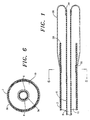
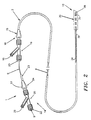
- the preferred embodiment of the everting catheter 1 is a dilatation catheter including an outer tube unit 2 about 0.06 inches in outer diameter and about 135 cm. in length defining a central axis.
- the catheter has a central or inner tube 6 coaxial with the outer tube unit to form a double lumen catheter preferably about 150 cm. long, one lumen 8 (the inner or "thru-lumen”) axially disposed within the other 10, as shown in Fig. 6.
- the thru-lumen is as long as the outer tube 2 plus the length of balloon 36, although additional length can be added for easy maneuverability during eversion and reinversion.
- the thru-lumen 8 is open to the environment at the distal end 12 of the catheter and tubing 6 is preferably about 0.02 inches in inner diameter and about 0.028 inches in outer diameter.
- the thru-lumen allows use of the catheter over a guidewire, and, via injection port 26, can be used to inject dye, contrast media, saline, or other fluids into the system.
- the catheter 1 terminates at proximal end 14 in an outer hub 16 with wings 15.
- the outer hub is attached to an outer Y connector 19 having an inflation port 18 accessing outer lumen 10.
- inner or central tube 6 slideably extends proximally from outer hub 16 to terminate in a sleeve 23 surrounded by an inner hub 24 having wings 27 and attached to an inner Y-connector 25 having an injection or infusion port 26 which accesses the thru-lumen.
- Access to the inner lumen at the proximal end is gained through an O ring 22 which can form a seal.
- Sheath 23 is usually formed of heatshrunk polyvinyl chloride ("PVC") and the two hubs and adapters 16 and 24 are usually formed of polycarbonate or PVC.
- PVC heatshrunk polyvinyl chloride
- the outer tubing 2 of the catheter is formed of nylon and the inner tubing 6 of nylon or polyether sulfone.
- the outer tube may include a radiopaque dye such as Barium, which may also increase stiffness.
- the primary considerations for the material for the tubing are, of course, biological inertness, inertness to saline, contrast media and other materials to be infused through the tubing, and sufficient flexibility, resistance to deformity, and torquability to bend the catheter through the tortuous pathways of the vascular or any other system in which it will be used yet retain torquability without crimping or occlusion.
- the catheter 1 terminates in a tip 28 covered while the catheter is stored in sterile condition before use by a cover or protective sleeve 30.
- a radiopaque marker 35 of stainless steel, tungsten/rhenium, or any other biocompatible metal or metal/polymer composite is formed annularly about outer tube 2 about a centimeter back from the distal tip 28 so that the position of the catheter in the vascular system can be easily identified when it is in use.
- central tube 6 When central tube 6 is in its fully withdrawn position, its tip 34 usually terminates up to about 15 cm. back from the distal tip 28 of the device.
- the exact distance from tip 28 will vary with the particular purpose for which the catheter is designed and the length of the expected occlusion in the vessel; thus models for use in the coronary arteries may terminate about 2 to 4 cm back, while peripheral models may easily terminate 10 cm. or more back.
- tubular balloon 36 is attached to the periphery of central tube 6 at the distal end thereof; the other end of the balloon is inverted and attached to the exterior of outer tube 2 spaced usually about a centimeter back from the distal tip 28, in an annular recession 38 in the exterior of the outer tube.
- the balloon is bonded to recession 38 thermally or by adhesives; in some instances it may be textured on the surface to promote anchoring at the desired spot in the vessel.
- the balloon and the tubing can be a unitary piece, so attachment of the balloon to the tubing need not be a concern.
- the balloon When inner tube 34 is completely withdrawn, the balloon remains inside the catheter; when it is moved toward distal end 12 of the catheter, it causes the balloon to evert and aids balloon inflation when saline is simultaneously infused through the inflation port 18 to inflate the balloon 36.
- the balloon is formed of a material more pliable than that of prior balloons made of polyethylene. It tends to inflate and evert at lower pressures than prior balloons and adapt better to the contours of the particular vessel.
- the material used In the dilatation catheter however, has sufficient strength to sustain the pressures required for dilatation, usually about 10 to 12 atmospheres.
- the balloon is formed of vinyl acetate blended with polyolefins in a copolymer product.
- the polyolefins are polyethylene
- the copolymer contains about 1 to about 51 percent vinyl acetate monomer units, more preferably about 10 to about 30 percent vinyl acetate monomer units, and most preferably about 18 percent vinyl acetate monomer units.
- the preferred material is sold by DuPont under the trademark Elvax 460.
- the balloon material is extruded to form tubing and irradiated with electron-beam radiation in the fashion used for cross-linking standard balloons. Irradiation is usually done with a 15 milliamp electron beam at a 200 feet per minute line speed to produce a cross-linked copolymer. The balloons are then blown and cut to size.
- the inner tubing material is also extruded and cut to size, and the balloon bonded to the outer distal tip thermally or preferably by using biocompatible adhesives such as cyanoacrylate or the urethane adhesives.
- a mandril is passed into the balloon which is inverted by hand rolling its open end back over the mandril and around the inner tube.
- the outer tubing material is also obtained and compounded, then extruded and cut to size and the radiopaque marker attached.
- the inner tubing is backloaded into the outer tubing and the balloon bonded to the outer tubing by heatshrinking or the application of adhesives. In the preferred embodiment, heat is applied to the outer tubing to create recession 38 and a biocompatible adhesive used to attach the balloon.
- the sheath is then heatshrunk about the proximal end of the inner tubing and the outer hub attached to the outer tubing using a cyanoacrylate adhesive, followed by the outer Y connector, the inner hub and the inner Y connector.
- the package is inspected and finally sterilized and sold.
- the catheter 1 is introduced into the vascular system, usually via a guiding catheter, particularly when used for percutaneous coronary access. Where it will be inserted only into peripheral vessels or is inserted intraoperatively, usually no guiding catheter is used, although a guidewire can be used through the thru-lumen.
- the tip of the catheter is inserted as close as possible to the lesion 52 to be removed, under fluoroscopy, and the balloon is inflated with saline through the inflation port 18 to about 2 atmospheres.
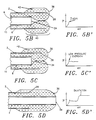
- Inner tube 6 is slid distally to evert the balloon 36 until resistance is felt, indicating that the balloon has formed an anchor annulus 42 (an inflated ring along the outside distal length 40 of the catheter which anchors the catheter in the lesion, see Figs. 5B and 5C). If the radiopaque marker continues to move, however, the catheter is insufficiently anchored, and the balloon inflated further until the anchor annulus is formed. The more compliant the balloon material, the lower the amount of pressure required to form the anchor annulus. Silicone texturing on the exterior of the annulus may further help to anchor the catheter.
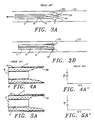
- the balloon is then further everted to extend it until it crosses the stenosis, as shown in Figs 3B and 5D. At that point, dilatation (or any diagnostic purpose for which the catheter is inserted) is handled in the standard manner.
- the balloon is deflated (via the inflation port) and the catheter withdrawn, or the balloon is reinverted by pulling the inner tube 6 proximally, and the catheter then is withdrawn.
- the present invention provides significant advantages over prior catheters. Inflation of an everting thru-lumen balloon catheter of the prior art, and the pressures required, are shown in Figs 4A through 4D, and 4A′ through 4D′. When initially pressurized as shown in Figs. 4A and 4A′, 4B and 4B′, the typical prior catheter required about 6 atmospheres of pressure to initially inflate the balloon 36, at which point the balloon expanded into the thru-lumen only.
- eversion began, the balloon everting at the end of the outer tube to form an essentially club-shaped balloon 36, as shown in Fig 4C.
- Inflation pressures within the balloon tended to produce a force 46 operating to extend the distal end of the balloon, and moving parallel to the inner and outer tubing. This tended to force the catheter backwards, away from the lesion, so that it was frequently necessary to deflate, reposition, and reinflate the balloon.
- the balloon was completely everted, but sometimes had to be partially deflated when the large initial pressure was too high for effective dilatation. Dilatation was then accomplished, and the balloon deflated and withdrawn.
- the catheter of the present invention requires only about 2 atmospheres pressure to inflate initially and to obtain eversion, due to its particularly pliable balloon.
- eversion begins, it results not in a balloon extending forward at the tip of the catheter, but in an extended, generally tubular balloon 36 which is inflated to extend along the outside length 40 of the catheter to form anchor annulus 42 as shown in Figs. 5B and 5C. Because the forces of inflation 48 within the balloon of this catheter tend to expand it radially with respect to the longitudinal axis of the catheter, the catheter is not forced backwards, but instead becomes anchored in place in the lesion.
- Central tube 6 is slid distally to further evert the balloon 36 and an appropriate amount of inflation pressure added to fully (or partially, when appropriate) evert the balloon, as shown in Fig. 5D. Dilatation (or any other purpose for which the catheter was inserted) is then accomplished, the balloon being further inflated to appropriate pressures for dilatation if necessary.
- the present invention requires much lower pressures than prior units to inflate and position the balloon; further, it is much easier to position the present catheter adjacent the lesion because the balloon tends to form an anchor annulus which anchors it in the lesion prior to eversion.
Landscapes
- Health & Medical Sciences (AREA)
- Life Sciences & Earth Sciences (AREA)
- Heart & Thoracic Surgery (AREA)
- Biomedical Technology (AREA)
- Biophysics (AREA)
- Pulmonology (AREA)
- Engineering & Computer Science (AREA)
- Anesthesiology (AREA)
- Child & Adolescent Psychology (AREA)
- Hematology (AREA)
- Animal Behavior & Ethology (AREA)
- General Health & Medical Sciences (AREA)
- Public Health (AREA)
- Veterinary Medicine (AREA)
- Media Introduction/Drainage Providing Device (AREA)
- Materials For Medical Uses (AREA)
Applications Claiming Priority (2)
| Application Number | Priority Date | Filing Date | Title |
|---|---|---|---|
| US24497888A | 1988-09-15 | 1988-09-15 | |
| US244978 | 1988-09-15 |
Publications (1)
| Publication Number | Publication Date |
|---|---|
| EP0359489A2 true EP0359489A2 (de) | 1990-03-21 |
Family
ID=22924852
Family Applications (1)
| Application Number | Title | Priority Date | Filing Date |
|---|---|---|---|
| EP19890309158 Withdrawn EP0359489A2 (de) | 1988-09-15 | 1989-09-08 | Ausstülpbarer Ballon-Katheter mit einem Verankerungsring und Ballon dafür |
Country Status (1)
| Country | Link |
|---|---|
| EP (1) | EP0359489A2 (de) |
Cited By (30)
| Publication number | Priority date | Publication date | Assignee | Title |
|---|---|---|---|---|
| EP0540858B1 (de) * | 1991-09-12 | 2001-08-08 | Advanced Cardiovascular Systems, Inc. | In begrenztem Bereich elastisch dehnbarer aufblasbarer Gegenstand |
| WO2001076678A1 (en) * | 2000-04-07 | 2001-10-18 | Medtronic Ave Inc. | Apparatus and method for the treatment of an occluded lumen |
| US6482348B1 (en) | 1991-04-26 | 2002-11-19 | Boston Scientific Corporation | Method of forming a co-extruded balloon for medical purposes |
| US6896842B1 (en) | 1993-10-01 | 2005-05-24 | Boston Scientific Corporation | Medical device balloons containing thermoplastic elastomers |
| US7008438B2 (en) | 2003-07-14 | 2006-03-07 | Scimed Life Systems, Inc. | Anchored PTCA balloon |
| WO2007004221A1 (en) * | 2005-07-05 | 2007-01-11 | Angioslide Ltd. | Balloon catheter |
| WO2007058884A1 (en) * | 2005-11-10 | 2007-05-24 | Boston Scientific Limited | Balloon catheter for distal protectioncompatability |
| US7824370B2 (en) | 2004-04-22 | 2010-11-02 | Angioslide Limited | Catheter |
| US8257382B2 (en) | 2007-03-29 | 2012-09-04 | Boston Scientific Limited | Lumen reentry devices and methods |
| EP2173424A4 (de) * | 2007-07-13 | 2013-06-05 | Abbott Cardiovascular Systems | Mit arzneimittel beschichteter ballonkatheter |
| CN101257943B (zh) * | 2005-07-05 | 2013-10-09 | 安乔斯里德公司 | 囊导管 |
| US8556851B2 (en) | 2005-07-05 | 2013-10-15 | Angioslide Ltd. | Balloon catheter |
| US8617114B2 (en) | 2007-07-13 | 2013-12-31 | Abbott Cardiovascular Systems Inc. | Drug coated balloon catheter |
| US8827951B2 (en) | 2008-07-02 | 2014-09-09 | Doron Besser | Balloon catheter system and methods of use thereof |
| EP2979722A3 (de) * | 2014-08-01 | 2016-04-27 | Cruzar Medsystems Inc | Katheter mit gefässfutter und verfahren zur verwendung davon |
| US9439662B2 (en) | 2005-07-05 | 2016-09-13 | Angioslide Ltd. | Balloon catheter |
| US9533125B2 (en) | 2013-10-01 | 2017-01-03 | Boston Scientific Scimed, Inc. | Balloon catheter and method of manufacture |
| US9675780B2 (en) | 2010-01-19 | 2017-06-13 | Angioslide Ltd. | Balloon catheter system and methods of making and use thereof |
| US9795408B2 (en) | 2010-10-06 | 2017-10-24 | Cruzar Medsystems, Inc. | Catheter with vessel lining and methods for using same |
| WO2017199155A1 (en) * | 2016-05-15 | 2017-11-23 | Thermopeutix, Inc. | Variable size balloon catheter for vessel treatment |
| US10112035B2 (en) | 2010-10-06 | 2018-10-30 | Cruzar Medsystems, Inc. | Catheter with vessel lining and methods for using same |
| US10124153B2 (en) | 2012-12-04 | 2018-11-13 | Angioslide Ltd. | Balloon catheter and methods of use thereof |
| WO2019010244A1 (en) * | 2017-07-03 | 2019-01-10 | Crossbay Medical, Inc. | APPARATUS AND METHOD FOR RETURNING A CATHETER WITH ALIGNMENT AND FLEXIBLE PRESSURIZATION |
| US10349957B2 (en) | 2016-11-09 | 2019-07-16 | Cruzar Medsystems, Inc. | Systems and methods for traversing a site of obstruction |
| US10744304B2 (en) | 2009-08-28 | 2020-08-18 | Boston Scientific Limited | Inverted balloon neck on catheter |
| US11141308B2 (en) | 2017-08-31 | 2021-10-12 | Crossbay Medical, Inc. | Apparatus and method for everting catheter for IUD delivery and placement in the uterine cavity |
| US11311313B2 (en) | 2013-11-11 | 2022-04-26 | Crossbay Medical, Inc. | Apparatus and methods for accessing and sealing bodily vessels and cavities |
| US11607234B2 (en) | 2019-06-11 | 2023-03-21 | Cruzar Medsystems, Inc. | Systems and methods for traversing a site of obstruction |
| WO2025016870A1 (en) * | 2023-07-14 | 2025-01-23 | Biotronik Ag | Catheter comprising a rolling membrane |
| US12551203B2 (en) | 2018-12-28 | 2026-02-17 | Cellapax Corporation | Catheter with vessel lining for cell collection and methods for using same |
-
1989
- 1989-09-08 EP EP19890309158 patent/EP0359489A2/de not_active Withdrawn
Cited By (45)
| Publication number | Priority date | Publication date | Assignee | Title |
|---|---|---|---|---|
| US7585289B2 (en) | 1991-04-26 | 2009-09-08 | Boston Scientific Scimed, Inc. | Co-extruded medical balloon |
| US6482348B1 (en) | 1991-04-26 | 2002-11-19 | Boston Scientific Corporation | Method of forming a co-extruded balloon for medical purposes |
| EP0540858B1 (de) * | 1991-09-12 | 2001-08-08 | Advanced Cardiovascular Systems, Inc. | In begrenztem Bereich elastisch dehnbarer aufblasbarer Gegenstand |
| US7781038B2 (en) | 1993-10-01 | 2010-08-24 | Boston Scientific Scimed, Inc. | Medical device balloons containing thermoplastic elastomers |
| US6896842B1 (en) | 1993-10-01 | 2005-05-24 | Boston Scientific Corporation | Medical device balloons containing thermoplastic elastomers |
| US6533753B1 (en) | 2000-04-07 | 2003-03-18 | Philip Haarstad | Apparatus and method for the treatment of an occluded lumen |
| WO2001076678A1 (en) * | 2000-04-07 | 2001-10-18 | Medtronic Ave Inc. | Apparatus and method for the treatment of an occluded lumen |
| US7008438B2 (en) | 2003-07-14 | 2006-03-07 | Scimed Life Systems, Inc. | Anchored PTCA balloon |
| US7824370B2 (en) | 2004-04-22 | 2010-11-02 | Angioslide Limited | Catheter |
| WO2007004221A1 (en) * | 2005-07-05 | 2007-01-11 | Angioslide Ltd. | Balloon catheter |
| US9439662B2 (en) | 2005-07-05 | 2016-09-13 | Angioslide Ltd. | Balloon catheter |
| CN101257943B (zh) * | 2005-07-05 | 2013-10-09 | 安乔斯里德公司 | 囊导管 |
| CN102580227A (zh) * | 2005-07-05 | 2012-07-18 | 安乔斯里德公司 | 囊导管系统 |
| CN102580227B (zh) * | 2005-07-05 | 2015-06-24 | 安乔斯里德公司 | 囊导管系统 |
| US8556851B2 (en) | 2005-07-05 | 2013-10-15 | Angioslide Ltd. | Balloon catheter |
| US8894680B2 (en) | 2005-10-14 | 2014-11-25 | Angioslide Ltd. | Balloon catheter |
| US9782570B2 (en) | 2005-10-14 | 2017-10-10 | Angioslide Ltd. | Balloon catheter |
| WO2007058884A1 (en) * | 2005-11-10 | 2007-05-24 | Boston Scientific Limited | Balloon catheter for distal protectioncompatability |
| US8721675B2 (en) | 2007-03-29 | 2014-05-13 | Boston Scientific Limited | Lumen reentry devices and methods |
| US8257383B2 (en) | 2007-03-29 | 2012-09-04 | Boston Scientific Limited | Lumen reentry devices and methods |
| US8257382B2 (en) | 2007-03-29 | 2012-09-04 | Boston Scientific Limited | Lumen reentry devices and methods |
| US8617114B2 (en) | 2007-07-13 | 2013-12-31 | Abbott Cardiovascular Systems Inc. | Drug coated balloon catheter |
| US8617104B2 (en) | 2007-07-13 | 2013-12-31 | Abbott Cardiovascular Systems, Inc. | Drug coated balloon catheter |
| US8690823B2 (en) | 2007-07-13 | 2014-04-08 | Abbott Cardiovascular Systems Inc. | Drug coated balloon catheter |
| EP2173424A4 (de) * | 2007-07-13 | 2013-06-05 | Abbott Cardiovascular Systems | Mit arzneimittel beschichteter ballonkatheter |
| US8827951B2 (en) | 2008-07-02 | 2014-09-09 | Doron Besser | Balloon catheter system and methods of use thereof |
| US10744304B2 (en) | 2009-08-28 | 2020-08-18 | Boston Scientific Limited | Inverted balloon neck on catheter |
| US9675780B2 (en) | 2010-01-19 | 2017-06-13 | Angioslide Ltd. | Balloon catheter system and methods of making and use thereof |
| US10112035B2 (en) | 2010-10-06 | 2018-10-30 | Cruzar Medsystems, Inc. | Catheter with vessel lining and methods for using same |
| US9795408B2 (en) | 2010-10-06 | 2017-10-24 | Cruzar Medsystems, Inc. | Catheter with vessel lining and methods for using same |
| US10441755B2 (en) | 2010-10-06 | 2019-10-15 | Cruzar Medsystems, Inc. | Catheter with vessel lining and methods for using same |
| US10124153B2 (en) | 2012-12-04 | 2018-11-13 | Angioslide Ltd. | Balloon catheter and methods of use thereof |
| US9533125B2 (en) | 2013-10-01 | 2017-01-03 | Boston Scientific Scimed, Inc. | Balloon catheter and method of manufacture |
| US11819245B2 (en) | 2013-11-11 | 2023-11-21 | Crossbay Medical, Inc. | Apparatus and methods for accessing and sealing bodily vessels and cavities |
| US11311313B2 (en) | 2013-11-11 | 2022-04-26 | Crossbay Medical, Inc. | Apparatus and methods for accessing and sealing bodily vessels and cavities |
| EP2979722A3 (de) * | 2014-08-01 | 2016-04-27 | Cruzar Medsystems Inc | Katheter mit gefässfutter und verfahren zur verwendung davon |
| WO2017199155A1 (en) * | 2016-05-15 | 2017-11-23 | Thermopeutix, Inc. | Variable size balloon catheter for vessel treatment |
| US10349957B2 (en) | 2016-11-09 | 2019-07-16 | Cruzar Medsystems, Inc. | Systems and methods for traversing a site of obstruction |
| WO2019010244A1 (en) * | 2017-07-03 | 2019-01-10 | Crossbay Medical, Inc. | APPARATUS AND METHOD FOR RETURNING A CATHETER WITH ALIGNMENT AND FLEXIBLE PRESSURIZATION |
| US11141308B2 (en) | 2017-08-31 | 2021-10-12 | Crossbay Medical, Inc. | Apparatus and method for everting catheter for IUD delivery and placement in the uterine cavity |
| US12551203B2 (en) | 2018-12-28 | 2026-02-17 | Cellapax Corporation | Catheter with vessel lining for cell collection and methods for using same |
| US11607234B2 (en) | 2019-06-11 | 2023-03-21 | Cruzar Medsystems, Inc. | Systems and methods for traversing a site of obstruction |
| US11318041B2 (en) | 2019-10-09 | 2022-05-03 | Crossbay Medical, Inc. | Apparatus and method for everting catheter for IUD delivery and placement in the uterine cavity |
| US11583436B2 (en) | 2019-10-09 | 2023-02-21 | Crossbay Medical, Inc. | Apparatus and method for everting catheter for IUD delivery and placement in the uterine cavity |
| WO2025016870A1 (en) * | 2023-07-14 | 2025-01-23 | Biotronik Ag | Catheter comprising a rolling membrane |
Similar Documents
| Publication | Publication Date | Title |
|---|---|---|
| US5074845A (en) | Catheter with heat-fused balloon with waist | |
| EP0409427B1 (de) | Katheter | |
| US4820349A (en) | Dilatation catheter with collapsible outer diameter | |
| US5246421A (en) | Method of treating obstructed regions of bodily passages | |
| EP0820784B1 (de) | Ballonkatheter und Methode zur Anwendung | |
| US5976107A (en) | Catheter having extendable guide wire lumen | |
| US6361528B1 (en) | Dynamically compliant catheter | |
| US7763043B2 (en) | Dilatation catheter with enhanced distal end for crossing occluded lesions | |
| US20050033343A1 (en) | Catheter drive | |
| JPS62172969A (ja) | 経皮的内腔貫通冠状動脈血管形成カテーテル | |
| JPS63238877A (ja) | 灌流型バルーン膨脹装置及びそのカテーテル | |
| EP0869827A1 (de) | Ballonkatheterspitze aus hochdruckfestem ballonwerkstoff | |
| US8469989B2 (en) | Pushable coaxial balloon catheter | |
| JP5085121B2 (ja) | 遠位拡張特徴部を有するガイドワイヤ、および、医療装置の送達能力および横断能力を向上する方法 | |
| AU628444B2 (en) | Fast purge balloon dilatation catheter | |
| EP0409436B1 (de) | Katheter mit warmverschweissten Ballon und einer Einschnürung | |
| JPH11114067A (ja) | プリペアードカテーテル | |
| US20060135983A1 (en) | Catheter with tapered end balloon | |
| GB2172205A (en) | Dilatation catheter | |
| JPH0354592B2 (de) | ||
| WO2005115524A2 (en) | Catheter drive | |
| JP2004357872A (ja) | 体腔内拡張用カテーテル | |
| JPH01121067A (ja) | 拡張体付カテーテル | |
| US20040176792A1 (en) | Device and method for advancing a wire |
Legal Events
| Date | Code | Title | Description |
|---|---|---|---|
| PUAI | Public reference made under article 153(3) epc to a published international application that has entered the european phase |
Free format text: ORIGINAL CODE: 0009012 |
|
| AK | Designated contracting states |
Kind code of ref document: A2 Designated state(s): DE FR GB |
|
| STAA | Information on the status of an ep patent application or granted ep patent |
Free format text: STATUS: THE APPLICATION HAS BEEN WITHDRAWN |
|
| 18W | Application withdrawn |
Withdrawal date: 19900726 |
|
| R18W | Application withdrawn (corrected) |
Effective date: 19900726 |