EP0357350B1 - Xanthenfarbstoffe - Google Patents
Xanthenfarbstoffe Download PDFInfo
- Publication number
- EP0357350B1 EP0357350B1 EP89308642A EP89308642A EP0357350B1 EP 0357350 B1 EP0357350 B1 EP 0357350B1 EP 89308642 A EP89308642 A EP 89308642A EP 89308642 A EP89308642 A EP 89308642A EP 0357350 B1 EP0357350 B1 EP 0357350B1
- Authority
- EP
- European Patent Office
- Prior art keywords
- cells
- compound
- fluorescence
- compounds
- solution
- Prior art date
- Legal status (The legal status is an assumption and is not a legal conclusion. Google has not performed a legal analysis and makes no representation as to the accuracy of the status listed.)
- Expired - Lifetime
Links
- 239000001018 xanthene dye Substances 0.000 title abstract description 11
- 150000001875 compounds Chemical class 0.000 claims description 57
- 238000000034 method Methods 0.000 claims description 17
- 125000003178 carboxy group Chemical group [H]OC(*)=O 0.000 claims description 6
- 238000010186 staining Methods 0.000 claims description 6
- 230000000694 effects Effects 0.000 claims description 5
- 210000001124 body fluid Anatomy 0.000 claims description 3
- 239000010839 body fluid Substances 0.000 claims description 3
- 108090000790 Enzymes Proteins 0.000 claims description 2
- 102000004190 Enzymes Human genes 0.000 claims description 2
- 229910006069 SO3H Inorganic materials 0.000 claims 1
- 125000000217 alkyl group Chemical group 0.000 claims 1
- 125000004432 carbon atom Chemical group C* 0.000 claims 1
- 125000002496 methyl group Chemical group [H]C([H])([H])* 0.000 claims 1
- 125000001436 propyl group Chemical group [H]C([*])([H])C([H])([H])C([H])([H])[H] 0.000 claims 1
- 239000000975 dye Substances 0.000 abstract description 39
- 239000003795 chemical substances by application Substances 0.000 abstract description 4
- 210000004027 cell Anatomy 0.000 description 46
- 239000000243 solution Substances 0.000 description 38
- 239000007787 solid Substances 0.000 description 35
- WFDIJRYMOXRFFG-UHFFFAOYSA-N Acetic anhydride Chemical compound CC(=O)OC(C)=O WFDIJRYMOXRFFG-UHFFFAOYSA-N 0.000 description 27
- HEMHJVSKTPXQMS-UHFFFAOYSA-M Sodium hydroxide Chemical compound [OH-].[Na+] HEMHJVSKTPXQMS-UHFFFAOYSA-M 0.000 description 24
- 239000000203 mixture Substances 0.000 description 21
- LFQSCWFLJHTTHZ-UHFFFAOYSA-N Ethanol Chemical compound CCO LFQSCWFLJHTTHZ-UHFFFAOYSA-N 0.000 description 18
- 230000005284 excitation Effects 0.000 description 17
- GNBHRKFJIUUOQI-UHFFFAOYSA-N fluorescein Chemical compound O1C(=O)C2=CC=CC=C2C21C1=CC=C(O)C=C1OC1=CC(O)=CC=C21 GNBHRKFJIUUOQI-UHFFFAOYSA-N 0.000 description 17
- HEDRZPFGACZZDS-MICDWDOJSA-N Trichloro(2H)methane Chemical compound [2H]C(Cl)(Cl)Cl HEDRZPFGACZZDS-MICDWDOJSA-N 0.000 description 14
- XLYOFNOQVPJJNP-UHFFFAOYSA-N water Substances O XLYOFNOQVPJJNP-UHFFFAOYSA-N 0.000 description 14
- 238000005160 1H NMR spectroscopy Methods 0.000 description 12
- IAZDPXIOMUYVGZ-UHFFFAOYSA-N Dimethylsulphoxide Chemical compound CS(C)=O IAZDPXIOMUYVGZ-UHFFFAOYSA-N 0.000 description 12
- XEKOWRVHYACXOJ-UHFFFAOYSA-N Ethyl acetate Chemical compound CCOC(C)=O XEKOWRVHYACXOJ-UHFFFAOYSA-N 0.000 description 12
- 238000006862 quantum yield reaction Methods 0.000 description 12
- 238000004448 titration Methods 0.000 description 11
- IAZDPXIOMUYVGZ-WFGJKAKNSA-N Dimethyl sulfoxide Chemical compound [2H]C([2H])([2H])S(=O)C([2H])([2H])[2H] IAZDPXIOMUYVGZ-WFGJKAKNSA-N 0.000 description 10
- 230000008033 biological extinction Effects 0.000 description 10
- 239000000872 buffer Substances 0.000 description 10
- CHADEQDQBURGHL-UHFFFAOYSA-N (6'-acetyloxy-3-oxospiro[2-benzofuran-1,9'-xanthene]-3'-yl) acetate Chemical compound O1C(=O)C2=CC=CC=C2C21C1=CC=C(OC(C)=O)C=C1OC1=CC(OC(=O)C)=CC=C21 CHADEQDQBURGHL-UHFFFAOYSA-N 0.000 description 9
- QTBSBXVTEAMEQO-UHFFFAOYSA-N Acetic acid Chemical compound CC(O)=O QTBSBXVTEAMEQO-UHFFFAOYSA-N 0.000 description 9
- 108090000371 Esterases Proteins 0.000 description 8
- 238000000862 absorption spectrum Methods 0.000 description 8
- MHMNJMPURVTYEJ-UHFFFAOYSA-N fluorescein-5-isothiocyanate Chemical compound O1C(=O)C2=CC(N=C=S)=CC=C2C21C1=CC=C(O)C=C1OC1=CC(O)=CC=C21 MHMNJMPURVTYEJ-UHFFFAOYSA-N 0.000 description 8
- JIAARYAFYJHUJI-UHFFFAOYSA-L zinc dichloride Chemical compound [Cl-].[Cl-].[Zn+2] JIAARYAFYJHUJI-UHFFFAOYSA-L 0.000 description 8
- 238000002835 absorbance Methods 0.000 description 7
- NTECHUXHORNEGZ-UHFFFAOYSA-N acetyloxymethyl 3',6'-bis(acetyloxymethoxy)-2',7'-bis[3-(acetyloxymethoxy)-3-oxopropyl]-3-oxospiro[2-benzofuran-1,9'-xanthene]-5-carboxylate Chemical compound O1C(=O)C2=CC(C(=O)OCOC(C)=O)=CC=C2C21C1=CC(CCC(=O)OCOC(C)=O)=C(OCOC(C)=O)C=C1OC1=C2C=C(CCC(=O)OCOC(=O)C)C(OCOC(C)=O)=C1 NTECHUXHORNEGZ-UHFFFAOYSA-N 0.000 description 7
- 238000004458 analytical method Methods 0.000 description 7
- VJYGFSGAAOVTLC-UHFFFAOYSA-N 1,1-dioxospiro[2,1$l^{6}-benzoxathiole-3,9'-xanthene]-3',6'-diol Chemical class O1S(=O)(=O)C2=CC=CC=C2C21C1=CC=C(O)C=C1OC1=CC(O)=CC=C21 VJYGFSGAAOVTLC-UHFFFAOYSA-N 0.000 description 6
- RTZKZFJDLAIYFH-UHFFFAOYSA-N Diethyl ether Chemical compound CCOCC RTZKZFJDLAIYFH-UHFFFAOYSA-N 0.000 description 6
- VYPSYNLAJGMNEJ-UHFFFAOYSA-N Silicium dioxide Chemical compound O=[Si]=O VYPSYNLAJGMNEJ-UHFFFAOYSA-N 0.000 description 6
- 239000000706 filtrate Substances 0.000 description 6
- 239000012528 membrane Substances 0.000 description 6
- 239000000758 substrate Substances 0.000 description 6
- 125000000020 sulfo group Chemical group O=S(=O)([*])O[H] 0.000 description 6
- OWXMKDGYPWMGEB-UHFFFAOYSA-N HEPPS Chemical compound OCCN1CCN(CCCS(O)(=O)=O)CC1 OWXMKDGYPWMGEB-UHFFFAOYSA-N 0.000 description 5
- 239000002253 acid Substances 0.000 description 5
- 238000006243 chemical reaction Methods 0.000 description 5
- 238000000295 emission spectrum Methods 0.000 description 5
- 238000010992 reflux Methods 0.000 description 5
- 239000000523 sample Substances 0.000 description 5
- 239000000741 silica gel Substances 0.000 description 5
- 229910002027 silica gel Inorganic materials 0.000 description 5
- YMWUJEATGCHHMB-UHFFFAOYSA-N Dichloromethane Chemical compound ClCCl YMWUJEATGCHHMB-UHFFFAOYSA-N 0.000 description 4
- IXQIUDNVFVTQLJ-UHFFFAOYSA-N Naphthofluorescein Chemical compound O1C(=O)C2=CC=CC=C2C21C(C=CC=1C3=CC=C(O)C=1)=C3OC1=C2C=CC2=CC(O)=CC=C21 IXQIUDNVFVTQLJ-UHFFFAOYSA-N 0.000 description 4
- UIIMBOGNXHQVGW-UHFFFAOYSA-M Sodium bicarbonate Chemical compound [Na+].OC([O-])=O UIIMBOGNXHQVGW-UHFFFAOYSA-M 0.000 description 4
- 210000000601 blood cell Anatomy 0.000 description 4
- XPPKVPWEQAFLFU-UHFFFAOYSA-J diphosphate(4-) Chemical compound [O-]P([O-])(=O)OP([O-])([O-])=O XPPKVPWEQAFLFU-UHFFFAOYSA-J 0.000 description 4
- 235000011180 diphosphates Nutrition 0.000 description 4
- 238000003760 magnetic stirring Methods 0.000 description 4
- 238000005259 measurement Methods 0.000 description 4
- 239000011550 stock solution Substances 0.000 description 4
- 235000005074 zinc chloride Nutrition 0.000 description 4
- 239000011592 zinc chloride Substances 0.000 description 4
- UNILWMWFPHPYOR-KXEYIPSPSA-M 1-[6-[2-[3-[3-[3-[2-[2-[3-[[2-[2-[[(2r)-1-[[2-[[(2r)-1-[3-[2-[2-[3-[[2-(2-amino-2-oxoethoxy)acetyl]amino]propoxy]ethoxy]ethoxy]propylamino]-3-hydroxy-1-oxopropan-2-yl]amino]-2-oxoethyl]amino]-3-[(2r)-2,3-di(hexadecanoyloxy)propyl]sulfanyl-1-oxopropan-2-yl Chemical compound O=C1C(SCCC(=O)NCCCOCCOCCOCCCNC(=O)COCC(=O)N[C@@H](CSC[C@@H](COC(=O)CCCCCCCCCCCCCCC)OC(=O)CCCCCCCCCCCCCCC)C(=O)NCC(=O)N[C@H](CO)C(=O)NCCCOCCOCCOCCCNC(=O)COCC(N)=O)CC(=O)N1CCNC(=O)CCCCCN\1C2=CC=C(S([O-])(=O)=O)C=C2CC/1=C/C=C/C=C/C1=[N+](CC)C2=CC=C(S([O-])(=O)=O)C=C2C1 UNILWMWFPHPYOR-KXEYIPSPSA-M 0.000 description 3
- FQVVJFIHGLIEBJ-UHFFFAOYSA-N 2-chlorosulfonylbenzoyl chloride Chemical compound ClC(=O)C1=CC=CC=C1S(Cl)(=O)=O FQVVJFIHGLIEBJ-UHFFFAOYSA-N 0.000 description 3
- NLXLAEXVIDQMFP-UHFFFAOYSA-N Ammonia chloride Chemical compound [NH4+].[Cl-] NLXLAEXVIDQMFP-UHFFFAOYSA-N 0.000 description 3
- WKBOTKDWSSQWDR-UHFFFAOYSA-N Bromine atom Chemical compound [Br] WKBOTKDWSSQWDR-UHFFFAOYSA-N 0.000 description 3
- OKKJLVBELUTLKV-UHFFFAOYSA-N Methanol Chemical compound OC OKKJLVBELUTLKV-UHFFFAOYSA-N 0.000 description 3
- XKRFYHLGVUSROY-UHFFFAOYSA-N argon Substances [Ar] XKRFYHLGVUSROY-UHFFFAOYSA-N 0.000 description 3
- 229910052786 argon Inorganic materials 0.000 description 3
- -1 argon ion Chemical class 0.000 description 3
- 230000015572 biosynthetic process Effects 0.000 description 3
- 210000004369 blood Anatomy 0.000 description 3
- 239000008280 blood Substances 0.000 description 3
- GDTBXPJZTBHREO-UHFFFAOYSA-N bromine Substances BrBr GDTBXPJZTBHREO-UHFFFAOYSA-N 0.000 description 3
- 229910052794 bromium Inorganic materials 0.000 description 3
- 238000004587 chromatography analysis Methods 0.000 description 3
- 239000007979 citrate buffer Substances 0.000 description 3
- 229940125782 compound 2 Drugs 0.000 description 3
- 239000003085 diluting agent Substances 0.000 description 3
- 230000009977 dual effect Effects 0.000 description 3
- 238000002189 fluorescence spectrum Methods 0.000 description 3
- 239000007850 fluorescent dye Substances 0.000 description 3
- 230000007062 hydrolysis Effects 0.000 description 3
- 238000006460 hydrolysis reaction Methods 0.000 description 3
- 239000004033 plastic Substances 0.000 description 3
- 238000003756 stirring Methods 0.000 description 3
- SZUVGFMDDVSKSI-WIFOCOSTSA-N (1s,2s,3s,5r)-1-(carboxymethyl)-3,5-bis[(4-phenoxyphenyl)methyl-propylcarbamoyl]cyclopentane-1,2-dicarboxylic acid Chemical compound O=C([C@@H]1[C@@H]([C@](CC(O)=O)([C@H](C(=O)N(CCC)CC=2C=CC(OC=3C=CC=CC=3)=CC=2)C1)C(O)=O)C(O)=O)N(CCC)CC(C=C1)=CC=C1OC1=CC=CC=C1 SZUVGFMDDVSKSI-WIFOCOSTSA-N 0.000 description 2
- NCYNKWQXFADUOZ-UHFFFAOYSA-N 1,1-dioxo-2,1$l^{6}-benzoxathiol-3-one Chemical compound C1=CC=C2C(=O)OS(=O)(=O)C2=C1 NCYNKWQXFADUOZ-UHFFFAOYSA-N 0.000 description 2
- HNAGHMKIPMKKBB-UHFFFAOYSA-N 1-benzylpyrrolidine-3-carboxamide Chemical compound C1C(C(=O)N)CCN1CC1=CC=CC=C1 HNAGHMKIPMKKBB-UHFFFAOYSA-N 0.000 description 2
- QTBSBXVTEAMEQO-UHFFFAOYSA-M Acetate Chemical compound CC([O-])=O QTBSBXVTEAMEQO-UHFFFAOYSA-M 0.000 description 2
- DPKHZNPWBDQZCN-UHFFFAOYSA-N acridine orange free base Chemical compound C1=CC(N(C)C)=CC2=NC3=CC(N(C)C)=CC=C3C=C21 DPKHZNPWBDQZCN-UHFFFAOYSA-N 0.000 description 2
- 235000019270 ammonium chloride Nutrition 0.000 description 2
- DZBUGLKDJFMEHC-UHFFFAOYSA-N benzoquinolinylidene Natural products C1=CC=CC2=CC3=CC=CC=C3N=C21 DZBUGLKDJFMEHC-UHFFFAOYSA-N 0.000 description 2
- 238000009835 boiling Methods 0.000 description 2
- OBNCKNCVKJNDBV-UHFFFAOYSA-N butanoic acid ethyl ester Natural products CCCC(=O)OCC OBNCKNCVKJNDBV-UHFFFAOYSA-N 0.000 description 2
- YHASWHZGWUONAO-UHFFFAOYSA-N butanoyl butanoate Chemical compound CCCC(=O)OC(=O)CCC YHASWHZGWUONAO-UHFFFAOYSA-N 0.000 description 2
- 239000011545 carbonate/bicarbonate buffer Substances 0.000 description 2
- 210000000170 cell membrane Anatomy 0.000 description 2
- 229940125773 compound 10 Drugs 0.000 description 2
- 229940126543 compound 14 Drugs 0.000 description 2
- 238000001514 detection method Methods 0.000 description 2
- 238000004821 distillation Methods 0.000 description 2
- YQGOJNYOYNNSMM-UHFFFAOYSA-N eosin Chemical compound [Na+].OC(=O)C1=CC=CC=C1C1=C2C=C(Br)C(=O)C(Br)=C2OC2=C(Br)C(O)=C(Br)C=C21 YQGOJNYOYNNSMM-UHFFFAOYSA-N 0.000 description 2
- ZMMJGEGLRURXTF-UHFFFAOYSA-N ethidium bromide Chemical compound [Br-].C12=CC(N)=CC=C2C2=CC=C(N)C=C2[N+](CC)=C1C1=CC=CC=C1 ZMMJGEGLRURXTF-UHFFFAOYSA-N 0.000 description 2
- 229960005542 ethidium bromide Drugs 0.000 description 2
- 238000000684 flow cytometry Methods 0.000 description 2
- ZLVXBBHTMQJRSX-VMGNSXQWSA-N jdtic Chemical compound C1([C@]2(C)CCN(C[C@@H]2C)C[C@H](C(C)C)NC(=O)[C@@H]2NCC3=CC(O)=CC=C3C2)=CC=CC(O)=C1 ZLVXBBHTMQJRSX-VMGNSXQWSA-N 0.000 description 2
- 210000000265 leukocyte Anatomy 0.000 description 2
- 210000004185 liver Anatomy 0.000 description 2
- XOOMNEFVDUTJPP-UHFFFAOYSA-N naphthalene-1,3-diol Chemical compound C1=CC=CC2=CC(O)=CC(O)=C21 XOOMNEFVDUTJPP-UHFFFAOYSA-N 0.000 description 2
- FZZQNEVOYIYFPF-UHFFFAOYSA-N naphthalene-1,6-diol Chemical compound OC1=CC=CC2=CC(O)=CC=C21 FZZQNEVOYIYFPF-UHFFFAOYSA-N 0.000 description 2
- 230000035699 permeability Effects 0.000 description 2
- 239000011541 reaction mixture Substances 0.000 description 2
- GHMLBKRAJCXXBS-UHFFFAOYSA-N resorcinol Chemical compound OC1=CC=CC(O)=C1 GHMLBKRAJCXXBS-UHFFFAOYSA-N 0.000 description 2
- PYWVYCXTNDRMGF-UHFFFAOYSA-N rhodamine B Chemical compound [Cl-].C=12C=CC(=[N+](CC)CC)C=C2OC2=CC(N(CC)CC)=CC=C2C=1C1=CC=CC=C1C(O)=O PYWVYCXTNDRMGF-UHFFFAOYSA-N 0.000 description 2
- 235000017557 sodium bicarbonate Nutrition 0.000 description 2
- 229910000030 sodium bicarbonate Inorganic materials 0.000 description 2
- 239000002904 solvent Substances 0.000 description 2
- 239000000126 substance Substances 0.000 description 2
- 125000000542 sulfonic acid group Chemical group 0.000 description 2
- 238000003786 synthesis reaction Methods 0.000 description 2
- GHYOCDFICYLMRF-UTIIJYGPSA-N (2S,3R)-N-[(2S)-3-(cyclopenten-1-yl)-1-[(2R)-2-methyloxiran-2-yl]-1-oxopropan-2-yl]-3-hydroxy-3-(4-methoxyphenyl)-2-[[(2S)-2-[(2-morpholin-4-ylacetyl)amino]propanoyl]amino]propanamide Chemical compound C1(=CCCC1)C[C@@H](C(=O)[C@@]1(OC1)C)NC([C@H]([C@@H](C1=CC=C(C=C1)OC)O)NC([C@H](C)NC(CN1CCOCC1)=O)=O)=O GHYOCDFICYLMRF-UTIIJYGPSA-N 0.000 description 1
- QFLWZFQWSBQYPS-AWRAUJHKSA-N (3S)-3-[[(2S)-2-[[(2S)-2-[5-[(3aS,6aR)-2-oxo-1,3,3a,4,6,6a-hexahydrothieno[3,4-d]imidazol-4-yl]pentanoylamino]-3-methylbutanoyl]amino]-3-(4-hydroxyphenyl)propanoyl]amino]-4-[1-bis(4-chlorophenoxy)phosphorylbutylamino]-4-oxobutanoic acid Chemical compound CCCC(NC(=O)[C@H](CC(O)=O)NC(=O)[C@H](Cc1ccc(O)cc1)NC(=O)[C@@H](NC(=O)CCCCC1SC[C@@H]2NC(=O)N[C@H]12)C(C)C)P(=O)(Oc1ccc(Cl)cc1)Oc1ccc(Cl)cc1 QFLWZFQWSBQYPS-AWRAUJHKSA-N 0.000 description 1
- KIEFFPFIBREPIX-UHFFFAOYSA-N 2-(2,4-dihydroxybenzoyl)benzoic acid Chemical compound OC(=O)C1=CC=CC=C1C(=O)C1=CC=C(O)C=C1O KIEFFPFIBREPIX-UHFFFAOYSA-N 0.000 description 1
- MESJRHHDBDCQTH-UHFFFAOYSA-N 3-(dimethylamino)phenol Chemical compound CN(C)C1=CC=CC(O)=C1 MESJRHHDBDCQTH-UHFFFAOYSA-N 0.000 description 1
- ACDGJGZGETVPOC-UHFFFAOYSA-N 9h-xanthene-1,2-diol Chemical compound C1=CC=C2CC3=C(O)C(O)=CC=C3OC2=C1 ACDGJGZGETVPOC-UHFFFAOYSA-N 0.000 description 1
- VHUUQVKOLVNVRT-UHFFFAOYSA-N Ammonium hydroxide Chemical compound [NH4+].[OH-] VHUUQVKOLVNVRT-UHFFFAOYSA-N 0.000 description 1
- KCXVZYZYPLLWCC-UHFFFAOYSA-N EDTA Chemical compound OC(=O)CN(CC(O)=O)CCN(CC(O)=O)CC(O)=O KCXVZYZYPLLWCC-UHFFFAOYSA-N 0.000 description 1
- LGRFSURHDFAFJT-UHFFFAOYSA-N Phthalic anhydride Natural products C1=CC=C2C(=O)OC(=O)C2=C1 LGRFSURHDFAFJT-UHFFFAOYSA-N 0.000 description 1
- 239000004793 Polystyrene Substances 0.000 description 1
- 150000001242 acetic acid derivatives Chemical class 0.000 description 1
- 239000000980 acid dye Substances 0.000 description 1
- 108010004469 allophycocyanin Proteins 0.000 description 1
- 239000000908 ammonium hydroxide Substances 0.000 description 1
- 125000000129 anionic group Chemical group 0.000 description 1
- 230000003466 anti-cipated effect Effects 0.000 description 1
- 239000003637 basic solution Substances 0.000 description 1
- FYXKZNLBZKRYSS-UHFFFAOYSA-N benzene-1,2-dicarbonyl chloride Chemical compound ClC(=O)C1=CC=CC=C1C(Cl)=O FYXKZNLBZKRYSS-UHFFFAOYSA-N 0.000 description 1
- 239000012620 biological material Substances 0.000 description 1
- 210000001185 bone marrow Anatomy 0.000 description 1
- 125000001246 bromo group Chemical group Br* 0.000 description 1
- 239000008366 buffered solution Substances 0.000 description 1
- JHIWVOJDXOSYLW-UHFFFAOYSA-N butyl 2,2-difluorocyclopropane-1-carboxylate Chemical compound CCCCOC(=O)C1CC1(F)F JHIWVOJDXOSYLW-UHFFFAOYSA-N 0.000 description 1
- 125000002843 carboxylic acid group Chemical group 0.000 description 1
- 150000001735 carboxylic acids Chemical class 0.000 description 1
- 239000003054 catalyst Substances 0.000 description 1
- 229940125797 compound 12 Drugs 0.000 description 1
- 229940126214 compound 3 Drugs 0.000 description 1
- 229940125898 compound 5 Drugs 0.000 description 1
- 239000013078 crystal Substances 0.000 description 1
- 125000004093 cyano group Chemical group *C#N 0.000 description 1
- 230000003247 decreasing effect Effects 0.000 description 1
- 230000002939 deleterious effect Effects 0.000 description 1
- 230000023077 detection of light stimulus Effects 0.000 description 1
- 238000007865 diluting Methods 0.000 description 1
- 239000000539 dimer Substances 0.000 description 1
- 230000007071 enzymatic hydrolysis Effects 0.000 description 1
- 238000006047 enzymatic hydrolysis reaction Methods 0.000 description 1
- 210000003743 erythrocyte Anatomy 0.000 description 1
- 150000002148 esters Chemical class 0.000 description 1
- IDGUHHHQCWSQLU-UHFFFAOYSA-N ethanol;hydrate Chemical compound O.CCO IDGUHHHQCWSQLU-UHFFFAOYSA-N 0.000 description 1
- 239000000284 extract Substances 0.000 description 1
- 238000001943 fluorescence-activated cell sorting Methods 0.000 description 1
- CPBQJMYROZQQJC-UHFFFAOYSA-N helium neon Chemical compound [He].[Ne] CPBQJMYROZQQJC-UHFFFAOYSA-N 0.000 description 1
- 238000011534 incubation Methods 0.000 description 1
- 230000003834 intracellular effect Effects 0.000 description 1
- 230000002934 lysing effect Effects 0.000 description 1
- 230000014759 maintenance of location Effects 0.000 description 1
- 238000012986 modification Methods 0.000 description 1
- 230000004048 modification Effects 0.000 description 1
- 239000003068 molecular probe Substances 0.000 description 1
- 150000007523 nucleic acids Chemical class 0.000 description 1
- 102000039446 nucleic acids Human genes 0.000 description 1
- 108020004707 nucleic acids Proteins 0.000 description 1
- AICOOMRHRUFYCM-ZRRPKQBOSA-N oxazine, 1 Chemical compound C([C@@H]1[C@H](C(C[C@]2(C)[C@@H]([C@H](C)N(C)C)[C@H](O)C[C@]21C)=O)CC1=CC2)C[C@H]1[C@@]1(C)[C@H]2N=C(C(C)C)OC1 AICOOMRHRUFYCM-ZRRPKQBOSA-N 0.000 description 1
- 239000007793 ph indicator Substances 0.000 description 1
- UHZYTMXLRWXGPK-UHFFFAOYSA-N phosphorus pentachloride Chemical compound ClP(Cl)(Cl)(Cl)Cl UHZYTMXLRWXGPK-UHFFFAOYSA-N 0.000 description 1
- 229920000137 polyphosphoric acid Polymers 0.000 description 1
- 229920002223 polystyrene Polymers 0.000 description 1
- 239000011736 potassium bicarbonate Substances 0.000 description 1
- 235000015497 potassium bicarbonate Nutrition 0.000 description 1
- 229910000028 potassium bicarbonate Inorganic materials 0.000 description 1
- TYJJADVDDVDEDZ-UHFFFAOYSA-M potassium hydrogencarbonate Chemical compound [K+].OC([O-])=O TYJJADVDDVDEDZ-UHFFFAOYSA-M 0.000 description 1
- 238000002360 preparation method Methods 0.000 description 1
- 238000000425 proton nuclear magnetic resonance spectrum Methods 0.000 description 1
- 239000010453 quartz Substances 0.000 description 1
- 230000000717 retained effect Effects 0.000 description 1
- 241000894007 species Species 0.000 description 1
- 230000003595 spectral effect Effects 0.000 description 1
- 238000001228 spectrum Methods 0.000 description 1
- 210000000952 spleen Anatomy 0.000 description 1
- 239000006228 supernatant Substances 0.000 description 1
- 238000004809 thin layer chromatography Methods 0.000 description 1
- 210000001541 thymus gland Anatomy 0.000 description 1
- 210000001519 tissue Anatomy 0.000 description 1
- 210000002700 urine Anatomy 0.000 description 1
- GNJZTWSDPQEIRS-UHFFFAOYSA-N vita blue Chemical class O1S(=O)(=O)C2=CC=CC=C2C21C(C=CC=1C3=CC=C(O)C=1)=C3OC1=C2C=CC2=CC(O)=CC=C21 GNJZTWSDPQEIRS-UHFFFAOYSA-N 0.000 description 1
- 150000003732 xanthenes Chemical class 0.000 description 1
Images




Classifications
-
- C—CHEMISTRY; METALLURGY
- C09—DYES; PAINTS; POLISHES; NATURAL RESINS; ADHESIVES; COMPOSITIONS NOT OTHERWISE PROVIDED FOR; APPLICATIONS OF MATERIALS NOT OTHERWISE PROVIDED FOR
- C09B—ORGANIC DYES OR CLOSELY-RELATED COMPOUNDS FOR PRODUCING DYES, e.g. PIGMENTS; MORDANTS; LAKES
- C09B11/00—Diaryl- or thriarylmethane dyes
- C09B11/28—Pyronines ; Xanthon, thioxanthon, selenoxanthan, telluroxanthon dyes
-
- G—PHYSICS
- G01—MEASURING; TESTING
- G01N—INVESTIGATING OR ANALYSING MATERIALS BY DETERMINING THEIR CHEMICAL OR PHYSICAL PROPERTIES
- G01N33/00—Investigating or analysing materials by specific methods not covered by groups G01N1/00 - G01N31/00
- G01N33/48—Biological material, e.g. blood, urine; Haemocytometers
- G01N33/50—Chemical analysis of biological material, e.g. blood, urine; Testing involving biospecific ligand binding methods; Immunological testing
- G01N33/58—Chemical analysis of biological material, e.g. blood, urine; Testing involving biospecific ligand binding methods; Immunological testing involving labelled substances
- G01N33/582—Chemical analysis of biological material, e.g. blood, urine; Testing involving biospecific ligand binding methods; Immunological testing involving labelled substances with fluorescent label
Definitions
- This invention relates to novel xanthene dyes, and more particularly, this invention relates to fluorescent sulfonexanthene dyes that may be used in cell analysis.
- Xanthene dyes are among the most commonly used class of fluorescent dyes. Fluorescein, a dihydroxy xanthene dye, is a particularly useful biological dye for several reasons: the dianionic form of the dye is very soluble in water; its PK a is 6.3-6.7 thus being mostly deprotonated and fluorescent at physiological pH (7.0-7.6); the excitation maxima of the dye (490 nm) is well matched to a 488 nm line of an argon ion laser; it has a high extinction coefficient (8 x 10⁴M ⁇ 1cm ⁇ 1); and a high quantum yield (0.93). The last two properties allow the detection of minute quantities of the dye.
- fluorescein diacetate has utility as a membrane permeable esterase substrate.
- fluorescein isothiocyanate FITC
- FITC fluorescein isothiocyanate
- Flow cytometers generally are characterized as having one or more sources of excitation (typically lasers tuned to a specific frequency), means which allow the passage of cells substantially one at a time through a measurement region and means for detection of light scatter and fluorescence from cells as they pass through the measurement region. Means to record the data for each of the cells also may be coupled to the device.
- sources of excitation typically lasers tuned to a specific frequency
- Means to record the data for each of the cells also may be coupled to the device.
- Fluorescein isothiocyanate typically is used in such systems coupled to a monoclonal antibody (MAb) which will react with certain cells in a sample, although it may be coupled to any type antibody.
- MAb monoclonal antibody
- FITC fluorescence-activated fluorescent-labeled Cell
- An article by Touchberg et al ., Sci. Amer., (1979) and U.S. Pat. No. 4,599,307 describe a typical flow cytometer and describe the use of FITC conjugated MAbs to detect the presence of certain cells.
- U.S. Pat. No. 4,727,020 further describes a method for the analysis of subpopulations of blood cells using FITC conjugated MAbs in combination with other tagging agents, such as a nucleic acid dye.
- fluorescein isothiocyanate is somewhat limited in that it is excited at 488 nm and emits at 520 nm. It would be useful to have the characteristics of FITC but with an excitation maxima to the red of fluorescein.
- the advantages of a dye with a longer wavelength excitation and emission are several: background fluorescence from biological materials (e.g. , DNA) diminishes; the cost and size of the laser needed to excite the dye diminishes; and the possibility of dual laser excitation using an argon ion laser as the lower wavelength laser rises. As such, dyes having such properties would be useful in the analysis of cells in a sample.
- Xanthene dyes of this invention comprise derivatives of sulfonefluorescein and naphthosulfone fluorescein as well as derivatives of fluorescein and naphthofluorescein.
- Derivatives of sulfonefluorescein and naphthosulfonefluorescein are preferred, and in particular, a naphthosulfonefluorescein named Vita Blue is especially preferred.
- Xanthene dyes described in this invention are useful in cell analysis.
- a sample of cells may be taken from a variety of solid tissues (e.g. , spleen and thymus) and body fluid (e.g. , blood, urine and bone marrow), and may be analyzed when combined with tagging agents (e.g. , monoclonal antibodies) which are reactive with specific cell types.
- tagging agents e.g. , monoclonal antibodies
- These tagging agents may be coupled directly to the novel dyes of this invention or indirectly by means well known in the art such as biotin-avidin complexes.
- other forms of the dyes described in this invention may be used as an intracellular pH indicators and as means to discriminate between "live” and "dead” cells.
- Analyses of cells in the sample may be done using any means capable of detecting fluorescence from the labelled cells.
- a fluorescent light microscope is one such means, and a flow cytometer (such as FACSCanTM or FACStarTM, Becton Dickinson Immunocytometry Systems (BDIS)) may be used as automated means.
- a flow cytometer such as FACSCanTM or FACStarTM, Becton Dickinson Immunocytometry Systems (BDIS) may be used as automated means.
- the xanthene compounds which form the basis of this invention were prepared by the following methods. Unless otherwise indicated, all chemicals were obtained from Aldrich Chemical Co. The basic structure for xanthene dyes is given below: The structure of fluorescein is shown as compound 1. Sulfonefluorescein, compound 2, was made as follows: Resorcinol (2 g, 18 mmol), 2-sulfobenzoic anhydride (1.7 g, 9 mmol), polyphosphoric acid (8 g) were combined in a round bottomed flask and heated in an oil bath for 3.5 h. The resulting red solution was poured into water and the solid filtered. The solid was dissolved in 10% NaHCO3 solution and filtered.
- Sulfonefluorescein diacetate, compound 13 was prepared as follows. Sulfonefluorescein (0.28 g, 0.76 mmol) was refluxed with acetic anhydride (15 mL) for 7 h. The solution then was cooled overnight. The next day dark green shiny crystals were filtered and dried to constant weight. Yield: 0.2g (64%). 1H NMR of the solid indicated it was a mixture of the mono- and diacetates. The diacetate could be purified by medium pressure chromatography on silica gel. A solution of the mono- and diacetates (20 mg) in CH2Cl2(0.5 mL) was loaded onto silica gel and rapidly eluted with additional CH2Cl2.
- Rhodol, compound 3 was prepared as follows. Fluorescein (3.2 g, 9.6 mmol), sodium hydroxide (6.4 g, 0.17 mmol) and water (3.2 mL) were heated with stirring in an oil bath for 3 h. The solution turned purple, then yellow. The solution was cooled, water (20 mL) was added, and the solution acidified to pH 1 with concentrated HCl. The resulting mixture (a yellow oil plus a white solid) was extracted with ether and the ethereal portion concentrated. The oil was recrystallized from an ethanol-water mixture, providing yellow shiny needles (1.5 g, 60%). Mp: 210°C.
- 1,2,7,8-dibenzofluorescein compound 4 was prepared as follows. In a round bottomed flask, 1,3-dihydroxynaphthalene (1 g, 6.3 mmol) and phthaloyl dichloride (0.63 g, 3.1 mmol) were heated briefly in an oil bath. Water (30 mL) and sodium hydroxide (1 g) were added. The solution was acidified with concentrated HCl and filtered. The solid was refluxed with acetic anhydride (30 mL) until homogeneous. The solution was cooled overnight. The diacetate was filtered and collected as a pale orange solid.
- 1,2,7,8-Dibenzo-4.5-dibromofluorescein compound 5 was prepared as follows. 1,2,7,8-Dibenzofluorescein (0.25 g, 0.58 mmol), bromine (0.4 g, 2.3 mmol) and acetic acid (3 mL) were combined in a round bottomed flask equipped with a magnetic stirring bar and a reflux condenser. The mixture was refluxed for 1 h. Water (20 mL) was added, the mixture was filtered, and the red solid dried. Yield: 0.21 g (62%). This compound was purified by conversion to the diacetate and hydrolysis in basic ethanol as described for compound 4.
- 1,2,7,8-Dibenzosulfonefluorescein compound 6 was prepared as follows. In a round bottomed flask, 1,3-dihydroxynaphthalene (2 g, 12.5 mmol) and 2-chlorosulfonylbenzoyl chloride, compound 10 (1.5 g, 6.3 mmol), were combined and heated briefly in an oil bath. The dark solid was dissolved in hot, 10% NaHCO3 solution and filtered. The dark residue (0.2 g) was discarded. The filtrate was heated to boiling and acidified with concentrated HCl. The solid was filtered and refluxed with hot ethanol (150 mL). The solid was filtered and dried. Yield: 0.9 g (30%) red solid.
- naphthofluorescein, compound 7 was prepared as follows. In a round bottomed flask, 1,6-dihydroxynaphthalene (10 g, 63 mmol), phthalic anhydride (4.6 g, 31 mmol) and zinc chloride (4.2 g) were combined and heated in an oil bath for 2 h. Sodium hydroxide (15 g) and water (100 mL) were added to the reaction mixture. The blue solution was filtered through CeliteTM, acidified with concentrated HCl and filtered. The solid was dried. Yield: 12.5 g (93%).
- 4,10-Dibromonaphthofluorescein compound 8 was prepared as follows. In a round bottomed flask equipped with a magnetic stirring bar and reflux condenser, naphthofluorescein (0.25 g, 0.58 mmol), bromine (0.56 g, 3.5 mmol) and acetic acid (2 mL) were combined and refluxed for 1 h. The bromine and acetic acid were removed by distillation. Acetic anhydride (5 mL) was added and the mixture refluxed until the mixture was colorless. The mixture was cooled and filtered. Yield: 0.32 g (78%) white solid.
- 2-Chlorosulfonylbenzoylchloride, compound 10, was prepared as follows during the synthesis of Vita Blue (compound 9).
- 2-Sulfobenzoic anhydride (25 g, 0.13 mol) and phosphorus pentachloride (56 g, 0.27 mol) were combined in a round bottomed flask equipped with a magnetic stirring bar and reflux condenser. The mixture was heated with stirring in an oil bath for 2 h, poured onto ice and extracted with ether. The ethereal solution was extracted with dilute ammonium hydroxide solution until the extracts were basic (pH 10). This step converts the "unsymmetric" dichloride, compound 11, into the cyano derivative, compound 12. The ethereal solution was dried and concentrated to a white solid (Mp:75-78°C, lit: 79°C). Yield: 8.1 g (26%).
- Vita Blue compound 9 was prepared as follows and in accordance with the schematic below.
- 2-chlorosulfonylbenzoyl- chloride 3.5 g, 15 mmol
- 1,6-dihydroxynaphthalene 4.7 g, 29 mmol
- zinc chloride 2 g, 15 mmol
- Reactions conducted without any catalyst gave yields which were comparable to reactions with zinc chloride.
- the mixture had turned into a black solid.
- Sodium hydroxide (6 g, 0.15 mol) and water (100 mL) were added. The dark solution was, filtered. The filtrate was acidified with concentrated HCl and filtered.
- Vita Blue diacetate, compound 13 was prepared as follows. In a round bottomed flask, crude Vita Blue (15 g, 0.32 mmol) was refluxed with acetic anhydride (100 mL) until the solution appeared to be homogeneous. The solution was filtered while hot under reduced pressure through a Buchner funnel. The filtrate was concentrated to half the original volume by distilling the acetic anhydride at atmospheric pressure. A red-orange solid appeared, and the solution was allowed to cool overnight. The next day the mixture was filtered and a red-orange solid was obtained (23 mg). The filtrate was concentrated and the dark brown solid which appeared was filtered.
- Vita Blue dibutyrate (VBDB, compound 14), was prepared as follows. In a round bottomed flask, Vita Blue diacetate (13 mg, 0. 023 mmol) was refluxed with butyric anhydride (5 mL) until the solution was homogeneous. The solvent was removed by distillation under reduced pressure provided by a water aspirator. Additional butyric anhydride (5 mL) was added and the solution refluxed briefly. The solvent was removed under reduced pressure until about 0.5 mL was remaining. The resulting bright orange solid was filtered, washed with ether, and dried (1 mmHg). Yield: 13 mg (93%). The solid did not melt but decomposed above 250°C.
- Vita Blue also can be prepared from Vita Blue diacetate by the following method. Ethanol (5 mL) was warmed with solid sodium hydroxide (0.2 g, 5 mmol) in a round bottomed flask until the solid was mostly dissolved. Vita Blue diacetate (18 mg, 0.033 mmol) was added. The solution immediately turned blue-green. The solution was concentrated to dryness on a rotary evaporator. Water (20 mL) and concentrated HCl (1 mL) were added. The mixture was filtered and the resulting purple solid was dried in an oven. Yield: 15 mg (97%).
- the extinction coefficient of compounds 1-9 and 14 was determined.
- Stock solutions (5 x 10 ⁇ 3 M) of each dye were made by dissolving the dye in two equivalents of 0.1 N NaOH and making up the volume with carbonate/bicarbonate buffer (0.16, 0.34 M, pH 9.5). The solution was diluted (2 10 ⁇ 5 M) in additional buffer (final pH 9.5-10) and the absorbance spectrum measured:
- a stock solution (1.2 x 10 ⁇ 3 M) of Vita Blue was prepared in DMSO, diluted into citrate buffer (0.1 M, pH 5.2) to give a final concentration of 1.6 x 10 ⁇ 5 M and the absorbance spectrum measured.
- a stock solution (8.2 x 10 ⁇ 3 M) of VBDB was prepared in DMSO and diluted into pyrophosphate buffer (0.1 M, pH 7.2) to give a final concentration of 8.1 x 10 ⁇ 5 M and the absorbance spectrum measured on a Beckman model DU-6UV visible spectrophotometer.
- the value of I o was determined from a table that was generated by scanning the range of exciting wavelengths on the fluorescence spectrophotometer with the emission monochrometer open; a piece of white paper was placed in the, sample holder to reflect the exciting light.
- the concentration of the dyes were 0.6-1.0 ⁇ M; this value in each case was below the concentration (0.005/ ⁇ ) required in order for the equation to be valid.
- Fluorescence titration of compounds 1-9 also was performed.
- Fluorescence emission spectra of Vita Blue also was determined. To each of five plastic cuvettes (3 mL) were added one of the following buffered solutions (0.1 M): citrate buffer (pH 4.21), pyrophosphate buffer at three pH values (6.22, 7.21, 9.05), and EPPS buffer (pH 8.37). Vita Blue solution (5 uL, 1.25 x 10 ⁇ 3 M) was added, and the fluorescence emission spectra from 450 to 650 nm was measured. The excitation wavelength was 540 nm.
- VBDB (5 mg, 8.2 x 10 ⁇ 3 mmol) was dissolved in DMSO (1 mL) to give a yellow solution (8.2 x 10 ⁇ 3 M).
- This solution was diluted to a range of concentrations (4.0 x 10 ⁇ 6M to 2 x 10 ⁇ 5 M) with EPPS buffer (pH 8.0) and the change in O.D. at 608 nm measured after addition of esterase (Sigma Chemical, E.C. 3.1.1.1, 8 ug).
- a Lineweaver-Burk plot is shown in Fig. 1.
- the K m was found to be 4 x 10 ⁇ 5 M; the specific activity was 2.5 (ug substrate) (min) ⁇ 1(mg enzyme) ⁇ 1.
- VBDB a dye that was used to stain cells.
- BCECF-AM a membrane permeable esterase substrate
- FDA fluorescein diacetate
- human whole blood 1.5 ml
- ammonium chloride lysing solution 30 ml, 0.15 M NH4Cl, 10 mM KHCO3, 0.11 mM EDTA, pH 7.3
- the supernatant was removed and the white blood cells which remained were washed twice and resuspended in blood cell diluent (1 mL, Diagnostic Technology, Inc.).
- the cell concentration and the percentage of dead cells were ascertained by counting the cells manually using a fluorescent microscope and a hemacytometer; acridine orange and ethidium bromide were used to stain live and dead cells respectively.
- the cell concentration was 2.8 x 10⁷ cells/mL and the percentage of dead cells was 2-4%.
- VBDB, BCECF-AM and FDA were compared as vital dyes by staining lysed whole blood and examining the fluorescence by flow cytometry. All dyes are membrane permeable esterase substrates which are cleaved by intramolecular esterases to provide a fluorescent dye.
- BCECF acid contains five ionizable protons (four are carboxylic acids). It shows excellent retention by cells in comparison to other dyes and is useful for comparison.
- a higher concentration of VBDB than BCECF was required to achieve similar coefficient of variations (CVs) in the fluorescence histogram.
- VBDB the CVs increased slightly over time.
- the higher concentration of dye did not seem to be deleterious to the cells; the same number of "leaky" cells after two hours were found for both BCECF and VBDB.
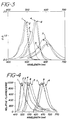
- Fig. 5 shows absorbance spectra of Vita Blue at varying pH values at two different concentrations. Apparently, a dimer is formed at the higher concentration; the peak with a maximum at 600 nm in the spectra of 9 (1.7 x 10 ⁇ 5 M, pH 3.10, 4.06 and 6.45) is not visible in the absorbance spectra at the lower concentration (3.4 x 10 ⁇ 6 M). An isobestic point at approximately 540 nm is apparent in the absorbance titration at the lower concentration.
- Fig. 6 shows emission spectra of compound 9 at varying pH values; the excitation wavelength used, was 540 nm. The emission spectra show an isobestic point at 630 nm.
- the pK a3 values of the dyes were determined by fluorescence titration.
- the pK a values shown were determined from absorbance titration.
- the main difficulty in using absorbance titration or pH titration to determine the pK a3 value of fluorescein and related compounds is that it is impossible to make a solution of solely the monoanionic form because the values of pK a2 and pK a3 differ only by 2.3 units. Since the absorbance spectra of all the different protonated forms overlap, it is difficult to obtain extinction coefficients of the different forms.
- Equation 1 describes the relationship between pH and pK a3 for an acid, where [HA1 ⁇ ]0 is the total concentration of the acid e.g. , fluorescein) and [A2 ⁇ ] is the concentration of the acid in the dianionic form.
- [A2 ⁇ ]/[HA1 ⁇ ]0 normalized fluorescence (nf).
- Fig. 7 shows a plot of pH vs. fluorescence of the data obtained from the fluorescence titration of Vita Blue.
- the data at pH 8.6 and above was discarded.
- Fig. 8 shows a plot of the data of all of the dyes in Table I (log [(1-nf)/nf] vs. pk) using a normalized fluorescence factor which resulted in the slope of the line to be closest to one.
- a straight line was drawn through the points, and the pK a3 was determined to be the value of the pH when the value of log [(1-nf)/nf] was zero.
- the titration was repeated.
- the two values of the pK a3 were 7.54 +/- 0.03 and 7.57 +/- 0.03; the average value was 7.56 +/- 0.03.
- Table I shows that the addition of two bromo groups on compounds 5 and 8 lower the pK a3 compared to the parent compounds 4 and 7 as anticipated.
- the extinction coefficients and quantum yields of compounds 5 and 9 were also lower than the parent dyes, and the excitation maxima were at longer wavelengths, as expected by analogy to fluorescein and eosin.
- the sulfo group on compounds 2, 6 and 9 shifted both the absorbance maxima (6-14 nm) and the emission maxima (1-5 nm) to the red as compared to the carboxy analogs 1, 4 and 7.
- the sulfo group on compounds 2 and 6 lowered the pK a3 very slightly or not at all as compared to the carboxy analogs, 1 and 4; however, the sulfo group on Vita Blue lowered the pK a3 by 0.4 units compared to the carboxy analog, 7.
- the effect of the sulfo group on compounds 2 and 9 had little effect on the extinction coefficients and the quantum yield as compared to the carboxy analogs, 1 and 7.
- the sulfo analog, compound 6, had twice the quantum yield as the carboxy analog, 4.
- Another effect of the sulfo groups on compounds 2, 6 and 9 was to inhibit sulfolactone formation in diacetate synthesis.
- Compound 2 formed a mixture of the green monoacetate and yellow diacetate in acetic anhydride; the diacetate could be purified by rapid chromatography on silica gel.
- Compound 6 decomposed before forming the diacetate in refluxing acetic anhydride.
- Vita Blue also formed a colored diacetate; after refluxing Vita Blue several hours in acetic anhydride the diacetate could be collected as a red solid.
- the 1H NMR spectra of the diacetates of both compounds 2 and 9 showed two acetates per dye; the fact that the diacetates were colored suggested that their structure is an equilibrium between the closed, sulfolactone form and the open, zwitterionic form.
- the dibutyrate derivative of compound 9 and the diacetate derivative of 2 were relatively stable in water at pH 7.
- VBDB was found to be a good substrate for pig liver esterase (E.C.3.1.1.1).
- the Michaelis constant (K m ) of VBDB at pH 8.0 was found to be 4 x 10 ⁇ 5 M (Fig. 1). This K m can be compared to that of ethyl butyrate (4.4 x 10 ⁇ 4 M).
- the fact that the K m of VBDB is actually lower than that of ethyl butyrate suggests that the large steric bulk of the chromophore does not inhibit enzymatic hydrolysis.
- Diacetate ester of compounds 2 and 9 were also esterase substrates; however, neither diacetates were membrane permeable.
Landscapes
- Life Sciences & Earth Sciences (AREA)
- Health & Medical Sciences (AREA)
- Engineering & Computer Science (AREA)
- Chemical & Material Sciences (AREA)
- Molecular Biology (AREA)
- Biomedical Technology (AREA)
- Hematology (AREA)
- Immunology (AREA)
- Urology & Nephrology (AREA)
- Physics & Mathematics (AREA)
- Organic Chemistry (AREA)
- Cell Biology (AREA)
- Food Science & Technology (AREA)
- Medicinal Chemistry (AREA)
- Biotechnology (AREA)
- Analytical Chemistry (AREA)
- Biochemistry (AREA)
- General Health & Medical Sciences (AREA)
- General Physics & Mathematics (AREA)
- Pathology (AREA)
- Microbiology (AREA)
- Heterocyclic Carbon Compounds Containing A Hetero Ring Having Oxygen Or Sulfur (AREA)
- Preparation Of Compounds By Using Micro-Organisms (AREA)
- Measuring Or Testing Involving Enzymes Or Micro-Organisms (AREA)
- Macromonomer-Based Addition Polymer (AREA)
- Non-Silver Salt Photosensitive Materials And Non-Silver Salt Photography (AREA)
- Luminescent Compositions (AREA)
- Investigating Or Analysing Biological Materials (AREA)
- Pyrane Compounds (AREA)
- Peptides Or Proteins (AREA)
Claims (15)
- Verbindung mit der Formel (I):

- Verbindung mit der Formel (II):

- Verbindung mit der Formel (III):
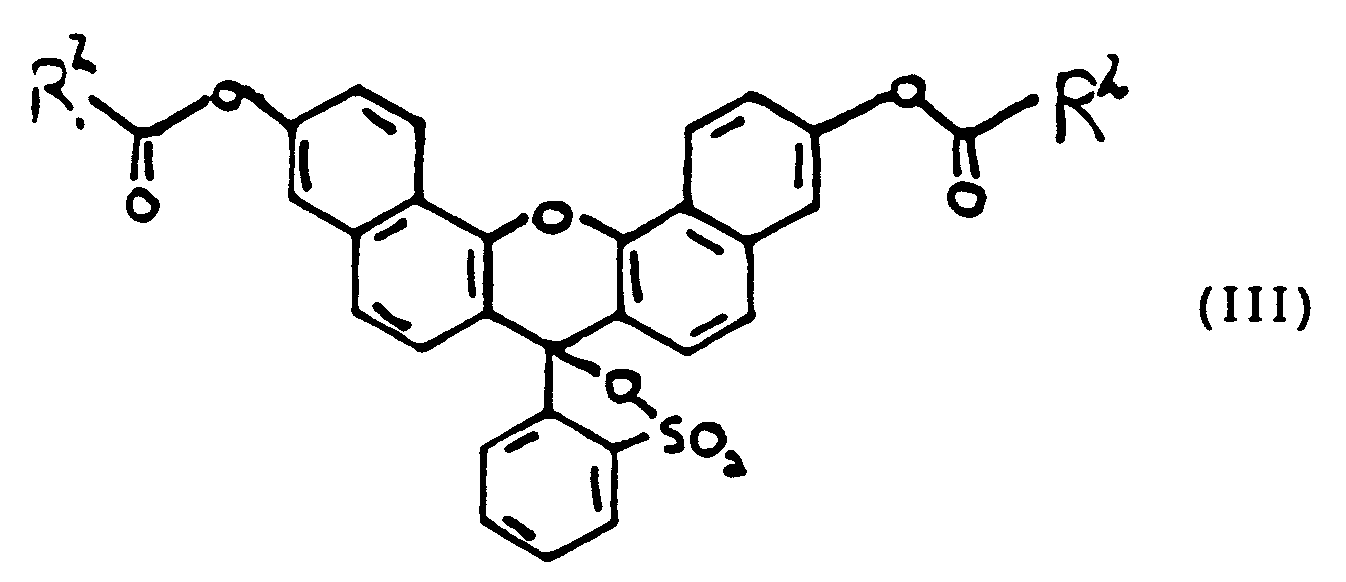
- Verbindung nach Anspruch 3, wobei jedes R² eine Methyl- oder Propylgruppe ist.
- Verfahren zum Färben von Zellen in einer Probe, wobei die Zellen mit einem Markierungsmittel in Kontakt gebracht werden, das an irgendeine der Verbindungen nach Anspruch 1 bis 4 gekoppelt ist.
- Verfahren nach Anspruch 5, wobei das Markierungsmittel ein Antikörper ist, vorzugsweise ein monoklonaler Antikörper.
- Verfahren nach Anspruch 5, wobei die Zellen aus Körpergewebe oder Körperflüssigkeiten abgeleitet werden.
- Verfahren nach Anspruch 5, wobei die Verbindung eine Verbindung nach irgendeinem der Ansprüche 2 bis 4 ist.
- Verfahren zur Identifizierung von Zellen in einer Probe mit den Schritten: Inkontaktbringen der Zellen mit einem Markierungsmittel, das an irgendeine der Verbindungen nach Anspruch 1 bis 4 gekoppelt ist, und Nachweis der dadurch emittierten Fluoreszenz.
- Verfahren nach Anspruch 9, wobei das Markierungsmittel ein Antikörper ist, vorzugsweise ein monoklonaler Antikörper.
- Verfahren nach Anspruch 9, wobei die Zellen aus Körpergewebe oder Körperflüssigkeiten abgeleitet werden.
- Verfahren nach Anspruch 9, wobei Fluoreszenz unter Verwendung eines Durchflußzytometers nachgewiesen wird.
- Verfahren nach Anspruch 9, wobei die Verbindung eine Verbindung nach irgendeinem der Ansprüche 2 bis 4 ist.
- Verfahren zur Unterscheidung zwischen lebenden und toten Zellen in einer Probe, mit den Schritten: Inkontaktbringen der Zellen mit irgendeiner der Verbindungen nach Anspruch 1 bis 4 und Nachweis der dadurch emittierten Fluoreszenz.
- Verfahren zum Nachweis der Enzymaktivität in einer Zellprobe, wobei die Zellen mit irgendeiner der Verbindungen nach Anspruch 1 bis 4 in Kontakt gebracht werden.
Priority Applications (1)
| Application Number | Priority Date | Filing Date | Title |
|---|---|---|---|
| AT89308642T ATE100483T1 (de) | 1988-08-31 | 1989-08-24 | Xanthenfarbstoffe. |
Applications Claiming Priority (2)
| Application Number | Priority Date | Filing Date | Title |
|---|---|---|---|
| US07/238,945 US4933471A (en) | 1988-08-31 | 1988-08-31 | Xanthene dyes |
| US238945 | 1988-08-31 |
Publications (3)
| Publication Number | Publication Date |
|---|---|
| EP0357350A2 EP0357350A2 (de) | 1990-03-07 |
| EP0357350A3 EP0357350A3 (de) | 1991-04-17 |
| EP0357350B1 true EP0357350B1 (de) | 1994-01-19 |
Family
ID=22899967
Family Applications (1)
| Application Number | Title | Priority Date | Filing Date |
|---|---|---|---|
| EP89308642A Expired - Lifetime EP0357350B1 (de) | 1988-08-31 | 1989-08-24 | Xanthenfarbstoffe |
Country Status (6)
| Country | Link |
|---|---|
| US (1) | US4933471A (de) |
| EP (1) | EP0357350B1 (de) |
| JP (1) | JPH064618B2 (de) |
| AT (1) | ATE100483T1 (de) |
| DE (1) | DE68912462T2 (de) |
| ES (1) | ES2062018T3 (de) |
Cited By (1)
| Publication number | Priority date | Publication date | Assignee | Title |
|---|---|---|---|---|
| CN109813588A (zh) * | 2019-02-19 | 2019-05-28 | 湖北泰康医疗设备有限公司 | 一种寄生虫染色液 |
Families Citing this family (14)
| Publication number | Priority date | Publication date | Assignee | Title |
|---|---|---|---|---|
| US5654442A (en) | 1989-11-14 | 1997-08-05 | The Perkin-Elmer Corporation | 4,7-dichlorofluorescein dyes as molecular probes |
| US5548661A (en) * | 1991-07-12 | 1996-08-20 | Price; Jeffrey H. | Operator independent image cytometer |
| US5790710A (en) * | 1991-07-12 | 1998-08-04 | Jeffrey H. Price | Autofocus system for scanning microscopy |
| DE4137934A1 (de) * | 1991-11-18 | 1993-05-19 | Boehringer Mannheim Gmbh | Neue pentacyklische verbindungen und ihre verwendung als absorptions- oder fluoreszenzfarbstoffe |
| US5637733A (en) * | 1995-09-27 | 1997-06-10 | Warner-Jenkinson Company, Inc. | Syntheses of fluorescein compounds with excess resorcinol as a solvent |
| US6459805B1 (en) | 1996-03-26 | 2002-10-01 | Childrens Hospital Los Angeles | Fluorescence digital imaging microscopy system |
| US6020481A (en) | 1996-04-01 | 2000-02-01 | The Perkin-Elmer Corporation | Asymmetric benzoxanthene dyes |
| US5835112A (en) * | 1996-10-08 | 1998-11-10 | Hewlett-Packard Company | Segmented electrical distribution plane |
| EP1383911A4 (de) * | 2001-04-02 | 2004-12-15 | Cytoprint Inc | Verfahren und vorrichtungen zur entdeckung, identifizierung und zum vergleich biologischer aktivitätsmechanismen |
| CA2508007A1 (en) * | 2003-08-01 | 2005-04-14 | Glotell Products, Inc. | Dye solutions for use in methods to detect the prior evaporation of anhydrous ammonia and the production of illicit drugs |
| GB0407836D0 (en) | 2004-04-06 | 2004-05-12 | Univ Cambridge Tech | Fluorescent dyes and complexes |
| JP2008533167A (ja) | 2005-03-15 | 2008-08-21 | アプレラ コーポレイション | 分析物の検出のための、抗体の代替抗原系の使用 |
| US8017338B2 (en) * | 2007-11-20 | 2011-09-13 | Life Technologies Corporation | Reversible di-nucleotide terminator sequencing |
| US20090171078A1 (en) * | 2007-11-20 | 2009-07-02 | Applied Biosystems Inc. | Method of sequencing nucleic acids using elaborated nucleotide phosphorotiolate compounds |
Family Cites Families (4)
| Publication number | Priority date | Publication date | Assignee | Title |
|---|---|---|---|---|
| US3786369A (en) | 1972-12-27 | 1974-01-15 | Eastman Kodak Co | Laser dye composition |
| US4599307A (en) * | 1983-07-18 | 1986-07-08 | Becton, Dickinson And Company | Method for elimination of selected cell populations in analytic cytology |
| JPS6054381A (ja) * | 1983-09-05 | 1985-03-28 | Mitsui Toatsu Chem Inc | 新規キサンテン系化合物 |
| US4727020A (en) * | 1985-02-25 | 1988-02-23 | Becton, Dickinson And Company | Method for analysis of subpopulations of blood cells |
-
1988
- 1988-08-31 US US07/238,945 patent/US4933471A/en not_active Expired - Lifetime
-
1989
- 1989-08-24 EP EP89308642A patent/EP0357350B1/de not_active Expired - Lifetime
- 1989-08-24 AT AT89308642T patent/ATE100483T1/de active
- 1989-08-24 ES ES89308642T patent/ES2062018T3/es not_active Expired - Lifetime
- 1989-08-24 JP JP1218428A patent/JPH064618B2/ja not_active Expired - Fee Related
- 1989-08-24 DE DE68912462T patent/DE68912462T2/de not_active Expired - Fee Related
Cited By (1)
| Publication number | Priority date | Publication date | Assignee | Title |
|---|---|---|---|---|
| CN109813588A (zh) * | 2019-02-19 | 2019-05-28 | 湖北泰康医疗设备有限公司 | 一种寄生虫染色液 |
Also Published As
| Publication number | Publication date |
|---|---|
| EP0357350A3 (de) | 1991-04-17 |
| EP0357350A2 (de) | 1990-03-07 |
| ES2062018T3 (es) | 1994-12-16 |
| ATE100483T1 (de) | 1994-02-15 |
| JPH064618B2 (ja) | 1994-01-19 |
| DE68912462T2 (de) | 1994-06-23 |
| DE68912462D1 (de) | 1994-03-03 |
| US4933471A (en) | 1990-06-12 |
| JPH02142782A (ja) | 1990-05-31 |
Similar Documents
| Publication | Publication Date | Title |
|---|---|---|
| US5066580A (en) | Xanthene dyes that emit to the red of fluorescein | |
| EP0357350B1 (de) | Xanthenfarbstoffe | |
| Lee et al. | Vita blue: A new 633‐nm excitable fluorescent dye for cell analysis | |
| Schulman et al. | Dependence of the fluorescence of immobilized 1-hydroxypyrene-3, 6, 8-trisulfonate on solution pH: extension of the range of applicability of a pH fluorosensor | |
| EP0231125B1 (de) | Hydrolysierbare fluoreszierende Substrate und deren Verwendung zur analytischen Bestimmung | |
| US4774339A (en) | Chemically reactive dipyrrometheneboron difluoride dyes | |
| US6201134B1 (en) | Diaminorhodamine derivatives | |
| US4945171A (en) | Xanthene dyes having a fused (C) benzo ring | |
| JP2688549B2 (ja) | 1,2−ジオキセタン製造用のアルケン化合物 | |
| EP0410806B1 (de) | Neuer fluoreszierender Farbstoff | |
| US5514710A (en) | Photocleavable derivatives of hydroxyprenesulfonic acids | |
| Fang et al. | Phosphinate-containing rhodol and fluorescein scaffolds for the development of bioprobes | |
| CN109053802B (zh) | 一种比率型近红外荧光探针及其合成方法与应用 | |
| US6057120A (en) | Redox-active compounds and their use | |
| JPWO1999001447A1 (ja) | ジアミノローダミン誘導体 | |
| CN108398409B (zh) | 一种荧光比率检测次氯酸根的方法 | |
| CN115974853A (zh) | 基于苯并半花菁类化合物的荧光探针及其制法和应用 | |
| Undeman et al. | Covalent complexes of DNA and two stereoisomers of benzo (a) pyrene 7, 8-dihydrodiol-9, 10-epoxide studied by fluorescence and linear dichroism | |
| US20030049714A1 (en) | Novel fluorogenic substrates for hydrolytic enzymes | |
| US7083982B2 (en) | Helium-neon excitable reticulocyte dyes derivable from halolepidines | |
| Klötzner et al. | A new photoactivatable near-infrared-emitting QCy7 fluorophore for single-molecule super-resolution microscopy | |
| US4677060A (en) | Process for determining the pH value in the interior of a cell | |
| EP0277139A1 (de) | 7-amino-4-methyl-coumarin-3-carboxyalkyl-abkömmlinge und fluoreszierende konjugate daraus. | |
| JP2583327B2 (ja) | 分析で使用するジオキセタン | |
| Kuroda et al. | New phenylboronic acid derivatives as enhancers of the luminol–H2O2–horseradish peroxidase chemiluminescence reaction |
Legal Events
| Date | Code | Title | Description |
|---|---|---|---|
| PUAI | Public reference made under article 153(3) epc to a published international application that has entered the european phase |
Free format text: ORIGINAL CODE: 0009012 |
|
| AK | Designated contracting states |
Kind code of ref document: A2 Designated state(s): AT BE CH DE ES FR GB GR IT LI LU NL SE |
|
| 17P | Request for examination filed |
Effective date: 19900515 |
|
| PUAL | Search report despatched |
Free format text: ORIGINAL CODE: 0009013 |
|
| AK | Designated contracting states |
Kind code of ref document: A3 Designated state(s): AT BE CH DE ES FR GB GR IT LI LU NL SE |
|
| 17Q | First examination report despatched |
Effective date: 19930614 |
|
| GRAA | (expected) grant |
Free format text: ORIGINAL CODE: 0009210 |
|
| AK | Designated contracting states |
Kind code of ref document: B1 Designated state(s): AT BE CH DE ES FR GB GR IT LI LU NL SE |
|
| PG25 | Lapsed in a contracting state [announced via postgrant information from national office to epo] |
Ref country code: SE Effective date: 19940119 Ref country code: LI Effective date: 19940119 Ref country code: GR Free format text: LAPSE BECAUSE OF FAILURE TO SUBMIT A TRANSLATION OF THE DESCRIPTION OR TO PAY THE FEE WITHIN THE PRESCRIBED TIME-LIMIT Effective date: 19940119 Ref country code: CH Effective date: 19940119 Ref country code: AT Effective date: 19940119 |
|
| REF | Corresponds to: |
Ref document number: 100483 Country of ref document: AT Date of ref document: 19940215 Kind code of ref document: T |
|
| ITF | It: translation for a ep patent filed | ||
| REF | Corresponds to: |
Ref document number: 68912462 Country of ref document: DE Date of ref document: 19940303 |
|
| ET | Fr: translation filed | ||
| REG | Reference to a national code |
Ref country code: CH Ref legal event code: PL |
|
| PG25 | Lapsed in a contracting state [announced via postgrant information from national office to epo] |
Ref country code: LU Free format text: LAPSE BECAUSE OF NON-PAYMENT OF DUE FEES Effective date: 19940831 |
|
| PLBE | No opposition filed within time limit |
Free format text: ORIGINAL CODE: 0009261 |
|
| STAA | Information on the status of an ep patent application or granted ep patent |
Free format text: STATUS: NO OPPOSITION FILED WITHIN TIME LIMIT |
|
| REG | Reference to a national code |
Ref country code: ES Ref legal event code: FG2A Ref document number: 2062018 Country of ref document: ES Kind code of ref document: T3 |
|
| 26N | No opposition filed | ||
| PGFP | Annual fee paid to national office [announced via postgrant information from national office to epo] |
Ref country code: ES Payment date: 19980814 Year of fee payment: 10 |
|
| PGFP | Annual fee paid to national office [announced via postgrant information from national office to epo] |
Ref country code: NL Payment date: 19980827 Year of fee payment: 10 |
|
| PGFP | Annual fee paid to national office [announced via postgrant information from national office to epo] |
Ref country code: BE Payment date: 19981016 Year of fee payment: 10 |
|
| PG25 | Lapsed in a contracting state [announced via postgrant information from national office to epo] |
Ref country code: ES Free format text: LAPSE BECAUSE OF NON-PAYMENT OF DUE FEES Effective date: 19990825 |
|
| PG25 | Lapsed in a contracting state [announced via postgrant information from national office to epo] |
Ref country code: BE Free format text: LAPSE BECAUSE OF NON-PAYMENT OF DUE FEES Effective date: 19990831 |
|
| BERE | Be: lapsed |
Owner name: BECTON DICKINSON AND CY Effective date: 19990831 |
|
| PG25 | Lapsed in a contracting state [announced via postgrant information from national office to epo] |
Ref country code: NL Free format text: LAPSE BECAUSE OF NON-PAYMENT OF DUE FEES Effective date: 20000301 |
|
| NLV4 | Nl: lapsed or anulled due to non-payment of the annual fee |
Effective date: 20000301 |
|
| REG | Reference to a national code |
Ref country code: GB Ref legal event code: IF02 |
|
| PGFP | Annual fee paid to national office [announced via postgrant information from national office to epo] |
Ref country code: FR Payment date: 20020731 Year of fee payment: 14 |
|
| PGFP | Annual fee paid to national office [announced via postgrant information from national office to epo] |
Ref country code: GB Payment date: 20020821 Year of fee payment: 14 |
|
| PGFP | Annual fee paid to national office [announced via postgrant information from national office to epo] |
Ref country code: DE Payment date: 20020830 Year of fee payment: 14 |
|
| PG25 | Lapsed in a contracting state [announced via postgrant information from national office to epo] |
Ref country code: GB Free format text: LAPSE BECAUSE OF NON-PAYMENT OF DUE FEES Effective date: 20030824 |
|
| PG25 | Lapsed in a contracting state [announced via postgrant information from national office to epo] |
Ref country code: DE Free format text: LAPSE BECAUSE OF NON-PAYMENT OF DUE FEES Effective date: 20040302 |
|
| REG | Reference to a national code |
Ref country code: ES Ref legal event code: FD2A Effective date: 20000911 |
|
| GBPC | Gb: european patent ceased through non-payment of renewal fee | ||
| PG25 | Lapsed in a contracting state [announced via postgrant information from national office to epo] |
Ref country code: FR Free format text: LAPSE BECAUSE OF NON-PAYMENT OF DUE FEES Effective date: 20040430 |
|
| REG | Reference to a national code |
Ref country code: FR Ref legal event code: ST |
|
| PG25 | Lapsed in a contracting state [announced via postgrant information from national office to epo] |
Ref country code: IT Free format text: LAPSE BECAUSE OF NON-PAYMENT OF DUE FEES;WARNING: LAPSES OF ITALIAN PATENTS WITH EFFECTIVE DATE BEFORE 2007 MAY HAVE OCCURRED AT ANY TIME BEFORE 2007. THE CORRECT EFFECTIVE DATE MAY BE DIFFERENT FROM THE ONE RECORDED. Effective date: 20050824 |