EP0353476B1 - Biomedical material and method for making the same - Google Patents
Biomedical material and method for making the same Download PDFInfo
- Publication number
- EP0353476B1 EP0353476B1 EP89112220A EP89112220A EP0353476B1 EP 0353476 B1 EP0353476 B1 EP 0353476B1 EP 89112220 A EP89112220 A EP 89112220A EP 89112220 A EP89112220 A EP 89112220A EP 0353476 B1 EP0353476 B1 EP 0353476B1
- Authority
- EP
- European Patent Office
- Prior art keywords
- whiskers
- whisker
- sintered
- calcium phosphate
- calcium
- Prior art date
- Legal status (The legal status is an assumption and is not a legal conclusion. Google has not performed a legal analysis and makes no representation as to the accuracy of the status listed.)
- Expired - Lifetime
Links
- 239000003519 biomedical and dental material Substances 0.000 title claims description 34
- 238000000034 method Methods 0.000 title claims description 27
- QORWJWZARLRLPR-UHFFFAOYSA-H tricalcium bis(phosphate) Chemical compound [Ca+2].[Ca+2].[Ca+2].[O-]P([O-])([O-])=O.[O-]P([O-])([O-])=O QORWJWZARLRLPR-UHFFFAOYSA-H 0.000 claims description 77
- 239000000463 material Substances 0.000 claims description 73
- 239000001506 calcium phosphate Substances 0.000 claims description 69
- 235000011010 calcium phosphates Nutrition 0.000 claims description 59
- 229910000389 calcium phosphate Inorganic materials 0.000 claims description 58
- 239000000203 mixture Substances 0.000 claims description 53
- ODINCKMPIJJUCX-UHFFFAOYSA-N calcium oxide Inorganic materials [Ca]=O ODINCKMPIJJUCX-UHFFFAOYSA-N 0.000 claims description 48
- VYPSYNLAJGMNEJ-UHFFFAOYSA-N Silicium dioxide Chemical compound O=[Si]=O VYPSYNLAJGMNEJ-UHFFFAOYSA-N 0.000 claims description 47
- 239000011159 matrix material Substances 0.000 claims description 45
- 238000005245 sintering Methods 0.000 claims description 41
- CPLXHLVBOLITMK-UHFFFAOYSA-N magnesium oxide Inorganic materials [Mg]=O CPLXHLVBOLITMK-UHFFFAOYSA-N 0.000 claims description 35
- 239000000292 calcium oxide Substances 0.000 claims description 32
- 229910052588 hydroxylapatite Inorganic materials 0.000 claims description 31
- XYJRXVWERLGGKC-UHFFFAOYSA-D pentacalcium;hydroxide;triphosphate Chemical group [OH-].[Ca+2].[Ca+2].[Ca+2].[Ca+2].[Ca+2].[O-]P([O-])([O-])=O.[O-]P([O-])([O-])=O.[O-]P([O-])([O-])=O XYJRXVWERLGGKC-UHFFFAOYSA-D 0.000 claims description 31
- PNEYBMLMFCGWSK-UHFFFAOYSA-N aluminium oxide Inorganic materials [O-2].[O-2].[O-2].[Al+3].[Al+3] PNEYBMLMFCGWSK-UHFFFAOYSA-N 0.000 claims description 28
- NWXHSRDXUJENGJ-UHFFFAOYSA-N calcium;magnesium;dioxido(oxo)silane Chemical compound [Mg+2].[Ca+2].[O-][Si]([O-])=O.[O-][Si]([O-])=O NWXHSRDXUJENGJ-UHFFFAOYSA-N 0.000 claims description 23
- 229910052637 diopside Inorganic materials 0.000 claims description 23
- 239000000395 magnesium oxide Substances 0.000 claims description 21
- 239000000377 silicon dioxide Substances 0.000 claims description 21
- 229910052661 anorthite Inorganic materials 0.000 claims description 19
- GWWPLLOVYSCJIO-UHFFFAOYSA-N dialuminum;calcium;disilicate Chemical compound [Al+3].[Al+3].[Ca+2].[O-][Si]([O-])([O-])[O-].[O-][Si]([O-])([O-])[O-] GWWPLLOVYSCJIO-UHFFFAOYSA-N 0.000 claims description 19
- 239000011575 calcium Substances 0.000 claims description 17
- VSIIXMUUUJUKCM-UHFFFAOYSA-D pentacalcium;fluoride;triphosphate Chemical class [F-].[Ca+2].[Ca+2].[Ca+2].[Ca+2].[Ca+2].[O-]P([O-])([O-])=O.[O-]P([O-])([O-])=O.[O-]P([O-])([O-])=O VSIIXMUUUJUKCM-UHFFFAOYSA-D 0.000 claims description 17
- BRPQOXSCLDDYGP-UHFFFAOYSA-N calcium oxide Chemical compound [O-2].[Ca+2] BRPQOXSCLDDYGP-UHFFFAOYSA-N 0.000 claims description 13
- 239000002131 composite material Substances 0.000 claims description 11
- 229910052791 calcium Inorganic materials 0.000 claims description 10
- 229910000391 tricalcium phosphate Inorganic materials 0.000 claims description 10
- 235000019731 tricalcium phosphate Nutrition 0.000 claims description 10
- 229910052698 phosphorus Inorganic materials 0.000 claims description 9
- 229940078499 tricalcium phosphate Drugs 0.000 claims description 9
- 238000005096 rolling process Methods 0.000 claims description 8
- 239000000378 calcium silicate Substances 0.000 claims description 7
- 229910052918 calcium silicate Inorganic materials 0.000 claims description 7
- OYACROKNLOSFPA-UHFFFAOYSA-N calcium;dioxido(oxo)silane Chemical compound [Ca+2].[O-][Si]([O-])=O OYACROKNLOSFPA-UHFFFAOYSA-N 0.000 claims description 7
- AXZKOIWUVFPNLO-UHFFFAOYSA-N magnesium;oxygen(2-) Chemical compound [O-2].[Mg+2] AXZKOIWUVFPNLO-UHFFFAOYSA-N 0.000 claims description 7
- OYPRJOBELJOOCE-UHFFFAOYSA-N Calcium Chemical compound [Ca] OYPRJOBELJOOCE-UHFFFAOYSA-N 0.000 claims description 5
- 238000002156 mixing Methods 0.000 claims description 5
- TWNQGVIAIRXVLR-UHFFFAOYSA-N oxo(oxoalumanyloxy)alumane Chemical compound O=[Al]O[Al]=O TWNQGVIAIRXVLR-UHFFFAOYSA-N 0.000 claims description 5
- FYYHWMGAXLPEAU-UHFFFAOYSA-N Magnesium Chemical compound [Mg] FYYHWMGAXLPEAU-UHFFFAOYSA-N 0.000 claims description 4
- 238000001816 cooling Methods 0.000 claims description 4
- 229910052587 fluorapatite Inorganic materials 0.000 claims description 4
- 229910052749 magnesium Inorganic materials 0.000 claims description 4
- 239000011777 magnesium Substances 0.000 claims description 4
- 239000011574 phosphorus Substances 0.000 claims description 4
- 229910052814 silicon oxide Inorganic materials 0.000 claims description 4
- YKTSYUJCYHOUJP-UHFFFAOYSA-N [O--].[Al+3].[Al+3].[O-][Si]([O-])([O-])[O-] Chemical compound [O--].[Al+3].[Al+3].[O-][Si]([O-])([O-])[O-] YKTSYUJCYHOUJP-UHFFFAOYSA-N 0.000 claims description 2
- 150000001875 compounds Chemical class 0.000 claims description 2
- 235000012255 calcium oxide Nutrition 0.000 description 29
- 239000000843 powder Substances 0.000 description 25
- 229910052586 apatite Inorganic materials 0.000 description 15
- 210000000988 bone and bone Anatomy 0.000 description 12
- 239000002270 dispersing agent Substances 0.000 description 12
- 229910052681 coesite Inorganic materials 0.000 description 10
- 229910052593 corundum Inorganic materials 0.000 description 10
- 229910052906 cristobalite Inorganic materials 0.000 description 10
- 235000012239 silicon dioxide Nutrition 0.000 description 10
- 229910052682 stishovite Inorganic materials 0.000 description 10
- 229910052905 tridymite Inorganic materials 0.000 description 10
- 229910001845 yogo sapphire Inorganic materials 0.000 description 10
- 230000004071 biological effect Effects 0.000 description 9
- MCMNRKCIXSYSNV-UHFFFAOYSA-N Zirconium dioxide Chemical compound O=[Zr]=O MCMNRKCIXSYSNV-UHFFFAOYSA-N 0.000 description 8
- 239000011230 binding agent Substances 0.000 description 6
- -1 boundary Chemical compound 0.000 description 6
- 229910052710 silicon Inorganic materials 0.000 description 6
- 239000008187 granular material Substances 0.000 description 5
- 230000001965 increasing effect Effects 0.000 description 5
- HBMJWWWQQXIZIP-UHFFFAOYSA-N silicon carbide Chemical compound [Si+]#[C-] HBMJWWWQQXIZIP-UHFFFAOYSA-N 0.000 description 5
- 238000012360 testing method Methods 0.000 description 5
- 230000008901 benefit Effects 0.000 description 4
- GFIKIVSYJDVOOZ-UHFFFAOYSA-L calcium;fluoro-dioxido-oxo-$l^{5}-phosphane Chemical compound [Ca+2].[O-]P([O-])(F)=O GFIKIVSYJDVOOZ-UHFFFAOYSA-L 0.000 description 4
- 238000000576 coating method Methods 0.000 description 4
- 238000010586 diagram Methods 0.000 description 4
- 239000002557 mineral fiber Substances 0.000 description 4
- 239000002002 slurry Substances 0.000 description 4
- 241000283973 Oryctolagus cuniculus Species 0.000 description 3
- 229910052581 Si3N4 Inorganic materials 0.000 description 3
- QVQLCTNNEUAWMS-UHFFFAOYSA-N barium oxide Chemical compound [Ba]=O QVQLCTNNEUAWMS-UHFFFAOYSA-N 0.000 description 3
- 230000015572 biosynthetic process Effects 0.000 description 3
- 239000006227 byproduct Substances 0.000 description 3
- 239000000919 ceramic Substances 0.000 description 3
- 230000000694 effects Effects 0.000 description 3
- 239000007943 implant Substances 0.000 description 3
- 229910052809 inorganic oxide Inorganic materials 0.000 description 3
- 238000003801 milling Methods 0.000 description 3
- 230000001376 precipitating effect Effects 0.000 description 3
- 230000002787 reinforcement Effects 0.000 description 3
- 229910010271 silicon carbide Inorganic materials 0.000 description 3
- IATRAKWUXMZMIY-UHFFFAOYSA-N strontium oxide Chemical compound [O-2].[Sr+2] IATRAKWUXMZMIY-UHFFFAOYSA-N 0.000 description 3
- 210000004746 tooth root Anatomy 0.000 description 3
- 238000002441 X-ray diffraction Methods 0.000 description 2
- 238000004458 analytical method Methods 0.000 description 2
- 238000006243 chemical reaction Methods 0.000 description 2
- 239000011248 coating agent Substances 0.000 description 2
- 238000005336 cracking Methods 0.000 description 2
- 239000013078 crystal Substances 0.000 description 2
- 230000002950 deficient Effects 0.000 description 2
- 238000009792 diffusion process Methods 0.000 description 2
- KZHJGOXRZJKJNY-UHFFFAOYSA-N dioxosilane;oxo(oxoalumanyloxy)alumane Chemical compound O=[Si]=O.O=[Si]=O.O=[Al]O[Al]=O.O=[Al]O[Al]=O.O=[Al]O[Al]=O KZHJGOXRZJKJNY-UHFFFAOYSA-N 0.000 description 2
- 239000000835 fiber Substances 0.000 description 2
- 238000010438 heat treatment Methods 0.000 description 2
- 238000007731 hot pressing Methods 0.000 description 2
- 230000001939 inductive effect Effects 0.000 description 2
- 229910003465 moissanite Inorganic materials 0.000 description 2
- 238000000465 moulding Methods 0.000 description 2
- 229910052863 mullite Inorganic materials 0.000 description 2
- 239000002245 particle Substances 0.000 description 2
- 239000002244 precipitate Substances 0.000 description 2
- LIVNPJMFVYWSIS-UHFFFAOYSA-N silicon monoxide Chemical compound [Si-]#[O+] LIVNPJMFVYWSIS-UHFFFAOYSA-N 0.000 description 2
- 239000006104 solid solution Substances 0.000 description 2
- BVKZGUZCCUSVTD-UHFFFAOYSA-M Bicarbonate Chemical class OC([O-])=O BVKZGUZCCUSVTD-UHFFFAOYSA-M 0.000 description 1
- 229910019142 PO4 Inorganic materials 0.000 description 1
- OAICVXFJPJFONN-UHFFFAOYSA-N Phosphorus Chemical compound [P] OAICVXFJPJFONN-UHFFFAOYSA-N 0.000 description 1
- 229910003564 SiAlON Inorganic materials 0.000 description 1
- 241000251539 Vertebrata <Metazoa> Species 0.000 description 1
- 230000002159 abnormal effect Effects 0.000 description 1
- 239000002253 acid Substances 0.000 description 1
- 125000000129 anionic group Chemical group 0.000 description 1
- 239000007864 aqueous solution Substances 0.000 description 1
- 125000004429 atom Chemical group 0.000 description 1
- 238000005452 bending Methods 0.000 description 1
- 239000003462 bioceramic Substances 0.000 description 1
- 230000005540 biological transmission Effects 0.000 description 1
- 210000001124 body fluid Anatomy 0.000 description 1
- 239000010839 body fluid Substances 0.000 description 1
- 238000004364 calculation method Methods 0.000 description 1
- 238000003490 calendering Methods 0.000 description 1
- 150000004649 carbonic acid derivatives Chemical class 0.000 description 1
- 229910010293 ceramic material Inorganic materials 0.000 description 1
- 125000001309 chloro group Chemical group Cl* 0.000 description 1
- 230000000052 comparative effect Effects 0.000 description 1
- 238000007796 conventional method Methods 0.000 description 1
- 238000005260 corrosion Methods 0.000 description 1
- 230000007797 corrosion Effects 0.000 description 1
- 230000003111 delayed effect Effects 0.000 description 1
- 238000001125 extrusion Methods 0.000 description 1
- 125000001153 fluoro group Chemical group F* 0.000 description 1
- 229910052839 forsterite Inorganic materials 0.000 description 1
- 239000011521 glass Substances 0.000 description 1
- 229910052736 halogen Inorganic materials 0.000 description 1
- 150000002367 halogens Chemical class 0.000 description 1
- 150000004679 hydroxides Chemical class 0.000 description 1
- 230000001771 impaired effect Effects 0.000 description 1
- 239000004615 ingredient Substances 0.000 description 1
- 230000004807 localization Effects 0.000 description 1
- 238000009766 low-temperature sintering Methods 0.000 description 1
- HCWCAKKEBCNQJP-UHFFFAOYSA-N magnesium orthosilicate Chemical compound [Mg+2].[Mg+2].[O-][Si]([O-])([O-])[O-] HCWCAKKEBCNQJP-UHFFFAOYSA-N 0.000 description 1
- 238000004519 manufacturing process Methods 0.000 description 1
- 238000005259 measurement Methods 0.000 description 1
- 238000012986 modification Methods 0.000 description 1
- 230000004048 modification Effects 0.000 description 1
- 231100000252 nontoxic Toxicity 0.000 description 1
- 230000003000 nontoxic effect Effects 0.000 description 1
- 238000012829 orthopaedic surgery Methods 0.000 description 1
- 125000004437 phosphorous atom Chemical group 0.000 description 1
- 230000000704 physical effect Effects 0.000 description 1
- 238000013001 point bending Methods 0.000 description 1
- 239000011148 porous material Substances 0.000 description 1
- 238000012805 post-processing Methods 0.000 description 1
- 238000000634 powder X-ray diffraction Methods 0.000 description 1
- 230000002028 premature Effects 0.000 description 1
- 238000002360 preparation method Methods 0.000 description 1
- 238000003825 pressing Methods 0.000 description 1
- 239000011226 reinforced ceramic Substances 0.000 description 1
- 239000011208 reinforced composite material Substances 0.000 description 1
- 239000012758 reinforcing additive Substances 0.000 description 1
- 238000007493 shaping process Methods 0.000 description 1
- 239000010703 silicon Substances 0.000 description 1
- 238000007569 slipcasting Methods 0.000 description 1
- 210000004872 soft tissue Anatomy 0.000 description 1
- 239000000243 solution Substances 0.000 description 1
- 239000007858 starting material Substances 0.000 description 1
- 239000000126 substance Substances 0.000 description 1
- 150000008054 sulfonate salts Chemical class 0.000 description 1
- 239000004094 surface-active agent Substances 0.000 description 1
- 238000001356 surgical procedure Methods 0.000 description 1
- 229920005992 thermoplastic resin Polymers 0.000 description 1
- 210000001519 tissue Anatomy 0.000 description 1
- 238000011282 treatment Methods 0.000 description 1
- XLYOFNOQVPJJNP-UHFFFAOYSA-N water Substances O XLYOFNOQVPJJNP-UHFFFAOYSA-N 0.000 description 1
- 239000010456 wollastonite Substances 0.000 description 1
- 229910052882 wollastonite Inorganic materials 0.000 description 1
- 229910001720 Åkermanite Inorganic materials 0.000 description 1
Images

Classifications
-
- C—CHEMISTRY; METALLURGY
- C04—CEMENTS; CONCRETE; ARTIFICIAL STONE; CERAMICS; REFRACTORIES
- C04B—LIME, MAGNESIA; SLAG; CEMENTS; COMPOSITIONS THEREOF, e.g. MORTARS, CONCRETE OR LIKE BUILDING MATERIALS; ARTIFICIAL STONE; CERAMICS; REFRACTORIES; TREATMENT OF NATURAL STONE
- C04B35/00—Shaped ceramic products characterised by their composition; Ceramics compositions; Processing powders of inorganic compounds preparatory to the manufacturing of ceramic products
- C04B35/01—Shaped ceramic products characterised by their composition; Ceramics compositions; Processing powders of inorganic compounds preparatory to the manufacturing of ceramic products based on oxide ceramics
- C04B35/447—Shaped ceramic products characterised by their composition; Ceramics compositions; Processing powders of inorganic compounds preparatory to the manufacturing of ceramic products based on oxide ceramics based on phosphates, e.g. hydroxyapatite
-
- A—HUMAN NECESSITIES
- A61—MEDICAL OR VETERINARY SCIENCE; HYGIENE
- A61C—DENTISTRY; APPARATUS OR METHODS FOR ORAL OR DENTAL HYGIENE
- A61C8/00—Means to be fixed to the jaw-bone for consolidating natural teeth or for fixing dental prostheses thereon; Dental implants; Implanting tools
- A61C8/0012—Means to be fixed to the jaw-bone for consolidating natural teeth or for fixing dental prostheses thereon; Dental implants; Implanting tools characterised by the material or composition, e.g. ceramics, surface layer, metal alloy
-
- A—HUMAN NECESSITIES
- A61—MEDICAL OR VETERINARY SCIENCE; HYGIENE
- A61F—FILTERS IMPLANTABLE INTO BLOOD VESSELS; PROSTHESES; DEVICES PROVIDING PATENCY TO, OR PREVENTING COLLAPSING OF, TUBULAR STRUCTURES OF THE BODY, e.g. STENTS; ORTHOPAEDIC, NURSING OR CONTRACEPTIVE DEVICES; FOMENTATION; TREATMENT OR PROTECTION OF EYES OR EARS; BANDAGES, DRESSINGS OR ABSORBENT PADS; FIRST-AID KITS
- A61F2/00—Filters implantable into blood vessels; Prostheses, i.e. artificial substitutes or replacements for parts of the body; Appliances for connecting them with the body; Devices providing patency to, or preventing collapsing of, tubular structures of the body, e.g. stents
- A61F2/02—Prostheses implantable into the body
- A61F2/28—Bones
-
- A—HUMAN NECESSITIES
- A61—MEDICAL OR VETERINARY SCIENCE; HYGIENE
- A61L—METHODS OR APPARATUS FOR STERILISING MATERIALS OR OBJECTS IN GENERAL; DISINFECTION, STERILISATION OR DEODORISATION OF AIR; CHEMICAL ASPECTS OF BANDAGES, DRESSINGS, ABSORBENT PADS OR SURGICAL ARTICLES; MATERIALS FOR BANDAGES, DRESSINGS, ABSORBENT PADS OR SURGICAL ARTICLES
- A61L27/00—Materials for grafts or prostheses or for coating grafts or prostheses
- A61L27/02—Inorganic materials
- A61L27/12—Phosphorus-containing materials, e.g. apatite
-
- C—CHEMISTRY; METALLURGY
- C04—CEMENTS; CONCRETE; ARTIFICIAL STONE; CERAMICS; REFRACTORIES
- C04B—LIME, MAGNESIA; SLAG; CEMENTS; COMPOSITIONS THEREOF, e.g. MORTARS, CONCRETE OR LIKE BUILDING MATERIALS; ARTIFICIAL STONE; CERAMICS; REFRACTORIES; TREATMENT OF NATURAL STONE
- C04B35/00—Shaped ceramic products characterised by their composition; Ceramics compositions; Processing powders of inorganic compounds preparatory to the manufacturing of ceramic products
- C04B35/01—Shaped ceramic products characterised by their composition; Ceramics compositions; Processing powders of inorganic compounds preparatory to the manufacturing of ceramic products based on oxide ceramics
- C04B35/16—Shaped ceramic products characterised by their composition; Ceramics compositions; Processing powders of inorganic compounds preparatory to the manufacturing of ceramic products based on oxide ceramics based on silicates other than clay
- C04B35/18—Shaped ceramic products characterised by their composition; Ceramics compositions; Processing powders of inorganic compounds preparatory to the manufacturing of ceramic products based on oxide ceramics based on silicates other than clay rich in aluminium oxide
- C04B35/195—Alkaline earth aluminosilicates, e.g. cordierite or anorthite
-
- C—CHEMISTRY; METALLURGY
- C04—CEMENTS; CONCRETE; ARTIFICIAL STONE; CERAMICS; REFRACTORIES
- C04B—LIME, MAGNESIA; SLAG; CEMENTS; COMPOSITIONS THEREOF, e.g. MORTARS, CONCRETE OR LIKE BUILDING MATERIALS; ARTIFICIAL STONE; CERAMICS; REFRACTORIES; TREATMENT OF NATURAL STONE
- C04B35/00—Shaped ceramic products characterised by their composition; Ceramics compositions; Processing powders of inorganic compounds preparatory to the manufacturing of ceramic products
- C04B35/01—Shaped ceramic products characterised by their composition; Ceramics compositions; Processing powders of inorganic compounds preparatory to the manufacturing of ceramic products based on oxide ceramics
- C04B35/16—Shaped ceramic products characterised by their composition; Ceramics compositions; Processing powders of inorganic compounds preparatory to the manufacturing of ceramic products based on oxide ceramics based on silicates other than clay
- C04B35/20—Shaped ceramic products characterised by their composition; Ceramics compositions; Processing powders of inorganic compounds preparatory to the manufacturing of ceramic products based on oxide ceramics based on silicates other than clay rich in magnesium oxide, e.g. forsterite
-
- C—CHEMISTRY; METALLURGY
- C04—CEMENTS; CONCRETE; ARTIFICIAL STONE; CERAMICS; REFRACTORIES
- C04B—LIME, MAGNESIA; SLAG; CEMENTS; COMPOSITIONS THEREOF, e.g. MORTARS, CONCRETE OR LIKE BUILDING MATERIALS; ARTIFICIAL STONE; CERAMICS; REFRACTORIES; TREATMENT OF NATURAL STONE
- C04B35/00—Shaped ceramic products characterised by their composition; Ceramics compositions; Processing powders of inorganic compounds preparatory to the manufacturing of ceramic products
- C04B35/01—Shaped ceramic products characterised by their composition; Ceramics compositions; Processing powders of inorganic compounds preparatory to the manufacturing of ceramic products based on oxide ceramics
- C04B35/16—Shaped ceramic products characterised by their composition; Ceramics compositions; Processing powders of inorganic compounds preparatory to the manufacturing of ceramic products based on oxide ceramics based on silicates other than clay
- C04B35/22—Shaped ceramic products characterised by their composition; Ceramics compositions; Processing powders of inorganic compounds preparatory to the manufacturing of ceramic products based on oxide ceramics based on silicates other than clay rich in calcium oxide, e.g. wollastonite
-
- C—CHEMISTRY; METALLURGY
- C04—CEMENTS; CONCRETE; ARTIFICIAL STONE; CERAMICS; REFRACTORIES
- C04B—LIME, MAGNESIA; SLAG; CEMENTS; COMPOSITIONS THEREOF, e.g. MORTARS, CONCRETE OR LIKE BUILDING MATERIALS; ARTIFICIAL STONE; CERAMICS; REFRACTORIES; TREATMENT OF NATURAL STONE
- C04B35/00—Shaped ceramic products characterised by their composition; Ceramics compositions; Processing powders of inorganic compounds preparatory to the manufacturing of ceramic products
- C04B35/01—Shaped ceramic products characterised by their composition; Ceramics compositions; Processing powders of inorganic compounds preparatory to the manufacturing of ceramic products based on oxide ceramics
- C04B35/44—Shaped ceramic products characterised by their composition; Ceramics compositions; Processing powders of inorganic compounds preparatory to the manufacturing of ceramic products based on oxide ceramics based on aluminates
-
- C—CHEMISTRY; METALLURGY
- C04—CEMENTS; CONCRETE; ARTIFICIAL STONE; CERAMICS; REFRACTORIES
- C04B—LIME, MAGNESIA; SLAG; CEMENTS; COMPOSITIONS THEREOF, e.g. MORTARS, CONCRETE OR LIKE BUILDING MATERIALS; ARTIFICIAL STONE; CERAMICS; REFRACTORIES; TREATMENT OF NATURAL STONE
- C04B35/00—Shaped ceramic products characterised by their composition; Ceramics compositions; Processing powders of inorganic compounds preparatory to the manufacturing of ceramic products
- C04B35/622—Forming processes; Processing powders of inorganic compounds preparatory to the manufacturing of ceramic products
- C04B35/64—Burning or sintering processes
- C04B35/645—Pressure sintering
-
- C—CHEMISTRY; METALLURGY
- C04—CEMENTS; CONCRETE; ARTIFICIAL STONE; CERAMICS; REFRACTORIES
- C04B—LIME, MAGNESIA; SLAG; CEMENTS; COMPOSITIONS THEREOF, e.g. MORTARS, CONCRETE OR LIKE BUILDING MATERIALS; ARTIFICIAL STONE; CERAMICS; REFRACTORIES; TREATMENT OF NATURAL STONE
- C04B35/00—Shaped ceramic products characterised by their composition; Ceramics compositions; Processing powders of inorganic compounds preparatory to the manufacturing of ceramic products
- C04B35/71—Ceramic products containing macroscopic reinforcing agents
- C04B35/78—Ceramic products containing macroscopic reinforcing agents containing non-metallic materials
- C04B35/80—Fibres, filaments, whiskers, platelets, or the like
-
- A—HUMAN NECESSITIES
- A61—MEDICAL OR VETERINARY SCIENCE; HYGIENE
- A61F—FILTERS IMPLANTABLE INTO BLOOD VESSELS; PROSTHESES; DEVICES PROVIDING PATENCY TO, OR PREVENTING COLLAPSING OF, TUBULAR STRUCTURES OF THE BODY, e.g. STENTS; ORTHOPAEDIC, NURSING OR CONTRACEPTIVE DEVICES; FOMENTATION; TREATMENT OR PROTECTION OF EYES OR EARS; BANDAGES, DRESSINGS OR ABSORBENT PADS; FIRST-AID KITS
- A61F2/00—Filters implantable into blood vessels; Prostheses, i.e. artificial substitutes or replacements for parts of the body; Appliances for connecting them with the body; Devices providing patency to, or preventing collapsing of, tubular structures of the body, e.g. stents
- A61F2/02—Prostheses implantable into the body
- A61F2/30—Joints
- A61F2/3094—Designing or manufacturing processes
- A61F2002/30968—Sintering
-
- A—HUMAN NECESSITIES
- A61—MEDICAL OR VETERINARY SCIENCE; HYGIENE
- A61F—FILTERS IMPLANTABLE INTO BLOOD VESSELS; PROSTHESES; DEVICES PROVIDING PATENCY TO, OR PREVENTING COLLAPSING OF, TUBULAR STRUCTURES OF THE BODY, e.g. STENTS; ORTHOPAEDIC, NURSING OR CONTRACEPTIVE DEVICES; FOMENTATION; TREATMENT OR PROTECTION OF EYES OR EARS; BANDAGES, DRESSINGS OR ABSORBENT PADS; FIRST-AID KITS
- A61F2310/00—Prostheses classified in A61F2/28 or A61F2/30 - A61F2/44 being constructed from or coated with a particular material
- A61F2310/00005—The prosthesis being constructed from a particular material
- A61F2310/00179—Ceramics or ceramic-like structures
- A61F2310/00293—Ceramics or ceramic-like structures containing a phosphorus-containing compound, e.g. apatite
-
- C—CHEMISTRY; METALLURGY
- C04—CEMENTS; CONCRETE; ARTIFICIAL STONE; CERAMICS; REFRACTORIES
- C04B—LIME, MAGNESIA; SLAG; CEMENTS; COMPOSITIONS THEREOF, e.g. MORTARS, CONCRETE OR LIKE BUILDING MATERIALS; ARTIFICIAL STONE; CERAMICS; REFRACTORIES; TREATMENT OF NATURAL STONE
- C04B2235/00—Aspects relating to ceramic starting mixtures or sintered ceramic products
- C04B2235/02—Composition of constituents of the starting material or of secondary phases of the final product
- C04B2235/30—Constituents and secondary phases not being of a fibrous nature
- C04B2235/32—Metal oxides, mixed metal oxides, or oxide-forming salts thereof, e.g. carbonates, nitrates, (oxy)hydroxides, chlorides
- C04B2235/3205—Alkaline earth oxides or oxide forming salts thereof, e.g. beryllium oxide
- C04B2235/3206—Magnesium oxides or oxide-forming salts thereof
-
- C—CHEMISTRY; METALLURGY
- C04—CEMENTS; CONCRETE; ARTIFICIAL STONE; CERAMICS; REFRACTORIES
- C04B—LIME, MAGNESIA; SLAG; CEMENTS; COMPOSITIONS THEREOF, e.g. MORTARS, CONCRETE OR LIKE BUILDING MATERIALS; ARTIFICIAL STONE; CERAMICS; REFRACTORIES; TREATMENT OF NATURAL STONE
- C04B2235/00—Aspects relating to ceramic starting mixtures or sintered ceramic products
- C04B2235/02—Composition of constituents of the starting material or of secondary phases of the final product
- C04B2235/30—Constituents and secondary phases not being of a fibrous nature
- C04B2235/32—Metal oxides, mixed metal oxides, or oxide-forming salts thereof, e.g. carbonates, nitrates, (oxy)hydroxides, chlorides
- C04B2235/3205—Alkaline earth oxides or oxide forming salts thereof, e.g. beryllium oxide
- C04B2235/3208—Calcium oxide or oxide-forming salts thereof, e.g. lime
-
- C—CHEMISTRY; METALLURGY
- C04—CEMENTS; CONCRETE; ARTIFICIAL STONE; CERAMICS; REFRACTORIES
- C04B—LIME, MAGNESIA; SLAG; CEMENTS; COMPOSITIONS THEREOF, e.g. MORTARS, CONCRETE OR LIKE BUILDING MATERIALS; ARTIFICIAL STONE; CERAMICS; REFRACTORIES; TREATMENT OF NATURAL STONE
- C04B2235/00—Aspects relating to ceramic starting mixtures or sintered ceramic products
- C04B2235/02—Composition of constituents of the starting material or of secondary phases of the final product
- C04B2235/30—Constituents and secondary phases not being of a fibrous nature
- C04B2235/32—Metal oxides, mixed metal oxides, or oxide-forming salts thereof, e.g. carbonates, nitrates, (oxy)hydroxides, chlorides
- C04B2235/3205—Alkaline earth oxides or oxide forming salts thereof, e.g. beryllium oxide
- C04B2235/3208—Calcium oxide or oxide-forming salts thereof, e.g. lime
- C04B2235/3212—Calcium phosphates, e.g. hydroxyapatite
-
- C—CHEMISTRY; METALLURGY
- C04—CEMENTS; CONCRETE; ARTIFICIAL STONE; CERAMICS; REFRACTORIES
- C04B—LIME, MAGNESIA; SLAG; CEMENTS; COMPOSITIONS THEREOF, e.g. MORTARS, CONCRETE OR LIKE BUILDING MATERIALS; ARTIFICIAL STONE; CERAMICS; REFRACTORIES; TREATMENT OF NATURAL STONE
- C04B2235/00—Aspects relating to ceramic starting mixtures or sintered ceramic products
- C04B2235/02—Composition of constituents of the starting material or of secondary phases of the final product
- C04B2235/30—Constituents and secondary phases not being of a fibrous nature
- C04B2235/32—Metal oxides, mixed metal oxides, or oxide-forming salts thereof, e.g. carbonates, nitrates, (oxy)hydroxides, chlorides
- C04B2235/3217—Aluminum oxide or oxide forming salts thereof, e.g. bauxite, alpha-alumina
-
- C—CHEMISTRY; METALLURGY
- C04—CEMENTS; CONCRETE; ARTIFICIAL STONE; CERAMICS; REFRACTORIES
- C04B—LIME, MAGNESIA; SLAG; CEMENTS; COMPOSITIONS THEREOF, e.g. MORTARS, CONCRETE OR LIKE BUILDING MATERIALS; ARTIFICIAL STONE; CERAMICS; REFRACTORIES; TREATMENT OF NATURAL STONE
- C04B2235/00—Aspects relating to ceramic starting mixtures or sintered ceramic products
- C04B2235/02—Composition of constituents of the starting material or of secondary phases of the final product
- C04B2235/30—Constituents and secondary phases not being of a fibrous nature
- C04B2235/32—Metal oxides, mixed metal oxides, or oxide-forming salts thereof, e.g. carbonates, nitrates, (oxy)hydroxides, chlorides
- C04B2235/3217—Aluminum oxide or oxide forming salts thereof, e.g. bauxite, alpha-alumina
- C04B2235/3222—Aluminates other than alumino-silicates, e.g. spinel (MgAl2O4)
-
- C—CHEMISTRY; METALLURGY
- C04—CEMENTS; CONCRETE; ARTIFICIAL STONE; CERAMICS; REFRACTORIES
- C04B—LIME, MAGNESIA; SLAG; CEMENTS; COMPOSITIONS THEREOF, e.g. MORTARS, CONCRETE OR LIKE BUILDING MATERIALS; ARTIFICIAL STONE; CERAMICS; REFRACTORIES; TREATMENT OF NATURAL STONE
- C04B2235/00—Aspects relating to ceramic starting mixtures or sintered ceramic products
- C04B2235/02—Composition of constituents of the starting material or of secondary phases of the final product
- C04B2235/30—Constituents and secondary phases not being of a fibrous nature
- C04B2235/34—Non-metal oxides, non-metal mixed oxides, or salts thereof that form the non-metal oxides upon heating, e.g. carbonates, nitrates, (oxy)hydroxides, chlorides
- C04B2235/3418—Silicon oxide, silicic acids or oxide forming salts thereof, e.g. silica sol, fused silica, silica fume, cristobalite, quartz or flint
-
- C—CHEMISTRY; METALLURGY
- C04—CEMENTS; CONCRETE; ARTIFICIAL STONE; CERAMICS; REFRACTORIES
- C04B—LIME, MAGNESIA; SLAG; CEMENTS; COMPOSITIONS THEREOF, e.g. MORTARS, CONCRETE OR LIKE BUILDING MATERIALS; ARTIFICIAL STONE; CERAMICS; REFRACTORIES; TREATMENT OF NATURAL STONE
- C04B2235/00—Aspects relating to ceramic starting mixtures or sintered ceramic products
- C04B2235/02—Composition of constituents of the starting material or of secondary phases of the final product
- C04B2235/30—Constituents and secondary phases not being of a fibrous nature
- C04B2235/34—Non-metal oxides, non-metal mixed oxides, or salts thereof that form the non-metal oxides upon heating, e.g. carbonates, nitrates, (oxy)hydroxides, chlorides
- C04B2235/3427—Silicates other than clay, e.g. water glass
- C04B2235/3436—Alkaline earth metal silicates, e.g. barium silicate
- C04B2235/3445—Magnesium silicates, e.g. forsterite
-
- C—CHEMISTRY; METALLURGY
- C04—CEMENTS; CONCRETE; ARTIFICIAL STONE; CERAMICS; REFRACTORIES
- C04B—LIME, MAGNESIA; SLAG; CEMENTS; COMPOSITIONS THEREOF, e.g. MORTARS, CONCRETE OR LIKE BUILDING MATERIALS; ARTIFICIAL STONE; CERAMICS; REFRACTORIES; TREATMENT OF NATURAL STONE
- C04B2235/00—Aspects relating to ceramic starting mixtures or sintered ceramic products
- C04B2235/02—Composition of constituents of the starting material or of secondary phases of the final product
- C04B2235/30—Constituents and secondary phases not being of a fibrous nature
- C04B2235/34—Non-metal oxides, non-metal mixed oxides, or salts thereof that form the non-metal oxides upon heating, e.g. carbonates, nitrates, (oxy)hydroxides, chlorides
- C04B2235/3427—Silicates other than clay, e.g. water glass
- C04B2235/3436—Alkaline earth metal silicates, e.g. barium silicate
- C04B2235/3454—Calcium silicates, e.g. wollastonite
-
- C—CHEMISTRY; METALLURGY
- C04—CEMENTS; CONCRETE; ARTIFICIAL STONE; CERAMICS; REFRACTORIES
- C04B—LIME, MAGNESIA; SLAG; CEMENTS; COMPOSITIONS THEREOF, e.g. MORTARS, CONCRETE OR LIKE BUILDING MATERIALS; ARTIFICIAL STONE; CERAMICS; REFRACTORIES; TREATMENT OF NATURAL STONE
- C04B2235/00—Aspects relating to ceramic starting mixtures or sintered ceramic products
- C04B2235/02—Composition of constituents of the starting material or of secondary phases of the final product
- C04B2235/30—Constituents and secondary phases not being of a fibrous nature
- C04B2235/34—Non-metal oxides, non-metal mixed oxides, or salts thereof that form the non-metal oxides upon heating, e.g. carbonates, nitrates, (oxy)hydroxides, chlorides
- C04B2235/3427—Silicates other than clay, e.g. water glass
- C04B2235/3463—Alumino-silicates other than clay, e.g. mullite
- C04B2235/3481—Alkaline earth metal alumino-silicates other than clay, e.g. cordierite, beryl, micas such as margarite, plagioclase feldspars such as anorthite, zeolites such as chabazite
-
- C—CHEMISTRY; METALLURGY
- C04—CEMENTS; CONCRETE; ARTIFICIAL STONE; CERAMICS; REFRACTORIES
- C04B—LIME, MAGNESIA; SLAG; CEMENTS; COMPOSITIONS THEREOF, e.g. MORTARS, CONCRETE OR LIKE BUILDING MATERIALS; ARTIFICIAL STONE; CERAMICS; REFRACTORIES; TREATMENT OF NATURAL STONE
- C04B2235/00—Aspects relating to ceramic starting mixtures or sintered ceramic products
- C04B2235/02—Composition of constituents of the starting material or of secondary phases of the final product
- C04B2235/30—Constituents and secondary phases not being of a fibrous nature
- C04B2235/44—Metal salt constituents or additives chosen for the nature of the anions, e.g. hydrides or acetylacetonate
- C04B2235/444—Halide containing anions, e.g. bromide, iodate, chlorite
- C04B2235/445—Fluoride containing anions, e.g. fluosilicate
-
- C—CHEMISTRY; METALLURGY
- C04—CEMENTS; CONCRETE; ARTIFICIAL STONE; CERAMICS; REFRACTORIES
- C04B—LIME, MAGNESIA; SLAG; CEMENTS; COMPOSITIONS THEREOF, e.g. MORTARS, CONCRETE OR LIKE BUILDING MATERIALS; ARTIFICIAL STONE; CERAMICS; REFRACTORIES; TREATMENT OF NATURAL STONE
- C04B2235/00—Aspects relating to ceramic starting mixtures or sintered ceramic products
- C04B2235/02—Composition of constituents of the starting material or of secondary phases of the final product
- C04B2235/50—Constituents or additives of the starting mixture chosen for their shape or used because of their shape or their physical appearance
- C04B2235/52—Constituents or additives characterised by their shapes
- C04B2235/5208—Fibers
- C04B2235/5216—Inorganic
- C04B2235/522—Oxidic
- C04B2235/5224—Alumina or aluminates
-
- C—CHEMISTRY; METALLURGY
- C04—CEMENTS; CONCRETE; ARTIFICIAL STONE; CERAMICS; REFRACTORIES
- C04B—LIME, MAGNESIA; SLAG; CEMENTS; COMPOSITIONS THEREOF, e.g. MORTARS, CONCRETE OR LIKE BUILDING MATERIALS; ARTIFICIAL STONE; CERAMICS; REFRACTORIES; TREATMENT OF NATURAL STONE
- C04B2235/00—Aspects relating to ceramic starting mixtures or sintered ceramic products
- C04B2235/02—Composition of constituents of the starting material or of secondary phases of the final product
- C04B2235/50—Constituents or additives of the starting mixture chosen for their shape or used because of their shape or their physical appearance
- C04B2235/52—Constituents or additives characterised by their shapes
- C04B2235/5208—Fibers
- C04B2235/5216—Inorganic
- C04B2235/522—Oxidic
- C04B2235/5228—Silica and alumina, including aluminosilicates, e.g. mullite
-
- C—CHEMISTRY; METALLURGY
- C04—CEMENTS; CONCRETE; ARTIFICIAL STONE; CERAMICS; REFRACTORIES
- C04B—LIME, MAGNESIA; SLAG; CEMENTS; COMPOSITIONS THEREOF, e.g. MORTARS, CONCRETE OR LIKE BUILDING MATERIALS; ARTIFICIAL STONE; CERAMICS; REFRACTORIES; TREATMENT OF NATURAL STONE
- C04B2235/00—Aspects relating to ceramic starting mixtures or sintered ceramic products
- C04B2235/02—Composition of constituents of the starting material or of secondary phases of the final product
- C04B2235/50—Constituents or additives of the starting mixture chosen for their shape or used because of their shape or their physical appearance
- C04B2235/52—Constituents or additives characterised by their shapes
- C04B2235/5208—Fibers
- C04B2235/5216—Inorganic
- C04B2235/522—Oxidic
- C04B2235/5232—Silica or silicates other than aluminosilicates, e.g. quartz
-
- C—CHEMISTRY; METALLURGY
- C04—CEMENTS; CONCRETE; ARTIFICIAL STONE; CERAMICS; REFRACTORIES
- C04B—LIME, MAGNESIA; SLAG; CEMENTS; COMPOSITIONS THEREOF, e.g. MORTARS, CONCRETE OR LIKE BUILDING MATERIALS; ARTIFICIAL STONE; CERAMICS; REFRACTORIES; TREATMENT OF NATURAL STONE
- C04B2235/00—Aspects relating to ceramic starting mixtures or sintered ceramic products
- C04B2235/02—Composition of constituents of the starting material or of secondary phases of the final product
- C04B2235/50—Constituents or additives of the starting mixture chosen for their shape or used because of their shape or their physical appearance
- C04B2235/52—Constituents or additives characterised by their shapes
- C04B2235/5208—Fibers
- C04B2235/5216—Inorganic
- C04B2235/524—Non-oxidic, e.g. borides, carbides, silicides or nitrides
- C04B2235/5244—Silicon carbide
-
- C—CHEMISTRY; METALLURGY
- C04—CEMENTS; CONCRETE; ARTIFICIAL STONE; CERAMICS; REFRACTORIES
- C04B—LIME, MAGNESIA; SLAG; CEMENTS; COMPOSITIONS THEREOF, e.g. MORTARS, CONCRETE OR LIKE BUILDING MATERIALS; ARTIFICIAL STONE; CERAMICS; REFRACTORIES; TREATMENT OF NATURAL STONE
- C04B2235/00—Aspects relating to ceramic starting mixtures or sintered ceramic products
- C04B2235/02—Composition of constituents of the starting material or of secondary phases of the final product
- C04B2235/50—Constituents or additives of the starting mixture chosen for their shape or used because of their shape or their physical appearance
- C04B2235/52—Constituents or additives characterised by their shapes
- C04B2235/5208—Fibers
- C04B2235/526—Fibers characterised by the length of the fibers
-
- C—CHEMISTRY; METALLURGY
- C04—CEMENTS; CONCRETE; ARTIFICIAL STONE; CERAMICS; REFRACTORIES
- C04B—LIME, MAGNESIA; SLAG; CEMENTS; COMPOSITIONS THEREOF, e.g. MORTARS, CONCRETE OR LIKE BUILDING MATERIALS; ARTIFICIAL STONE; CERAMICS; REFRACTORIES; TREATMENT OF NATURAL STONE
- C04B2235/00—Aspects relating to ceramic starting mixtures or sintered ceramic products
- C04B2235/02—Composition of constituents of the starting material or of secondary phases of the final product
- C04B2235/50—Constituents or additives of the starting mixture chosen for their shape or used because of their shape or their physical appearance
- C04B2235/52—Constituents or additives characterised by their shapes
- C04B2235/5208—Fibers
- C04B2235/5268—Orientation of the fibers
-
- C—CHEMISTRY; METALLURGY
- C04—CEMENTS; CONCRETE; ARTIFICIAL STONE; CERAMICS; REFRACTORIES
- C04B—LIME, MAGNESIA; SLAG; CEMENTS; COMPOSITIONS THEREOF, e.g. MORTARS, CONCRETE OR LIKE BUILDING MATERIALS; ARTIFICIAL STONE; CERAMICS; REFRACTORIES; TREATMENT OF NATURAL STONE
- C04B2235/00—Aspects relating to ceramic starting mixtures or sintered ceramic products
- C04B2235/02—Composition of constituents of the starting material or of secondary phases of the final product
- C04B2235/50—Constituents or additives of the starting mixture chosen for their shape or used because of their shape or their physical appearance
- C04B2235/52—Constituents or additives characterised by their shapes
- C04B2235/5276—Whiskers, spindles, needles or pins
-
- C—CHEMISTRY; METALLURGY
- C04—CEMENTS; CONCRETE; ARTIFICIAL STONE; CERAMICS; REFRACTORIES
- C04B—LIME, MAGNESIA; SLAG; CEMENTS; COMPOSITIONS THEREOF, e.g. MORTARS, CONCRETE OR LIKE BUILDING MATERIALS; ARTIFICIAL STONE; CERAMICS; REFRACTORIES; TREATMENT OF NATURAL STONE
- C04B2235/00—Aspects relating to ceramic starting mixtures or sintered ceramic products
- C04B2235/02—Composition of constituents of the starting material or of secondary phases of the final product
- C04B2235/50—Constituents or additives of the starting mixture chosen for their shape or used because of their shape or their physical appearance
- C04B2235/52—Constituents or additives characterised by their shapes
- C04B2235/5296—Constituents or additives characterised by their shapes with a defined aspect ratio, e.g. indicating sphericity
-
- C—CHEMISTRY; METALLURGY
- C04—CEMENTS; CONCRETE; ARTIFICIAL STONE; CERAMICS; REFRACTORIES
- C04B—LIME, MAGNESIA; SLAG; CEMENTS; COMPOSITIONS THEREOF, e.g. MORTARS, CONCRETE OR LIKE BUILDING MATERIALS; ARTIFICIAL STONE; CERAMICS; REFRACTORIES; TREATMENT OF NATURAL STONE
- C04B2235/00—Aspects relating to ceramic starting mixtures or sintered ceramic products
- C04B2235/02—Composition of constituents of the starting material or of secondary phases of the final product
- C04B2235/50—Constituents or additives of the starting mixture chosen for their shape or used because of their shape or their physical appearance
- C04B2235/54—Particle size related information
- C04B2235/5409—Particle size related information expressed by specific surface values
-
- C—CHEMISTRY; METALLURGY
- C04—CEMENTS; CONCRETE; ARTIFICIAL STONE; CERAMICS; REFRACTORIES
- C04B—LIME, MAGNESIA; SLAG; CEMENTS; COMPOSITIONS THEREOF, e.g. MORTARS, CONCRETE OR LIKE BUILDING MATERIALS; ARTIFICIAL STONE; CERAMICS; REFRACTORIES; TREATMENT OF NATURAL STONE
- C04B2235/00—Aspects relating to ceramic starting mixtures or sintered ceramic products
- C04B2235/65—Aspects relating to heat treatments of ceramic bodies such as green ceramics or pre-sintered ceramics, e.g. burning, sintering or melting processes
- C04B2235/656—Aspects relating to heat treatments of ceramic bodies such as green ceramics or pre-sintered ceramics, e.g. burning, sintering or melting processes characterised by specific heating conditions during heat treatment
-
- C—CHEMISTRY; METALLURGY
- C04—CEMENTS; CONCRETE; ARTIFICIAL STONE; CERAMICS; REFRACTORIES
- C04B—LIME, MAGNESIA; SLAG; CEMENTS; COMPOSITIONS THEREOF, e.g. MORTARS, CONCRETE OR LIKE BUILDING MATERIALS; ARTIFICIAL STONE; CERAMICS; REFRACTORIES; TREATMENT OF NATURAL STONE
- C04B2235/00—Aspects relating to ceramic starting mixtures or sintered ceramic products
- C04B2235/65—Aspects relating to heat treatments of ceramic bodies such as green ceramics or pre-sintered ceramics, e.g. burning, sintering or melting processes
- C04B2235/656—Aspects relating to heat treatments of ceramic bodies such as green ceramics or pre-sintered ceramics, e.g. burning, sintering or melting processes characterised by specific heating conditions during heat treatment
- C04B2235/6565—Cooling rate
-
- C—CHEMISTRY; METALLURGY
- C04—CEMENTS; CONCRETE; ARTIFICIAL STONE; CERAMICS; REFRACTORIES
- C04B—LIME, MAGNESIA; SLAG; CEMENTS; COMPOSITIONS THEREOF, e.g. MORTARS, CONCRETE OR LIKE BUILDING MATERIALS; ARTIFICIAL STONE; CERAMICS; REFRACTORIES; TREATMENT OF NATURAL STONE
- C04B2235/00—Aspects relating to ceramic starting mixtures or sintered ceramic products
- C04B2235/70—Aspects relating to sintered or melt-casted ceramic products
- C04B2235/74—Physical characteristics
- C04B2235/77—Density
-
- C—CHEMISTRY; METALLURGY
- C04—CEMENTS; CONCRETE; ARTIFICIAL STONE; CERAMICS; REFRACTORIES
- C04B—LIME, MAGNESIA; SLAG; CEMENTS; COMPOSITIONS THEREOF, e.g. MORTARS, CONCRETE OR LIKE BUILDING MATERIALS; ARTIFICIAL STONE; CERAMICS; REFRACTORIES; TREATMENT OF NATURAL STONE
- C04B2235/00—Aspects relating to ceramic starting mixtures or sintered ceramic products
- C04B2235/70—Aspects relating to sintered or melt-casted ceramic products
- C04B2235/74—Physical characteristics
- C04B2235/78—Grain sizes and shapes, product microstructures, e.g. acicular grains, equiaxed grains, platelet-structures
- C04B2235/785—Submicron sized grains, i.e. from 0,1 to 1 micron
-
- C—CHEMISTRY; METALLURGY
- C04—CEMENTS; CONCRETE; ARTIFICIAL STONE; CERAMICS; REFRACTORIES
- C04B—LIME, MAGNESIA; SLAG; CEMENTS; COMPOSITIONS THEREOF, e.g. MORTARS, CONCRETE OR LIKE BUILDING MATERIALS; ARTIFICIAL STONE; CERAMICS; REFRACTORIES; TREATMENT OF NATURAL STONE
- C04B2235/00—Aspects relating to ceramic starting mixtures or sintered ceramic products
- C04B2235/70—Aspects relating to sintered or melt-casted ceramic products
- C04B2235/74—Physical characteristics
- C04B2235/78—Grain sizes and shapes, product microstructures, e.g. acicular grains, equiaxed grains, platelet-structures
- C04B2235/786—Micrometer sized grains, i.e. from 1 to 100 micron
-
- C—CHEMISTRY; METALLURGY
- C04—CEMENTS; CONCRETE; ARTIFICIAL STONE; CERAMICS; REFRACTORIES
- C04B—LIME, MAGNESIA; SLAG; CEMENTS; COMPOSITIONS THEREOF, e.g. MORTARS, CONCRETE OR LIKE BUILDING MATERIALS; ARTIFICIAL STONE; CERAMICS; REFRACTORIES; TREATMENT OF NATURAL STONE
- C04B2235/00—Aspects relating to ceramic starting mixtures or sintered ceramic products
- C04B2235/70—Aspects relating to sintered or melt-casted ceramic products
- C04B2235/80—Phases present in the sintered or melt-cast ceramic products other than the main phase
- C04B2235/85—Intergranular or grain boundary phases
-
- C—CHEMISTRY; METALLURGY
- C04—CEMENTS; CONCRETE; ARTIFICIAL STONE; CERAMICS; REFRACTORIES
- C04B—LIME, MAGNESIA; SLAG; CEMENTS; COMPOSITIONS THEREOF, e.g. MORTARS, CONCRETE OR LIKE BUILDING MATERIALS; ARTIFICIAL STONE; CERAMICS; REFRACTORIES; TREATMENT OF NATURAL STONE
- C04B2235/00—Aspects relating to ceramic starting mixtures or sintered ceramic products
- C04B2235/70—Aspects relating to sintered or melt-casted ceramic products
- C04B2235/96—Properties of ceramic products, e.g. mechanical properties such as strength, toughness, wear resistance
Definitions
- This invention relates to a biomedical material in the form of a whisker-reinforced sintered body and a method for making the same. More particularly, it relates to a biomedical material for use as artificial bone and dental root in the form of a sintered body based on calcium phosphate having biological activity and affinity and reinforced with whiskers as well as a method for making the same.
- Calcium phosphate materials including hydroxyapatite, fluoroapatite, and tricalcium phosphate are widely used as living hard tissue replacements such as artificial bones and dental roots because their sintered bodies are non-toxic and likely to bond with the bone in a living system.
- Sintered calcium phosphate is not necessarily satisfactory in practice because it is neither mechanically strong nor tough. Sintered calcium phosphate tends to break or chip away when it is shaped to a configuration conforming to a deficient site in a living system, fitted and embedded in the site.
- Japanese Patent Publication No. 40803/1982 discloses an admixture of apatite and at least one member of particulate SiO2, Al2O3, and the like.
- Japanese Patent Application Kokai Nos. 96359/1987 and 96360/1987 discloses a mixture of tricalcium phosphate and particulate amorphous quartz.
- Japanese Patent Application Kokai No. 297254/1987 discloses a mixture of calcium phosphate and particulate ceramic material. These mixtures show increased flexural strength, but are insufficient in toughness.
- Japanese Patent Application Kokai No. 57971/1984 discloses fibrous or acicular apatite which is reinforced with mineral fibers.
- This composition is impractical in that manufacture of apatite in fiber or needle form is very difficult and mineral fibers having affinity thereto must be separately prepared. It is a cumbersome operation to sinter apatite in close contact with mineral fibers under pressure at a relatively low temperature of lower than 800°C under conditions to prevent substantial escape of moisture. In addition, such low-temperature sintering results in a low relative density. Many problems must be overcome before this composition can be used in practice.
- Japanese Patent Application Kokai No. 162676/1987 discloses a composite apatite material of whisker reinforcement type in which mullite whiskers are simultaneously grown during sintering of apatite.
- this reference pays no attention to the grain size of apatite and the amount and dimensions of whiskers.
- a reinforced composite material is prepared by mixing calcium phosphate powder and a mixture of powder silica and powder alumina as a mullite-forming material, and sintering the resulting mixture at 1300 to 1350°C.
- whiskers precipitated only in an amount occupying less than 0.1% by area of across section of the sintered body.
- the sintered body is not tough enough to prevent cracking and chipping upon application to a deficient site in a living system.
- Japanese Patent Application Kokai No. 166772/1988 discloses whisker-reinforced ceramics. Whiskers of SiC or Si3N4 are dispersed in ceramics. Examples of the ceramics disclosed therein are Si3N4, SiAlON, zirconia, alumina, and calcium phosphate. Japanese Patent Application Kokai No. 151652/1988 discloses a biomedical implanting material comprising calcium phosphate matrix and 40 to 85% by weight of the material of SiC whiskers havaing an average length of 2 to 10 ⁇ m. Undesirably SiC and Si3N4 whiskers have poor biological affinity.
- EP-A3-0 104 640 discloses a sintered apatite mineral fiber material body, wherein the crystals of the sintered apatite have fine dense crystalline structures and are entangled together for improving the mechanical properties of the sintered body.
- this known apatite body being useful for bioceramic uses does not show specifications as provided by the present invention.
- An object of the present invention is to provide a novel and improved biomedical material having biological activity and affinity in the form of a sintered body of whisker reinforcement type having high strength and increased toughness.
- Another object of the present invention is to provide a method for making such a biomedical material.
- a biomedical material in the form of a sintered composite body comprising a crystalline calcium phosphate matrix and inorganic whiskers dispersed therein.
- the whiskers occupy 0.5 to 95% by area of a cross section of the sintered body.
- the whiskers contain at least one oxide selected from the group consisting of solicon oxide, aluminum oxide, calcium oxide and magnesium oxide.
- the matrix has a grain size of 0.05 to 30 ⁇ m.
- the whiskers have a length of 0.05 to 30 ⁇ m and an aspect ratio of from 1.2/1 to 100/1.
- the ratio of matrix grain size to whisker length ranges from 14/10 to 2/10.
- a biomedical material as defined above is prepared by mixing a calcium phosphate material and a whisker-forming material, and sintering the mixture at a sufficient temperature of 800 to 1600°C for a sufficient time to allow whiskers to grow.
- the biomedical material is prepared by mixing a calcium phosphate material and inorganic whiskers preferably having a length of 0.05 to 30 ⁇ m and an aspect ratio of from 1/1 to 100/1, and sintering the mixture at a temperature of 800 to 1600°C.
- the calcium phosphate materials used as sintering stock material in the practice of the present invention include a variety of calcium phosphate compounds, for example, tricalcium phosphate Ca3(PO4)2, and apatite series calcium phosphates Ca10(PO4)6X2 wherein X is OH, halogen (e.g., fluoro and chloro), CO3 or the like, such as hydroxyapatite, fluoroapatite, chloroapatite, and carbonated apatite. They may be used alone or in admixture of two or more.
- halogen e.g., fluoro and chloro
- Preferred calcium phosphates are of the apatite series, especially hydroxyapatite and fluoroapatite. These apatites may be either synthetic apatites prepared by dry and wet processes or biotic apatites collected from bones and teeth of various vertebrate animals. A typical dry synthetic process is by reacting calcium phosphate with excess CaO in a steam stream at a high temperature of 900 to 1300°C.
- the preferred calcium phosphate materials used herein are apatites, especially hydroxyapatites and fluoroapatites, having an atomic calcium to phosphorus (Ca/P) ratio of from 165/100 to 175/100. Hydroxyapatites are most preferred.
- fluoroapatites have many advantages. They do not convert into ⁇ -tricalcium phosphate or ⁇ -tricalcium phosphate upon sintering. They are highly stable, strong, and tough because they are free of strains due to shrinkage or expansion. They are resistant to corrosion and acid.
- whisker-forming material or reinforcing additives such as SiO, Al2O3, and MgO
- SiO, Al2O3, and MgO part of whisker components
- part of whisker components might form a solid solution with the apatite to form tricalcium phosphate, inducing strains and losing strength and biological affinity.
- the hydroxyapatites are generally microporous. They may have pores with a diameter of 5 to 200 ⁇ m and a porosity of 20 to 50%.
- the preferred tricalcium phosphate used herein is ⁇ -tricalcium phosphate although ⁇ -tricalcium phosphate may be used. Also a mixture of porous hydroxyapatite and tricalcium phosphate may be used.
- These calcium phosphate materials are used in the form of powder having a particle size of 0.1 to 1000 ⁇ m or granules having a particle size of 0.1 to 3 mm.
- the powder or granules preferably have a surface area of about 0.01 to 300 m2/g in BET value.
- the above-mentioned calcium phosphate materials should be eventually sintered into crystalline calcium phosphate having a grain size of 0.05 to 30 ⁇ m, preferably 0.1 to 20 ⁇ m, more preferably 0.1 to 10 ⁇ m.
- a grain size smaller than the lower limit is difficult to achieve whereas a grain size larger than the upper limit results in a reduced strength.
- the inorganic whiskers more precisely inorganic oxide whiskers contain at least one oxide selected from the group consisting of silicon oxide (silica), aluminum oxide (alumina), calcium oxide (calcia), and magnesium oxide (magnesia) because whiskers otherwise show poor biological affinity. Better biological affinity and activity are achievable when the inorganic oxide whiskers contain at least two oxides selected from the group consisting of silicon oxide (silica), aluminum oxide (alumina), and calcium oxide (calcia), and contain optionally magneisum oxide (magnesia), especially when the inorganic oxide whiskers contain i) silicon, ii) calcia and iii) alumina and/or magnesia.
- the inorganic whiskers are preferably selected from the group consisting of calcium silicate whiskers and calcium silicate magnesium whiskers.
- alumina whiskers aluminum silicate calcium whiskers such as anorthite (CaO ⁇ 2SiO2 ⁇ Al2O3) whiskers, calcium silicate magnesium whiskers such as diopside (CaO ⁇ 2SiO2 ⁇ MgO) whiskers, and calcium silicate whiskers such as wollastonite (CaO ⁇ SiO2) whiskers.
- anorthite whiskers and diopside whiskers are most preferred bacause of outstandingly high biological activity.
- the whiskers may have a composition deviating more or less from the stoichiometry as shown above.
- the inorganic whiskers are generally used in an amount of about 0.5 to about 95 percent by weight, preferably about 5 to about 70 percent by weight, more preferably about 10 to about 60 percent by weight per 100 parts by weight of sintering body. If inorganic whiskers are used in more amounts beyond the range, the desirable properties of calcium phosphate, for example, the biological affinity of apatite as artificial bone are reduced or lost. Materials containing less amounts of inorganic whiskers will result in sintered bodies having low mechanical strength (e.g., bending strength) and toughness. It will be understood that when pre-formed whiskers are used, the whiskers in the resulting sintered body have approximately the same dimensions as the original.
- Whisker-forming materials that is, materials which can convert into whiskers under sintering conditions may also be used, for example, silica, calcium oxide, magnesium oxide, and alumina, as well as those which can convert into these compounds upon sintering, such as corresponding carbonates, bicarbonates, and hydroxides. These materials may be used in the form of powder, granules, slurry, and aqueous solution. The materials in the form of powder or granules, preferably have a BET value of about 0.01 to about 300 m2/g.
- whisker-forming materials may be blended in such a proportion corresponding to the composition of the desired whiskers.
- Useful are a blend comprising a silica source in an amount of 0.05 to 600 parts by weight of SiO2 and a calcium oxide source in an amount of 0.05 to 600 parts by weight of CaO or an alumina source in an amount of 0.05 to 600 parts by weight of Al2O3; and a blend comprising a silica source in an amount of 0.05 to 800 parts by weight of SiO2, a calcium oxide source in an amount of 0.05 to 600 parts by weight of CaO, and at least one of an alumina source in an amount of 0.05 to 600 parts by weight of Al2O3 and a magnesia source in an amount of 0.05 to 600 parts by weight of MgO, all parts being per 100 parts by weight of the calcium phosphate material.
- the sources may be blended in such proportions that 0.5 to 20 mol of silica, 0.1 to 20 mol of alumina and 0.1 to 20 mol of magn
- zirconia, strontium oxide, and barium oxide sources may be used in sufficient amounts to provide up to 20 parts by weight of ZrO2, SrO, and BaO on the same basis as above.
- the sources may be blended in such proportions that 0.15 to 14 mol, preferably 0.5 to 5 mol, more preferably 0.8 to 2.5 mol, most preferably 0.8 to 1.2 mol of magnesium oxide and 0.5 to 10 mol, preferably 2 to 5 mol, more preferably 2 to 3 mol, most preferably 2 to 2.5 mol of silica are present per mol of calcium oxide.
- the sources may be blended in such proportions that 0.1 to 20 mol, preferably 0.2 to 1.5 mol, more preferably 0.8 to 1.2 mol of alumina and 1 to 10 mol, preferably 2 to 5 mol, more preferably 2 to 3 mol, most preferably 2 to 2.5 mol of silica are present per mol of calcium oxide.
- These sources may be added individually to the calcium phosphate component or previously admixed in a proportion as described above and sintered at 600 to 1600°C before addition.
- a component capable of forming whiskers for example, a diopside component corresponding to composition CaO ⁇ 2SiO2 ⁇ MgO and an anorthite component corresponding to composition CaO ⁇ 2SiO2 ⁇ Al2O3.
- These components may also be used in powder or granule form like the calcium phosphate component.
- the whisker-forming components in powder form preferably has a BET value of about 0.01 to about 300 m2/g.
- whiskers typically, diopside or anorthite.
- the presence of matrix and whisker by-products created upon sintering is permitted as long as the desired effect is not impaired.
- permissible is inclusion of such by-products as ⁇ -tricalcium phosphate and other oxides such as forsterite and wallastonite in the case of diopside whiskers and akermanite and mullite in the case of anorthite whiskers.
- the by-products are usually copresent in the matrix.
- the whisker-forming material preferably has a sintering temperature higher by 50 to 400°C than the sintering temperature of the calcium phosphate material.
- Source materials as described above may be readily blended so as to give such a sintering temperature.
- the sintering temperature of a material can be readily determined by measuring an increase of shrinkage factor using a thermo-dilatometer.
- the calcium phosphate forming the matrix is present as crystals and the whiskers are dispersed in the matrix.
- the whiskers each have a length and a diameter.
- the whisker length is in the range of from 0.05 to 30 ⁇ m, preferably from 0.2 to 30 ⁇ m, more preferably from 0.2 to 15 ⁇ m.
- the aspect ratio defined as length divided by diameter is in the range of from 1.2/1 to 100/1, preferably from 1.5/1 to 100/1, more preferably from 2/1 to 20/1, most preferably from 3/1 to 15/1. Shorter whiskers outside the length range are less effective whereas longer whiskers tend to induce strain. Whiskers having an aspect ratio of less than 1 are less effective whereas whiskers having an aspect ratio of more than 100 tend to induce strain.
- the ratio of matrix grain size to whisker length is in the range of from 14/10 to 2/10, preferably from 1/1 to 2/10. If the ratio is smaller than 1/10, strains are induced upon sintering, losing strength. If the ratio is larger than 10/1, the whiskers do not fully exert their function of increasing strength.
- the whiskers occupy 0.5 to 95% by area, preferably 5 to 75% by area, more preferably 10 to 60% by area of a cross section of the sintered body. Outside the range, sintered bodies having less amounts of whiskers are less tough whereas sintered bodies having excess amounts of whiskers are low in biological affinity.
- the percent area that whiskers occupy in a cross section of the sintered body can be determined using a photomicrograph. More particularly, a sintered body sample is sectioned. The section is mirror polished, and then chemically etched with aqueous 1-5% HCl or thermally etched at a temperature of higher than 800°C, but lower than the whisker forming temperature. The section is then observed under a scanning electron microscope. The photomicrograph is then transferred to a section paper, from which the percent area of whiskers is calculated by counting the corresponding sections. The procedure may be repeated five times, for example, determining the percent area of whiskers.
- the starting material is powder calcium phosphate material.
- a predetermined amount of whiskers or whisker-forming materials in powder form is added to the powder calcium phosphate material along with a dispersant.
- the whisker-forming materials are materials that can transform into whiskers under sintering conditions, for example, silica, calcium oxide, magnesium oxide, and alumina, and may be added separately or as a premix. Use of sources which produce materials that can together form whiskers under sintering conditions is also contemplated. Materials having whisker compositions such as the anorthite and diopside compositions are also useful.
- the dispersant assists in uniformly dispersing whiskers or whisker-forming materials in powder calcium phosphate material.
- examples of the dispersant include anionic surface-active agents such as carboxylate salts and sulfonate salts.
- the thus prepared powder mixture is shaped into a desired shape by a conventional method such as press molding and slip casting, dried, and then sintered in air at a temperature of 800 to 1600°C. Shaping is generally carried out under a pressure of 1 to 10,000 kg/cm2.
- Sintering is preferably effected at a temperature of 800 to 1500°C particularly when it is desired to form anorthite whiskers. Sintering is preferably effected at a temperature of 900 to 1500°C particularly when it is desired to form diopside whiskers. When pre-formed whiskers are used, sintering may be effected at a temperature of 800 to 1600°C. The sintering time generally ranges from about 5 minutes to about 15 hours in either case.
- Sintering creates crystalline calcium phosphate matrix or crystalline calcium phosphate matrix and whiskers at the same time when the whisker-forming material is used.
- a sintered composite body in which whiskers are dispersed in the crystalline calcium phosphate matrix, both the matrix and whiskers meeting the dimensional requirements.
- the sintered composite body is useful as biomedical material.
- whiskers As compared with the addition of pre-formed whiskers, it is advantageous to form whiskers simultaneous with crystalline calcium phosphate as the matrix because the resulting sintered body has improved toughness and strength due to the increased bond between the whiskers and the matrix.
- the material mixture can be sintered at a temperature in a wide range of 900 to 1500°C without the risk of conversion of hydroxyapatite into tricalcium phosphate or ⁇ -tricalcium phosphate into ⁇ -calcium phosphate catalyzed by alumina. Formation of anorthite whiskers also avoids such a risk because they can be formed at temperatures of lower than 1300°C.
- the sintering temperature is set to lower than 1300°C in the above-defined range, a sintered body having good biological affinity and mechanical strength and toughness can be obtained even from hydroxyapatite prepared by a wet process without causing abnormal grains to grow.
- whiskers during sintering is described in further detail.
- the whisker-forming material or mixture used has a sintering temperature higher by 50 to 400°C than the sintering temperature of the calcium phosphate material as previously described, the calcium phosphate is sintered in an earlier stage where the whisker component has not been activated. Consequently, the whisker component is unlikely to diffuse into the matrix in this stage. If diffusion occurs in this stage, then the respective components would change their composition with a possibility that little whiskers would form or glass would form. Such a risk is avoided by controlled diffusion of the whisker component in the early stage. Whiskers start precipitating in a later stage when calcium phosphate has been sintered to a certain extent.
- a practically satisfactory density is achieved without any problems that whiskers having the matrix component included therein can precipitate and that no sufficient density is available because the matrix has not been fully sintered when formation of whiskers is complete.
- the matrix is sintered too earlier than necessary, and premature sintering of the matrix prevents whiskers from precipitating or causes precipitating whiskers to be largely stressed.
- the intermediate layer extends partially or entirely along the boundary therebetween.
- the intermediate layer contains at least one of the elements in either one or both of the whiskers and the matrix. Since some elements like calcium are common to both the whiskers and the matrix, the intermediate layer preferably contains the common element or elements.
- the intermediate layer has a continuous or stepwise gradient of concentration between the whiskers and the matrix grains. More illustratively, for one element contained in the whisker, the intermediate layer contains the element in a high concentration adjacent the whisker and gradually reduces its concentration toward the interface with the matrix.
- the intermediate layer generally has a thickness of up to 3 ⁇ m, preferably from 0.005 to 3 ⁇ m, more preferably from 0.01 to 1.5 ⁇ m, most preferably from 0.05 to 1.0 ⁇ m.
- the intermediate layer may be formed by slowly cooling down the sintered body from the sintering temperature over an extended time. Cooling is preferably performed at a slow constant rate of 0.2 to 30°C/min., more preferably 0.5 to 10°C/min.
- Provision of an intermediate layer between whiskers and grains prevents direct reaction between whiskers and grains so that the whiskers are no longer changed maintaining sufficient strength, improves the bond between whiskers and grains also contributing to strength, and enables easy control of the interface between whiskers and grains.
- the sintered body is reinforced more densely, further improving mechanical strengths such as flexural strength and toughness.
- whiskers in the matrix are possible and desirable because the strength of the biomedical material is improved.
- the whiskers are present in the matrix at a degree of orientation of at least 60%, more preferably at least 75%, most preferably at least 85%.
- Whiskers may be oriented by adding a binder to a blend of a calcium phosphate material and whiskers and milling the mixture.
- the binder used herein may be selected from those commonly used for biomedical materials, for example, rubber or thermoplastic resins.
- the binder may be added to the blend in amounts commonly used for biomedical materials, generally in amounts of 10 to 50%, preferably 20 to 45% by weight of the blend. Less amounts of binder are ineffective in helping orientation whereas larger amounts of binder would result in porous sintered bodies which are low in biological affinity and density.
- the mixture is repeatedly rolled to control the degree of orientation.
- the rolling process renders whiskers anisotropic. Sufficient orientation may be accomplished by repeating the rolling step several times, for example, 3 to 10 times.
- the rolling process includes rolling techniques such as calendering, pressing and extrusion techniques. Rolling techniques are preferred.
- the pressure under which the mixture is rolled is generally in the range of from 20 to 300 kg/cm2, preferably from 50 to 150 kg/cm2. Lower rolling pressures would be ineffective to provide sufficient strength whereas higher rolling pressures give no further benefits.
- the mixture is thus rolled into a plate or sheet material, which is sintered into a sintered body with or without post-processing like hot pressing before sintering.
- a biomedical material in the form of a sintered body of a crystalline calcium phosphate matrix having whiskers dispersed therein.
- the composite material is improved in many respects while the desired properties of calcium phosphate material, for example, the biological affinity of apatite as artificial bone is maintained.
- the strength of the composite material is increased by controlling the grain size of the matrix to a specific range. Occurrence of strain during sintering is minimized by controlling the dimensions of whiskers, that is, the length and aspect ratio of whiskers and the ratio of matrix grain size to whisker length to specific ranges.
- a desirable amount of whiskers can be distributed in the matrix along the grain boundaries or among grains without localization, preventing cracking. Growth of whiskers can be delayed relative to matrix sintering to produce a sintered body having improved toughness and fracture energy.
- the sintered body of the invention has high strength and toughness as well as biological affinity and activity, it can find application as artificial bone, dental root and joint materials for treatments in orthopaedic surgery, dental and oral surgery.
- An advantage of the method of the invention is that high strength and toughness can be readily and efficiently imparted to a biomedical material.
- hydroxyapatite (HAP) and whisker-forming material were milled along with a dispersant in a ball mill for one hour.
- the slurry was filtered through a qualitative filter paper.
- the collected cake was dried at 120°C for 5 hours and a 50-gram portion of the cake was then molded in a mold of 40 mm by 50 mm under a pressure of 300 kg/cm2.
- the molded material was sintered at the temperature shown in Table 1 for 2 hours, obtaining a sintered body useful as biomedical material.
- the hydroxyapatites used had an atomic calcium-to-phosphorus (Ca/P) ratio of 1.67 and the BET values shown in Table 1.
- the whisker-forming materials used were anorthites and diopsides having the BET values shown in Table 1.
- the amount of whisker-forming material added is reported in Table 1 in % by weight based on the total weight of HAP plus whisker-forming material.
- the whisker-forming materials used are as identified below.
- the dispersant was SN Dispersant 5045 manufactured and sold by SAN NAPCO Limited and was used in an amount of 0.05% by weight based on the total weight of HAP plus whisker-forming material.
- biomedical materials were sectioned and observed under an electron microscope to determine their whisker amount, matrix grain size (D), whisker length (L), whisker aspect ratio, and matrix grain size/whisker length ratio (D/L). They were also measured for relative density, flexural strength (F.S.), and toughness (K I C). The results are shown in Table 2.
- the density of a sintered sample was measured by the Archimedian method.
- the sintered sample was pulverlized into powder having a surface area of 5 m2/g which was measured for true density. Relative density was calculated from the apparent and true densities.
- Ten test specimens of 3 x 4 x 40 mm were cut out and mirror polished. They were measured by the three point bending test with a span of 36 mm and a cross head speed of 0.5 mm/min.
- Fracture toughness was measured according to ASTM E399-83.
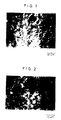
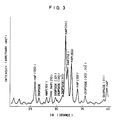
- FIGS. 1 and 2 are photomicrographs of sample No. 2 containing diopside whiskers and sample No. 3 containing anorthite whiskers, both taken under a scanning electron microscope. As seen from the photos, the sintered body has a structure in which anorthite or diopside whiskers are dispersed among hydroxyapatite grains.
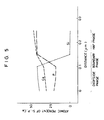
- FIGS. 3 and 4 are X-ray diffraction diagrams of sample Nos. 2 and 3, indicating that diopside or anorthite whiskers are formed in hydroxyapatite.
- the sintered bodies of the invention have improved density, strength and toughness.
- Sample Nos. 1 to 10 whithin the scope of the invention were determined for biological activity by immersing them in simulative body fluid for several days and thereafter examining them at intervals by SEM photomicrographic observation and chemical analysis to see whether HAP precipitated on the sample surface.
- hydroxyapatite (HAP) powder and alumina whiskers were milled along with a dispersant in a ball mill for one hour.
- the slurry was filtered through a qualitative filter paper.
- the collected cake was dried at 120°C for 5 hours and then molded in a mold of 40 mm by 50 mm under a pressure of 200 kg/cm2.
- the molded material was sintered at a temperature of 1350°C for 2 hours, obtaining a sintered body useful as biomedical material.
- the hydroxyapatite powder used had a BET value of 7 m2/g.
- the alumina whiskers used had a length of 2 ⁇ m and an aspect ratio of 10.
- the sintered bodies were measured for flexural strength (F.S.) and fracture toughness (K I C) as in Example 1.
- Sintered bodies were prepared by the same procedure as Sample No. 12 of Example 2 except that the whiskers were replaced by the following. These sintered bodies were found equivalent to sample No. 12.
- Example 1 exhibited good biological activity and affinity because a direct bond was observed between the bone and the HAP after 2 weeks when diopside whiskers were used, and after 3 weeks when anorthite whiskers were used.
- the samples of Example 2 and 3 also exhibited good biological affinity because the bone bonded to the HAP via a thin soft tissue.
- hydroxyapatite (HAP) powder and whisker-forming material were milled along with a dispersant in a ball mill for one hour.
- the slurry was filtered through a qualitative filter paper.
- the collected cake was dried at 120°C for 5 hours and a 50-gram portion of cake was then molded in a mold of 40 mm by 50 mm under a pressure of 300 kg/cm2.
- the molded material was sintered at the temperature shown in Table 4 for 2 hours, obtaining a sintered body useful as biomedical material.
- the hydroxyapatites used had varying atomic calcium-to-phosphorus (Ca/P) ratios.
- the whisker-forming material was Diopside A identified in Example 1.
- the dispersant, SN Dispersant 5045, was used in an amount of 0.05% by weight based on the total weight of HAP plus whisker-forming material.
- biomedical materials were sectioned and observed under an electron microscope to determine their whisker amount, matrix grain size (D), whisker length (L), whisker aspect ratio, and matrix grain size/whisker length ratio (D/L). They were also measured for relative density, flexural strength (F.S.), and toughness (K I C). The results are shown in Table 5.
- biomedical material sample Nos. 21 and 22 using hydroxyapatite having a Ca/P ratio of higher than 1.65 had higher flexural strength and toughness than sample No. 23 using hydroxyapatite having a Ca/P ratio of lower than 1.65 because more whiskers precipitated in the former.
- Test specimens of 3 x 4 x 36 mm were prepared from these two anorthite whisker-reinforced composite sintered bodies. They were measured for flexural strength as in Example 1. The sample sintered at 1200°C showed a flexural strength of 130 MPa and a relative density of 95.0% whereas the other sample sintered at 1300°C showed a flexural strength of 220 MPa and a relative density of 99.7%.
- samples were prepared and measured for flexural strength by the same procedures as above except that the calcium fluorophosphate was replaced by hydroxyapatite.
- the sample sintered at 1200°C showed a flexural strength of 100 MPa and a relative density of 96.0% whereas the other sample sintered at 1300°C showed a flexural strength of 150 MPa and a relative density of 99.5%.
- Sintered bodies were prepared from this mixture by following substantially the same procedure as in Example 5. They were diopside/wallastonite whisker-reinforced composite sintered bodies.
- Test specimens of 3 x 4 x 36 mm were prepared from the two bodies sintered at different temperatures and measured for flexural strength.
- the sample sintered at 1200°C showed a flexural strength of 140 MPa and a relative density of 94.0% whereas the other sample sintered at 1300°C showed a flexural strength of 200 MPa and a relative density of 99.1%.
- samples were prepared and measured for flexural strength by the same procedures as above except that the calcium fluorophosphate was replaced by hydroxyapatite.
- the sample sintered at 1200°C showed a flexural strength of 130 MPa and a relative density of 94.0% whereas the other sample sintered at 1300°C showed a flexural strength of 180 MPa and a relative density of 99.0%.
- a series of sintered bodies were prepared by repeating the procedure of Example 1 while varying the cooling rate after sintering as shown in Table 6.
- FIG. 5 shows the profiles of Si, Ca and P contents in atomic percent determined from X-ray peaks of Si, P and Ca. It is to be noted that O and H are excluded from the calculation of atom% of Si, Ca and P in the diagram of FIG. 5. It is seen from FIG. 5 that Ca, P and Si are contained in the grain boundary vitreous phase and that they have a graded concentration in the boundary phase.
- Sintered bodies were prepared by the same procedure as in Example 8 except that the HAP and whisker-forming material used had the sintering temperatures shown in Table 8. For only sample No. 51, the mixture was sintered at 1260°C. The sintered state and physical properties of the sintered bodies are shown in Table 8.
- the sintering temperature was determined by compacting a material to a density of 1.4 g/cm3, heating the compact at a rate of 20°C/min. by means of a thermo-dilatometer Model DL-1500 (manufactured by Shinku Rikou K.K.), and measuring the heating temperature at which a shrinkage factor of 5% was reached.
- Table 9 Sintered body Sample No. 51 52 Whisker content (area%) 18 15 Matrix grain size ( ⁇ m) 3 10 Whisker length ( ⁇ m) 4 4 Whisker aspect ratio 15 17 Flexural strength (MPa) 250 140 Fracture toughness (MPa m) 2.80 1.35
- hydroxyapatite powder To 100 parts by weight of hydroxyapatite powder was added 50 parts by weight of silicon carbide whiskers having a length of 15 ⁇ m and an aspect ratio of 15. To 100 parts by weight of the mixture was added 40 parts by weight of a rubber. The mixture was milled in a laboratory plasto-mill for 30 minutes and then rolled into a plate through rollers under a pressure of 100 kg/cm2. An SEM photomicrograph of a section of the plate showed that silicon carbide whiskers were oriented. The degree of orientation was 80%.
- the rolled plate was further shaped by hot pressing under a pressure of 200 kg/cm2 and sintered at 1300°C, obtaining a sintered body having a degree of orientation of 80%, a flexural strength of 90 MPa, and a fracture toughness of 1.7 MPa ⁇ m, which was ready for use as biomedical material.
- Example 10 The procedure of Example 10 was repeated to prepare sintered bodies. Tricalcium phosphate sintering material, alumina whiskers, and binder were used in the proportion shown in Table 10. The mixture was milled, rolled, press shaped, and sintered under the conditions shown in Table 10. The degree of orientation, flexural strength and toughness of the sintered bodies are shown in Table 11.
Landscapes
- Chemical & Material Sciences (AREA)
- Engineering & Computer Science (AREA)
- Ceramic Engineering (AREA)
- Health & Medical Sciences (AREA)
- Manufacturing & Machinery (AREA)
- Materials Engineering (AREA)
- Structural Engineering (AREA)
- Organic Chemistry (AREA)
- Veterinary Medicine (AREA)
- Life Sciences & Earth Sciences (AREA)
- Public Health (AREA)
- General Health & Medical Sciences (AREA)
- Oral & Maxillofacial Surgery (AREA)
- Animal Behavior & Ethology (AREA)
- Transplantation (AREA)
- Epidemiology (AREA)
- Inorganic Chemistry (AREA)
- Orthopedic Medicine & Surgery (AREA)
- Chemical Kinetics & Catalysis (AREA)
- Cardiology (AREA)
- Biomedical Technology (AREA)
- Vascular Medicine (AREA)
- Dermatology (AREA)
- Medicinal Chemistry (AREA)
- Heart & Thoracic Surgery (AREA)
- Dentistry (AREA)
- Materials For Medical Uses (AREA)
- Compositions Of Oxide Ceramics (AREA)
Description
- This invention relates to a biomedical material in the form of a whisker-reinforced sintered body and a method for making the same. More particularly, it relates to a biomedical material for use as artificial bone and dental root in the form of a sintered body based on calcium phosphate having biological activity and affinity and reinforced with whiskers as well as a method for making the same.
- Calcium phosphate materials including hydroxyapatite, fluoroapatite, and tricalcium phosphate are widely used as living hard tissue replacements such as artificial bones and dental roots because their sintered bodies are non-toxic and likely to bond with the bone in a living system. Sintered calcium phosphate, however, is not necessarily satisfactory in practice because it is neither mechanically strong nor tough. Sintered calcium phosphate tends to break or chip away when it is shaped to a configuration conforming to a deficient site in a living system, fitted and embedded in the site.
- One solution is the use of a core which is coated with calcium phosphate as disclosed in Japanese Patent Publication No. 39533/1983. However, calcium phosphate coatings do not bond firmly to the core. Japanese Patent Application Kokai No. 161971/1988 teaches to enhance the bond between a calcium phosphate coating and a core by interposing ceramics fibers having one end embedded in the core and another end protruding into the coating. Nevertheless, the strength and toughness of calcium phosphate coatings themselves are unsatisfactory.
- Various mixtures were proposed in order to increase the strength of calcium phosphate. For example, Japanese Patent Publication No. 40803/1982 discloses an admixture of apatite and at least one member of particulate SiO₂, Al₂O₃, and the like. Japanese Patent Application Kokai Nos. 96359/1987 and 96360/1987 discloses a mixture of tricalcium phosphate and particulate amorphous quartz. Japanese Patent Application Kokai No. 297254/1987 discloses a mixture of calcium phosphate and particulate ceramic material. These mixtures show increased flexural strength, but are insufficient in toughness.
- Japanese Patent Application Kokai No. 57971/1984 discloses fibrous or acicular apatite which is reinforced with mineral fibers. This composition, however, is impractical in that manufacture of apatite in fiber or needle form is very difficult and mineral fibers having affinity thereto must be separately prepared. It is a cumbersome operation to sinter apatite in close contact with mineral fibers under pressure at a relatively low temperature of lower than 800°C under conditions to prevent substantial escape of moisture. In addition, such low-temperature sintering results in a low relative density. Many problems must be overcome before this composition can be used in practice.
- Japanese Patent Application Kokai No. 162676/1987 discloses a composite apatite material of whisker reinforcement type in which mullite whiskers are simultaneously grown during sintering of apatite. However, this reference pays no attention to the grain size of apatite and the amount and dimensions of whiskers. More particularly, according to this reference, a reinforced composite material is prepared by mixing calcium phosphate powder and a mixture of powder silica and powder alumina as a mullite-forming material, and sintering the resulting mixture at 1300 to 1350°C. The present inventors found that when the mixture was sintered at such temperatures, whiskers precipitated only in an amount occupying less than 0.1% by area of across section of the sintered body. The sintered body is not tough enough to prevent cracking and chipping upon application to a deficient site in a living system.
- Japanese Patent Application Kokai No. 166772/1988 discloses whisker-reinforced ceramics. Whiskers of SiC or Si₃N₄ are dispersed in ceramics. Examples of the ceramics disclosed therein are Si₃N₄, SiAlON, zirconia, alumina, and calcium phosphate. Japanese Patent Application Kokai No. 151652/1988 discloses a biomedical implanting material comprising calcium phosphate matrix and 40 to 85% by weight of the material of SiC whiskers havaing an average length of 2 to 10 µm. Undesirably SiC and Si₃N₄ whiskers have poor biological affinity.
- EP-A3-0 104 640 discloses a sintered apatite mineral fiber material body, wherein the crystals of the sintered apatite have fine dense crystalline structures and are entangled together for improving the mechanical properties of the sintered body. However, this known apatite body being useful for bioceramic uses does not show specifications as provided by the present invention.
- There is a need for overcoming the above-mentioned problems of the prior art sintered calcium phosphate materials.
- An object of the present invention is to provide a novel and improved biomedical material having biological activity and affinity in the form of a sintered body of whisker reinforcement type having high strength and increased toughness.
- Another object of the present invention is to provide a method for making such a biomedical material.
- Making efforts in search of a sintered body of whisker reinforcement type having high strength and toughness, the inventors have found that the object is achieved with crystalline calcium phosphate matrix having whiskers dispersed therein when the grain size of the matrix, and the amount, length and aspect ratio of whiskers dispersed are controlled to specific ranges.
- According to the present invention, there is provided a biomedical material in the form of a sintered composite body comprising a crystalline calcium phosphate matrix and inorganic whiskers dispersed therein. The whiskers occupy 0.5 to 95% by area of a cross section of the sintered body. The whiskers contain at least one oxide selected from the group consisting of solicon oxide, aluminum oxide, calcium oxide and magnesium oxide. The matrix has a grain size of 0.05 to 30 µm. The whiskers have a length of 0.05 to 30 µm and an aspect ratio of from 1.2/1 to 100/1. The ratio of matrix grain size to whisker length ranges from 14/10 to 2/10.
- A biomedical material as defined above is prepared by mixing a calcium phosphate material and a whisker-forming material, and sintering the mixture at a sufficient temperature of 800 to 1600°C for a sufficient time to allow whiskers to grow. Alternatively, the biomedical material is prepared by mixing a calcium phosphate material and inorganic whiskers preferably having a length of 0.05 to 30 µm and an aspect ratio of from 1/1 to 100/1, and sintering the mixture at a temperature of 800 to 1600°C.
-
- FIGS. 1 and 2 are photomicrographs under a scanning electron microscope of biomedical material sample Nos. 2 and 3 in Example 1, respectively;
- FIGS. 3 and 4 are diagrams of X-ray diffraction analysis of biomedical material sample Nos. 2 and 3 in Example 1, respectively; and
- FIG. 5 is a diagram showing the results of analysis of a biomedical material under an electron microscope, plotting the atomic percents of Si, P and Ca in the diopside, boundary, and hydroxyapatite phases.
- The calcium phosphate materials used as sintering stock material in the practice of the present invention include a variety of calcium phosphate compounds, for example, tricalcium phosphate Ca₃(PO₄)₂, and apatite series calcium phosphates Ca₁₀(PO₄)₆X₂ wherein X is OH, halogen (e.g., fluoro and chloro), CO₃ or the like, such as hydroxyapatite, fluoroapatite, chloroapatite, and carbonated apatite. They may be used alone or in admixture of two or more.
- Preferred calcium phosphates are of the apatite series, especially hydroxyapatite and fluoroapatite. These apatites may be either synthetic apatites prepared by dry and wet processes or biotic apatites collected from bones and teeth of various vertebrate animals. A typical dry synthetic process is by reacting calcium phosphate with excess CaO in a steam stream at a high temperature of 900 to 1300°C.
- The preferred calcium phosphate materials used herein are apatites, especially hydroxyapatites and fluoroapatites, having an atomic calcium to phosphorus (Ca/P) ratio of from 165/100 to 175/100. Hydroxyapatites are most preferred.
- Also fluoroapatites have many advantages. They do not convert into β-tricalcium phosphate or α-tricalcium phosphate upon sintering. They are highly stable, strong, and tough because they are free of strains due to shrinkage or expansion. They are resistant to corrosion and acid.
- If the Ca/P atom ratio is less than 165/100, there is some likelihood that part of whiskers, whisker-forming material or reinforcing additives (such as SiO, Al₂O₃, and MgO) would form a solid solution with the apatite, inducing a change in the composition of whiskers. As a result, whiskers might not fully precipitate. In the case of hydroxyapatite, part of whisker components might form a solid solution with the apatite to form tricalcium phosphate, inducing strains and losing strength and biological affinity.
- The hydroxyapatites are generally microporous. They may have pores with a diameter of 5 to 200 µm and a porosity of 20 to 50%.
- The preferred tricalcium phosphate used herein is α-tricalcium phosphate although β-tricalcium phosphate may be used. Also a mixture of porous hydroxyapatite and tricalcium phosphate may be used.
- These calcium phosphate materials are used in the form of powder having a particle size of 0.1 to 1000 µm or granules having a particle size of 0.1 to 3 mm. The powder or granules preferably have a surface area of about 0.01 to 300 m²/g in BET value.
- In the practice of the invention, the above-mentioned calcium phosphate materials should be eventually sintered into crystalline calcium phosphate having a grain size of 0.05 to 30 µm, preferably 0.1 to 20 µm, more preferably 0.1 to 10 µm. A grain size smaller than the lower limit is difficult to achieve whereas a grain size larger than the upper limit results in a reduced strength.
- The inorganic whiskers, more precisely inorganic oxide whiskers contain at least one oxide selected from the group consisting of silicon oxide (silica), aluminum oxide (alumina), calcium oxide (calcia), and magnesium oxide (magnesia) because whiskers otherwise show poor biological affinity. Better biological affinity and activity are achievable when the inorganic oxide whiskers contain at least two oxides selected from the group consisting of silicon oxide (silica), aluminum oxide (alumina), and calcium oxide (calcia), and contain optionally magneisum oxide (magnesia), especially when the inorganic oxide whiskers contain i) silicon, ii) calcia and iii) alumina and/or magnesia.
- The inorganic whiskers are preferably selected from the group consisting of calcium silicate whiskers and calcium silicate magnesium whiskers.
- Because of biological activity and biological affinity or compatibility, preferred are alumina whiskers, aluminum silicate calcium whiskers such as anorthite (CaO·2SiO₂·Al₂O₃) whiskers, calcium silicate magnesium whiskers such as diopside (CaO·2SiO₂·MgO) whiskers, and calcium silicate whiskers such as wollastonite (CaO·SiO₂) whiskers. Among them, anorthite whiskers and diopside whiskers are most preferred bacause of outstandingly high biological activity. The whiskers may have a composition deviating more or less from the stoichiometry as shown above.
- The inorganic whiskers are generally used in an amount of about 0.5 to about 95 percent by weight, preferably about 5 to about 70 percent by weight, more preferably about 10 to about 60 percent by weight per 100 parts by weight of sintering body. If inorganic whiskers are used in more amounts beyond the range, the desirable properties of calcium phosphate, for example, the biological affinity of apatite as artificial bone are reduced or lost. Materials containing less amounts of inorganic whiskers will result in sintered bodies having low mechanical strength (e.g., bending strength) and toughness. It will be understood that when pre-formed whiskers are used, the whiskers in the resulting sintered body have approximately the same dimensions as the original.
- Whisker-forming materials, that is, materials which can convert into whiskers under sintering conditions may also be used, for example, silica, calcium oxide, magnesium oxide, and alumina, as well as those which can convert into these compounds upon sintering, such as corresponding carbonates, bicarbonates, and hydroxides. These materials may be used in the form of powder, granules, slurry, and aqueous solution. The materials in the form of powder or granules, preferably have a BET value of about 0.01 to about 300 m²/g.
- These whisker-forming materials may be blended in such a proportion corresponding to the composition of the desired whiskers. Useful are a blend comprising a silica source in an amount of 0.05 to 600 parts by weight of SiO₂ and a calcium oxide source in an amount of 0.05 to 600 parts by weight of CaO or an alumina source in an amount of 0.05 to 600 parts by weight of Al₂O₃; and a blend comprising a silica source in an amount of 0.05 to 800 parts by weight of SiO₂, a calcium oxide source in an amount of 0.05 to 600 parts by weight of CaO, and at least one of an alumina source in an amount of 0.05 to 600 parts by weight of Al₂O₃ and a magnesia source in an amount of 0.05 to 600 parts by weight of MgO, all parts being per 100 parts by weight of the calcium phosphate material. In the latter case, the sources may be blended in such proportions that 0.5 to 20 mol of silica, 0.1 to 20 mol of alumina and 0.1 to 20 mol of magnesia are present per mol of calcium oxide.
- In addition, one or more of zirconia, strontium oxide, and barium oxide sources may be used in sufficient amounts to provide up to 20 parts by weight of ZrO₂, SrO, and BaO on the same basis as above.
- When it is desired to grow diopside whiskers, for example, the sources may be blended in such proportions that 0.15 to 14 mol, preferably 0.5 to 5 mol, more preferably 0.8 to 2.5 mol, most preferably 0.8 to 1.2 mol of magnesium oxide and 0.5 to 10 mol, preferably 2 to 5 mol, more preferably 2 to 3 mol, most preferably 2 to 2.5 mol of silica are present per mol of calcium oxide.
- When it is desired to grow anorthite whiskers, for example, the sources may be blended in such proportions that 0.1 to 20 mol, preferably 0.2 to 1.5 mol, more preferably 0.8 to 1.2 mol of alumina and 1 to 10 mol, preferably 2 to 5 mol, more preferably 2 to 3 mol, most preferably 2 to 2.5 mol of silica are present per mol of calcium oxide.
- These sources may be added individually to the calcium phosphate component or previously admixed in a proportion as described above and sintered at 600 to 1600°C before addition. Instead of individual addition, it is also possible to add a component capable of forming whiskers, for example, a diopside component corresponding to composition CaO·2SiO₂·MgO and an anorthite component corresponding to composition CaO·2SiO₂·Al₂O₃. These components may also be used in powder or granule form like the calcium phosphate component. The whisker-forming components in powder form preferably has a BET value of about 0.01 to about 300 m²/g.
- A mixture of two types of stock materials, a calcium phosphate-forming component and a whisker or whisker-forming component as described above, is sintered into a sintered composite body consisting essentially of 5 to 95% by weight of crystalline calcium phosphate and 95 to 5% by weight of whiskers (typically, diopside or anorthite). The presence of matrix and whisker by-products created upon sintering is permitted as long as the desired effect is not impaired. In the examples mentioned above, permissible is inclusion of such by-products as α-tricalcium phosphate and other oxides such as forsterite and wallastonite in the case of diopside whiskers and akermanite and mullite in the case of anorthite whiskers. The by-products are usually copresent in the matrix.
- In the case of forming whiskers upon sintering, the whisker-forming material preferably has a sintering temperature higher by 50 to 400°C than the sintering temperature of the calcium phosphate material. Source materials as described above may be readily blended so as to give such a sintering temperature. The sintering temperature of a material can be readily determined by measuring an increase of shrinkage factor using a thermo-dilatometer.
- In the sintered composite body, the calcium phosphate forming the matrix is present as crystals and the whiskers are dispersed in the matrix.
- The whiskers each have a length and a diameter. The whisker length is in the range of from 0.05 to 30 µm, preferably from 0.2 to 30 µm, more preferably from 0.2 to 15 µm. The aspect ratio defined as length divided by diameter is in the range of from 1.2/1 to 100/1, preferably from 1.5/1 to 100/1, more preferably from 2/1 to 20/1, most preferably from 3/1 to 15/1. Shorter whiskers outside the length range are less effective whereas longer whiskers tend to induce strain. Whiskers having an aspect ratio of less than 1 are less effective whereas whiskers having an aspect ratio of more than 100 tend to induce strain.
- The ratio of matrix grain size to whisker length is in the range of from 14/10 to 2/10, preferably from 1/1 to 2/10. If the ratio is smaller than 1/10, strains are induced upon sintering, losing strength. If the ratio is larger than 10/1, the whiskers do not fully exert their function of increasing strength.
- The whiskers occupy 0.5 to 95% by area, preferably 5 to 75% by area, more preferably 10 to 60% by area of a cross section of the sintered body. Outside the range, sintered bodies having less amounts of whiskers are less tough whereas sintered bodies having excess amounts of whiskers are low in biological affinity. The percent area that whiskers occupy in a cross section of the sintered body can be determined using a photomicrograph. More particularly, a sintered body sample is sectioned. The section is mirror polished, and then chemically etched with aqueous 1-5% HCl or thermally etched at a temperature of higher than 800°C, but lower than the whisker forming temperature. The section is then observed under a scanning electron microscope. The photomicrograph is then transferred to a section paper, from which the percent area of whiskers is calculated by counting the corresponding sections. The procedure may be repeated five times, for example, determining the percent area of whiskers.
- The preparation of the biomedical material of the present invention will be described in detail. The starting material is powder calcium phosphate material. A predetermined amount of whiskers or whisker-forming materials in powder form is added to the powder calcium phosphate material along with a dispersant. The whisker-forming materials are materials that can transform into whiskers under sintering conditions, for example, silica, calcium oxide, magnesium oxide, and alumina, and may be added separately or as a premix. Use of sources which produce materials that can together form whiskers under sintering conditions is also contemplated. Materials having whisker compositions such as the anorthite and diopside compositions are also useful.
- The dispersant assists in uniformly dispersing whiskers or whisker-forming materials in powder calcium phosphate material. Examples of the dispersant include anionic surface-active agents such as carboxylate salts and sulfonate salts.
- The thus prepared powder mixture is shaped into a desired shape by a conventional method such as press molding and slip casting, dried, and then sintered in air at a temperature of 800 to 1600°C. Shaping is generally carried out under a pressure of 1 to 10,000 kg/cm².
- Sintering is preferably effected at a temperature of 800 to 1500°C particularly when it is desired to form anorthite whiskers. Sintering is preferably effected at a temperature of 900 to 1500°C particularly when it is desired to form diopside whiskers. When pre-formed whiskers are used, sintering may be effected at a temperature of 800 to 1600°C. The sintering time generally ranges from about 5 minutes to about 15 hours in either case.
- Sintering creates crystalline calcium phosphate matrix or crystalline calcium phosphate matrix and whiskers at the same time when the whisker-forming material is used. There is obtained a sintered composite body in which whiskers are dispersed in the crystalline calcium phosphate matrix, both the matrix and whiskers meeting the dimensional requirements. The sintered composite body is useful as biomedical material.
- As compared with the addition of pre-formed whiskers, it is advantageous to form whiskers simultaneous with crystalline calcium phosphate as the matrix because the resulting sintered body has improved toughness and strength due to the increased bond between the whiskers and the matrix.
- When diopside whiskers free of alumina are formed, the material mixture can be sintered at a temperature in a wide range of 900 to 1500°C without the risk of conversion of hydroxyapatite into tricalcium phosphate or β-tricalcium phosphate into α-calcium phosphate catalyzed by alumina. Formation of anorthite whiskers also avoids such a risk because they can be formed at temperatures of lower than 1300°C.
- When the sintering temperature is set to lower than 1300°C in the above-defined range, a sintered body having good biological affinity and mechanical strength and toughness can be obtained even from hydroxyapatite prepared by a wet process without causing abnormal grains to grow.
- The formation of whiskers during sintering is described in further detail. When the whisker-forming material or mixture used has a sintering temperature higher by 50 to 400°C than the sintering temperature of the calcium phosphate material as previously described, the calcium phosphate is sintered in an earlier stage where the whisker component has not been activated. Consequently, the whisker component is unlikely to diffuse into the matrix in this stage. If diffusion occurs in this stage, then the respective components would change their composition with a possibility that little whiskers would form or glass would form. Such a risk is avoided by controlled diffusion of the whisker component in the early stage. Whiskers start precipitating in a later stage when calcium phosphate has been sintered to a certain extent. A practically satisfactory density is achieved without any problems that whiskers having the matrix component included therein can precipitate and that no sufficient density is available because the matrix has not been fully sintered when formation of whiskers is complete. In addition, there are little possibilities that the matrix is sintered too earlier than necessary, and premature sintering of the matrix prevents whiskers from precipitating or causes precipitating whiskers to be largely stressed.
- Better results are obtained when an intermediate layer is present between grains of the crystalline calcium phosphate matrix and inorganic whiskers. The intermediate layer extends partially or entirely along the boundary therebetween. The intermediate layer contains at least one of the elements in either one or both of the whiskers and the matrix. Since some elements like calcium are common to both the whiskers and the matrix, the intermediate layer preferably contains the common element or elements. The intermediate layer has a continuous or stepwise gradient of concentration between the whiskers and the matrix grains. More illustratively, for one element contained in the whisker, the intermediate layer contains the element in a high concentration adjacent the whisker and gradually reduces its concentration toward the interface with the matrix.
- The intermediate layer generally has a thickness of up to 3 µm, preferably from 0.005 to 3 µm, more preferably from 0.01 to 1.5 µm, most preferably from 0.05 to 1.0 µm.
- The intermediate layer may be formed by slowly cooling down the sintered body from the sintering temperature over an extended time. Cooling is preferably performed at a slow constant rate of 0.2 to 30°C/min., more preferably 0.5 to 10°C/min.
- Provision of an intermediate layer between whiskers and grains prevents direct reaction between whiskers and grains so that the whiskers are no longer changed maintaining sufficient strength, improves the bond between whiskers and grains also contributing to strength, and enables easy control of the interface between whiskers and grains. As a result, the sintered body is reinforced more densely, further improving mechanical strengths such as flexural strength and toughness.
- Orientation of whiskers in the matrix is possible and desirable because the strength of the biomedical material is improved. Preferably, the whiskers are present in the matrix at a degree of orientation of at least 60%, more preferably at least 75%, most preferably at least 85%.
- Whiskers may be oriented by adding a binder to a blend of a calcium phosphate material and whiskers and milling the mixture. The binder used herein may be selected from those commonly used for biomedical materials, for example, rubber or thermoplastic resins. The binder may be added to the blend in amounts commonly used for biomedical materials, generally in amounts of 10 to 50%, preferably 20 to 45% by weight of the blend. Less amounts of binder are ineffective in helping orientation whereas larger amounts of binder would result in porous sintered bodies which are low in biological affinity and density.
- Next, it is necessary to process the mixture so as to have a controlled degree of orientation of whiskers of 60% or higher. In practice, the mixture is repeatedly rolled to control the degree of orientation. The rolling process renders whiskers anisotropic. Sufficient orientation may be accomplished by repeating the rolling step several times, for example, 3 to 10 times. The rolling process includes rolling techniques such as calendering, pressing and extrusion techniques. Rolling techniques are preferred. The pressure under which the mixture is rolled is generally in the range of from 20 to 300 kg/cm², preferably from 50 to 150 kg/cm². Lower rolling pressures would be ineffective to provide sufficient strength whereas higher rolling pressures give no further benefits.
- The mixture is thus rolled into a plate or sheet material, which is sintered into a sintered body with or without post-processing like hot pressing before sintering.
- There is thus obtained a biomedical material in the form of a sintered body of a crystalline calcium phosphate matrix having whiskers dispersed therein. The composite material is improved in many respects while the desired properties of calcium phosphate material, for example, the biological affinity of apatite as artificial bone is maintained. The strength of the composite material is increased by controlling the grain size of the matrix to a specific range. Occurrence of strain during sintering is minimized by controlling the dimensions of whiskers, that is, the length and aspect ratio of whiskers and the ratio of matrix grain size to whisker length to specific ranges. A desirable amount of whiskers can be distributed in the matrix along the grain boundaries or among grains without localization, preventing cracking. Growth of whiskers can be delayed relative to matrix sintering to produce a sintered body having improved toughness and fracture energy.
- Since the sintered body of the invention has high strength and toughness as well as biological affinity and activity, it can find application as artificial bone, dental root and joint materials for treatments in orthopaedic surgery, dental and oral surgery.
- An advantage of the method of the invention is that high strength and toughness can be readily and efficiently imparted to a biomedical material.
- Examples of the present invention are given below by way of illustration and not by way of limitation.
- As reported in Table 1, hydroxyapatite (HAP) and whisker-forming material were milled along with a dispersant in a ball mill for one hour. The slurry was filtered through a qualitative filter paper. The collected cake was dried at 120°C for 5 hours and a 50-gram portion of the cake was then molded in a mold of 40 mm by 50 mm under a pressure of 300 kg/cm². The molded material was sintered at the temperature shown in Table 1 for 2 hours, obtaining a sintered body useful as biomedical material.
- The hydroxyapatites used had an atomic calcium-to-phosphorus (Ca/P) ratio of 1.67 and the BET values shown in Table 1.
- The whisker-forming materials used were anorthites and diopsides having the BET values shown in Table 1. The amount of whisker-forming material added is reported in Table 1 in % by weight based on the total weight of HAP plus whisker-forming material. The whisker-forming materials used are as identified below.
- Anorthite A:
- sintered CaO·Al₂O₃·2SiO₂
- Anorthite B:
- a mixture of SiO₂ 61% by weight, Al₂O₃ 17% by weight, and CaO 22% by weight
- Anorthite C:
- a mixture of
SiO₂ 50% by weight,Al₂O₃ 30% by weight, andCaO 20% by weight - Diopside A:
- sintered CaO·MgO·2SiO₂
- Diopside B:
- a mixture of SiO₂ 61% by weight, MgO 12% by weight, and CaO 27% by weight
- Diopside C:
- a mixture of SiO₂ 55% by weight, MgO 19% by weight, and CaO 26% by weight
- The dispersant was SN Dispersant 5045 manufactured and sold by SAN NAPCO Limited and was used in an amount of 0.05% by weight based on the total weight of HAP plus whisker-forming material.
- The thus obtained biomedical materials were sectioned and observed under an electron microscope to determine their whisker amount, matrix grain size (D), whisker length (L), whisker aspect ratio, and matrix grain size/whisker length ratio (D/L). They were also measured for relative density, flexural strength (F.S.), and toughness (KIC). The results are shown in Table 2.
- Measurement of relative density, flexural strength, and toughness (KIC) is as described below.
- The density of a sintered sample was measured by the Archimedian method. The sintered sample was pulverlized into powder having a surface area of 5 m²/g which was measured for true density. Relative density was calculated from the apparent and true densities.
- Ten test specimens of 3 x 4 x 40 mm were cut out and mirror polished. They were measured by the three point bending test with a span of 36 mm and a cross head speed of 0.5 mm/min.
- Fracture toughness was measured according to ASTM E399-83.
- Comparative samples outside the scope of the invention are also reported in Tables 1 and 2.
- FIGS. 1 and 2 are photomicrographs of sample No. 2 containing diopside whiskers and sample No. 3 containing anorthite whiskers, both taken under a scanning electron microscope. As seen from the photos, the sintered body has a structure in which anorthite or diopside whiskers are dispersed among hydroxyapatite grains.
- FIGS. 3 and 4 are X-ray diffraction diagrams of sample Nos. 2 and 3, indicating that diopside or anorthite whiskers are formed in hydroxyapatite.


- As seen from Tables 1 and 2, the sintered bodies of the invention have improved density, strength and toughness.
- Sample Nos. 1 to 10 whithin the scope of the invention were determined for biological activity by immersing them in simulative body fluid for several days and thereafter examining them at intervals by SEM photomicrographic observation and chemical analysis to see whether HAP precipitated on the sample surface.
- An HAP layer precipitated on the surface after 3 days in the samples using diopside whiskers and after 10 days in the samples using anorthite whiskers, indicating high biological activity. Generally speaking, in order that an implant bond to the adjoining bone in the living body, it is essential that an HAP layer analogous to the natural bone form on the surface of the implant. Therefore, the samples of the invention exhibited good biological activity in this sense.
- As reported in Table 3, hydroxyapatite (HAP) powder and alumina whiskers were milled along with a dispersant in a ball mill for one hour. The slurry was filtered through a qualitative filter paper. The collected cake was dried at 120°C for 5 hours and then molded in a mold of 40 mm by 50 mm under a pressure of 200 kg/cm². The molded material was sintered at a temperature of 1350°C for 2 hours, obtaining a sintered body useful as biomedical material.
- The hydroxyapatite powder used had a BET value of 7 m²/g. The alumina whiskers used had a length of 2 µm and an aspect ratio of 10. The dispersant, SN Dispersant 5045 (SAN NAPCO Limited), was used in an amount of 0.05% by weight based on the total weight of HAP plus whiskers.
- The sintered bodies were measured for flexural strength (F.S.) and fracture toughness (KIC) as in Example 1.
- The results are shown in Table 3.

- Sintered bodies were prepared by the same procedure as Sample No. 12 of Example 2 except that the whiskers were replaced by the following. These sintered bodies were found equivalent to sample No. 12.
- Material: calcium silicate CaO·SiO₂
Length: 3 µm
Aspect ratio: 5 - Material: aluminum silicate
Length: 2 µm
Aspect ratio: 5 - Material: calcium aluminate
Length: 2 µm
Aspect ratio: 15 - Material: magnesium silicate
Length: 2 µm
Aspect ratio: 8
Blocks of 3 x 4 x 5 mm were prepared from the samples of Examples 1 to 3. A cut-out was artificially engraved in the lower edge of the jaw bone of adult rabbits. Each block was implanted in the cut-out in the rabbit's jaw. The rabbits were killed every week after the implanting operation. Polished, but non-decalsified specimens were prepared from the implanted jaw bone. A SEM photomicrograph was taken on the interface between the implant and the newly grown bone. - The sample of Example 1 exhibited good biological activity and affinity because a direct bond was observed between the bone and the HAP after 2 weeks when diopside whiskers were used, and after 3 weeks when anorthite whiskers were used. The samples of Example 2 and 3 also exhibited good biological affinity because the bone bonded to the HAP via a thin soft tissue.
- As reported in Table 4, hydroxyapatite (HAP) powder and whisker-forming material were milled along with a dispersant in a ball mill for one hour. The slurry was filtered through a qualitative filter paper. The collected cake was dried at 120°C for 5 hours and a 50-gram portion of cake was then molded in a mold of 40 mm by 50 mm under a pressure of 300 kg/cm². The molded material was sintered at the temperature shown in Table 4 for 2 hours, obtaining a sintered body useful as biomedical material.
- The hydroxyapatites used had varying atomic calcium-to-phosphorus (Ca/P) ratios. The whisker-forming material was Diopside A identified in Example 1. The dispersant, SN Dispersant 5045, was used in an amount of 0.05% by weight based on the total weight of HAP plus whisker-forming material.
- The thus obtained biomedical materials were sectioned and observed under an electron microscope to determine their whisker amount, matrix grain size (D), whisker length (L), whisker aspect ratio, and matrix grain size/whisker length ratio (D/L). They were also measured for relative density, flexural strength (F.S.), and toughness (KIC). The results are shown in Table 5.


- As seen from Table 5, biomedical material sample Nos. 21 and 22 using hydroxyapatite having a Ca/P ratio of higher than 1.65 had higher flexural strength and toughness than sample No. 23 using hydroxyapatite having a Ca/P ratio of lower than 1.65 because more whiskers precipitated in the former.
- To calcium fluorophosphate powder having a surface area of 20 m²/g in BET were added 5% by weight of powder CaO, 7% by weight of powder Al₂O₃, and 12% by weight of granular SiO₂, based on the weight of the calcium phosphate powder. The mixture was fully mixed. A vibratory mill was charged with 100 grams of the mixture and 300 grams of water along with 1 kg of zirconia milling medium and operated for 60 minutes for milling. The contents were filtered and the collected cake was dried at 110°C for 60 minutes. The mixture was passed through a 110-mesh screen, placed in a mold cavity of 40 x 50 x 10 mm, and press molded under a pressure of 300 kg/cm². For every two moldings, one was sintered at 1200°C for 2 hours and the other sintered at 1300°C for 2 hours.
- Test specimens of 3 x 4 x 36 mm were prepared from these two anorthite whisker-reinforced composite sintered bodies. They were measured for flexural strength as in Example 1. The sample sintered at 1200°C showed a flexural strength of 130 MPa and a relative density of 95.0% whereas the other sample sintered at 1300°C showed a flexural strength of 220 MPa and a relative density of 99.7%.
- Separately, samples were prepared and measured for flexural strength by the same procedures as above except that the calcium fluorophosphate was replaced by hydroxyapatite. The sample sintered at 1200°C showed a flexural strength of 100 MPa and a relative density of 96.0% whereas the other sample sintered at 1300°C showed a flexural strength of 150 MPa and a relative density of 99.5%.
- To calcium fluorophosphate powder were added 4% by weight of powder CaO, 4% by weight of powder MgO, and 12% by weight of granular SiO₂, based on the weight of the calcium phosphate powder. Sintered bodies were prepared from this mixture by following substantially the same procedure as in Example 5. They were diopside/wallastonite whisker-reinforced composite sintered bodies.
- Test specimens of 3 x 4 x 36 mm were prepared from the two bodies sintered at different temperatures and measured for flexural strength. The sample sintered at 1200°C showed a flexural strength of 140 MPa and a relative density of 94.0% whereas the other sample sintered at 1300°C showed a flexural strength of 200 MPa and a relative density of 99.1%.
- Separately, samples were prepared and measured for flexural strength by the same procedures as above except that the calcium fluorophosphate was replaced by hydroxyapatite. The sample sintered at 1200°C showed a flexural strength of 130 MPa and a relative density of 94.0% whereas the other sample sintered at 1300°C showed a flexural strength of 180 MPa and a relative density of 99.0%.
- A series of sintered bodies were prepared by repeating the procedure of Example 1 while varying the cooling rate after sintering as shown in Table 6.
- The samples were observed under a scanning electron microscope to find a grain boundary vitreous phase having the thickness shown in Table 7.


- Sample No. 34 was analyzed by means of an analytical transmission electron microscope (ATEM). FIG. 5 shows the profiles of Si, Ca and P contents in atomic percent determined from X-ray peaks of Si, P and Ca. It is to be noted that O and H are excluded from the calculation of atom% of Si, Ca and P in the diagram of FIG. 5. It is seen from FIG. 5 that Ca, P and Si are contained in the grain boundary vitreous phase and that they have a graded concentration in the boundary phase.
- To 80% by weight of a calcium phosphate material having a sintering temperature of 1150°C was added 20% by weight of diopside having a sintering temperature of 1250°C. The mixture was sintered at 1300°C for 2 hours, obtaining a diopside whisker-reinforced, sintered body. The sintered body showed well sintered state and had a flexural strength of 130 kg/cm² and a fracture toughness (KIC) of 1.40.
- Sintered bodies were prepared by the same procedure as in Example 8 except that the HAP and whisker-forming material used had the sintering temperatures shown in Table 8. For only sample No. 51, the mixture was sintered at 1260°C. The sintered state and physical properties of the sintered bodies are shown in Table 8.
- The sintering temperature was determined by compacting a material to a density of 1.4 g/cm³, heating the compact at a rate of 20°C/min. by means of a thermo-dilatometer Model DL-1500 (manufactured by Shinku Rikou K.K.), and measuring the heating temperature at which a shrinkage factor of 5% was reached.

Table 9 Sintered body Sample No. 51 52 Whisker content (area%) 18 15 Matrix grain size (µm) 3 10 Whisker length (µm) 4 4 Whisker aspect ratio 15 17 Flexural strength (MPa) 250 140 Fracture toughness (MPa m) 2.80 1.35 - As seen from Tables 8 and 9, better results are obtained when the difference in sinterable temperature between the whisker-forming material and the calcium phosphate material (Tw - Tm) is in the range of from 50° to 400°C.
- To 100 parts by weight of hydroxyapatite powder was added 50 parts by weight of silicon carbide whiskers having a length of 15 µm and an aspect ratio of 15. To 100 parts by weight of the mixture was added 40 parts by weight of a rubber. The mixture was milled in a laboratory plasto-mill for 30 minutes and then rolled into a plate through rollers under a pressure of 100 kg/cm². An SEM photomicrograph of a section of the plate showed that silicon carbide whiskers were oriented. The degree of orientation was 80%. The rolled plate was further shaped by hot pressing under a pressure of 200 kg/cm² and sintered at 1300°C, obtaining a sintered body having a degree of orientation of 80%, a flexural strength of 90 MPa, and a fracture toughness of 1.7 MPa√m, which was ready for use as biomedical material.
- It is to be noted that the degree of orientation of shaped and sintered articles was measured by powder X-ray diffraction with the peak intensity in the diffraction chart being expressed as I(001)/I(nkl) in percent.
- The procedure of Example 10 was repeated to prepare sintered bodies. Tricalcium phosphate sintering material, alumina whiskers, and binder were used in the proportion shown in Table 10. The mixture was milled, rolled, press shaped, and sintered under the conditions shown in Table 10. The degree of orientation, flexural strength and toughness of the sintered bodies are shown in Table 11.

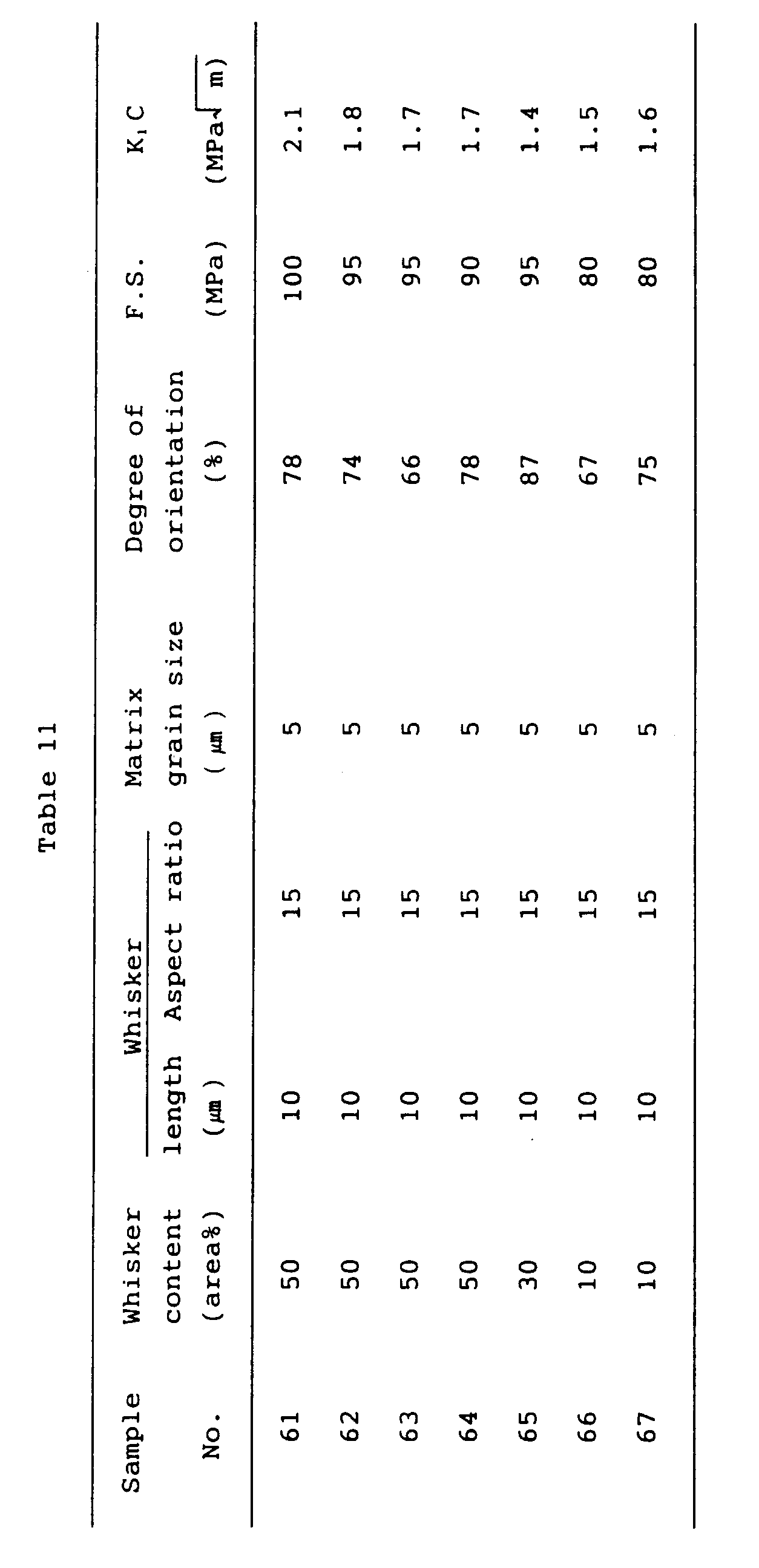
- All the samples of Examples 4 to 11 exhibited good biological activity and affinity in an implanting test.
- Although some preferred embodiments have been described, many modifications and variations may be made thereto in the light of the above teachings. It is therefore to be understood that within the scope of the appended claims, the invention may be practiced otherwise than as specifically described.
Claims (17)
- A biomedical material in the form of a sintered composite body comprising a crystalline calcium phosphate matrix and inorganic whiskers dispersed therein, the whiskers occupying 0.5 to 95% by area of a cross section of the sintered body, and containing at least one oxide selected from the group consisting of silicon oxide, aluminum oxide, calcium oxide and magnesium oxide, the matrix having a grain size of 0.05 to 30 µm, and the whiskers having a length of 0.05 to 30 µm and an aspect ratio as defined by length/diameter of from 1.2/1 to 100/1, the ratio of matrix grain size to whisker length ranging from 14/10 to 2/10.
- The biomedical material of claim 1 wherein the crystalline calcium phosphate is tricalcium phosphate.
- The biomedical material of claim 1 wherein the crystalline calcium phosphate is of apatite series.
- The biomedical material of claim 3 wherein the crystalline calcium phosphate is hydroxyapatite or fluoroapatite having an atomic calcium-to-phosphorus (Ca/P) ratio of from 165/100 to 175/100.
- The biomedical material of claim 1 wherein the inorganic whiskers are selected from the group consisting of calcium silicate and calcium silicate magnesium.
- The biomedical material of claim 1 wherein the whiskers contain at least two oxides selected from the group consisting of silicon oxide, aluminum oxide and calcium oxide, and optionally contain magnesium oxide.
- The biomedical material of claim 6 wherein the inorganic whiskers are selected from the group consisting of aluminum silicate calcium, and calcium silicate magnesium whiskers.
- The biomedical material of claim 7 wherein the inorganic whiskers are anorthite or diopside whiskers.
- The biomedical material of claim 1 wherein an intermediate layer is present between the whiskers and the matrix grains, the intermediate layer containing elements in either one or both of the whiskers and the matrix.
- The biomedical material of claim 9 wherein the intermediate layer has a continuous or stepwise gradient of concentration and a thickness of up to 3 µm.
- The biomedical material of claim 1 wherein the whiskers have a degree of orientation of at least 60%.
- A method for preparing a biomedical material as defined in claim 1, comprising
mixing a calcium phosphate material and a whisker-forming material, and
sintering the mixture at a sufficient temperature of 800 to 1600°C for a sufficient time to allow whiskers to grow. - The method of claim 12 wherein the temperature at which the whisker-forming material forms whiskers is higher by 50 to 400°C than the temperature normally required for sintering the calcium phosphate material.
- The method of claim 12 wherein the whisker-forming material is a mixture or compound consisting essentially of (i) at least one member of an alumina source and magnesia source, (ii) a silica source, and (iii) a calcium oxide source.
- The method of claim 12 which further comprises
cooling the sintered material at a sufficiently slow rate of up to 30°C/min. to allow an intermediate layer to form between the matrix grains and the whiskers. - A method for preparing a biomedical material as defined in claim 1, comprising
mixing a calcium phosphate material and inorganic whiskers having a length of 0.05 to 30 µm and an aspect ratio as defined by length/diameter of 1.2/1 to 100/1, and
sintering the mixture at a temperature of 800 to 1600°C. - The method of claim 16 which further comprises rolling the mixture of calcium phosphate and inorganic whiskers for whisker orientation before the mixture is sintered.
Priority Applications (1)
| Application Number | Priority Date | Filing Date | Title |
|---|---|---|---|
| EP89121837A EP0411208A1 (en) | 1989-07-04 | 1989-11-27 | Ceramic material and method for making the same |
Applications Claiming Priority (12)
| Application Number | Priority Date | Filing Date | Title |
|---|---|---|---|
| JP164960/88 | 1988-07-04 | ||
| JP16496088 | 1988-07-04 | ||
| JP16495988 | 1988-07-04 | ||
| JP164959/88 | 1988-07-04 | ||
| JP63210669A JPH0260656A (en) | 1988-08-26 | 1988-08-26 | Biomaterial and production thereof |
| JP210669/88 | 1988-08-26 | ||
| JP26810288 | 1988-10-26 | ||
| JP268102/88 | 1988-10-26 | ||
| JP5388/89 | 1989-01-12 | ||
| JP1005388A JPH02184576A (en) | 1989-01-12 | 1989-01-12 | Production of whisker mixed crystal type calcined compact |
| JP34967/89 | 1989-02-16 | ||
| JP1034967A JPH02217366A (en) | 1989-02-16 | 1989-02-16 | Whisker composite sintered body and its production |
Publications (3)
| Publication Number | Publication Date |
|---|---|
| EP0353476A2 EP0353476A2 (en) | 1990-02-07 |
| EP0353476A3 EP0353476A3 (en) | 1991-01-23 |
| EP0353476B1 true EP0353476B1 (en) | 1993-10-06 |
Family
ID=27547908
Family Applications (1)
| Application Number | Title | Priority Date | Filing Date |
|---|---|---|---|
| EP89112220A Expired - Lifetime EP0353476B1 (en) | 1988-07-04 | 1989-07-04 | Biomedical material and method for making the same |
Country Status (3)
| Country | Link |
|---|---|
| US (1) | US5032552A (en) |
| EP (1) | EP0353476B1 (en) |
| DE (1) | DE68909712T2 (en) |
Cited By (1)
| Publication number | Priority date | Publication date | Assignee | Title |
|---|---|---|---|---|
| CN110448476A (en) * | 2019-07-02 | 2019-11-15 | 陈明英 | A kind of oral care composition and its application |
Families Citing this family (44)
| Publication number | Priority date | Publication date | Assignee | Title |
|---|---|---|---|---|
| US5082808A (en) * | 1988-07-04 | 1992-01-21 | Tdk Corporation | Ceramic material and method for making |
| EP0411208A1 (en) * | 1989-07-04 | 1991-02-06 | TDK Corporation | Ceramic material and method for making the same |
| JPH03143448A (en) * | 1989-10-31 | 1991-06-19 | Asahi Optical Co Ltd | Calcium phosphate biomaterial and preparation thereof |
| ES2088690T3 (en) * | 1990-12-19 | 1996-08-16 | Harle Anton | PROCEDURE FOR THE MANUFACTURE OF A MEDICAL IMPLANT AND IMPLANT MADE IN ACCORDANCE WITH SUCH PROCEDURE. |
| DE4101526A1 (en) * | 1990-12-19 | 1992-07-02 | Haerle Anton | Bone substitute for repairing bone defects and distractions - consists of two components, one to provide mechanical strength, the other promoting osteo-conductive action |
| US5769897A (en) * | 1991-12-13 | 1998-06-23 | Haerle; Anton | Synthetic bone |
| US5994247A (en) | 1992-01-17 | 1999-11-30 | The Morgan Crucible Company Plc | Saline soluble inorganic fibres |
| NZ246629A (en) * | 1992-01-17 | 1997-07-27 | Morgan Crucible Co | Saline soluble fibres for refractory insulation comprising greater than 58 percent by weight of silicon dioxide |
| FI91713C (en) * | 1992-04-23 | 1994-08-10 | Axidental Oy | New bioactive coatings and their preparation and use |
| DE4228355C1 (en) * | 1992-08-26 | 1994-02-24 | Didier Werke Ag | Fireproof lightweight molded body |
| DE4228353C1 (en) * | 1992-08-26 | 1994-04-28 | Didier Werke Ag | Inorganic fiber |
| US5536686A (en) * | 1992-10-20 | 1996-07-16 | The Research Foundation Of State University Of New York At Buffalo | Phosphate binders for metal-matrix composites |
| GB9508683D0 (en) * | 1994-08-02 | 1995-06-14 | Morgan Crucible Co | Inorganic fibres |
| AU713540B2 (en) * | 1994-10-25 | 1999-12-02 | Osteonics Corp. | Interlocking structural elements and method for bone repair, augmentation and replacement |
| WO1996016611A1 (en) * | 1994-11-30 | 1996-06-06 | Implant Innovations, Inc. | Implant surface preparation |
| US6652765B1 (en) | 1994-11-30 | 2003-11-25 | Implant Innovations, Inc. | Implant surface preparation |
| US5863201A (en) * | 1994-11-30 | 1999-01-26 | Implant Innovations, Inc. | Infection-blocking dental implant |
| US5621035A (en) * | 1995-02-08 | 1997-04-15 | M.E.D. Usa | Ceramic fused fiber enhanced dental materials |
| US5730598A (en) * | 1997-03-07 | 1998-03-24 | Sulzer Calcitek Inc. | Prosthetic implants coated with hydroxylapatite and process for treating prosthetic implants plasma-sprayed with hydroxylapatite |
| GB2341607B (en) | 1998-09-15 | 2000-07-19 | Morgan Crucible Co | Bonded fibrous materials |
| JP4066138B2 (en) | 1999-09-10 | 2008-03-26 | ザ・モーガン・クルーシブル・カンパニー・ピーエルシー | High temperature resistant saline soluble fiber |
| US6368993B1 (en) * | 1999-12-21 | 2002-04-09 | Hyoun Ee Kim | Method of fabricating a sintered ceramic composite |
| US6723334B1 (en) * | 2000-03-01 | 2004-04-20 | Iowa State University Research Foundation, Inc. | Biologically compatible bone cements and orthopedic methods |
| CA2311734C (en) * | 2000-04-12 | 2011-03-08 | Bristol-Myers Squibb Company | Flash-melt oral dosage formulation |
| DE10027946A1 (en) * | 2000-06-08 | 2001-12-13 | Wolfgang Wiedemann | Dental ceramic used in dentistry as filling material and tooth replacement is anisotropic and contains a large amount of hydroxylapatite |
| US7727539B2 (en) * | 2001-03-14 | 2010-06-01 | Drexel University | Polymeric bioresorbable composites containing an amorphous calcium phosphate polymer ceramic for bone repair and replacement |
| TWI324074B (en) * | 2001-10-09 | 2010-05-01 | Bristol Myers Squibb Co | Flashmelt oral dosage formulation |
| US6610266B2 (en) * | 2001-11-28 | 2003-08-26 | Michael C. Withiam | Calcium metasilicates and methods for making |
| KR100473276B1 (en) * | 2001-12-05 | 2005-03-08 | 요업기술원 | Preparation of Si,Mg-containing hydroxyapatite whisker using a hydrothermal method and its application |
| KR100473275B1 (en) * | 2001-12-05 | 2005-03-08 | 요업기술원 | Preparation of Si,Mg-containing hydroxyapatite whisker using a molten salt method and its application |
| GB2383793B (en) | 2002-01-04 | 2003-11-19 | Morgan Crucible Co | Saline soluble inorganic fibres |
| US8251700B2 (en) | 2003-05-16 | 2012-08-28 | Biomet 3I, Llc | Surface treatment process for implants made of titanium alloy |
| WO2006080741A1 (en) * | 2004-10-11 | 2006-08-03 | Lg Chem, Ltd. | Sintered bioactive ceramic composite implant and preparation thereof |
| US7875566B2 (en) * | 2004-11-01 | 2011-01-25 | The Morgan Crucible Company Plc | Modification of alkaline earth silicate fibres |
| US9327056B2 (en) | 2006-02-14 | 2016-05-03 | Washington State University | Bone replacement materials |
| WO2007124511A2 (en) * | 2006-04-25 | 2007-11-01 | Washington State University | Resorbable ceramics with controlled strength loss rates |
| US8916198B2 (en) | 2006-04-25 | 2014-12-23 | Washington State University | Mesoporous calcium silicate compositions and methods for synthesis of mesoporous calcium silicate for controlled release of bioactive agents |
| CN100411693C (en) * | 2006-10-17 | 2008-08-20 | 山东大学 | Hydroxyapatite-based composite bioceramic material and its preparation process |
| US8673364B2 (en) | 2009-09-28 | 2014-03-18 | Skeletal Kinetics, Llc | Rapid setting high strength calcium phosphate cements comprising cyclodextrins |
| EP2352458A4 (en) * | 2008-12-04 | 2013-08-28 | Skeletal Kinetics Llc | Tricalcium phosphate coarse particle compositions and methods for making the same |
| US8409538B2 (en) * | 2008-12-04 | 2013-04-02 | Skeletal Kinetics Llc | Tricalcium phosphate coarse particle compositions and methods for making the same |
| GB201111549D0 (en) | 2011-07-06 | 2011-08-24 | Nobel Biocare Services Ag | Composite ceramic for dental implants |
| EP3593753A1 (en) * | 2018-07-09 | 2020-01-15 | VITA-ZAHNFABRIK H. Rauter GmbH & Co. KG | Multilayer moulded body |
| CN115068694A (en) * | 2022-05-16 | 2022-09-20 | 昆明理工大学 | Preparation method of active injectable bone cement repair material |
Family Cites Families (5)
| Publication number | Priority date | Publication date | Assignee | Title |
|---|---|---|---|---|
| JPS5264199A (en) * | 1975-11-21 | 1977-05-27 | Tokyo Ika Shika Daigakuchiyou | Artificial bone and dental root with sintered apatite and method of producing same |
| US4503157A (en) * | 1982-09-25 | 1985-03-05 | Ina Seito Co., Ltd. | Sintered apatite bodies and composites thereof |
| US4643982A (en) * | 1984-12-05 | 1987-02-17 | Hoya Corporation | High-strength glass-ceramic containing anorthite crystals and process for producing the same |
| US4772573A (en) * | 1986-01-10 | 1988-09-20 | Agency Of Industrial Science And Technology | High-strength sintered article of calcium phosphate compound, raw material for production of said sintered article, and method for production of said sintered article |
| JPH0622568B2 (en) * | 1986-12-18 | 1994-03-30 | 日本特殊陶業株式会社 | Biomedical implant |
-
1989
- 1989-07-03 US US07/374,989 patent/US5032552A/en not_active Expired - Fee Related
- 1989-07-04 EP EP89112220A patent/EP0353476B1/en not_active Expired - Lifetime
- 1989-07-04 DE DE89112220T patent/DE68909712T2/en not_active Expired - Fee Related
Cited By (2)
| Publication number | Priority date | Publication date | Assignee | Title |
|---|---|---|---|---|
| CN110448476A (en) * | 2019-07-02 | 2019-11-15 | 陈明英 | A kind of oral care composition and its application |
| CN110448476B (en) * | 2019-07-02 | 2022-04-26 | 广州市晶神化妆品有限公司 | Composition for oral care and application thereof |
Also Published As
| Publication number | Publication date |
|---|---|
| EP0353476A3 (en) | 1991-01-23 |
| DE68909712D1 (en) | 1993-11-11 |
| US5032552A (en) | 1991-07-16 |
| DE68909712T2 (en) | 1994-04-28 |
| EP0353476A2 (en) | 1990-02-07 |
Similar Documents
| Publication | Publication Date | Title |
|---|---|---|
| US5032552A (en) | Biomedical material | |
| US5125971A (en) | Living hard tissue replacement, its preparation | |
| US5232878A (en) | Process for producing inorganic biomaterial | |
| US5062798A (en) | SiC based artificial dental implant | |
| EP0104640B1 (en) | Sintered apatite bodies and composites thereof | |
| EP0467948A1 (en) | Composite ceramic material and method to manufacture the material. | |
| EP0705802A1 (en) | TYPE $g(a) TRICALCIUM PHOSPHATE CERAMIC AND PROCESS FOR PRODUCING THE SAME | |
| US5082808A (en) | Ceramic material and method for making | |
| EP0411208A1 (en) | Ceramic material and method for making the same | |
| US5204319A (en) | Fiber reinforced ceramics of calcium phosphate series compounds | |
| JPH0555150B2 (en) | ||
| US5091344A (en) | Fiber reinforced ceramics of calcium phosphate series compounds and method of producing the same | |
| JP3933716B2 (en) | Method for producing α-tricalcium phosphate ceramic | |
| JP2898331B2 (en) | Bioactive implant material | |
| JPH0337171A (en) | Production of composite ceramic | |
| JPH02212350A (en) | Biomaterial and production thereof | |
| JPH05208877A (en) | Calcium phosphate ceramic porous material and its production | |
| KR100446701B1 (en) | Bioceramic composition | |
| JPH01115360A (en) | Inorganic living body material and preparation thereof | |
| JPH02124775A (en) | Whisker reinforced sintered body and production thereof | |
| JPH02124776A (en) | Whisker reinforced sintered body and production thereof | |
| JPH0369551A (en) | Ceramic material and production thereof | |
| JPH05161707A (en) | In vivo implant material | |
| JPS6252163A (en) | Apatite base sintered body | |
| CA1266868A (en) | No alkali containing biocompatible glass ceramic with apatite, wollastonite and diopside crystals mixed |
Legal Events
| Date | Code | Title | Description |
|---|---|---|---|
| PUAI | Public reference made under article 153(3) epc to a published international application that has entered the european phase |
Free format text: ORIGINAL CODE: 0009012 |
|
| AK | Designated contracting states |
Kind code of ref document: A2 Designated state(s): DE FR GB |
|
| PUAL | Search report despatched |
Free format text: ORIGINAL CODE: 0009013 |
|
| AK | Designated contracting states |
Kind code of ref document: A3 Designated state(s): DE FR GB |
|
| RHK1 | Main classification (correction) |
Ipc: A61L 27/00 |
|
| 17P | Request for examination filed |
Effective date: 19910307 |
|
| 17Q | First examination report despatched |
Effective date: 19920124 |
|
| GRAA | (expected) grant |
Free format text: ORIGINAL CODE: 0009210 |
|
| AK | Designated contracting states |
Kind code of ref document: B1 Designated state(s): DE FR GB |
|
| REF | Corresponds to: |
Ref document number: 68909712 Country of ref document: DE Date of ref document: 19931111 |
|
| ET | Fr: translation filed | ||
| PLBE | No opposition filed within time limit |
Free format text: ORIGINAL CODE: 0009261 |
|
| STAA | Information on the status of an ep patent application or granted ep patent |
Free format text: STATUS: NO OPPOSITION FILED WITHIN TIME LIMIT |
|
| 26N | No opposition filed | ||
| PGFP | Annual fee paid to national office [announced via postgrant information from national office to epo] |
Ref country code: GB Payment date: 19950623 Year of fee payment: 7 Ref country code: FR Payment date: 19950623 Year of fee payment: 7 |
|
| PGFP | Annual fee paid to national office [announced via postgrant information from national office to epo] |
Ref country code: DE Payment date: 19950726 Year of fee payment: 7 |
|
| PG25 | Lapsed in a contracting state [announced via postgrant information from national office to epo] |
Ref country code: GB Effective date: 19960704 |
|
| GBPC | Gb: european patent ceased through non-payment of renewal fee |
Effective date: 19960704 |
|
| PG25 | Lapsed in a contracting state [announced via postgrant information from national office to epo] |
Ref country code: FR Effective date: 19970328 |
|
| PG25 | Lapsed in a contracting state [announced via postgrant information from national office to epo] |
Ref country code: DE Effective date: 19970402 |
|
| REG | Reference to a national code |
Ref country code: FR Ref legal event code: ST |