EP0351382B1 - Process for the synthesis of optically active aminoacids - Google Patents
Process for the synthesis of optically active aminoacids Download PDFInfo
- Publication number
- EP0351382B1 EP0351382B1 EP89830317A EP89830317A EP0351382B1 EP 0351382 B1 EP0351382 B1 EP 0351382B1 EP 89830317 A EP89830317 A EP 89830317A EP 89830317 A EP89830317 A EP 89830317A EP 0351382 B1 EP0351382 B1 EP 0351382B1
- Authority
- EP
- European Patent Office
- Prior art keywords
- formula
- carbon atoms
- comprised
- compounds
- alkyl
- Prior art date
- Legal status (The legal status is an assumption and is not a legal conclusion. Google has not performed a legal analysis and makes no representation as to the accuracy of the status listed.)
- Expired - Lifetime
Links
- 238000000034 method Methods 0.000 title claims abstract description 33
- 235000001014 amino acid Nutrition 0.000 title claims abstract description 30
- 150000001413 amino acids Chemical class 0.000 title claims abstract description 30
- 238000003786 synthesis reaction Methods 0.000 title claims abstract description 15
- 230000015572 biosynthetic process Effects 0.000 title claims abstract description 13
- 150000001875 compounds Chemical class 0.000 claims abstract description 63
- 125000004432 carbon atom Chemical group C* 0.000 claims abstract description 47
- 150000002148 esters Chemical class 0.000 claims abstract description 46
- 125000000217 alkyl group Chemical group 0.000 claims abstract description 14
- 239000002253 acid Substances 0.000 claims abstract description 9
- 125000003118 aryl group Chemical group 0.000 claims abstract description 8
- 125000004435 hydrogen atom Chemical group [H]* 0.000 claims abstract description 8
- LFQSCWFLJHTTHZ-UHFFFAOYSA-N Ethanol Chemical compound CCO LFQSCWFLJHTTHZ-UHFFFAOYSA-N 0.000 claims abstract description 7
- 125000002560 nitrile group Chemical group 0.000 claims abstract description 7
- 229910052739 hydrogen Inorganic materials 0.000 claims abstract description 4
- 239000001257 hydrogen Substances 0.000 claims abstract description 4
- VEXZGXHMUGYJMC-UHFFFAOYSA-N Hydrochloric acid Chemical compound Cl VEXZGXHMUGYJMC-UHFFFAOYSA-N 0.000 claims description 75
- YXFVVABEGXRONW-UHFFFAOYSA-N Toluene Chemical compound CC1=CC=CC=C1 YXFVVABEGXRONW-UHFFFAOYSA-N 0.000 claims description 56
- 239000007864 aqueous solution Substances 0.000 claims description 54
- XLYOFNOQVPJJNP-UHFFFAOYSA-N water Substances O XLYOFNOQVPJJNP-UHFFFAOYSA-N 0.000 claims description 54
- 239000011541 reaction mixture Substances 0.000 claims description 39
- 239000000203 mixture Substances 0.000 claims description 28
- 239000003960 organic solvent Substances 0.000 claims description 21
- NOOLISFMXDJSKH-KXUCPTDWSA-N (-)-Menthol Chemical compound CC(C)[C@@H]1CC[C@@H](C)C[C@H]1O NOOLISFMXDJSKH-KXUCPTDWSA-N 0.000 claims description 20
- 238000009835 boiling Methods 0.000 claims description 20
- 238000006243 chemical reaction Methods 0.000 claims description 19
- NOOLISFMXDJSKH-UHFFFAOYSA-N DL-menthol Natural products CC(C)C1CCC(C)CC1O NOOLISFMXDJSKH-UHFFFAOYSA-N 0.000 claims description 16
- 239000002585 base Substances 0.000 claims description 15
- NLXLAEXVIDQMFP-UHFFFAOYSA-N Ammonia chloride Chemical compound [NH4+].[Cl-] NLXLAEXVIDQMFP-UHFFFAOYSA-N 0.000 claims description 14
- WTDRDQBEARUVNC-LURJTMIESA-N L-DOPA Chemical compound OC(=O)[C@@H](N)CC1=CC=C(O)C(O)=C1 WTDRDQBEARUVNC-LURJTMIESA-N 0.000 claims description 14
- 150000001350 alkyl halides Chemical class 0.000 claims description 13
- VHUUQVKOLVNVRT-UHFFFAOYSA-N Ammonium hydroxide Chemical compound [NH4+].[OH-] VHUUQVKOLVNVRT-UHFFFAOYSA-N 0.000 claims description 12
- 239000000908 ammonium hydroxide Substances 0.000 claims description 12
- 150000004945 aromatic hydrocarbons Chemical class 0.000 claims description 12
- 238000002425 crystallisation Methods 0.000 claims description 12
- 230000008025 crystallization Effects 0.000 claims description 12
- 229960004873 levomenthol Drugs 0.000 claims description 10
- 229910052783 alkali metal Inorganic materials 0.000 claims description 7
- 235000019270 ammonium chloride Nutrition 0.000 claims description 7
- 239000003795 chemical substances by application Substances 0.000 claims description 7
- NOOLISFMXDJSKH-UTLUCORTSA-N (+)-Neomenthol Chemical compound CC(C)[C@@H]1CC[C@@H](C)C[C@@H]1O NOOLISFMXDJSKH-UTLUCORTSA-N 0.000 claims description 6
- BMYNFMYTOJXKLE-UHFFFAOYSA-N 3-azaniumyl-2-hydroxypropanoate Chemical compound NCC(O)C(O)=O BMYNFMYTOJXKLE-UHFFFAOYSA-N 0.000 claims description 6
- 150000007513 acids Chemical class 0.000 claims description 6
- -1 alkali metal cyanide Chemical class 0.000 claims description 6
- 150000001408 amides Chemical class 0.000 claims description 6
- LPNYRYFBWFDTMA-UHFFFAOYSA-N potassium tert-butoxide Chemical group [K+].CC(C)(C)[O-] LPNYRYFBWFDTMA-UHFFFAOYSA-N 0.000 claims description 6
- 150000001340 alkali metals Chemical class 0.000 claims description 5
- 230000003301 hydrolyzing effect Effects 0.000 claims description 5
- 239000012429 reaction media Substances 0.000 claims description 5
- WTVCASIWZSXYKE-ZEWHYZSASA-N (5-methyl-2-propan-2-ylcyclohexyl) (2s)-2-acetamido-3-(3,4-dimethoxyphenyl)propanoate Chemical compound C1=C(OC)C(OC)=CC=C1C[C@H](NC(C)=O)C(=O)OC1C(C(C)C)CCC(C)C1 WTVCASIWZSXYKE-ZEWHYZSASA-N 0.000 claims description 4
- 150000001298 alcohols Chemical class 0.000 claims description 4
- 239000012298 atmosphere Substances 0.000 claims description 4
- 230000020335 dealkylation Effects 0.000 claims description 4
- 238000006900 dealkylation reaction Methods 0.000 claims description 4
- DTGKSKDOIYIVQL-UHFFFAOYSA-N dl-isoborneol Natural products C1CC2(C)C(O)CC1C2(C)C DTGKSKDOIYIVQL-UHFFFAOYSA-N 0.000 claims description 4
- 150000004678 hydrides Chemical class 0.000 claims description 4
- 239000011261 inert gas Substances 0.000 claims description 4
- ATRRKUHOCOJYRX-UHFFFAOYSA-N Ammonium bicarbonate Chemical compound [NH4+].OC([O-])=O ATRRKUHOCOJYRX-UHFFFAOYSA-N 0.000 claims description 3
- 229910000013 Ammonium bicarbonate Inorganic materials 0.000 claims description 3
- XFXPMWWXUTWYJX-UHFFFAOYSA-N Cyanide Chemical compound N#[C-] XFXPMWWXUTWYJX-UHFFFAOYSA-N 0.000 claims description 3
- 235000012538 ammonium bicarbonate Nutrition 0.000 claims description 3
- 239000001099 ammonium carbonate Substances 0.000 claims description 3
- BFNBIHQBYMNNAN-UHFFFAOYSA-N ammonium sulfate Chemical compound N.N.OS(O)(=O)=O BFNBIHQBYMNNAN-UHFFFAOYSA-N 0.000 claims description 3
- 229910052921 ammonium sulfate Inorganic materials 0.000 claims description 3
- 235000011130 ammonium sulphate Nutrition 0.000 claims description 3
- 125000005843 halogen group Chemical group 0.000 claims description 3
- 125000000896 monocarboxylic acid group Chemical group 0.000 claims description 3
- 238000010899 nucleation Methods 0.000 claims description 3
- 230000001376 precipitating effect Effects 0.000 claims description 3
- 229940075966 (+)- menthol Drugs 0.000 claims description 2
- DTGKSKDOIYIVQL-NQMVMOMDSA-N (+)-Borneol Natural products C1C[C@]2(C)[C@H](O)C[C@@H]1C2(C)C DTGKSKDOIYIVQL-NQMVMOMDSA-N 0.000 claims description 2
- DTGKSKDOIYIVQL-WEDXCCLWSA-N (+)-borneol Chemical compound C1C[C@@]2(C)[C@@H](O)C[C@@H]1C2(C)C DTGKSKDOIYIVQL-WEDXCCLWSA-N 0.000 claims description 2
- DTGKSKDOIYIVQL-OYNCUSHFSA-N (+)-isoborneol Chemical compound C1C[C@]2(C)[C@@H](O)C[C@H]1C2(C)C DTGKSKDOIYIVQL-OYNCUSHFSA-N 0.000 claims description 2
- NOOLISFMXDJSKH-AEJSXWLSSA-N (+)-menthol Chemical compound CC(C)[C@H]1CC[C@H](C)C[C@@H]1O NOOLISFMXDJSKH-AEJSXWLSSA-N 0.000 claims description 2
- DTGKSKDOIYIVQL-KHQFGBGNSA-N (-)-Isoborneol Natural products C1C[C@]2(C)[C@@H](O)C[C@@H]1C2(C)C DTGKSKDOIYIVQL-KHQFGBGNSA-N 0.000 claims description 2
- DTGKSKDOIYIVQL-QXFUBDJGSA-N (-)-borneol Chemical compound C1C[C@]2(C)[C@H](O)C[C@H]1C2(C)C DTGKSKDOIYIVQL-QXFUBDJGSA-N 0.000 claims description 2
- 229930006703 (-)-borneol Natural products 0.000 claims description 2
- DTGKSKDOIYIVQL-MRTMQBJTSA-N (-)-isoborneol Chemical compound C1C[C@@]2(C)[C@H](O)C[C@@H]1C2(C)C DTGKSKDOIYIVQL-MRTMQBJTSA-N 0.000 claims description 2
- NOOLISFMXDJSKH-GUBZILKMSA-N (-)-neoisomenthol Chemical compound CC(C)[C@@H]1CC[C@H](C)C[C@@H]1O NOOLISFMXDJSKH-GUBZILKMSA-N 0.000 claims description 2
- NOOLISFMXDJSKH-LPEHRKFASA-N (1r,2s,5s)-5-methyl-2-propan-2-ylcyclohexan-1-ol Chemical compound CC(C)[C@@H]1CC[C@H](C)C[C@H]1O NOOLISFMXDJSKH-LPEHRKFASA-N 0.000 claims description 2
- NOOLISFMXDJSKH-BBBLOLIVSA-N (1s,2r,5r)-5-methyl-2-propan-2-ylcyclohexan-1-ol Chemical compound CC(C)[C@H]1CC[C@@H](C)C[C@@H]1O NOOLISFMXDJSKH-BBBLOLIVSA-N 0.000 claims description 2
- JMSUNAQVHOHLMX-UHFFFAOYSA-N 1-cyclohexylethanol Chemical compound CC(O)C1CCCCC1 JMSUNAQVHOHLMX-UHFFFAOYSA-N 0.000 claims description 2
- NOOLISFMXDJSKH-OPRDCNLKSA-N Isomenthol Chemical compound CC(C)[C@H]1CC[C@@H](C)C[C@H]1O NOOLISFMXDJSKH-OPRDCNLKSA-N 0.000 claims description 2
- WJRBRSLFGCUECM-UHFFFAOYSA-N hydantoin Chemical compound O=C1CNC(=O)N1 WJRBRSLFGCUECM-UHFFFAOYSA-N 0.000 claims description 2
- 229940091173 hydantoin Drugs 0.000 claims description 2
- 230000009466 transformation Effects 0.000 claims description 2
- 239000011260 aqueous acid Substances 0.000 claims 4
- 125000002485 formyl group Chemical class [H]C(*)=O 0.000 claims 3
- 229910001514 alkali metal chloride Inorganic materials 0.000 claims 2
- 239000007795 chemical reaction product Substances 0.000 claims 2
- 239000013078 crystal Substances 0.000 claims 2
- 238000000605 extraction Methods 0.000 claims 2
- 150000007530 organic bases Chemical group 0.000 claims 2
- FXVOCWOMFZJWQL-NZXVLACBSA-N (5-methyl-2-propan-2-ylcyclohexyl) (2s)-3-(3,4-dimethoxyphenyl)-2-(methoxycarbonylamino)propanoate Chemical compound C([C@H](NC(=O)OC)C(=O)OC1C(CCC(C)C1)C(C)C)C1=CC=C(OC)C(OC)=C1 FXVOCWOMFZJWQL-NZXVLACBSA-N 0.000 claims 1
- VEALHWXMCIRWGC-UHFFFAOYSA-N 3-methylcyclopentan-1-ol Chemical compound CC1CCC(O)C1 VEALHWXMCIRWGC-UHFFFAOYSA-N 0.000 claims 1
- 229910001854 alkali hydroxide Inorganic materials 0.000 claims 1
- 150000008044 alkali metal hydroxides Chemical class 0.000 claims 1
- 230000020477 pH reduction Effects 0.000 claims 1
- 230000002035 prolonged effect Effects 0.000 claims 1
- 125000003944 tolyl group Chemical group 0.000 claims 1
- 125000003545 alkoxy group Chemical group 0.000 abstract 2
- 101100295741 Gallus gallus COR4 gene Chemical group 0.000 abstract 1
- 125000000753 cycloalkyl group Chemical group 0.000 abstract 1
- 229910052736 halogen Chemical group 0.000 abstract 1
- 150000002367 halogens Chemical group 0.000 abstract 1
- 125000002887 hydroxy group Chemical group [H]O* 0.000 abstract 1
- HEMHJVSKTPXQMS-UHFFFAOYSA-M Sodium hydroxide Chemical compound [OH-].[Na+] HEMHJVSKTPXQMS-UHFFFAOYSA-M 0.000 description 36
- 239000000047 product Substances 0.000 description 31
- 229940024606 amino acid Drugs 0.000 description 20
- YMWUJEATGCHHMB-UHFFFAOYSA-N Dichloromethane Chemical compound ClCCl YMWUJEATGCHHMB-UHFFFAOYSA-N 0.000 description 18
- CSCPPACGZOOCGX-UHFFFAOYSA-N Acetone Chemical compound CC(C)=O CSCPPACGZOOCGX-UHFFFAOYSA-N 0.000 description 15
- 239000000725 suspension Substances 0.000 description 14
- 238000003756 stirring Methods 0.000 description 13
- WFDIJRYMOXRFFG-UHFFFAOYSA-N Acetic anhydride Chemical compound CC(=O)OC(C)=O WFDIJRYMOXRFFG-UHFFFAOYSA-N 0.000 description 12
- JOXIMZWYDAKGHI-UHFFFAOYSA-N toluene-4-sulfonic acid Chemical compound CC1=CC=C(S(O)(=O)=O)C=C1 JOXIMZWYDAKGHI-UHFFFAOYSA-N 0.000 description 12
- 239000000243 solution Substances 0.000 description 11
- 239000007787 solid Substances 0.000 description 10
- 0 CC(C1*)C(**(*)*O)C=CC1O Chemical compound CC(C1*)C(**(*)*O)C=CC1O 0.000 description 8
- HEDRZPFGACZZDS-UHFFFAOYSA-N Chloroform Chemical compound ClC(Cl)Cl HEDRZPFGACZZDS-UHFFFAOYSA-N 0.000 description 8
- 239000008346 aqueous phase Substances 0.000 description 8
- 239000010410 layer Substances 0.000 description 8
- 238000010533 azeotropic distillation Methods 0.000 description 7
- QTBSBXVTEAMEQO-UHFFFAOYSA-N Acetic acid Chemical compound CC(O)=O QTBSBXVTEAMEQO-UHFFFAOYSA-N 0.000 description 6
- QAOWNCQODCNURD-UHFFFAOYSA-N Sulfuric acid Chemical compound OS(O)(=O)=O QAOWNCQODCNURD-UHFFFAOYSA-N 0.000 description 6
- ZMANZCXQSJIPKH-UHFFFAOYSA-N Triethylamine Chemical compound CCN(CC)CC ZMANZCXQSJIPKH-UHFFFAOYSA-N 0.000 description 6
- 238000001816 cooling Methods 0.000 description 6
- 238000001035 drying Methods 0.000 description 6
- 230000003287 optical effect Effects 0.000 description 6
- UOCLXMDMGBRAIB-UHFFFAOYSA-N 1,1,1-trichloroethane Chemical compound CC(Cl)(Cl)Cl UOCLXMDMGBRAIB-UHFFFAOYSA-N 0.000 description 5
- WTDRDQBEARUVNC-UHFFFAOYSA-N L-Dopa Natural products OC(=O)C(N)CC1=CC=C(O)C(O)=C1 WTDRDQBEARUVNC-UHFFFAOYSA-N 0.000 description 5
- VYPSYNLAJGMNEJ-UHFFFAOYSA-N Silicium dioxide Chemical compound O=[Si]=O VYPSYNLAJGMNEJ-UHFFFAOYSA-N 0.000 description 5
- PMZURENOXWZQFD-UHFFFAOYSA-L Sodium Sulfate Chemical compound [Na+].[Na+].[O-]S([O-])(=O)=O PMZURENOXWZQFD-UHFFFAOYSA-L 0.000 description 5
- 125000005219 aminonitrile group Chemical group 0.000 description 5
- 235000019441 ethanol Nutrition 0.000 description 5
- 239000000706 filtrate Substances 0.000 description 5
- 229960004502 levodopa Drugs 0.000 description 5
- 239000003610 charcoal Substances 0.000 description 4
- KXZJHVJKXJLBKO-UHFFFAOYSA-N chembl1408157 Chemical compound N=1C2=CC=CC=C2C(C(=O)O)=CC=1C1=CC=C(O)C=C1 KXZJHVJKXJLBKO-UHFFFAOYSA-N 0.000 description 4
- 239000000543 intermediate Substances 0.000 description 4
- 239000012074 organic phase Substances 0.000 description 4
- ZWEHNKRNPOVVGH-UHFFFAOYSA-N 2-Butanone Chemical compound CCC(C)=O ZWEHNKRNPOVVGH-UHFFFAOYSA-N 0.000 description 3
- UEVGZSZRFXMFRJ-UHFFFAOYSA-N 5-[(3,4-dimethoxyphenyl)methyl]imidazolidine-2,4-dione Chemical compound C1=C(OC)C(OC)=CC=C1CC1C(=O)NC(=O)N1 UEVGZSZRFXMFRJ-UHFFFAOYSA-N 0.000 description 3
- OKKJLVBELUTLKV-UHFFFAOYSA-N Methanol Chemical compound OC OKKJLVBELUTLKV-UHFFFAOYSA-N 0.000 description 3
- ZMXDDKWLCZADIW-UHFFFAOYSA-N N,N-Dimethylformamide Chemical compound CN(C)C=O ZMXDDKWLCZADIW-UHFFFAOYSA-N 0.000 description 3
- 230000002378 acidificating effect Effects 0.000 description 3
- 230000010933 acylation Effects 0.000 description 3
- 238000005917 acylation reaction Methods 0.000 description 3
- 150000001299 aldehydes Chemical class 0.000 description 3
- 238000001914 filtration Methods 0.000 description 3
- AFVFQIVMOAPDHO-UHFFFAOYSA-N methanesulfonic acid Substances CS(O)(=O)=O AFVFQIVMOAPDHO-UHFFFAOYSA-N 0.000 description 3
- 239000012299 nitrogen atmosphere Substances 0.000 description 3
- 239000012071 phase Substances 0.000 description 3
- 238000005406 washing Methods 0.000 description 3
- VWTFNYVAFGYEKI-QMMMGPOBSA-N (2s)-2-azaniumyl-3-(3,4-dimethoxyphenyl)propanoate Chemical compound COC1=CC=C(C[C@H](N)C(O)=O)C=C1OC VWTFNYVAFGYEKI-QMMMGPOBSA-N 0.000 description 2
- CQWUDNSUZLTLGO-KQVFYFFLSA-N (5-methyl-2-propan-2-ylcyclohexyl) (2s)-2-benzamido-3-(3,4-dimethoxyphenyl)propanoate Chemical compound C1=C(OC)C(OC)=CC=C1C[C@@H](C(=O)OC1C(CCC(C)C1)C(C)C)NC(=O)C1=CC=CC=C1 CQWUDNSUZLTLGO-KQVFYFFLSA-N 0.000 description 2
- RIVVYJWUHXMGSK-UHFFFAOYSA-N 2-(3,4-dimethoxyphenyl)acetaldehyde Chemical compound COC1=CC=C(CC=O)C=C1OC RIVVYJWUHXMGSK-UHFFFAOYSA-N 0.000 description 2
- QGZKDVFQNNGYKY-UHFFFAOYSA-N Ammonia Chemical compound N QGZKDVFQNNGYKY-UHFFFAOYSA-N 0.000 description 2
- IJGRMHOSHXDMSA-UHFFFAOYSA-N Atomic nitrogen Chemical compound N#N IJGRMHOSHXDMSA-UHFFFAOYSA-N 0.000 description 2
- RTZKZFJDLAIYFH-UHFFFAOYSA-N Diethyl ether Chemical compound CCOCC RTZKZFJDLAIYFH-UHFFFAOYSA-N 0.000 description 2
- DKPFZGUDAPQIHT-UHFFFAOYSA-N butyl acetate Chemical compound CCCCOC(C)=O DKPFZGUDAPQIHT-UHFFFAOYSA-N 0.000 description 2
- 229910052799 carbon Inorganic materials 0.000 description 2
- 238000004821 distillation Methods 0.000 description 2
- 230000032050 esterification Effects 0.000 description 2
- 238000005886 esterification reaction Methods 0.000 description 2
- 238000010438 heat treatment Methods 0.000 description 2
- 238000004128 high performance liquid chromatography Methods 0.000 description 2
- 230000007062 hydrolysis Effects 0.000 description 2
- 238000006460 hydrolysis reaction Methods 0.000 description 2
- 125000000956 methoxy group Chemical group [H]C([H])([H])O* 0.000 description 2
- 150000002825 nitriles Chemical class 0.000 description 2
- 239000012044 organic layer Substances 0.000 description 2
- 230000000144 pharmacologic effect Effects 0.000 description 2
- QLNJFJADRCOGBJ-UHFFFAOYSA-N propionamide Chemical compound CCC(N)=O QLNJFJADRCOGBJ-UHFFFAOYSA-N 0.000 description 2
- 229940080818 propionamide Drugs 0.000 description 2
- 238000004064 recycling Methods 0.000 description 2
- 229910052938 sodium sulfate Inorganic materials 0.000 description 2
- 235000011152 sodium sulphate Nutrition 0.000 description 2
- 125000004203 4-hydroxyphenyl group Chemical group [H]OC1=C([H])C([H])=C(*)C([H])=C1[H] 0.000 description 1
- COVZYZSDYWQREU-UHFFFAOYSA-N Busulfan Chemical compound CS(=O)(=O)OCCCCOS(C)(=O)=O COVZYZSDYWQREU-UHFFFAOYSA-N 0.000 description 1
- UXVMQQNJUSDDNG-UHFFFAOYSA-L Calcium chloride Chemical compound [Cl-].[Cl-].[Ca+2] UXVMQQNJUSDDNG-UHFFFAOYSA-L 0.000 description 1
- VEXZGXHMUGYJMC-UHFFFAOYSA-M Chloride anion Chemical compound [Cl-] VEXZGXHMUGYJMC-UHFFFAOYSA-M 0.000 description 1
- LJCWONGJFPCTTL-SSDOTTSWSA-N D-4-hydroxyphenylglycine Chemical compound [O-]C(=O)[C@H]([NH3+])C1=CC=C(O)C=C1 LJCWONGJFPCTTL-SSDOTTSWSA-N 0.000 description 1
- 101100295738 Gallus gallus COR3 gene Proteins 0.000 description 1
- ZGUNAGUHMKGQNY-ZETCQYMHSA-N L-alpha-phenylglycine zwitterion Chemical compound OC(=O)[C@@H](N)C1=CC=CC=C1 ZGUNAGUHMKGQNY-ZETCQYMHSA-N 0.000 description 1
- COLNVLDHVKWLRT-QMMMGPOBSA-N L-phenylalanine Chemical compound OC(=O)[C@@H](N)CC1=CC=CC=C1 COLNVLDHVKWLRT-QMMMGPOBSA-N 0.000 description 1
- QIVBCDIJIAJPQS-VIFPVBQESA-N L-tryptophane Chemical compound C1=CC=C2C(C[C@H](N)C(O)=O)=CNC2=C1 QIVBCDIJIAJPQS-VIFPVBQESA-N 0.000 description 1
- OUYCCCASQSFEME-QMMMGPOBSA-N L-tyrosine Chemical compound OC(=O)[C@@H](N)CC1=CC=C(O)C=C1 OUYCCCASQSFEME-QMMMGPOBSA-N 0.000 description 1
- 208000018737 Parkinson disease Diseases 0.000 description 1
- QIVBCDIJIAJPQS-UHFFFAOYSA-N Tryptophan Natural products C1=CC=C2C(CC(N)C(O)=O)=CNC2=C1 QIVBCDIJIAJPQS-UHFFFAOYSA-N 0.000 description 1
- 239000006035 Tryptophane Substances 0.000 description 1
- 239000003377 acid catalyst Substances 0.000 description 1
- 229960003767 alanine Drugs 0.000 description 1
- 235000004279 alanine Nutrition 0.000 description 1
- 229910021529 ammonia Inorganic materials 0.000 description 1
- 239000006286 aqueous extract Substances 0.000 description 1
- 239000012736 aqueous medium Substances 0.000 description 1
- 239000003637 basic solution Substances 0.000 description 1
- 244000309464 bull Species 0.000 description 1
- 238000013375 chromatographic separation Methods 0.000 description 1
- 238000000354 decomposition reaction Methods 0.000 description 1
- 239000012024 dehydrating agents Substances 0.000 description 1
- XBDQKXXYIPTUBI-UHFFFAOYSA-N dimethylselenoniopropionate Natural products CCC(O)=O XBDQKXXYIPTUBI-UHFFFAOYSA-N 0.000 description 1
- 229940079593 drug Drugs 0.000 description 1
- 239000003814 drug Substances 0.000 description 1
- 230000008030 elimination Effects 0.000 description 1
- 238000003379 elimination reaction Methods 0.000 description 1
- 125000001495 ethyl group Chemical group [H]C([H])([H])C([H])([H])* 0.000 description 1
- 238000001704 evaporation Methods 0.000 description 1
- 239000000284 extract Substances 0.000 description 1
- 238000001640 fractional crystallisation Methods 0.000 description 1
- 125000004051 hexyl group Chemical group [H]C([H])([H])C([H])([H])C([H])([H])C([H])([H])C([H])([H])C([H])([H])* 0.000 description 1
- 150000003840 hydrochlorides Chemical class 0.000 description 1
- XLYOFNOQVPJJNP-UHFFFAOYSA-M hydroxide Chemical compound [OH-] XLYOFNOQVPJJNP-UHFFFAOYSA-M 0.000 description 1
- 125000001972 isopentyl group Chemical group [H]C([H])([H])C([H])(C([H])([H])[H])C([H])([H])C([H])([H])* 0.000 description 1
- 125000001449 isopropyl group Chemical group [H]C([H])([H])C([H])(*)C([H])([H])[H] 0.000 description 1
- 238000011005 laboratory method Methods 0.000 description 1
- 229940098779 methanesulfonic acid Drugs 0.000 description 1
- XMJHPCRAQCTCFT-UHFFFAOYSA-N methyl chloroformate Chemical compound COC(Cl)=O XMJHPCRAQCTCFT-UHFFFAOYSA-N 0.000 description 1
- 125000002496 methyl group Chemical group [H]C([H])([H])* 0.000 description 1
- 150000007522 mineralic acids Chemical class 0.000 description 1
- DUWWHGPELOTTOE-UHFFFAOYSA-N n-(5-chloro-2,4-dimethoxyphenyl)-3-oxobutanamide Chemical compound COC1=CC(OC)=C(NC(=O)CC(C)=O)C=C1Cl DUWWHGPELOTTOE-UHFFFAOYSA-N 0.000 description 1
- 125000004108 n-butyl group Chemical group [H]C([H])([H])C([H])([H])C([H])([H])C([H])([H])* 0.000 description 1
- 125000000740 n-pentyl group Chemical group [H]C([H])([H])C([H])([H])C([H])([H])C([H])([H])C([H])([H])* 0.000 description 1
- 125000001971 neopentyl group Chemical group [H]C([*])([H])C(C([H])([H])[H])(C([H])([H])[H])C([H])([H])[H] 0.000 description 1
- 229910052757 nitrogen Inorganic materials 0.000 description 1
- 150000007524 organic acids Chemical class 0.000 description 1
- 239000003208 petroleum Substances 0.000 description 1
- COLNVLDHVKWLRT-UHFFFAOYSA-N phenylalanine Natural products OC(=O)C(N)CC1=CC=CC=C1 COLNVLDHVKWLRT-UHFFFAOYSA-N 0.000 description 1
- 239000002244 precipitate Substances 0.000 description 1
- 239000002243 precursor Substances 0.000 description 1
- 238000002360 preparation method Methods 0.000 description 1
- 235000019260 propionic acid Nutrition 0.000 description 1
- WYVAMUWZEOHJOQ-UHFFFAOYSA-N propionic anhydride Chemical compound CCC(=O)OC(=O)CC WYVAMUWZEOHJOQ-UHFFFAOYSA-N 0.000 description 1
- 125000001436 propyl group Chemical group [H]C([*])([H])C([H])([H])C([H])([H])[H] 0.000 description 1
- 230000035484 reaction time Effects 0.000 description 1
- 238000011084 recovery Methods 0.000 description 1
- 150000003839 salts Chemical class 0.000 description 1
- 229920006395 saturated elastomer Polymers 0.000 description 1
- 125000002914 sec-butyl group Chemical group [H]C([H])([H])C([H])([H])C([H])(*)C([H])([H])[H] 0.000 description 1
- 238000000926 separation method Methods 0.000 description 1
- 239000000741 silica gel Substances 0.000 description 1
- 229910002027 silica gel Inorganic materials 0.000 description 1
- 239000012265 solid product Substances 0.000 description 1
- 230000007928 solubilization Effects 0.000 description 1
- 238000005063 solubilization Methods 0.000 description 1
- 239000002904 solvent Substances 0.000 description 1
- 125000000999 tert-butyl group Chemical group [H]C([H])([H])C(*)(C([H])([H])[H])C([H])([H])[H] 0.000 description 1
- 125000001973 tert-pentyl group Chemical group [H]C([H])([H])C([H])([H])C(*)(C([H])([H])[H])C([H])([H])[H] 0.000 description 1
- 238000002560 therapeutic procedure Methods 0.000 description 1
- 229960004799 tryptophan Drugs 0.000 description 1
- 229960004441 tyrosine Drugs 0.000 description 1
- OUYCCCASQSFEME-UHFFFAOYSA-N tyrosine Natural products OC(=O)C(N)CC1=CC=C(O)C=C1 OUYCCCASQSFEME-UHFFFAOYSA-N 0.000 description 1
Classifications
-
- C—CHEMISTRY; METALLURGY
- C07—ORGANIC CHEMISTRY
- C07C—ACYCLIC OR CARBOCYCLIC COMPOUNDS
- C07C255/00—Carboxylic acid nitriles
- C07C255/01—Carboxylic acid nitriles having cyano groups bound to acyclic carbon atoms
- C07C255/32—Carboxylic acid nitriles having cyano groups bound to acyclic carbon atoms having cyano groups bound to acyclic carbon atoms of a carbon skeleton containing at least one six-membered aromatic ring
- C07C255/42—Carboxylic acid nitriles having cyano groups bound to acyclic carbon atoms having cyano groups bound to acyclic carbon atoms of a carbon skeleton containing at least one six-membered aromatic ring the carbon skeleton being further substituted by singly-bound nitrogen atoms, not being further bound to other hetero atoms
- C07C255/44—Carboxylic acid nitriles having cyano groups bound to acyclic carbon atoms having cyano groups bound to acyclic carbon atoms of a carbon skeleton containing at least one six-membered aromatic ring the carbon skeleton being further substituted by singly-bound nitrogen atoms, not being further bound to other hetero atoms at least one of the singly-bound nitrogen atoms being acylated
-
- C—CHEMISTRY; METALLURGY
- C07—ORGANIC CHEMISTRY
- C07C—ACYCLIC OR CARBOCYCLIC COMPOUNDS
- C07C227/00—Preparation of compounds containing amino and carboxyl groups bound to the same carbon skeleton
- C07C227/30—Preparation of optical isomers
- C07C227/34—Preparation of optical isomers by separation of optical isomers
-
- C—CHEMISTRY; METALLURGY
- C07—ORGANIC CHEMISTRY
- C07C—ACYCLIC OR CARBOCYCLIC COMPOUNDS
- C07C233/00—Carboxylic acid amides
- C07C233/01—Carboxylic acid amides having carbon atoms of carboxamide groups bound to hydrogen atoms or to acyclic carbon atoms
- C07C233/45—Carboxylic acid amides having carbon atoms of carboxamide groups bound to hydrogen atoms or to acyclic carbon atoms having the nitrogen atom of at least one of the carboxamide groups bound to a carbon atom of a hydrocarbon radical substituted by carboxyl groups
- C07C233/46—Carboxylic acid amides having carbon atoms of carboxamide groups bound to hydrogen atoms or to acyclic carbon atoms having the nitrogen atom of at least one of the carboxamide groups bound to a carbon atom of a hydrocarbon radical substituted by carboxyl groups with the substituted hydrocarbon radical bound to the nitrogen atom of the carboxamide group by an acyclic carbon atom
- C07C233/51—Carboxylic acid amides having carbon atoms of carboxamide groups bound to hydrogen atoms or to acyclic carbon atoms having the nitrogen atom of at least one of the carboxamide groups bound to a carbon atom of a hydrocarbon radical substituted by carboxyl groups with the substituted hydrocarbon radical bound to the nitrogen atom of the carboxamide group by an acyclic carbon atom having the carbon atom of the carboxamide group bound to an acyclic carbon atom of a carbon skeleton containing six-membered aromatic rings
-
- C—CHEMISTRY; METALLURGY
- C07—ORGANIC CHEMISTRY
- C07C—ACYCLIC OR CARBOCYCLIC COMPOUNDS
- C07C233/00—Carboxylic acid amides
- C07C233/64—Carboxylic acid amides having carbon atoms of carboxamide groups bound to carbon atoms of six-membered aromatic rings
- C07C233/81—Carboxylic acid amides having carbon atoms of carboxamide groups bound to carbon atoms of six-membered aromatic rings having the nitrogen atom of at least one of the carboxamide groups bound to a carbon atom of a hydrocarbon radical substituted by carboxyl groups
- C07C233/82—Carboxylic acid amides having carbon atoms of carboxamide groups bound to carbon atoms of six-membered aromatic rings having the nitrogen atom of at least one of the carboxamide groups bound to a carbon atom of a hydrocarbon radical substituted by carboxyl groups with the substituted hydrocarbon radical bound to the nitrogen atom of the carboxamide group by an acyclic carbon atom
- C07C233/87—Carboxylic acid amides having carbon atoms of carboxamide groups bound to carbon atoms of six-membered aromatic rings having the nitrogen atom of at least one of the carboxamide groups bound to a carbon atom of a hydrocarbon radical substituted by carboxyl groups with the substituted hydrocarbon radical bound to the nitrogen atom of the carboxamide group by an acyclic carbon atom of a carbon skeleton containing six-membered aromatic rings
-
- C—CHEMISTRY; METALLURGY
- C07—ORGANIC CHEMISTRY
- C07C—ACYCLIC OR CARBOCYCLIC COMPOUNDS
- C07C237/00—Carboxylic acid amides, the carbon skeleton of the acid part being further substituted by amino groups
- C07C237/02—Carboxylic acid amides, the carbon skeleton of the acid part being further substituted by amino groups having the carbon atoms of the carboxamide groups bound to acyclic carbon atoms of the carbon skeleton
- C07C237/20—Carboxylic acid amides, the carbon skeleton of the acid part being further substituted by amino groups having the carbon atoms of the carboxamide groups bound to acyclic carbon atoms of the carbon skeleton the carbon skeleton containing six-membered aromatic rings
-
- C—CHEMISTRY; METALLURGY
- C07—ORGANIC CHEMISTRY
- C07C—ACYCLIC OR CARBOCYCLIC COMPOUNDS
- C07C271/00—Derivatives of carbamic acids, i.e. compounds containing any of the groups, the nitrogen atom not being part of nitro or nitroso groups
- C07C271/06—Esters of carbamic acids
- C07C271/08—Esters of carbamic acids having oxygen atoms of carbamate groups bound to acyclic carbon atoms
- C07C271/10—Esters of carbamic acids having oxygen atoms of carbamate groups bound to acyclic carbon atoms with the nitrogen atoms of the carbamate groups bound to hydrogen atoms or to acyclic carbon atoms
- C07C271/22—Esters of carbamic acids having oxygen atoms of carbamate groups bound to acyclic carbon atoms with the nitrogen atoms of the carbamate groups bound to hydrogen atoms or to acyclic carbon atoms to carbon atoms of hydrocarbon radicals substituted by carboxyl groups
Definitions
- a method used for the optical resolution is based on the different chemical-physical properties of diastereoisomer derivatives of the aminoacids themselves, for instance their salts, esters or amides, with an optically active compound.
- optical resolution of racemic mixtures of phenylalanine and of phenylglycine is exemplified in US Patent 4379941 where it is also named the optical resolution of other aminoacids like 4-hydroxyphenylglycine, 3,4-dihydroxyphenylalanine, tyrosine and tryptophane by means of chromatographic separation on silica gel of diastereoisomer esters coming from the esterification of racemic mixtures of these aminoacids with(-)-menthol.
- the object of the present invention is a new process for the synthesis of optically active aminoacids of formula wherein R and R1, equal or different, represent a hydrogen atom or an alkyl radical, straight or branched, containing from 1 to 6 carbon atoms.
- R and R1 equal or different, represent a hydrogen atom or an alkyl radical, straight or branched, containing from 1 to 6 carbon atoms.
- the methyl, ethyl, isopropyl, propyl, n-butyl, sec-butyl, tert-butyl, n-pentyl, isopentyl, neopentyl, tert-pentyl, hexyl and isohexyl radicals are meant as straight or branched alkyl radicals.
- the first step of the process is the reaction of compounds of formula wherein R and R1 have the above seen meanings, R2 represents a nitrile group or a COOH group and R3 represents an alkyl or an alkoxy radical, straight or branched, containing from 1 to 6 carbon atoms, or an aryl or an aralkyl radical, with an optically active alcohol of formula R6 -OH (III) (+)or(-) wherein R6 represents an alkyl or a cycloalkyl radical, substituted or unsubstituted, containing from 3 to 12 carbon atoms, in an organic solvent immiscible with water, selected between the alkyl halides containing from 1 to 4 carbon atoms and the aromatic hydrocarbons, optionally in presence of acids or bases.
- Optically active alcohols which are particularly suitable for the aims of the present invention are optically active cycloalkanols selected from(+)- and (-)--menthol, (+)- and (-)-borneol, (+)- and(-)-isomenthol, (+)- and(-)--neomenthol, (+) and (-)-neoisomenthol, (+)- and (-)-1-cyclohexylethanol, (+)- and (-) -campholalcohol, (+)- and (-) - -isoborneol,(+)- and(-)-3-methylcyclopentanol.
- The(-)-menthol is particularly preferred among the above mentioned optically active alcohols.
- the second step consists in treating said pair of diastereoisomer esters of formula (IV), dissolved in an anhydrous organic solvent, with a strong base like an alkaline alcoholate containing from 1 to 6 carbon atoms or like an alkaline amide or hydride, preferably under an atmosphere of an inert gas, in order to obtain a single diastereoisomer ester of formula
- the third step of the process consists in treating the single diastereoisomer ester of formula (V) by means of aqueous solutions of strong organic or inorganic acids, or mixtures thereof, in order to obtain the optically active aminoacid of formula (I).
- R and R1 represent an alkyl radical, straight or branched, containing from 1 to 6 carbon atoms, it is possible to obtain the complete dealkylation by using more drastic conditions of temperature and of time of reaction.
- reaction between the compounds of formula (II) and the optically active alcohols of formula (III) to obtain the racemic mixtures of diastereoisomer esters of formula (IV) can be carried out according to several ways. Preferably it is carried out in an organic solvent immiscible with water selected from the aliphatic halides containing from 1 to 4 carbon atoms and the aromatic hydrocarbons and optionally in presence of acids or bases, depending on the meaning of R2.
- the reaction is carried out in presence of aqueous sulfuric acid, alone or together with an alkylsulfonic or an arylsulfonic acid, at the boiling temperature of the reaction mixture, for a period of time comprised between about 2 and about 6 hours and then going on with the heating to the boiling temperature for a period of time comprised between about 2 and about 4 hour while eliminating the water coming from the reaction by means of an azeotropic distillation.
- R2 represents a COOH group
- the reaction is catalyzed by sulfuric acid or by alkylsulfonic or arylsulfonic acids, preferably methanesulfonic and p--toluenesulfonic acid, or mixtures thereof,- at the boiling temperature of the reaction mixture for a period of time comprised between about 2 and about 12 hours by eliminating the water coming from the reaction by azeotropic distillation.
- the water is separated from the organic solvent through a suitable separator while the organic solvent is continuously recycled.
- the acid catalyst is eliminated by means of aqueous washings at the end of the reaction.
- Said resolution is carried out in presence of an organic solvent selected from the alkyl halides containing from 1 to 4 carbon atoms and the aromatic hydrocarbons, preferably toluene, by adding to the reaction mixture an amount of a strong base comprised between about 0.05 and about 0.25 molar equivalents calculated on the pair of diastereoisomer esters of formula (IV).
- an organic solvent selected from the alkyl halides containing from 1 to 4 carbon atoms and the aromatic hydrocarbons, preferably toluene
- Said strong base is selected from the alkaline alcoholates containing from 1 to 6 carbon atoms, or from the alkaline amides and hydrides; the potassium tert- butylate is the strong base preferably used.
- the resulting mixture is kept at a temperature comprised between the room temperature and about 85°C, preferably under an atmosphere of an inert gas like, for instance, nitrogen, for a period of time comprised between about 4 and about 24 hours. During this period of time the crystallization of the desired single diastereoisomer ester starts and it can be helped by seeding the reaction mixture by means of a little amount of the desired diastereoisomer ester.
- R and R1 represent an alkyl, straight or branched, containing from 1 to 6 carbon atoms
- reaction of hydrolysis and the possible accompanying reactions of dealkylation are carried out in acid aqueous medium in presence of aqueous solutions of hydrochloric or hydrobromic acid or of mixtures thereof, at the boiling temperature of the reaction mixture for a period of time comprised between about 4 and about 24 hours, preferably distilling off under a vapour stream the oily layer which forms.
- the reaction mixture is subsequently cooled, diluted with water, decolourized with active charcoal and filtered over dicalite.
- the filtrate is brought to pH 4.5 by means of an aqueous concentrated solution of a base and in this way the desired product of formula (I) crystallizes and subsequently it is recovered according to known techniques.
- the starting product for the synthesis of these intermediates is the aldehyde of formula wherein R and R1 represent an alkyl radical, straight or branched, containing from 1 to 6 carbon atoms, from which the desired intermediates can be obtained according to two different ways that are indicated in the following schemes 1, 2 and 3
- the process according to scheme 1 consists in reacting a molar equivalent of the aldehyde of formula (VII) with about one molar equivalent of an alkaline cyanide, preferably sodium cyanide, with from about 1 to about 2 molar equivalents of ammonium bicarbonate and with from about 0.5 to about 1 molar equivalents of ammonium sulfate in an aqueous solution of ammonium hydroxide, in presence of an organic solvent immiscible with water selected from the alkyl halides containing from 1 to 4 carbon atoms, preferably trichloroethane, in autoclave at a temperature from about 70°C and about 110°C for a period of
- hydantoin of formula (VIII) is treated with an aqueous solution of an alkaline hydroxide, preferably sodium hydroxide, at the boiling temperature of the reaction mixture for a period of time comprised between about 4 and about 12 hours, so obtaining the aminoacid of formula (IX).
- an alkaline hydroxide preferably sodium hydroxide
- This aminoacid is acylated by treatment with a suitable acylating agent of formula R3-COX (XV) wherein R3 represents an alkyl or alkoxy radical, straight or branched, containing from 1 to 6 carbon atoms or an aryl or aralkyl radical, X represents a halogen atom or a OCOR7 group in which R7 represents a straight or branched alkyl radical containing from 1 to 6 carbon atoms to give the products of formula (X).
- the reaction of acylation is preferably carried out without isolating the aminoacid of formula (IX) from the reaction medium and preferably takes place at a temperature comprised from about 0°C to the room temperature, for a period of time comprised from about 0.5 to about 6 hours at a pH range comprised from about 7 to about 12.
- the compounds of formula (X) are separated at the end of the reaction by precipitating them at acidic pH, comprised between about 1 and about 3, at a temperature comprised between about 0°C and the room temperature.
- the first step of the process according to scheme 2 regards the preparation of the aminonitrile hydrocloride of formula (XI) by reacting one molar equivalent of the aldehyde of formula (VII) with from about 1 to about 3 molar equivalents of a cyanide of an alkali metal, preferably sodium cyanide, and of ammonium chloride in presence of from about 3 to about 10 molar equivalents of ammonium hydroxide.
- the reaction takes place in aqueous solution in presence of an organic solvent immiscible with water selected from the aromatic hydrocarbons and the alkyl halides containing from 1 to 4 carbon atoms, preferably methylene chloride, at a temperature comprised between about 30°C and about 70°C for a period of time comprised from about 1 to about 8 hours.
- an organic solvent immiscible with water selected from the aromatic hydrocarbons and the alkyl halides containing from 1 to 4 carbon atoms, preferably methylene chloride
- the aminonitrile is extracted from the organic phase by means of an aqueous diluted solution of hydrochloric acid from which the hydrochloride of formula (XI) crystallizes by saturation with gaseous hydrochloric acid or by adding an alkaline chloride or ammonium chloride.
- the hydrochloride of the propionamide of formula (XII) is obtained by hydrolizing said compound by means of an aqueous solution of hydrochloric acid at a temperature comprised between the room temperature and 50°C for a period of time comprised from about 2 to about 24 hours.
- the aminoacid of formula (IX) is obtained.
- This aminoacid preferably, is not separated but it is acylated in the same reaction medium, as already previously described, by means of a suitable acylating agent of formula R3-COX (XV), wherein R3 and X have the above seen meanings, so obtaining the compounds of formula (X).
- the aminoacid of formula (IX) can also be directly obtained from the aminonitrile of formula (XI) without isolating the intermediate amide of formula (XII), by working at temperatures comprised from about 80°C to about 100°C for a period of time comprised between about 2 and about 8 hours.
- the process according to the scheme 3 envisages the acylation of the hydrochloride of the aminonitrile of formula (XI) with an acylating agent of formula R3-COX (XV), wherein R3 and X have the above seen meanings, to get the compounds of formula (XIII).
- the reaction of acylation is preferably carried out in an organic solvent selected from an aromatic hydrocarbon and an alkyl halide containing from 1 to 4 carbon atoms, in presence of an organic tertiary base, preferably triethylamine, for a period of time comprised from about 1 to about 6 hours at a temperature comprised between 0°C and the room temperature.
- an organic tertiary base preferably triethylamine
- the compounds of formula (XIV) are obtained by treating the compounds of formula (XIII) by means of an aqueous solution of hydrochloric acid at a temperature comprised between about 0°C and about 30°C for a period of time comprised between about 0.5 and about 4 hours and by filtering the reaction mixture.
- the compounds of formula (XIII) and (XIV) give the compounds of formula (X) by treatment with aqueous solutions of hydrochloric acid at a temperature comprised between 40°C and 70°C for a period of time comprised between about 4 and about 12 hours.
- a mixture of 10 g of 5-(3,4-dimethoxybenzyl)hydantoin and of 20 ml of a 30% (w/v) aqueous solution of sodium hydroxide is heated to the boiling for 7 hours and then it is cooled to room temperature and added with 25 ml of water and 8 ml of 32% (w/v) aqueous solution of hydrochloric acid.
- 4.5 ml of acetic anhydride are added to the reaction mixture in about one hour while keeping the temperature at about 10°C.
- the reaction mixture is brought to pH 7 by adding a 32% (w/v) aqueous solution of hydrochloric acid, then it is filtred and the filtrate is acidified till pH 1.
- the suspension is cooled to 2°C and then it is filtered.
- the solid is washed at 50°C giving 10.5 g of product with a yield of 92%.
- a solution of 63.4 g of 3,4-dimethoxyphenylacetaldehyde in 50 ml of methylene chloride is added in about 30 minutes, while keeping the temperature at about 40°C, to a solution made of 110 ml of water, 220 ml of a 27% (w/v) aqueous solution of ammonium hydroxide, 20.9 g of sodium cyanide and 35.5 g of ammonium chloride.
- the reaction mixture is kept for 2 hours at 45° ⁇ 50°C, then it is cooled to about 25°C and the two layers are separated.
- the aqueous layer is twice extracted with 100 ml of methylene chloride and then it is discarded, while the organic layer, containing the nitrile, is extracted with a mixture of 270 ml of water and of 37 ml of 32% (w/v) aqueous hydrochloric acid.
- the aqueous solution containing the hydrochloride of the aminonitrile is kept under stirring for 12 hours so obtaining the crystallization of the product.
- the suspension is then saturated with gaseous hydrochloric acid, kept 2 hours under stirring at room temperature and other 2 hours at 10°C and lastly it is filtered. After drying under vacuum, 67 g of the hydrochloride of the nitrile are obtained with a yield of 78.6%.
- (+),(-)-2-amino-3-(3,4-dimethoxyphenyl)propionitrile hydrochloride are suspended in 400 ml of a 32% (w/v) aqueous solution of hydrochloric acid and kept at room temperature for 16 hours and at 45°C for 30 minutes.
- the suspension is filtered after cooling to 2°C and the solid is washed first with 80 ml of a 32% (w/v) cold aqueous solution of hydrochloric acid and then with acetone; subsequently it is dried under vacuum at 40°C giving 98.7 g of product with a yield of 92%.
- (+),(-)-2-acetamido-3-(3,4-dimethoxyphenyl) propionitrile are added under strong stirring to a 32% (w/v) acqueous solution of hydrochloric acid.
- the temperature of the reaction mixture goes up till about 55°C and the suspension completely dissolves.
- the reaction mixture is kept to this temperature for other 5 hours under stirring, then it is cooled to about 5°C and is diluted with 200 ml of water.
- 70 ml of a 30% (w/v) aqueous solution of sodium hydroxide are added while keeping the temperature at about 40°C.
- the product crystallizes by cooling to 2°C and it is filtered, washed with water upon the filter and dried under vacuum.
- 64 Grams of (+),(-)-N-acetyl-3,4-dimethoxyphenylalanine monohydrate are obtained with a yield of 90%.
- (+),(-)-2-acetamido-3-(3,4-dimethoxyphenyl) propionamide are added under strong stirring to 50 ml of a 32% (w/v) aqueous solution of hydrochloric acid.
- the temperature of the reaction mixture goes up till about 55°C and this temperature is kept for another 5 hours under strong stirring.
- the reaction mixture is diluted with 100 ml of water and added with 35 ml of a 30% (w/v) aqueous solution of sodium hydroxide.
- a suspension of 45.04 g of 3,4-dimethoxyphenylalanine in 340 ml of water is dissolved by adding a 30% (w/v) aqueous solution of sodium hydroxide up to pH 12 . 29.2 ml of propionic anhydride are added in about one hour while keeping the pH value at about 8 by means of a 30% (w/v) aqueous solution of sodium hydroxide. 24 ml of a 32% (w/v) aqueous solution of hydrochloric acid are afterwards added and the aqueous phase is twice treated with 100 ml of trichloroethane. The trichloroethane washings are collected and extracted with 80 ml of water.
- the aqueous extract is washed with 50 ml of trichloroethane and then is collected to the aqueous phase.
- the aqueous solution is then acidified to pH 3 by means of a 32% (w/v) aqueous solution of hydrochloric acid and the product starts crystallizing. After about 30 minutes the mixture is further acidified to pH 2 and cooled to about 5°C.
- the crystallized solid is filtered, washed upon the filter first with water, then with toluene and lastly with petroleum ether so obtaining, after drying under vacuum, 44.1 g of product with a yield of 78.3%.
- a mixture containing 45 g of 3,4-dimethoxyphenylalanine and 20 ml of a 30% (w/v) aqueous solution of sodium hydroxide in 200 ml of water is added with 17 ml of methyl chloroformate in about one hour while keeping the pH between 7 and 8 by means of an aqueous solution of sodium hydroxide and the temperature between 10°C and 15°C.
- the reaction mixture is twice washed with 50 ml of methylene chloride and then is decolourized by means of 2.5 g of active charcoal and is filtered over dicalite.
- the filtrate is acidified to pH 2 by means of a 32% (w/v) aqueous solution of hydrochloric acid and the product is extracted once with 200 ml and twice with 75 ml of methylethylketone.
- the collected organic extracts are washed with 100 ml of a 10% (w/v) aqueous solution of sodium sulfate and then are dried over anhydrous sodium sulfate, decolourized by means of decolourizing earths and evaporated to dryness under vacuum.
- (+) ,(-)-N-acetyl- 3,4-dimethoxyphenylalanine-(-)-menthyl ester [(+), (-) + (-), (-)]
- a mixture of 20.3 g of (-) - menthol and 24.82 g of (+),(-)-N-acetyl-3-(3,4-dimethoxyphenyl)propionitrile in 100 ml of toluene is heated at 70 °C and is added in 30 minutes with a mixture of 5.2 ml of methanesulfonic acid and of 3.6 ml of a 57% (w/v) aqueous solution of sulfuric acid.
- the reaction mixture is heated to the boiling for 5 hours and then water is eliminated from toluene by means of a suitable separator by boiling for other 2 hours.
- the reaction mixture is then cooled to about 85°C and is added with 50 ml of water.
- the layers are separated, the aqueous phase is extracted with 20 ml of toluene and then is discarded while the toluene phases are collected and evaporated to dryness so obtaining an oily residue containing a racemic mixture of (+),(-)- and (-),(-)-N-acetyl-3,4-dimethoxyphenylalanine menthyl esters.
- the yield calculated over the starting (+),(-)-N-acetyl-3-(3,4-dimethoxyphenyl)propionitrile, is of about 95%.
- reaction mixture coming from example 13 is slowly cooled under nitrogen atmosphere to about 65°C and at this temperature the crystallization is seeded by adding a little amount of (+) -N-acetyl-3,4-dimethoxyphenylalanine (-) - -menthyl ester. 7 Grams of potassium tert-butylate are added to the reaction mixture which is slowly cooled under stirring for 12 hours. Then 100 ml of water and 3.56 ml of acetic acid are added to the reaction mixture which is stirred for one hour and heated to 85°C until complete solubilization.
- the solution is slowly cooled and at about 75°C the crystallization is seeded by adding a little amount of(+)-N-acetyl-3,4-dimethoxyphenylalanine (-)-mentyl ester.
- the suspension is filtered at the temperature of about 20°C, the solid product is washed upon the filter with toluene and with water and lastly is dried under vacuum.
- (+),(-)- N-benzoyl-3,4-dimethoxyphenylalanine(-)-menthyl ester coming from example 15 is diluted with 300 ml of toluene and the mixture is heated to boiling and dried by distilling off about 50 ml of solvent. Then the reaction mixture is cooled to about 65°C and, under nitrogen atmosphere, is added with 2 g of potassium tert-butylate and 500 mg of (+)-N-benzoyl-3,4-dimethoxyphenylalanine (-)-menthyl ester. The reaction mixture is kept under stirring for about 8 hours by lowering the temperature first at room temperature and then to about 10°C.
- a mixture of 42.2 g of (+),(-)-N-propionyl-3,4-dimethoxyphenylalanine, 26.95 g of (-)-menthol and 2.85 g of p-toluenesulfonic acid in 180 ml of toluene is heated to the boiling under stirring for about 4 hours.
- the reaction mixture is then cooled, washed three times with 50 ml of water and dried by azeotropic distillation separating the water by means of a suitable separator.
- the dried toluene solution is cooled to 60°C, added with 0.84 g of potassium tert-butylate and then kept for 12 hours under stirring while cooling to room temperature.
- the resulting suspension is filtered and the obtained solid is recrystallized from toluene obtaining 38.7 g of product with a yield of 61.4%.
- a mixture of 43.2 g of (+),(-) -N-carbomethoxy-3,4-dimethoxyphenylalanine, 27 g of (-)-menthol and 3 g of p-toluenesulfonic acid in 200 ml of toluene is heated to the boiling for 4 hours while eliminating the water coming from the reaction by means a suitable separator.
- the reaction mixture is cooled to about 50°C, washed three times with 50 ml of water and then it is heated again to the boiling, completely eliminating by distillation the water with a suitable separator.
- the reaction mixture is then cooled to room temperature under nitrogen atmosphere, added with 1.6 g of potassium tert-butylate and kept under stirring for 24 hours.
- the suspension is cooled to 0°C and is filtered.
- the solid is dried and crystallized from methyl alcohol obtaining 45 g of product with a yield of 71%.
- a mixture of 40.5 g of (+)-N-acetyl-3,4-dimethoxyphenylalanine (-)-menthyl ester, 20 ml of water, 20 ml of acetic acid and 35 ml of aqueous 48% (w/v) hydrobromic acid is heated to the boiling under stirring for 5 hours while distilling off the oily phase under vapour stream and recycling the condensed aqueous phase.
- Another 6 ml of 48% (w/v) aqueous hydrobromic acid are added to the reaction mixture which is heated to the boiling while distilling off vapour until the boiling temperature of the reaction mixture reaches 118°C, then the reaction mixture is heated at this temperature for other 6 hours.
- the reaction mixture is then cooled, diluted with 100 ml of water, decolourized on active charcoal and filtered on dicalite.
- the filtrate is brought to pH 4.5 by means of a 27% (w/v) aqueous solution of ammonium hydroxide and cooled to 5°C obtaining an abundant precipitate which is filtered and washed on the filter first with water and then with acetone. After drying under vacuum at 40°C, 17.7 g of pure product are obtained with a yield of 89.8%.
- a mixture of 8.6 g of (+)-N-propionyl-3,4-dimethoxyphenylalanine(-)- menthyl ester, 8 ml of a 32% (w/v) aqueous solution of hydrochloric acid and 8 ml of a 50% (w/v) aqueous solution of hydrobromic acid is heated to the boiling for one hour and half and then the oily phase is distilled off while recycling the aqueous phase. The distillation is stopped after the temperature reaches 118°C and the heating is continued for another 5 hours at this temperature. The reaction mixture is then cooled, diluted with 12.5 ml of water, decolourized on active charcoal and filtered on dicalite.
- the filtrate is brought to pH 4 by means of a 27% (w/v) aqueous solution of ammonium hydroxide and the suspension which forms is cooled to 5°C for one hour.
- a mixture of 11.7 g of(-)-N-benzoyl-3,4-dimethoxyphenylalanine (-)-mentyl ester and of 48 ml of a 48% (w/v) aqueous solution of hydrobromic acid is heated at the boiling for 4 hours and then is cooled to room temperature and diluted with 50 ml of water.
- the reaction mixture is extracted three times with 30 ml of methylene chloride and then is concentrated under vacuum. The residue is diluted with 60 ml of water and is brought to pH 4.5 by adding a 27% (w/v) aqueous solution of ammonium hydroxide.
- the L-(-)-2-amino-3-(3,4-dihydroxyphenyl)propanoic acid is obtained starting from the (+)-N-carbomethoxy-3,4-dimethoxyphenlalanine (-)--menthyl ester.
Landscapes
- Chemical & Material Sciences (AREA)
- Organic Chemistry (AREA)
- Analytical Chemistry (AREA)
- Organic Low-Molecular-Weight Compounds And Preparation Thereof (AREA)
- Preparation Of Compounds By Using Micro-Organisms (AREA)
- Polysaccharides And Polysaccharide Derivatives (AREA)
- Pharmaceuticals Containing Other Organic And Inorganic Compounds (AREA)
- Nitrogen Condensed Heterocyclic Rings (AREA)
- Valve-Gear Or Valve Arrangements (AREA)
- Plural Heterocyclic Compounds (AREA)
Abstract
Description
- In the nature there are many optically active aminoacids known for their pharmacological properties. It is known that the natural synthesis of these aminoacids brings to aminoacids of L configuration which are endowed of pharmacological activity in man. The (-)-3,4-dihydroxyphenyl-L-alanine, also known as 3-hydroxy-L-tyrosine or as L-(-)-2-amino-3-(3,4-hydroxyphenyl) propanoic acid, which is present in nature in some leguminous plants and which is internationally known as a drug useful in the therapy of the Parkinson's disease under the name of levodopa, has a great importance.
- As the chiral syntheses which usually take place in nature are at present difficult to carry out in the field of the chemical synthesis, it is necessary to find methods for the optical resolution of the racemic mixtures of aminoacids or of precursors thereof. A method used for the optical resolution is based on the different chemical-physical properties of diastereoisomer derivatives of the aminoacids themselves, for instance their salts, esters or amides, with an optically active compound.
- The different solubility of the two diastereoisomers often makes possible to separate them, under appropriate conditions, by means of a fractionated crystallyzation. Harada and Hayakawa Bull. Chem. Soc. Japan, 37, 191, (1964),separated the hydrochlorides of diastereoisomer menthyl esters of some aminoacids by starting the crystallization of a supersaturated solution by means of a diastereoisomer, while Halpern and Westley, Chem. Comm., 421, (1965), similarly separated the para-toluensulfonates of diastereoisomer menthyl esters of aminoacids.
- The optical resolution of racemic mixtures of phenylalanine and of phenylglycine is exemplified in US Patent 4379941 where it is also named the optical resolution of other aminoacids like 4-hydroxyphenylglycine, 3,4-dihydroxyphenylalanine, tyrosine and tryptophane by means of chromatographic separation on silica gel of diastereoisomer esters coming from the esterification of racemic mixtures of these aminoacids with(-)-menthol.
- All these methods are characterized in that the maximum recovery of product in the optical separation can theoretically reach the 50% of the racemic mixture of the diastereoisomers and moreover,the process described in US Patent 4379941 clearly appears to be a speculative laboratory method without any possibility of an useful industrial exploitation.
- The process described in the present invention, on the contrary, is characterized from the very important fact that in theory the whole racemic aminoacid can be transformed into the desired diastereoisomer. Moreover this process is easy to carry out and can be industrially exploited and therefore it is a remarkable progress over the prior art.
- The object of the present invention is a new process for the synthesis of optically active aminoacids of formula
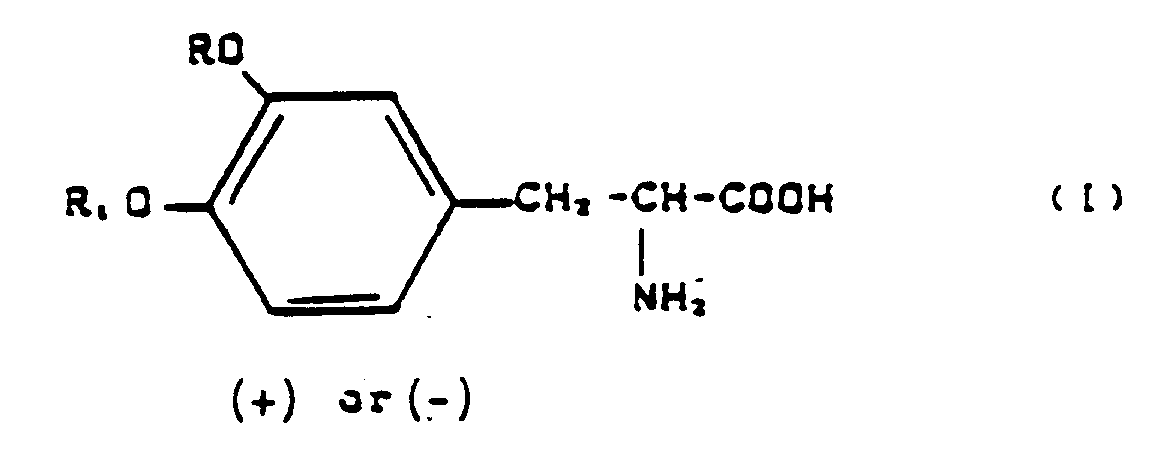
wherein R and R₁, equal or different, represent a hydrogen atom or an alkyl radical, straight or branched, containing from 1 to 6 carbon atoms. The methyl, ethyl, isopropyl, propyl, n-butyl, sec-butyl, tert-butyl, n-pentyl, isopentyl, neopentyl, tert-pentyl, hexyl and isohexyl radicals are meant as straight or branched alkyl radicals. - The first step of the process is the reaction of compounds of formula

wherein R and R₁ have the above seen meanings, R₂ represents a nitrile group or a COOH group and R₃ represents an alkyl or an alkoxy radical, straight or branched, containing from 1 to 6 carbon atoms, or an aryl or an aralkyl radical, with an optically active alcohol of formula
R₆ -OH (III)
(+)or(-)
wherein R₆ represents an alkyl or a cycloalkyl radical, substituted or unsubstituted, containing from 3 to 12 carbon atoms, in an organic solvent immiscible with water, selected between the alkyl halides containing from 1 to 4 carbon atoms and the aromatic hydrocarbons, optionally in presence of acids or bases. Optically active alcohols which are particularly suitable for the aims of the present invention are optically active cycloalkanols selected from(+)- and (-)--menthol, (+)- and (-)-borneol, (+)- and(-)-isomenthol, (+)- and(-)--neomenthol, (+) and (-)-neoisomenthol, (+)- and (-)-1-cyclohexylethanol, (+)- and (-) -campholalcohol, (+)- and (-) - -isoborneol,(+)- and(-)-3-methylcyclopentanol. The(-)-menthol is particularly preferred among the above mentioned optically active alcohols. - In this way, a pair of diastereoisomer esters of formula

is obtained, wherein R, R₁,R₃ and R₆ have the above seen meanings. - The second step consists in treating said pair of diastereoisomer esters of formula (IV), dissolved in an anhydrous organic solvent, with a strong base like an alkaline alcoholate containing from 1 to 6 carbon atoms or like an alkaline amide or hydride, preferably under an atmosphere of an inert gas, in order to obtain a single diastereoisomer ester of formula

The third step of the process consists in treating the single diastereoisomer ester of formula (V) by means of aqueous solutions of strong organic or inorganic acids, or mixtures thereof, in order to obtain the optically active aminoacid of formula (I). When one or both R and R₁ represent an alkyl radical, straight or branched, containing from 1 to 6 carbon atoms, it is possible to obtain the complete dealkylation by using more drastic conditions of temperature and of time of reaction. In this way the aminoacid of formula (I) wherein R = R₁ = hydrogen is obtained, which corresponds, in the L-(-) configuration, to the L-(-)-2-amino-3-(3,4-dihydroxyphenyl)propanoic acid, known as levodopa. - The reaction between the compounds of formula (II) and the optically active alcohols of formula (III) to obtain the racemic mixtures of diastereoisomer esters of formula (IV) can be carried out according to several ways. Preferably it is carried out in an organic solvent immiscible with water selected from the aliphatic halides containing from 1 to 4 carbon atoms and the aromatic hydrocarbons and optionally in presence of acids or bases, depending on the meaning of R₂.
- So, for istance, when R₂ represents a nitrile group, the reaction is carried out in presence of aqueous sulfuric acid, alone or together with an alkylsulfonic or an arylsulfonic acid, at the boiling temperature of the reaction mixture, for a period of time comprised between about 2 and about 6 hours and then going on with the heating to the boiling temperature for a period of time comprised between about 2 and about 4 hour while eliminating the water coming from the reaction by means of an azeotropic distillation. When R₂ represents a COOH group , the reaction is catalyzed by sulfuric acid or by alkylsulfonic or arylsulfonic acids, preferably methanesulfonic and p--toluenesulfonic acid, or mixtures thereof,- at the boiling temperature of the reaction mixture for a period of time comprised between about 2 and about 12 hours by eliminating the water coming from the reaction by azeotropic distillation.
- During the azeotropic distillation the water is separated from the organic solvent through a suitable separator while the organic solvent is continuously recycled. The acid catalyst is eliminated by means of aqueous washings at the end of the reaction.
- In this way, pairs of diastereoisomer esters of formula

are obtained, wherein R, R₁, R₃ and R₆ have the above seen meanings. - These compounds of formula (IV) are new and therefore they are a further object of the present invention. They can be isolated according to known techniques and characterized or they can undergo the subsequent resolution into the single diastereoisomer esters directly in the reaction medium which is previously made anhydrous by treatment with a suitable dehydrating agent like, for instance, anhydrous calcium chloride or sodium sulfate, or by azeotropic distillation. Said resolution is carried out in presence of an organic solvent selected from the alkyl halides containing from 1 to 4 carbon atoms and the aromatic hydrocarbons, preferably toluene, by adding to the reaction mixture an amount of a strong base comprised between about 0.05 and about 0.25 molar equivalents calculated on the pair of diastereoisomer esters of formula (IV).
- Said strong base is selected from the alkaline alcoholates containing from 1 to 6 carbon atoms, or from the alkaline amides and hydrides; the potassium tert- butylate is the strong base preferably used. The resulting mixture is kept at a temperature comprised between the room temperature and about 85°C, preferably under an atmosphere of an inert gas like, for instance, nitrogen, for a period of time comprised between about 4 and about 24 hours. During this period of time the crystallization of the desired single diastereoisomer ester starts and it can be helped by seeding the reaction mixture by means of a little amount of the desired diastereoisomer ester.
- The crystallization is completed by cooling at a temperature comprised between the room temperature and 0°C; after filtering and drying, the single diastereoisomer esters of formula

are obtained, wherein R, R₁, R₃ and R₆ have the above seen meanings. These esters of formula (V) are new and therefore they constitute a further object of the present invention. - This process of crystallization in presence of a strong base causes the transformation of the more soluble diastereoisomer ester into the diastereoisomer which crystallizes, so obtaining yields of optical resolution far higher than the theoretical 50%, calculated over the starting pair of diastereoisomer esters, of a normal resolution by fractional crystallization. In fact, as it can be easily deduced from the non limiting examples hereinafter reported, the yields of a single diastereoisomer ester are very high, about 90% calculated over the starting pair of diasteroisomer esters.
- The compounds of formula (V) are then submitted to hydrolysis under acidic conditions to remove the groups COR₃ and R₆.
- When one or both of R and R₁ represent an alkyl, straight or branched, containing from 1 to 6 carbon atoms, it is possible, by operating under more drastic conditions of temperature and of reaction time, to obtain also the complete dealkylation of the compounds of formula (V), so obtaining the aminoacid of formula (I) wherein R = R₁ = hydrogen, which corresponds, in the L-(-) configuration,to the L-(-)-2-amino-3-(3,4-dihydroxyphenyl) propanoic acid, known as levodopa.
- In practice, the reaction of hydrolysis and the possible accompanying reactions of dealkylation are carried out in acid aqueous medium in presence of aqueous solutions of hydrochloric or hydrobromic acid or of mixtures thereof, at the boiling temperature of the reaction mixture for a period of time comprised between about 4 and about 24 hours, preferably distilling off under a vapour stream the oily layer which forms. The reaction mixture is subsequently cooled, diluted with water, decolourized with active charcoal and filtered over dicalite. The filtrate is brought to pH 4.5 by means of an aqueous concentrated solution of a base and in this way the desired product of formula (I) crystallizes and subsequently it is recovered according to known techniques.
- The compounds of formula (II) wherein R₂ represents a nitrile group and the compounds of formula (IV) and (V) are new and therefore they constitute a further object of the present invention. The compounds of formula (II) wherein R₂ represents a nitrile group and R₃ represents a methoxy group were disclosed in US-A-3,923,833.
- The synthesis of the intermediates which bring to the achievement of the compounds of formula (VI) is a further object of the present invention.
- The starting product for the synthesis of these intermediates is the aldehyde of formula

wherein R and R₁ represent an alkyl radical, straight or branched, containing from 1 to 6 carbon atoms, from which the desired intermediates can be obtained according to two different ways that are indicated in the following schemes 1, 2 and 3


The process according to scheme 1 consists in reacting a molar equivalent of the aldehyde of formula (VII) with about one molar equivalent of an alkaline cyanide, preferably sodium cyanide, with from about 1 to about 2 molar equivalents of ammonium bicarbonate and with from about 0.5 to about 1 molar equivalents of ammonium sulfate in an aqueous solution of ammonium hydroxide, in presence of an organic solvent immiscible with water selected from the alkyl halides containing from 1 to 4 carbon atoms, preferably trichloroethane, in autoclave at a temperature from about 70°C and about 110°C for a period of time comprised from about 2 to about 8 hours. The so obtained hydantoin of formula (VIII) is treated with an aqueous solution of an alkaline hydroxide, preferably sodium hydroxide, at the boiling temperature of the reaction mixture for a period of time comprised between about 4 and about 12 hours, so obtaining the aminoacid of formula (IX). This aminoacid is acylated by treatment with a suitable acylating agent of formula
R₃-COX (XV)
wherein R₃ represents an alkyl or alkoxy radical, straight or branched, containing from 1 to 6 carbon atoms or an aryl or aralkyl radical, X represents a halogen atom or a OCOR₇ group in which R₇ represents a straight or branched alkyl radical containing from 1 to 6 carbon atoms to give the products of formula (X). The reaction of acylation is preferably carried out without isolating the aminoacid of formula (IX) from the reaction medium and preferably takes place at a temperature comprised from about 0°C to the room temperature, for a period of time comprised from about 0.5 to about 6 hours at a pH range comprised from about 7 to about 12. The compounds of formula (X) are separated at the end of the reaction by precipitating them at acidic pH, comprised between about 1 and about 3, at a temperature comprised between about 0°C and the room temperature. - The first step of the process according to scheme 2 regards the preparation of the aminonitrile hydrocloride of formula (XI) by reacting one molar equivalent of the aldehyde of formula (VII) with from about 1 to about 3 molar equivalents of a cyanide of an alkali metal, preferably sodium cyanide, and of ammonium chloride in presence of from about 3 to about 10 molar equivalents of ammonium hydroxide. The reaction takes place in aqueous solution in presence of an organic solvent immiscible with water selected from the aromatic hydrocarbons and the alkyl halides containing from 1 to 4 carbon atoms, preferably methylene chloride, at a temperature comprised between about 30°C and about 70°C for a period of time comprised from about 1 to about 8 hours.
- The aminonitrile is extracted from the organic phase by means of an aqueous diluted solution of hydrochloric acid from which the hydrochloride of formula (XI) crystallizes by saturation with gaseous hydrochloric acid or by adding an alkaline chloride or ammonium chloride. The hydrochloride of the propionamide of formula (XII) is obtained by hydrolizing said compound by means of an aqueous solution of hydrochloric acid at a temperature comprised between the room temperature and 50°C for a period of time comprised from about 2 to about 24 hours.
- By treating said propionamide by means of an aqueous solution of hydrochloric acid at a temperature comprised between about 80°C and about 100 °C for a period of time comprised between about 1 and about 4 hours, the aminoacid of formula (IX) is obtained. This aminoacid, preferably, is not separated but it is acylated in the same reaction medium, as already previously described, by means of a suitable acylating agent of formula R₃-COX (XV), wherein R₃ and X have the above seen meanings, so obtaining the compounds of formula (X).
- The aminoacid of formula (IX) can also be directly obtained from the aminonitrile of formula (XI) without isolating the intermediate amide of formula (XII), by working at temperatures comprised from about 80°C to about 100°C for a period of time comprised between about 2 and about 8 hours.
- The process according to the scheme 3 envisages the acylation of the hydrochloride of the aminonitrile of formula (XI) with an acylating agent of formula R₃-COX (XV), wherein R₃ and X have the above seen meanings, to get the compounds of formula (XIII).
- The reaction of acylation is preferably carried out in an organic solvent selected from an aromatic hydrocarbon and an alkyl halide containing from 1 to 4 carbon atoms, in presence of an organic tertiary base, preferably triethylamine, for a period of time comprised from about 1 to about 6 hours at a temperature comprised between 0°C and the room temperature. The reaction mixture is subsequently washed with aqueous acidic and basic solutions and then the compounds of formula (XIII) are isolated by evaporating off under vacuum the organic solvent.
- The compounds of formula (XIV) are obtained by treating the compounds of formula (XIII) by means of an aqueous solution of hydrochloric acid at a temperature comprised between about 0°C and about 30°C for a period of time comprised between about 0.5 and about 4 hours and by filtering the reaction mixture.
- The compounds of formula (XII), (XIII) and (XIV) are new, except for the compounds of formula (XIII) in which R₃ represents a methoxy group, which were disclosed in US-A-3,923,833. Therefore, said compounds constitute a further object of the present invention.
- The compounds of formula (XIII) and (XIV) give the compounds of formula (X) by treatment with aqueous solutions of hydrochloric acid at a temperature comprised between 40°C and 70°C for a period of time comprised between about 4 and about 12 hours.
- The examples described hereinafter are a further illustration of the process object of the present invention but they have not to be considered as an its limitation.
- A mixture of 215 ml of water, 215 ml of a 27% (w/v) aqueous solution of ammonium hydroxide, 35.3 g of sodium cyanide, 113.3 g of ammonium bicarbonate, 47.5 g of ammonium sulfate and a solution containing 129.6 g of 3,4-dimethoxyphenylacetaldehyde in 900 ml of trichloroethane is heated at 90°C for 6 hours in an antoclave and then is cooled and filtered.
- The organic layer is discarded while the aqueous layer is concentrated under vacuum until complete elimination of the ammonium hydroxide and then it is cooled. The 5-(3,4-dimethoxybenzyl) hydantoin crystallizes and then it is filtered, washed with cold water and dried under vacuum, thus obtaining 122.8 g of product with a yield equal to 69%. A sample is crystallized from acetone and shows m.p. = 162° - 163 °C.
- A mixture of 10 g of 5-(3,4-dimethoxybenzyl)hydantoin and of 20 ml of a 30% (w/v) aqueous solution of sodium hydroxide is heated to the boiling for 7 hours and then it is cooled to room temperature and added with 25 ml of water and 8 ml of 32% (w/v) aqueous solution of hydrochloric acid. 4.5 ml of acetic anhydride are added to the reaction mixture in about one hour while keeping the temperature at about 10°C. Subsequently the reaction mixture is brought to pH 7 by adding a 32% (w/v) aqueous solution of hydrochloric acid, then it is filtred and the filtrate is acidified till pH 1. The suspension is cooled to 2°C and then it is filtered. The solid is washed at 50°C giving 10.5 g of product with a yield of 92%.
- A solution of 63.4 g of 3,4-dimethoxyphenylacetaldehyde in 50 ml of methylene chloride is added in about 30 minutes, while keeping the temperature at about 40°C, to a solution made of 110 ml of water, 220 ml of a 27% (w/v) aqueous solution of ammonium hydroxide, 20.9 g of sodium cyanide and 35.5 g of ammonium chloride. The reaction mixture is kept for 2 hours at 45°÷50°C, then it is cooled to about 25°C and the two layers are separated. The aqueous layer is twice extracted with 100 ml of methylene chloride and then it is discarded, while the organic layer, containing the nitrile, is extracted with a mixture of 270 ml of water and of 37 ml of 32% (w/v) aqueous hydrochloric acid. The aqueous solution containing the hydrochloride of the aminonitrile is kept under stirring for 12 hours so obtaining the crystallization of the product. The suspension is then saturated with gaseous hydrochloric acid, kept 2 hours under stirring at room temperature and other 2 hours at 10°C and lastly it is filtered. After drying under vacuum, 67 g of the hydrochloride of the nitrile are obtained with a yield of 78.6%. The product shows a m.p. = 191°C with decomposition.
- 100 Grams of (+),(-)-2-amino-3-(3,4-dimethoxyphenyl)propionitrile hydrochloride are suspended in 400 ml of a 32% (w/v) aqueous solution of hydrochloric acid and kept at room temperature for 16 hours and at 45°C for 30 minutes. The suspension is filtered after cooling to 2°C and the solid is washed first with 80 ml of a 32% (w/v) cold aqueous solution of hydrochloric acid and then with acetone; subsequently it is dried under vacuum at 40°C giving 98.7 g of product with a yield of 92%.
- 26 Grams of(+),(-)-2-amino-3-(3,4-dimethoxyphenyl)propionamide hydrochloride are suspended in 100 ml of a 32% (w/v) aqueous solution of hydrochloric acid and the reaction mixture is heated at 90°C for two hours, then it is cooled to room temperature and evaporated to dryness under vacuum. The residue is treated with 250 ml of water, alkalinized to pH 9.5 by means of a 15% (w/v) aqueous solution of sodium hydroxide and the ammonia is evaporated off. Subsequently, 20 ml of acetic anhydride are added in about 1 hour while keeping the pH between 7 and 8.5 by means of a 15% aqueous solution of sodium hydroxide. The pH of the reaction mixture is brought to 2 30 minutes after the end of the addition of the acetic anhydride and after cooling to 0°C the suspension is filtered. The solid is washed with cold water on the filter and dried under vacuum to give 24.5 g of product with a yield of 86%.
- 121.4 Grams of (+),(-)-2-amino-3-(3,4-dimethoxyphenyl) propionitrile hydrochloride are suspended in a mixture of 300 ml of water and 300 ml of methylene chloride and the pH is brought to 6.5 by means of a 27% (w/v) aqueous solution of ammonium hydroxide. The layers are separated, the aqueous phase is discarded while the organic phase is dried over anhydrous sodium sulfate, filtered and added with 70 ml of triethylamine. The solution is cooled to about 10°C and in about 1 hour is added with 52.5 of acetic anhydride and then with 200 ml of water and with 50 ml of a 32% (w/v) acqueous solution of hydrochloric acid. After separating the layers, the aqueous phase is discarded while the organic phase is added with other 200 ml of water and the pH is brought to 9 with a 30 % (w/v) aqueous solution of sodium hydroxide. The layers are separated, the aqueous phase is discarded while the organic phase is dried over anhydrous sodium sulfate, filtered and evaporated to dryness. The product obtained is dried under vacuum at 40°C and shows m.p. = 134° ÷ 135°C. 121 Grams of (+),(-)-2-acetamido-3-(3,4-dimethoxyphenyl) propionitrile are obtained with a yield of 97.5%.
- 62 Grams of (+),(-)-2-acetamido-3-(3,4-dimethoxyphenyl) propionitrile are added under strong stirring to a 32% (w/v) acqueous solution of hydrochloric acid. The temperature of the reaction mixture goes up till about 55°C and the suspension completely dissolves. The reaction mixture is kept to this temperature for other 5 hours under stirring, then it is cooled to about 5°C and is diluted with 200 ml of water. Then 70 ml of a 30% (w/v) aqueous solution of sodium hydroxide are added while keeping the temperature at about 40°C. The product crystallizes by cooling to 2°C and it is filtered, washed with water upon the filter and dried under vacuum. 64 Grams of (+),(-)-N-acetyl-3,4-dimethoxyphenylalanine monohydrate are obtained with a yield of 90%.
- 62 Grams of (+),(-)-2-acetamido-3-(3,4-dimethoxyphenyl) propionitrile are added to 100 ml of a 32% (w/v) aqueous solution of hydrochloric acid while keeping the temperature at 25°C for about 1 hour, then 150 ml of water and 100 ml of a 30% (w/v) aqueous solution of sodium hydroxide are added while keeping the temperature at 25°C. The suspension is then cooled to 2°C and filtered. The solid is washed upon the filter with cold water and then dried under vacuum to give 63 g of product with a yield of 94.7%. A sample of product recrystallized from N,N-dimethylformamide shows m.p. = 206° ÷ 207°C.
- 2.6 Grams of (+),(-)-2-acetamido-3-(3,4-dimethoxyphenyl) propionamide are added under strong stirring to 50 ml of a 32% (w/v) aqueous solution of hydrochloric acid. The temperature of the reaction mixture goes up till about 55°C and this temperature is kept for another 5 hours under strong stirring. Then the reaction mixture is diluted with 100 ml of water and added with 35 ml of a 30% (w/v) aqueous solution of sodium hydroxide. After cooling to 2°C, the product crystallizes and it is filtered, washed with water and dried under vacuum, so obtaining 26.2 g of (+),(-)-N-acetyl-3,4-dimethoxyphenylalanine monohydrate with yield of 92%.
- A suspension of 45.04 g of 3,4-dimethoxyphenylalanine in 340 ml of water is dissolved by adding a 30% (w/v) aqueous solution of sodium hydroxide up to pH 12 . 29.2 ml of propionic anhydride are added in about one hour while keeping the pH value at about 8 by means of a 30% (w/v) aqueous solution of sodium hydroxide. 24 ml of a 32% (w/v) aqueous solution of hydrochloric acid are afterwards added and the aqueous phase is twice treated with 100 ml of trichloroethane. The trichloroethane washings are collected and extracted with 80 ml of water. The aqueous extract is washed with 50 ml of trichloroethane and then is collected to the aqueous phase. The aqueous solution is then acidified to pH 3 by means of a 32% (w/v) aqueous solution of hydrochloric acid and the product starts crystallizing. After about 30 minutes the mixture is further acidified to pH 2 and cooled to about 5°C. The crystallized solid is filtered, washed upon the filter first with water, then with toluene and lastly with petroleum ether so obtaining, after drying under vacuum, 44.1 g of product with a yield of 78.3%. A sample of product, further purified by crystallization from n-butyl acetate shows m.p. = 142° - 143°C.
- A mixture containing 45 g of 3,4-dimethoxyphenylalanine and 20 ml of a 30% (w/v) aqueous solution of sodium hydroxide in 200 ml of water is added with 17 ml of methyl chloroformate in about one hour while keeping the pH between 7 and 8 by means of an aqueous solution of sodium hydroxide and the temperature between 10°C and 15°C. Afterwards, the reaction mixture is twice washed with 50 ml of methylene chloride and then is decolourized by means of 2.5 g of active charcoal and is filtered over dicalite. The filtrate is acidified to pH 2 by means of a 32% (w/v) aqueous solution of hydrochloric acid and the product is extracted once with 200 ml and twice with 75 ml of methylethylketone. The collected organic extracts are washed with 100 ml of a 10% (w/v) aqueous solution of sodium sulfate and then are dried over anhydrous sodium sulfate, decolourized by means of decolourizing earths and evaporated to dryness under vacuum. The residue is first crumbled and then crystallized from toluene. After filtration, washing with toluene and drying under vacuum, 45.8 g of pure product, having m.p. = 116° ÷ 117°C are obtained, with a yield of 81%.
-
- A mixture of 20.3 g of (-) - menthol and 24.82 g of (+),(-)-N-acetyl-3-(3,4-dimethoxyphenyl)propionitrile in 100 ml of toluene is heated at 70 °C and is added in 30 minutes with a mixture of 5.2 ml of methanesulfonic acid and of 3.6 ml of a 57% (w/v) aqueous solution of sulfuric acid. The reaction mixture is heated to the boiling for 5 hours and then water is eliminated from toluene by means of a suitable separator by boiling for other 2 hours. The reaction mixture is then cooled to about 85°C and is added with 50 ml of water. The layers are separated, the aqueous phase is extracted with 20 ml of toluene and then is discarded while the toluene phases are collected and evaporated to dryness so obtaining an oily residue containing a racemic mixture of (+),(-)- and (-),(-)-N-acetyl-3,4-dimethoxyphenylalanine menthyl esters. The yield, calculated over the starting (+),(-)-N-acetyl-3-(3,4-dimethoxyphenyl)propionitrile, is of about 95%.
- A mixture of 100 g of (+),(-)-N-acetyl-3,4-dimethoxyphenylalanine monohydrate, 71.2 g of (-)-menthol and 5.2 g of p-toluenesulfonic acid in 350 ml of toluene is boiled under stirring for 5 hours while eliminating the water coming from the reaction by azeotropic distillation with a suitable separator. The amount of product obtained is determined by HPLC and results equal to 119.5 g with a yield of esterification of 84% .
- The reaction mixture coming from example 13 is slowly cooled under nitrogen atmosphere to about 65°C and at this temperature the crystallization is seeded by adding a little amount of (+) -N-acetyl-3,4-dimethoxyphenylalanine (-) - -menthyl ester. 7 Grams of potassium tert-butylate are added to the reaction mixture which is slowly cooled under stirring for 12 hours. Then 100 ml of water and 3.56 ml of acetic acid are added to the reaction mixture which is stirred for one hour and heated to 85°C until complete solubilization. The solution is slowly cooled and at about 75°C the crystallization is seeded by adding a little amount of(+)-N-acetyl-3,4-dimethoxyphenylalanine (-)-mentyl ester. The suspension is filtered at the temperature of about 20°C, the solid product is washed upon the filter with toluene and with water and lastly is dried under vacuum. 112.3 Grams of(+)-N-acetyl-3,4-dimethoxyphenylanine(-)-menthyl ester are obtained with a yield of 94% over the racemic mixture of the(+),(-)-N-acetyl-3,4 dimethoxyphenylalanine (-)-menthyl ester and of 79% over the (+),(-)-N-acetyl-3,4-dimethoxyphenylalanine monohydrate. The product shows m.p. = 152° ÷ 153°C and [α]

- 17.2 Grams of (-)-menthol and 1.8 g of p-toluenesulfonic acid are added to a suspension of 32.93 g of (+),(-)-N-benzoyl-3,4-dimethoxyphenylalanine in 300 ml of toluene and the reaction mixture is heated to the boiling for about 5 hours by eliminating the water of reaction by azeotropic distillation by means of a suitable separator. The reaction mixture is then cooled to about 50°C, once washed with 50 ml of water to eliminate the p-toluenesulfonic acid and evaporated to dryness obtaining an oily residue containing 44.6 g of product, determined by HPLC, with a yield of 95%.
- The (+),(-)- N-benzoyl-3,4-dimethoxyphenylalanine(-)-menthyl ester coming from example 15 is diluted with 300 ml of toluene and the mixture is heated to boiling and dried by distilling off about 50 ml of solvent. Then the reaction mixture is cooled to about 65°C and, under nitrogen atmosphere, is added with 2 g of potassium tert-butylate and 500 mg of (+)-N-benzoyl-3,4-dimethoxyphenylalanine (-)-menthyl ester. The reaction mixture is kept under stirring for about 8 hours by lowering the temperature first at room temperature and then to about 10°C. The suspension is then filtered and the obtained solid is washed on the filter first with water and then with toluene so obtaining, after drying under vacuum, 40.3 g of pure product with a yield of 90% calculated over the starting mixture of diastereoisomer esters. A sample of (-) -N-benzoyl-3,4-dimethoxyphenylalanine (-)- menthyl ester recrystallized by ethyl alcohol shows m.p. = 146° ÷ 147°C and [α]

- A mixture of 42.2 g of (+),(-)-N-propionyl-3,4-dimethoxyphenylalanine, 26.95 g of (-)-menthol and 2.85 g of p-toluenesulfonic acid in 180 ml of toluene is heated to the boiling under stirring for about 4 hours. The reaction mixture is then cooled, washed three times with 50 ml of water and dried by azeotropic distillation separating the water by means of a suitable separator. The dried toluene solution is cooled to 60°C, added with 0.84 g of potassium tert-butylate and then kept for 12 hours under stirring while cooling to room temperature. The resulting suspension is filtered and the obtained solid is recrystallized from toluene obtaining 38.7 g of product with a yield of 61.4%. The crystallized product shows m.p. = 129°÷130°C and [α]

- A mixture of 43.2 g of (+),(-) -N-carbomethoxy-3,4-dimethoxyphenylalanine, 27 g of (-)-menthol and 3 g of p-toluenesulfonic acid in 200 ml of toluene is heated to the boiling for 4 hours while eliminating the water coming from the reaction by means a suitable separator. The reaction mixture is cooled to about 50°C, washed three times with 50 ml of water and then it is heated again to the boiling, completely eliminating by distillation the water with a suitable separator. The reaction mixture is then cooled to room temperature under nitrogen atmosphere, added with 1.6 g of potassium tert-butylate and kept under stirring for 24 hours. The suspension is cooled to 0°C and is filtered. The solid is dried and crystallized from methyl alcohol obtaining 45 g of product with a yield of 71%. The product shows m.p. = 114° ÷ 115°C and [α]

- A mixture of 40.5 g of (+)-N-acetyl-3,4-dimethoxyphenylalanine (-)-menthyl ester, 20 ml of water, 20 ml of acetic acid and 35 ml of aqueous 48% (w/v) hydrobromic acid is heated to the boiling under stirring for 5 hours while distilling off the oily phase under vapour stream and recycling the condensed aqueous phase. Another 6 ml of 48% (w/v) aqueous hydrobromic acid are added to the reaction mixture which is heated to the boiling while distilling off vapour until the boiling temperature of the reaction mixture reaches 118°C, then the reaction mixture is heated at this temperature for other 6 hours. The reaction mixture is then cooled, diluted with 100 ml of water, decolourized on active charcoal and filtered on dicalite. The filtrate is brought to pH 4.5 by means of a 27% (w/v) aqueous solution of ammonium hydroxide and cooled to 5°C obtaining an abundant precipitate which is filtered and washed on the filter first with water and then with acetone. After drying under vacuum at 40°C, 17.7 g of pure product are obtained with a yield of 89.8%. This product shows [α]

- A mixture of 8.6 g of (+)-N-propionyl-3,4-dimethoxyphenylalanine(-)- menthyl ester, 8 ml of a 32% (w/v) aqueous solution of hydrochloric acid and 8 ml of a 50% (w/v) aqueous solution of hydrobromic acid is heated to the boiling for one hour and half and then the oily phase is distilled off while recycling the aqueous phase. The distillation is stopped after the temperature reaches 118°C and the heating is continued for another 5 hours at this temperature. The reaction mixture is then cooled, diluted with 12.5 ml of water, decolourized on active charcoal and filtered on dicalite. The filtrate is brought to pH 4 by means of a 27% (w/v) aqueous solution of ammonium hydroxide and the suspension which forms is cooled to 5°C for one hour. The precipitated solid is filtered, washed on the filter with water and acetone and dried under vacuum obtaining 3.6 g of pure levodopa having [α]

- A mixture of 11.7 g of(-)-N-benzoyl-3,4-dimethoxyphenylalanine (-)-mentyl ester and of 48 ml of a 48% (w/v) aqueous solution of hydrobromic acid is heated at the boiling for 4 hours and then is cooled to room temperature and diluted with 50 ml of water. The reaction mixture is extracted three times with 30 ml of methylene chloride and then is concentrated under vacuum. The residue is diluted with 60 ml of water and is brought to pH 4.5 by adding a 27% (w/v) aqueous solution of ammonium hydroxide. The obtained suspension is kept at 5°C for about 1 hour and then is filtered and the solid is washed on the filter with water and acetone and dried under vacuum to give 3.7 g of product having [α]

- By operating in an analogous manner, the L-(-)-2-amino-3-(3,4-dihydroxyphenyl)propanoic acid is obtained starting from the (+)-N-carbomethoxy-3,4-dimethoxyphenlalanine (-)--menthyl ester.
Claims (31)
- Process for the synthesis of optically active aminoacids of formula
 a) reacting compounds of formula
R₆ -OH (III)
(+) or (-)
wherein R₆ represents an alkyl or cycloalkyl radical, substituted or unsubstituted , containing from 3 to 12 carbon atoms, in an organic solvent immiscible with water, selected from the alkyl halides containing from 1 to 4 carbon atoms and the aromatic hydrocarbons, optionally in presence of acids or of bases;b) treating the resulting pair of diastereoisomer esters of formula c) treating the resulting single diastereoisomer ester of formula
- Process for the synthesis of optically active aminoacids of formula
 a1) reacting one molar equivalent of an aldehyde of formula
 b1) isolating the reaction product of formula
 c1) acylating the compound of formula (XI) with an acylating agent of formula R₃-COX (XV), wherein R₃ represents an alkyl or alkoxy radical, straight or branched, containing from 1 to 6 carbon atoms, or an aryl or aralkyl radical, and X represents a halogen atom or a OCOR₇ group in which R₇ represents a straight or branched alkyl radical containing from 1 to 6 carbon atoms, in an organic solvent selected from an aromatic hydrocarbon and an alkyl halide containing from 1 to 4 carbon atoms in presence of a tertiary organic base for a period of time comprised between 1 and 6 hours at a temperature comprised between 0°C and the room temperature, to obtain the compounds of formula
 d1) reacting the above compounds of formula (II) with an optically active alcohol of formula
R₆-OH (III)
(+) or (-)
wherein R₆ represents an alkyl or cycloalkyl radical, substituted or unsubstituted, containing from 3 to 12 carbon atoms, in an organic solvent immiscible with water, selected from the alkyl halides containing from 1 to 4 carbon atoms and the aromatic hydrocarbons, optionally in presence of acids or of bases;e1) treating the resulting pair of diastereoisomer esters of formula f1) treating the resulting single diastereoisomer ester of formula
- Process according to claims 1 or 2 in which when one or both R and R₁ represent an alkyl radical, straight or branched, containing from 1 to 6 carbon atoms, the treatment in aqueous acid medium is prolonged up to the complete dealkylation of the compound of formula (V), to obtain the optically active aminoacid of formula (I) wherein R = R₁ = hydrogen.
- Process according to claims 1 or 2 wherein the optically active alcohols of formula (III) are optically active cycloalkanols selected from(+)- and(-)-menthol, (+)- and (-)-borneol,(+)- and(-)-isomenthol,(+)- and(-)-neomenthol,(+)- and (-)-neoisomenthol, (+)- and (-)-1-cyclohexylethanol, (+)-and(-)-campholalcohol, (+)- and (-)-isoborneol, (+)- and (-)-3-methylcyclopentanol.
- Process according to claim 4 wherein(-)-menthol is the optically active cycloalkanol.
- Process according to claims 1 or 2 wherein the reaction between the compounds of formula (II) and (III) is carried out in presence of acids.
- Process according to claims 1 or 2 wherein the reaction between the compounds of formula (II) and (III) is carried out in toluene.
- Process according to claims 1 or 2 wherein the transformation of the pairs of diastereoisomers esters of formula (IV) into the single diastereoisomer esters of formula (V) is carried out in an organic solvent selected from the alkyl halides containing from 1 to 4 carbon atoms and the aromatic hydrocarbons by using from 0.05 to 0.25 molar equivalents of a strong base at a temperature comprised between the room temperature and 85°C for a period of time comprised between 4 and 24 hours.
- Process according to claim 8 wherein the organic solvent is toluene and the strong base is potassium tert-butylate.
- Process according to anyone of claims 1-3 wherein the treatment in aqueous acid medium of steps c) or f1) is carried out with aqueous solutions of hydrochloric or hydrobromic acid or mixtures thereof at the boiling temperature of the reaction mixture for a period of time comprised between 4 and 24 hours.
- Compounds of formula

- A compound according to claim 11 which is the (+),(-)-2-acetamido-3-(3,4-dimethoxyphenyl) propionitrile.
- Compounds of formula

- A compound according to claim 13 which is the (+),(-)-N-acetyl-3,4-dimethoxyphenylalanine(-)-menthyl ester.
- A compound according to claim 13 which is the (+),(-)-N-benzoyl-3,4-dimethoxyphenylalanine(-)-menthyl ester.
- Compounds of formula

- A compound according to claim 16 which is the (+)-N-acetyl-3,4-dimethoxyphenylalanine (-)-menthyl ester.
- A compound according to claim 16 which is the -N-propionyl-3,4-dimethoxyphenylalanine(-)-menthyl ester.
- A compound according to claim 16 which is the (+)-N-carbomethoxy-3,4-dimethoxyphenylalanine (-)-menthyl ester.
- A compound according to claim 16 which is the(-)-N-benzoyl-3,4-dimethoxyphenylalanine(-)-menthyl ester.
- Use of the compounds according to claims from 11 to 20 in the synthesis of the L-(-)-2-amino-3-(3,4-dihydroxyphenyl) propanoic acid.
- Process for the synthesis of compounds of formula
 a) reacting a molar equivalent of an aldehyde of formula
 b) treating the so obtained hydantoin of formula
 c) acylating the so obtained aminoacid of formula
R₃-COX (XV)
wherein R₃ represents an alkyl or alkoxy radical, straight or branched, containing from 1 to 6 carbon atoms or an aryl or aralkyl radical, X represents a halogen atom or a OCOR₇ group, in which R₇ represents a straight or branched alkyl radical containing from 1 to 6 carbon atoms at a temperature comprised between 0°C and the room temperature, for a period of time comprised between 0.5 and 6 hours in a pH range comprised between 7 and 12;d) precipitating the compound of formula (X) from the reaction medium by acidification at a pH comprised between 1 and about 3 at a temperature comprised between 0°C and the room temperature. - Process for the synthesis of compounds of formula
 a) reacting one molar equivalent of an aldehyde of formula (VII) with from 1 to 3 molar equivalents of an alkali metal cyanide and of ammonium chloride in presence of from 3 to 10 molar equivalents of ammonium hydroxide in aqueous solution in presence of an organic solvent immiscible with water selected from the aromatic hydrocarbons and the alkyl halides containing from 1 to 4 carbon atoms at a temperature comprised between 30°C and 70°C for a period of time comprised between 1 and 8 hours;b) isolating the reaction product by extraction by means of a diluted aqueous solution of hydrochloric acid and by subsequent crystallization by adding gaseous hydrochloric acid or an alkali metal chloride or ammonium chloride;c) hydrolyzing the so obtained compound of formula
 d) hydrolyzing the so obtained compound of formula
 e) acylating the so obtained aminoacid of formula (IX) by means of an acylating agent of formula R₃-COX (XV) wherein R₃ and X have the above seen meanings, at a temperature comprised between 0°C and the room temperature, for a period of time comprised between 0.5 and 6 hours at a pH range comprised between 7 and 12;f) precipitating the compound of formula (X) from the reaction medium by acidifying at a pH comprised between 1 and 3 at a temperature comprised between 0°C and the room temperature.
 - Process according to claim 23 wherein the compound of formula (XI) is directly hydrolyzed to the compound of formula (IX) without isolating the compound of formula (XII), by operating at a temperature comprised between 80°C and 100°C for a period of time comprised between 2 and 8 hours.
- Process for the synthesis of compounds of formula
 a) acylating the compound of formula (XI) with an acylating agent of formula R₃-COX (XV), wherein R₃ and X have the above seen meanings, in an organic solvent selected from an aromatic hydrocarbon and an alkyl halide containing from 1 to 4 carbon atoms in presence of a tertiary organic base for a period of time comprised between 1 and 6 hours at a temperature comprised between 0°C and the room temperature, to obtain the compounds of formula
 b) hydrolyzing the compounds of formula (XIII) by means of an aqueous solution of hydrochloric acid at a temperature comprised between 0°C and 30°C for a period of time comprised between 0.5 and 4 hours;c) hydrolyzing the so obtained compounds of formula
- Process according to claim 25 wherein the compounds of formula (XIII) are directly hydrolyzed to the compounds of formula (X) without isolating the compounds of formula (XIV), by operating at a temperature comprised between 40°C and 70°C for a period of time comprised between 4 and 12 hours.
- Compounds of formula

- A compound according to claim 27 which is the (+),(-)-2-amino-3-(3,4-dimethoxyphenyl) propionamide hydrochloride.
- Compounds of formula

- A compound according to claim 29 which is the (+),(-)-2-acetamido-3-(3,4-dimethoxyphenyl) propionamide.
- Use of the compounds according to claims from 27 to 30 in the synthesis of the L-(-)-2-amino-3-(3,4-dihydroxyphenyl)propanoic acid.
Applications Claiming Priority (2)
| Application Number | Priority Date | Filing Date | Title |
|---|---|---|---|
| IT2132388 | 1988-07-12 | ||
| IT8821323A IT1226903B (en) | 1988-07-12 | 1988-07-12 | PROCESS FOR THE SYNTHESIS OF OPTICALLY ACTIVE AMINO ACIDS |
Publications (3)
| Publication Number | Publication Date |
|---|---|
| EP0351382A2 EP0351382A2 (en) | 1990-01-17 |
| EP0351382A3 EP0351382A3 (en) | 1991-10-09 |
| EP0351382B1 true EP0351382B1 (en) | 1994-09-21 |
Family
ID=11180108
Family Applications (1)
| Application Number | Title | Priority Date | Filing Date |
|---|---|---|---|
| EP89830317A Expired - Lifetime EP0351382B1 (en) | 1988-07-12 | 1989-07-07 | Process for the synthesis of optically active aminoacids |
Country Status (21)
| Country | Link |
|---|---|
| US (1) | US5041637A (en) |
| EP (1) | EP0351382B1 (en) |
| JP (1) | JPH0776199B2 (en) |
| KR (1) | KR960005515B1 (en) |
| AT (1) | ATE111888T1 (en) |
| AU (1) | AU617197B2 (en) |
| DD (1) | DD283997A5 (en) |
| DE (1) | DE68918357T2 (en) |
| DK (1) | DK172006B1 (en) |
| ES (1) | ES2066880T3 (en) |
| FI (1) | FI104423B (en) |
| HU (1) | HU203716B (en) |
| IE (1) | IE65530B1 (en) |
| IL (1) | IL90845A0 (en) |
| IT (1) | IT1226903B (en) |
| NO (1) | NO174885C (en) |
| NZ (1) | NZ229909A (en) |
| PL (1) | PL160887B1 (en) |
| PT (1) | PT91145B (en) |
| YU (1) | YU47906B (en) |
| ZA (1) | ZA895254B (en) |
Families Citing this family (6)
| Publication number | Priority date | Publication date | Assignee | Title |
|---|---|---|---|---|
| FR2672598A1 (en) * | 1991-02-11 | 1992-08-14 | Adir | NOVEL N-MYRISTOYLTRANSFERASE INHIBITORS, PROCESS FOR THEIR PREPARATION AND PHARMACEUTICAL COMPOSITIONS CONTAINING THEM |
| GB9215354D0 (en) * | 1992-07-20 | 1992-09-02 | Unilever Plc | Cosmetic composition |
| NL1009814C2 (en) * | 1998-08-06 | 2000-02-08 | Dsm Nv | Production of N-acylated amino nitriles comprises reacting an amino nitrile with an optionally alpha-substituted phenylacetic or phenoxyacetic acid in the presence of a penicillin G or V acylase |
| US20040002615A1 (en) * | 2002-06-28 | 2004-01-01 | Allen David Robert | Preparation of chiral amino-nitriles |
| EP1596808A4 (en) * | 2003-02-07 | 2007-04-04 | Yissum Res Dev Co | L-dopa amide derivatives and uses thereof |
| CN104945270B (en) * | 2015-05-01 | 2017-08-15 | 李玉山 | A kind of synthetic method of L-dopa methyl ester hydrochloride |
Family Cites Families (9)
| Publication number | Priority date | Publication date | Assignee | Title |
|---|---|---|---|---|
| US2388688A (en) * | 1941-07-18 | 1945-11-13 | Purdue Research Foundation | Resolution of enantiomorphs |
| GB1051045A (en) * | 1963-04-23 | |||
| US3923833A (en) * | 1968-05-01 | 1975-12-02 | Hoffmann La Roche | N-{8 (1-cyano-2-phenyl)ethyl{9 carbamates |
| DE2735834A1 (en) * | 1977-08-09 | 1979-02-22 | Hoechst Ag | SEPARATION OF AMINO ACIDS INTO OPTICAL ANTIPODES |
| US4379941A (en) * | 1982-01-08 | 1983-04-12 | Uop Inc. | Resolution of racemic amino acids |
| EP0174358A1 (en) * | 1984-03-01 | 1986-03-19 | ALKALOIDA VEGYéSZETI GYáR | Novel diastereomer salts of phenylalanine and n-acyl derivatives thereof and process for the separation of optically active phenylalanine and n-acyl derivatives thereof |
| JPS60215657A (en) * | 1984-04-10 | 1985-10-29 | Mitsui Toatsu Chem Inc | Preparation of n-acylphenylalanine |
| US4749811A (en) * | 1985-10-29 | 1988-06-07 | The Standard Oil Company | Method of making a diastereomeric mixture containing two diastereomeric α-acyloxy acid esters |
| IT1226902B (en) * | 1988-07-12 | 1991-02-21 | Mini Ricerca Scient Tecnolog | LEVODOPA SYNTHESIS PROCESS |
-
1988
- 1988-07-12 IT IT8821323A patent/IT1226903B/en active
-
1989
- 1989-07-03 IL IL90845A patent/IL90845A0/en not_active IP Right Cessation
- 1989-07-03 US US07/374,769 patent/US5041637A/en not_active Expired - Fee Related
- 1989-07-07 ES ES89830317T patent/ES2066880T3/en not_active Expired - Lifetime
- 1989-07-07 AT AT89830317T patent/ATE111888T1/en not_active IP Right Cessation
- 1989-07-07 EP EP89830317A patent/EP0351382B1/en not_active Expired - Lifetime
- 1989-07-07 DE DE68918357T patent/DE68918357T2/en not_active Expired - Fee Related
- 1989-07-11 DK DK342389A patent/DK172006B1/en not_active IP Right Cessation
- 1989-07-11 FI FI893369A patent/FI104423B/en not_active IP Right Cessation
- 1989-07-11 HU HU893484A patent/HU203716B/en not_active IP Right Cessation
- 1989-07-11 PL PL89280529A patent/PL160887B1/en unknown
- 1989-07-11 DD DD89330689A patent/DD283997A5/en not_active IP Right Cessation
- 1989-07-11 IE IE222889A patent/IE65530B1/en not_active IP Right Cessation
- 1989-07-11 NO NO892862A patent/NO174885C/en not_active IP Right Cessation
- 1989-07-11 ZA ZA895254A patent/ZA895254B/en unknown
- 1989-07-11 NZ NZ229909A patent/NZ229909A/en unknown
- 1989-07-12 YU YU139889A patent/YU47906B/en unknown
- 1989-07-12 JP JP1180151A patent/JPH0776199B2/en not_active Expired - Lifetime
- 1989-07-12 AU AU38058/89A patent/AU617197B2/en not_active Ceased
- 1989-07-12 PT PT91145A patent/PT91145B/en not_active IP Right Cessation
- 1989-07-12 KR KR1019890009906A patent/KR960005515B1/en not_active Expired - Fee Related
Also Published As
Similar Documents
| Publication | Publication Date | Title |
|---|---|---|
| KR0179946B1 (en) | Process for the preparation of cyclic aminoacid derivatives as well as the intermediate products | |
| EP0357565B1 (en) | New process for the synthesis of the levodopa | |
| EP0024210B1 (en) | Process for the production of optically active threo-3-(3,4-dihydroxyphenyl) serine, and product thus produced | |
| US5041637A (en) | Process for the synthesis of optically active aminoacids | |
| JP2941350B2 (en) | Process for producing R (+)-aminocarnitine and S (-)-aminocarnitine | |
| EP0204911B1 (en) | A new process for the optical resolution of racemic mixtures of alpha-naphthylpropionic acids | |
| EP0414262A2 (en) | Process for the preparation of cyclic amino anticonvulsant compounds | |
| EP0182279B1 (en) | Process for the optical resolution of racemic mixtures of alpha-naphtyl-propionic acids | |
| US4325886A (en) | Optical resolution of acylthiopropionic acid | |
| US4642205A (en) | Diastereomer salts of phenylalanine and N-acyl derivatives thereof and process for the separation of optically active phenylalanine and N-acyl derivatives thereof | |
| EP0344737B1 (en) | Process for purifying alpha-substituted acetic acids | |
| EP0906906B1 (en) | Process for preparing optically active 2-piperazinecarboxylic acid derivatives | |
| JPH0228144A (en) | Production of stereospecific intermediate useful for synthesis of peptide derivative | |
| US6043364A (en) | Regiospecific process for synthesis of acyclic nucleosides | |
| JPH06306028A (en) | Improved process for producing L-(-)-carnitine from waste of opposite configuration | |
| JP4093608B2 (en) | Process for producing optically active 2-phenoxypropionic acid | |
| EP0204481A2 (en) | Process for optically active threo-3-(3,4-methylenedioxyphenyl) serine | |
| EP0138468B1 (en) | Method for preparing optically active dialkyl trans-epoxysuccinates | |
| JP3272377B2 (en) | Optical resolution of optically active glutaric acid ester derivatives | |
| EP0281393B1 (en) | Method for producing indan derivatives | |
| JPH09241227A (en) | New optical resolution agent | |
| GB2029826A (en) | Process for preparing benzoxazolyl propionic acid derivaties | |
| DK154220B (en) | Process for preparing etoposide |
Legal Events
| Date | Code | Title | Description |
|---|---|---|---|
| PUAI | Public reference made under article 153(3) epc to a published international application that has entered the european phase |
Free format text: ORIGINAL CODE: 0009012 |
|
| AK | Designated contracting states |
Kind code of ref document: A2 Designated state(s): AT BE CH DE ES FR GB GR IT LI LU NL SE |
|
| PUAL | Search report despatched |
Free format text: ORIGINAL CODE: 0009013 |
|
| AK | Designated contracting states |
Kind code of ref document: A3 Designated state(s): AT BE CH DE ES FR GB GR IT LI LU NL SE |
|
| 17P | Request for examination filed |
Effective date: 19920210 |
|
| 17Q | First examination report despatched |
Effective date: 19930707 |
|
| GRAA | (expected) grant |
Free format text: ORIGINAL CODE: 0009210 |
|
| AK | Designated contracting states |
Kind code of ref document: B1 Designated state(s): AT BE CH DE ES FR GB GR IT LI LU NL SE |
|
| REF | Corresponds to: |
Ref document number: 111888 Country of ref document: AT Date of ref document: 19941015 Kind code of ref document: T |
|
| REF | Corresponds to: |
Ref document number: 68918357 Country of ref document: DE Date of ref document: 19941027 |
|
| ITF | It: translation for a ep patent filed | ||
| EAL | Se: european patent in force in sweden |
Ref document number: 89830317.7 |
|
| ET | Fr: translation filed | ||
| REG | Reference to a national code |
Ref country code: GR Ref legal event code: FG4A Free format text: 3014463 |
|
| REG | Reference to a national code |
Ref country code: ES Ref legal event code: FG2A Ref document number: 2066880 Country of ref document: ES Kind code of ref document: T3 |
|
| PLBE | No opposition filed within time limit |
Free format text: ORIGINAL CODE: 0009261 |
|
| STAA | Information on the status of an ep patent application or granted ep patent |
Free format text: STATUS: NO OPPOSITION FILED WITHIN TIME LIMIT |
|
| 26N | No opposition filed | ||
| PGFP | Annual fee paid to national office [announced via postgrant information from national office to epo] |
Ref country code: GB Payment date: 19990614 Year of fee payment: 11 Ref country code: AT Payment date: 19990614 Year of fee payment: 11 |
|
| PGFP | Annual fee paid to national office [announced via postgrant information from national office to epo] |
Ref country code: NL Payment date: 19990630 Year of fee payment: 11 |
|
| PGFP | Annual fee paid to national office [announced via postgrant information from national office to epo] |
Ref country code: SE Payment date: 19990707 Year of fee payment: 11 Ref country code: FR Payment date: 19990707 Year of fee payment: 11 |
|
| PGFP | Annual fee paid to national office [announced via postgrant information from national office to epo] |
Ref country code: ES Payment date: 19990719 Year of fee payment: 11 |
|
| PGFP | Annual fee paid to national office [announced via postgrant information from national office to epo] |
Ref country code: GR Payment date: 19990728 Year of fee payment: 11 |
|
| PGFP | Annual fee paid to national office [announced via postgrant information from national office to epo] |
Ref country code: DE Payment date: 19990730 Year of fee payment: 11 |
|
| PGFP | Annual fee paid to national office [announced via postgrant information from national office to epo] |
Ref country code: LU Payment date: 19990813 Year of fee payment: 11 |
|
| PGFP | Annual fee paid to national office [announced via postgrant information from national office to epo] |
Ref country code: BE Payment date: 19990817 Year of fee payment: 11 |
|
| PGFP | Annual fee paid to national office [announced via postgrant information from national office to epo] |
Ref country code: CH Payment date: 19991021 Year of fee payment: 11 |
|
| PG25 | Lapsed in a contracting state [announced via postgrant information from national office to epo] |
Ref country code: LU Free format text: LAPSE BECAUSE OF NON-PAYMENT OF DUE FEES Effective date: 20000707 Ref country code: GB Free format text: LAPSE BECAUSE OF NON-PAYMENT OF DUE FEES Effective date: 20000707 Ref country code: AT Free format text: LAPSE BECAUSE OF NON-PAYMENT OF DUE FEES Effective date: 20000707 |
|
| PG25 | Lapsed in a contracting state [announced via postgrant information from national office to epo] |
Ref country code: SE Free format text: LAPSE BECAUSE OF NON-PAYMENT OF DUE FEES Effective date: 20000708 Ref country code: ES Free format text: LAPSE BECAUSE OF NON-PAYMENT OF DUE FEES Effective date: 20000708 |
|
| PG25 | Lapsed in a contracting state [announced via postgrant information from national office to epo] |
Ref country code: LI Free format text: LAPSE BECAUSE OF NON-PAYMENT OF DUE FEES Effective date: 20000731 Ref country code: GR Free format text: LAPSE BECAUSE OF NON-PAYMENT OF DUE FEES Effective date: 20000731 Ref country code: CH Free format text: LAPSE BECAUSE OF NON-PAYMENT OF DUE FEES Effective date: 20000731 Ref country code: BE Free format text: LAPSE BECAUSE OF NON-PAYMENT OF DUE FEES Effective date: 20000731 |
|
| BERE | Be: lapsed |
Owner name: MINISTERO DELL' UNIVERSITA' E DELLA RICERCA SCIEN Effective date: 20000731 |
|
| PG25 | Lapsed in a contracting state [announced via postgrant information from national office to epo] |
Ref country code: NL Free format text: LAPSE BECAUSE OF NON-PAYMENT OF DUE FEES Effective date: 20010201 |
|
| GBPC | Gb: european patent ceased through non-payment of renewal fee |
Effective date: 20000707 |
|
| REG | Reference to a national code |
Ref country code: CH Ref legal event code: PL |
|
| EUG | Se: european patent has lapsed |
Ref document number: 89830317.7 |
|
| PG25 | Lapsed in a contracting state [announced via postgrant information from national office to epo] |
Ref country code: FR Free format text: LAPSE BECAUSE OF NON-PAYMENT OF DUE FEES Effective date: 20010330 |
|
| NLV4 | Nl: lapsed or anulled due to non-payment of the annual fee |
Effective date: 20010201 |
|
| REG | Reference to a national code |
Ref country code: FR Ref legal event code: ST |
|
| PG25 | Lapsed in a contracting state [announced via postgrant information from national office to epo] |
Ref country code: DE Free format text: LAPSE BECAUSE OF NON-PAYMENT OF DUE FEES Effective date: 20010501 |
|
| REG | Reference to a national code |
Ref country code: ES Ref legal event code: FD2A Effective date: 20010810 |
|
| PG25 | Lapsed in a contracting state [announced via postgrant information from national office to epo] |
Ref country code: IT Free format text: LAPSE BECAUSE OF NON-PAYMENT OF DUE FEES Effective date: 20050707 |