EP0349371A1 - Rechneranlage mit einer zentralen Zwischenverbindung - Google Patents
Rechneranlage mit einer zentralen Zwischenverbindung Download PDFInfo
- Publication number
- EP0349371A1 EP0349371A1 EP19890401679 EP89401679A EP0349371A1 EP 0349371 A1 EP0349371 A1 EP 0349371A1 EP 19890401679 EP19890401679 EP 19890401679 EP 89401679 A EP89401679 A EP 89401679A EP 0349371 A1 EP0349371 A1 EP 0349371A1
- Authority
- EP
- European Patent Office
- Prior art keywords
- pli
- plm
- agent
- link
- clm
- Prior art date
- Legal status (The legal status is an assumption and is not a legal conclusion. Google has not performed a legal analysis and makes no representation as to the accuracy of the status listed.)
- Granted
Links
Images



Classifications
-
- G—PHYSICS
- G06—COMPUTING OR CALCULATING; COUNTING
- G06F—ELECTRIC DIGITAL DATA PROCESSING
- G06F13/00—Interconnection of, or transfer of information or other signals between, memories, input/output devices or central processing units
- G06F13/38—Information transfer, e.g. on bus
- G06F13/382—Information transfer, e.g. on bus using universal interface adapter
- G06F13/385—Information transfer, e.g. on bus using universal interface adapter for adaptation of a particular data processing system to different peripheral devices
Definitions
- the present invention relates to a computer system with interconnection between its central organs and its peripheral organs.
- Common computer systems are made up of central organs, processors or central units (CPUs) and a central memory comprising one or more memory units (MMUs), one or more Input / Output controllers allowing communication with organs peripherals for example (disk memories, modems, printers ).
- processors CPUs
- MMUs central memory units
- Input / Output controllers allowing communication with organs peripherals for example (disk memories, modems, printers .
- Processors (CPUs) and central memory units (MMUs) communicate via an internal communication bus, the protocol of which is chosen by the designer of the host system according to its architecture. These protocols are most often specific and very diverse.
- standard buses such as "Backplane" buses of IEEE standard. Most often these standard buses have at least one parallel communication channel.
- the object of the present invention is a computer system, the interconnection of which provides the link between different protocol buses, in a flexible manner to adapt to the internal bus of the host system and in an efficient manner to make best use of the standard communication buses. in terms of speed, cost and flexibility.
- the invention provides a computer system comprising at least one central unit (CPU) and a central memory (MMU) communicating via an internal communication bus, at least one peripheral member associated with a control module.
- IOM module and at least one interconnection between the IOM module and the internal bus
- the system being characterized in that on the one hand the IOM module is connected to an external communication bus of a type different from that of the internal bus and in that, on the other hand, the interconnection comprises an internal liaison agent (CLM) connected to the internal bus, an external liaison agent (PLM) connected to the external bus, an inter-agent connection, after called PLI link, arranged between said link agents, said link agents (CLM) (PLM) ensuring the adaptation between the protocols used respectively in the two buses and the PLI link.
- CLM internal liaison agent
- PLM external liaison agent
- PLI link link agents
- the protocols used respectively in the two buses and the PLI link are different, the internal liaison agent (CLM) ensuring the adaptation between the protocols used in the internal bus and the PLI link, the PLM external liaison agent ensuring the adaptation between the protocols used in the external bus and the PLI link.
- CLM internal liaison agent
- the invention also presents a certain number of variants, the particular characteristics of which contribute to improving the efficiency of the interconnection.
- the PLI link is of the type having a parallel communication channel working in message mode of the packet type (message transmission with header).
- the parallel communication channel of the PLI link is bidirectional and includes a synchronization line between the internal (CLM) and external (PLM) liaison agents.
- the synchronization signal XCL in the PLI link is generated by a clock (HOR) transmitting from the internal link agent (CLM) and controlling two sequencers (PLS) arranged in each of the Liaison Officers (CLM) (PLM).
- HOR clock
- PLS sequencers
- the PLI link comprises an independent serial channel and controlled by two service controllers (ASC) arranged in each of the liaison agents (CLM) (PLM) and intended to transmit the initialization and / or service-maintenance orders.
- ASC service controllers
- CLM liaison agents
- This transmission can thus be carried out completely independently of the parallel channel without constraint or blocking of any kind.
- the computer system comprises a plurality of external communication buses of the same type or of different type each supporting at least one IOM module and an external connection agent (PLM) associated with each of the external buses, said link agents (PLM) being connected by a star network of PLI links to a single internal link agent (CLM) comprising connection means for ensuring direct communication between the IOM modules associated with different external buses. It is thus possible, without overloading the internal bus or modifying the capacity of the IOM modules, to interconnect a very large number of peripheral agents.
- PLM external connection agent
- the external liaison agent furthermore comprises means of indirect communication between the IOM modules and the memory units (MMUs) to ensure a "Memory Server" function during data streams in response to negotiation messages from the IOM module.
- MMUs memory units
- the computer system illustrated in FIG. 1 is represented diagrammatically in the form of three localized physical sub-assemblies, a central sub-assembly 10 and two peripheral sub-assemblies 12 and 14.
- the central sub-assembly 10 receives the central organs of the system grouped around an internal communication bus 16 hereinafter called UMI bus more particularly one or more central processors (CPUs) 18 and one or more central memory units (MMUs) 20.
- UMI bus more particularly one or more central processors (CPUs) 18 and one or more central memory units (MMUs) 20.
- the central organs of the computer system belong to a machine architecture of the applicant company.
- the UMI communication bus is structured along three separate channels: a control channel (UMI-CMD), an address channel (UMI-AD) and a parallel 32-bit data channel (UMI-DT) of useful width.
- the frequency of its clock is 7.5 MHZ ensuring a maximum speed of 30 M bytes / s.
- the non-limiting subsets 12 and 14 of two are structured around external communication buses (24, 26) of the same type or of a different type.
- the external buses are constituted by a standard parallel communication channel called PSB.
- PSB standard parallel communication channel
- its clock frequency is 10 MHz and its bit rate can reach 32 Mbytes / s in message mode with 32-byte data packets and almost 40 Mbytes / s with data packets 256 bytes.
- Each PSB bus here two in number and entitled PSB 0 (ref 24) and PSB 1 (ref 26), are associated with peripheral organs 28, 29 of the computer system.
- These bodies 28, 29 of any type are connected to the corresponding PSB through control modules 30, 31 hereinafter called IOM modules.
- each link comprises a parallel PC-PLI channel (shown in solid lines) and a SC-PLI serial channel (shown in dashed line) controlled at each end by service controllers, hereinafter called controllers (ASC) 42, 44 and 46 incorporated respectively in the internal liaison agent (CLM) and the two external liaison agents (PLM).
- CLM internal connection agent
- PLM external connection agent
- ASC controllers
- ASC service controller
- CLM system service processor
- the number of PSB buses of the system is equal to two. It should be noted that there is no limitation on the number of external PSB buses and corresponding PLI links with regard to the invention.
- the real limitations lie in the physical capacity of certain components of the system, for example the internal liaison agent (CLM) and / or in the addressing for the identification of the units of the system.
- CLM internal liaison agent
- the number of central organs (CPUs) and (MMUs) associated with the internal bus can be 30, while the number of peripheral PSB buses can go up to 12 and each of the PSB buses can receive up to 15 IOM modules.
- the system described here has a star structure of two PLI links around a single link agent (CLM) 22 capable of ensuring direct communication between all the peripheral agents whatever the PSB buses with which they are associated. This very advantageous characteristic in terms of the ease of use of the system will be described in more detail later.
- CLM link agent
- peripheral sub-assembly a single PSB bus, a single external connection agent (PLM) and a single PLI connection.
- PLM peripheral connection agent
- the PSB buses work in message mode like their PLI link and make it possible to implement, with respect to the central organs of the system, the I / O channel function in the IOM modules; each of which can support one or more physical I / O channels.
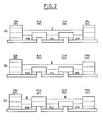
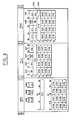
- Figure 3 illustrates the formats of the various messages conveyed by the UMI, PLI (parallel channel), and PSB buses in the case of a type II link (IOM / MMU), more precisely the writing in main memory at address MA of a DOO-D15 data block.
- IOM / MMU type II link
- control channel composed of the lines CMD, RQUN and UNID
- address channel UMI-AD giving the real address MA in central memory on 32 bits ( 0-31)
- UMI-DT data channel capable of transmitting blocks of 16 bytes.
- the control channel is broken down into a control field proper "CMD" wide by 6 bits (0-3, 4-5) bearing the reference of the operation code, here "E3", an identification field of the sender unit “RQUN” 4 bits wide, carrying the agent identification reference (PLM) with which the source IOM module of the DOO-D15 data block is associated and an identification line of the destination unit " UNID "wide by 4 bits here carrying the value” 0 "significant of direct access to the central organs of the system and completed by the existence of a real address MA in the address channel UMI-AD.
- CMS control field proper
- E3 an identification field of the sender unit
- RQUN 4 bits wide
- PLM agent identification reference
- the formats of the messages in the PLI link and the PSB bus are related and are presented in a form divisible into 4 byte words (0-31) with a "header” and a "data” part.
- the ⁇ header '' part of the messages of the PLI link and of the PSB bus comprises the first four significant bytes gathered on a word (4 bytes) in the PLI link and on two words on the PSB bus to comply in the latter.
- n ° 1 (DST) and n ° 2 (EXP) are reserved for the identification of the agents or bodies recipient and sender (IOM-ID, PLM-ID, CPU-ID), bytes n ° 3 (CDE) and n ° 4 (AUX) are reserved for coding the main and auxiliary commands also called "operation" codes.
- the "data" part of the messages follows the header to start when it exists by a 32-bit MA memory address.
- the DST field contains the value 00-Hex (hexadecimal notation) significant of direct access to the central organs of the system
- the EXP field contains the IOM module identifier (IOM-ID ) sender
- the CDE field contains the value corresponding to the 4E-Hex write operation
- the AUX code contains the value 10-Hex (which corresponds to the length of the significant byte field of the block to be written, ie 16 bytes in the present case of a total writing of a block).
- the AUX field can be used from various information such as operation references given by the agents, for example: IOM ref. or PLM ref.
- the invention is described with reference to a very specific type of internal bus, the UMI bus. It is understood that without departing from the scope of the invention the data blocks here limited to 16 bytes can be enlarged up to 256 bytes without having to change the format of the messages of the PLI link, in particular at the level of the length of the field of significant bytes of a data block (maximum 256 bytes given by the hexadecimal value 00-Hex in the byte corresponding to the additional code AUX in the "header" part).
- Information passes over the three physical links, which are the two UMI and PSB buses, and the PLI link.
- the liaison officers (CLM) and (PLM) are transparent, their roles being limited to the transposition of protocols, in particular to the restructuring of the ⁇ header '' part of the messages.
- the fields are coded as follows: 00-Hex for DST, IOM-ID for EXP, the operation code 48-Hex for CDE and CPU-ID for AUX.
- the AUX field carries a PC time code in an Input / Output table provided in the main memory (MMU). Indeed, the additional information relating to the event thus notified is obtained by the IOM module requested by a procedure called "mailboxes".
- the IOM / MMU links between IOM modules and central memory (MMU) are also called immediate memory access operation.
- the elementary memory access commands (read, write) are carried out in the form of messages.
- the information travels on the three physical links UMI, PLI and PSB in the form of unsolicited (asynchronous) messages or requests.
- the liaison officers (CLM) and (PLM) are also transparent with the sole function of transposing the protocols.
- the central memory does not send a message in response to the write commands.
- the response message returns the memory address of the "Write Block" command and specifies the causes of the failure.
- the response message from the central memory to the IOM module declines the content of the block accessed in central memory, possibly notifying the corrected errors or indicates the cause of the failure.
- the "Write Block" command (which served as an example for the presentation of the messages illustrated in Figure 2) is sent by the IOM module to the central memory (MMU) with a DST identification of 00-Hex. It is accompanied of the memory address MA and of the data block to be written, partially or entirely.
- the first significant byte is given by the content of the least significant bits 28-31 of the address MA, the length of the significant bytes being contained in the AUX field (value less than 10-Hex in the case of partial block writing).
- the command "Read Block” is also sent to the central memory (MMU) with a DST identification of 00-Hex. It is accompanied by the memory address MA and a reference of the IOM request (IOM ref.) Carried in the AUX field.
- MMU central memory
- IOM ref. IOM request
- There are four commands for responses from the main memory: - Memory Write Error (CDE field 49): this command returns to the IOM module the MA memory address attached to the "Write Block” command not executed with an indication of the type of failure in the AUX field.
- IOM / PLM connections constitute the external phase of the global operations of data movement in or out of the central memory (MMU) in which the IOM / MMU communication is no longer direct but controlled by the agent (PLM) which plays the role of "Memory Server".
- MMU central memory
- PLM agent
- IOM / PLM connections only correspond to messages on the PSB bus.
- the agent comprises a set of 32 servers with DMA function (direct memory access). Each server being made up of 11 registers: . a 16-bit "IOM operation reference” register, . an 8-bit ⁇ Memory Command '' register, . a 16-bit "Transfer Length” register (length per word of 4 bytes), . four memory descriptors for chaining the buffers in central memory and each comprising a 16-bit "length” register, ie half a word (length byte) and a 32-bit "address” register, or one word (address at the 'byte).
- An IOM module can occupy as many servers with DMA function as it can request within the limit of their availability. It should be noted that the ability for DMA servers to operate simultaneously depends essentially on the PSB bus control circuits and agent structure (PLM). By way of example, the agent (PLM) described later with reference to FIG. 6 allows only one entry operation and one exit operation simultaneously. These external data movement operations relate to lengths which can reach 4 times 64 Kbytes. Servers with DMA function are "Memory Servers" which unload the IOM modules and the PSB bus, thereby increasing the efficient (or useful) speed of the PSB bus.
- PLM agent structure
- the agent responds with a message "Entry Buffer Agreement" (field CDE 35) giving the AUX field the reference of the server with DMA function (PLM ref.) assigned to the operation requested by the IOM module.
- this message includes a third word (word N ° 2) in which the reference of the IOM operation (IOM ref.) Is carried on a byte as well as the maximum rate of work, also carried on one byte.
- This response ends the negotiation sequence and is immediately followed by the sending of the first message synchronously by the IOM module of the first message "Input data packet".
- the "header” part of these messages includes the identification of the IOM module (IOM-ID) in the EXP field, agent identification (PLM) (PLM-ID) in the DST field, an order code (3F-Hex modified to 3E-Hex for the last packet) in the CDE field and the operation reference (PLM ref.) in the AUX field
- the "data” part of these messages is a maximum of 32 bytes If the envisaged transfer length is not an exact multiple of 32, the last word is completed by non-significant bytes.
- the PLM “Memory Server” function is activated automatically upon receipt of the first message "Input data packet".
- the agent (PLM) writes the byte chain to central memory as it receives the data packets.
- the agent (PLM) writes to central memory by generating itself on PLI, according to the internal phase of data movement, so-called type IV messages (studied later) and which are similar to those that IOM modules send directly to immediate access operations (type II message).
- the agent sends its message "End of Data Entry” and releases the server with DMA function.
- This message three words long, includes a "en- head '' incorporating in the DST field the identification of the IOM module (IOM-ID), in the EXP field the agent identification (PLM) (PLM-ID), in the CDE field the code 4C-Hex, finally in the field AUX the agent operation reference (PLM) (PLM ref.).
- the "data” part one word long, will include on the one hand the reference of the operation by IOM (IOM ref.), on the other hand an indication of the state of the operation (00-Hex in the event of success or a higher value in the event of incident). In the latter case, it will be up to the IOM module to restart the entire operation by sending an initialization message "Input Buffer Request".
- this agent sends a message whose "given” part reduced to one word will include the IOM reference of the operation ( IOM ref.).
- This rejection can come from a lack of resources on the part of the agent (PLM), in particular from servers with DMA function (infrequent case), but also from a request that does not comply with the content of the message "Request Buffer Entry ".
- the IOM module must therefore issue a new request.
- the external phase data output operations on the PSB bus are structured in a similar manner to the data input operations and will not be presented in detail in the following description. There are also five orders; they have the same number of standard messages on PSB: . '' Data Output Request "from the IOM module to the agent (PLM) to initialize the operation. This message contains, in addition to an operation reference (IOM ref.), Memory descriptors (maximum 4) associated with data transfers (addresses central memory and corresponding lengths of the byte fields to be transferred). . Agent "Buffer Output" request (PLM) to the IOM module. This message contains, among other things, the references (PLM ref.) Of the PLM resources (server with DMA function) assigned to the operation.
- PLM / MMU links between liaison officers (PLM) and the central memory (MMU) correspond to the internal phase of data movement operations. To these connections correspond only messages on the UMI buses and the PLI link.
- the structure of the messages is identical to that of the messages described in the presentation of the messages relating to type II links (immediate access), however replacing the role of the IOM module by that of the liaison officer (PLM) which will be identified by its code (PLM-ID).
- the liaison officer comprises a set of working memories composed of a set of buffers 100 intended to receive data, a pair of auxiliary buffers 102, 104 (TAU 0 and TAU 1, TAP 0 and TAP 1) intended to receive addresses, and another auxiliary buffer memory 106 (TH 0 and TH 1) intended to receive the "header" part of the messages conveyed on the PLI link.
- the agent also includes a set of bidirectional doors with storage 108, 110 by PLI link.
- the sets of memorized doors 108 and 110 are mounted in a star (in the present case in parallel taking into account the number limited to two of the PLI links) on a node 135 to be connected respectively to the parallel PC-PLI 0 and PC- channels. PLI 1 of the PLI connections.
- the circuits corresponding to these various memories 100, 102, 104, to the memory doors 108, 110 are 32 in number (x 32 in FIG. 4) to allow information transfers of width equal to 4 bytes, ie 1 word.
- the liaison agent (CLM) comprises two sequencers, the sequencer (UMS) 118, the sequencer (PLS) 120, both synchronized by a clock (HOR) 124.
- the agent also incorporates a subset service link (ASC) 42 organized around a microprocessor type 8086 connected to the SC-PLI 0 and SC-PLI 1 serial channels of the two inter-agent links through USART 8251 interface circuits (not shown).
- ASC subset service link
- the subset (ASC) 42 manages in particular the initialization of the system, the test and error procedures.
- the buffer memory set 100 is bidirectional and consists at the input of two memory circuits BPU 0 (152) and BPU 1 (154) with a capacity of 4 words each and at the output of two memory circuits BUP 0 (156) and BUP 1 (158) with a capacity of 4 words also and two memory circuits TW0 and TW1 of a capacity of 1 word, the latter being specially reserved for the transfer of information in the "mailbox" procedure associated with interruptions of IOM modules by central units.
- These memory circuits are connected in parallel and are connected on the one hand to the "data" channel UMI-DT of the UMI bus through a set of doors 130, on the other hand on the PLI side to a work bus 132.
- This bus 132 is connected to the sub-assembly (ASC) 42 through a set of TST doors 134, to the set of memorized doors 108 and 110 by a set of ISO 136 isolation doors connected to node 135 and to the inputs of the set of auxiliary buffers in sets 102, 104 and 106 by another set of ISO 138 isolation doors.
- the auxiliary buffers in sets 102, 104 and 106 all have a capacity of 1 word. Each set has as many buffers (here two) as there are PLI links in the computer system.
- the first set of address buffers (TAU 0 and TAU 1) 102 has its output connected by a bus 140 to the address channel UMI-AD of the bus UMI through a set of doors 142.
- the other set of address buffers (TAP 0 and TAP 1) 104 has its looped output on bus 132 via gate 150 138, as well as the output of the ⁇ header '' buffer set (TH 0 and TH 1) 106.
- This last configuration is used for the generation of response messages to the IOM modules and the agents (PLM) in the types II and IV links studied previously.
- PLM agents
- the memories of the doors of sets 108 and 110 have a capacity of 1 word.
- the clock (HOR) 124 delivers two synchronous clock signals, one for the UMI bus, the other referenced XCL (see arrow line 148) for the parallel channels of the PLI links.
- the sequencers (UMS) 118 and (PLS) 120 also work synchronously with the XCL signal and at the same frequency.
- the UMS sequencer (118) is connected to the UMI-CMD control channel of the UMI bus through a set of doors 146. In addition to priority management on UMI, the sequencer (UMS) 118 controls the access doors on the side UMI of memories 100 and 102 (see signposted network 150). In addition, the sequencer (UMS) 118 is capable of receiving instructions from the messages (or message headers) contained in the auxiliary buffers 106 (TH 0 and TH 1).
- the sequencer (PLS) 120 controls the access doors on the PLI side of memories 100 and 102, the access doors of memories 104 and 106, memory doors 108 and 110 of ISO doors 136 and 138 and the generation and / or reception of control signals illustrated in Figure 4 under the reference XIR 0/1, XIG 0/1, XCP 0/1 used in the parallel channels of the PLI links on three additional lines (not shown) to the 36 data transmission lines ( see signposted network 152).
- These three lines whose functions will be explained later consist of a bidirectional XCP line, a unidirectional line in XIG transmission and a unidirectional line in XIR reception, these lines are connected to the sequencer (PLS) 120 respectively by a set of bi-directional storage doors, a unidirectional storage door and a storage circuit (not shown) all synchronized from the XCL signal from the clock 124.
- PLS sequencer
- the two sequencers (UMS) 118 and (PLS) 120 are made entirely wired in the form of programmed logic networks. These logical networks, the principle and use of which are well known in the art will not be described here in detail. Obviously these circuits correspond to as many flowcharts as situations of the various messages of interest to the agent (CLM) 120 and presented before.
- the read command message from a IOM module enters the agent (CLM) via the PLI link (for example PLI 0).
- This message consists of a header directed to buffer 106 (TH 0) and an address directed to buffers 102 (TAU 0) and 104 (TAP 0).
- TH 0 buffer 106
- TAU 0 buffer 102
- TAU 0 address directed to buffers 102
- TAU 0 address directed to buffers 102
- TAU 0 address directed to buffers 102
- TAU 0 address directed to buffers 102
- TAU 0 buffers 102
- TAU 0 address directed to buffers 102
- TAU 0 address directed to buffers 102
- TAU 0 buffers 104
- the UMS controller 118 takes over, reads the header contained in TH 0 and decodes it to generate the CMD, RQUN and UNID instructions intended for the UMI bus.
- the content of the TAU 0 buffer is transferred to the UMI
- the central memory responds and loads, under control of the sequencer (UMS) 118, the buffers 156 (BUP 0).
- the content of buffer 106 (TH 0) is modified according to the result of the read operation (Memory Block Return, State 0/1/2).
- the PLS sequencer (120) takes over the operation and sends on PLI 0 from buffer 106 (TH 0) the header of the return message to the requesting IOM module followed by the content of buffers 156 (BUP 0) that is, data read from memory.
- the return phase of the operation which has just been described is partly illustrated in the flowchart of Figure 5 commented below.
- the flow diagram of FIG. 5 partially illustrates the operation of the logical networks programmed in the sequencers (UMS) and (PLS) of the internal liaison agent (CLM) and which corresponds to a central memory (MMU) return after an immediate access operation (read or write) requested by an IOM module associated with a given PLI link.
- UMI sequencers
- PLS internal liaison agent
- MMU central memory
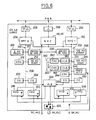
- the external liaison agent (PLM) described comprises two communication chains 200 and 202 mounted in parallel between the bus PSB and the parallel link of inter-agent connection PLI.
- the communication chain 200 is assigned to direct transfers between PSB and PLI while the communication chain 202 is assigned to indirect transfers and more particularly to the realization of the "Memory Server" function of the agent (PLM).
- the direct communication chain 200 consists of a message controller circuit (MPC 0) 204 whose message address is 00-Hex.
- MPC 0 message controller circuit
- the input of the identifier circuit is connected by a set of bidirectional doors 206 to the PSB bus, while its output is connected to a work bus 208 on which are connected an auxiliary processing unit composed of a microprocessor 210 (32-bit - 16 MHz) of the 68020 type and of a 2 KB bytes PROM type 212 memory loaded with instructions intended for the microprocessor 210, of a first large capacity (32 Kbytes) SRAM type working memory 214 for allow temporary storage of information, a CDC 216 coding-decoding unit and a second working memory composed of a pair of FIFO registers 218,220 with a capacity of one hundred words of 32 bits.
- the input FIFO register 218 is associated with an 8-bit control counter 222 while the output FIFO register 220 is associated with another 8-bit control counter 224.
- the two FIFO registers 218,220 are connected to the parallel channel PC -PLI through a bidirectional interface circuit with storage doors 226.
- the FIFO registers 218,220 and the storage doors of circuit 226 are managed and controlled by a sequencer (PLS) 228 of the liaison agent (PLM) itself controlled by the sequencer (PLS) 120 of the liaison agent (CLM) and synchronized by the clock signal XCL.
- the indirect communication chain 202 consists of a message controller circuit (MPC 1) 230 whose message address is the agent identification code (PLM) considered, that is to say PLM-ID.
- the circuit input (MPC 1) is connected by a set of bidirectional doors 232 on the PSB bus while its output is connected to a work bus 234 to which are connected an auxiliary processing unit composed of a microprocessor 236 (32 bit - 16 MHz) of type 68020 and of a read-only memory of type EPROM 238 of 128 Kbytes responsible for the instructions intended to the microprocessor 236, a first working memory 240 of SRAM type and of large capacity (128 Kbytes) to allow the storage of information in the "Server Memory" operating mode, a direct access device in CAD 242 memory, a CDC 244 coding-decoding unit, a multifunction processor circuit (MFP) 246 of the 68901 type, and a second working memory consisting of a pair of FIFO registers 248, 250 with a capacity of one
- the input FIFO register 248 is associated with an 8-bit control counter 252 while the output FIFO register 250 is associated with another 8-bit control counter 254.
- the FIFO registers 248 and 250 are mounted in parallel with the FIFO registers 228 and 220 of the direct chain 200 to be connected to the parallel PC-PLI channel through the interface circuit with storage doors 226. They are also controlled by the sequencer (PLS) 228 of l 'agent (PLM). Although not shown, the three lines XCP, XIR, XIG of the PC-PLI channel are connected, through the interface circuit 226, to the sequencer (PLS) 228 of the agent (PLM). With regard to these three lines, circuit 226 has a structure of storage and memory doors similar to that already described of the interface associated with the other end of the lines, on the CLM side.
- the multifunction processor (MFP) 246 which also performs the classic stopwatch interrupt functions, is incorporated into the service controller (ASC) 44-46 suitably connected to the SC-PLI serial channel of the PLI link and assisted by the microprocessor 236.
- the service controller (ASC) 44-46 is responsible for the PSB interface function known as CSM and the definition of which is given in the IEEE 1296 standard.
- CSM function implies connection to the PSB bus by a unidirectional door 258. It is used within the framework of the IEEE 1296 standard during the initialization of the PSB bus.
- the service controller (ASC) 44-46 is also used for PSB's own test and error procedures and protocols within the framework of the IEE 1296 standard. It is therefore connected to the two message controller circuits (MPC O ) 204 and (MPC 1) 230.
- An RC-PLI line coming from the PLI link allows the hot restart (WRS) of the service controller (ASC) 44-46 and the microprocessors 210 and 236.
- the direct communication chain 200 ensures the transfer and the management of the messages concerned by the types I and II links while the indirect communication chain 202 ensures the transfer and the management of the types III and IV messages.
- the discrimination is carried out by the identification of the message addresses by the circuits (MPC) 204 and 230 00-Hex for (MPC 0) and PLM-ID for (MPC 1).
- type IV messages intended for the communication chain 202 are selected by their PLM-ID message address when the FIFO 248 register is loaded.
- This identification function is used successfully and efficiently for the transfer of information between IOM modules (IOM-E transmitter module, IOM-R receiver module) associated with two separate PSB buses (PSB-E and PSB-R).
- the "header" part of the message will include the identification of the PLM-R agent.
- the message will pass through the PLM-E agent then through the PLI-E link to load the agent's TPLI-E I / O storage gate (CLM).
- CLM TPLI-E I / O storage gate
- the message is blocked at the node 135 by the isolation doors 136 and will be loaded into the storage door TPLI-R associated with the agent PLM-R which will recognize and take charge of it. Thanks to that particularity, a real extension of the capacity of the external communication buses is thus obtained.
- the CAD circuit 242 (not to be confused with the 32 servers with DMA direct access function obtained by software during the implementation of the "Memory Server" function of the PLM agent ) includes a set of input counters (CAE) 260 and (CLE) 262 on 16 bits and a set of output counters (CAS) 264 and (CLS) 266 on 16 bits which does not allow, in the embodiment here described, that a single input operation and a single simultaneous output operation between the IOM module and the agent (PLM) in type III links.
- the counters (CAE) 260 and (CAS) 264 are assigned to addressing in memory SRAM 240 while counters (CLE) 262 and (CLS) 266 are nt assigned to the determination of the length of the information blocks to be transferred.
- Figure 7 schematically illustrates an inter-agent PLI link (if we consider Figure 7, the references of the PC, SC and RC channels are indicated on the left while the references of the corresponding signals are indicated on the right). Physically it consists of 43 active lines in the form of a flexible link which can reach a few meters.
- a PC-PLI parallel channel 40 lines
- SC-PLI serial channel 2 lines
- a unidirectional RC-PLI line of the agent ( CLM) to the agent (PLM) to convey, from the service controller (ASC) 42 of the agent (CLM) or the service processor (SPA) 22 of the host system connected to its MCSI output, a WSR signal to the agent service controller (ASC) 44-46 (PLM) during hot reboots of the system.
- ASC agent service controller
- SPA service processor
- the serial communication channel SC provides the link between the system service processor (SPA) 22 and the controller (ASC) 44-46 and the agent microprocessors 210 and 236 (PLM) via the controller (ASC) 42 of the agent (CLM) and the MCSI service link (see Figures 1 and 3). It consists of two lines: a transmission line referenced TXD from the agent (CLM) (master) to the agent (PLM) (slave) and a reception line RXD from the agent (PLM) to the agent (CLM ).
- TXD transmission line referenced from the agent (CLM) (master) to the agent (PLM) (slave)
- RXD reception line from the agent (PLM) to the agent (CLM ).
- the parallel communication channel of the PLI links consists of 40 lines comprising: . the XCL transmission clock signal sent by the agent (CLM), . the signals of agreement to the agent (PLM) of the communication channel XIR and XIG, . the bidirectional path "Addresses / Data" consisting of 36 signals offering a 4-byte wide passage with their parity, XAD00-35 and a signal occupying the path, XCP.
- the lines of the parallel path PC of the PLI link are connected to the various storage circuits and doors (in particular elements 108-110 and 226) already described and located at each end of the parallel path in the corresponding CLM and PLM agents.
- the transmission frequency can reach 25 MHz by limiting the physical length of PLI to 0.5 meters. With a physical length of 2.5 meters, the maximum allowable frequency drops to 16 MHz.
- the interval between messages is at least one "time" T of the clock.
- the agreement to the agent (PLM) of the communication channel is based on the agent's sequencer (PLS) 120 (CLM), which the latter normally having the track.
- the agent (PLM) wants to send, it activates its XIR request signal. If the agent (CLM) does not need the channel (the output memories of doors 108 or 110 being emptied and the input memories of these same doors being ready to receive), the agent (CLM) activates its XIG tuning signal by its sequencer (PLS) 120.
- the appearance of XIG in the agent (PLM) commands the immediate deactivation of its XIR unless the agent (PLM) wishes to keep the channel to chain the present cycle with another transmission cycle.
- the disappearance of XIR in the agent (CLM) commands the immediate deactivation of its XIG. If the XIG signal remains present in the agent (PLM) after sending its message, the latter can continue to transmit by immediately chaining the next transmission cycle.
- the messages are transmitted in 4-byte giclées in parallel with each XCL clock time of the transmission cycle.
- the "header" part H of the message is transmitted at time "0" of the cycle and the rest when it exists is transmitted at the next time (s).
- the appearance of the signal / XCP / indicates the start of transmission of a message on the parallel channel of PLI and its disappearance the end of transmission. This signal / XCP / indicates the busy state of the XAD lines.
- All signals / XIR /, / XIG /, / XCP / and / XADi / are clocked on transmission and reception by the liaison officer (CLM) or (PLM) concerned from the synchronization clock signal XCL issued by CLM.
- CLM liaison officer
- PLM PLM
- the computer system which has just been described by way of example may, without departing from the scope of the invention, give rise to a certain number of variants either at the level of the construction of the controlling agents, or at the level of the protocols used in the different buses.
- the modular structure of the interconnection central according to the invention allows either a simple reconfiguration of the system or a partial adaptation suitable for each type of bus (internal or external) without completely redesigning the interconnection for each particular application.
Landscapes
- Engineering & Computer Science (AREA)
- Theoretical Computer Science (AREA)
- Physics & Mathematics (AREA)
- General Engineering & Computer Science (AREA)
- General Physics & Mathematics (AREA)
- Bus Control (AREA)
- Multi Processors (AREA)
- Communication Control (AREA)
Applications Claiming Priority (2)
| Application Number | Priority Date | Filing Date | Title |
|---|---|---|---|
| FR8808578A FR2633414B1 (fr) | 1988-06-27 | 1988-06-27 | Systeme informatique a interconnexion centrale |
| FR8808578 | 1988-06-27 |
Publications (2)
| Publication Number | Publication Date |
|---|---|
| EP0349371A1 true EP0349371A1 (de) | 1990-01-03 |
| EP0349371B1 EP0349371B1 (de) | 1994-08-10 |
Family
ID=9367737
Family Applications (1)
| Application Number | Title | Priority Date | Filing Date |
|---|---|---|---|
| EP89401679A Expired - Lifetime EP0349371B1 (de) | 1988-06-27 | 1989-06-15 | Rechneranlage mit einer zentralen Zwischenverbindung |
Country Status (6)
| Country | Link |
|---|---|
| US (1) | US5245703A (de) |
| EP (1) | EP0349371B1 (de) |
| JP (1) | JPH0731654B2 (de) |
| DE (1) | DE68917388T2 (de) |
| ES (1) | ES2062063T3 (de) |
| FR (1) | FR2633414B1 (de) |
Cited By (1)
| Publication number | Priority date | Publication date | Assignee | Title |
|---|---|---|---|---|
| RU2128362C1 (ru) * | 1991-03-07 | 1999-03-27 | Диджитал Эквипмент Корпорэйшн | Система для подготовки вызывающего образа и его осуществления |
Families Citing this family (47)
| Publication number | Priority date | Publication date | Assignee | Title |
|---|---|---|---|---|
| JP2930257B2 (ja) * | 1991-04-22 | 1999-08-03 | 株式会社東芝 | 携帯可能電子装置 |
| FR2679352B1 (fr) | 1991-07-15 | 1996-12-13 | Bull Sa | Dispositif universel de couplage d'un bus d'ordinateur a un controleur d'un groupe de peripheriques. |
| US5826017A (en) * | 1992-02-10 | 1998-10-20 | Lucent Technologies | Apparatus and method for communicating data between elements of a distributed system using a general protocol |
| US5495585A (en) * | 1992-10-16 | 1996-02-27 | Unisys Corporation | Programmable timing logic system for dual bus interface |
| US5430847A (en) * | 1992-10-22 | 1995-07-04 | International Business Machines Corporation | Method and system for extending system buses to external devices |
| US5784622A (en) * | 1992-11-18 | 1998-07-21 | Canon Kabushiki Kaisha | Method and apparatus for multiprotocol operation of a networked peripheral |
| US5442754A (en) * | 1992-12-04 | 1995-08-15 | Unisys Corporation | Receiving control logic system for dual bus network |
| JP3421378B2 (ja) * | 1993-03-23 | 2003-06-30 | 株式会社東芝 | 伝送制御方式 |
| JP3264465B2 (ja) * | 1993-06-30 | 2002-03-11 | 株式会社日立製作所 | 記憶システム |
| US5594874A (en) * | 1993-09-30 | 1997-01-14 | Cirrus Logic, Inc. | Automatic bus setting, sensing and switching interface unit |
| US5758107A (en) * | 1994-02-14 | 1998-05-26 | Motorola Inc. | System for offloading external bus by coupling peripheral device to data processor through interface logic that emulate the characteristics of the external bus |
| US6510465B1 (en) | 1994-04-19 | 2003-01-21 | Ibm | Dual communication services interface for distributed transaction processing |
| US5794014A (en) * | 1994-06-27 | 1998-08-11 | Cirrus Logic, Inc. | Method and apparatus for interfacing between peripherals of multiple formats and a single system bus |
| US5727184A (en) * | 1994-06-27 | 1998-03-10 | Cirrus Logic, Inc. | Method and apparatus for interfacing between peripherals of multiple formats and a single system bus |
| US5805924A (en) * | 1994-11-08 | 1998-09-08 | Stoevhase; Bent | Method and apparatus for configuring fabrics within a fibre channel system |
| JP3522882B2 (ja) * | 1995-03-22 | 2004-04-26 | 株式会社東芝 | プロトコル切換方法 |
| US5608877A (en) * | 1995-03-24 | 1997-03-04 | Cirrus Logic, Inc. | Reset based computer bus identification method and circuit resilient to power transience |
| US5596169A (en) * | 1995-05-12 | 1997-01-21 | Iomega Corporation | Combined SCSI/parallel port cable |
| US7137107B1 (en) | 2003-04-29 | 2006-11-14 | Roy-G-Biv Corporation | Motion control systems and methods |
| US7024666B1 (en) | 2002-01-28 | 2006-04-04 | Roy-G-Biv Corporation | Motion control systems and methods |
| US6571141B1 (en) | 1995-05-30 | 2003-05-27 | Roy-G-Biv Corporation | Application programs for motion control devices including access limitations |
| US6209037B1 (en) | 1995-05-30 | 2001-03-27 | Roy-G-Biv Corporation | Motion control systems using communication map to facilitating communication with motion control hardware |
| US6859671B1 (en) | 1995-05-30 | 2005-02-22 | Roy-G-Biv Corporation | Application programs for motion control devices including access limitations |
| US20100131081A1 (en) * | 1995-05-30 | 2010-05-27 | Brown David W | Systems and methods for motion control |
| US20060206219A1 (en) | 1995-05-30 | 2006-09-14 | Brown David W | Motion control systems and methods |
| US7139843B1 (en) | 1995-05-30 | 2006-11-21 | Roy-G-Biv Corporation | System and methods for generating and communicating motion data through a distributed network |
| US6542925B2 (en) | 1995-05-30 | 2003-04-01 | Roy-G-Biv Corporation | Generation and distribution of motion commands over a distributed network |
| US5691897A (en) | 1995-05-30 | 1997-11-25 | Roy-G-Biv Corporation | Motion control systems |
| US5832244A (en) * | 1996-02-20 | 1998-11-03 | Iomega Corporation | Multiple interface input/output port for a peripheral device |
| US5878225A (en) * | 1996-06-03 | 1999-03-02 | International Business Machines Corporation | Dual communication services interface for distributed transaction processing |
| US6058263A (en) * | 1996-06-03 | 2000-05-02 | Microsoft Corporation | Interface hardware design using internal and external interfaces |
| US6105093A (en) * | 1997-02-21 | 2000-08-15 | General Electric Company | Interface monitor for communicating between different communication protocols |
| US5978861A (en) * | 1997-09-30 | 1999-11-02 | Iomega Corporation | Device and method for continuously polling for communication bus type and termination |
| US20010032278A1 (en) | 1997-10-07 | 2001-10-18 | Brown Stephen J. | Remote generation and distribution of command programs for programmable devices |
| SE516175C2 (sv) * | 1999-02-17 | 2001-11-26 | Axis Ab | Anordning och metod för kommunikation över ett nätverk |
| WO2001031408A1 (en) | 1999-10-27 | 2001-05-03 | Roy-G-Biv Corporation | Systems and methods for generating and communicating motion data through a distributed network |
| US6885898B1 (en) | 2001-05-18 | 2005-04-26 | Roy-G-Biv Corporation | Event driven motion systems |
| US8032605B2 (en) | 1999-10-27 | 2011-10-04 | Roy-G-Biv Corporation | Generation and distribution of motion commands over a distributed network |
| US20100131078A1 (en) * | 1999-10-27 | 2010-05-27 | Brown David W | Event driven motion systems |
| WO2002071241A1 (en) | 2001-02-09 | 2002-09-12 | Roy-G-Biv Corporation | Event management systems and methods for the distribution of motion control commands |
| US7904194B2 (en) | 2001-02-09 | 2011-03-08 | Roy-G-Biv Corporation | Event management systems and methods for motion control systems |
| US8027349B2 (en) * | 2003-09-25 | 2011-09-27 | Roy-G-Biv Corporation | Database event driven motion systems |
| US20060064503A1 (en) | 2003-09-25 | 2006-03-23 | Brown David W | Data routing systems and methods |
| US20100131077A1 (en) * | 2004-02-25 | 2010-05-27 | Brown David W | Data Collection Systems and Methods for Motion Control |
| US7606945B2 (en) * | 2006-01-04 | 2009-10-20 | Broadcom Corporation | Method and apparatus for dynamically configuring hardware resources by a generic CPU management interface |
| US20130235884A1 (en) * | 2012-03-11 | 2013-09-12 | Broadcom Corporation | Mixed serial and parallel stream channel bonding architecture |
| US9383932B2 (en) * | 2013-12-27 | 2016-07-05 | Intel Corporation | Data coherency model and protocol at cluster level |
Citations (1)
| Publication number | Priority date | Publication date | Assignee | Title |
|---|---|---|---|---|
| EP0193933A2 (de) * | 1985-03-05 | 1986-09-10 | Wang Laboratories Inc. | Anordnung zur Steuerung eines Rechnersystems durch ein anderes Rechnersystem |
Family Cites Families (16)
| Publication number | Priority date | Publication date | Assignee | Title |
|---|---|---|---|---|
| US4162536A (en) * | 1976-01-02 | 1979-07-24 | Gould Inc., Modicon Div. | Digital input/output system and method |
| JPS5427748A (en) * | 1977-08-03 | 1979-03-02 | Toshiba Corp | Bus control system of composite computer system |
| US4156796A (en) * | 1977-11-29 | 1979-05-29 | International Business Machines Corporation | Programmable data processing communications multiplexer |
| US4188665A (en) * | 1977-11-29 | 1980-02-12 | International Business Machines Corporation | Programmable communications subsystem |
| JPS581454B2 (ja) * | 1978-03-27 | 1983-01-11 | 株式会社東芝 | 入出力制御方式 |
| US4434459A (en) * | 1980-04-25 | 1984-02-28 | Data General Corporation | Data processing system having instruction responsive apparatus for both a basic and an extended instruction set |
| US4945471A (en) * | 1981-04-01 | 1990-07-31 | Teradata Corporation | Message transmission system for selectively transmitting one of two colliding messages based on contents thereof |
| US4814979A (en) * | 1981-04-01 | 1989-03-21 | Teradata Corporation | Network to transmit prioritized subtask pockets to dedicated processors |
| US4493021A (en) * | 1981-04-03 | 1985-01-08 | The United States Of America As Represented By The Administrator Of The National Aeronautics And Space Administration | Multicomputer communication system |
| US4631666A (en) * | 1982-10-25 | 1986-12-23 | Burroughs Corporation | Data transfer network for variable protocol management |
| EP0133117A3 (de) * | 1983-07-20 | 1988-01-27 | FAIRCHILD CAMERA & INSTRUMENT CORPORATION | Unabhängig arbeitendes lokales Netzwerk |
| JPS62184558A (ja) * | 1986-02-10 | 1987-08-12 | Fujitsu Ltd | インタフエ−ス装置 |
| US4774659A (en) * | 1986-04-16 | 1988-09-27 | Astronautics Corporation Of America | Computer system employing virtual memory |
| US5056015A (en) * | 1988-03-23 | 1991-10-08 | Du Pont Pixel Systems Limited | Architectures for serial or parallel loading of writable control store |
| US4872159A (en) * | 1988-03-31 | 1989-10-03 | American Telephone And Telegraph Company At&T Bell Laboratories | Packet network architecture for providing rapid response time |
| US4872157A (en) * | 1988-03-31 | 1989-10-03 | American Telephone And Telegraph Company, At&T Bell Laboratories | Architecture and organization of a high performance metropolitan area telecommunications packet network |
-
1988
- 1988-06-27 FR FR8808578A patent/FR2633414B1/fr not_active Expired - Fee Related
-
1989
- 1989-06-15 DE DE68917388T patent/DE68917388T2/de not_active Expired - Fee Related
- 1989-06-15 ES ES89401679T patent/ES2062063T3/es not_active Expired - Lifetime
- 1989-06-15 EP EP89401679A patent/EP0349371B1/de not_active Expired - Lifetime
- 1989-06-21 US US07/369,333 patent/US5245703A/en not_active Expired - Lifetime
- 1989-06-27 JP JP1165166A patent/JPH0731654B2/ja not_active Expired - Fee Related
Patent Citations (1)
| Publication number | Priority date | Publication date | Assignee | Title |
|---|---|---|---|---|
| EP0193933A2 (de) * | 1985-03-05 | 1986-09-10 | Wang Laboratories Inc. | Anordnung zur Steuerung eines Rechnersystems durch ein anderes Rechnersystem |
Non-Patent Citations (3)
| Title |
|---|
| COMPUTER DESIGN, vol. 22, no. 11, octobre 1983, pages 117-123, Winchester, Massachusetts, US; R.R. RUSS: "Getting the best of both buses" * |
| ELECTRO AND MINI/MICRO NORTHEAST, New York, 23-25 avril 1985, pages 1-9, Electronic Conventions Management; S.D. COOPER: "Multibus II-A major advancement in multiprocessing" * |
| IEEE TRANSACTIONS ON NUCLEAR SCIENCE, vol. NS-30, no. 5, octobre 1983, pages 3958-3963, IEEE, New York, US; R.K. ADAIR et al.: "Brookhaven fastbus/unibus interface" * |
Cited By (1)
| Publication number | Priority date | Publication date | Assignee | Title |
|---|---|---|---|---|
| RU2128362C1 (ru) * | 1991-03-07 | 1999-03-27 | Диджитал Эквипмент Корпорэйшн | Система для подготовки вызывающего образа и его осуществления |
Also Published As
| Publication number | Publication date |
|---|---|
| DE68917388D1 (de) | 1994-09-15 |
| FR2633414A1 (fr) | 1989-12-29 |
| ES2062063T3 (es) | 1994-12-16 |
| JPH0731654B2 (ja) | 1995-04-10 |
| DE68917388T2 (de) | 1995-04-06 |
| EP0349371B1 (de) | 1994-08-10 |
| JPH0245856A (ja) | 1990-02-15 |
| US5245703A (en) | 1993-09-14 |
| FR2633414B1 (fr) | 1993-07-09 |
Similar Documents
| Publication | Publication Date | Title |
|---|---|---|
| EP0349371B1 (de) | Rechneranlage mit einer zentralen Zwischenverbindung | |
| EP0524070B1 (de) | Universelle Koppeleinrichtung zwischen einem Rechnerbus und einer Steuereinheit einer Gruppe von Periphergeräten | |
| EP0159941A2 (de) | Serieller Verbindungsbus für Datenverabeitungssystem und Verfahren zum Informationsaustausch | |
| FR2773935A1 (fr) | Procedes de communication entre systemes informatiques et dispositifs les mettant en oeuvre | |
| EP0493215A1 (de) | Verteilte Rechnerarchitektur die ein CSMA/CD ähnliches locales Netwerk benutzt | |
| EP0755010A1 (de) | Schnittstelleneinrichtung zwischen einem Rechner redundanter Architektur und einem Kommunikationsmittel | |
| EP0048781A1 (de) | Leitungssteuerung für einen Vorschaltrechner in einem Datennetz | |
| EP0917062A1 (de) | Vorrichtung zur Kommunikation zwischen Informationsverarbeitungseinheiten und mit einem gemeinsamen Bus verbundenenen Prozessoren | |
| EP1845456B1 (de) | On-Chip System zur Verbindung von externen Funktionsbausteinen mit einem einzigen parametrierbaren Kommunikationsprotokoll | |
| EP1531589B1 (de) | System und Verfahren zur Übertragung von einer Nachrichtenreihenfolge in einem Verbindungsnetzwerk | |
| FR2650412A1 (fr) | Dispositif passerelle de connexion d'un bus d'ordinateur a un reseau fibre optique en forme d'anneau | |
| FR2770008A1 (fr) | Dispositif de communication entre plusieurs processeurs | |
| EP0537040B1 (de) | Verfahren und Vorrichtung zum Test eines ringförmigen Hochgeschwindigkeitsnetzwerkes | |
| Scott | The SCX channel: A new, supercomputer-class system interconnect | |
| EP0895159B1 (de) | Verfahren zur Entleeren von Hochdurchsatzübertragungspuffern und Vorrichtung zur Ausführung des Verfahrens | |
| EP0470875B1 (de) | Fernmeldesteuerungsanordnung zwischen einem Rechner und einer Mehrheit von ISDN-artigen Endgeräten | |
| EP0589743B1 (de) | Modulare Vorrichtung zum Koppeln und zum Multiplexen von unterschiedlichen Bussen | |
| EP0866583B1 (de) | Rechnernetzwerk mit nicht-deterministischem Zugriff, aber mit deterministischer Zugriffzeit | |
| LU84541A1 (fr) | Dispositif d'interface entre un ordinateur et une ligne de telex ou une teleimprimante | |
| EP0133139B1 (de) | Hilfsgerät zum Betrieb von Datenübertragungssystemen auf lokalen Netzen und Systeme, die ein solches Gerät enthalten | |
| EP0481896B1 (de) | Übertragungssteuerung zwischen einem Rechner und einer Mehrzahl von Datenendgeräten in einem Netzwerk vom CSMA/CD-Typ | |
| FR2818849A1 (fr) | Systeme de memorisation a tolerance de pannes a architecture d'interconnexion qui assure egalement le trafic du reseau | |
| FR2827995A1 (fr) | Procede et dispositif de gestion de memoire | |
| EP0966803A1 (de) | Funkkommunikationsterminal zur datenverarbeitung von internetservern und elektronischen nachrichten | |
| Postel | Transmission Control Protocol (TCP) Version 4 |
Legal Events
| Date | Code | Title | Description |
|---|---|---|---|
| PUAI | Public reference made under article 153(3) epc to a published international application that has entered the european phase |
Free format text: ORIGINAL CODE: 0009012 |
|
| AK | Designated contracting states |
Kind code of ref document: A1 Designated state(s): BE CH DE ES FR GB IT LI LU NL SE |
|
| 17P | Request for examination filed |
Effective date: 19891116 |
|
| 17Q | First examination report despatched |
Effective date: 19920115 |
|
| RAP3 | Party data changed (applicant data changed or rights of an application transferred) |
Owner name: BULL S.A. |
|
| GRAA | (expected) grant |
Free format text: ORIGINAL CODE: 0009210 |
|
| AK | Designated contracting states |
Kind code of ref document: B1 Designated state(s): BE CH DE ES FR GB IT LI LU NL SE |
|
| REF | Corresponds to: |
Ref document number: 68917388 Country of ref document: DE Date of ref document: 19940915 |
|
| GBT | Gb: translation of ep patent filed (gb section 77(6)(a)/1977) |
Effective date: 19940825 |
|
| ITF | It: translation for a ep patent filed | ||
| REG | Reference to a national code |
Ref country code: ES Ref legal event code: FG2A Ref document number: 2062063 Country of ref document: ES Kind code of ref document: T3 |
|
| EAL | Se: european patent in force in sweden |
Ref document number: 89401679.9 |
|
| PLBE | No opposition filed within time limit |
Free format text: ORIGINAL CODE: 0009261 |
|
| STAA | Information on the status of an ep patent application or granted ep patent |
Free format text: STATUS: NO OPPOSITION FILED WITHIN TIME LIMIT |
|
| 26N | No opposition filed | ||
| REG | Reference to a national code |
Ref country code: GB Ref legal event code: IF02 |
|
| PGFP | Annual fee paid to national office [announced via postgrant information from national office to epo] |
Ref country code: CH Payment date: 20050526 Year of fee payment: 17 |
|
| PGFP | Annual fee paid to national office [announced via postgrant information from national office to epo] |
Ref country code: SE Payment date: 20050527 Year of fee payment: 17 Ref country code: GB Payment date: 20050527 Year of fee payment: 17 Ref country code: DE Payment date: 20050527 Year of fee payment: 17 |
|
| PGFP | Annual fee paid to national office [announced via postgrant information from national office to epo] |
Ref country code: BE Payment date: 20050601 Year of fee payment: 17 |
|
| PGFP | Annual fee paid to national office [announced via postgrant information from national office to epo] |
Ref country code: LU Payment date: 20050603 Year of fee payment: 17 |
|
| PGFP | Annual fee paid to national office [announced via postgrant information from national office to epo] |
Ref country code: ES Payment date: 20050609 Year of fee payment: 17 |
|
| PG25 | Lapsed in a contracting state [announced via postgrant information from national office to epo] |
Ref country code: GB Free format text: LAPSE BECAUSE OF NON-PAYMENT OF DUE FEES Effective date: 20060615 |
|
| PG25 | Lapsed in a contracting state [announced via postgrant information from national office to epo] |
Ref country code: SE Free format text: LAPSE BECAUSE OF NON-PAYMENT OF DUE FEES Effective date: 20060616 Ref country code: ES Free format text: LAPSE BECAUSE OF NON-PAYMENT OF DUE FEES Effective date: 20060616 |
|
| PGFP | Annual fee paid to national office [announced via postgrant information from national office to epo] |
Ref country code: FR Payment date: 20060629 Year of fee payment: 18 |
|
| PG25 | Lapsed in a contracting state [announced via postgrant information from national office to epo] |
Ref country code: LI Free format text: LAPSE BECAUSE OF NON-PAYMENT OF DUE FEES Effective date: 20060630 Ref country code: CH Free format text: LAPSE BECAUSE OF NON-PAYMENT OF DUE FEES Effective date: 20060630 Ref country code: BE Free format text: LAPSE BECAUSE OF NON-PAYMENT OF DUE FEES Effective date: 20060630 |
|
| PGFP | Annual fee paid to national office [announced via postgrant information from national office to epo] |
Ref country code: IT Payment date: 20060630 Year of fee payment: 18 |
|
| PG25 | Lapsed in a contracting state [announced via postgrant information from national office to epo] |
Ref country code: DE Free format text: LAPSE BECAUSE OF NON-PAYMENT OF DUE FEES Effective date: 20070103 |
|
| REG | Reference to a national code |
Ref country code: CH Ref legal event code: PL |
|
| EUG | Se: european patent has lapsed | ||
| GBPC | Gb: european patent ceased through non-payment of renewal fee |
Effective date: 20060615 |
|
| PGFP | Annual fee paid to national office [announced via postgrant information from national office to epo] |
Ref country code: NL Payment date: 20070528 Year of fee payment: 19 |
|
| REG | Reference to a national code |
Ref country code: ES Ref legal event code: FD2A Effective date: 20060616 |
|
| BERE | Be: lapsed |
Owner name: S.A. *BULL Effective date: 20060630 |
|
| REG | Reference to a national code |
Ref country code: FR Ref legal event code: ST Effective date: 20080229 |
|
| PG25 | Lapsed in a contracting state [announced via postgrant information from national office to epo] |
Ref country code: LU Free format text: LAPSE BECAUSE OF NON-PAYMENT OF DUE FEES Effective date: 20060615 |
|
| PG25 | Lapsed in a contracting state [announced via postgrant information from national office to epo] |
Ref country code: FR Free format text: LAPSE BECAUSE OF NON-PAYMENT OF DUE FEES Effective date: 20070702 |
|
| NLV4 | Nl: lapsed or anulled due to non-payment of the annual fee |
Effective date: 20090101 |
|
| PG25 | Lapsed in a contracting state [announced via postgrant information from national office to epo] |
Ref country code: NL Free format text: LAPSE BECAUSE OF NON-PAYMENT OF DUE FEES Effective date: 20090101 |
|
| PG25 | Lapsed in a contracting state [announced via postgrant information from national office to epo] |
Ref country code: IT Free format text: LAPSE BECAUSE OF NON-PAYMENT OF DUE FEES Effective date: 20070615 |