EP0348321B1 - Verfahren zur Regelung von Hilfsdatenraten für die Rekonstruktion unterabgetasteter, elektronischer Bilder - Google Patents
Verfahren zur Regelung von Hilfsdatenraten für die Rekonstruktion unterabgetasteter, elektronischer Bilder Download PDFInfo
- Publication number
- EP0348321B1 EP0348321B1 EP89460020A EP89460020A EP0348321B1 EP 0348321 B1 EP0348321 B1 EP 0348321B1 EP 89460020 A EP89460020 A EP 89460020A EP 89460020 A EP89460020 A EP 89460020A EP 0348321 B1 EP0348321 B1 EP 0348321B1
- Authority
- EP
- European Patent Office
- Prior art keywords
- assistance data
- throughput rate
- treatment
- image
- choice
- Prior art date
- Legal status (The legal status is an assumption and is not a legal conclusion. Google has not performed a legal analysis and makes no representation as to the accuracy of the status listed.)
- Expired - Lifetime
Links
Images

Classifications
-
- H—ELECTRICITY
- H04—ELECTRIC COMMUNICATION TECHNIQUE
- H04N—PICTORIAL COMMUNICATION, e.g. TELEVISION
- H04N7/00—Television systems
- H04N7/015—High-definition television systems
- H04N7/0152—High-definition television systems using spatial or temporal subsampling
- H04N7/0155—High-definition television systems using spatial or temporal subsampling using pixel blocks
-
- H—ELECTRICITY
- H04—ELECTRIC COMMUNICATION TECHNIQUE
- H04N—PICTORIAL COMMUNICATION, e.g. TELEVISION
- H04N19/00—Methods or arrangements for coding, decoding, compressing or decompressing digital video signals
- H04N19/10—Methods or arrangements for coding, decoding, compressing or decompressing digital video signals using adaptive coding
- H04N19/102—Methods or arrangements for coding, decoding, compressing or decompressing digital video signals using adaptive coding characterised by the element, parameter or selection affected or controlled by the adaptive coding
- H04N19/103—Selection of coding mode or of prediction mode
- H04N19/107—Selection of coding mode or of prediction mode between spatial and temporal predictive coding, e.g. picture refresh
-
- H—ELECTRICITY
- H04—ELECTRIC COMMUNICATION TECHNIQUE
- H04N—PICTORIAL COMMUNICATION, e.g. TELEVISION
- H04N19/00—Methods or arrangements for coding, decoding, compressing or decompressing digital video signals
- H04N19/10—Methods or arrangements for coding, decoding, compressing or decompressing digital video signals using adaptive coding
- H04N19/102—Methods or arrangements for coding, decoding, compressing or decompressing digital video signals using adaptive coding characterised by the element, parameter or selection affected or controlled by the adaptive coding
- H04N19/117—Filters, e.g. for pre-processing or post-processing
-
- H—ELECTRICITY
- H04—ELECTRIC COMMUNICATION TECHNIQUE
- H04N—PICTORIAL COMMUNICATION, e.g. TELEVISION
- H04N19/00—Methods or arrangements for coding, decoding, compressing or decompressing digital video signals
- H04N19/10—Methods or arrangements for coding, decoding, compressing or decompressing digital video signals using adaptive coding
- H04N19/134—Methods or arrangements for coding, decoding, compressing or decompressing digital video signals using adaptive coding characterised by the element, parameter or criterion affecting or controlling the adaptive coding
- H04N19/136—Incoming video signal characteristics or properties
- H04N19/137—Motion inside a coding unit, e.g. average field, frame or block difference
-
- H—ELECTRICITY
- H04—ELECTRIC COMMUNICATION TECHNIQUE
- H04N—PICTORIAL COMMUNICATION, e.g. TELEVISION
- H04N19/00—Methods or arrangements for coding, decoding, compressing or decompressing digital video signals
- H04N19/10—Methods or arrangements for coding, decoding, compressing or decompressing digital video signals using adaptive coding
- H04N19/169—Methods or arrangements for coding, decoding, compressing or decompressing digital video signals using adaptive coding characterised by the coding unit, i.e. the structural portion or semantic portion of the video signal being the object or the subject of the adaptive coding
- H04N19/17—Methods or arrangements for coding, decoding, compressing or decompressing digital video signals using adaptive coding characterised by the coding unit, i.e. the structural portion or semantic portion of the video signal being the object or the subject of the adaptive coding the unit being an image region, e.g. an object
- H04N19/176—Methods or arrangements for coding, decoding, compressing or decompressing digital video signals using adaptive coding characterised by the coding unit, i.e. the structural portion or semantic portion of the video signal being the object or the subject of the adaptive coding the unit being an image region, e.g. an object the region being a block, e.g. a macroblock
-
- H—ELECTRICITY
- H04—ELECTRIC COMMUNICATION TECHNIQUE
- H04N—PICTORIAL COMMUNICATION, e.g. TELEVISION
- H04N19/00—Methods or arrangements for coding, decoding, compressing or decompressing digital video signals
- H04N19/46—Embedding additional information in the video signal during the compression process
-
- H—ELECTRICITY
- H04—ELECTRIC COMMUNICATION TECHNIQUE
- H04N—PICTORIAL COMMUNICATION, e.g. TELEVISION
- H04N19/00—Methods or arrangements for coding, decoding, compressing or decompressing digital video signals
- H04N19/60—Methods or arrangements for coding, decoding, compressing or decompressing digital video signals using transform coding
- H04N19/61—Methods or arrangements for coding, decoding, compressing or decompressing digital video signals using transform coding in combination with predictive coding
-
- H—ELECTRICITY
- H04—ELECTRIC COMMUNICATION TECHNIQUE
- H04N—PICTORIAL COMMUNICATION, e.g. TELEVISION
- H04N19/00—Methods or arrangements for coding, decoding, compressing or decompressing digital video signals
- H04N19/10—Methods or arrangements for coding, decoding, compressing or decompressing digital video signals using adaptive coding
- H04N19/134—Methods or arrangements for coding, decoding, compressing or decompressing digital video signals using adaptive coding characterised by the element, parameter or criterion affecting or controlling the adaptive coding
- H04N19/146—Data rate or code amount at the encoder output
-
- H—ELECTRICITY
- H04—ELECTRIC COMMUNICATION TECHNIQUE
- H04N—PICTORIAL COMMUNICATION, e.g. TELEVISION
- H04N19/00—Methods or arrangements for coding, decoding, compressing or decompressing digital video signals
- H04N19/10—Methods or arrangements for coding, decoding, compressing or decompressing digital video signals using adaptive coding
- H04N19/134—Methods or arrangements for coding, decoding, compressing or decompressing digital video signals using adaptive coding characterised by the element, parameter or criterion affecting or controlling the adaptive coding
- H04N19/146—Data rate or code amount at the encoder output
- H04N19/149—Data rate or code amount at the encoder output by estimating the code amount by means of a model, e.g. mathematical model or statistical model
-
- H—ELECTRICITY
- H04—ELECTRIC COMMUNICATION TECHNIQUE
- H04N—PICTORIAL COMMUNICATION, e.g. TELEVISION
- H04N19/00—Methods or arrangements for coding, decoding, compressing or decompressing digital video signals
- H04N19/10—Methods or arrangements for coding, decoding, compressing or decompressing digital video signals using adaptive coding
- H04N19/134—Methods or arrangements for coding, decoding, compressing or decompressing digital video signals using adaptive coding characterised by the element, parameter or criterion affecting or controlling the adaptive coding
- H04N19/146—Data rate or code amount at the encoder output
- H04N19/15—Data rate or code amount at the encoder output by monitoring actual compressed data size at the memory before deciding storage at the transmission buffer
-
- H—ELECTRICITY
- H04—ELECTRIC COMMUNICATION TECHNIQUE
- H04N—PICTORIAL COMMUNICATION, e.g. TELEVISION
- H04N19/00—Methods or arrangements for coding, decoding, compressing or decompressing digital video signals
- H04N19/30—Methods or arrangements for coding, decoding, compressing or decompressing digital video signals using hierarchical techniques, e.g. scalability
Definitions
- a television image is defined by a certain number of parameters which represent the spatial and temporal analysis of this image (in particular the number of images per second, the number of lines per image and the number of points per line).
- the bandwidth required to transmit an HDTV image can reach values on the order of 100 MHz.
- channels with reduced bandwidth for example satellite channels having a band of the order of ten Megahertz
- This assistance data therefore consists of an indicator of the chosen treatment but may also include motion vectors when motion compensation is used.
- the assistance data rate in the transmission channel is limited to approximately 1 Mbit / s.
- a characteristic of the coding of assistance data by this method using hierarchical coding is to present a variable bit rate, while the bit rate of the channel is fixed.
- the flow regulation of the data leaving the DA encoder is therefore essential.
- the object of the invention is to provide a solution to this problem.
- the invention relates to a method for regulating the data rate, in particular assistance data for the reconstruction of an electronic image belonging to a sequence of images, in particular in HDTV, from a signal of compressed image, the image signal compression process consisting in segmenting the image into substantially homogeneous blocks of variable sizes, all the points of which can be defined collectively, the possible sizes being classifiable from a minimum size of elementary blocks, in segmentation levels, each level corresponding to the grouping of four adjacent blocks of lower level, said compression process comprising a step of selecting, for each elementary image block, an optimal treatment from among several concurrent compression treatments carried out in parallel, said selection being carried out on a criterion of minimizing the psychovisual distortions induced in the image rebuilt, process characterized in that the assistance data is transmitted in a specific transmission channel at maximum authorized speed, in that said compression processing operations can be characterized by the flow of assistance data that they generate, the processing operations comprising in particular on the one hand at least one processing with low consumption of flow of assistance data, of the type of a simple image filter
- said assistance data rate corresponds to the quantity of assistance data transmitted for a predetermined transmission unit, said predetermined transmission unit typically consisting of an image of said image sequence.
- forcing the optimal choice of processing consists in imposing the choice of a processing with low consumption of data rate of assistance data for a current transmission unit, when a exceeding the maximum authorized speed for the previous transmission unit.
- the forcing of the optimal choice of treatment consists in a modification of the criterion of choice of treatment in order to selectively preserve the choice of the treatment with high consumption of data rate of assistance data for the units of transmission for which said treatment is most optimal.
- this second method of forcing consists in increasing, decreasing respectively, artificially the value of the distortions induced by said high consumption treatment assistance data throughput.
- the first and second forcing methods are not mutually exclusive.
- the solution adopted is to choose in each image zone four possible types of subsampling.
- the optimal sub-sampling is chosen at the coder and the corresponding sub-sampled points are transmitted to the decoder. It also receives assistance data which enables it to reconstruct the HD (high definition) image as best as possible.
- the fourth treatment is a treatment using motion compensation (channel 4).
- the assistance data coding method is applied on a four-channel system, one of which is motion-compensated.
- This method consists of a nested hierarchical coding which segments the image of treatment choice into homogeneous blocks and overblocks of the same treatment choice, and of variable sizes.
- the motion vectors are only transmitted for the blocks which are processed in motion-compensated channel.
- filter isolated blocks 64 and blocks indifferent 65, and filter time 66 For information on the processing selection module 63, filter isolated blocks 64 and blocks indifferent 65, and filter time 66, reference may be made to the French patent application No. 8,802,650 filed March 2, 88 the names of the same applicants .
- said step of selecting image elements with indifferent treatments consists in searching for each image element if there is a set of treatments, among the available treatments, such as each of the treatments belonging to said set of indifferent treatments satisfies both a minimal distortion condition compared to other non-indifferent available treatments, and to a threshold distortion deviation condition with each of the other indifferent treatments.
- a filtering operation for eliminating isolated image elements said filtering consisting in scanning the subsampled image with a mobile filtering window of size nxn picture elements, and preferably 3 x 3 picture elements, and to modify the sub-sampling processing associated with at least one central picture element for each position on the image of the moving window, in case the processing associated with said central image element is different from a majority processing and / or an average processing associated with the other image elements inside said window.
- said filtering operation for eliminating the isolated blocks is carried out before the forcing operation of the treatment choice, for the blocks with indifferent treatments.
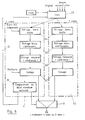
- the calculation of the bit rate used in the present invention is based on the nested hierarchical coding 67 described in the joint French patent application cited in the preamble.
- This parallel patent application describes a method for coding data for assistance in the reconstruction of an electronic image belonging to a sequence of images, in particular in HDTV, from a compressed image signal, the image signal compression process consisting in segmenting the image into substantially homogeneous blocks of variable sizes ixi all of whose points can be defined collectively, the possible sizes being classifiable in segmentation levels, from a minimum size of elementary blocks, each level corresponding to the grouping of four adjacent blocks of lower level, said compression process comprising a step of selecting, for each elementary image block, an optimal treatment from among several concurrent compression treatments performed in parallel, the treatments notably comprising on the one hand at least one image filtering treatment , and on the other hand at least one compression compensation by motion compensation, method characterized in that said assistance data essentially comprise, for each block, on the one hand a processing choice information item associated with a block segmentation information, and on the other hand, in the event of choice of compression processing by motion compensation for the current block, motion vector information representative of said block associated with block segmentation information, in that, in
- the coding 67 of the DAs for the 3-channel 62 is identical to that of the 4-channel 61 and can be carried out by the same modules by forcing the value of the error for the channel 4 to an arbitrarily high value in the choice module 63.
- the formatting of the assistance data for the 3 channels advantageously consists in transmitting 2 bits indicating the processing chosen between 3 for each of the elementary blocks.
- the resulting bit rate is 25,920 bits (because there are 12,960 elementary blocks in the image) and is always lower than the channel bit rate (around 30,000 bits / picture).
- the fact that the DA is transmitted for 4 channels or 3 channels is indicated to the decoder at the start of each image preferably in the form of a bit.
- This bit positioned at "1" indicates that the processing is normal (4-channel processing), and at "0" that there has been regulation (3-channel forcing).
- the transmission of this information is essential because the formatting of DA data is different in the two cases.
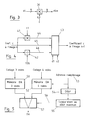
- the module for comparing to the maximum authorized flow rate shown diagrammatically in FIGS. 1 and 2 is the central module of the regulation.
- the embodiment illustrated in FIGS. 2 and 4 consists in generating in particular information d0, d1, d2 representative of the situation of the current flow 13 of the assistance data with respect to the thresholds S1, S2, S3.
- the bits d1 and d2 serve as selection values in a circuit 43 for choosing one of the multiplication channels 44, 45, 46 41, absence of specific processing, and division 42 respectively, of the coefficient c of artificial modification of the induced distortions on track 4.
- the choice module 63 the errors on the channels 1, 2, 3 and 4 are calculated which make it possible to make the choice of the optimal treatment: in the absence of forcing, this is the most inducing treatment low distortion in the reconstructed image.
- the error on channel 4 (called distortion d4) is systematically multiplied by C, and provides a modified distortion d4m.
Landscapes
- Engineering & Computer Science (AREA)
- Multimedia (AREA)
- Signal Processing (AREA)
- Compression Or Coding Systems Of Tv Signals (AREA)
Claims (8)
- Verfahren zur Regelung von Hilfsdatenraten, insbesondere der Hilfsdaten für die Rekonstruktion eines elektronischen Bildes aus einer Bilderfolge, insbesondere bei hochauflösendem Fernsehen, ausgehend von einem komprimierten Bildsignal,
wobei das Bildsignal-Kompressionsverfahren darin besteht, daß das Bild in annähernd homogene Blöcke verschiedener Größen segmentiert wird, wobei alle Punkte dieser Blöcke kollektiv definiert werden können, und wobei die möglichen Größen, ausgehend von einer kleinsten Elementarblockgröße, in Segmentierungsniveaus geordnet werden können, wobei jedes Niveau der Gruppierung von vier benachbarten Blöcken tieferen Niveaus entspricht,
wobei das besagte Kompressionsverfahren für jeden Elementarbildblock einen Auswahlschritt eines optimalen Verfahrens enthält, wobei die Auswahl zwischen mehreren parallel durchgeführten Konkurrenzverfahren und gemäß eines Kriteriums zur Minimierung der im rekonstruierten Bild induzierten psychovisuellen Verzerrungen erfolgt,
dadurch gekennzeichnet, daß die Hilfsdaten über einen spezifischen Sendekanal mit einer maximal zugelassenen Senderate gesendet werden,
daß die besagten Kompressionsverfahren durch die von ihnen erzeugten Hilfsdatenraten charakterisierbar sind, wobei die Verfahren insbesondere einerseits mindestens ein Verfahren mit geringem Hilfsdatenratenverbrauch enthalten, vom Typ einer einfachen Bildfiltrierung, welches eine Hilfsdatenrate erzeugt, die immer unterhalb der besagten zugelassenen Senderate bleibt, und andererseits mindestens ein Verfahren mit hohem Hilfsdatenratenverbrauch von der Art einer Bewegungskompensations-Kompression, die darin besteht, daß jedem Block ein Bewegungsvektor für die Rekonstruktion der Projektion des laufenden Blocks in das folgende Sequenzbild zugeordnet wird, wobei eine Hilfsdatenrate erzeugt wird, die größer sein kann, als die maximal zugelassene Senderate,
und daß die Auswahl, während des besagten Auswahlschritts für ein optimales Verfahren unter einem der Verfahren (11) mit geringem Hilfsdatenratenverbrauch, zwangsläufig erzwungen wird, wenn die besagte Hilfsdatenrate (13) sich der besagten zugelassenen Rate (10) nähert oder sie überschreitet, so daß die Hilfsdatenrate immer unterhalb der besagten maximal zugelassenen Rate bleibt. - Verfahren nach Anspruch 1, dadurch gekennzeichnet, daß die besagte Hilfsdatenrate der Menge an Hilfsdaten entspricht, die für eine vorher festgelegte Sendeeinheit gesendet werden, wobei besagte vorher festgestellte Sendeeinheit typischerweise aus einem Bild der besagten Bildsequenz besteht.
- Verfahren nach Anspruch 1, dadurch gekennzeichnet, daß die besagte Erzwingung der Optimalverfahrensauswahl darin besteht, daß die Auswahl eines Verfahrens mit geringem Hilfsdatenratenverbrauch für eine laufende Sendeeinheit erzwungen wird, wenn ein Überschreiten der maximal zugelassenen Rate für die vorhergehende Sendeeinheit erreicht wurde.
- Verfahren nach Anspruch 1, dadurch gekennzeichnet, daß die besagte Erzwingung der Optimalverfahrensauswahl in einer Modifizierung des Verfahrensauswahlkriteriums besteht, mit dem Zweck, die selektive Auswahl des Verfahrens mit hohem Hilfsdatenratenverbrauch für diejenigen Sendeeinheiten aufrechtzuerhalten, für welche das Verfahren den höchsten Optimierungsgrad aufweist.
- Verfahren nach Anspruch 4, für den Fall, daß die besagte Auswahl eines Optimalverfahrens gemäß eines Minimierungskriteriums für die im rekonstruierten Bilde induzierten psychovisuellen Verzerrungen ausgeführt wird, dadurch gekennzeichnet, daß die besagte Erzwingung darin besteht, den Wert der durch das besagte Verfahren mit hohem Hilfsdatenratenverbrauch induzierte Verzerrungen künstlich zu vergrößern, bzw. zu verringern.
- Verfahren nach Anspruch 4 oder 5, dadurch gekennzeichnet, daß die besagte Modifizierung des Verfahrensauswahlkriteriums selektiv gemäß eines Verhältnisses durchgeführt wird, welches unter mindestens zwei verschiedenen Modifizerungsverhältnissen ausgewählt wird, wobei ein Modifizierungsverhältnis angewandt wird, welches um so stärker ist, je höher die laufende Hilfsdatenrate ist.
- Verfahren nach einem der Ansprüche 1 bis 6, dadurch gekennzeichnet, daß die besagten Kompressionsverfahren folgendes enthalten:- drei lineare Filterungsverfahren mit geringem Hifsdatenratenverbrauch:* eine Filterung für Nullbewegungen;* eine Filterung für Bewegungen mittlerer Amplitude;* eine Filterung für Bewegungen großer Amplitude;- ein Verfahren, welches Bewegungskompensation mit hohem Hilfsdatenratenverbrauch verwendet.
- Verfahren nach einem der Ansprüche 1 bis 7, dadurch gekennzeichnet, daß eines der am Anfang eines jeden der besagten Bilder gesendeten Markierungsbits an einer der folgenden Stellen positioniert ist:- entweder bei "0", um anzuzeigen, daß die Verfahrensauswahl unter einem der Verfahren mit geringem Hilfsdatenratenverbrauch erzwungen wurde;- oder bei "1", falls die Auswahl nicht erzwungen wurde.
Applications Claiming Priority (2)
| Application Number | Priority Date | Filing Date | Title |
|---|---|---|---|
| FR8808705 | 1988-06-24 | ||
| FR8808705A FR2633477B1 (fr) | 1988-06-24 | 1988-06-24 | Procede de regulation de debit de donnees d'assistance a la reconstruction d'images electroniques animees sous-echantillonnees |
Publications (2)
| Publication Number | Publication Date |
|---|---|
| EP0348321A1 EP0348321A1 (de) | 1989-12-27 |
| EP0348321B1 true EP0348321B1 (de) | 1993-10-20 |
Family
ID=9367830
Family Applications (1)
| Application Number | Title | Priority Date | Filing Date |
|---|---|---|---|
| EP89460020A Expired - Lifetime EP0348321B1 (de) | 1988-06-24 | 1989-06-22 | Verfahren zur Regelung von Hilfsdatenraten für die Rekonstruktion unterabgetasteter, elektronischer Bilder |
Country Status (4)
| Country | Link |
|---|---|
| US (1) | US5041908A (de) |
| EP (1) | EP0348321B1 (de) |
| DE (1) | DE68910016T2 (de) |
| FR (1) | FR2633477B1 (de) |
Families Citing this family (3)
| Publication number | Priority date | Publication date | Assignee | Title |
|---|---|---|---|---|
| JPH06149990A (ja) * | 1992-11-02 | 1994-05-31 | Fujitsu Ltd | 画像圧縮方法及び画像処理装置 |
| US5512956A (en) * | 1994-02-04 | 1996-04-30 | At&T Corp. | Adaptive spatial-temporal postprocessing for low bit-rate coded image sequences |
| JP6724581B2 (ja) * | 2016-06-15 | 2020-07-15 | 富士通株式会社 | 画像符号化装置、方法、及びプログラム |
Family Cites Families (7)
| Publication number | Priority date | Publication date | Assignee | Title |
|---|---|---|---|---|
| JPS4929718A (de) * | 1972-07-19 | 1974-03-16 | ||
| US4605963A (en) * | 1983-08-15 | 1986-08-12 | Rca Corporation | Reduction of control bits for adaptive sub-nyquist encoder |
| US4745458A (en) * | 1984-11-21 | 1988-05-17 | Hitachi, Ltd. | Television signal processing system |
| US4862264A (en) * | 1985-12-24 | 1989-08-29 | British Broadcasting Corporation | Method of coding a video signal for transmission in a restricted bandwidth |
| EP0263112B1 (de) * | 1986-03-19 | 1992-06-03 | British Broadcasting Corporation | Videosignal-verarbeitung für bandbreitenverringerung |
| FR2606576B1 (fr) * | 1986-11-07 | 1989-02-03 | Labo Electronique Physique | Dispositif pour transmettre des images de television haute definition dans des canaux a bande etroite |
| EP0285902A3 (de) * | 1987-04-07 | 1990-10-10 | Siemens Aktiengesellschaft | Verfahren zur Datenreduktion digitaler Bildsequenzen |
-
1988
- 1988-06-24 FR FR8808705A patent/FR2633477B1/fr not_active Expired - Lifetime
-
1989
- 1989-06-21 US US07/369,466 patent/US5041908A/en not_active Expired - Fee Related
- 1989-06-22 EP EP89460020A patent/EP0348321B1/de not_active Expired - Lifetime
- 1989-06-22 DE DE89460020T patent/DE68910016T2/de not_active Expired - Fee Related
Non-Patent Citations (1)
| Title |
|---|
| PROCEEDINGS: ICASSP 87 - 1987 International Conference on Acoustics, Speech, and Signal Processing, Dallas, Texas, 6-9 April 1987 vol. 2 of 4, pages 1051-1054 * |
Also Published As
| Publication number | Publication date |
|---|---|
| US5041908A (en) | 1991-08-20 |
| DE68910016T2 (de) | 1994-05-05 |
| EP0348321A1 (de) | 1989-12-27 |
| DE68910016D1 (de) | 1993-11-25 |
| FR2633477B1 (fr) | 1990-11-09 |
| FR2633477A1 (fr) | 1989-12-29 |
Similar Documents
| Publication | Publication Date | Title |
|---|---|---|
| EP0247075B1 (de) | Hybrid-kodierungssystem durch umwandlung zur bildübertragung | |
| EP0349454B1 (de) | Verfahren zur Kodierung von Hilfsdaten für die Rekonstruktion eines unterabgetasteten, elektronischen Bildes | |
| EP0448491B1 (de) | Verfahren zur Kodierung und Übertragung von digitalen Bildern einer Bildsequenz mit mindestens zwei Qualitätsniveaus und zugehörige Geräte | |
| US5724451A (en) | Image compression method and apparatus using conditional quadtree split sysyem | |
| EP0248711B1 (de) | Verfahren zur Transformationskodierung für die Übertragung von Bildsignalen | |
| JP7827922B2 (ja) | 特徴データ符号化および復号方法および装置 | |
| FR2701186A1 (fr) | Système pour comprimer et décomprimer des données numériques d'images. | |
| FR2753330A1 (fr) | Procede de quantification pour codage video | |
| FR2759802A1 (fr) | Procede de filtrage adaptatif de signaux et filtre adaptatif de signaux | |
| EP0406074A1 (de) | Verfahren zur Teilung des Bewegungsfeldes eines Bildes zum Kodieren eines Videobildes | |
| EP0782339B1 (de) | Verfahren und Vorrichtung zur Kompression von digitalen Daten | |
| FR2755818A1 (fr) | Codage de signal numerique par decomposition en sous-bandes de frequence et quantification vectorielle a etats finis | |
| EP0332553B1 (de) | Verfahren zur Wiederzuordnung der Wahl eines Unterabtastungsverfahrens nach dem Kriterium einer Datenraten-Reduktion einer Folge von Hilfsdaten, die zur Rekonstruktion eines unterabgetasteten, elektronischen Bildes dienen | |
| EP0490799A1 (de) | Bildkodierungsvorrichtung und -verfahren und zugehöriges Sendesystem und Empfänger | |
| EP0117161B1 (de) | Verfahren und Einrichtung zur digitalen Kodierung eines Bildes, insbesondere eines Fernsehbildes | |
| EP0545475B1 (de) | Verfahren und Einrichtung zur Restitution von Textursignalen | |
| EP0276603A1 (de) | Kodierungs- und Übertragungsverfahren eines digitalen Signals durch zeitlich selektive Auffrischung eines vektoriellen Quantifizierers | |
| EP0348321A1 (de) | Verfahren zur Regelung von Hilfsdatenraten für die Rekonstruktion unterabgetasteter, elektronischer Bilder | |
| FR2503966A1 (fr) | Procede de transmission d'une image, a debit reduit; systeme de transmission pour la mise en oeuvre de ce procede | |
| FR2597282A1 (fr) | Procede de quantification dans un codage par transformation pour la transmission de signaux d'image | |
| EP0456804B1 (de) | Bildkompressionsverfahren durch autoorganisation von einem neuronalen netz | |
| WO2006053842A1 (fr) | Procede de codage d'images codees par ondelettes a controle de debit, dispositif de codage et programme d'ordinateur correspondants | |
| FR2654285A1 (fr) | Systeme de compression d'images numeriques appartenant a une sequence d'images, a quantification adaptative en fonction d'une information psychovisuelle. | |
| EP0524871B1 (de) | Verfahren zur adaptiven hybriden Kodierung von Signalen | |
| FR2728129A1 (fr) | Dispositif de multiplexage numerique de programmes video |
Legal Events
| Date | Code | Title | Description |
|---|---|---|---|
| PUAI | Public reference made under article 153(3) epc to a published international application that has entered the european phase |
Free format text: ORIGINAL CODE: 0009012 |
|
| AK | Designated contracting states |
Kind code of ref document: A1 Designated state(s): DE GB NL |
|
| 17P | Request for examination filed |
Effective date: 19900530 |
|
| 17Q | First examination report despatched |
Effective date: 19920402 |
|
| RAP1 | Party data changed (applicant data changed or rights of an application transferred) |
Owner name: TELEDIFFUSION DE FRANCE S.A. Owner name: FRANCE TELECOM |
|
| GRAA | (expected) grant |
Free format text: ORIGINAL CODE: 0009210 |
|
| AK | Designated contracting states |
Kind code of ref document: B1 Designated state(s): DE GB NL |
|
| REF | Corresponds to: |
Ref document number: 68910016 Country of ref document: DE Date of ref document: 19931125 |
|
| GBT | Gb: translation of ep patent filed (gb section 77(6)(a)/1977) |
Effective date: 19931231 |
|
| PG25 | Lapsed in a contracting state [announced via postgrant information from national office to epo] |
Ref country code: GB Effective date: 19940622 |
|
| PLBE | No opposition filed within time limit |
Free format text: ORIGINAL CODE: 0009261 |
|
| STAA | Information on the status of an ep patent application or granted ep patent |
Free format text: STATUS: NO OPPOSITION FILED WITHIN TIME LIMIT |
|
| 26N | No opposition filed | ||
| PG25 | Lapsed in a contracting state [announced via postgrant information from national office to epo] |
Ref country code: NL Effective date: 19950101 |
|
| GBPC | Gb: european patent ceased through non-payment of renewal fee |
Effective date: 19940622 |
|
| NLV4 | Nl: lapsed or anulled due to non-payment of the annual fee | ||
| PG25 | Lapsed in a contracting state [announced via postgrant information from national office to epo] |
Ref country code: DE Effective date: 19950301 |