EP0348215A2 - Novel cosmetic and paramedicinal compositions - Google Patents
Novel cosmetic and paramedicinal compositions Download PDFInfo
- Publication number
- EP0348215A2 EP0348215A2 EP89306371A EP89306371A EP0348215A2 EP 0348215 A2 EP0348215 A2 EP 0348215A2 EP 89306371 A EP89306371 A EP 89306371A EP 89306371 A EP89306371 A EP 89306371A EP 0348215 A2 EP0348215 A2 EP 0348215A2
- Authority
- EP
- European Patent Office
- Prior art keywords
- weight
- aqueous
- extract
- ethanol
- composition
- Prior art date
- Legal status (The legal status is an assumption and is not a legal conclusion. Google has not performed a legal analysis and makes no representation as to the accuracy of the status listed.)
- Granted
Links
Images


Classifications
-
- A—HUMAN NECESSITIES
- A61—MEDICAL OR VETERINARY SCIENCE; HYGIENE
- A61Q—SPECIFIC USE OF COSMETICS OR SIMILAR TOILETRY PREPARATIONS
- A61Q19/00—Preparations for care of the skin
- A61Q19/10—Washing or bathing preparations
-
- A—HUMAN NECESSITIES
- A61—MEDICAL OR VETERINARY SCIENCE; HYGIENE
- A61K—PREPARATIONS FOR MEDICAL, DENTAL OR TOILETRY PURPOSES
- A61K36/00—Medicinal preparations of undetermined constitution containing material from algae, lichens, fungi or plants, or derivatives thereof, e.g. traditional herbal medicines
- A61K36/18—Magnoliophyta (angiosperms)
- A61K36/185—Magnoliopsida (dicotyledons)
- A61K36/28—Asteraceae or Compositae (Aster or Sunflower family), e.g. chamomile, feverfew, yarrow or echinacea
-
- A—HUMAN NECESSITIES
- A61—MEDICAL OR VETERINARY SCIENCE; HYGIENE
- A61K—PREPARATIONS FOR MEDICAL, DENTAL OR TOILETRY PURPOSES
- A61K36/00—Medicinal preparations of undetermined constitution containing material from algae, lichens, fungi or plants, or derivatives thereof, e.g. traditional herbal medicines
- A61K36/18—Magnoliophyta (angiosperms)
- A61K36/185—Magnoliopsida (dicotyledons)
- A61K36/48—Fabaceae or Leguminosae (Pea or Legume family); Caesalpiniaceae; Mimosaceae; Papilionaceae
-
- A—HUMAN NECESSITIES
- A61—MEDICAL OR VETERINARY SCIENCE; HYGIENE
- A61K—PREPARATIONS FOR MEDICAL, DENTAL OR TOILETRY PURPOSES
- A61K36/00—Medicinal preparations of undetermined constitution containing material from algae, lichens, fungi or plants, or derivatives thereof, e.g. traditional herbal medicines
- A61K36/18—Magnoliophyta (angiosperms)
- A61K36/185—Magnoliopsida (dicotyledons)
- A61K36/52—Juglandaceae (Walnut family)
-
- A—HUMAN NECESSITIES
- A61—MEDICAL OR VETERINARY SCIENCE; HYGIENE
- A61K—PREPARATIONS FOR MEDICAL, DENTAL OR TOILETRY PURPOSES
- A61K36/00—Medicinal preparations of undetermined constitution containing material from algae, lichens, fungi or plants, or derivatives thereof, e.g. traditional herbal medicines
- A61K36/18—Magnoliophyta (angiosperms)
- A61K36/185—Magnoliopsida (dicotyledons)
- A61K36/73—Rosaceae (Rose family), e.g. strawberry, chokeberry, blackberry, pear or firethorn
-
- A—HUMAN NECESSITIES
- A61—MEDICAL OR VETERINARY SCIENCE; HYGIENE
- A61K—PREPARATIONS FOR MEDICAL, DENTAL OR TOILETRY PURPOSES
- A61K36/00—Medicinal preparations of undetermined constitution containing material from algae, lichens, fungi or plants, or derivatives thereof, e.g. traditional herbal medicines
- A61K36/18—Magnoliophyta (angiosperms)
- A61K36/185—Magnoliopsida (dicotyledons)
- A61K36/77—Sapindaceae (Soapberry family), e.g. lychee or soapberry
-
- A—HUMAN NECESSITIES
- A61—MEDICAL OR VETERINARY SCIENCE; HYGIENE
- A61K—PREPARATIONS FOR MEDICAL, DENTAL OR TOILETRY PURPOSES
- A61K8/00—Cosmetics or similar toiletry preparations
- A61K8/18—Cosmetics or similar toiletry preparations characterised by the composition
- A61K8/92—Oils, fats or waxes; Derivatives thereof, e.g. hydrogenation products thereof
- A61K8/922—Oils, fats or waxes; Derivatives thereof, e.g. hydrogenation products thereof of vegetable origin
-
- A—HUMAN NECESSITIES
- A61—MEDICAL OR VETERINARY SCIENCE; HYGIENE
- A61K—PREPARATIONS FOR MEDICAL, DENTAL OR TOILETRY PURPOSES
- A61K8/00—Cosmetics or similar toiletry preparations
- A61K8/18—Cosmetics or similar toiletry preparations characterised by the composition
- A61K8/96—Cosmetics or similar toiletry preparations characterised by the composition containing materials, or derivatives thereof of undetermined constitution
- A61K8/97—Cosmetics or similar toiletry preparations characterised by the composition containing materials, or derivatives thereof of undetermined constitution from algae, fungi, lichens or plants; from derivatives thereof
- A61K8/9783—Angiosperms [Magnoliophyta]
- A61K8/9789—Magnoliopsida [dicotyledons]
-
- A—HUMAN NECESSITIES
- A61—MEDICAL OR VETERINARY SCIENCE; HYGIENE
- A61K—PREPARATIONS FOR MEDICAL, DENTAL OR TOILETRY PURPOSES
- A61K8/00—Cosmetics or similar toiletry preparations
- A61K8/18—Cosmetics or similar toiletry preparations characterised by the composition
- A61K8/96—Cosmetics or similar toiletry preparations characterised by the composition containing materials, or derivatives thereof of undetermined constitution
- A61K8/97—Cosmetics or similar toiletry preparations characterised by the composition containing materials, or derivatives thereof of undetermined constitution from algae, fungi, lichens or plants; from derivatives thereof
- A61K8/9783—Angiosperms [Magnoliophyta]
- A61K8/9794—Liliopsida [monocotyledons]
-
- A—HUMAN NECESSITIES
- A61—MEDICAL OR VETERINARY SCIENCE; HYGIENE
- A61Q—SPECIFIC USE OF COSMETICS OR SIMILAR TOILETRY PREPARATIONS
- A61Q19/00—Preparations for care of the skin
-
- A—HUMAN NECESSITIES
- A61—MEDICAL OR VETERINARY SCIENCE; HYGIENE
- A61Q—SPECIFIC USE OF COSMETICS OR SIMILAR TOILETRY PREPARATIONS
- A61Q5/00—Preparations for care of the hair
- A61Q5/02—Preparations for cleaning the hair
-
- A—HUMAN NECESSITIES
- A61—MEDICAL OR VETERINARY SCIENCE; HYGIENE
- A61Q—SPECIFIC USE OF COSMETICS OR SIMILAR TOILETRY PREPARATIONS
- A61Q19/00—Preparations for care of the skin
- A61Q19/005—Preparations for sensitive skin
-
- A—HUMAN NECESSITIES
- A61—MEDICAL OR VETERINARY SCIENCE; HYGIENE
- A61Q—SPECIFIC USE OF COSMETICS OR SIMILAR TOILETRY PREPARATIONS
- A61Q19/00—Preparations for care of the skin
- A61Q19/007—Preparations for dry skin
Definitions
- the present invention relates to a cosmetic and paramedicinal composition with an increased effect, particularly with an antiinflammatory or skin-calming effect.
- the aim of the present invention is to develop a combination of active ingredients consisting of plant extracts of native origin which may be capable of exceeding the prior art product(s) in one or more indications.
- the invention is based on the recognition that a combination of active ingredients with an increased action can be composed by omitting or replacing the components defined in the patent specification cited above as well as varying the ratio of the original components.
- the invention relates to an active ingredient composition, preferably with an antiinflammatory and skin-calming effect, respectively, which comprises on the basis of its dry substance content 0.005 to 5.0% by weight of an aqueous-ethanolic extract of Marigold, 0.005 to 2.0% by weight of an aqueous-ethanolic extract of Horse-chestnut, 0.005 to 2.0% by weight of an aqueous-ethanolic extract of Liquorice (sweet-root), 0.005 to 2.0% by weight of an aqueous Silver-weed extract, 0.005 to 2.0% by weight of an aqueous extract of Walnut-tree leaves, 0.002 to 1.0% by weight of Lavender resinoid and 0.001 to 0.2% by weight of Roman camomile oil as calculated for the total weight; as well as 85 to 99% by weight of a 35 to 60% by weight ethanol-water mixture as carrier.
- the invention further relates to cosmetic preparations, paramedicinal cosmetics and paramedicinal products containing 1 to 50% by weight of the above composition and optionally 0.01 to 0.5% by weight of menthol, 0.02 to 0.5% by weight of citric acid, 0.02 to 1.0% by weight of d-panthenol, 0.05 to 0.5% by weight of allantoin, 0.05 to 2.0% by weight of 2,4,4′-trichloro-2-hydroxydiphenyl ether, 0.5 to 5.0% by weight of a natural moisturizing factor and 0.5 to 50.0% by weight of ethanol as active ingredients and partly as a carrier in the case of ethanol; furthermore vehicles, additives and auxiliary materials, preferably water, glycerol, propylene glycol, polyethylene glycol, polyoxyethylene-sobitan fatty acid esters, wax alcohols, coconut fatty acid diethanolamide, coconut fatty acid-propyl-betaine as well as solubilizing, stabilizing agents and flavour compositions in an
- Marigold (Calendula officinalis) contains flavonoids, saponines, phytosterols and ethereal oil.
- the tincture or tea prepared from Marigold is internally used for preventing stomach and intestinal ulcers, externally for the treatment of difficultly healing wounds as well as for vaginal irrigation and abolishment of vaginal fluor (c. f. Mrs. Verzár: "Medical Plants in the Therapy” /in Hungarian/, Medicina, Budapest 1984 , page 58; and H. A. Hoppe: "Drogen ambience”, de Gruyter Verlag, Berlin 1981 , page 480).
- the crop of the Horse-chestnut (Aesculus hyppocastanum) contains aescin, quercetin, caempherol as well as flavonoids and cumarin derivatives.
- the extracts prepared from Horse-chestnut show anti-exudative properties and diminish the fragility of the blood vessels wall.
- Standardized compositions containing aescin are used for the treatment of lymphatic congestions, cerebral and lung oedemas as well as crural ulcer and hemorrhoid status (Mrs. Verzár in her work cited above, page 92; as well as Hope in this work cited above, page 10).
- the extracts of Liquorice are used as sweetening agent, seasoning agent and eventually as an expectorant (c.f. Issekutz in: "Prescription of Medicaments” /in Hungarian/, Medicina, Budapest 1972 , page 578).
- the increased tone of the stomach wall and the inflammatory state of the gastric mucosa can be diminished (c.f. Mrs. Verzár in her work cited above, pages 92 and 93).
- the brew of Silver-weed is chiefly used internally as a spasmolytic agent (c. f. e. g. H-D. Braun: "Heil esse-Lexikon für ⁇ vide and maschiner", G. Fischer Verlag, Stuttgart 1974 , page 155).
- the aqueous extract of Walnut-tree leaves is used as an antiinflammatory agent.
- the teas prepared in the usual way are used for treating skin diseases and skin inflammations (M. Pahlow: "Das grosse Buch der Heilesse", Gräfe und Unzer GmbH, Ober 1979 , page 344). Rarely, it is employed as a packing agent against ophthalmitis as well as for face-care.
- Lavender Lavendula officinalis seu vera
- Lavender aqueous brew
- the Roman camomile (Anthemis norbilis) is a popular medicinal plant in several countries, e. g. France, where it has been introduced to the Pharmacopea, too. Except of a common component, i.e. camazulene, its composition is strongly different from that of the camomile oil; angelic acid and capric acid matricaria esters being its main constituents. It is widely used as a carminative and digestion-promoting agent; it is a particularly popular spasmolytic for treating the spastic con ditions of the gastrointestinal tract (c. f. e. g. Mrs. Verzár in her work cited above, page 55).
- the main active ingredients of the above 7 medicinal plants i.e. flavonoids, tannic acids, aescin, glycyrrhizin and glycyrrhetic acid prepared in a native or artificial way, are used also in themselves in the form of concentrates or as the pure substance as active ingredients for cosmetics, para-medicaments and medicaments.
- Concerning the tanning agents see the above-cited work of B. Issekutz (page 605). Many data on the other products are found in the "Rote Liste 1977/88", Bundesvious der Pharm. Industrie, Frankfurt 1978 ; as well as in A. Y. Leung: “Encyclopedia of Common Natural Ingredients", Wiley-Interscience Publ., New York 1980 .
- composition according to the invention are being used in the medicinal, cosmetical and popular medicinal practice though with a varying frequency; however, no composition corresponding or similar to the active ingredient composition according to the invention can be found in the descriptions published up to now.
- composition according to the invention has been increased by the changes in the content in an unexpected way and extent in several directions.
- the outstanding effect of this novel composition consists in a multiplied antiinflammatory and calming effect.
- the antiinflammatory action was studied on female CFY rats in such a way that an oedema-inducing agent (carrageenan or serotonin, respectively) was subplanetarily injected under the paw skin to elicit an oedema and then the volume of the paw was measured by a pletysmograph.
- the antiinflammatory agent was intraperitoneally administered to the animals 30 minutes before the administration of the inflammation-inducing agent.
- the oedema developed was evaluated in the 5th or 1st hour, respectively, following the administration of the above two substances.
- the granulation-promoting action of the composition (signed by A in Figure 3) can also be considered since it, based on the total number of the loosened scabs, abbreviated the healing of burns (elicited by focused light) by 2 days in comparison to physiological saline (signed by D in Figure 3).
- the examinations were similarly carried out on CFY rats.
- the burn was induced by a Tungsram 8V 50 W projector glow-lamp used in the tail-flick equipment.
- the light source was placed in a distance of 4 cm and the treatment lasted 4 seconds.
- 3 wounds each were inflicted on the unhaired skin of the animals 24 hours following the depilation.
- the treatment was continued daily twice until loosening of the last scab.
- the novel composition can be used for the treatment of hemorrhoids and other rectal complaints, burns, chiefly for curing inflammations following the burns by sun; for treatment of inflammations induced by chapping, abrasion simultaneously accompanied by epithelial lesions.
- inflammations induced by chapping, abrasion simultaneously accompanied by epithelial lesions.
- the composition according to the invention can preferably be used as an industrial protective composition; as a product serving the mass sports; and in some relations of treatment of the dry and sensitive skin such as in calming baths, shower shampoos, hair-tonics for sensitive and scaly skin and the like.
- the preparations containing the original composition serve also for prevention, in addition to treatment.
- Marigold Calendula officinalis flos
- the flowers are defatted by solvents (chloroform, methylene chloride) and removing the solvents the flowers are extracted by mixing with 40% aqueous ethanol under vigorous stirring for 2 hours. Thereupon the extract is poured off, the drug is thoroughly pressed out and the combined extract is adjusted to an 1.6:10 ratio of the drug to the extract. The extract is left to stand at -15 o C for 24 hours and then filtered to clear.
- solvents chloroform, methylene chloride
- the prescription involves a dry substance content of 6.5 to 7.5% for the final product and the dry substance should contain over 10% of aescin.
- the ethanol content amounts to 56 to 60%.
- the extract is prepared by extracting the dried and pulverized root of Glycyrrhiza glabra with 50% ethanol.
- the drug is extracted by an about 10fold amount of 50% ethanol while vigorous stirring for 2 hours. Then, the extract is filtered off, the filtrate is diluted to a 4:10 ratio of the drug to the extract by using 50% ethanol and then filtered to clear.
- the extract is always prepared in a fresh state and used for preparing the complex within 2 to 3 days.
- the dried leaves of Juglans regia L. are soaked in a 10fold amount of water suitably at a temperature of 55 o C. After maintaining this temperature for 4 hours and then filtering off, the aqueous extract is suitably evaporated under a pressure of 6 kPa.
- the given species does not grow in a wild form in Hungary but its improved variety is cultivated.
- the oil should not contain any plant protective agent in an amount detectable by gas-liquid chromatography.
- the plant material is treated in stainless steel vessel equipped with a distilling pipe and cooling coil by steam under a pressure of 300 to 400 kPa at optimum distillation rate of 80 to 100 litres/hour.
- the ethereal oil is taken up in Florentini glass bottles.
- the Marigold extract After dissolving the Lavender resinoid and Roman camomile oil in the weighed amount of 96% ethanol, the Marigold extract, optionally the Liquorice extract as well as the Horse-chestnut extract are added to the solution under stirring.
- the extract concentrates of the Walnut-tree leaves and Silver-weed are dissolved in distilled water or aqueous ethanol and the additive thus-obtained is mixed with the solution containing the other components.
- the alcohol content of the system is suitably adjusted to 50% by weight and then filtered. After a storage of 2 to 3 days, the preparation is filtered to completely clear.
- the total amount of the active ingredients is given for the total weight of the active ingredients and aqueous ethanol. Based on this definition, the total active ingredient content can amount to 2 to 50% by weight as calculated for the total weight of the composition.
- the creams are prepared from three phases, i.e. from the so-called phases A, B and C.
- the components of the separate phases are defined in tables.
- the phase B is preheated to a temperature between 67 and 82 o C, the phase A is added at an approximately similar temperature under stirring, then the mixture is stirred mostly at a high speed of rotation without cooling. Thereupon, the stirring is continued at a lower rotation speed while beginning the gradual cooling of the mixture.
- the temperature of the system reaches about 50 o C, the phase C is added under stirring and the stirring is continued until the mixture is cooled down.
- the liquid emulsions are prepared from two main phases (A and B) and two or three additive phases (C and E and C, D and E, respectively).
- the composition of the phases are indicated below.
- the materials of the fatty phase A are melted together under stirring at a temperature of about 70 o C.
- the aqueous phase B is prepared in such a way that the "cold" distilled water is mixed with the propylene glycol or glycerol and the carboxyvinyl copolymer (additive phase C) is swollen or dissolved, respectively, therein.
- the aqueous phase is mixed with the fatty phase while stirring.
- an aqueous solution of sodium hydroxide (phase D) is optionally (Example 6) added to the system.
- the emulsion is started to cool under constant stirring and the additive phase E, i.e. the medicinal plant composition is added to the emulsion at a temperature of about 50 o C.
- the stirring is continued until the mixture cools down.
- the 3 liquid emulsions are suggested to be used as a sport milk, as a body hygienic composition for men and as a calming emulsion against burns, respectively.
- Additive phase C Carboxyvinyl copolymer - 0.15 0.5
- Additive phase D Sodium hydroxide - 0.04 0.2
- Additive phase E Medicinal plant combination 5 c 3 a 8 d Menthol 0.1 - - Natural moisturizing factor - 2 - d-Panthenol - - 0.5 Fragrance 0.2 0.2 0.1
- the washactive concentrates are usually prepared from 4 phases.
- Phase A is prepared by mixing the components in the above succession; then phase B is added and thoroughly mixed therein. After adding the following phase C, i.e. the active ingredient combination, the mixture is stirred for 5 minutes.
- Phase 4 is the aqueous solution of sodium lauryl ether sulfate which is similarly mixed under stirring to the system.
- compositions can be used for the preparation of a calming foam bath, sport and home douche shampoo, respectively.
- Phase A Coconut fatty acid amide propylbetaine (50%) 15 20 - Propylene glycol ether sulfosuccinate (40%) - - 30
- Distilled water 42.2 23.7 30.2 Alkyl ether sulfate and a composition ensuring pearly lustre - 3 5
- Phase B Polyethylene glycol glyceryl monococoate 2 3 3
- Flavour composition 0.8 0.5 0.5 Phase C Medical plant combination 5 c 10 d 3 f Phase D Sodium lauryl ether sulfate (30%) 30 40 25
- Solution compositions which can be formulated as cloth, spray and painting preparations.
- These products can be prepared by mixing the components.
- the succession of mixing can be carried out according to the list given below.
- the solutions prepared are filtered in a suitable filtering device, e.g. on a Seitz filter directly after preparation, more preferably after standing for 24 hours.
Landscapes
- Health & Medical Sciences (AREA)
- Life Sciences & Earth Sciences (AREA)
- Natural Medicines & Medicinal Plants (AREA)
- Veterinary Medicine (AREA)
- Public Health (AREA)
- General Health & Medical Sciences (AREA)
- Animal Behavior & Ethology (AREA)
- Epidemiology (AREA)
- Mycology (AREA)
- Microbiology (AREA)
- Botany (AREA)
- Biotechnology (AREA)
- Engineering & Computer Science (AREA)
- Chemical & Material Sciences (AREA)
- Alternative & Traditional Medicine (AREA)
- Birds (AREA)
- Medical Informatics (AREA)
- Medicinal Chemistry (AREA)
- Pharmacology & Pharmacy (AREA)
- Dermatology (AREA)
- Oil, Petroleum & Natural Gas (AREA)
- Cosmetics (AREA)
- Medicines Containing Plant Substances (AREA)
Abstract
0.005 to 5.0% by weight of an aqueous-ethanolic extract of Marigold,
0.005 to 2.0% by weight of an aqueous-ethanolic extract of Horse-chestnut
0.005 to 2.0% by weight of an aqueous-ethanolic extract of Liquorice (sweet-root),
0.005 to 2.0% by weight of an aqueous Silver-weed extract,
0.005 to 2.0% by weight of an aqueous extract of Walnut-tree leaves,
0.002 to 1.0% by weight of Lavender resinoid and
0.001 to 0.2% by weight of Roman camomile oil
as calculated for the total weight; as well as
85 to 99% by weight of a 35 to 60% by weight ethanol-water mixture as carrier.
Description
- The present invention relates to a cosmetic and paramedicinal composition with an increased effect, particularly with an antiinflammatory or skin-calming effect.
- It is known that, in the last decade, cosmetic research shows a preference for medicinal plants and their extracts. In many cases, an unexpected surplus effect could be proved by the common use of preparations and extracts earlier used in the popular medicine or scientific therapy.
- A good example of such a recognition is represented by the composition consisting of 5 or 10, respectively, various medicinal extracts which has formed the basis of the successful product family commercially available under the trade name "Richtofit" and which was described in the Hungarian patent specification No. 190,391.
- Our research work has been aimed to develop a more effective composition starting from the above principle.
- Thus, the aim of the present invention is to develop a combination of active ingredients consisting of plant extracts of native origin which may be capable of exceeding the prior art product(s) in one or more indications.
- The invention is based on the recognition that a combination of active ingredients with an increased action can be composed by omitting or replacing the components defined in the patent specification cited above as well as varying the ratio of the original components.
- Thus, the invention relates to an active ingredient composition, preferably with an antiinflammatory and skin-calming effect, respectively, which comprises on the basis of its dry substance content
0.005 to 5.0% by weight of an aqueous-ethanolic extract of Marigold,
0.005 to 2.0% by weight of an aqueous-ethanolic extract of Horse-chestnut,
0.005 to 2.0% by weight of an aqueous-ethanolic extract of Liquorice (sweet-root),
0.005 to 2.0% by weight of an aqueous Silver-weed extract,
0.005 to 2.0% by weight of an aqueous extract of Walnut-tree leaves,
0.002 to 1.0% by weight of Lavender resinoid and
0.001 to 0.2% by weight of Roman camomile oil
as calculated for the total weight; as well as
85 to 99% by weight of a 35 to 60% by weight ethanol-water mixture as carrier. - The invention further relates to cosmetic preparations, paramedicinal cosmetics and paramedicinal products containing
1 to 50% by weight of the above composition and optionally
0.01 to 0.5% by weight of menthol,
0.02 to 0.5% by weight of citric acid,
0.02 to 1.0% by weight of d-panthenol,
0.05 to 0.5% by weight of allantoin,
0.05 to 2.0% by weight of 2,4,4′-trichloro-2-hydroxydiphenyl ether,
0.5 to 5.0% by weight of a natural moisturizing factor and
0.5 to 50.0% by weight of ethanol
as active ingredients and partly as a carrier in the case of ethanol; furthermore
vehicles, additives and auxiliary materials, preferably water, glycerol, propylene glycol, polyethylene glycol, polyoxyethylene-sobitan fatty acid esters, wax alcohols, coconut fatty acid diethanolamide, coconut fatty acid-propyl-betaine as well as solubilizing, stabilizing agents and flavour compositions in an amount of 50 to 98% by weight
in the form of e.g. a cream, liquid emulsion, lotion, bath and shampoo compositions with a washing active effect, spray, wet wipes or drops. - Concerning the components of the composition of the invention it is known from the literature that the Marigold (Calendula officinalis) contains flavonoids, saponines, phytosterols and ethereal oil. The tincture or tea prepared from Marigold is internally used for preventing stomach and intestinal ulcers, externally for the treatment of difficultly healing wounds as well as for vaginal irrigation and abolishment of vaginal fluor (c. f. Mrs. Verzár: "Medical Plants in the Therapy" /in Hungarian/, Medicina, Budapest 1984, page 58; and H. A. Hoppe: "Drogenkunde", de Gruyter Verlag, Berlin 1981, page 480).
- The crop of the Horse-chestnut (Aesculus hyppocastanum) contains aescin, quercetin, caempherol as well as flavonoids and cumarin derivatives. The extracts prepared from Horse-chestnut show anti-exudative properties and diminish the fragility of the blood vessels wall. Standardized compositions containing aescin are used for the treatment of lymphatic congestions, cerebral and lung oedemas as well as crural ulcer and hemorrhoid status (Mrs. Verzár in her work cited above, page 92; as well as Hope in this work cited above, page 10).
- Based on their characteristic sweetish taste, the extracts of Liquorice (Glycyrrhiza glabra) are used as sweetening agent, seasoning agent and eventually as an expectorant (c.f. Issekutz in: "Prescription of Medicaments" /in Hungarian/, Medicina, Budapest 1972, page 578). By the systematic use of the standardized preparations, the increased tone of the stomach wall and the inflammatory state of the gastric mucosa can be diminished (c.f. Mrs. Verzár in her work cited above, pages 92 and 93).
- The brew of Silver-weed is chiefly used internally as a spasmolytic agent (c. f. e. g. H-D. Braun: "Heil pflanzen-Lexikon für Ärzte and Apotheker", G. Fischer Verlag, Stuttgart 1974, page 155).
- The aqueous extract of Walnut-tree leaves is used as an antiinflammatory agent. The teas prepared in the usual way (in the form of decoctions or brews) are used for treating skin diseases and skin inflammations (M. Pahlow: "Das grosse Buch der Heilpflanzen", Gräfe und Unzer GmbH, München 1979, page 344). Rarely, it is employed as a packing agent against ophthalmitis as well as for face-care.
- The use of the ethereal oil of Lavender (Lavendula officinalis seu vera) is known: it is preferably used in refreshing, stimulating and antirheumatic baths. Its aqueous brew is used for packing in the popular medicine (for its use, c.f. M. Pahlow in his work cited above, page 213).
- The Roman camomile (Anthemis norbilis) is a popular medicinal plant in several countries, e. g. France, where it has been introduced to the Pharmacopea, too. Except of a common component, i.e. camazulene, its composition is strongly different from that of the camomile oil; angelic acid and capric acid matricaria esters being its main constituents. It is widely used as a carminative and digestion-promoting agent; it is a particularly popular spasmolytic for treating the spastic con ditions of the gastrointestinal tract (c. f. e. g. Mrs. Verzár in her work cited above, page 55).
- Further on, it should also be noted that the main active ingredients of the above 7 medicinal plants, i.e. flavonoids, tannic acids, aescin, glycyrrhizin and glycyrrhetic acid prepared in a native or artificial way, are used also in themselves in the form of concentrates or as the pure substance as active ingredients for cosmetics, para-medicaments and medicaments. Concerning the tanning agents, see the above-cited work of B. Issekutz (page 605). Many data on the other products are found in the "Rote Liste 1977/88", Bundesverband der Pharm. Industrie, Frankfurt 1978; as well as in A. Y. Leung: "Encyclopedia of Common Natural Ingredients", Wiley-Interscience Publ., New York 1980.
- Thus, according to the literature, the individual components of the composition according to the invention are being used in the medicinal, cosmetical and popular medicinal practice though with a varying frequency; however, no composition corresponding or similar to the active ingredient composition according to the invention can be found in the descriptions published up to now.
- Concerning the composition the preparation described in the Hungarian patent specification No. 190,391 cited above stands most close wherein 4 compo nents are identical with the components of the composition according to the present invention although the concentration ranges and the ratio of the components are different. In the patent specification cited above, 6 other components, i. e. willow-wood bark extract, oak-tree extract, garden sage extract, hop-concentrate, camomile oil and camomile extract, are described. The active ingredient content of the present invention is supplemented by 3 novel components in comparison to that described earlier: these are the extracts of the Marigold, Horse-chestnut and Liquorice.
- The activity of the composition according to the invention has been increased by the changes in the content in an unexpected way and extent in several directions. The outstanding effect of this novel composition consists in a multiplied antiinflammatory and calming effect.
- Two representative compositions, i. e. a composition containing 5 components and one containing 10 components, respectively, of the Hungarian patent specification No. 190,391 were examined in comparison to the active ingredient composition of 7 components according to the present invention. The results can briefly be summarized as follows.
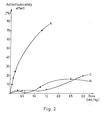
- In the case of inhibition of the carrageenan (viscarin) oedema, the antiinflammatory effect of the novel composition was 5 to 20 times as high (i.e. by an order of magnitude higher) as that of the control products. These results are shown in Figure 1. The antiinflammatory effect of the active ingredient consisting of 7 components according to the present invention is illustrated in curve A; that of the active ingredient consisting of 5 components according to the Hungarian patent specification No. 190,391 in curve B; and that of the composition consisting of 10 components according to the same Hungarian specification in curve C.
- The difference in favour of the novel composition was even higher in the so-called serotonin oedema inhibition, wherein the effect increased by 10 to 60-fold; more correctly, the effect of the control preparations was significant by using only high concentrations which were invaluable from a real viewpoint: the results are illustrated in Figure 2 (for the symbols, see above).
- The antiinflammatory action was studied on female CFY rats in such a way that an oedema-inducing agent (carrageenan or serotonin, respectively) was subplanetarily injected under the paw skin to elicit an oedema and then the volume of the paw was measured by a pletysmograph. The antiinflammatory agent was intraperitoneally administered to the
animals 30 minutes before the administration of the inflammation-inducing agent. The oedema developed was evaluated in the 5th or 1st hour, respectively, following the administration of the above two substances. - In addition to the outstanding antiinflammatory effect, the granulation-promoting action of the composition (signed by A in Figure 3) can also be considered since it, based on the total number of the loosened scabs, abbreviated the healing of burns (elicited by focused light) by 2 days in comparison to physiological saline (signed by D in Figure 3).
- The examinations were similarly carried out on CFY rats. The burn was induced by a Tungsram 8V 50 W projector glow-lamp used in the tail-flick equipment. The light source was placed in a distance of 4 cm and the treatment lasted 4 seconds. After depilating, 3 wounds each were inflicted on the unhaired skin of the animals 24 hours following the depilation. The treatment was continued daily twice until loosening of the last scab.
- The above-described two main effects unambiguously indicate the possibility of using the novel composition both in the paramedicine and within the scope of the cosmetic compositions containing a biologically active ingredient.
- In the paramedicine, the novel composition can be used for the treatment of hemorrhoids and other rectal complaints, burns, chiefly for curing inflammations following the burns by sun; for treatment of inflammations induced by chapping, abrasion simultaneously accompanied by epithelial lesions. Within these, the indications in the areas of sports and veterinary medicine are emphasized, with particular regard to competitors and competitory animals.
- In the area of cosmetics, the composition according to the invention can preferably be used as an industrial protective composition; as a product serving the mass sports; and in some relations of treatment of the dry and sensitive skin such as in calming baths, shower shampoos, hair-tonics for sensitive and scaly skin and the like. In both methods of use, the preparations containing the original composition serve also for prevention, in addition to treatment.
- In the following, the individual properties and preparation of the components used in the combination of active ingredients, the preparation of the medicinal plant complex as well as the composition of the active ingredient preparations are summarized (the symbols a, b, c, d, e and f will be used in the Examples).
- It is a yellowish-brown alcoholic liquid with an odour reminiscent of cognac, with a dry substance content of 3.5 to 4.5%. The pH value of the undiluted product is 5.0 to 6.5.
- It is a yellowish-brown odourless or alcohol-smelling liquid with a direct pH value of 5.5 to 7.0 dry substance content of 6.5 to 7.5% and an aescin content of 0.65 to 0.75% (but of 10% calculated for the dry substance content).
- It is a yellowish-brown alcohlic liquid with a characteristic sweet odour. The pH value of the undiluted product is between 5.5 and 6.0. Its dry substance content amounts to 3.5 to 4.5%.
- It is a brownish-black preparation with a characteristic odour reminiscent of the cooked sorrel and a thick, jam-like state. After diluting to 1:1 with water, its pH value is between 4 and 5. Its dry substance content amounts to 45 to 55% in the fresh state.
- It is a tar-like black mass with a mildly sweetish odour, with a dry substance content of 45 to 55% in the fresh state. After dilution to 1:1 with water, its pH value is between 4 and 6.
- It is a dark-green, jam-like mass with a characteristic odour of Lavender. After shaking 1 part of it with 50 parts of water, the solution shows a pH value of 3 to 4.5.
- It is a dark-green, mobile oil in a fresh state with a characteristic odour, which becomes yellowish-brown while standing, particularly under effect of light, with a viscosity of 8±4 mPa.s. After shaking 1 part of it with 50 parts of water, the solution shows a pH value of 3 to 4.5.
- The flowers are defatted by solvents (chloroform, methylene chloride) and removing the solvents the flowers are extracted by mixing with 40% aqueous ethanol under vigorous stirring for 2 hours. Thereupon the extract is poured off, the drug is thoroughly pressed out and the combined extract is adjusted to an 1.6:10 ratio of the drug to the extract. The extract is left to stand at -15oC for 24 hours and then filtered to clear.
- It is extracted by using 60% ethanol from the broken crop of Aesculus hippocastanum L. The prescription involves a dry substance content of 6.5 to 7.5% for the final product and the dry substance should contain over 10% of aescin. The ethanol content amounts to 56 to 60%.
- It is prepared by extracting the dried and pulverized root of Glycyrrhiza glabra with 50% ethanol. The drug is extracted by an about 10fold amount of 50% ethanol while vigorous stirring for 2 hours. Then, the extract is filtered off, the filtrate is diluted to a 4:10 ratio of the drug to the extract by using 50% ethanol and then filtered to clear. The extract is always prepared in a fresh state and used for preparing the complex within 2 to 3 days.
- The dried over-earth part (stem, leaves and flower) of Potentilla anserina L. are soaked in a 10fold amount of water suitably at a temperature of 55oC. This temperature is maintained for 4 hours, then the extract obtained is filtered off and evaporated suitably under a pressure of 6 kPa.
- The dried leaves of Juglans regia L. are soaked in a 10fold amount of water suitably at a temperature of 55oC. After maintaining this temperature for 4 hours and then filtering off, the aqueous extract is suitably evaporated under a pressure of 6 kPa.
- It is obtained by extracting the 1 year old flower and stem of Lavendula officinalis L. after evaporation of the ethereal oils and drying. The dried and chopped plant is first subjected to an extraction by methylene chloride and after evaporation of the solvent, the Lavender resinoid is obtained as the residue of the extract.
- This is the ethereal oil obtained by steam distillation of the flower and stem of Anthemis nobilis L. The given species does not grow in a wild form in Hungary but its improved variety is cultivated. The oil should not contain any plant protective agent in an amount detectable by gas-liquid chromatography. The plant material is treated in stainless steel vessel equipped with a distilling pipe and cooling coil by steam under a pressure of 300 to 400 kPa at optimum distillation rate of 80 to 100 litres/hour. The ethereal oil is taken up in Florentini glass bottles.
- After dissolving the Lavender resinoid and Roman camomile oil in the weighed amount of 96% ethanol, the Marigold extract, optionally the Liquorice extract as well as the Horse-chestnut extract are added to the solution under stirring. The extract concentrates of the Walnut-tree leaves and Silver-weed are dissolved in distilled water or aqueous ethanol and the additive thus-obtained is mixed with the solution containing the other components. Subsequently, the alcohol content of the system is suitably adjusted to 50% by weight and then filtered. After a storage of 2 to 3 days, the preparation is filtered to completely clear.
The labeling of the active ingredient combinations (a to f) in the Examples % by weight (calculated for the dry substance content a b c d e f Marigold extract 0.05 0.5 0.5 1.0 2.0 3.0 Horse-chestnut extract 0.05 0.5 1.0 1.0 1.5 1.5 Liquorice extract 0.05 0.25 0.5 1.0 0.5 1.0 Silver-weed extract 0.05 0.5 0.5 1.0 1.0 1.5 Walnut-tree leaves extract 0.05 0.25 0.5 0.5 1.0 1.0 Lavender resinoid 0.02 0.25 0.5 0.25 0.5 0.5 Roman camomile oil 0.005 0.05 0.1 0.05 0.1 0.15 furthermore as vehicles: 35.0% by weight ethanol 99.725 97.7 - - - - 50.0% by weight ethanol - - 96.4 95.2 - - 60.0% by weight ethanol - - - - 93.4 90.35 - The invention is illustrated in detail by the following non-limiting Examples. In these Examples, the total amount of the active ingredients is given for the total weight of the active ingredients and aqueous ethanol. Based on this definition, the total active ingredient content can amount to 2 to 50% by weight as calculated for the total weight of the composition.
- The creams are prepared from three phases, i.e. from the so-called phases A, B and C. The components of the separate phases are defined in tables.
- In a double-wall mixing vessel, the phase B is preheated to a temperature between 67 and 82oC, the phase A is added at an approximately similar temperature under stirring, then the mixture is stirred mostly at a high speed of rotation without cooling. Thereupon, the stirring is continued at a lower rotation speed while beginning the gradual cooling of the mixture. When the temperature of the system reaches about 50oC, the phase C is added under stirring and the stirring is continued until the mixture is cooled down.
- These 4 creams are suggested to be used as a veterinary antiinflammatory composition, a paramedicine against hemmorrhoid, sport cream and industrial protective cream, respectively.


- The liquid emulsions are prepared from two main phases (A and B) and two or three additive phases (C and E and C, D and E, respectively). The composition of the phases are indicated below.
- The materials of the fatty phase A are melted together under stirring at a temperature of about 70oC. Simultaneously, the aqueous phase B is prepared in such a way that the "cold" distilled water is mixed with the propylene glycol or glycerol and the carboxyvinyl copolymer (additive phase C) is swollen or dissolved, respectively, therein. After adjusting the temperature to about 72oC, the aqueous phase is mixed with the fatty phase while stirring. After carrying out an intense chopping for 5 to 10 minutes, an aqueous solution of sodium hydroxide (phase D) is optionally (Example 6) added to the system. Then, the emulsion is started to cool under constant stirring and the additive phase E, i.e. the medicinal plant composition is added to the emulsion at a temperature of about 50oC. Finally, the stirring is continued until the mixture cools down.
- The 3 liquid emulsions are suggested to be used as a sport milk, as a body hygienic composition for men and as a calming emulsion against burns, respectively.

Additive phase C Carboxyvinyl copolymer - 0.15 0.5 Additive phase D Sodium hydroxide - 0.04 0.2 Additive phase E Medicinal plant combination 5c 3a 8d Menthol 0.1 - - Natural moisturizing factor - 2 - d-Panthenol - - 0.5 Fragrance 0.2 0.2 0.1 - The washactive concentrates are usually prepared from 4 phases. Phase A is prepared by mixing the components in the above succession; then phase B is added and thoroughly mixed therein. After adding the following phase C, i.e. the active ingredient combination, the mixture is stirred for 5 minutes.
Phase 4 is the aqueous solution of sodium lauryl ether sulfate which is similarly mixed under stirring to the system. - These 3 compositions can be used for the preparation of a calming foam bath, sport and home douche shampoo, respectively.
No. of Examples Components, % by weight 8 9 10 Phase A Coconut fatty acid amide propylbetaine (50%) 15 20 - Propylene glycol ether sulfosuccinate (40%) - - 30 Distilled water 42.2 23.7 30.2 Alkyl ether sulfate and a composition ensuring pearly lustre - 3 5 Coconut fatty acid diethanolamide - 1 2 Sodium chloride 2 1 - Citric acid - 0.3 0.3 Phase B Polyethylene glycol glyceryl monococoate 2 3 3 Ethoxylated alkylphenol and 2-ethylhexenoic acid polyethylene glycol ester 1 1.5 1 Flavour composition 0.8 0.5 0.5 Phase C Medical plant combination 5c 10d 3f Phase D Sodium lauryl ether sulfate (30%) 30 40 25 - Solution compositions which can be formulated as cloth, spray and painting preparations.
- These products can be prepared by mixing the components. The succession of mixing can be carried out according to the list given below. The solutions prepared are filtered in a suitable filtering device, e.g. on a Seitz filter directly after preparation, more preferably after standing for 24 hours.
- The main indications of the solutions defined in the Examples are as follows:
- 11) industrial protective and calming spray;
- 12) and 13) calming and refreshing sport-spray;
- 14) anti-hemorrhoid spray;
- 15) a base solution for anti-hemorrhoid wet wipes;
- 16) and 17) antiinflammatory and refreshing preparations for the veterinary medicine.
| No. of the Examples | |||||||
| Components, % by weight | 11 | 12 | 13 | 14 | 15 | 16 | 17 |
| | 10b | 10e | 20c | 20b | 40d | 15b | 30d |
| Ethanol 96% by | 16 | 10 | 12 | - | - | - | - |
| | 10 | 12 | 15 | - | - | - | - |
| Propylene glycol | - | 5 | - | - | - | - | 7 |
| Distilled water | 63.5 | 62.5 | 52.5 | 76.8 | 58 | 81.8 | 60 |
| Polyoxyethylene-sorbitan monooleate containing 20 moles of ethylene oxide | 0.5 | 0.5 | 0.5 | 3 | - | 3 | 3 |
| Polydocanol | - | - | - | - | 2 | - | - |
| Potassium sorbate | - | - | - | 0.1 | - | 0.1 | - |
| Sorbic acid | - | - | - | 0.1 | - | 0.1 | - |
Claims (2)
0.005 to 5.0% by weight of an aqueous-ethanolic extract of Marigold,
0.005 to 2.0% by weight of an aqueous-ethanolic extract of Horse-chestnut,
0.005 to 2.0% by weight of an aqueous-ethanolic extract of Liquorice (sweet-root),
0.005 to 2.0% by weight of an aqueous Silver-weed extract,
0.005 to 2.0% by weight of an aqueous extract of Walnut-tree leaves,
0.002 to 1.0% by weight of Lavender resinoid and
0.001 to 0.2% by weight of Roman camomile oil
as calculated for the total weight; as well as
85 to 99% by weight of a 35 to 60% by weight ethanol-water mixture as carrier.
1 to 50% by weight of the composition as claimed in claim 1 and optionally
0.01 to 0.5% by weight of menthol,
0.02 to 0.5% by weight of citric acid,
0.02 to 1.0% by weight of d-panthenol,
0.05 to 0.5% by weight of allantoin,
0.05 to 2.0% by weight of 2,4,4′-trichloro-2-hydroxydiphenyl ether,
0.5 to 5.0% by weight of a natural moisturizing factor and
0.5 to 50.0% by weight of ethanol
as adjuvant active ingredients and partly as carrier in the case of ethanol; furthermore
vehicles, additives and auxiliary materials, preferably water, glycerol, propylene glycol, polyethylene glycol, polyoxyethylene-sorbitan fatty acid esters, wax alcohols, coconut fatty acid diethanolamide, coconut fatty acid-propyl-betaine as well as solubilizing, stabilizing agents and flavour (aroma) compositions in an amount of 50 to 98% by weight
in the form of e. g. a cream, liquid emulsion, lotion, bath and shampoo compositions with a washing-active effect, spray, wet wipes or drops.
Priority Applications (1)
| Application Number | Priority Date | Filing Date | Title |
|---|---|---|---|
| AT89306371T ATE88629T1 (en) | 1988-06-24 | 1989-06-23 | COSMETIC AND PARAMEDICAL PREPARATIONS. |
Applications Claiming Priority (2)
| Application Number | Priority Date | Filing Date | Title |
|---|---|---|---|
| HU1624488 | 1988-06-24 | ||
| HU1624488 | 1988-06-24 |
Publications (3)
| Publication Number | Publication Date |
|---|---|
| EP0348215A2 true EP0348215A2 (en) | 1989-12-27 |
| EP0348215A3 EP0348215A3 (en) | 1990-09-19 |
| EP0348215B1 EP0348215B1 (en) | 1993-04-28 |
Family
ID=10977772
Family Applications (1)
| Application Number | Title | Priority Date | Filing Date |
|---|---|---|---|
| EP89306371A Expired - Lifetime EP0348215B1 (en) | 1988-06-24 | 1989-06-23 | Novel cosmetic and paramedicinal compositions |
Country Status (4)
| Country | Link |
|---|---|
| EP (1) | EP0348215B1 (en) |
| AT (1) | ATE88629T1 (en) |
| DE (1) | DE68906205T2 (en) |
| ES (1) | ES2055061T3 (en) |
Cited By (5)
| Publication number | Priority date | Publication date | Assignee | Title |
|---|---|---|---|---|
| WO2001095873A1 (en) * | 2000-06-14 | 2001-12-20 | Svetlana Igorevna Uspenskaya | Hand treatment lotion |
| EP2022504A1 (en) * | 2007-08-08 | 2009-02-11 | Feyyaz Dr. Kücükay | Ointment for the treatment of haemorrhoids |
| WO2010081485A1 (en) * | 2009-01-13 | 2010-07-22 | Kuecuekay Feyyaz | Ointment for the topical treatment of haemorrhoids |
| FR3010307A1 (en) * | 2013-09-12 | 2015-03-13 | Basf Beauty Care Solutions F | COSMETIC OR DERMATOLOGICAL USE OF AVICULARIN |
| US10130652B2 (en) * | 2010-05-24 | 2018-11-20 | Indena S.P.A. | Anti-inflammatory compositions |
Families Citing this family (1)
| Publication number | Priority date | Publication date | Assignee | Title |
|---|---|---|---|---|
| DE19904801A1 (en) * | 1999-02-05 | 2000-08-10 | Klossner Axel | Agent containing urea, sulfur and Calendula extract, useful for topical treatment of skin disorders, especially neurodermatitis |
Family Cites Families (1)
| Publication number | Priority date | Publication date | Assignee | Title |
|---|---|---|---|---|
| FR2459661A1 (en) * | 1979-06-25 | 1981-01-16 | Phybiocit Laboratoires | NOVEL DRUG-BASED PLANT-BASED COMPOSITION AND PROCESS FOR PREPARING THE SAME |
-
1989
- 1989-06-23 EP EP89306371A patent/EP0348215B1/en not_active Expired - Lifetime
- 1989-06-23 AT AT89306371T patent/ATE88629T1/en not_active IP Right Cessation
- 1989-06-23 ES ES89306371T patent/ES2055061T3/en not_active Expired - Lifetime
- 1989-06-23 DE DE8989306371T patent/DE68906205T2/en not_active Expired - Fee Related
Cited By (8)
| Publication number | Priority date | Publication date | Assignee | Title |
|---|---|---|---|---|
| WO2001095873A1 (en) * | 2000-06-14 | 2001-12-20 | Svetlana Igorevna Uspenskaya | Hand treatment lotion |
| EP2022504A1 (en) * | 2007-08-08 | 2009-02-11 | Feyyaz Dr. Kücükay | Ointment for the treatment of haemorrhoids |
| WO2010081485A1 (en) * | 2009-01-13 | 2010-07-22 | Kuecuekay Feyyaz | Ointment for the topical treatment of haemorrhoids |
| CN102281885A (en) * | 2009-01-13 | 2011-12-14 | F·库卡凯 | Ointment for topical treatment of hemorrhoids |
| AU2009337870B2 (en) * | 2009-01-13 | 2013-10-17 | Feyyaz Kucukay | Ointment for the topical treatment of haemorrhoids |
| US8834944B2 (en) | 2009-01-13 | 2014-09-16 | Feyyaz Kucukay | Ointment for the topical treatment of haemorrhoids |
| US10130652B2 (en) * | 2010-05-24 | 2018-11-20 | Indena S.P.A. | Anti-inflammatory compositions |
| FR3010307A1 (en) * | 2013-09-12 | 2015-03-13 | Basf Beauty Care Solutions F | COSMETIC OR DERMATOLOGICAL USE OF AVICULARIN |
Also Published As
| Publication number | Publication date |
|---|---|
| EP0348215A3 (en) | 1990-09-19 |
| DE68906205D1 (en) | 1993-06-03 |
| ATE88629T1 (en) | 1993-05-15 |
| EP0348215B1 (en) | 1993-04-28 |
| ES2055061T3 (en) | 1994-08-16 |
| DE68906205T2 (en) | 1993-08-05 |
Similar Documents
| Publication | Publication Date | Title |
|---|---|---|
| US5080901A (en) | Cosmetic and paramedicinal compositions containing plant extracts | |
| JP3499616B2 (en) | Application to hydroxytyrosol, melanin production inhibitor or lipid peroxide production inhibitor | |
| KR20180137101A (en) | Cosmetic composition for skin massaging | |
| JP4495406B2 (en) | Sendangusa plant extract-containing composition | |
| JP2020511514A (en) | Composition for promoting melanin production containing thistle extract as an active ingredient | |
| KR102189330B1 (en) | A cosmetic composition for skin improvement comprising bulb extract | |
| EP0348215B1 (en) | Novel cosmetic and paramedicinal compositions | |
| CA2930821C (en) | Daphne laureola extracts in the treatment of dermopathies | |
| KR100530843B1 (en) | Anti-inflammatory composition containing paecilomyces extract and cordyceps extracts as effective composition | |
| KR102214985B1 (en) | Compositions for improving skin conditions comprising plant extracts or fractions thereof | |
| CN109939193A (en) | A kind of composition for treating skin eczema, preparation and preparation method and application | |
| KR101065356B1 (en) | Camellia gourd (camellia seed shell powder) and its use | |
| KR950000686B1 (en) | Whiteness make-up materials comprising reynoutria rhizoma extract | |
| KR20210018388A (en) | Compositions for improving skin conditions comprising plant extracts or fractions thereof | |
| KR101322850B1 (en) | The cosmetic composition for pore-minimizing and inhibition of Sebum Secretion containing the extract of leaves of Mentha arvensis var. piperascens, wheat bud, and Platycodon grandiflorum | |
| JPH0672838A (en) | Cosmetic | |
| JP5325727B2 (en) | Sendangusa plant extract-containing composition | |
| JPH11158053A (en) | Cosmetic | |
| KR20060074038A (en) | Composition having a prophylactic effect of atopic dermatitis | |
| KR101382137B1 (en) | A composition comprising the complex extract of corylopsis gotoana and erythronium japonicum | |
| US6589571B2 (en) | Method for combating summer eczema and malanders | |
| KR100754748B1 (en) | 5α-reductase activity inhibiting composition and sebum secretion inhibiting cosmetic composition containing elm extract as an active ingredient | |
| JP2894715B2 (en) | External preparation for skin | |
| JP5302526B2 (en) | Artemisia essential oil topical preparation | |
| JP3504590B2 (en) | External preparation for skin |
Legal Events
| Date | Code | Title | Description |
|---|---|---|---|
| PUAI | Public reference made under article 153(3) epc to a published international application that has entered the european phase |
Free format text: ORIGINAL CODE: 0009012 |
|
| AK | Designated contracting states |
Kind code of ref document: A2 Designated state(s): AT BE CH DE ES FR GB GR IT LI NL SE |
|
| PUAL | Search report despatched |
Free format text: ORIGINAL CODE: 0009013 |
|
| AK | Designated contracting states |
Kind code of ref document: A3 Designated state(s): AT BE CH DE ES FR GB GR IT LI NL SE |
|
| 17P | Request for examination filed |
Effective date: 19901221 |
|
| 17Q | First examination report despatched |
Effective date: 19920330 |
|
| ITF | It: translation for a ep patent filed | ||
| GRAA | (expected) grant |
Free format text: ORIGINAL CODE: 0009210 |
|
| AK | Designated contracting states |
Kind code of ref document: B1 Designated state(s): AT BE CH DE ES FR GB GR IT LI NL SE |
|
| REF | Corresponds to: |
Ref document number: 88629 Country of ref document: AT Date of ref document: 19930515 Kind code of ref document: T |
|
| REF | Corresponds to: |
Ref document number: 68906205 Country of ref document: DE Date of ref document: 19930603 |
|
| ET | Fr: translation filed | ||
| REG | Reference to a national code |
Ref country code: GR Ref legal event code: FG4A Free format text: 3008084 |
|
| PLBE | No opposition filed within time limit |
Free format text: ORIGINAL CODE: 0009261 |
|
| STAA | Information on the status of an ep patent application or granted ep patent |
Free format text: STATUS: NO OPPOSITION FILED WITHIN TIME LIMIT |
|
| 26N | No opposition filed | ||
| REG | Reference to a national code |
Ref country code: ES Ref legal event code: FG2A Ref document number: 2055061 Country of ref document: ES Kind code of ref document: T3 |
|
| EAL | Se: european patent in force in sweden |
Ref document number: 89306371.9 |
|
| REG | Reference to a national code |
Ref country code: GB Ref legal event code: IF02 |
|
| PGFP | Annual fee paid to national office [announced via postgrant information from national office to epo] |
Ref country code: AT Payment date: 20040525 Year of fee payment: 16 |
|
| PGFP | Annual fee paid to national office [announced via postgrant information from national office to epo] |
Ref country code: GR Payment date: 20040527 Year of fee payment: 16 Ref country code: FR Payment date: 20040527 Year of fee payment: 16 |
|
| PGFP | Annual fee paid to national office [announced via postgrant information from national office to epo] |
Ref country code: ES Payment date: 20040603 Year of fee payment: 16 |
|
| PGFP | Annual fee paid to national office [announced via postgrant information from national office to epo] |
Ref country code: NL Payment date: 20040623 Year of fee payment: 16 Ref country code: GB Payment date: 20040623 Year of fee payment: 16 Ref country code: BE Payment date: 20040623 Year of fee payment: 16 |
|
| PGFP | Annual fee paid to national office [announced via postgrant information from national office to epo] |
Ref country code: CH Payment date: 20040624 Year of fee payment: 16 |
|
| PGFP | Annual fee paid to national office [announced via postgrant information from national office to epo] |
Ref country code: SE Payment date: 20040628 Year of fee payment: 16 Ref country code: DE Payment date: 20040628 Year of fee payment: 16 |
|
| PG25 | Lapsed in a contracting state [announced via postgrant information from national office to epo] |
Ref country code: IT Free format text: LAPSE BECAUSE OF NON-PAYMENT OF DUE FEES;WARNING: LAPSES OF ITALIAN PATENTS WITH EFFECTIVE DATE BEFORE 2007 MAY HAVE OCCURRED AT ANY TIME BEFORE 2007. THE CORRECT EFFECTIVE DATE MAY BE DIFFERENT FROM THE ONE RECORDED. Effective date: 20050623 Ref country code: GB Free format text: LAPSE BECAUSE OF NON-PAYMENT OF DUE FEES Effective date: 20050623 Ref country code: AT Free format text: LAPSE BECAUSE OF NON-PAYMENT OF DUE FEES Effective date: 20050623 |
|
| PG25 | Lapsed in a contracting state [announced via postgrant information from national office to epo] |
Ref country code: SE Free format text: LAPSE BECAUSE OF NON-PAYMENT OF DUE FEES Effective date: 20050624 Ref country code: ES Free format text: LAPSE BECAUSE OF NON-PAYMENT OF DUE FEES Effective date: 20050624 |
|
| PG25 | Lapsed in a contracting state [announced via postgrant information from national office to epo] |
Ref country code: LI Free format text: LAPSE BECAUSE OF NON-PAYMENT OF DUE FEES Effective date: 20050630 Ref country code: CH Free format text: LAPSE BECAUSE OF NON-PAYMENT OF DUE FEES Effective date: 20050630 Ref country code: BE Free format text: LAPSE BECAUSE OF NON-PAYMENT OF DUE FEES Effective date: 20050630 |
|
| PG25 | Lapsed in a contracting state [announced via postgrant information from national office to epo] |
Ref country code: NL Free format text: LAPSE BECAUSE OF NON-PAYMENT OF DUE FEES Effective date: 20060101 |
|
| PG25 | Lapsed in a contracting state [announced via postgrant information from national office to epo] |
Ref country code: GR Free format text: LAPSE BECAUSE OF NON-PAYMENT OF DUE FEES Effective date: 20060103 Ref country code: DE Free format text: LAPSE BECAUSE OF NON-PAYMENT OF DUE FEES Effective date: 20060103 |
|
| REG | Reference to a national code |
Ref country code: CH Ref legal event code: PL |
|
| EUG | Se: european patent has lapsed | ||
| PG25 | Lapsed in a contracting state [announced via postgrant information from national office to epo] |
Ref country code: FR Free format text: LAPSE BECAUSE OF NON-PAYMENT OF DUE FEES Effective date: 20060228 |
|
| GBPC | Gb: european patent ceased through non-payment of renewal fee |
Effective date: 20050623 |
|
| NLV4 | Nl: lapsed or anulled due to non-payment of the annual fee |
Effective date: 20060101 |
|
| REG | Reference to a national code |
Ref country code: FR Ref legal event code: ST Effective date: 20060228 |
|
| REG | Reference to a national code |
Ref country code: ES Ref legal event code: FD2A Effective date: 20050624 |
|
| BERE | Be: lapsed |
Owner name: *RICHTER GEDEON VEGYESZETI GYAR R.T. Effective date: 20050630 |