EP0346537A1 - Method for correcting the travel path of a self- contained unmanned vehicle (robot car) - Google Patents
Method for correcting the travel path of a self- contained unmanned vehicle (robot car) Download PDFInfo
- Publication number
- EP0346537A1 EP0346537A1 EP88305421A EP88305421A EP0346537A1 EP 0346537 A1 EP0346537 A1 EP 0346537A1 EP 88305421 A EP88305421 A EP 88305421A EP 88305421 A EP88305421 A EP 88305421A EP 0346537 A1 EP0346537 A1 EP 0346537A1
- Authority
- EP
- European Patent Office
- Prior art keywords
- path
- given
- travel
- unmanned vehicle
- distance
- Prior art date
- Legal status (The legal status is an assumption and is not a legal conclusion. Google has not performed a legal analysis and makes no representation as to the accuracy of the status listed.)
- Withdrawn
Links
Images


Classifications
-
- G—PHYSICS
- G05—CONTROLLING; REGULATING
- G05D—SYSTEMS FOR CONTROLLING OR REGULATING NON-ELECTRIC VARIABLES
- G05D1/00—Control of position, course, altitude or attitude of land, water, air or space vehicles, e.g. using automatic pilots
- G05D1/02—Control of position or course in two dimensions
- G05D1/021—Control of position or course in two dimensions specially adapted to land vehicles
- G05D1/0255—Control of position or course in two dimensions specially adapted to land vehicles using acoustic signals, e.g. ultra-sonic singals
-
- G—PHYSICS
- G05—CONTROLLING; REGULATING
- G05D—SYSTEMS FOR CONTROLLING OR REGULATING NON-ELECTRIC VARIABLES
- G05D1/00—Control of position, course, altitude or attitude of land, water, air or space vehicles, e.g. using automatic pilots
- G05D1/02—Control of position or course in two dimensions
- G05D1/021—Control of position or course in two dimensions specially adapted to land vehicles
- G05D1/0268—Control of position or course in two dimensions specially adapted to land vehicles using internal positioning means
- G05D1/0272—Control of position or course in two dimensions specially adapted to land vehicles using internal positioning means comprising means for registering the travel distance, e.g. revolutions of wheels
-
- G—PHYSICS
- G05—CONTROLLING; REGULATING
- G05D—SYSTEMS FOR CONTROLLING OR REGULATING NON-ELECTRIC VARIABLES
- G05D1/00—Control of position, course, altitude or attitude of land, water, air or space vehicles, e.g. using automatic pilots
- G05D1/02—Control of position or course in two dimensions
- G05D1/021—Control of position or course in two dimensions specially adapted to land vehicles
- G05D1/0268—Control of position or course in two dimensions specially adapted to land vehicles using internal positioning means
- G05D1/0274—Control of position or course in two dimensions specially adapted to land vehicles using internal positioning means using mapping information stored in a memory device
Definitions
- the present invention relates to an unmanned vehicle which, upon specification of the target location (destination) will search its travel path to the target location (destination) on the basis of previously given geographic data and travel to said target location (destination) while recognizing its own currently traversed path, and to a path correction method whereby the travel path will be corrected, notably in the event that said self-contained unmanned vehicle deviates from its normal travel path.
- unmanned vehicles or robot cars capable of automatyically conveying items or objects such as parts and components within premises such as factory and warehouse precincts.
- the development of such robot cars includes a category known as self-contained unmanned vehicles, which, by merely specifying the node or nodal point corresponding to the target location or destination, are capable of independently searching for the optimum travel path and of determining the nodes to be traversed to reach said destination node, thereby ensuring automatic travel motion to the destination node.
- node denotes any location or point in which a change in the unmanned vehicle's travel condition such as its travel speed and/or its direction of movement occurs as is the case in stop locations, turn-off points, and operating/handling positions.
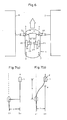
- Fig. 6 is an arrangement plan showing the general configuration of this type of self-contained unmanned vehicle.
- items 2L and 2R represent the left and right drive wheels, respectively, 3L and 3R the motors driving the left and right drive wheels 2L and 2R, respectively, 4L and 4R the pulse encoders for detecting the rotational speeds of the left and right wheels 2L and 3R, respectively, 5,5 ... castor-type roller-wheels, 6L and 6R ultrasound receiving units for sensing the distance from the unmanned vehicle to the left and right walls, respectively, and 7 the control unit.
- Said control unit 7 consists of a microprocessor memory which holds previously stored geographic data relating to the travel path. Said geographic data relate to the co-ordinates of all nodes traversed by the unmanned vehicles in its approach towards the destination point and to the distances from the unmanned vehicle to the left and right sides with respect to a given pre-determined travel path passing through these nodes.
- this target node instruction is supplied through a communication unit, which is not shown in the figure, to the control unit 7, whereupon said control unit 7 will search for the optimum travel path on the basis of the geographic data and determine the node or nodes to be traversed by said unmanned vehicle on its approach to the given destination node so as to set the motors 3L and 3R, respectively, in motion to ensure the unmanned vehicle's travel along the pre-determined travel path linking, in consecutive sequence, the respective nodes. Said control unit 7 will then measure the distance to the left and right side walls W on the basis of the signals supplies from the ultrasonic transmitter/receiver devices 6L and 6R, respectively.
- Fig. 7a when the amount of off-set D is larger than a given value, the unmanned vehicle 1 is caused to stop momentarily.
- the attitude of the drive wheels 2L and 3R is then inverted by an angle of 90°, whereupon the unmanned vehicle 1 will move sideways to the right, thereby performing an action known as a side-step movement to advance as far as the pre-determined normal travel path l0, when the unmanned vehicle 1 will again stop. Travel will then be resumed after the drive wheels 2L and 2R, respectively, have subsequently been re-aligned to the normal travel direction.
- the forward path of the unmanned vehicle 1 will be modified only by a given angle in the right-hand direction by controlling the wheel speed difference between the drive wheels 2L and 2R, respectively, whereupon said unmanned vehicle 1 will traverse, in a rectilinear movement, a suitable distance such that the forward path of said unmanned vehicle 1 is re-directed to the left by a given angle, thereby re-establishing the pre-determined normal travel path l0 by causing the unmanned vehicle 1 to described a given pattern of curvilinear motion while continuing to maintain its forward travel movement.
- the object of the present invention is to provide a means to restore an unmanned vehicle on its aforesaid pre-determined normal travel path in front of the normal node by minimizing the power consumption and travel time losses even when said unmanned vehicle has deviated from its predetermined normal travel path.
- the present invention uses a travel path correction method in which: at the moment in which the present travel path deviates, by a given amount, from the predetermined normal travel path, the given distance required for correcting the path, through a combination of curves given from the current position, is compared with the remaining travel distance until the node reached next from the current position, in such a manner that, if the remaining distance is greater than the given required distance, the travel path will be corrected by a combination of a given pattern of curves on the assumption that the path correction procedure will be completed ahead of the node reached next.
- the travel path will be corrected by a side-step movement in which the attitude of the drive wheel is re-directed so as to provide for a movement towards the side, on the assumption that the path correction procedure will be completed ahead of the node reached next.
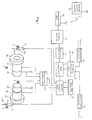
- Fig. 1 is a block schematic showing the configuration of a self-contained unmanned vehicle in which the path correction method according to a preferred embodiment of the present invention is applied.
- item 10 is a distance-measuring element for determining the travel distance from the node traversed immediately beforehand by calculation on the basis of the pulse signals LP and RP supplied from the pulse encoders 4L and 4R. It also determines the distance from the unmanned vehicle to the left and right side walls by calculation on the basis of the signals supplied from-the ultrasound transmitter/receiver units 6L and 6R, respectively.
- Item 11 is a geographic data memory in which the geographic data have been previously stored.
- Item 12 is a data comparator for comparing the distance-measurement data output from the distance-measuring element 10 with the geographic data output from the geographic data memory 11.
- item 20 is a control section which operates in such a manner that when the destination node specified through wireless communication from the central control station 23 is supplied through the communication unit 24, it searches for the optimum path on the basis of the geographic data, then determines the node or nodes to be traversed on the approach route to the destination node, generates the necessary travel commands to ensure travel motion along the predetermined path interlinking these nodes, and transmits these commands to the travel control section 13.
- Said travel control section 13 generates the speed control signals for controlling the rotational speed of the left and right drive motors 2L and 2R, respectively, on the basis of the travel commands supplied from the control section 20, and supplies these speed control signals to the drive wheel control unit 14.
- said travel control section 13 makes a judgment, on the basis of the comparison data supplied from the data comparator 12, to establish whether or not the current travel path deviates, to an extent greater than a given amount d, from the pre-determined normal travel path obtained on the basis of the geographic data, and if it does, the corresponding speed control signals are supplied to the drive wheel control section 14, or, if necessary, the brake system is activated to correct the path by the procedure described hereinafter.
- the drive wheel control unit 14 controls the rotational speed of the motors 3L and 3R, respectively, on the bsis of the speed control signals supplied from the travel control unit 13 and the speed feedback signals supplied from the pulse encoders 4L and 4R, respectively.
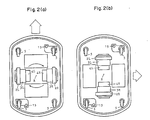
- the brake mechanism 15 consists of a braking cylinder, with one such brake mechanism being provided in the vicinity of each of the two idler wheels 5 and 5, respectively, at the front and back and located mutually diagonally on the floor of the unmanned vehicle, as shown in Fig. 2.
- the rod 15a of the electric power cylinder projects in the bottom direction so that the rubber element 15b mounted on the tip of this rod 15a strikes the bedplate on its descent, thereby actuating the brake.
- the left and right wheels 2L and 2R are caused to rotate in the reverse sense so that said left and right drive wheels 2L and 2R will change their attitude from the normal direction shown in Fig. 2a to a direction obtained by turning said wheels through an angle of 90°, with point R as the center of rotation.
- item 21 is the memory in which are previously stored the path correction curve data, which data are consulted, i.e., referred to, by the travel control unit 13 when correcting the travel path by way of a combination of a given pattern of curves.
- the following types of curve data are stored in this memory.
- the first type of curve data are the control data used for altering the unmanned vehicle's travel direction only by a given angle in the right-hand direction so as to cause the unmanned vehicle to described a given pattern of curves.
- the second type of curve data are the control data for altering the unmanned vehicle's travel direction only by as given angle in the left-hand direction so as to cause the unmanned vehicle to describe a givven pattern of curves.
- the first curve data referred to above are essential control data required for controlling the unmanned vehicle in such a manner that while said unmanned vehicle advances from the bottom of Fig. 3 to the top, it is made to described a curve C1, given in the same figure.
- the direction of movement of the unmanned vehicle is caused to alter only by a given angle in the right-hand direction.
- the unmanned vehicle moves only by half the given distance d (d/2) toward the right in the figure.
- the second curve data referred to above are essential control data required for controlling the unmanned vehicle in such a manner that it is made to describe curve C2 oriented in a direction opposite to that of the first curve data. Consequently, as a result of its movement along curve C2, the direction of movement of the unmanned vehicle is caused to alter only by the given angle in the left-hand direction. During this, the unmanned vehicle moves only by half the distance d (d/2) towards the left in the figure.
- the travel control unit 13 is provided with a control function such that it can control the unmanned vehicle so as to maintain its present travel condition without changing its direction of forward movement and without changing its speed, that is, a control function causing the unmanned vehicle to travel at an uniform speed on a rectilinear path.
- the travel control unit 13 is furnished with a decision-making function so that it can execute a selection between the correction mode in which the correction of the travel path of the unmanned vehicle is achieved by a combination of a given pattern of curves in accordance with the distance from the unmanned vehicle to the node to be reached next and the correction mode in which the correction of the travel path of the unmanned vehicle is achieved by means of a side-step movement.
- the given distance L required for correcting the travel path from the present position by means of a combination of a given pattern of curves and the remaining travel distance L1 from the present position to the node to be traversed next are compared, and if the remaining distance L1 is greater than the given distance L, the travel path is corrected by means of said combination of curves of a given pattern, whereas, if the remaining distance L1 is smaller than the distance 11, the travel path is corrected by the side-step method in which the left and right drive wheels 2L and 2R are shifted sideways through an angle of 90d.
- the unmanned vehicle compares, during its travel, the distance-measurement data and the geographic data (Step SP1), and determines the off-set amount D, being the difference between said distance-measurement data and said geographic data.
- Step SP2 the amount of off-set D and the given value d are compared. If the given value d is equal to the sum obtained from the distance d/2, being the distance by which the unmanned vehicle advances in the right direction as shown in Fig. 3, curve C1 will be used, and, conversely, if the distance value is equal to the distance d/2, being the distance by which the unmanned vehicle advances in the left dirction as shown in Fig. 3, curve C2 is used.
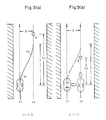
- the unmanned vehicle now travels along a travel path tht is significantly offset from the pre-determined normal path l0 towards the left in the figure, and if, therefore, the amount of offset is in excess of the given value d, then the next step SP3 will be engaged.
- the control section 13 compares the given distance L required for completing the correction of the travel path from the present position on the travel path 11 by means of a combination of curves of a given pattern and the remaining travel distance L1 from the present position to the node N to be traversed next.
- step SP3 has made the judgment that the remaining travel distance L1 > given distance so that the path correction is considered as being completed ahead of the node N to be reached next and the procedure goes over to step SP4.
- the procedures given next for steps SP4 ---> SP6 the travel path is corrected by a combination of curves of a given pattern.
- step SP4 the travel control section 13 controls the travel path of the unmanned vehicle on the basis of the first curve data stored in memory 21, causing the unmanned vehicle to follow curve C1.
- the unmanned vehicle continues its travel motion, and the direction of this travel motion changes from the travel path l1 towards the right only by the given angle ⁇ , advancing from the travel path l1 towards the right only by the distance d/2 (step SP4).
- step SP5 is initiated by causing the unmanned vehicle to travel at a uniform speed in rectilinear motion. As can be seen from Fig.
- the travel distance in this case is equal to the distance resulting when the unmanned vehicle is displaced to the right by a distance (D-d) obtained by subtracting the given value d from the off-set amount D.
- step SP6 will be initiated whereby the travel control unit 13 will control the travel movement of the unmanned vehicle on the basis of the second curve stored in memopry 21 and cause the unmanned vehicle to described curve C2. Consequently, the unmanned vehicle continues its travel motion, and the direction of this travel motion changes towards the left only by the given angle ⁇ , advancing to the right only by the distance d/2.
- the unmanned vehicle will be restored to its pre-determined normal travel path l0 ahead of the node N to be reached next, whereupon it will travel along the pre-determined normal path l0 on its approach towards node N.
- step SP3 the travel path is corrected by a side-step operation in which the orientation of the drive wheels is altered by shifting them sideways.
- the travel control section 13 causes the unmanned vehicle to stop momentarily (step SP7) and then it is displaced in the side-step operation of step SP8.
- step SP8 the brake mechanism 15 is activated in that its rod 15a is extended down to prject from the bottom so that the rubber element mounted on the front end of the rod 15a strikes against the bedplate so as to apply the brakes on the unmanned vehicle.
- the left and right drive wheels 2L and 2R, respectively are caused to rotate in mutually opposing directions so that said left and right drive wheels 2L and 2R, respectively, are brought from their normal attitude shown in Fig. 2a to an orientation turned at an offset angle of 90°, with point R as the center of rotation, as shown in Fig. 2b.
- the left and right drive wheels 2L and 2R are then caused to rotate in the same direction to move the unmanned vehicle back to the pre-determined normal path l0, with thew unmanned vehicle being stopped again.
- the drive wheels 2L nd 2R are then made to change back to their original normal travel orientation to complete the side-step operation.
- the sequence goes over to step SP9 with a resumption of travel by acceleration to reach the given travel speed.
- the unmanned vehicle is restored to its pre-determined normal travel path l0 at a location forward of node N. It will then travel along its normal travel path to approache node N.
Landscapes
- Engineering & Computer Science (AREA)
- Radar, Positioning & Navigation (AREA)
- Physics & Mathematics (AREA)
- Remote Sensing (AREA)
- Aviation & Aerospace Engineering (AREA)
- General Physics & Mathematics (AREA)
- Automation & Control Theory (AREA)
- Acoustics & Sound (AREA)
- Control Of Position, Course, Altitude, Or Attitude Of Moving Bodies (AREA)
Abstract
The invention relates to a method for controlling the travel path of an unmanned vehicle. When the current travel (l₁) path of an unmanned vehicle is found to deviate by a given amount (D) from the normal predetermined path (l₀), of the unmanned vehicle required for correcting the travel path the given distance (l₁) by means of curved paths (C1,C2) of a given pattern, and the remaining distance (L1) from the current position to the next reference (N) in the predetermined path (l₀) are compared in such a manner that, in the event that the remaining travel distance (L1) is larger than a given distance (L), the travel path (l₁) will be corrected by means of a combination of the curved paths (C1,C2) and in the event that the remaining travel distance (L1) is smaller than the given distance (L), the direction of the drive wheels will be altered so as to correct the travel path (l₁), by a cross-movement or side-step movement from the current path (l₁) to the predetermined path (l₀).
Description
- The present invention relates to an unmanned vehicle which, upon specification of the target location (destination) will search its travel path to the target location (destination) on the basis of previously given geographic data and travel to said target location (destination) while recognizing its own currently traversed path, and to a path correction method whereby the travel path will be corrected, notably in the event that said self-contained unmanned vehicle deviates from its normal travel path.
- In recent years, the significant advances in factory automation have prompted the development of a large variety of unmanned vehicles or robot cars capable of automatyically conveying items or objects such as parts and components within premises such as factory and warehouse precincts. The development of such robot cars includes a category known as self-contained unmanned vehicles, which, by merely specifying the node or nodal point corresponding to the target location or destination, are capable of independently searching for the optimum travel path and of determining the nodes to be traversed to reach said destination node, thereby ensuring automatic travel motion to the destination node. In this context, the term "node" denotes any location or point in which a change in the unmanned vehicle's travel condition such as its travel speed and/or its direction of movement occurs as is the case in stop locations, turn-off points, and operating/handling positions.
- Fig. 6 is an arrangement plan showing the general configuration of this type of self-contained unmanned vehicle. In this figure,
items right drive wheels right wheels control unit 7 consists of a microprocessor memory which holds previously stored geographic data relating to the travel path. Said geographic data relate to the co-ordinates of all nodes traversed by the unmanned vehicles in its approach towards the destination point and to the distances from the unmanned vehicle to the left and right sides with respect to a given pre-determined travel path passing through these nodes. - When the destination node is specified by the central station, this target node instruction is supplied through a communication unit, which is not shown in the figure, to the
control unit 7, whereupon saidcontrol unit 7 will search for the optimum travel path on the basis of the geographic data and determine the node or nodes to be traversed by said unmanned vehicle on its approach to the given destination node so as to set themotors control unit 7 will then measure the distance to the left and right side walls W on the basis of the signals supplies from the ultrasonic transmitter/receiver devices pulse encoders unmanned vehicle 1 will always travel along the pre-determined normal travel path to reach the destination node by traversing, in consecutive sequence, all nodes located en route. - In this context, two different methods for correcting the travel path of the
unmanned vehicle 1 are conceivable, one being a correction method using a side-step movement and the other one being a method based on a combination of curves. As shown in Figs. 7a and 7b, these two types of path correction methods can be explained as follows, by using, as an example, the case in which the current travel path l₁ is offset against the pre-determined normal path l₀ in the direction towards the left, with the amount of offset D being greater than the given value. - As shown in Fig. 7a, when the amount of off-set D is larger than a given value, the
unmanned vehicle 1 is caused to stop momentarily. The attitude of thedrive wheels unmanned vehicle 1 will move sideways to the right, thereby performing an action known as a side-step movement to advance as far as the pre-determined normal travel path l₀, when theunmanned vehicle 1 will again stop. Travel will then be resumed after thedrive wheels - As shown in Fig. 7b, when the amount of off-set D is smaller than a given value, the forward path of the
unmanned vehicle 1 will be modified only by a given angle in the right-hand direction by controlling the wheel speed difference between thedrive wheels unmanned vehicle 1 will traverse, in a rectilinear movement, a suitable distance such that the forward path of saidunmanned vehicle 1 is re-directed to the left by a given angle, thereby re-establishing the pre-determined normal travel path l₀ by causing theunmanned vehicle 1 to described a given pattern of curvilinear motion while continuing to maintain its forward travel movement. - These two path correction methods described hereinabove have been found to have the following drawbacks.
- (1) The path correction method using a side-stepe movement has the disadvantage of requiring a momentary stop of the
unmanned vehicle 1 when thedrive wheels unmanned vehicle 1. The double stop also entails a serious loss in travel time. - (2) The path correction method using a combination of curves implies that, as shown in Fig. 7b, the
unmanned vehicle 1 will advance only by the distance L until the correction operation is completed. Let us assume, for example, that a node N be located forward of the position P in which the path correction operation is brought to completion, it then follows that theunmanned vehicle 1 will not be able to traverse this node N. Let us assume, further, that, for example, theunmanned vehicle 1 is required to stop at the position of node N for load handling operations to be effected at thyis location, consisting, for example, of the off-loading of transported goods. It is clear that theunmanned vehicle 1 will not stop until a position beyond said note N is reached. - The object of the present invention is to provide a means to restore an unmanned vehicle on its aforesaid pre-determined normal travel path in front of the normal node by minimizing the power consumption and travel time losses even when said unmanned vehicle has deviated from its predetermined normal travel path.
- For this purpose, the present invention uses a travel path correction method in which:
at the moment in which the present travel path deviates, by a given amount, from the predetermined normal travel path, the given distance required for correcting the path, through a combination of curves given from the current position, is compared with the remaining travel distance until the node reached next from the current position, in such a manner that, if the remaining distance is greater than the given required distance, the travel path will be corrected by a combination of a given pattern of curves on the assumption that the path correction procedure will be completed ahead of the node reached next. - Conversely, if the remaining distance is smaller than the given required distance, the travel path will be corrected by a side-step movement in which the attitude of the drive wheel is re-directed so as to provide for a movement towards the side, on the assumption that the path correction procedure will be completed ahead of the node reached next.
- It is possible, however, to overcome the disadvantages associated with these two methods of correction by making a purposeful selection between the path correction method using a set pattern of curves and the correction method based on a side-step movement, in accordance with the distance to the node to be reached next.
-
- Fig. 1 is a block schematic showing the configuration of a self-contained unmanned vehicle in which the path correction method according to an embodiment of the present invention is applied. Figs. 2a and 2b are floor plans showing the configuration of a self-contained unmanned vehicle according to the same embodiment. Fig. 3 is an illustration drawing to show, with respect to the same embodiment, the travel pattern of a self-contained unmanned vehicle whose path is corrected by means of a given pttern of curves. Fig. 4 is a flowchart to demonstrate the operation of the path correction method in the same embodiment. Figs. 5a and 5b are plan views showing the operation of the path correction method with respect to the same embodiment. Fig. 6 is a plan view showing the general layout of a conventional self-contained unmanned vehicle. Figs. 7a and 7b are illustrations showing the operation of a conventional path correction method.
- Fig. 1 is a block schematic showing the configuration of a self-contained unmanned vehicle in which the path correction method according to a preferred embodiment of the present invention is applied.
- In this figure,
item 10, is a distance-measuring element for determining the travel distance from the node traversed immediately beforehand by calculation on the basis of the pulse signals LP and RP supplied from thepulse encoders receiver units Item 11 is a geographic data memory in which the geographic data have been previously stored.Item 12 is a data comparator for comparing the distance-measurement data output from the distance-measuringelement 10 with the geographic data output from thegeographic data memory 11. Further,item 20 is a control section which operates in such a manner that when the destination node specified through wireless communication from thecentral control station 23 is supplied through thecommunication unit 24, it searches for the optimum path on the basis of the geographic data, then determines the node or nodes to be traversed on the approach route to the destination node, generates the necessary travel commands to ensure travel motion along the predetermined path interlinking these nodes, and transmits these commands to thetravel control section 13. Saidtravel control section 13 generates the speed control signals for controlling the rotational speed of the left andright drive motors control section 20, and supplies these speed control signals to the drive wheel control unit 14. Further, saidtravel control section 13 makes a judgment, on the basis of the comparison data supplied from thedata comparator 12, to establish whether or not the current travel path deviates, to an extent greater than a given amount d, from the pre-determined normal travel path obtained on the basis of the geographic data, and if it does, the corresponding speed control signals are supplied to the drive wheel control section 14, or, if necessary, the brake system is activated to correct the path by the procedure described hereinafter. The drive wheel control unit 14 controls the rotational speed of themotors travel control unit 13 and the speed feedback signals supplied from thepulse encoders brake mechanism 15 consists of a braking cylinder, with one such brake mechanism being provided in the vicinity of each of the twoidler wheels rod 15a of the electric power cylinder projects in the bottom direction so that therubber element 15b mounted on the tip of thisrod 15a strikes the bedplate on its descent, thereby actuating the brake. With the brake thus applied, the left andright wheels right drive wheels - On the other hand,
item 21 is the memory in which are previously stored the path correction curve data, which data are consulted, i.e., referred to, by thetravel control unit 13 when correcting the travel path by way of a combination of a given pattern of curves. The following types of curve data are stored in this memory. The first type of curve data are the control data used for altering the unmanned vehicle's travel direction only by a given angle in the right-hand direction so as to cause the unmanned vehicle to described a given pattern of curves. The second type of curve data are the control data for altering the unmanned vehicle's travel direction only by as given angle in the left-hand direction so as to cause the unmanned vehicle to describe a givven pattern of curves. - The first curve data referred to above are essential control data required for controlling the unmanned vehicle in such a manner that while said unmanned vehicle advances from the bottom of Fig. 3 to the top, it is made to described a curve C1, given in the same figure. As a result of its movement along curve C1, the direction of movement of the unmanned vehicle is caused to alter only by a given angle in the right-hand direction. During this, the unmanned vehicle moves only by half the given distance d (d/2) toward the right in the figure.
- On the other hand, the second curve data referred to above are essential control data required for controlling the unmanned vehicle in such a manner that it is made to describe curve C2 oriented in a direction opposite to that of the first curve data. Consequently, as a result of its movement along curve C2, the direction of movement of the unmanned vehicle is caused to alter only by the given angle in the left-hand direction. During this, the unmanned vehicle moves only by half the distance d (d/2) towards the left in the figure.
- Further, the
travel control unit 13 is provided with a control function such that it can control the unmanned vehicle so as to maintain its present travel condition without changing its direction of forward movement and without changing its speed, that is, a control function causing the unmanned vehicle to travel at an uniform speed on a rectilinear path. - Furthermore, the
travel control unit 13 is furnished with a decision-making function so that it can execute a selection between the correction mode in which the correction of the travel path of the unmanned vehicle is achieved by a combination of a given pattern of curves in accordance with the distance from the unmanned vehicle to the node to be reached next and the correction mode in which the correction of the travel path of the unmanned vehicle is achieved by means of a side-step movement. In other words, when the current trvel position deviates from the pre-determined normal travel position to an extent in excess of a given amount d, the given distance L required for correcting the travel path from the present position by means of a combination of a given pattern of curves and the remaining travel distance L1 from the present position to the node to be traversed next are compared, and if the remaining distance L1 is greater than the given distance L, the travel path is corrected by means of said combination of curves of a given pattern, whereas, if the remaining distance L1 is smaller than thedistance 11, the travel path is corrected by the side-step method in which the left andright drive wheels - The operation of the preferred embodiment referred to above can be explained as follows with reference to the flowchart presented in Fig. 4
- In the same manner as for the previoiusly mentioned conventional types of unmanned vehicle, the unmanned vehicle according to the present invention compares, during its travel, the distance-measurement data and the geographic data (Step SP1), and determines the off-set amount D, being the difference between said distance-measurement data and said geographic data. Each time a given small time interval has elapsed, the amount of off-set D and the given value d are compared (Step SP2). If the given value d is equal to the sum obtained from the distance d/2, being the distance by which the unmanned vehicle advances in the right direction as shown in Fig. 3, curve C1 will be used, and, conversely, if the distance value is equal to the distance d/2, being the distance by which the unmanned vehicle advances in the left dirction as shown in Fig. 3, curve C2 is used.
- No particular corrective control is exercised for as long as the amount of off-set does not exceed the given amount d, so that the
travel control unit 13 lets the unmanned vehicle travel in a continuous travel motion. - If, as shown in Figs. 5a and 5b, by way of example, the unmanned vehicle now travels along a travel path tht is significantly offset from the pre-determined normal path l₀ towards the left in the figure, and if, therefore, the amount of offset is in excess of the given value d, then the next step SP3 will be engaged. In this step, SP3, the
control section 13 compares the given distance L required for completing the correction of the travel path from the present position on thetravel path 11 by means of a combination of curves of a given pattern and the remaining travel distance L1 from the present position to the node N to be traversed next. - In the case shown in Fig. 5a, the above step SP3 has made the judgment that the remaining travel distance L1 > given distance so that the path correction is considered as being completed ahead of the node N to be reached next and the procedure goes over to step SP4. Inm the procedures given next for steps SP4 ---> SP6, the travel path is corrected by a combination of curves of a given pattern.
- This means that the
travel control section 13 controls the travel path of the unmanned vehicle on the basis of the first curve data stored inmemory 21, causing the unmanned vehicle to follow curve C1. In this case, the unmanned vehicle continues its travel motion, and the direction of this travel motion changes from the travel path l₁ towards the right only by the given angle ϑ , advancing from the travel path l₁ towards the right only by the distance d/2 (step SP4). After the unmanned vehicle has completed its course on curve C1, step SP5 is initiated by causing the unmanned vehicle to travel at a uniform speed in rectilinear motion. As can be seen from Fig. 3, the travel distance in this case is equal to the distance resulting when the unmanned vehicle is displaced to the right by a distance (D-d) obtained by subtracting the given value d from the off-set amount D. When the unmanned vehicle is moved to the right only by the distance (D-d), step SP6 will be initiated whereby thetravel control unit 13 will control the travel movement of the unmanned vehicle on the basis of the second curve stored inmemopry 21 and cause the unmanned vehicle to described curve C2. Consequently, the unmanned vehicle continues its travel motion, and the direction of this travel motion changes towards the left only by the given angle ϑ , advancing to the right only by the distance d/2. As a result, the unmanned vehicle will be restored to its pre-determined normal travel path l₀ ahead of the node N to be reached next, whereupon it will travel along the pre-determined normal path l₀ on its approach towards node N. - In the case shown in Fig. 5, however, the judgments is made in step SP3, that the remaining travel distance L1 < given distance L so that the path correction is considered as not being completed ahead of the node N to be reached next and the procedure goes over to step SP7. In the procedures given next for steps SP7 ---> SP9, the travel path is corrected by a side-step operation in which the orientation of the drive wheels is altered by shifting them sideways. In other words, the
travel control section 13 causes the unmanned vehicle to stop momentarily (step SP7) and then it is displaced in the side-step operation of step SP8. In step SP8, thebrake mechanism 15 is activated in that itsrod 15a is extended down to prject from the bottom so that the rubber element mounted on the front end of therod 15a strikes against the bedplate so as to apply the brakes on the unmanned vehicle. With the brakes applied in this manner, the left andright drive wheels right drive wheels right drive wheels drive wheels 2Lnd 2R are then made to change back to their original normal travel orientation to complete the side-step operation. After this, the sequence goes over to step SP9 with a resumption of travel by acceleration to reach the given travel speed. As a result, the unmanned vehicle is restored to its pre-determined normal travel path l₀ at a location forward of node N. It will then travel along its normal travel path to approache node N. - If, contrary to the examples shown in Figs. 5a and 5b, the unmanned vehicle deviates considerably to the left of the pre-determined normal path l₀, the unmanned vehicle will be restored to its pre-determined normal travel path in the same manner as the procedure described hereinabove, even if said amount of deviation exceeds the given value d.
- By this means, a discrimination is made in the selection as to whether the correction method using a combination of curves of a given pattern should be used in accordance with the remaining travel distance until the next node is reached or, alternatively, whether the side-step method of correction should be employed to restore the unmanned vehicle to the pre-determined normal path l₀ ahead of node N.
- As has been explained above, a differentiation is made, according to this invention, between the path correction method using a combination of curves and the side-step correction method, depending on the distance from the unmanned vehicle to the node to be reached next. Through this differentiated use of the two correction methods, the shortcomings associated with each method singly are overcome so that, as a result, power consumption and travel time loss can be reduced to the absolute minimum as compared with the conventional path correction methods using only side-step correction, and, furthermore, the unmanned vehicle can be restored to its pre-determined normal path in such a manner as to ensure the correction always takes place ahead of the next node.
Claims (2)
1. A method for controlling the travel path of an unmanned vehicle travelling to a nominated destination, which destination is reached by traversing a number of nodes (N) whose positions are determined from previously given geographic data, the path of the vehicle being constantly corrected by comparing the predetermined travel path (l₀) passing through the nodes (N) with the current travel path (l₁) CHARACTERISED IN THAT
when the current path (l₁) deviates by a given amount (D) from the predetermined path (l₀), the given distance parallel with the predetermined path (l₀) from the current position of the vehicle required for correcting the current travel path (l₁) by a combination of curved paths (C1,C2) of a given pattern, is compared with the remaining distance (L1) from the present node to the next node (N) to be reached, and,
when the remaining distance (L1) is greater than the given distance (L), the current path (l₁) will be corrected by a combination of the curved paths (C1,C2) of a given pattern, or,
if the remaining distance (L1) is smaller than the given distance (L), the path (l₁) will be corrected by a side-step procedure in which the orientation of the drive wheels (2) of the vehicle is altered by a sideward shift and the vehicle follows a correction path generally perpendicular to the predetermined normal travel path (l₀).
when the current path (l₁) deviates by a given amount (D) from the predetermined path (l₀), the given distance parallel with the predetermined path (l₀) from the current position of the vehicle required for correcting the current travel path (l₁) by a combination of curved paths (C1,C2) of a given pattern, is compared with the remaining distance (L1) from the present node to the next node (N) to be reached, and,
when the remaining distance (L1) is greater than the given distance (L), the current path (l₁) will be corrected by a combination of the curved paths (C1,C2) of a given pattern, or,
if the remaining distance (L1) is smaller than the given distance (L), the path (l₁) will be corrected by a side-step procedure in which the orientation of the drive wheels (2) of the vehicle is altered by a sideward shift and the vehicle follows a correction path generally perpendicular to the predetermined normal travel path (l₀).
2. A method according to claim 1 wherein the combination of curved paths (C1,C2) used for correcting the travel path (l₁) consists of a first set of curves (C1) of a given pattern and a second set of curves (C2) of a given pattern, with the amount of shift towards the direction of deviation and the opposite direction thereto being 1/2 of said given amount (D), so that with respect to the extent by which the amount of deviation exceeds the above given amount (D), the unmanned vehicle is caused to move at a uniform speed in a rectilinear movement between both curves (C1,C2).
Priority Applications (2)
| Application Number | Priority Date | Filing Date | Title |
|---|---|---|---|
| US07/206,371 US4939650A (en) | 1988-06-14 | 1988-06-14 | Path correction method for a self-contained unmanned vehicle |
| EP88305421A EP0346537A1 (en) | 1988-06-14 | 1988-06-14 | Method for correcting the travel path of a self- contained unmanned vehicle (robot car) |
Applications Claiming Priority (1)
| Application Number | Priority Date | Filing Date | Title |
|---|---|---|---|
| EP88305421A EP0346537A1 (en) | 1988-06-14 | 1988-06-14 | Method for correcting the travel path of a self- contained unmanned vehicle (robot car) |
Publications (1)
| Publication Number | Publication Date |
|---|---|
| EP0346537A1 true EP0346537A1 (en) | 1989-12-20 |
Family
ID=8200102
Family Applications (1)
| Application Number | Title | Priority Date | Filing Date |
|---|---|---|---|
| EP88305421A Withdrawn EP0346537A1 (en) | 1988-06-14 | 1988-06-14 | Method for correcting the travel path of a self- contained unmanned vehicle (robot car) |
Country Status (2)
| Country | Link |
|---|---|
| US (1) | US4939650A (en) |
| EP (1) | EP0346537A1 (en) |
Cited By (9)
| Publication number | Priority date | Publication date | Assignee | Title |
|---|---|---|---|---|
| DE19522932A1 (en) * | 1994-06-30 | 1996-01-11 | Siemens Corp Res Inc | Robot vehicle system for moving along corridors |
| EP0727924A3 (en) * | 1995-02-15 | 1998-07-22 | Kabushiki Kaisha Toshiba | Method of sequentially mounting a number of components and apparatus therefor |
| DE4300941B4 (en) * | 1992-01-17 | 2009-06-04 | Honda Giken Kogyo K.K. | System for controlling a moving body |
| DE102010008807A1 (en) * | 2010-02-22 | 2011-08-25 | Engelskirchen, Jürgen, Dipl.-Ing., 22395 | Method for the automatic path control of a controllable object |
| CN110209170A (en) * | 2019-06-21 | 2019-09-06 | 珠海丽亭智能科技有限公司 | A kind of travel track antidote for the robot that stops |
| CN111142552A (en) * | 2018-11-06 | 2020-05-12 | 宝沃汽车(中国)有限公司 | Method and device for controlling unmanned aerial vehicle, storage medium and vehicle |
| JPWO2022168253A1 (en) * | 2021-02-05 | 2022-08-11 | ||
| WO2024026241A1 (en) * | 2022-07-28 | 2024-02-01 | Zoox, Inc. | Reference trajectory validating and collision checking management |
| WO2024137249A1 (en) * | 2022-12-22 | 2024-06-27 | Zoox, Inc. | Tracker trajectory validation |
Families Citing this family (40)
| Publication number | Priority date | Publication date | Assignee | Title |
|---|---|---|---|---|
| US5008804A (en) * | 1988-06-23 | 1991-04-16 | Total Spectrum Manufacturing Inc. | Robotic television-camera dolly system |
| US5107946A (en) * | 1989-07-26 | 1992-04-28 | Honda Giken Kogyo Kabushiki Kaisha | Steering control system for moving vehicle |
| US5610815A (en) * | 1989-12-11 | 1997-03-11 | Caterpillar Inc. | Integrated vehicle positioning and navigation system, apparatus and method |
| US5680306A (en) * | 1990-02-05 | 1997-10-21 | Caterpillar Inc. | System, and method for enabling a vehicle to track a path |
| US5216605A (en) * | 1990-06-28 | 1993-06-01 | Eaton-Kenway, Inc. | Update marker system for navigation of an automatic guided vehicle |
| US5187664A (en) * | 1990-11-27 | 1993-02-16 | Eaton-Kenway, Inc. | Proportional position-sensing system for an automatic guided vehicle |
| US5281901A (en) * | 1990-12-03 | 1994-01-25 | Eaton-Kenway, Inc. | Downward compatible AGV system and methods |
| FR2665411B1 (en) * | 1990-08-03 | 1993-08-06 | Richard Juan | DEVICE FOR CHANGING DIRECTION ON SITE FOR HANDLING TROLLEY. |
| US5127486A (en) * | 1990-11-23 | 1992-07-07 | Eaton-Kenway, Inc. | System for sensing arrival of an automatic guided vehicle at a wire |
| US5175415A (en) * | 1990-11-27 | 1992-12-29 | Eaton-Kenway, Inc. | Combination drive-wheel mechanism and travel-sensor mechanism |
| KR940006567B1 (en) * | 1992-01-06 | 1994-07-22 | 삼성전자 주식회사 | Mobile robot with navigation system using inertia |
| US5471385A (en) * | 1992-05-21 | 1995-11-28 | Tsubakimoto Chain Co. | Routeless guiding method for moving body |
| DE69330482T2 (en) * | 1992-08-19 | 2001-12-13 | Aisin Aw Co., Ltd. | Vehicle navigation system |
| US5539646A (en) * | 1993-10-26 | 1996-07-23 | Hk Systems Inc. | Method and apparatus for an AGV inertial table having an angular rate sensor and a voltage controlled oscillator |
| US5752207A (en) * | 1995-09-29 | 1998-05-12 | Caterpillar Inc. | Method and apparatus for determining a path for a machine between a predetermined route and a final position |
| US5913376A (en) * | 1995-10-31 | 1999-06-22 | Honda Giken Kogyo Kabushiki Kaisha | Automatic steering control apparatus |
| KR970066776A (en) * | 1996-03-29 | 1997-10-13 | 헨리 D.G. 웰레스 | Vehicle control device |
| US5974348A (en) * | 1996-12-13 | 1999-10-26 | Rocks; James K. | System and method for performing mobile robotic work operations |
| JP3375843B2 (en) * | 1997-01-29 | 2003-02-10 | 本田技研工業株式会社 | Robot autonomous traveling method and autonomous traveling robot control device |
| US5995884A (en) * | 1997-03-07 | 1999-11-30 | Allen; Timothy P. | Computer peripheral floor cleaning system and navigation method |
| JP4229358B2 (en) * | 2001-01-22 | 2009-02-25 | 株式会社小松製作所 | Driving control device for unmanned vehicles |
| US6526336B2 (en) * | 2001-02-01 | 2003-02-25 | Invacare Corp. | System and method for steering a multi-wheel drive vehicle |
| US8192137B2 (en) | 2004-05-03 | 2012-06-05 | Jervis B. Webb Company | Automatic transport loading system and method |
| US8210791B2 (en) * | 2004-05-03 | 2012-07-03 | Jervis B. Webb Company | Automatic transport loading system and method |
| US8075243B2 (en) | 2004-05-03 | 2011-12-13 | Jervis B. Webb Company | Automatic transport loading system and method |
| US7980808B2 (en) * | 2004-05-03 | 2011-07-19 | Jervis B. Webb Company | Automatic transport loading system and method |
| EP1747154A4 (en) * | 2004-05-03 | 2010-07-14 | Webb Int Co Jerwis B | Automatic transport loading system and method |
| US20060276958A1 (en) * | 2005-06-02 | 2006-12-07 | Jervis B. Webb Company | Inertial navigational guidance system for a driverless vehicle utilizing laser obstacle sensors |
| DE102011121722A1 (en) * | 2011-12-20 | 2013-06-20 | Gm Global Technology Operations, Llc | Device for parking control |
| CA3038898A1 (en) | 2016-09-30 | 2018-04-05 | Staples, Inc. | Hybrid modular storage fetching system |
| US10589931B2 (en) | 2016-09-30 | 2020-03-17 | Staples, Inc. | Hybrid modular storage fetching system |
| US10683171B2 (en) | 2016-09-30 | 2020-06-16 | Staples, Inc. | Hybrid modular storage fetching system |
| US11590997B1 (en) | 2018-08-07 | 2023-02-28 | Staples, Inc. | Autonomous shopping cart |
| US11084410B1 (en) | 2018-08-07 | 2021-08-10 | Staples, Inc. | Automated guided vehicle for transporting shelving units |
| US11630447B1 (en) | 2018-08-10 | 2023-04-18 | Staples, Inc. | Automated guided vehicle for transporting objects |
| US11180069B2 (en) | 2018-12-31 | 2021-11-23 | Staples, Inc. | Automated loading of delivery vehicles using automated guided vehicles |
| US11119487B2 (en) | 2018-12-31 | 2021-09-14 | Staples, Inc. | Automated preparation of deliveries in delivery vehicles using automated guided vehicles |
| US10867402B2 (en) * | 2019-03-01 | 2020-12-15 | Here Global B.V. | System and method for determining distance to object on road |
| US11124401B1 (en) | 2019-03-31 | 2021-09-21 | Staples, Inc. | Automated loading of delivery vehicles |
| US20220371613A1 (en) * | 2021-05-21 | 2022-11-24 | Zoox, Inc. | Vehicle trajectory determination |
Citations (4)
| Publication number | Priority date | Publication date | Assignee | Title |
|---|---|---|---|---|
| DE3135117A1 (en) * | 1980-09-05 | 1982-04-01 | Mitsubishi Denki K.K., Tokyo | Robot vehicle |
| FR2548401A1 (en) * | 1983-06-28 | 1985-01-04 | Kubota Ltd | VEHICLE UTILITY WITH WHEELS ORIENTABLE AND AUTOMATICALLY CONTROLLED BY A SENSOR FOR DETECTION OF LIMIT BETWEEN ZONES WORKED AND NOT WORKED |
| EP0168599A1 (en) * | 1984-07-19 | 1986-01-22 | Roland Bryda | Automatic ground conveyor system |
| US4665489A (en) * | 1984-03-15 | 1987-05-12 | Kabushiki Kaisha Meidensha | Unmanned vehicle control system and method |
Family Cites Families (5)
| Publication number | Priority date | Publication date | Assignee | Title |
|---|---|---|---|---|
| JPS60112111A (en) * | 1983-11-24 | 1985-06-18 | Toyota Central Res & Dev Lab Inc | Guidance control device for unmanned vehicles |
| US4751658A (en) * | 1986-05-16 | 1988-06-14 | Denning Mobile Robotics, Inc. | Obstacle avoidance system |
| US4821192A (en) * | 1986-05-16 | 1989-04-11 | Denning Mobile Robotics, Inc. | Node map system and method for vehicle |
| US4815008A (en) * | 1986-05-16 | 1989-03-21 | Denning Mobile Robotics, Inc. | Orientation adjustment system and robot using same |
| JPH0646364B2 (en) * | 1986-07-11 | 1994-06-15 | 株式会社椿本チエイン | How to guide an autonomous vehicle |
-
1988
- 1988-06-14 EP EP88305421A patent/EP0346537A1/en not_active Withdrawn
- 1988-06-14 US US07/206,371 patent/US4939650A/en not_active Expired - Fee Related
Patent Citations (4)
| Publication number | Priority date | Publication date | Assignee | Title |
|---|---|---|---|---|
| DE3135117A1 (en) * | 1980-09-05 | 1982-04-01 | Mitsubishi Denki K.K., Tokyo | Robot vehicle |
| FR2548401A1 (en) * | 1983-06-28 | 1985-01-04 | Kubota Ltd | VEHICLE UTILITY WITH WHEELS ORIENTABLE AND AUTOMATICALLY CONTROLLED BY A SENSOR FOR DETECTION OF LIMIT BETWEEN ZONES WORKED AND NOT WORKED |
| US4665489A (en) * | 1984-03-15 | 1987-05-12 | Kabushiki Kaisha Meidensha | Unmanned vehicle control system and method |
| EP0168599A1 (en) * | 1984-07-19 | 1986-01-22 | Roland Bryda | Automatic ground conveyor system |
Non-Patent Citations (1)
| Title |
|---|
| IEEE Journal of Robotics and Automation vol. 4, no. 3, June 1988, New York US page 265 - 276; Y. Kanayama et al.: "Vehicle Path Specification by Sequence of Straight Lines" * |
Cited By (11)
| Publication number | Priority date | Publication date | Assignee | Title |
|---|---|---|---|---|
| DE4300941B4 (en) * | 1992-01-17 | 2009-06-04 | Honda Giken Kogyo K.K. | System for controlling a moving body |
| DE19522932A1 (en) * | 1994-06-30 | 1996-01-11 | Siemens Corp Res Inc | Robot vehicle system for moving along corridors |
| EP0727924A3 (en) * | 1995-02-15 | 1998-07-22 | Kabushiki Kaisha Toshiba | Method of sequentially mounting a number of components and apparatus therefor |
| DE102010008807A1 (en) * | 2010-02-22 | 2011-08-25 | Engelskirchen, Jürgen, Dipl.-Ing., 22395 | Method for the automatic path control of a controllable object |
| CN111142552A (en) * | 2018-11-06 | 2020-05-12 | 宝沃汽车(中国)有限公司 | Method and device for controlling unmanned aerial vehicle, storage medium and vehicle |
| CN110209170A (en) * | 2019-06-21 | 2019-09-06 | 珠海丽亭智能科技有限公司 | A kind of travel track antidote for the robot that stops |
| JPWO2022168253A1 (en) * | 2021-02-05 | 2022-08-11 | ||
| WO2022168253A1 (en) * | 2021-02-05 | 2022-08-11 | 日本電気株式会社 | Delivery system, control device, and control method |
| WO2024026241A1 (en) * | 2022-07-28 | 2024-02-01 | Zoox, Inc. | Reference trajectory validating and collision checking management |
| WO2024137249A1 (en) * | 2022-12-22 | 2024-06-27 | Zoox, Inc. | Tracker trajectory validation |
| US12497031B2 (en) | 2022-12-22 | 2025-12-16 | Zoox, Inc. | Tracker trajectory validation |
Also Published As
| Publication number | Publication date |
|---|---|
| US4939650A (en) | 1990-07-03 |
Similar Documents
| Publication | Publication Date | Title |
|---|---|---|
| US4939650A (en) | Path correction method for a self-contained unmanned vehicle | |
| US4939651A (en) | Control method for an unmanned vehicle (robot car) | |
| JPWO2019067837A5 (en) | ||
| CN112666934A (en) | Control system, scheduling system and control method for automobile carrying AGV | |
| US4974259A (en) | Control system for unattended transport car | |
| US12162737B2 (en) | Control method for mobile object, mobile object, and computer-readable storage medium | |
| JP2022070559A (en) | Mobile body, mobile control system, mobile control method and program | |
| JP2671297B2 (en) | Route correction method for self-supporting unmanned vehicles | |
| CN113252040B (en) | Improved AGV trolley two-dimensional code arc navigation method | |
| JP3317159B2 (en) | Automatic guided vehicle | |
| JP2001265438A (en) | Unmanned carrier | |
| JPH04340607A (en) | Optimum route determining device | |
| JPH05257529A (en) | Method and device for guiding course learning of traveling body | |
| JP2004362022A (en) | Moving body | |
| JPH07248819A (en) | Track control method for automatic running vehicle | |
| JPH0296809A (en) | Automatic guided vehicle travel command creation device | |
| JPH01280807A (en) | How to guide moving objects | |
| Li et al. | A Guided Hybrid A*-Based Path Planning Method for Autonomous Driving | |
| JP3846829B2 (en) | Steering angle control device for moving body | |
| JP3804235B2 (en) | Automated guided vehicle | |
| JP2000122721A (en) | Steering angle controller for mobile object | |
| JPH06161550A (en) | Controller for traveling of moving vehicle | |
| JPH08272443A (en) | Posture control method of all-wheel steering type automatic guided vehicle | |
| JPS63314613A (en) | Drive controller for unmanned vehicle | |
| JPS61110209A (en) | Controlling facility of optically guided moving car |
Legal Events
| Date | Code | Title | Description |
|---|---|---|---|
| PUAI | Public reference made under article 153(3) epc to a published international application that has entered the european phase |
Free format text: ORIGINAL CODE: 0009012 |
|
| AK | Designated contracting states |
Kind code of ref document: A1 Designated state(s): DE FR GB |
|
| 17P | Request for examination filed |
Effective date: 19900806 |
|
| STAA | Information on the status of an ep patent application or granted ep patent |
Free format text: STATUS: THE APPLICATION IS DEEMED TO BE WITHDRAWN |
|
| 18D | Application deemed to be withdrawn |
Effective date: 19920103 |