EP0346508A1 - Méthode de filtrage de signaux audio numériques - Google Patents
Méthode de filtrage de signaux audio numériques Download PDFInfo
- Publication number
- EP0346508A1 EP0346508A1 EP88109478A EP88109478A EP0346508A1 EP 0346508 A1 EP0346508 A1 EP 0346508A1 EP 88109478 A EP88109478 A EP 88109478A EP 88109478 A EP88109478 A EP 88109478A EP 0346508 A1 EP0346508 A1 EP 0346508A1
- Authority
- EP
- European Patent Office
- Prior art keywords
- transformation
- digital audio
- filter
- segments
- transform
- Prior art date
- Legal status (The legal status is an assumption and is not a legal conclusion. Google has not performed a legal analysis and makes no representation as to the accuracy of the status listed.)
- Granted
Links
Images


Classifications
-
- H—ELECTRICITY
- H03—ELECTRONIC CIRCUITRY
- H03H—IMPEDANCE NETWORKS, e.g. RESONANT CIRCUITS; RESONATORS
- H03H17/00—Networks using digital techniques
- H03H17/02—Frequency selective networks
Definitions
- the invention relates to a method according to the preamble of claim 1.
- x (n) denotes any digital filter input signal and y (m) the corresponding digital filter output signal
- system equation applies to a non-recursive filter where h (mn) is the filter impulse response and N is the number of filter coefficients or the degree of the filter are.
- Each of the N series-connected filter elements comprises a delay stage z ⁇ 1 in the longitudinal branch and a multiplier stage in the transverse branch, wherein the filter input signal x (n) is delayed by one sample value in each of the series branches connected in series and is multiplied by a filter coefficient h after each delay in the multiplier stage. Furthermore, the undelayed filter input signal is also multiplied by a filter coefficient h .
- the products or partial signals thus formed are added up in an adding stage and form the filter output signal y (m) .
- the object of the invention is to provide a method for filtering digital audio signals, which has the advantages of non-recursive filters, namely stability and phase linearity, and at the same time requires considerably less computation, so that real-time filtering is possible.
- the scalar individual products are converted back by means of inverse transformation and form the discrete values of the filter output signal.
- a number-theoretical transformation with the following system equation is used as a suitable transformation: where alpha is a whole number that can be represented without errors in a digital computer and modulo M means that a modular arithmetic with a finite number set between 0 and M-1 is used.
- modulo M means that a modular arithmetic with a finite number set between 0 and M-1 is used.
- the module M When using the transformation for digital studio audio signals with a 16 bit linear quantization must the module M must be at least 40 bits in size in order to avoid overflows and overloads.
- the module In order to still be able to use 16 bit standard hardware, the module must be factored.
- the use of the Chinese residual theorem is known: the module M is broken down into factors that are not prime factors in pairs, the transformations are carried out with regard to the individual factors and the partial convolution results thus obtained are combined to form the final result in accordance with the Chinese residual theorem.
- This solution requires a modulo M adder (> 40 bit) for the last step.
- the advantage of factoring in numbers smaller than 16 bits cannot be used consistently.
- the arithmetic modulo p q can then be simplified to an arithmetic modulo p .
- Rectangles are used as an example as the pattern signals for the filter impulse response and the data, since the mode of operation of the filter method becomes particularly clear here.
- the finite filter impulse response h (FIG. 1a) is divided into segments h i of length N / 2 (FIG. 1b ... 1d).
- the value i is chosen to be 3 , for example.
- Each of these segments h i is supplemented with N / 2 "zero" key values for the transformation length N.
- the transform H i of the segments h i is calculated with the aid of the number-theoretical transformation described above.
- FIG. 2 shows how an "infinite" data stream (FIG. 2a) is divided into processable data segments x j (FIG. 2b ... 2g).
- the segments x j have the length N , but they overlap the neighboring segments by N / 2 sample values.
- the transforms X j of each segment are also formed using the number-theoretical transformation.
- Each transformed X j is multiplied scalarly with all transformed H i and transformed back into the time domain using the inverse number-theoretical transformation.
- the first N / 2 sampling values of the filter segments Y k (FIG. 3) are settling processes which are not used in the further processing.
- the last N / 2 key values form a partial result y1 , y2 , y3 , y4 ..., ie the data block j filtered with all shock response segments.
- Fig. 3 shows the first four partial results y1 to y4 for the signals of the Fign. 1 and 2, namely: Fig.
- the end result is achieved by adding the individual partial results (FIGS. 3b to 3d), as shown in FIG. 4.
- FIG. 5 A filter arrangement 1, which according to FIGS. 1 to 4 works, is shown in Fig. 5.
- the data segments x are fed to a number-theoretical transformation stage NNT 2 in order to be transferred into the transformation area.
- the transformed segment X at the output of stage 2 is fed in parallel to the multiplier stages 11 ... 61 connected in parallel on the input side, where it is multiplied by the i transform H i of the filter impulse response.
- i can be any integer, that is, the filter impulse response can be of any length, since the filter impulse response is broken down into more or less segments depending on the transformation length N. It is therefore only necessary to provide more branches 10, 20,... 60 accordingly.
- the multiplication result is transformed back into the time domain in each branch 10 ... 60 by means of an inverse number-theoretical transformation stage INTT 12 ... 62 , then depending on the temporal position of the filter segment h i (see FIG. 1) by means of a delay stage 23. ..63 delayed (with the exception of the first branch 10 ) and added in an accumulation level 3 with the other branch signals.
- the resulting output signal of the accumulation stage 3 represents the filtered data signal y according to FIG. 4.
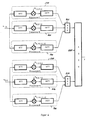
- FIG. 6 shows a computer circuit designed for real-time processing for the filter arrangement 1 according to FIG. 5.
- processing is carried out in parallel in the branches 100 ... 300 and 500 ... 700 .
- the calculation in the individual branches 100 ... 700 is carried out using identical software and hardware. For example, it is assumed that a branch 100 , 200,... 700 formed by a processor can process four segments h i of a filter impulse response. An extension to longer filter burst responses is achieved by connecting processors in parallel in processing branches 100 ... 700 .
- the time delay stages 23 ... 63 indicated in FIG. 5 are simulated by the multiplexers 400 and 800 , of which the multiplexer 400 is assigned to the branches 100, 200, 300 and the multiplexer 800 to the branches 500, 600, 700 .
- the processing branches 100 ... 700 are combined and their signals are added up, so that the data signal y is available for further processing at the output of stage 1000 .
- the power of a prime number must be used as the transformation module M in order to achieve a sufficient dynamic of the filtering.
- transformation roots alpha can also be specified, which can be represented as powers of 2, so that the scalar multiplication required in the transformation can be implemented using simple bit shifts (for example by means of so-called barrel shifters).
Landscapes
- Physics & Mathematics (AREA)
- Engineering & Computer Science (AREA)
- Computer Hardware Design (AREA)
- Mathematical Physics (AREA)
- Compression, Expansion, Code Conversion, And Decoders (AREA)
- Complex Calculations (AREA)
- Electrophonic Musical Instruments (AREA)
- Stereophonic System (AREA)
Priority Applications (3)
| Application Number | Priority Date | Filing Date | Title |
|---|---|---|---|
| EP88109478A EP0346508B1 (fr) | 1988-06-14 | 1988-06-14 | Méthode de filtrage de signaux audio numériques |
| DE88109478T DE3885450D1 (de) | 1988-06-14 | 1988-06-14 | Verfahren zum Filtern von digitalen Tonsignalen. |
| AT88109478T ATE96952T1 (de) | 1988-06-14 | 1988-06-14 | Verfahren zum filtern von digitalen tonsignalen. |
Applications Claiming Priority (1)
| Application Number | Priority Date | Filing Date | Title |
|---|---|---|---|
| EP88109478A EP0346508B1 (fr) | 1988-06-14 | 1988-06-14 | Méthode de filtrage de signaux audio numériques |
Publications (2)
| Publication Number | Publication Date |
|---|---|
| EP0346508A1 true EP0346508A1 (fr) | 1989-12-20 |
| EP0346508B1 EP0346508B1 (fr) | 1993-11-03 |
Family
ID=8199055
Family Applications (1)
| Application Number | Title | Priority Date | Filing Date |
|---|---|---|---|
| EP88109478A Expired - Lifetime EP0346508B1 (fr) | 1988-06-14 | 1988-06-14 | Méthode de filtrage de signaux audio numériques |
Country Status (3)
| Country | Link |
|---|---|
| EP (1) | EP0346508B1 (fr) |
| AT (1) | ATE96952T1 (fr) |
| DE (1) | DE3885450D1 (fr) |
-
1988
- 1988-06-14 DE DE88109478T patent/DE3885450D1/de not_active Expired - Fee Related
- 1988-06-14 AT AT88109478T patent/ATE96952T1/de not_active IP Right Cessation
- 1988-06-14 EP EP88109478A patent/EP0346508B1/fr not_active Expired - Lifetime
Non-Patent Citations (4)
| Title |
|---|
| ELECTRONICS AND COMMUNICATIONS IN JAPAN, Band 64, Nr. 12, DEzember 1981, Seiten 27-33, Scripta Publishing CO., Silver Spring, Maryland, US; T. EDANAMI et al.: "A new realization of a digital filter using a number theory transform" * |
| ICASSP 86 PROCEEDINGS, 7.-11. April 1986, Seiten 17-20, Tokyo, JP; R. LAGADEC: "Digital data equalizing in multitrack digital audio recording" * |
| IEEE TRANS ACOUST, SPEECH AND SIGNAL PROCESS, Band ASSP-26, Nr. 1, Februar 1978, Seiten 88-93, IEEE, New York, US; H.J. NUSSBAUMER: "Relative evaluation of various number theoretic transforms for digital filtering applications" * |
| PROCEEDINGS OF THE IEEE 1986 CUSTOM INTEGRATED CIRCUITS CONFERENCE, 12.-15. Mai 1986, Seiten 74-77, IEEE, New York, US; H. AMIR-ALIKHANI et al.: A VLSI pipeline number theoretic transform processor" * |
Also Published As
| Publication number | Publication date |
|---|---|
| DE3885450D1 (de) | 1993-12-09 |
| EP0346508B1 (fr) | 1993-11-03 |
| ATE96952T1 (de) | 1993-11-15 |
Similar Documents
| Publication | Publication Date | Title |
|---|---|---|
| DE69332975T2 (de) | Digitales filter mit hoher genauigkeit und effizienz | |
| DE69406306T2 (de) | Verfahren zur bildskalierung und zum filtern mit diskreter cosinustransformation | |
| DE3044208C2 (de) | Interpolator zur Erhöhung der Wortgeschwindigkeit eines digitalen Signals | |
| DE102009039428B4 (de) | Digitalfilter | |
| DE3853372T2 (de) | Filterkoeffizientenberechnung für ein digitales Filter. | |
| DE2145404A1 (de) | Nichtrekursive Digitalfiltereinrichtung mit Verzögerungs- und Addier-Anordnung | |
| DE3610195A1 (de) | Digitale filterbank | |
| DE69132844T2 (de) | Schneller Rechner zur Durchführung einer Vorwärts- und Rückwärtstransformation | |
| DE69419167T2 (de) | Digitale vorrichtung zur änderung der grösse eines bildes und verwendungsmethode desgleichen | |
| EP0974105B1 (fr) | Methode de traitement discret multidimensionnel en ondelettes et unite de traitement pour l'application de cette methode | |
| EP0234452B1 (fr) | Circuit numérique pour la conversion de la fréquence d'échantillonnage, le filtrage de signaux et son procédé de développement | |
| DE2315347C3 (de) | Verfahren und Vorrichtung zur fortlaufenden Korrelations-Decodierung unter Einbeziehung von Amplitudengewichtung von Gruppen bildenden Signalen | |
| DE69320218T2 (de) | Digitales Filter | |
| DE2718902A1 (de) | Transformationsgenerator und dessen verwendung beim aufbau von digitalfiltern | |
| DE2615498A1 (de) | Konvolutionsfunktionsgenerator und dessen anwendung in digitalfiltern | |
| DE10250555A1 (de) | Verfahren zur Ermittlung von Filterköffizienten eines digitalen Filters und digitales Filter | |
| DE3922469C2 (fr) | ||
| EP1906527A2 (fr) | Dispositif et procédé destinés au rééchantillonnage polyphasique | |
| WO2000067375A1 (fr) | Ensemble filtre-peigne pour la decimation d'une serie de valeurs d'entree numeriques en une serie de valeurs d'entree numeriques d'un facteur n'etant pas un entier | |
| EP0346508A1 (fr) | Méthode de filtrage de signaux audio numériques | |
| DE4022381C2 (de) | Verwendung langer Digitalfilter bei Vorkommnis von Abrundungsfehlern | |
| WO2001097376A1 (fr) | Filtre d'interpolation numerique | |
| DE102020133279A1 (de) | Verfahren und schaltung zur steigerung des durchsatzes von rekursiven systemen | |
| DE19925464C2 (de) | Verfahren und Schaltungsanordnung zur Abtastratenanpassung digitaler Signale | |
| DE69027619T2 (de) | Fourier-Transformationsmethode mit Benutzung zahlentheoretischer Transformationen |
Legal Events
| Date | Code | Title | Description |
|---|---|---|---|
| PUAI | Public reference made under article 153(3) epc to a published international application that has entered the european phase |
Free format text: ORIGINAL CODE: 0009012 |
|
| 17P | Request for examination filed |
Effective date: 19890718 |
|
| AK | Designated contracting states |
Kind code of ref document: A1 Designated state(s): AT BE CH DE ES FR GB GR IT LI LU NL SE |
|
| 17Q | First examination report despatched |
Effective date: 19911119 |
|
| GRAA | (expected) grant |
Free format text: ORIGINAL CODE: 0009210 |
|
| AK | Designated contracting states |
Kind code of ref document: B1 Designated state(s): AT BE CH DE ES FR GB GR IT LI LU NL SE |
|
| PG25 | Lapsed in a contracting state [announced via postgrant information from national office to epo] |
Ref country code: GR Free format text: LAPSE BECAUSE OF FAILURE TO SUBMIT A TRANSLATION OF THE DESCRIPTION OR TO PAY THE FEE WITHIN THE PRESCRIBED TIME-LIMIT Effective date: 19931103 Ref country code: IT Free format text: LAPSE BECAUSE OF FAILURE TO SUBMIT A TRANSLATION OF THE DESCRIPTION OR TO PAY THE FEE WITHIN THE PRE;WARNING: LAPSES OF ITALIAN PATENTS WITH EFFECTIVE DATE BEFORE 2007 MAY HAVE OCCURRED AT ANY TIME BEFORE 2007. THE CORRECT EFFECTIVE DATE MAY BE DIFFERENT FROM THE ONE RECORDED.SCRIBED TIME-LIMIT Effective date: 19931103 Ref country code: BE Effective date: 19931103 Ref country code: SE Effective date: 19931103 Ref country code: NL Effective date: 19931103 Ref country code: ES Free format text: THE PATENT HAS BEEN ANNULLED BY A DECISION OF A NATIONAL AUTHORITY Effective date: 19931103 |
|
| REF | Corresponds to: |
Ref document number: 96952 Country of ref document: AT Date of ref document: 19931115 Kind code of ref document: T |
|
| REF | Corresponds to: |
Ref document number: 3885450 Country of ref document: DE Date of ref document: 19931209 |
|
| ET | Fr: translation filed | ||
| GBT | Gb: translation of ep patent filed (gb section 77(6)(a)/1977) |
Effective date: 19940126 |
|
| NLV1 | Nl: lapsed or annulled due to failure to fulfill the requirements of art. 29p and 29m of the patents act | ||
| PG25 | Lapsed in a contracting state [announced via postgrant information from national office to epo] |
Ref country code: AT Effective date: 19940614 |
|
| PG25 | Lapsed in a contracting state [announced via postgrant information from national office to epo] |
Ref country code: LU Free format text: LAPSE BECAUSE OF NON-PAYMENT OF DUE FEES Effective date: 19940630 Ref country code: LI Effective date: 19940630 Ref country code: CH Effective date: 19940630 |
|
| PLBE | No opposition filed within time limit |
Free format text: ORIGINAL CODE: 0009261 |
|
| STAA | Information on the status of an ep patent application or granted ep patent |
Free format text: STATUS: NO OPPOSITION FILED WITHIN TIME LIMIT |
|
| 26N | No opposition filed | ||
| REG | Reference to a national code |
Ref country code: CH Ref legal event code: PL |
|
| PGFP | Annual fee paid to national office [announced via postgrant information from national office to epo] |
Ref country code: GB Payment date: 19950516 Year of fee payment: 8 |
|
| PGFP | Annual fee paid to national office [announced via postgrant information from national office to epo] |
Ref country code: FR Payment date: 19950524 Year of fee payment: 8 |
|
| PG25 | Lapsed in a contracting state [announced via postgrant information from national office to epo] |
Ref country code: GB Effective date: 19960614 |
|
| GBPC | Gb: european patent ceased through non-payment of renewal fee |
Effective date: 19960614 |
|
| PG25 | Lapsed in a contracting state [announced via postgrant information from national office to epo] |
Ref country code: FR Effective date: 19970228 |
|
| REG | Reference to a national code |
Ref country code: FR Ref legal event code: ST |
|
| PGFP | Annual fee paid to national office [announced via postgrant information from national office to epo] |
Ref country code: DE Payment date: 20020226 Year of fee payment: 15 |
|
| PG25 | Lapsed in a contracting state [announced via postgrant information from national office to epo] |
Ref country code: DE Free format text: LAPSE BECAUSE OF NON-PAYMENT OF DUE FEES Effective date: 20040101 |