EP0346312B1 - A method for dewatering water-containing particle collections with the aid of gas under pressure - Google Patents
A method for dewatering water-containing particle collections with the aid of gas under pressure Download PDFInfo
- Publication number
- EP0346312B1 EP0346312B1 EP89850183A EP89850183A EP0346312B1 EP 0346312 B1 EP0346312 B1 EP 0346312B1 EP 89850183 A EP89850183 A EP 89850183A EP 89850183 A EP89850183 A EP 89850183A EP 0346312 B1 EP0346312 B1 EP 0346312B1
- Authority
- EP
- European Patent Office
- Prior art keywords
- gas
- pressure
- particle collection
- pressure difference
- dewatering
- Prior art date
- Legal status (The legal status is an assumption and is not a legal conclusion. Google has not performed a legal analysis and makes no representation as to the accuracy of the status listed.)
- Expired - Lifetime
Links
- 239000002245 particle Substances 0.000 title claims description 36
- 238000000034 method Methods 0.000 title claims description 28
- XLYOFNOQVPJJNP-UHFFFAOYSA-N water Substances O XLYOFNOQVPJJNP-UHFFFAOYSA-N 0.000 title claims description 14
- 230000035515 penetration Effects 0.000 claims description 14
- 238000012544 monitoring process Methods 0.000 claims 1
- 239000012065 filter cake Substances 0.000 description 9
- 230000008569 process Effects 0.000 description 9
- 239000007788 liquid Substances 0.000 description 8
- 238000007664 blowing Methods 0.000 description 6
- 238000005265 energy consumption Methods 0.000 description 4
- 239000000725 suspension Substances 0.000 description 3
- 239000004744 fabric Substances 0.000 description 2
- 229910052500 inorganic mineral Inorganic materials 0.000 description 2
- 239000000463 material Substances 0.000 description 2
- 239000011707 mineral Substances 0.000 description 2
- 238000005086 pumping Methods 0.000 description 2
- 229920006395 saturated elastomer Polymers 0.000 description 2
- 239000007787 solid Substances 0.000 description 2
- 238000005054 agglomeration Methods 0.000 description 1
- 230000002776 aggregation Effects 0.000 description 1
- 239000012141 concentrate Substances 0.000 description 1
- 238000010276 construction Methods 0.000 description 1
- 238000007796 conventional method Methods 0.000 description 1
- 230000001419 dependent effect Effects 0.000 description 1
- 238000010586 diagram Methods 0.000 description 1
- 238000001035 drying Methods 0.000 description 1
- 238000005516 engineering process Methods 0.000 description 1
- 239000000835 fiber Substances 0.000 description 1
- 238000001914 filtration Methods 0.000 description 1
- 238000010438 heat treatment Methods 0.000 description 1
- 229910052595 hematite Inorganic materials 0.000 description 1
- 239000011019 hematite Substances 0.000 description 1
- LIKBJVNGSGBSGK-UHFFFAOYSA-N iron(3+);oxygen(2-) Chemical compound [O-2].[O-2].[O-2].[Fe+3].[Fe+3] LIKBJVNGSGBSGK-UHFFFAOYSA-N 0.000 description 1
- 230000007246 mechanism Effects 0.000 description 1
- 239000012528 membrane Substances 0.000 description 1
- 230000002093 peripheral effect Effects 0.000 description 1
- 239000011148 porous material Substances 0.000 description 1
- 230000000135 prohibitive effect Effects 0.000 description 1
- 235000008001 rakum palm Nutrition 0.000 description 1
- 230000009467 reduction Effects 0.000 description 1
- 238000000926 separation method Methods 0.000 description 1
- 238000005406 washing Methods 0.000 description 1
Images
Classifications
-
- B—PERFORMING OPERATIONS; TRANSPORTING
- B01—PHYSICAL OR CHEMICAL PROCESSES OR APPARATUS IN GENERAL
- B01D—SEPARATION
- B01D43/00—Separating particles from liquids, or liquids from solids, otherwise than by sedimentation or filtration
-
- F—MECHANICAL ENGINEERING; LIGHTING; HEATING; WEAPONS; BLASTING
- F26—DRYING
- F26B—DRYING SOLID MATERIALS OR OBJECTS BY REMOVING LIQUID THEREFROM
- F26B5/00—Drying solid materials or objects by processes not involving the application of heat
- F26B5/14—Drying solid materials or objects by processes not involving the application of heat by applying pressure, e.g. wringing; by brushing; by wiping
Definitions
- the present invention relates to a method for dewatering water-containing particle collections in which at least one of a possible multiple of dewatering stages is effected with the aid of gas to which a pressure difference is imparted through and across the particle collection.
- Water-containing particle collections such as mineral suspensions and fibre suspensions
- Water-containing particle collections are often dewatered by first mechanically pumping the particle collection onto a filtering medium and/or by pressing said collection against said medium under high pressure, such as to form a filter cake from which water is then removed under the influence of gas under pressure.
- Dewatering can either be accomplished by employing a vacuum and/or by using a pressurized gas, said gas normally being compressed air.
- the filter cake is subjected to a pressure difference which consists, in principle, of the sum of the low pressure on the suction side and the high pressure on the pressure side.
- the dewatering process is effected through the influence of this pressure difference in three successive phases, mainly a first penetration phase, which is commenced by subjecting fully saturated filter cake to pressurized gas on one side thereof, and is terminated when the gas breaks through the filter cake (penetration) and thus exits from the other side of said cake.
- a first penetration phase which is commenced by subjecting fully saturated filter cake to pressurized gas on one side thereof, and is terminated when the gas breaks through the filter cake (penetration) and thus exits from the other side of said cake.
- water present in the cake is simply displaced forwardly by the advancing gas front.
- the drainage phase the gas flows through the filter cake while maintaining a pressure difference within the cake, the water in this case being forced to move in the same direction as the gas.
- This phase will terminate when the water capillary forces are in equilibrium with the gas pressure prevailing locally within the filter cake, with a subsequent decrease in water flow. When this state is reached, further water can only be removed by vapourizing water into the passing gas flow
- dewatering mechanism is employed in several processes that are applied industrially for the purpose of dewatering particle collections in three phases or stages.
- dewatering is effected in at least one of the process stages with the aid of a gas to which there is imparted a pressure difference through and across the particle collection.
- the final lowering of the moisture content of the particle collection is achieved by compressed-air blowing.
- the novel and inventive method is based on the principle of effecting pressurized-gas dewatering of the particle collection or agglomeration in essentially one single phase, namely the penetration phase, instead of in all three phases of the conventional method described briefly above. It has been found, very surprisingly, that dewatering in one single phase can be effected in a manner such as to render further dewatering phases unnecessary, therewith utilizing the energy input to an optimum.
- dewatering is accomplished with a high gas pressure or large pressure difference of not less than 0.1 MPa (1 atm ) over a well defined time period, namely the time taken for the gas to penetrate, i.e. pass through, the particle collection (the filter cake).
- the time taken for the gas to penetrate a particle collection is a highly complex magnitude which is contingent, inter alia, on the thickness or depth extension of the particle collection (the filter cake), the pressure applied, the porosity of the filter cake, the specific surface area and density of the particles, the viscosity of the water and the proportion of solids in the particle collection.
- the pressure difference is engendered by first compressing a given, known gas volume to a pressure which will provide the predetermined pressure difference through and across the particle collection, while taking into account possible pressure losses and an optionally applied sub-ambient pressure on the suction side, whereafter the compressed gas is allowed to act freely on the particle collection.
- the simplest method of achieving this in practice is by pumping gas, from a small compressor, into a pressure vessel until the desired pressure is obtained, and then opening a valve so as to allow the gas to exit forcibly onto the particle collection for as long as it takes the gas volume to expand.
- a gas flow of constant predetermined pressure for instance taken from a compressed air mains, is allowed to act on the particle collection until penetration occurs.
- the time at which penetration occurs can be followed-up and indicated in several ways, although it is preferred to measure the flow of gas through the particle collection continuously, and to cut-off the gas flow automatically when penetration is indicated.
- these two embodiments of the inventive method can be combined in different ways.
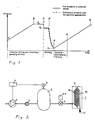
- Figure 1 is a principle diagram of the gas pressure prevailing in the pressure vessel,through and across the particle collection, as a function of the state of a working cycle
- Figure 2 illustrates the principle construction of apparatus for carrying out the preferred embodiment.
- gas normally air
- the capacity of the compressor 1 is preferably chosen so that a desired maximum pressure P b is obtained in the pressure vessel 2 prior to the blowing phase of the working cycle, time point c in Figure 1. In this way, minor variations in the duration of the working cycle will not affect the maximum pressure P b , and therewith the end result. Consequently, the compressor 1 is relieved of load at point b ( Figure 1) at which the pressure P b has been reached, e.g. through a compressor control circuit 4 which is activated by a control signal produced by a manometer 3, back leakage of gas through the pressure-relieved compressor 1 being prevented by a check valve 5.
- the volume of the pressure vessel 2 is selected so that the useable part of the enclosed compressed gas at pressure P b has an energy content which corresponds to the energy required to expel liquid.
- a valve 6 is opened by an auxiliary operating device 6a, such that gas will flow into the high pressure side 8 of a chamber arrangement 7 of the kind described and illustrated in the aforementioned publication SE-A-453 726.
- the gas pressure will fall from pressure P b to pressure P n , as a result of the increase in the available gas volume, said gas pressure P n being chosen so that the requisite expulsion of liquid will have been achieved upon completion of the penetration of the gas and associated lowering of the pressure, time point e.
- the gas on the high pressure side 8 can only expand further, while displacing liquid from the initially liquid-saturated particle collection 9.
- the displaced liquid exits into the low pressure side 10 of the chamber 7, and is led away from said low pressure side through a drainage pipe 11.
- the gas reaches the low pressure side 10 at time point d, wherewith the rate of flow of the gas increases drastically while displacing flow-prohibiting liquid from the major part of the pore system in the particle collection 9.
- the gas pressure will now fall quickly across the particle collection 9 and the through flowing gas will assist in draining liquid from the particle collection 9 and the chamber 7.
- the valve 6 is closed at time point e (alternatively at pressure P m ) and the compressor 1 is switched to its working state, so that the gas pressure will again rise to pressure P b during the time points e-b1.
- the chamber 7 has been opened and and its contents discharged and optional washing of the filter medium on fabric cloth has been carried out, the chamber 7 has been reclosed and again filled, accompanied by optional subsequent pressing of the particle collection through a membrane.
Landscapes
- Engineering & Computer Science (AREA)
- Health & Medical Sciences (AREA)
- Life Sciences & Earth Sciences (AREA)
- Molecular Biology (AREA)
- Mechanical Engineering (AREA)
- General Engineering & Computer Science (AREA)
- Chemical & Material Sciences (AREA)
- Chemical Kinetics & Catalysis (AREA)
- Processing Of Solid Wastes (AREA)
- Drying Of Solid Materials (AREA)
- Filtering Materials (AREA)
- Drying Of Gases (AREA)
Description
- The present invention relates to a method for dewatering water-containing particle collections in which at least one of a possible multiple of dewatering stages is effected with the aid of gas to which a pressure difference is imparted through and across the particle collection.
- Water-containing particle collections, such as mineral suspensions and fibre suspensions, are often dewatered by first mechanically pumping the particle collection onto a filtering medium and/or by pressing said collection against said medium under high pressure, such as to form a filter cake from which water is then removed under the influence of gas under pressure. Dewatering can either be accomplished by employing a vacuum and/or by using a pressurized gas, said gas normally being compressed air. Thus, in both instances, and also in different combinations thereof, the filter cake is subjected to a pressure difference which consists, in principle, of the sum of the low pressure on the suction side and the high pressure on the pressure side. The dewatering process is effected through the influence of this pressure difference in three successive phases, mainly a first penetration phase, which is commenced by subjecting fully saturated filter cake to pressurized gas on one side thereof, and is terminated when the gas breaks through the filter cake (penetration) and thus exits from the other side of said cake. During this phase, water present in the cake is simply displaced forwardly by the advancing gas front. During the second phase, the drainage phase, the gas flows through the filter cake while maintaining a pressure difference within the cake, the water in this case being forced to move in the same direction as the gas. This phase will terminate when the water capillary forces are in equilibrium with the gas pressure prevailing locally within the filter cake, with a subsequent decrease in water flow. When this state is reached, further water can only be removed by vapourizing water into the passing gas flow. This last dewatering phase, the drying phase, is thus dependent on gas mass flow, temperature and pressure.
- The aforedescribed dewatering mechanism is employed in several processes that are applied industrially for the purpose of dewatering particle collections in three phases or stages. Thus, a common feature of these processes is that dewatering is effected in at least one of the process stages with the aid of a gas to which there is imparted a pressure difference through and across the particle collection.
- For instance, "Solid/Liquid Separation Technology", published by Uplants Press Ltd, 1981, describes on page 331 one such method in which gas is blown into the particle collection at a pressure of 0.6 MPa (6 bars), whereas the final stage is effected by mechanical pressing-dewatering of the particle collection.
- According to another known method, described in SE-A-453 726 (Sala International), the final lowering of the moisture content of the particle collection is achieved by compressed-air blowing.
- A common feature of all methods known hitherto, however, is that further lowering of the moisture content can only be achieved by extending the blowing time or the cake-heating time. Both cases thus require a high energy input. Furthermore, an extended blow time will lower the capacity of the filter medium used.
- Because of higher energy costs and the ever greater industrial demands for more economical particle suspension dewatering processes, there is a need for further development of such dewatering processes which will render such processes less prohibitive, from the aspect of energy consumption, in the handling of these materials. In present times, energy costs are considered a very important factor in the total dewatering costs. Consequently, there is found an ever increasing desire for particle-collection dewatering processes which fulfill the requirements of lower energy consumption and(or higher productivity.
- It has now surprisingly been found possible to provide a method which will enable energy consumption to be kept low and higher productivity to be achieved in a simple fashion. The inventive method will be apparent from its characterising features set forth in the following method claims.
- Thus, the novel and inventive method is based on the principle of effecting pressurized-gas dewatering of the particle collection or agglomeration in essentially one single phase, namely the penetration phase, instead of in all three phases of the conventional method described briefly above. It has been found, very surprisingly, that dewatering in one single phase can be effected in a manner such as to render further dewatering phases unnecessary, therewith utilizing the energy input to an optimum. According to the invention, dewatering is accomplished with a high gas pressure or large pressure difference of not less than 0.1 MPa (1 atm) over a well defined time period, namely the time taken for the gas to penetrate, i.e. pass through, the particle collection (the filter cake). During the development of the present invention, it was found possible to achieve the same residual moisture content in the particle collection with a net energy input of only one hundredth, or even less, of that required when employing conventional gas-pressure dewatering processes. At the same time, the invention resulted in higher productivity for given dewatering apparatus, since the time taken to dewater the particle collection to the aforesaid same moisture level also fell drastically.
- The time taken for the gas to penetrate a particle collection is a highly complex magnitude which is contingent, inter alia, on the thickness or depth extension of the particle collection (the filter cake), the pressure applied, the porosity of the filter cake, the specific surface area and density of the particles, the viscosity of the water and the proportion of solids in the particle collection.
- The higher the pressure difference, the shorter the time taken to penetrate the particle collection and, paradoxically, the greater the savings in energy that can be achieved. For instance, it was found that when dewatering a given mineral concentrate, the penetration times were ca 120 s at 0.2 MPa (2 atm) pressure, ca 50 s at 0.4 MPa (4 atm), ca 30 s at 0.6 MPa (6 atm), ca 15 s at 1 MPa (10 atm) and only ca 10 s at 2 MPa (20 atm) pressure. Corresponding residual moisture contents were, in percent by weight, ca 10 at 0.2 MPa (2 atm), ca 9 at 0.4 MPa (4 atm), ca 7 at 0.6 MPa (6 atm), ca 6.5 at 0.8 MPa (8 atm), ca 6 at 1 MPa (10 atm) and ca 5 at 2 MPa (20 atm).
- According to one preferred embodiment of the invention, the pressure difference is engendered by first compressing a given, known gas volume to a pressure which will provide the predetermined pressure difference through and across the particle collection, while taking into account possible pressure losses and an optionally applied sub-ambient pressure on the suction side, whereafter the compressed gas is allowed to act freely on the particle collection. The simplest method of achieving this in practice is by pumping gas, from a small compressor, into a pressure vessel until the desired pressure is obtained, and then opening a valve so as to allow the gas to exit forcibly onto the particle collection for as long as it takes the gas volume to expand. Having knowledge of the volume of the pressure vessel, it is possible to calculate the pressure, or vice versa if so desired, so that the time taken for the gas to exit from the pressure vessel will correspond essentially to the penetration time, when this is known or can be calculated in respect of the material and dewatering apparatus concerned. In accordance with another preferred embodiment, which does not assume that the penetration time is known, a gas flow of constant predetermined pressure, for instance taken from a compressed air mains, is allowed to act on the particle collection until penetration occurs. The time at which penetration occurs can be followed-up and indicated in several ways, although it is preferred to measure the flow of gas through the particle collection continuously, and to cut-off the gas flow automatically when penetration is indicated. Naturally, these two embodiments of the inventive method can be combined in different ways.
- The invention will now be described in more detail with reference to a preferred embodiment and also with reference to the accompanying drawing, in which Figure 1 is a principle diagram of the gas pressure prevailing in the pressure vessel,through and across the particle collection, as a function of the state of a working cycle, and Figure 2 illustrates the principle construction of apparatus for carrying out the preferred embodiment.
- Referring to Figure 2, gas, normally air, is supplied to a
pressure vessel 2 from a compressor 1. The capacity of the compressor 1 is preferably chosen so that a desired maximum pressure Pb is obtained in thepressure vessel 2 prior to the blowing phase of the working cycle, time point c in Figure 1. In this way, minor variations in the duration of the working cycle will not affect the maximum pressure Pb, and therewith the end result. Consequently, the compressor 1 is relieved of load at point b (Figure 1) at which the pressure Pb has been reached, e.g. through a compressor control circuit 4 which is activated by a control signal produced by a manometer 3, back leakage of gas through the pressure-relieved compressor 1 being prevented by a check valve 5. The volume of thepressure vessel 2 is selected so that the useable part of the enclosed compressed gas at pressure Pb has an energy content which corresponds to the energy required to expel liquid. When the working cycle reaches time c, a valve 6 is opened by an auxiliary operating device 6a, such that gas will flow into the high pressure side 8 of achamber arrangement 7 of the kind described and illustrated in the aforementioned publication SE-A-453 726. The gas pressure will fall from pressure Pb to pressure Pn, as a result of the increase in the available gas volume, said gas pressure Pn being chosen so that the requisite expulsion of liquid will have been achieved upon completion of the penetration of the gas and associated lowering of the pressure, time point e. The gas on the high pressure side 8 can only expand further, while displacing liquid from the initially liquid-saturated particle collection 9. The displaced liquid exits into thelow pressure side 10 of thechamber 7, and is led away from said low pressure side through adrainage pipe 11. The gas reaches thelow pressure side 10 at time point d, wherewith the rate of flow of the gas increases drastically while displacing flow-prohibiting liquid from the major part of the pore system in the particle collection 9. The gas pressure will now fall quickly across the particle collection 9 and the through flowing gas will assist in draining liquid from the particle collection 9 and thechamber 7. The valve 6 is closed at time point e (alternatively at pressure Pm) and the compressor 1 is switched to its working state, so that the gas pressure will again rise to pressure Pb during the time points e-b₁. During this time period thechamber 7 has been opened and and its contents discharged and optional washing of the filter medium on fabric cloth has been carried out, thechamber 7 has been reclosed and again filled, accompanied by optional subsequent pressing of the particle collection through a membrane. - The following advantages are among those which can be achieved when practicing the preferred embodiment of the invention:
- 1) The time required to complete the gas blowing stage is shorter than the time required when practicing the known technique. For example, a 32 mm cake of a given hematite having a k₈₀ value of 40 microns requires a blowing time of ca 330s in order to achieve a 6% residual moisture content at a pressure difference of 0.6 MPa (6 atm). When proceeding in accordance with the preferred embodiment, a corresponding residual moisture content is achieved after a total blowing time of ca 30 s, when the pressure Pn is set to a 1 MPa (10 atm) overpressure. In practice, this increases the capacity of given apparatus by about 100%. Naturally, this will lower considerably the investment costs of the press equipment.
- 2) The net energy input required to expel liquid to the desired level is lowered by more effective use of the gas medium employed. In the aforedescribed example, the net energy consumption falls from about 290 kJ/kg expelled water to about 50 kJ/kg water. This results in appreciable lowering of operational costs.
- 3) The compressor requirement is reduced due to the reduction in energy requirements. When applying the known technique with the aforesaid example, there was required a compressor capable of delivering ca 15 Nm³/m² filter area at 0.6 MPa (6 atm) above ambient pressure over a period of 5.5 min, wherea the preferred inventive embodiment required a compressor capable of compressing ca 2 Nm³/m² to 1 MPa (10 atm) above ambient pressure over a running time of ca 5 min. This lowers the capital costs for peripheral equipment.
Claims (6)
- A method for dewatering water-containing particle collections, comprising a dewatering stage effected with the aid of gas which is imparted a predetermined pressure difference of not less than 0.1 MPa (1 atm) through and across the particle collection, characterized in that said dewatering stage is effected by, maintaining said pressure difference over a time period which does not appreciably exceed the time taken to reach gas penetration of the therewith dewatered particle collection.
- A method according the Claim 1, characterised by controlling the predetermined pressure difference and said time period, by first compressing a predetermined gas volume to a predetermined pressure which stands in relation to said pressure difference, and then permitting the compressed gas volume to act on the particle collection.
- A method according to Claim 1, characterised in that said predetermined pressure difference is created by permitting a gas flow of constant predetermined pressure in relation to said pressure difference to act upon the particle collection, until said penetration occurs.
- A method according to Claim 2, characterised by compressing said gas with the aid of a compressor which is operative in supplying gas to a pressure vessel of predetermined volume until said predetermined pressure is reached.
- A method according to Claims 1-3, characterised in that the penetration time point is indicated by continuously monitoring the gas flow.
- A method according to Claims 1-5, characterised by cutting-off the gas flow when the penetration time point is indicated.
Applications Claiming Priority (2)
| Application Number | Priority Date | Filing Date | Title |
|---|---|---|---|
| SE8802110 | 1988-06-07 | ||
| SE8802110A SE464171B (en) | 1988-06-07 | 1988-06-07 | PROCEDURE FOR GAS PRESSURE DRAINAGE OF WATER-CONTAINING PARTICLE COLLECTION |
Publications (2)
| Publication Number | Publication Date |
|---|---|
| EP0346312A1 EP0346312A1 (en) | 1989-12-13 |
| EP0346312B1 true EP0346312B1 (en) | 1993-08-18 |
Family
ID=20372537
Family Applications (1)
| Application Number | Title | Priority Date | Filing Date |
|---|---|---|---|
| EP89850183A Expired - Lifetime EP0346312B1 (en) | 1988-06-07 | 1989-06-05 | A method for dewatering water-containing particle collections with the aid of gas under pressure |
Country Status (9)
| Country | Link |
|---|---|
| US (1) | US4986008A (en) |
| EP (1) | EP0346312B1 (en) |
| AU (1) | AU614126B2 (en) |
| BR (1) | BR8902638A (en) |
| CA (1) | CA1325605C (en) |
| DE (1) | DE68908487T2 (en) |
| DK (1) | DK172237B1 (en) |
| ES (1) | ES2045555T3 (en) |
| SE (1) | SE464171B (en) |
Families Citing this family (4)
| Publication number | Priority date | Publication date | Assignee | Title |
|---|---|---|---|---|
| SE465656B (en) * | 1990-02-22 | 1991-10-14 | Sala International Ab | PROCEDURE FOR DRAINAGE OF PARTICLE COLLECTIONS |
| US5331747A (en) * | 1992-03-04 | 1994-07-26 | General Electric Company | Hydraulic test apparatus and method for stator in electrical generator |
| CA2580291C (en) * | 2004-09-13 | 2011-03-08 | Steve C. Benesi | High-efficiency slurry filtration apparatus and method |
| DE102008010184B4 (en) * | 2008-02-20 | 2015-12-10 | Jürgen Kuhn und Michael Kuhn Grundstücksverwaltungs- und verpachtungs GbR (Vertretungsberechtigter Gesellschafter der GbR: Michael Kuhn, 74746 Höpfingen) | Press device, in particular for a washing press, and washing press device with such a press device |
Family Cites Families (4)
| Publication number | Priority date | Publication date | Assignee | Title |
|---|---|---|---|---|
| GB1571504A (en) * | 1976-01-29 | 1980-07-16 | English Clays Lovering Pochin | Separation of solids and liquids |
| EP0088174B1 (en) * | 1980-08-06 | 1987-06-16 | William Bradshaw | An improved drying method and apparatus |
| US4664813A (en) * | 1985-09-26 | 1987-05-12 | Schneider John R | Method and apparatus for drying sludge using movable plates |
| SE453726B (en) * | 1986-07-10 | 1988-02-29 | Sala International Ab | PROCESS FILTER PROCEDURE AND DEVICE |
-
1988
- 1988-06-07 SE SE8802110A patent/SE464171B/en not_active IP Right Cessation
-
1989
- 1989-05-05 AU AU34065/89A patent/AU614126B2/en not_active Ceased
- 1989-05-09 CA CA000599101A patent/CA1325605C/en not_active Expired - Fee Related
- 1989-06-05 EP EP89850183A patent/EP0346312B1/en not_active Expired - Lifetime
- 1989-06-05 DE DE89850183T patent/DE68908487T2/en not_active Expired - Fee Related
- 1989-06-05 ES ES89850183T patent/ES2045555T3/en not_active Expired - Lifetime
- 1989-06-06 BR BR898902638A patent/BR8902638A/en not_active IP Right Cessation
- 1989-06-06 DK DK274989A patent/DK172237B1/en not_active IP Right Cessation
- 1989-06-06 US US07/362,011 patent/US4986008A/en not_active Expired - Fee Related
Also Published As
| Publication number | Publication date |
|---|---|
| EP0346312A1 (en) | 1989-12-13 |
| AU3406589A (en) | 1989-12-14 |
| SE464171B (en) | 1991-03-18 |
| SE8802110D0 (en) | 1988-06-07 |
| DK274989D0 (en) | 1989-06-06 |
| DE68908487D1 (en) | 1993-09-23 |
| DK274989A (en) | 1989-12-08 |
| US4986008A (en) | 1991-01-22 |
| CA1325605C (en) | 1993-12-28 |
| BR8902638A (en) | 1990-01-23 |
| DE68908487T2 (en) | 1993-12-09 |
| ES2045555T3 (en) | 1994-01-16 |
| DK172237B1 (en) | 1998-02-02 |
| SE8802110L (en) | 1989-12-08 |
| AU614126B2 (en) | 1991-08-22 |
Similar Documents
| Publication | Publication Date | Title |
|---|---|---|
| US4116831A (en) | Separation of solids and liquids | |
| EP0346312B1 (en) | A method for dewatering water-containing particle collections with the aid of gas under pressure | |
| US4464253A (en) | Continuous filter | |
| AU7150281A (en) | Dewatering system | |
| US5133879A (en) | Filtering procedure using a box filter and removing cake therefrom | |
| US4622144A (en) | Pressure filter apparatus | |
| US5460733A (en) | Control system distinguishing filterability of medium filtered | |
| KR20130018279A (en) | Solid-liquid separation method | |
| Carleton et al. | Dewatering of cakes | |
| FI89874B (en) | ADJUSTMENT OF THE CONNECTION OF THE FABRICS OF THE FIRE RELEASE | |
| JP7617360B2 (en) | Air blowing method for filter press | |
| SU1715384A1 (en) | Dehydration technique for coagulated sediment in aeration stations | |
| JPS6443314A (en) | Controlling device for sludge dehydrator | |
| JPH0472600B2 (en) | ||
| RU1808004C (en) | Method for dewatering of dispersed capillary porous materials | |
| JPS6094109A (en) | Dehydrating method by filter press | |
| JPS6129765B2 (en) | ||
| SU1711974A1 (en) | Method for processing wastes resulting from coal dressing | |
| JPH0256123B2 (en) | ||
| SU1681966A1 (en) | Filtering centrifuge | |
| JPS59159299A (en) | Compression dehydrating device for sludge | |
| JPH0515708A (en) | Operation method of filter press | |
| JPH0471607A (en) | Method for preventing freezing of pressure filter | |
| JPH0724402U (en) | Sludge dewatering filtration device | |
| JPS6266898A (en) | Dehydrator |
Legal Events
| Date | Code | Title | Description |
|---|---|---|---|
| PUAI | Public reference made under article 153(3) epc to a published international application that has entered the european phase |
Free format text: ORIGINAL CODE: 0009012 |
|
| AK | Designated contracting states |
Kind code of ref document: A1 Designated state(s): BE DE ES FR GB IT |
|
| 17P | Request for examination filed |
Effective date: 19900530 |
|
| 17Q | First examination report despatched |
Effective date: 19911106 |
|
| GRAA | (expected) grant |
Free format text: ORIGINAL CODE: 0009210 |
|
| AK | Designated contracting states |
Kind code of ref document: B1 Designated state(s): BE DE ES FR GB IT |
|
| REF | Corresponds to: |
Ref document number: 68908487 Country of ref document: DE Date of ref document: 19930923 |
|
| ET | Fr: translation filed | ||
| ITF | It: translation for a ep patent filed | ||
| REG | Reference to a national code |
Ref country code: ES Ref legal event code: FG2A Ref document number: 2045555 Country of ref document: ES Kind code of ref document: T3 |
|
| PLBE | No opposition filed within time limit |
Free format text: ORIGINAL CODE: 0009261 |
|
| STAA | Information on the status of an ep patent application or granted ep patent |
Free format text: STATUS: NO OPPOSITION FILED WITHIN TIME LIMIT |
|
| 26N | No opposition filed | ||
| REG | Reference to a national code |
Ref country code: GB Ref legal event code: IF02 |
|
| PGFP | Annual fee paid to national office [announced via postgrant information from national office to epo] |
Ref country code: GB Payment date: 20020605 Year of fee payment: 14 |
|
| PGFP | Annual fee paid to national office [announced via postgrant information from national office to epo] |
Ref country code: FR Payment date: 20020610 Year of fee payment: 14 |
|
| PGFP | Annual fee paid to national office [announced via postgrant information from national office to epo] |
Ref country code: DE Payment date: 20020612 Year of fee payment: 14 |
|
| PGFP | Annual fee paid to national office [announced via postgrant information from national office to epo] |
Ref country code: ES Payment date: 20020618 Year of fee payment: 14 |
|
| PGFP | Annual fee paid to national office [announced via postgrant information from national office to epo] |
Ref country code: BE Payment date: 20020821 Year of fee payment: 14 |
|
| PG25 | Lapsed in a contracting state [announced via postgrant information from national office to epo] |
Ref country code: GB Free format text: LAPSE BECAUSE OF NON-PAYMENT OF DUE FEES Effective date: 20030605 |
|
| PG25 | Lapsed in a contracting state [announced via postgrant information from national office to epo] |
Ref country code: ES Free format text: LAPSE BECAUSE OF NON-PAYMENT OF DUE FEES Effective date: 20030606 |
|
| PG25 | Lapsed in a contracting state [announced via postgrant information from national office to epo] |
Ref country code: BE Free format text: LAPSE BECAUSE OF NON-PAYMENT OF DUE FEES Effective date: 20030630 |
|
| BERE | Be: lapsed |
Owner name: *SALA INTERNATIONAL A.B. Effective date: 20030630 |
|
| PG25 | Lapsed in a contracting state [announced via postgrant information from national office to epo] |
Ref country code: DE Free format text: LAPSE BECAUSE OF NON-PAYMENT OF DUE FEES Effective date: 20040101 |
|
| GBPC | Gb: european patent ceased through non-payment of renewal fee |
Effective date: 20030605 |
|
| PG25 | Lapsed in a contracting state [announced via postgrant information from national office to epo] |
Ref country code: FR Free format text: LAPSE BECAUSE OF NON-PAYMENT OF DUE FEES Effective date: 20040227 |
|
| REG | Reference to a national code |
Ref country code: FR Ref legal event code: ST |
|
| REG | Reference to a national code |
Ref country code: ES Ref legal event code: FD2A Effective date: 20030606 |
|
| PG25 | Lapsed in a contracting state [announced via postgrant information from national office to epo] |
Ref country code: IT Free format text: LAPSE BECAUSE OF NON-PAYMENT OF DUE FEES;WARNING: LAPSES OF ITALIAN PATENTS WITH EFFECTIVE DATE BEFORE 2007 MAY HAVE OCCURRED AT ANY TIME BEFORE 2007. THE CORRECT EFFECTIVE DATE MAY BE DIFFERENT FROM THE ONE RECORDED. Effective date: 20050605 |