EP0343070A1 - Method and device for washing laundry in a machine using a powdery product - Google Patents
Method and device for washing laundry in a machine using a powdery product Download PDFInfo
- Publication number
- EP0343070A1 EP0343070A1 EP89401366A EP89401366A EP0343070A1 EP 0343070 A1 EP0343070 A1 EP 0343070A1 EP 89401366 A EP89401366 A EP 89401366A EP 89401366 A EP89401366 A EP 89401366A EP 0343070 A1 EP0343070 A1 EP 0343070A1
- Authority
- EP
- European Patent Office
- Prior art keywords
- bag
- washing
- mouth
- ring
- machine
- Prior art date
- Legal status (The legal status is an assumption and is not a legal conclusion. Google has not performed a legal analysis and makes no representation as to the accuracy of the status listed.)
- Granted
Links
- 238000005406 washing Methods 0.000 title claims abstract description 136
- 238000000034 method Methods 0.000 title claims abstract description 58
- 239000003599 detergent Substances 0.000 claims abstract description 80
- -1 polypropylene Polymers 0.000 claims abstract description 18
- 239000004033 plastic Substances 0.000 claims abstract description 16
- 229920003023 plastic Polymers 0.000 claims abstract description 16
- 239000007787 solid Substances 0.000 claims abstract description 15
- 230000000694 effects Effects 0.000 claims abstract description 10
- 239000004743 Polypropylene Substances 0.000 claims abstract description 5
- 229920001155 polypropylene Polymers 0.000 claims abstract description 5
- 239000000463 material Substances 0.000 claims description 33
- XLYOFNOQVPJJNP-UHFFFAOYSA-N water Substances O XLYOFNOQVPJJNP-UHFFFAOYSA-N 0.000 claims description 28
- 239000000203 mixture Substances 0.000 claims description 24
- 238000004090 dissolution Methods 0.000 claims description 15
- 230000000873 masking effect Effects 0.000 claims description 15
- 239000002245 particle Substances 0.000 claims description 12
- 238000009792 diffusion process Methods 0.000 claims description 10
- 239000003795 chemical substances by application Substances 0.000 claims description 9
- 239000000470 constituent Substances 0.000 claims description 9
- 229920000742 Cotton Polymers 0.000 claims description 7
- 230000008569 process Effects 0.000 claims description 7
- 230000000750 progressive effect Effects 0.000 claims description 7
- 239000007844 bleaching agent Substances 0.000 claims description 6
- 102000004190 Enzymes Human genes 0.000 claims description 5
- 108090000790 Enzymes Proteins 0.000 claims description 5
- 239000004698 Polyethylene Substances 0.000 claims description 5
- 239000007864 aqueous solution Substances 0.000 claims description 5
- 238000001035 drying Methods 0.000 claims description 5
- 238000004806 packaging method and process Methods 0.000 claims description 5
- 229920000573 polyethylene Polymers 0.000 claims description 5
- 230000009471 action Effects 0.000 claims description 4
- 239000011248 coating agent Substances 0.000 claims description 3
- 238000000576 coating method Methods 0.000 claims description 3
- 150000001875 compounds Chemical class 0.000 claims description 3
- 239000000123 paper Substances 0.000 claims description 3
- 230000000149 penetrating effect Effects 0.000 claims description 3
- 230000035515 penetration Effects 0.000 claims description 3
- ZAMOUSCENKQFHK-UHFFFAOYSA-N Chlorine atom Chemical compound [Cl] ZAMOUSCENKQFHK-UHFFFAOYSA-N 0.000 claims description 2
- 230000000844 anti-bacterial effect Effects 0.000 claims description 2
- QVGXLLKOCUKJST-UHFFFAOYSA-N atomic oxygen Chemical compound [O] QVGXLLKOCUKJST-UHFFFAOYSA-N 0.000 claims description 2
- 239000003899 bactericide agent Substances 0.000 claims description 2
- 239000011111 cardboard Substances 0.000 claims description 2
- 239000003054 catalyst Substances 0.000 claims description 2
- 239000000460 chlorine Substances 0.000 claims description 2
- 229910052801 chlorine Inorganic materials 0.000 claims description 2
- 239000006260 foam Substances 0.000 claims description 2
- 239000004519 grease Substances 0.000 claims description 2
- 239000001301 oxygen Substances 0.000 claims description 2
- 229910052760 oxygen Inorganic materials 0.000 claims description 2
- 239000002023 wood Substances 0.000 claims description 2
- 238000005282 brightening Methods 0.000 claims 1
- 230000001627 detrimental effect Effects 0.000 claims 1
- 239000000835 fiber Substances 0.000 claims 1
- 239000002184 metal Substances 0.000 claims 1
- 239000000047 product Substances 0.000 description 81
- 239000000843 powder Substances 0.000 description 22
- 238000012360 testing method Methods 0.000 description 19
- 239000002609 medium Substances 0.000 description 14
- CDBYLPFSWZWCQE-UHFFFAOYSA-L Sodium Carbonate Chemical compound [Na+].[Na+].[O-]C([O-])=O CDBYLPFSWZWCQE-UHFFFAOYSA-L 0.000 description 8
- 239000004115 Sodium Silicate Substances 0.000 description 8
- 239000000654 additive Substances 0.000 description 8
- 239000004744 fabric Substances 0.000 description 7
- 239000000243 solution Substances 0.000 description 7
- PMZURENOXWZQFD-UHFFFAOYSA-L Sodium Sulfate Chemical compound [Na+].[Na+].[O-]S([O-])(=O)=O PMZURENOXWZQFD-UHFFFAOYSA-L 0.000 description 5
- 239000012736 aqueous medium Substances 0.000 description 5
- 230000008901 benefit Effects 0.000 description 5
- 238000009826 distribution Methods 0.000 description 5
- 239000008187 granular material Substances 0.000 description 5
- 239000007788 liquid Substances 0.000 description 5
- 229910052938 sodium sulfate Inorganic materials 0.000 description 5
- 235000011152 sodium sulphate Nutrition 0.000 description 5
- XAGFODPZIPBFFR-UHFFFAOYSA-N aluminium Chemical compound [Al] XAGFODPZIPBFFR-UHFFFAOYSA-N 0.000 description 4
- 229910052782 aluminium Inorganic materials 0.000 description 4
- 235000014113 dietary fatty acids Nutrition 0.000 description 4
- 239000000194 fatty acid Substances 0.000 description 4
- 229930195729 fatty acid Natural products 0.000 description 4
- 150000004665 fatty acids Chemical class 0.000 description 4
- 230000002093 peripheral effect Effects 0.000 description 4
- 229910000029 sodium carbonate Inorganic materials 0.000 description 4
- 229960001922 sodium perborate Drugs 0.000 description 4
- NTHWMYGWWRZVTN-UHFFFAOYSA-N sodium silicate Chemical compound [Na+].[Na+].[O-][Si]([O-])=O NTHWMYGWWRZVTN-UHFFFAOYSA-N 0.000 description 4
- 229910052911 sodium silicate Inorganic materials 0.000 description 4
- 235000019351 sodium silicates Nutrition 0.000 description 4
- YKLJGMBLPUQQOI-UHFFFAOYSA-M sodium;oxidooxy(oxo)borane Chemical compound [Na+].[O-]OB=O YKLJGMBLPUQQOI-UHFFFAOYSA-M 0.000 description 4
- 102000005158 Subtilisins Human genes 0.000 description 3
- 108010056079 Subtilisins Proteins 0.000 description 3
- 239000012190 activator Substances 0.000 description 3
- 230000000295 complement effect Effects 0.000 description 3
- 230000021615 conjugation Effects 0.000 description 3
- 210000003811 finger Anatomy 0.000 description 3
- 238000012423 maintenance Methods 0.000 description 3
- 210000000056 organ Anatomy 0.000 description 3
- 238000005192 partition Methods 0.000 description 3
- 229920003169 water-soluble polymer Polymers 0.000 description 3
- QAOWNCQODCNURD-UHFFFAOYSA-L Sulfate Chemical compound [O-]S([O-])(=O)=O QAOWNCQODCNURD-UHFFFAOYSA-L 0.000 description 2
- 229910021536 Zeolite Inorganic materials 0.000 description 2
- 230000000996 additive effect Effects 0.000 description 2
- 125000000217 alkyl group Chemical group 0.000 description 2
- 238000004061 bleaching Methods 0.000 description 2
- 230000000052 comparative effect Effects 0.000 description 2
- 238000013461 design Methods 0.000 description 2
- HNPSIPDUKPIQMN-UHFFFAOYSA-N dioxosilane;oxo(oxoalumanyloxy)alumane Chemical compound O=[Si]=O.O=[Al]O[Al]=O HNPSIPDUKPIQMN-UHFFFAOYSA-N 0.000 description 2
- XAMVQPGMBASQMV-UHFFFAOYSA-N ethane-1,1,1,2,2,2-hexamine Chemical compound NC(N)(N)C(N)(N)N XAMVQPGMBASQMV-UHFFFAOYSA-N 0.000 description 2
- 230000014509 gene expression Effects 0.000 description 2
- 238000003780 insertion Methods 0.000 description 2
- 230000037431 insertion Effects 0.000 description 2
- 238000004519 manufacturing process Methods 0.000 description 2
- 238000000465 moulding Methods 0.000 description 2
- 239000013618 particulate matter Substances 0.000 description 2
- 229920000642 polymer Polymers 0.000 description 2
- 239000011148 porous material Substances 0.000 description 2
- 230000009467 reduction Effects 0.000 description 2
- 235000019832 sodium triphosphate Nutrition 0.000 description 2
- 238000003860 storage Methods 0.000 description 2
- 239000000126 substance Substances 0.000 description 2
- 239000003760 tallow Substances 0.000 description 2
- FRPJTGXMTIIFIT-UHFFFAOYSA-N tetraacetylethylenediamine Chemical compound CC(=O)C(N)(C(C)=O)C(N)(C(C)=O)C(C)=O FRPJTGXMTIIFIT-UHFFFAOYSA-N 0.000 description 2
- 239000010457 zeolite Substances 0.000 description 2
- 229910019142 PO4 Inorganic materials 0.000 description 1
- 239000000853 adhesive Substances 0.000 description 1
- 230000001070 adhesive effect Effects 0.000 description 1
- 239000002671 adjuvant Substances 0.000 description 1
- 125000000129 anionic group Chemical group 0.000 description 1
- 239000011324 bead Substances 0.000 description 1
- 239000011230 binding agent Substances 0.000 description 1
- 230000033228 biological regulation Effects 0.000 description 1
- 230000008859 change Effects 0.000 description 1
- 239000006185 dispersion Substances 0.000 description 1
- 230000007613 environmental effect Effects 0.000 description 1
- 238000011156 evaluation Methods 0.000 description 1
- 230000002349 favourable effect Effects 0.000 description 1
- 239000000945 filler Substances 0.000 description 1
- 239000012530 fluid Substances 0.000 description 1
- 230000002209 hydrophobic effect Effects 0.000 description 1
- 238000002347 injection Methods 0.000 description 1
- 239000007924 injection Substances 0.000 description 1
- 238000001746 injection moulding Methods 0.000 description 1
- 239000004816 latex Substances 0.000 description 1
- 229920000126 latex Polymers 0.000 description 1
- 230000014759 maintenance of location Effects 0.000 description 1
- 238000005259 measurement Methods 0.000 description 1
- 239000007769 metal material Substances 0.000 description 1
- 238000012986 modification Methods 0.000 description 1
- 230000004048 modification Effects 0.000 description 1
- 238000010137 moulding (plastic) Methods 0.000 description 1
- 239000004482 other powder Substances 0.000 description 1
- 235000011837 pasties Nutrition 0.000 description 1
- 239000008188 pellet Substances 0.000 description 1
- PATMLLNMTPIUSY-UHFFFAOYSA-N phenoxysulfonyl 7-methyloctanoate Chemical compound CC(C)CCCCCC(=O)OS(=O)(=O)OC1=CC=CC=C1 PATMLLNMTPIUSY-UHFFFAOYSA-N 0.000 description 1
- NBIIXXVUZAFLBC-UHFFFAOYSA-K phosphate Chemical compound [O-]P([O-])([O-])=O NBIIXXVUZAFLBC-UHFFFAOYSA-K 0.000 description 1
- 239000010452 phosphate Substances 0.000 description 1
- 238000003825 pressing Methods 0.000 description 1
- 238000011160 research Methods 0.000 description 1
- 238000009666 routine test Methods 0.000 description 1
- 238000005070 sampling Methods 0.000 description 1
- 230000035945 sensitivity Effects 0.000 description 1
- 239000012265 solid product Substances 0.000 description 1
- 239000004094 surface-active agent Substances 0.000 description 1
- 239000012209 synthetic fiber Substances 0.000 description 1
- 229920002994 synthetic fiber Polymers 0.000 description 1
- 239000004753 textile Substances 0.000 description 1
- 210000003813 thumb Anatomy 0.000 description 1
- 238000012546 transfer Methods 0.000 description 1
- 238000009827 uniform distribution Methods 0.000 description 1
- 230000000007 visual effect Effects 0.000 description 1
Images




Classifications
-
- C—CHEMISTRY; METALLURGY
- C11—ANIMAL OR VEGETABLE OILS, FATS, FATTY SUBSTANCES OR WAXES; FATTY ACIDS THEREFROM; DETERGENTS; CANDLES
- C11D—DETERGENT COMPOSITIONS; USE OF SINGLE SUBSTANCES AS DETERGENTS; SOAP OR SOAP-MAKING; RESIN SOAPS; RECOVERY OF GLYCEROL
- C11D17/00—Detergent materials or soaps characterised by their shape or physical properties
- C11D17/04—Detergent materials or soaps characterised by their shape or physical properties combined with or containing other objects
- C11D17/041—Compositions releasably affixed on a substrate or incorporated into a dispensing means
- C11D17/046—Insoluble free body dispenser
-
- D—TEXTILES; PAPER
- D06—TREATMENT OF TEXTILES OR THE LIKE; LAUNDERING; FLEXIBLE MATERIALS NOT OTHERWISE PROVIDED FOR
- D06F—LAUNDERING, DRYING, IRONING, PRESSING OR FOLDING TEXTILE ARTICLES
- D06F39/00—Details of washing machines not specific to a single type of machines covered by groups D06F9/00 - D06F27/00
- D06F39/02—Devices for adding soap or other washing agents
- D06F39/024—Devices for adding soap or other washing agents mounted on the agitator or the rotating drum; Free body dispensers
Definitions
- the present invention belongs to the field of machine washing. It relates to a new washing process making it possible to optimally use the products currently available on the market in solid form, in particular powder, which are used in a washing operation, for example detergents or other special additives having activity during washing.
- the invention also relates to a device for implementing such a method.
- Washing is increasingly carried out in machines, using products presented in the form of powder, granules or other solid forms in particles. Washing machines are mainly drum machines but there are also so-called agitator / pulsator machines. Whatever type of machine is used, specialists know that the conditions for using such products are far from optimal. There is indeed a real problem in ensuring a uniform distribution of the particulate product and its dissolution in the washing medium located in the tank of the machine. In the following, the technical problems will be illustrated more particularly in the case of powdered detergents, but it is clear that similar problems arise with detergents presented otherwise as with any additives having activity during washing.
- compartments or trays are provided for receiving the appropriate quantity of detergent powder before the actual washing operation.
- the powdery active product is supposed to be entrained by the water in the tank of the machine, as the process progresses.
- the powdered detergent is far from being completely entrained by the water, so that more or less significant residual quantities remain in the distribution tank. So the expected amount of detergent powder is not actually consumed, which affects the effectiveness of washing.
- the washing machine tubs are always soiled with residues from previous operations. This difficulty is widely known and is the subject of numerous complaints from users.
- the detergent particles are colored, so that the colored granules of the detergent dissolve by releasing the dye from the laundry and can then cause stains on the laundry.
- the detergent composition contains peroxygen compounds, the corresponding granules, for example perborate granules, decompose on contact with the laundry and can discolor the articles of fragile color.
- the applicant has appealed to the concept of a process according to which a device is first filled with detergent, which is then placed in the machine, with the laundry to be washed. It has, in fact, developed this concept essentially in the case of liquid detergents and, by way of reference to illustrate such a state of the art, mention may be made of patent application FR 34 O6151 filed on April 18, 1984 and published under N ° 2.563.250, having as title: "Washing machine in machine with liquid detergent and device for its application".
- the detergent contained in the device gradually diffuses into the washing medium and into the laundry in the machine.
- the device comprises a filling orifice and vents for the gradual release of the liquid within the laundry during washing.
- such a device comprises a body capable of being filled with the desired quantity of detergent, removable means for closing off this body, the body or said means having holes or vents for the release of the detergent, said device being characterized in that it comprises means separating the part of the device comprising the holes or vents from the part comprising the particulate detergent, said means being designed to allow the washing water to pass freely and for practice prevent the massive and uncontrolled release of particulate detergent.
- a device structure which has given very interesting practical results has the general appearance of a body of revolution which can be closed by a removable cap, which has holes allowing both the entry of water inside.
- the device being more particularly characterized in that it comprises at least one plate mounted inside the device for separating the cap and the part of the body containing the particulate detergent, said plate having -even at least one orifice whose surface is less than that of the holes or vents of the cap,
- the perforated plate makes it possible to retain the particulate detergent in the body of the device while allowing the washing water to come to dissolve this detergent before his release in the washing machine.
- the Applicant has continued its research to solve the technical problems mentioned in the aforementioned FR patent application, while retaining the concept of progressive diffusion and dispersion in the washing medium and in the linen of an active product initially available in the form particulate, ensuring the predissolution of this product before its diffusion.
- the present invention provides a solution to these technical problems as well as to others, as will emerge from the description which follows, while fully retaining the benefits of the metering and diffusing devices which it had already proposed for particulate detergents. , in particular those forming the subject of the aforementioned FR patent application.
- the invention relates to a method for washing laundry in the machine, according to which a metering and diffusing device of the reusable type is filled with a particulate product having activity during washing, this device is placed in the machine with the laundry. washing and then washing is carried out in the usual manner, characterized in that said device essentially comprises a flexible sheath in the form of a bag extending around at least one mouth, which allows the filling of the bag with the desired quantity of corresponding product substantially to a washing operation and remains at least partially open during washing, the aqueous washing medium penetrating inside the bag at least through the mouth thereof, with a view to the gradual dissolution of the particulate product, this the latter thus being gradually released during washing predominantly in the form of an aqueous solution passing at least through the mouth of the bag.
- the bag is made of a material capable of retaining the particulate product, without letting it pass in solid form, as well as withstanding the washing and drying temperatures of the machine.
- the material constituting the bag is designed to allow the penetration of the aqueous washing medium through the bag, towards the particulate product which is contained therein, as well as the diffusion of an active aqueous solution, originating from the progressive dissolution of the particulate product and passing through the bag, from the inside to the outside of the latter.
- the bag is permeable to water. Penetration of the aqueous washing medium takes place both through the mouth of the bag and through it and the diffusion or release of the active solution of product also takes place through the mouth of the bag and through it .
- the process of the invention can be applied not only to detergents in solid form, but also to any particulate product having activity during washing, for example chosen from bleaching agents, such as agents releasing chlorine or active oxygen (peroxygen compounds), bleaching catalysts, bleaching activators, bactericides, foam regulators, brighteners, anti-deposition agents of dirt, enzymes, softeners, stain-removing agents grease or constituents which do not exert a direct action on the dirt but which can intervene in a washing process of the washing machine, for example the agents ensuring a protection of the organs and internal parts of the washing machine.
- bleaching agents such as agents releasing chlorine or active oxygen (peroxygen compounds)
- the expression "particulate product” includes all the forms of presentation of such solid products, such as powders, granules, flakes, pellets and other similar physical structures capable of being dissolved in water under normal conditions of washing.
- the process of the invention is particularly advantageous with detergents presented in the form of so-called high density particles, which are already de currently being developed in some countries. They have advantages in packaging, transport, storage, vis-à-vis similar traditional products, because of the reduction in size they allow to obtain.
- high-density particulate detergents tend to cause losses in the distribution tank as well as in the drainage circuits, even greater than detergents in traditional powder.
- the ability to dissolve these new detergents is, in some cases, less than that of known products.
- the device used according to the invention is distinguished in many aspects from certain means known from the prior art which consisted of sachets or bags which may contain a detergent or an additive useful in washing, such products may be present under particulate form in the sachet.
- the bags or sachets of the prior art contain a predosed amount of product and cannot be reused. Their design does not allow the product to be released gradually, it being completely dispensed either immediately at the start of the washing cycle, or during it.
- the device of the invention does not have the drawbacks of sachets or bags of the prior art.
- the device is of the reusable type and can dose at will the quantity of product (detergent or any additive) thanks to the presence of the mouthpiece, which is used to fill the product.
- the sachets or bags of the prior art must have a wall which is soluble in water or in the washing medium or else, in the case where this wall does not is not soluble in water, it is necessary to provide seals, or bonds capable of dissolving to release the products.
- the sachets or bags are difficult to store and to market practically, because of their sensitivity to humidity.
- the device of the invention can be recovered at the end of washing without any risk for the machine, which is entirely essential for the practical needs of users.
- the method of the invention can be implemented with a wide variety of devices comprising a flexible bag.
- the material of the flexible bag can be of any type, as long as it has sufficient resistance to water and to the washing medium at the temperatures used during washing as well as during drying, thus being able to go up to 'at about 150 ° C. he can therefore be a woven or non-woven material made from natural or synthetic fibers or a mixture thereof.
- a bag formed from a flexible sheath made of pure cotton may be used either in the form of a fabric having a mesh opening of less than about 0.5 mm or in the form of a nonwoven article with openings ranging in particular from 0.5 to 0.8 mm.
- the bag can also be produced from extruded or co-extruded films and having perforations.
- the dimensions of these can vary within wide limits, depending on the nature and the particle size of the particulate product. As an indication, perforation films of approximately 380 microns can be used.
- the material of the bag is not necessarily a textile material.
- the sheath can also be produced from a plastic mesh or a sheet of paper or other porous and water-resistant cellulosic material. If the material provided for the flexible bag does not in itself have sufficient resistance to water, it can be provided with a coating making it water resistant.
- the coating may consist of a latex-based binder associated with a hydrophobic substance.
- the external shape of the bag can also be very variable and according to an advantageous characteristic of the invention, it is possible to adapt this shape to the type of particulate product used as well as to the conditions under which this product must be released, as examples. will be given later.
- the bag can be a substantially cylindrical sheath extending in the extension of the mouth, the diameter of the sheath then being substantially equal to that of the mouth. But one can also use gains which are tapered from the mouth or on the contrary flared from it. A tapered sheath provides relatively faster release of the particulate product, while a flared sheath provides relatively slower release.
- the flexible bag can have various markings corresponding to filling levels and therefore to variable quantities. of particulate products.
- the device according to the invention had at least one mouth allowing both the filling of the bag with the active product and its release in pre-dissolved form, in the washing medium and in the laundry in the machine.
- the device comprises a single mouth, the section of which may be any: circular, oval, square, rectangular and the like. Good practical results have been obtained with mouthpieces of circular section.
- the mouth of the bag should be delimited by a means serving to support the sheath of the bag.
- This can be simply made using a ring having, as a section, that intended for the mouth.
- This ring can be made of a material of completely variable hardness, the only condition being that the mouthpiece is kept open during washing.
- the constituent material of the ring can be a plastic, metallic material or else wood, cardboard rendered water resistant and any other similar material. Good practical results are obtained with plastics which are easy to work in order to achieve the desired configurations of the ring.
- polyethylene and polypropylene are very suitable.
- the mouth of the bag should be kept open, at least partially, during washing, in order to allow the gradual release of an aqueous solution of active product. It is therefore possible, ultimately, to use flexible bag devices, in which the mouth is entirely free, but it is generally preferred to use devices in which the mouth additionally comprises means making it possible to mask it, with the exception certain predetermined openings.
- the means intended to mask the mouthpiece must be adapted to the shape and nature of the ring defining it. Purely illustrative examples will be given later. Good practical results have been obtained with a ring having radial walls leading to a solid central zone, so that openings are thus produced between each of said radial walls.
- the walls in question may be straight or on the contrary have a particular profile, for example in the form of a helix. But many other variants are possible: for example one can provide inside the ring delimiting the mouth, walls concentric with this ring, going towards the inside thereof, with radial walls disposed between said intermediate partitions and the outer ring.
- the shape of the ring surrounding the flexible bag can be chosen so as to facilitate the removal of particulate product in a larger container, for example a barrel.
- the ring can be arranged so that its outer edge acts as a sampling trough.
- the ring may also have surface irregularities, in relief or in hollow, allowing a good grip with the fingers.
- fix on the ring an element allowing its gripping.
- Such an element can be permanently mounted, in which case it is preferably of small dimension, or as a variant, this element consists of a handle of larger dimension, which can be removably fixed by any suitable means on the body of the Ring.
- the choice of a particular type of metering and diffusing device with flexible bag can be adapted to the active product to be used during washing.
- devices whose mouthpiece remains completely open during washing and which do not include any masking means can be used to contain detergents or additives whose constituents dissolve in water only slowly.
- An example of a detergent composition having such characteristics is as follows: Alkyl sulphates 7-10% Fatty acid 1- 3% Aluminum and sodium silicates 15-25% Water-soluble polymers 1- 3% Sodium silicate 3- 8% Sodium sulfate 10-40% Sodium carbonate 5-10% Alcalase (enzyme) 0-2%
- Another example of a detergent composition which can be used for delicate washing and which can be used with a metering and diffusing device with an open mouth is as follows: Alkyl sulphates 10-20% Fatty acid 1- 3% Aluminum and sodium silicates 20-30% Sodium silicate 1- 5% Sodium sulfate 20-40% Sodium carbonate 0- 5%
- Additives which can also be used in such a metering and diffusing device are, for example, products which exert a softening action on the washing water. ge.
- a metering and diffusing device comprising a mouthpiece with masking means can be used with detergents for heavy washes for which direct contact between the linen and some of its constituents should be avoided.
- a detergent composition for heavy washes falling into this category the following may be cited: Alkyl sulphates 7-10% Fatty acid 1- 3% Aluminum and sodium silicates 15-25% Water-soluble polymers 1- 3% Sodium perborate 10-25% Sodium silicate 3- 8% Sodium sulfate 10-40% Sodium carbonate 5-10% Alcalase 0-2%
- composition can comprise up to 5% of a bleach activator such as tetraacetyl-ethylene diamine or iso-nonanoyl oxybenzene sulfonate.
- a bleach activator such as tetraacetyl-ethylene diamine or iso-nonanoyl oxybenzene sulfonate.
- Certain particulate products may present some difficulty in dissolving in the aqueous medium, after having been introduced inside the flexible bag. Powder residues, wet but not dissolved, which have remained inside the bag at the end of the washing operation have sometimes been observed.
- the present invention also relates to a general type process described above and ensuring complete dissolution of the particulate product during the washing cycle.
- the invention also relates to devices whose structure is designed to preserve the longevity of the flexible sheath constituting the bag.
- a device comprising means extending inside the bag, from the mouth thereof, said means ensuring at least partial maintenance of the general shape of the bag during washing.
- a device for the implementation of this embodiment is therefore characterized by the presence of the aforementioned holding means, which are placed inside the sheath of the bag.
- the general shape of the sheath of the bag was then kept substantially during the entire washing operation, the holding means preventing in particular the flexible walls of the sheath from approaching.
- the integrity of the shape of the bag is substantially preserved, so that the particulate product dissolves completely and normally during washing, to be gradually released through the mouth of the bag as well as, if the material constituting the bag is permeable to water, through the sheath of the bag.
- the holding means consist of a rod plunging inside the bag, one end of which is fixed at the mouth and the other end is free.
- the length of such a rod is variable, the latter being able to extend at various levels inside the bag, from the mouth to the bottom of the latter.
- the cross section of the rod is significantly less than the section of the bag, so that the sheath thereof can exercise its function without being hindered by the presence of the rod inside the bag.
- the free end of the rod has a flared or open part towards the bottom of the bag.
- This flared part may have the shape of a disc produced in one piece with the rod or made integral with the latter by any means. This flared part can be full or perforated, so, in the latter case, to more easily allow free access to the aqueous medium to the bottom of the bag.
- the length of the rod was, suitably, such that the flared part is in the vicinity of the bottom of the bag.
- the holding means consist of a cage plunging inside the bag.
- Said cage may comprise a first end part, cooperating with the mouthpiece in order to be fixed on the latter and a second end part, which is free and extends inside the bag.
- This first end part can be shaped in the form of a rod to be fixed at the mouth of the bag, with the ring delimiting the latter or, if they exist, as is preferred, with the masking means from this mouth.
- Said cage also comprises a number of members in the form of bars, which generally extend in the direction of the longitudinal axis of the bag. It is advantageous that these bars are held at each end by an annular member, or any other section, generally corresponding to that of the mouth and the sheath of the bag.
- the holding means consist of an assembly whose longitudinal axis generally corresponds to that of the bag, said assembly comprises both at one end a first member cooperating with the means delimiting the mouth of the bag or, if they exist, with the means for masking the latter, and at the other end a second member located inside the bag, the said members serving as support for the bars extending generally longitudinally inside the bag.
- the volume of the flexible bag must be chosen according to the dose of active product to be dispensed during washing.
- suitable volume values for the flexible bag are approximately 250 ml to 400 ml, which makes it possible to introduce weight quantities of particulate detergent of the order of 150 250 g per wash.
- the method of the invention which uses a metering and diffusing device with flexible bag makes it possible to use detergent compositions which currently cannot find a practical application, due to the fact that they cannot be properly distributed from the container or compartment fitted to the washing machine. This is already true for certain high density detergent compositions, which have already been mentioned previously. But the same observation is to be made for other detergent compositions having a poor solubility in water.
- the method of the invention therefore makes it possible to use detergent compositions providing better washing performance, for example by reducing or even eliminating the fillers of sodium sulfate type while increasing the proportions of surfactant, for example anionic and nonionic.
- the invention can be implemented with particulate products of very variable particle size, since the person skilled in the art has many parameters in the metering and diffusing device to choose the most appropriate device according to the nature of the active product. : material constituting the flexible bag as well as its shape, mouthpiece with or without masking means, shapes and dimensions of the mouthpiece and the openings which it comprises if there is presence of masking means, holding means inside the bag sheath, and the like.
- the method of the invention makes it possible to distribute detergents, additives or other active washing products available in particulate form, even within the laundry in the machine, which provides higher concentrations of detergent solution in contact with the laundry and therefore increases the performance and quality of washing .
- the invention virtually eliminates the losses of active product, in particular detergent, which occur when the metering compartment of the washing machine is used, the losses in the drain circuit of the machine also being eliminated.
- the quantity of plastic material used in the metering and diffusing device is very low, since it is reduced to that of the ring delimiting the mouthpiece and carrying the flexible bag. In some cases, it is not even necessary to use plastic material to make such a ring.
- the invention provides better protection of the environment, since the materials constituting the device are very largely degraded in the natural environment.
- the very small size of the dosing and diffusing device with flexible bag makes it possible to associate it in an optimal manner with the packaging of products in particles, such as detergents and other additives useful in washing. It is thus possible to use individual packages comprising larger quantities of particulate product and / or packages which themselves have a reduced bulk.
- the device in question is very easy to handle and store, since it occupies only a very small space.
- the invention makes it possible to use any desired quantity of product, depending on the nature of the latter. We therefore even choose the metering and diffusing device most appropriate to the characteristics of the product, a type of device then being assigned to an individual product packaging.
- the method of the invention is still very easy to implement since the metering and diffusing device can be used directly to take off the particulate active product. Once the washing operation is complete, the device is easily retrieved from the machine and can then be reused. Even if the user forgets the device in the machine or in the dryer, this presents no disadvantage either for the machine or for the laundry in a subsequent washing operation.
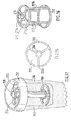
- the metering and diffusing device designated by the general reference 10 in FIG. 1 essentially comprises a ring 1 and a bag 2 made of flexible material, for example cotton fabric.
- the size of the openings of the fabric 2 must be such that it can prevent the free passage of a pro particulate matter, in particular a detergent, placed inside the bag, even with regard to the finest particles.
- the bag 2 has a generally approximately cylindrical shape but there are shown variants in Figures 2 and 3 which illustrate different shapes.
- the device 20 comprises a ring 21 carrying a flexible bag 22 which tapers towards the tip.
- the device 30 of FIG. 3 comprises a ring 31 and a flexible bag 32 which widens out from the mouth delimited by the ring 31.
- the shape of the bags allows the retention characteristics of the particulate product to be varied. inside the bags and, consequently, the ability to diffuse into the washing medium and into the laundry the particulate product in pre-dissolved form.
- the bag 22 of Figure 2 provides faster diffusion characteristics than the bag 32 of Figure 3, the structure of the ring 31 and the corresponding mouth being the same.
- Figure 4 is a sectional view schematically showing the mounting of a flexible bag 42 on a support ring 41.
- a flexible bag 42 In this example it is made of plastic, for example polypropylene. It is formed of an outer wall 43 connecting to an inner wall 44, the latter being substantially rectilinear. Between these two walls is provided a compartment 45 inside which can be inserted the extreme edge 46 of the bag 42.
- any suitable means can be used, for example an adhesive capable of withstand the temperatures used in washing machines, including those where drying is carried out, the temperatures then being able to range up to 150 ° C.
- FIG. 5 schematically shows in plan the structure of a ring having given good practical results in the implementation of the method of the invention. It essentially comprises a peripheral wall 51 arranged in the same way as the ring 41 shown in FIG. 4. At the center of the ring 51 is mounted a pad 52 from which extend a certain number (in the example chosen this number is equal to 6) of elements 53 in the form of turbine blades. Between the elements 53 are openings 57.
- a ring of the type shown in FIG. 5 allows both the filling of an associated flexible bag, while preventing a massive release of particulate product through the openings 57.
- FIG. 6 shows a ring comprising a peripheral wall 61, an internal stud 62 and rectilinear radial partitions 64, to form openings 67 therebetween.
- a ring comprising a wall peripheral 71, an intermediate wall 73 of concentric shape and an interior stud 72. Between the walls 71 and 73 are provided radial partitions 74 forming between them openings 77. Likewise between the walls 73 and the interior stud 72 are provided walls radial 75 forming openings therebetween 78. Results equivalent to those of the device of FIG. 5 can be obtained using the devices of FIGS. 6 and 7, by appropriately choosing the number and the size of the openings thus produced.
- FIGS. 4 to 23 have been given only by way of illustration for those skilled in the art. The latter can also use structures which have been the subject of FIGS. 4 to 23 of the FR patent application already mentioned and introduced by reference in the present specification.
- FIGS. 5 to 7 show rings which all have inside certain elements which act as masking means to prevent the particulate product from being released in solid form from the inside of the bag.
- This type of ring is shown in Figures 8 and 9.
- the ring of Figure 8 has a peripheral wall 81 provided with a tongue 82 which can serve as a gripping means.
- the tongue 82 facilitates the introduction of the particulate product when it is taken out in a package for dosing in the bag.
- FIG. 9 illustrates a variant in which the ring 91 can be provided with a handle 92, presented separately and which can be fixed in a removable manner at 93, by any suitable rapid fixing means, in particular by clipping or notching.
- FIG. 10 shows another variant according to which the ring 101 comprises surface irregularities on its outer edge, intended to facilitate gripping with the fingers.
- these irregularities are formed by a recess 102, for example to accommodate the thumb, and at least one other recess 103, to accommodate the index finger of the same hand. The user can thus, very simply, grasp the ring 101 in order to fill the bag associated with it.
- FIGS. 4 to 10 The metering and diffusing devices used in the process of the invention have been illustrated in FIGS. 4 to 10 with rings delimiting a circular mouth.
- this shape is by no means compulsory and that one can also use oval or other contours. Devices which do not have a sharp edge are preferred for washing purposes, so as to cause no damage to the laundry. This is why in general it prefers round or oval structures rather than structures with square or rectangular sections, even if the edges are rounded.
- the skilled person can adopt any shape or structure, especially if the ring is made of plastic, because its manufacture is easy by known molding techniques, for example by injection. But, as already indicated above, it is not imperative that the ring is made of plastic, other materials may also be suitable.
- Figures 11 to 18 illustrate embodiments of the device of the invention with holding means arranged inside the sheath of the bag.
- the device shown in perspective and in exploded view in Figure 11 comprises, in accordance with the teaching of the main patent, a part 201 having the general shape of a ring, which delimits the mouth of the device.
- This in the example shown, comprises masking means 202, which are constituted by a number of sails in the form of propellers, which start from a hollow central axis 203 to end at the periphery of the ring 201
- This type of device is easy to obtain by molding plastic material, for example polyethylene or polyproplyene.
- the central part 203 is hollow, which lightens the device and also makes it possible to produce the assembly according to the invention, as will be described later.
- the device comprises a bag 204, for example in the form of a nonwoven, permeable to an aqueous medium.
- This bag has an end 204 a and a bottom 204 b .
- the end 204 a is wound and fixed on a ring 205, which can be fixed by form conjugation in the ring 201; this fixing can be done by simple pressing in or by any other means, for example by screwing or by quick fixing of the bead-throat type (clipping). All of these mounting methods are familiar to those skilled in the art and are easy to use with plastic components.
- the device of FIG. 11 also comprises means which, in the example shown, consist of a rod 206 ending in a widened or flared part 207. At its end 208, the rod 206 is pressed into the central part 203 of the ring 201.
- Figure 12 shows the device of Figure 11, once it has been mounted. It can be seen that the holding means, in the form of the rod 206, extend from the center 203 of the ring 201 to a depth inside the bag 204 close to the bottom 204 b thereof. In this example, the part 207 is full and the rod 206 extends practically over the entire length of the bag.
- the holding means in the form of the rod 206
- the length of the rod 206 can be variable.
- the rod 206 does not go to the bottom of the bag 204.
- the section of the open part 207 can be d variable importance.
- FIGS. 11 and 12 show a solid part 207, but, as shown seen from above in FIG. 14, the holding means can consist of a rod 206 comprising at its end plunging inside the bag, a perforated disc 209; in this example we see that the disc 209 has three holes 209 b , held by a ring 209 a .
- a rod of the type shown in Figure 14 can also be used in a device according to Figures 11 and 12.
- the desired quantity of particulate product having a function during washing, more particularly a detergent.
- Any of the particulate products already described above can be used. Tests have been carried out with detergent compositions, examples of which will be given below.
- the volume of the bag 204 must correspond to the quantity of detergent useful for washing, for example the bag is designed to contain an amount of the order of 250 g of powder.
- the quantity of undissolved powder at the end of the washing is greatly reduced compared to a device comprising no means for holding the bag inside of it.
- the tests carried out have shown that the devices of the type described in FIG. 12 (rod going to the bottom of the bag) give rather better results than those in which the rod does not go to the bottom of the bag.
- FIGS 15 and 16 illustrate another embodiment in which the holding means are established in the form of a cage.
- Figure 15 shows in exploded view the various components of the device.
- the ring 211 provided with its masking means 212 in the form of a helix, with its central opening 213.
- the bag 214 is fixed at its end 214 a to a ring 215. The latter cooperates by conjugation of shapes with the ring 211.
- the holding means designated by the general reference 220 have a first end in the form of a cylindrical rod 216 ending in a part 218 capable of being introduced into the central opening 213 of the ring 211.
- the cage 220 ends with an openwork collar 219 and, as shown in the drawing in FIG. 15, we see members 217 or bars, extending in the direction longitudinal inside the bag 214 and in the axis thereof.
- these bars 217 are four in number.
- the height of the cage 220 can be variable, so that the flange 219 can end near the bottom 214 b of the bag 214 or else stop at an intermediate distance from the inside the bag 214.
- the end 219 is shown in the form of an openwork collar, but it is also possible to use a full disc.
- the bars 217 have a part 217 b substantially parallel to the axis of the bag 214 and another part 217 has oriented obliquely to connect to the rod 216.
- Many other alternative embodiments are possible while adopting a general form of cage. By way of example, a variant has been shown in Figure 16.
- the latter illustrates holding means in the form of a cage designated by the general reference 220.
- a tubular part 216 of small dimensions , intended to be introduced into the central opening 213 of the ring 211.
- the cage 220 ends in a flange 219.
- the bars 217 which have longitudinal parts 217 b of other parts 217 a connecting to the tubular part 216.
- FIGS 17 and 18 illustrate another embodiment which has been found to provide particularly interesting results for washing laundry in the machine.
- the exploded view of Figure 17 shows the various components of the device.
- This first comprises a ring 221 comprising masking means 222 in the form of a helix extending around a hollow central axis 223.
- the bag 224 has a bottom 224 b and is fixed to its other end 224 a on a ring 225 which can cooperate by conjugation of shapes with the ring 221.
- the holding means consist of an assembly designated by the general reference 230.
- the latter comprises two members 226, 229 of generally annular shape.
- the ring 226 has a flange 229 capable of bearing on the ring 225 delimiting the mouth of the bag, so that during assembly, the ring 221 comes to cover the flange 228 and the ring 225.
- the assembly 230 is integral with both the ring 225 carrying the bag 224 and the ring 221, which is fixed by any suitable means: screwing, simple insertion or rapid fixing by clipping (of the bead and groove type).
- annular members 226 and 229 extend a number of bars 227 giving the assembly 230 a generally frustoconical shape, the section of the member 226 being greater than that of the member 229.
- the realization of the assembly 230 is within the reach of those skilled in the art, by using conventional means of plastic molding.
- FIG 18 There is shown in Figure 18 the device of Figure 17 once mounted, that is to say in use.
- the partial tearing practiced in the bag 224 makes it possible to see inside of it the arrangement of the assembly 230, which is used to maintain the general shape from the bag.
- the longitudinal dimension of the assembly 230 is such that the ring member 229 arrives at a small distance from the bottom 224 b of the bag 224.
- This arrangement gave the best practical results and it was found that no residue of particulate product, such as a detergent, remained at the end of a washing operation.
- Possible variants can however be implemented with different dimensions of the assembly 230, the latter then extending to variable levels inside the bag 224. It has also been found that a structure of the holding means like that of the assembly 230 gave it excellent mechanical strength.
- a metering and diffusing device comprising a flexible bag with a capacity of 250 ml to 400 ml, having the approximate shape shown in FIG. 2. Its mouth was delimited by a polypropylene ring as illustrated above with reference to FIG. 5.
- the washing of the laundry was carried out with doses of detergent varying between 150 and 250 g.
- the bag was made with a cotton fabric, the mesh openings of which were less than about 0.5 mm in size.
- Other tests were carried out with a non-woven cotton bag, having openings in the range of about 0.5 to 0.8 mm and equivalent results were obtained.
- a detergent composition for heavy washing was used as defined below: Alkyl sulphates 7-10% Fatty acid 1- 3% Aluminum and sodium silicates 15-25% Water-soluble polymers 1- 3% Sodium perborate 10-25% Sodium silicate 3- 8% Sodium sulfate 10-40% Sodium carbonate 5-10% Alcalase 0-2%
- the above composition was added with an amount of up to 5% of a bleach activator, namely tetraacetylethylenediamine. In all cases, excellent results in washing performance have been obtained.
- a bleach activator namely tetraacetylethylenediamine.
- Comparative tests have been undertaken to assess the speed of dissolution of the same granular detergent composition for heavy washing of the type just described, under conditions similar to those of washing the machine.
- a metering device was used according to the present invention comprising a ring as shown in Figure 5, and a bag made of a coextruded polypropylene film with openings of about 380 microns.
- the same tests were carried out on a metering device comprising an identical ring but extended by a solid polyethylene body. In both cases the capacity of the device corresponded to approximately 200 g.
- the results obtained showed that the speed of dissolution of the composition was faster with the device according to the invention, as evidenced by the measurements made on the amount of detergent released in the bath, especially during a period of 8 to 10 minutes. after placing the device in the machine. This is particularly favorable for washing laundry.
- the conditions for the machine washing tests were as follows: Type of washing machine : Miele and Siemens washing machines available on the market Wash temperature : 30 ° C, 60 ° C and 90 ° C respectively. Wash cycle : main wash only Water hardness : average value corresponding to mains water from the distribution network Drying : in a shaker dryer Laundry load : household goods fabrics ordinary at a rate of 2 kg (30 ° C) and 3 kg (60 and 90 ° C) with, as comparison points, four pairs of identical characteristic samples per test, the number of comparison tests being 24.
- the washing results were evaluated by experts, who thus carried out 288 visual evaluations (ie 12 per test) based in particular on the characteristic samples.
- the preference rate (61%) expressed in favor of the flexible bag device of the invention was significantly higher than that (39%) concerning the rigid device.
- the particulate product used was a detergent powder having the following approximate composition: Linear alkylbenzene sulfonate 5.64 Alkyl (tallow) sulfate 2.42 Non-ionic 5.76 Sodium tripolyphosphate 24.00 Zeolite A 5.39 Polymers 3.60 Sodium perborate 13.50 Tetraaminoethylenediamine 5.28 Enzyme 1.62 Buffer 21.18 Chelating 1.08 Miscellaneous and humidity complement to 100
- composition in which the parts are expressed by weight, corresponds to a detergent containing, as an adjuvant, a phosphate-based constituent, namely sodium tripolyphosphate.
- phosphate-free compositions such as that indicated below: Linear alkylbenzene sulfonate 6.63 Alkyl (tallow) sulfate 2.43 Non-ionic 6.11 Zeolite A 22 Polymers 5.60 Sodium perborate 16 Tetraaminoethylenediamine 5.76 Enzyme 1.62 Buffer 20 Chelating 0.80 Miscellaneous and humidity complement to 100
- the amount of product used was 260 g in each case.
- the washing tests were carried out by placing in the drum of the machine white and colored towels and for the purposes of the demonstration, the device was placed in the middle of the towels to be washed, these being folded to cover the device as well put in place.
- the washing machine was then started (program 7 - 40 ° C) and the complete washing cycle was allowed to end.
- devices have also been used which have no means of holding inside the bag.
- the devices with holding means were found to be superior, in that the quantities of undissolved powder residue were either completely absent, or, in any case, significantly lower than those of the device not comprising the means holding.
- the best results have been recorded. Also, it has been found that even after numerous washes (10 to 20 washes), the device could be reused without wearing the bag.
- the present invention has been illustrated with devices comprising a mouth with masking means. It is quite certain that the same provisions could also be adopted with devices without masking means, that is to say with a mouth completely free from the bag. Similarly, the practical tests were carried out with bags whose constituent material was permeable to the aqueous medium. It goes without saying that the invention is also applicable to devices whose bag is impermeable to the aqueous washing medium.
Landscapes
- Chemical & Material Sciences (AREA)
- Engineering & Computer Science (AREA)
- Chemical Kinetics & Catalysis (AREA)
- Oil, Petroleum & Natural Gas (AREA)
- Wood Science & Technology (AREA)
- Organic Chemistry (AREA)
- Textile Engineering (AREA)
- Life Sciences & Earth Sciences (AREA)
- Detergent Compositions (AREA)
- Detail Structures Of Washing Machines And Dryers (AREA)
- Treatment Of Fiber Materials (AREA)
- Main Body Construction Of Washing Machines And Laundry Dryers (AREA)
- Accessory Of Washing/Drying Machine, Commercial Washing/Drying Machine, Other Washing/Drying Machine (AREA)
- Control Of Washing Machine And Dryer (AREA)
- Medicines Containing Antibodies Or Antigens For Use As Internal Diagnostic Agents (AREA)
- Cleaning By Liquid Or Steam (AREA)
- Vehicle Cleaning, Maintenance, Repair, Refitting, And Outriggers (AREA)
- Processing Of Solid Wastes (AREA)
Abstract
Description
La présente invention appartient au domaine du lavage du linge en machine. Elle a pour objet un nouveau procédé de lavage permettant d'utiliser de manière optimale les produits actuellement disponibles sur le marché sous forme solide, en particulier de poudre, qui sont mis en oeuvre dans une opération de lavage, par exemple des détergents ou d'autres additifs spéciaux ayant une activité au cours du lavage. L'invention concerne également un dispositif pour la mise en oeuvre d'un tel procédé.The present invention belongs to the field of machine washing. It relates to a new washing process making it possible to optimally use the products currently available on the market in solid form, in particular powder, which are used in a washing operation, for example detergents or other special additives having activity during washing. The invention also relates to a device for implementing such a method.
Le lavage est de plus en plus effectué dans des machines, à l'aide de produits présentés sous forme de poudre, de granules ou autres formes solides en particules. Les machines à laver le linge sont principalement les machines à tambour mais on trouve aussi des machines dites à agitateur/pulsateur. Quel que soit le type de machine mis en oeuvre, les spécialistes savent que les conditions d'utilisation de tels produits sont loin d'être optimales. Il y a en effet un réel problème pour assurer une distribution uniforme du produit particulaire et sa dissolution dans le milieu de lavage se trouvant dans la cuve de la machine. Dans ce qui suit, on illustrera plus particulièrement les problèmes techniques dans le case des détergents en poudre, mais il est clair que des problèmes similaires se posent avec des détergents présentés autrement comme avec des additifs quelconques ayant une activité au cours du lavage.Washing is increasingly carried out in machines, using products presented in the form of powder, granules or other solid forms in particles. Washing machines are mainly drum machines but there are also so-called agitator / pulsator machines. Whatever type of machine is used, specialists know that the conditions for using such products are far from optimal. There is indeed a real problem in ensuring a uniform distribution of the particulate product and its dissolution in the washing medium located in the tank of the machine. In the following, the technical problems will be illustrated more particularly in the case of powdered detergents, but it is clear that similar problems arise with detergents presented otherwise as with any additives having activity during washing.
On prévoit la plupart du temps des compartiments ou bacs, pour recevoir la quantité appropriée de détergent en poudre avant l'opération de lavage proprement dite. Le produit actif pulvérulent est censé être entraîné par l'eau dans la cuve de la machine, au fur et à mesure de l'avancement du processus. Cependant, on constate que la lessive en poudre est loin d'être totalement entraînée par l'eau, de sorte qu'il demeure des quantités résiduelles plus ou moins importantes dans le bac de distribution. Ainsi, la quantité prévue de lessive en poudre n'est pas réellement consommée, ce qui nuit à l'efficacité du lavage. En outre, les bacs des machines à laver sont toujours souillés de résidus provenant des opérations antérieures. Cette difficulté est largement connue et fait l'objet de nombreuses récriminations de la part des utilisateurs.Most of the time, compartments or trays are provided for receiving the appropriate quantity of detergent powder before the actual washing operation. The powdery active product is supposed to be entrained by the water in the tank of the machine, as the process progresses. However, it can be seen that the powdered detergent is far from being completely entrained by the water, so that more or less significant residual quantities remain in the distribution tank. So the expected amount of detergent powder is not actually consumed, which affects the effectiveness of washing. In addition, the washing machine tubs are always soiled with residues from previous operations. This difficulty is widely known and is the subject of numerous complaints from users.
Un autre problème technique posé par l'utilisation des détergents en poudre est que la dissolution du produit actif au sein de la cuve n'est pas totale, de sorte que la poudre entraînée par l'eau et qui n'a pas été en mesure de s'y dissoudre convenablement, tombe directement au fond de la cuve. Suivant le type de machine, la perte de produit dans le système de vidange peut atteindre 20% de la quantité initialement placée dans les bacs. La poudre non dissoute est directement évacuée dans la vidange de la machine, ce qui conduit finalement l'utilisateur à augmenter les doses de poudre pour assurer un lavage optimal.Another technical problem posed by the use of powdered detergents is that the dissolution of the active product within the tank is not complete, so that the powder entrained by water and which has not been able to dissolve properly, falls directly to the bottom of the tank. Depending on the type of machine, the loss of product in the drainage system can reach 20% of the quantity initially placed in the tanks. The undissolved powder is directly discharged into the machine drain, which ultimately leads the user to increase the doses of powder to ensure optimal washing.
Pour éviter les inconvénients précités et les pertes de détergent dans les bacs de distribution, un certain nombre d'utilisateurs ont recours à un expédient artisanal, qui consiste à placer directement la poudre de détergent sur le tambour de la machine à laver, avant de commencer l'opération de lavage. Cette mesure n'est bien entendu utilisable que dans le cas d'une machine à tambour avec ouverture par le dessus, et elle n'est pas exempte non plus d'inconvénients. Si l'on peut estimer, en effet, que les pertes dans les bacs de distribution sont éliminées, il n'en est pas de même pour les pertes dans le système de vidange, qui ne sont alors que légèrement réduites. De toute manière, cette solution n'est pas satisfaisante, car la poudre passe au travers des trous du tambour, et vient en contact direct avec le linge. Lors de la rotation du tambour dans l'eau, la dissolution des particules de poudre détergente ainsi venues en contact du linge exerce une influence défavorable sur celui-ci. Fréquemment, les particules de détergent ont une coloration, si bien que les granules colorés de la lessive se dissolvent en libérant la colorant à même le linge et peuvent alors provoquer des taches sur celui-ci. De la même façon, si, comme on le souhaite pour obtenir une bonne performance de lavage, la composition détergente contient des composés péroxygénés, les granules correspondants, par exemple les granules de perborate, se décomposent au contact du linge et peuvent décolorer les articles de couleur fragile.To avoid the aforementioned drawbacks and the loss of detergent in the distribution bins, a certain number of users resort to an artisanal expedient, which consists in placing the detergent powder directly on the drum of the washing machine, before starting the washing operation. This measure is of course only usable in the case of a drum machine with opening from above, and it is not free of drawbacks either. If it can be estimated, in fact, that the losses in the distribution tanks are eliminated, it is not the same for the losses in the drainage system, which are then only slightly reduced. In any case, this solution is not satisfactory, since the powder passes through the holes in the drum, and comes into direct contact with the laundry. During the rotation of the drum in water, the dissolution of the detergent powder particles thus come into contact with the laundry exerts an unfavorable influence on the latter. Frequently, the detergent particles are colored, so that the colored granules of the detergent dissolve by releasing the dye from the laundry and can then cause stains on the laundry. Likewise, if, as desired to obtain a good washing performance, the detergent composition contains peroxygen compounds, the corresponding granules, for example perborate granules, decompose on contact with the laundry and can discolor the articles of fragile color.
Il existe donc un problème technique indiscutable, qui est lié au fait que les détergents ou lessives présentés sous forme particulaire, ne répondent pas aux conditions optimales de dissolution dans l'eau au cours du lavage.There is therefore an indisputable technical problem, which is linked to the fact that the detergents or detergents presented in particulate form do not meet the optimal conditions for dissolution in water during washing.
Pour résoudre un tel problème, la demanderesse a fait appel au concept d'un procédé selon lequel on remplit d'abord de détergent un dispositif, lequel est ensuite placé dans la machine, avec le linge à laver. Elle a, en effet, développé ce concept essentiellement dans le cas des détergents liquides et, à titre de référence pour illustrer un tel état de la technique, on peut citer la demande de brevet FR 34 O6151 déposée le 18 Avril 1984 et publiée sous le N° 2.563.250, ayant pour titre: "Procédé de lavage du linge en machine avec un détergent liquide et dispositif pour son application". Dans ce cas, le détergent contenu dans le dispositif diffuse progressivement dans le milieu de lavage et dans le linge se trouvant dans la machine. Dans un mode de réalisation, le dispositif comporte un orifice de remplissage et des évents pour la libération progressive du liquide au sein du linge en cours de lavage.To solve such a problem, the applicant has appealed to the concept of a process according to which a device is first filled with detergent, which is then placed in the machine, with the laundry to be washed. It has, in fact, developed this concept essentially in the case of liquid detergents and, by way of reference to illustrate such a state of the art, mention may be made of patent application FR 34 O6151 filed on April 18, 1984 and published under N ° 2.563.250, having as title: "Washing machine in machine with liquid detergent and device for its application". In this case, the detergent contained in the device gradually diffuses into the washing medium and into the laundry in the machine. In one embodiment, the device comprises a filling orifice and vents for the gradual release of the liquid within the laundry during washing.
Mais, lorsqu'on souhaite appliquer purement et simplement un tel concept au cas des détergents particulaires, on se heurte dans de nombreux cas à des difficultés pratiques. Celles-ci tiennent au fait que la dissolution des particules solides de détergent dans l'eau de lavage n'est pas assurée de manière satisfaisante si l'on met en place un tel détergent dans un dispositif comportant des orifices, pour ensuite introduire un tel dispositif dans la machine au sein du linge. On a constaté, en effet, que la présence d'orifices sur le dispositif, susceptibles d'assurer la diffusion du détergent, ne permettait pas une bonne dissolution de la poudre. Le fait d'augmenter le nombre et/ou la grandeur des orifices n'est pas non plus une solution satisfaisante, car elle se heurte aux mêmes inconvénients que ceux cités au début de la présente description, à savoir les pertes de poudre dans le système de vidange et/ou un contact avec le linge alors que les particules sont encore solides. Egalement, une réduction du nombre et/ou des dimensions des orifices conduit, ainsi qu'on l'a constaté, à une obturation progressive des orifices par la poudre mouillée, de sorte que le détergent ne peut plus sortir du dispositif pour assurer la fonction de lavage. Toute la discussion ci-dessus montre donc qu'en règle générale, il n'est pas possible d'utiliser d'une façon optimale des détergents en poudre dans des dispositifs doseurs et diffuseurs qui, par ailleurs, se révèlent tout à fait appropriés pour des lessives liquides.However, when it is desired to apply such a concept purely and simply to the case of particulate detergents, there are in many cases encountered practical difficulties. These are due to the fact that the solid particles of detergent dissolve in the washing water is not satisfactorily ensured if such a detergent is placed in a device comprising orifices, and then to introduce such a device in the machine at within the laundry. It was found, in fact, that the presence of orifices on the device, capable of ensuring the diffusion of the detergent, did not allow good dissolution of the powder. The fact of increasing the number and / or the size of the orifices is also not a satisfactory solution, since it encounters the same drawbacks as those mentioned at the beginning of this description, namely the losses of powder in the system. and / or contact with the laundry while the particles are still solid. Also, a reduction in the number and / or dimensions of the orifices leads, as has been observed, to a progressive closure of the orifices by the wet powder, so that the detergent can no longer leave the device to ensure the function of washing. All the above discussion therefore shows that, in general, it is not possible to optimally use powdered detergents in metering and diffusing devices which, moreover, prove to be entirely suitable for liquid detergents.
Dans sa demande de brevet FR-87.06.413 du 6 Mai 1987 publiée le 10 Novembre 1988 sous le N° 2614905, pour "Procédé et dispositif pour le lavage du linge en machine", la demanderesse a proposé d'utiliser un dispositif doseur et diffuser contenant un détergent sous forme solide et assurant la prédissolution de la poudre avant sa libération progressive au milieu du linge. Dans un mode de réalisation, un tel dispositif comprend un corps capable d'être rempli avec la quantité désirée de détergent, des moyens amovibles d'obturation de ce corps, le corps ou lesdits moyens présentant des trous ou évents pour la libération du détergent, ledit dispositif étant caractérisé en ce qu'il comporte des moyens séparant la partie du dispositif comprenant les trous ou évents de la partie comprenant le détergent particulaire, lesdits moyens étant conçus pour laisser librement passer l'eau de lavage et pour pratique ment empêcher la sortie massive et incontrôlée du détergent particulaire. Une structure de dispositif qui a donné des résultats pratiques très intéressants présente l'allure générale d'un corps de révolution pouvant être fermé par un capuchon amovible, lequel comporte des trous permettant à la fois l'entrée de l'eau à l'intérieur du dispositif et aussi la diffusion du détergent, le dispositif étant plus particulièrement caractérisé en ce qu'il comporte au moins une plaquette montée à l'intérieur du dispositif pour séparer le capuchon et la partie du corps contenant le détergent particulaire, ladite plaquette présentant elle-même au moins un orifice dont la surface est inférieure à celle des trous ou évents du capuchon, Ainsi, la plaquette perforée permet de retenir le détergent particulaire dans le corps du dispositif tout en autorisant l'eau de lavage à venir dissoudre ce détergent avant sa libération dans la machine à laver.In its patent application FR-87.06.413 of May 6, 1987 published on November 10, 1988 under No. 2614905, for "Method and device for washing laundry in the machine", the applicant proposed to use a metering device and diffusing containing a detergent in solid form and ensuring the predissolution of the powder before its progressive release in the middle of the linen. In one embodiment, such a device comprises a body capable of being filled with the desired quantity of detergent, removable means for closing off this body, the body or said means having holes or vents for the release of the detergent, said device being characterized in that it comprises means separating the part of the device comprising the holes or vents from the part comprising the particulate detergent, said means being designed to allow the washing water to pass freely and for practice prevent the massive and uncontrolled release of particulate detergent. A device structure which has given very interesting practical results has the general appearance of a body of revolution which can be closed by a removable cap, which has holes allowing both the entry of water inside. of the device and also the diffusion of the detergent, the device being more particularly characterized in that it comprises at least one plate mounted inside the device for separating the cap and the part of the body containing the particulate detergent, said plate having -even at least one orifice whose surface is less than that of the holes or vents of the cap, Thus, the perforated plate makes it possible to retain the particulate detergent in the body of the device while allowing the washing water to come to dissolve this detergent before his release in the washing machine.
La demanderesse a poursuivi ses recherches pour résoudre les problèmes techniques mentionnés dans la demande de brevet FR précité, tout en conservant le concept de diffusion et de dispersion progressives dans le milieu de lavage et dans le linge d'un produit actif disponible au départ sous forme particulaire, en assurant la prédissolution de ce produit avant sa diffusion. Il est souhaitable en effet de mettre au point un dispositif doseur et diffuseur qui, tout en conservant une structure simple, apporte encore des améliorations aux dispositifs déjà proposés à cet effet dans le cas des détergents particulaires et permet notamment de:
- diminuer la quantité de matière plastique utilisée dans le dispositif, ce qui répond à des besoins de plus en plus importants de protection de l'environnement, les réglementations à cet égard visant à empêcher les rejets d'articles en matière plastique qui ne sont pas normalement détruits dans les milieux naturels,
- réaliser un encombrement minimal, afin de répon dre aux besoins du conditionnement, du transport, et du magasinage, et
- éliminer les bruits causés par les dispositifs doseurs et diffuseurs dans les machines à laver, afin de répondre à l'attente de certains utilisateurs.The Applicant has continued its research to solve the technical problems mentioned in the aforementioned FR patent application, while retaining the concept of progressive diffusion and dispersion in the washing medium and in the linen of an active product initially available in the form particulate, ensuring the predissolution of this product before its diffusion. It is indeed desirable to develop a metering and diffusing device which, while retaining a simple structure, still provides improvements to the devices already proposed for this purpose in the case of particulate detergents and makes it possible in particular to:
- reduce the amount of plastic used in the device, which meets increasingly important environmental protection needs, the regulations in this regard aiming to prevent the rejection of plastic articles which are not normally destroyed in natural environments,
- achieve a minimum footprint, in order to respond meet the needs of packaging, transport, and storage, and
- eliminate the noise caused by metering and diffusing devices in washing machines, in order to meet the expectations of certain users.
La présente invention apporte une solution à ces problèmes techniques ainsi qu'à d'autres, ainsi qu'il ressortira de la description qui suit, tout en conservant intégralement les bénéfices des dispositifs doseurs et diffuseurs qu'elle avait déjà proposés pour des détergents particulaires, notamment ceux faisant l'objet de la demande de brevet FR précitée.The present invention provides a solution to these technical problems as well as to others, as will emerge from the description which follows, while fully retaining the benefits of the metering and diffusing devices which it had already proposed for particulate detergents. , in particular those forming the subject of the aforementioned FR patent application.
L'invention concerne un procédé pour le lavage du linge en machine, selon lequel on remplit un dispositif doseur et diffuseur de type réutilisable, avec un produit particulaire ayant une activité au cours du lavage, on place ce dispositif dans la machine avec le linge à laver et on exécute ensuite le lavage de manière usuelle, caractérisé en ce que ledit dispositif comprend essentiellement une gaine souple en forme de sac s'étendant autour d'au moins une embouchure, laquelle permet le remplissage du sac avec la quantité désirée de produit correspondant sensiblement à une opération de lavage et demeure au moins partiellement ouverte pendant le lavage, le milieu aqueux de lavage pénétrant à l'intérieur du sac au moins par l'embouchure de celui-ci, en vue de la dissolution progressive du produit particulaire, ce dernier étant ainsi progressivement libéré au cours du lavage de manière prédominante sous forme de solution aqueuse passant au moins à travers l'embouchure du sac.The invention relates to a method for washing laundry in the machine, according to which a metering and diffusing device of the reusable type is filled with a particulate product having activity during washing, this device is placed in the machine with the laundry. washing and then washing is carried out in the usual manner, characterized in that said device essentially comprises a flexible sheath in the form of a bag extending around at least one mouth, which allows the filling of the bag with the desired quantity of corresponding product substantially to a washing operation and remains at least partially open during washing, the aqueous washing medium penetrating inside the bag at least through the mouth thereof, with a view to the gradual dissolution of the particulate product, this the latter thus being gradually released during washing predominantly in the form of an aqueous solution passing at least through the mouth of the bag.
Selon l'invention, le sac est réalisé en une matière capable de retenir le produit particulaire, sans le laisser passer sous forme solide, ainsi que de résister aux températures de lavage ainsi que de séchage du linge en machine.According to the invention, the bag is made of a material capable of retaining the particulate product, without letting it pass in solid form, as well as withstanding the washing and drying temperatures of the machine.
Selon un mode de réalisation préféré de l'invention, la matière constitutive du sac est conçue pour permettre la pénétration du milieu aqueux de lavage à travers le sac, vers le produit particulaire qui s'y trouve contenu, ainsi que la diffusion d'une solution aqueuse active, provenant de la dissolution progressive du produit particulaire et passant à travers le sac, de l'intérieur vers l'extérieur de celui-ci. Dans ce mode de réalisation, le sac est perméable à l'eau. La pénétration du milieu aqueux de lavage se fait aussi bien par l'embouchure du sac qu'à travers celui-ci et la diffusion ou libération de la solution active de produit se fait également par l'embouchure du sac et à travers celui-ci.According to a preferred embodiment of the invention, the material constituting the bag is designed to allow the penetration of the aqueous washing medium through the bag, towards the particulate product which is contained therein, as well as the diffusion of an active aqueous solution, originating from the progressive dissolution of the particulate product and passing through the bag, from the inside to the outside of the latter. In this embodiment, the bag is permeable to water. Penetration of the aqueous washing medium takes place both through the mouth of the bag and through it and the diffusion or release of the active solution of product also takes place through the mouth of the bag and through it .
Le procédé de l'invention peut être appliqué non seulement à des détergents sous forme solide, mais également à tout produit particulaire ayant une activité au cours du lavage par exemple choisi parmi les agents de blanchiment, tels que les agents libérant du chlore ou de l'oxygène actif (composés péroxygénés), les catalyseurs de blanchiment, les activateurs de blanchiment, les bactéricides, les régulateurs de mousse, les agents brillanteurs, les agents antiredéposition des salissures, les enzymes, les adoucissants, les agents exerçant une action détachante des taches de graisse ou encore des constituants n'exerçant pas une action directe sur les salissures mais pouvant intervenir dans un processus de lavage du linge en machine, par exemple les agents assurant une protection des organes et parties internes de la machine à laver.The process of the invention can be applied not only to detergents in solid form, but also to any particulate product having activity during washing, for example chosen from bleaching agents, such as agents releasing chlorine or active oxygen (peroxygen compounds), bleaching catalysts, bleaching activators, bactericides, foam regulators, brighteners, anti-deposition agents of dirt, enzymes, softeners, stain-removing agents grease or constituents which do not exert a direct action on the dirt but which can intervene in a washing process of the washing machine, for example the agents ensuring a protection of the organs and internal parts of the washing machine.
Dans la présente description l'expression "produit particulaire" englobe toutes les formes de présentation de tels produits solides, telles que poudres, granules, paillettes, pastilles et autres structures physiques similaires capables d'être dissoutes dans l'eau dans les conditions normales du lavage. Le procédé de l'invention est particulièrement intéressant avec des détergents présentés sous forme de particules dites à haute densité, qui sont déjà dé veloppés actuellement dans certains pays. Ils présentent des avantages dans le conditionnement, le transport, le magasinage, vis-à-vis des produits traditionnels similaires, en raison de la réduction d'encombrement qu'ils permettent d'obtenir. Toutefois, en raison de leur composition chimique et de leurs caractéristiques de structure physique, de tels détergents à particules à haute densité ont tendance à entraîner des pertes dans le bac de distribution ainsi que dans les circuits de vidange, encore plus importantes que les détergents en poudre traditionnels. L'aptitude à la dissolution de ces nouveaux détergents est, dans certains cas, moindre que celle des produits connus. Les conditionnements individuels utilisés pour ces détergents en particules à haute densité ont souvent un volume plus faible, ce qui signifie qu'il y a moins de place disponible pour l'insertion de dispositifs doseurs et diffuseurs. Ces nouveaux problèmes techniques liés à l'apparition des détergents en particules à haute densité sont également résolus par le procédé de la présente invention, lequel met en oeuvre un dispositif doseur et diffuseur comportant essentiellement un sac en matière souple.In the present description the expression "particulate product" includes all the forms of presentation of such solid products, such as powders, granules, flakes, pellets and other similar physical structures capable of being dissolved in water under normal conditions of washing. The process of the invention is particularly advantageous with detergents presented in the form of so-called high density particles, which are already de currently being developed in some countries. They have advantages in packaging, transport, storage, vis-à-vis similar traditional products, because of the reduction in size they allow to obtain. However, due to their chemical composition and their physical structure characteristics, such high-density particulate detergents tend to cause losses in the distribution tank as well as in the drainage circuits, even greater than detergents in traditional powder. The ability to dissolve these new detergents is, in some cases, less than that of known products. The individual packages used for these high density particulate detergents often have a smaller volume, which means that there is less space available for the insertion of metering and diffusing devices. These new technical problems linked to the appearance of detergents in high density particles are also resolved by the method of the present invention, which uses a metering and diffusing device essentially comprising a bag made of flexible material.
Le dispositif mis en oeuvre selon l'invention se distingue sous de nombreux aspects de certains moyens connus de l'art antérieur qui consistaient en des sachets ou poches pouvant contenir un détergent ou un additif utile dans le lavage, de tels produits pouvant être présents sous forme particulaire dans le sachet. Tout d'abord les poches ou sachets de la technique antérieure contiennent une quantité prédosée de produit et ne peuvent pas être réutilisés. Leur conception ne permet pas de libérer progressivement le produit, celui-ci étant distribué complètement soit immédiatement au début du cycle de lavage, soit au cours de celui-ci. Le dispositif de l'invention ne présente pas les inconvénients des sachets ou poches de l'art antérieur. Selon l'invention le dispositif est du genre réutilisable et on peut doser à volonté la quantité de produit (détergent ou additif quelconque) grâce à la présence de l'embouchure, qui sert au remplissage du produit. Par ailleurs l'homme du métier sait que pour permettre la diffusion du produit actif, les sachets ou poches de l'art antérieur doivent comporter une paroi soluble dans l'eau ou le milieu de lavage ou bien, dans le cas où cette paroi n'est pas soluble dans l'eau, il faut prévoir des joints, ou liaisons capables de se dissoudre pour libérer les produits. Dans le premier cas, celui des parois hydrosolubles, il n'y a pas de problème au niveau de la machine à laver, mais les sachets ou poches sont difficiles à entreposer et à commercialiser pratiquement, en raison de leur sensibilité à l'humidité. Cette solution n'est donc pas techniquement acceptable, sauf en adoptant des mesures beaucoup plus coûteuses concernant la conception de la paroi. En revanche, avec des poches ou sachets insolubles, le corps de ceux-ci est libéré en même temps que le produit actif, ce qui entraîne de graves inconvénients pour les organes de la machine à laver, les poches ou sachets vidés de leur contenu occasionnant alors divers dommages, tels que le bouchage des circuits de vidange. De telles difficultés pratiques sont bien connues de l'homme du métier et n'ont donc pas à être expliquées plus en détail.The device used according to the invention is distinguished in many aspects from certain means known from the prior art which consisted of sachets or bags which may contain a detergent or an additive useful in washing, such products may be present under particulate form in the sachet. First of all, the bags or sachets of the prior art contain a predosed amount of product and cannot be reused. Their design does not allow the product to be released gradually, it being completely dispensed either immediately at the start of the washing cycle, or during it. The device of the invention does not have the drawbacks of sachets or bags of the prior art. According to the invention the device is of the reusable type and can dose at will the quantity of product (detergent or any additive) thanks to the presence of the mouthpiece, which is used to fill the product. Furthermore, those skilled in the art know that to allow the diffusion of the active product, the sachets or bags of the prior art must have a wall which is soluble in water or in the washing medium or else, in the case where this wall does not is not soluble in water, it is necessary to provide seals, or bonds capable of dissolving to release the products. In the first case, that of the water-soluble walls, there is no problem with the washing machine, but the sachets or bags are difficult to store and to market practically, because of their sensitivity to humidity. This solution is therefore not technically acceptable, except by adopting much more costly measures concerning the design of the wall. On the other hand, with insoluble bags or sachets, the body of these is released at the same time as the active product, which entails serious disadvantages for the organs of the washing machine, the bags or sachets emptied of their contents causing various damage, such as blockage of the drainage circuits. Such practical difficulties are well known to those skilled in the art and therefore do not need to be explained in more detail.
Au contraire des moyens de l'art antérieur, le dispositif de l'invention peut être récupéré à la fin du lavage sans aucun risque pour la machine, ce qui est tout-à-fait essentiel pour les besoins pratiques des utilisateurs.Unlike the means of the prior art, the device of the invention can be recovered at the end of washing without any risk for the machine, which is entirely essential for the practical needs of users.
Le procédé de l'invention peut être mis en oeuvre avec une large variété de dispositifs comportant un sac souple.The method of the invention can be implemented with a wide variety of devices comprising a flexible bag.
Le matériau constitutif du sac souple peut être d'un type quelconque, dès lors qu'il présente une résistance suffisante à l'eau et au milieu de lavage aux températures mises en oeuvre pendant le lavage ainsi que pendant le séchage, pouvant ainsi aller jusqu'à 150°C environ. Il peut donc s'agir d'une matière tissée ou non tissée réalisée à partir de fibres naturelles ou synthétiques ou de mélange de celles-ci. A titre purement illustratif, on peut utiliser un sac formé d'une gaine souple en coton pur soit sous forme d'un tissu ayant une ouverture de maille inférieure à 0,5 mm environ soit sous forme d'un article non tissé avec des ouvertures allant notamment de 0,5 à 0,8 mm. Le sac peut également être réalisé à partir de films extrudés ou co-extrudés et présentant des perforations. Les dimensions de celles-ci peuvent varier dans de larges limites, selon la nature et la granulométrie du produit particulaire. A titre indicatif, des films à perforations d'environ 380 microns sont utilisables. Toutefois le matériau du sac n'est pas obligatoirement une matière textile. La gaine peut aussi être réalisée à partir d'un treillis en matière plastique ou d'une feuille de papier ou autre matière cellulosique poreuse et résistante à l'eau. Si le matériau prévu pour le sac souple ne possède pas en lui même une résistance suffisante à l'eau, on peut le munir d'un revêtement le rendant résistant à l'eau. Par exemple dans le cas du papier poreux, le revêtement peut être constitué d'un liant à base de latex associé à une substance hydrophobe.The material of the flexible bag can be of any type, as long as it has sufficient resistance to water and to the washing medium at the temperatures used during washing as well as during drying, thus being able to go up to 'at about 150 ° C. he can therefore be a woven or non-woven material made from natural or synthetic fibers or a mixture thereof. By way of illustration only, a bag formed from a flexible sheath made of pure cotton may be used either in the form of a fabric having a mesh opening of less than about 0.5 mm or in the form of a nonwoven article with openings ranging in particular from 0.5 to 0.8 mm. The bag can also be produced from extruded or co-extruded films and having perforations. The dimensions of these can vary within wide limits, depending on the nature and the particle size of the particulate product. As an indication, perforation films of approximately 380 microns can be used. However, the material of the bag is not necessarily a textile material. The sheath can also be produced from a plastic mesh or a sheet of paper or other porous and water-resistant cellulosic material. If the material provided for the flexible bag does not in itself have sufficient resistance to water, it can be provided with a coating making it water resistant. For example in the case of porous paper, the coating may consist of a latex-based binder associated with a hydrophobic substance.
Jusqu'à présente l'exposé de l'invention a été fait sur les modes de réalisation préférés qui consistent à utiliser un sac souple dont la gaine ou paroi comporte des pores ou ouvertures de formes et dimensions variées, soit organisées comme dans le cas d'un tissu, soit aléatoires comme dans le cas des matériaux non tissés. Mais, pour les besoins de l'invention, il est aussi possible d'utiliser un sac souple dont la gaine est complètement imperméable à l'eau et au milieu de lavage, auquel cas les transferts de fluide en direction de l'intérieur du sac de même que vers l'extérieur de celui-ci, se font uniquement à travers l'embouchure du sac. De telles formes de réalisation sont en effet possibles en prenant des mesures pour disposer dans l'embouchure des moyens permettant de réaliser la prédissolution du produits particulaires, ainsi qu'il sera décrit ci-après.Up to now, the description of the invention has been made on the preferred embodiments which consist in using a flexible bag whose sheath or wall has pores or openings of various shapes and sizes, either organized as in the case of 'a fabric, be random as in the case of non-woven materials. But, for the purposes of the invention, it is also possible to use a flexible bag whose sheath is completely impermeable to water and to the washing medium, in which case the fluid transfers towards the interior of the bag as well as towards the outside of it, are done only through the mouth of the bag. Such embodiments are indeed possible by taking steps to arrange in the mouth of the means making it possible to carry out the predissolution of the particulate products, as will be described below.
La forme extérieure du sac peut également être très variable et selon une caractéristique intéressante de l'invention, il est possible d'adapter cette forme au type de produit particulaire utilisé ainsi qu'aux conditions dans lesquelles ce produit doit être libéré, comme des exemples en seront donnés plus loin. A titre illustratif, le sac peut être une gaine sensiblement cylindrique s'étendant dans le prolongement de l'embouchure, le diamètre de la gaine étant alors sensiblement égal à celui de l'embouchure. Mais on peut également utiliser des gains qui vont en s'effilant à partir de l'embouchure ou au contraire en s'évasant à partir de celle-ci. Une gaine de forme effilée assure une libération relativement plus rapide du produit particulaire, alors qu'une gaine évasée permet une libération relativement plus lente. Egalement, étant donné que le dispositif selon l'invention est du type réutilisable et que l'utilisateur peut doser à volonté la quantité de produit particulaire, le sac souple peut présenter divers marquages correspondant à des niveaux de remplissage et par conséquent à des quantités variables de produits particulaires.The external shape of the bag can also be very variable and according to an advantageous characteristic of the invention, it is possible to adapt this shape to the type of particulate product used as well as to the conditions under which this product must be released, as examples. will be given later. By way of illustration, the bag can be a substantially cylindrical sheath extending in the extension of the mouth, the diameter of the sheath then being substantially equal to that of the mouth. But one can also use gains which are tapered from the mouth or on the contrary flared from it. A tapered sheath provides relatively faster release of the particulate product, while a flared sheath provides relatively slower release. Also, given that the device according to the invention is of the reusable type and that the user can dose the quantity of particulate product at will, the flexible bag can have various markings corresponding to filling levels and therefore to variable quantities. of particulate products.
On a dit précédemment que le dispositif selon l'invention présentait au moins une embouchure permettant à la fois le remplissage du sac avec le produit actif et sa libération sous forme prédissoute, dans le milieu de lavage et dans le linge se trouvant dans la machine. Dans la forme de réalisation la plus simple, qui est préférée, le dispositif comporte une seule embouchure, dont la section peut être quelconque: circulaire, ovale, carrée, rectangulaire et autres. On a obtenu de bons résultats pratiques avec des embouchures de section circulaire.It has been said previously that the device according to the invention had at least one mouth allowing both the filling of the bag with the active product and its release in pre-dissolved form, in the washing medium and in the laundry in the machine. In the simplest embodiment, which is preferred, the device comprises a single mouth, the section of which may be any: circular, oval, square, rectangular and the like. Good practical results have been obtained with mouthpieces of circular section.
Il convient que l'embouchure du sac soit délimitée par un moyen servant de support à la gaine du sac. Ceci peut être simplement réalisé à l'aide d'une bague ayant, comme section, celle prévue pour l'embouchure. Cette bague peut être réalisée en une matière de dureté tout-à-fait variable, la seule condition étant que l'embouchure soit maintenue ouverte pendant le lavage. La matière constitutive de la bague peut être une matière plastique, métallique ou bien du bois, du carton rendu résistant à l'eau et toute autre matière similaire. De bons résultats pratiques sont obtenus avec les matières plastiques qui sont aisée à travailler pour réaliser les configurations désirées de la bague. A titre d'exemple, le polyéthylène et le polypropylène conviennent bien.The mouth of the bag should be delimited by a means serving to support the sheath of the bag. This can be simply made using a ring having, as a section, that intended for the mouth. This ring can be made of a material of completely variable hardness, the only condition being that the mouthpiece is kept open during washing. The constituent material of the ring can be a plastic, metallic material or else wood, cardboard rendered water resistant and any other similar material. Good practical results are obtained with plastics which are easy to work in order to achieve the desired configurations of the ring. By way of example, polyethylene and polypropylene are very suitable.
On a dit précédemment que l'embouchure du sac devait être maintenue ouverte, au moins partiellement, pendant le lavage, afin de permettre la libération progressive d'une solution aqueuse de produit actif. On peut donc, à la limite, utiliser des dispositifs à sac souple, dans lesquels l'embouchure est entièrement libre, mais on préfère en général utiliser des dispositifs dans lesquels l'embouchure comporte complémentairement des moyens permettant de la masquer, à l'exception de certaines ouvertures prédéterminées. De très nombreux modes de réalisation sont possibles dès lors que les moyens associés à la bague délimitant l'embouchure permettant tout à la fois:
- de réaliser le remplissage du sac avec le produit particulaire,
- d'empêcher le produit particulaire de sortir du sac massivement sous forme particulaire au cours du lavage,
- de rendre accessible l'intérieur du sac au milieu de lavage, de manière à assurer la prédissolution du produit particulaire, la libération de celui-ci se faisant alors essentiellement sous forme d'une solution passant, au moins en partie, à travers l'embouchure, de l'intérieur vers l'extérieur du sac.It has been said previously that the mouth of the bag should be kept open, at least partially, during washing, in order to allow the gradual release of an aqueous solution of active product. It is therefore possible, ultimately, to use flexible bag devices, in which the mouth is entirely free, but it is generally preferred to use devices in which the mouth additionally comprises means making it possible to mask it, with the exception certain predetermined openings. Numerous embodiments are possible as soon as the means associated with the ring delimiting the mouth allow both:
- filling the bag with the particulate product,
- prevent the particulate product from leaving the bag massively in particulate form during washing,
- to make the inside of the bag accessible to the washing medium, so as to ensure the predissolution of the particulate product, the release of the latter then taking place essentially in the form of a solution passing, at least in part, through the mouth, from the inside to the outside of the bag.
Il va sans dire que les moyens destinés à masquer l'embouchure devront être adaptés à la forme et à la nature de la bague délimitant celle-ci. Des exemples purement illustratifs seront donnés plus loin. On a obtenu de bons résultats pratiques avec une bague présentant des parois radiales aboutissant à une zone centrale pleine, de telle manière que des ouvertures soient ainsi réalisées entre chacune desdites parois radiales. Les parois en question peuvent être rectilignes ou au contraire avoir un profil particulier, par exemple en forme d'hélice. Mais beaucoup d'autres variantes sont possibles: par exemple on peut prévoir à l'intérieur de la bague délimitant l'embouchure, des parois concentriques à cette bague, allant vers l'intérieur de celle-ci, avec des parois radiales disposées entre lesdites cloisons intermédiaires et la bague extérieure.It goes without saying that the means intended to mask the mouthpiece must be adapted to the shape and nature of the ring defining it. Purely illustrative examples will be given later. Good practical results have been obtained with a ring having radial walls leading to a solid central zone, so that openings are thus produced between each of said radial walls. The walls in question may be straight or on the contrary have a particular profile, for example in the form of a helix. But many other variants are possible: for example one can provide inside the ring delimiting the mouth, walls concentric with this ring, going towards the inside thereof, with radial walls disposed between said intermediate partitions and the outer ring.
Par des essais de routine, l'homme du métier est à même de choisir les formes et les dimensions des ouvertures pratiquées dans l'embouchure pour obtenir les meilleurs résultats selon le type de produit actif à utiliser au cours du lavage. Des exemples illustratifs seront donnés plus loin.By routine tests, the skilled person is able to choose the shapes and dimensions of the openings made in the mouthpiece to obtain the best results according to the type of active product to be used during washing. Illustrative examples will be given later.
Selon un mode de réalisation complémentaire, la forme de la bague entourant le sac souple peut être choisie de manière à faciliter le prélèvement de produit particulaire dans un conditionnement de plus grande dimension, par exemple un baril. A cet effet, la bague peut être aménagée de manière que son bord externe fasse fonction d'auge de prélèvement. Pour faciliter la préhension, la bague peut aussi présenter des irrégularités de surface, en relief ou en creux, permettant une bonne prise avec les doigts. Mais il est également possible de fixer sur la bague un élément permettant sa préhension. Un tel élément peut être monté à demeure, auquel cas il est de préférence de faible dimension, ou en variante, cet élément est constitué par une poignée de plus grande dimension, qui peut être fixée de manière amovible par tout moyen approprié sur le corps de la bague.According to a complementary embodiment, the shape of the ring surrounding the flexible bag can be chosen so as to facilitate the removal of particulate product in a larger container, for example a barrel. To this end, the ring can be arranged so that its outer edge acts as a sampling trough. To facilitate gripping, the ring may also have surface irregularities, in relief or in hollow, allowing a good grip with the fingers. But it is also possible to fix on the ring an element allowing its gripping. Such an element can be permanently mounted, in which case it is preferably of small dimension, or as a variant, this element consists of a handle of larger dimension, which can be removably fixed by any suitable means on the body of the Ring.
Selon une caractéristique intéressante de la présente invention, le choix d'un type particulier de dispositifs doseur et diffuseur avec sac souple peut être adapté au produit actif à utiliser pendant le lavage. Ainsi, des dispositifs dont l'embouchure reste complètement ouverte pendant le lavage et qui ne comportent aucun moyen de masquage peuvent être utilisés pour contenir des détergents ou des additifs dont les constituants ne se dissolvent dans l'eau que lentement. Un exemple de composition détergente ayant de telles caractéristiques est la suivante:
Dans la composition ci-dessus ainsi que dans les autres exemples qui suivent, toutes les parties sont exprimées en poids sauf indication contraire.In the above composition as well as in the other examples which follow, all the parts are expressed by weight unless otherwise indicated.
Un autre exemple de composition détergente, utilisable pour lavage délicat, pouvant être mise en oeuvre avec un dispositif doseur et diffuseur à embouchure ouverte est la suivante:
Des additifs pouvant également être utilisés dans un tel dispositif doseur et diffuseur sont, par exemple, des produits exerçant une action adoucissante sur l'eau de lava ge.Additives which can also be used in such a metering and diffusing device are, for example, products which exert a softening action on the washing water. ge.
Un dispositif doseur et diffuser comportant une embouchure avec des moyens de masquage, peut être utilisé avec des détergents pour gros lavages pour lesquels il convient d'éviter le contact direct entre le linge et certains de ses constituants. A titre d'exemple de composition détergente pour gros lavages entrant dans cette catégorie, on peut citer la suivante:
Complémentairement, la composition ci-dessus peut comprendre jusqu'à 5% d'un activateur de blanchiment tel que la tétraacétyl-éthylène diamine ou bien l'oxybenzène sulfonate d'iso-nonanoyle.Additionally, the above composition can comprise up to 5% of a bleach activator such as tetraacetyl-ethylene diamine or iso-nonanoyl oxybenzene sulfonate.
Certains produits particulaires peuvent présenter quelques difficultés de dissolution dans le milieu aqueux, après avoir été introduits à l'intérieur du sac souple. On a ainsi observé parfois des résidus de poudre, mouillés mais non dissous, subsistant à l'intérieur du sac à la fin de l'opération de lavage.Certain particulate products may present some difficulty in dissolving in the aqueous medium, after having been introduced inside the flexible bag. Powder residues, wet but not dissolved, which have remained inside the bag at the end of the washing operation have sometimes been observed.
La présente invention a également pour objet un procédé de type général décrit ci-dessus et assurant une dissolution complète du produit particulaire pendant le cycle de lavage.The present invention also relates to a general type process described above and ensuring complete dissolution of the particulate product during the washing cycle.
L'invention a encore pour objet des dispositifs dont la structure est conçue pour conserver la longévité de la gaine souple constitutive de sac.The invention also relates to devices whose structure is designed to preserve the longevity of the flexible sheath constituting the bag.
Conformément à un autre mode de réalisation de la présente invention, on utilise un dispositif comprenant des moyens s'étendant à l'intérieur du sac, à partir de l'embouchure de celui-ci, lesdits moyens assurant le maintien au moins partiel de la forme générale du sac pendant le lavage.In accordance with another embodiment of the present invention, a device is used comprising means extending inside the bag, from the mouth thereof, said means ensuring at least partial maintenance of the general shape of the bag during washing.
Un dispositif pour la mise en oeuvre de ce mode de réalisation se caractérise donc par la présence des moyens de maintien précités, qui sont mis en place à l'intérieur de la gaine du sac.A device for the implementation of this embodiment is therefore characterized by the presence of the aforementioned holding means, which are placed inside the sheath of the bag.
On a trouvé que, la forme générale de la gaine du sac était alors conservée sensiblement pendant toute l'opération de lavage, les moyens de maintien empêchant notamment les parois souples de la gaine de se rapprocher. On élimine ainsi l'inconvénient constaté dans certains cas d'une sorte d'emprisonnement d'une petite partie de produit particulaire, lorsque les parois du sac sont rapprochées jusqu'à pratiquement venir en contact, cette quantité de produit particulaire pouvant même être comprimée entre les parois du sac, rendant ainsi une dissolution moins aisée par le milieu aqueux. Grâce à la présente invention, l'intégrité de la forme du sac est sensiblement conservée, de sorte que le produit particulaire se dissout complètement et normalement pendant le lavage, pour être progressivement libéré à travers l'embouchure du sac ainsi que, si la matière constitutive du sac est perméable à l'eau, à travers la gaine du sac.It has been found that, the general shape of the sheath of the bag was then kept substantially during the entire washing operation, the holding means preventing in particular the flexible walls of the sheath from approaching. This eliminates the drawback observed in certain cases of a sort of imprisonment of a small portion of particulate product, when the walls of the bag are brought together until practically coming into contact, this amount of particulate product can even be compressed. between the walls of the bag, thus making dissolution less easy by the aqueous medium. Thanks to the present invention, the integrity of the shape of the bag is substantially preserved, so that the particulate product dissolves completely and normally during washing, to be gradually released through the mouth of the bag as well as, if the material constituting the bag is permeable to water, through the sheath of the bag.
Dans une première forme de réalisation, les moyens de maintien consistent en une tige plongeant à l'intérieur du sac, dont une extrémité est fixée au niveau de l'embouchure et l'autre extrémité est libre.In a first embodiment, the holding means consist of a rod plunging inside the bag, one end of which is fixed at the mouth and the other end is free.
La longueur d'une telle tige est variable, celle-ci pouvant s'étendre à divers niveaux à l'intérieur du sac, depuis l'embouchure jusqu'au fond de celui-ci.The length of such a rod is variable, the latter being able to extend at various levels inside the bag, from the mouth to the bottom of the latter.
On préfère que la section transversale de la tige soit nettement inférieure à la section du sac, de manière que la gaine de celui-ci puisse exercer sa fonction sans être gênée par la présence de la tige à l'intérieur du sac. Il est également approprié que l'extrémité libre de la tige présente une partie évasée ou épanouie vers le fond du sac. Cette partie évasée peut avoir la forme d'un disque réalisé d'une pièce avec la tige ou rendu solidaire de celle-ci par tout moyen. Cette partie évasée peut être pleine ou perforée, de manière, dans ce dernier cas, à laisser plus facilement libre accès au milieu aqueux jusqu'au fond du sac.It is preferred that the cross section of the rod is significantly less than the section of the bag, so that the sheath thereof can exercise its function without being hindered by the presence of the rod inside the bag. It is also appropriate that the free end of the rod has a flared or open part towards the bottom of the bag. This flared part may have the shape of a disc produced in one piece with the rod or made integral with the latter by any means. This flared part can be full or perforated, so, in the latter case, to more easily allow free access to the aqueous medium to the bottom of the bag.
On a trouvé que, pour assurer un bon maintien de la forme du sac, la longueur de la tige était, de manière appropriée, telle que la partie évasée se trouve au voisinage du fond du sac.It has been found that, to ensure good maintenance of the shape of the bag, the length of the rod was, suitably, such that the flared part is in the vicinity of the bottom of the bag.
Selon d'autres formes de réalisation conformes à l'invention, les moyens de maintien consistent en une cage plongeant à l'intérieur du sac.According to other embodiments according to the invention, the holding means consist of a cage plunging inside the bag.
Ladite cage peut comporter une première partie d'extrémité, coopérant avec l'embouchure en vue d'être fixée sur cette dernière et une deuxième partie d'extrémité, qui est libre et s'étend à l'intérieur du sac. Cette première partie d'extrémité peut être conformée en forme de tige pour être fixée au niveau de l'embouchure du sac, avec, la bague délimitant celle-ci ou, s'ils existent, comme on le préfère, avec les moyens de masquage de cette embouchure.Said cage may comprise a first end part, cooperating with the mouthpiece in order to be fixed on the latter and a second end part, which is free and extends inside the bag. This first end part can be shaped in the form of a rod to be fixed at the mouth of the bag, with the ring delimiting the latter or, if they exist, as is preferred, with the masking means from this mouth.
Ladite cage comprend également un certain nombre d'organes ayant la forme de barreaux, qui s'étendent généralement dans la direction de l'axe longitudinal du sac. Il est avantageux que ces barreaux soient maintenus à chaque extrémité par un organe annulaire, ou de toute autre section, correspondant généralement à celle de l'embouchure et de la gaine du sac.Said cage also comprises a number of members in the form of bars, which generally extend in the direction of the longitudinal axis of the bag. It is advantageous that these bars are held at each end by an annular member, or any other section, generally corresponding to that of the mouth and the sheath of the bag.
Selon encore un autre mode de réalisation, qui a donné présentement les meilleurs résultats, les moyens de maintien consistent en un ensemble dont l'axe longitudinal correspond généralement à celui du sac, ledit ensemble compor tant à une extrémité un premier organe coopérant avec les moyens délimitant l'embouchure du sac ou, s'ils existent, avec les moyens de masquage de celle-ci, et à l'autre extrémité un deuxième organe se trouvant à l'intérieur du sac, les dits organes servant de support à des barreaux s'étendant d'une manière générale longitudinalement à l'intérieur du sac.According to yet another embodiment, which has currently given the best results, the holding means consist of an assembly whose longitudinal axis generally corresponds to that of the bag, said assembly comprises both at one end a first member cooperating with the means delimiting the mouth of the bag or, if they exist, with the means for masking the latter, and at the other end a second member located inside the bag, the said members serving as support for the bars extending generally longitudinally inside the bag.
On a constaté que les meilleurs résultats pour le lavage, en particulier au point de vue de la dissolution du produit particulaire, étaient obtenus avec un ensemble du type venant d'être mentionné, dans lequel les barreaux s'étendent au voisinage de la gaine formant le sac. On préfère aussi que, lorsque l'ensemble est mis en place sur l'embouchure, le deuxième organe se situe à l'intérieur du sac au voisinage du fond de celui-ci.It has been found that the best results for washing, in particular from the point of view of the dissolution of the particulate product, are obtained with an assembly of the type just mentioned, in which the bars extend in the vicinity of the sheath forming the bag. It is also preferred that, when the assembly is placed on the mouth, the second member is located inside the bag in the vicinity of the bottom thereof.
Les modes d'exécution qui viennent d'être cités pour illustrer les moyens de maintien à l'intérieur de la gaine du sac peuvent faire application de toutes les indications et formes de réalisation décrites précédemment, par exemple pour ce qui est de la nature du produit particulaire, de la structure générale du dispositif doseur et diffuseur et des matières constitutives de celui-ci. On notera aussi que les résultats de l'invention peuvent être obtenus avec des formes de réalisation très variées des moyens de maintien de la forme du sac pendant l'opération de lavage. La description ci-après donne des exemples illustratifs.The embodiments which have just been cited to illustrate the means of holding inside the sheath of the bag can apply all the indications and embodiments described above, for example as regards the nature of the particulate product, of the general structure of the metering and diffusing device and of the constituent materials thereof. It will also be noted that the results of the invention can be obtained with very varied embodiments of the means for maintaining the shape of the bag during the washing operation. The description below gives illustrative examples.
Dans la pratique, le volume du sac souple doit être choisi en fonction de la dose de produit actif à distribuer pendant le lavage. Lorsqu'il s'agit d'une composition détergente, des valeurs convenables de volume pour le sac souple sont d'environ 250 ml à 400 ml, ce qui permet d'y introduire des quantités pondérales de détergent particulaire de l'ordre de 150 à 250 g par lavage.In practice, the volume of the flexible bag must be chosen according to the dose of active product to be dispensed during washing. In the case of a detergent composition, suitable volume values for the flexible bag are approximately 250 ml to 400 ml, which makes it possible to introduce weight quantities of particulate detergent of the order of 150 250 g per wash.
Il convient encore de noter que le procédé de l'invention qui utilise un dispositif doseur et diffuseur avec sac souple permet d'utiliser des compositions détergen tes qui actuellement ne peuvent pas trouver une application pratique, en raison du fait qu'elles ne peuvent pas être distribuées convenablement à partir du bac ou compartiment qui équipe la machine à laver. Ceci est déjà vrai pour certaines compositions détergentes à haute densité, qui ont déjà été mentionnées précédemment. Mais la même observation est à faire pour d'autres compositions détergentes ayant une médiocre solubilité dans l'eau. Le procédé de l'invention permet donc d'utiliser des compositions détergentes procurant de meilleures performances de lavage, par exemple en réduisant ou même en éliminant les charge de type sulfate de sodium tout en augmentant les proportions d'agent tensio-actif, par exemple anionique et non ionique. Egalement, l'invention peut être mise en oeuvre avec des produits particulaires de granulométrie très variable, étant donné que l'homme du métier dispose de nombreux paramètres dans le dispositif doseur et diffuseur pour choisir le dispositif le plus approprié selon la nature du produit actif: matériau constituant le sac souple ainsi que forme de celui-ci, embouchure avec moyen de masquage ou non, formes et dimensions de l'embouchure et des ouvertures qu'elle comporte s'il y a présence de moyen de masquage, moyens de maintien à l'intérieur de la gaine du sac, et autres paramètres analogues.It should also be noted that the method of the invention which uses a metering and diffusing device with flexible bag makes it possible to use detergent compositions which currently cannot find a practical application, due to the fact that they cannot be properly distributed from the container or compartment fitted to the washing machine. This is already true for certain high density detergent compositions, which have already been mentioned previously. But the same observation is to be made for other detergent compositions having a poor solubility in water. The method of the invention therefore makes it possible to use detergent compositions providing better washing performance, for example by reducing or even eliminating the fillers of sodium sulfate type while increasing the proportions of surfactant, for example anionic and nonionic. Also, the invention can be implemented with particulate products of very variable particle size, since the person skilled in the art has many parameters in the metering and diffusing device to choose the most appropriate device according to the nature of the active product. : material constituting the flexible bag as well as its shape, mouthpiece with or without masking means, shapes and dimensions of the mouthpiece and the openings which it comprises if there is presence of masking means, holding means inside the bag sheath, and the like.
Lorsque, dans la présence description, il est question d'embouchure ou d'ouverture, ces expressions sont destinées à désigner des passages de forme quelconque à travers lesquels peuvent passer des produits présentés sous forme particulaire ou des produits liquides, pâteux ou autres.When, in the description presence, it is a question of mouth or opening, these expressions are intended to designate passages of any shape through which products presented in particulate form or liquid, pasty or other products can pass.
La description qui précède et les exemples concrêts suivants illustrent bien les problèmes techniques résolus par l'invention ainsi que les avantages qu'elle procure.The foregoing description and the following concrete examples illustrate the technical problems solved by the invention as well as the advantages which it provides.
Le procédé de l'invention permet de distribuer des détergents, additifs ou autres produits actifs de lavage disponibles sous forme particulaire, au sein même du linge se trouvant dans la machine, ce qui fournit des concentrations plus élevées de solution détergente en contact avec le linge et augmente donc les performances et la qualité du lavage.The method of the invention makes it possible to distribute detergents, additives or other active washing products available in particulate form, even within the laundry in the machine, which provides higher concentrations of detergent solution in contact with the laundry and therefore increases the performance and quality of washing .
L'invention élimine en quasi totalité les pertes de produit actif, en particulier de détergent, qui interviennent lorsqu'on utilise le compartiment doseur de la machine à laver, les pertes dans le circuit de vidange de la machine étant également supprimées.The invention virtually eliminates the losses of active product, in particular detergent, which occur when the metering compartment of the washing machine is used, the losses in the drain circuit of the machine also being eliminated.
La quantité de matière plastique utilisée dans le dispositif doseur et diffuseur est très faible, car elle se réduit à celle de la bague délimitant l'embouchure et portant le sac souple. Dans certains cas, il n'est même pas besoin d'utiliser de la matière plastique pour réalier une telle bague. Ainsi l'invention procure une meilleure protection de l'environnement, car les matières constitutives du dispositif sont très largement dégradées dans le milieu naturel.The quantity of plastic material used in the metering and diffusing device is very low, since it is reduced to that of the ring delimiting the mouthpiece and carrying the flexible bag. In some cases, it is not even necessary to use plastic material to make such a ring. Thus, the invention provides better protection of the environment, since the materials constituting the device are very largely degraded in the natural environment.
Les essais pratiques ont démontré aussi que la mise en oeuvre du dispositif doseur et diffuseur avec un sac souple ne causait aucun bruit à l'intérieur de la machine pendant l'opération de lavage. Le dispositif, en raison de son faible poids, ne cause aucun dommage au linge.Practical tests have also shown that using the dosing and diffusing device with a flexible bag did not cause any noise inside the machine during the washing operation. The device, due to its low weight, does not cause any damage to the laundry.
Le très faible encombrement du dispositif doseur et diffuseur à sac souple permet de l'associer d'une manière optimale au conditionnement des produits en particules, tels que les détergents et autres additifs utiles dans le lavage. On peut ainsi utiliser des conditionnements individuels comportant des quantités plus importantes de produit particulaire et/ou des conditionnements qui eux-mêmes ont un encombrement réduit. Le dispositif en question est très facile à manipuler et à entreposer, car il n'occupe qu'une place très réduite.The very small size of the dosing and diffusing device with flexible bag makes it possible to associate it in an optimal manner with the packaging of products in particles, such as detergents and other additives useful in washing. It is thus possible to use individual packages comprising larger quantities of particulate product and / or packages which themselves have a reduced bulk. The device in question is very easy to handle and store, since it occupies only a very small space.
Contrairement aux poches ou sachets contenant une dose prédéterminée de produit actif, l'invention permet d'utiliser n'importe quelle quantité désirée de produit, selon la nature de celui-ci. On choisit même en conséquence le dispositif doseur et diffuseur le plus approprié aux caractéristiques du produit, un type de dispositif étant alors affecté à un conditionnement individuel de produit.Unlike bags or sachets containing a predetermined dose of active product, the invention makes it possible to use any desired quantity of product, depending on the nature of the latter. We therefore even choose the metering and diffusing device most appropriate to the characteristics of the product, a type of device then being assigned to an individual product packaging.
Le procédé de l'invention est encore très facile à mettre en oeuvre car le dispositif doseur et diffuseur peut servir directement à prélever le produit actif particulaire. Une fois que l'opération de lavage est terminée, le dispositif est facilement récupéré dans la machine et il peut ensuite être réutilisé. Même si l'utilisateur oublie le dispositif dans la machine ou dans le séchoir, cela ne présente aucun inconvénient ni pour celle-ci ni pour le linge dans une opération ultérieure de lavage.The method of the invention is still very easy to implement since the metering and diffusing device can be used directly to take off the particulate active product. Once the washing operation is complete, the device is easily retrieved from the machine and can then be reused. Even if the user forgets the device in the machine or in the dryer, this presents no disadvantage either for the machine or for the laundry in a subsequent washing operation.
L'homme du métier comprendra que la présente invention offre donc beaucoup de souplesse pour résoudre les divers problèmes techniques du lavage du linge en machine avec des produits actifs particulaires.Those skilled in the art will understand that the present invention therefore offers a great deal of flexibility in solving the various technical problems of washing machine in the machine with particulate active products.
L'invention sera encore illustrée sans être aucunement limitée par la description qui suit faite en référence aux dessins annexés sur lesquels:
- Fig. 1 représente schématiquement, en vue de face, un dispositif doseur et diffuseur utilisable dans le procédé de l'invention.
- Fig. 2 est une vue similaire à la figure 1 représentant une variante.
- Fig. 3 est une vue similaire aux figures 1 et 2 représentant une autre variante.
- Fig. 4 est une coupe illustrant le montage du sac souple sur une bague-support.
- Fig. 5 est une vue en plan d'une bague délimitant l'embouchure du sac.
- Fig. 6 est une vue analogue à la figure 5 illus trant une variante.
- Fig. 7 est une vue analogue aux figures 5 et 6, illustrant une autre variante.
- Fig. 8 est une vue en plan schématique montrant une bague avec moyen de préhension.
- Fig. 9 est une vue analogue à la figure 8, illustrant une variante.
- Fig. 10 est une vue analogue à la figure 8, illustrant une autre variante.
- Fig. 11 est une vue en perspective éclatée, montrant les divers constituants d'un autre mode de réalisation d'un dispositif conforme à l'invention, ainsi que le mode de montage desdits constituants.
- Fig. 12 est une vue en perspective avec arrachement partiel du dispositif de la Figure 11, tel qu'il peut être utilisé.
- Fig. 13 est une vue analogue à la Figure 12, illustrant une variante.
- Fig. 14 est une vue de dessus montrant un détail d'un organe du dispositif de la Figure 13.
- Fig. 15 est une vue en perspective éclatée d'un autre mode de réalisation d'un dispositif de l'invention.
- Fig. 16 est une vue en perspective de détail montrant une variante des moyens de maintien utilisés dans le dispositif de la Figure 15.
- Fig. 17 est une vue en perspective éclatée d'un autre mode de réalisation d'un dispositif de l'invention.
- Fig. 18 est une vue en perspective du dispositif de la Figure 17, avec arrachement partiel, ledit dispositif étant monté et prêt à l'utilisation.
- Fig. 1 schematically represents, in front view, a metering and diffusing device usable in the method of the invention.
- Fig. 2 is a view similar to FIG. 1 showing a variant.
- Fig. 3 is a view similar to FIGS. 1 and 2 showing another variant.
- Fig. 4 is a section illustrating the mounting of the flexible bag on a support ring.
- Fig. 5 is a plan view of a ring delimiting the mouth of the bag.
- Fig. 6 is a view similar to FIG. 5 illus trant a variant.
- Fig. 7 is a view similar to FIGS. 5 and 6, illustrating another variant.
- Fig. 8 is a schematic plan view showing a ring with gripping means.
- Fig. 9 is a view similar to FIG. 8, illustrating a variant.
- Fig. 10 is a view similar to FIG. 8, illustrating another variant.
- Fig. 11 is an exploded perspective view showing the various components of another embodiment of a device according to the invention, as well as the method of mounting said components.
- Fig. 12 is a perspective view with partial cutaway of the device of Figure 11, as it can be used.
- Fig. 13 is a view similar to FIG. 12, illustrating a variant.
- Fig. 14 is a top view showing a detail of an organ of the device in FIG. 13.
- Fig. 15 is an exploded perspective view of another embodiment of a device of the invention.
- Fig. 16 is a detailed perspective view showing a variant of the holding means used in the device in FIG. 15.
- Fig. 17 is an exploded perspective view of another embodiment of a device of the invention.
- Fig. 18 is a perspective view of the device of FIG. 17, with partial cutaway, said device being mounted and ready for use.
Le dispositif doseur et diffuseur désigné par la référence générale 10 à la figure 1 comprend essentiellement une bague 1 et un sac 2 en matière souple, par exemple en tissu de coton. La grandeur des ouvertures du tissu 2 doit être telle qu'il puisse empêcher le libre passage d'un pro duit particulaire, notamment d'un détergent, mis en place à l'intérieur du sac, même pour ce qui est des particules les plus fines. Dans l'exemple représenté à la figure 1, le sac 2 a une forme générale approximativement cylindrique mais on a représenté des variantes aux figures 2 et 3 qui illustrent des formes différentes.The metering and diffusing device designated by the
A la figure 2 le dispositif 20 comporte une bague 21 portant un sac souple 22 qui va en s'effilant vers la pointe. Le dispositif 30 de la figure 3 comprend une bague 31 et un sac souple 32 qui va en s'évasant depuis l'embouchure délimitée par la bague 31. La forme des sacs permet de faire varier les caractéristiques de rétention du produit particulaire à l'intérieur des sacs et, par conséquent, l'aptitude à la diffusion dans le milieu de lavage et dans le linge du produit particulaire sous forme prédissoute. Ainsi, le sac 22 de la figure 2 fournit des caractéristiques de diffusion plus rapide que le sac 32 de la figure 3, la structure de la bague 31 et de l'embouchure correspondante étant les mêmes.In Figure 2 the
La figure 4 est une vue en coupe montrant schématiquement le montage d'un sac souple 42 sur une bague-support 41. Dans cet exemple celle-ci est en matière plastique, par exemple en polypropylène. Elle est formée d'une paroi extérieure 43 se raccordant à une paroi intérieure 44, cette dernière étant sensiblement rectiligne. Entre ces deux parois est ménagé un compartiment 45 à l'intérieur duquel peut être inséré le bord extrème 46 du sac 42. Pour assurer le maintien du sac 42 sur la bague 41, tout moyen approprié peut être utilisé, par exemple un adhésif capable de résister aux températures mises en oeuvre dans les machines à laver y compris celles où est réalisé un séchage, les températures pouvant alors aller jusqu'à 150°C.Figure 4 is a sectional view schematically showing the mounting of a flexible bag 42 on a support ring 41. In this example it is made of plastic, for example polypropylene. It is formed of an
La figure 5 montre schématiquement en plan la structure d'une bague ayant donné de bons résultats pratiques dans la mise en oeuvre du procédé de l'invention. Elle comprend essentiellement une paroi périphérique 51 aménagée de la même manière que la bague 41 représentée à la figure 4. Au centre de la bague 51 est montée une pastille 52 à partir de laquelle s'étendent un certain nombre (dans l'exemple choisi ce nombre est égal à 6) d'éléments 53 en forme de pales de turbine. Entre les éléments 53 sont ménagées des ouvertures 57. Une bague du type représenté à la figure 5 permet à la fois le remplissage d'un sac souple associé , tout en empêchant une sortie massive de produit particulaire par les ouvertures 57. En effet, pendant le fonctionnement de la machine, le dispositif est roulé en même temps que le linge, ce qui privilégie la mise en contact du produit particulaire avec le milieu de lavage, celui-ci pénétrant tout à la fois par les pores du sac souple et par les ouvertures 57. En revanche, le produit particulaire ne sort pratiquement pas sous forme solide non dissoute, grâce à la présence des pales 53. Il va sans dire que l'exemple de la figure 5 n'est qu'illustratif. De nombreuses autres variantes peuvent être également prévues. A titre indicatif, on a représenté à la figure 6 une bague comportant une paroi périphérique 61, un plot intérieur 62 et des cloisons radiales rectilignes 64, pour ménager entre elles des ouvertures 67. A la figure 7, on voit une bague comportant une paroi périphérique 71, une paroi intermédiaire 73 de forme concentrique et un plot intérieur 72. Entre les parois 71 et 73 sont prévues des cloisons radiales 74 ménageant entre elles des ouvertures 77. De même entre la paroi 73 et le plot intérieur 72 sont prévues des parois radiales 75 ménageant entre elles des ouvertures 78. Des résultats équivalant à ceux du dispositif de la figure 5 peuvent être obtenus à l'aide des dispositifs des figures 6 et 7, en choisissant de manière appropriée le nombre et la dimension des ouvertures ainsi réalisées.FIG. 5 schematically shows in plan the structure of a ring having given good practical results in the implementation of the method of the invention. It essentially comprises a
Les figures 5 à 6 n'ont été données qu'à titre illustratif pour l'homme du métier. Celui-ci peut également utiliser des structures ayant fait l'objet des figures 4 à 23 de la demande de brevet FR déjà mentionnée et introduite par référence dans le présent mémoire descriptif.Figures 5 to 6 have been given only by way of illustration for those skilled in the art. The latter can also use structures which have been the subject of FIGS. 4 to 23 of the FR patent application already mentioned and introduced by reference in the present specification.
Les figures 5 à 7 représentent des bagues qui toutes comportent à l'intérieur certains éléments qui font fonction de moyens de masquage pour empêcher le produit particulaire d'être libéré sous forme solide à partir de l'intérieur du sac. Mais, selon la nature du produit particulaire à utiliser, il est parfaitement possible d'utiliser des bagues laissant entièrement libre l'embouchure du sac. Ce type de bague est représenté aux figures 8 et 9. Pour les besoins de l'illustration, la bague de la figure 8 comporte une paroi périphérique 81 munie d'une languette 82 pouvant servir de moyen de préhension. La languette 82 facilite l'introduction du produit particulaire lorsque celui-ci est prélevé dans un conditionnement en vue de son dosage dans le sac. La figure 9 illustre une variante dans laquelle la bague 91 peut être munie d'une poignée 92, présentée séparément et pouvant être fixée de manière amovible en 93, par tout moyen de fixation rapide approprié, notamment par clipsage ou crantage.FIGS. 5 to 7 show rings which all have inside certain elements which act as masking means to prevent the particulate product from being released in solid form from the inside of the bag. However, depending on the nature of the particular product to be used, it is perfectly possible to use rings leaving the mouth of the bag entirely free. This type of ring is shown in Figures 8 and 9. For the purposes of illustration, the ring of Figure 8 has a
La figure 10 montre une autre variante selon laquelle la bague 101 comprend des irrégularités de surface sur son bord externe, destinées à faciliter la prise avec les doigts. Dans l'exemple choisi, ces irrégularités sont formées par un évidement 102, par exemple pour loger le pouce, et au moins un autre évidement 103, pour loger l'index de la même main. L'utilisateur peut ainsi, de manière très simple, saisir la bague 101 en vue du remplissage du sac qui lui est associé.FIG. 10 shows another variant according to which the
Les dispositifs doseur et diffuseur utilisés dans le procédé de l'invention ont été illustrés aux figures 4 à 10 avec des bagues délimitant une embouchure circulaire. On a déjà dit que cette forme n'était nullement obligatoire et que l'on peut aussi utiliser des contours ovales ou autres. On préfère, pour les besoins du lavage, des dispositifs ne présentant pas d'arête vive, de manière à ne causer aucun dommage au linge. C'est pourquoi en préfère en général des structures rondes ou ovales plutôt que des structures à sections carrées ou rectangulaires, même si les bords sont arrondis. De toutes façons, l'homme du métier peut adopter n'importe quelle forme ou structure, surtout si la bague est réalisée en matière plastique, car sa fabrication est aisée par les techniques connues de moulage, par exemple par injection. Mais, ainsi qu'on l'a déjà indiqué précédemment, il n'est pas impératif que la bague soit réalisée en matière plastique, d'autres matières pouvant également convenir.The metering and diffusing devices used in the process of the invention have been illustrated in FIGS. 4 to 10 with rings delimiting a circular mouth. We has already said that this shape is by no means compulsory and that one can also use oval or other contours. Devices which do not have a sharp edge are preferred for washing purposes, so as to cause no damage to the laundry. This is why in general it prefers round or oval structures rather than structures with square or rectangular sections, even if the edges are rounded. Anyway, the skilled person can adopt any shape or structure, especially if the ring is made of plastic, because its manufacture is easy by known molding techniques, for example by injection. But, as already indicated above, it is not imperative that the ring is made of plastic, other materials may also be suitable.
Les Figures 11 à 18 illustrent des formes de réalisation du dispositif de l'invention avec des moyens de maintien disposés à l'intérieur de la gaine du sac.Figures 11 to 18 illustrate embodiments of the device of the invention with holding means arranged inside the sheath of the bag.
Le dispositif représenté en perspective et en vue éclatée sur la Figure 11 comprend, conformément à l'enseignement du brevet principal, une partie 201 ayant la forme générale d'une bague, qui délimite l'embouchure du dispositif. Celle-ci, dans l'exemple représenté, comporte des moyens de masquage 202, qui sont constitués par un certain nombre de voiles en forme d'hélices, qui partent d'un axe central creux 203 pour aboutir à la périphérie de la bague 201. Ce genre de dispositif est facile à obtenir par moulage de matière plastique, par exemple en polyéthylène ou en polyproplyène. La partie centrale 203 est creuse, ce qui allège le dispositif et permet en outre de réaliser le montage conforme à l'invention, comme cela sera décrit plus loin.The device shown in perspective and in exploded view in Figure 11 comprises, in accordance with the teaching of the main patent, a
Par ailleurs, le dispositif comporte un sac 204, par exemple sous forme d'un non tissé, perméable à un milieu aqueux. Ce sac comporte une extrémité 204a et un fond 204b. L'extrémité 204a est enroulée et fixée sur un anneau 205, lequel peut être fixé par conjugaison de forme dans la bague 201; cette fixation peut se faire par simple enfoncement ou par tout autre moyen, par exemple par vissage ou par fixation rapide du genre bourrelet-gorge (clipsage). Tous ces modes de montage sont familiers à l'homme du métier et sont aisés à mettre en oeuvre avec des constituants en matière plastique.Furthermore, the device comprises a
Le dispositif de la Figure 11 comporte encore des moyens qui, dans l'exemple représenté, sont constitués par une tige 206 se terminant par une partie épanouie ou évasée 207. A son extrémité 208, la tige 206 est enfoncée dans la partie centrale 203 de la bague 201.The device of FIG. 11 also comprises means which, in the example shown, consist of a
La Figure 12 représente le dispositif de la Figure 11, une fois qu'il a été monté. On voit que les moyens de maintien, sous forme de la tige 206, s'étendent depuis le centre 203 de a bague 201 jusqu'à une profondeur à l'intérieur du sac 204 voisine du fond 204b de celui-ci. Dans cet exemple, la partie 207 est pleine et la tige 206 s'étend pratiquement sur toute la longueur du sac.Figure 12 shows the device of Figure 11, once it has been mounted. It can be seen that the holding means, in the form of the
Mais il est possible d'apporter au dispositif des Figures 11 et 12 de nombreuses variantes, qui entrent toutes dans le cadre de l'invention. La longueur de la tige 206 peut être variable. Par exemple, comme cela a été représenté sur la Figure 13, où les mêmes composants portent les mêmes chiffres de référence, la tige 206 ne va pas jusqu'au fond du sac 204. Egalement, la section de la partie épanouie 207 peut être d'importance variable. De même, on a représenté aux Figures 11 et 12 une partie 207 pleine, mais, comme représentés vus de dessus à la Figure 14, les moyens de maintien peuvent consister en une tige 206 comportant à son extrémité plongeant à l'intérieur du sac, un disque 209 ajouré; dans cet exemple on voit que le disque 209 comporte trois orifices 209b, maintenus par une couronne 209a. Il est clair qu'une tige du type représenté à la Figure 14 peut aussi être utilisée dans un dispositif conforme aux Figures 11 et 12.However, it is possible to provide the device of Figures 11 and 12 with numerous variants, all of which fall within the scope of the invention. The length of the
En vue de l'utilisation, on introduit dans l'un des dispositifs représentés aux Figures 11 à 14, la quantité voulue de produit particulaire, ayant une fonction au cours du lavage, plus particulièrement un détergent. On peut mettre en oeuvre l'un quelconque des produits particulaires déjà décrits précédemment. Des essais ont été réalisés avec des compositions détergentes dont des exemples seront donnés plus loin. Le volume du sac 204 doit correspondre à la quantité de détergent utile pour un lavage, par exemple le sac est conçu pour contenir une quantité de l'ordre de 250 g de poudre. Avec un dispositif du genre représenté aux Figures 11 à 14, la quantité de poudre non dissoute à la fin du lavage est largement réduite par rapport à un dispositif ne comportant aucun moyen de maintien du sac à l'intérieur de celui-ci. Les essais réalisés ont montré que les dispositifs du genre décrit à la Figure 12 (tige allant jusqu'au fond du sac) donnent plutôt de meilleurs résultats que ceux dans lesquels la tige ne va pas jusqu'au fond du sac.In view of the use, one introduces into one of the devices represented in FIGS. 11 to 14, the desired quantity of particulate product, having a function during washing, more particularly a detergent. Any of the particulate products already described above can be used. Tests have been carried out with detergent compositions, examples of which will be given below. The volume of the
Les Figures 15 et 16 illustrent un autre mode de réalisation dans lequel les moyens de maintien sont établis sous forme d'une cage.Figures 15 and 16 illustrate another embodiment in which the holding means are established in the form of a cage.
La Figure 15 montre en vue éclatée les divers constituants du dispositif. Comme sur la Figure 11, on voit la bague 211 munie de ses moyens de masquage 212 en forme d'hélice, avec son ouverture centrale 213. Le sac 214 est fixé à son extrémité 214a sur un anneau 215. Ce dernier coopère par conjugaison de formes avec la bague 211. Les moyens de maintien désignés par la référence générale 220, comportent une première extrémité sous forme d'une tige cylindrique 216 se terminant par une partie 218 capable d'être introduite dans l'ouverture centrale 213 de la bague 211. A l'autre extrémité, la cage 220 se termine par une collerette ajourée 219 et, comme représenté au dessin de la Figure 15, on voit des organes 217 ou barreaux, s'étendant en direction longitudinale à l'intérieur du sac 214 et dans l'axe de celui-ci. Dans l'exemple représenté, ces barreaux 217 sont au nombre de quatre. Comme pour les dispositifs représentés aux Figures 11 à 14, la hauteur de la cage 220 peut être variable, de sorte que la collerette 219 peut aboutir à proximité du fond 214b du sac 214 ou bien s'arrêter à une distance intermédiaire à l'intérieur du sac 214. Egalement, on a représenté l'extrémité 219 sous forme d'une collerette ajourée, mais on pourraît aussi utiliser un disque plein. Dans l'ensemble illustré à la Figure 15, les barreaux 217 comportent une partie 217b sensiblement parallèle à l'axe du sac 214 et une autre partie 217a orientée obliquement pour se raccorder à la tige 216. Beaucoup d'autres variantes de réalisation sont possibles tout en adoptant une forme générale de cage. A titre d'exemple, une variante a été représentée à la Figure 16. Cette dernière illustre des moyens de maintien sous forme d'une cage désignée par la référence générale 220. A une extrémité, on trouve une partie tubulaire 216, de faibles dimensions, destinée à être introduite dans l'ouverture centrale 213 de la bague 211. A l'autre extrémité, la cage 220 se termine par une collerette 219. On voit également les barreaux 217 qui comportent des parties longitudinales 217b d'autres parties 217a se raccordant à la partie tubulaire 216.Figure 15 shows in exploded view the various components of the device. As in FIG. 11, we see the
Dans la variante de la Figure 16, on voit une autre collerette 219a qui est montée de manière à supporter les barreaux 217b avant qu'ils changent de direction sous forme de barreaux 217a pour rejoindre la tige 216. De la sorte, la tenue mécanique de l'ensemble est encore améliorée. De telles variantes sont à la portée de l'homme du métier, d'autant plus que leur fabrication est aisée par les techniques de moulage par injection des matières plastiques.In the variant of Figure 16, we see another flange 219 a which is mounted so as to support the
Avec le dispositif du genre illustré aux Figures 15 et 16, on obtient de bons résultats de lavage, surtout si la section de la cage 220 est assez voisine de celle du sac 214.With the device of the kind illustrated in Figures 15 and 16, good washing results are obtained, especially if the section of the
Les Figures 17 et 18 illustrent un autre mode de réalisation qui s'est avéré fournir des résultats particulièrement intéressants pour le lavage du linge en machine.Figures 17 and 18 illustrate another embodiment which has been found to provide particularly interesting results for washing laundry in the machine.
On voit sur la vue éclatée de la Figure 17 les divers constituants du dispositif. Celui-ci comprend d'abord une bague 221 comportant des moyens de masquage 222 en forme d'hélice s'étendant autour d'un axe central creux 223. Par ailleurs, le sac 224 comporte un fond 224b et est fixé à son autre extrémité 224a sur un anneau 225 pouvant coopérer par conjugaison de formes avec la bague 221. Les moyens de maintien sont constitués par un ensemble désigné par la référence générale 230. Ce dernier comporte deux organes 226, 229 de forme générale annulaire. L'anneau 226 comporte un rebord 229 capable de porter sur l'anneau 225 délimitant l'embouchure du sac, de sorte qu'au montage, la bague 221 vient coiffer le rebord 228 et l'anneau 225. De cette manière, l'ensemble 230 est solidaire à la fois de l'anneau 225 portant le sac 224 et de la bague 221, laquelle est fixée par tout moyen approprié: vissage, simple enfoncement ou fixation rapide par clipsage (du genre bourrelet et gorge).The exploded view of Figure 17 shows the various components of the device. This first comprises a
Entre les organes annulaires 226 et 229 s'étendent un certain nombre de barreaux 227 donnant à l'ensemble 230 une forme générale tronconique, la section de l'organe 226 étant supérieure à celle de l'organe 229. Dans ce cas également, la réalisation de l'ensemble 230, comme celles des autres composants du dispositif, est à la portée de l'homme du métier, par utilisation des moyens conventionnels de moulage de matière plastique.Between the
On a représenté à la Figure 18 le dispositif de la Figure 17 une fois monté, c'est-à-dire en situation d'utilisation. L'arrachement partiel pratiqué dans le sac 224 permet de voir à l'intérieur de celui-ci la disposition de l'ensemble 230, qui sert au maintien de la forme générale du sac. Dans l'exemple illustré, la dimension longitudinale de l'ensemble 230 est telle que l'organe annulaire 229 arrive à une faible distance du fond 224b du sac 224. Cette disposition a donné les meilleurs résultats pratiques et l'on a constaté qu'aucun résidu de produit particulaire, tel qu'un détergent, ne demeurait à la fin d'une opération de lavage. Des variantes possibles peuvent toutefois être mises en oeuvre avec des dimensions différentes de l'ensemble 230, celui-ci s'étendant alors à des niveaux variables à l'intérieur du sac 224. On a trouvé également qu'une structure des moyens de maintien comme celle de l'ensemble 230 conférait à celui-ci une excellente tenue mécanique.There is shown in Figure 18 the device of Figure 17 once mounted, that is to say in use. The partial tearing practiced in the
L'invention sera encore illustrée par les exemples concrèts ci-après relatifs à la mise en oeuvre du procédé de l'invention. Dans une première série d'exemples, on a utilisé un dispositif doseur et diffuseur comprenant un sac souple d'une contenance de 250 ml à 400 ml, ayant la forme approximative représentée à la figure 2. Son embouchure était délimitée par une bague en polypropylène telle qu'illustrée précédemment en référence à la figure 5. Dans les essais rapportés ci-après, le lavage du linge a été effectué avec des doses de détergent variant entre 150 et 250 g. Dans certains essais, le sac était réalisé avec un tissu de coton, dont les ouvertures de mailles avaient une grandeur inférieure à 0,5 mm environ. D'autres essais ont été conduits avec un sac en coton non tissé, ayant des ouvertures dans une gamme d'environ 0,5 à 0,8 mm et des résultats équivalents ont été obtenus.The invention will be further illustrated by the concrete examples below relating to the implementation of the method of the invention. In a first series of examples, a metering and diffusing device was used comprising a flexible bag with a capacity of 250 ml to 400 ml, having the approximate shape shown in FIG. 2. Its mouth was delimited by a polypropylene ring as illustrated above with reference to FIG. 5. In the tests reported below, the washing of the laundry was carried out with doses of detergent varying between 150 and 250 g. In some tests, the bag was made with a cotton fabric, the mesh openings of which were less than about 0.5 mm in size. Other tests were carried out with a non-woven cotton bag, having openings in the range of about 0.5 to 0.8 mm and equivalent results were obtained.
A titre de produit actif dans les essais, on a utilisé une composition détergente pour gros lavage telle que définie ci-après:
Toutes les parties ci-dessus s'entendent en poids. Dans certains des essais, la composition ci-dessus a été additionnée d'une quantité pouvant aller jusqu'à 5% d'un activateur de blanchiment, à savoir la tétraacétyl-éthylène diamine. Dans tous les cas, on a obtenu d'excellents résultats dans les performances de lavage.All the above parts are by weight. In some of the tests, the above composition was added with an amount of up to 5% of a bleach activator, namely tetraacetylethylenediamine. In all cases, excellent results in washing performance have been obtained.
Des essais comparatifs ont été entrepris pour apprécier la vitesse de dissolution d'une même composition détergent granulaire pour gros lavage du type venant d'être décrit , dans des conditions similaires à celles du lavage du linge en machine. On a utilisé un dispositif doseur selon la présente invention comportant une bague telle que représentée à la figure 5, et un sac constitué d'un film coextrudé en polypropylène avec des ouvertures d'environ 38O microns . Par ailleurs, on a soumis aux mêmes essais un dispositif doseur comportant une bague identique mais prolongée par un corps plein en polyéthylène .Dans les deux cas la contenance du dispositif correspondait à 2OO g environ. Les résultats obtenus ont montré que la vitesse de dissolution de la composition était plus rapide avec le dispositif selon l'invention, comme en ont témoigné les mesures faites sur la quantité de détergent libéré dans le bain,surtout pendant une période de 8 à 1O minutes après la mise en place du dispositif dans la machine . Ceci est particulièrement favorable pour le lavage du linge.Comparative tests have been undertaken to assess the speed of dissolution of the same granular detergent composition for heavy washing of the type just described, under conditions similar to those of washing the machine. A metering device was used according to the present invention comprising a ring as shown in Figure 5, and a bag made of a coextruded polypropylene film with openings of about 380 microns. Furthermore, the same tests were carried out on a metering device comprising an identical ring but extended by a solid polyethylene body. In both cases the capacity of the device corresponded to approximately 200 g. The results obtained showed that the speed of dissolution of the composition was faster with the device according to the invention, as evidenced by the measurements made on the amount of detergent released in the bath, especially during a period of 8 to 10 minutes. after placing the device in the machine. This is particularly favorable for washing laundry.
Des essais comparatifs complémentaires ont été entrepris pour démontrer les avantages procurés par un dispositif doseur et diffuseur à sac souple dans le lavage du linge en machine . Les essais rapportés ci-après ont été réalisés d'une part avec un dispositif selon l'invention, comportant un sac en tissu de coton fixé sur une bague du type représenté à la figure 5 et d'autre part un dispositif comportant un corps rigide en polyéthylène, solidaire d'une bague identique à celle de la figure 5. Dans tous les cas, on a utilisé la composition détergente granulaire pour gros lavage définie.Additional comparative tests have been undertaken to demonstrate the benefits of a flexible bag metering and diffusing device in machine washing. The tests reported below were carried out on the one hand with a device according to the invention, comprising a cotton fabric bag fixed to a ring of the type shown in FIG. 5 and on the other hand a device comprising a rigid polyethylene body, secured to a ring identical to that of FIG. 5. In all cases, the defined granular detergent composition for heavy washing was used.
Les conditions des essais de lavage du linge en machine étaient les suivantes :
Les résultats de lavage ont été évalués par des experts , qui ont ainsi procédé à 288 évaluations visuelles (soit 12 par essai) en se basant en particulier sur les échantillons caractéristiques.The washing results were evaluated by experts, who thus carried out 288 visual evaluations (ie 12 per test) based in particular on the characteristic samples.
Le taux de préférence (61%) exprimé en faveur du dispositif à sac souple de l'invention était nettement supérieur à celui (39%) concernant le dispositif rigide.The preference rate (61%) expressed in favor of the flexible bag device of the invention was significantly higher than that (39%) concerning the rigid device.
Les résultats ci-dessus montrent donc la supériorité des performances réalisées par l'invention dans le lavage du linge en machine .The above results therefore show the superior performance achieved by the invention in machine washing.
D'autres essais de lavage en machine ont été effectués avec des dispositifs de l'invention, tels qu'illustrés aux Figures 11 à 18 précitées, le sac étant chaque fois réalisé en coton non tissé. Le produit particulaire utilisé était une poudre de détergent répondant à la composition approximative suivante :
La composition ci-dessus, dans laquelle les parties sont exprimées en poids, correspond à un détergent contenant , à titre d'adjuvant, un constituant à base de phosphate, à savoir le tripolyphosphate de sodium.The above composition, in which the parts are expressed by weight, corresponds to a detergent containing, as an adjuvant, a phosphate-based constituent, namely sodium tripolyphosphate.
On a aussi mis en oeuvre d'autres compositions détergentes en poudre et notamment des compositions sans phosphate, telles que celle indiquée ci-après :
La quantité de produit mise en oeuvre était de 260 g dans chaque cas. Les essais de lavage ont été pratiqués en plaçant dans le tambour de la machine des serviettes blanches et colorées et pour les besoins de la démonstration, on a placé le dispositif au milieu des serviettes à laver, celles-ci étant repliées pour recouvrir le dispositif ainsi mis en place.The amount of product used was 260 g in each case. The washing tests were carried out by placing in the drum of the machine white and colored towels and for the purposes of the demonstration, the device was placed in the middle of the towels to be washed, these being folded to cover the device as well put in place.
On a ensuite mis en route la machine à laver (programme 7 - 40°C) et on a laissé se terminer le cycle complet de lavage. On a ensuite récupéré le dispositif, en prenant soin de la saisir par sa bague d'embouchure, pour observer attentivement les éventuels résidus de poudre non dissoute qui auraient pu subsister à l'intérieur du sac, en particulier au fond de celui-ci.The washing machine was then started (program 7 - 40 ° C) and the complete washing cycle was allowed to end. We then retrieved the device, taking care to grasp it by its mouth ring, to carefully observe any residues of undissolved powder that could have remained inside the bag, in particular at the bottom of it.
A titre de comparaison, on a également utilisé des dispositifs ne comportant aucun moyen de maintien à l'intérieur du sac. Dans tous les cas, les dispositifs avec moyens de maintien se sont avérés supérieurs, en ce que les quantités de résidu de poudre non dissoute étaient ou complètement absentes, ou, en tout cas, nettement plus faibles que celles du dispositif ne comportant pas les moyens de maintien. Dans le cas des dispositifs du genre illustré aux Figures 17 et 18, on a enregistré les meilleurs résultats. Egalement, on a trouvé que même après de nombreux lavages (10 à 20 lavages), le dispositif pouvait être réutilisé sans usure du sac.By way of comparison, devices have also been used which have no means of holding inside the bag. In all cases, the devices with holding means were found to be superior, in that the quantities of undissolved powder residue were either completely absent, or, in any case, significantly lower than those of the device not comprising the means holding. In the case of devices of the kind illustrated in Figures 17 and 18, the best results have been recorded. Also, it has been found that even after numerous washes (10 to 20 washes), the device could be reused without wearing the bag.
La présente invention a été illustrée avec des dispositifs comportant une embouchure avec des moyens de masquage. Il est bien certain que les mêmes dispositions pourraient aussi être adoptées avec des dispositifs sans moyen de masquage, c'est-à-dire avec une embouchure complètement libre du sac. De même, les essais pratiques ont été réalisés avec des sacs dont la matière constitutive était perméable au milieu aqueux. Il va sans dire que l'invention est aussi applicable à des dispositifs dont le sac est imperméable au milieu aqueux de lavage.The present invention has been illustrated with devices comprising a mouth with masking means. It is quite certain that the same provisions could also be adopted with devices without masking means, that is to say with a mouth completely free from the bag. Similarly, the practical tests were carried out with bags whose constituent material was permeable to the aqueous medium. It goes without saying that the invention is also applicable to devices whose bag is impermeable to the aqueous washing medium.
On notera aussi qu'une certaine quantité de matière particulaire peut passer par l'embouchure du dispositif à l'état non dissous, surtout au début du cycle de lavage. Les avantages d'une dissolution progressive de la matière contenue dans le sac et de sa diffusion au sein du linge n'en sont pas moins obtenus pendant le lavage.It should also be noted that a certain amount of particulate matter can pass through the mouth of the device in the undissolved state, especially at the start of the washing cycle. The advantages of a progressive dissolution of the material contained in the bag and of its diffusion within the linen are nonetheless obtained during washing.
Comme l'homme du métier le comprendra aisément, on peut apporter à la présente invention de multiples modifications sans pour autant sortir de son cadre. Ainsi, dans les exemples qui précèdent, on a surtout illustré l'invention dans son application aux détergents particulaires, mais il doit bient être entendu que l'invention est également utilisable avec d'autres produits actifs particulaires utiles dans le lavage, qui peuvent être présentés séparément et exercer leurs effets spécifiques à des moments choisis du cycle de lavage, soit au début de celui-ci soit au cours du lavage.As those skilled in the art will readily understand, numerous modifications can be made to the present invention without departing from its scope. Thus, in the preceding examples, the invention has above all been illustrated in its application to particulate detergents, but it should be understood that the invention can also be used with other particulate active products useful in washing, which can be shown separately and exert their specific effects at selected times in the wash cycle, either at the start of the wash cycle or during the wash.
Claims (34)
Applications Claiming Priority (4)
| Application Number | Priority Date | Filing Date | Title |
|---|---|---|---|
| FR8806660A FR2631640B1 (en) | 1988-05-18 | 1988-05-18 | METHOD AND DEVICE FOR WASHING LAUNDRY IN A MACHINE WITH A PARTICULATE PRODUCT |
| FR8806660 | 1988-05-18 | ||
| FR898900288A FR2641551B2 (en) | 1988-05-18 | 1989-01-11 | METHOD AND DEVICE FOR WASHING LAUNDRY IN A MACHINE WITH A PARTICULATE PRODUCT |
| FR8900288 | 1989-01-11 |
Publications (2)
| Publication Number | Publication Date |
|---|---|
| EP0343070A1 true EP0343070A1 (en) | 1989-11-23 |
| EP0343070B1 EP0343070B1 (en) | 1996-11-13 |
Family
ID=26226673
Family Applications (1)
| Application Number | Title | Priority Date | Filing Date |
|---|---|---|---|
| EP89401366A Expired - Lifetime EP0343070B1 (en) | 1988-05-18 | 1989-05-17 | Method and device for washing laundry in a machine using a powdery product |
Country Status (13)
| Country | Link |
|---|---|
| US (1) | US4969927A (en) |
| EP (1) | EP0343070B1 (en) |
| AT (1) | ATE145260T1 (en) |
| DE (1) | DE68927448T2 (en) |
| DK (1) | DK168796B1 (en) |
| EG (1) | EG19297A (en) |
| ES (1) | ES2093615T3 (en) |
| FI (1) | FI87663C (en) |
| FR (1) | FR2641551B2 (en) |
| GR (1) | GR3021782T3 (en) |
| MA (1) | MA21550A1 (en) |
| PT (1) | PT90565B (en) |
| TR (1) | TR24072A (en) |
Cited By (26)
| Publication number | Priority date | Publication date | Assignee | Title |
|---|---|---|---|---|
| WO1991004369A1 (en) * | 1989-09-25 | 1991-04-04 | Henkel Kommanditgesellschaft Auf Aktien | Dispenser reservoir |
| WO1991005903A1 (en) * | 1989-10-20 | 1991-05-02 | Henkel Kommanditgesellschaft Auf Aktien | Metering container |
| WO1991015566A1 (en) * | 1990-04-03 | 1991-10-17 | The Procter & Gamble Company | Fabric cleaning process |
| EP0473532A1 (en) * | 1990-08-23 | 1992-03-04 | Cleantabs A/S | A method and a dispensing device for washing clothes in a washing machine |
| EP0479711A1 (en) * | 1990-10-05 | 1992-04-08 | Cleantabs A/S | Dispensing device for dispensing a detergent when washing clothes in a washing machine by means of a solid detergent in the form of tablets |
| EP0490577A1 (en) * | 1990-12-07 | 1992-06-17 | Unilever Plc | Dispensing device |
| AU632046B2 (en) * | 1988-05-18 | 1992-12-17 | Procter & Gamble Company, The | Method and device for washing laundry in a machine with a particulate product |
| EP0641881A1 (en) * | 1993-08-10 | 1995-03-08 | The Procter & Gamble Company | Dispensing device |
| EP0683262A1 (en) * | 1994-05-21 | 1995-11-22 | The Procter & Gamble Company | Dispensing and dosing device |
| EP0687637A1 (en) * | 1994-06-17 | 1995-12-20 | The Procter & Gamble Company | Package assembly |
| DE19518843C1 (en) * | 1995-05-23 | 1996-11-21 | Henkel Kgaa | Distribution container esp. for placing washing powder among washing |
| WO1998046716A1 (en) | 1997-04-14 | 1998-10-22 | The Procter & Gamble Company | Effervescent compositions and dry effervescent granules |
| EP0875616A1 (en) * | 1997-05-01 | 1998-11-04 | The Procter & Gamble Company | Dispensing devices for use with laundry detergents |
| WO2000017438A1 (en) * | 1998-09-18 | 2000-03-30 | Unilever Plc | Device for machine washing of clothes |
| US6063390A (en) * | 1998-08-07 | 2000-05-16 | Chesebrough-Pond's Usa Co., A Division Of Conopco, Inc. | Cosmetic effervescent cleansing pillow |
| WO2000055046A1 (en) | 1999-03-17 | 2000-09-21 | Unilever Plc | A process for producing a water soluble package |
| WO2000055068A1 (en) | 1999-03-17 | 2000-09-21 | Unilever Plc | Water soluble package |
| EP1072715A1 (en) | 1999-07-19 | 2001-01-31 | The Procter & Gamble Company | A dispensing device for a detergent tablet |
| US6363693B1 (en) | 1999-03-17 | 2002-04-02 | Unilever Home & Personal Care, Usa | Process for producing a water soluble package |
| US6378274B1 (en) | 1999-03-17 | 2002-04-30 | Unilever Home & Personal Care Usa Division Of Conopco, Inc. | Process for producing a water soluble package |
| US6451331B1 (en) | 2000-01-31 | 2002-09-17 | Unilever Home & Personal Care Usa, Division Of Conopco, Inc. | Pleated cosmetic effervescent cleansing pillow |
| US6624130B2 (en) | 2000-12-28 | 2003-09-23 | Unilever Home & Personal Care Usa Division Of Conopco, Inc. | Laundry product |
| EP0964951B2 (en) † | 1997-03-07 | 2006-02-08 | Unilever Plc | Process and dispensing device for washing laundry in a washing machine |
| US7179772B2 (en) | 2004-06-24 | 2007-02-20 | Unilever Home & Personal Care Usa, Division Of Conopco, Inc. | Extended lathering pillow article for personal care |
| WO2011113745A1 (en) * | 2010-03-18 | 2011-09-22 | Henkel Ag & Co. Kgaa | Kit having power amplifying effect |
| US8367599B2 (en) | 2001-03-16 | 2013-02-05 | Unilever Home & Personal Care Usa, Division Of Conopco, Inc. | Dishwashing composition with particles |
Families Citing this family (22)
| Publication number | Priority date | Publication date | Assignee | Title |
|---|---|---|---|---|
| DE3903793A1 (en) * | 1989-02-09 | 1990-08-23 | Finke Robert Kg | METHOD AND CONTAINER FOR DISPENSING A FILLING GOOD |
| US5687588A (en) * | 1993-10-18 | 1997-11-18 | The Procter & Gamble Company | Package assembly for granular product |
| US5972040A (en) * | 1993-12-21 | 1999-10-26 | The Procter & Gamble Company | Detergent compositions containing percarbonate and amylase |
| CN1138346A (en) * | 1993-12-21 | 1996-12-18 | 普罗格特-甘布尔公司 | Detergent composition containing percarbonate and amylase |
| US5839298A (en) * | 1994-05-21 | 1998-11-24 | The Procter & Gamble Company | Dispensing and dosing device |
| GB2303150A (en) * | 1995-07-08 | 1997-02-12 | Procter & Gamble | Laundry washing method |
| US5881412A (en) * | 1998-06-01 | 1999-03-16 | Dye Magnet Industries | Dye scavenging article |
| US6095380A (en) * | 1998-10-27 | 2000-08-01 | The Procter & Gamble Company | Dosing device for a highly viscous liquid |
| EP1074654A1 (en) * | 1999-07-27 | 2001-02-07 | The Procter & Gamble Company | Hand-held container |
| US6410496B1 (en) * | 1999-10-29 | 2002-06-25 | The Procter & Gamble Company | Laundry devices for delivering dye transfer inhibiting benefits |
| US6681963B2 (en) | 2001-04-23 | 2004-01-27 | The Procter & Gamble Company | Apparatus for dispensing rinse water additive in an automatic washing machine |
| US6736294B2 (en) | 2001-09-18 | 2004-05-18 | The Procter & Gamble Company | Apparatus for dispensing rinse water additive in an automatic washing machine |
| US6773625B2 (en) * | 2002-08-26 | 2004-08-10 | Unilever Home & Personal Care Usa, Division Of Conopco, Inc. | Dry bleach compositions |
| EP1543763B1 (en) * | 2003-12-16 | 2012-03-14 | Unilever N.V. | Ingredient dispenser for automatic dishwashers |
| US20070261176A1 (en) * | 2006-05-15 | 2007-11-15 | Stone Dawin W | Apparatus and method for washing fibers |
| US20080171110A1 (en) * | 2007-01-17 | 2008-07-17 | Geoffrey Catherwood Stuart | Solids package |
| US20080178637A1 (en) * | 2007-01-31 | 2008-07-31 | The Procter & Gamble Company | Dosing and dispensing device |
| GB0712991D0 (en) * | 2007-07-05 | 2007-08-15 | Reckitt Benckiser Nv | Improvement in or relating to compositions |
| EP2171027A1 (en) * | 2007-08-03 | 2010-04-07 | Unilever Plc, A Company Registered In England And Wales under company no. 41424 of Unilever House | Enzyme delivery device |
| EP2107106A1 (en) | 2008-04-02 | 2009-10-07 | The Procter and Gamble Company | A kit of parts comprising a solid laundry detergent composition and a dosing device |
| WO2012175284A1 (en) * | 2011-06-23 | 2012-12-27 | Unilever Plc | Dosing device for particulate laundry composition |
| CN117306210A (en) * | 2022-06-24 | 2023-12-29 | 无锡小天鹅电器有限公司 | Filters, dispensing components, detergent box components and laundry treatment equipment |
Citations (3)
| Publication number | Priority date | Publication date | Assignee | Title |
|---|---|---|---|---|
| DE870985C (en) * | 1951-07-14 | 1953-03-19 | Hedwig Heidecker | Device for dissolving the detergents when preparing the washing liquor |
| US3048993A (en) * | 1960-10-11 | 1962-08-14 | Procter & Gamble | Detergent dispenser for automatic clothes washing machine |
| EP0151549A2 (en) * | 1984-04-18 | 1985-08-14 | THE PROCTER & GAMBLE COMPANY | Utilisation of a device containing a liquid detergent for washing laundry in a washing machine having a drum |
Family Cites Families (7)
| Publication number | Priority date | Publication date | Assignee | Title |
|---|---|---|---|---|
| FR809365A (en) * | 1935-06-20 | 1937-03-02 | Grassiani Freres | Device for the economical and practical use of blue for laundry |
| US3400808A (en) * | 1966-03-01 | 1968-09-10 | Colgate Palmolive Co | Combination dispensing and measuring vessel |
| GB1298454A (en) * | 1969-01-07 | 1972-12-06 | Lantor Ltd | Washing powder bags |
| US3754871A (en) * | 1971-01-22 | 1973-08-28 | Stewart Hall Chem Co | Chemical dispensing apparatus |
| US4642258A (en) * | 1983-07-05 | 1987-02-10 | Economics Laboratory, Inc. | Treatment of fabrics in machine dryers using treating means containing fabric treating composition having resistance to change in viscosity and release rate with temperature change |
| FR2628451B2 (en) * | 1987-05-06 | 1991-08-30 | Procter & Gamble | PROCESS FOR WASHING AND SOFTENING MACHINE LAUNDRY |
| US4835804A (en) * | 1988-03-25 | 1989-06-06 | The Procter & Gamble Company | Multiple compartment container laundering method |
-
1989
- 1989-01-11 FR FR898900288A patent/FR2641551B2/en not_active Expired - Lifetime
- 1989-05-12 MA MA21800A patent/MA21550A1/en unknown
- 1989-05-16 DK DK236989A patent/DK168796B1/en not_active IP Right Cessation
- 1989-05-16 PT PT90565A patent/PT90565B/en not_active IP Right Cessation
- 1989-05-17 ES ES89401366T patent/ES2093615T3/en not_active Expired - Lifetime
- 1989-05-17 DE DE68927448T patent/DE68927448T2/en not_active Expired - Fee Related
- 1989-05-17 EG EG24189A patent/EG19297A/en active
- 1989-05-17 EP EP89401366A patent/EP0343070B1/en not_active Expired - Lifetime
- 1989-05-17 AT AT89401366T patent/ATE145260T1/en not_active IP Right Cessation
- 1989-05-18 US US07/353,843 patent/US4969927A/en not_active Expired - Fee Related
- 1989-05-18 TR TR89/0431A patent/TR24072A/en unknown
- 1989-05-18 FI FI892391A patent/FI87663C/en not_active IP Right Cessation
-
1996
- 1996-11-27 GR GR960403180T patent/GR3021782T3/en unknown
Patent Citations (3)
| Publication number | Priority date | Publication date | Assignee | Title |
|---|---|---|---|---|
| DE870985C (en) * | 1951-07-14 | 1953-03-19 | Hedwig Heidecker | Device for dissolving the detergents when preparing the washing liquor |
| US3048993A (en) * | 1960-10-11 | 1962-08-14 | Procter & Gamble | Detergent dispenser for automatic clothes washing machine |
| EP0151549A2 (en) * | 1984-04-18 | 1985-08-14 | THE PROCTER & GAMBLE COMPANY | Utilisation of a device containing a liquid detergent for washing laundry in a washing machine having a drum |
Cited By (34)
| Publication number | Priority date | Publication date | Assignee | Title |
|---|---|---|---|---|
| AU632046B2 (en) * | 1988-05-18 | 1992-12-17 | Procter & Gamble Company, The | Method and device for washing laundry in a machine with a particulate product |
| WO1991004369A1 (en) * | 1989-09-25 | 1991-04-04 | Henkel Kommanditgesellschaft Auf Aktien | Dispenser reservoir |
| WO1991005903A1 (en) * | 1989-10-20 | 1991-05-02 | Henkel Kommanditgesellschaft Auf Aktien | Metering container |
| WO1991015566A1 (en) * | 1990-04-03 | 1991-10-17 | The Procter & Gamble Company | Fabric cleaning process |
| EP0473532A1 (en) * | 1990-08-23 | 1992-03-04 | Cleantabs A/S | A method and a dispensing device for washing clothes in a washing machine |
| EP0479711A1 (en) * | 1990-10-05 | 1992-04-08 | Cleantabs A/S | Dispensing device for dispensing a detergent when washing clothes in a washing machine by means of a solid detergent in the form of tablets |
| EP0490577A1 (en) * | 1990-12-07 | 1992-06-17 | Unilever Plc | Dispensing device |
| EP0641881A1 (en) * | 1993-08-10 | 1995-03-08 | The Procter & Gamble Company | Dispensing device |
| EP0683262A1 (en) * | 1994-05-21 | 1995-11-22 | The Procter & Gamble Company | Dispensing and dosing device |
| EP0687637A1 (en) * | 1994-06-17 | 1995-12-20 | The Procter & Gamble Company | Package assembly |
| DE19518843C1 (en) * | 1995-05-23 | 1996-11-21 | Henkel Kgaa | Distribution container esp. for placing washing powder among washing |
| EP0964951B2 (en) † | 1997-03-07 | 2006-02-08 | Unilever Plc | Process and dispensing device for washing laundry in a washing machine |
| WO1998046716A1 (en) | 1997-04-14 | 1998-10-22 | The Procter & Gamble Company | Effervescent compositions and dry effervescent granules |
| EP0875616A1 (en) * | 1997-05-01 | 1998-11-04 | The Procter & Gamble Company | Dispensing devices for use with laundry detergents |
| US6063390A (en) * | 1998-08-07 | 2000-05-16 | Chesebrough-Pond's Usa Co., A Division Of Conopco, Inc. | Cosmetic effervescent cleansing pillow |
| US6217854B1 (en) | 1998-08-07 | 2001-04-17 | Chesebrough-Pond's Usa Co., Division Of Conopco, Inc. | Cosmetic effervescent cleansing pillow |
| US6878380B2 (en) | 1998-08-07 | 2005-04-12 | Chesebrough-Pond's Usa, Division Of Conopco, Inc. | Cosmetic effervescent cleansing pillow |
| US6610312B2 (en) | 1998-08-07 | 2003-08-26 | Unilever Home & Personal Care Usa, Division Of Conopco, Inc. | Cosmetic effervescent cleansing pillow |
| WO2000017438A1 (en) * | 1998-09-18 | 2000-03-30 | Unilever Plc | Device for machine washing of clothes |
| CZ299480B6 (en) * | 1998-09-18 | 2008-08-13 | Unilever N. V. | Dispensing device |
| US6523371B1 (en) | 1998-09-18 | 2003-02-25 | Unilever Home & Personal Care Usa, Division Of Conopco, Inc. | Device for machine washing of clothes |
| WO2000055068A1 (en) | 1999-03-17 | 2000-09-21 | Unilever Plc | Water soluble package |
| US6378274B1 (en) | 1999-03-17 | 2002-04-30 | Unilever Home & Personal Care Usa Division Of Conopco, Inc. | Process for producing a water soluble package |
| EP1314654A2 (en) | 1999-03-17 | 2003-05-28 | Unilever Plc | Water soluble package |
| US6363693B1 (en) | 1999-03-17 | 2002-04-02 | Unilever Home & Personal Care, Usa | Process for producing a water soluble package |
| EP1361172A1 (en) | 1999-03-17 | 2003-11-12 | Unilever Plc | Water soluble package |
| US6281183B1 (en) | 1999-03-17 | 2001-08-28 | Unilever Home & Personal Care, Division Of Conopco, Inc. | Process for producing a water soluble package |
| WO2000055046A1 (en) | 1999-03-17 | 2000-09-21 | Unilever Plc | A process for producing a water soluble package |
| EP1072715A1 (en) | 1999-07-19 | 2001-01-31 | The Procter & Gamble Company | A dispensing device for a detergent tablet |
| US6451331B1 (en) | 2000-01-31 | 2002-09-17 | Unilever Home & Personal Care Usa, Division Of Conopco, Inc. | Pleated cosmetic effervescent cleansing pillow |
| US6624130B2 (en) | 2000-12-28 | 2003-09-23 | Unilever Home & Personal Care Usa Division Of Conopco, Inc. | Laundry product |
| US8367599B2 (en) | 2001-03-16 | 2013-02-05 | Unilever Home & Personal Care Usa, Division Of Conopco, Inc. | Dishwashing composition with particles |
| US7179772B2 (en) | 2004-06-24 | 2007-02-20 | Unilever Home & Personal Care Usa, Division Of Conopco, Inc. | Extended lathering pillow article for personal care |
| WO2011113745A1 (en) * | 2010-03-18 | 2011-09-22 | Henkel Ag & Co. Kgaa | Kit having power amplifying effect |
Also Published As
| Publication number | Publication date |
|---|---|
| ATE145260T1 (en) | 1996-11-15 |
| FR2641551A2 (en) | 1990-07-13 |
| DE68927448D1 (en) | 1996-12-19 |
| DE68927448T2 (en) | 1997-04-24 |
| DK236989A (en) | 1989-11-19 |
| ES2093615T3 (en) | 1997-01-01 |
| FR2641551B2 (en) | 1991-11-22 |
| PT90565B (en) | 1994-04-29 |
| MA21550A1 (en) | 1989-12-31 |
| EP0343070B1 (en) | 1996-11-13 |
| FI87663C (en) | 1993-02-10 |
| GR3021782T3 (en) | 1997-02-28 |
| FI892391A7 (en) | 1989-11-19 |
| US4969927A (en) | 1990-11-13 |
| DK168796B1 (en) | 1994-06-13 |
| PT90565A (en) | 1989-11-30 |
| TR24072A (en) | 1991-03-01 |
| EG19297A (en) | 1994-09-29 |
| DK236989D0 (en) | 1989-05-16 |
| FI892391A0 (en) | 1989-05-18 |
| FI87663B (en) | 1992-10-30 |
Similar Documents
| Publication | Publication Date | Title |
|---|---|---|
| EP0343070B1 (en) | Method and device for washing laundry in a machine using a powdery product | |
| EP0343069B1 (en) | Method and device for washing laundry in a machine using a powdery product | |
| EP0151549B1 (en) | Utilisation of a device containing a liquid detergent for washing laundry in a washing machine having a drum | |
| EP0288345B1 (en) | Single purpose multi-compartmented container, its fabrication and application, in particular for washing laundry | |
| FR2627198A1 (en) | IMPROVED PROCESS FOR WASHING LAUNDRY IN A MACHINE | |
| EP0201376B2 (en) | Packaging container incorporating a dosing device, in particular for liquid products | |
| EP0329538B1 (en) | Device for washing laundry in a washing machine | |
| FR2472046A1 (en) | DISPENSER OF PACKAGING AGENT, IN PARTICULAR FOR LAUNDRYING LAUNDRY AND COMPRISING SAME | |
| FR2669944A1 (en) | DEVICE FOR WASHING LAUNDRY IN A MACHINE AND METHOD OF IMPLEMENTING SAME. | |
| FR3092338A1 (en) | Bags comprising perforated film wall materials and methods of making | |
| EP0290332B1 (en) | Method and device for washing laundry in a machine | |
| FR2563529A1 (en) | WHITENING PRODUCTS CONTAINED IN A CLOSED BAG | |
| EP0288346B1 (en) | Method and container for washing laundry | |
| EP0331542B1 (en) | Method and device for washing laundry in a washing machine | |
| FR2587001A1 (en) | DOSING DEVICE AND DIFFUSER, WHICH CAN BE INCORPORATED IN A CONTAINER, IN PARTICULAR FOR LIQUID PRODUCTS | |
| FR2631640A1 (en) | Method and device for washing laundry by machine with a particulate product | |
| EP1198303B1 (en) | Method for cleaning thermoplastic material and alkaline composition for the cleaning thereof | |
| FR2600075A1 (en) | BAG PRODUCT FOR THE TREATMENT OF TEXTILES IN A WASHING MACHINE | |
| EP0038247B1 (en) | Laundry washing machine with additives dispensers | |
| FR2614905A1 (en) | Method and device for washing laundry in a machine | |
| FR2969171A1 (en) | SOFTENING TABLET FOR TEXTILE | |
| WO2014053755A1 (en) | Tablet including a compacted fabric | |
| BE413487A (en) |
Legal Events
| Date | Code | Title | Description |
|---|---|---|---|
| PUAI | Public reference made under article 153(3) epc to a published international application that has entered the european phase |
Free format text: ORIGINAL CODE: 0009012 |
|
| AK | Designated contracting states |
Kind code of ref document: A1 Designated state(s): AT BE CH DE ES FR GB GR IT LI LU NL SE |
|
| 17P | Request for examination filed |
Effective date: 19891027 |
|
| 17Q | First examination report despatched |
Effective date: 19910521 |
|
| GRAG | Despatch of communication of intention to grant |
Free format text: ORIGINAL CODE: EPIDOS AGRA |
|
| GRAH | Despatch of communication of intention to grant a patent |
Free format text: ORIGINAL CODE: EPIDOS IGRA |
|
| GRAH | Despatch of communication of intention to grant a patent |
Free format text: ORIGINAL CODE: EPIDOS IGRA |
|
| GRAA | (expected) grant |
Free format text: ORIGINAL CODE: 0009210 |
|
| AK | Designated contracting states |
Kind code of ref document: B1 Designated state(s): AT BE CH DE ES FR GB GR IT LI LU NL SE |
|
| REF | Corresponds to: |
Ref document number: 145260 Country of ref document: AT Date of ref document: 19961115 Kind code of ref document: T |
|
| REG | Reference to a national code |
Ref country code: CH Ref legal event code: NV Representative=s name: RITSCHER & SEIFERT PATENTANWAELTE VSP |
|
| GBT | Gb: translation of ep patent filed (gb section 77(6)(a)/1977) |
Effective date: 19961113 |
|
| REF | Corresponds to: |
Ref document number: 68927448 Country of ref document: DE Date of ref document: 19961219 |
|
| REG | Reference to a national code |
Ref country code: ES Ref legal event code: FG2A Ref document number: 2093615 Country of ref document: ES Kind code of ref document: T3 |
|
| ITF | It: translation for a ep patent filed | ||
| REG | Reference to a national code |
Ref country code: GR Ref legal event code: FG4A Free format text: 3021782 |
|
| PLBQ | Unpublished change to opponent data |
Free format text: ORIGINAL CODE: EPIDOS OPPO |
|
| PLAV | Examination of admissibility of opposition |
Free format text: ORIGINAL CODE: EPIDOS OPEX |
|
| PLBI | Opposition filed |
Free format text: ORIGINAL CODE: 0009260 |
|
| PLAV | Examination of admissibility of opposition |
Free format text: ORIGINAL CODE: EPIDOS OPEX |
|
| PLBF | Reply of patent proprietor to notice(s) of opposition |
Free format text: ORIGINAL CODE: EPIDOS OBSO |
|
| 26 | Opposition filed |
Opponent name: HENKEL KGAA PATENTE (TTP) Effective date: 19970813 |
|
| NLR1 | Nl: opposition has been filed with the epo |
Opponent name: HENKEL KGAA PATENTE (TTP) |
|
| PLBF | Reply of patent proprietor to notice(s) of opposition |
Free format text: ORIGINAL CODE: EPIDOS OBSO |
|
| PLBF | Reply of patent proprietor to notice(s) of opposition |
Free format text: ORIGINAL CODE: EPIDOS OBSO |
|
| PLBL | Opposition procedure terminated |
Free format text: ORIGINAL CODE: EPIDOS OPPC |
|
| PLBM | Termination of opposition procedure: date of legal effect published |
Free format text: ORIGINAL CODE: 0009276 |
|
| STAA | Information on the status of an ep patent application or granted ep patent |
Free format text: STATUS: OPPOSITION PROCEDURE CLOSED |
|
| 27C | Opposition proceedings terminated |
Effective date: 19980717 |
|
| NLR2 | Nl: decision of opposition | ||
| PGFP | Annual fee paid to national office [announced via postgrant information from national office to epo] |
Ref country code: NL Payment date: 20010319 Year of fee payment: 13 |
|
| PGFP | Annual fee paid to national office [announced via postgrant information from national office to epo] |
Ref country code: LU Payment date: 20010327 Year of fee payment: 13 |
|
| PGFP | Annual fee paid to national office [announced via postgrant information from national office to epo] |
Ref country code: GB Payment date: 20010404 Year of fee payment: 13 Ref country code: AT Payment date: 20010404 Year of fee payment: 13 |
|
| PGFP | Annual fee paid to national office [announced via postgrant information from national office to epo] |
Ref country code: SE Payment date: 20010405 Year of fee payment: 13 |
|
| PGFP | Annual fee paid to national office [announced via postgrant information from national office to epo] |
Ref country code: GR Payment date: 20010420 Year of fee payment: 13 |
|
| PGFP | Annual fee paid to national office [announced via postgrant information from national office to epo] |
Ref country code: FR Payment date: 20010503 Year of fee payment: 13 |
|
| PGFP | Annual fee paid to national office [announced via postgrant information from national office to epo] |
Ref country code: ES Payment date: 20010517 Year of fee payment: 13 |
|
| PGFP | Annual fee paid to national office [announced via postgrant information from national office to epo] |
Ref country code: DE Payment date: 20010530 Year of fee payment: 13 |
|
| PGFP | Annual fee paid to national office [announced via postgrant information from national office to epo] |
Ref country code: BE Payment date: 20010620 Year of fee payment: 13 |
|
| PGFP | Annual fee paid to national office [announced via postgrant information from national office to epo] |
Ref country code: CH Payment date: 20010627 Year of fee payment: 13 |
|
| REG | Reference to a national code |
Ref country code: GB Ref legal event code: IF02 |
|
| PG25 | Lapsed in a contracting state [announced via postgrant information from national office to epo] |
Ref country code: LU Free format text: LAPSE BECAUSE OF NON-PAYMENT OF DUE FEES Effective date: 20020517 Ref country code: GB Free format text: LAPSE BECAUSE OF NON-PAYMENT OF DUE FEES Effective date: 20020517 Ref country code: AT Free format text: LAPSE BECAUSE OF NON-PAYMENT OF DUE FEES Effective date: 20020517 |
|
| PG25 | Lapsed in a contracting state [announced via postgrant information from national office to epo] |
Ref country code: SE Free format text: LAPSE BECAUSE OF NON-PAYMENT OF DUE FEES Effective date: 20020518 Ref country code: ES Free format text: LAPSE BECAUSE OF NON-PAYMENT OF DUE FEES Effective date: 20020518 |
|
| PG25 | Lapsed in a contracting state [announced via postgrant information from national office to epo] |
Ref country code: LI Free format text: LAPSE BECAUSE OF NON-PAYMENT OF DUE FEES Effective date: 20020531 Ref country code: CH Free format text: LAPSE BECAUSE OF NON-PAYMENT OF DUE FEES Effective date: 20020531 Ref country code: BE Free format text: LAPSE BECAUSE OF NON-PAYMENT OF DUE FEES Effective date: 20020531 |
|
| PG25 | Lapsed in a contracting state [announced via postgrant information from national office to epo] |
Ref country code: NL Free format text: LAPSE BECAUSE OF NON-PAYMENT OF DUE FEES Effective date: 20021201 |
|
| PG25 | Lapsed in a contracting state [announced via postgrant information from national office to epo] |
Ref country code: DE Free format text: LAPSE BECAUSE OF NON-PAYMENT OF DUE FEES Effective date: 20021203 |
|
| PG25 | Lapsed in a contracting state [announced via postgrant information from national office to epo] |
Ref country code: GR Free format text: LAPSE BECAUSE OF NON-PAYMENT OF DUE FEES Effective date: 20021206 |
|
| EUG | Se: european patent has lapsed | ||
| GBPC | Gb: european patent ceased through non-payment of renewal fee |
Effective date: 20020517 |
|
| REG | Reference to a national code |
Ref country code: CH Ref legal event code: PL |
|
| PG25 | Lapsed in a contracting state [announced via postgrant information from national office to epo] |
Ref country code: FR Free format text: LAPSE BECAUSE OF NON-PAYMENT OF DUE FEES Effective date: 20030131 |
|
| NLV4 | Nl: lapsed or anulled due to non-payment of the annual fee |
Effective date: 20021201 |
|
| REG | Reference to a national code |
Ref country code: FR Ref legal event code: ST |
|
| REG | Reference to a national code |
Ref country code: ES Ref legal event code: FD2A Effective date: 20030611 |
|
| PG25 | Lapsed in a contracting state [announced via postgrant information from national office to epo] |
Ref country code: IT Free format text: LAPSE BECAUSE OF NON-PAYMENT OF DUE FEES;WARNING: LAPSES OF ITALIAN PATENTS WITH EFFECTIVE DATE BEFORE 2007 MAY HAVE OCCURRED AT ANY TIME BEFORE 2007. THE CORRECT EFFECTIVE DATE MAY BE DIFFERENT FROM THE ONE RECORDED. Effective date: 20050517 |