EP0343000A2 - Length-extensional piezo-electric resonator - Google Patents
Length-extensional piezo-electric resonator Download PDFInfo
- Publication number
- EP0343000A2 EP0343000A2 EP89305086A EP89305086A EP0343000A2 EP 0343000 A2 EP0343000 A2 EP 0343000A2 EP 89305086 A EP89305086 A EP 89305086A EP 89305086 A EP89305086 A EP 89305086A EP 0343000 A2 EP0343000 A2 EP 0343000A2
- Authority
- EP
- European Patent Office
- Prior art keywords
- length
- extensional
- oscillating
- portions
- resonator
- Prior art date
- Legal status (The legal status is an assumption and is not a legal conclusion. Google has not performed a legal analysis and makes no representation as to the accuracy of the status listed.)
- Granted
Links
Images


Classifications
-
- H—ELECTRICITY
- H03—ELECTRONIC CIRCUITRY
- H03H—IMPEDANCE NETWORKS, e.g. RESONANT CIRCUITS; RESONATORS
- H03H9/00—Networks comprising electromechanical or electro-acoustic elements; Electromechanical resonators
- H03H9/02—Details
- H03H9/05—Holders or supports
- H03H9/0595—Holders or supports the holder support and resonator being formed in one body
-
- H—ELECTRICITY
- H03—ELECTRONIC CIRCUITRY
- H03H—IMPEDANCE NETWORKS, e.g. RESONANT CIRCUITS; RESONATORS
- H03H9/00—Networks comprising electromechanical or electro-acoustic elements; Electromechanical resonators
- H03H9/15—Constructional features of resonators consisting of piezoelectric or electrostrictive material
- H03H9/17—Constructional features of resonators consisting of piezoelectric or electrostrictive material having a single resonator
- H03H9/19—Constructional features of resonators consisting of piezoelectric or electrostrictive material having a single resonator consisting of quartz
Definitions
- the present invention relates to a length-extensional piezo-electric resonator, e.g. a length-extensional quartz resonator having an oscillating frequency in the range of 1.04 MHz to 1.06 MHz.
- a resonator may for example, be used in an information processing device and in a communication device such as a microcomputer and a wireless telephone.
- a length-extensional quartz resonator is designed to undergo dominant length-extensional oscillation accompanied by spurious flexural oscillations.
- the specific frequencies of the dominant and the spurious oscillations are determined according to the dimensional parameters of the resonator.
- the equivalent resistance of the resonator is abruptly increased so as to thereby impair the performance of the resonator.
- An object of the present invention is, therefore, to arrange that the dimensions of the length-extensional resonator are such as to avoid coupling between the dominant and spurious oscillations, whereby to ensure stable oscillatory performance of the resonator.
- a length-extensional piezo-electric resonator comprising: oscillating means arranged in operation to undergo a dominant length-extensional oscillation and having an oscillating frequency in the range from 1.04 MHz to 1.06 MHz; and frame means arranged to surround the oscillating means and having an overall outer length of 4000 ⁇ m ⁇ 200 ⁇ m, the frame means including a pair of longitudinally extending frame portions connected to the oscillating means so as in operation to undergo flexural oscillation and having a width which is in the range from 110 ⁇ m to 260 ⁇ m and which is effective to substantially suppress spurious coupling between the dominant length-extensional oscillation and the flexural oscillation.
- the resonator is a quartz resonator.
- the oscillating means preferably comprises a pair of longitudinally extending oscillating portions arranged linearly of and connected to each other so that the combined length thereof is within the range from 2585 ⁇ m to 2635 ⁇ m.
- a pair of supporting portions extend transversely from the linearly arranged longitudinally extending oscillating portions in opposite directions for connecting the oscillating portions to the respective supporting portions.
- the frame means has an integral rectangular form having the said overall outer length of 4000 ⁇ m + 200 ⁇ m and comprises a pair of longitudinal frame portions spaced in parallel to each other, a base portion connected to one end of each of the respective frame portions, and a bridge portion connected transversely between the other ends of the respective frame portions.
- Figure 1 is a plan view showing the shape of a length-extensional quartz resonator according to the present invention.
- the resonator comprises a pair of oscillating portions 1 arranged linearly of each other, and a pair of frame portions 3 and 4 which surround the oscillating portions 1 and which are formed integrally with a base or mounting portion 7.
- the pair of oscillating portions 1 are centrally arranged between the opposite frame portions 3 and 4, and are connected at their junction to the respective frame portions 3 and 4 through a pair of crossing or transverse supporting portions 5 and 6 formed integrally with the other portions of the resonator.
- Such shape of the length-extensional quartz resonator is formed by etching a quartz water by photolithography.
- the linearly aligned oscillating portions 1 are surrounded by the frame portions 3, 4 and mounting portion 7. Further, the pair of frame portions 3 and 4 are preferably connected at their free ends to each other through a bridge portion 7a to thereby define a rectangular outer shape of the length-extensional quartz resonator.
- FIG 2 is a sectional view of a housing accommodating therein the length-extensional quartz resonator of Figure 1.
- the housing comprises a cylindrical metal container or cap 8 having a diameter of 2mm and a 1ength of 6mm.
- the cap 8 has a closed top end portion and an open bottom end portion which is closed by a stem 9.
- the length-extensional quartz resonator is mounted inside the cap 8 by means of a pair of lead members 10.
- Each of the lead members 10 is fixed at one end thereof to the base or mounting portion 7 of the resonator by solder or electro-conductive adhesive, and extends outwardly of the cap 8 through the stem 9 for electrical connection to the outside.
- the specific frequency, f(KHz) of the dominant oscillation of the length-extensional quartz resonator is determined according to the total length l ( Figure 1) of the linearly arranged oscillating portions 1 as indicated in the following equation (1):
- the container 8 is designed to have a typical shape and dimensions for practical and general purposes so that the container 8 may have a cylindrical shape with an outer diameter D of 2.0mm and a length of L′ of 6.Omm.
- Figure 3 shows the oscillation modes of the length-extensional quartz resonator shown in Figure 1.
- the resonator comprises a pair of longitudinally extending oscillating portions 1 which are arranged linearly with respect to each other, a pair of longitudinally extending frame portions 3 and 4 which are arranged parallel to each other and parallel to the oscillating portions 1, and a pair of transverse supporting portions 5 and 6 each of which is connected between a respective frame portion 3, 4 and the mid junction of the pair of oscillating portions 1.
- the oscillating portions 1 undergo a dominant length-extensional oscillation displacement as indicated by the double headed arrow a .
- This displacement a is transmitted through the supporting portions 5 and 6 to the respective longitudinally extending frame portions 3 and 4 to induce therein flexural oscillations as illustrated by the dashed lines 11 and 12.
- the specific frequency f of the dominant oscillation of the oscillating portions 1 is determined according to the equation (1) in the Figure 3 embodiment. Consequently, the frame portions 3 and 4 tend to undergo the flexural oscillations at a frequency identical to the specific frequency f of the oscillating portions 1. However, the frame portions 3 and 4 have their own specific frequency for the flexural oscillation independently from the oscillating portions 1. If the specific frequency of the frame portions 3 and 4 substantially coincides with that of the pure length-extensional oscillation of the oscillating portions 1, the equivalent resistance R1 of the resonator is abruptly increased due to resonance so as to cause serious problems. Such a phenomenon is similar to the coupling phenomenon between a dominant oscillation and a spurious oscillation, which is observed in other types of quartz resonators, for example, typically in the AT cut quartz resonator.
- the dimensions of the resonator can be selected so as to stabilize or improve the equivalent resistance characteristic of a length-extensional quartz resonator.
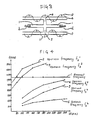
- Figure 4 is a graph showing the experimental relationship between the dominant frequency of the length-extensional oscillation and the spurious frequencies of the frame portions, the results shown in Figure 4 being obtained by varying the width W of the longitudinal frame portions 3 and 4 of the length-extensional quartz resonator shown in Figure 1.
- the curve 1 indicates the change of the dominant frequency f in terms of the width W of the frame portions.
- the dominant frequency f is substantially kept constant when the width W is changed.
- the dominant frequency f is typically 1.05 MHz in this embodiment.
- the curves 2-6 indicate the changes of various spurious frequency f s 1 - f s 6 in terms of the width W of the frame portions.
- the spurious frequencies f s 2 and f s 1 indicated by the curves 3 and 2, respectively, have the same values to the dominant frequency f in the range of the width W from 80 ⁇ m to 100 ⁇ m . Further, in the range of the width W above 260 ⁇ m, the spurious frequency f s 3, f s 4 and f s 6 approach the dominant frequency f as indicated by the curves 4, 5 and 6, respectively. Namely, a specific frequency of some spurious flexural oscillation of the frame portions coincides with that of the main oscillating portion in the range of width W between 80 ⁇ m and 100 ⁇ m and above 260 ⁇ m to thereby abruptly increase the equivalent resistance R2. Accordingly, it is found that the width W of the frame portions should be set within the following range (2): 110 ⁇ m ⁇ W ⁇ 260 ⁇ m (2)
- the width W of the frame portions 3 and 4 is set within the range 110 ⁇ m ⁇ W ⁇ 260 ⁇ m to thereby eliminate the spurious oscillation due to the resonant flexural oscillation of the frame portions, so as to reduce the equivalent resistance R1 of the resonator.
- the length-extensional quartz resonator has an overall outer length L of 4000 ⁇ m ⁇ 200 ⁇ m and a rectangular outer shape in which the pair of linearly arranged longitudinally extending oscillating portions 1 are surrounded by the pair of frames 3 and 4.
- Figure 5A shows the resonant characteristic of a length-extensional quartz resonator which is not in accordance with the present invention. Namely, the width dimension of the frame portions is outside the optimum range referred to above, and the resonator has a plurality of resonant frequencies due to the spurious oscillation.
- Figure 5B shows the resonant characteristic of a length-extensional quartz resonator according to the present invention, in which the width W of the frame portions is in the range specified at (2).
- the resonant resistance or equivalent resistance R1 is affected by the spurious oscillation and therefore has a value of at least 1.5 K ⁇
- the resonant resistance R1 has the value of 300 ⁇ to 800 ⁇ , which is not more than about half of the resonant resistance of the Figure 5A resonator.
- Figure 6A shows the frequency-temperature characteristic of a length-extensional quartz resonator not in accordance with the present invention.
- the frequency-temperature characteristic curve is distorted by the spurious oscillation.
- Figure 6B shows the frequency-temperature characteristic of a length-extensional quartz resonator according to the present invention in which the width dimensions of the frame portions thereof are in the range specified at (2).
- the frequency-temperature characteristic curve is not distorted and the resonator can exhibit a good intrinsic temperature characteristic specific to a length-extensional quartz resonator.
- the optimum equivalent resistance characteristic can be obtained, but also the optimum frequency-temperature characteristic can also be obtained according to the present invention.
Landscapes
- Physics & Mathematics (AREA)
- Acoustics & Sound (AREA)
- Piezo-Electric Or Mechanical Vibrators, Or Delay Or Filter Circuits (AREA)
Abstract
Description
- The present invention relates to a length-extensional piezo-electric resonator, e.g. a length-extensional quartz resonator having an oscillating frequency in the range of 1.04 MHz to 1.06 MHz. Such a resonator may for example, be used in an information processing device and in a communication device such as a microcomputer and a wireless telephone.
- A length-extensional quartz resonator is designed to undergo dominant length-extensional oscillation accompanied by spurious flexural oscillations. The specific frequencies of the dominant and the spurious oscillations are determined according to the dimensional parameters of the resonator. When a spurious oscillation is coupled with or resonated to the dominant oscillation, the equivalent resistance of the resonator is abruptly increased so as to thereby impair the performance of the resonator.
- An object of the present invention is, therefore, to arrange that the dimensions of the length-extensional resonator are such as to avoid coupling between the dominant and spurious oscillations, whereby to ensure stable oscillatory performance of the resonator.
- According to the present invention, there is therefore provided a length-extensional piezo-electric resonator comprising: oscillating means arranged in operation to undergo a dominant length-extensional oscillation and having an oscillating frequency in the range from 1.04 MHz to 1.06 MHz; and frame means arranged to surround the oscillating means and having an overall outer length of 4000 µm ± 200 µm, the frame means including a pair of longitudinally extending frame portions connected to the oscillating means so as in operation to undergo flexural oscillation and having a width which is in the range from 110 µm to 260 µm and which is effective to substantially suppress spurious coupling between the dominant length-extensional oscillation and the flexural oscillation.
- Preferably, the resonator is a quartz resonator.
- The oscillating means preferably comprises a pair of longitudinally extending oscillating portions arranged linearly of and connected to each other so that the combined length thereof is within the range from 2585 µm to 2635 µm.
- Preferably, a pair of supporting portions extend transversely from the linearly arranged longitudinally extending oscillating portions in opposite directions for connecting the oscillating portions to the respective supporting portions.
- Preferably, the frame means has an integral rectangular form having the said overall outer length of 4000 µm + 200 µm and comprises a pair of longitudinal frame portions spaced in parallel to each other, a base portion connected to one end of each of the respective frame portions, and a bridge portion connected transversely between the other ends of the respective frame portions.
- The invention is illustrated, merely by way of example, in the accompanying drawings, in which:-
- Figure 1 is a plan view of a length-extensional quartz resonator in accordance with the present invention,
- Figure 2 is a sectional view of the length-extensional quartz resonator of Figure 1 mounted in a housing;
- Figure 3 is a partial plan view of the length-extensional quartz resonator of Figure 1, schematically illustrating its oscillation modes of dominant length-extensional oscillation and accompanied flexural oscillation;
- Figure 4 is a diagram showing the frequency relations between the dominant length-extensional oscillation and the spurious frame flexural oscillations;
- Figure 5A is a graph showing the resonant characteristic of a length-extensional quartz resonator not in accordance with the present invention;
- Figure 5B is a graph showing the resonant characteristic of a length-extensional quartz resonator according to the present invention;
- Figure 6A is a graph showing the frequency-temperature characteristic of a length-extensional quartz resonator not in accordance with the present invention; and
- Figure 6B is a graph showing the frequency-temperature characteristic of a length-extensional quartz resonator according to the present invention.
- Figure 1 is a plan view showing the shape of a length-extensional quartz resonator according to the present invention. The resonator comprises a pair of oscillating
portions 1 arranged linearly of each other, and a pair offrame portions portions 1 and which are formed integrally with a base or mountingportion 7. The pair of oscillatingportions 1 are centrally arranged between theopposite frame portions respective frame portions portions portions 1 are surrounded by theframe portions portion 7. Further, the pair offrame portions - Figure 2 is a sectional view of a housing accommodating therein the length-extensional quartz resonator of Figure 1. The housing comprises a cylindrical metal container or
cap 8 having a diameter of 2mm and a 1ength of 6mm. Thecap 8 has a closed top end portion and an open bottom end portion which is closed by astem 9. The length-extensional quartz resonator is mounted inside thecap 8 by means of a pair oflead members 10. Each of thelead members 10 is fixed at one end thereof to the base or mountingportion 7 of the resonator by solder or electro-conductive adhesive, and extends outwardly of thecap 8 through thestem 9 for electrical connection to the outside. - The specific frequency, f(KHz) of the dominant oscillation of the length-extensional quartz resonator is determined according to the total length ℓ (Figure 1) of the linearly arranged oscillating
portions 1 as indicated in the following equation (1):
- Further, as indicated by Figure 2, the
container 8 is designed to have a typical shape and dimensions for practical and general purposes so that thecontainer 8 may have a cylindrical shape with an outer diameter D of 2.0mm and a length of L′ of 6.Omm. In view of these dimensions of thecontainer 8, the entire length L of the rectangular resonator is necessarily limited to L = 4000 µm +200 µm as shown in Figures 1 and 2. - Figure 3 shows the oscillation modes of the length-extensional quartz resonator shown in Figure 1. As shown, the resonator comprises a pair of longitudinally extending
oscillating portions 1 which are arranged linearly with respect to each other, a pair of longitudinally extendingframe portions portions 1, and a pair of transverse supportingportions respective frame portion portions 1. The oscillatingportions 1 undergo a dominant length-extensional oscillation displacement as indicated by the double headed arrowa . - This displacement
a is transmitted through the supportingportions frame portions - The specific frequency f of the dominant oscillation of the oscillating
portions 1 is determined according to the equation (1) in the Figure 3 embodiment. Consequently, theframe portions portions 1. However, theframe portions portions 1. If the specific frequency of theframe portions portions 1, the equivalent resistance R₁ of the resonator is abruptly increased due to resonance so as to cause serious problems. Such a phenomenon is similar to the coupling phenomenon between a dominant oscillation and a spurious oscillation, which is observed in other types of quartz resonators, for example, typically in the AT cut quartz resonator. - However, with regard to the length-extensional quartz resonator, a theoretical or experimental analysis has not previously been undertaken with regard to the specific frequency of the spurious flexural oscillations of the frame portions. There has been no suggested design for a length-extensional quartz resonator effective to avoid the spurious oscillation and there has been the serious problem that the equivalent resistance R₁ of the resonator is abruptly increased due to the spurious oscillation. Therefore, it is particularly important to analyze the quantitative relationship between the specific frequency of the spurious oscillation of the frame portions and the specific frequency of the dominant length-extensional oscillation of the main oscillating portion in terms of the dimensions of the resonator, so as to enable a proper choice of such dimensions which will be effective to suppress the phenomenon of the spurious oscillation.
- We have found that the quantitative and numerical relationship between the specific flexural oscillation of the frame portions and the dominant length-extensional oscillation of the main oscillating portion can be determined by experiment. Based on the results of such experiment, the dimensions of the resonator can be selected so as to stabilize or improve the equivalent resistance characteristic of a length-extensional quartz resonator.
- Figure 4 is a graph showing the experimental relationship between the dominant frequency of the length-extensional oscillation and the spurious frequencies of the frame portions, the results shown in Figure 4 being obtained by varying the width W of the
longitudinal frame portions curve 1 indicates the change of the dominant frequency f in terms of the width W of the frame portions. As shown, the dominant frequency f is substantially kept constant when the width W is changed. The dominant frequency f is typically 1.05 MHz in this embodiment. The curves 2-6 indicate the changes of various spurious frequency fs¹ -f s⁶ in terms of the width W of the frame portions. The experimentally obtained results indicated in Figure 4 can be effectively applied to a length-extensional quartz resonator having an overall outer length L of 4000 µm±200 µm and the combined length ℓ of the main oscillating portions of 2585 µm to 2635 µm. For the range of combined length ℓ from 2585 µm to 2635 µm, the length-extensional quartz resonator undergoes a length-extensional oscillation at a frequency of about 1.040 MHz to 1.060 MHz. - In Figure 4, the
spurious frequencies f s² andf s¹ indicated by thecurves spurious frequency f s³,f s⁴ andf s⁶ approach the dominant frequency f as indicated by thecurves
110 µm ≦ W ≦ 260 µm (2) - In a length-extensional quartz resonator having an overall outer length L of 4000 µm ± 200 µm and a dominant oscillating frequency in the range from 1040 KHz to 1060 KHz, the width W of the
frame portions - The length-extensional quartz resonator has an overall outer length L of 4000 µm ± 200 µm and a rectangular outer shape in which the pair of linearly arranged longitudinally extending
oscillating portions 1 are surrounded by the pair offrames - Figure 5A shows the resonant characteristic of a length-extensional quartz resonator which is not in accordance with the present invention. Namely, the width dimension of the frame portions is outside the optimum range referred to above, and the resonator has a plurality of resonant frequencies due to the spurious oscillation. On the other hand, Figure 5B shows the resonant characteristic of a length-extensional quartz resonator according to the present invention, in which the width W of the frame portions is in the range specified at (2). In the case of the resonator of Figure 5A which is not in accordance with the present invention, the resonant resistance or equivalent resistance R₁ is affected by the spurious oscillation and therefore has a value of at least 1.5 K Ω, whereas in the case of the resonator of Figure 5B, which is in accordance with the present invention, the resonant resistance R₁ has the value of 300 Ω to 800 Ω, which is not more than about half of the resonant resistance of the Figure 5A resonator. As described above, by setting the width dimensions of the frame portions within the desired range according to the invention, the optimum resonant resistance characteristic can be obtained.
- Figure 6A shows the frequency-temperature characteristic of a length-extensional quartz resonator not in accordance with the present invention. The frequency-temperature characteristic curve is distorted by the spurious oscillation. On the other hand, Figure 6B shows the frequency-temperature characteristic of a length-extensional quartz resonator according to the present invention in which the width dimensions of the frame portions thereof are in the range specified at (2). The frequency-temperature characteristic curve is not distorted and the resonator can exhibit a good intrinsic temperature characteristic specific to a length-extensional quartz resonator. Thus, not only the optimum equivalent resistance characteristic can be obtained, but also the optimum frequency-temperature characteristic can also be obtained according to the present invention.
- As described above, in a length-extensional quartz resonator whose oscillating frequency is in the range from 1.04 to 1.06 MHz and which has main oscillating portions surrounded by frame portions, if the width dimension W of the frame portions is within the range 110 µm ≦ W ≦ 260 µm, the following remarkable advantages are achieved:
- (1) By setting the width of the frame portions to the optimum dimension, the coupling of the spurious oscillations can be substantially eliminated so as to reduce the equivalent resistance R₁.
- (2) The intrinsic desired temperature characteristic can be obtained due to the substantial elimination of the coupling of the spurious oscillations.
Claims (5)
Applications Claiming Priority (2)
| Application Number | Priority Date | Filing Date | Title |
|---|---|---|---|
| JP63124545A JPH01293707A (en) | 1988-05-20 | 1988-05-20 | Long side vertical oscillator |
| JP124545/88 | 1988-05-20 |
Publications (3)
| Publication Number | Publication Date |
|---|---|
| EP0343000A2 true EP0343000A2 (en) | 1989-11-23 |
| EP0343000A3 EP0343000A3 (en) | 1990-01-24 |
| EP0343000B1 EP0343000B1 (en) | 1994-01-26 |
Family
ID=14888130
Family Applications (1)
| Application Number | Title | Priority Date | Filing Date |
|---|---|---|---|
| EP89305086A Expired - Lifetime EP0343000B1 (en) | 1988-05-20 | 1989-05-19 | Length-extensional piezo-electric resonator |
Country Status (4)
| Country | Link |
|---|---|
| US (1) | US5107164A (en) |
| EP (1) | EP0343000B1 (en) |
| JP (1) | JPH01293707A (en) |
| DE (1) | DE68912644D1 (en) |
Cited By (1)
| Publication number | Priority date | Publication date | Assignee | Title |
|---|---|---|---|---|
| EP0365268A3 (en) * | 1988-10-17 | 1990-10-03 | Seiko Electronic Components Ltd. | Length longitudinal resonator |
Families Citing this family (9)
| Publication number | Priority date | Publication date | Assignee | Title |
|---|---|---|---|---|
| DE4322144C2 (en) * | 1992-07-03 | 1997-06-05 | Murata Manufacturing Co | Vibrator unit |
| DE4321949C2 (en) * | 1992-07-03 | 1997-07-10 | Murata Manufacturing Co | Vibrator unit |
| US5541469A (en) * | 1993-04-14 | 1996-07-30 | Murata Manufacturing Co., Ltd. | Resonator utilizing width expansion mode |
| GB2278721B (en) * | 1993-05-31 | 1996-12-18 | Murata Manufacturing Co | Chip-type piezoelectric resonance component |
| US5621263A (en) * | 1993-08-09 | 1997-04-15 | Murata Manufacturing Co., Ltd. | Piezoelectric resonance component |
| US5648746A (en) * | 1993-08-17 | 1997-07-15 | Murata Manufacturing Co., Ltd. | Stacked diezoelectric resonator ladder-type filter with at least one width expansion mode resonator |
| GB2281159B (en) * | 1993-08-17 | 1997-10-01 | Murata Manufacturing Co | Ladder-type filter |
| JP3114526B2 (en) * | 1994-10-17 | 2000-12-04 | 株式会社村田製作所 | Chip type piezoelectric resonance component |
| EP1365508A2 (en) * | 1995-01-19 | 2003-11-26 | Matsushita Electric Industrial Co., Ltd. | Piezoelectric filter, its manufacturing method, and intermediate frequency filter |
Family Cites Families (8)
| Publication number | Priority date | Publication date | Assignee | Title |
|---|---|---|---|---|
| CH578803A5 (en) * | 1974-05-14 | 1976-08-13 | Suisse Horlogerie | |
| CH608335B (en) * | 1976-09-14 | Ebauches Sa | MICRORESONATEUR PIEZOELECTRIQUE. | |
| JPS5552621A (en) * | 1978-10-11 | 1980-04-17 | Matsushima Kogyo Co Ltd | Vertical vibration-type piezo-vibrator |
| CH641632B (en) * | 1981-01-15 | Asulab Sa | PIEZO-ELECTRIC MICRO-RESONATOR. | |
| EP0096653B1 (en) * | 1982-06-04 | 1989-04-12 | Statek Corparation | Extensional mode piezoelectric microresonator |
| JPS5937722A (en) * | 1982-08-26 | 1984-03-01 | Matsushima Kogyo Co Ltd | Longitudinal oscillation type piezoelectric oscillator |
| JPS59216313A (en) * | 1983-05-24 | 1984-12-06 | Matsushima Kogyo Co Ltd | Longitudinal oscillation-type piezo-oscillator |
| JPS6070810A (en) * | 1983-09-27 | 1985-04-22 | Matsushima Kogyo Co Ltd | Longitudinal vibration type piezoelectric vibrator |
-
1988
- 1988-05-20 JP JP63124545A patent/JPH01293707A/en active Pending
-
1989
- 1989-05-19 DE DE89305086T patent/DE68912644D1/en not_active Expired - Lifetime
- 1989-05-19 EP EP89305086A patent/EP0343000B1/en not_active Expired - Lifetime
- 1989-05-22 US US07/355,152 patent/US5107164A/en not_active Expired - Lifetime
Cited By (1)
| Publication number | Priority date | Publication date | Assignee | Title |
|---|---|---|---|---|
| EP0365268A3 (en) * | 1988-10-17 | 1990-10-03 | Seiko Electronic Components Ltd. | Length longitudinal resonator |
Also Published As
| Publication number | Publication date |
|---|---|
| US5107164A (en) | 1992-04-21 |
| EP0343000B1 (en) | 1994-01-26 |
| JPH01293707A (en) | 1989-11-27 |
| DE68912644D1 (en) | 1994-03-10 |
| EP0343000A3 (en) | 1990-01-24 |
Similar Documents
| Publication | Publication Date | Title |
|---|---|---|
| US7626318B2 (en) | Piezoelectric resonator with optimised motional capacitances | |
| EP0343000B1 (en) | Length-extensional piezo-electric resonator | |
| US5311096A (en) | KT cut width-extensional mode quartz crystal resonator | |
| RU2003122360A (en) | REFERENCE TIME GENERATOR BASED ON AN INTEGRAL MICROMECHANICAL CUSTOMIZABLE CAMERTON RESONATOR | |
| US6362561B1 (en) | Piezoelectric vibration device and piezoelectric resonance component | |
| US4410827A (en) | Mode coupled notched tuning fork type quartz crystal resonator | |
| KR20010013453A (en) | Electrode edge wave patterns for piezoelectric resonator | |
| US20040036380A1 (en) | Crystal unit | |
| JP3322153B2 (en) | Tuning fork type crystal vibrating piece | |
| US5059853A (en) | Longitudinal quartz crystal resonator | |
| JP3017746B2 (en) | Crystal oscillator | |
| JPS6013608B2 (en) | Thickness sliding piezoelectric vibrator | |
| JP2000031781A (en) | Piezoelectric vibrator | |
| EP0365268A2 (en) | Length longitudinal resonator | |
| JP2003060482A (en) | Tuning fork type crystal vibrating piece | |
| US4570137A (en) | Lumped-mode resonator | |
| US6016025A (en) | Selected overtone resonator with channels | |
| EP0516400A1 (en) | Torsional quartz crystal resonator | |
| JP3155113B2 (en) | Temperature compensated crystal oscillation circuit | |
| GB2075254A (en) | Mode coupled tuning fork type piezo-electric resonator | |
| US5153478A (en) | Resonator having a bar designed to vibrate in one extension mode | |
| JPS644370B2 (en) | ||
| JPS59148421A (en) | Piezoelectric resonator | |
| JPH10145179A (en) | Frame-type crystal vibrator and device element using it | |
| SA | A MINIATURE QUARTZ RESONATOR VIBRATING AT 1 MHz |
Legal Events
| Date | Code | Title | Description |
|---|---|---|---|
| PUAI | Public reference made under article 153(3) epc to a published international application that has entered the european phase |
Free format text: ORIGINAL CODE: 0009012 |
|
| AK | Designated contracting states |
Kind code of ref document: A2 Designated state(s): CH DE GB LI |
|
| PUAL | Search report despatched |
Free format text: ORIGINAL CODE: 0009013 |
|
| AK | Designated contracting states |
Kind code of ref document: A3 Designated state(s): CH DE GB LI |
|
| 17P | Request for examination filed |
Effective date: 19900618 |
|
| 17Q | First examination report despatched |
Effective date: 19930310 |
|
| GRAA | (expected) grant |
Free format text: ORIGINAL CODE: 0009210 |
|
| AK | Designated contracting states |
Kind code of ref document: B1 Designated state(s): CH DE GB LI |
|
| PG25 | Lapsed in a contracting state [announced via postgrant information from national office to epo] |
Ref country code: DE Effective date: 19940126 |
|
| REF | Corresponds to: |
Ref document number: 68912644 Country of ref document: DE Date of ref document: 19940310 |
|
| PG25 | Lapsed in a contracting state [announced via postgrant information from national office to epo] |
Ref country code: GB Effective date: 19940519 |
|
| PLBE | No opposition filed within time limit |
Free format text: ORIGINAL CODE: 0009261 |
|
| STAA | Information on the status of an ep patent application or granted ep patent |
Free format text: STATUS: NO OPPOSITION FILED WITHIN TIME LIMIT |
|
| 26N | No opposition filed | ||
| GBPC | Gb: european patent ceased through non-payment of renewal fee |
Effective date: 19940519 |
|
| REG | Reference to a national code |
Ref country code: CH Ref legal event code: PFA Free format text: SEIKO ELECTRONIC COMPONENTS LTD TRANSFER- SEIKO INSTRUMENTS INC. |
|
| PGFP | Annual fee paid to national office [announced via postgrant information from national office to epo] |
Ref country code: CH Payment date: 20010511 Year of fee payment: 13 |
|
| PG25 | Lapsed in a contracting state [announced via postgrant information from national office to epo] |
Ref country code: LI Free format text: LAPSE BECAUSE OF NON-PAYMENT OF DUE FEES Effective date: 20020531 Ref country code: CH Free format text: LAPSE BECAUSE OF NON-PAYMENT OF DUE FEES Effective date: 20020531 |
|
| REG | Reference to a national code |
Ref country code: CH Ref legal event code: PL |