EP0342791A2 - An electro-hydraulic helicopter system having individual blade control - Google Patents
An electro-hydraulic helicopter system having individual blade control Download PDFInfo
- Publication number
- EP0342791A2 EP0342791A2 EP89303650A EP89303650A EP0342791A2 EP 0342791 A2 EP0342791 A2 EP 0342791A2 EP 89303650 A EP89303650 A EP 89303650A EP 89303650 A EP89303650 A EP 89303650A EP 0342791 A2 EP0342791 A2 EP 0342791A2
- Authority
- EP
- European Patent Office
- Prior art keywords
- control signals
- hydraulic
- grooves
- providing
- valving means
- Prior art date
- Legal status (The legal status is an assumption and is not a legal conclusion. Google has not performed a legal analysis and makes no representation as to the accuracy of the status listed.)
- Granted
Links
Images



Classifications
-
- B—PERFORMING OPERATIONS; TRANSPORTING
- B64—AIRCRAFT; AVIATION; COSMONAUTICS
- B64C—AEROPLANES; HELICOPTERS
- B64C27/00—Rotorcraft; Rotors peculiar thereto
- B64C27/54—Mechanisms for controlling blade adjustment or movement relative to rotor head, e.g. lag-lead movement
-
- B—PERFORMING OPERATIONS; TRANSPORTING
- B64—AIRCRAFT; AVIATION; COSMONAUTICS
- B64C—AEROPLANES; HELICOPTERS
- B64C27/00—Rotorcraft; Rotors peculiar thereto
- B64C27/54—Mechanisms for controlling blade adjustment or movement relative to rotor head, e.g. lag-lead movement
- B64C27/72—Means acting on blades
-
- B—PERFORMING OPERATIONS; TRANSPORTING
- B64—AIRCRAFT; AVIATION; COSMONAUTICS
- B64C—AEROPLANES; HELICOPTERS
- B64C27/00—Rotorcraft; Rotors peculiar thereto
- B64C27/54—Mechanisms for controlling blade adjustment or movement relative to rotor head, e.g. lag-lead movement
- B64C27/72—Means acting on blades
- B64C2027/7205—Means acting on blades on each blade individually, e.g. individual blade control [IBC]
- B64C2027/7211—Means acting on blades on each blade individually, e.g. individual blade control [IBC] without flaps
- B64C2027/7216—Means acting on blades on each blade individually, e.g. individual blade control [IBC] without flaps using one actuator per blade
-
- Y—GENERAL TAGGING OF NEW TECHNOLOGICAL DEVELOPMENTS; GENERAL TAGGING OF CROSS-SECTIONAL TECHNOLOGIES SPANNING OVER SEVERAL SECTIONS OF THE IPC; TECHNICAL SUBJECTS COVERED BY FORMER USPC CROSS-REFERENCE ART COLLECTIONS [XRACs] AND DIGESTS
- Y02—TECHNOLOGIES OR APPLICATIONS FOR MITIGATION OR ADAPTATION AGAINST CLIMATE CHANGE
- Y02T—CLIMATE CHANGE MITIGATION TECHNOLOGIES RELATED TO TRANSPORTATION
- Y02T50/00—Aeronautics or air transport
- Y02T50/30—Wing lift efficiency
Definitions
- This invention relates to electro-hydraulic helicopter control systems and more particularly to a full authority electro-hydraulic control system having a hydraulic slip ring providing individual blade control.
- the predominant frequency of excitation is the "nth" harmonic of an n bladed rotor.
- the predominant frequency of the vibration is the fourth harmonic or four per rev.
- a helicopter control system It would be advantageous for a helicopter control system to be fully hydraulic allowing for individual blade control and allowing for auxiliary blade tracking higher harmonic and trim force control inputs using exclusively electrical or optical input signals and hydraulic controls.
- the present invention is directed toward such a system.
- An object of the present invention is to provide for a helicopter control system which allows for individual blade control, and/or to provide a helicopter control system which is fully hydraulic, and/or to provide improvements in such apparatus generally.
- apparatus used in providing fluid control signals of a first element to a moveable second element includes a first member having an outer surface formed with a plurality of grooves, each receiving respective fluid control signals by means of corresponding channels formed in said first member interior.
- the apparatus also includes a second member adapted to receive, at an inner surface thereof, the first member outer surface.
- the second member inner surface has a plurality of grooves each communicating with corresponding second member interior channels and each in registration with a corresponding first member groove.
- a second member is moveable relative to the first member, with the registered first and second member grooves continuously communicating the fluid control signals throughout the displacement.
- the valving means selectively provides fluid control signals.
- An interface apparatus is included for communicating the control signals from the first element to the second element.
- the apparatus includes a first member having an outer surface formed with a plurality of grooves each for receiving from respective interior channels fluid control signals, and the second member adapted to receive at an inner surface thereof the first member outer surface.
- the second member inner surface having a plurality of grooves communicating with second member interior channels and each in registration with a corresponding first member groove.
- the second member is moveable relative to the first member.
- the registered first and second member grooves continuously communicate the fluid control signals throughout any second member movement.
- an actuator means configured with the moving second element for receiving the control signals from the inter face means and generating displacements in dependence thereon.
- Fig. 1 shows a portion of a mechanical control system 10 used in a helicopter 12, shown in phantom.
- the control system is an example of a known mechanical control system and is comprised of a plurality of levers, bellcranks, control rods and other such mechanical devices needed to translate control signals provided by a pilot at control stick 14 to adjust the pitch of helicopter blades (not shown) rotating above swash plate 16.
- the swash plate is a rotary coupler which will transmit mechanical displacement received on control rods 18, 20 and 22 to actuators on the rotating helicopter blades.
- the helicopter control system of Fig. 1 also incorporates automatic stabilization equipment (ASE) 24 which provides in a known manner stability augmentation and higher harmonic control signals which are superimposed on the input control signal.
- ASE automatic stabilization equipment
- the exact same composite control signal must then be applied simultaneously to each of the rotating helicopter blades. That is, no helicopter blade can be addressed individually.
- the hydraulic control system 26 includes a central processing unit (CPU) 28 and memory 30 which contain flight control algorithms. External pilot command signals are presented on line 31. Helicopter parameter signals are presented on lines 32 to input/output interface 34 are then processed by the CPU.
- the input signals include signals indicative of the following parameters: Collective pitch Cyclic pitch Lateral pitch ASE input P transducer inputs Longitudinal pitch Main control valve (LVDT) Blade trim (controls) Main ram position (LVDT) Blade tracking Gust sensing P transducer input
- the central processing unit will, in accordance with control algorithms provide output control signals to a servo amplifer 36 on lines 38. These control signals will then operate a plurality of electro hydraulic valves which comprise part of control module 40.
- the hydraulic control module is configured with two hydraulic systems (c1,c2) each comprising a source 41 and return 42 line which are selected by system switching valve 43.
- the hydraulic signals are presented on either lines 44 or 46.
- a transducer preferably a rotary variable differential transducer (RVDT) or LVDT for a linear actuator, is included to provide actuator simulation and outputs on line 50 a feedback signal to the central processing unit.
- the hydraulic control signal is presented through a hydraulic slip ring 52, detailed hereinafter to a hydraulic actuator 54 located on the rotating helicopter blades.
- a hydraulic slip ring 52 located on the rotating helicopter blades.
- a hydraulic actuator 54 located on the rotating helicopter blades.
- a hydraulic circuit 56 used in the control system of Fig. 2.
- the hydraulic circuit includes primary and secondary hydraulic systems (c1,c2) each comprised of a pressure 58,60 and return at 62,64 hydraulic lines.
- Each helicopter blade has a control module 66 that includes a plurality of electro hydraulic valves 68, 70 and 72 configured in a known fashion to provide two levels of redundancy.
- a control module 66 that includes a plurality of electro hydraulic valves 68, 70 and 72 configured in a known fashion to provide two levels of redundancy.
- Differential transducers 74, 76 and 78 are installed between each of the primary and secondary system pressure lines and monitor the operation of that channel. In case of conflict between the channels (e.g. a failure of the valve) the two channels with similar values of pressure difference will "out vote" the third channel.
- This function is performed by the switching solenoid valve positioned downstream of the electro-hydraulic in the control module. The solenoid triggers the bypass of the electro-hydraulic valve pressure 1 and pressure 2 lines in the defective channel.
- each of the electro-hydraulic valves in the system is capable of operating the primary and secondary hydraulic systems of the helicopter.
- the hydraulic circuit comprising the hydraulic control modules are connected to the primary and secondary hydraulic systems in the helicopter. Both of the systems are driven from the combining gearbox for a multi-engine helicopter or from the accessories gearbox in a case of a single engine helicopter.
- the primary system pressure is ported through a filter (not shown) to the electro hydraulic valves and to the pressure port on the main control valve.
- the secondary system is similarly connected to an electro-hydraulic valve and the secondary control pressure port on the main control valve.
- a difference in pressure is produced between the hydraulic inputs for a particular electro hydraulic valve.
- This difference in pressure moves a spool 82 in the main control valve. This movement connects one of the actuator cylinder ports to the system pressure and the other port to the return through the system switching valve 43.
- the spool 82 has a set of centering springs which bring it to a neutral position in the absence of a pressure differential thereacross.
- the main control valve spool MCV transducer 48 is connected through a synchronizing link to the (LVDT) installed to monitor the MCV spool position.
- the system switching valve 42 receives the primary system pressure at one end of spool 86.
- the spool disconnects the secondary system actuator cylinder lines coming from the main control module to that of the actuator.
- the spool valve shuttles due to a spring installed in the system and disconnects the primary system cylinder lines from the control module to that of the actuator and simultaneously connects the secondary system main control valve lines to that of the actuator lines to accomplish the desired redundancy.
- An embodiment which includes dual tandem control the system switching valve 42 is deleted and all four cylinder lines are connected to the four cylinder lines of the dual tandem system.
- actuator simulator port 1 One output from the system switching valve is received by actuator simulator port 1.
- the second port of the actuator simulator is connected to the input cylinder port for the respective actuator channel stator of the hydraulic slip ring.
- the second line from the system switching valve is directly connected to the second cylinder port in the stator of the hydraulic slip ring. This connection is repeated for the rest of the three control modules in the four bladed helicopter of Fig. 2.
- the actuator simulator and feedback RVDT is positioned on the fuselage to avoid installation of feedback devices in a rotating system and carrying feedback signal through an electrical slip ring which would increase sophistication and contribute to electrical noise.
- the main control valve comprises a lap, spool and sleeve assembly installed in a split manifold isolating the two hydraulic systems.
- the solenoid operated bypass valves are conventional and are the type used in aircraft hydraulic systems.
- the electro-hydraulic valves are of a conventional type used in fly by wire control systems and in auto pilots.
- control modules are remotely located in the preferred embodiment and present a dynamic stiffness problem which is solved by wrapping the lines with preloaded fiber. This is the same principle used in the design of composite Kevlar-wrapped hydraulic accumulator bodies. In addition to the electro hydraulic redundancies, an actuator will have built-in dynamic biases for a safe autorotation in case of total electrical and hydraulic failure.
- the output hydraulic signal from one of the cylinder ports in the hydraulic control module in the form of cylinder pressure and flow is presented through the control actuator simulator 48 which has identical characteristics to the main actuator.
- a feedback transducer (RVDT or LVDT) is configured with the simulator and provides feedback signals on lines 50 to the CPU.
- Hydraulic control signals are provided along respective lines to the rotating system through the hydraulic slip ring 52.
- the hydraulic slip ring is configured with nine channels, and presents the hydraulic control signals to actuators represented schematically by actuator 54 which can be either of a linear or rotary type.
- the hydraulic slip ring comprises an outer rotor 86 which is configured to be received by an inner stator 88.
- the stator consists of twelve concentric flow channels each set of two channels for one blade pitch, horn or hinge line actuator positioned next to these two channels in the slip ring is a return line groove. This configuration is repeated for each of the next three helicopter blades.
- the return groove between each set of blades actuator lines picks up the lap leakage and also provides system isolation.
- Each of the 12 grooves is sandwiched between a set of "O" ring grooves per MIL-G-5514F.
- the stator and rotor of the slip ring are lap fitted to provide redundant system isolation apart from the primary sealing done by either "O" rings or piston rings.
- hydraulic control signals are presented on lines 90,92 with pressure and return lines 94,96 also shown.
- the hydraulic slip ring is preferably configured with a plurality of inner bores or channels, such as bores 98 and 100, which sources and returns hydraulic control signals presented in the manner described hereinabove.
- the hydraulic control signals are, for example, presented at outer groove 102.
- Corresponding grooves are configured in the rotor and provide the hydraulic control signals thereacross to channel 104 in the rotor and eventually to the corresponding helicopter blade actuator.
- End cap 106 is positioned with the rotor to locate the rotor via retention bolts 108 and 110.
- Each of the registered flow and return grooves in both the rotor and stator are preferably formed with a scalloped configuration.
- Those skilled in the art will note that right angles connecting channels in the rotor or stator to the flow grooves will lead to fatigue in the rotating member.
- the scalloped portion reduces the material fatigue.
- FIG. 4 Also shown in Fig. 4 are a plurality of seals such as rod seal 112 and GLYD ring 114.
- a rod seal is conventional and performs its known function. It is preferable to configure the flow grooves and return grooves to be separated by a common system return 116, as well as by "O" rings 118. This configuration of separating the pressure line from its corresponding return line by "O" rings and an intermediate common return line collects lap leakage and further prevents communication between adjacent channels in the event of a seal component failure.
- the collective input signal generated from the transducer on the pilot's collective controller stick is scaled by the CPU to give full helicopter blade travel.
- the cyclic pitch signal is generated on the cyclic of stick controller by having two transducers approximately 90 degrees apart to resolve the longitudinal and lateral components of a pilots input command. Both of the outputs of the transducers are scaled to represent their respective control authority for maximum amplitude relative to the input signal magnitude.
- the combined signal waveform generated by collective longitudinal and lateral signal inputs is modified by the stability augmentation inputs, auto pilot inputs, higher harmonic inputs and miscellaneous blade trim input signals. This combined, forms the input command to the control module.
- Each of the second, third, and fourth blades are displaced phasewise 90, 180 and 270 degrees apart respectively.
- Figs. 5 and 6 each contain diagrammatic illustrations of a control signal presented to an individual helicopter blade by the system of the present invention.
- Curve 120 corresponds to a cyclic pitch signal
- curve 122 corresponds to a 2 per rev higher harmonic input signal at approximately 10% of the cyclic pitch signal amplitude.
- the composite output signal to the actuator is shown by curve 124.
- curve 126 illustrates a 4 per rev higher harmonic input signal
- curve 128 shows the input pitch signal
- Curve 130 respresents the composite signal.
Landscapes
- Engineering & Computer Science (AREA)
- Mechanical Engineering (AREA)
- Aviation & Aerospace Engineering (AREA)
- Fluid-Pressure Circuits (AREA)
Abstract
Description
- This invention relates to electro-hydraulic helicopter control systems and more particularly to a full authority electro-hydraulic control system having a hydraulic slip ring providing individual blade control.
- It is well known that helicopter flight is primarily controlled by cyclic and collective control inputs to the rotating helicopter blades, usually through a common mechanical input such as a swash plate. Input and transfer of these control signals to the rotating blades is most often accomplished by an exclusively mechanical arrangement of levers, mixers and cranks. Some known control systems modify the mechanical arrangements by the addition of a hydraulic boost mechanism to provide amplification of the mechanical input signals. Other control systems are mechanical with auxiliary hydraulic amplification, but lack a direct mechanical connection between the control stick that inputs the signals to control the helicopter blades.
- These known control systems all must provide the same blade control signals to every blade because of the common control signal input mechanism. Individual blade control, wherein each blade may receive different control signals, is therefore physically impossible.
- A major problem which still plagues present day helicopters is the very high vibration magnitudes. The major sources of these vibrations are rotor induced shears and moments. Consequently, known control systems incorporate mechanical devices such as vibration absorbers and isolators to provide compensation. Unfortunately, these mechanical devices do not effect the magnitude of the shears and moments.
- The nature of the vibration inducing shears and moments is such as to produce an input at the hub at a frequency which is an integral multiple of the number of blades in the rotor system. Therefore, the predominant frequency of excitation is the "nth" harmonic of an n bladed rotor. For a four bladed rotor the predominant frequency of the vibration is the fourth harmonic or four per rev.
- Other helicopter control systems have attempted to minimize vibration by reducing the magnitude of these shears and moments by the introduction of blade pitch changes at non-predominant harmonic freqencies. The air-loads on each blade are therefore altered by the control system generating blade loads at other than the predominant harmonic frequency. For a four bladed helicopter rotor, these systems introduce three per rev and five per rev pitch changes on the blades in the rotating system. Introduction of these harmonic forces has been accomplished by superimposing a predominant harmonic (four per rev for four bladed helicopters) translation and rotation on the nonrotating control mechanism or swash plate at the helicopter blade hub. These higher harmonic input forces are introduced downstream of azimuth or the swash plate in the stationary part of the control system. Individual blade control, not physically possible with known helicopter control systems, provides tremendous versatility because other control harmonic forces (such as two per rev forces) which can also effect rotor performance, can be easily introduced on a per blade basis. With mechanical systems of the prior art, the mechanical control elements have inherent built-in drawbacks, such as backlash and bearings hysterisis, due to the friction and structural compliance found in these elaborate mechanical systems, even when augmented by servohydraulics. With known mechanical systems the higher harmonic forces input to reduce vibration problems are all of small magnitude and operate at relatively high frequency. However, the benefits of the compensating harmonic forces are seriously diminished because the mechanical control system lacks sufficient resolution, and is most often saturated.
- It would be advantageous for a helicopter control system to be fully hydraulic allowing for individual blade control and allowing for auxiliary blade tracking higher harmonic and trim force control inputs using exclusively electrical or optical input signals and hydraulic controls. The present invention is directed toward such a system.
- An object of the present invention is to provide for a helicopter control system which allows for individual blade control, and/or to provide a helicopter control system which is fully hydraulic, and/or to provide improvements in such apparatus generally.
- In a preferred embodiment, apparatus used in providing fluid control signals of a first element to a moveable second element includes a first member having an outer surface formed with a plurality of grooves, each receiving respective fluid control signals by means of corresponding channels formed in said first member interior. The apparatus also includes a second member adapted to receive, at an inner surface thereof, the first member outer surface. The second member inner surface has a plurality of grooves each communicating with corresponding second member interior channels and each in registration with a corresponding first member groove. A second member is moveable relative to the first member, with the registered first and second member grooves continuously communicating the fluid control signals throughout the displacement.
- In a further preferred embodiment,
a hydraulic actuator assembly for providing hydraulic control signals between first and second elements includes a hydraulic valving means communicating with a source of fluid pressure and a fluid pressure return through respective ports in the valving means. The valving means selectively provides fluid control signals. An interface apparatus is included for communicating the control signals from the first element to the second element. The apparatus includes a first member having an outer surface formed with a plurality of grooves each for receiving from respective interior channels fluid control signals, and the second member adapted to receive at an inner surface thereof the first member outer surface. The second member inner surface having a plurality of grooves communicating with second member interior channels and each in registration with a corresponding first member groove. The second member is moveable relative to the first member. The registered first and second member grooves continuously communicate the fluid control signals throughout any second member movement. Also included is an actuator means configured with the moving second element for receiving the control signals from the inter face means and generating displacements in dependence thereon. -
- Fig. 1 is a simplified schematic illustation showing a portion of a mechanical control system found in the prior art.
- Fig. 2 is a simplified illustration of a portion of a hydraulic control system provided according to the present invention.
- Fig. 3 is a schematic illustration of a hydraulic circuit found in the control system of Fig. 2.
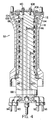
- Fig. 4 is a sectioned illustration of a portion of the hydraulic slip ring of the system of Fig. 2.
- Fig. 5 illustrates diagramatically a composite output control signal comprised of a cyclic pitch signal with a two per rev higher harmonic input signal superimposed thereon.
- Fig. 6 illustrates a composite output control signal having a four per rev signal superimposed on a cyclic pitch control signal.
- Fig. 1 shows a portion of a mechanical control system 10 used in a
helicopter 12, shown in phantom. The control system is an example of a known mechanical control system and is comprised of a plurality of levers, bellcranks, control rods and other such mechanical devices needed to translate control signals provided by a pilot at control stick 14 to adjust the pitch of helicopter blades (not shown) rotating aboveswash plate 16. As detailed hereinabove, the swash plate is a rotary coupler which will transmit mechanical displacement received oncontrol rods - The helicopter control system of Fig. 1 also incorporates automatic stabilization equipment (ASE) 24 which provides in a known manner stability augmentation and higher harmonic control signals which are superimposed on the input control signal. The exact same composite control signal must then be applied simultaneously to each of the rotating helicopter blades. That is, no helicopter blade can be addressed individually.
- Moreover, these input signals provide for stability augmentation are typically a small magnitude at relatively high frequencies. Because of the mechanical nature of the system and the limitations mandated by built-in setbacks note above, the true benefit of the active control input signal is compromised.
- Referring now to Fig. 2, there is illustrated a simplified schematic diagram of a portion of a
hydraulic control system 26 provided according to the present invention. Thehydraulic control system 26 includes a central processing unit (CPU) 28 andmemory 30 which contain flight control algorithms. External pilot command signals are presented online 31. Helicopter parameter signals are presented onlines 32 to input/output interface 34 are then processed by the CPU. For a typical four bladed helicopter the input signals include signals indicative of the following parameters:Collective pitch Cyclic pitch Lateral pitch ASE input P transducer inputs Longitudinal pitch Main control valve (LVDT) Blade trim (controls) Main ram position (LVDT) Blade tracking Gust sensing P transducer input - The central processing unit will, in accordance with control algorithms provide output control signals to a servo amplifer 36 on
lines 38. These control signals will then operate a plurality of electro hydraulic valves which comprise part ofcontrol module 40. - In the preferred embodiment, the hydraulic control module is configured with two hydraulic systems (c₁,c₂) each comprising a
source 41 and return 42 line which are selected bysystem switching valve 43. The hydraulic signals are presented on eitherlines - The hydraulic control signal is presented through a
hydraulic slip ring 52, detailed hereinafter to ahydraulic actuator 54 located on the rotating helicopter blades. Although the system components for only two helicopter blades are illustrated in Fig. 2, there will be a two additional control elements generating control signals on respective line for a four bladed helicopter, as shown in Fig. 2. - Referring now to Fig. 3, there is illustrated a
hydraulic circuit 56 used in the control system of Fig. 2. As indicated hereinabove, the hydraulic circuit includes primary and secondary hydraulic systems (c₁,c₂) each comprised of apressure 58,60 and return at 62,64 hydraulic lines. - Each helicopter blade has a control module 66 that includes a plurality of electro
hydraulic valves 68, 70 and 72 configured in a known fashion to provide two levels of redundancy. In Fig. 3, only one of four control modules is shown.Differential transducers pressure 2 lines in the defective channel. In the preferred embodiment, each of the electro-hydraulic valves in the system is capable of operating the primary and secondary hydraulic systems of the helicopter. The hydraulic circuit comprising the hydraulic control modules are connected to the primary and secondary hydraulic systems in the helicopter. Both of the systems are driven from the combining gearbox for a multi-engine helicopter or from the accessories gearbox in a case of a single engine helicopter. The primary system pressure is ported through a filter (not shown) to the electro hydraulic valves and to the pressure port on the main control valve. The secondary system is similarly connected to an electro-hydraulic valve and the secondary control pressure port on the main control valve. - In response to a control signal received by an electro hydraulic valve, a difference in pressure is produced between the hydraulic inputs for a particular electro hydraulic valve. This difference in pressure ( P) moves a spool 82 in the main control valve. This movement connects one of the actuator cylinder ports to the system pressure and the other port to the return through the
system switching valve 43. The spool 82 has a set of centering springs which bring it to a neutral position in the absence of a pressure differential thereacross. The main control valvespool MCV transducer 48 is connected through a synchronizing link to the (LVDT) installed to monitor the MCV spool position. - The
system switching valve 42 receives the primary system pressure at one end ofspool 86. The spool disconnects the secondary system actuator cylinder lines coming from the main control module to that of the actuator. In case of failure to the primary system the spool valve shuttles due to a spring installed in the system and disconnects the primary system cylinder lines from the control module to that of the actuator and simultaneously connects the secondary system main control valve lines to that of the actuator lines to accomplish the desired redundancy. - An embodiment which includes dual tandem control the
system switching valve 42 is deleted and all four cylinder lines are connected to the four cylinder lines of the dual tandem system. - One output from the system switching valve is received by actuator simulator port 1. The second port of the actuator simulator is connected to the input cylinder port for the respective actuator channel stator of the hydraulic slip ring. The second line from the system switching valve is directly connected to the second cylinder port in the stator of the hydraulic slip ring. This connection is repeated for the rest of the three control modules in the four bladed helicopter of Fig. 2. The actuator simulator and feedback RVDT is positioned on the fuselage to avoid installation of feedback devices in a rotating system and carrying feedback signal through an electrical slip ring which would increase sophistication and contribute to electrical noise.
- In the preferred embodiment, the main control valve comprises a lap, spool and sleeve assembly installed in a split manifold isolating the two hydraulic systems. The solenoid operated bypass valves are conventional and are the type used in aircraft hydraulic systems. The electro-hydraulic valves are of a conventional type used in fly by wire control systems and in auto pilots.
- The control modules are remotely located in the preferred embodiment and present a dynamic stiffness problem which is solved by wrapping the lines with preloaded fiber. This is the same principle used in the design of composite Kevlar-wrapped hydraulic accumulator bodies. In addition to the electro hydraulic redundancies, an actuator will have built-in dynamic biases for a safe autorotation in case of total electrical and hydraulic failure.
- The output hydraulic signal from one of the cylinder ports in the hydraulic control module in the form of cylinder pressure and flow is presented through the
control actuator simulator 48 which has identical characteristics to the main actuator. A feedback transducer (RVDT or LVDT) is configured with the simulator and provides feedback signals onlines 50 to the CPU. - Hydraulic control signals are provided along respective lines to the rotating system through the
hydraulic slip ring 52. The hydraulic slip ring is configured with nine channels, and presents the hydraulic control signals to actuators represented schematically byactuator 54 which can be either of a linear or rotary type. - Referring now to Fig. 4, there is illustrated in section a portion of the
hydraulic slip ring 52 of Fig. 1. The hydraulic slip ring comprises anouter rotor 86 which is configured to be received by aninner stator 88. The stator consists of twelve concentric flow channels each set of two channels for one blade pitch, horn or hinge line actuator positioned next to these two channels in the slip ring is a return line groove. This configuration is repeated for each of the next three helicopter blades. The return groove between each set of blades actuator lines picks up the lap leakage and also provides system isolation. Each of the 12 grooves is sandwiched between a set of "O" ring grooves per MIL-G-5514F. The stator and rotor of the slip ring are lap fitted to provide redundant system isolation apart from the primary sealing done by either "O" rings or piston rings. In Fig. 4, hydraulic control signals are presented onlines lines 94,96 also shown. - The hydraulic slip ring is preferably configured with a plurality of inner bores or channels, such as
bores 98 and 100, which sources and returns hydraulic control signals presented in the manner described hereinabove. The hydraulic control signals are, for example, presented atouter groove 102. Corresponding grooves are configured in the rotor and provide the hydraulic control signals thereacross to channel 104 in the rotor and eventually to the corresponding helicopter blade actuator.End cap 106 is positioned with the rotor to locate the rotor viaretention bolts - Each of the registered flow and return grooves in both the rotor and stator are preferably formed with a scalloped configuration. Those skilled in the art will note that right angles connecting channels in the rotor or stator to the flow grooves will lead to fatigue in the rotating member. The scalloped portion reduces the material fatigue.
- Also shown in Fig. 4 are a plurality of seals such as
rod seal 112 andGLYD ring 114. A rod seal is conventional and performs its known function. It is preferable to configure the flow grooves and return grooves to be separated by acommon system return 116, as well as by "O" rings 118. This configuration of separating the pressure line from its corresponding return line by "O" rings and an intermediate common return line collects lap leakage and further prevents communication between adjacent channels in the event of a seal component failure. - The collective input signal generated from the transducer on the pilot's collective controller stick, is scaled by the CPU to give full helicopter blade travel. The cyclic pitch signal is generated on the cyclic of stick controller by having two transducers approximately 90 degrees apart to resolve the longitudinal and lateral components of a pilots input command. Both of the outputs of the transducers are scaled to represent their respective control authority for maximum amplitude relative to the input signal magnitude.
- The combined signal waveform generated by collective longitudinal and lateral signal inputs, is modified by the stability augmentation inputs, auto pilot inputs, higher harmonic inputs and miscellaneous blade trim input signals. This combined, forms the input command to the control module. Each of the second, third, and fourth blades are displaced phasewise 90, 180 and 270 degrees apart respectively.
- Figs. 5 and 6 each contain diagrammatic illustrations of a control signal presented to an individual helicopter blade by the system of the present invention.
Curve 120 corresponds to a cyclic pitch signal, whilecurve 122 corresponds to a 2 per rev higher harmonic input signal at approximately 10% of the cyclic pitch signal amplitude. The composite output signal to the actuator is shown bycurve 124. - Similarly,
curve 126 illustrates a 4 per rev higher harmonic input signal, whilecurve 128 shows the input pitch signal.Curve 130 respresents the composite signal. - Similarly, although the invention has been described hereinabove with respect to a preferred embodiment thereof, it should be understood by those skilled in the art that various changes, omissions and additions thereto may be made therein without departing from the spririt and scope of the invention.
Claims (9)
Applications Claiming Priority (2)
| Application Number | Priority Date | Filing Date | Title |
|---|---|---|---|
| US07/194,400 US4899641A (en) | 1988-05-16 | 1988-05-16 | Electro-hydraulic helicopter system having individual blade control |
| US194400 | 1988-05-16 |
Publications (3)
| Publication Number | Publication Date |
|---|---|
| EP0342791A2 true EP0342791A2 (en) | 1989-11-23 |
| EP0342791A3 EP0342791A3 (en) | 1990-08-29 |
| EP0342791B1 EP0342791B1 (en) | 1993-08-04 |
Family
ID=22717459
Family Applications (1)
| Application Number | Title | Priority Date | Filing Date |
|---|---|---|---|
| EP89303650A Expired - Lifetime EP0342791B1 (en) | 1988-05-16 | 1989-04-12 | An electro-hydraulic helicopter system having individual blade control |
Country Status (3)
| Country | Link |
|---|---|
| US (1) | US4899641A (en) |
| EP (1) | EP0342791B1 (en) |
| DE (1) | DE68908008T2 (en) |
Cited By (1)
| Publication number | Priority date | Publication date | Assignee | Title |
|---|---|---|---|---|
| EP2829471A1 (en) * | 2013-07-23 | 2015-01-28 | Sikorsky Aircraft Corporation | Swashplateless coaxial rotary wing aircraft |
Families Citing this family (9)
| Publication number | Priority date | Publication date | Assignee | Title |
|---|---|---|---|---|
| US5409183A (en) * | 1993-08-06 | 1995-04-25 | Kaman Aerospace Corporation | Helicopter with leading edge servo flaps for pitch positioning its rotor blades |
| US5678786A (en) * | 1995-12-06 | 1997-10-21 | Mcdonnell Douglas Helicopter Co. | Reconfigurable helicopter flight control system |
| US5897293A (en) * | 1996-11-22 | 1999-04-27 | United Technologies Corporation | Counterweighted propeller control system |
| ATE464475T1 (en) * | 2005-12-29 | 2010-04-15 | Georg Hamann | DEVICE AND SYSTEM FOR GENERATING REGENERATIVE AND RENEWABLE ENERGY FROM WATER |
| US8608441B2 (en) * | 2006-06-12 | 2013-12-17 | Energyield Llc | Rotatable blade apparatus with individually adjustable blades |
| US7786684B2 (en) * | 2007-10-22 | 2010-08-31 | Honeywell International Inc. | Electromechanical flight control system and method for rotorcraft |
| US10029781B2 (en) * | 2015-08-03 | 2018-07-24 | The Boeing Company | Shape memory alloy-actuated propeller blades and shape memory alloy-actuated propeller assemblies |
| EP3565974B1 (en) | 2017-03-17 | 2021-04-28 | Ie Assets Gmbh & Co. Kg | Hydraulic rotary feed-through |
| RU2685115C1 (en) * | 2018-01-22 | 2019-04-16 | Акционерное общество "Павловский машиностроительный завод "ВОСХОД"-АО "ПМЗ "ВОСХОД" | Unit of combined hydraulic actuators |
Family Cites Families (9)
| Publication number | Priority date | Publication date | Assignee | Title |
|---|---|---|---|---|
| GB759098A (en) * | 1954-06-29 | 1956-10-10 | Taylor & Sons Manchester Ltd F | Improvements in or relating to rotary fluid-supply couplings |
| FR1204772A (en) * | 1958-08-04 | 1960-01-28 | Pompes Soc D Expl De | Rotary distributor seal |
| US3242992A (en) * | 1964-09-25 | 1966-03-29 | United Aircraft Corp | Feedback system |
| DE1938596C3 (en) * | 1969-07-30 | 1974-02-07 | Deutsche Babcock & Wilcox Ag, 4200 Oberhausen | Device for supplying pressurized oil to a rotating machine with hydraulically operated actuators |
| FR2230241A5 (en) * | 1973-05-14 | 1974-12-13 | Sigma Diesel | Rotating joint for lathe turret - has series of annular lubricating oil grooves in rotating sleeve |
| DE2832898C2 (en) * | 1978-07-27 | 1985-12-19 | Messerschmitt-Bölkow-Blohm GmbH, 8012 Ottobrunn | Irreversible hydraulic actuator |
| FR2437512A1 (en) * | 1978-09-28 | 1980-04-25 | Ppm Sa | Rotatable joint for multiple hydraulic circuits - has parallel holes in inner cylinder connected to grooves in outer sleeve |
| US4445421A (en) * | 1981-11-06 | 1984-05-01 | The Charles Stark Draper Laboratory, Inc. | Helicopter swashplate controller |
| SE455629B (en) * | 1986-11-25 | 1988-07-25 | Flygt Ab | rotary joint |
-
1988
- 1988-05-16 US US07/194,400 patent/US4899641A/en not_active Expired - Lifetime
-
1989
- 1989-04-12 EP EP89303650A patent/EP0342791B1/en not_active Expired - Lifetime
- 1989-04-12 DE DE89303650T patent/DE68908008T2/en not_active Expired - Fee Related
Cited By (2)
| Publication number | Priority date | Publication date | Assignee | Title |
|---|---|---|---|---|
| EP2829471A1 (en) * | 2013-07-23 | 2015-01-28 | Sikorsky Aircraft Corporation | Swashplateless coaxial rotary wing aircraft |
| US9248909B2 (en) | 2013-07-23 | 2016-02-02 | Sikorsky Aircraft Corporation | Swashplateless coaxial rotary wing aircraft |
Also Published As
| Publication number | Publication date |
|---|---|
| EP0342791A3 (en) | 1990-08-29 |
| DE68908008D1 (en) | 1993-09-09 |
| DE68908008T2 (en) | 1993-11-18 |
| EP0342791B1 (en) | 1993-08-04 |
| US4899641A (en) | 1990-02-13 |
Similar Documents
| Publication | Publication Date | Title |
|---|---|---|
| US5791596A (en) | Process and device for the control of the rudder of an aircraft | |
| US4762294A (en) | Elevator control system especially for an aircraft | |
| US4899641A (en) | Electro-hydraulic helicopter system having individual blade control | |
| US3606233A (en) | Vibration isolation system | |
| EP1700041B1 (en) | Redundant flow control for hydraulic actuator systems | |
| EP2076436B1 (en) | Dual higher harmonic control (hhc) for a counter-rotating, coaxial rotor system | |
| US2705940A (en) | Controllable power actuator for aircraft control surface | |
| US11391384B2 (en) | Hydraulic actuator force fight mitigation mechanism | |
| EP1504195B1 (en) | Integrated three function valve | |
| CA1185680A (en) | Helicopter swashplate controller | |
| EP2821343B1 (en) | Independent hydraulic control system for rotorcraft secondary rotor | |
| US3679156A (en) | Fly-by-wire | |
| JPH082496A (en) | Servo control system for aircraft flight control components | |
| US4534704A (en) | Helicopter rotor control system with integrated hub | |
| US3070071A (en) | Failure protected signal translating system | |
| US3438306A (en) | Preloaded servo actuator controls for redundant systems | |
| EP0787318B1 (en) | Multiplexing hydraulic control network with latching valves | |
| US20210139134A1 (en) | Hydraulic cylinder with matching bias | |
| WO2016075491A1 (en) | Servo actuators | |
| EP2848521B1 (en) | Flexible response secured mechanical balancing for multiple control actuators with a common output | |
| US4507050A (en) | Pneumatic valve control for circulation control aircraft | |
| US20110036940A1 (en) | Mechanical flight control auxiliary power assist system | |
| WO2019069287A1 (en) | Stability and command augmentation system for an aircraft, and stabilization and control method of an aircraft | |
| US4362085A (en) | Flight control system | |
| US3368351A (en) | Redundant control system |
Legal Events
| Date | Code | Title | Description |
|---|---|---|---|
| PUAI | Public reference made under article 153(3) epc to a published international application that has entered the european phase |
Free format text: ORIGINAL CODE: 0009012 |
|
| 17P | Request for examination filed |
Effective date: 19890503 |
|
| AK | Designated contracting states |
Kind code of ref document: A2 Designated state(s): DE FR GB IT |
|
| PUAL | Search report despatched |
Free format text: ORIGINAL CODE: 0009013 |
|
| AK | Designated contracting states |
Kind code of ref document: A3 Designated state(s): DE FR GB IT |
|
| 17Q | First examination report despatched |
Effective date: 19911008 |
|
| GRAA | (expected) grant |
Free format text: ORIGINAL CODE: 0009210 |
|
| ITF | It: translation for a ep patent filed | ||
| AK | Designated contracting states |
Kind code of ref document: B1 Designated state(s): DE FR GB IT |
|
| REF | Corresponds to: |
Ref document number: 68908008 Country of ref document: DE Date of ref document: 19930909 |
|
| ET | Fr: translation filed | ||
| PLBE | No opposition filed within time limit |
Free format text: ORIGINAL CODE: 0009261 |
|
| STAA | Information on the status of an ep patent application or granted ep patent |
Free format text: STATUS: NO OPPOSITION FILED WITHIN TIME LIMIT |
|
| 26N | No opposition filed | ||
| REG | Reference to a national code |
Ref country code: GB Ref legal event code: IF02 |
|
| PGFP | Annual fee paid to national office [announced via postgrant information from national office to epo] |
Ref country code: GB Payment date: 20030415 Year of fee payment: 15 |
|
| PGFP | Annual fee paid to national office [announced via postgrant information from national office to epo] |
Ref country code: FR Payment date: 20030418 Year of fee payment: 15 |
|
| PGFP | Annual fee paid to national office [announced via postgrant information from national office to epo] |
Ref country code: DE Payment date: 20030423 Year of fee payment: 15 |
|
| PG25 | Lapsed in a contracting state [announced via postgrant information from national office to epo] |
Ref country code: GB Free format text: LAPSE BECAUSE OF NON-PAYMENT OF DUE FEES Effective date: 20040412 |
|
| PG25 | Lapsed in a contracting state [announced via postgrant information from national office to epo] |
Ref country code: DE Free format text: LAPSE BECAUSE OF NON-PAYMENT OF DUE FEES Effective date: 20041103 |
|
| GBPC | Gb: european patent ceased through non-payment of renewal fee |
Effective date: 20040412 |
|
| PG25 | Lapsed in a contracting state [announced via postgrant information from national office to epo] |
Ref country code: FR Free format text: LAPSE BECAUSE OF NON-PAYMENT OF DUE FEES Effective date: 20041231 |
|
| REG | Reference to a national code |
Ref country code: FR Ref legal event code: ST |
|
| PG25 | Lapsed in a contracting state [announced via postgrant information from national office to epo] |
Ref country code: IT Free format text: LAPSE BECAUSE OF NON-PAYMENT OF DUE FEES;WARNING: LAPSES OF ITALIAN PATENTS WITH EFFECTIVE DATE BEFORE 2007 MAY HAVE OCCURRED AT ANY TIME BEFORE 2007. THE CORRECT EFFECTIVE DATE MAY BE DIFFERENT FROM THE ONE RECORDED. Effective date: 20050412 |