EP0342645A2 - Isokonduktive Gradientenionenchromatographie - Google Patents
Isokonduktive Gradientenionenchromatographie Download PDFInfo
- Publication number
- EP0342645A2 EP0342645A2 EP89108864A EP89108864A EP0342645A2 EP 0342645 A2 EP0342645 A2 EP 0342645A2 EP 89108864 A EP89108864 A EP 89108864A EP 89108864 A EP89108864 A EP 89108864A EP 0342645 A2 EP0342645 A2 EP 0342645A2
- Authority
- EP
- European Patent Office
- Prior art keywords
- eluent
- composition
- gradient
- ion chromatography
- cationic
- Prior art date
- Legal status (The legal status is an assumption and is not a legal conclusion. Google has not performed a legal analysis and makes no representation as to the accuracy of the status listed.)
- Withdrawn
Links
Images

Classifications
-
- G—PHYSICS
- G01—MEASURING; TESTING
- G01N—INVESTIGATING OR ANALYSING MATERIALS BY DETERMINING THEIR CHEMICAL OR PHYSICAL PROPERTIES
- G01N30/00—Investigating or analysing materials by separation into components using adsorption, absorption or similar phenomena or using ion-exchange, e.g. chromatography or field flow fractionation
- G01N30/02—Column chromatography
- G01N30/26—Conditioning of the fluid carrier; Flow patterns
- G01N30/28—Control of physical parameters of the fluid carrier
- G01N30/34—Control of physical parameters of the fluid carrier of fluid composition, e.g. gradient
-
- G—PHYSICS
- G01—MEASURING; TESTING
- G01N—INVESTIGATING OR ANALYSING MATERIALS BY DETERMINING THEIR CHEMICAL OR PHYSICAL PROPERTIES
- G01N30/00—Investigating or analysing materials by separation into components using adsorption, absorption or similar phenomena or using ion-exchange, e.g. chromatography or field flow fractionation
- G01N30/96—Investigating or analysing materials by separation into components using adsorption, absorption or similar phenomena or using ion-exchange, e.g. chromatography or field flow fractionation using ion-exchange
Definitions
- gradient elution This technique, in which the composition of the mobile phase eluent is varied over time, has been found to be very useful when analyzing samples containing a mixture of both weakly retained anions and strongly retained anions.
- the most common method of gradient elution uses a two solvent gradient in which elution is begun using a weak solvent. This is followed by a continuous or stepwise increase of concentration of a second, stronger solvent until the solution consists entirely of the stronger solvent.
- the conductivity detection methods have been made compatible with gradient elution by employing external chemical devices, called suppressors, between the chromatographic separation column and the detector. While suppressors generally function to convert high conductivity signals to low level background readings, they can also be used to reduce the large change in conductivity which results from the conventional gradient elution techniques. Software methods are then required to subtract the baseline of blank gradients to improve the appearance of the obtained recordings. Additionally, the software methods enable an evaluation of peak heights and areas. In the absence of chemical suppressors, the computer aided baseline subtraction is insufficient to enable a reproducible evaluation of peak heights and peak areas when using conductivity detection in conjunction with conventional gradient elution techniques.
- This invention pertains to a gradient ion chromatography process which eliminates the need for chemical suppressors and complex baseline subtraction regimens. More specifically, the invention pertains to a gradient ion chromatography process wherein the mobile phase solvent remains in a substantially isoconductive state despite its change in composition throughout the gradient program.
- the mobile phase, or eluent can have a variable cationic composition ranging from a high ionic equivalent conductance to a low ionic equivalent conductance.
- a substantially isoconductive state can be maintained throughout a compositional changeover between two eluents of different eluting strength.
- an isoconductive mobile phase eliminates the need for chemical suppressors and suppressor regenerants which have traditionally been required for gradient ion chromatography.
- advantages of a process employing gradient elution are retained. These include the ability to determine large numbers of ions in a single run and the ability to determine trace ions in the presence of excess concentrations of other ionic compounds.
- the isoconductive gradient process provides the ability to separate mixtures of weakly and strongly retained ions while maintaining a uniform and efficient level of separation efficiency throughout the entire separation.
- the most common type of gradient eluent employed in gradient ion chromatography employs a two solvent gradient. Generally, elution begins with a weak solvent to which increasing concentrations of a stronger solvent are added continuously or in a step-wise manner until the eluent comprises a solution containing entirely strong solvent. This method of gradient elution is considered the easiest to conduct.
- the variation of solvent composition over time referred to as the solvent program, is the most important variable in gradient ion chromatography.
- a and B For two given solvents, A and B, a continuous program can be described by the shape and by the steepness or rate of change of the composition curve of the component mixture. Each of these features can greatly affect the quality of the separation. Additionally, the choice of the solvents themselves is important in the design of adequate gradient elution separation processes.
- the general requirement is that the first solvent, A, be weak enough to give adequate resolution at the front end of the chromatogram, and that the second solvent, B, be strong enough to provide elution of the strongly retained analytes within a reasonable total separation time.
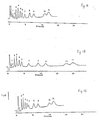
- Figure 1A shows a chromatogram which results from a proper selection of solvents A and B.
- Figure 1A all sample components have been eluted at optimum concentrations of A and B as adequately resolved bands.
- Figures 1B and 1C are representative chromatograms which result when the eluents are less then ideal for the specific sample.
- starting solvent A is too strong.
- Figure 1B represents a chromatogram resulting when the eluent is too weak.
- Later eluted bands show peak broadening and unacceptably long separation time. The final bands to elute would probably be undetectable at any slightly lower concentration of analyte or eluent.
- the conductivity baseline which results from the eluent phase rather than from the analytes, varies with the changes in eluent composition. This variation of the baseline leads to complex schemes to minimize the inaccuracies it introduces into the system. These include the use of chemical suppressors to minimize the baseline signal and software to convert the variable baseline to a signal which is as flat as possible.
- solvents A and B which maintain an isoconductive state throughout the gradual or step-wise composition gradient, the need for chemical suppressors and sophisticated baseline manipulation is eliminated.
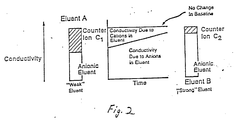
- This approach is illustrated in Figure 2.
- the solvents are chosen such that the weaker eluent contains cations with high ionic equivalent conductance and the stronger eluent contains cations with low ionic equivalent conductance.
- the anionic eluting strength of the eluent can increase without changing the background conductance significantly. This produces an essentially flat baseline which can be evaluated for quantitative results by relatively uncomplicated software methods.
- Equation (1) A formula for calculating the background conductance signal, G, resulting from a fully dissociated ionic mobile phase was described by Gjerde et al. in "Ion Chromatography", 2nd edition, A. Huethig Verlag (New York 1987), pp. 93-128. This formula is represented as Equation (1): wherein ⁇ c and ⁇ a are cationic and anionic equivalent conductances in cm2equiv ⁇ 1ohm ⁇ 1. The concentrations in equiv liter ⁇ 1 and cell constant in cm ⁇ 1 are represented as c and K respectively.
- Equation (2) For any two isoconductive mobile phases with a common anion A n- and two different cations, c1, and c2, it is possible to derive an expression which links the ratio of the weaker (C1) and stronger (C2) concentrations with the corresponding equivalent conductances. This expression is given in Equation (2):
- An efficient temperature control which eliminates most of the irreproducible thermal influence can be achieved by maintaining the eluent reservoirs, the connecting capillaries, the separation apparatus and the conductivity cell at exactly the same temperature.
- One method for accomplishing this is to place all exposed parts into an insulated box maintained at a slightly elevated temperature, typically about 35°C.
- this method should employ a temperature control means having accuracy of better than ⁇ 0.1°C.
- lithium hydroxide monohydrate (99%), potassium hydroxide (86.2%), cesium hydroxide monohydrate (99%), boric acid (99% A.C.S. reagent), and D-gluconic acid (50% wt in H2O) were supplied by Aldrich Chemical Company, Inc.
- Glycerin U.S.P.-F.C.C.
- acetonitrile HPLC grade
- An Automatic High Pressure Switching Valve was used as an injector. This was achieved by connecting either a 100 ul or 20 ul sample loop and an injection port to the valve. A signal connection was made between the injector and the M590 pump. Solvent changes resulting in step gradients and also data aquisition by an M840 Chromatographic Data Station were triggered by manual actuation of the injector. As a result of a delay volume of 3 ml and a flow rate of 1.2 ml/min, the changed composition of the eluent reached the separation column about 2.5 minutes after injection for each chromatogram produced. The same delay volume made it possible to change back to eluent B before the current gradient run was completed. Thus, this step could occur almost 2.5 minutes before the elution of the final peak.
- the first was an IC Pak Anion column which had dimensions of 0.46 x 5.0 cm. This column was packed with a polyacrylate-based anion exchange material. The particle size was 10 microns and an ion exchange capacity of 30 ueq/ml was specified.
- the second column was an IC Pak Anion HR column having dimensions of 0.46 x 7.5 cm. The column was packed with 7 micron particles of the polyacrylate resin used in the first column. The ion exchange capacity of the resin of the second column was the same as that of the material used in the first column.
- An M430 Detector was employed to measure conductivity changes in the column eluate.
- the detector cell had a nominal cell constant of one and was maintained at a constant temperature of 35°C.
- An Extech Model 590 Conductivity Meter was chosen for evaluating the conductivity of solutions which contained solutions of borate and gluconate. The value of the cell constant, (1.0 cm ⁇ 1), was verified by measuring the conductance of a 0.01 N KCl solution. The equivalent conductance of borate gluconate complex was calculated using the conductivity reading obtained from a solution which contained 2.6 mM sodium gluconate (Eastman Kodak P8626), 1.3 mM boric acid and 1.3 mM sodium hydroxide.
- the value of equivalent conductance of the borate gluconate complex was determined to be 25.5 cm2equiv ⁇ 1ohm ⁇ 1. This value was confirmed by additional measurements in which the borate gluconate ratio was held constant and the concentration of sodium hydroxide was increased in several steps. All measurements were conducted at 25°C.
- the unadjusted gradient eluent contained solvents designated A1 and B1, each containing potassium as a counterion.
- Solvent A1 was a solution of 11 mM boric acid, 1.48 mM gluconic acid, 3.49 mM potassium hydroxide, 0.65 mM glycerin and 12% acetonitrile.
- Solvent B1 was a solution of 13.75 mM boric acid, 1.85 mM gluconic acid. 4.36 mM potassium hydroxide, and 0.81 mM glycerin and 12% acetonitrile.
- the isoconductive gradient eluent contained solvents designated A2 and B2.
- the eluents were adjusted to the same level of conductance using potassium for the weaker mobile phase correspoding to solvent A2 and lithium for the stronger mobile phase corresponding to solvent B2.
- Solvent A2 was identical to solvent A1 above.
- Solvent B2 was a solution containing 5.13 mM lithium hydroxide monohydrate, 13.75 mM boric acid, 1.85 mM gluconic acid, 0.81 mM glycerin and 12% acetonitrile. The increased glycerin concentration did not contribute to eluting strength. Rather, the increase was derived from the fact that 25 ml of a fifty-fold concentrate of solvent A1 (without acetonitrile) was used to prepare solvent B2.
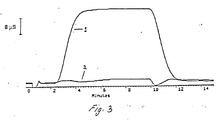
- Example 3 The results of the comparison of Example 1 are given in Figure 3.
- the unadjusted gradient is designated baseline 1 while the isoconductive gradient is designated baseline 2.
- the originally overwhelming change of the background signal is efficiently removed via the isoconductive gradient eluent.
- the size and shape of the two small baseline disturbances in baseline 2 are largely column independent. They have been found to remain unchanged even if an anion exchange column is not present in the system.
- the first fluctuation occurs between 2.5 and 4 minutes as the changing composition of the eluent begins to reach the detector cell.
- the larger of the two baseline deflections, having an amplitude of about 4 uS is observed at the point that the system is returned to the initial eluent, i.e., between 9.5 and 11 minutes in Figure 3.
- Example II Ion Detection Using Isocratic Elution and Isoconductive Gradients
- a sample containing 11 anions was separated using a weak solvent, (A2 of the previous example); a strong solvent, (B2 of the previous example); and an isoconductive step gradient from solvent A2 to solvent B2 which was initiated simultaneously with the sample injection.
- the sample contained the following anions which are preceded by their peak identities: 1. fluoride 1 ppm, 2. carbonate 2 ppm, 3. chloride 2 ppm, 4. nitrite 4 ppm, 5. bromide 4 ppm, 6. nitrate 4 ppm, 7. phosphate 6 ppm, 8. sulfate 4 ppm, 9. oxalate 4 ppm, 10. chromate 10 ppm, 11. molybdate 10 ppm.
- the injected sample had a 100 ul volume.
- the separation column was the IC-Pak anion column previously described.
- FIG. 1A A chromatogram produced using the isoconductive gradient, in which solvents A2 and B2 are simultaneously employed, is presented in Figure 1A.
- the gradient solution combines the advantages of the weak and strong eluents in one separation, thereby providing a short run time and good separation of early eluting analytes.
- an efficient separation is acheived in the initial portion, while the total run time is very similar to the shortened run times characteristic of stronger eluents.
- the chromatogram of Figure 1A was obtained by subtracting the blank isoconductive gradient (baseline 2 of Figure 3), from the actual raw chromatographic recording. The reproducibility of these subtractions, (and of the whole isoconductive gradient), was tested via six repetitions of the gradient separation of Figure 1A. Relative standard deviations (RSDs) of the retention times and of the integrated areas for each of the eleven separated peaks are given in Table III.
- Example III High Resolution Ion Detection Using an Isoconductive Gradient
- a sample containing 14 anions was separated using a high resolution column (IC-Pak Anion HR) previously described.
- the weak solvent designated A3 was a solution of 8.25 mM boric acid, 1.11 mM gluconic acid, 3.08 mM cesium hydroxide, 0.48 mM glycerin and 12% acetonitrile.
- the stronger solvent, designated B3, was a solution of 12.65 mM boric acid, 1.70 mM gluconic acid, 4.72 mM lithium hydroxide, 0.75 mM glycerin and 12% acetonitrile.
- a isoconductive step gradient from A3 to B3 was initiated at the moment of injection.
- the flow rate of the mobile phase was increased from 1.2 ml/min to 1.7 ml/min.
- the injected sample had a volume of 20 ul.
- the resulting chromatograph is presented as Figure 4.
- Figure 4 a short run time along with good resolution of the early eluted species is observed.
- the sample of Figure 4 contained the following anions which are preceded by their peak identities: 1. fluoride, 5 ppm; 2. carbonate, 20 ppm; 3. chloride, 15 ppm; 4. nitrite, 20 ppm; 5. bromide, 20 ppm; 6. nitrate, 20 ppm; 7. phosphate, 30 ppm; 8. phosphite, 20 ppm; 9. sulfate, 20 ppm; 10. oxalate, 20 ppm; 11. tungstate, 25 ppm; 12. chromate, 25 ppm; 13. molybdate, 25 ppm; and 14. thiocyanate, 25 ppm.
Landscapes
- Physics & Mathematics (AREA)
- Health & Medical Sciences (AREA)
- Life Sciences & Earth Sciences (AREA)
- Chemical & Material Sciences (AREA)
- Analytical Chemistry (AREA)
- Biochemistry (AREA)
- General Health & Medical Sciences (AREA)
- General Physics & Mathematics (AREA)
- Immunology (AREA)
- Pathology (AREA)
- Treatment Of Liquids With Adsorbents In General (AREA)
Applications Claiming Priority (2)
| Application Number | Priority Date | Filing Date | Title |
|---|---|---|---|
| US19631288A | 1988-05-20 | 1988-05-20 | |
| US196312 | 1988-05-20 |
Publications (2)
| Publication Number | Publication Date |
|---|---|
| EP0342645A2 true EP0342645A2 (de) | 1989-11-23 |
| EP0342645A3 EP0342645A3 (de) | 1991-09-11 |
Family
ID=22724872
Family Applications (1)
| Application Number | Title | Priority Date | Filing Date |
|---|---|---|---|
| EP19890108864 Withdrawn EP0342645A3 (de) | 1988-05-20 | 1989-05-17 | Isokonduktive Gradientenionenchromatographie |
Country Status (2)
| Country | Link |
|---|---|
| EP (1) | EP0342645A3 (de) |
| JP (1) | JPH0259662A (de) |
Family Cites Families (3)
| Publication number | Priority date | Publication date | Assignee | Title |
|---|---|---|---|---|
| US4732686A (en) * | 1985-12-19 | 1988-03-22 | The Dow Chemical Company | Weak eluant ion chromatography |
| JPS6324154A (ja) * | 1986-07-16 | 1988-02-01 | Shimadzu Corp | イオンクロマトグラフのグラジエント分析方法及び装置 |
| JP2581568B2 (ja) * | 1987-10-08 | 1997-02-12 | 株式会社日立製作所 | イオンクロマトグラフイ装置 |
-
1989
- 1989-05-17 EP EP19890108864 patent/EP0342645A3/de not_active Withdrawn
- 1989-05-19 JP JP1124610A patent/JPH0259662A/ja active Pending
Also Published As
| Publication number | Publication date |
|---|---|
| EP0342645A3 (de) | 1991-09-11 |
| JPH0259662A (ja) | 1990-02-28 |
Similar Documents
| Publication | Publication Date | Title |
|---|---|---|
| EP3355054A1 (de) | Verfahren, vorrichtung und anwendung für simulierten internen standard zur quantitativeb analyse in der massenspektrometrie | |
| Iskandarani et al. | Simultaneous independent analysis of anions and cations using indirect photometric chromatography | |
| Crescentini et al. | Fast reversed-phase high-performance liquid chromatographic determination of nucleotides in red blood cells | |
| US5132018A (en) | Isoconductive gradient ion chromatography | |
| Gritti et al. | Harmonization of experimental methods used to measure the true hold-up volume of liquid chromatography columns | |
| Domínguez et al. | Retention parameters in chromatography | |
| Jenke | Modeling of analyte behavior in indirect photometric chromatography | |
| das Neves et al. | HPLC assay of underivatized free amino acids with column switching and evaporative light‐scattering detection | |
| Werner et al. | Simultaneous determination of creatine, uric acid and creatinine by high-performance liquid chromatography with direct serum injection and multi-wavelength detection | |
| Saari-Nordhaus et al. | Simultaneous analysis of anions and cations by single-column ion chromatography | |
| US4567753A (en) | Independent analysis of anions and cations using indirect photometric chromatography | |
| Jones et al. | Gradient elution of anions in single column ion chromatography | |
| Petritis et al. | Validation of an ion-interaction chromatography analysis of underivatized amino acids in commercial preparation using evaporative light scattering detection | |
| Lucy | What are the unanswered (and unasked) questions in ion analysis? | |
| CN102841169A (zh) | 一种高效液相色谱梯度法测定左亚叶酸钙有关物质的方法 | |
| EP0342645A2 (de) | Isokonduktive Gradientenionenchromatographie | |
| Billiet et al. | Rapid optimization of the concentration of the ion-pairing reagent in ion-pairing reversed-phase liquid chromatography | |
| Muntean | Food Analysis: Using Ion Chromatography | |
| Vera-Avila et al. | RP-IPC with a lactic acid modified eluent for separation and determination of lanthanide ions | |
| Jonker et al. | Adaption of the ninhydrin reactor to highly efficient columns for amino acid analysis by chromatography | |
| Metzger et al. | Chemistry in a Bottle: Ester Formation in Acidified Mobile-Phase Solvents | |
| Cortes et al. | Multidimensional high-performance liquid chromatography | |
| Crommen | Ion-pairing detection technique in reversed-phase high-performance liquid chromatography of drugs and related compounds | |
| Chauret et al. | Characterization of indirect photometry for the determination of inorganic anions in natural water by ion chromatography | |
| Simonson et al. | Separation and detection of underivatized amino acids |
Legal Events
| Date | Code | Title | Description |
|---|---|---|---|
| PUAI | Public reference made under article 153(3) epc to a published international application that has entered the european phase |
Free format text: ORIGINAL CODE: 0009012 |
|
| AK | Designated contracting states |
Kind code of ref document: A2 Designated state(s): DE FR GB IT NL SE |
|
| PUAL | Search report despatched |
Free format text: ORIGINAL CODE: 0009013 |
|
| AK | Designated contracting states |
Kind code of ref document: A3 Designated state(s): DE FR GB IT NL SE |
|
| 17P | Request for examination filed |
Effective date: 19920221 |
|
| 17Q | First examination report despatched |
Effective date: 19931208 |
|
| STAA | Information on the status of an ep patent application or granted ep patent |
Free format text: STATUS: THE APPLICATION IS DEEMED TO BE WITHDRAWN |
|
| 18D | Application deemed to be withdrawn |
Effective date: 19940419 |