EP0342447B1 - Direkt ablesbarer Testträger - Google Patents
Direkt ablesbarer Testträger Download PDFInfo
- Publication number
- EP0342447B1 EP0342447B1 EP89108100A EP89108100A EP0342447B1 EP 0342447 B1 EP0342447 B1 EP 0342447B1 EP 89108100 A EP89108100 A EP 89108100A EP 89108100 A EP89108100 A EP 89108100A EP 0342447 B1 EP0342447 B1 EP 0342447B1
- Authority
- EP
- European Patent Office
- Prior art keywords
- strip
- sample pad
- bridging
- bibulous
- sample
- Prior art date
- Legal status (The legal status is an assumption and is not a legal conclusion. Google has not performed a legal analysis and makes no representation as to the accuracy of the status listed.)
- Expired - Lifetime
Links
- 238000003556 assay Methods 0.000 title description 36
- 239000012491 analyte Substances 0.000 claims abstract description 28
- 102000004190 Enzymes Human genes 0.000 claims abstract description 21
- 108090000790 Enzymes Proteins 0.000 claims abstract description 21
- 238000000034 method Methods 0.000 claims abstract description 19
- 238000012546 transfer Methods 0.000 claims abstract description 10
- 238000005259 measurement Methods 0.000 claims description 58
- 239000012530 fluid Substances 0.000 claims description 47
- HVYWMOMLDIMFJA-DPAQBDIFSA-N cholesterol Chemical compound C1C=C2C[C@@H](O)CC[C@]2(C)[C@@H]2[C@@H]1[C@@H]1CC[C@H]([C@H](C)CCCC(C)C)[C@@]1(C)CC2 HVYWMOMLDIMFJA-DPAQBDIFSA-N 0.000 claims description 43
- 238000004891 communication Methods 0.000 claims description 15
- 238000006243 chemical reaction Methods 0.000 claims description 13
- 239000003480 eluent Substances 0.000 claims description 13
- 235000012000 cholesterol Nutrition 0.000 claims description 11
- 230000001681 protective effect Effects 0.000 claims description 9
- 108090000854 Oxidoreductases Proteins 0.000 claims description 6
- 102000004316 Oxidoreductases Human genes 0.000 claims description 6
- 238000007654 immersion Methods 0.000 claims description 5
- 108010089254 Cholesterol oxidase Proteins 0.000 claims description 4
- 102000003992 Peroxidases Human genes 0.000 claims description 4
- 108010055297 Sterol Esterase Proteins 0.000 claims description 4
- 102000000019 Sterol Esterase Human genes 0.000 claims description 4
- 239000012911 assay medium Substances 0.000 claims description 4
- WQZGKKKJIJFFOK-GASJEMHNSA-N Glucose Natural products OC[C@H]1OC(O)[C@H](O)[C@@H](O)[C@@H]1O WQZGKKKJIJFFOK-GASJEMHNSA-N 0.000 claims description 3
- 239000008103 glucose Substances 0.000 claims description 3
- 108040007629 peroxidase activity proteins Proteins 0.000 claims description 3
- 238000009736 wetting Methods 0.000 claims description 3
- LFQSCWFLJHTTHZ-UHFFFAOYSA-N Ethanol Chemical compound CCO LFQSCWFLJHTTHZ-UHFFFAOYSA-N 0.000 claims 3
- OAKJQQAXSVQMHS-UHFFFAOYSA-N Hydrazine Chemical compound NN OAKJQQAXSVQMHS-UHFFFAOYSA-N 0.000 claims 2
- 230000004888 barrier function Effects 0.000 claims 2
- 229940088598 enzyme Drugs 0.000 claims 2
- LJCNDNBULVLKSG-UHFFFAOYSA-N 2-aminoacetic acid;butane Chemical compound CCCC.CCCC.NCC(O)=O LJCNDNBULVLKSG-UHFFFAOYSA-N 0.000 claims 1
- 108010025188 Alcohol oxidase Proteins 0.000 claims 1
- 108010015776 Glucose oxidase Proteins 0.000 claims 1
- 239000004366 Glucose oxidase Substances 0.000 claims 1
- 229940116332 glucose oxidase Drugs 0.000 claims 1
- 235000019420 glucose oxidase Nutrition 0.000 claims 1
- 125000002791 glucosyl group Chemical group C1([C@H](O)[C@@H](O)[C@H](O)[C@H](O1)CO)* 0.000 claims 1
- 230000002401 inhibitory effect Effects 0.000 claims 1
- 239000000758 substrate Substances 0.000 abstract description 14
- 239000000203 mixture Substances 0.000 abstract description 7
- 239000000523 sample Substances 0.000 description 101
- 150000001875 compounds Chemical class 0.000 description 26
- 239000010410 layer Substances 0.000 description 19
- 239000000047 product Substances 0.000 description 18
- 239000000853 adhesive Substances 0.000 description 15
- 230000001070 adhesive effect Effects 0.000 description 15
- 239000000243 solution Substances 0.000 description 10
- 210000004369 blood Anatomy 0.000 description 9
- 239000008280 blood Substances 0.000 description 9
- 239000000463 material Substances 0.000 description 9
- MHAJPDPJQMAIIY-UHFFFAOYSA-N Hydrogen peroxide Chemical compound OO MHAJPDPJQMAIIY-UHFFFAOYSA-N 0.000 description 8
- 239000003153 chemical reaction reagent Substances 0.000 description 8
- 239000002245 particle Substances 0.000 description 8
- 239000003599 detergent Substances 0.000 description 7
- YMWUJEATGCHHMB-UHFFFAOYSA-N Dichloromethane Chemical compound ClCCl YMWUJEATGCHHMB-UHFFFAOYSA-N 0.000 description 6
- 108010001336 Horseradish Peroxidase Proteins 0.000 description 6
- JLTDJTHDQAWBAV-UHFFFAOYSA-N N,N-dimethylaniline Chemical compound CN(C)C1=CC=CC=C1 JLTDJTHDQAWBAV-UHFFFAOYSA-N 0.000 description 6
- 239000012790 adhesive layer Substances 0.000 description 6
- 239000000872 buffer Substances 0.000 description 6
- 235000018102 proteins Nutrition 0.000 description 6
- 102000004169 proteins and genes Human genes 0.000 description 6
- 108090000623 proteins and genes Proteins 0.000 description 6
- PHOLIFLKGONSGY-CSKARUKUSA-N (e)-(3-methyl-1,3-benzothiazol-2-ylidene)hydrazine Chemical compound C1=CC=C2S\C(=N\N)N(C)C2=C1 PHOLIFLKGONSGY-CSKARUKUSA-N 0.000 description 5
- 238000004587 chromatography analysis Methods 0.000 description 5
- 229940079593 drug Drugs 0.000 description 5
- 239000003814 drug Substances 0.000 description 5
- 239000002609 medium Substances 0.000 description 5
- 239000006163 transport media Substances 0.000 description 5
- 238000011068 loading method Methods 0.000 description 4
- 238000004519 manufacturing process Methods 0.000 description 4
- 230000035945 sensitivity Effects 0.000 description 4
- 210000002966 serum Anatomy 0.000 description 4
- OKKJLVBELUTLKV-UHFFFAOYSA-N Methanol Chemical compound OC OKKJLVBELUTLKV-UHFFFAOYSA-N 0.000 description 3
- 238000001514 detection method Methods 0.000 description 3
- 238000011534 incubation Methods 0.000 description 3
- 239000003446 ligand Substances 0.000 description 3
- 238000013508 migration Methods 0.000 description 3
- 230000005012 migration Effects 0.000 description 3
- 239000000126 substance Substances 0.000 description 3
- 230000000007 visual effect Effects 0.000 description 3
- 244000215068 Acacia senegal Species 0.000 description 2
- 229920002799 BoPET Polymers 0.000 description 2
- 238000008620 Cholesterol Assay Methods 0.000 description 2
- 108010010803 Gelatin Proteins 0.000 description 2
- 229920000084 Gum arabic Polymers 0.000 description 2
- 108010007622 LDL Lipoproteins Proteins 0.000 description 2
- 102000007330 LDL Lipoproteins Human genes 0.000 description 2
- AFBPFSWMIHJQDM-UHFFFAOYSA-N N-methylaniline Chemical compound CNC1=CC=CC=C1 AFBPFSWMIHJQDM-UHFFFAOYSA-N 0.000 description 2
- BAWFJGJZGIEFAR-NNYOXOHSSA-N NAD zwitterion Chemical compound NC(=O)C1=CC=C[N+]([C@H]2[C@@H]([C@H](O)[C@@H](COP([O-])(=O)OP(O)(=O)OC[C@@H]3[C@H]([C@@H](O)[C@@H](O3)N3C4=NC=NC(N)=C4N=C3)O)O2)O)=C1 BAWFJGJZGIEFAR-NNYOXOHSSA-N 0.000 description 2
- 239000004677 Nylon Substances 0.000 description 2
- 239000004793 Polystyrene Substances 0.000 description 2
- AUNGANRZJHBGPY-SCRDCRAPSA-N Riboflavin Chemical compound OC[C@@H](O)[C@@H](O)[C@@H](O)CN1C=2C=C(C)C(C)=CC=2N=C2C1=NC(=O)NC2=O AUNGANRZJHBGPY-SCRDCRAPSA-N 0.000 description 2
- VYPSYNLAJGMNEJ-UHFFFAOYSA-N Silicium dioxide Chemical compound O=[Si]=O VYPSYNLAJGMNEJ-UHFFFAOYSA-N 0.000 description 2
- PXIPVTKHYLBLMZ-UHFFFAOYSA-N Sodium azide Chemical compound [Na+].[N-]=[N+]=[N-] PXIPVTKHYLBLMZ-UHFFFAOYSA-N 0.000 description 2
- FAPWRFPIFSIZLT-UHFFFAOYSA-M Sodium chloride Chemical compound [Na+].[Cl-] FAPWRFPIFSIZLT-UHFFFAOYSA-M 0.000 description 2
- 229930006000 Sucrose Natural products 0.000 description 2
- CZMRCDWAGMRECN-UGDNZRGBSA-N Sucrose Chemical compound O[C@H]1[C@H](O)[C@@H](CO)O[C@@]1(CO)O[C@@H]1[C@H](O)[C@@H](O)[C@H](O)[C@@H](CO)O1 CZMRCDWAGMRECN-UGDNZRGBSA-N 0.000 description 2
- XSQUKJJJFZCRTK-UHFFFAOYSA-N Urea Chemical compound NC(N)=O XSQUKJJJFZCRTK-UHFFFAOYSA-N 0.000 description 2
- 239000000205 acacia gum Substances 0.000 description 2
- 235000010489 acacia gum Nutrition 0.000 description 2
- WQZGKKKJIJFFOK-VFUOTHLCSA-N beta-D-glucose Chemical compound OC[C@H]1O[C@@H](O)[C@H](O)[C@@H](O)[C@@H]1O WQZGKKKJIJFFOK-VFUOTHLCSA-N 0.000 description 2
- 230000015572 biosynthetic process Effects 0.000 description 2
- 239000008366 buffered solution Substances 0.000 description 2
- 238000011088 calibration curve Methods 0.000 description 2
- 239000000975 dye Substances 0.000 description 2
- 238000001952 enzyme assay Methods 0.000 description 2
- 108010074605 gamma-Globulins Proteins 0.000 description 2
- 229920000159 gelatin Polymers 0.000 description 2
- 239000008273 gelatin Substances 0.000 description 2
- 235000019322 gelatine Nutrition 0.000 description 2
- 235000011852 gelatine desserts Nutrition 0.000 description 2
- 150000004676 glycans Chemical class 0.000 description 2
- 230000005764 inhibitory process Effects 0.000 description 2
- 239000012528 membrane Substances 0.000 description 2
- 229950006238 nadide Drugs 0.000 description 2
- 229930027945 nicotinamide-adenine dinucleotide Natural products 0.000 description 2
- 229920001778 nylon Polymers 0.000 description 2
- 230000003647 oxidation Effects 0.000 description 2
- 238000007254 oxidation reaction Methods 0.000 description 2
- 230000001590 oxidative effect Effects 0.000 description 2
- 239000004033 plastic Substances 0.000 description 2
- 229920003023 plastic Polymers 0.000 description 2
- 229920000728 polyester Polymers 0.000 description 2
- 229920000642 polymer Polymers 0.000 description 2
- -1 polyoxyethylene lauryl ethers Polymers 0.000 description 2
- 229920001282 polysaccharide Polymers 0.000 description 2
- 239000005017 polysaccharide Substances 0.000 description 2
- 229920002223 polystyrene Polymers 0.000 description 2
- 239000003755 preservative agent Substances 0.000 description 2
- 238000002791 soaking Methods 0.000 description 2
- NRHMKIHPTBHXPF-TUJRSCDTSA-M sodium cholate Chemical compound [Na+].C([C@H]1C[C@H]2O)[C@H](O)CC[C@]1(C)[C@@H]1[C@@H]2[C@@H]2CC[C@H]([C@@H](CCC([O-])=O)C)[C@@]2(C)[C@@H](O)C1 NRHMKIHPTBHXPF-TUJRSCDTSA-M 0.000 description 2
- 241000894007 species Species 0.000 description 2
- 239000005720 sucrose Substances 0.000 description 2
- ZFXYFBGIUFBOJW-UHFFFAOYSA-N theophylline Chemical compound O=C1N(C)C(=O)N(C)C2=C1NC=N2 ZFXYFBGIUFBOJW-UHFFFAOYSA-N 0.000 description 2
- LWIHDJKSTIGBAC-UHFFFAOYSA-K tripotassium phosphate Chemical compound [K+].[K+].[K+].[O-]P([O-])([O-])=O LWIHDJKSTIGBAC-UHFFFAOYSA-K 0.000 description 2
- XZPNVGKRRGOOMS-UHFFFAOYSA-N 10-methyl-5h-phenazine Chemical compound C1=CC=C2N(C)C3=CC=CC=C3NC2=C1 XZPNVGKRRGOOMS-UHFFFAOYSA-N 0.000 description 1
- LNOBZXNCABUBKK-UHFFFAOYSA-N 2,3,5-triphenyltetrazolium Chemical compound C1=CC=CC=C1C(N=[N+]1C=2C=CC=CC=2)=NN1C1=CC=CC=C1 LNOBZXNCABUBKK-UHFFFAOYSA-N 0.000 description 1
- JRBJSXQPQWSCCF-UHFFFAOYSA-N 3,3'-Dimethoxybenzidine Chemical compound C1=C(N)C(OC)=CC(C=2C=C(OC)C(N)=CC=2)=C1 JRBJSXQPQWSCCF-UHFFFAOYSA-N 0.000 description 1
- RBTBFTRPCNLSDE-UHFFFAOYSA-N 3,7-bis(dimethylamino)phenothiazin-5-ium Chemical compound C1=CC(N(C)C)=CC2=[S+]C3=CC(N(C)C)=CC=C3N=C21 RBTBFTRPCNLSDE-UHFFFAOYSA-N 0.000 description 1
- DVLFYONBTKHTER-UHFFFAOYSA-N 3-(N-morpholino)propanesulfonic acid Chemical compound OS(=O)(=O)CCCN1CCOCC1 DVLFYONBTKHTER-UHFFFAOYSA-N 0.000 description 1
- DLBNJGHWLFGEFN-UHFFFAOYSA-N 4-(4-aminophenyl)aniline;2-chlorophenol Chemical compound OC1=CC=CC=C1Cl.C1=CC(N)=CC=C1C1=CC=C(N)C=C1 DLBNJGHWLFGEFN-UHFFFAOYSA-N 0.000 description 1
- NUBOMXHHTQFVBI-UHFFFAOYSA-N 4-[2-amino-5-[4-amino-3-(3-carboxypropoxy)phenyl]phenoxy]butanoic acid Chemical compound C1=C(OCCCC(O)=O)C(N)=CC=C1C1=CC=C(N)C(OCCCC(O)=O)=C1 NUBOMXHHTQFVBI-UHFFFAOYSA-N 0.000 description 1
- YRNWIFYIFSBPAU-UHFFFAOYSA-N 4-[4-(dimethylamino)phenyl]-n,n-dimethylaniline Chemical compound C1=CC(N(C)C)=CC=C1C1=CC=C(N(C)C)C=C1 YRNWIFYIFSBPAU-UHFFFAOYSA-N 0.000 description 1
- LVSPDZAGCBEQAV-UHFFFAOYSA-N 4-chloronaphthalen-1-ol Chemical compound C1=CC=C2C(O)=CC=C(Cl)C2=C1 LVSPDZAGCBEQAV-UHFFFAOYSA-N 0.000 description 1
- BTBUEUYNUDRHOZ-UHFFFAOYSA-N Borate Chemical compound [O-]B([O-])[O-] BTBUEUYNUDRHOZ-UHFFFAOYSA-N 0.000 description 1
- 241000283690 Bos taurus Species 0.000 description 1
- BVKZGUZCCUSVTD-UHFFFAOYSA-L Carbonate Chemical compound [O-]C([O-])=O BVKZGUZCCUSVTD-UHFFFAOYSA-L 0.000 description 1
- 108010076119 Caseins Proteins 0.000 description 1
- 208000017667 Chronic Disease Diseases 0.000 description 1
- 102000007644 Colony-Stimulating Factors Human genes 0.000 description 1
- 108010071942 Colony-Stimulating Factors Proteins 0.000 description 1
- 102100030497 Cytochrome c Human genes 0.000 description 1
- 108010075031 Cytochromes c Proteins 0.000 description 1
- AUNGANRZJHBGPY-UHFFFAOYSA-N D-Lyxoflavin Natural products OCC(O)C(O)C(O)CN1C=2C=C(C)C(C)=CC=2N=C2C1=NC(=O)NC2=O AUNGANRZJHBGPY-UHFFFAOYSA-N 0.000 description 1
- 229920002307 Dextran Polymers 0.000 description 1
- 238000012286 ELISA Assay Methods 0.000 description 1
- YTNIXZGTHTVJBW-SCRDCRAPSA-N FMNH2 Chemical compound OP(=O)(O)OC[C@@H](O)[C@@H](O)[C@@H](O)CN1C=2C=C(C)C(C)=CC=2NC2=C1NC(=O)NC2=O YTNIXZGTHTVJBW-SCRDCRAPSA-N 0.000 description 1
- 239000004606 Fillers/Extenders Substances 0.000 description 1
- 108010010234 HDL Lipoproteins Proteins 0.000 description 1
- 102000015779 HDL Lipoproteins Human genes 0.000 description 1
- 102000014150 Interferons Human genes 0.000 description 1
- 108010050904 Interferons Proteins 0.000 description 1
- 239000007993 MOPS buffer Substances 0.000 description 1
- XJLXINKUBYWONI-NNYOXOHSSA-O NADP(+) Chemical compound NC(=O)C1=CC=C[N+]([C@H]2[C@@H]([C@H](O)[C@@H](COP(O)(=O)OP(O)(=O)OC[C@@H]3[C@H]([C@@H](OP(O)(O)=O)[C@@H](O3)N3C4=NC=NC(N)=C4N=C3)O)O2)O)=C1 XJLXINKUBYWONI-NNYOXOHSSA-O 0.000 description 1
- 239000000020 Nitrocellulose Substances 0.000 description 1
- 229910019142 PO4 Inorganic materials 0.000 description 1
- 239000004698 Polyethylene Substances 0.000 description 1
- 239000004372 Polyvinyl alcohol Substances 0.000 description 1
- 102000007562 Serum Albumin Human genes 0.000 description 1
- 108010071390 Serum Albumin Proteins 0.000 description 1
- 239000007983 Tris buffer Substances 0.000 description 1
- 108010062497 VLDL Lipoproteins Proteins 0.000 description 1
- 108010065667 Viral Matrix Proteins Proteins 0.000 description 1
- 239000000654 additive Substances 0.000 description 1
- 239000002390 adhesive tape Substances 0.000 description 1
- WQZGKKKJIJFFOK-PHYPRBDBSA-N alpha-D-galactose Chemical compound OC[C@H]1O[C@H](O)[C@H](O)[C@@H](O)[C@H]1O WQZGKKKJIJFFOK-PHYPRBDBSA-N 0.000 description 1
- PNEYBMLMFCGWSK-UHFFFAOYSA-N aluminium oxide Inorganic materials [O-2].[O-2].[O-2].[Al+3].[Al+3] PNEYBMLMFCGWSK-UHFFFAOYSA-N 0.000 description 1
- 238000004458 analytical method Methods 0.000 description 1
- 235000021120 animal protein Nutrition 0.000 description 1
- 125000000129 anionic group Chemical group 0.000 description 1
- 239000000427 antigen Substances 0.000 description 1
- 102000036639 antigens Human genes 0.000 description 1
- 108091007433 antigens Proteins 0.000 description 1
- 229940125717 barbiturate Drugs 0.000 description 1
- 239000003613 bile acid Substances 0.000 description 1
- 239000011230 binding agent Substances 0.000 description 1
- 230000008033 biological extinction Effects 0.000 description 1
- 239000007767 bonding agent Substances 0.000 description 1
- 239000004202 carbamide Substances 0.000 description 1
- 235000013877 carbamide Nutrition 0.000 description 1
- 150000001720 carbohydrates Chemical class 0.000 description 1
- 125000002915 carbonyl group Chemical group [*:2]C([*:1])=O 0.000 description 1
- PFKFTWBEEFSNDU-UHFFFAOYSA-N carbonyldiimidazole Chemical compound C1=CN=CN1C(=O)N1C=CN=C1 PFKFTWBEEFSNDU-UHFFFAOYSA-N 0.000 description 1
- 239000005018 casein Substances 0.000 description 1
- BECPQYXYKAMYBN-UHFFFAOYSA-N casein, tech. Chemical compound NCCCCC(C(O)=O)N=C(O)C(CC(O)=O)N=C(O)C(CCC(O)=N)N=C(O)C(CC(C)C)N=C(O)C(CCC(O)=O)N=C(O)C(CC(O)=O)N=C(O)C(CCC(O)=O)N=C(O)C(C(C)O)N=C(O)C(CCC(O)=N)N=C(O)C(CCC(O)=N)N=C(O)C(CCC(O)=N)N=C(O)C(CCC(O)=O)N=C(O)C(CCC(O)=O)N=C(O)C(COP(O)(O)=O)N=C(O)C(CCC(O)=N)N=C(O)C(N)CC1=CC=CC=C1 BECPQYXYKAMYBN-UHFFFAOYSA-N 0.000 description 1
- 235000021240 caseins Nutrition 0.000 description 1
- 125000002091 cationic group Chemical group 0.000 description 1
- 239000001913 cellulose Substances 0.000 description 1
- 229920002678 cellulose Polymers 0.000 description 1
- 239000003610 charcoal Substances 0.000 description 1
- 239000003638 chemical reducing agent Substances 0.000 description 1
- 239000003795 chemical substances by application Substances 0.000 description 1
- 229940107161 cholesterol Drugs 0.000 description 1
- 238000003776 cleavage reaction Methods 0.000 description 1
- 229940047120 colony stimulating factors Drugs 0.000 description 1
- 208000029078 coronary artery disease Diseases 0.000 description 1
- 238000003745 diagnosis Methods 0.000 description 1
- 235000005911 diet Nutrition 0.000 description 1
- 230000037213 diet Effects 0.000 description 1
- 238000009792 diffusion process Methods 0.000 description 1
- 238000001035 drying Methods 0.000 description 1
- 230000000694 effects Effects 0.000 description 1
- 230000002255 enzymatic effect Effects 0.000 description 1
- 238000006911 enzymatic reaction Methods 0.000 description 1
- 238000011156 evaluation Methods 0.000 description 1
- KTWOOEGAPBSYNW-UHFFFAOYSA-N ferrocene Chemical compound [Fe+2].C=1C=C[CH-]C=1.C=1C=C[CH-]C=1 KTWOOEGAPBSYNW-UHFFFAOYSA-N 0.000 description 1
- UPBDXRPQPOWRKR-UHFFFAOYSA-N furan-2,5-dione;methoxyethene Chemical compound COC=C.O=C1OC(=O)C=C1 UPBDXRPQPOWRKR-UHFFFAOYSA-N 0.000 description 1
- 229930182830 galactose Natural products 0.000 description 1
- 239000003365 glass fiber Substances 0.000 description 1
- 239000003102 growth factor Substances 0.000 description 1
- 208000019622 heart disease Diseases 0.000 description 1
- 239000005556 hormone Substances 0.000 description 1
- 229940088597 hormone Drugs 0.000 description 1
- 239000001257 hydrogen Substances 0.000 description 1
- 229910052739 hydrogen Inorganic materials 0.000 description 1
- 230000007062 hydrolysis Effects 0.000 description 1
- 238000006460 hydrolysis reaction Methods 0.000 description 1
- 238000003018 immunoassay Methods 0.000 description 1
- 239000004615 ingredient Substances 0.000 description 1
- 230000002452 interceptive effect Effects 0.000 description 1
- 229940047124 interferons Drugs 0.000 description 1
- FZWBNHMXJMCXLU-BLAUPYHCSA-N isomaltotriose Chemical compound O[C@@H]1[C@@H](O)[C@H](O)[C@@H](CO)O[C@@H]1OC[C@@H]1[C@@H](O)[C@H](O)[C@@H](O)[C@@H](OC[C@@H](O)[C@@H](O)[C@H](O)[C@@H](O)C=O)O1 FZWBNHMXJMCXLU-BLAUPYHCSA-N 0.000 description 1
- YWXYYJSYQOXTPL-SLPGGIOYSA-N isosorbide mononitrate Chemical compound [O-][N+](=O)O[C@@H]1CO[C@@H]2[C@@H](O)CO[C@@H]21 YWXYYJSYQOXTPL-SLPGGIOYSA-N 0.000 description 1
- 125000005647 linker group Chemical group 0.000 description 1
- 239000006249 magnetic particle Substances 0.000 description 1
- 230000005499 meniscus Effects 0.000 description 1
- 229960000907 methylthioninium chloride Drugs 0.000 description 1
- 238000012544 monitoring process Methods 0.000 description 1
- SBWGZAXBCCNRTM-CTHBEMJXSA-N n-methyl-n-[(2s,3r,4r,5r)-2,3,4,5,6-pentahydroxyhexyl]octanamide Chemical compound CCCCCCCC(=O)N(C)C[C@H](O)[C@@H](O)[C@H](O)[C@H](O)CO SBWGZAXBCCNRTM-CTHBEMJXSA-N 0.000 description 1
- BOPGDPNILDQYTO-NNYOXOHSSA-N nicotinamide-adenine dinucleotide Chemical compound C1=CCC(C(=O)N)=CN1[C@H]1[C@H](O)[C@H](O)[C@@H](COP(O)(=O)OP(O)(=O)OC[C@@H]2[C@H]([C@@H](O)[C@@H](O2)N2C3=NC=NC(N)=C3N=C2)O)O1 BOPGDPNILDQYTO-NNYOXOHSSA-N 0.000 description 1
- 229920001220 nitrocellulos Polymers 0.000 description 1
- UYDLBVPAAFVANX-UHFFFAOYSA-N octylphenoxy polyethoxyethanol Chemical compound CC(C)(C)CC(C)(C)C1=CC=C(OCCOCCOCCOCCO)C=C1 UYDLBVPAAFVANX-UHFFFAOYSA-N 0.000 description 1
- 239000000546 pharmaceutical excipient Substances 0.000 description 1
- NBIIXXVUZAFLBC-UHFFFAOYSA-K phosphate Chemical compound [O-]P([O-])([O-])=O NBIIXXVUZAFLBC-UHFFFAOYSA-K 0.000 description 1
- 239000010452 phosphate Substances 0.000 description 1
- 108060006184 phycobiliprotein Proteins 0.000 description 1
- 229920000573 polyethylene Polymers 0.000 description 1
- 229920000259 polyoxyethylene lauryl ether Polymers 0.000 description 1
- 229920002689 polyvinyl acetate Polymers 0.000 description 1
- 239000011118 polyvinyl acetate Substances 0.000 description 1
- 229920002451 polyvinyl alcohol Polymers 0.000 description 1
- 239000004800 polyvinyl chloride Substances 0.000 description 1
- 229920000915 polyvinyl chloride Polymers 0.000 description 1
- 229920000036 polyvinylpyrrolidone Polymers 0.000 description 1
- 239000001267 polyvinylpyrrolidone Substances 0.000 description 1
- 235000013855 polyvinylpyrrolidone Nutrition 0.000 description 1
- 229910000160 potassium phosphate Inorganic materials 0.000 description 1
- 235000011009 potassium phosphates Nutrition 0.000 description 1
- 230000002335 preservative effect Effects 0.000 description 1
- 238000002203 pretreatment Methods 0.000 description 1
- 239000011241 protective layer Substances 0.000 description 1
- 230000008929 regeneration Effects 0.000 description 1
- 238000011069 regeneration method Methods 0.000 description 1
- 229960002477 riboflavin Drugs 0.000 description 1
- 235000019192 riboflavin Nutrition 0.000 description 1
- 239000002151 riboflavin Substances 0.000 description 1
- 239000012488 sample solution Substances 0.000 description 1
- 238000009738 saturating Methods 0.000 description 1
- 230000007017 scission Effects 0.000 description 1
- 238000000926 separation method Methods 0.000 description 1
- 239000000377 silicon dioxide Substances 0.000 description 1
- 239000011780 sodium chloride Substances 0.000 description 1
- 239000001488 sodium phosphate Substances 0.000 description 1
- 229910000162 sodium phosphate Inorganic materials 0.000 description 1
- JAJWGJBVLPIOOH-IZYKLYLVSA-M sodium taurocholate Chemical compound [Na+].C([C@H]1C[C@H]2O)[C@H](O)CC[C@]1(C)[C@@H]1[C@@H]2[C@@H]2CC[C@H]([C@@H](CCC(=O)NCCS([O-])(=O)=O)C)[C@@]2(C)[C@@H](O)C1 JAJWGJBVLPIOOH-IZYKLYLVSA-M 0.000 description 1
- AEQFSUDEHCCHBT-UHFFFAOYSA-M sodium valproate Chemical compound [Na+].CCCC(C([O-])=O)CCC AEQFSUDEHCCHBT-UHFFFAOYSA-M 0.000 description 1
- 239000011550 stock solution Substances 0.000 description 1
- 239000006228 supernatant Substances 0.000 description 1
- 238000012360 testing method Methods 0.000 description 1
- 229960000278 theophylline Drugs 0.000 description 1
- 238000002560 therapeutic procedure Methods 0.000 description 1
- 230000009466 transformation Effects 0.000 description 1
- RYFMWSXOAZQYPI-UHFFFAOYSA-K trisodium phosphate Chemical compound [Na+].[Na+].[Na+].[O-]P([O-])([O-])=O RYFMWSXOAZQYPI-UHFFFAOYSA-K 0.000 description 1
- 229940045136 urea Drugs 0.000 description 1
- 229940102566 valproate Drugs 0.000 description 1
- XLYOFNOQVPJJNP-UHFFFAOYSA-N water Substances O XLYOFNOQVPJJNP-UHFFFAOYSA-N 0.000 description 1
Images



Classifications
-
- G—PHYSICS
- G01—MEASURING; TESTING
- G01N—INVESTIGATING OR ANALYSING MATERIALS BY DETERMINING THEIR CHEMICAL OR PHYSICAL PROPERTIES
- G01N33/00—Investigating or analysing materials by specific methods not covered by groups G01N1/00 - G01N31/00
- G01N33/48—Biological material, e.g. blood, urine; Haemocytometers
- G01N33/50—Chemical analysis of biological material, e.g. blood, urine; Testing involving biospecific ligand binding methods; Immunological testing
- G01N33/53—Immunoassay; Biospecific binding assay; Materials therefor
-
- G—PHYSICS
- G01—MEASURING; TESTING
- G01N—INVESTIGATING OR ANALYSING MATERIALS BY DETERMINING THEIR CHEMICAL OR PHYSICAL PROPERTIES
- G01N33/00—Investigating or analysing materials by specific methods not covered by groups G01N1/00 - G01N31/00
- G01N33/48—Biological material, e.g. blood, urine; Haemocytometers
- G01N33/50—Chemical analysis of biological material, e.g. blood, urine; Testing involving biospecific ligand binding methods; Immunological testing
- G01N33/52—Use of compounds or compositions for colorimetric, spectrophotometric or fluorometric investigation, e.g. use of reagent paper and including single- and multilayer analytical elements
- G01N33/525—Multi-layer analytical elements
-
- C—CHEMISTRY; METALLURGY
- C12—BIOCHEMISTRY; BEER; SPIRITS; WINE; VINEGAR; MICROBIOLOGY; ENZYMOLOGY; MUTATION OR GENETIC ENGINEERING
- C12Q—MEASURING OR TESTING PROCESSES INVOLVING ENZYMES, NUCLEIC ACIDS OR MICROORGANISMS; COMPOSITIONS OR TEST PAPERS THEREFOR; PROCESSES OF PREPARING SUCH COMPOSITIONS; CONDITION-RESPONSIVE CONTROL IN MICROBIOLOGICAL OR ENZYMOLOGICAL PROCESSES
- C12Q1/00—Measuring or testing processes involving enzymes, nucleic acids or microorganisms; Compositions therefor; Processes of preparing such compositions
- C12Q1/26—Measuring or testing processes involving enzymes, nucleic acids or microorganisms; Compositions therefor; Processes of preparing such compositions involving oxidoreductase
-
- C—CHEMISTRY; METALLURGY
- C12—BIOCHEMISTRY; BEER; SPIRITS; WINE; VINEGAR; MICROBIOLOGY; ENZYMOLOGY; MUTATION OR GENETIC ENGINEERING
- C12Q—MEASURING OR TESTING PROCESSES INVOLVING ENZYMES, NUCLEIC ACIDS OR MICROORGANISMS; COMPOSITIONS OR TEST PAPERS THEREFOR; PROCESSES OF PREPARING SUCH COMPOSITIONS; CONDITION-RESPONSIVE CONTROL IN MICROBIOLOGICAL OR ENZYMOLOGICAL PROCESSES
- C12Q1/00—Measuring or testing processes involving enzymes, nucleic acids or microorganisms; Compositions therefor; Processes of preparing such compositions
- C12Q1/54—Measuring or testing processes involving enzymes, nucleic acids or microorganisms; Compositions therefor; Processes of preparing such compositions involving glucose or galactose
-
- C—CHEMISTRY; METALLURGY
- C12—BIOCHEMISTRY; BEER; SPIRITS; WINE; VINEGAR; MICROBIOLOGY; ENZYMOLOGY; MUTATION OR GENETIC ENGINEERING
- C12Q—MEASURING OR TESTING PROCESSES INVOLVING ENZYMES, NUCLEIC ACIDS OR MICROORGANISMS; COMPOSITIONS OR TEST PAPERS THEREFOR; PROCESSES OF PREPARING SUCH COMPOSITIONS; CONDITION-RESPONSIVE CONTROL IN MICROBIOLOGICAL OR ENZYMOLOGICAL PROCESSES
- C12Q1/00—Measuring or testing processes involving enzymes, nucleic acids or microorganisms; Compositions therefor; Processes of preparing such compositions
- C12Q1/60—Measuring or testing processes involving enzymes, nucleic acids or microorganisms; Compositions therefor; Processes of preparing such compositions involving cholesterol
-
- Y—GENERAL TAGGING OF NEW TECHNOLOGICAL DEVELOPMENTS; GENERAL TAGGING OF CROSS-SECTIONAL TECHNOLOGIES SPANNING OVER SEVERAL SECTIONS OF THE IPC; TECHNICAL SUBJECTS COVERED BY FORMER USPC CROSS-REFERENCE ART COLLECTIONS [XRACs] AND DIGESTS
- Y10—TECHNICAL SUBJECTS COVERED BY FORMER USPC
- Y10S—TECHNICAL SUBJECTS COVERED BY FORMER USPC CROSS-REFERENCE ART COLLECTIONS [XRACs] AND DIGESTS
- Y10S435/00—Chemistry: molecular biology and microbiology
- Y10S435/805—Test papers
-
- Y—GENERAL TAGGING OF NEW TECHNOLOGICAL DEVELOPMENTS; GENERAL TAGGING OF CROSS-SECTIONAL TECHNOLOGIES SPANNING OVER SEVERAL SECTIONS OF THE IPC; TECHNICAL SUBJECTS COVERED BY FORMER USPC CROSS-REFERENCE ART COLLECTIONS [XRACs] AND DIGESTS
- Y10—TECHNICAL SUBJECTS COVERED BY FORMER USPC
- Y10S—TECHNICAL SUBJECTS COVERED BY FORMER USPC CROSS-REFERENCE ART COLLECTIONS [XRACs] AND DIGESTS
- Y10S435/00—Chemistry: molecular biology and microbiology
- Y10S435/81—Packaged device or kit
Definitions
- the field of the subject invention concerns diagnostic assay strips permitting visual measurement.
- Cholesterol levels can be controlled by both diet and cholesterol lowering drugs. The key is to identify those individuals at risk. By being able to monitor one's own cholesterol at home for those individuals at risk will provide a significant tool in monitoring cholesterol levels and reducing the potential for heart disease. The measuring of other naturally occurring compounds of physiologic importance and synthetic drugs is also of great interest.
- Diagnostic strips are provided which permit the determination of a variety of analytes, particularly analytes which are enzyme substrates.
- the strips provide for a visual determination of the amount of the analyte, comprising as subcomponents a sample pad which permits substantially quantitative measurement of the sample to be determined, an interrupted flow path completed by the sample pad, and a strip configuration which provides for the formation of a rocket-shaped color front, for easy detection of the analyte level.
- Methods and apparatus are provided for the detection of analytes employing diagnostic strips which allow for a visual determination of an amount of analyte present in a sample.
- the method employs a sample pad which becomes impregnated with the sample resulting in the presence of a product in proportion to the amount of analyte in the sample.
- the product is then transported from the sample pad through a bibulous strip onto another bibulous strip impregnated with signal-forming reagents.
- a dual-stream path may be provided, one stream path being directed through the sample pad; and a second stream path bypassing the pad, where the sample pad stream path is a narrower path than the diverted path.
- the two paths meet in the bibulous strip measuring or quantitation region, resulting in a sharply delineated rocket formation color front.
- the height of the color front may be related to the amount of analyte in the medium.
- a sample may or may not be subjected to pre-treatment.
- the sample is spotted onto the sample pad.
- the pad will have one side exposed for receiving the sample and the other side in contact with a porous, non-wettable film which is in contact with an absorbant layer.
- the sample will saturate the sample pad and any residual fluid will overflow through the porous film and be absorbed by the absorbant layer. In this way, a fixed amount of sample fluid will be taken up by the pad.
- the pad may be impregnated with reagents, which together with the sample and, as appropriate, components in the transport medium will result in an enzymatic reaction producing a product.
- the product may be produced prior to adding the sample solution to the pad and added as part of the sample.
- This product will be transported by the transport medium through a bibulous layer impregnated with a signal-producing compound, which will react with the product to produce a signal, usually the creation or loss of color, defining a boundary.
- a rocket-shaped boundary or front is achieved which is readily detectable and easily measured.
- analytes may be divided into two categories.
- the first category includes those analytes which may serve as a substrate for an enzyme, resulting in a product which can further react with another compound to produce a detectable product, particularly a visually colored product.
- These compounds may be illustrated by galactose, glucose, or other saccharides, cholesterol, urea, nicotinamide adenine dinucleotide, riboflavin, compounds which result in the reduction or oxidation of co-factors, such as NAD or NADP (D.L. Morris et al ., Third European Congress of Clinical Chemistry, Brighton, England, June 1979).
- the resulting hydrogen peroxide may react in the presence of a peroxidase, e.g. horseradish peroxidase (HRP), with a wide variety of horseradish peroxidase substrates.
- HRP horseradish peroxidase
- substrates include o -chlorophenol benzidine, tetramethylbenzidine, dimethylaniline in conjunction with 3-methyl-2-benzothiazolinone hydrazone (MBTH), dicarboxidine, o -dianisidine, 4-chloro-1-naphthol, etc.
- the compounds which are bound to the assay measurement region may react by themselves with the enzyme product or in conjunction with a component in the transport medium.
- compounds which may be bound in the assay measurement region may include methylene blue, N-methyl phenazine methosulfate, ferrocene, ferridoxin, cytochrome c, triphenyltetrazolium, etc., preferably where the reduced compound is colored.
- the other format will involve those analytes which are not substrates of enzymes which produce a product which can be used to form a detectable signal by reacting with another substance.
- These analytes can be employed in a variety of ways where the analyte or analyte analog is joined to another compound which serves to modulate enzyme activity.
- co-enzyme conjugates can be prepared where the co-enzyme conjugate will compete with the analyte for antibody to the analyte. The antibody bound conjugate will be unable to bind to the enzyme and no reaction will occur. Free co-enzyme conjugate will be able to bind and allow for a single reaction in the absence of a regeneration system.
- the analyte may be conjugated to a substrate for the enzyme, where the substrate provides a product analogous to the products described previously, which react with the compound in the assay measurement region.
- the substrate provides a product analogous to the products described previously, which react with the compound in the assay measurement region.
- the sample pad will include an enzyme which will degrade the polysaccharide and provide a plurality of substrate molecules for the saccharide oxidase.
- a heterogeneous format may be used, where the analyte and conjugate compete for a limited amount of antibody bound to a surface and the supernatant is then the sample which is applied to the pad. In this case, some measurement will be required to ensure the proper amount of sample as well as buffer.
- the subject method and device can be used to monitor any solution comprising a first compound, which by itself or by enzymatic transformation will react with another compound to produce a signal resulting in a detectable boundary in the measurement region. Therefore, any methodology which provides such a first compound can be monitored.
- rate measurements can be made, where the reaction does not continue in a significant manner once transferred to the sample pad. Alternatively, one could terminate the reaction so that no further reaction occurs and then use the solution for impregnating the sample pad. In this manner both “homogeneous” and “heterogeneous” enzyme immunoassays, enzyme assays, or the like may be performed, where the device serves only as a metering or measuring instrument.
- the analytes may be haptens or antigens, will usually be of at least about 32 MW and may be 1,000,000 MW or more, may involve naturally-occurring compounds, synthetic compounds, or combinations thereof.
- the compounds may vary from methanol to high molecular weight proteins comprising a plurality of subunits.
- the compounds may be monomeric or polymeric.
- Categories of analytes of particular interest will be those analytes involving synthetic drugs, particularly those employed with chronic diseases, such as valproate, theophylline, barbiturates, etc., drugs of abuse, and the like.
- Other compounds of interest will be those which are naturally occurring, particularly physiologically active compounds, such as hormones, growth factors, colony stimulating factors, interferons, surface membrane proteins, viral proteins, animal proteins, antibodies, enzymes, etc., both proteinaceous and non-proteinaceous.
- the conjugates which are prepared may be prepared in conventional ways, and will vary with the particular component which interacts with the enzyme and the nature of the analyte.
- a wide variety of linking groups are known and can be used and will be chosen so as to minimize the inhibition of the reaction with the enzyme and maximize the inhibition by the antibody, where a homogeneous system is employed.
- the subject method may be employed in any situation where a fixed amount of a substance is involved, which can be transferred to the sample pad for measurement or further reaction and reacts with another compound to produce a detectable boundary.
- assays may be illustrated by ELISA assays, EMIT assays, sandwich assays, or the like.
- the sample pad to which the sample is added may be prepared in a variety of ways. It may be untreated, impregnated with buffer, or provide a reagent signal-producing system. A variety of sophisticated reagents, protocols or regimens can be devised based on a limited amount of material migrating to produce a boundary in proportion to the amount of material present. Examples of protocols would include particles having first and second ligands, where the first ligand competes with analyte for receptor bound to a surface. After carrying out the competition for a limited amount of receptor between analyte and particle, an aliquot of the assay medium is transferred to the sample pad and the particle transported with eluent through the measurement region.
- the particle boundary will be defined by the number of particles added to the pad.
- the boundary will be readily defined.
- Any technique which allows for binding of a detectable entity in proportion to an analyte of interest may be employed. These may include cleavage of a bond to release the entity, where the bond to the entity is not cleavable when the entity is bound to a receptor, binding to a support which inhibits migration of the entity in proportion to the amount of analyte in a sample, or the like.
- the entity may be a particle as described above, an enzyme which catalyzes the production of a detectable product, or the like.
- the sample pad may be impregnated with the appropriate enzyme or enzymes to provide for a product.
- the enzyme product will react, either directly or indirectly, with a compound which is fixed in the assay measurement region. This may be exemplified by cholesterol, glucose, or the like, which react with an oxidase to provide an oxidizing species. The oxidizing species may then react with the bound compound or a mobile compound which reacts with the bound compound to produce a detectable boundary.
- H2O2 is formed in a stationary reaction pad and combines with HRP which is in the mobile phase.
- HRP ⁇ H2O2 reacts with a bound substrate to produce a detectable boundary.
- detergents find use where a lipophilic analyte in blood is involved, where the lipophilic analyte binds to proteins present in the blood. This may be illustrated by cholesterol which binds to proteins, as for example in very low, low and high density lipoproteins.
- detergents such as non-ionic, anionic, or cationic detergents may be employed.
- polyoxyalkylenes ethoxylated alkylphenols, octylphenoxypolyethoxyethanol, octylphenol-ethylene oxide condensates and polyoxyethylene lauryl ethers, or anionic detergents, such as bile acids, e.g. sodium cholate and sodium taurocholate.
- anionic detergents such as bile acids, e.g. sodium cholate and sodium taurocholate.
- various sticking agents or adhesives may be employed, such as gum arabic.
- proteins which are substantially non-interfering which may include gelatin, casein, serum albumin, or gamma globulins.
- the reagent pad may include preservatives, such as sucrose, polyvinyl alcohol, polyvinyl pyrrolidone, dextran or sodium azide.
- a buffered solution will normally be employed for impregnating the pad, where any convenient buffer may be employed, generally a substantially dilute buffer, which may include phosphate, tris, MOPS, borate, carbonate, or the like.
- the buffered solution will be at a pH in the range of about 4 to 9.
- the buffer concentration will generally be from about 10 to 500 mM.
- the impregnating solution will have from about 2 to 100 units/ml of the two enzymes, cholesterol esterase and cholesterol oxidase.
- the detergents will be in total weight from about 0.1 to 5 weight percent of the medium, while in the case of mixtures the weight of the non-ionic detergents may be from about 10 to 90%, usually from about 25 to 75 weight percent of the total detergent mixture.
- the binding agents or adhesives will generally be in the range of about 0.2 to 10, more usually from about 1 to 5 weight percent of the medium.
- a preservative or hydrogen bonding agent may be present in from about 1 to 20 weight percent, more usually from about 2 to 10 weight percent.
- the remaining additives will generally be present in total amount in less than about 10 weight percent, more usually in less than about 5 weight percent.
- the remaining composition may be water, non-reactive ingredients, excipients, extenders, and the like.
- the assay is carried out by impregnating a sample pad which serves as a bridge between two bibulous members.
- a first bibulous member serves to receive the transport solution, which may or may not have reaction components, depending upon the assay.
- the first bibulous member transfers the fluid to the sample pad.
- the second bibulous member receives the transport fluid from the sample pad and serves as a bridge to transfer the transport fluid from the sample pad to the assay measurement region.
- the sample is prevented from interacting with the two bibulous members when sample is transferred to the pad by a separation means, usually an inert non-porous film, which blocks transfer from the sample pad to the bibulous members.
- the amount of sample accepted by the sample pad and involved in the assay medium may be controlled by providing for transfer of fluid beyond the amount saturating the pad through a non-wetting screen into an absorbant layer. After addition of the sample to the sample pad, and an incubation of from 1 to 30 minutes, the porous non-wetting material and absorbant layer are removed, leaving the sample pad as the sole repository of sample for the assay.
- a transport fluid is provided whose path is bifurcated, where the path between the sample pad and the assay measurement region is narrower than a second path for the transportation medium which meets the transportation medium from the assay sample pad.
- the transport medium carrying the migratable components from the sample pad and the transport medium which does not include the component(s) from the sample pad meet and mix, where the signal-producing or color-producing component is directed along a central path in the assay measurement region and does not have significant diffusion toward the sides of the assay measurement region strip.
- a rocket conformation is achieved whereby there is a sharp delineation at the detectable boundary between a region providing a detectable signal, e.g. color, and a region lacking such signal, without migration along the edges, a fuzzy undefinable front, nor a difficultly defined meniscus.
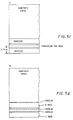
- Figs. 1a and 1b an embodiment is shown which is primarily directed to an interrupted flow method to prevent the transfer of any sample away from the sample pad to bridging bibulous strips.
- the assay strip 10 has an assay measurement or quantitation area 12 to which is adhered a bibulous strip 14 which extends from the quantitation area 12 to the sample pad 16.
- the bibulous strip 14 overlaps the sample pad 16 and provides for flow of a fluid from the sample pad 16 to the quantitation area 12.
- a second bibulous strip 20 extends from the sample pad 16 to the end of the strip for receiving fluid, transporting fluid or eluent, which will be transported from a fluid source to the sample pad 16.
- Fig. 1b a rear view is given of the strip 10 which shows a loading port 22 through support layer 24.
- the loading port 22 exposes sample pad 16.
- the support layer 24 is a fluid impervious layer which is present to provide for structural stability to the strip.
- Fig. 2 the top layer 12 is shown above support layer 24 and separated by adhesive layer 26 which bonds the quantitation area layer 12 to the support layer 24.
- Bibulous layers 14 and 20 are shown adhered to the support layer 24 by means of adhesive layer 26 and have elevated ends 30 and 32 respectively which overlap sample pad 16 and are prevented from contacting sample pad 16 by protective strip 34.
- Protective strip 34 is present at the time of fabrication of the assay strip and is removed after the sample is loaded onto sample pad 16 and sample incubation is complete.
- the entire strip may have a length of about 25 to 200 mm, more usually from about 50 to 150 mm, preferably about 100 mm. About 25 to 90% of the length of the strip will be the measurement or quantitation area.
- the strips which provide for flow of fluid to and from the sample pad may be of the same or different length and will generally be from about 5 to 25, more usually about 10 to 20% each of the length of the strip.
- the sample pad will generally be from about 1 to 10%, more usually from about 2 to 8% of the length of the strip, the longer the strip, the larger the sample pad may normally be.
- the width of the strip may be varied widely, usually being at least about 3 mm and not more than about 10 mm, preferably from about 4 to 7 mm.
- the bridging strips will usually overlap the sample pad by at least about 0.2 mm and not more than about 2 mm, usually about 1 mm, being primarily a matter of convenience, so long as the bridging strips are not in direct fluid communication.
- any convenient material may be used for the various bibulous parts of the assay strip.
- the thickness of the bibulous components will be in the range of about 0.05 to 2.0 mm, more usually 0.15 to 0.75 mm.
- a wide variety of bibulous supports may be employed, particularly cellulosic supports, such as chromatography paper, silica on a support, alumina on a support, and polymeric membranes such as nitrocellulose and nylon.
- the characteristics of the bibulous material employed for the measurement region include the need in many instances to covalently or irreversibly bind an indicator molecule to the support, that the color developed should be clear and sharp, and that the fluid should be capable of flowing at a convenient rate through the bibulous member.
- the bibulous member should be able to adhere to a support, as well as allowing for adherence of the bridging bibulous member to the measurement region bibulous member without significant interference with flow from the bridging member to the measurement member.
- the support layer may be any convenient rigid backing material, generally from about 0.0508 to about 1.270mm (0.002 to about 0.05 in) more usually from about 0.127 to 0.0635 mm (0.005 to 0.025 inch) thick.
- rigid convenient materials are available, for the most part polymers, which include polystyrene, polyvinylacetate, polyvinylchloride, polyester, etc.
- the adhesive layer may be any convenient adhesive which does not significantly penetrate the bibulous member and interfere with flow. For the most part, double-stick tape adhesive has been found to be convenient and successful. Double-stick adhesives include 3M 415, 443, or 9460.
- the sample is introduced at the sample loading port 22 and is absorbed by the sample pad 16.
- the protective strip 34 is removed, at which time the elevated ends 30 and 32 of the bibulous strip bridging members 14 and 20 make contact with the sample pad 16.
- the bibulous strip bridging member 20 is now immersed in the transport fluid, whereby the fluid flows through the bridging member 20 through the pad carrying with it product or other substances (which will provide for signal production in the measurement area 12) through the bridging member 14 into the bibulous measurement area 12.
- assay strip 50 has measurement or quantitation area 52 with bridging strip 54, sample pad 56 and bridging bibulous strip 76 extending to space 60.
- a spanning flow diversion strip 62 is provided which extends from the immersion end 64 of the assay strip device 50 over the bridging strip 54, pad 56, and fills space 60 to provide for continuity to measurement area 52.
- Spanning flow diversion strip 62 thus forms an intervening juncture in the plane of measurement region 52 and bridging strip 76, so as to provide a bibulous joining region 66, resulting in a continuous layer and flow path between bridging region 76 and measurement region 52.
- the end 70 of the flow diversion strip 62 may abut measurement region 52 or extend over the end of measurement region 52 to ensure smooth fluid flow.
- an adhesive layer 72 firmly binds the bibulous strips to the support film 74.
- All or part of bibulous strip 76 is of narrower dimension than the measurement region 52 so as to provide a narrow neck 76 which results in the flow path from sample pad 56 being narrower than the flow path from flow diversion strip 62, as the two streams enter the measurement area 52.
- the result of having the sample stream narrower than the transport fluid stream when the two streams meet in the measurement area and the measurement area is wetted by the transport fluid is to maintain a relatively sharply defined color front to produce a rocket conformation which can be easily discriminated and measured.
- the bibulous bridging strip 76 may for example have a width in the range of about 2 to 4 mm, where the measurement area has a width of 5 mm. That is, the bridging strip will usually be at least 1 mm smaller than the measurement area, and may range from about 20 to 80% of the width of the measurement area.
- the diversion strip on the other hand, will be about the width of the measurement area.
- a metering device substitutes for the protective strip 34 in the previous embodiment.
- the metering device 80 which is comprised of the sample pad 56 which is shown above the screen 82, which in turn is bonded by means of adhesive strips 84 to absorbant 86.
- the adhesive strips 84 are distant from the region of the sample pad 56, so as to avoid interference with the transfer of fluid from the sample pad 56 to the absorbant 86.
- the absorbant 86 is covered with an inert film 90, which prevents transfer of fluid from the absorbant to the bridging strips 54 and 76.
- the screen is characterized by having a mesh of from about 100 ⁇ m to about 1 mm, preferably from about 200 ⁇ m to about 500 ⁇ m.
- the thickness will generally be from about 150 ⁇ m to 600 ⁇ m, more usually from about 200 ⁇ m to 400 ⁇ m.
- the composition may be nylon, polyester, polyethylene, or the like, so long as the dimensions and composition do not allow continuity of capillary flow between the sample pad and the absorbant pad, but allows for wicking upon saturation of the sample pad.
- the sample pad may be of a dimension to have a volume capacity of from about 5 to 100 ⁇ l more usually from about 10 to 50 ⁇ l.
- the volume administered to the pad may be as a single drop, or a plurality of drops.
- the screen will be laid on top of the sample pad, so that it may be removed subsequently, when the strip end is immersed in the transport fluid.
- Figs. 5a-f are diagrammatically indicated the various stages in preparing a strip.
- adhesive liner is removed and the adhesive tape exposed on the upper 7 cm of the the 20-cm length of plastic support laminate.
- a 7-cm x 20-cm area of chromatography paper with peroxidase substrate immobilized is laminated with even and firm pressure.
- Fig. 5b 3.17 mm (1/8-inch) diameter holes are punched 5 mm apart on a center 1.5 cm from the base of the strip.
- Fig. 5a-f 3.17 mm (1/8-inch) diameter holes are punched 5 mm apart on a center 1.5 cm from the base of the strip.
- the adhesive is then removed from the sample pad area centered 1.5 cm from the bottom of the strip, and a piece of sample pad paper (0.5 cm x 20 cm) is laminated in this area with firm, even pressure, overlapping the adhesive layer at its edges.
- the release liner is then removed and the adhesive in the bridging strip area is exposed (Fig. 5d).
- a 1.4-cm x 20-cm section of chromatography paper is laminated over area B, ensuring a 1-mm overlap at each interface.
- a 1.3-cm x 20-cm section of paper is laminated over area C providing again for the 1-mm overlap at the pad interface.
- the strips may then be cut using a paper cutter to provide strips 5-mm wide (Fig. 5e).
- the lower strip is bent to allow a 0.127 mm (0.005-inch) thick clear Mylar® slide to be inserted or the metering device to be inserted, after which time the strips may be stored in a dessicator (Fig. 5f).
- strips were prepared as follows for the detection of cholesterol in serum.
- a sample strip is prepared as follows.
- the support layer is composed of polystyrene rigid backing material of 0.254 mm (0.01) inch thick.
- the 3M 443 double-stick tape is provided as a first 10 mm strip beginning at one end, followed by a space of 2.5 mm, a second layer of adhesive having a width of 5 mm, followed by a space of 2.5 mm. Finally, the remainder of the support is covered with 3M 415 double-stick adhesive for a width of 80 mm. A 3 mm hole is punched through the support 15 mm from the end in order to provide the sample loading port.
- the measurement or quantitation area is prepared by placing a sheet of Whatman R 31ET chromatography paper having a width of 70 mm and may be of any convenient length, so that ultimately the strips may be cut from a larger laminated sheet.
- a stock solution is prepared for attachment of the dye to the measurement region.
- modified N,N-dimethylaniline which is N-[ ⁇ -1,2-ethylenediamine carboxamido-butyl],N-methylaniline.
- DMA dimethylaniline
- the dimethylaniline (DMA) derivative is coupled to the paper employing carbonyl diamidazole.
- the paper is activated by soaking the paper in 0.20 M carbonyldiimidazole in methylene chloride, followed by soaking the paper in 1.5 mg/ml DMA derivative in methylene chloride.
- the paper is soaked in a 0.5 mg/ml solution of 3-methyl-2-benzothiazolinone hydrazone (MBTH), although a concentration in the range of 0.1 to 2 mg/ml is useful. Excess solution is wiped off gently by wiping the paper over one edge of a dish, followed by drying the paper in a forced air convention oven at 50°C for about 25 minutes.
- the paper is firmly laminated onto the double-stick adhesive layer in the measurement region extending from one end of the support.
- the bridging strips are affixed to the support.
- the first strip beginning at the end is 13 mm long and is affixed at one end along the adhesive and overlaps the sample pad by about 1 mm.
- the second strip is 14 mm long and overlaps the sample pad by about 1 mm.
- the second strip is placed over the second strip of adhesive extending from the sample pad to the measurement area, while overlapping both the measurement region and sample pad by about 1 mm.
- the sample pad is conveniently of cellulose chromatography paper, but glass fiber paper, synthetic membrane, or other suitable material may be employed. Conveniently, the pad is 5 mm x 5 mm.
- the sample pad is impregnated with the following solution: Gantrez R AN-149 0.5% Gum Arabic 2.0% Sucrose 5.0% Mega R 8* 0.83% Gelatin 0.5% Cholesterol Esterase 9 u/ml Cholesterol Oxidase 5 u/ml Sodium Cholate 1.0% Nonidet R P-40 1.0% *Octanoyl-N-methylglucamide (Sigma #03129). in 0.1 M potassium phosphate, pH 7.0 buffer. The protective slide or metering system is then inserted under the bridging strips.
- the slide may be 0.127 mm (0.005-inch) thick Mylar® sheet of about 8 mm width, or the metering device, comprising an 8-mm wide plastic screen, Tetko Nitex R 3-500/49, 500 ⁇ m mesh, 390 ⁇ m thick, adhered at its ends by means of 3M 415 double-stick adhesive to Whatman R lC absorbant.
- the exposed side of the absorbant is covered with a protective layer of 3M 845.
- the sheet may now be cut into 5-mm strips, so as to provide the final device. In some instances it may be desirable to first prepare the strip before introducing the protective slide. The strip is now ready to be used in an assay.
- the assay is performed as follows. A measured sample of serum, 10 ⁇ l where the metering device is not employed, is added through the port on the rear of the strip and the sample pad allowed to incubate for 10 min. The protective slide is then removed by sliding sideways and the end of the device is placed into a 13 x 100 mm test tube containing 0.5 ml of peroxidase enzyme solution.
- the solution has 25 ⁇ g/ml of horseradish peroxidase, 2.0 mg/ml of bovine gamma-globulin, in 0.1 M sodium phosphate, 0.2 M sodium chloride, pH 7. The solution is allowed to wick to the top of the strip for approximately 10 min.
- the height of the color band is then measured and compared to a calibration curve which defines the cholesterol level of the serum in mg/dl.
- the following table indicates the results.
- the MBTH substrate is immobilized in the quantitation area at two levels: 0.25 and 0.50 mg/ml.
- the results shown below demonstrate that the sensitivity of the assay can be adjusted by varying the amount of immobilized indicator.
- CALIBRATION CURVE OF SERUM WITH H2O2 SPIKE mg/dl* Migration Height 0.25 mg/ml 0.5 mg/ml 50 10.0 5.0 100 23.5 16.0 200 38.0 29.0 400 52.0 43.0 *Values expressed as cholesterol equivalents.
Landscapes
- Life Sciences & Earth Sciences (AREA)
- Chemical & Material Sciences (AREA)
- Health & Medical Sciences (AREA)
- Engineering & Computer Science (AREA)
- Organic Chemistry (AREA)
- Immunology (AREA)
- Molecular Biology (AREA)
- Zoology (AREA)
- Wood Science & Technology (AREA)
- Proteomics, Peptides & Aminoacids (AREA)
- Biotechnology (AREA)
- Microbiology (AREA)
- General Health & Medical Sciences (AREA)
- Analytical Chemistry (AREA)
- Biochemistry (AREA)
- Physics & Mathematics (AREA)
- Hematology (AREA)
- Bioinformatics & Cheminformatics (AREA)
- Urology & Nephrology (AREA)
- Genetics & Genomics (AREA)
- Biophysics (AREA)
- Biomedical Technology (AREA)
- General Engineering & Computer Science (AREA)
- General Physics & Mathematics (AREA)
- Food Science & Technology (AREA)
- Medicinal Chemistry (AREA)
- Cell Biology (AREA)
- Pathology (AREA)
- Emergency Medicine (AREA)
- Investigating Or Analysing Biological Materials (AREA)
- Measuring Or Testing Involving Enzymes Or Micro-Organisms (AREA)
- Magnetic Heads (AREA)
- Apparatus Associated With Microorganisms And Enzymes (AREA)
- Measurement Of The Respiration, Hearing Ability, Form, And Blood Characteristics Of Living Organisms (AREA)
- Investigating Or Analysing Materials By The Use Of Chemical Reactions (AREA)
Claims (12)
- Teststäbchen-Meßeinrichtung mit in der Strömungsrichtung des Eluenten:
einem ersten, saugfähigen Überbrückungsstreifen, der sich von dem Eintauchende der Einrichtung bis an den Ort eines Probenkissens erstreckt;
einem Probenkissen;
einem zweiten saugfähigen Überbrückungsstreifen, der sich von dem Ort des Probenkissens bis zu einem Ort zur Aufnahme eines Fluids in einer Meßregion erstreckt, wobei der zweite Streifen in Fluidverbindung mit dem Probenkissen steht, und einem verlängerten, saugfähigen Meßstreifen, der in Fluidverbindung mit dem zweiten Überbrückungsstreifen steht und mit einem ersten Element eines ein Signal liefernden Systems imprägniert ist, das bei der Reaktion mit einem zweiten Element des signalliefernden Systems ein meßbares Signal erzeugt, welches eine Grenzlinie auf dem Meßstreifen definiert; sowie
Mitteln zur Unterbrechung der Fluidverbindung zwischen dem Probenkissen und den ersten und zweiten Überbrückungselementen vor der Messung und zum Ermöglichen der Fluidverbindung während der Messung. - Einrichtung nach Anspruch 1, bei der die ersten und zweiten Überbrückungsstreifen das Probenkissen ohne Kontakt zwischen den Streifen überlagern.
- Einrichtung nach Anspruch 1, bei der das signalerzeugende System mindestens ein Enzym umfaßt, mit dem das Probenkissen imprägniert ist.
- Einrichtung nach Anspruch 3, bei der das Enzym eine Oxidase ist.
- Teststäbchen-Meßeinrichtung mit in der Strömungsrichtung des Eluenten:
einem ersten, saugfähigen Überbrückungsstreifen, der sich von dem Eintauchende der Einrichtung zu dem Ort eines Probenkissens erstreckt;
einem Probenkissen an dem Probenkissenort in Fluidverbindung mit dem ersten Überbrückungsstreifen;
einem zweiten, saugfähigen Überbrückungsstreifen, der sich von dem Probenkissenort bis zu einem Ort zur Aufnahme eines Fluids in einer Meßregion erstreckt, wobei der zweite Streifen in Fluidverbindung mit dem Probenkissen steht; und
einem verlängerten, saugfähigen Meßstreifen, der in Fluidverbindung mit dem zweiten Überbrückungsstreifen steht und mit einem ersten Element eines ein signalliefernden Systems imprägniert ist, das bei der Reaktion mit einem zweiten Element des signalliefernden Systems ein meßbares Signal erzeugt, welches eine Grenzlinie auf dem Meßstreifen definiert; sowie zusätzlich
einer inerten Schutzbarriere, die das Probenkissen von der Fluidverbindung mit den ersten und zweiten Überbrückungselementen trennt; sowie
einem überspannenden, saugfähigen Streifen, der sich von dem Eintauchende bis zu dem Meßstreifen in Fluidverbindung mit dem Meßstreifen erstreckt; und
wobei der zweite Überbrückungsstreifen einen Bereich aufweist, der enger als der überspannende Streifen ist. - Einrichtung nach Anspruch 5, bei der der überspannende, saugfähige Streifen zwischen den zweiten Überbrückungsstreifen und dem Meßstreifen liegt und die Fluidverbindung zwischen diesen liefert.
- Teststäbchen-Meßeinrichtung mit in der Strömungsrichtung des Eluenten:
einem ersten, saugfähigen Überbrückungsstreifen, der sich von dem Eintauchende der Einrichtung bis an den Ort eines Probenkissens erstreckt;
einem Probenkissen an dem Probenkissenort, das in Fluidverbindung mit dem ersten Überbrückungsstreifen steht;
einem zweiten, saugfähigen Überbrückungsstreifen, der sich von dem Probenkissenort bis an einen Ort zur Aufnahme eines Fluids in einer Meßregion erstreckt, wobei der zweite Streifen in Fluidverbindung mit dem Probenkissen steht; und
einem verlängerten, saugfähigen Meßstreifen, der in Fluidverbindung mit dem zweiten Überbrückungsstreifen steht und mit einem ersten Element eines signalliefernden Systems imprägniert ist, das bei der Reaktion mit einem zweiten Element des Signalliefernden Systems ein meßbares Signal erzeugt, welches eine Grenzlinie auf dem Meßstreifen definiert; und
einer Meßvorrichtung mit einem porösen, nicht benetzenden Element in Fluidaufnahmekontakt mit dem Probenkissen, einer Verstärkung einer absorbierenden Schicht zur Aufnahme von Fluid von dem Probenkissen, bedeckt mit einer inerten Folie und eine inerte Schutzbarriere bildend, die das Probenkissen von der Fluidverbindung mit den ersten und zweiten Überbrückungselementen trennt. - Verfahren zur Bestimmung der Anwesenheit eines Analyten in einer Probe unter Verwendung einer Einrichtung mit einem ersten, saugfähigen Überbrückungselement für den Transfer von Eluent und einer Fluidquelle zu einem Probenkissen, einem zweiten Überbrückungselement zum Transfer von Eluentfluid von dem Probenkissen zu einem verlängerten, saugfähigen Meßstreifen, der mit einem zweiten Element eines Signalliefernden Systems imprägniert ist, wobei das Verfahren die folgenden Schritte umfaßt:
Imprägnieren eines Probenkissens mit einem Assaymedium, woraus die Anwesenheit eines ersten Elementes eines signalliefernden Systems in dem Probenkissen resultiert, und zwar in einer Menge, die in Beziehung zur Menge des Analyten in der Probe steht, während der Transport des Assaymediums zu den saugfähigen Überbrückungselementen verhindert wird;
Leiten eines Eluentstromes von einer Eluentquelle zu dem Probenkissen zum Transfer des ersten Elementes von dem Kissen zu dem Meßstreifen über das zweite Überbrückungselement;
Leiten des das erste Element enthaltenden Eluents durch den Meßstreifen, wobei die ersten und zweiten Elemente des Signalliefernden Systems und jegliche zusätzlichen Elemente des Signalliefernden Systems unter Bildung einer meßbaren Grenzlinie auf dem Meßstreifen reagieren, wobei die Ausdehnung der Grenzlinie in Beziehung zu der Menge des Analyten in der Probe steht. - Verfahren nach Anspruch 8, mit den weiteren Schritten des Leitens eines umgeleiteten Stromes direkt von der Eluentquelle zu dem Meßelement, wobei der umgeleitete Strom sich über die Breite des Meßelementes erstreckt und das den Eluentstrom enthaltende erste Element enger als die Breite des Meßelementes ist sowie auf die Mitte des Meßelementes gerichtet ist.
- Verfahren nach Anspruch 8, wobei das erste signalliefernde System eine Oxidase umfaßt, die kovalent in dem Probenkissen immobilisiert ist, in dem Meßstreifen ein Dialkylanilin kovalent immobilisiert ist, der Meßstreifen mit einem Hydrazin imprägniert ist und in den Eluenten sich eine Peroxidase befindet.
- Verfahren nach Anspruch 10, bei dem die Oxidase Glucoseoxidase, Alkoholoxidase oder Cholesterinoxidase und der Analyt Glucose, Ethanol bzw. Cholesterin ist, mit der Maßgabe, daß das signalliefernde System weiterhin Cholesterinesterase, imprägniert in dem Probenkissen, enthält, wenn der Analyt Cholesterin ist.
- Kit, enthaltend eine Einrichtung gemäß Anspruch 1, Elemente des signalerzeugenden Systems und eine Probenmeßeinrichtung.
Applications Claiming Priority (2)
| Application Number | Priority Date | Filing Date | Title |
|---|---|---|---|
| US195881 | 1988-05-19 | ||
| US07/195,881 US4999287A (en) | 1988-05-19 | 1988-05-19 | Direct measuring assay strip and method of use thereof |
Publications (3)
| Publication Number | Publication Date |
|---|---|
| EP0342447A2 EP0342447A2 (de) | 1989-11-23 |
| EP0342447A3 EP0342447A3 (de) | 1991-07-31 |
| EP0342447B1 true EP0342447B1 (de) | 1994-12-14 |
Family
ID=22723208
Family Applications (1)
| Application Number | Title | Priority Date | Filing Date |
|---|---|---|---|
| EP89108100A Expired - Lifetime EP0342447B1 (de) | 1988-05-19 | 1989-05-05 | Direkt ablesbarer Testträger |
Country Status (7)
| Country | Link |
|---|---|
| US (1) | US4999287A (de) |
| EP (1) | EP0342447B1 (de) |
| JP (1) | JPH02138961A (de) |
| KR (1) | KR890017533A (de) |
| AT (1) | ATE115631T1 (de) |
| AU (1) | AU626853B2 (de) |
| DE (1) | DE68919902T2 (de) |
Families Citing this family (63)
| Publication number | Priority date | Publication date | Assignee | Title |
|---|---|---|---|---|
| US5039607A (en) * | 1988-05-17 | 1991-08-13 | Syntex (U.S.A.) Inc. | Method for immunochromatographic analysis |
| US5334513A (en) * | 1988-05-17 | 1994-08-02 | Syntex (U.S.A.) Inc. | Method for immunochromatographic analysis |
| US5423989A (en) * | 1988-05-19 | 1995-06-13 | Chemtrack, Inc. | Plasma forming device |
| US5132086A (en) * | 1990-02-06 | 1992-07-21 | Chemtrak Corporation | Non-instrumented cholesterol assay |
| US5416000A (en) * | 1989-03-16 | 1995-05-16 | Chemtrak, Inc. | Analyte immunoassay in self-contained apparatus |
| US5264180A (en) * | 1989-03-16 | 1993-11-23 | Chemtrak, Inc. | Mobile reagents in an analyte assay in a self-contained apparatus |
| CA1336062C (en) * | 1989-03-17 | 1995-06-27 | Chemtrak, Inc. | Hydrogen peroxide stabilization in assays |
| US5087556A (en) * | 1989-05-17 | 1992-02-11 | Actimed Laboratories, Inc. | Method for quantitative analysis of body fluid constituents |
| US5234813A (en) * | 1989-05-17 | 1993-08-10 | Actimed Laboratories, Inc. | Method and device for metering of fluid samples and detection of analytes therein |
| US6395227B1 (en) * | 1989-08-28 | 2002-05-28 | Lifescan, Inc. | Test strip for measuring analyte concentration over a broad range of sample volume |
| US5468648A (en) | 1991-05-29 | 1995-11-21 | Smithkline Diagnostics, Inc. | Interrupted-flow assay device |
| US5607863A (en) | 1991-05-29 | 1997-03-04 | Smithkline Diagnostics, Inc. | Barrier-controlled assay device |
| US6168956B1 (en) | 1991-05-29 | 2001-01-02 | Beckman Coulter, Inc. | Multiple component chromatographic assay device |
| US5877028A (en) | 1991-05-29 | 1999-03-02 | Smithkline Diagnostics, Inc. | Immunochromatographic assay device |
| US5869345A (en) | 1991-05-29 | 1999-02-09 | Smithkline Diagnostics, Inc. | Opposable-element assay device employing conductive barrier |
| US5998220A (en) | 1991-05-29 | 1999-12-07 | Beckman Coulter, Inc. | Opposable-element assay devices, kits, and methods employing them |
| US5204063A (en) * | 1991-12-12 | 1993-04-20 | Chemtrak, Inc. | Eluent release system and automated assay device |
| CA2129839A1 (en) * | 1992-02-10 | 1993-08-19 | David J. Gibboni | Method for immobilizing dye on substrates |
| US5409780A (en) * | 1992-02-13 | 1995-04-25 | Chemtrak, Inc. | Aniline analogs for hydrogen peroxide detection |
| US5837546A (en) * | 1993-08-24 | 1998-11-17 | Metrika, Inc. | Electronic assay device and method |
| US5409664A (en) * | 1993-09-28 | 1995-04-25 | Chemtrak, Inc. | Laminated assay device |
| AU3276895A (en) * | 1994-07-28 | 1996-02-22 | Pall Corporation | Fibrous web and process of preparing same |
| US5582907A (en) * | 1994-07-28 | 1996-12-10 | Pall Corporation | Melt-blown fibrous web |
| US7635597B2 (en) | 1995-08-09 | 2009-12-22 | Bayer Healthcare Llc | Dry reagent particle assay and device having multiple test zones and method therefor |
| US5968839A (en) * | 1996-05-13 | 1999-10-19 | Metrika, Inc. | Method and device producing a predetermined distribution of detectable change in assays |
| US20020010406A1 (en) | 1996-05-17 | 2002-01-24 | Douglas Joel S. | Methods and apparatus for expressing body fluid from an incision |
| EP1579814A3 (de) | 1996-05-17 | 2006-06-14 | Roche Diagnostics Operations, Inc. | Verfahren und Vorrichtung zur Probenahme und Analyse von Körperflüssigkeit |
| US5879951A (en) | 1997-01-29 | 1999-03-09 | Smithkline Diagnostics, Inc. | Opposable-element assay device employing unidirectional flow |
| US20050101032A1 (en) * | 1997-02-10 | 2005-05-12 | Metrika, Inc. | Assay device, composition, and method of optimizing assay sensitivity |
| US5744096A (en) * | 1997-02-21 | 1998-04-28 | Cholestech Corporation | Automated immunoassay cassette |
| US5939252A (en) | 1997-05-09 | 1999-08-17 | Lennon; Donald J. | Detachable-element assay device |
| GB2326476A (en) * | 1997-06-17 | 1998-12-23 | Hypoguard | Reagent comprising polymeric binder, chromogen, catalyst system which initiates colour change, and sulphonate or buffer |
| US5948695A (en) * | 1997-06-17 | 1999-09-07 | Mercury Diagnostics, Inc. | Device for determination of an analyte in a body fluid |
| JP2001527216A (ja) * | 1997-12-19 | 2001-12-25 | アミラ メディカル | エンボス加工されたテストストリップシステム |
| EP1062510A2 (de) | 1998-03-10 | 2000-12-27 | Strategic Diagnostics Inc. | Integriertes testgerät und verfahren zur produktion und verwendung |
| US20060019404A1 (en) * | 1998-05-06 | 2006-01-26 | Blatt Joel M | Quantitative assay with extended dynamic range |
| US7700305B2 (en) | 1999-09-17 | 2010-04-20 | N2Itive1 Innovations | Analyte detection |
| CN100558407C (zh) * | 2000-02-04 | 2009-11-11 | 柳署弘 | 制备含有胆汁酸的澄清水溶液剂型 |
| US6998273B1 (en) | 2000-02-09 | 2006-02-14 | A-Fem Medical Corporation | Collection device for lateral flow chromatography |
| US6365417B1 (en) * | 2000-02-09 | 2002-04-02 | A-Fem Medical Corporation | Collection device for lateral flow chromatography |
| GB0016841D0 (en) * | 2000-07-07 | 2000-08-30 | Stanley Christopher J | Optical device for measurement of analytes in tears |
| US20040229347A1 (en) * | 2001-09-17 | 2004-11-18 | Perez Edward P. | Embossed test strip system |
| DE10204606C1 (de) * | 2002-01-18 | 2003-10-16 | Cholestech Corp | Vorrichtung und Verfahren für Lipoproteine hoher Dichte |
| DE60207196T2 (de) * | 2002-04-09 | 2006-07-20 | Cholestech Corp., Hayward | Verfahren und Vorrichtung zur Quantifizierung von Lipoprotein-Cholesterol hoher Dichte |
| TWI333545B (en) * | 2003-04-02 | 2010-11-21 | Cholestech Corp | Adhered membranes retaining porosity and biological activity |
| US7150995B2 (en) | 2004-01-16 | 2006-12-19 | Metrika, Inc. | Methods and systems for point of care bodily fluid analysis |
| US20050227370A1 (en) * | 2004-03-08 | 2005-10-13 | Ramel Urs A | Body fluid analyte meter & cartridge system for performing combined general chemical and specific binding assays |
| US7858384B2 (en) * | 2005-04-29 | 2010-12-28 | Kimberly-Clark Worldwide, Inc. | Flow control technique for assay devices |
| US7803319B2 (en) * | 2005-04-29 | 2010-09-28 | Kimberly-Clark Worldwide, Inc. | Metering technique for lateral flow assay devices |
| EP1880218A2 (de) * | 2005-04-29 | 2008-01-23 | Beckman Coulter | Querfluss-fluoreszenzimmuntest |
| US7279136B2 (en) * | 2005-12-13 | 2007-10-09 | Takeuchi James M | Metering technique for lateral flow assay devices |
| US7618810B2 (en) | 2005-12-14 | 2009-11-17 | Kimberly-Clark Worldwide, Inc. | Metering strip and method for lateral flow assay devices |
| EP2126587B1 (de) * | 2007-01-09 | 2010-09-29 | Cholestech Corporation | Vorrichtung und verfahren zur messung des ldl-assoziierten cholesterols |
| EP2217925A4 (de) * | 2007-12-13 | 2011-01-19 | Beckman Coulter Inc | Vorrichtung und verfahren für den nachweis einer zielzelle |
| US9404911B2 (en) * | 2008-04-21 | 2016-08-02 | Quidel Corporation | Integrated assay device and housing |
| US9877672B2 (en) | 2010-01-28 | 2018-01-30 | Ellume Pty Ltd | Sampling and testing device for the human or animal body |
| WO2011111108A1 (ja) * | 2010-03-11 | 2011-09-15 | Dicプラスチック株式会社 | 酵素免疫測定器具及び酵素免疫測定方法 |
| USD679410S1 (en) | 2012-02-03 | 2013-04-02 | Respirio Pty Ltd | Sampling and testing device |
| US10890590B2 (en) | 2012-09-27 | 2021-01-12 | Ellume Limited | Diagnostic devices and methods |
| ITMI20131354A1 (it) * | 2013-08-07 | 2015-02-08 | Copan Italia Spa | Supporto per la conservazione di campioni di materiale biologico e relativo metodo di produzione |
| JP5792859B1 (ja) * | 2014-04-04 | 2015-10-14 | 田中貴金属工業株式会社 | 免疫クロマト分析方法 |
| US10786229B2 (en) | 2015-01-22 | 2020-09-29 | Ellume Limited | Diagnostic devices and methods for mitigating hook effect and use thereof |
| EP3887827B1 (de) * | 2018-11-28 | 2024-01-17 | 2PI-sigma Corporation | Lateral-flow-test mit gesteuertem konjugat und kontrollierter durchflusszeit |
Family Cites Families (12)
| Publication number | Priority date | Publication date | Assignee | Title |
|---|---|---|---|---|
| US3511608A (en) * | 1967-12-14 | 1970-05-12 | Harold P Anderson | Multiple layer paper test strip |
| CA1023251A (en) * | 1973-06-22 | 1977-12-27 | The Standard Oil Company | Method and paper test strip for determining low levels of lead in hydrocarbon fuels |
| US4108729A (en) * | 1977-05-16 | 1978-08-22 | U.S. Packaging Corp. | Paper booklet for presumptive diagnosis of Neisseria Gonorrhoeae in the male |
| US4435504A (en) * | 1982-07-15 | 1984-03-06 | Syva Company | Immunochromatographic assay with support having bound "MIP" and second enzyme |
| US4826759A (en) * | 1984-10-04 | 1989-05-02 | Bio-Metric Systems, Inc. | Field assay for ligands |
| US4999285A (en) * | 1984-11-15 | 1991-03-12 | Syntex (U.S.A.) Inc. | Chromatographic cassette |
| DE3445816C1 (de) * | 1984-12-15 | 1986-06-12 | Behringwerke Ag, 3550 Marburg | Flaechenfoermiges diagnostisches Mittel |
| US4740468A (en) * | 1985-02-14 | 1988-04-26 | Syntex (U.S.A.) Inc. | Concentrating immunochemical test device and method |
| DE3530993A1 (de) * | 1985-08-30 | 1987-03-05 | Miles Lab | Teststreifen mit festlegbarer probenaufnahmekapazitaet |
| DE3630999A1 (de) * | 1986-09-12 | 1988-03-17 | Boehringer Mannheim Gmbh | Mehrschichtiger testtraeger |
| US4960691A (en) * | 1986-09-29 | 1990-10-02 | Abbott Laboratories | Chromatographic test strip for determining ligands or receptors |
| DE3638654A1 (de) * | 1986-11-12 | 1988-05-26 | Boehringer Mannheim Gmbh | Testtraeger zur analytischen bestimmung eines bestandteils einer koerperfluessigkeit |
-
1988
- 1988-05-19 US US07/195,881 patent/US4999287A/en not_active Expired - Lifetime
-
1989
- 1989-04-28 AU AU33847/89A patent/AU626853B2/en not_active Ceased
- 1989-05-05 DE DE68919902T patent/DE68919902T2/de not_active Expired - Fee Related
- 1989-05-05 AT AT89108100T patent/ATE115631T1/de not_active IP Right Cessation
- 1989-05-05 EP EP89108100A patent/EP0342447B1/de not_active Expired - Lifetime
- 1989-05-18 JP JP1122996A patent/JPH02138961A/ja active Pending
- 1989-05-19 KR KR1019890006708A patent/KR890017533A/ko not_active Ceased
Also Published As
| Publication number | Publication date |
|---|---|
| EP0342447A3 (de) | 1991-07-31 |
| US4999287A (en) | 1991-03-12 |
| AU626853B2 (en) | 1992-08-13 |
| AU3384789A (en) | 1989-11-23 |
| ATE115631T1 (de) | 1994-12-15 |
| EP0342447A2 (de) | 1989-11-23 |
| DE68919902T2 (de) | 1995-05-11 |
| JPH02138961A (ja) | 1990-05-28 |
| KR890017533A (ko) | 1989-12-16 |
| DE68919902D1 (de) | 1995-01-26 |
Similar Documents
| Publication | Publication Date | Title |
|---|---|---|
| US4999287A (en) | Direct measuring assay strip and method of use thereof | |
| US4987085A (en) | Blood filtering metering device | |
| CA1236011A (en) | Assay method for whole blood samples | |
| US5753452A (en) | Reagent test strip for blood glucose determination | |
| EP0799896B1 (de) | Reagenzteststreifen zum Nachweis von Glukose im Blut | |
| US5830680A (en) | Unitary sandwhich enzyme immunoassay cassette device and method of use | |
| USRE38688E1 (en) | Sheet-like diagnostic device | |
| US5132086A (en) | Non-instrumented cholesterol assay | |
| US4973549A (en) | Quantitative diagnostic assay employing signal producing agent bound to support and measuring migration distance of detectable signal | |
| US4959324A (en) | Sample pad assay initiation device and method of making | |
| JP3150857B2 (ja) | グリコヘモグロビン含有比測定用分析要素及び分析方法 | |
| US5435970A (en) | Device for analysis for constituents in biological fluids | |
| US4361648A (en) | Color fixed chromogenic analytical element | |
| US5326697A (en) | Composition and method of assaying for D-β-hydroxybutyrate | |
| JP2599192B2 (ja) | 結合アッセイ装置 | |
| EP1264898A2 (de) | Blutglucose-Teststreifen mit reduzierter Sensitivität für Hämatokrit | |
| JPH0521509B2 (de) | ||
| JP2576910B2 (ja) | 免疫分析要素および免疫分析方法 | |
| US5340539A (en) | Non-instrumented cholesterol assay | |
| US20040219694A1 (en) | Lateral flow test format for enzyme assays | |
| EP0526226B1 (de) | Vorrichtung und Verfahren zur Durchführung biologischer Assays, die ein Partikelsiebsystem enthalten | |
| EP0427534A1 (de) | Verbesserung in einem gerätefreien auf Entfernungsbestimmung beruhenden diagnostischen Test | |
| EP0464934B1 (de) | Element zur Bestimmung von Katechin und Katechin-bildenden Substanzen | |
| US5220035A (en) | Dithiol-(2-nitrobenzoate) indicators | |
| EP0195320B1 (de) | Diagnostische Probe, die Mikroperoxidase verwendet |
Legal Events
| Date | Code | Title | Description |
|---|---|---|---|
| PUAI | Public reference made under article 153(3) epc to a published international application that has entered the european phase |
Free format text: ORIGINAL CODE: 0009012 |
|
| AK | Designated contracting states |
Kind code of ref document: A2 Designated state(s): AT BE CH DE ES FR GB GR IT LI LU NL SE |
|
| PUAL | Search report despatched |
Free format text: ORIGINAL CODE: 0009013 |
|
| AK | Designated contracting states |
Kind code of ref document: A3 Designated state(s): AT BE CH DE ES FR GB GR IT LI LU NL SE |
|
| 17P | Request for examination filed |
Effective date: 19920115 |
|
| 17Q | First examination report despatched |
Effective date: 19930908 |
|
| GRAA | (expected) grant |
Free format text: ORIGINAL CODE: 0009210 |
|
| AK | Designated contracting states |
Kind code of ref document: B1 Designated state(s): AT BE CH DE ES FR GB GR IT LI LU NL SE |
|
| PG25 | Lapsed in a contracting state [announced via postgrant information from national office to epo] |
Ref country code: NL Effective date: 19941214 Ref country code: LI Effective date: 19941214 Ref country code: GR Free format text: LAPSE BECAUSE OF FAILURE TO SUBMIT A TRANSLATION OF THE DESCRIPTION OR TO PAY THE FEE WITHIN THE PRESCRIBED TIME-LIMIT Effective date: 19941214 Ref country code: ES Free format text: THE PATENT HAS BEEN ANNULLED BY A DECISION OF A NATIONAL AUTHORITY Effective date: 19941214 Ref country code: CH Effective date: 19941214 Ref country code: AT Effective date: 19941214 |
|
| REF | Corresponds to: |
Ref document number: 115631 Country of ref document: AT Date of ref document: 19941215 Kind code of ref document: T |
|
| REF | Corresponds to: |
Ref document number: 68919902 Country of ref document: DE Date of ref document: 19950126 |
|
| ET | Fr: translation filed | ||
| ITF | It: translation for a ep patent filed | ||
| PG25 | Lapsed in a contracting state [announced via postgrant information from national office to epo] |
Ref country code: SE Effective date: 19950314 |
|
| REG | Reference to a national code |
Ref country code: CH Ref legal event code: PL |
|
| PGFP | Annual fee paid to national office [announced via postgrant information from national office to epo] |
Ref country code: FR Payment date: 19950411 Year of fee payment: 7 |
|
| PGFP | Annual fee paid to national office [announced via postgrant information from national office to epo] |
Ref country code: DE Payment date: 19950425 Year of fee payment: 7 |
|
| PGFP | Annual fee paid to national office [announced via postgrant information from national office to epo] |
Ref country code: GB Payment date: 19950428 Year of fee payment: 7 |
|
| NLV1 | Nl: lapsed or annulled due to failure to fulfill the requirements of art. 29p and 29m of the patents act | ||
| PG25 | Lapsed in a contracting state [announced via postgrant information from national office to epo] |
Ref country code: LU Free format text: LAPSE BECAUSE OF NON-PAYMENT OF DUE FEES Effective date: 19950531 Ref country code: BE Effective date: 19950531 |
|
| PLBE | No opposition filed within time limit |
Free format text: ORIGINAL CODE: 0009261 |
|
| STAA | Information on the status of an ep patent application or granted ep patent |
Free format text: STATUS: NO OPPOSITION FILED WITHIN TIME LIMIT |
|
| BERE | Be: lapsed |
Owner name: CHEMTRAK INC. Effective date: 19950531 |
|
| 26N | No opposition filed | ||
| PG25 | Lapsed in a contracting state [announced via postgrant information from national office to epo] |
Ref country code: GB Effective date: 19960505 |
|
| GBPC | Gb: european patent ceased through non-payment of renewal fee |
Effective date: 19960505 |
|
| PG25 | Lapsed in a contracting state [announced via postgrant information from national office to epo] |
Ref country code: FR Effective date: 19970131 |
|
| PG25 | Lapsed in a contracting state [announced via postgrant information from national office to epo] |
Ref country code: DE Effective date: 19970201 |
|
| REG | Reference to a national code |
Ref country code: FR Ref legal event code: ST |
|
| PG25 | Lapsed in a contracting state [announced via postgrant information from national office to epo] |
Ref country code: IT Free format text: LAPSE BECAUSE OF NON-PAYMENT OF DUE FEES;WARNING: LAPSES OF ITALIAN PATENTS WITH EFFECTIVE DATE BEFORE 2007 MAY HAVE OCCURRED AT ANY TIME BEFORE 2007. THE CORRECT EFFECTIVE DATE MAY BE DIFFERENT FROM THE ONE RECORDED. Effective date: 20050505 |