EP0342028A2 - Moniteur pour un collecteur d'urine - Google Patents
Moniteur pour un collecteur d'urine Download PDFInfo
- Publication number
- EP0342028A2 EP0342028A2 EP89304771A EP89304771A EP0342028A2 EP 0342028 A2 EP0342028 A2 EP 0342028A2 EP 89304771 A EP89304771 A EP 89304771A EP 89304771 A EP89304771 A EP 89304771A EP 0342028 A2 EP0342028 A2 EP 0342028A2
- Authority
- EP
- European Patent Office
- Prior art keywords
- fluid
- vessel
- averages
- flow
- readings
- Prior art date
- Legal status (The legal status is an assumption and is not a legal conclusion. Google has not performed a legal analysis and makes no representation as to the accuracy of the status listed.)
- Withdrawn
Links
Images




Classifications
-
- A—HUMAN NECESSITIES
- A61—MEDICAL OR VETERINARY SCIENCE; HYGIENE
- A61B—DIAGNOSIS; SURGERY; IDENTIFICATION
- A61B5/00—Measuring for diagnostic purposes; Identification of persons
- A61B5/20—Measuring for diagnostic purposes; Identification of persons for measuring urological functions restricted to the evaluation of the urinary system
- A61B5/207—Sensing devices adapted to collect urine
- A61B5/208—Sensing devices adapted to collect urine adapted to determine urine quantity, e.g. flow, volume
-
- A—HUMAN NECESSITIES
- A61—MEDICAL OR VETERINARY SCIENCE; HYGIENE
- A61B—DIAGNOSIS; SURGERY; IDENTIFICATION
- A61B10/00—Instruments for taking body samples for diagnostic purposes; Other methods or instruments for diagnosis, e.g. for vaccination diagnosis, sex determination or ovulation-period determination; Throat striking implements
- A61B10/0045—Devices for taking samples of body liquids
- A61B10/007—Devices for taking samples of body liquids for taking urine samples
Definitions
- the present invention relates to a method and an apparatus for determining the flow rate of urine during micturition and for determining other variables, and for obtaining a urine sample for clinical laboratory analysis.
- Measurement of urinary flow rates (uroflowmetry) during micturition is an important technique of evaluating lower urinary tract dysfunction. Average flow rates and the peak flow rate, along with the patterns of changing flow rates during the micturition event allow physicians to identify conditions of outflow obstruction and differentiate between anatomic and neurologic disease.
- the simplest form of uroflowmetry is observation of the urine stream by a trained physician.
- a simple and more quantifying technique is timing the voiding of a patient while collecting the urine into a calibrated container, thereby allowing average flow rate to be calculated.
- Other devices allow peak flow rate to be estimated by collecting urine into chambers of varying sizes in a device, with the filling of the chambers dependent upon flow rates. Observation of urination, however, is embarrassing to many patients, and many cannot void or do not void normally under such conditions. Furthermore, observation, timed voiding, and peak flow measurement alone give only partial information about how the patient urinates.
- Electro-mechanical devices have been devised to make a recording of urine flow rates during micturition. Many technologies have been used to make the measurement. Measurement by weight is a common technique. Weight represents volume, and change in weight over time represents flow rate. Other technologies include micro-turbines in which the urine flowing through a tube acts upon a small fan blade, the rotation of which is proportional to urine flow rate, with the rotation being measured optically. Another technique employs a DC motor with a blade rotating at a fixed speed. The urine acts upon the blade to impede its rotation causing the motor to draw more current to rotate the blade at a fixed speed. The change in current draw is then measured and reflects flow rate.
- the sensors must endure repeated exposure to urine, which is corrosive and damaging to the sensors. Cleaning is of utmost importance to maintain reliable performance of the sensor. Cleaning is also important in that infected urine may remain in or on the mechanism, allowing bacteria to grow and exposing other patients to disease. Further, since urine from several patients comes into contact with the sensor mechanism, the urine cannot be used reliably for clinical chemical and microbiological analysis. On a practical basis, the sensor systems cannot be cleaned adequately to provide the level of cleanliness required for such urinalysis.
- Urine does not directly contact weight-type sensors, similar problems exist. Urine is collected into a vessel which rests on the weight sensor. The sensor must be isolated from patient contact, and the urine must be directed into the collector from a standard size and height channel such that the weight measurement is not changed by the kinetic forces of the urine stream. Therefore a weight-type apparatus must provide a means of directing the urine into the collection cup. Since urine contacts this portion of the apparatus (generally a large funnel), this system obviates the use of the voided urine for additional laboratory tests.
- the present invention provides a method and apparatus for flow analysis during collection of a urine sample, and for simultaneously maintaining the urine sample sterile for use in clinical and microbiological analysis.
- a collector assembly adapted to fit a standard commode is used and includes a fold-out liner covering the entire target area for capturing the urine stream during voiding.
- a variable capacitor is included in the collector assembly, which has a capacitance value which varies with the amount of fluid in the collector assembly. The variable capacitor is attached to a capacitance bridge, and the change in capacitance is provided as a voltage to a microprocessor for determining flow rates and other, related variables.
- a tube is provided for aspirating a urine sample from the collector for urinalysis, so that the sample is not handled by a person.
- the collector assembly also includes a drain mechanism allowing the unwanted urine to be drained into the commode without handling the assembly itself and protecting the operator of the apparatus from contact with the urine.
- the collector assembly is provided as a single unit for easy disposal when a given sample has been taken.
- variable capacitor has air acting as a dielectric, so that as the collector assembly fills with fluid, the capacitance changes.
- the method of the invention involves determining a potential difference between two points in the capacitance bridge, with the potential difference relating to the changing capacitance value.
- This potential difference is processed for input into a microprocessor, which samples the processed potential difference periodically, thus determining the flow rate.
- Other variables which are determined are the peak flow rate, average flow rate and total time of micturition.
- a printer is connected to the microprocessor for outputting the flow versus time results, and a control panel is provided for either interface.
- Figs. 1 and 2 show a typical toilet or commode 10 in connection with which the method and apparatus of the invention are used.
- the urine collection monitor 20 includes a urine collection system 30, a sensor 40, a urine sampling system 50, and an electronics module 60.
- the urine collection system 30 includes a commode adaptor 70 which is configured to fit over a standard toilet bowl 80.
- the adaptor 70 is a reusable item which may be left in place on the bowl 80.
- the collection system 30 also includes a vessel 90, which is basically bucket-shaped, and has a rim 100 (shown in Fig. 3) to which a liner 110 is attached in a fluid-sealing fashion.
- the rim 100 has a lip 105 for supporting the vessel 90 when it is inserted into the adaptor 70, which is preferably configured to the outside shape thereof.
- the vessel 90 has an interior 120 in which a fluid 130, such as a patient's urine, is collected during micturition.
- a fluid 130 such as a patient's urine
- a drain is provided, comprising an aperture 140 which provides fluid communication between the interior 120 and an exterior 150 of the vessel 90.
- a plug 160 is provided for sealing the aperture 140, and a cord 170 or other means of pulling the plug 160 is provided.
- the cord 170 has one end attached to the plug 160, and the other end extending to the exterior of the urine collection system 30, so that when a sufficient sample has been collected and the necessary measurements have been taken, the plug 160 may be pulled open as shown in Fig. 2 so that the urine flows out of the aperture 140 and into the commode 10, in order to dispose of the unwanted portion of the urine.
- the plug 160 may comprise a piece of tape configured to seal the aperture 140, and the pulling means 170 may include a piece of tape with an end thereof attached to the plug 160, such that pulling of the pulling means 170 will shear or rupture the plug 160, allowing for draining of the fluid 130.
- the use of the present device with its commode adaptor 70 allows the patient to void in a bathroom, rather than in a special apparatus set up in an examination room. This has the advantage of reducing deleterious psychological affects which may cause the patient to void in an abnormal fashion.
- the urine sampling system 50 includes a conduit or tube 180 with one end having an opening 190 in communication with the interior 120 of the vessel 90, preferably near the bottom of the vessel.
- the other end of the tube 180 is connected to a means for drawing a sample from the interior 120 of the vessel 90, such as an evacuating device 200 of a type known in the art, which may be the VACUTAINERTM evacuated test tube device produced by Beckton Dickinson and Co. of Rutherford, New Jersey, which includes a pre-evacuated receptacle 210.
- the tube 180 is connected by the user of the system to the receptacle 210, and has a seal adjacent thereto.
- the device 200 includes a needle (not separately shown) for puncturing the seal of the tube 180.
- the user of the monitor 20 punctures the seal, and the vacuum in the device 200 draws a sample of urine 130 from the interior 120 through the tube 180 into the receptacle 210.
- the receptacle 210 is then removed from the device and taken to a laboratory for urinalysis. Other means of drawing a sample may of course be utilized.
- a urine sample may be aspirated through the conduit 180 without being handled by the physician, nurse or other operator of the device, the operator never needs to come in contact with urine, which may be infected. Similarly, the operator is protected from contacting the urine by means of the cord 170 which is utilized to drain the vessel 90 from a point remote therefrom, again preventing unwanted contact with potentially infected urine. It will also be appreciated that the vessel 90 and lining 110 shield the patient from the commode adaptor 70 and the commode 10 itself, thus protecting patients from possible contamination from earlier uses by other patients.
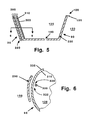
- variable capacitor 220 carried in the interior 120 of the vessel 90 is a variable capacitor 220 having a first electrode 230, a second electrode 240, a first dielectric 250 disposed around said second dielectric 240, and an air space 260 between the first electrode and the first dielectric, with the air space 260 acting as a second dielectric.
- the first and second electrodes 230 and 240 and the first dielectric 250 are in this embodiment disposed in the interior 120 of the vessel 90.
- the first electrode 230 is configured as shown in Fig. 3 so as to allow communication of the fluid 130 with the air space 260, such as by including an aperture 270.
- urine 130 displaces air in the air space 260, thereby altering the capacitance value of the capacitor 220.
- the top of the variable capacitor 220 may be open, in order to allow air present in the air space 260 to escape as it is displaced by incoming fluid. Otherwise, there would be resistance to the incoming flow, and possible turbulence due to bubbling as the air escapes past the fluid 130 at the bottom of the variable capacitor 220.
- a cap 274 is provided atop the variable capacitor 220 to prevent splashed fluid or other materials from entering the air space 260 except through the aperture 270.
- a second aperture 278 is provided in the electrode 230, to allow air to escape the air space 260, which would otherwise be inhibited by the cap 274.
- the capacitor 280 includes a first electrode 290, a second electrode 300, a first dielectric 310, and an air space 320 comprising a second dielectric of the capacitor 280.
- the first dielectric 310 comprises a portion of a wall 330 of the vessel 90 defining the interior 120 and the exterior 150 of the vessel.
- the first electrode 290 is thus disposed adjacent the first dielectric 310 at the exterior 150 of the vessel 90. Urine 130 is therefore prevented from contacting the first electrode 290.
- the electrodes may be made of brass, aluminum, or other conductors.
- the second electrode 300 of the capacitor 280 may simply be a length of wire or a strip of conductor in tape form adhered to the inside of the vessel 90, and may or may not be electrically insulated from the fluid 130.
- the capacitor 280 exhibits relative independence of resistivity of the fluid, and therefore is relatively independent of the type of fluid which acts to vary the capacitance value thereof.
- the vessel 90, the variable capacitor 220, the liner 110, the plug 160, the cord 170, and the tube 180 comprise a single disposable unit.
- the plug 160 is pulled as described above, and then the tube 180 is detached from the receptacle 210, and the tube 180, the cord 170 and the liner 110 are stuffed into the interior 120 of the vessel 90 and the entire system 30 may be disposed of.
- the vessel 90, the lining 110, the second electrode 300, the cord 170 and the tube 180 comprise a single unit which may be disposed of once it is used.
- the electrodes 230 and 240 of the variable capacitor 220 are electrically connected to a capacitance bridge circuit 340, as represented in Figs. 7 and 8. This is done automatically when the user places the vessel 90 into the commode adapter 70, with both the vessel 90 and adaptor 70 being provided with contacts (not shown), so that when the vessel 90 is in place, the proper connections are made.
- a coaxial cable 265 (see Fig. 1) is provided for connecting the capacitor 220 to the module 60.
- any reference to the capacitor 220 may equivalently refer to the capacitor 280 or other variable capacitor configurations which would operate under the same principle.
- All of the components shown in the block diagram of Fig. 7 are preferably carried by the electronics module 60, except for the variable capacitor 220. However, any desired portion of the ciruitry may alternatively be carried by the commode adaptor 70.
- a sine wave is provided by an oscillator 350 to the capacitance bridge 340, which includes, in addition to the variable capacitor 220, fixed capacitors 360, 370 and 380.
- the capacitance values of the capacitors 220, 360, 370 and 380 are all equal, the potential difference between a first point A and a second point B of the circuit is zero.
- a differential operational amplifier 400 is connected to points A and B.
- no potential difference appears at the amplifier 400, which therefore has a zero output.
- a small imbalance to the capacitance bridge 340 is deliberately provided by a trim capacitor 390, so that at least a small positive voltage always appears at the input to the amplifier 400.
- the capacitance of the variable capacitor 220 changes, thereby unbalancing the capacitance bridge 340, causing an increased potential difference between points A and B to appear at the amplifier 400.
- This potential is directly related to the amount of fluid in the vessel 90--and indeed is substantially proportional thereto--and thereby provides a means for measuring the same.
- the output of the amplifier 400 is input to a band pass filter 410, which in the preferred embodiment passes frequencies frequencies in the range of about 500 Hz to 50 kHz, and minimizes any phase shift at the center frequency of approximately 5 kHz.
- This filter 410 operates to filter out line noise, radio frequency interference, and other high frequency noise, which may emanate from sources external to the monitor 20, or may emanate from other components of the monitor itself.
- the signal after filtering in the band pass filter 410, is input to a synchronous demodulator 420, which also has as an input an output from a reference generator 430 which is in turn driven by the sine wave oscillator 350.
- the synchronous demodulator 420 effectively rectifies the signal input thereto, obtaining a DC equivalent of the AC sine wave from the filter 410. As the vessel 90 fills, this signal grows in amplitude.
- the demodulator converts the input signal without significant phase shift, and with fast transitions.
- This demodulator 420 typically requires a square wave input from the reference generator 430.
- the reference generator 430 amplifies the signal from the oscillator 350, forming very steep transitions. Thus, if the signal is centered on zero volts, these steep transitions will occur around the zero crossings of the wave.
- An example of the intended conversion is shown in Fig. 10, with the waveform 590 representing an idealized input to the reference generator 430, and the waveform 600 representing the idealized output therefrom.
- the signal is actually centered on a positive voltage, with the minimum voltage being approximately zero; the demodulator functions equivalently for such a signal as for a signal centered on zero volts.
- the reference generator 430 may use a Schmitt trigger, which actually detects points on the signal obtained from the oscillator 350 which are adjacent, but no quite at, the zero crossings.
- the output of the generator 230 is an approximately 5 kHz wave in phase with the sine wave input thereto.
- the generator 430 could also be used to generate a signal 180° out of phase with its input for use by the synchronous demodulator, if desired, so along as the zero crossings of the signal match up.
- FIG. 9 A schematic diagram of the synchronous demodulator 420 is shown in Fig. 9. As shown in Figs. 7 and 9, the output of the synchronous demodulator 420 is provided as input to a DC amplifier 440.
- the demodulator includes four switches 422, 424, 426 and 428, which are controlled in a conventional manner to open and close in response to the sign of the input to the demodulator.
- the switches 422, 424, 426 and 428 are CMOS devices, although they could alternatively be bipolar devices.
- switch 422 When positive input--i.e. a positive portion or lobe of the AC wave input--is received by the demodulator 420, switch 422 is on (i.e.
- Switch 424 is off (i.e. open) to prevent the signal from reaching the negative side of the amplifier 440.
- Switch 426 is off, again to allow the positive signal to reach the amplifier 440, and switch 428 is on, in order to prevent any other signal, such as unwanted spurious signals, from reaching the negative side of the amplifier 440.
- the demodulator 420 thus eliminates components of the input signal which are out of phase, and external noise not synchronous with the oscillator output is eliminated.
- the result is that the output of the synchronous demodulator 420 is the DC equivalent of the sine wave output from the capacitance bridge 340, wherein the amplitude is proportional to the amplitude of the AC signal, and therefore proportional to the change in capacitance of the variable capacitor 220.
- the amplification by the amplifier 440 is preferably relatively small in order to prevent amplification of parasitic DC parameters, such as DC bias inherent in the devices used.
- the gain of the amplifier 400 may on the other hand be relatively large (and in the preferred embodiment gain of about 30 is used), since DC offset bias is effectively rejected in an AC carrier system.
- the output of the amplifier 440 is then preferably passed through a low pass filter 450, in order to in effect average out the wave, giving a true DC equivalent thereof, and further excluding unwanted noise from the signal.
- the signal is then input to a voltage-to-frequency converter 460 which is a simple, low cost way to feed the signal into the microprocessor 470.
- a voltage-to-frequency converter 460 which is a simple, low cost way to feed the signal into the microprocessor 470.
- an analog-to-digital converter could be used for feeding digital data in a serial or parallel bit stream, with the digital numbers being proportional to the DC signal input.
- the microprocessor 240 is preferably a processor such as the INTEL 80C39.
- a single-line bit port is utilized for feeding in the output from the converter 460.
- the capacitance bridge 340 is given a slightly positive DC offset voltage when the vessel 90 is empty. This is done in order to accommodate any lack of tolerance of the voltage-to-frequency converter 460 to negative voltages. If the potential difference between points A and B in Fig. 8 is exactly zero when the vessel 90 is empty, it is possible that DC bias somewhere in the system could actually make the voltage output from the amplifier 440 become negative, when it should be zero. Thus, a slight offset bias of approximately 170 mV in the preferred embodiment is utilized. Because of the offset bias induced by the trim capacitor 390, the amplifier 440 has a small output even when the vessel 90 is empty.
- the microprocessor 470 samples the output of the voltage-to-frequency converter 460 at regular intervals.
- the output of the converter 460 is essentially a square wave signal with a frequency proportional to the voltage which was input to the converter 460.
- the input to the converter 460 should, as noted above, being non-negative, and therefore the output of the converter 460 is preferably a signal with amplitude between zero and 6 volts, where approximately 3 volts represents a "zero crossing" or frequency transition.
- the microprocessor 470 includes an internal counter governed by an internal clock, with the counter generating bits related to the frequency readings at the input.
- the clock has a count rate which in the preferred embodiment is five counts per second, so that each count is taken one-fifth of a second after the preceding count.
- the frequency of the input may be 5 to 40 kHz, and thus at a counting rate of five times per second, counts of 1,000 to 8,000 may be expected.
- the functions of the microprocessor 470 are controlled by a program stored in an EPROM (erasable programmable read-only memory) 480.
- EPROM erasable programmable read-only memory
- the difference between the current count (which is related to the volume of fluid in the vessel, and therefore may be referred to as a volume reading) and the previous count is calculated.
- This differential count represents the change in volume between the times of the two intervals, and thus represents the flow rate for that period of time.
- the differential count may be referred to as a flow count or flow reading.
- an internal register (not separately shown) is provided in the microprocessor 470 for storing the previous volume reading at any given time, and the current volume reading for a given interval is substituted therefor as the next succeeding count is made.
- intervals 1 through 16 which equals J-(K+1)
- they are stored in the RAM 490 in place of the flow readings appearing therein for those intervals.
- prospective averages for intervals 25 through 443 i.e., J+1 through N-K
- they are likewise stored in memory in place of the flow readings for those intervals.
- the retrospective and prospective averages are first merged, according to the method represented in Fig. 12, and the combined averages are then substituted for the flow readings in memory relating to those intervals.
- the total volume of urine 130 received by the vessel 90 is also calculated, by subtracting the initial (calibration) volume count--which relates to zero volume of fluid 130 in the vessel 90--from the final volume count. Finally, the average flow during voiding is calculated by dividing the total volume by the total voiding time as described above. The total volume calculation will, of course, depend upon the vessel correction factor discussed above, the step for which appears in Fig. 11.
Landscapes
- Health & Medical Sciences (AREA)
- Life Sciences & Earth Sciences (AREA)
- Medical Informatics (AREA)
- Molecular Biology (AREA)
- Urology & Nephrology (AREA)
- Biophysics (AREA)
- Pathology (AREA)
- Engineering & Computer Science (AREA)
- Biomedical Technology (AREA)
- Heart & Thoracic Surgery (AREA)
- Physiology (AREA)
- Physics & Mathematics (AREA)
- Surgery (AREA)
- Animal Behavior & Ethology (AREA)
- General Health & Medical Sciences (AREA)
- Public Health (AREA)
- Veterinary Medicine (AREA)
- Investigating Or Analysing Biological Materials (AREA)
- Measurement Of The Respiration, Hearing Ability, Form, And Blood Characteristics Of Living Organisms (AREA)
- Measurement Of Levels Of Liquids Or Fluent Solid Materials (AREA)
Applications Claiming Priority (2)
| Application Number | Priority Date | Filing Date | Title |
|---|---|---|---|
| US19341588A | 1988-05-12 | 1988-05-12 | |
| US193415 | 1988-05-12 |
Publications (2)
| Publication Number | Publication Date |
|---|---|
| EP0342028A2 true EP0342028A2 (fr) | 1989-11-15 |
| EP0342028A3 EP0342028A3 (fr) | 1991-01-02 |
Family
ID=22713538
Family Applications (1)
| Application Number | Title | Priority Date | Filing Date |
|---|---|---|---|
| EP19890304771 Withdrawn EP0342028A3 (fr) | 1988-05-12 | 1989-05-11 | Moniteur pour un collecteur d'urine |
Country Status (3)
| Country | Link |
|---|---|
| EP (1) | EP0342028A3 (fr) |
| JP (1) | JPH0257240A (fr) |
| AU (1) | AU620613B2 (fr) |
Cited By (21)
| Publication number | Priority date | Publication date | Assignee | Title |
|---|---|---|---|---|
| FR2770993A1 (fr) * | 1997-11-18 | 1999-05-21 | Jean Claude Henry | Dispositif pour la mesure temporelle d'un ecoulement liquide |
| WO1997008993A3 (fr) * | 1995-09-06 | 2002-10-17 | Inventamed Internat Inc | Systeme pour recueillir l'urine |
| WO2006001690A1 (fr) * | 2004-06-25 | 2006-01-05 | Dijkman Holding B.V. | Dispositif de mesure des donnees concernant la production urinaire d'un patient |
| GB2437549A (en) * | 2006-04-24 | 2007-10-31 | Andrew Chung-Ming Chu | Uroflowmeter with automatic receptacle emptying |
| WO2009035599A1 (fr) * | 2007-09-10 | 2009-03-19 | Rocona, Inc. | Capteurs et dispositifs d'analyse d'urine |
| GB2455778A (en) * | 2007-12-21 | 2009-06-24 | Newcastle Upon Tyne Hospitals | Apparatus for measuring parameters of fluid flow |
| US20120123233A1 (en) * | 2009-07-24 | 2012-05-17 | Flometrica Ltd. | Disposable usb cup |
| WO2014145971A3 (fr) * | 2013-03-15 | 2014-12-31 | C.R. Bard, Inc. | Systèmes et procédés de surveillance d'urine |
| CN109518784A (zh) * | 2017-09-18 | 2019-03-26 | 天津果实科技有限公司 | 一种全自动尿液分析智能马桶 |
| CN111655139A (zh) * | 2017-11-29 | 2020-09-11 | 塞伦诺医疗公司 | 监测腹内压和排尿量的装置和方法 |
| US11703365B2 (en) | 2020-07-14 | 2023-07-18 | C. R. Bard, Inc. | Automatic fluid flow system with push-button connection |
| US11911160B2 (en) | 2018-08-10 | 2024-02-27 | C. R. Bard, Inc. | Automated urine output measurement systems and methods thereof |
| US11931151B2 (en) | 2020-12-22 | 2024-03-19 | C. R. Bard, Inc. | Automated urinary output measuring system |
| US11938277B2 (en) | 2018-05-22 | 2024-03-26 | C. R. Bard, Inc. | Catheterization system and methods for use thereof |
| US12055249B2 (en) | 2020-07-21 | 2024-08-06 | C. R. Bard, Inc. | Automatic fluid flow system with retractable connection |
| US12083261B2 (en) | 2020-06-05 | 2024-09-10 | C. R. Bard, Inc. | Automated fluid output monitoring |
| US12181471B2 (en) | 2020-03-10 | 2024-12-31 | SciKare, Inc. | Devices and methods of urinalysis for real-time monitoring of organ health |
| US12246146B2 (en) | 2020-12-23 | 2025-03-11 | C. R. Bard, Inc. | Automated weight based fluid output monitoring system |
| US12364423B2 (en) | 2020-12-21 | 2025-07-22 | C. R. Bard, Inc. | Automated urinary output-measuring systems and methods |
| US12408853B2 (en) | 2020-12-17 | 2025-09-09 | C. R. Bard, Inc. | Smart bag to measure urine output via catheter |
| US12446813B2 (en) | 2021-08-23 | 2025-10-21 | C. R. Bard, Inc. | Automated urine output system for attachment to hospital bed |
Families Citing this family (1)
| Publication number | Priority date | Publication date | Assignee | Title |
|---|---|---|---|---|
| JP5069831B2 (ja) * | 2001-08-08 | 2012-11-07 | 株式会社サカエ | 界面検知装置及びこれを用いた自動分析装置 |
Family Cites Families (4)
| Publication number | Priority date | Publication date | Assignee | Title |
|---|---|---|---|---|
| DE2500094C3 (de) * | 1975-01-03 | 1979-03-22 | Richard Wolf Gmbh, 7134 Knittlingen | Gerät zur elektrischen Messung von Urinströmmengen |
| US4389900A (en) * | 1979-06-14 | 1983-06-28 | The United States Of America As Represented By The Secretary Of The Interior | Capacitance probe sensor device |
| US4554687A (en) * | 1982-12-17 | 1985-11-26 | Medical Engineering Corporation | Toilet mounted urine flow meter |
| NZ210240A (en) * | 1984-11-19 | 1989-04-26 | Allflex Int | Milk flow measure and teat cup removal |
-
1989
- 1989-05-10 AU AU34713/89A patent/AU620613B2/en not_active Ceased
- 1989-05-11 EP EP19890304771 patent/EP0342028A3/fr not_active Withdrawn
- 1989-05-12 JP JP1120198A patent/JPH0257240A/ja active Pending
Cited By (27)
| Publication number | Priority date | Publication date | Assignee | Title |
|---|---|---|---|---|
| WO1997008993A3 (fr) * | 1995-09-06 | 2002-10-17 | Inventamed Internat Inc | Systeme pour recueillir l'urine |
| FR2770993A1 (fr) * | 1997-11-18 | 1999-05-21 | Jean Claude Henry | Dispositif pour la mesure temporelle d'un ecoulement liquide |
| WO1999025247A1 (fr) * | 1997-11-18 | 1999-05-27 | Henry Jean Claude | Dispositif pour la mesure temporelle du volume d'un ecoulement liquide |
| WO2006001690A1 (fr) * | 2004-06-25 | 2006-01-05 | Dijkman Holding B.V. | Dispositif de mesure des donnees concernant la production urinaire d'un patient |
| GB2437549A (en) * | 2006-04-24 | 2007-10-31 | Andrew Chung-Ming Chu | Uroflowmeter with automatic receptacle emptying |
| WO2009035599A1 (fr) * | 2007-09-10 | 2009-03-19 | Rocona, Inc. | Capteurs et dispositifs d'analyse d'urine |
| GB2455778A (en) * | 2007-12-21 | 2009-06-24 | Newcastle Upon Tyne Hospitals | Apparatus for measuring parameters of fluid flow |
| GB2455778B (en) * | 2007-12-21 | 2009-11-04 | Newcastle Upon Tyne Hospitals | Apparatus for measuring parameters of fluid flow |
| US20120123233A1 (en) * | 2009-07-24 | 2012-05-17 | Flometrica Ltd. | Disposable usb cup |
| US8986613B2 (en) * | 2009-07-24 | 2015-03-24 | Flometrica Ltd. | Disposable USB cup |
| WO2014145971A3 (fr) * | 2013-03-15 | 2014-12-31 | C.R. Bard, Inc. | Systèmes et procédés de surveillance d'urine |
| CN105025809A (zh) * | 2013-03-15 | 2015-11-04 | C·R·巴德股份有限公司 | 尿液监测系统和方法 |
| CN109518784A (zh) * | 2017-09-18 | 2019-03-26 | 天津果实科技有限公司 | 一种全自动尿液分析智能马桶 |
| CN109518784B (zh) * | 2017-09-18 | 2023-09-08 | 天津果实科技有限公司 | 一种全自动尿液分析智能马桶 |
| US20210000361A1 (en) * | 2017-11-29 | 2021-01-07 | Serenno Medical | Apparatus and method of monitoring intra-abdominal pressure and urine output |
| CN111655139A (zh) * | 2017-11-29 | 2020-09-11 | 塞伦诺医疗公司 | 监测腹内压和排尿量的装置和方法 |
| US11938277B2 (en) | 2018-05-22 | 2024-03-26 | C. R. Bard, Inc. | Catheterization system and methods for use thereof |
| US11911160B2 (en) | 2018-08-10 | 2024-02-27 | C. R. Bard, Inc. | Automated urine output measurement systems and methods thereof |
| US12181471B2 (en) | 2020-03-10 | 2024-12-31 | SciKare, Inc. | Devices and methods of urinalysis for real-time monitoring of organ health |
| US12083261B2 (en) | 2020-06-05 | 2024-09-10 | C. R. Bard, Inc. | Automated fluid output monitoring |
| US11703365B2 (en) | 2020-07-14 | 2023-07-18 | C. R. Bard, Inc. | Automatic fluid flow system with push-button connection |
| US12055249B2 (en) | 2020-07-21 | 2024-08-06 | C. R. Bard, Inc. | Automatic fluid flow system with retractable connection |
| US12408853B2 (en) | 2020-12-17 | 2025-09-09 | C. R. Bard, Inc. | Smart bag to measure urine output via catheter |
| US12364423B2 (en) | 2020-12-21 | 2025-07-22 | C. R. Bard, Inc. | Automated urinary output-measuring systems and methods |
| US11931151B2 (en) | 2020-12-22 | 2024-03-19 | C. R. Bard, Inc. | Automated urinary output measuring system |
| US12246146B2 (en) | 2020-12-23 | 2025-03-11 | C. R. Bard, Inc. | Automated weight based fluid output monitoring system |
| US12446813B2 (en) | 2021-08-23 | 2025-10-21 | C. R. Bard, Inc. | Automated urine output system for attachment to hospital bed |
Also Published As
| Publication number | Publication date |
|---|---|
| JPH0257240A (ja) | 1990-02-27 |
| AU620613B2 (en) | 1992-02-20 |
| EP0342028A3 (fr) | 1991-01-02 |
| AU3471389A (en) | 1989-11-16 |
Similar Documents
| Publication | Publication Date | Title |
|---|---|---|
| US5062304A (en) | Urine collection monitor with temperature sensing | |
| EP0342028A2 (fr) | Moniteur pour un collecteur d'urine | |
| EP2445408B1 (fr) | Dispositif de mesure d'urine | |
| EP2326294B1 (fr) | Dispositif d analyse d'urine | |
| US4554687A (en) | Toilet mounted urine flow meter | |
| US4448207A (en) | Medical fluid measuring system | |
| EP2456353B1 (fr) | Tasse usb jetable | |
| US5882931A (en) | Method and apparatus for performing urinalysis in real time | |
| US4085616A (en) | Liquid measuring and collection device | |
| EP1166806A2 (fr) | Système de mesure du volume d'un réservoir de sang | |
| WO2004036343A3 (fr) | Systeme de surveillance de l'etat de sante d'une personne et procede d'utilisation dudit systeme | |
| US4131016A (en) | Peak flow measuring device | |
| US4200112A (en) | Device for measuring the force of a urine discharge | |
| KR20220085983A (ko) | 기준 공기량 보정이 가능한 질 내 용적 및 압력 진단 장치 | |
| CN103959020B (zh) | 尿排量处理装置和方法 | |
| JPH0413928A (ja) | 液量計 | |
| CN104939846A (zh) | 一种动态尿液计量仪 | |
| CN219516306U (zh) | 一种改良的精密计尿器 | |
| CN113144339A (zh) | 一种输液监测装置及方法 | |
| CN214761960U (zh) | 一种新型小便壶 | |
| CN209653065U (zh) | 一种适用于临床上方便准确的检测尿量的马桶 | |
| CN211535850U (zh) | 一种引流袋高度调节提醒装置 | |
| CN220608325U (zh) | 一种便携式尿流率测定装置 | |
| CN220141697U (zh) | 一种尿液收集计量装置 | |
| CN223727197U (zh) | 液体流量检测传感器 |
Legal Events
| Date | Code | Title | Description |
|---|---|---|---|
| PUAI | Public reference made under article 153(3) epc to a published international application that has entered the european phase |
Free format text: ORIGINAL CODE: 0009012 |
|
| AK | Designated contracting states |
Kind code of ref document: A2 Designated state(s): AT BE CH DE ES FR GB GR IT LI LU NL SE |
|
| RAP1 | Party data changed (applicant data changed or rights of an application transferred) |
Owner name: DACOMED CORPORATION |
|
| PUAL | Search report despatched |
Free format text: ORIGINAL CODE: 0009013 |
|
| AK | Designated contracting states |
Kind code of ref document: A3 Designated state(s): AT BE CH DE ES FR GB GR IT LI LU NL SE |
|
| 17P | Request for examination filed |
Effective date: 19910412 |
|
| STAA | Information on the status of an ep patent application or granted ep patent |
Free format text: STATUS: THE APPLICATION HAS BEEN WITHDRAWN |
|
| 17Q | First examination report despatched |
Effective date: 19930607 |
|
| 18W | Application withdrawn |
Withdrawal date: 19930712 |