EP0341916A2 - Solvent-based alkyd paints - Google Patents
Solvent-based alkyd paints Download PDFInfo
- Publication number
- EP0341916A2 EP0341916A2 EP89304542A EP89304542A EP0341916A2 EP 0341916 A2 EP0341916 A2 EP 0341916A2 EP 89304542 A EP89304542 A EP 89304542A EP 89304542 A EP89304542 A EP 89304542A EP 0341916 A2 EP0341916 A2 EP 0341916A2
- Authority
- EP
- European Patent Office
- Prior art keywords
- paint
- paints
- alkyd
- clay
- resin
- Prior art date
- Legal status (The legal status is an assumption and is not a legal conclusion. Google has not performed a legal analysis and makes no representation as to the accuracy of the status listed.)
- Granted
Links
Images
Classifications
-
- C—CHEMISTRY; METALLURGY
- C09—DYES; PAINTS; POLISHES; NATURAL RESINS; ADHESIVES; COMPOSITIONS NOT OTHERWISE PROVIDED FOR; APPLICATIONS OF MATERIALS NOT OTHERWISE PROVIDED FOR
- C09D—COATING COMPOSITIONS, e.g. PAINTS, VARNISHES OR LACQUERS; FILLING PASTES; CHEMICAL PAINT OR INK REMOVERS; INKS; CORRECTING FLUIDS; WOODSTAINS; PASTES OR SOLIDS FOR COLOURING OR PRINTING; USE OF MATERIALS THEREFOR
- C09D167/00—Coating compositions based on polyesters obtained by reactions forming a carboxylic ester link in the main chain; Coating compositions based on derivatives of such polymers
- C09D167/08—Polyesters modified with higher fatty oils or their acids, or with natural resins or resin acids
Definitions
- the invention relates to solvent-based alkyd paints having a non-drip character.
- Non-drip paints have many advantages which appeal particularly to the D.I.Y. user. They allow heavy brush loading without dripping. Due to the very high level of thixotropy, the high shear (brushing) viscosity which determines the degree of brush drag can be lower than with liquid paints. Thick coatings can be applied to vertical surfaces with little tendency to run or sag due to the recovery of thixotropy preventing flow due to gravity. In a well formulated paint the flow-out of brush-marks occurs immediately after application and before thixotropy sets-in to restrict flow. Because of easy application and low brush drag and the facility to apply uniform heavy coatings, it is normally possible to achieve one-coat cover in all redecoration work.
- Paints of the above kind are well known and are characterised by having a resilient (jelly-like) gel structure.
- the usual procedure for their formation involves the use of chemically (polyamide for example) modified alkyds.
- These alkyds have the disadvantage that they are generally delivered in a solid state which involves severe handling problems for the paint manu- facturer.
- the widely used polyamide modified thixotropic alkyds are usually heated before use to liquify them. Such heating is avoided, if possible, as it can cause darkening and deterioration and often creates increased fire risk and health problems due to increased emission of solvent.
- Resilient gel non-drip paints also suffer from the disadvantage that, if stirred (such as required if separation of liquid has taken place due to syneresis), unattractive lumpiness occurs, as it does during brush loading. Lumpiness can also occur during application of the paint which can make it difficult to achieve a uniform film of paint and a good edge when painting narrow sections such as window frames. In this position many painters, whilst appreciating the non-drip properties, will nevertheless turn to liquid paints, some of which have a low level of thixotropy in the form of a creaminess introduced by various thickening procedures (as referred to later) and hence sacrifice the advantageous features of a non-drip product.
- the invention includes two known paint thickening techniques which have been used to give a degree of thixotropy to conventional liquid (i.e. paints which will drip) solvent based alkyd paints but in a manner such that an unexpected degree of thixotropy is obtained (a Gel Strength of at least 60 gm. cm., seven days after manu- facture) whilst, at the same time, having a non-drip character based on a creamy (non-resilient) structure which flows out well on application and with a low risk of sag even in heavy coatings.
- the first thickening technique comprises interacting resins: see, “Thixotropic Alkyd Resin Paints Through Resin Interaction” by W.H. Ellis et al - Journal of Paint Technology Vol. 40, No. 521 dated June 1968. This gives slight thixotropy (see “Introduction” of that reference).
- the other thickening technique comprises the use of a clay-based rheology modifier such as a smectite clay for example: see, "Handbook of Coating Additives” edited by Leonard J. Calbo at page 1.
- Fine particles can aggregate to form structure that modifies the viscosity of liquids in which they are dis- persed.
- Some very fine clays are particularly effective and a number of products in which polar groups are used to enhance their effect are offered commercially as rheology modifiers for use in paints to prevent pigment settling and to impart slight thixotropy.
- These are typically based on the smectite clays referred to above (bentonites, e.g. montmorillonite; hectorites, etc.) and a typical polar organic modification is a quarternary amine. They are commonly used in solvent based alkyd gloss paints at levels up to about 0.5%. Higher levels e.g. greater than about 2.5% can be used but the thickening effect is not great and cost becomes prohibitive whilst gloss and flow-out of brushmarks becomes unacceptable and incorporation becomes increasingly difficult at high levels.
- additives are known to thicken solvent based paints, for example, fine particle silicas, but these are efficient matting agents and reduce gloss.
- Other clay products e.g. attapulgite clays impart thixotropy when used in the region of 5- 15% but again are not suitable for gloss paints.
- Extender pigments like china clays used in much higher quantity in low sheen and matt paints can induce thixotropy but, in these quantities, markedly alter the characteristics of the paint.
- Hydrogenated castor oils have been used to thicken paints but can fail by causing unexpected "seeding" as the paint ages.
- Metal soaps e.g. aluminium stearate has been used to achieve slight thixotropy in alkyd paints.
- the Ferranti-Shirley Cone-Plate Viscometer is capable of applying varying rates of shear and determines the viscosity continuously as the shear rate changes.
- the shear stress is plotted against the changing R.P.M. of the cone.
- the Stormer Viscometer is used according to A.S.T.M. D562-8l Standard Test Method and measures viscosity at a low shear rate by determining the load necessary to cause a rotational frequency of 200 R.P.M. of a standard paddle immersed in the paint at 21 o C. Units are given in Kreb Units (K.U.) which is a log function of the measured load.
- the Gel Strength is determined on the Sheen/I.C.I. Gel Strength Tester using a paddle 4 cm. x 2 cm. at 21 o C, which measures the point at which the gel breaks as the torque on the paddle, immersed in the paint, is increased. Figures are given in gm. cm. and are measured seven days after manufacture of the paint.
- the R.E.L./I.C.I. Cone and Plate Viscometer measures viscosity at 10,000 sec ⁇ 1 at 25 o C. Units are given in Pascals (Pa) (converted from Poise). This viscosity is very closely related to brush drag, i.e. ease of applica- tion. If paints are manufactured to a constant R.E.L./I.C.I. Cone and Plate viscosity, the Stormer viscosity can be used to compare the levels of thixotropy they exhibit.
- the present invention is stated as : a solvent-based non-drip alkyd paint characterised in having a creamy non-resilient structure, of at least 60 gm.cms. seven days after manufacture, induced by the use of a base alkyd resin and an auxiliary alkyd resin which can interact to give a thickening effect together with a clay-based rheology modifier.
- the base resin and the auxiliary resin can each be a single resin or a group of two or more resins.
- the invention is of particular significance for gloss paints, i.e. paints having on the Byk-Mallinckrodt Glossmeter, Single Head (A.S.T.M. D523) a gloss measurement of at least 75% at 60 o .
- gloss paints i.e. paints having on the Byk-Mallinckrodt Glossmeter, Single Head (A.S.T.M. D523) a gloss measurement of at least 75% at 60 o .
- Gloss paints which can be applied as one thick non-sag coating are of particular value to the non-professional (D.I.Y.) user.
- the invention can supply such a paint.
- a range of alkyd based gloss paints was prepared to study the effect on Stormer Viscosity and Gel Strength (both measured seven days after manufacture) when the level of clay-based rheology modifier (Bentone SD3) and the ratio of Base Resin to Auxiliary are varied.
- Base and auxiliary resin mixtures vary in their thickening effect. Many clay-based rheology modi- bombs are available and they vary in effectiveness such that one grade might be as much as three times as effective in its thickening effect as another, and they are all very dependent on how well they are dispersed.
- Example 1 Gloss Paint Titanium dioxide.... 900 BENTONE (R.T.M.) SD 1.... 60 Alkyd 'A' (see below).... 1307 Alkyd 'B' (see below).... 136 Calcium drier (10% Calcium).... 23 Cobalt drier (8% Cobalt).... 8.6 White (Mineral) Spirit.... 325 Antiskin.... 5.6 % Clay-Based Rheology Modifier.... 2.2 Viscosity....
- gloss paints described in the Examples 1 and 2 are different from thixotropic gloss paints made from the widely used polyamide modified alkyds and, in fact, from other known paints.
- the paste-like or cream-like consistency allows heavy loading of the brush with lump-free paint. Since the viscosity of paint according to the invention breaks down smoothly it is easier to distribute the paint uniformly and painting narrow features, e.g. window frames, is easier since there is no tendency to form lumps during application.
- the above Examples give much better gap-filling properties than other gloss paints, for example, filling a gap (2.0 mm wide) between a beading and a flat surface to which it is attached. In contrast, conventional paints are unlikely to fill gaps even of 1.0 mm width. Further, the above Examples give a non-drip paint having non-volatiles which are high (69 - 80%) when compared with known thixotropic alkyd based non-drip paints (e.g. 55% - 70%).
- Fig. 1 of the accompanying drawing which shows typical graphs for both paints obtained from a Ferranti-Shirley Cone-Plate Viscometer relating revolu- tions per second (R.P.S.) of the cone to the viscosity of the paint.
- Graph A (full-line) relates to the known paint
- Graph B (dash-line) relates to a paint according to the invention. It is seen that Graph A possesses a distinct "heel” or “spike” C which represents the Yield Value of the paint as the jelly-like structure breaks down.
- the spike C is either not present or is so small as not to be readily observed.
Landscapes
- Chemical & Material Sciences (AREA)
- Wood Science & Technology (AREA)
- Chemical Kinetics & Catalysis (AREA)
- Life Sciences & Earth Sciences (AREA)
- Engineering & Computer Science (AREA)
- Materials Engineering (AREA)
- Oil, Petroleum & Natural Gas (AREA)
- Organic Chemistry (AREA)
- Paints Or Removers (AREA)
- Compounds Of Unknown Constitution (AREA)
- Manufacture Of Porous Articles, And Recovery And Treatment Of Waste Products (AREA)
- Chemical And Physical Treatments For Wood And The Like (AREA)
- Application Of Or Painting With Fluid Materials (AREA)
- Silicates, Zeolites, And Molecular Sieves (AREA)
- Compositions Of Macromolecular Compounds (AREA)
Abstract
Description
- The invention relates to solvent-based alkyd paints having a non-drip character.
- Non-drip paints have many advantages which appeal particularly to the D.I.Y. user. They allow heavy brush loading without dripping. Due to the very high level of thixotropy, the high shear (brushing) viscosity which determines the degree of brush drag can be lower than with liquid paints. Thick coatings can be applied to vertical surfaces with little tendency to run or sag due to the recovery of thixotropy preventing flow due to gravity. In a well formulated paint the flow-out of brush-marks occurs immediately after application and before thixotropy sets-in to restrict flow. Because of easy application and low brush drag and the facility to apply uniform heavy coatings, it is normally possible to achieve one-coat cover in all redecoration work.
- Paints of the above kind are well known and are characterised by having a resilient (jelly-like) gel structure. The usual procedure for their formation involves the use of chemically (polyamide for example) modified alkyds. These alkyds have the disadvantage that they are generally delivered in a solid state which involves severe handling problems for the paint manu- facturer. The widely used polyamide modified thixotropic alkyds are usually heated before use to liquify them. Such heating is avoided, if possible, as it can cause darkening and deterioration and often creates increased fire risk and health problems due to increased emission of solvent.
- Resilient gel non-drip paints also suffer from the disadvantage that, if stirred (such as required if separation of liquid has taken place due to syneresis), unattractive lumpiness occurs, as it does during brush loading. Lumpiness can also occur during application of the paint which can make it difficult to achieve a uniform film of paint and a good edge when painting narrow sections such as window frames. In this position many painters, whilst appreciating the non-drip properties, will nevertheless turn to liquid paints, some of which have a low level of thixotropy in the form of a creaminess introduced by various thickening procedures (as referred to later) and hence sacrifice the advantageous features of a non-drip product.
- It is an object of the present invention to provide a solvent-based non-drip alkyd paint having an improved structure and usefulness.
- The invention includes two known paint thickening techniques which have been used to give a degree of thixotropy to conventional liquid (i.e. paints which will drip) solvent based alkyd paints but in a manner such that an unexpected degree of thixotropy is obtained (a Gel Strength of at least 60 gm. cm., seven days after manu- facture) whilst, at the same time, having a non-drip character based on a creamy (non-resilient) structure which flows out well on application and with a low risk of sag even in heavy coatings.
- The first thickening technique comprises interacting resins: see, "Thixotropic Alkyd Resin Paints Through Resin Interaction" by W.H. Ellis et al - Journal of Paint Technology Vol. 40, No. 521 dated June 1968. This gives slight thixotropy (see "Introduction" of that reference).
- The other thickening technique comprises the use of a clay-based rheology modifier such as a smectite clay for example: see, "Handbook of Coating Additives" edited by Leonard J. Calbo at page 1.
- It is of interest to make general mention of known ways of modifying rheology in solvent-based alkyd paints:
- Fine particles can aggregate to form structure that modifies the viscosity of liquids in which they are dis- persed. Some very fine clays are particularly effective and a number of products in which polar groups are used to enhance their effect are offered commercially as rheology modifiers for use in paints to prevent pigment settling and to impart slight thixotropy. These are typically based on the smectite clays referred to above (bentonites, e.g. montmorillonite; hectorites, etc.) and a typical polar organic modification is a quarternary amine. They are commonly used in solvent based alkyd gloss paints at levels up to about 0.5%. Higher levels e.g. greater than about 2.5% can be used but the thickening effect is not great and cost becomes prohibitive whilst gloss and flow-out of brushmarks becomes unacceptable and incorporation becomes increasingly difficult at high levels.
- Other additives are known to thicken solvent based paints, for example, fine particle silicas, but these are efficient matting agents and reduce gloss. Other clay products, e.g. attapulgite clays impart thixotropy when used in the region of 5- 15% but again are not suitable for gloss paints.
- Extender pigments like china clays, used in much higher quantity in low sheen and matt paints can induce thixotropy but, in these quantities, markedly alter the characteristics of the paint.
- Hydrogenated castor oils have been used to thicken paints but can fail by causing unexpected "seeding" as the paint ages. Metal soaps, e.g. aluminium stearate has been used to achieve slight thixotropy in alkyd paints.
- In fact, it has been possible to impart slight thixotropy into solvent based alkyd paints by several means but the only systems that have been available for the high levels of thixotropy required for non-drip paints without very seriously affecting the paint performance have been by the chemically modified alkyd resin route already referred to. The most widely used chemical modification is with polyamide resins prepared from dimeric fatty acids. Such modifications invariably exhibit resilient gel structure.
- Various instruments are used to study the rheology of paints.
- The Ferranti-Shirley Cone-Plate Viscometer is capable of applying varying rates of shear and determines the viscosity continuously as the shear rate changes. The shear stress is plotted against the changing R.P.M. of the cone.
- The Stormer Viscometer is used according to A.S.T.M. D562-8l Standard Test Method and measures viscosity at a low shear rate by determining the load necessary to cause a rotational frequency of 200 R.P.M. of a standard paddle immersed in the paint at 21oC. Units are given in Kreb Units (K.U.) which is a log function of the measured load.
- The Gel Strength is determined on the Sheen/I.C.I. Gel Strength Tester using a paddle 4 cm. x 2 cm. at 21oC, which measures the point at which the gel breaks as the torque on the paddle, immersed in the paint, is increased. Figures are given in gm. cm. and are measured seven days after manufacture of the paint.
- The R.E.L./I.C.I. Cone and Plate Viscometer measures viscosity at 10,000 sec⁻¹ at 25oC. Units are given in Pascals (Pa) (converted from Poise). This viscosity is very closely related to brush drag, i.e. ease of applica- tion. If paints are manufactured to a constant R.E.L./I.C.I. Cone and Plate viscosity, the Stormer viscosity can be used to compare the levels of thixotropy they exhibit.
- The present invention is stated as : a solvent-based non-drip alkyd paint characterised in having a creamy non-resilient structure, of at least 60 gm.cms. seven days after manufacture, induced by the use of a base alkyd resin and an auxiliary alkyd resin which can interact to give a thickening effect together with a clay-based rheology modifier.
- The base resin and the auxiliary resin can each be a single resin or a group of two or more resins.
- The invention is of particular significance for gloss paints, i.e. paints having on the Byk-Mallinckrodt Glossmeter, Single Head (A.S.T.M. D523) a gloss measurement of at least 75% at 60o. As already referred to above in the general mention of known ways of modifying rheology, one would not expect to include more than 0.5% of a clay-based rheology modifier in a gloss paint. Gloss paints which can be applied as one thick non-sag coating are of particular value to the non-professional (D.I.Y.) user. The invention can supply such a paint.
- Whilst the Gel Strength of 60 gm. cms., seven days after manufacture, is referred to above (in order to give a straightforward test taken with Table 1, described later) typical rheology figures in the range of 100 to 240 gm. cms. can be expected by the time the paint comes to be used by a painter or decorator.
- A range of alkyd based gloss paints was prepared to study the effect on Stormer Viscosity and Gel Strength (both measured seven days after manufacture) when the level of clay-based rheology modifier (Bentone SD3) and the ratio of Base Resin to Auxiliary are varied.
- All paints were adjusted to 0.35 Pa viscosity (with White (Mineral) Spirit) using the R.E.L./I.C.I. Cone and Plate Viscometer (Shear rate 10,000 sec⁻¹) at 25oC. Bentone SD3 is a typical commercially available clay-based rheology modifier.
- Table 1 below shows the results.

- Several conclusions may be drawn from Table I.
- 1. Without Bentone SD3 (first horizontal row) an increase in thixotropy is shown with some alkyd ratios. No Gel Strength obtained.
- 2. With Base Alkyd only (first vertical column) an increase in thixotropy is shown with increasing Bentone SD3 level. No significant Gel Strength obtained.
- 3. With higher levels of Bentone SD3 (1% and greater) together with alkyd mixtures, already showing a thickening effect, higher increases in thixotropy and unexpectedly high Gel Strengths are obtained (shaded area).
- 4. With much higher levels of Bentone SD3, e.g. 3%, it was difficult to incorporate and produced unsatis- factory paints having reduced gloss and very bad brush marking.
- NB. Base and auxiliary resin mixtures vary in their thickening effect. Many clay-based rheology modi- fiers are available and they vary in effectiveness such that one grade might be as much as three times as effective in its thickening effect as another, and they are all very dependent on how well they are dispersed.
- Examples of white paints according to the present invention will now be given. (All parts by weight and all viscosi- ties checked using the R.E.L./I.C.I. Cone and Plate Viscometer at 25oC with a shear rate of 10,000 sec⁻¹.)
Example 1 - Gloss Paint Titanium dioxide.... 900 BENTONE (R.T.M.) SD 1.... 60 Alkyd 'A' (see below).... 1307 Alkyd 'B' (see below).... 136 Calcium drier (10% Calcium).... 23 Cobalt drier (8% Cobalt).... 8.6 White (Mineral) Spirit.... 325 Antiskin.... 5.6 % Clay-Based Rheology Modifier.... 2.2 Viscosity.... 0.35 Pa % non-volatile.... 74 Gel Strength.... 81 gm. cm. Ratio, Resin A:Resin B.... 90:10 Example 2 - Gloss Paint Titanium dioxide.... 1400 BENTONE (R.T.M.) SD 3.... 60 Alkyd 'C' (see below).... 2613 Alkyd 'B' (see below).... 236 Drier Solution.... 89 White (Mineral) Spirit.... 525 Antiskin.... 6 % Clay-Based Rheology Modifier.... 1.2 Viscosity.... 0.30 Pa % non-volatile.... 69 Gel Strength.... 95 gm. cm. Ratio, Resin C:Resin B.... 90:10 Example 3 - Undercoat Titanium dioxide.... 663 Carbonate Extender.... 1000 BENTONE (R.T.M.) SD 3.... 60 Alkyd 'D' (see below) 1237 Alkyd 'B' (see below).... 112 Calcium drier (10% Calcium).... 17.8 Cobalt drier (8% Cobalt).... 13.2 Antiskin.... 4.4 White (Mineral) Spirit.... 458 Gel Strength.... 126 gm. cm. Ratio, Resin D:Resin B.... 90:10 % Clay-Based Rheology Modifier.... 1.7 Viscosity.... 0.2 Pa % non-volatile.... 74 Example 4 - Undercoat Titanium dioxide.... 730 Carbonate extender.... 911 BENTONE (R.T.M.) SD 1.... 90 Alkyd 'E' (see below).... 881 Alkyd 'B' (see below).... 66 Calcium drier (10% calcium).... 6.6 Cobalt drier (8% cobalt).... 10.0 Antiskin.... 3.9 White (Mineral) Spirit.... 448 % Clay-Based Rheology Modifier.... 2.8 Viscosity.... 0.2 Pa % non-volatile.... 71 Gel Strength.... 119 gm. cm. Ratio, Resin E:Resin B.... 90:10 Example 5 - "Eggshell" Titanium dioxide.... 750 Carbonate extender.... 750 BENTONE (R.T.M.) SD 1.... 50 Alkyd 'A' (see below).... 1210 Alkyd 'B' (see below).... 85 Calcium drier (10% calcium).... 18.6 Cobalt drier (8% cobalt).... 7.1 Antiskin.... 5.0 White (Mineral) Spirit.... 293 % Clay-Based Rheology Modifier.... 1.6 Viscosity.... 0.25 Pa % non-volatile.... 80 Gel Strength.... 78 gm. cm. Ratio, Resin A:Resin B.... 93.7 -
- A. Long oil, high solids, fatty acid alkyd, 75% non-volatile.
- B. Medium oil, high solids, polyethylene glycol modified alkyd, 80% non-volatile.
- C. Long oil, fatty acid alkyd, 65% non-volatile.
- D. Long oil, soya oil alkyd, 65% non-volatile.
- E. Medium oil length soya alkyd, 50% non-volatile.
- Typically properties of the gloss paints described in the Examples 1 and 2 are different from thixotropic gloss paints made from the widely used polyamide modified alkyds and, in fact, from other known paints.
- They have the initial appearance in their container of a conventional commercial non-drip alkyd paint. Mild agitation (such as stirring) produces a thick attractive creamy consistency whilst non-drip properties are maintained. The paint may be used equally well as the thick gelled undisturbed product or after agitation.
- This difference in the way the viscosity of the new product changes under shear imparts improved properties. The paste-like or cream-like consistency allows heavy loading of the brush with lump-free paint. Since the viscosity of paint according to the invention breaks down smoothly it is easier to distribute the paint uniformly and painting narrow features, e.g. window frames, is easier since there is no tendency to form lumps during application.
- The low Cone and Plate viscosity of these paints, 0.2 - 0.35 Pa, (cf. typical viscosity of conventional liquid gloss paint is 0.45 Pa) ensures easy brush appli- cation.
- Simple variation in formulation allows excellent control between flow-out of brushmarks, gloss and sag resistance on vertical surfaces whereas with known thixotropic paints this presents a difficult compromise.
- The above Examples give much better gap-filling properties than other gloss paints, for example, filling a gap (2.0 mm wide) between a beading and a flat surface to which it is attached. In contrast, conventional paints are unlikely to fill gaps even of 1.0 mm width. Further, the above Examples give a non-drip paint having non-volatiles which are high (69 - 80%) when compared with known thixotropic alkyd based non-drip paints (e.g. 55% - 70%).
- Similar comments to the above are applicable to the appropriate properties of the Examples of undercoat and eggshell paints given.
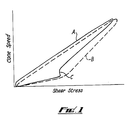
- The clear differences between the known jelly-like resilient non-drip paints and the creamy non-resilient non-drip paints of the present invention are observable by considering Fig. 1 of the accompanying drawing which shows typical graphs for both paints obtained from a Ferranti-Shirley Cone-Plate Viscometer relating revolu- tions per second (R.P.S.) of the cone to the viscosity of the paint.
- Graph A (full-line) relates to the known paint, and Graph B (dash-line) relates to a paint according to the invention. It is seen that Graph A possesses a distinct "heel" or "spike" C which represents the Yield Value of the paint as the jelly-like structure breaks down.
- In Graph B the spike C is either not present or is so small as not to be readily observed.
Claims (5)
Applications Claiming Priority (2)
| Application Number | Priority Date | Filing Date | Title |
|---|---|---|---|
| GB888811110A GB8811110D0 (en) | 1988-05-11 | 1988-05-11 | Paint formulations |
| GB8811110 | 1988-05-11 |
Publications (3)
| Publication Number | Publication Date |
|---|---|
| EP0341916A2 true EP0341916A2 (en) | 1989-11-15 |
| EP0341916A3 EP0341916A3 (en) | 1991-08-07 |
| EP0341916B1 EP0341916B1 (en) | 1994-11-09 |
Family
ID=10636701
Family Applications (1)
| Application Number | Title | Priority Date | Filing Date |
|---|---|---|---|
| EP89304542A Expired - Lifetime EP0341916B1 (en) | 1988-05-11 | 1989-05-05 | Solvent-based alkyd paints |
Country Status (13)
| Country | Link |
|---|---|
| EP (1) | EP0341916B1 (en) |
| JP (1) | JP2749364B2 (en) |
| CN (1) | CN1032313C (en) |
| AT (1) | ATE113980T1 (en) |
| AU (1) | AU614365B2 (en) |
| CA (1) | CA1339957C (en) |
| DE (1) | DE68919271T2 (en) |
| ES (1) | ES2063126T3 (en) |
| GB (2) | GB8811110D0 (en) |
| GR (1) | GR3014984T3 (en) |
| IE (1) | IE62324B1 (en) |
| PT (1) | PT90528B (en) |
| ZA (1) | ZA893499B (en) |
Cited By (4)
| Publication number | Priority date | Publication date | Assignee | Title |
|---|---|---|---|---|
| WO2005120864A2 (en) | 2004-06-08 | 2005-12-22 | Imperial Chemical Industries Plc | Coating combination including a buoyant fluid coating contacting member |
| CN1324065C (en) * | 2004-05-21 | 2007-07-04 | 中国印钞造币总公司 | Self-emulsified alcoholic acid resin and its preparing method |
| CN102140301A (en) * | 2010-11-19 | 2011-08-03 | 吴江龙泾红贝家装有限公司 | Normal temperature self-dried coating for woodenware |
| CN1964856B (en) * | 2004-06-08 | 2012-02-29 | 帝国化学工业公司 | a coating component |
Families Citing this family (2)
| Publication number | Priority date | Publication date | Assignee | Title |
|---|---|---|---|---|
| CN100375766C (en) * | 2003-09-29 | 2008-03-19 | 上海富臣化工有限公司 | Colored nitrocellulose (NC) antibacterial wood paint |
| CN100406529C (en) * | 2003-09-29 | 2008-07-30 | 上海富臣化工有限公司 | A kind of nitro antibacterial wood varnish |
Family Cites Families (8)
| Publication number | Priority date | Publication date | Assignee | Title |
|---|---|---|---|---|
| GB691010A (en) * | 1949-12-31 | 1953-05-06 | British Thomson Houston Co Ltd | Improvements in and relating to thixotropic compositions |
| US3475360A (en) * | 1966-07-01 | 1969-10-28 | Chevron Res | Thixotropic,non-sag,one-coat paints containing binary mixtures of oil modified alkyds having different oil lengths |
| US3637580A (en) * | 1969-08-25 | 1972-01-25 | Kao Corp | Method for preventing sagging of coating materials |
| US3977894A (en) * | 1975-09-19 | 1976-08-31 | Nl Industries, Inc. | Rheological agent for non-aqueous fluid systems |
| GB2003491B (en) * | 1977-07-13 | 1982-02-10 | Ici Ltd | Coating compositions |
| US4412018A (en) * | 1980-11-17 | 1983-10-25 | Nl Industries, Inc. | Organophilic clay complexes, their preparation and compositions comprising said complexes |
| JPS60123551A (en) * | 1983-12-08 | 1985-07-02 | Mitsubishi Gas Chem Co Inc | Acrylate-modified unsaturated polyester resin composition |
| FR2632652A1 (en) * | 1988-06-08 | 1989-12-15 | Diamantine Sa | Gelled anticorrosion coating agent |
-
1988
- 1988-05-11 GB GB888811110A patent/GB8811110D0/en active Pending
-
1989
- 1989-05-05 EP EP89304542A patent/EP0341916B1/en not_active Expired - Lifetime
- 1989-05-05 AT AT89304542T patent/ATE113980T1/en not_active IP Right Cessation
- 1989-05-05 DE DE68919271T patent/DE68919271T2/en not_active Expired - Fee Related
- 1989-05-05 ES ES89304542T patent/ES2063126T3/en not_active Expired - Lifetime
- 1989-05-05 GB GB8910293A patent/GB2218423B/en not_active Expired - Lifetime
- 1989-05-09 IE IE150289A patent/IE62324B1/en not_active IP Right Cessation
- 1989-05-10 JP JP1115254A patent/JP2749364B2/en not_active Expired - Fee Related
- 1989-05-10 CA CA000599354A patent/CA1339957C/en not_active Expired - Fee Related
- 1989-05-11 ZA ZA893499A patent/ZA893499B/en unknown
- 1989-05-11 CN CN89104422A patent/CN1032313C/en not_active Expired - Fee Related
- 1989-05-11 PT PT90528A patent/PT90528B/en not_active IP Right Cessation
- 1989-05-11 AU AU34687/89A patent/AU614365B2/en not_active Ceased
-
1995
- 1995-02-08 GR GR950400225T patent/GR3014984T3/en unknown
Cited By (6)
| Publication number | Priority date | Publication date | Assignee | Title |
|---|---|---|---|---|
| CN1324065C (en) * | 2004-05-21 | 2007-07-04 | 中国印钞造币总公司 | Self-emulsified alcoholic acid resin and its preparing method |
| WO2005120864A2 (en) | 2004-06-08 | 2005-12-22 | Imperial Chemical Industries Plc | Coating combination including a buoyant fluid coating contacting member |
| WO2005120864A3 (en) * | 2004-06-08 | 2006-07-27 | Ici Plc | Coating combination including a buoyant fluid coating contacting member |
| US7900313B2 (en) | 2004-06-08 | 2011-03-08 | Imperial Chemical Industries Limited | Coating container, kit and coating combination |
| CN1964856B (en) * | 2004-06-08 | 2012-02-29 | 帝国化学工业公司 | a coating component |
| CN102140301A (en) * | 2010-11-19 | 2011-08-03 | 吴江龙泾红贝家装有限公司 | Normal temperature self-dried coating for woodenware |
Also Published As
| Publication number | Publication date |
|---|---|
| PT90528B (en) | 1994-11-30 |
| GB2218423A (en) | 1989-11-15 |
| IE62324B1 (en) | 1995-01-25 |
| GR3014984T3 (en) | 1995-05-31 |
| ATE113980T1 (en) | 1994-11-15 |
| CN1038115A (en) | 1989-12-20 |
| GB8910293D0 (en) | 1989-06-21 |
| DE68919271T2 (en) | 1995-05-18 |
| GB2218423B (en) | 1991-04-03 |
| ZA893499B (en) | 1990-01-31 |
| ES2063126T3 (en) | 1995-01-01 |
| EP0341916A3 (en) | 1991-08-07 |
| DE68919271D1 (en) | 1994-12-15 |
| AU614365B2 (en) | 1991-08-29 |
| CA1339957C (en) | 1998-07-14 |
| GB8811110D0 (en) | 1988-06-15 |
| AU3468789A (en) | 1989-11-16 |
| IE891502L (en) | 1989-11-11 |
| JP2749364B2 (en) | 1998-05-13 |
| CN1032313C (en) | 1996-07-17 |
| EP0341916B1 (en) | 1994-11-09 |
| JPH0218477A (en) | 1990-01-22 |
| PT90528A (en) | 1989-11-30 |
Similar Documents
| Publication | Publication Date | Title |
|---|---|---|
| EP0281124B1 (en) | Thixotropic preparations, use of polycarboxylic amides in making them, and silicium dioxide coated with polycarboxylic amides | |
| DE2618417C3 (en) | Silicone rubber coating composition and process for the production thereof | |
| JPH0361714B2 (en) | ||
| DE1644703B2 (en) | Aqueous dispersions for paint purposes | |
| DE69124623T2 (en) | CORRECTIONAL LIQUID MEASURES | |
| DE2641353B2 (en) | Additive for influencing the flow properties of non-aqueous fluid systems | |
| EP0341916B1 (en) | Solvent-based alkyd paints | |
| DE2131678A1 (en) | Paint dispersions with improved flow and leveling agent | |
| DE68902766T2 (en) | METHOD FOR PRODUCING MATTER OR HALF MATERIAL WATER COLORS. | |
| DE69823993T2 (en) | Use of aqueous protective layer compositions for industrial coatings and aqueous coating compositions | |
| DE3900054A1 (en) | UNDERFLOOR PROTECTION MASS AND METHOD FOR THE PRODUCTION THEREOF | |
| EP0043501A1 (en) | Plastic organopolysiloxane moulding masses storable by excluding water | |
| US2279387A (en) | Resin emulsion with constant viscosity | |
| EP0546421B1 (en) | Paint for façades and plaster with high initial stability towards moisture | |
| DE3039721A1 (en) | METHOD FOR PRODUCING COVERS | |
| DE3922285C2 (en) | Paints and use of a mixture of a hydroxyl end-blocked polydiorganosiloxane and a filler as an additive for an aqueous dispersion coating composition | |
| DE2364153A1 (en) | POLISHES | |
| DE3884908T2 (en) | Plastisol composition. | |
| AT375085B (en) | METHOD FOR PREVENTING SURFACE | |
| DE2554415A1 (en) | STABILIZED BINDER | |
| US2151184A (en) | Mixed paint | |
| DE69723745T2 (en) | Use of a stabilizer for polysiloxane compositions | |
| WO2023021177A1 (en) | Coating material | |
| DE3145423A1 (en) | Non-aqueous fluid system and surface-coating composition containing it | |
| DD227971A1 (en) | SOLVENT-REDUCED CELLULOSENITRATE ALKYDE RESINS |
Legal Events
| Date | Code | Title | Description |
|---|---|---|---|
| PUAI | Public reference made under article 153(3) epc to a published international application that has entered the european phase |
Free format text: ORIGINAL CODE: 0009012 |
|
| AK | Designated contracting states |
Kind code of ref document: A2 Designated state(s): AT BE CH DE ES FR GB GR IT LI LU NL SE |
|
| PUAL | Search report despatched |
Free format text: ORIGINAL CODE: 0009013 |
|
| AK | Designated contracting states |
Kind code of ref document: A3 Designated state(s): AT BE CH DE ES FR GB GR IT LI LU NL SE |
|
| 16A | New documents despatched to applicant after publication of the search report | ||
| 17P | Request for examination filed |
Effective date: 19911104 |
|
| 17Q | First examination report despatched |
Effective date: 19920313 |
|
| RAP1 | Party data changed (applicant data changed or rights of an application transferred) |
Owner name: CROWN BERGER LIMITED |
|
| RBV | Designated contracting states (corrected) |
Designated state(s): AT BE CH DE ES FR GR IT LI LU NL SE |
|
| GRAA | (expected) grant |
Free format text: ORIGINAL CODE: 0009210 |
|
| ITF | It: translation for a ep patent filed | ||
| AK | Designated contracting states |
Kind code of ref document: B1 Designated state(s): AT BE CH DE ES FR GR IT LI LU NL SE |
|
| REF | Corresponds to: |
Ref document number: 113980 Country of ref document: AT Date of ref document: 19941115 Kind code of ref document: T |
|
| REF | Corresponds to: |
Ref document number: 68919271 Country of ref document: DE Date of ref document: 19941215 |
|
| REG | Reference to a national code |
Ref country code: ES Ref legal event code: FG2A Ref document number: 2063126 Country of ref document: ES Kind code of ref document: T3 |
|
| EAL | Se: european patent in force in sweden |
Ref document number: 89304542.7 |
|
| ET | Fr: translation filed | ||
| REG | Reference to a national code |
Ref country code: GR Ref legal event code: FG4A Free format text: 3014984 |
|
| PLBE | No opposition filed within time limit |
Free format text: ORIGINAL CODE: 0009261 |
|
| STAA | Information on the status of an ep patent application or granted ep patent |
Free format text: STATUS: NO OPPOSITION FILED WITHIN TIME LIMIT |
|
| 26N | No opposition filed | ||
| PGFP | Annual fee paid to national office [announced via postgrant information from national office to epo] |
Ref country code: FR Payment date: 20020417 Year of fee payment: 14 |
|
| PGFP | Annual fee paid to national office [announced via postgrant information from national office to epo] |
Ref country code: SE Payment date: 20020418 Year of fee payment: 14 Ref country code: NL Payment date: 20020418 Year of fee payment: 14 Ref country code: AT Payment date: 20020418 Year of fee payment: 14 |
|
| PGFP | Annual fee paid to national office [announced via postgrant information from national office to epo] |
Ref country code: CH Payment date: 20020419 Year of fee payment: 14 |
|
| PGFP | Annual fee paid to national office [announced via postgrant information from national office to epo] |
Ref country code: GR Payment date: 20020426 Year of fee payment: 14 |
|
| PGFP | Annual fee paid to national office [announced via postgrant information from national office to epo] |
Ref country code: LU Payment date: 20020508 Year of fee payment: 14 |
|
| PGFP | Annual fee paid to national office [announced via postgrant information from national office to epo] |
Ref country code: DE Payment date: 20020520 Year of fee payment: 14 |
|
| PGFP | Annual fee paid to national office [announced via postgrant information from national office to epo] |
Ref country code: BE Payment date: 20020527 Year of fee payment: 14 |
|
| PGFP | Annual fee paid to national office [announced via postgrant information from national office to epo] |
Ref country code: ES Payment date: 20020606 Year of fee payment: 14 |
|
| PG25 | Lapsed in a contracting state [announced via postgrant information from national office to epo] |
Ref country code: LU Free format text: LAPSE BECAUSE OF NON-PAYMENT OF DUE FEES Effective date: 20030505 Ref country code: AT Free format text: LAPSE BECAUSE OF NON-PAYMENT OF DUE FEES Effective date: 20030505 |
|
| PG25 | Lapsed in a contracting state [announced via postgrant information from national office to epo] |
Ref country code: SE Free format text: LAPSE BECAUSE OF NON-PAYMENT OF DUE FEES Effective date: 20030506 Ref country code: ES Free format text: LAPSE BECAUSE OF NON-PAYMENT OF DUE FEES Effective date: 20030506 |
|
| PG25 | Lapsed in a contracting state [announced via postgrant information from national office to epo] |
Ref country code: LI Free format text: LAPSE BECAUSE OF NON-PAYMENT OF DUE FEES Effective date: 20030531 Ref country code: CH Free format text: LAPSE BECAUSE OF NON-PAYMENT OF DUE FEES Effective date: 20030531 Ref country code: BE Free format text: LAPSE BECAUSE OF NON-PAYMENT OF DUE FEES Effective date: 20030531 |
|
| BERE | Be: lapsed |
Owner name: *CROWN BERGER LTD Effective date: 20030531 |
|
| PG25 | Lapsed in a contracting state [announced via postgrant information from national office to epo] |
Ref country code: NL Free format text: LAPSE BECAUSE OF NON-PAYMENT OF DUE FEES Effective date: 20031201 |
|
| PG25 | Lapsed in a contracting state [announced via postgrant information from national office to epo] |
Ref country code: DE Free format text: LAPSE BECAUSE OF NON-PAYMENT OF DUE FEES Effective date: 20031202 |
|
| PG25 | Lapsed in a contracting state [announced via postgrant information from national office to epo] |
Ref country code: GR Free format text: LAPSE BECAUSE OF NON-PAYMENT OF DUE FEES Effective date: 20031203 |
|
| EUG | Se: european patent has lapsed | ||
| REG | Reference to a national code |
Ref country code: CH Ref legal event code: PL |
|
| PG25 | Lapsed in a contracting state [announced via postgrant information from national office to epo] |
Ref country code: FR Free format text: LAPSE BECAUSE OF NON-PAYMENT OF DUE FEES Effective date: 20040130 |
|
| NLV4 | Nl: lapsed or anulled due to non-payment of the annual fee |
Effective date: 20031201 |
|
| REG | Reference to a national code |
Ref country code: FR Ref legal event code: ST |
|
| REG | Reference to a national code |
Ref country code: ES Ref legal event code: FD2A Effective date: 20030506 |
|
| PG25 | Lapsed in a contracting state [announced via postgrant information from national office to epo] |
Ref country code: IT Free format text: LAPSE BECAUSE OF NON-PAYMENT OF DUE FEES;WARNING: LAPSES OF ITALIAN PATENTS WITH EFFECTIVE DATE BEFORE 2007 MAY HAVE OCCURRED AT ANY TIME BEFORE 2007. THE CORRECT EFFECTIVE DATE MAY BE DIFFERENT FROM THE ONE RECORDED. Effective date: 20050505 |