EP0341675A2 - Alkoholfühler - Google Patents
Alkoholfühler Download PDFInfo
- Publication number
- EP0341675A2 EP0341675A2 EP89108345A EP89108345A EP0341675A2 EP 0341675 A2 EP0341675 A2 EP 0341675A2 EP 89108345 A EP89108345 A EP 89108345A EP 89108345 A EP89108345 A EP 89108345A EP 0341675 A2 EP0341675 A2 EP 0341675A2
- Authority
- EP
- European Patent Office
- Prior art keywords
- electrostatic capacity
- alcohol
- electric insulating
- fuel
- alcohol sensor
- Prior art date
- Legal status (The legal status is an assumption and is not a legal conclusion. Google has not performed a legal analysis and makes no representation as to the accuracy of the status listed.)
- Granted
Links
Images


Classifications
-
- G—PHYSICS
- G01—MEASURING; TESTING
- G01N—INVESTIGATING OR ANALYSING MATERIALS BY DETERMINING THEIR CHEMICAL OR PHYSICAL PROPERTIES
- G01N27/00—Investigating or analysing materials by the use of electric, electrochemical, or magnetic means
- G01N27/60—Investigating or analysing materials by the use of electric, electrochemical, or magnetic means by investigating electrostatic variables, e.g. electrographic flaw testing
-
- G—PHYSICS
- G01—MEASURING; TESTING
- G01N—INVESTIGATING OR ANALYSING MATERIALS BY DETERMINING THEIR CHEMICAL OR PHYSICAL PROPERTIES
- G01N27/00—Investigating or analysing materials by the use of electric, electrochemical, or magnetic means
- G01N27/02—Investigating or analysing materials by the use of electric, electrochemical, or magnetic means by investigating impedance
- G01N27/22—Investigating or analysing materials by the use of electric, electrochemical, or magnetic means by investigating impedance by investigating capacitance
- G01N27/221—Investigating or analysing materials by the use of electric, electrochemical, or magnetic means by investigating impedance by investigating capacitance by investigating the dielectric properties
-
- G—PHYSICS
- G01—MEASURING; TESTING
- G01N—INVESTIGATING OR ANALYSING MATERIALS BY DETERMINING THEIR CHEMICAL OR PHYSICAL PROPERTIES
- G01N33/00—Investigating or analysing materials by specific methods not covered by groups G01N1/00 - G01N31/00
- G01N33/26—Oils; Viscous liquids; Paints; Inks
- G01N33/28—Oils, i.e. hydrocarbon liquids
- G01N33/2835—Specific substances contained in the oils or fuels
- G01N33/2852—Alcohol in fuels
Definitions
- the present invention relates to an alcohol sensor of the electrostatic capacity type for detecting a mixing ratio of alcohol in fuel.
- Alcohol sensors conventionally adopted for measuring a mixing ratio of alcohol in fuel are those which make use of the fact that an electrostatic capacity formed between a pair or a plurality of pairs of electrode plates disposed in a fuel passage has a proportional relationship to such alcohol mixing ratio.
- An exemplary one of such alcohol sensors is disclosed, for example, in Japanese Patent Laid-open No. 62-18004.
- a change in electrostatic capacity is converted into a change in oscillation frequency of a CR oscillator, and an alcohol mixing ratio is detected in accordance with a relationship thereof to the oscillation frequency.
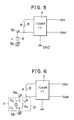
- the electrostatic capacity measuring CR oscillating circuit shown includes a resistor 8 and a capacitor 9 formed from a pair or a plurality of pairs of electrode plates disposed in a fuel passage.
- the opposite ends of the capacitor 9 are connected at a pair of points a and b to a timer IC (integrated circuit) 7 by way of a pair of lead wires 5a and 5b, respectively.
- a resistor 8 is connected to the capacitor 9 at the point a and also connected at the opposite ends thereof to the timer IC 7.
- the timer IC 7 includes an oscillating element not shown therein and produces oscillations which have a frequency determined by a time constant RC defined by a capacity of the capacitor 9 and a resistance R of the resistor 8.
- the capacitor 9 formed between the electrodes is represented as a parallel circuit of a capacitor having an electrostatic capacity Cx and a resistor having a loss Rx as shown in Fig.6.
- the capacitor C may be considered in such a simplified form as shown in Fig.5.
- ⁇ is a dielectric constant of fuel
- S an area of opposing faces of the electrode plates
- d a distance between the electrodes
- ⁇ a volume resistivity
- the conventional electrostatic capacity measuring CR oscillating circuit has such a construction as described above, if the volume resistivity of fuel decreases due to an increase in concentration of alcohol in gasoline or due to an increase in percentage of water content in gasoline, then the loss Rx of the capacitor 9 decreases. Accordingly, there causes a problem that oscillation of the electrostatic capacity measuring CR oscillating circuit may possibly be stopped.
- an alcohol sensor having an electrostatic capacity detecting section disposed in a fuel passage to measure an electrostatic capacity thereby for detecting a mixing ratio of alcohol in fuel is constituted in such a manner that a surface of each of electrode layers which form the electrostatic capacity detecting section is covered with an electric insulating layer.
- the alcohol sensor according to the present invention detects a mixing ratio of alcohol in fuel by detecting an electrostatic capacity of a capacitor which is formed by alcohol-mixed fuel filled between the electrode layers covered with electric insulating layers.
- an electrostatic capacity corresponding to a mixing ratio of alcohol can be always detected without relying upon a volume resistivity of fuel and can be converted into an oscillation frequency with a simple circuit.
- FIG.1 there is shown an alcohol sensor according to a preferred embodiment of the present invention. It is to be noted that, in Fig.1 and also in Figs.2 to 4, like parts or elements are denoted by the same reference characters as Figs. 5 and 6 described hereinabove.
- the alcohol sensor shown includes a plurality of, three in the embodiment, electrode layers 2 (shadowed portions) disposed in a predetermined spaced relationship in a fuel passage 1 in which fuel containing alcohol therein passes.
- a pair of lead wires 5a and 5b made of a conductive rigid material are connected to the electrode layers 2 in such a manner that they are all mechanically coupled to the electrode layers 2 but are electrically connected to different alternate ones of the electrode layers 2, that is, the lead wire 5a is electrically connected to the central one of the electrode layers 2 in Fig.1 while the other lead wire 5b is electrically connected to the other two electrode layers 2 on the opposite sides of the central layer 2.
- Each of the electrode layers 2 has a perforation formed therein, and an electric insulating piece 4 is securely fitted in the perforation.
- the lead wires 5a and 5b extend through and are secured to the electric insulating pieces 4 by way of which the lead wires 5a and 5b are mechanically coupled but not electrically connectd to the electrode layers 2 while assuring electric insulation between the electrode layers 2 and the lead wires 5a and 5b.
- the lead wires 5a and 5b are connected at a pair of points a and b to an electrostatic capacity measuring CR oscillating circuit shown in Fig.2.
- the lead wires 5a and 5b thus support the electrode layers 2 in position thereon in the fuel passage 1 due to their rigidity.
- All surfaces of the elements of the alcohol sensor described above are covered with an electric insulating layer 3 in such a manner that only the electric insulating layer 3 is exposed to fuel in the fuel passage 1.
- a capacitor 9 shown in Fig.2 for detecting alcohol is thus formed with portions of the electric insulating layer 3 located between the individual electrode layers 2.
- FIG.2 there is shown an electrostatic capacity measuring CR oscillating circuit which employs the alcohol sensor of Fig.1.
- the electrostatic capacity measuring CR oscillating circuit shown has a substantially similar construction to that of the conventional electrostatic capacity measuring CR oscillating circuit shown in Fig.5 but is only different in detailed construction of the capacitor 9 serving as an alcohol sensor.
- the opposite ends of the capacitor 9 are connected at a pair of points a and b to a timer IC (integrated circuit) 7 by way of a pair of lead wires 5a and 5b, respectively.
- a resistor 8 is connected to the capacitor 9 at the point a and also connected at the opposite ends thereof to the timer IC 7 which includes an oscillating element therein (not shown).
- a capacitor 9 formed from a pair of electrode plates 10 opposing surfaces of which are covered with electric insulating layers 3 has an electrostatic capacity C which is equivalent to that of a series circuit of a capacitor having an electrostatic capacity Cx formed by fuel filled between the electrode plates 10 and another capacitor having an electrostatic capacity Co formed by the electric insulating layers 3.
- the inter-electrode distance do of the electrostatic capacity Co that is, the thickness do of each electric insulating layer 3
- the inter-electrode distance dx of the electrostatic capacity Cx should be set sufficiently smaller than the inter-electrode distance dx of the electrostatic capacity Cx, or else a material of a high dielectric constant should be employed for the electric insulating layers 3 so as to assure a high dielectric constant ⁇ .
- the alcohol sensor can always convert a change in characteristics of fuel into a change oscillation frequency.
- the alcohol sensor shown can be produced by such a method that an electric insulating material is coated on a surface of a metal plate to be used as an electrode layer 2 by a physico-chemical means such as painting, adhesion, welding, evaporation and dipping to form an electric insulating layer 3 and then such metal plates 2 are assembled into such an alcohol sensor as shown in Fig.1.
- the alcohol sensor may be produced otherwise by another method that an assembly of such electrode layers 2 as shown in Fig.1 is first produced and then an electric insulating material is coated on all of electrostatic capacity detecting sections of the assembly by such physico-chemical means as listed above to form such an electric insulating layer or layers 3 as seen in Fig.1
- the surfaces of the electrostatic capacity detecting sections to be exposed in the fuel passage 1 are entirely covered with the electric insulating layer or layers 3, they may otherwise be covered partially or in a different manner with the electric insulating layer or layers 3.
- Fig.4 an alcohol sensor according to a second embodiment of the present invention is shown which has such a modified construction as described just above.
- the alcohol sensor shown includes a plurality of, three in the present embodiment, base plates 6 each having a pair of electrode layers 2 formed on the opposite surfaces thereof by printing in such a manner as to partially expose the opposite the opposite surfaces of the base plates 6.
- a pair of lead wires 5a and 5b are mechanically coupled to all of the base plates 6 and electrically connected to the electrode layers 2 on different alternate ones of the base plates 6 as seen in Fig.4. Surfaces of each of the base plates 6 and the electrode layers 2 on each base plate 6 are covered with an electric insulating layer 3 so that neither of the base plates 6 nor the electrode layers 2 may be exposed.
- printing of an electric insulating material may be employed in addition to such physico-chemical means as described above in order to form such electric insulating layers 2. such printing technique will enable simplification and reduction in working steps for production of an alcohol sensor and is advantageous in cost.
- the number of such capacitors may be selected suitably by a user depending upon an area of and a distance between the electrodes, a dielectric constant ⁇ of the electric insulating layers 3 and the oscillation frequency of the electrostatic capacity measuring CR oscillating circuit.
Landscapes
- Chemical & Material Sciences (AREA)
- Health & Medical Sciences (AREA)
- Life Sciences & Earth Sciences (AREA)
- General Health & Medical Sciences (AREA)
- Immunology (AREA)
- Pathology (AREA)
- Analytical Chemistry (AREA)
- Biochemistry (AREA)
- Chemical Kinetics & Catalysis (AREA)
- General Physics & Mathematics (AREA)
- Physics & Mathematics (AREA)
- Electrochemistry (AREA)
- Engineering & Computer Science (AREA)
- General Chemical & Material Sciences (AREA)
- Oil, Petroleum & Natural Gas (AREA)
- Food Science & Technology (AREA)
- Medicinal Chemistry (AREA)
- Investigating Or Analyzing Materials By The Use Of Electric Means (AREA)
Applications Claiming Priority (2)
| Application Number | Priority Date | Filing Date | Title |
|---|---|---|---|
| JP1988063780U JPH01165457U (de) | 1988-05-12 | 1988-05-12 | |
| JP63780/88U | 1988-05-12 |
Publications (3)
| Publication Number | Publication Date |
|---|---|
| EP0341675A2 true EP0341675A2 (de) | 1989-11-15 |
| EP0341675A3 EP0341675A3 (en) | 1990-07-04 |
| EP0341675B1 EP0341675B1 (de) | 1994-08-03 |
Family
ID=13239236
Family Applications (1)
| Application Number | Title | Priority Date | Filing Date |
|---|---|---|---|
| EP89108345A Expired - Lifetime EP0341675B1 (de) | 1988-05-12 | 1989-05-09 | Alkoholfühler |
Country Status (4)
| Country | Link |
|---|---|
| EP (1) | EP0341675B1 (de) |
| JP (1) | JPH01165457U (de) |
| KR (1) | KR910004509Y1 (de) |
| DE (1) | DE68917199T2 (de) |
Cited By (19)
| Publication number | Priority date | Publication date | Assignee | Title |
|---|---|---|---|---|
| US5196801A (en) * | 1988-12-19 | 1993-03-23 | Calsonic Corporation | Capacitance-type fuel sensor for sensing methanol in methanol-mixed fuel |
| EP0674171A1 (de) * | 1994-03-24 | 1995-09-27 | PIMA Sensors, Inc. | Gassensor und Sensoranordnung |
| EP0901013A1 (de) * | 1997-09-02 | 1999-03-10 | Goss Graphic Systems, Inc. | Vorrichtung zur Messung des Wassergehaltes |
| WO2000034767A1 (en) * | 1998-12-04 | 2000-06-15 | Sargent John S | Volume charge density measuring system |
| US6586949B1 (en) | 1999-12-03 | 2003-07-01 | John S. Sargent | Volume charge density measuring system |
| US6586950B1 (en) | 1998-12-04 | 2003-07-01 | John S. Sargent | Volume charge density measuring system |
| US6716119B1 (en) | 2002-11-06 | 2004-04-06 | Pro Performance Sports, Inc. | Sports ball striking training device |
| EP1610119A1 (de) * | 2004-06-24 | 2005-12-28 | Ngk Spark Plug Co., Ltd. | Kapazitiver Sensor zur Messung des Zustands einer Flüssigkeit |
| WO2008003365A3 (de) * | 2006-07-06 | 2008-04-24 | Bartec Gmbh | Kapazitive messvorrichtung zum nachweis von fremdstoffen in einer flüssigkeit |
| WO2008106989A1 (de) * | 2007-03-02 | 2008-09-12 | Bartec Gmbh | Vorrichtung und verfahren zur mengenerfassung bei der annahme und/oder abgabe einer einen gasanteil aufweisenden flüssigkeit |
| WO2016137343A1 (en) * | 2015-02-23 | 2016-09-01 | Alsemix Sp. Z O.O. | Method for determination of ethanol content in fuel for internal combustion engines |
| EP3355051A4 (de) * | 2016-04-27 | 2018-08-22 | KYB Corporation | Sensor und verfahren zur herstellung eines sensors |
| US11467094B2 (en) | 2017-05-17 | 2022-10-11 | University Of Florida Research Foundation, Inc. | Methods and sensors for detection |
| US11480527B2 (en) | 2017-12-20 | 2022-10-25 | University Of Florida Research Foundation, Inc. | Methods and sensors for detection |
| US11705527B2 (en) | 2017-12-21 | 2023-07-18 | University Of Florida Research Foundation, Inc. | Substrates having a broadband antireflection layer and methods of forming a broadband antireflection layer |
| US11795281B2 (en) | 2016-08-15 | 2023-10-24 | University Of Florida Research Foundation, Inc. | Methods and compositions relating to tunable nanoporous coatings |
| US11819277B2 (en) | 2018-06-20 | 2023-11-21 | University Of Florida Research Foundation, Inc. | Intraocular pressure sensing material, devices, and uses thereof |
| US12248123B2 (en) | 2017-12-20 | 2025-03-11 | University Of Florida Research Foundation, Inc. | Methods of forming an antireflective layer on a complex substrate and complex substrates having the antireflective layer |
| US12258470B2 (en) | 2018-02-13 | 2025-03-25 | University Of Florida Research Foundation, Inc. | Chromogenic materials, methods of making chromogenic materials, and methods of use |
Family Cites Families (5)
| Publication number | Priority date | Publication date | Assignee | Title |
|---|---|---|---|---|
| DE925621C (de) * | 1953-06-14 | 1955-03-24 | Otto Dr Velten | Verfahren und Vorrichtung zur selbsttaetigen Anzeige des Taupunktes |
| GB1570039A (en) * | 1977-02-22 | 1980-06-25 | Auburn Int | Measurement of phase fractions in flowing fluid |
| GB2149117A (en) * | 1983-11-04 | 1985-06-05 | Anderson Strathclyde Plc | Detection of water in oil |
| US4757252A (en) * | 1985-10-25 | 1988-07-12 | Drexelbrook Controls, Inc. | Probe system for measuring the condition of materials |
| DE8609566U1 (de) * | 1986-04-09 | 1987-04-16 | Testoterm Meßtechnik GmbH & Co, 7825 Lenzkirch | Kapazitive Sonde zur Messung des Flüssigkeitsgehaltes von Gemischen |
-
1988
- 1988-05-12 JP JP1988063780U patent/JPH01165457U/ja active Pending
-
1989
- 1989-04-13 KR KR2019890004560U patent/KR910004509Y1/ko not_active Expired
- 1989-05-09 EP EP89108345A patent/EP0341675B1/de not_active Expired - Lifetime
- 1989-05-09 DE DE68917199T patent/DE68917199T2/de not_active Expired - Fee Related
Cited By (28)
| Publication number | Priority date | Publication date | Assignee | Title |
|---|---|---|---|---|
| US5196801A (en) * | 1988-12-19 | 1993-03-23 | Calsonic Corporation | Capacitance-type fuel sensor for sensing methanol in methanol-mixed fuel |
| EP0674171A1 (de) * | 1994-03-24 | 1995-09-27 | PIMA Sensors, Inc. | Gassensor und Sensoranordnung |
| US5522980A (en) * | 1994-03-24 | 1996-06-04 | Pima Sensors, Inc. | Gas sensor and sensing device |
| US6169407B1 (en) | 1997-09-02 | 2001-01-02 | Goss Graphics Systems | Water content metering apparatus |
| WO1999012024A1 (en) * | 1997-09-02 | 1999-03-11 | Goss Graphic Systems, Inc. | Water content metering apparatus |
| EP0901013A1 (de) * | 1997-09-02 | 1999-03-10 | Goss Graphic Systems, Inc. | Vorrichtung zur Messung des Wassergehaltes |
| WO2000034767A1 (en) * | 1998-12-04 | 2000-06-15 | Sargent John S | Volume charge density measuring system |
| US6586950B1 (en) | 1998-12-04 | 2003-07-01 | John S. Sargent | Volume charge density measuring system |
| US6586949B1 (en) | 1999-12-03 | 2003-07-01 | John S. Sargent | Volume charge density measuring system |
| US6716119B1 (en) | 2002-11-06 | 2004-04-06 | Pro Performance Sports, Inc. | Sports ball striking training device |
| EP1610119A1 (de) * | 2004-06-24 | 2005-12-28 | Ngk Spark Plug Co., Ltd. | Kapazitiver Sensor zur Messung des Zustands einer Flüssigkeit |
| US7337662B2 (en) | 2004-06-24 | 2008-03-04 | Ngk Spark Plug Co., Ltd. | Electrostatic capacity type liquid state detecting sensor |
| CN100399000C (zh) * | 2004-06-24 | 2008-07-02 | 日本特殊陶业株式会社 | 静电电容型液体状态检测传感器 |
| WO2008003365A3 (de) * | 2006-07-06 | 2008-04-24 | Bartec Gmbh | Kapazitive messvorrichtung zum nachweis von fremdstoffen in einer flüssigkeit |
| WO2008106989A1 (de) * | 2007-03-02 | 2008-09-12 | Bartec Gmbh | Vorrichtung und verfahren zur mengenerfassung bei der annahme und/oder abgabe einer einen gasanteil aufweisenden flüssigkeit |
| US8056425B2 (en) | 2007-03-02 | 2011-11-15 | Bartec Benke Gmbh | Device and method for detecting a volume while receiving and/or discharging a fluid having a gas portion |
| WO2016137343A1 (en) * | 2015-02-23 | 2016-09-01 | Alsemix Sp. Z O.O. | Method for determination of ethanol content in fuel for internal combustion engines |
| EP3355051A4 (de) * | 2016-04-27 | 2018-08-22 | KYB Corporation | Sensor und verfahren zur herstellung eines sensors |
| US11795281B2 (en) | 2016-08-15 | 2023-10-24 | University Of Florida Research Foundation, Inc. | Methods and compositions relating to tunable nanoporous coatings |
| US11781993B2 (en) | 2017-05-17 | 2023-10-10 | University Of Florida Research Foundation, Inc. | Methods and sensors for detection |
| US11467094B2 (en) | 2017-05-17 | 2022-10-11 | University Of Florida Research Foundation, Inc. | Methods and sensors for detection |
| US11480527B2 (en) | 2017-12-20 | 2022-10-25 | University Of Florida Research Foundation, Inc. | Methods and sensors for detection |
| US12031919B2 (en) | 2017-12-20 | 2024-07-09 | University Of Florida Research Foundation, Inc. | Methods and sensors for detection |
| US12248123B2 (en) | 2017-12-20 | 2025-03-11 | University Of Florida Research Foundation, Inc. | Methods of forming an antireflective layer on a complex substrate and complex substrates having the antireflective layer |
| US11705527B2 (en) | 2017-12-21 | 2023-07-18 | University Of Florida Research Foundation, Inc. | Substrates having a broadband antireflection layer and methods of forming a broadband antireflection layer |
| US12224362B2 (en) | 2017-12-21 | 2025-02-11 | University Of Florida Research Foundation, Inc. | Substrates having a broadband antireflection layer and methods of forming a broadband antireflection layer |
| US12258470B2 (en) | 2018-02-13 | 2025-03-25 | University Of Florida Research Foundation, Inc. | Chromogenic materials, methods of making chromogenic materials, and methods of use |
| US11819277B2 (en) | 2018-06-20 | 2023-11-21 | University Of Florida Research Foundation, Inc. | Intraocular pressure sensing material, devices, and uses thereof |
Also Published As
| Publication number | Publication date |
|---|---|
| DE68917199D1 (de) | 1994-09-08 |
| KR890023432U (ko) | 1989-12-02 |
| EP0341675A3 (en) | 1990-07-04 |
| KR910004509Y1 (ko) | 1991-06-29 |
| EP0341675B1 (de) | 1994-08-03 |
| DE68917199T2 (de) | 1994-11-24 |
| JPH01165457U (de) | 1989-11-20 |
Similar Documents
| Publication | Publication Date | Title |
|---|---|---|
| EP0341675B1 (de) | Alkoholfühler | |
| US4603581A (en) | Sensing apparatus | |
| US4142415A (en) | Device for continuously measuring the liquid level in a container | |
| US4583296A (en) | Electrical inclination sensor and method for its manufacture | |
| US5142909A (en) | Material level indicator | |
| US4176553A (en) | Liquid level measuring system | |
| US5802728A (en) | Liquid level and angle detector | |
| US4194395A (en) | Capacitive liquid level sensor | |
| US6178818B1 (en) | Capacitive filling level sensor | |
| US5051921A (en) | Method and apparatus for detecting liquid composition and actual liquid level | |
| JPH0512661B2 (de) | ||
| US4939467A (en) | Fuel sensor for sensing the mixture ratio of gasoline and methanol | |
| US4399699A (en) | Electrostatic type fuel measuring device | |
| US4204427A (en) | Device for the capacitive level height measurement of liquids or solids | |
| CA1069996A (en) | Apparatus for generating an electrical signal indicative of liquid level | |
| DE3855131T2 (de) | Thermisches Luftströmungsmessgerät | |
| GB2046918A (en) | Capacitance-based metering of filling levels | |
| US4628612A (en) | Tilt angle detection device | |
| IL106829A (en) | Soil moisture sensor | |
| US4883366A (en) | Temperature sensor | |
| JPH04273002A (ja) | 容量センサ | |
| WO1999010714A1 (en) | A compensated capacitive liquid level sensor | |
| US4864273A (en) | Variable resistor | |
| GB2222261A (en) | Humidity measuring apparatus | |
| US5097248A (en) | Electrode for level detection |
Legal Events
| Date | Code | Title | Description |
|---|---|---|---|
| PUAI | Public reference made under article 153(3) epc to a published international application that has entered the european phase |
Free format text: ORIGINAL CODE: 0009012 |
|
| AK | Designated contracting states |
Kind code of ref document: A2 Designated state(s): DE FR GB |
|
| PUAL | Search report despatched |
Free format text: ORIGINAL CODE: 0009013 |
|
| AK | Designated contracting states |
Kind code of ref document: A3 Designated state(s): DE FR GB |
|
| 17P | Request for examination filed |
Effective date: 19900621 |
|
| 17Q | First examination report despatched |
Effective date: 19920131 |
|
| GRAA | (expected) grant |
Free format text: ORIGINAL CODE: 0009210 |
|
| AK | Designated contracting states |
Kind code of ref document: B1 Designated state(s): DE FR GB |
|
| REF | Corresponds to: |
Ref document number: 68917199 Country of ref document: DE Date of ref document: 19940908 |
|
| ET | Fr: translation filed | ||
| PLBE | No opposition filed within time limit |
Free format text: ORIGINAL CODE: 0009261 |
|
| STAA | Information on the status of an ep patent application or granted ep patent |
Free format text: STATUS: NO OPPOSITION FILED WITHIN TIME LIMIT |
|
| 26N | No opposition filed | ||
| PGFP | Annual fee paid to national office [announced via postgrant information from national office to epo] |
Ref country code: GB Payment date: 19980430 Year of fee payment: 10 |
|
| PGFP | Annual fee paid to national office [announced via postgrant information from national office to epo] |
Ref country code: FR Payment date: 19980511 Year of fee payment: 10 |
|
| PGFP | Annual fee paid to national office [announced via postgrant information from national office to epo] |
Ref country code: DE Payment date: 19980515 Year of fee payment: 10 |
|
| PG25 | Lapsed in a contracting state [announced via postgrant information from national office to epo] |
Ref country code: GB Free format text: LAPSE BECAUSE OF NON-PAYMENT OF DUE FEES Effective date: 19990509 |
|
| GBPC | Gb: european patent ceased through non-payment of renewal fee |
Effective date: 19990509 |
|
| PG25 | Lapsed in a contracting state [announced via postgrant information from national office to epo] |
Ref country code: FR Free format text: LAPSE BECAUSE OF NON-PAYMENT OF DUE FEES Effective date: 20000131 |
|
| PG25 | Lapsed in a contracting state [announced via postgrant information from national office to epo] |
Ref country code: DE Free format text: LAPSE BECAUSE OF NON-PAYMENT OF DUE FEES Effective date: 20000301 |
|
| REG | Reference to a national code |
Ref country code: FR Ref legal event code: ST |