EP0341380A2 - Bandförmiges, faseriges Material mit hoher Öffnungsfähigkeit und Dimensionsstabilität - Google Patents
Bandförmiges, faseriges Material mit hoher Öffnungsfähigkeit und Dimensionsstabilität Download PDFInfo
- Publication number
- EP0341380A2 EP0341380A2 EP89102634A EP89102634A EP0341380A2 EP 0341380 A2 EP0341380 A2 EP 0341380A2 EP 89102634 A EP89102634 A EP 89102634A EP 89102634 A EP89102634 A EP 89102634A EP 0341380 A2 EP0341380 A2 EP 0341380A2
- Authority
- EP
- European Patent Office
- Prior art keywords
- belt
- fibers
- fibrous material
- fibrous
- shaped fibrous
- Prior art date
- Legal status (The legal status is an assumption and is not a legal conclusion. Google has not performed a legal analysis and makes no representation as to the accuracy of the status listed.)
- Withdrawn
Links
Images

Classifications
-
- D—TEXTILES; PAPER
- D04—BRAIDING; LACE-MAKING; KNITTING; TRIMMINGS; NON-WOVEN FABRICS
- D04H—MAKING TEXTILE FABRICS, e.g. FROM FIBRES OR FILAMENTARY MATERIAL; FABRICS MADE BY SUCH PROCESSES OR APPARATUS, e.g. FELTS, NON-WOVEN FABRICS; COTTON-WOOL; WADDING ; NON-WOVEN FABRICS FROM STAPLE FIBRES, FILAMENTS OR YARNS, BONDED WITH AT LEAST ONE WEB-LIKE MATERIAL DURING THEIR CONSOLIDATION
- D04H1/00—Non-woven fabrics formed wholly or mainly of staple fibres or like relatively short fibres
- D04H1/70—Non-woven fabrics formed wholly or mainly of staple fibres or like relatively short fibres characterised by the method of forming fleeces or layers, e.g. reorientation of fibres
- D04H1/74—Non-woven fabrics formed wholly or mainly of staple fibres or like relatively short fibres characterised by the method of forming fleeces or layers, e.g. reorientation of fibres the fibres being orientated, e.g. in parallel (anisotropic fleeces)
Definitions
- the present invention relates to dense and compact belt-shaped fibrous materials superior in openability, dimensional stability or deformation resistance, and flexibility.
- slivers prepared from short fibers by carding are used as fiber bundles for the purpose of forming more uniform fibrous webs.
- said technique has the following disadvantages: Because such slivers are bulky, a large space is required for the fiber-bundle feed section of the facility even when the size of opening system is reduced to compact the facility, since said slivers are instable in shape or in dimension, that is, since they are readily elongated by tension resulting in irregularities or breaks, the speed of supplying the fiber bundle cannot be increased or said slivers must be exchanged frequently one for another.
- the present invention involves (i) a beltshaped fibrous material of 2-30 cm width, 2-50 mm thickness, and 0.01-0.50 g/cm3 density, superior in openability and dimensional stability, the component short fibers of which are previously opened and arranged in sliver form said fibrous material having 5-25 corrugated or depressive crimps/inch of its length and (ii) a process for producing such belt-shaped fibrous materials, which comprises opening and arranging base short fibers by carding to form webs or slivers, piling up or bundling these webs or slivers, and crimping the piled or bundled material by forcing it into a crimper.
- the short fibers are free to choose from; thermoplastic synthetic fibers, e.g. polyester fibers, nylon fibers, acrylic fibers, and polypropylene fibers; semi-synthetic fibers, e.g. acetate fibers; regenerated fibers, e.g. rayon; and natural fibers, e.g. cotton. These fibers may be used separately or in blends one with another.
- thermoplastic synthetic fibers e.g. polyester fibers, nylon fibers, acrylic fibers, and polypropylene fibers
- semi-synthetic fibers e.g. acetate fibers
- regenerated fibers e.g. rayon
- natural fibers e.g. cotton
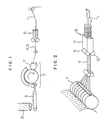
- the belt-shaped fibrous material of the present invention can be produced with ease in the manner that, as illustrated in Fig. 1, short fibers 3 are opened and arranged by using a carding opener 2, the resulting webs 4 or slivers 5 are piled up or bundled and then pressed in a forced-feed type of crimper 6 to form fine projective or depressive crimps.
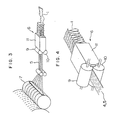
- the web 4 or sliver 5 formed by the carding opener 2 is divided into parts of suitable width by passing over a doffer 7 provided with separator collars and the separated webs or slivers are superposed one upon another as shown in Fig. 2 or a suitable number of separated slivers 5 are arranged in near parallel one to another to give a sliver of suitable width as shown in Fig. 3. Then the resulting web or sliver is fed to the gap between the crimper rolls 9 and 10 of the forced-feed type crimper 6, which is illustrated in Fig. 4. The web or sliver nipped by the crimper rolls 9 and 10 is forced into a crimper box 11 and pressed therein to form the intended belt-shaped fibrous material 1, which is then taken out.
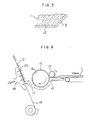
- This belt-shaped material 1 as illustrated in Fig. 5, is in the shape of a belt composed of aggregated fibers and has fine crimps in projective or depressive form distributed length-wise. That is, the belt-shaped material 1 constructed of short fibers 3 which have been opened once, arranged by carding, and then compressed.
- the opener illustrated in Fig. 6 comprises a feed roller 13, a disk plate 14, and a taker-in roller 16 around which a garnet wire 15 is coiled.
- the belt-shaped fibrous material 1 is fed to the opener through a feed roller 13.
- Opened fibers 17 obtained are sucked by an aspirator 18 to pile over a continuously traveling nonwoven fabric 19, whereby it is possible to form a fibrous web structure 21 that is a single body combining the nonwoven fabric 19 with the fibrous web 20.
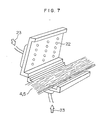
- FIG. 7 A device for heat treatment of the web 4 or sliver 5 is illustrated in Fig. 7.
- the traveling web 4 or sliver 5 is heated with high temperature steam or air 23 ejected through blowout holes 22 bored in the upper and lower plates of the heat treatment device, and then is fed to the gap between the crimper rolls 9 and 10 of the forced-feed type crimper 6.
- a bulky web or sliver prepared, as described above, through a suitable system such as a carding opener be compressed in the forced-feed type crimper to form a belt-shaped fibrous material having fine corrugated or depressive crimps distributed lengthwise.
- a bulky web or sliver can be converted into such a dense belt-shaped fibrous material as that of the present invention only by applying a compressive pressure exceeding 1200 kg/cm2.
- the base fibers when crimped previously are crimped again by a forced-feed type crimper; hence the later opening of the fibrous belt crimped again yields fibrous webs of favorable quality provided with prominent bulkiness and high compressive resilience.
- the belt-shaped fibrous material of the present invention must be 2-30 cm wide and 2-50 mm thick. Since fibrous webs used for sanitary materials such as napkins and disposable diapers are 2-30 cm wide, the width of the belt-shaped fibrous material to be fed to an opener is chosen properly from the above range of widths according to the width of the objective sanitary material.
- the thickness of the belt-shaped fibrous material depends on its bulk density, the speed of its feed to opener, and the basis weight of the intended fibrous web. When the thickness of said fibrous material is less than 2 mm, the speed of feeding it to the opener needs to be increased and the resulting fibrous web will be inferior in uniformity.
- the thickness of the belt-shaped fibrous material exceeds 50 mm, such a fibrous material will be difficult to feed to the opener.
- the density of the belt-shaped fibrous material is at least 0.01 g/cm3 and the higher density is the better, since the fibrous material of high density can be put or enclosed in a small space and is superior in dimensional stability, particularly in the stability to tension. But the density exceeding 0.50 g/cm3 makes the opening difficult.
- the belt-shaped fibrous material of the present invention should be provided with 5-25 fine crimps in corrugated or depressive form per/inch of its length.
- said number of crimps is less than 5, such fibrous material will be fluffy and inferior in bundling workability and their lengthwise tensile strengths will be unsatisfactory.
- the number of crimps exceed 25, such fibrous materials will be hard, that is, they will be deficient in flexibility and hence it will be difficult to fold and compact them so as to put or enclose them in a small space.
- the belt-shaped fibrous material is desired to have a tensile strength at break of at least 20 g/104d.
- the tensile strength at break is determined by measuring the strength at break of cut test pieces of 2 x 10⁴d each and 150 mm length by using a Tensilon tensile tester at a distance of 100 mm between the chucks and at a strain rate of 100%/min, and the found value is expressed in the strength per 104 deniers.
- the tensile strength at break is less than 20 g/104d, such belt-shaped fibrous materials in traveling will be elongated, resulting in irregularities or breaks.
- the thermoplastic synthetic short fibers constituting the belt-shaped fibrous material have cushioning properties which do not deteriorate even under wet conditions. If the proportion of the thermoplastic synthetic short fibers having such moisture-resistant cushioning properties is less than 50% by weight, the cushioning property of such fibrous web will be poor particularly under wet conditions. Further, the fibers used herein is desired to have 1.5-15 d fiber size, 25-128 mm length, 5-25 crimps/ inch, and 5-25% degree of crimping.
- the cushioning property of the fibrous web will be inferior and upon using such a fibrous web, for instance, as a sanitary material, the comfortable wearing feel of the end product (napkin or diaper) will be impaired.
- said fibrous web will bring about such lowering in the performance of end product that it is difficult for body fluids and/or excretions to diffuse through voids in the cushioning fibrous layer in the thickness direction and toward the outer surface and in particular, that body fluids absorbed in the absorber wet back or the cushioning fibrous layer has a low capacity to hold excretions such as slushy feces.
- the cushioning layer will have a high rigidity, being hard to the touch and excretions such as slushy feces will not readily permeate the cushioning layer.
- the finish to make their surfaces hydrophilic is favorable for the present invention since such finish improves the hydrophilic property and retentivity for body fluids and/or excretions.
- Known agents suitable for this surface finishing are, for example, anionic or nonionic surface active agents having phase-inversion viscosities of 10,000 cps and more and/or block copolymers of polyoxyalkylenes with oligomers or low-molecular copolymers, the monomers constituting these oligomers or copolymers being the same as those constituting polymers for thermoplastic synthetic fibers, said block copolymers having molecular weights of 1000 to 10,000. It is possible, of course, to use other durable finishing agents which can make the fiber surface hydrophilic.
- base fibers which exhibit high compressive resilience e.g. polyester fibers
- hollow structures When the hollow volume fraction of these base fibers is less than 5%, the resilience improving effect is limited and when the hollow volume fraction exceeds 35%, the resilience is not improved over the value of base fibers having a hollow volume fraction of 35%.
- the card web or sliver is desirably constituted of fibers whose shrinkages due to heat treatment are from 2 to 35% when the shrinkage is less than 2%, such fibers cannot be effectively bundled and hence, upon feeding the resulting bulky web or sliver as such to the gap between the crimper rolls of a forced-feed type crimper, the nip by the crimper rolls will be instable.
- shrinkage exceeds 35%, such fibers are too strongly bundled by shrinking treatment and additionally the compression in a forced-feed type crimper results in very hard belt-shaped fibrous materials which will be difficult to open.
- Hollow polyester fibers (fiber size 6 d, fiber length 51 mm, number of crimps 14/inch, degree of crimping 16%, shrinkage in boiling water 13%, hollow volume fraction 15%) finished to make the surface hydrophilic were opened by using a roller card of 2 m width. The resulting fibrous web, leaving a doffer roll, was divided once into 6 slivers. As shown in Fig. 7, the slivers were then arranged in parallel one to another and subjected to wet heat treatment with steam.
- the treated slivers were fed to a forced-feed type crimper comprising crimper rolls and a crimper box and compressed to form a belt-shaped fibrous material (width 13 cm, thickness 5 mm, density 0.25 g/cm3) having 15 crimps/inch.
- the tensile strength at break of this fibrous belt was found to be 82 g/104d.
- This fibrous belt was fed to a small, simple opening machine as shown in Fig. 6, and the opened fibers were piled to form a fibrous web 20 (basis weight 19 g/m2, width 13 cm, thickness 3 mm, density 0.006 g/cm3) on a nonwoven fabric 19 moved continuously at a speed of 230 m/min.
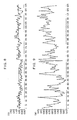
- the nonwoven fabric 19 retains its own shape with hydrophobic polypropylene fibers of 1.5 d fiber size being interlaced and has numerous perforations of 1.5 mm diameter at intervals of 1.5 mm. While moving the nonwoven fabric continuously at a speed of 230 m/min, the underlying aspirator 18 was operated to suck and deposit said opened short polyester fibers in web form on the nonwoven fabric, thereby yielding a fibrous web structure 21. This fibrous web structure 21 was cut transversly at intervals of 40 cm to sample 125 pieces. Results of weighing these pieces are shown in Fig. 8.
- Short rayon fibers (fiber size 4 d, fiber length 32 mm, number of crimps 12/inch, degree of crimping 7%) were opened by using a roller card of 1 m width.
- the resulting fibrous web after leaving a doffer roll was divided once into 4 slivers.
- the slivers were then arranged in parallel one to another and subjected to wet heat treatment with steam.
- the treated slivers were fed to a forced-feed type crimper comprising crimper rolls and a crimper box and compressed to form a belt-shaped fibrous material of 5 cm width, 5 mm thickness, and 0.25 g/cm3 density, having 15 crimps/inch.
- the tensile strength at break of this fibrous belt was found to be 56 g/104d.
- This fibrous belt was fed to a small, simple opening machine as shown in Fig. 6, and the opened fibers were piled to form a fibrous web 20 (basis weight 10 g/m2, width 5 cm, thickness 3 mm, density 0.003 g/cm3) on a nonwoven fabric 19 moved continuously at a speed of 230 m/min.
- the nonwoven fabric 19 retains its own shape with hydrophobic polypropylene fibers of 1.5 d fiber size being interlaced and has numerous perforations of 1.5 mm diameter at intervals of 1.5 mm.
- the Supreme web structure showing slight variation in basis weight, was superior in uniformity. Napkins made from this fibrous web structure 21 were good in cushioning property and prominent in wearing feel and exhibited such superior performance as to absorb and hold body fluids and/or excretions and not to allow them to wet back to the surface.
- Hollow polyester fibers (the same as used in Example 1, fiber size 6 d, fiber length 51 mm, number of crimps 14/inch, degree of crimping 16%, shrinkage in boiling water 13%, hollow volume fraction 15%, finished to make the surface hydrophilic) were opened by using a roller card of 1 m width.
- the resulting webs leaving a doffer roll were bundled to form a sliver (whole fiber size 150,000 d, density 0.005 g/cm3, tensile strength at break 15 g/104 d), which was then cut into six parts and once contained in 6 cans by using a coiler. These slivers were taken out of the cans, and arranged in parallel one to another.
- Hollow polyester fibers (the same as used in Example 1 and Comparative Example 1, fiber size 6 d, fiber length 51 mm, number of crimps 14/inch, degree of crimping 16%, shrinkage in boiling water 13%, hollow volume fraction 15%, finished to make the surface hydrophilic) were opened coarsely by using a beater opener, and the resulting lap was once wound up. The lap, unwound, was compressed with hot calender rolls (150°C) and then slit into strips 13 cm wide, that is, belt-shaped fibrous materials of 10 mm thickness and 0.15 g/cm3 density. The tensile strength at break of these belt-shaped fibrous materials was found to be 1100 g/25 mm width.
- belt-shaped fibrous materials of high densities which are superior in dimensional stability and can be opened easily and uniformly by a small, simple opening machine and it is possible to produce, from the resulting opened fibers, fibrous webs which are superior in uniformity, bulkiness, and compressive resilience and best suited for use as cushioning fibrous layers in sanitary materials. That is, the present invention has such distinguished effects.
Landscapes
- Engineering & Computer Science (AREA)
- Textile Engineering (AREA)
- Nonwoven Fabrics (AREA)
Applications Claiming Priority (2)
| Application Number | Priority Date | Filing Date | Title |
|---|---|---|---|
| JP11189788 | 1988-05-09 | ||
| JP111897/88 | 1988-05-09 |
Publications (2)
| Publication Number | Publication Date |
|---|---|
| EP0341380A2 true EP0341380A2 (de) | 1989-11-15 |
| EP0341380A3 EP0341380A3 (de) | 1990-01-24 |
Family
ID=14572876
Family Applications (1)
| Application Number | Title | Priority Date | Filing Date |
|---|---|---|---|
| EP89102634A Withdrawn EP0341380A3 (de) | 1988-05-09 | 1989-02-16 | Bandförmiges, faseriges Material mit hoher Öffnungsfähigkeit und Dimensionsstabilität |
Country Status (1)
| Country | Link |
|---|---|
| EP (1) | EP0341380A3 (de) |
Cited By (2)
| Publication number | Priority date | Publication date | Assignee | Title |
|---|---|---|---|---|
| EP0457226A1 (de) * | 1990-05-15 | 1991-11-21 | Hoechst Aktiengesellschaft | Textile Verstärkungseinlage und faserverstärkter Verbundwerkstoff |
| AU630278B2 (en) * | 1990-02-28 | 1992-10-22 | E.I. Du Pont De Nemours And Company | Dispersible aramid pulp |
Family Cites Families (2)
| Publication number | Priority date | Publication date | Assignee | Title |
|---|---|---|---|---|
| EP0088191A3 (de) * | 1982-03-08 | 1986-02-19 | Imperial Chemical Industries Plc | Polsterfasermischung aus Polyester |
| DE3415683A1 (de) * | 1984-04-27 | 1985-10-31 | Bayer Ag, 5090 Leverkusen | Verfahren zum fixieren und kuehlen gekraeuselter faserbaender |
-
1989
- 1989-02-16 EP EP89102634A patent/EP0341380A3/de not_active Withdrawn
Cited By (2)
| Publication number | Priority date | Publication date | Assignee | Title |
|---|---|---|---|---|
| AU630278B2 (en) * | 1990-02-28 | 1992-10-22 | E.I. Du Pont De Nemours And Company | Dispersible aramid pulp |
| EP0457226A1 (de) * | 1990-05-15 | 1991-11-21 | Hoechst Aktiengesellschaft | Textile Verstärkungseinlage und faserverstärkter Verbundwerkstoff |
Also Published As
| Publication number | Publication date |
|---|---|
| EP0341380A3 (de) | 1990-01-24 |
Similar Documents
| Publication | Publication Date | Title |
|---|---|---|
| US5789328A (en) | Bulky nonwoven fabric and method for producing the same | |
| US3523059A (en) | Needled fibrous batting and method of making the same | |
| US3333315A (en) | Method of forming a nonwoven web product | |
| DE10084561B3 (de) | Lockere Bahn aus einem nichtgewebten Material sowie Verfahren zur Herstellung eines lockeren nichtgewebten Materials | |
| EP1050612B1 (de) | Bauschiger Vliesstoff, Herstellungsverfahren und saugfähige Artikel | |
| EP0365943B1 (de) | Elastische Vliesstoffe und Verfahren zur Herstellung derselben | |
| EP2049715B1 (de) | Faserbündel und vlies | |
| CN100378261C (zh) | 可拉伸多组分非织造布及其制备方法 | |
| EP0127483A2 (de) | Heissverschweisste, elastische, nichtgewebte Stoffbahn | |
| EP0411857A1 (de) | Verfahren zum Geschmeidigmachen und Bauchen von Stichvliesen | |
| US20030026948A1 (en) | Laminated material and method for its production | |
| CA2894674C (en) | Method for production of a hydroentangled airlaid web and products obtained therefrom | |
| MXPA01011065A (es) | Materiales que tienen fibras y dobleces en la direccion-z y metodo para producir los mismos. | |
| DE60225718T2 (de) | Verfahren zur herstellung voluminöses vlies | |
| EP4077786B1 (de) | Vliesstoff und verfahren zum herstellen der bahn | |
| US6274237B1 (en) | Potentially crimpable composite fiber and a non-woven fabric using the same | |
| GB1105968A (en) | Webs of crimped continuous filaments | |
| CN215689118U (zh) | 吸收性物品用热风无纺布 | |
| US3101520A (en) | Method and apparatus for making brushed nonwoven fabric | |
| CA1075870A (en) | Process and apparatus for stretching a non-woven web of an orientable polymeric material | |
| KR20110013526A (ko) | 슬릿 넥크 스펀본드 공정 및 재료 | |
| JPH08291451A (ja) | 不織布およびその製造方法 | |
| JP3132202B2 (ja) | 熱融着性複合繊維の製造方法 | |
| US3324527A (en) | Methods of producing textured non-woven fabric | |
| JP4026280B2 (ja) | ポリオレフィン系分割型複合繊維、その製造方法及びその繊維を用いた繊維成形体 |
Legal Events
| Date | Code | Title | Description |
|---|---|---|---|
| PUAI | Public reference made under article 153(3) epc to a published international application that has entered the european phase |
Free format text: ORIGINAL CODE: 0009012 |
|
| AK | Designated contracting states |
Kind code of ref document: A2 Designated state(s): DE FR GB IT |
|
| PUAL | Search report despatched |
Free format text: ORIGINAL CODE: 0009013 |
|
| AK | Designated contracting states |
Kind code of ref document: A3 Designated state(s): DE FR GB IT |
|
| 17P | Request for examination filed |
Effective date: 19900404 |
|
| 17Q | First examination report despatched |
Effective date: 19911230 |
|
| STAA | Information on the status of an ep patent application or granted ep patent |
Free format text: STATUS: THE APPLICATION HAS BEEN WITHDRAWN |
|
| 18W | Application withdrawn |
Withdrawal date: 19920305 |