EP0341256B1 - Modem und verfahren zur verwendung mehrdimensionaler kodierter modulierung - Google Patents
Modem und verfahren zur verwendung mehrdimensionaler kodierter modulierung Download PDFInfo
- Publication number
- EP0341256B1 EP0341256B1 EP88900914A EP88900914A EP0341256B1 EP 0341256 B1 EP0341256 B1 EP 0341256B1 EP 88900914 A EP88900914 A EP 88900914A EP 88900914 A EP88900914 A EP 88900914A EP 0341256 B1 EP0341256 B1 EP 0341256B1
- Authority
- EP
- European Patent Office
- Prior art keywords
- common
- component
- cost
- dimensional
- members
- Prior art date
- Legal status (The legal status is an assumption and is not a legal conclusion. Google has not performed a legal analysis and makes no representation as to the accuracy of the status listed.)
- Expired - Lifetime
Links
- 238000000034 method Methods 0.000 title claims description 33
- 238000004364 calculation method Methods 0.000 claims description 8
- 230000007704 transition Effects 0.000 claims description 6
- 230000005540 biological transmission Effects 0.000 claims 2
- 230000015572 biosynthetic process Effects 0.000 claims 1
- 238000007476 Maximum Likelihood Methods 0.000 abstract description 4
- 230000001131 transforming effect Effects 0.000 abstract 1
- 238000010586 diagram Methods 0.000 description 7
- 238000007792 addition Methods 0.000 description 6
- 230000009467 reduction Effects 0.000 description 5
- 239000000470 constituent Substances 0.000 description 4
- 230000008569 process Effects 0.000 description 4
- 230000001186 cumulative effect Effects 0.000 description 3
- 239000013598 vector Substances 0.000 description 3
- 238000001914 filtration Methods 0.000 description 2
- 230000004048 modification Effects 0.000 description 2
- 238000012986 modification Methods 0.000 description 2
- 230000000717 retained effect Effects 0.000 description 2
- 230000001360 synchronised effect Effects 0.000 description 2
- 108010076504 Protein Sorting Signals Proteins 0.000 description 1
- 238000013459 approach Methods 0.000 description 1
- 230000008859 change Effects 0.000 description 1
- 238000004891 communication Methods 0.000 description 1
- 238000013500 data storage Methods 0.000 description 1
- 230000006735 deficit Effects 0.000 description 1
- 230000008030 elimination Effects 0.000 description 1
- 238000003379 elimination reaction Methods 0.000 description 1
- 238000013507 mapping Methods 0.000 description 1
- 230000010363 phase shift Effects 0.000 description 1
- 238000012545 processing Methods 0.000 description 1
Images



Classifications
-
- H—ELECTRICITY
- H03—ELECTRONIC CIRCUITRY
- H03M—CODING; DECODING; CODE CONVERSION IN GENERAL
- H03M13/00—Coding, decoding or code conversion, for error detection or error correction; Coding theory basic assumptions; Coding bounds; Error probability evaluation methods; Channel models; Simulation or testing of codes
- H03M13/25—Error detection or forward error correction by signal space coding, i.e. adding redundancy in the signal constellation, e.g. Trellis Coded Modulation [TCM]
-
- H—ELECTRICITY
- H04—ELECTRIC COMMUNICATION TECHNIQUE
- H04L—TRANSMISSION OF DIGITAL INFORMATION, e.g. TELEGRAPHIC COMMUNICATION
- H04L27/00—Modulated-carrier systems
- H04L27/32—Carrier systems characterised by combinations of two or more of the types covered by groups H04L27/02, H04L27/10, H04L27/18 or H04L27/26
- H04L27/34—Amplitude- and phase-modulated carrier systems, e.g. quadrature-amplitude modulated carrier systems
- H04L27/3405—Modifications of the signal space to increase the efficiency of transmission, e.g. reduction of the bit error rate, bandwidth, or average power
- H04L27/3416—Modifications of the signal space to increase the efficiency of transmission, e.g. reduction of the bit error rate, bandwidth, or average power in which the information is carried by both the individual signal points and the subset to which the individual points belong, e.g. using coset coding, lattice coding, or related schemes
- H04L27/3427—Modifications of the signal space to increase the efficiency of transmission, e.g. reduction of the bit error rate, bandwidth, or average power in which the information is carried by both the individual signal points and the subset to which the individual points belong, e.g. using coset coding, lattice coding, or related schemes in which the constellation is the n - fold Cartesian product of a single underlying two-dimensional constellation
- H04L27/3438—Modifications of the signal space to increase the efficiency of transmission, e.g. reduction of the bit error rate, bandwidth, or average power in which the information is carried by both the individual signal points and the subset to which the individual points belong, e.g. using coset coding, lattice coding, or related schemes in which the constellation is the n - fold Cartesian product of a single underlying two-dimensional constellation using an underlying generalised cross constellation
Definitions
- the present invention relates to transmitting digital data over a band limited channel by using convolutional coding and multidimensional coded modulation.
- U.S. patent 4,077,021 to Csajka et al. used 2-dimensional coding to improve the performance of the modem against Gaussian noise. Although this coding scheme improved the performance of the system against noise, it also doubled the number of points in the signal constellation making the system more susceptible to other impairments. This is mitigated by the use of a multidimensional code, as described in European patent application EP-A-0 154 415 to Gallager and U.S. patent 4,581,601.
- the signal constellation can be divided into inner points and outer points, with one of the uncoded bits indicating for the n 2-dimensional (symbols) whether there are any outer points and at least one uncoded bit to indicate in which of the n bauds the outer point occurs, as shown in the article entitled "Efficient Modulation for Band Limited Channels", G. David Forney et al., IEEE Journal On Selected Areas in Communication, Vol. SAC, 2 September, 1984, pp. 632-645.
- European patent application EP-A-0 200 505 teaches, for a multidimensional coded modulation system, a method wherein the most likely sequence of multidimensional signal points to have been sent is determined from the received signal.
- the distance is computed between each received constituent signal (with dimensions fewer than that of the multidimensional constellation) and the nearest constituent signal points in the corresponding constituent subsets.
- the distance between each received multidimensional signal and the nearest multidimensional signal point in each multidimensional subset is determined based on a combination of distances with respect to constituent subsets corresponding to the multidimensional subset.
- the most likely sequence is determined based on the distances between each received multidimensional signal and the nearest multidimensional signal point in each multidimensional subset.
- EP-A-0 200 505 on page 20, second column, first paragraph suggests that an improper number of outer points can be determined from the detected bits and that "Then a modification is made on those four groups to render them together valid". However, no method of accomplishing this "modification" is taught.
- a first aspect of the present invention is directed to a modulation-demodulation apparatus for transmitting a plurality of information bits over a band limited channel
- said apparatus including a transmitter having convolutional encoder means, said convolutional encoder means providing one of a plurality of members of a coset during each one of a plurality of group intervals, said coset being one of a plurality of cosets with each of said cosets being associated with a unique permissible transition of said convolutional encoder means from a given present state to one of a plurality of next states, each said group interval having a plurality of bauds, each of said members having a plurality of components with each of said components being associated with a unique one of said bauds, said apparatus further including a receiver having branch cost calculator means for selecting one of said members from each of said cosets for said group interval based upon said selected member having associated therewith a minimum member cost relative to a plurality of member costs of the other said members of said coset, each of said member costs
- the invention resides in a modulation-demodulation method for transmitting a plurality of information bits over a band limited channel, said method including convolutionally encoding said plurality of information bits using a convolutional encoder so as to provide one of a plurality of members of a coset during each one of a plurality of group intervals, said coset being one of a plurality of cosets with each of said cosets being associated with a unique permissible transition of said convolutional encoder from a given present state to one of a plurality of next states, each said group interval having a plurality of bauds, each of said members having a plurality of components with each of said components being associated with a unique one of said bauds, said method further including at a receiver using a branch cost calculator for selecting one of said members from each of said cosets for said group interval based upon said selected member having associated therewith a minimum member cost relative to a plurality of member costs of the other said members of said coset, each
- FIGURE 1 shows a block diagram of a transmitter of a modem of the present invention and the channel.
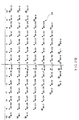
- FIGURE 2A shows the upper two quadrants of the complex plane of the signal constellation used with the present invention.
- FIGURE 2B shows the lower two quadrants of the complex plane of the signal constellation of the present invention.
- FIGURE 3 shows a fragmented portion of the upper, right hand quadrant of the signal constellation and illustrates the distance properties in the constellation.
- FIGURE 4 shows a data packet utilized in the present invention.
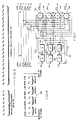
- FIGURE 5 is a schematic diagram of a portion of the convolutional encoder which generates the subset-selecting bits.
- FIGURE 6 shows a frame of the subset-selecting bits generated by the convolutional encoder.
- FIGURE 7 shows the structure of the convolutional encoder.
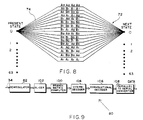
- FIGURE 8 shows two states of the trellis with the branches shown between the present state zero and the next state zero.
- FIGURE 9 is a block diagram of the receiver of the present invention.
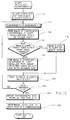
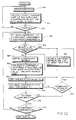
- FIGURE 10 is a flow chart of the branch metric calculator of the present invention.
- FIGURE 11 is a flow chart of the branch metric calculator of the present invention.
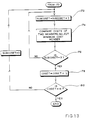
- FIGURE 12 is a flow chart of the branch metric calculator of the present invention.
- FIGURE 13 is a flow chart of the branch metric calculator of the present invention.
- FIGURE 14 is a flow chart of the Viterbi decoder of the present invention.
- FIGURE 1 there is shown a block diagram of the generalized structure of a transmitter 10 of a modem 12 in which the present invention is implemented.
- an information bit stream 14 is made up of serial digital data from a data source (not shown).
- bit sequences of fixed length are taken by a serial to parallel converter 16 to form packets of bits which are passed on to a convolutional encoder 18.
- a portion of the bits of each packet, symbol-selecting bits 20, are passed through the convolutional encoder 18 to a symbol generator 22.
- the remaining portion 24 of the bits of the packet are passed on to the convolutional encoder 18.
- the convolutional encoder 18 preferably, but not necessarily, is an encoder which allows for 2n dimensional coded modulation.
- a portion of the output of the convolutional encoder 18, i.e., subset-selecting bits 26, form a frame of an even number of bits, i.e., the subset-selection bits in a frame consist of 2n bits. In other implementations, the frame can have an odd number of bits.
- the subset-selecting bits 26 are passed to the symbol generator 22. For each received packet, the subset-selecting bits 26 and symbol-selecting bits 20 form an output of the encoder 18 that will be identified as the expanded bit sequence.
- the symbol generator 22 typically uses a pair (i.e., bit group) of the 2n subset-selecting bits each baud (i.e., symbol interval/modulation period) to specify one of four subsets into which a symbol constellation is partitioned.
- the symbol-selecting bits 20 are used by the symbol generator 22 to select a symbol (i.e., signal point in constellation) from each subset. Consequently, each packet from the converter 16 is mapped onto a group of n 2-dimensional symbols in n bauds (one group interval), where n is > 1 and defines a multidimensional point (symbol) 28.
- the multidimensional symbols 28, in a conventional manner, are filtered by bandwidth limiting filters and used to modulate a carrier in modulator and filter means 30 to provide a modulated carrier signal 32 to a band limited channel 34.
- the symbol generator 22 and modulator and filtering means 30 define a multidimensional coded modulation means 35.
- the modem 12 in which the present invention is preferably, but not necessarily, implemented transmits data at a rate of 19,200 bits per second.
- the symbol constellation 36 used by the symbol generator 22 of FIGURE 1 is shown in FIGURES 2A and 2B, with upper two quadrants and lower two quadrants of the complex plane of the constellation 36 being shown, respectively, in FIGURES 2A and 2B.
- the transmitter 10 uses eight dimensional coded modulation.
- the baud rate is 2742.86 symbols per second with 7 bits per baud.
- the constellation 36 has 160 complex 2-dimensional symbols, i.e., signal points, with each symbol having a specific alphanumerical identifier.
- the symbols are divided into outer and inner points, with a circle around each signal point that is an outside point.
- the symbol constellation 36 also is divided into four subsets A0, A1, B0, B1, which are the first portion of the symbol identifier. After the subset identifier, separately for both inner or outer symbol groups, the symbols within each subset are designated in the symbol identifier by the number after the hyphen. For example, the symbol identifier "A0-5" for a circled point indicates an outer point from the subset A0, with that particular point being designated by number 5 within the outer points of the subset A0.
- the constellation is not only partitioned into four subsets of A0, A1, B0, and B1, but the constellation is also divided into a portion having inner points and a portion having outer points.
- the preferred embodiment has four subsets, different numbers and arrangements of subsets are possible.
- Each subset is represented by a two bit number shown in Table 1.
- the subset-selecting bits 26 of FIGURE 1 form an output of the (m, m-1) convolutional encoder 18 of FIGURE 1 which can be represented by n 2-dimensional subsets of the form shown in Table 1.
- the integer m is equal to 2n plus the number of symbol selecting bits.
- MSB and LSB stand for most significant bit and least significant bit, respectively.
- FIGURE 3 To better illustrate the subset to symbol mapping provided by the symbol generator 22, a portion of the first quadrant of the symbol constellation 36 shown in FIGURE 2A is enlarged and shown in FIGURE 3.
- the symbols of the constellation 36 are on a square grid of the complex plane. From FIGURE 3 it can be seen that the maximum Euclidean distance of 2 1/2 (d) occurs between A0 and A1 as well as between B0 and B1.
- the minimum distance of d is between A0 and B0, A0 and B1, A1 and B0 and A1 and B1.
- the maximum Hamming distance also occurs between A0 and A1, as well as between B0 and B1.
- FIGURE 4 shows a packet of data generated by the serial to parallel converter 16 of FIGURE 1 which comprises 28 bits which go to the convolutional encoder 18.
- the bits x8-x28 are the symbol-selecting bits 20.
- bits x1, x2, x3, x4, x5, x6, and x7 form the input bits 24 to convolutional encoder 18 of FIGURE 1.
- the output bits y7, y6, y5, y4, y3, y2, y1, and y0 of the encoder 18 are grouped into four bit groups (y7 y6), (y5 y4), (y3 y2) and (y1 y0) that defines a frame 48 of bits of FIGURE 6.
- bits x1-x7 form only a portion of the expanded bit sequence output of the encoder 18 of FIGURE 1.
- FIGURES 5 and 6 shows the assignment of bit groups for each baud in the frame 48, with each bit group 50 defining a bit pair in the preferred embodiment.
- Each frame 48 has the duration of a group interval (time interval) that is four bauds in duration.
- each bit group 50 of FIGURE 5 corresponds to one of the four 2-dimensional subsets A0, A1, B0 and B1.
- a symbol is transmitted from one of the 2-dimensional subsets in each of the four bauds.
- each frame 48 of FIGURE 6 of eight bit output of the encoder 18 of FIGURE 1 corresponds to one of 256 8-dimensional symbol subsets, with each multidimensional symbol subset corresponding to a different combination of four 2-dimensional symbol subsets.
- the multidimensional symbol subset A1 B0 A0 B0 (11100010) corresponds to 2-dimensional symbol subsets (11), (10), (00) and (10).
- bit x7 occurring in the nth frame will be referred to as x 7 n .
- Table 2 shows the assignment of points from inner and outer points of the constellation 36 shown in FIGURES 2A-2B for different values of x 8 n , x 9 n and x 10 n .
- Bit x 8 n indicates whether the frame 48 of FIGURE 6 has any outer points or not.
- the dibit x 9 n x 10 n would indicate in which baud (and therefore bit group) the outer point would occur.
- "Inner” means inner point
- “Outer” means outer point.
- Table 3 shows how the symbol-selecting bits 20 of FIGURES 1 and 4 are assigned with each group of x 8 n , x 9 n , and x 10 n .
- FIGURE 7 shows the convolutional encoder 18 of FIGURES 1 and 5 in detail.
- the encoder 18 is a 64 state (8, 7) encoder.
- the encoder adds one redundancy bit; however, in the preferred embodiment the encoder adds less than one bit per baud of redundancy into the system. Encoders with redundancies greater than one bit (and therefore redundancy of one or greater per baud) can be used with the present invention.
- Input bits x 8 n through x 28 n are passed through unchanged and unused to become output bits y 8 n through y 28 n .
- Inputs x 4 n -x 7 n are used but pass through the encoder 18 without being changed and become output bits y 4 n -y 7 n .
- the input bits x 1 n -x 3 n are expanded to create the output bits y 0 n -y 3 n .
- the output bits of y 0 n through y 28 n are identified as the expanded bit sequence, which includes the subset-selecting bits y 0 n -y 7 n and the symbol-selecting bits y 8 n -y 28 n .
- the convolutional encoder 18 includes four modulo 2 adders 52, 54, 56, and 58, each connected to receive at least some of the bits x 3 n , x 2 n , and x 1 n .
- the encoder 18 includes six delay elements 60, 62, 64, 66, 68, and 70, with each element providing a delay of one group interval (four bauds).
- the input bit x 3 n is fed to the modulo adders 52 and 58 via line 70a
- the input bit x 2 n is fed to the modulo adders 54 and 58 via line 70b
- the input bit x 1 n is fed to the modulo adders 56 and 58 via line 70c.
- the bit x 3 n-1 is fed to the modulo adders 52 and 58 via line 70d
- the bit x 2 n-1 is fed to the modulo adders 54 and 58 via line 70e
- the bit x 1 n-1 is fed to the modulo adders 52, 54 and 56 via line 70f.
- the bit x 3 n-2 is fed to the modulo adders 54 and 58 via line 70g
- the bit x 2 n-2 is fed to the modulo adders 52 and 56 via line 70h
- the bit x 1 n-2 is fed to the modulo adders 54 and 56 via line 70i.
- the bit x 7 n is fed to the modulo adders 52, 54, and 56 via line 70j.
- the bit x 6 n is fed to the modulo adders 52, 54, and 58 via line 70k.
- the 4 bit x 5 n is fed to the modulo adders 52, 56, and 58 via line 70l.
- the bit x 4 n is fed to the modulo adders 54, 56 and 58 via line 70m.
- the convolutional encoder 18 of FIGURE 1 is a finite state device which passes through a succession of states, with each state being separated in time by one group interval.
- the encoder 18 of FIGURE 1 has 64 possible states (not all shown). Due to the fact that the encoder 18 has three binary inputs, for a given present state, only 8 of the next states are permissible, i.e., can be reached from the present state. Which next state occurs is a function of the present state and on the combination of the x 1 n , x 2 n , and x 3 n bits received each group interval. Each permissible transition from one state to another state is identified by a coset of parallel branches.
- the trellis can be used to diagram all permissible transitions between the present state to the next state of the encoder, although only the parallel branches 74 between present state 0 and next state 0 are shown in FIGURE 8.
- each branch is labeled by one of the 16 multidimensional symbol subsets of a given coset.
- 8 of the cosets are assigned to even number states and 8 are assigned to odd number states.
- the multidimensional symbol subsets associated with each branch can be indexed by integers ranging from 0 to 255.
- the 2-dimensional subsets therein preferably, but not necessarily, are arranged as a frame of subsets for bauds 4, 3, 2, 1, in that order.
- the encoder 18 transmits 29 bits in 4 bauds or 7.25 bits per baud.
- a receiver 80 of the modem is generally shown in the block diagram of FIGURE 9 and includes a demodulator 82.
- the noise affected modulated carrier signal is received over the channel 34 and in a conventional manner that will not be detailed herein is passed through the demodulator 82 (which is normally preceded by a Hilbert filter and passband equalizer) to produce a baseband signal consisting of a stream of received 2-dimensional symbol signals.
- the decoding process is repeated for each frame of received subset-defining bits (e.g., bits defining a multidimensional symbol subset), which is the received version of the frame transmitted and shown in FIGURE 6.
- the receiver operation is synchronized to the frames of the incoming signal i.e., the receiver must know the beginning of each frame. In other words, the receiver must determine which bit group in the received frame of subset-defining bits corresponds to the bit group (y1 y0) in the transmitted subset-defining bits. Having found this starting bit group, the receiver frame of received subset-defining bits is synchronized with the transmitter frame of subset-defining bits.
- Each received multidimensional signal provides information in the form of the multidimensional subsets of the multidimensional points sent.
- K 0 means that the point is inner
- K 1 means that the point is outer
- L 1 means that the point belongs to subset A0
- L 2 means that the point belongs to subset
- N index of the point in the subset.
- 2
- the slicer 102 thus finds eight nearest points for the received signal of each baud. Of these eight ideal points, four are inner points and four are outer points. A pair of inner and outer points belong to each of the four subset A0, B0, B1 and A1.
- d [J, K(J), L(J), N min (J)]
- the "K" terms are removed from the above equations, and the slicer 102 thus finds the four nearest points to the received signal for each baud, regardless of whether the nearest point is an inner point or an outer point. Only the costs (metrics) of the four nearest points to the received signal are needed for the branch metric (cost) calculator 100 of the second embodiment and there is no need for keeping track of the points themselves.
- a branch metric (cost) is the distance between a received multidimensional signal and possible multidimensional symbol from the multidimensional symbol subset corresponding to the branch of the trellis.
- a Viterbi decoder (to be described hereinafter) computes a cumulative path metric for each of the survivor paths during each frame. This cumulative path metric (cost) is the arithmetic sum of the metrics of the individual branches which form the particular path.
- the branch metric calculator 100 selects for each coset (group of 16 parallel branches each) that branch, i.e., multidimensional symbol subset, which has the minimum branch metric, which results in reducing the number of contending branches from 256 to 16.
- each coset group of 16 parallel branches each
- multidimensional symbol subset which has the minimum branch metric, which results in reducing the number of contending branches from 256 to 16.
- only one branch of each coset can be a candidate to be part of one of the surviving paths of the trellis during the decoding process.
- the described reduction by a factor of 16 of the contending branches is based upon which branch of said coset represents the multidimensional symbol subset which is closest to the received multidimensional signal.
- the present invention concerns the computations performed by the branch cost calculator 100.
- each branch of the trellis corresponds to a possible multidimensional symbol subset (therefore a four baud signal in the frame) and in this embodiment there are 256 branches, as identified by multidimensional symbol subsets A0 A0 A0 A0 through A1 A1 A1.
- each multidimensional symbol subset five possible signal combinations of 2-dimensional symbols can be constructed having inner (In) and outer (Out) points (symbols) as shown in Table 4.
- Table 4 we assume that the right most signal of the frame belongs to the first baud and the left most signal is that of the fourth baud.
- the brute force computation of Equation 6 would be done for each of the five combinations shown in Table 4 and the combination with the least value is chosen as the metric for the branch.
- 256, d2 values one for each of the 256 branches, with each squared distance d2 value representing the squared distances between the received 2-dimensional signal and the contending 2-dimensional symbol subsets.
- the contending branches are next reduced from 256 to 16, based upon selecting the lowest cost branch for each coset.
- the present invention is directed toward making it unnecessary to determine the branch metric for each branch and to directly compare all of the branch metrics (cost) during each group interval.
- the brute force approach can be avoided.
- the term "component” will be used in place of "2-dimensional symbol subset”.
- a branch is associated with a unique multidimensional symbol subset, which is a sequence of components and has n components.
- Each multidimensional symbol subset of a coset is defined as being a "member" of that coset.
- a submember of a member consists of part of the components of the member. The submember does not have all of the components of the member and only has components that form some part of the member in the same bauds. If two or more members (or submembers) have the same components for the same bauds, they are said to have common components, if not they are said to have non-common components in those bauds.
- the present invention makes use of the fact that several members have a common submember and the cost of this common submember (once calculated) can be used for all the members of any coset which has this common submember without having to be calculated repeatedly.
- FIGURE 8 it is important to note that the parallel branches 74 between states are merely added to conceptually illustrate that when the convolutional encoder passes from one state to another, as shown by the lines connecting the states, one of a plurality of multidimensional symbol subsets have been generated. Of course, the lines do not physically exist and what in fact exists is only a number representative of the multidimensional symbol subset.
- the 256 multidimensional symbol subsets (members) associated with 256 branches of the trellis for the encoder of FIGURE 6 are provided in Table 5.
- the 256 multidimensional symbol subsets are tabulated into sixteen cosets, with there being 16 members for each coset.
- the left most component is that of the fourth baud, the next is that of third baud, the next is that of second baud and the right most is that of first baud.
- the order of the components within a given member are predetermined; however, it should be understood that this order can be reversed, i.e., the first component can be for the first baud and the last component for the fourth baud.
- the arrangement of cosets and the members in each coset brings out the commonality of the components.
- This commonality reduces the number of calculations needed to compute the value of the branch cost as given by Equation 6.
- use of this commonality reduces computations in two ways. First, it reduces the computations required to eliminate members within a coset. Second, costs calculated for one coset can be used in the other cosets.
- the preferred arrangement of the first embodiment of the present invention will be described, with the properties generated by such arrangements being also described.
- the cosets are grouped into four sets.
- the set of four cosets is identified as a supercoset.
- each coset is divided into four sets, with each set having four members. This set is identified as a subcoset.
- the members within a coset are arranged so that the four members of a subcoset have a property that the left most component is common for all.
- subcoset 1 belonging to coset 15 is as follows: For the purposes of identification for each coset, the top most subcoset in each coset is identified as subcoset 1, with each one thereafter being progressively numbered until the bottom one, which is subcoset four.
- the four cosets which belong to the same supercoset have what is defined as a common three member property.
- any subcoset in a coset can be transformed to one of the subcoset in each of the other cosets belonging to the same supercoset by just changing the common components, i.e., the components within the same baud that are the same for all four members of the subcoset.
- the four components of four members in baud four consist of the same component, for this description and in the claims, they will be referred to in the plural, i.e., components.
- components Likewise, wherever there is a repetition of a common component in the same baud, when referring to the group, the term "components" is used. These common components will be referred to as the common-subcoset-components.
- the subcoset belonging to coset 15 can be transformed to subcoset of coset 12.
- the first column of common subset components from A0′s of subcoset 1 of coset 15 to A1′s, B0′s, or B1′s one obtains, respectively, subcoset 4 of coset 12, subcoset 3 of coset 1, or subcoset 2 of coset 2, all of which are in the same supercoset. This type of relationship holds true for all cosets within all supercosets.
- each subcoset there is commonality of two pairs of components in a second column. More particularly, for example, in coset 15, in the column for baud one, there are two common components of A1′s and two common components of A0′s. It is important to note that commonality is determined with reference to comparisons made between components of different members, not with components of the same member. Because each member has its components in a row, the commonality appears in the columns, although this could be reversed.
- each subcoset there are sixteen submembers containing the components for baud three and baud two, which can be split into eight sets of two submembers each.
- the component of each submember (consisting of two components) are the non-common components.
- the components of each submember are non-common components relative to the components of the other submember when a comparison is made between components of the two submembers of the same baud.
- Submember sets (1), (2), (3) and (4) of the first group are common to the supercoset 3 containing cosets 15, 12, 1 and 2, as well as to the supercoset 4 containing cosets 13, 14, 3 and 0.
- submember sets (5), (6), (7), and (8) of Group Two are common to supercoset 1 containing cosets 7, 4, 9, and 10 as well as supercoset 2 containing cosets 5, 6, 11 and 8.
- the subcosets in cosets 7, 4, 9, and 10 illustrate this point as follows in Table 7.
- each submember forming part of the set is defined as the non-common portion of the member and the balance of each member that does not form part of the set is defined as the common portion of the member.
- cost the minimum metric
- the components for bauds three, two and one, which define four submembers are repeated four times. Therefore, the cost computations done for four submembers in one coset can be used for the submembers in three other cosets. Hence, the cost computation is reduced by a factor of four.
- the outer point occurs only in one baud of a multidimensional-symbol-subset.
- an algorithm to minimize the number of computations can be based on the following principle which we will denote as principle of algorithm one, which is used in the first embodiment.
- algorithm one as previously described, the slicer 102 of FIGURE 9 computes the cost (metric or distance) of the nearest inner and outer point of each component (subset) to the received signal in each baud.
- the cost of baud three is added to baud two and the resulting cost is added to the cost of baud one and the second resulting cost is added to the cost of baud four.
- the rule is that, if the prior three-component submember contained an outer point as determined at block 154, then to the submember defined at block 156, the cost of the inner point for baud four is added at block 162. If there is no outer point, and for the member defined at block 156, the smaller cost of the two costs, one for the inner point and one for the outer point, is determined at block 150. As to the four-component members being defined in blocks 156 and 160, this is merely a matter of sequentially associating the baud four component (subset) to the appropriate submember.
- Each surviving three-component branch has the four components of baud four added thereto to generate the four members in four cosets of the same supercoset, as defined by the loop having blocks 164, 168 and 166. This is repeated for each surviving three-component submember as dictated by the loop having blocks 170 and 153. The cost of baud four is added to the three-component cost at block 162 and this is repeated for all 64 members.
- the branch metric calculator 100 of FIGURE 9 does not take into account whether a point is an inner point or an outer point.
- a second algorithm is used which requires a lesser number of operations than algorithm one of the first embodiment and will be referred to as algorithm two.
- algorithm two no distinction is made between the cost of inner and outer points.
- the algorithm will now be described in detail and basically results in a simplified version of the first and has the following steps, with Tables 7 and 8 being again applicable. 1) For each baud, the cost of the closest point in each component (subset) to the received point in slicer 102 as previously described.
- the number of additions for algorithm two is the same as the number of additions for algorithm one.
- the number of comparisons for algorithm 2 is less than the number of comparisons for algorithm one by sixteen.
- the overall complexity of algorithm two is smaller than that of algorithm one.
- the slicer 102 of FIGURE 9 for algorithm two has to do half the number of computations as the slicer for algorithm one, since the former does not have to search for inner and outer points separately.
- the members are needed during each addition. These members are tested to determine if the previous submember contains any outer point or not. Depending upon whether the previous submembers contained any outer point or not the subsequent instructions will have to be branched to the right location. This increases the number of instruction cycles needed to code the algorithm.
- the Viterbi decoder 104 for the first embodiment of the present invention in the receiver 80 uses the received multidimensional signals to estimate the original path of the encoder 18 through the trellis, such trellis being discussed with respect to FIGURE 8.
- the maximum likelihood path is determined by finding the possible sequence of multidimensional symbol subsets (which trellis path) which is closest to the sequence of received multidimensional signals.
- the receiver computes the minimum cost path and from the path history, determines the estimated multidimensional symbol.
- the Viterbi decoder 104 during each frame (group interval) extends each of the surviving paths to their successor state at the next frame.
- the metric (cost) of the extended path is obtained by adding the metric of the survivor to the branch metric of the corresponding branch which extends the path.
- the survivor at the next frame at a given state is found by comparing the metrics of all the extended paths which connect to a given state and choosing the minimum.
- the path history of the surviving paths is extended.
- the decoder 104 finds the minimum cost path among the survivors, and from the path history outputs the best estimate of the multidimensional symbol subset for the group interval to a convolutional decoder 106.
- the delay between the present frame and the present estimate (of the past symbol) can be 3v frames, where v is the constraint length of the convolutional encoder 18 and in this case is 6.
- the convolutional decoder 106 From the retained knowledge of the received multidimensional signal sequence and from the knowledge of the closest multidimensional symbol subset of the maximum likelihood path, the best estimate of the transmitted multidimensional symbol (point) is obtained. From the estimated, transmitted multidimensional signal the convolutional decoder 106 produces the packet data. Finally a serial to parallel converter 108 converts this packet to serial data.
- the Viterbi decoder 104 of FIGURE 9 for the second embodiment of the present invention is exactly the same conventional arrangement, except as follows. Once the minimum cost sequence is found and the corresponding member has been estimated at the receiver, it is necessary to determine (with knowledge of the corresponding received sequence, i.e., received multidimensional signal) which sequence of inner and outer points is closest to the received sequence which has just been estimated. As previously described and shown in Table 4, each member can be composed of five possible signal combinations of inner and outer points (2-dimensional symbols). The inner and outer points of the signal constellation are defined in Tables 2 and 3.
- the component costs of nearest ideal points can be used in the branch cost calculations (regardless of whether the nearest point is an inner or outer point) without significant loss in performance, if any resultant impermissible sequence of inner and outer signal points is corrected in the Viterbi decoder.
- the best estimate of a member which forms a part of the minimum cost path
- the received multidimensional signal i.e., multidimensional point (symbol) received
- the best estimate of the member i.e., a multidimensional symbol subset.
- the Viterbi decoder 104 calculates d BRANCH (I) of Equation 6 five times, one for each of the five combinations of Table 4.
- the "L” term is defined by the known member and the "K” term is defined by the particular sequence of inner and outer points. Consequently, there are five summed costs associated with the five combinations, and the combination with the minimum (smallest) summed cost is selected to be the multidimensional symbol provided to the convolutional decoder 106.
- the slicer output of the cost of the closest (in Euclidean distance) 2-dimensional symbol for each 2-dimensional symbol subset for each baud is used by the branch cost calculator.
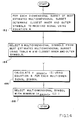
- the slicer must provide for each best estimated member (multidimensional-symbol-subset) the cost of the closest inner point and outer point, but only for those 2-dimensional symbol subsets of the best estimated member. Referring to the flow chart of FIGURE 16, this is done at block 182 for each best estimated member determined by the Viterbi decoder. Consequently, there are two 2-dimensional costs for each baud for a given best estimated member.
- five multidimensional symbols are selected from the best estimated multidimensional-symbol-subset (member) that have the sequences of inner and outer 2-dimensional symbols (components) shown in Table 4.
- the 2-dimensional cost provided above are summed to define a member (multidimensional cost), i.e. d BRANCH (I) of Equation 6, for each of the five multidimensional symbols.
- the multidimensional symbol with the minimum multidimensional cost (metric) is selected by the Viterbi decoder to be outputted to the convolutional decoder 106 and is defined as being the best estimated multidimensional symbol selected from the best estimated multidimensional-symbol-subset based upon the knowledge of the received multidimensional signal and the requirement of meeting one of the permissible sequences of Table 4.
- multidimensions shall mean more than 2-dimensions.
- the modem in which the present invention is implemented is a microprocessor based modem.
- the microprocessor-based modem control and data processing circuits also typically include the usual data storage elements (e.g., ROM for program control storage and the like, and RAM for variable input/output/intermediate result data, etc.) conventionally associated with a microprocessor CPU for performing desired manipulation of digital signals in accordance with a stored program.
- data storage elements e.g., ROM for program control storage and the like, and RAM for variable input/output/intermediate result data, etc.
- these already present microprocessor CPU, ROM and RAM elements are also utilized to perform the functions of the present invention.
- the modem functions are implemented in Texas Instrument's TMS 32020 processors.
- all of the transmitter modem functions therein are preferable, but not necessarily, performed by the digital signal processor.
- a D/A converter and antialasing filters are used.
- all of the receiver modem functions of FIGURE 9 are preferably, but not necessarily, performed by the digital signal processor.
- the received signal is processed by an A/D converter and filters.
- Equation 1 the dependence of y 3 n , y 2 n , y 1 n and y 0 n on x 7 n , x 6 n , x 5 n and x 4 n in Equation 1 can be expressed by the vector: where the first row corresponds to y 3 n , the second row to y 2 n , the third row to y 1 n and the fourth row to y 0 n . By interchanging the rows, a total of 24 different vectors can be obtained.
- H i (D) a v D v ⁇ a v-1 D v-1 ⁇ .... a0
- 1 0 ... v
- v is the constraint length of the encoder.
- the constraint length of the encoder is six, since there are six shift registers.
- the concept of the parity check equation and constraint length are well-known in the literature of convolutional codes as shown by U.S. patent 4,601,044 to Kromer et al.
- the total number of terms in the parity check equation is an even number.
- P is still zero, because of the even number of terms in the parity check equation.
- the received points are 180 degrees from the transmitted points.
- the received 2-dimensional subsets are changed as follows:
- the parity check equation P remains zero even though y i n goes to .
- the output sequence satisfies the parity check equation.
Landscapes
- Engineering & Computer Science (AREA)
- Computer Networks & Wireless Communication (AREA)
- Signal Processing (AREA)
- Physics & Mathematics (AREA)
- Probability & Statistics with Applications (AREA)
- Theoretical Computer Science (AREA)
- Digital Transmission Methods That Use Modulated Carrier Waves (AREA)
- Error Detection And Correction (AREA)
- Detection And Prevention Of Errors In Transmission (AREA)
Claims (40)
- Modulations-Demodulations-Vorrichtung (12) zur Übertragung einer Vielzahl von Informationsbits (14) über einen bandbegrenzten Kanal, wobei die Vorrichtung (12) einen Übertrager (10) mit einem Faltungscodierer (18) aufweist, dieser Faltungscodierer (18) während jedes aus einer Vielzahl von Gruppenintervallen eines aus einer Vielzahl von Mitgliedern einer Nebenmenge bereitstellt, diese Nebenmenge eine aus einer Vielzahl von Nebenmengen ist, welche jeweils einem einzigen erlaubten Übergang des Faltungscodierers (18) von einem gegebenen gegenwärtigen Zustand zu einem aus einer Vielzahl von nächsten Zuständen zugeordnet ist, jedes dieser Gruppenintervalle eine Vielzahl von Bauds aufweist, jedes der Mitglieder eine Vielzahl von Komponenten aufweist, wobei jede Komponente einem einzigen dieser Bauds zugeordnet ist, die Vorrichtung (12) weiterhin einen Empfänger (80) mit einem Verzweigungskostenrechner (100) zur Auswahl eines der Mitglieder aus jeder Nebenmenge für das Gruppenintervall auswählt, basierend auf dem ausgewählten Mitglied, dem ein minimaler Mitgliedskostenwert zugeordnet ist, relativ zu einer Vielzahl von Mitgliedskostenwerten der anderen Mitgliedern dieser Nebenmenge, wobei jeder dieser Mitgliedskostenwerte die Summe aus einer Vielzahl von Komponentenkosten für die Komponenten eines der Mitglieder ist, gekennzeichnet durch folgende Merkmale:· der Faltungscodierer (18) ist geeignet ausgebildet, um mindestens eine Gruppe von mindestens zwei dieser Mitglieder aus einer der Nebenmengen bereitzustellen, wobei die Mitglieder dieser Gruppe jeweils einen nichtgemeinsamen Anteil und einen gemeinsamen Anteil aufweisen, alle nichtgemeinsamen Anteile mindestens eine nichtgemeinsame Komponente aufweisen, welche sich unter den mindestens zwei Mitgliedern unterscheidet und jeder der gemeinsamen Anteile mindestens eine gemeinsame Komponente aufweist, welche bei den mindestens zwei Mitgliedern gleich ist;· der Verzweigungskostenrechner (100) weist eine Vergleichsvorrichtung zum Vergleich von mindestens zwei nichtgemeinsamen Anteilskosten auf, welche den nichtgemeinsamen Anteilen zugeordnet sind und zur Auswahl eines verbleibenden dieser nichtgemeinsamen Anteile mit minimalen nichtgemeinsamen Anteilskosten, wobei die Auswahl des verbleibenden nichtgemeinsamen Anteils, die auf den minimalen nichtgemeinsamen Anteilskosten basiert, bestimmt, welches der mindestens zwei Mitglieder die minimalen Mitgliedskosten aufweist.
- Modulations-Demodulations-Vorrichtung (12) nach Anspruch 1, wobei die nichtgemeinsamen Anteile der mindestens zwei Mitglieder eine Menge definieren, der Faltungscodierer (18) so ausgestaltet ist, daß diese Menge in mindestens einer anderen Nebenmenge wiederholt wird und der Verzweigungskostenrechner (100) darüberhinaus Mittel zum wiederholten Verwenden dieses minimalen nichtgemeinsamen Anteilskostenwerts aufweist, welcher durch Vergleich der nichtgemeinsamen Anteile dieser Menge einer Nebenmenge in mindestens einer weiteren Nebenmenge bestimmt wird, die auch diese Menge aufweist, ohne daß die Vergleichsvorrichtung den Vergleich der nichtgemeinsamen Anteile dieser Menge wiederholt.
- Modulations-Demodulations-Vorrichtung (12) nach Anspruch 1, wobei die Vergleichsvorrichtung Mittel zur Kategorisierung der Mitglieder jeder Nebenmenge in eine Vielzahl von Unternebenmengen aufweist, jede Unternebenmenge zwei Paare von Mitgliedern aufweist, der Faltungscodierer (18) so ausgestaltet ist, daß mindestens eine Gruppe diese Paare von Mitgliedern aufweist, wobei jedes Mitglied des Paars bezüglich des anderen Mitglieds des Paars den nichtgemeinsamen Anteil mit zwei nichtgemeinsamen Komponenten und den gemeinsamen Anteil mit zwei gemeinsamen Komponenten aufweist, eine der gemeinsamen Komponenten beider Paare der gleichen Unternebenmenge zwischen den Paaren für das gleiche Baud gemeinsam ist und somit vier Komponenten mit gemeinsamer Unternebenmenge definiert werden, wobei für jede Unternebenmenge die Komponenten für alle vier Mitglieder in einem der Bauds gemeinsam sind und zwei Paare der Komponenten innerhalb bzw. mit den Paaren in einem anderen Baud gemeinsam sind.
- Modulations-Demodulations-Vorrichtung (12) nach Anspruch 3, wobei die nichtgemeinsamen Anteilskostenwerte jeweils einen zweikomponentigen Kostenwert umfassen, der eine Summe ist aus den Komponentenkosten, welche den nichtgemeinsamen Komponenten zugeordnet sind, die einen der nichtgemeinsamen Anteile bilden und diese minimalen nichtgemeinsamen Komponentenkosten einen minimalen zweikomponentigen Kostenanteil umfassen, und die nichtgemeinsamen Anteile jedes Paars aus Mitgliedern eine Menge definieren, wobei die Vergleichsvorrichtung für jede einzelne Menge die den nichtgemeinsamen Anteilen der Mengen zugeordneten zweikomponentigen Kosten vergleicht und für jede dieser Mengen einen der nichtgemeinsamen Anteile auswählt, welcher die minimalen zweikomponentigen Kosten hat.
- Modulations-Demodulations-Vorrichtung (12) nach Anspruch 2, wobei jede Komponente eine zweidimensionale Symboluntermenge aus zwei dimensionalen Symbolen ist, jeder nichtgemeinsame Anteil mindestens zwei nichtgemeinsame Komponenten beinhaltet, und welche darüberhinaus einen Doppelbegrenzer (102) aufweist zur Bestimmung für mindestens eine erste nichtgemeinsame Komponente eines Paars aus Punktkostenwerten für jede dieser zweidimensionalen Symboluntermengen, wobei einer dieser Punktkostenwerte des Paars eine Größe aufweist, die sich auf einen euklidischen Abstand zwischen einem empfangenen Signal und einem inneren zweidimensionalen Symbol der zweidimensionalen Symboluntermenge bezieht, welches den geringsten euklidischen Abstand zu dem empfangenen Signal relativ zu einer Vielzahl anderer innerer zweidimensionaler Symbole der zweidimensionalen Symboluntermenge aufweist und der andere Punktkostenwert dieses Paars eine Größe aufweist, welche sich auf den euklidischen Abstand zwischen dem empfangenen Signal und einem äußeren zweidimensionalen Symbol der zweidimensionalen Symboluntermenge bezieht, welches den geringsten euklidischen Abstand zu dem empfangenen Signal relativ zu einer Vielzahl anderer äußerer zweidimensionaler Symbole der zweidimensionalen Symboluntermenge aufweist, und wobei die Vergleichsvorrichtung für jedes Paar von Punktkostenwerten den minimalen auswählt und dieser ausgewählte Punktkostenwert die Komponentenkosten für diese bestimmte Komponente umfaßt.
- Modulations-Demodulations-Vorrichtung (12) nach Anspruch 5, wobei die Vergleichsvorrichtung darüberhinaus Mittel zur Feststellung umfaßt, ob die erste nichtgemeinsame Komponente eines der äußeren zweidimensionalen Symbole beinhaltete und Mittel zur Definition einer zweiten nichtgemeinsamen Komponente, deren Komponentenkosten diejenigen eines der inneren zweidimensionalen Symbole aufweisen müssen, falls das äußere zweidimensionale Symbol vorher gefunden wurde.
- Modulations-Demodulations-Vorrichtung (12) nach Anspruch 2, wobei jede Komponente eine zweidimensionale Symboluntermenge aus zweidimensionalen Symbolen ist und die Vorrichtung darüberhinaus einen Doppelbegrenzer (102) zur Bestimmung der Komponentenkostenwerte für die zweidimensionalen Symboluntermengen aufweist, wobei jeder Komponentenkostenwert eine Größe umfaßt, die sich auf den euklidischen Abstand zwischen einem empfangenen Signal und einem der zweidimensionalen Symbole aus einer der zweidimensionalen Symboluntermengen bezieht, das den geringsten euklidischen Abstand zu dem empfangenen Signal relativ zu den anderen zweidimensionalen Symbolen der einen zweidimensionalen Symboluntermengen aufweist.
- Modulations-Demodulations-Vorrichtung (12) nach Anspruch 4, wobei die Kategorisierungsvorrichtung die Mitglieder derart gruppiert, daß sich in jeder Nebenmenge vier Unternebenmengen befinden, in jeder von vier Supernebenmengen vier Nebenmengen befinden, ein Anteil jedes Mitglieds, welcher keine der Komponenten gemeinsamer Unternebenmengen beinhaltet als Untermitglied mit drei Komponenten definiert wird, diese Untermitglieder jeder Unternebenmenge eine Untermitgliedergruppe definieren; und wobei der Faltungscodierer (18) so ausgebildet ist, daß innerhalb jeder Nebenmenge Komponenten gemeinsamer Unternebenmengen jeder Unternebenmenge nichtgemeinsam mit den Komponenten gemeinsamer Untermengen der anderen Unternebenmengen sind, wobei innerhalb jeder Supernebenmenge jede Nebenmenge Unternebenmengen aufweist mit den gleichen Komponenten gemeinsamer Untermengen wie die der Unternebenmengen der anderen Nebenmengen und jede Untermitgliedergruppe jeder Nebenmenge innerhalb einer der Supernebenmengen in jeder der anderen Nebenmengen in der einen Supernebenmenge wiederholt wird.
- Modulations-Demodulations-Vorrichtung (12) nach Anspruch 8, wobei acht einzelne Mengen vorhanden sind und die Vergleichsvorrichtung zum Vergleich der nichtgemeinsamen Anteile des Paars aus Mitgliedern von jeder dieser Mengen so auswählt, daß acht verbleibende nichtgemeinsame Anteile definiert werden.
- Modulations-Demodulations-Vorrichtung (12) nach Anspruch 3, wobei die nichtgemeinsamen Komponenten jedes Paars von Mitgliedern eine Menge dieser Komponenten definieren, wobei acht einzelne Mengen vorhanden sind und die Vergleichsvorrichtung zum Vergleich der nichtgemeinsamen Anteile des Paars von Mitgliedern den Vergleich für jede dieser Mengen wiederholen kann, um acht verbleibende nichtgemeinsame Anteile zu definieren.
- Modulations-Demodulations-Vorrichtung (12) nach Anspruch 9, wobei der Verzweigungskostenrechner (100) darüberhinaus Mittel zur Bildung einer Vielzahl dreikomponentiger Kostenwerte durch aufeinanderfolgende Addierung zu jedem zweikomponentigen Kostenwert einer der verbleibenden nichtgemeinsamen Bereiche jeden von vier möglichen Komponentenkostenwerten einer der gemeinsamen Komponenten, welche nicht identisch mit einer der Komponenten gemeinsamer Unternebenmenge ist, wobei zwei der dreikomponentigen Kosten für ein Paar verbleibender Untermitglieder jeder Untermitgliedergruppe definiert werden.
- Modulations-Demodulations-Vorrichtung (12) nach Anspruch 11, wobei der Verzweigungskostenrechner (100) darüberhinaus Mittel zur vor der Bildung des dreikomponentigen Kostenwerts stattfindenden Bestimmung aufweist, ob der zweikomponentige Kostenwert jedes nichtgemeinsamen Anteils einen der Komponentenkostenwerte für ein äußeres zweidimensionales Symbol beinhaltet und Mittel zur Definition dieser Komponentenkostenwerte für die gemeinsame Komponente, welche nicht die Komponente gemeinsamer Unternebenmengen ist, zum Einschließen eines dieser Komponentenkostenwerte eines inneren zweidimensionalen Symbols, falls der Komponentenkostenwert für das äußere zweidimensionale Symbol gefunden wurde.
- Modulations-Demodulations-Vorrichtung (12) nach Anspruch 11, wobei die Vergleichsvorrichtung die dreikomponentigen Kostenwerte der Paare von Untermitgliedern jeder Untermitgliedergruppe vergleicht und für jede Untermitgliedergruppe eines der Untermitglieder auswählt, welches den minimalen dreikomponentigen Kostenwert aufweist, wobei dieser minimale dreikomponentige Kostenwert ein Kostenwert für ein einzelnes verbleibendes Untermitglied der Untermitgliedergruppe ist.
- Modulations-Demodulations-Vorrichtung (12) nach Anspruch 13, wobei der Verzweigungskostenrechner (100) darüberhinaus Mittel zur wiederholten Benutzung des minimalen dreikomponentigen Kostenwerts in einer der Unternebenmengen jeder Nebenmenge innerhalb der selben Supernebenmenge umfaßt.
- Modulations-Demodulations-Vorrichtung (12) nach Anspruch 14, wobei der Verzweigungskostenrechner (100) darüberhinaus Mittel zur aufeinanderfolgen den Addition zu jedem verbleibenden dreikomponentigen Kostenwert von vier möglichen Komponentenkostenwert für die Komponenten gemeinsamer Unternebenmengen umfaßt, sowie zur Bildung eines Mitgliedskostenwerts in jeder Nebenmenge innerhalb einer Supernebenmenge und wobei die Vergleichsvorrichtung die Mitgliederkosten dieses Mitglieds für jede Unternebenmenge jeder Nebenmenge vergleicht und für jede Nebenmenge das Mitglied mit dem minimalen Mitgliedskostenwert auswählt.
- Modulations-Demodulations-Vorrichtung (12) nach Anspruch 15, wobei jede Komponente eine zweidimensionale Symboluntermenge aus zweidimensionalen Symbolen ist und die Vorrichtung darüberhinaus einen Doppelbegrenzer zur Bestimmung eines Paars von Punktkostenwerten in jedem Baud für jede zweidimensionale Symboluntermenge aufweist, wobei einer dieser Punktkostenwerte für dieses Paar für eines aus einer Vielzahl innerer zweidimensionaler Symbole aus der zweidimensionalen Symboluntermenge steht, welches den geringsten euklidischen Abstand zu einem empfangenen Signal relativ zu den anderen inneren zweidimensionalen Symbolen aus den zweidimensionalen Symboluntermengen aufweist und die anderen Punktkostenwerte dieses Paars für eines aus einer Vielzahl äußerer zweidimensionaler Symbole der zweidimensionalen Symboluntermenge stehen, welches den geringsten euklidischen Abstand zu dem empfangenen Signal aufweist, relativ zu den anderen äußeren zweidimensionalen Symbolen der zweidimensionalen Symboluntermengen, wobei für jedes Baud acht Punktkostenwerte existieren, von denen zwei für jede mögliche Komponente stehen.
- Modulations-Demodulations-Vorrichtung (12) nach Anspruch 16, wobei die Vergleichsvorrichtung für eine erste nichtgemeinsame Komponente aus den Punktkostenwerten für das Paar den Minimalwert auswählt, um den Komponentenkostenwert für die erste nichtgemeinsame Komponente zu definieren.
- Modulations-Demodulations-Vorrichtung (12) nach Anspruch 16, wobei die Vergleichsvorrichtung darüberhinaus Auswahlmittel zur Auswahl der Punktkostenwerte des Paars aufweist, welches ein Minimum ist, als Komponentenkostenwert für die zuerst betrachtete nichtgemeinsame Komponente und Definiermittel zur Spezifizierung des Komponentenkostenwerts als Punktkostenwert für eines der inneren zweidimensionalen Symbole für jede Komponente dieses Mitglieds, dessen Komponentenkostenwert durch die Vergleichsvorrichtung verglichen wird, nachdem das Minimum für den Punktkostenwert eines der äußeren zweidimensionalen Symbole von der Auswahlvorrichtung ausgewählt wurde.
- Modulations-Demodulations-Vorrichtung (12) nach Anspruch 2, wobei jedes der Mitglieder zu einer Vielzahl mehrdimensionaler Symboluntermengen gehört und jede der Komponenten zu einer Vielzahl aus zweidimensionalen Symboluntermengen gehört und in dem Übertrager (10) ein mehrdimensionales Symbol aus einer der mehrdimensionalen Symboluntermengen während jedes Gruppenintervalls zur Übertragung ausgewählt wird, wobei jedes mehrdimensionale Symbol eine Vielzahl zweidimensionaler Symbole beinhaltet und die zweidimensionalen Symbole innere und äußere und zweidimensionale Symbole beinhalten.
- Modulations-Demodulations-Vorrichtung (12) nach Anspruch 19, ferner umfassend:· einen Doppelbegrenzer (102) zur Bestimmung der Komponentenkostenwerte für die zweidimensionalen Symboluntermengen, wobei diese Komponentenkostenwerte dem Verzweigungskostenrechner (100) bereitgestellt werden, jeder der Komponentenkostenwerte einer der zweidimensionalen Symboluntermengen für ein zweidimensionales Symbol daraus steht, welches den geringsten euklidischen Abstand zu einem empfangenen Signal aufweist, unabhängig davon, ob das zweidimensionale Symbol zu den inneren zweidimensionalen Symbolen gehört und unabhängig davon, ob das zweidimensionale Symbol zu den äußeren zweidimensionalen Symbolen gehört;· einen Viterbi-Decoder (104) zur Bereitstellung eines bestabgeschätzten Mitglieds aus den Mitgliedern während jedes Gruppenintervalls;· wobei der Doppelbegrenzer (102) darüberhinaus für jede zweidimensionale Symboluntermenge bestabgeschätzter Mitglieder eines der inneren zweidimensionalen Symbole zur Verfügung stellt, das den geringsten euklidischen Abstand zu dem empfangenen Signal relativ zu den anderen inneren zweidimensionalen Symbolen der zweidimensionalen Symboluntermenge aufweist und der zugehörigen Komponentenkosten und eines der äußeren zweidimensionalen Symbole, welches den geringsten euklidischen Abstand zu dem empfangenen Signal aufweist relativ zu den anderen äußeren zweidimensionalen Symbolen der zweidimensionalen Symboluntermenge; und· der Viterbi-Decoder (104) das abgeschätzte Mitglied und das empfangene Signal zur Bestimmung einer Bestabschätzung eines mehrdimensionalen Symbols verwenden kann, wobei der Viterbi-Decoder (104) für das abgeschätzte Mitglied die Mitgliedskosten für jede aus einer Vielzahl erlaubter Sequenzen mit mindestens den inneren zweidimensionalen Symbolen und mindestens einem der äußeren zweidimensionalen Symbole berechnen kann.
- Modulations-Demodulations-Verfahren zur Übertragung einer Vielzahl von Informationsbits (14) über einen bandbegrenzten Kanal, wobei dieses Verfahren die Faltungscodierung der Vielzahl von Informationsbits (14) unter Verwendung eines Faltungscodierers (18) umfaßt, um so eines aus einer Vielzahl von Mitgliedern einer Nebenmenge während jedes aus einer Vielzahl von Gruppenintervallen bereitzustellen, wobei diese Nebenmenge eine aus einer Vielzahl von Nebenmengen ist, die jeweils einem einzigen erlaubten Übergang des Faltungscodierers (18) aus einem gegebenen, momentanen Zustand zu einem aus einer Vielzahl nächster Zustände zugeordnet ist, jedes dieser Gruppenintervalle eine Vielzahl von Bauds aufweist, jedes der Mitglieder eine Vielzahl von Komponenten aufweist, welche jeweils einem einzigen Baud zugeordnet sind, und das Verfahren ferner einen Empfänger (80) mit einem Verzweigungskostenrechner (100) umfaßt zur Auswahl eines der Mitglieder aus jeder Nebenmenge für das auf diesen ausgewählten Mitglied basierte Gruppenintervall, welchem ein minimaler Mitgliedskostenwert zugeordnet sind bezüglich einer Vielzahl von Mitgliedskostenwerten der anderen Mitglieder dieser Nebenmenge, wobei jeder der einzelnen Mitgliedskostenwerten eine Summe aus einer Vielzahl von Komponentenkosten für die Komponenten eines der Bauteile ist, gekennzeichnet durch folgende Verfahrensschritte:· Bereitstellung an diesen Übertrager (10) mindestens einer Gruppe aus mindestens zwei der Mitglieder aus einer der Nebenmengen, wodurch die Mitglieder dieser Gruppe jeweils einen nichtgemeinsamen Anteil und einen gemeinsamen Anteil aufweisen, alle nichtgemeinsamen Anteile mindestens eine nichtgemeinsame Komponente aufweisen, welche sich unter den mindestens zwei Mitgliedern unterscheidet und jeder der gemeinsamen Anteile mindestens eine gemeinsame Komponente aufweist, welche bei den mindestens zwei Mitgliedern gleich ist;· Vergleichen mindestens zweier nichtgemeinsamer Anteilskosten bei dem Empfänger (80), welche den nichtgemeinsamen Anteilen zugeordnet sind und Auswählen eines verbleibenden, nichtgemeinsamen Anteils mit minimalen, nichtgemeinsamen Anteilskosten, wobei das Auswählen des verbleibenden nichtgemeinsamen Anteils, basierend auf den minimalen nichtgemeinsamen Anteilskosten, bestimmt, welches der mindestens zwei Mitglieder die minimalen Mitgliedskosten aufweist.
- Modulations-Demodulations-Verfahren nach Anspruch 21, wobei die nichtgemeinsamen Anteile der mindestens zwei Mitglieder eine Menge definieren, der Verfahrensschritt der zur Verfügungsstellung außerdem beinhaltet, daß diese Menge in mindestens einer weiteren Nebenmenge wiederholt wird und darüberhinaus, nach dem Schritt des Auswählens, einen Verfahrensschritt der wiederholten Verwendung des nichtgemeinsamen Anteilskostenwerts umfaßt, welcher aus dem Vergleich der nichtgemeinsamen Anteile der Menge einer Nebenmenge in mindestens einer weiteren Nebenmenge, welche diese Menge ebenfalls aufweist, bestimmt wurden, ohne den Vergleich der nichtgemeinsamen Anteile der Menge wiederholen zu müssen.
- Modulations-Demodulations-Verfahren nach Anspruch 21, wobei der Verfahrensschritt des Vergleichens die Kategorisierung der Mitglieder für jede Nebenmenge in eine Vielzahl von Unternebenmengen umfaßt, jede dieser Unternebenmengen zwei Paare von Mitgliedern zur Definition einer Vielzahl von Paaren von Mitgliedern aufweist, der Verfahrensschritt der Bereitstellung darüberhinaus die Bereitstellung der mindestens einen Gruppe dieser Mitglieder als Vielzahl der Paare von Mitgliedern umfaßt, wobei jedes Mitglied jedes Paars relativ zu dem anderen Mitglied des Paars den nichtgemeinsamen Anteil mit zwei nichtgemeinsamen Komponenten und den gemeinsamen Anteil mit zwei gemeinsamen Komponenten aufweist, eine der gemeinsamen Komponenten beider Paare der gleichen Unternebenmenge zwischen den Paaren für das gleiche Baud gemeinsam ist und somit vier Komponenten mit gemeinsamer Unternebenmenge definiert werden, wobei für jede Unternebenmenge die Komponenten für alle vier Mitglieder in einem der Bauds gemeinsam sind und zwei Paare der Komponenten innerhalb bzw. mit den Paaren in einem anderen Baud gemeinsam sind.
- Modulations-Demodulations-Verfahren nach Anspruch 23, wobei die nichtgemeinsamen Anteilskostenwerte jeweils einen zweikomponentigen Kostenwert umfassen, der eine Summe ist aus den Komponentenkosten, welche den nichtgemeinsamen Komponenten zugeordnet sind, die einen der nichtgemeinsamen Anteile bilden und diese minimalen nichtgemeinsamen Komponentenkosten einen minimalen zweikomponentigen Kostenanteil umfassen, und die nichtgemeinsamen Anteile jedes Paars aus Mitgliedern eine Menge definieren, und wobei der Verfahrensschritt des Vergleichens für jede einzelne Menge den Vergleich der zweikomponentigen Kosten, welche den nichtgemeinsamen Anteilen der Mengen zugeordnet sind, umfaßt und die Auswahl für jede dieser Mengen einen der nichtgemeinsamen Anteile mit dem minimalen zweikomponentigen Kostenwert.
- Modulations-Demodulations-Verfahren nach Anspruch 22, wobei jede Komponente eine zweidimensionale Symboluntermenge aus zweidimensionalen Symbolen ist, und wobei der Verfahrensschritt des weiteren Bereitstellens darüberhinaus die Bereitstellung jedes nichtgemeinsamen Anteils zum Einschluß von mindestens zwei nichtgemeinsamen Komponenten umfaßt und darüberhinaus, vor dem Verfahrensschritt des Vergleichens, die Verfahrensschritte des Bestimmens für mindestens eine erste nichtgemeinsame Komponente eines Paars aus Punktkostenwerten für jede dieser zweidimensionalen Symboluntermengen, wobei einer dieser Punktkostenwerte des Paars eine Größe aufweist, die sich auf einen euklidischen Abstand zwischen einem empfangenen Signal und einem inneren zweidimensionalen Symbol der zweidimensionalen Symboluntermenge bezieht, welches den geringsten euklidischen Abstand zu dem empfangenen Signal relativ zu einer Vielzahl anderer innerer zweidimensionaler Symbole der zweidimensionalen Symboluntermenge aufweist und der andere Punktkostenwert dieses Paars eine Größe aufweist, welche sich auf den euklidischen Abstand zwischen dem empfangenen Signal und einem äußeren zweidimensionalen Symbol der zweidimensionalen Symboluntermenge bezieht, welches den geringsten euklidischen Abstand zu dem empfangenen Signal relativ zu einer Vielzahl anderer äußerer zweidimensionaler Symbole der zweidimensionalen Symboluntermenge aufweist, und wobei für jedes Paar von Punktkostenwerten das minimale ausgewählt wird und dieser ausgewählte Punktkostenwert die Komponentenkosten für diese bestimmte Komponente umfaßt.
- Modulations-Demodulations-Verfahren nach Anspruch 25, mit den zusätzlichen, vor dem Verfahrensschritt des Vergleichens stattfindenden, Verfahrensschritten der Bestimmung, ob die erste nichtgemeinsame Komponente eines der äußeren zweidimensionalen Symbole beinhaltete und der Definition einer zweiten nichtgemeinsamen Komponente, deren Komponentenkosten diejenigen eines der inneren zweidimensionalen Symbole aufweisen müssen, falls das äußere zweidimensionale Symbol vorher gefunden wurde.
- Modulations-Demodulations-Verfahren nach Anspruch 22, wobei jede Komponente eine zweidimensionale Symboluntermenge aus zweidimensionalen Symbolen ist und, vor dem Verfahrensschritt des Vergleichens, ein weiterer Verfahrensschritt der Bestimmung der Komponentenkostenwerte für die zweidimensionalen Symboluntermengen stattfindet, wobei jeder Komponentenkostenwert eine Größe umfaßt, die sich auf den euklidischen Abstand zwischen einem empfangenen Signal und einem der zweidimensionalen Symbole aus einer der zweidimensionalen Symboluntermengen bezieht, das den geringsten euklidischen Abstand zu dem empfangenen Signal relativ zu den anderen zweidimensionalen Symbolen der einen zweidimensionalen Symboluntermengen aufweist.
- Modulations-Demodulations-Verfahren nach Anspruch 24, wobei der Verfahrensschritt des Kategorisierens das Gruppieren der Mitglieder beinhaltet, so daß jede Nebenmenge vier Unternebenmengen beinhaltet und jede Supernebenmenge vier Nebenmengen beinhaltet, ein Anteil jedes Mitglieds, welcher keine der Komponenten gemeinsamer Unternebenmengen beinhaltet als Untermitglied mit drei Komponenten definiert wird, diese Untermitglieder jeder Unternebenmenge eine Untermitgliedergruppe definieren; und wobei der Verfahrensschritt der Bereitstellung der Mitglieder darüberhinaus umfaßt, daß innerhalb jeder Nebenmenge die Komponenten gemeinsamer Unternebenmengen jeder Unternebenmenge nichtgemeinsam mit den Komponenten gemeinsamer Untermengen der anderen Unternebenmengen sind, wobei innerhalb jeder Supernebenmenge jede Nebenmenge Unternebenmengen aufweist mit den gleichen Komponenten gemeinsamer Untermengen wie die der Unternebenmengen der anderen Nebenmengen und jede Untermitgliedergruppe jeder Nebenmenge innerhalb einer der Supernebenmengen in jeder der anderen Nebenmengen in der einen Supernebenmenge wiederholt wird.
- Modulations-Demodulations-Verfahren nach Anspruch 28, wobei acht einzelne Mengen vorhanden sind und der Verfahrensschritt des Vergleichens der nichtgemeinsamen Anteile der Paare von Mitgliedern den Verfahrensschritt des Auswählens aus jeder dieser Mengen umfaßt, um acht verbleibende nichtgemeinsame Anteile zu definieren.
- Modulations-Demodulations-Verfahren nach Anspruch 23, wobei die nichtgemeinsamen Komponenten jedes Paars von Mitgliedern eine Menge dieser Komponenten definieren, der Verfahrensschritt des Bereitstellens der Mitglieder die Bereitstellung von acht einzelnen Mengen beinhaltet, und der Verfahrensschritt des Vergleichens das wiederholte Vergleichen der nichtgemeinsamen Anteile der Paare von Mitgliedern für jede der Mengen umfaßt, um acht verbleibende nichtgemeinsame Anteile zu definieren.
- Modulations-Demodulations-Verfahren nach Anspruch 29, mit dem zusätzlichen, nach dem Verfahrensschritt des Vergleichens der nichtgemeinsamen Bereiche stattfindenden, Verfahrensschritt der Bildung einer Vielzahl dreikomponentiger Kostenwerte durch aufeinanderfolgende Addierung zu jedem zweikomponentigen Kostenwert einer der verbleibenden nichtgemeinsamen Bereiche jeden von vier möglichen Komponentenkostenwerten einer der gemeinsamen Komponenten, welche nicht identisch mit einer der Komponenten gemeinsamer Unternebenmenge ist, wobei zwei der dreikomponentigen Kostenwerte für ein Paar verbleibender Untermitglieder jeder Untermitgliedergruppe definiert werden.
- Modulations-Demodulations-Verfahren nach Anspruch 31, mit dem weiteren, vor dem Verfahrensschritt der Bildung stattfindenden, Verfahrensschritt der Bestimmung, ob der zweikomponentige Kostenwert jedes nichtgemeinsamen Anteils einen der Komponentenkostenwerte für ein äußeres zweidimensionales Symbol beinhaltet und Mittel zur Definition dieser Komponentenkostenwerte für die gemeinsame Komponente, welche nicht die Komponente gemeinsamer Unternebenmengen ist, zum Einschließen eines dieser Komponentenkostenwerte eines inneren zweidimensionalen Symbols, falls der Komponentenkostenwert für das äußere zweidimensionale Symbol gefunden wurde.
- Modulations-Demodulations-Verfahren nach Anspruch 31, wobei der Verfahrensschritt des Vergleichens darüberhinaus das Vergleichen der dreikomponentigen Kostenwerte der Paare der Untermitglieder jeder Untermitgliedergruppe und das Auswählen eines der Untermitglieder für jede Untermitgliedergruppe umfaßt, welches den minimalen dreikomponentigen Kostenwert aufweist, wobei dieser minimale dreikomponentiger Kostenwert ein Kostenwert für ein einzelnes verbleibendes Untermitglied der Untermitgliedergruppe ist.
- Modulations-Demodulations-Verfahren nach Anspruch 33, mit dem zusätzlichen, nach dem Verfahrensschritt des Auswählens eines der Untermitglieder stattfindenden, Verfahrensschritt der wiederholten Verwendung des minimalen dreikomponentigen Kostenwerts in einer der Unternebenmengen jeder Nebenmenge innerhalb der selben Supernebenmenge.
- Modulations-Demodulations-Verfahren nach Anspruch 29, mit dem zusätzlichen, nach dem Verfahrensschritt der wiederholten Verwendung des minimalen dreikomponentigen Kostenwerts stattfindenden, Verfahrensschritten des aufeinanderfolgenden Addierens zu jedem der verbleibenden dreikomponentigen Kostenwerte vier mögliche Komponentenkostenwerte für die Komponenten mit gemeinsamen Unternebenmengen zur Bildung eines Mitgliedskostenwerts in jeder der Nebenmengen innerhalb einer der Supernebenmengen, wobei der Verfahrensschritt des Vergleichens das Vergleichen der Mitgliederkosten der Mitglieder jeder Unternebenmenge jeder Nebenmenge und das Auswählen des Mitglieds mit den minimalen Mitgliedskosten für jede Nebenmenge umfaßt.
- Modulations-Demodulations-Verfahren nach Anspruch 35, wobei jede Komponente eine zweidimensionale Symboluntermenge ist und darüberhinaus ein Verfahrensschritt des Bestimmens eines Paares von Punktkostenwerten in jedem Baud stattfindet für jede zweidimensionale Symboluntermenge, wobei einer der Punktkostenwerte für dieses Paar für eines aus einer Vielzahl innerer zweidimensionaler Symbole aus der zweidimensionalen Symboluntermenge steht, welches den geringsten euklidischen Abstand zu einem empfangenen Signal relativ zu den anderen inneren zweidimensionalen Symbolen aus den zweidimensionalen Symboluntermengen aufweist und die anderen Punktkostenwerte dieses Paars für eines aus einer Vielzahl äußerer zweidimensionaler Symbole der zweidimensionalen Symboluntermenge stehen, welches den geringsten euklidischen Abstand zu dem empfangenen Signal aufweist, relativ zu den anderen äußeren zweidimensionalen Symbolen der zweidimensionalen Symboluntermengen, wobei für jedes Baud acht Punktkostenwerte existieren, von denen zwei für jede mögliche Komponente stehen.
- Modulations-Demodulations-Verfahren nach Anspruch 36, wobei der Verfahrensschritt des Vergleichens einer ersten nichtgemeinsamen Komponente darüberhinaus beinhaltet den Schritt des Auswählens des Minimums aus dem Paar von Punktkostenwerten, um den Komponentenkostenwert für die erste nichtgemeinsame Komponente zu definieren.
- Modulations-Demodulations-Verfahren nach Anspruch 36, wobei der Verfahrensschritt des Vergleichens darüberhinaus umfaßt das Auswählen der Punktkostenwerte für das Paar, welches minimal ist, als diejenigen Komponentenkosten für die nichtgemeinsame Komponente des zuerst betrachteten Mitglieds einer der Mitglieder und der Spezifizierung dieser Komponentenkosten als Punktkosten für eines der inneren zweidimensionalen Symbole für jede Komponente dieses Mitglieds, dessen Komponentenkostenwert verglichen wird, nachdem das Minimum für den Punktkostenwert eines der äußeren zweidimensionalen Symbole ausgewählt wurde.
- Modulations-Demodulations-Verfahren nach Anspruch 22, wobei jedes der Mitglieder zu einer Vielzahl mehrdimensionaler Symboluntermengen gehört und jede der Komponenten zu einer Vielzahl aus zweidimensionalen Symboluntermengen gehört und mit dem Verfahrensschritt des Auswählens bei dem Übertrager (10) eines mehrdimensionalen Symbols aus einer der mehrdimensionalen Symboluntermengen während jedes Gruppenintervalls, wobei jedes mehrdimensionale Symbol eine Vielzahl zweidimensionaler Symbole beinhaltet und die zweidimensionalen Symbole innere und äußere und zweidimensionale Symbole beinhalten.
- Modulations-Demodulations-Verfahren nach Anspruch 39, mit den folgenden zusätzlichen Verfahrensschritten:· Bestimmung der Komponentenkostenwerte für die zweidimensionalen Symboluntermengen, die den Verzweigungskostenrechnungen bereitgestellt werden, wobei jeder der Komponentenkostenwerte einer der zweidimensionalen Symboluntermengen für ein zweidimensionales Symbol daraus steht, welches den geringsten euklidischen Abstand zu einem empfangenen Signal aufweist, unabhängig davon, ob das zweidimensionale Symbol zu den inneren zweidimensionalen Symbolen gehört und unabhängig davon, ob das zweidimensionale Symbol zu den äußeren zweidimensionalen Symbolen gehört;· Bereitstellung eines bestabgeschätzten Mitglieds aus den Mitgliedern während jedes Gruppenintervalls unter Verwendung eines Viterbi-Decoders;· weitere Bereitstellung für jede zweidimensionale Untermenge bestabgeschätzter Mitglieder eines der inneren zweidimensionalen Symbole, das den geringsten euklidischen Abstand zu dem empfangenen Signal relativ zu den anderen inneren zweidimensionalen Symbolen der zweidimensionalen Symboluntermenge aufweist und der zugehörigen Komponentenkosten und eines der äußeren zweidimensionalen Symbole, welches den geringsten euklidischen Abstand zu dem empfangenen Signal aufweist relativ zu den anderen äußeren zweidimensionalen Symbolen der zweidimensionalen Symboluntermenge und der zugehörigen Komponentenkosten; und· Verwendung dieses abgeschätzten Mitglieds und des empfangenen Signals zur Bestimmung einer Bestabschätzung eines mehrdimensionalen Symbols, und Berechnung der Mitgliedskosten für das abgeschätzte Mitglied für jede aus einer Vielzahl erlaubter Sequenzen mit mindestens den inneren zweidimensionalen Symbolen und mindestens einem der äußeren zweidimensionalen Symbole.
Applications Claiming Priority (3)
| Application Number | Priority Date | Filing Date | Title |
|---|---|---|---|
| US4389 | 1987-01-15 | ||
| US07/004,389 US4761784A (en) | 1987-01-15 | 1987-01-15 | Modem and method using multidimensional coded modulation |
| PCT/US1987/003356 WO1988005571A1 (en) | 1987-01-15 | 1987-12-16 | Modem and method using multidimensional coded modulation |
Publications (3)
| Publication Number | Publication Date |
|---|---|
| EP0341256A1 EP0341256A1 (de) | 1989-11-15 |
| EP0341256A4 EP0341256A4 (en) | 1991-09-11 |
| EP0341256B1 true EP0341256B1 (de) | 1995-02-01 |
Family
ID=21710565
Family Applications (1)
| Application Number | Title | Priority Date | Filing Date |
|---|---|---|---|
| EP88900914A Expired - Lifetime EP0341256B1 (de) | 1987-01-15 | 1987-12-16 | Modem und verfahren zur verwendung mehrdimensionaler kodierter modulierung |
Country Status (6)
| Country | Link |
|---|---|
| US (1) | US4761784A (de) |
| EP (1) | EP0341256B1 (de) |
| JP (1) | JPH02504690A (de) |
| CA (1) | CA1295741C (de) |
| DE (1) | DE3751039T2 (de) |
| WO (1) | WO1988005571A1 (de) |
Families Citing this family (26)
| Publication number | Priority date | Publication date | Assignee | Title |
|---|---|---|---|---|
| JP2521925B2 (ja) * | 1986-10-14 | 1996-08-07 | 日本電気株式会社 | 畳み込み符号器 |
| US4809300A (en) * | 1988-04-05 | 1989-02-28 | General Datacomm, Inc. | Branch metric algorithm for eight-dimensional signal constellation |
| DE3910739C3 (de) * | 1989-04-03 | 1996-11-21 | Deutsche Forsch Luft Raumfahrt | Verfahren zum Verallgemeinern des Viterbi-Algorithmus und Einrichtungen zur Durchführung des Verfahrens |
| DE68915758T2 (de) * | 1989-07-07 | 1994-12-08 | Ibm | Blockkodierungsschema für die Übertragung von partiellen Bits. |
| US5185763A (en) * | 1991-04-09 | 1993-02-09 | Racal-Datacom, Inc. | Data bit to constellation symbol mapper |
| US5119403A (en) * | 1991-04-09 | 1992-06-02 | Racal Data Communications Inc. | Superframes |
| US5243605A (en) * | 1991-07-11 | 1993-09-07 | Storage Technology Corporation | Modified viterbi detector with run-length code constraint |
| US5263052A (en) * | 1991-09-30 | 1993-11-16 | Motorola, Inc. | Viterbi equalizer for radio receiver |
| US5754600A (en) * | 1994-08-29 | 1998-05-19 | Motorola, Inc. | Method and apparatus for optimum soft-decision viterbi decoding of convolutional-differential encoded QPSK data in coherent detection |
| US5841796A (en) * | 1995-03-14 | 1998-11-24 | Comsat Corporation | Apparatus and method for calculating viterbi path metric using exponentially-weighted moving average |
| US5675139A (en) * | 1995-05-18 | 1997-10-07 | Symbol Technologies, Inc. | Interface arrangement for use with consumer devices |
| US7254167B2 (en) | 1998-10-30 | 2007-08-07 | Broadcom Corporation | Constellation-multiplexed transmitter and receiver |
| US6760385B1 (en) * | 2000-05-30 | 2004-07-06 | Adtran, Inc. | Universal parallel processing decoder |
| US6654928B1 (en) * | 2000-07-20 | 2003-11-25 | Nokia Mobile Phones Limited | Hybrid dimensional, spherical space-time coding and decoding apparatus, and associated method, for a communication system |
| US7230993B2 (en) * | 2002-03-06 | 2007-06-12 | Nokia Corporation | Method and apparatus for modulation using an at least four-dimensional signal constellation |
| US7822150B2 (en) * | 2003-03-15 | 2010-10-26 | Alcatel-Lucent Usa Inc. | Spherical decoder for wireless communications |
| US7613260B2 (en) | 2005-11-21 | 2009-11-03 | Provigent Ltd | Modem control using cross-polarization interference estimation |
| US7796708B2 (en) * | 2006-03-29 | 2010-09-14 | Provigent Ltd. | Adaptive receiver loops with weighted decision-directed error |
| US7643512B2 (en) | 2006-06-29 | 2010-01-05 | Provigent Ltd. | Cascaded links with adaptive coding and modulation |
| US7839952B2 (en) * | 2006-12-05 | 2010-11-23 | Provigent Ltd | Data rate coordination in protected variable-rate links |
| US7720136B2 (en) | 2006-12-26 | 2010-05-18 | Provigent Ltd | Adaptive coding and modulation based on link performance prediction |
| US8315574B2 (en) * | 2007-04-13 | 2012-11-20 | Broadcom Corporation | Management of variable-rate communication links |
| US7821938B2 (en) * | 2007-04-20 | 2010-10-26 | Provigent Ltd. | Adaptive coding and modulation for synchronous connections |
| US8001445B2 (en) * | 2007-08-13 | 2011-08-16 | Provigent Ltd. | Protected communication link with improved protection indication |
| US8040985B2 (en) | 2007-10-09 | 2011-10-18 | Provigent Ltd | Decoding of forward error correction codes in the presence of phase noise |
| WO2010011500A1 (en) * | 2008-07-25 | 2010-01-28 | Smith International, Inc. | Pdc bit having split blades |
Family Cites Families (7)
| Publication number | Priority date | Publication date | Assignee | Title |
|---|---|---|---|---|
| CH609510A5 (de) * | 1976-06-18 | 1979-02-28 | Ibm | |
| US4457004A (en) * | 1982-02-08 | 1984-06-26 | Bell Telephone Laboratories, Incorporated | Multidimensional channel coding |
| US4597090A (en) * | 1983-04-14 | 1986-06-24 | Codex Corporation | Block coded modulation system |
| US4700349A (en) * | 1984-02-06 | 1987-10-13 | Codex Corporation | Coded modulation system |
| US4581601A (en) * | 1984-06-25 | 1986-04-08 | At&T Bell Laboratories | Multi-dimensional coding for error reduction |
| US4709377A (en) * | 1985-03-13 | 1987-11-24 | Paradyne | Viterbi decoder for wireline modems |
| US4713817A (en) * | 1985-04-25 | 1987-12-15 | Codex Corporation | Multidimensional, convolutionally coded communication systems |
-
1987
- 1987-01-15 US US07/004,389 patent/US4761784A/en not_active Expired - Lifetime
- 1987-12-16 WO PCT/US1987/003356 patent/WO1988005571A1/en not_active Ceased
- 1987-12-16 EP EP88900914A patent/EP0341256B1/de not_active Expired - Lifetime
- 1987-12-16 JP JP63501077A patent/JPH02504690A/ja active Pending
- 1987-12-16 DE DE3751039T patent/DE3751039T2/de not_active Expired - Fee Related
-
1988
- 1988-01-08 CA CA000556101A patent/CA1295741C/en not_active Expired - Fee Related
Also Published As
| Publication number | Publication date |
|---|---|
| EP0341256A1 (de) | 1989-11-15 |
| WO1988005571A1 (en) | 1988-07-28 |
| DE3751039D1 (de) | 1995-03-16 |
| JPH02504690A (ja) | 1990-12-27 |
| CA1295741C (en) | 1992-02-11 |
| DE3751039T2 (de) | 1995-05-24 |
| US4761784A (en) | 1988-08-02 |
| EP0341256A4 (en) | 1991-09-11 |
Similar Documents
| Publication | Publication Date | Title |
|---|---|---|
| EP0341256B1 (de) | Modem und verfahren zur verwendung mehrdimensionaler kodierter modulierung | |
| EP0344213B1 (de) | Viterbidekodierer mit verringerter zahl von datentransportoperationen | |
| US4933956A (en) | Simplified decoding of lattices and codes | |
| US4807230A (en) | Frame synchronization | |
| EP0200505B1 (de) | Gerät zur Übertragung von Datenbitgruppen und Verfahren zur Beurteilung der mit der grössten Wahrscheinlichkeit übertragenen Sequenz | |
| US4700349A (en) | Coded modulation system | |
| US4597090A (en) | Block coded modulation system | |
| US4713829A (en) | Coded modulation system with a simplified decoder capable of reducing the effects of channel distortion | |
| US4583236A (en) | Modified absolute phase detector | |
| US5535228A (en) | Device and method for achieving rotational invariance in a multi-level trellis coding system | |
| EP1031218B1 (de) | Zeitvariante trelliskodierte phasensprungmodulation | |
| EP0660534B1 (de) | Fehlerkorrektursysteme mit veränderter Viterbidekodierung | |
| US4755998A (en) | Coded modulation system | |
| US4896353A (en) | Apparatus for fast decoding of a non-linear code | |
| US5594742A (en) | Bidirectional trellis coding | |
| US5077743A (en) | System and method for decoding of convolutionally encoded data | |
| JP3348303B2 (ja) | ビタビ復号方法およびその装置 | |
| JPH0683284B2 (ja) | モデム | |
| US5619540A (en) | Transmission system using block-coded or trellis-coded modulations, receiver and decoder for such a system | |
| JPH0214622A (ja) | 最尤復号法 | |
| WO1999041887A1 (fr) | Codage multidimensionnel, et procede et dispositif de codage |
Legal Events
| Date | Code | Title | Description |
|---|---|---|---|
| PUAI | Public reference made under article 153(3) epc to a published international application that has entered the european phase |
Free format text: ORIGINAL CODE: 0009012 |
|
| 17P | Request for examination filed |
Effective date: 19890701 |
|
| AK | Designated contracting states |
Kind code of ref document: A1 Designated state(s): DE FR GB LU NL |
|
| RHK1 | Main classification (correction) |
Ipc: H03M 13/12 |
|
| A4 | Supplementary search report drawn up and despatched |
Effective date: 19910722 |
|
| AK | Designated contracting states |
Kind code of ref document: A4 Designated state(s): DE FR GB LU NL |
|
| R17P | Request for examination filed (corrected) |
Effective date: 19890701 |
|
| RBV | Designated contracting states (corrected) |
Designated state(s): DE FR GB NL |
|
| RAP1 | Party data changed (applicant data changed or rights of an application transferred) |
Owner name: RACAL-DATACOM, INC. |
|
| 17Q | First examination report despatched |
Effective date: 19931007 |
|
| GRAA | (expected) grant |
Free format text: ORIGINAL CODE: 0009210 |
|
| AK | Designated contracting states |
Kind code of ref document: B1 Designated state(s): DE FR GB NL |
|
| PG25 | Lapsed in a contracting state [announced via postgrant information from national office to epo] |
Ref country code: NL Effective date: 19950201 |
|
| ET | Fr: translation filed | ||
| REF | Corresponds to: |
Ref document number: 3751039 Country of ref document: DE Date of ref document: 19950316 |
|
| NLV1 | Nl: lapsed or annulled due to failure to fulfill the requirements of art. 29p and 29m of the patents act | ||
| PLBE | No opposition filed within time limit |
Free format text: ORIGINAL CODE: 0009261 |
|
| STAA | Information on the status of an ep patent application or granted ep patent |
Free format text: STATUS: NO OPPOSITION FILED WITHIN TIME LIMIT |
|
| 26N | No opposition filed | ||
| PGFP | Annual fee paid to national office [announced via postgrant information from national office to epo] |
Ref country code: FR Payment date: 19981202 Year of fee payment: 12 |
|
| PGFP | Annual fee paid to national office [announced via postgrant information from national office to epo] |
Ref country code: GB Payment date: 19981203 Year of fee payment: 12 |
|
| PGFP | Annual fee paid to national office [announced via postgrant information from national office to epo] |
Ref country code: DE Payment date: 19981204 Year of fee payment: 12 |
|
| REG | Reference to a national code |
Ref country code: GB Ref legal event code: 732E |
|
| PG25 | Lapsed in a contracting state [announced via postgrant information from national office to epo] |
Ref country code: GB Free format text: LAPSE BECAUSE OF NON-PAYMENT OF DUE FEES Effective date: 19991216 |
|
| GBPC | Gb: european patent ceased through non-payment of renewal fee |
Effective date: 19991216 |
|
| PG25 | Lapsed in a contracting state [announced via postgrant information from national office to epo] |
Ref country code: FR Free format text: LAPSE BECAUSE OF NON-PAYMENT OF DUE FEES Effective date: 20000831 |
|
| PG25 | Lapsed in a contracting state [announced via postgrant information from national office to epo] |
Ref country code: DE Free format text: LAPSE BECAUSE OF NON-PAYMENT OF DUE FEES Effective date: 20001003 |
|
| REG | Reference to a national code |
Ref country code: FR Ref legal event code: ST |