EP0339079B1 - Embossing of coated sheets - Google Patents
Embossing of coated sheets Download PDFInfo
- Publication number
- EP0339079B1 EP0339079B1 EP89900030A EP89900030A EP0339079B1 EP 0339079 B1 EP0339079 B1 EP 0339079B1 EP 89900030 A EP89900030 A EP 89900030A EP 89900030 A EP89900030 A EP 89900030A EP 0339079 B1 EP0339079 B1 EP 0339079B1
- Authority
- EP
- European Patent Office
- Prior art keywords
- coating
- embossing
- thermoplastic
- temperature
- sheeting
- Prior art date
- Legal status (The legal status is an assumption and is not a legal conclusion. Google has not performed a legal analysis and makes no representation as to the accuracy of the status listed.)
- Expired - Lifetime
Links
- 238000004049 embossing Methods 0.000 title claims abstract description 123
- 238000000576 coating method Methods 0.000 claims abstract description 142
- 239000011248 coating agent Substances 0.000 claims abstract description 135
- 238000000034 method Methods 0.000 claims abstract description 50
- 239000000758 substrate Substances 0.000 claims abstract description 40
- 230000003746 surface roughness Effects 0.000 claims abstract description 18
- 238000005034 decoration Methods 0.000 claims abstract description 11
- 229920001169 thermoplastic Polymers 0.000 claims description 82
- 239000004416 thermosoftening plastic Substances 0.000 claims description 82
- 239000002985 plastic film Substances 0.000 claims description 38
- 229920006255 plastic film Polymers 0.000 claims description 38
- -1 polysiloxane Polymers 0.000 claims description 21
- 239000000463 material Substances 0.000 claims description 17
- 239000003795 chemical substances by application Substances 0.000 claims description 14
- 238000010438 heat treatment Methods 0.000 claims description 11
- 230000000694 effects Effects 0.000 claims description 10
- 229920001296 polysiloxane Polymers 0.000 claims description 10
- 239000004698 Polyethylene Substances 0.000 claims description 9
- 229920000573 polyethylene Polymers 0.000 claims description 9
- 239000004793 Polystyrene Substances 0.000 claims description 7
- 229920002223 polystyrene Polymers 0.000 claims description 7
- 229920000915 polyvinyl chloride Polymers 0.000 claims description 5
- 239000004800 polyvinyl chloride Substances 0.000 claims description 5
- 238000005096 rolling process Methods 0.000 claims description 4
- 239000012815 thermoplastic material Substances 0.000 claims description 4
- 239000000853 adhesive Substances 0.000 claims description 3
- 239000004922 lacquer Substances 0.000 claims description 3
- 229920000139 polyethylene terephthalate Polymers 0.000 claims description 2
- 239000005020 polyethylene terephthalate Substances 0.000 claims description 2
- NJVOHKFLBKQLIZ-UHFFFAOYSA-N (2-ethenylphenyl) prop-2-enoate Chemical compound C=CC(=O)OC1=CC=CC=C1C=C NJVOHKFLBKQLIZ-UHFFFAOYSA-N 0.000 claims 2
- 239000002174 Styrene-butadiene Substances 0.000 claims 2
- MTAZNLWOLGHBHU-UHFFFAOYSA-N butadiene-styrene rubber Chemical compound C=CC=C.C=CC1=CC=CC=C1 MTAZNLWOLGHBHU-UHFFFAOYSA-N 0.000 claims 2
- 229920002689 polyvinyl acetate Polymers 0.000 claims 2
- 239000011118 polyvinyl acetate Substances 0.000 claims 2
- 239000011115 styrene butadiene Substances 0.000 claims 2
- 229920003048 styrene butadiene rubber Polymers 0.000 claims 2
- 241000711981 Sais Species 0.000 claims 1
- VQLYBLABXAHUDN-UHFFFAOYSA-N bis(4-fluorophenyl)-methyl-(1,2,4-triazol-1-ylmethyl)silane;methyl n-(1h-benzimidazol-2-yl)carbamate Chemical compound C1=CC=C2NC(NC(=O)OC)=NC2=C1.C=1C=C(F)C=CC=1[Si](C=1C=CC(F)=CC=1)(C)CN1C=NC=N1 VQLYBLABXAHUDN-UHFFFAOYSA-N 0.000 claims 1
- 229920003023 plastic Polymers 0.000 abstract description 7
- 239000004033 plastic Substances 0.000 abstract description 7
- 239000010408 film Substances 0.000 description 29
- 239000000123 paper Substances 0.000 description 21
- 239000002131 composite material Substances 0.000 description 13
- 238000001465 metallisation Methods 0.000 description 10
- 229920002678 cellulose Polymers 0.000 description 8
- 239000001913 cellulose Substances 0.000 description 8
- 238000001125 extrusion Methods 0.000 description 7
- YXFVVABEGXRONW-UHFFFAOYSA-N Toluene Chemical compound CC1=CC=CC=C1 YXFVVABEGXRONW-UHFFFAOYSA-N 0.000 description 6
- 239000002904 solvent Substances 0.000 description 5
- XLYOFNOQVPJJNP-UHFFFAOYSA-N water Substances O XLYOFNOQVPJJNP-UHFFFAOYSA-N 0.000 description 4
- 239000002184 metal Substances 0.000 description 3
- 239000000654 additive Substances 0.000 description 2
- 238000001035 drying Methods 0.000 description 2
- 239000000976 ink Substances 0.000 description 2
- 239000006223 plastic coating Substances 0.000 description 2
- 239000007787 solid Substances 0.000 description 2
- NIXOWILDQLNWCW-UHFFFAOYSA-N acrylic acid group Chemical group C(C=C)(=O)O NIXOWILDQLNWCW-UHFFFAOYSA-N 0.000 description 1
- 230000000996 additive effect Effects 0.000 description 1
- 238000003490 calendering Methods 0.000 description 1
- 239000004927 clay Substances 0.000 description 1
- 239000003086 colorant Substances 0.000 description 1
- 238000001816 cooling Methods 0.000 description 1
- 230000000994 depressogenic effect Effects 0.000 description 1
- 239000000975 dye Substances 0.000 description 1
- 239000000839 emulsion Substances 0.000 description 1
- 238000007765 extrusion coating Methods 0.000 description 1
- 239000012943 hotmelt Substances 0.000 description 1
- 230000002452 interceptive effect Effects 0.000 description 1
- 239000007788 liquid Substances 0.000 description 1
- 239000002932 luster Substances 0.000 description 1
- 238000004519 manufacturing process Methods 0.000 description 1
- 239000011104 metalized film Substances 0.000 description 1
- 239000000203 mixture Substances 0.000 description 1
- 230000004048 modification Effects 0.000 description 1
- 238000012986 modification Methods 0.000 description 1
- 239000000049 pigment Substances 0.000 description 1
- 229920006267 polyester film Polymers 0.000 description 1
- 239000012858 resilient material Substances 0.000 description 1
- 239000005060 rubber Substances 0.000 description 1
- 238000000926 separation method Methods 0.000 description 1
- 239000000126 substance Substances 0.000 description 1
- 229920001187 thermosetting polymer Polymers 0.000 description 1
Images


Classifications
-
- B—PERFORMING OPERATIONS; TRANSPORTING
- B29—WORKING OF PLASTICS; WORKING OF SUBSTANCES IN A PLASTIC STATE IN GENERAL
- B29C—SHAPING OR JOINING OF PLASTICS; SHAPING OF MATERIAL IN A PLASTIC STATE, NOT OTHERWISE PROVIDED FOR; AFTER-TREATMENT OF THE SHAPED PRODUCTS, e.g. REPAIRING
- B29C59/00—Surface shaping of articles, e.g. embossing; Apparatus therefor
- B29C59/02—Surface shaping of articles, e.g. embossing; Apparatus therefor by mechanical means, e.g. pressing
- B29C59/04—Surface shaping of articles, e.g. embossing; Apparatus therefor by mechanical means, e.g. pressing using rollers or endless belts
- B29C59/046—Surface shaping of articles, e.g. embossing; Apparatus therefor by mechanical means, e.g. pressing using rollers or endless belts for layered or coated substantially flat surfaces
-
- B—PERFORMING OPERATIONS; TRANSPORTING
- B29—WORKING OF PLASTICS; WORKING OF SUBSTANCES IN A PLASTIC STATE IN GENERAL
- B29D—PRODUCING PARTICULAR ARTICLES FROM PLASTICS OR FROM SUBSTANCES IN A PLASTIC STATE
- B29D11/00—Producing optical elements, e.g. lenses or prisms
-
- B—PERFORMING OPERATIONS; TRANSPORTING
- B29—WORKING OF PLASTICS; WORKING OF SUBSTANCES IN A PLASTIC STATE IN GENERAL
- B29C—SHAPING OR JOINING OF PLASTICS; SHAPING OF MATERIAL IN A PLASTIC STATE, NOT OTHERWISE PROVIDED FOR; AFTER-TREATMENT OF THE SHAPED PRODUCTS, e.g. REPAIRING
- B29C59/00—Surface shaping of articles, e.g. embossing; Apparatus therefor
- B29C59/02—Surface shaping of articles, e.g. embossing; Apparatus therefor by mechanical means, e.g. pressing
- B29C59/022—Surface shaping of articles, e.g. embossing; Apparatus therefor by mechanical means, e.g. pressing characterised by the disposition or the configuration, e.g. dimensions, of the embossments or the shaping tools therefor
-
- B—PERFORMING OPERATIONS; TRANSPORTING
- B32—LAYERED PRODUCTS
- B32B—LAYERED PRODUCTS, i.e. PRODUCTS BUILT-UP OF STRATA OF FLAT OR NON-FLAT, e.g. CELLULAR OR HONEYCOMB, FORM
- B32B38/00—Ancillary operations in connection with laminating processes
- B32B38/06—Embossing
-
- B—PERFORMING OPERATIONS; TRANSPORTING
- B42—BOOKBINDING; ALBUMS; FILES; SPECIAL PRINTED MATTER
- B42D—BOOKS; BOOK COVERS; LOOSE LEAVES; PRINTED MATTER CHARACTERISED BY IDENTIFICATION OR SECURITY FEATURES; PRINTED MATTER OF SPECIAL FORMAT OR STYLE NOT OTHERWISE PROVIDED FOR; DEVICES FOR USE THEREWITH AND NOT OTHERWISE PROVIDED FOR; MOVABLE-STRIP WRITING OR READING APPARATUS
- B42D25/00—Information-bearing cards or sheet-like structures characterised by identification or security features; Manufacture thereof
- B42D25/30—Identification or security features, e.g. for preventing forgery
- B42D25/328—Diffraction gratings; Holograms
-
- B—PERFORMING OPERATIONS; TRANSPORTING
- B42—BOOKBINDING; ALBUMS; FILES; SPECIAL PRINTED MATTER
- B42D—BOOKS; BOOK COVERS; LOOSE LEAVES; PRINTED MATTER CHARACTERISED BY IDENTIFICATION OR SECURITY FEATURES; PRINTED MATTER OF SPECIAL FORMAT OR STYLE NOT OTHERWISE PROVIDED FOR; DEVICES FOR USE THEREWITH AND NOT OTHERWISE PROVIDED FOR; MOVABLE-STRIP WRITING OR READING APPARATUS
- B42D25/00—Information-bearing cards or sheet-like structures characterised by identification or security features; Manufacture thereof
- B42D25/40—Manufacture
- B42D25/405—Marking
- B42D25/425—Marking by deformation, e.g. embossing
-
- B—PERFORMING OPERATIONS; TRANSPORTING
- B44—DECORATIVE ARTS
- B44B—MACHINES, APPARATUS OR TOOLS FOR ARTISTIC WORK, e.g. FOR SCULPTURING, GUILLOCHING, CARVING, BRANDING, INLAYING
- B44B5/00—Machines or apparatus for embossing decorations or marks, e.g. embossing coins
- B44B5/0004—Machines or apparatus for embossing decorations or marks, e.g. embossing coins characterised by the movement of the embossing tool(s), or the movement of the work, during the embossing operation
- B44B5/0009—Rotating embossing tools
-
- B—PERFORMING OPERATIONS; TRANSPORTING
- B44—DECORATIVE ARTS
- B44B—MACHINES, APPARATUS OR TOOLS FOR ARTISTIC WORK, e.g. FOR SCULPTURING, GUILLOCHING, CARVING, BRANDING, INLAYING
- B44B5/00—Machines or apparatus for embossing decorations or marks, e.g. embossing coins
- B44B5/009—Machines or apparatus for embossing decorations or marks, e.g. embossing coins by multi-step processes
-
- G—PHYSICS
- G03—PHOTOGRAPHY; CINEMATOGRAPHY; ANALOGOUS TECHNIQUES USING WAVES OTHER THAN OPTICAL WAVES; ELECTROGRAPHY; HOLOGRAPHY
- G03H—HOLOGRAPHIC PROCESSES OR APPARATUS
- G03H1/00—Holographic processes or apparatus using light, infrared or ultraviolet waves for obtaining holograms or for obtaining an image from them; Details peculiar thereto
- G03H1/02—Details of features involved during the holographic process; Replication of holograms without interference recording
- G03H1/0276—Replicating a master hologram without interference recording
- G03H1/028—Replicating a master hologram without interference recording by embossing
-
- B—PERFORMING OPERATIONS; TRANSPORTING
- B29—WORKING OF PLASTICS; WORKING OF SUBSTANCES IN A PLASTIC STATE IN GENERAL
- B29C—SHAPING OR JOINING OF PLASTICS; SHAPING OF MATERIAL IN A PLASTIC STATE, NOT OTHERWISE PROVIDED FOR; AFTER-TREATMENT OF THE SHAPED PRODUCTS, e.g. REPAIRING
- B29C59/00—Surface shaping of articles, e.g. embossing; Apparatus therefor
- B29C59/02—Surface shaping of articles, e.g. embossing; Apparatus therefor by mechanical means, e.g. pressing
- B29C59/022—Surface shaping of articles, e.g. embossing; Apparatus therefor by mechanical means, e.g. pressing characterised by the disposition or the configuration, e.g. dimensions, of the embossments or the shaping tools therefor
- B29C2059/023—Microembossing
-
- B—PERFORMING OPERATIONS; TRANSPORTING
- B29—WORKING OF PLASTICS; WORKING OF SUBSTANCES IN A PLASTIC STATE IN GENERAL
- B29L—INDEXING SCHEME ASSOCIATED WITH SUBCLASS B29C, RELATING TO PARTICULAR ARTICLES
- B29L2031/00—Other particular articles
- B29L2031/722—Decorative or ornamental articles
- B29L2031/7224—Holograms
-
- B—PERFORMING OPERATIONS; TRANSPORTING
- B32—LAYERED PRODUCTS
- B32B—LAYERED PRODUCTS, i.e. PRODUCTS BUILT-UP OF STRATA OF FLAT OR NON-FLAT, e.g. CELLULAR OR HONEYCOMB, FORM
- B32B37/00—Methods or apparatus for laminating, e.g. by curing or by ultrasonic bonding
- B32B37/14—Methods or apparatus for laminating, e.g. by curing or by ultrasonic bonding characterised by the properties of the layers
- B32B37/24—Methods or apparatus for laminating, e.g. by curing or by ultrasonic bonding characterised by the properties of the layers with at least one layer not being coherent before laminating, e.g. made up from granular material sprinkled onto a substrate
- B32B2037/243—Coating
-
- B42D2033/30—
-
- B—PERFORMING OPERATIONS; TRANSPORTING
- B42—BOOKBINDING; ALBUMS; FILES; SPECIAL PRINTED MATTER
- B42D—BOOKS; BOOK COVERS; LOOSE LEAVES; PRINTED MATTER CHARACTERISED BY IDENTIFICATION OR SECURITY FEATURES; PRINTED MATTER OF SPECIAL FORMAT OR STYLE NOT OTHERWISE PROVIDED FOR; DEVICES FOR USE THEREWITH AND NOT OTHERWISE PROVIDED FOR; MOVABLE-STRIP WRITING OR READING APPARATUS
- B42D25/00—Information-bearing cards or sheet-like structures characterised by identification or security features; Manufacture thereof
- B42D25/40—Manufacture
- B42D25/45—Associating two or more layers
- B42D25/455—Associating two or more layers using heat
-
- G—PHYSICS
- G03—PHOTOGRAPHY; CINEMATOGRAPHY; ANALOGOUS TECHNIQUES USING WAVES OTHER THAN OPTICAL WAVES; ELECTROGRAPHY; HOLOGRAPHY
- G03H—HOLOGRAPHIC PROCESSES OR APPARATUS
- G03H2250/00—Laminate comprising a hologram layer
- G03H2250/12—Special arrangement of layers
-
- G—PHYSICS
- G03—PHOTOGRAPHY; CINEMATOGRAPHY; ANALOGOUS TECHNIQUES USING WAVES OTHER THAN OPTICAL WAVES; ELECTROGRAPHY; HOLOGRAPHY
- G03H—HOLOGRAPHIC PROCESSES OR APPARATUS
- G03H2270/00—Substrate bearing the hologram
- G03H2270/10—Composition
- G03H2270/12—Fibrous, e.g. paper, textile
Definitions
- a present practice is to emboss the plastic film with holographic patterns a a relatively slow rate of travel, on the order of 0,125-0,150 m/s (25-30 feet per minute). This is done by direct embossing of polyester film before or after metallization.
- the film is a single-heated, and softened somewhat, in order to accept an embossing pattern. If the film is softened to the point where it readily accepts the pattern there can be significant distortion of the film and consequently of the pattern embossed upon it. This has resulted in the need to emboss at relatively low temperatures, i. e., below the true softening temperature of the film, slow speeds and relatively high pressures.
- Such films are typically embossed at rates under about 0,25 m/s (50 feet per minute).
- Another object is to increase the rate at which plastic films can be embossed without significant distortion.
- a related object is to avoid the need for embossment at relatively low temperatures, slow speeds and relatively high pressures.
- a further object of the invention is to realize desired decorative effects for cellulosic sheeting, at high speed, despite the grainy texture.
- the paper advantageously is supplied with the coating of thermoplastic material.
- the coating is easily applied by extrusion.
- the thermoplastic coating may typically be applied in a solvent or water base by gravure or reverse roll methods.
- the softened coating is theorized to flow into the low depth areas of the substrate producing a more uniformly embossed surface.
- Other decorative effects can be achieved by the invention, for example, a matte background.
- the decorating roller can be sandblasted or otherwise treated to produce a roughened surface, or the coating surface can be made matte prior to the embossing step.
- the result is a desired, decorative material.
- the invention can be used for the application of diffraction gratings and holographic interference patterns by the decorating member.
- the coating surface can be metallized.
- thermoplastic surface containing a polysiloxane release agent In a method of high-speed embossing of a thermoplastic surface coated on a paper, or heat-resistant plastic substrate, a thermoplastic surface containing a polysiloxane release agent is provided.
- the thermoplastic surface is heated to above its softening temperature; and the softened thermoplastic surface is contacted with an embossing master at temperatures below the thermoplastic softening temperature.
- the presence of the release agent facilitates the release of the embossing master during embossing.
- thermoplastic can have opposed surfaces of which the surface facing away from a film is embossed and the surface facing toward the film is metallized. This provides an embossed metallizable member which is producible at relatively high speeds.
- the embossed thermoplastic can be imprinted with a compatible material to selectively eliminate the embossing pattern at prescribed print positions.
- the embossed thermoplastic surface can also be directly metallized. The process and embodiments of the invention make practicable high-speed embossing of sheeting.
- the coated substrate is applied to a heated cylinder 21 (Fig. 2). This causes the substrate to become heated and to provide thermal transfer through the substrate to the upper outer layer of the plastic material 11.
- the embossing roller 31 When the embossing roller 31 contacts the softened plastic surface 11, it transfers an embossment pattern to the coating 11 on the paper and simultaneously cools the coating so that it will not flow after being removed from the embossing roller.
- an embossed pattern becomes embedded in the polyethylene surface, The result is decorated, polycoated paper.
- the embossing master (roller 31) preferred temperature in the process of the present invention is between about -6,7°C (20°F) to about 15,6°C (60°F) below the self-adhesive temperature of the thermoplastic coating 11.
- the self-adhesive temperature of the thermoplastic coating 11 is defined as the minimum temperature at which two layers of the coating (excluding any release agents added to the coating) will mutually adhere when pressed together. It has been determined that, in the context of the present process, this generally places the preferred embossing master (embossing roller 31) temperature between about 37,8°C (100°F) and 93°C (200°F).
- the contact (dwell) time wherein the embossing roller 31 and nip roller 33 contact the sheeting or plastic film to achieve embossing, is generally in the range of about 40 milliseconds (e. g., 0,3 m/s (60 ft./min.) for a 0,0125 cm (1/2 inch) wide contact area) to about 1 millisecond (e.g., 3,0 m/s (600 ft./min). for a 3,1 mm (1/8 inch) wide contact area).
- the process of the present invention permits embossing of the sheeting herein described at high rates, typically higher than 0,5 m/s (100 ft./min).
- the process of the present invention permits embossing of the sheeting herein described at rates typically between 0,5 m/s - 4,0 m/s (100 ft./min. to 800 ft./min)., more typically between about 0,8 m/s - 2,6 m/s (200 ft./min. to about 500 ft./min).
- the surface roughness of the base paper 10, that is, the average peak-to-valley surface height variation, will typically vary from about 1.0 to about 3.0 microns for clay-coated papers suitable for coating.
- rougher paper sheets 10 may also be used.
- sheets 10 having surface peak-to-valley roughness of up to 5.0 microns, or even higher may also be used, particularly if the thermoplastic coating 11 is applied at high solids content as by extrusion or hot-melt methods.
- Fig. 6 illustrates a composite film which is embossable at speeds exceeding 400 feet per minute with good results.
- the composite film 50 of Fig. 6 is formed by a heat resistant plastic film 110 and an overlying thermoplastic coating 12 containing a release agent.
- the thermoplastic coating has an outer surface or a face 12f which can receive an embossment as shown in Fig. 7.
- a heat-resistant plastic film 110 is used as the substrate, as in Fig. 6, instead of, or in the absence of a paper substrate, the surface of the thermoplastic coating 12 thereon may be smooth. In this case, the depth of the embossment may be greater than the depth of surface roughness of thermoplastic coating 12.
- the composite plastic film 50 should be preheated before embossing to a temperature above the softening temperature of thermoplastic coating 12, which temperature is also below the heat distortion temperature of the heat-resistant plastic film 110.
- thermoplastic composite plastic film 50 should be preheated to a temperature before embossing, which is between the softening temperature of coating 12 and the heat distortion temperature of heat-resistant plastic film 110. All other process conditions described with respect to the coated paper sheeting 10 as referenced in Figs. 1-4 apply as well to the composite plastic film 50 and variations thereof illustrated in Figs. 6-10.
- the release material in conjunction with the embossment procedure herein described is advantageously applied to any situation where a high temperature carrier or a temperature resistant carrier is used in conjunction with a lower temperature plastic coating. It is desirable to maintain a suitable temperature differential between the plastic coating 12 and the embossing master 20.
- the embossing master 20 temperature should be below the softening temperature of the coating so that rapid embossing takes place and reflow of the plastic is avoided after separation of the coating.
- a metallized surface 13 has a clear overcoat structure, which is illustratively formed by the heat-resistant film 110 and the coating 12k.
- the coating 12k is diffraction embossed. This gives the appearance that is substantially similar to that which is achieved by embossing followed by metallization.
- a variation of the embodiment shown in Fig. 10 is to have the metallic layer 13 sandwiched between heat-resistant film 110 and thermoplastic coating 12k.
- a paper substrate could optionally be included under heat-resistant film 110, i. e., film 110 would be first coated onto the paper substrate. This variation also produces the appearance similar to that achieved by embossing followed by metallization.
- a coating is made consisting of 200 parts by weight of polystyrene in a suitable solvent such as toluene, To this polystyrene solution 1 part by weight of polysiloxane is added and dispersed.
- This coating is applied by conventional coating methods, such as rotogravure, to a cellulose substrate and dried using forced hot air until all toluene is removed from the coating resulting in a continuous film of polystyrene on the cellulose substrate. Desired coat weight is 0,9 - 1,8 kg (2.0 - 4.0 lbs.) of dried polystyrene per 279 m 2 (3,000 square feet) of cellulose substrate. Embossment can take place immediately after drying while the coating remains hot or can be achieved by subsequent re-heating and embossment of the coating on the cellulose substrate.
Landscapes
- Engineering & Computer Science (AREA)
- Mechanical Engineering (AREA)
- Manufacturing & Machinery (AREA)
- Physics & Mathematics (AREA)
- General Physics & Mathematics (AREA)
- Health & Medical Sciences (AREA)
- Ophthalmology & Optometry (AREA)
- Shaping Of Tube Ends By Bending Or Straightening (AREA)
- Laminated Bodies (AREA)
- Diaphragms For Electromechanical Transducers (AREA)
- Adornments (AREA)
- Manufacture Of Macromolecular Shaped Articles (AREA)
- Finger-Pressure Massage (AREA)
- Cosmetics (AREA)
- Polishing Bodies And Polishing Tools (AREA)
- Toys (AREA)
Abstract
Description
- This invention relates to a method of decoration of sheeting and more particularly to the decoration of materials such as standard, lightweight, cellulosic sheets. This invention also relates to the embossment of plastic film and more particularly the high speed embossment of such films with holographic patterns. A prior art method for the decoration of sheeting is known from GB-A-612982.
- Cellulosic sheets are normally decorated by imprinting. To achieve special effects, this requires special inks and relatively complex printing procedures. In addition, some decorative effects cannot be realized by imprinting. Complex procedures limit the speed at which decoration can take place.
- In addition, it is difficult to achieve shallow or surface embossment for cellulose sheets because of their grainy texture.
- There are wide-spread applications for embossed plastic films. One example is provided by plastic films embossed with holographic patterns. These are used in applications where security sensitive items such as holographic labels are used.
- A present practice is to emboss the plastic film with holographic patterns a a relatively slow rate of travel, on the order of 0,125-0,150 m/s (25-30 feet per minute). This is done by direct embossing of polyester film before or after metallization. The film is a single-heated, and softened somewhat, in order to accept an embossing pattern. If the film is softened to the point where it readily accepts the pattern there can be significant distortion of the film and consequently of the pattern embossed upon it. This has resulted in the need to emboss at relatively low temperatures, i. e., below the true softening temperature of the film, slow speeds and relatively high pressures. Such films are typically embossed at rates under about 0,25 m/s (50 feet per minute).
- Another procedure involves a large number of rolls disposed in series and preheated before embossment. It is necessary to use a large number of preheated rolls for careful control over the temperature and the accomplishment of embossment without distortion of the plastic film. In order to reach a desired compromise between web speed and temperature, the leader of the plastic film that is to be embossed is fed through a complex series of rolls. The operation is initially started at a slow speed which is programmed to increase to a desired speed consistent with the temperature at which suitable embossment should take place without damaging the underlying plastic film. Not only is this complex but the final speed that is achievable in practise is in the range from about 0,150-0,250 m/s (30-50 feet per minute).
- In a further procedure a film of polyvinylchloride is extruded. The film still retains some of its residual heat when the embossment takes place, but this is awkward. If there is too much of a delay between the time of extrusion and the time of embossment, the pattern is relatively poor. Another objection is that an extruder must be tied to an embossing arrangement.
- It is accordingly an object of the invention to provide an alternative and simplified technique for the decoration of sheeting. A related object is to achieve special effects without printing. Another related object is to achieve decorative effects that cannot be realized by ordinary imprinting.
- It is an object of the invention to facilitate the embossment of plastic film, particularly films that are to have holographic or diffraction pattern images. A related object is to facilitate the production of security sensitive material such as holographic labels.
- Another object is to increase the rate at which plastic films can be embossed without significant distortion. A related object is to avoid the need for embossment at relatively low temperatures, slow speeds and relatively high pressures.
- A further object of the invention is to eliminate the need for a large number of preheated rolls in order to control film temperature and accomplish the desired embossment without plastic film distortion.
- Another object of the invention is to eliminate the need for embossment following extrusion, with the embossment relying upon the residual heat of extrusion in order to form a suitable pattern. A related object is to improve the quality of patterns associated with embossment following extrusion. Another related object is to eliminate the need for operating embossing apparatus in conjunction with an extruder.
- A further object of the invention is to realize desired decorative effects for cellulosic sheeting, at high speed, despite the grainy texture.
- In accomplishing the foregoing and related objects the invention provides for a method of high speed decoration of sheeting which comprises the steps of:
- (a) providing a substrate;
- (b) providing a coating of thermoplastic material which contains a release agent on a surface on said substrate, the release agent being a hydroxylated polysiloxane, the roughness of the substrate before embossing exceeding the depth of the embossment;
- (c) heating the coating to a temperature above its softening temperature; and
- (d) contacting the heated thermoplastic coating with an embossing member under rolling pressure contact to emboss the coating with a diffraction or holographic decorative pattern, wherein the embossing member is at a temperature below the softening temperature of said coating before and during said embossing
- (e), wherein the embossing is accomplished at a speed of 30,48 to 243,83 m/min (100 to 800 ft/min). The coating is a thermosensitive material such as polyethylene, polystyrene, polyvinyl chloride and like thermoplastics or semicured thermosets ("B" staged) which have discernible thermoplastic properties. The term thermoplastic, as used hereinafter, shall be construed to include such materials.
- The paper advantageously is supplied with the coating of thermoplastic material. In the case of polyethylene, the coating is easily applied by extrusion. The thermoplastic coating may typically be applied in a solvent or water base by gravure or reverse roll methods.
- When the coated sheet is heated, the outer layer of thermoplastic material becomes softened. To assure proper softening, adequate heating must be employed. This can take the form of a heated cylinder and additional heaters can be diposed away from the sheet surface. Infrared heaters can be used which operate at temperatures on the order of 538°C (1000°F). The thermoplastic coating is heated to above its softening temperature before the embossing.
- The decoration of the softened sheet surface is accomplished with an embossing member, which can take the form of a roll, rollers, belt or platen. The embossing member transfers an embossment pattern, which can be applied to the softened coating on the sheeting substrate. The result is a decorated sheet.
- The embossment desirably has a diffraction pattern or hologram in which the depth is less than one micron and typically under 0,5 microns. When the substrate is paper, the coating that is embossed has a surface roughness with a depthe, before embossing, greater than about 0,7 micron. It would be expected that with a depth of surface roughness that exceeds the depth of the diffraction pattern, a suitable transfer of the diffraction pattern to the thermoplastic surface could not be achieved, or, if achieved, would at least be distorted in the area where the surface roughness exceeds the diffraction depth of the embossment member, particularly if the coating is heated to above its softening temperature.
- In the practice of the invention it has been discovered surprisingly that a desirable diffraction pattern is produced. The reason for this result is not fully understood. In the present invention the softened coating is theorized to flow into the low depth areas of the substrate producing a more uniformly embossed surface. Other decorative effects can be achieved by the invention, for example, a matte background. In such a case, the decorating roller can be sandblasted or otherwise treated to produce a roughened surface, or the coating surface can be made matte prior to the embossing step. Upon completion of the process, with a matte background and a desired image elsewhere, the result is a desired, decorative material. The invention can be used for the application of diffraction gratings and holographic interference patterns by the decorating member. In addition, the coating surface can be metallized.
- Another aspect of the invention is to use a substrate which is a heat-resistant plastic film. An aspect of the invention is that it provides a high speed embossable plastic film formed by the heat resistant base film and a thermoplastic coating upon the base film. The thermoplastic coating has a softening temperature below that of the heat resistant film. This provides a film which is embossable with distortion resistance at relatively high speeds. The heat resistant plastic can be polyethylene terephthalate and the thermoplastic coating illustratively is polyvinylchloride. An embossing pattern in holographic form can be formed on the thermoplastic layer which desirably contains a release agent such as hydroxylated polysiloxane.
- In accordance with another apsect of the invention, the thermoplastic coating can be opaque or tinted to provide a lustrous embossing pattern. This gives the appearance of metallization. A side of the thermoplastic coating opposite embossment can be metallized directly or indirectly.
- In accordance with a procedure for the high speed embossment of plastic film, a first step is to provide a heat resistant plastic film with a thermoplastic coating that has a softening temperature below the heat-distortion temperature of the heat resistant film. The thermoplastic is then heated to above its softening temperature and the softened thermoplastic layer is contacted with an embossing master.
- The contacting step involves the contact of the thermoplastic layer with an embossing master, which is an embossing roller, a metallic die, or a metallized plastic film, on the roller. The master can be used to form a holographic or diffractive pattern in the thermoplastic layer.
- In a high-speed embossable sheeting pursuant to the invention, the thermoplastic surface is adapted for diffraction embossment with a release agent preferably of hydroxylated polysiloxane blended within the thermoplastic. The sheeting may include an embossing pattern in the thermoplastic surface, which can be holographic. When the thermoplastic is opaque or tinted, the result is a lustrous embossing pattern. Where the thermoplastic is transparent, it can have a side opposite the embossing pattern which is metallized.
- In a method of high-speed embossing of a thermoplastic surface coated on a paper, or heat-resistant plastic substrate, a thermoplastic surface containing a polysiloxane release agent is provided. The thermoplastic surface is heated to above its softening temperature; and the softened thermoplastic surface is contacted with an embossing master at temperatures below the thermoplastic softening temperature. The presence of the release agent facilitates the release of the embossing master during embossing.
- The thermoplastic can have opposed surfaces of which the surface facing away from a film is embossed and the surface facing toward the film is metallized. This provides an embossed metallizable member which is producible at relatively high speeds. The embossed thermoplastic can be imprinted with a compatible material to selectively eliminate the embossing pattern at prescribed print positions. The embossed thermoplastic surface can also be directly metallized. The process and embodiments of the invention make practicable high-speed embossing of sheeting.
-
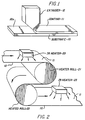
- Fig. 1 is a schematic drawing which shows extrusion coating;
- Fig. 2 is a schematic which shows heating of the coated substrate of Fig. 1;
- Fig. 3 is a perspective illustration of one form of embossment;
- Fig. 4 is a perspective illustration of an alternative form of embossment;
- Fig. 5a is a cross section of the laminate showing the surface roughness of the thermoplastic layer;
- Fig. 5b is a cross section of the laminate after embossing;
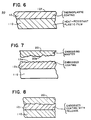
- Fig. 6 is a sectional view of a portion of a plastic film composite which is embossable at relatively high speeds in accordance with the invention;
- Fig. 7 shows the composite of Fig. 6 after having been embossed by an embossing master;
- Fig. 8 illustrates embossment of the composite of Fig. 6 where the embossed thermoplastic layer contains a release material to prevent the thermoplastic from sticking to the embossing master;
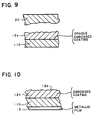
- Fig. 9 illustrates a composite employing an opaque coating which has been embossed by a master to produce a lustrous, metallic-like embossment, without metallization; and
- Fig. 10 is a composite in accordance with the invention where metallization has taken place on a surface opposed to an embossed thermoplastic surface.
-
Standard paper sheeting 10 is provided with athermoplastic coating 11, for example, from an extrusion coater 120 (Fig. 1). A typical coating is of polyethylene. Thethermoplastic coating 11 may also be applied in a solvent, or water base, using gravure or reverse roll methods. -
Paper sheeting 10 thickness usually varies from about 40 microns to about 100 microns. Thepaper sheeting 10 can also be of cardboard stock having a thickness up to about 750 microns. (Note: 25.4 microns equal 0.001 inch). Thethermoplastic coating 11 thickness advantageously is between about 1.5 microns to about 50 microns and can even be higher. The preferred range for thethermoplastic coating 11 thickness has been determined to be about 4 to 10 microns, This corresponds to a coating basis weight, e. g., of polyethylene, of between about 0,9 to 2,72 kg (2 to 6 lbs.) per 279 m2 (3,000 sq. ft.) of coating applied. - Once the
coating 11 is applied to thesurface 10s of thepaper substrate 10, the coated substrate is applied to a heated cylinder 21 (Fig. 2). This causes the substrate to become heated and to provide thermal transfer through the substrate to the upper outer layer of theplastic material 11. - To assure proper softening, additional heating can be employed (Fig. 2). Particularly suitable is
infrared heater 23 which can be disposed away from thesurface 11 that is being softened. Such aheater 23 is operated at heater surface temperatures of about 538°C (1000°F). In addition, a secondheated roll 22 may be employed. - The thermoplastic (thermally deformable)
coating 11 just prior to embossing should be heated to well above its softening temperature. A practical limit toheating coating 11, however, is about 232°C (450°F) above which temperature paper begins to degrade. In operation, it has been determined that coating 11 should be heated to temperature typically between about 121°C to 177°C (250°F to 350°F), which range represents a preferred range for most thermoplastic coatings to be embossed in the process of the present invention. - Once the
outer layer 11 of plastic, such as polyethylene, has been softened, an embossing arrangement is employed for decoration (Fig. 3 or Fig. 4). In Fig. 3 the arrangement uses aheated platen 32, anembossing roll 31 and a pressure niproll 33. Theembossing roller 31 is a conventional embossing master which has the desired embossing pattern. This pattern is produced on the roller or rollers by engraving, embossing with a hard material or mounting patterned plastic films or metal films onto the surface of the roller. When theembossing roller 31 contacts the softenedplastic surface 11, it transfers an embossment pattern to thecoating 11 on the paper and simultaneously cools the coating so that it will not flow after being removed from the embossing roller. Thus, in the case of polyethylene, an embossed pattern becomes embedded in the polyethylene surface, The result is decorated, polycoated paper. - The temperature of the embossing master (embossing roller 31) must be below the softening temperature of
thermoplastic coating 11. The temperature ofembossing roller 31, however, should not be so low as to hardencoating 11 before the embossing is completed. It has been found that the preferred temperature for embossing roller 31 (embossing master) can vary depending on its thermal conductivity and specific heat, the embossing nip pressure, operating speed and the temperature to whichcoating 11 is heated immediately prior to contact with theembossing roller 31. Despite the large number of variables, applicant has determined that the embossing master (roller 31) preferred temperature in the process of the present invention is between about -6,7°C (20°F) to about 15,6°C (60°F) below the self-adhesive temperature of thethermoplastic coating 11. The self-adhesive temperature of thethermoplastic coating 11 is defined as the minimum temperature at which two layers of the coating (excluding any release agents added to the coating) will mutually adhere when pressed together. It has been determined that, in the context of the present process, this generally places the preferred embossing master (embossing roller 31) temperature between about 37,8°C (100°F) and 93°C (200°F). - In figure 4, a take-off
roller 34 has been added to allow longer contact of the embossed surface withembossing roll 31. The longer contact time allows better cooling of the embossed surface to facilitate easy parting of the web from the embossing roll and to prevent possible reflow of the coating and loss of the embossed pattern. The pressure niproller 33 may be metal or be surfaced with a resilient material such as rubber. The force applied between the pressure niproller 33 and theembossing roller 31 should range from about 892 kg/m (50 pounds per lineal inch (PLI)) to about 17835 kg/m (1000 PLI) along the length of contact between these two rollers. The force applied between pressure niproller 33 andembossing roller 31 may advantageously be 50 to 300 pounds per lineal inch but is more preferably in a range between about 1783 to 8917 kg/m (100 to 500 pounds per lineal inch). - This latter range corresponds approximately to between about 276 kPa to 1379 kPa (400 to 2,000 pounds per square inch). (Contact pressure between two cylinders, or rollers, is often reported in pounds per lineal inch (PLI) rather than pounds per square inch because the exact width (i. e., area) of contact between two rollers is not usually known, but the force applied and contact length are generally known.)
- The surface of the embossing master (roller 31) should be hard and distortion resistant so the embossing pattern is preserved during the embossing step. The opposing roller, i. e., nip
roller 33, should be firm but also be somewhat resilient. This allows niproller 33 to apply a nearly uniformly distributed pressure to the back of the sheeting being embossed. It has been determined that niproller 33 can be quite firm, typically with a Shore A durometer hardness (ASTM D-412) reading of about 40 to about 60, or even somewhat higher, and yet not be so hard as to interfere with attainment of a uniformly distributed pressure on the back of the sheeting being embossed. The contact (dwell) time, wherein theembossing roller 31 and niproller 33 contact the sheeting or plastic film to achieve embossing, is generally in the range of about 40 milliseconds (e. g., 0,3 m/s (60 ft./min.) for a 0,0125 cm (1/2 inch) wide contact area) to about 1 millisecond (e.g., 3,0 m/s (600 ft./min). for a 3,1 mm (1/8 inch) wide contact area). - The process of the present invention permits embossing of the sheeting herein described at high rates, typically higher than 0,5 m/s (100 ft./min). The process of the present invention permits embossing of the sheeting herein described at rates typically between 0,5 m/s - 4,0 m/s (100 ft./min. to 800 ft./min)., more typically between about 0,8 m/s - 2,6 m/s (200 ft./min. to about 500 ft./min).
- Various effects can be achieved, If the diffraction pattern is not to be continuous, a matte background can be provided by suitable modification of the embossing roller. Alternatively, the embossing pattern can, in parts, be filled in with coating material, such as ink or clear lacquer, in those areas where no embossed decoration is desired.
- Fig. 5A shows an enlargement of the
substrate 10 which is paper sheeting withcoating 11 prior to embossing. Thesubstrate 10 has a roughened surface which creates in the structure, a variable thickness ranging between a maximum thickness t1, and a minimum thickness t2. The coating has a uniform depth d1. After embossing, as shown in Fig. 5B, the thickness, t3, is nearly uniform, but the coating depth now varies from d2 to d3 due to the calendaring effect. The embossing pattern depth d4 is less than the original surface roughness (t1-t2). - The surface roughness of the
base paper 10, that is, the average peak-to-valley surface height variation, will typically vary from about 1.0 to about 3.0 microns for clay-coated papers suitable for coating. However,rougher paper sheets 10 may also be used. For example,sheets 10 having surface peak-to-valley roughness of up to 5.0 microns, or even higher may also be used, particularly if thethermoplastic coating 11 is applied at high solids content as by extrusion or hot-melt methods. - After the
thermoplastic coating 11 is applied, but before embossing, the surface roughness (t1-t2) will typically be somewhat lower than the surface roughness of thebase paper 10 alone. It has been determined that the surface roughness (t1-t2), after thebase coating 11 has been applied, may typically be about 70 to 90 percent of the original base paper roughness. Thus the surface roughness (t1-t2), after coating 11 has been applied, may typically be between about 0.7 microns to about 3.0 microns and as high as about 5.0 microns. After embossing, the embossing depth illustrated schematically in Fig. 5b is less than the original coated-surface roughness (t1-t2). The embossing pattern depth d4 will be less than 1.0 micron and may vary typically from about 0.1 micron to about 0.5 micron more usually between about 0.2 to about 0.4 micron. - With reference to the drawings, Fig. 6 illustrates a composite film which is embossable at speeds exceeding 400 feet per minute with good results. The
composite film 50 of Fig. 6 is formed by a heatresistant plastic film 110 and an overlyingthermoplastic coating 12 containing a release agent. The thermoplastic coating has an outer surface or aface 12f which can receive an embossment as shown in Fig. 7. When a heat-resistant plastic film 110 is used as the substrate, as in Fig. 6, instead of, or in the absence of a paper substrate, the surface of thethermoplastic coating 12 thereon may be smooth. In this case, the depth of the embossment may be greater than the depth of surface roughness ofthermoplastic coating 12. - The
thermoplastic coating 12 has a softening temperature which is less than the softening temperature of the heat-resistant plastic film 110. All the process conditions aforementioned with respect to the embossing ofthermoplastic coating 11 onpaper sheeting 10 apply equally to the embossing of thecomposite plastic film 50 as shown in Figs. 6 to 10. However, in the case ofcomposite plastic film 50, thecoating 12 should soften at least -12°C (10°F) and, preferably 4,5°C (40°F) and even more below the heat distortion temperature of the support film, namely, heat-resistant plastic film 110. Thecomposite plastic film 50 should be preheated before embossing to a temperature above the softening temperature ofthermoplastic coating 12, which temperature is also below the heat distortion temperature of the heat-resistant plastic film 110. Thus, thermoplasticcomposite plastic film 50 should be preheated to a temperature before embossing, which is between the softening temperature ofcoating 12 and the heat distortion temperature of heat-resistant plastic film 110. All other process conditions described with respect to thecoated paper sheeting 10 as referenced in Figs. 1-4 apply as well to thecomposite plastic film 50 and variations thereof illustrated in Figs. 6-10. - In Fig. 7 an
embossing master 20 is shown after having been applied to thethermoplastic coating 12k and separated to yield anembossed surface 12e. The composite formed by thefilm 110 at thecoating 12k can be embossed at a relatively rapid rate by the embossingmaster 20. The embossingmaster 20 may take the form of a pattern stampedembossing roller 31 or rotary metallic die or a metallizedfilm covering roller 31.. - In order to avoid any tendency for the
thermoplastic coating 12 of Fig. 6 to stick to theembossing master 20 of Fig. 7, the thermoplastic coating is provided with a release agent to yield the modifiedcoating 12r illustrated in Fig. 8. The presence of the release agent allows higher speeds to be achieved during embossment.
Although other release additives are possible, a preferred release additive for the thermoplastic coating is a polysiloxane preferably hydroxylated polysiloxane. One form of such a polysiloxane is available from the Dow Corning Corporation under the designation Q4-3667. This material has the following chemical formula:
- In addition to providing release properties from an embossing master, the material permits the subsequent application of additional coatings, which may be functional or decorative, to the embossed surface without interfering with the adhesion of these coatings. These coatings include vacuum deposited metal and solvent or aqueous borne coatings applied by conventional coating methods.
- The release material in conjunction with the embossment procedure herein described is advantageously applied to any situation where a high temperature carrier or a temperature resistant carrier is used in conjunction with a lower temperature plastic coating. It is desirable to maintain a suitable temperature differential between the
plastic coating 12 and theembossing master 20. The embossingmaster 20 temperature should be below the softening temperature of the coating so that rapid embossing takes place and reflow of the plastic is avoided after separation of the coating. - Other procedures are illustrated in Figs. 9 and 10. In Fig. 9 solid opaque or tinted colors can be embossed directly to give the luster and effect of metallization without actual metallization. This involves the use of opaque dyes or pigments to produce a brilliant diffraction pattern without metallization. Although in Fig. 9 the
embossing master 20 is depressed into the coating 12q, it is also possible to cast the coating 12q on themaster 20. - Another embodiment is shown in Fig. 10 where a metallized
surface 13 has a clear overcoat structure, which is illustratively formed by the heat-resistant film 110 and thecoating 12k. Thecoating 12k is diffraction embossed. This gives the appearance that is substantially similar to that which is achieved by embossing followed by metallization. A variation of the embodiment shown in Fig. 10 is to have themetallic layer 13 sandwiched between heat-resistant film 110 andthermoplastic coating 12k. A paper substrate could optionally be included under heat-resistant film 110, i. e.,film 110 would be first coated onto the paper substrate. This variation also produces the appearance similar to that achieved by embossing followed by metallization. The advantage of such embodiments is that the embossment can take place in line with printing. The metallization step can be performed before the embossment, and it is not necessary to perform it after the embossment. In addition, when the embossing pattern is in the coating, it is possible to control the pattern at will by simply overcoating in accordance with a desired pattern that has the same, or nearly the same, refractive index as the embossed coating because the overcoated areas then are now devoid of the embossment. This permits control over the embossing pattern in a very simply way without requiring a change in the basic embossment that is used with metallic films. - A coating is made consisting of 200 parts by weight of polystyrene in a suitable solvent such as toluene, To this polystyrene solution 1 part by weight of polysiloxane is added and dispersed. This coating is applied by conventional coating methods, such as rotogravure, to a cellulose substrate and dried using forced hot air until all toluene is removed from the coating resulting in a continuous film of polystyrene on the cellulose substrate. Desired coat weight is 0,9 - 1,8 kg (2.0 - 4.0 lbs.) of dried polystyrene per 279 m2 (3,000 square feet) of cellulose substrate. Embossment can take place immediately after drying while the coating remains hot or can be achieved by subsequent re-heating and embossment of the coating on the cellulose substrate.
- A mixture of 200 parts by weight of a styrenated acrylic emulsion and 1 part by weight of polysiloxane is made. This coating is applied to a cellulose substrate by conventional coating techniques, such as roll coating, and dried using forced hot air or other means to raise the temperature of the liquid to remove all water until a continuous film of the coating on the cellulose substrate is achieved. Desired coat weight is 0,9 - 2,3 kg (2.0 - 5.0 lbs.) of dried coating per 279 m2 (3,000 square feet) of cellulose substrate, Embossment can occur immediately after drying while the coating is hot or can be achieved by subsequent re-heating and embossment of the coating.
- Other aspects of the invention will be apparent to those of ordinary skill in the art. The invention therefore is not intended to be limited to the preferred embodiments described herein but rather is defined by the claims and equivalents thereof.
Claims (39)
- A method of high speed decoration of sheeting which comprises the steps of:(a) providing a substrate (10);(b) providing a coating (11) of thermoplastic material which contains a release agent on a surface (10s) on said substrate (10), the release agent being a hydroxylated polysiloxane, the roughness of the substrate (11) before embossing exceeding the depth (d4) of the embossment;(c) heating the coating (11) to a temperature above its softening temperature;(d) contacting the heated thermoplastic coating (11) with an embossing member (31) under rolling pressure contact to emboss the coating (11) with a diffraction or holographic decorative pattern, wherein the embossing member (31) is at a temperature below the softening temperature of said coating (11) before and during said embossing; and(e) wherein the embossing is accomplished at a speed of 30, 48 to 243,83 metre/minute (100 to 800 foot/minute).
- Method according to claim 1 wherein the substrate (10) is paper.
- Method according to claim 1 wherein the substrate (10) is a heat resistant plastic film.
- Method according to claim 1, 2 or 3 wherein the roughness of said substrate (10) exceeds one micron and the depth of said embossment is less than one micron.
- Method according to claim 1, 2 or 3 wherein the depth of surface roughness of said coating (11) is greater than 0.7 microns, and the depth of the embossment is less than the depth the surface roughness of the coating (11) before embossing.
- Method according to one of the preceding claims wherein the embossing member (31) is selected from the group consisting of rollers, belts and platen.
- Method according to one of the preceding claims wherein the embossing member (31) during embossing is a temperature below the self-adhesive temperature of the thermoplastic coating (11).
- Method according to one of the preceding claims wherein the embossing is accomplished by passing said sheet between an embossing roller (31) and a nip roller (33), and wherein the force applied between the embossing roller (31) and the nip roller (33) during embossing is in the range between 8,93 to 178,58 kilograms per lineal centimeter (50 to 1000 pounds per lineal inch) along the length of contact of said rollers.
- Method according to one of the preceding claims wherein the thermoplastic coating (11) before embossing is at a temperature in the range 121°C to 177°C (250° - 350°F).
- Method according to one of the preceding claims wherein the embossing member (31) during embossing is at a temperature in the range of 38°C to 93°C (100° to 200°F).
- Method according to one of the preceding claims wherein the heating of said coating (11) before embossing is accomplished with at least one heater (23) not contacting the coating.
- Method according to claim 11 wherein at least one of said heaters not contacting the coating is an infrared heater (23) and operates at a heater surface temperature of about 538°C.
- Method according to one of the preceding claims further including the step of metallizing the embossed coating (11).
- Method according to claim 2 wherein the substrate (10) is paper having a depth of surface roughness between about 1.0 and 5.0 microns.
- Method according to claim 4 wherein the depth of the embossment is between about 0.1 to about 0.5 microns.
- Method according to one of the preceding claims wherein the substrate (10) is a heat-resistant plastic film supporting the thermoplastic coating.
- Method according to claim 16 wherein the thermoplastic coating (11) has a softening temperature below the temperature wherein the heat-resistant plastic film (10) begins to distort.
- Method according to claim 17 wherein the temperature of the thermoplastic coating (11) during embossing is above its softening temperature but below the heat-distortion temperature for the supporting heat-resistant plastic film (10).
- Method according to one of the preceding claims wherein the coating (11) of thermosensitive material contains (11) a plysiloxane release agent.
- Method according to claim 19 wherein the embossing is achieved with an embossing member (31) comprising a metallized plastic film.
- Method according to one of the preceding claims further comprising the step of filling in said embossed pattern at least in parts with an ink or lacquer coating material.
- Method according to claim 19 wherein said thermoplastic coating has opposed surfaces of which an outer surface (12e) is embossed (12) and an underlying surface (13) is metallized; thereby to provide an embossed metallized member at relatively high speeds.
- Method according to claim 19 wherein the thermoplastic coating (12) contains an opaque or tinted material; thereby to permit the embossed coating to have a metallic-like lustre.
- Method according to one of the preceding claims, wherein the contact time in which the embossing roller (31) and nip roller (33) contact the sheeting to effect embossing, is in a range between about 1 millisecond to about 40 milliseconds.
- Method according to one of the preceding claims wherein the thermoplastic coating (12) is a thermoplastic selected from the group consisting of polyethylene, polyvinylchloride, styrene acrylate, styrene butadiene, polyvinylacetate and polystyrene.
- Decorative embossed sheeting manufactured according to the method of one of the preceding claims, comprising a substrate (10); a thermoplastic coating (11) upon said paper substrate (10), a release agent in said thermoplastic coating (11), said thermoplastic coating (11) being embossed with a diffraction or holographic pattern the depth (d4) of which is less than the surface roughness of the substrate (10) before embossment, wherein the embossed pattern was produced on the thermoplastic coating (11) by heating the coating to a temperature above its softening point, and contacting the coating (11) with an embossing member (31) at a temperature below the softening temperature of the coating (11).
- Sheeting according to claim 26 wherein said thermoplastic is selected from the group consisting of polyethylene, polyvinylchloride, styrene acrylate, styrene butadiene, polyvinylacetate and polystyrene.
- Sheeting according to claim 26 wherein said substrate (10) is paper, and the embossment is present in the coating (11) after embossment to a depth (d4) which is less than the depth of surface roughness of the coating (11) before embossment.
- Sheeting according to claim 26 wherein the embossed pattern was produced on the thermoplastic coating (11) by heating the coating to a temperature above its softening point, and contacting the coating (11) with an embossing member (31) at a temperature below the softening temperature of the coating (11) while said coating (11) is initially at a temperature above its softening point.
- Sheeting according to claim 26 wherein said embossing pattern is holographic.
- Sheeting according to claim 26 wherein sais thermoplastic is opaque or tinted; thereby to provide a lustrous embossing pattern.
- Sheeting according to claim 26 wherein said thermoplastic is transparent and has a side opposite said embossing pattern which is directly or indirectly metallized.
- Sheeting according to claim 28 wherein the depth of the surface roughness of the thermoplastic coating before embossing is greater than 0.7 microns and the depth of the embossment is between about 0.1 to 0.5 microns.
- Sheeting according to claim 26 wherein the substrate (10) comprises a heat-restant plastic film and wherein the softening temperature of the thermoplastic coating (11) is below the distortion temperature of the heat-resistant plastic film.
- Sheeting according to claim 34 wherein the heat-resistant plastic film (10) comprises polyethylene terephthalate.
- Sheeting according to claim 34 wherein the thermoplastic coating (11) is opaque or tinted; thereby to provide a lustrous embossing pattern which appears metallized.
- Sheeting according to 34 wherein said thermoplastic coating (11) is transparent and has a side opposite said embossing pattern which is directly or indirectly metallized.
- Sheeting according to claim 34 wherein said sheeting includes a metallic layer between the heat-resistant plastic film and the thermoplastic coating.
- Sheeting according to claim 26 wherein the embossed pattern is at least in parts filled in with ink or lacquer coating material.
Applications Claiming Priority (5)
| Application Number | Priority Date | Filing Date | Title |
|---|---|---|---|
| US11368987A | 1987-10-26 | 1987-10-26 | |
| US113689 | 1987-10-26 | ||
| US23444888A | 1988-08-19 | 1988-08-19 | |
| US234448 | 1988-08-19 | ||
| PCT/US1988/003581 WO1989003760A1 (en) | 1987-10-26 | 1988-10-14 | Embossing of coated sheets |
Publications (3)
| Publication Number | Publication Date |
|---|---|
| EP0339079A1 EP0339079A1 (en) | 1989-11-02 |
| EP0339079A4 EP0339079A4 (en) | 1990-12-05 |
| EP0339079B1 true EP0339079B1 (en) | 1997-02-05 |
Family
ID=26811352
Family Applications (1)
| Application Number | Title | Priority Date | Filing Date |
|---|---|---|---|
| EP89900030A Expired - Lifetime EP0339079B1 (en) | 1987-10-26 | 1988-10-14 | Embossing of coated sheets |
Country Status (14)
| Country | Link |
|---|---|
| EP (1) | EP0339079B1 (en) |
| KR (1) | KR910006380B1 (en) |
| CN (1) | CN1013260B (en) |
| AT (1) | ATE148654T1 (en) |
| AU (1) | AU602273B2 (en) |
| BR (1) | BR8807319A (en) |
| CA (1) | CA1324869C (en) |
| DE (1) | DE3855784T2 (en) |
| ES (1) | ES2009079A6 (en) |
| HK (1) | HK130997A (en) |
| IL (1) | IL88069A0 (en) |
| MX (1) | MX173653B (en) |
| PT (1) | PT88840A (en) |
| WO (1) | WO1989003760A1 (en) |
Cited By (3)
| Publication number | Priority date | Publication date | Assignee | Title |
|---|---|---|---|---|
| US7913619B2 (en) | 2006-11-30 | 2011-03-29 | Leonhard Kurz Stiftung & Co. Kg | Embossing apparatus |
| EP4245538A3 (en) * | 2015-12-10 | 2023-12-27 | Sappi North America, Inc. | Textured products |
| US12128661B2 (en) | 2020-07-16 | 2024-10-29 | Bixby International Corporation | Micro embossing |
Families Citing this family (52)
| Publication number | Priority date | Publication date | Assignee | Title |
|---|---|---|---|---|
| GB8916493D0 (en) * | 1989-07-19 | 1989-09-06 | Ridout Graham T | Embossing machine roller |
| GB8924111D0 (en) * | 1989-10-26 | 1989-12-13 | Amblehurst Ltd | Optical device |
| US5181981A (en) * | 1990-07-29 | 1993-01-26 | Gencorp Inc. | Method of embossing thermoplastic material |
| US5182157A (en) * | 1990-11-01 | 1993-01-26 | Van Leer Metallized Products (U.S.A.) Limited | Method of forming a coated sheet which wicks away oil and product thereof |
| BR9107019A (en) * | 1990-11-01 | 1993-08-17 | Leer Metallized Prod Usa | COATED SHEET FOR DECORATIVE OR INFORMATIONAL APPLICATIONS AND PROCESS FOR FORMING THE SAME |
| GB2250237B (en) * | 1990-11-30 | 1995-02-08 | Folders Galore Ltd | A sheet of clear plastics material bearing an image |
| DE4107401C1 (en) * | 1991-03-08 | 1992-07-30 | Douwe Harmen Wilhelm Zwolle Nl Plantinga | Producing flat image of object or motive with holographic effect - by using holographic foil and forming negative relieve in bold flat lines on heatable metallic embossing plate |
| GB2271300B (en) * | 1991-10-17 | 1996-03-20 | Applied Holographics | Packaging material with holographic pattern |
| GB9122028D0 (en) * | 1991-10-17 | 1991-11-27 | Applied Holographics | Packaging materials |
| US7204909B1 (en) | 1992-07-17 | 2007-04-17 | Opsec Security Group, Inc. | Informational article and an associated method |
| US5913543A (en) * | 1992-07-17 | 1999-06-22 | Optical Security Group, Inc. | Tamper evident and counterfeit resisting informational article and associated method |
| US5704652A (en) | 1992-07-17 | 1998-01-06 | Optical Security Group, Inc. | Tamper evident and counterfeit resisting informational article and associated method |
| FR2716213A1 (en) * | 1994-02-15 | 1995-08-18 | Barnoin Pierre | Manufacturing procedure for holographic articles which cannot be counterfeited |
| IT1276887B1 (en) * | 1994-11-14 | 1997-11-03 | Olmo Giancarlo Dell | SYSTEM TO PROTECT FROM COUNTERFEIT OR GUARANTEE ORIGINALITY OR CUSTOMIZE PREPRINTED SHEETS |
| GB9521276D0 (en) * | 1995-10-18 | 1995-12-20 | Wiggins Teape Group The Limite | Casting paper |
| GB2311752B (en) * | 1996-04-04 | 2000-09-13 | Courtaulds Chemicals | Production and use of plastics film |
| US5948555A (en) * | 1996-05-21 | 1999-09-07 | Optical Security Group, Inc. | Tamper resistant vehicular validation tab having differential adhesive properties |
| EP0939037A1 (en) | 1998-02-26 | 1999-09-01 | Alusuisse Technology & Management AG | Packaging material |
| CN1115238C (en) * | 1999-06-23 | 2003-07-23 | 许清水 | Method for manufacturing reinforced plastic base material with three-dimensional decoration |
| US7306158B2 (en) | 2001-07-10 | 2007-12-11 | American Express Travel Related Services Company, Inc. | Clear contactless card |
| US6581839B1 (en) | 1999-09-07 | 2003-06-24 | American Express Travel Related Services Company, Inc. | Transaction card |
| US7156301B1 (en) | 1999-09-07 | 2007-01-02 | American Express Travel Related Services Company, Inc. | Foldable non-traditionally-sized RF transaction card system and method |
| US7239226B2 (en) | 2001-07-10 | 2007-07-03 | American Express Travel Related Services Company, Inc. | System and method for payment using radio frequency identification in contact and contactless transactions |
| US7093767B2 (en) | 1999-09-07 | 2006-08-22 | American Express Travel Related Services Company, Inc. | System and method for manufacturing a punch-out RFID transaction device |
| US7070112B2 (en) | 1999-09-07 | 2006-07-04 | American Express Travel Related Services Company, Inc. | Transparent transaction device |
| US6764014B2 (en) | 1999-09-07 | 2004-07-20 | American Express Travel Related Services Company, Inc. | Transaction card |
| EP1093932A1 (en) * | 1999-10-21 | 2001-04-25 | Polestar Jowetts Limited | Security printing method |
| US6537407B1 (en) | 2000-09-06 | 2003-03-25 | Acordis Acetate Chemicals Limited | Process for the manufacture of an improved laminated material |
| GB0115814D0 (en) | 2001-06-28 | 2001-08-22 | Arjo Wiggins Fine Papers Ltd | Production of holographic images |
| US8548927B2 (en) | 2001-07-10 | 2013-10-01 | Xatra Fund Mx, Llc | Biometric registration for facilitating an RF transaction |
| US7429927B2 (en) | 2001-07-10 | 2008-09-30 | American Express Travel Related Services Company, Inc. | System and method for providing and RFID transaction device |
| US7360689B2 (en) | 2001-07-10 | 2008-04-22 | American Express Travel Related Services Company, Inc. | Method and system for proffering multiple biometrics for use with a FOB |
| US9454752B2 (en) | 2001-07-10 | 2016-09-27 | Chartoleaux Kg Limited Liability Company | Reload protocol at a transaction processing entity |
| US9031880B2 (en) | 2001-07-10 | 2015-05-12 | Iii Holdings 1, Llc | Systems and methods for non-traditional payment using biometric data |
| US7735725B1 (en) | 2001-07-10 | 2010-06-15 | Fred Bishop | Processing an RF transaction using a routing number |
| US9024719B1 (en) | 2001-07-10 | 2015-05-05 | Xatra Fund Mx, Llc | RF transaction system and method for storing user personal data |
| US7249112B2 (en) | 2002-07-09 | 2007-07-24 | American Express Travel Related Services Company, Inc. | System and method for assigning a funding source for a radio frequency identification device |
| US7543738B1 (en) | 2001-07-10 | 2009-06-09 | American Express Travel Related Services Company, Inc. | System and method for secure transactions manageable by a transaction account provider |
| US7303120B2 (en) | 2001-07-10 | 2007-12-04 | American Express Travel Related Services Company, Inc. | System for biometric security using a FOB |
| US6764571B2 (en) | 2002-02-01 | 2004-07-20 | Applied Optical Technologies Holdings, Inc. | Informational article and an associated method |
| US6805287B2 (en) | 2002-09-12 | 2004-10-19 | American Express Travel Related Services Company, Inc. | System and method for converting a stored value card to a credit card |
| JP4379715B2 (en) * | 2004-02-19 | 2009-12-09 | 豊田合成株式会社 | Long molded product |
| US7314165B2 (en) | 2004-07-01 | 2008-01-01 | American Express Travel Related Services Company, Inc. | Method and system for smellprint recognition biometrics on a smartcard |
| FI20065407A0 (en) * | 2006-06-14 | 2006-06-14 | Avantone Oy | Hard forgery hologram |
| KR100719831B1 (en) * | 2006-08-04 | 2007-05-18 | 정 수 윤 | Manufacturing method of patterned artificial marble |
| RU2363591C1 (en) * | 2008-09-03 | 2009-08-10 | Закрытое акционерное общество "Полиграф-защита" | Method of hot application of holograms and device for method implementation |
| DE102009033504A1 (en) * | 2009-07-15 | 2011-01-27 | Mann + Hummel Gmbh | Method and device for marking objects, in particular components of a motor vehicle, with an embossed hologram and objects characterized in this way |
| US20140255832A1 (en) * | 2011-10-19 | 2014-09-11 | 3M Innovative Properties Company | Hardcoat compositions |
| ITMI20122107A1 (en) * | 2012-12-11 | 2014-06-12 | Icma Ind Costr Mac Affini | EMBOSSING UNIT OF PLASTIC PROFILES AND METHOD OF EMBOSSING PLASTIC PROFILES |
| ES2833422T3 (en) * | 2015-02-13 | 2021-06-15 | Centitvc Centro De Nanotecnologia E Materiais Tecnicos Funcionais E Inteligentes | Wood-derived multilayer product with integrated electrical circuit and manufacturing procedure |
| EP3501819A1 (en) | 2017-12-22 | 2019-06-26 | Covestro Deutschland AG | Plastic films for id documents with imprinted holograms having improved brightness |
| EP4334111A1 (en) * | 2021-05-06 | 2024-03-13 | CSP Technologies, Inc. | Blister packages containing active material and methods of making and using same |
Family Cites Families (12)
| Publication number | Priority date | Publication date | Assignee | Title |
|---|---|---|---|---|
| GB601796A (en) * | 1944-12-09 | 1948-05-12 | Bakelite Corp | Apparatus and process for pressing plastic sheeting |
| GB612982A (en) * | 1946-06-12 | 1948-11-19 | Greenwich Leathercloth Company | An improved process for embossing fabrics coated with polyvinyl compositions |
| US3535413A (en) * | 1968-06-25 | 1970-10-20 | Gen Electric | Method of making tape replicas |
| US3535417A (en) * | 1968-06-25 | 1970-10-20 | Gen Electric | Method of making tape replicas |
| US3758649A (en) * | 1971-06-21 | 1973-09-11 | Rca Corp | Method of manufacturing holographic replicas |
| US3882207A (en) * | 1972-10-12 | 1975-05-06 | Rca Corp | Process of producing double-sided holographic replicas |
| CA1011638A (en) * | 1972-12-15 | 1977-06-07 | Walter J. Lewicki (Jr.) | Mechanically embossed resilient laminar floor material |
| US4500484A (en) * | 1978-08-25 | 1985-02-19 | Discovision Associates | Process for making a video record disc |
| US4547141A (en) * | 1984-07-05 | 1985-10-15 | Alpha Foils Inc. | Apparatus for embossing holograms on metalized thermoplastic films |
| JPH0722985B2 (en) * | 1985-10-30 | 1995-03-15 | 大日本印刷株式会社 | Method of manufacturing hologram decorative resin molded product |
| US4744936A (en) * | 1986-01-30 | 1988-05-17 | Plastic Film Corporation Of America | Process for embossing thermoplastic material |
| JPH06271615A (en) * | 1993-03-22 | 1994-09-27 | Tonen Corp | Method for producing propylene copolymer |
-
1988
- 1988-10-14 DE DE3855784T patent/DE3855784T2/en not_active Expired - Lifetime
- 1988-10-14 AT AT89900030T patent/ATE148654T1/en not_active IP Right Cessation
- 1988-10-14 AU AU26109/88A patent/AU602273B2/en not_active Ceased
- 1988-10-14 KR KR1019890700957A patent/KR910006380B1/en not_active Expired
- 1988-10-14 EP EP89900030A patent/EP0339079B1/en not_active Expired - Lifetime
- 1988-10-14 BR BR888807319A patent/BR8807319A/en not_active IP Right Cessation
- 1988-10-14 WO PCT/US1988/003581 patent/WO1989003760A1/en not_active Ceased
- 1988-10-18 IL IL88069A patent/IL88069A0/en unknown
- 1988-10-20 CA CA000580826A patent/CA1324869C/en not_active Expired - Fee Related
- 1988-10-24 PT PT88840A patent/PT88840A/en not_active Application Discontinuation
- 1988-10-25 ES ES8803245A patent/ES2009079A6/en not_active Expired
- 1988-10-25 CN CN88107408A patent/CN1013260B/en not_active Expired
- 1988-10-26 MX MX013563A patent/MX173653B/en unknown
-
1997
- 1997-06-26 HK HK130997A patent/HK130997A/en not_active IP Right Cessation
Cited By (3)
| Publication number | Priority date | Publication date | Assignee | Title |
|---|---|---|---|---|
| US7913619B2 (en) | 2006-11-30 | 2011-03-29 | Leonhard Kurz Stiftung & Co. Kg | Embossing apparatus |
| EP4245538A3 (en) * | 2015-12-10 | 2023-12-27 | Sappi North America, Inc. | Textured products |
| US12128661B2 (en) | 2020-07-16 | 2024-10-29 | Bixby International Corporation | Micro embossing |
Also Published As
| Publication number | Publication date |
|---|---|
| DE3855784T2 (en) | 1997-06-12 |
| AU602273B2 (en) | 1990-10-04 |
| PT88840A (en) | 1989-07-31 |
| AU2610988A (en) | 1989-05-23 |
| DE3855784D1 (en) | 1997-03-20 |
| IL88069A0 (en) | 1989-06-30 |
| KR890701340A (en) | 1989-12-20 |
| EP0339079A4 (en) | 1990-12-05 |
| BR8807319A (en) | 1990-03-27 |
| CN1034888A (en) | 1989-08-23 |
| MX173653B (en) | 1994-03-22 |
| CN1013260B (en) | 1991-07-24 |
| ATE148654T1 (en) | 1997-02-15 |
| CA1324869C (en) | 1993-12-07 |
| HK130997A (en) | 1997-09-26 |
| KR910006380B1 (en) | 1991-08-21 |
| EP0339079A1 (en) | 1989-11-02 |
| ES2009079A6 (en) | 1989-08-16 |
| WO1989003760A1 (en) | 1989-05-05 |
Similar Documents
| Publication | Publication Date | Title |
|---|---|---|
| US5155604A (en) | Coated paper sheet embossed with a diffraction or holographic pattern | |
| US4913858A (en) | Method of embossing a coated sheet with a diffraction or holographic pattern | |
| US5164227A (en) | Method for embossing a coated sheet with a diffraction or holographic pattern | |
| CA1324869C (en) | Decoration of sheeting | |
| US4012552A (en) | Decorative metal film heat transfer decalcomania | |
| US5674580A (en) | Plastic foil for hot leaf stamping and method for forming | |
| US5935692A (en) | Composite for in mold transfer printing | |
| US6059914A (en) | Process for the production of a stamping foil | |
| CA2283766A1 (en) | A method of producing embossed, light-diffracting patterns | |
| US6015604A (en) | Impressed emblem and method | |
| US4475975A (en) | Decorating coated aluminum for extrusion encapsulation | |
| EP0097528A2 (en) | Dye pattern absorption into plastics | |
| US4596190A (en) | Method for concurrently forming and hot-transfer printing a synthetic resin | |
| CN102001243A (en) | Multi-thermal transfer method and multi-thermal transfer system | |
| JP2589833B2 (en) | Sheet material decoration | |
| JPH06297570A (en) | Decorative sheet manufacturing method | |
| JPH0124078B2 (en) | ||
| JP3248168B2 (en) | Film-adhered printed matter and method for producing the same | |
| JPH068321A (en) | Decorative sheet manufacturing method and manufacturing apparatus | |
| JPS6345354Y2 (en) | ||
| JPH0414450A (en) | Decorative film and production thereof | |
| JPH03223784A (en) | Manufacture of label | |
| JP2922239B2 (en) | Manufacturing method of decorative sheet | |
| JPH0268172A (en) | Preparation of embossed molded product | |
| WO2008145649A1 (en) | Method for decorating thermoplastic resin panels |
Legal Events
| Date | Code | Title | Description |
|---|---|---|---|
| PUAI | Public reference made under article 153(3) epc to a published international application that has entered the european phase |
Free format text: ORIGINAL CODE: 0009012 |
|
| 17P | Request for examination filed |
Effective date: 19890426 |
|
| AK | Designated contracting states |
Kind code of ref document: A1 Designated state(s): AT BE CH DE FR GB IT LI LU NL SE |
|
| A4 | Supplementary search report drawn up and despatched |
Effective date: 19901018 |
|
| AK | Designated contracting states |
Kind code of ref document: A4 Designated state(s): AT BE CH DE FR GB IT LI LU NL SE |
|
| 17Q | First examination report despatched |
Effective date: 19920304 |
|
| RAP1 | Party data changed (applicant data changed or rights of an application transferred) |
Owner name: VAN LEER METALLIIZED PRODUCTS (USA) LIMITED |
|
| GRAG | Despatch of communication of intention to grant |
Free format text: ORIGINAL CODE: EPIDOS AGRA |
|
| GRAH | Despatch of communication of intention to grant a patent |
Free format text: ORIGINAL CODE: EPIDOS IGRA |
|
| GRAH | Despatch of communication of intention to grant a patent |
Free format text: ORIGINAL CODE: EPIDOS IGRA |
|
| GRAA | (expected) grant |
Free format text: ORIGINAL CODE: 0009210 |
|
| AK | Designated contracting states |
Kind code of ref document: B1 Designated state(s): AT BE CH DE FR GB IT LI LU NL SE |
|
| ITF | It: translation for a ep patent filed | ||
| REF | Corresponds to: |
Ref document number: 148654 Country of ref document: AT Date of ref document: 19970215 Kind code of ref document: T |
|
| REG | Reference to a national code |
Ref country code: CH Ref legal event code: EP Ref country code: CH Ref legal event code: NV Representative=s name: BRYNJULV LEGLAND |
|
| REF | Corresponds to: |
Ref document number: 3855784 Country of ref document: DE Date of ref document: 19970320 |
|
| ET | Fr: translation filed | ||
| RAP4 | Party data changed (patent owner data changed or rights of a patent transferred) |
Owner name: VAN LEER METALLIZED PRODUCTS (USA) LIMITED |
|
| PLBE | No opposition filed within time limit |
Free format text: ORIGINAL CODE: 0009261 |
|
| STAA | Information on the status of an ep patent application or granted ep patent |
Free format text: STATUS: NO OPPOSITION FILED WITHIN TIME LIMIT |
|
| 26N | No opposition filed | ||
| NLS | Nl: assignments of ep-patents |
Owner name: VAN LEER METALLIZED PRODUCTS (USA) LIMITED |
|
| REG | Reference to a national code |
Ref country code: FR Ref legal event code: TP |
|
| REG | Reference to a national code |
Ref country code: GB Ref legal event code: 732E |
|
| REG | Reference to a national code |
Ref country code: CH Ref legal event code: PFA Free format text: VAN LEER METALLIZED PRODUCTS (USA) LIMITED TRANSFER- PROMA TECHNOLOGIES, INC. |
|
| REG | Reference to a national code |
Ref country code: GB Ref legal event code: IF02 |
|
| REG | Reference to a national code |
Ref country code: GB Ref legal event code: 732E |
|
| NLT1 | Nl: modifications of names registered in virtue of documents presented to the patent office pursuant to art. 16 a, paragraph 1 |
Owner name: PROMA TECHNOLOGIES, INC. |
|
| REG | Reference to a national code |
Ref country code: FR Ref legal event code: CD Ref country code: FR Ref legal event code: TP |
|
| BECN | Be: change of holder's name |
Effective date: 20020328 |
|
| PGFP | Annual fee paid to national office [announced via postgrant information from national office to epo] |
Ref country code: SE Payment date: 20051027 Year of fee payment: 18 Ref country code: FR Payment date: 20051027 Year of fee payment: 18 |
|
| PGFP | Annual fee paid to national office [announced via postgrant information from national office to epo] |
Ref country code: LU Payment date: 20051028 Year of fee payment: 18 |
|
| PGFP | Annual fee paid to national office [announced via postgrant information from national office to epo] |
Ref country code: AT Payment date: 20051031 Year of fee payment: 18 |
|
| PGFP | Annual fee paid to national office [announced via postgrant information from national office to epo] |
Ref country code: CH Payment date: 20051101 Year of fee payment: 18 |
|
| PGFP | Annual fee paid to national office [announced via postgrant information from national office to epo] |
Ref country code: BE Payment date: 20051103 Year of fee payment: 18 |
|
| PG25 | Lapsed in a contracting state [announced via postgrant information from national office to epo] |
Ref country code: AT Free format text: LAPSE BECAUSE OF NON-PAYMENT OF DUE FEES Effective date: 20061014 |
|
| PG25 | Lapsed in a contracting state [announced via postgrant information from national office to epo] |
Ref country code: SE Free format text: LAPSE BECAUSE OF NON-PAYMENT OF DUE FEES Effective date: 20061015 |
|
| PG25 | Lapsed in a contracting state [announced via postgrant information from national office to epo] |
Ref country code: CH Free format text: LAPSE BECAUSE OF NON-PAYMENT OF DUE FEES Effective date: 20061031 Ref country code: LI Free format text: LAPSE BECAUSE OF NON-PAYMENT OF DUE FEES Effective date: 20061031 |
|
| REG | Reference to a national code |
Ref country code: CH Ref legal event code: PL |
|
| EUG | Se: european patent has lapsed | ||
| REG | Reference to a national code |
Ref country code: FR Ref legal event code: ST Effective date: 20070629 |
|
| BERE | Be: lapsed |
Owner name: *PROMA TECHNOLOGIES INC. Effective date: 20061031 |
|
| PGFP | Annual fee paid to national office [announced via postgrant information from national office to epo] |
Ref country code: DE Payment date: 20071101 Year of fee payment: 20 |
|
| PGFP | Annual fee paid to national office [announced via postgrant information from national office to epo] |
Ref country code: IT Payment date: 20071031 Year of fee payment: 20 |
|
| PG25 | Lapsed in a contracting state [announced via postgrant information from national office to epo] |
Ref country code: FR Free format text: LAPSE BECAUSE OF NON-PAYMENT OF DUE FEES Effective date: 20061031 |
|
| PGFP | Annual fee paid to national office [announced via postgrant information from national office to epo] |
Ref country code: GB Payment date: 20071115 Year of fee payment: 20 |
|
| PG25 | Lapsed in a contracting state [announced via postgrant information from national office to epo] |
Ref country code: LU Free format text: LAPSE BECAUSE OF NON-PAYMENT OF DUE FEES Effective date: 20061014 |
|
| PGFP | Annual fee paid to national office [announced via postgrant information from national office to epo] |
Ref country code: NL Payment date: 20080429 Year of fee payment: 20 |
|
| REG | Reference to a national code |
Ref country code: GB Ref legal event code: PE20 Expiry date: 20081013 |
|
| PG25 | Lapsed in a contracting state [announced via postgrant information from national office to epo] |
Ref country code: NL Free format text: LAPSE BECAUSE OF EXPIRATION OF PROTECTION Effective date: 20081014 |
|
| NLV7 | Nl: ceased due to reaching the maximum lifetime of a patent |
Effective date: 20081014 |
|
| PG25 | Lapsed in a contracting state [announced via postgrant information from national office to epo] |
Ref country code: GB Free format text: LAPSE BECAUSE OF EXPIRATION OF PROTECTION Effective date: 20081013 |
|
| PG25 | Lapsed in a contracting state [announced via postgrant information from national office to epo] |
Ref country code: BE Free format text: LAPSE BECAUSE OF FAILURE TO SUBMIT A TRANSLATION OF THE DESCRIPTION OR TO PAY THE FEE WITHIN THE PRESCRIBED TIME-LIMIT Effective date: 20061031 |